Author: Donnie Ashok

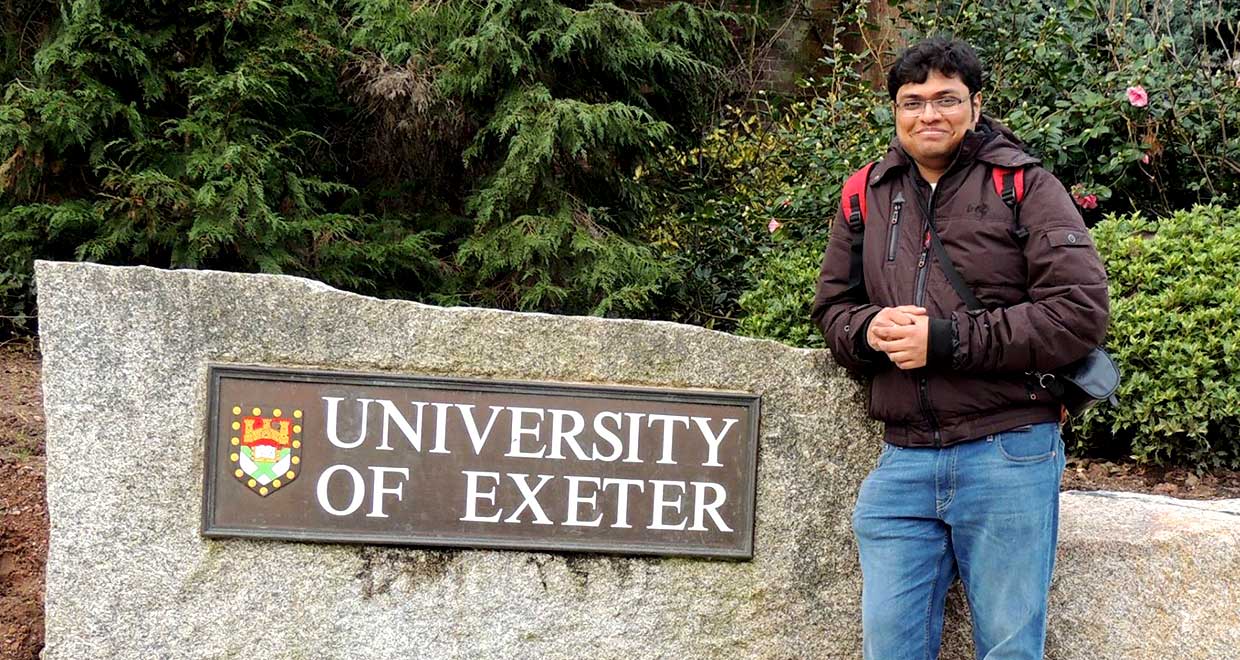
  • Avik Ghatak, Advocate, Criminal Law, on Litigation and LL.M in Human Rights Law from Univ of Exeter

    Avik Ghatak, Advocate, Criminal Law, on Litigation and LL.M in Human Rights Law from Univ of Exeter

    Avik Ghatak graduated from Jogesh Chandra Chaudhuri Law College, Kolkata in 2011. He started his legal career as an Advocate in the Sub-Divisional Court of Asansol and District Court of Burdwan. Thereafter he pursued Masters from University of Exetor, Devon in International Human Rights Law. He also attended the Certificate Course on International Humanitarian Law organized by the Instituto Internazionale di Diritto Umanitario in San Remo, Italy and Geneva. He has also published numerous papers and currently practises at the High Court at Calcutta.

    In this interview he talks about:

    • Law college experience at JCC Law College, Kolkata
    • Masters at University of Exeter, Devon
    • Publishing various papers
    • Building a career in criminal law litigation at the Trial Courts


    Please introduce yourself to our readers. Tell us a little bit about your childhood and your background?

    A warm hello to all the readers of SuperLawyer. I am Avik Ghatak and I am an Advocate at the Hon’ble High Court at Calcutta. It gives me immense pleasure to be able to reach out to all the readers of this forum and share my views and experiences with them.

    I was born and brought up in Asansol in the state of West Bengal. I studied at St. Patrick’s Higher Secondary School till class X and completed my higher secondary from Burnpur Riverside School.

    After that, I had gotten through to Symbiosis Law School, Pune for my LL.B., but decided to pursue my graduation from Jogesh Chandra Chaudhuri Law College, under the aegis of the University of Calcutta..

    I started my career as a junior advocate at the chamber of Mr. Somenath Chattaraj at the Sub-divisional Court at Asansol.

    Occasionally, I also had the opportunity to appear before the District Court at Burdwan, West Bengal. After a year of practicing as a litigator, I got through to the University of Exeter in the U.K., from where I completed my LL.M. in International Human Rights Law. After completion of the same, I re-joined the profession and started practicing at the Hon’ble High Court at Calcutta.

    While being able to give relief to clients gives me an immense satisfaction as a litigator, academics too, continues to interest me to no end. After having completed a Diploma in Cyber Laws through the distance mode, I was fortunate enough to be able to get the opportunity to attend a short certificate course in International Humanitarian Law last year.


    Do you have lawyers in your family? Would you say your parents were instrumental in your decision to pursue law?

    I am the 4th generation in a line of advocates. There is no dearth of advocates on my mother’s side too. My mother is also an advocate while her elder brother is an Ex-Judge of the High Court at Calcutta and his elder daughter, i.e. my cousin and her husband are advocates too.

    As interesting as it may sound, neither of my parents wanted me to pursue law as a career. In fact, I had decided on leaving Symbiosis Law School after getting through to the same, and joining the University of Calcutta, since I thought that Kolkata would be a better place to prepare for the engineering entrance exams that are held in the state. However, fate had other plans in store for me. By the end of the 1st year of LL.B., I was so interested in the subject of law, that changing my stream was no longer an option for me.


    Your father, Mr. Moloy Ghatak is a prominent lawyer & former Law Minister of West Bengal. How did he influence your career as a mentor? Did you get to hear legal discussions right from your childhood days?

    Considering the fact that almost my whole family is comprised of advocates, including both my parents, there is no denying that I did in fact, come across legal discussions and terminology from a very young age.

    Ever since joining practice, my father has been a source of constant support for me, whether as a senior to consult or a mentor to guide me through the times when I have come under duress. He has always been my idol as a human being. Now, his success as a counsel is also something that I look up to and would like to replicate in the days to come.


    Your father is also an MLA and a member of All India Trinamul Congress party (TMC). Did you ever think of joining politics?

    Like in advocacy, my father is not the first politician of our family. Politics in our family, to the best of my knowledge, goes back even further than advocacy. Inspired, as most young minds are during their college days, by such a background and charged with thoughts of revolutionising the prevalent scenario, I did dabble in college politics for a couple of years before realization dawned on me that politics is most certainly not my cup of tea.


    How would you describe your time at Jogesh Chandra Choudhuri Law College (affiliated to Calcutta University)? Please share some memorable experiences of your college life.

    In two words, it was life changing. I went to J.C.C. Law College as someone who was more interested in preparing for the engineering entrance exams next year. At the end of the 5 years there I was convinced that I would have had committed the greatest blunder of my life had I not decided to pursue a subject as interesting as law. The credit of making someone pretty disinterested in the subject to actually start loving the same goes completely to our professors and lecturers.

    There are probably too many memorable experiences to write home about. Among them, the experience of organising an art and craft competition for the students, re-launching our College’s law journal after a gap of a few years and winning the Moot Court Competition at Hazra Law College, would probably take the cake. Also, our very first class at college, where we were given a lecture by the then Principal of J.C.C. Law College, Dr. Manik Bhattacharya, remains a memorable experience for me. His statement that those coming from families having legal backgrounds ought not take success for granted since expectations from them would be sky high and almost impossible to meet and his quip that ‘A successful advocate barely ever enjoys his life and it is rather his children who do so’, shall remain etched in my memory for a long time to come.


    In Calcutta, universities are always charged up with a political atmosphere. How was your experience in such an atmosphere?

    Yes, I was indeed engulfed by such a political atmosphere and activism till I called quits sometime later. It is perhaps better to enter politics when we have something to give to politics rather than the other way round. The best example that comes to my mind is my father, who established himself professionally before taking the plunge. Another person from our very own High Court would be Mr. Kalyan Banerjee, who rose to the pinnacle of success as an advocate before deciding that it was time enough for him to become a legislator from a litigator.

    My experience in the midst of such an enlightened community of people, as I stated earlier, was very enriching, not only academically but also through the lessons of life that I had the opportunity to learn during my years at the University of Calcutta.


    You have nine publications in various renowned journals. How should one go about writing papers and getting the same published?

    The first and foremost thing that one should keep in mind when one intends to write a paper is whether the question that he/she seeks to answer through his/her research work or the topic he/she wishes to deal with is feasible or not. Being over-ambitious is of little help since choosing a vague or a wide ranging topic would pose significant problems for the author of the paper in collecting primary data. More importantly, to be able to collect and collate such a huge amount of information within the restricted number of words, as most journals tend to have a word limit for the submissions that one makes to them, would become that much tougher if the topic is not precise and focussed. A research paper also needs to be structured in the sense that one needs to be able to clearly define what one wants to say through the paper. The cardinal rule while writing a paper is to always remember that each line and each paragraph in the paper must be related to the question one is trying to answer in the paper.

    Also, last but not the least, there is no use in giving a long winding introduction or in merely compiling existing information vis-a-vis the topic you have chosen. What is rather of more importance is to be able to do some analysis of your own and preferably coming up with some suggestions on how to improve the law and/or the policy dealt with in your paper so that the law/policy is better adapted to the needs of an ever changing world/ society.


    After your graduation in graduating in 2011, you have started your criminal law practice at the Sub-Divisional Court of Asansol and also practised at the District Court of  Burdwan. What did you gather from your experience at the trial courts?

    On seeing most of my friends joining the High Court directly, I had been a bit averse to joining the lower court before making the switch to our state’s only constitutional court. It was on my father’s insistence that I went back to my hometown to start practicing as an advocate at the sub-divisional court situated there. And now I realise that it was a very good decision since when practicing at an appellate court, like the High Court, it is very necessary for you to be having a clear idea about the procedures of the trial court. And that is exactly what you gain if you practice at the lower courts, at least for some time, before making the switch to the higher courts, whether at the state or at the federal level.


    What influenced your decision to start your criminal practice just after graduation?

    Criminal law has always fascinated me. Not surprisingly, it had been my forte at college as well. Also, both my parents were criminal law practitioners. It is perhaps a combination of the above stated factors that influenced me to take up criminal law practice immediately after graduation. I would, however, also like to state that I consider these divisions in legal practice to be very artificial. This is especially true in the backdrop of the fact that at the graduation level we study all the major laws and as advocates, we are supposed to have a basic understanding of all or at least, most of them, even if we cannot claim to hold sway over all of them.


    avik-ghatak-2

    At what point did you decide to pursue your Masters at the University of Exeter? What was your motivation?

    It was after spending some time in legal practice that I had a lingering feeling that I still had some academics left in me. A few publications, especially a couple of them in a law journal published by the reputed and respected Common Law House publishers in Kolkata, further fuelled my thoughts in this regard. Aniket Mukherjee, one of our family friends and also a senior at J.C.C. Law College, who had himself completed his masters from the U.K., inspired me to go for an LL.M. One thing led to another and I landed up at the University of Exeter pursuing my Legum Magister.


    How was your experience at Exeter University?

    The experience at Exeter was vastly different from anything that I had come across in India during my graduation days. To begin with, there were no written exams for the subjects (referred to as modules therein) and hence no concept of buying the last ten years question papers and memorizing the answers . However, the absence of written exams did not mean unlimited free time since we were required to submit research essays in all the subjects we had chosen. Legal education over there depends much more on research work and analysis than over here. So, in a way, there weren’t too many shortcuts or last night studies. The path to success lay in the library, if I may say so.

    The library was absolutely fantastic with law journals from all major legal jurisdictions and systems, including those from India. Students over there are also given access to the best online journals available over the internet. I literally had almost the whole legal world at my fingertips while studying as a student at the University.

    A multi-national teaching staff, including among their ranks, a Special Rapporteur of the United Nations Secretary General and also a Refugee Status Determination Officer of the United Nations High Commissioner for Refugees, and a similarly diverse student group, further enhanced the knowledge exchange process. That is something that is available at only very few law universities in India.


    Why have you chosen International Human Rights as your specialization for LL.M?

    Most of whom I know to have done their LL.M., have pursued International Business Laws or International Commercial Laws. Perhaps it is more lucrative in terms of job prospects. But somehow, interest in this particular branch of law continues to elude me till date. International Human Rights Law was thus, pretty much an obvious choice since international law and human rights had been as close to my heart as criminal law.


    How difficult was studying abroad in terms of finding accommodation, finances and settling in?

    I shall begin with the last issue put forth in this question. Settling in was never a problem in the U.K. since they have a multi-cultural society with people from various countries and cultures residing therein for a long period of time. Racism is down to a near zero. All my concerns regarding whether I would be able to integrate into the society over there or not, were laid to rest pretty soon after my arrival at the University.

    Finding an accommodation hadn’t been a problem since I had put up at accommodation provided by the University.. However, when I decided to move out, it proved to be a tough task since as per the agreement with the University, one has to get someone who, at that point of time wasn’t staying at any of the University provided accommodation, to take your place or to continue to pay the entire fees for the University accommodation for the whole year. Fortunately, I did not have to wait for long to get such a replacement. However, my suggestion to anyone reading this and contemplating to pursue his/her LL.M. abroad, would be to decide beforehand as to whether one would like to stay at University provided accommodation or at an independent accommodation because once you ink the accommodation agreement with the University, the way out of the same could be very tough and not everyone could get as lucky as I did in getting a replacement who matches the terms of the agreement.

    Lastly, it is a known fact that studying in the western countries is a much costlier proposition than studying anywhere in India. Hence, prospective students would be better advised to look for scholarships, if the same is on offer. Over and above the same, perhaps putting up at a shared accommodation and not spending too much on travelling, a natural attraction for anyone going abroad for studies, should do the trick as far as the finances are concerned.


    avik-ghatak-3

    You were as one of the 50 professionals from around the world to attend a Certificate Course on International Humanitarian Law organised by the Istituto Internazionale di Diritto Umanitario in San Remo, Italy and also in Geneva. How was the overall experience? What was this course all about?

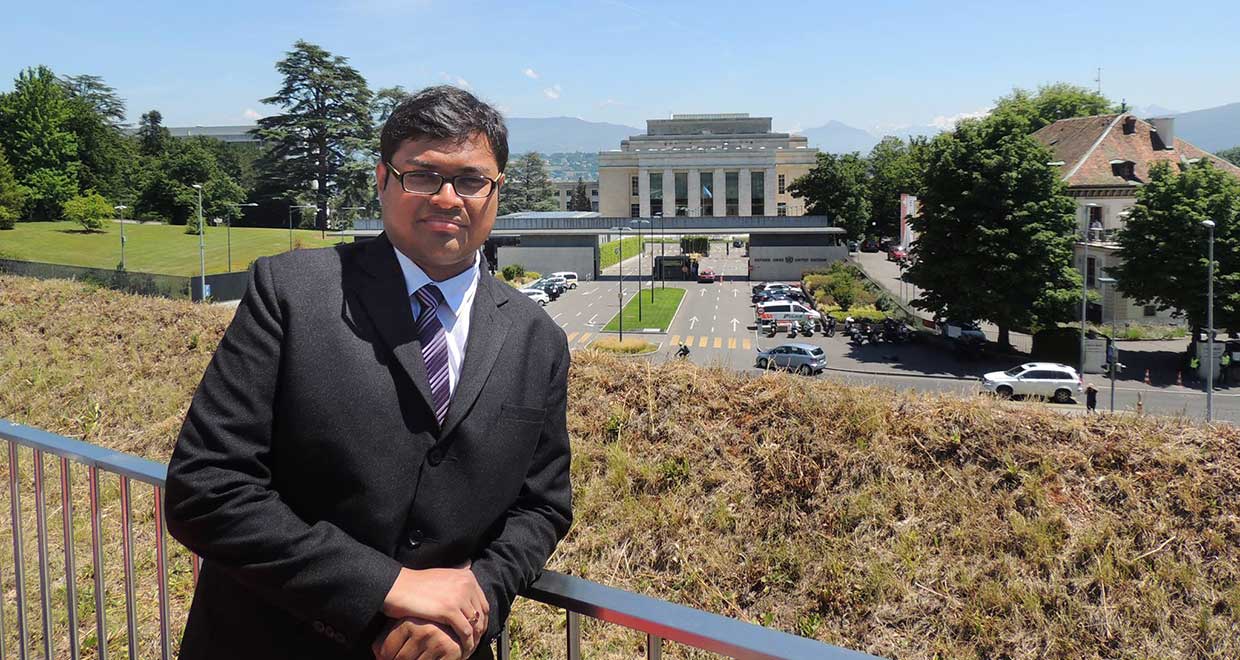
     I had been fortunate enough to be sent, along with 15 others from my University to attend the 82nd session of the United Nations Committee on the Elimination of Racial Discrimination and the 54th session of the United Nations Committee on the Elimination of Discrimination Against Women at the United Nations Office at Geneva in February, 2013. It is over there that I came to know about the Istituto Internazionale di Diritto Umanitario in San Remo, Italy. The Institute primarily deals with the military personnel from around the world, training them in the rules of engagement in accordance with International Humanitarian Law. In order to achieve their aims in this regard, they work in close collaboration with the likes of the International Committee of the Red Cross and has operational relations with the likes of the European Union and the N.A.T.O. They also organise a handful of courses for civilian personnel and I was fortunate enough to be selected to one such certificate course on International Humanitarian Law.

    The experience of being able to come into contact and converse with military personnel, diplomats, professors, personnel from the UN and other international organisations such as the International Committee of the Red Cross, Amnesty International, Caritas etc. and lawyers drawn from a pool of countries spanning over all the continents on earth is something that perhaps cannot be expressed in words. Understandably, it was a very enriching experience.
    The course was on Humanitarian Law wherein the functioning of the same was explained to us by various military personnel and jurists, including Special Rapporteurs of the United Nations Secretary General and Judges of international courts, at times, through exercises resembling real life decision making inside the battle command centres. Also, the relation that Humanitarian Law shares with Human Rights Law, International Criminal Law and as well as International Refugee Law was explained at length, over the course of two weeks.


    You currently practice at the Appellate side of Calcutta High Court. How is the work atmosphere at the High Court presently?

    As time progresses, our society is faced with newer challenges that are to be overcome. And in an attempt to do that, new laws are enacted by our legislatures or amendments are made to the existing ones. More the number of laws more would be the number of litigations though there may be certain exceptions. Hence the scope for private practice at the High Court is better than ever before and I am of the firm belief that the best days are yet to come. So, under no circumstances would I say that it has become more difficult for a fresher to be successful.
    As far as the atmosphere is concerned, having practiced at other lower courts in the past, I have found the High Court at Calcutta to be much friendlier to new comers than most other places. Most seniors are more than willing to help out the juniors when the juniors find themselves on a sticky wicket. And it is not as if they do so with an expectation of getting briefed by the junior concerned. I, for example, have been fortunate to have had worked with a senior who not only allowed me to brief other senior advocates, if the clients so wished, but also to appear against him in matters where, by a stroke of fate, we ended up representing opposite parties in the same case.

    It would be advisable for a fresh graduate to not expect a huge amount of money in his bank account at the end of every month, at least for the first few years of his practice career. Advocacy surely isn’t the place where one can rake in the money right from the word go. One would do better to do away with any vanity or air of superiority and get his head down into becoming a good clerk to begin with. In the words of my senior at the Asansol Court, ‘One has to first become a good clerk if one is to become a successful advocate later on.’ Basically, one would have to know the procedure of the Court inside out before concentrating on the laws since knowing the procedures himself/herself would make him/her less dependent on others in basic matters such as those relating to the filing of a case, for example. Next comes the knowledge of law and the finesse of arguing a matter in the court, both of which one learns over a span of a life time. There are barely any last minute quick fixes or short cuts to success in this profession.


    Many law students prefer corporate jobs over a career in litigation. What is your take on this? Is it better to work in the corporate sector for a few years before starting litigation?

    A High Court Justice had once famously quipped that he is proud that his college produces eminent lawyers and jurists instead of producing ‘corporate slaves’. An ex-Supreme Court Justice, while in conversation with a representative team from our college had stated that he felt that the corporate lawyers contribute nothing to the legal field in terms of legal jurisprudence and interpretation of the laws.

    Such views, though, are generally restricted to our previous generations. Being someone from a generation, a good chunk of whose members have gone into the corporate sector or into law firms, I don’t possess such a traditional view in this regard. In fact, I do understand that in the initial days, a corporate job does seem to be much more lucrative. We are also in an age when most of our friends who go into other streams, especially engineering, get corporate jobs immediately after graduation and their lifestyle and economic stability does appeal to students of the legal field too.

    Also, some students may actually need the economic support in the form of salary that one would get on joining a corporate job or a firm after passing LL.B. That is something that advocacy, by and large, would fail to provide you with during the initial days. Also, some may not want the daily hassles and the schedule less life that comes along with a career in litigation. Hence, corporate jobs for those in the legal field is also a necessity in today’s age, as it provides an additional career option, and a pretty good one at that, to the law graduates.

    I do not have any previous experience of either interning or working in the corporate sector and hence I may not be the best person to be speaking to in this regard. However, to the best of my belief, I do not think that working for a few years in the corporate sector before starting a career in litigation would make much of a difference, especially since the nature of the work that one does at the corporate sector is vastly different from the work that one would be required to do in litigation. One’s experience in the corporate sector is useful for a career in litigation or not, would perhaps depend on how much exposure one gets to the proceedings of the courts during one’s work as a corporate lawyer. However, the experience relating to the drafting of legal documents that one would be required to undertake in the corporate sector is surely going to come in handy even in litigation.


    How did you get to connect with your clients? How many years of practice do you think would be required to build a firm clientele?

    I believe that working at the lower courts at Asansol, Durgapur and Burdwan went a long way in increasing contacts among the advocates practicing over there. And once I shifted to the High Court, advocates from these places found someone they knew and had worked with, to send their cases to, if and when they needed to send some matter up to the High Court. I also make it a point to visit the lower courts in and around Kolkata on a periodic basis, if and when an opportunity to do so presents itself before me. Such visits however, are never at the cost of my work at the High Court since that is my primary place of work.

    As far as direct interaction with the clients is concerned, one has to remember that most of them come to us only when they are in distress and hence, they may seem to be a bit repetitive with their questions at times and at other times, they may seem not to be able to understand your point of view due to a multitude of reasons including their general lack of legal knowledge. One would do better to keep one’s calm under such circumstances. Ultimately, no matter what one says, even the clients understand that you may lose a matter after all. What matters is that they should be able to see in you the intent to give it your best. Good behaviour with clients is a must because our very profession, after all, is in existence to help them out with their legal problems.

    As far as the number of years it would take someone to build a firm clientele is something that would vary from advocate to advocate and there is no straitjacket answer in this regard.


    How is your experience so far? What is your workday like? Are there new challenges every day or did work fall into a predictable pattern?

    My experience at the High Court has been exciting, complete with its share of ups and downs.
    I tend to reach court a little early, i.e. within 9:30 to 10:00, a habit that was inculcated in me by my senior, Mr. Debasish Roy, when I had joined the High Court. After completing Court in the evening I tend to be able to come back home if there are no conferences and dive headlong into studying for the cases scheduled to come up for hearing on the next day or draft documents that are to be filed in the days to come. If however, I am required to meet some senior for any conference then the time by which I am able to return home completely depends on the timing of such a conference.

    Once in this profession, one has to be ready to attend conferences that are held at the convenience of the seniors, whether they are held at midnight or before sunrise in the morning. Life, effectively becomes schedule less. But then, that is part and parcel of advocacy.

    My grandfather used to say that every day is a battle for an advocate. Quite obviously, when you are engaged in a battle on a daily basis, things would not tend to be predictable at all. Two cases may be similar but no two cases are ever the same and hence predictability is not something that one can come across in this profession since each case requires individual care due to its uniqueness, thereby throwing a new challenge at the advocate handling the same. The only thing predictable about a day in an advocate’s life is perhaps that it would be unpredictable.


    What would be your parting message to law students who want to litigate just after graduation?

    Hard, though intelligent work, an indomitable appetite for legal and as well as other related knowledge, loads of patience and humility can and is bound to lead to a success story after a certain point of time. Those coming into litigation must keep in mind that it is not for nothing that we are referred to as ‘Learned’ advocates from day one. We have to behave and act as learned people if we are to do justice to our profession.

    Having said that, I would like to wish all the best to all the law students wishing to become legal practitioners after graduation.

    Last, but not the least, I would also like to say, in the words of my mentor Mr. Protik Prokash Banerjee, ‘Welcome to the Glorious Uncertainty’.


  • Santhosh Mathew, Standing Counsel, Calicut University, on how he built his litigation practice

    Santhosh Mathew, Standing Counsel, Calicut University, on how he built his litigation practice

    Santhosh Mathew is an alumnus of the NLSIU, Bangalore of the 1995 graduating batch. He focused on litigation right from the beginning. A first generation lawyer, he started his practice at Dandapani Associates in 1995. He became independent and co-founded a litigation firm in 2004. He is currently a Standing Counsel for the University of Calicut. His practice areas are in Writ Petitions, Telecom, Media laws, Banking Laws, Company Law and Service Laws.

    In this interview he tells us about:

    • His first few years after graduation
    • Role of mentors in litigation
    • Work of a Standing Counsel
    • Necessary skills for the legal profession


    Tell us a bit about your pre-college years. What motivated you to study law?

    My grandfather was a District Sessions Judge at the time of his retirement in 1964. My father after graduating in law from the Government Law College, Ernakulam, joined ‘Malayala Manorama’ which is a leading Vernacular Daily, as its Personnel and Administration Manager. He used to take care of the Company’s legal matters His classmates from GLC, Mr. K.P Dandapani (A former Judge of the Kerala High Court and the present Advocate General of Kerala) and Mrs. Sumathi Dandapani were very close family friends.

    After completing my 10th Standard like any other youngster at that time I joined for pre degree (equivalent to present day higher secondary) and took Physics, Chemistry and Biology along with Mathematics to pursue a career in Medicine or Engineering. In time, Mr. Dandapani came to know about the National Law School of India University, Bangalore and bought an application form for me. When the entrance results came out, I was in the waiting list and hence joined ILS Pune which has an awesome campus. After two weeks, my admission at NLS Bangalore was confirmed and finally, I landed up at the “Harvard of the East” in 1990 with Roll no: BLIJ 189. The classes back then used to be held in one of the three car sheds which were converted to class rooms later on. That was the beginning of a wonderful journey in my legal Career.


    Tell us about your objectives while in the preliminary years of Law College. What were your plans after graduation?

    In my preliminary year my intention was to clear courses without getting too many repeats. Since I was not a very hard working student I was happy with my B+ grades! I studied the notes prepared by my Classmates Mr. Piyush Joshi and Mr. V. Umakanth. In my first year I interned with Adv. P.C. Abraham in the District court at Kottayam. I feel it is very important that all students start by doing an internship with a lawyer who practices in the lower courts and learn to draft Civil Suits and Criminal Complaints first. Merely by walking along with the Court Clerk will teach you the filing procedure.

    From the Second year onwards I used to do my internship with Mr. & Mrs. Dandapani who used to entrust me with various matters to do research and also with drafting of pleadings. My internships helped me to make up my mind to be a litigator. My appeal to all the law Students reading this is to use all the opportunities you get during your internship to decide what you want to do after graduating. Nobody will entrust you with any responsibility unless you volunteer. Only if you display a passion to take up responsibilities, the seniors with whom you intern will have the confidence or inclination to entrust you with more work. I understand that some lawyers don’t pay the interns. My appeal to those lawyers would be to loosen their purse strings a bit and pay a stipend which will at least cover their expenses.


    santhosh-mathew-2

    Looking back, how significant do you think that your legal education was? When did you happen to experience the learning curve?

    I sincerely regret not being a serious law student. Since I was not a very ambitious person I was more involved in co-curricular activities and did not spend too much time participating in Moot Courts other than the mandatory ones which were required as part of the curriculum. Since we had a fine group of students from all over the country I got to learn about various cultures and made some great friends. The projects done every trimester helped us to learn about different research methodologies and made us better equipped to do legal research.

    By the time we graduated we had a clear idea as to how case law could be worked up. This helped me tremendously in my career as a lawyer. So to all the law students out there, my appeal would be to try and identify a topic you can relate to and do an honest work with all earnestness. During my LL.B. course I ended up doing a lot of absurd projects which on hindsight makes me wonder, “Why on earth did I do those projects?” Please remember that you will be the sole beneficiary of your project and if you do a shabby work, you will be fooling no one but yourself.


    Do you feel that there is a difference in the court atmosphere between now and when you started practice? Has it become easier or more difficult for a young lawyer to establish himself?

    I believe the present day judges are much more accommodative of junior lawyers. In Kerala the Judges never had a fascination for Senior Lawyers from outside. So the local lawyers received great exposure which resulted in improving the quality of such local lawyers. My seniors Mr. K.P. Dandapani and Mrs. Sumathy Dandapani were always encouraging and permitted the juniors to take up their own matters which helped us to build up our careers apart from being a major boost to our self esteem.

    In fact all the juniors who have been mentored by Mr. & Mrs. Dandapani have made a mark for themselves after becoming independent. I was with Dandapani Associates for 9 years from 1995 till 2004 when I set up independent practice with my wonderful partner Mr. Sathish Ninan who is my friend, philosopher and guide. So it is very important to find a good office and work with a senior for a decent span of time. Court crafting is something you don’t acquire over night. It is very important that you don’t compromise on your integrity for monetary gains. If you get a bad name in this profession, you are DOOMED.


    Please tell us about your experience with regard to your first few sessions in court. Has it become more difficult for a fresher to achieve success?

    In my first year of practice there was a complaint filed by the then Chief Minister Mr. E.K. Nayanar against ‘Malayala Manorama’ before the Press Council of India. The complainant had instructed Senior Counsel Mr. Rajeev Dhavan. We had instructed Mr. Gopal Subramanium. Justice Sawanth was the then Chairman of the Press Council.

    When the matter was taken up, Mr. Rajeev Dhavan started arguing and Mr. Gopal Subramaniam became unavailable as he had to go to the Supreme Court for some urgent matter. When our turn came up, “yours truly” had no other option but to argue the matter and with God’s grace we got a favourable verdict. My client was so happy that they celebrated my victory by publishing my photograph in the ‘Malayala Manorama’ newspapers by celebrating it as a victory by a young David over Goliath.

    On a lighter note, a lot of my friends at the Bar after seeing my snap in the newspaper thought I had met with an accident! This was a big boost to my budding career. Thereafter there have been numerous opportunities in the last nineteen years of my career where I have been at the right place at the right time.

    For instance, when Mont Blanc came out with the ‘Mahatma Gandhi pens’, we filed a PIL in the Kerala High Court against the sale of those pens in India alleging violation of the provisions of Emblems and Names (Prevention of Improper Use) Act, 1950. As a result, Mont Blanc undertook before the High Court of Kerala that it will not sell the ‘Mahatma Gandhi series’ pens in India.

    We have conducted a lot of cases before the High Court relating to issues relating to health hazards from Telecommunication Towers. We have been successfully representing most of the major cellular operators and Telecom infrastructure providers in Kerala before the various Courts. We have represented various educational institutions challenging the unreasonable restrictions imposed by the State Government which adversely affected their minority rights guaranteed under the Constitution of India.

    God has been extremely kind to me. One must have the self confidence that he or she can handle any matter that comes his/her’s way. If we don’t know the subject matter in detail, we should study extra hard and consult the seniors who are experts in that field. The legal profession is a unique profession where seniors are willing to go out of their way to guide a junior counsel in need. While arguing a matter if a judge asks a question to which you readily don’t have an answer, have the humility to admit that fact and be assured most of the judges would be more than happy to grant you time to work up and make your submission. Remember Bench and Bar are two sides of the same coin and you have a duty to our client to win a case but you have a bigger duty as a responsible officer of the Court to assist the Court to arrive at legally correct judgments. Therefore, never mislead the Court.


    What was the role of mentors in your case? How important do you think a mentor is in the field of litigation?

    I was extremely lucky to have wonderful seniors like Mr. K.P Dandapani, Mrs. Sumathi Dandapani and Mr. Jaju Babu who are all designated Senior Counsels who mentored me and had tremendous confidence in my abilities. This motivated me to reach office at 7.30 AM and work till late night until the work entrusted was finished completely. They paid me handsomely which was also a very important factor as far as a junior lawyer is concerned. It is very important for a young lawyer to have a mentor to guide him/her just like a toddler during infancy.


    Please tell us about the requisite soft skills which are essential for a young lawyer to build a successful career?

    There is no substitute for hard work. Try to get a good mentor. Be ready to take whatever assignment that is given and never shirk away from responsibilities. Learn to respect your colleagues and opposite side lawyers. Invest in proper infrastructure. Don’t be concerned about money. Always be courteous to the judges. You don’t win any case by picking up a fight with a presiding officer! You will only succeed in losing not only that case but other matters too till the judge gets tired of dismissing your matters! It’s good to have aggression and self confidence but over confidence would land you in trouble. Always be prepared and never go to argue a case without preparing properly. Always take the relevant statutes and the latest case laws on the point when you go to argue a matter. Never underestimate the opposite side.


    How did you build up your client base? How many years of practice would you say it requires to build a firm clientele?

    There is no hard and fast rule for this. Work hard and put in your best effort when a client comes to you. Satisfied clients will in turn, get you more clients. Legal profession is a unique profession where you cannot build up a client base through marketing gimmicks. One needs a lot of luck to be at the right place at the right time. There are so many learned lawyers who have vanished due to lack of opportunities. I genuinely feel that not all are capable of being leaders. There is a lot of space for everyone here. The lawyers who are incapable of building up a client base on their own must find good senior or like minded lawyers and form a firm and learn to manage things. Some are good in impressing clients but may not be effective lawyers. These two categories can form a common platform. Gone are the days of individual practitioners. A group of like minded lawyers providing a one stop shop would become the order of the day in the future.


    What has been your experience of being a Standing Counsel? How is the work pressure and what are your responsibilities like?

    Being a Standing Counsel of an institution like the University of Calicut was purely providential. It was a huge responsibility. In June 2011, nearly 4000 case files were brought over to my office and I didn’t know where to start with. Within three years, I have with the support of my able colleagues Mr. Arun Thomas and Mr. Jennis Stephen, disposed off nearly 2500 cases. I consider it a huge opportunity to help students who have a genuine cause to have their grievance redressed.

    A lot of old service matters could be disposed off. The High Court judges who dealt with the jurisdiction are very efficiently disposing off matters. The biggest challenge was to build a good working relationship with the client and to get instructions on time. Giving timely legal advice and getting instructions from the various departments of the University were all difficult in the beginning but over a period of time it started functioning smoothly like a well oiled bicycle. One must learn to respect the representative of the client who comes to instruct you.

    I was fortunate to have a great team right from the Vice Chancellor till the Assistant in the Legal Department who would be ready to render all possible support and assistance. Each day was a new learning experience. Being a Standing Counsel of a prestigious institution increases your visibility and gives you tremendous exposure. You get to argue cases against the best lawyers in the field. You get to learn the subject in extenso.


    When you hire lawyers, what kind of skills and profile do you look for? What kind of a profile suits best to the profession?

    All the lawyers we have hired have been recommended by my friends. We have been extremely lucky to have a set of sincere hardworking colleagues. I personally feel that young associates must be delegated work depending on their potential. Over burdening a junior lawyer with work he/she cannot do will only help in demoralising them. At the same time I hasten to add that each one should be pushed to their optimum to make them good lawyers and better individuals.

    Right from the time of internship in their first year, law students must try out different options like NGOs, Law Firms, Individual practitioners etc. and by the time one completes the third year he/she must have a clear idea about where they want to be after graduating. As a junior lawyer one must not be bothered too much about the monetary aspect. For the first five years it really helps if one has a generous and understanding father.

    I was really privileged to have a great father who ensured that all my needs were to be taken care of so that I could concentrate in my work. If you are serious about the profession, you must be ready to put in long hours at work. Be assured after some time in your career those long hours you have put in as a young lawyer will definitely help you in your journey. I have seen a lot of youngsters in my time. Some of them have started their blogs, websites, entrance coaching centres etc, taken up theatre and even marriage photography mainly because most of them eventually got fagged out after learning “Law” for five years and this prompted them to do something out of the box.


    Do you think that achievements such as having a landmark judgment to your credit can change one’s recognition drastically?

    I don’t think so. I strongly believe each day is a new day and you have to consistently deliver your best. There is no place for complacency in this profession. You cannot afford to rest on your laurels. In fact some of my important cases which we won did not actually get the client the relief which they ultimately wanted. They were classic cases of “operation successful but patient dead”. It definitely feels nice when your peers send you a text in appreciation of your efforts after reading a reported judgment which you have argued.


    Do you feel that there are differences between students of ‘elite’ law schools and students from other law colleges and traditional universities?

    Frankly it is difficult to generalise. The students from the ‘elite’ law schools have a structured curriculum which makes them better equipped. I guess one gets a 5-10% head start if you graduate from a good law school. But if any student feels that he is superior in any way to his peers who have graduated from other law colleges he is a FOOL.

    Once you enter the profession if you don’t work hard, others will catch up and before you realise it, they will run over you. It is high time and the scheme and syllabus of all law colleges are also structured in a similar fashion which will do away with artificial barriers. With the right kind of opportunities and a proper level playing field, anyone with a passion will be able to make a mark in this profession.


    What are your views on the future of Indian legal education? How would you suggest that a law student manages to stay ahead?

    It is high time the three year courses are stopped. After retirement persons must not be permitted to enter the profession as a litigator. They could be permitted to practise in non litigation areas. The State Bar Councils must provide for a stipend for young lawyers from economically weak backgrounds to survive for at least 5 years after graduation. All lawyers have a duty to contribute to that corpus. Courses which gives more in depth exposure to applications should be evolved and incorporated into the curriculum in place of those which require mugging up and reproducing what you have memorised. An opportunity must be provided to young first generation promising law graduates to get a placement with a successful lawyer. All of us have an obligation to reach out and do our little bit for our young brothers and sisters who join the profession with all earnestness to become “social engineers”.


    What would be your advice to young law students? How do you think that they should approach their career?

    Don’t be an arm chair critic who looks down on everything in life. Learn to appreciate the good things in life. Equip yourself and make yourself marketable. Be ready to work hard. Be practical in what you want to achieve. Everybody cannot be a Harish Salve, K.K. Venugopal, N.R. Madhava Menon, or a Cyril Shroff. India is one of the biggest populations in the world. Everyone has a legal requirement at least once in his/her lifetime. If we can make a qualitative difference to at least one person due to our expertise we can make the world a better place to live in. Ours is a noble profession.

    Let us collectively restore its lost glory. Wish you all a Merry Christmas and a Happy New Year!

  • Sucheta Chatterjee, Indian Foreign Service Officer, on the UPSC and work experience at SEBI

    Sucheta Chatterjee, Indian Foreign Service Officer, on the UPSC and work experience at SEBI

    Sucheta Chatterjee is a graduate of WBNUJS, Kolkata (2007 Batch). Soon after her graduation she joined SEBI as a Legal Officer and had been working there for six long years, before challenging herself to the formidable UPSC.

    For her, taking the UPSC was more of an aspiration to serve the nation as an IFS Officer. She had determined that she would either serve India in the Foreign Service or continue in SEBI.

    In this interview she shares with us:

    • Work experience at SEBI
    • Deciding to take the UPSC plunge
    • Taking the UPSC prelims and the mains
    • Training period and posting


    How would you introduce yourself to our readers who are mainly young and enthusiastic lawyers?

    I would firstly like to congratulate them for taking up law as a career. As far as introductions go, I’m a law graduate from the National University of Juridical Sciences, Kolkata, and I subsequently worked in SEBI in the very niche field of capital markets and securities law, specifically in enquiry and adjudication matters. Thereafter I stumbled into the Indian Foreign Service. My first posting abroad will be in Moscow.


    What inclined you towards the field of legal education? Did anyone among your family and friends suggest you to choose alternate career options?

    Growing up as an adolescent in Calcutta’s politically charged atmosphere left me well coloured with a burning idealism and a fierce intolerance of injustice. At eighteen, I felt as if I could change the world and fight for the rights of the underprivileged and [sociallocker]marginalized. Therefore, I joined law school with starry eyes and I was rather disconnected from reality.

    My family and friends were very supportive and never tried to impose any course of action upon me. I remain grateful to my parents for their unflinching support even in the face of some unconventional decisions that I’ve made.


    How was your experience at NUJS? What activities were you involved in apart from the regular academic curriculum?

    NUJS was a wake-up call in many ways. My years there taught me some very hard lessons about the legal system. My very first encounters with the bureaucratic mode of functioning happened in NUJS, leading to several bitter-sweet incidents. All things considered, it was a very extensive learning experience that enriched my life and I feel a sense of gratitude towards my alma mater. I would specifically like to mention Professor D. Banerjee who was always an inspiration in my life. He had always told me that he felt that the civil services would be the best option for me and that he was confident that I would get selected.  I kept telling him that I couldn’t possibly get selected. Had he been alive, he would have been very happy. I miss him so much.

    As far as co-curricular activities are concerned, I can only remember a controversial monograph I’d written about the AFSPA in Manipur, which won me the first prize, to my greatest astonishment. Otherwise, I was essentially a loner and did not participate in any activity if I could help it. I was rarely in the campus after class hours and spent most of my time reading really amazing books (borrowed from the library) that had nothing to do with our academic curriculum.


    After graduation, you joined SEBI (Securities and Exchange Board of India) as a Legal Officer. How did you go about the appointment? Please tell us about the recruitment process at SEBI.

    I was selected by SEBI through the campus recruitment programme. I chose SEBI over law firms because I felt that working in the government sector has certain specific advantages that are not available in the private sector.


    You have worked with SEBI for a considerably long time as an Assistant Legal Advisor. Please tell us about your experience there.

    I worked at SEBI for about six years! SEBI is an outstanding employer. My years there were a continuous learning experience, albeit in a very niche sphere. SEBI, and especially my colleagues there, will always remain special to me. I will always feel a sense of gratitude to them for making my debut into the legal world such an enjoyable experience.


    sucheta-chatterjee-2

    When and what inspired you to appear for UPSC after having a secured career at SEBI?

    Will you believe me if I tell you that I appeared for the UPSC exam because I wanted to get away from my boss?! That was indeed a major factor.

    Another reason was pure wanderlust and I felt that joining the Indian Foreign Service would be a great way to live in various parts of the world, immersed in alien cultures. The fact that I have always been keenly interested in international affairs further strengthened my resolve to give it a go.


    When did you start preparing for the exams? When should a person ideally start preparation for the UPSC exam?

    I had severe time constraints because I was handling a full-time job while preparing for the exam. I started practicing a lot of mathematics about a few months before the preliminary examination. I focused entirely on mathematics because I felt that my performance in the quantitative aptitude part of the paper would make or break my attempt to clear the civil service exams. I studied for the main examination only after the results of the preliminary exam was declared and I was sure that I had qualified for the main exam.

    I suppose ideally a person ought to start preparing a year in advance but then I firmly belong to the school of thought that maintains that the amount of time you study is irrelevant. How you do it is what counts.


    Did you enrol in a coaching institute? How valuable do you think coaching institutions can be for UPSC preparation?

    No, I did not enrol myself in a coaching institute because of time constraints. Thus, I am not competent to opine about the value of coaching institutions.


    How many hours did you put in for your preparations every day? Is it important to have a fixed schedule or weekly targets important according to you?

    It varied from two hours to none at all. I did not maintain a fixed schedule and studied in fits and starts.

    I am sure fixed schedules and monthly targets are useful for those inclined to study in that manner. It is important to know what suits you as an individual and to create your own style of preparation. I don’t believe there is a fixed formula for success.

    What did you do to keep yourself abreast of all domestic and international current affairs? How did you study for static GK?

    I relied on The Hindu and the Indian Express to give me a fair idea of how events were playing out in local and international politics. But this isn’t something that can be started a year before the exam. It is a lifelong process and one has to keep reading all the time. I strongly believe that in the UPSC, it is accumulated knowledge that makes all the difference.


    Did you regularly read newspapers? How did that help you? How should one strategically use newspapers for preparation?

    I have always read newspapers regularly. It has become a habit. With time, one can instinctively pick out what’s important and what is of relatively less importance. My personal favourites are the editorial section and the opinion page. It is a mistake to cram up facts because the pattern of the UPSC paper is heavily analytical.


    Which books/materials did you rely on while preparing?

    A CSAT book published by Tata McGraw Hill on quantitative aptitude helped me to conquer my fear of mathematics to an extent. For the mains, NCERT textbooks were my bible, so to speak. I also highly recommend The Economic and Political Weekly as well as The Frontline magazine. Wikipedia should also not be underestimated, no matter what the pundits tell you. It also helps to choose one’s own subject for the Main Exams as it saves the trouble of learning an entirely new subject. The myth that some subjects are more “scoring” than others has effectively been busted. I stuck to my strengths – law and political science.


    Lakhs of people attempt the UPSC prelims and only a thousand get selected for the main written exam. Which are the prime skills and expertise required to crack the prelims?

    I will spare you a lecture on hard work and dedication because that would be an insult to lakhs of candidates who studied very hard with tremendous dedication and still did not make it. The role of chance is a big factor that is seldom mentioned by successful candidates. You have to do your best and hope that by chance you get to attempt questions which you have prepared for.

    Besides, those who have good time management skills have an obvious edge over those who do not.


    Please share with us your insight of attempting the prelims.

    You are interviewing me more than two years after I appeared for the preliminary examination. I cannot remember much except for the fact that most of the multiple choice questions were very tricky and designed to make one choose the wrong answer so I attempted only those questions that I felt reasonably sure about in order to avoid negative marking.


    What kind of posts had you opted for in the UPSC enrolment form? How do you want to serve the nation? Didn’t you think of applying for the IAS?

    In my DAP (detailed application form), I chose the Indian Foreign Service as my one and only option. I could have easily got IAS with my home cadre but I was determined to join either the IFS or remain with SEBI.

    As a diplomat, I would like to contribute to the formulation of a rational, enlightened foreign policy in consonance with the spirit of the constitution and the ideals of Panchsheel.


    How would you rate the main exam question paper on difficulty?

    The main examination paper was rather difficult, at least by my standards. The GS papers especially had some very tough questions that compelled a lot of thinking and planning before writing, leading to a time crunch.


    Did you appear for mock interviews? What are your views on taking mock interviews?

    No, I did not appear for mock interviews. So, I can’t comment on that too.


    Any specific strategy you would recommend us for the interview?

    I decided to be frank and forthright in my interview and not pretend to be someone I am not. The board members were all experienced bureaucrats who could easily see through all attempts at falsehood. Therefore one should respect their intelligence and not try to fool them. I was asked several highly controversial political questions and I answered all of them with candour and made no attempts to be evasive. Thankfully, I was also asked a lot of legal questions. There was one question to which I did not know the answer and I admitted my ignorance.

    “Bullshitting” is absolutely useless in the UPSC interview. Interestingly, I was even made to recite some Bengali poetry and sing a few lines of Rabindra Sangeet. I am sure the board members regretted asking me to sing the moment I opened my mouth!


    sucheta-chatterjee-3

    How would you describe your training period? Please share some memorable moments of your training programme with our readers.

    The training at Lal Bahadur National Academy of Administration, Mussoorie, was a saga of never-ending hardship for a laidback, unorganized person like me because there is a lot of emphasis on discipline, order and method. The fun parts were the treks, village visit and weekend parties in the Officers’ Lounge. But apart from having to get up at 4:30 a.m. in the freezing cold for P.T., I think we all had a stellar time.

    The training provided at the Foreign Service Institute was excellent. We especially enjoyed ‘Bharat Darshan’, the attachments with all three wings of the armed forces and the mission attachment at Dhaka. It is a cliché to say that training is the best part of the service bit it is very true, nonetheless.


    After the training period, where was your first appointment?

    At present, I am undergoing desk attachment at South Block in the Eurasia Division. My first posting will probably happen around August, 2015 in Moscow, Russian Federation.


    Please tell us a little about your work profile working as a Foreign Services officer. What are the responsibilities you are entrusted with?

    As a Foreign Service Officer, we are entrusted with nearly everything that involves a foreign relations component, from writing concept papers, to vetting treaties and MoUs to organizing visits of heads of states etc. Our division successfully handled the recently concluded Indo-Russia Annual Summit in New Delhi. We get to learn something new every day and compared to other services, political interference in the IFS is minimal.


    How is a typical workday like? How has your experience of being an IFS officer been so far?

    A typical workday involves getting up early and rushing to South Block by 9, dealing with little mountains of files, attending numerous phone calls and meeting a wide variety of people from all over the world. While working abroad, the experience is bound to be different.


    What would be your message to law students and lawyers who aspire to become a civil servant?

    It is always an asset to the civil service to have legally literate officers and I personally believe that law students and lawyers have an edge over others in the civil service exams because of the five years of rigorous training that we undergo at law schools. So if you think that the civil service is where you aim to reach, there is absolutely nothing to stop you! All the very best!

     [/sociallocker]

  • Rahul Rai, Competition/Antitrust & Trade Lawyer, AZB Partners on LL.M in International Trade Law from Stanford Law School

    Rahul Rai, Competition/Antitrust & Trade Lawyer, AZB Partners on LL.M in International Trade Law from Stanford Law School

    Rahul Rai graduated from WBNUJS, Kolkata in 2006 and got a PPO from Economic Laws Practice after interning there twice. He joined as an Associate after graduating and worked mostly on international trade and competition law matters.

    In 2011, he decided to pursue an LL.M and got in at Stanford Law School in the USA. He describes his LL.M experience, talks about the world-class professors and facilities and his time as an Article Editor of the International Law Journal.

    After returning to India, he joined AZB & Partners and contributed in building their competition law practice. Here, he talks about:

    • Why he didn’t take up any extra-curricular activities in law school
    • His experience as an Associate at Economic Laws Practice
    • The biggest reason he got through to Stanford Law School, USA
    • Joining AZB & Partners upon his return to India


    Please tell us a bit about yourself. How would you like to be introduced to our readers?

    I am a competition and international trade (WTO law) lawyer working with AZB & Partners in Bombay.


    rahul-rai-2How did you come to know about the newly established WBNUJS? What helped you gravitate towards law?

    Like most kids from my part of the country, I too aspired to crack the IIT-JEE. Like many, I bombed through class XI and XII and unless my parents were to buy a management quota seat in some forlorn engineering college; I stood no chance of becoming an engineer. Even if I were to get into an engineering college, I was confident about my incompetence. Throughout high school I had loved studying non-science subjects like history, economics, and civics. I fleetingly heard about Professor Madhav Menon and the National Law School in Bangalore. Law as a possible career option was becoming more and more promising- it offered the escape from sciences and also promised reasonably well-paid jobs upon graduation. The prospect of landing decent jobs helped win over my parents and their fascination of seeing their son in an IIT. The prospect of getting over the baggage of disastrous XI-XII performance (I got 2/100 in Maths in the first semester in class XI and passed my XIIth with 43/100), never to look back at sciences, studying subjects that I had enjoyed in high school and yet be hopeful of a decent job upon graduation made me zero down on law as a possible career. Thereafter, it was simple. In 2001 Google was relatively new but was catching up as a research tool. I went searching for National Law School, Bangalore and found a thread talking about Professor Menon’s move to Calcutta as the founding Vice-Chancellor of WBNUJS. I wrote the WBNUJS entrance test, got through but failed to crack the entrance to National Law School, Bangalore. So I ended up in Calcutta and WBNUJS.


    How would you describe your time at WBNUJS? Did you partake in extracurricular activities?

    Time at WBNUJS was fun. I entered NUJS with three other friends from school. All four of us had struggled in similar fashion to find a roof over our heads after class XII. The five years at NUJS made me cement the friendship for life. I also met some very interesting and nice people and the friendships forged during college days continue to this day. That is one of my most cherished takeaway from NUJS. Academically, when I look back, I can count 5 out of 50 subjects that were taught brilliantly. I just loved G. Ajay’s Political Science, Prof. Rudranshu Mukheerjee’s History, Prof. BS Chimni + Ms. Sheela Rai + Prof. Mritiunjoy Mohanty’s International Trade Law and M.V. Shiju’s Constitutional and Competition Law courses.

    Extracurricular activities were a strict no for me. I had spent my high school days in boarding school chasing (with reasonable success) the trophies in debates, elocutions and sports and decided to do nothing in law school unless it interested me. So, all I did, was sleep, read a few books, and spend just so much energy on studies that would offer a fighting shot at jobs.


    Right after graduating, you started working at Economic Laws Practice. How did the appointment take place? How difficult were the first few months of ELP given that it focuses mainly on a specific field of law?

    I had enjoyed studying International Trade Law and had done reasonably well in the course. With some good luck I landed an internship at ELP, Bombay. I think I worked hard and that got noticed. I got another opportunity to intern with ELP and I decided to work in their Delhi office. Back in 2006 there were 6 associates in their office and Samir Gandhi led the International trade practice in Delhi. Again, I think I worked hard and ELP made an offer.

    First few months at ELP were difficult. I could barely draft a two sentence email and within the first month I was working on a full blown WTO dispute. Samir was and continues to be a great mentor. I struggled with drafting for about 8-10 months and finally one day I got a draft without any red marks! Working in the area of International Trade law and doing a WTO dispute was more of fun than a challenge.


    How did you build up your expertise in competition and trade law? Please tell us a bit about your work profile at ELP.

    I had joined ELP with the idea of working in the area of International Trade law and the hope that someday when the Competition Act, 2002 becomes operational, take up competition law as well. I spent most of the first eighteen months at ELP working on the WTO Dispute with the US on additional and extra-additional duties on import of alcoholic beverages. I would spend 8 hours in the office and another two to three hours reading up on WTO laws. I guess once you become a lawyer, there is no substitute for reading legal texts and commentaries. I just read as much as I could between Monday to Friday, week after week and month after month while at ELP.

    Sometime in late 2007 I saw an advertisement from the Competition Commission of India for conducting market studies. I took the idea to Samir, who was extremely supportive and so was Mr. Suhail Nathani, my ultimate reporting partner at ELP. We put in our proposal to run a study on the interface between antidumping and antitrust law, the Commission accepted it and thus began my career as a competition lawyer. Again, I read and read- there is just no substitute.

    The work profile at ELP was just what I had asked for- mix of litigation, advisory and policy. Above all, ELP offered the opportunity to do what I wanted to do- trade and competition work.


    rahul-rai

    What prompted you to opt for an LL.M from Stanford Law School? How difficult would you say it was gaining admission?

    The desire to study for LL.M. was driven more by the idea of experiencing life in a very good university and not so much by learning ‘law’ a little more. Perhaps, I wanted to make good for the ignominy of not even coming close to cracking IIT-JEE (I was ranked somewhere around 99000 in prelims)! An LL.M. in the US back in 2011 cost about USD 75K and therefore I wanted to go to a place which ranked amongst the very best. Stanford Law School, of course does not need my certificate. I lucked out, despite my not so great rank and CGPA at WBNUJS, Stanford granted me a seat. In retrospect I think, it was all because of my work experience at ELP.


    Did you apply for any scholarships? How was the academic culture at SLS?

    Stanford Law School does not offer any scholarships to LL.M.s and I had secured the Hugo Grotius scholarship at Michigan. So, it was a tough call. In the end, the lure for the sun and sand in California took me to Stanford. I also tried my luck for INLAKS where I did not even make the shortlist.

    The best part about Stanford Law School was the absence of a formal grading system which made the law school such a fun place. Once you stop pitting students against each other and get rid of the system where one student will necessarily be ranked first and other ranked last, studies become fun. Students no longer run after CGPA, take up courses that they really like and above all study than aim for the top CGPA/rank. Like most top law schools in the US, Stanford attracts the very best of faculty and students. The professors are the very best, the peer group is the most diverse and extraordinarily talented. The law school promotes multidisciplinary education in the truest sense. Some of my friends were able to take up courses at the design school, others opted for ‘coding’. I had read a little on Francis Fukuyama’s work and never knew that he taught at Stanford. Realising this, I ran to register for his introductory course of political theory and despite being very selective he was just glad to take in a trade and competition lawyer with nothing but pop political science theories to offer. Likewise, I wanted to try courses at the Stanford GSB and was able to take up one of the most sought after courses-“Build your own start-up”. If I have to sum up the academic culture at Stanford, I would say that it offers the opportunity to try different things, perhaps fail, try again and in the end if nothing works out then walk out with an experience that will certainly make you a better person, if nothing else.


    You were also an editor of the reputed Stanford Journal of International Law. How did this opportunity come to you?

    Stanford Law School is fairly small but has significant resources. So it offers more opportunities than one can make good of in a year’s time. Every year, the student run law journals invite applications for editors. I had spent close to four years doing trade work and so I tried my luck with the International Law Journal. It worked and I got selected as one of the article editors.

    The experience though was a little ‘under-whelming’ considering how correcting footnotes can be quite boring. The article I edited was written by one of the top trade law practitioners and it was fun to read the primary sources and test the author’s propositions.


    How would you say in retrospect your experience in LL.M. helped you in gaining more knowledge and expertise in competition law? Would you suggest other lawyers having a similar profile to opt for an LL.M.?

    Yes. I studied competition law under Professor Mark Lemley, who is without a doubt one of the very best professors in IP and Antitrust and Charles Koob who has one of the most unparalleled profiles as a practitioner. The lessons in Antitrust and assignments have indeed helped in the manner in which I approach an issue now.

    I would most certainly recommend people to opt for an LL.M. at Stanford. If nothing you’d come back with a lot of good friends and even if you sleep through the classes, the activity surrounding you will leave you richer in many different ways.


    After finishing your LL.M. you started work at AZB & Partners. What prompted you to join AZB? Were there other career options available to you?

    Of course I wanted to spend sometime in the U.S. and had managed to secure an offer from one the top firm’s with their antitrust practice in Washington DC. The law firm withdrew the offer after a few weeks of extending it. I had to come scurrying back to India and look for a job. Although AZB did not have an established competition law practice, Samir and my colleagues from ELP had moved to AZB. I spoke to Samir and Zia and was convinced about the firm’s focus on building the competition law practice. Zia was and continues to be very enthusiastic about competition law and that was a big plus. The prospect of reuniting with the old team at a firm that promised to invest in a new area of law made the decision to join AZB a fairly simple one.

    I would have considered sticking around in the U.S. if we completed the “Build your own start up” course at Stanford GSB by securing the seed capital from a venture fund. All VCs told us we were ahead of the curve (polite way of saying the idea sucks). Once the start up dream failed to take off, and the DC law firm withdrew its offer, I came back to India.  AZB happened and I did not try my luck at any other firm.


    Have you ever considered litigation or starting up on your own? Would you say the opportunity a firm provides for a young lawyer is worth the trade off in building a reputation?

    The romance of doing litigation never got to me. I had grown up seeing a generation of my family and family friends with nothing short of master degrees looking for jobs and not finding any. Deep down I wanted a JOB and at the moment I am happy with the sense of security the monthly pay cheque provides.

    I don’t necessarily see a disconnection between the opportunity offered by law firms and building reputation. All professions are about building trust and maintaining one’s credibility. In a law firm setting, one has to first gain the trust of his/her colleagues, immediate seniors, then the partner and finally the clients. I like the system where you are slowly exposed to different levels of responsibilities. Once you have won the trust of colleagues, seniors, partners and clients, recognition will come. On the point of building reputation I do not see any trade offs between a law firm career track and private practice track. One has to earn the trust of everyone around whether at a law firm or at a counsel’s chamber. Become trustworthy and then recognition is bound to come.


    What are the primary essentials of a corporate lawyer? How do you say a fresh graduate can work on building these skills?

    There is a massive gulf between what is taught at law schools and what is expected from an associate at a law firm. If you manage to learn something, there is a good chance that you will have to unlearn it all once you start working. I generally think that most students walking out of the law schools have more or less the same level of intelligence and certainly sufficient intelligence to become a successful lawyer. The real differentiator is communication skills- written and spoken. The good part is that you need not be a gifted writer or orator- these skills can be acquired. And for that you need to be very very careful in the first job you pick. Rather, the decision to take up a job should primarily be driven by the senior you’d work with. If you find the right senior, the battle is half won. And if the senior has the time and patience to guide you, then nothing like it. Else just observing every single word he/she writes and speaks, analyze the difference in approach, and very soon you would develop your own style, tempered by the basic dos and don’ts taught by the senior.

    The other skill set that law schools can never provide is the ability to handle pressure. As you progress in your career, the pressure points will change and you’d see yourself struggling again. It is a continuous process and I am yet to reach a stage where I can start preaching.


    What is your current work profile at AZB? How can an intern be of help while trying to learn?

    I do a mix of competition and trade law work. I would say about 85% of my work is in competition law. In competition, a bulk of my work involves representation in behavioural cases and merger notifications to the CCI. Increasingly companies are approaching us for risk assessment on their business practice and guidance on mitigating risks. We loosely call it competition advisory and compliance. In International Trade I do the occasional representation for an exporter in an anti-dumping or safeguard duty investigation.

    Interns are quite valuable as the colleagues are working full time. We try and involve interns in ongoing assignments for all types of work, including research and drafting of bits and pieces of let’s say an appeal memo. All that I look for in an intern is ability and willingness to work hard and with diligence.


    What would be your parting message to our readers?

    To continue to work for a long period in a law firm set up can be challenging. Unless you enjoy the work, there is just no way that you will survive. So, pick the area of law that interests you the most and make a career out of that.

  • Neeraj Arora, Expert Investigator, Cyber Crimes, Delhi Police on building a career in Cyber Law

    Neeraj Arora, Expert Investigator, Cyber Crimes, Delhi Police on building a career in Cyber Law

    Neeraj Arora started working in the Delhi police as a sub-inspector in order to support his family, while studying B.Com. Thereafter he did his LL.B from Delhi University.

    After graduating and continuing work in the police force, he developed an interest in cyber crimes and law and took up a variety of certificate courses and diplomas in India and abroad to further his knowledge in the area. Eventually, he started up his own law firm, Hazen Legal Associates which specialises mainly in cyber law and offences.

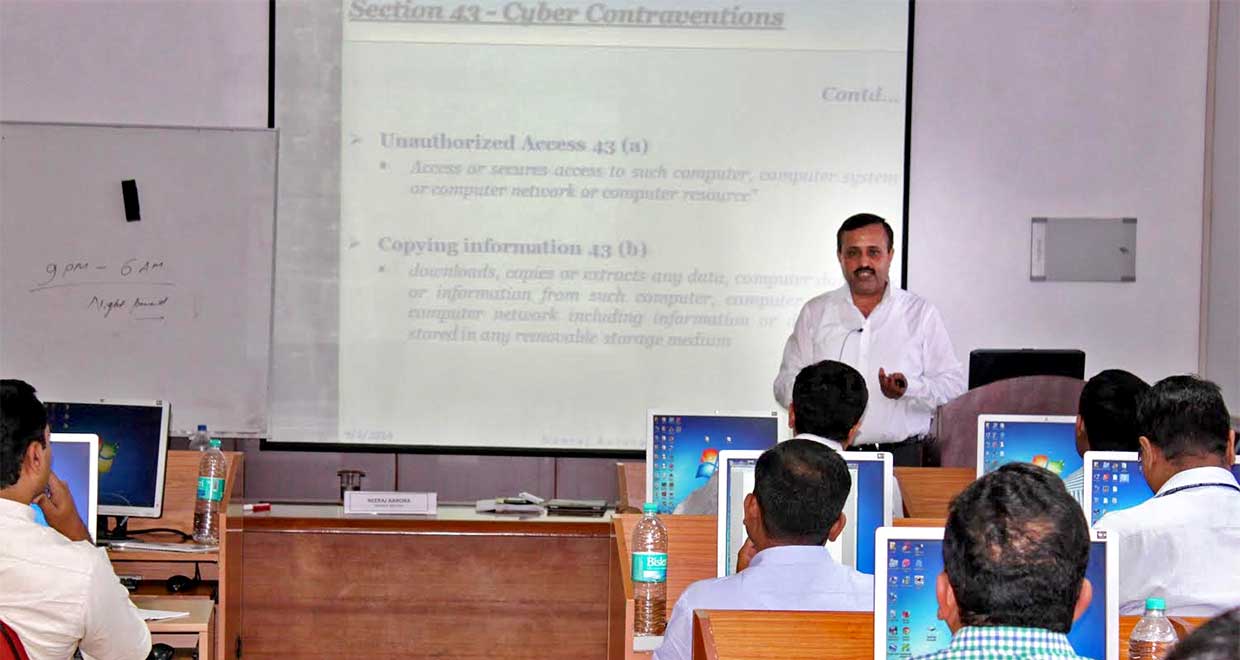
    Presently, he is a designated Expert Investigator and he has investigated a large number of cases relating to E-mail related crimes, Web-Server/System/Wireless Network Hacking, BPO Data theft, Online Auctions Website Frauds, Obscenity, E-mails/SMS Spoofing, Phishing Frauds etc. for the Delhi Police. He serves as a guest faculty member and a guest lecturer of ISACA, NICFS, Indian Law Institute, Directorate of Enforcement, Indian Institute of Corporate Affairs and many other prominent institutions. He is also an Arbitrator for NSE, ICADR and MCX in online trading matters.

    In this interview we asked Neeraj to share:

    • His initial decisive moments during graduation
    • Being a part of the Delhi police and his work in the Cyber Crimes Cell
    • Doing a number of extra diplomas and certificate courses in Cyber Law and Digital Forensics
    • Being a Consultant for the World Bank
    • Being appointed as an Arbitrator of the National Stock Exchange
    • His experience of starting up his own law firm, Hazen Legal Associates


    Please introduce yourself to our readers and tell us a bit about your college life days. Did you have lawyers in your family?

    After doing my 12th, I started working and took my first job as an Accounts Assistant because my family circumstances required me to earn for my family. I joined B.Com (H) at the School of Correspondence Studies, Delhi University, while continuing my job. I also took up part-time writing work, filing of Income Tax/Sales Tax returns and tuitions to support my family. I am a first generation lawyer in my family.


    You are a Commerce (B.Com) Graduate and a Cost Accountant by qualification. What prompted you to make the transition to law?

    After completing B.Com, I joined ICWA as I intended to join the accountancy profession. Meanwhile, due to my financial troubles, [sociallocker]I joined the Delhi police as a Sub-Inspector. I also continued with ICWA and completed my final in 1996.


    You have pursued PG Diplomas in Arbitration and Drafting long after graduating in LL.B. What prompted you to take up these diplomas?

    I did my LL.B. from Delhi University in 2001 and pursued a PG Diploma in Arbitration & PG Diploma Drafting of Legislation, Treaties, International Agreement & Contracts from 2008 to 2010. I pursued the extra diplomas because the topic fascinated me as it upgrades existing skills and enables one to reach new heights in life as well as the legal profession. After resigning from the Delhi police in 2008, I decided to explore my career in Arbitration which is an upcoming and rewarding career. In 2008, I was appointed as an Arbitrator with the MCX Exchange and to augment my skill in the field of International Arbitration, I joined and completed these two part-time courses, PG Diploma in Arbitration, Drafting of Legislation, Treaties, International Agreement & Contracts.


    You have been practicing cyber law for almost eight years now. How did you become interested in cyber law?

    In 2005, I was transferred to the Cyber Crime Cell of Economic Offences Wing (EOW) of Delhi police and at the time I didn’t have much knowledge of computers. I treated the posting as a punishment, but took it up as a challenge as I foresaw huge potential in the area. I did a number of trainings on cyber offences from various police academies: CBI, CDTS and also did a Certificate Course in Computer Forensic from IP University, Cyber Crime Investigator Course from Asian School of Cyber Law, PG Diploma in Cyber Law from Indian Law Institute (ILI), Delhi, PG Diploma in Cyber Security from Asian School of Cyber Law and MBA (Information Technology) from Manipal University. Consequently, that is also how I became one of the prominent Investigators of the Cyber Crime Cell of the Delhi police.


    neeraj-arora-2

    You are associated with Delhi Police as a Cyber Lawyer & an Expert Cyber Crime Investigator. Please share few interesting experiences of your investigation with our readers and tell us more about these issues.

    On being equipped with knowledge on Information Technology, I got opportunities to investigate a large number of cases relating to E-mail related crimes, Web-Server/System/Wireless Network Hacking, BPO Data theft, Online Auctions Website Frauds, Obscenity, E-mails/SMS Spoofing, Phishing Frauds etc.

    In all the cases, I prepared the mirror images on the spot, collected relevant digital evidence, arrested a number of hackers, filed the charge-sheets in the court, etc. The investigation of cyber offences was quite challenging as there were no precedents, standard operating procedure and no one to guide us. I have collected the requisite information from the internet, various books and journals on digital forensics and by 2008, I was awarded the status of an expert cyber crime Investigator.


    You are a Certified Forensic Computer Expert and an empanelled member of IACIS for more than two years now. What is your job as an expert at IACIS? What kind of issues do you deal with?

    The IACIS (International Association of Computer Investigative Specialists) is the top most organization in the world which specializes in the field of computer forensics. The Certification, “Certified Forensic Computer Examiner” (CFCE) is one of the top most certification which is also recognized by the Forensic Specialities Board of U.S.

    In order to augment my skill and also to gain an in-depth knowledge, I joined the Certification and attended two weeks Hands on Training in Orlando, U.S. and after that I worked hard for another year and passed the six exams which involves analysis of mirror images to find out the Window, Internet and other Artifacts of the Crime.

    The Course was a big challenge as this is the only Certification which requires extracting the evidence without using Forensic Software. The only Software which can be used is Hex Editor and for doing one need to have good knowledge of FAT File System, NTFS etc. as the Data/Artifacts has to be extracted manually by finding the location of data from FAT/MFT Table.


    You have vast experience as an Investigating Officer of CBI, Cyber Crime cell and Economic Offences Wing of Delhi Police and you are also associated with Justice K. Venkataswami Commissioner of Enquiry (Tehelka) for more than a decade. Please share your experience.

    I joined the CBI as Inspector on Deputation and got the opportunity to investigate the huge and technically complex cases of Economic Offences going into hundreds of crores of rupees. My skill and knowledge in the field of Finance, being a Cost Accountant, enable me to investigate these cases and to book the fraudsters. As an Investigating Officer with Justice K. Venkataswami Commissioner of Enquiry (Tehelka), I got the opportunity to investigate the huge scam and I received an award for outstanding investigation in the said assignment.


    You have trained many professionals at Police Organisations, Indian Law Institute, CBI and also at IACIS. Please tell us about your training programme.

    The arena of cyber forensics comprises of three domains namely Computer Forensic, Network Forensic & Mobile Forensic. These domains are inter-connected and integrated in such a manner that the knowledge of three domains is required to handle the Digital Evidence. I have been continuously sharing my knowledge of these domains by way of training. The training I provide is an integration of Bit & Byte, Debit & Credit with investigation and procedural and substantive laws.


    neeraj-arora-3

    You have also delivered a couple of lectures on cyber law. How do you prepare yourself before any presentation or delivering any lecture? Please give some tips to our readers.

    My competence in integrating computer forensics with digital evidence, e-commerce, procedural/substantive laws gives me a unique edge in delivering training in the field of Cyber Crime/Cyber Law/Computer Forensic/Financial Forensic when it is connected to the ground realities of investigation, analysis and presentation in a court of law. I am able to provide a solution to the various gaps in the investigation, collection, analysis, presentation & cross-examination on the digital evidence and integrate it with the applicable principles of digital investigation, digital evidence, cyber laws and other procedural/substantive law.


    From your profile it can be seen that you have strong exposure, knowledge and specialization in Arbitration law. How did you gravitate towards this discipline?

    Arbitration is one of the upcoming fields which require skills of legal procedure, proceedings, appreciation of evidence and discovery. The academic domain, knowledge and experience plays a major role in acquiring these skills and since the entire world is moving to ADR for dispute resolution, this is the most growing field with opportunities increasing exponentially.


    As an Arbitrator and Mediator for NSE, ICADR and MCX what kind of disputes do you deal with? What is the normal time period of disposal of an arbitral proceeding?

    As an Arbitrator on various exchanges, I am adjudicating the disputes relating to the Online Share/Commodity Transactions between the Members of Exchanges (Brokers) and their clients.

    As a member of IGRC on various exchanges, I conduct conciliatory proceedings to resolve disputes relating to the online share/commodity transactions between the Members of Exchanges (Brokers) and their clients. This mechanism provides an opportunity to the litigant to resolve their dispute with the help of Conciliator/Mediator.

    The normal time period of disposal of such dispute is 3-6 months. The disputes are resolved by conducting the proceedings as per the bye-laws and exchanges and the procedure prescribed in Arbitration & Conciliation Act, 1996.


    You were also appointed as a Consultant of World Bank for four years. How did you get associated with the World Bank?

    I was appointed as a Consultant to the World Bank for analysing the contractual issues relating to the projects of World Bank.


    You have started your own firm – Hazen Legal Associates. What were the primary challenges you faced?

    I have started my own firm as the various skills in the field of law, finance & cyber offences gave me an edge. I got a lot of work in the field of criminal laws, cyber offences and consultancy relating to cyber offences. The only challenge was to bring together so many technical and legal aspects, which I did with the help of my colleagues and associates.


    What are the practice areas at Hazen Legal Associates? Do your firm emphasize more on cyber law than other areas of law?

    The main practice area is confined to criminal trials in the field of economic, cyber & anti-corruption cases. Due to heavy demand in the field of cyber law, we are now specializing in consultancy and compliance with cyber law as required by ISO 27001, storage/maintenance of digital evidence, handling cases relating to cyber crimes, cross- examination on digital evidence, handling of cyber security, etc.


    What is the application procedure for interns at HLA? What do you look for in a prospective applicant?

    We keep 3-4 interns at all times. The application procedure requires the applicant to send the detailed profile at on cyber.nk@gmail.com, we shall then follow it up by an interview. The skills required are knowledge of computer and research in the legal field. The networking and programming knowledge adds to the priority for the applicant.


    In spite of having so many involvements in various organizations apart from managing your own law firm, is it easy to have a work-life balance?

    It’s always a challenge but with the support of good colleagues and associates, one can maintain a work life balance.


    How should one go about starting his/her own cyber law practice in India? Please name a few institutes to study cyber law in India. How important are procedural laws in this discipline?

    A good knowledge of computers is a must. A Diploma in Computer Networking is required to understand the Cyber Offences and any further qualification in the field of Computer, Network or Mobile would add to the success of individual in this arena. There are various Institutes which provide courses like Indian Law Institute, NALSAR, IGNOU etc.

    Procedural laws have a very important aspect in Cyber Law, one should have knowledge of Criminal Procedure Code/Civil Procedure Code/Evidence Act. Without a good knowledge of these procedural laws, success in the field of cyber law cannot be achieved because the implementation would be only through these procedural laws.

    The other important aspect is that the Cyber Law caters to only 20% of the Cyber crimes whereas 80% of all Cyber crimes get covered under the IPC and other Laws.


    What would be your advice for aspiring cyber lawyers?

    The aspiring cyber lawyer should develop their skill in the field of procedural laws and Internet Technology at the same time. Later, these practitioners may not get the time/opportunity to develop skills and therefore, I recommend that aspiring legal practitioners should acquire maximum technical skills parallel with their L.L.B which would give them an edge later on.

    In the Europe, U.S., etc. most of the cyber lawyers have a background in technology like B.Tech etc. Now, integrated Course of B.Tech + L.L.B. (5 Years) have been introduced in various Universities/Colleges and pursing these courses would ensure the success in the field of cyber law. It can be said that candidates with such qualifications will dominate the cyber world in the near future.[/sociallocker]

  • Jagruti Dekavadiya, Managing Partner at Arun Oza & Associates on specialisation in Commercial Law from UCL

    Jagruti Dekavadiya, Managing Partner at Arun Oza & Associates on specialisation in Commercial Law from UCL

    Jagruti Dekavadiya is a graduate of the 2012 batch of Institute of Law, Nirma University B.A. LL.B. (Business Laws – Hons.). A lawyer with the qualification of LL.M. (International Commercial Laws) from University College London, (U.K.) and a Registered Trademark Attorney, Govt. of India, she is now the Managing Partner of Arun Oza & Associates.

    In this interview you will get to read what she has to say about:

    • Choosing law as a career option
    • Specialization in Commercial Law
    • Importance of Research and publications and other co curricular activities
    • Working as a Managing Partner at Arun Oza & Associates


    Please tell us what defines you.

    I am a very passionate human being. Routine bores me so to keep going, I need challenges. I graft wonders under pressure. I love challenges and it becomes an obsession to win, be it a boardroom game or on a playground. I believe in maximum output with limited time. Moreover, I like being at peace followed by hard work and complete fairness. I don’t like it I get favoured in anyway. I like to earn it myself than to get it inherited.


    What is it that motivated you to take study law?

    It is actually a very funny story. Till I completed my 12th (Science Stream – Biology Group), I always wondered as to why one chooses being a lawyer. Why would one fight cases and take mental stress dealing with others every day? But during that period, I came in contact with my mentor, guide and philosopher, Shree Arun D. Oza (Former Government Pleader and Public Prosecutor for High Court of Gujarat), who changed my perception about lawyers forever. He is the type of lawyer who fights for justice, always fighting for the cause of justice against oppression and victimisation.

    He is the only lawyer I have seen so far who will ask his filthy rich prospective client bluntly, “Did you do this?” and if the client says “Yes”, he is at fault. Mr. Oza won’t proceed further and will show him the real picture. So his honesty, integrity and power of truth inspired me to become a lawyer and then in the meanwhile, Nirma University launched their Institute of Law and Shree Oza filled out my form and told me on the day of the exam an hour before that you have to go and appear for entrance and so I did.

    My Rank was 81 (Only top 80 were to be selected.) and I got an interview call followed by an admission, and now, I hold the qualification of a B.A. LL.B. (Hons- Business Laws) with University Second Rank (with minor difference of 0.01 points) and I was also among the toppers in the Business Law Honours Subjects. I also hold an LL.M (International Commercial Laws) from University College London (UCL), UK and Registered Trademark Attorney, Govt. of India.


    You have specialized in Commercial law. What made you interested in the same?

    I am a Gujarati, therefore business oriented by birth! The intricacies of business, investment and calculation come natural to me. I always see the pros and cons of everything may it be on professional or personal front. Plus everything has a reason in whatever I do. So, the calculative nature and my interest in learning more about commercial law directed me to specialize in commercial law.


    jagruti-dekavadiya

    Do you say there is room for specialisation and research in Commercial Laws?

    Indeed, there is. Commercial Law is rather a discipline in itself. Very vast and diversified. It has an incredible scope from the academic and research point of view. The study of commerce and market, foreseeing the economic growth, and identifying the best practice to adapt or policy to formulate is the ongoing dynamic and intense area for academicians and researchers and the same is also related to the professionals up to a certain extent. I feel students who want to specialise in this, should think what they want to be – A professional or an academician and then should adapt themselves accordingly, as it’s interdependent and does not have straight jacket formula to follow.


    Most of your internships have been litigation internships. How helpful were they in increasing your skills and competence as a professional in the field of commercial law?

    My internships into litigation were not isolated from the commercial laws. During those internships, I have learnt the intense interdependent aspects of legislations like Income Tax, Carriage of Goods Act, Trade policies etc along with the Constitution of India. At various judicial forums, these internships have helped me learn the basics which every lawyer should know, along with the aspects of interpretations as far as commercial laws are concerned. Moreover, I believe any skill gained is always an advantage. So for me, it was like know the problems with poor contract drafting or policies resulting into litigation, so that I can be prepared to curb them before inception. Knowing what could be the prospective problem, equips you with solutions resulting into excellence and success.


    What do you think about students pursuing CS?

    I believe in adding brownie points to your CV but for the students who already want to specialise in Commercial Law, why do CS? It has more or less the same subjects and same contents. So, I would invest my time in attending workshop on corporate finance or investment or any related area.


    You did your masters from UCL, one of the most prestigious universities of the world in international commercial law. What do you think is the scope in this area?

    UCL is indeed the one of the most prestigious universities in the world and known for its course on International Commercial Law. It was indeed prestigious and an amazing experience to do my LL.M. in International Commercial Laws from there. There is a tremendous scope in this area. It widens your theoretical understanding along with the technical ‘know how’. Proficiency in International Commercial Law has the power to empower one to become a global citizen or a professional in its true sense.


    How do you assess your LL.M program? Was it an intensive academic and research oriented exercise or did it also help from a professional point of view?

    UCL has a very intense and comprehensive program for its LL.M. It is extremely well structured. It comprises of the academic and research aspects on the various topics and also has tutorials and workshops which empower students to have a complete holistic view than just focusing on academics. So, it was very intense from an academic and research point of view but it also offered various training programs and endowed me on the professional front too.


    You have done a lot of publications. How big a role did the same have to play in helping you get admission at Cambridge?

    Having publications on your name and authoring upon the burning topics always adds cherry to the cake. However, I would say that a prestigious University like UCL and Cambridge do note it. As it’s evident in my case, inspite of lacking post study experience, along with A+ Grades, it were my publications which helped me bag admission at Cambridge and UCL too. I believe in collecting options on my plate to choose and pick from later when needed.


    Along with having publications, what all activities did you indulge in as a law student, which helped you secure admission at Cambridge? Do research work and writing papers have a role in building you as a professional?

    I have been very active in co-curricular activities and I firmly believe that it surely played a role for me in getting an admission. I have successfully carried out responsibility in my post as the Chief Executive Editor of Nirma University Law Journal. One of the key achievements out of the list was to be selected as the Chief Coordinator to lead a batch for legal awareness camps at various villages, schools and Sabarmati Central Jail for five years. I have also been the founder and active member in the Moot Court Committee, Debate Committee, and Seminar & Publication research cell. You name any committee or any team; I have played an active role in it. I believe these responsibilities makes you a complete professional along with your academics and it surely distinguishes your profile and leads you on the top of everything. As it did to me, apart from getting admission it also helped me grab the PPO from a London based International Law Firm. (which I rejected, as I was clear of doing an LL.M. and then subsequently having my own law firm which I am doing successfully now.)

    I have presented more than fifteen papers and chaired sessions at various National and International Conferences at leading Universities in India including Bombay, Calcutta, Chandigarh, Indian Business Academy Bangalore, and Indian Society of International Law (ISIL) and as well as some outstanding seminars abroad including Los Angeles in 8th International Conference on New Dimensions of Humanities organized by University of California Los Angeles, USA in February 2010, Mauritius in ICER-2010 by University of Mauritius in September 2010, London in BSA Sociological Association Annual Conference at London School of Economics and Political Science (LSE) in April 2011.

    I have also taken active part in one National and two International Moots – Participated as a Researcher in Surana & Surana National Corporate Law Moot Court Competition 2008 and as a Speaker in 9thPhilip. C. Jessup International Moot Court Competition 2009 and a coach and chief researcher in International Maritime Law Arbitration Moot 2011, organized by Murdoch University, Australia in collaboration with National University of Singapore, National University of Singapore July 2011.

    I firmly believe being professional is not only about skill or knowledge. A professional needs to be equipped with the knowledge and also with a technical ‘know-how’ to face any situation ahead. Hence, I also had equal focus on my academics too. I have scored the highest in the University in Business Laws Honors subjects. I have also scored University Second position with the minor difference of 0.01 points. So, I believe in achieving excellence at every possible thing related to your area and it will be followed by the success never achieved by anyone before, may it be getting admission or a PPO for that matter.


    Along with Commercial law, your profile also shows that you have interest in Trademark and IPR? How closely are the two branches of law related?

    Commercial law is very vast and mammoth. Of course, it has interrelation with IP related issues too. In fact, while I was advising one of my corporate clients, he had issues with breaching contract of confidentiality resulting into the leakage of the trade secret. So, I had to take IP protections for this client. That’s how I actually ended up being qualified as Registered Trademark attorney.


    What are the other areas of study which you think that a law student wanting to excel as a professional in the field of commercial law should be proficient in?

    As I suggested earlier, based on the individual limb of commercial law, whatever area which interests the most to the student, he/she has to be equipped with the skills and knowledge needed. However, if you ask me to pin point them: Maritime Law, International Trade Law, Insurance, Merger & Acquisition and Corporate Finance are the essential areas of study, though each of them have an entire discipline in it.


    How was your first year after graduation? Do law schools in India prepare their students for their professional life?

    My first year was very exciting indeed. There were a lot of challenges to meet with. I doubt that law schools in India are completely adequate enough to prepare the students for their professional life since the curriculum in Indian Law schools is academic centered rather than practice oriented. A law student must enhance his CV with Publications, Paper presentations, Research and Moot Court presentations to compete with other candidates. I believe only academics or only extracurricular will not help. Make your CV that impressive that no one can ignore it.


    How did you get to work at Arun Oza & Associates? Please share with us your journey from your induction into the firm till date?

    Shree Arun Oza is a senior lawyer at the High Court of Gujarat and he served as an inspiration for me to shift to law from my Science background. I have been attending his office since 2007 from my first year of law and now, it’s my firm. I am managing it. My journey was quite tough and taunting as from day one it felt like I was talking responsibility. It was the real experience of being responsible for your act rather than a feeling of being an associate where you know there is always a senior to check. However, the journey was very interesting and to this day it continues to be. I have new challenges and new aspects to explore.


    What is a normal workday like at Arun Oza & Associates? Being the Managing Partner at AOA, what are your responsibilities?

    I head the Corporate and Commercial Department, including Arbitration and Intellectual Property Rights. I also head litigation along with Mr. Oza. My day starts with urgent admissions and other matters on board and ends with meetings and drafting for my commercial clients, especially companies whom I am currently advising on its International affairs too. So, my duties aren’t fixed. It’s kind of like being an entrepreneur and being the head at the same time. I also have to manage associates directly and run for final hearings at Court too. But, it’s very much happening.


    Do you take interns at AOA? What do you look for in a typical cover letter and CV? How can interns manage to get positive feedback in the limited time they have?

    Of course, I do take interns at AOA. Matter of fact, I am currently having three interns directly under me. One from JGLS and other two are from NLUs. I am really picky about their cover letter. I believe, because they are applying for experience, I don’t expect their CV to be full of achievements but I read the cover letter carefully. The way they draft cover letter depicts the confidence level and clarity as to why they want to intern under me or AOA. Once, I approve the cover letter, my office writes back for interview either online or offline and then if they are selected, they directly report to me. I provide them feedback on each and everything. The interns under me aren’t pampered. They get the first hand experience of everything I do. It may range from cracking negotiations with corporate clients to appearing at different final hearing stage in Courts. I give them files to read and also give them the responsibility to assist me inside the Court being on the front desk alongside myself.


    Is there any other tip you would like to give to our budding professionals?

    Strive to learn and stay hungry for knowledge. Take it as a challenge and believe that you can do it. Hard work is important but in this age if you also want to succeed what’s more important, is focused smart work. Know your priorities and act accordingly. No doubt, Law is a lucrative profession but learn to be fair and give back to the society as well.

  • Aditya Sondhi, Senior Counsel, Karnataka High Court, on building a career in litigation

    Aditya Sondhi, Senior Counsel, Karnataka High Court, on building a career in litigation

    Aditya Sondhi is an alumnus of the NLSIU, Bangalore. He graduated from NLSIU in 1998, and had thereafter independently set up his litigation practice, ‘brick-by-brick’. He was recently (in June, 2014) designated a Senior Counsel at the Karnataka High Court.

    In this interview, he reckons his first hearing at the court and shares with us his in-depth experience of advocacy. There is so much to learn from here. Read on!


    Please tell our readers what motivated you to take up legal studies?

    I was an accidental lawyer. One had heard of the NLSIU at Bangalore in the early 1990s, and when the entrance exam came along, I sat for it just for a lark. My plans were to go to England after my 12th standard. As it turned out, I cleared the Law School exam and ended up staying on in Bangalore.


    Have the NLUs been able to produce socially relevant lawyers? What is your take on this, given that many chose to take up firm jobs?

    Quite so, because those who have taken up social-action practice have made their mark. There is a saying in Hindi – Sau sonar ki, ek lauhar ki (For a hundred blows of a goldsmith, a single blow of the blacksmith). Despite many NLU alumni taking up corporate law at firms, the few who have taken up socially relevant lawyering have [sociallocker] more than made up for their tribe. Like my classmates and friends at the ALF.


    aditya-sondhi-2

    How was your law school experience at NLSIU? Are there any memorable moments which you would like to share?

    I was fairly nonchalant about being in NLS and hence didn’t necessarily get very deeply influenced by the ethos of the place. Equally, my contribution to the institution as a student was negligible. I do, however, vividly remember our founder-director Dr. Madhava Menon at the orientation programme in 1993, clearly mentioning that the object of the Law School was to contribute purposefully to the Bar. For me, that was a clarion call of sorts and helped me take up litigation once I graduated without even an iota of doubt.


    How do you say a law student can shape up his profile for litigation while still in law school? Do moots and academic writing help?

    Moots and academic writing scarcely help one shape up for practice. Though moot courts may give a mild flavour of what it is like to prepare and argue a brief, the lack of accountability to a real client or a real cause makes the experience artificial. Academic writing in fact makes it difficult to adjust to pleadings for court, which are meant to be concise, uncomplicated and largely factual. Even the legal grounds that are pleaded are expected to be scholarly, yet pithy. Closer attention to research and strenuous litigation internships can surely muster up a skill-set that comes handy in the long run. Most importantly, law students must stay clear of the anti-litigation propaganda that goes around and make up their own minds about practice.


    How were the first few years after your graduation? Would you say law school prepared you for the real world practice of law?

    They were the toughest years of my life. Simply, because I realized how ignorant and wet behind the ears I was. It was more a case of trying to survive in practice, rather than succeed. This was due to the fact that one knew so little and experience could only be gathered the hard way. Law School did not prepare me for this episode, as the culture in NLS was generally removed from litigation and concentrated more on academia and corporate, in-house practice. Of course, the few professors who had shown us glimpses of the real world outside, like Dr. Lalit Kumar Rao (may he rest in peace), were valuable mentors.


    Please tell us about how you decided to pursue litigation. What were the other opportunities you were considering?

    As I said earlier, Dr. Menon’s message stayed with me. This, coupled with the fact that I was offended by very senior professionals coming down for pre-placement talks and simply selling their firms to the students. I always wanted to work in an environment where I would be inspired by my seniors. Not be seduced by them to join them. That changes the entire grain of how you approach your life ahead. A robust placement in my fourth year with Mr. Dipankar Gupta in the Supreme Court and in the final year with Mr. Udaya Holla clinched it for me.


    Did you have a mentor while in your formative years of your practice? How was your experience arguing at the court for the first time?

    Not directly, but Mr. Holla shaped my career tremendously by simply giving me opportunities to argue matters in the High Court from the day I enrolled. His style of mentorship is quite stringent and effective – to throw you in the deep and let you swim for yourself. Something he has done himself with remarkable élan. On the evening that I got my sanad, when I offered my senior some sweets, he reciprocated by offering me two files for the next day to argue in Court!

    One was a writ petition before the legendary Justice R V Raveendran, in which former Advocate General Mr. B V Acharya appeared for the petitioner, and I could not get to open my mouth for the respondent! Not so much out of fear, but more because I had over-prepared for the case and did not know where to begin. (Fortunately for me, the other case allotted to me was adjourned!).


    What was the attitude of judges towards new advocates? Has it changed over the years? Are there any specific challenges to be faced on the first day?

    As I recounted my first hearing above, I can say that soon enough I became confident to argue more assertively and calmly in Court, and tribute here must be paid to some wonderful judges at the time who were most encouraging to juniors. I can recall Justice Dattu, Justice Rangavitalachar, Justice P V Reddy, Justice Mohan Kumar, Justice Thakur, Justice PatriBasavangoud and Justice Rajaratnam, among many others. Some of them were tough task-masters but at the same time, never bullied or discouraged juniors. This brings out the best in junior advocates – knowing they need to be fully prepared and that the Court will hear them impartially. The greatest challenge in the beginning is the mind-block that one has with the system – uncertainty as to how the Courts will treat a new entrant. Good seniors and judges help you keep the faith.


    How do you say we can boost the fiduciary relations between clients and us? How many years of practice would you say is required to build a firm clientele?

    One good performance is sufficient to build faith in the party. Clients, generally, only expect their Counsel to be prompt in their filings, honest to the T and to give it their best when the case is heard. Of course, the unethical practice of soliciting clients makes it very difficult for solo, first-generation practitioners who stay true to their code of conduct. I would say, my clientele was never as large as many other lawyers. However, it was built brick-by-brick, and that takes years.


    What all does a Senior Counsel have to do? Please tell us about a typical work day.

    Seniors have the benefit of not having to worry about mundane, micro-management of cases and are only required to argue their matters to the best of their ability, after being briefed by the advocate on record. However, the very fact that one is a designated Senior mandates greater preparation, better submissions and total fairness to the Hon’ble Court. Typically, a day entails briefings by Counsel on record and interaction with juniors to prop up the research. Thereafter, it’s a question of waiting your turn in Court and arguing the brief. Evenings are at Chambers, where briefings and reading continue.


    aditya-sondhi-1

    What are your core areas of practice? How do you say one can find his domain?

    I’ve always maintained that litigation is a speciality in itself and thereafter one may or may not concentrate on any core area of law. I would say my work broadly covers commercial and constitutional law, on both the civil and criminal side. Having said that, there is a great thrill in arguing newer areas of law, where one is outside his / her comfort zone and where one must work doubly hard to do justice to a brief. Unless one already knows what area of law he should practice in, it is best to free-fall and discover the areas of interest as one goes along.


    What is the transformation from being a Counsel to Senior Counsel like? Are business development skills mandatory at such higher roles?

    A designated Senior Counsel at the time of his / her designation must already be made of the stuff that is expected of a Senior. If that is so, the transition is not so sharp, though one does face several practical changes in terms of retiring from pending cases, avoiding direct client interaction and so on.

    I’m afraid, that the words ‘business’ and ‘practice’ do not go together in the profession. The skills are professional and entail the entire gamut of skills required for better advocacy. Not least, a high degree of ethics, which one must constantly strive to uphold. And which is no easy task.


    How did you take time out for pursuing higher studies? Would you say higher studies are necessary for a career in litigation?

    I got my masters’ in political science through correspondence and thereafter a PhD, while I was practising. This I did only because I missed the academic side a little. Otherwise, neither did I intend to pursue an LL.M nor do I think one can afford to take much time off from practice to pursue higher studies. Particularly, if you are a first-generation lawyer and have to stay at it from day one.


    What are the skills that you look for when you hire juniors under you? How do you reckon that law students should develop these skills?

    The hunger to learn and the modesty to know that they know very little. My chambers are ill-suited for juniors who are smug and all-knowing. These are not so much skills as they are an attitude. And that attitude needs to be developed by introspection.


    When you accept interns under you, what kind of qualities do you look for? How do you say interns should go about their work so as to get noticed in a positive way in the limited time they have?

    I find it quite difficult to screen interns considering the number of students who apply. And I get all sorts. Really good, keen interns and others who are there as a formality. Interns clearly need to slog and make the most of their time in Court, without waiting to be spoon-fed assignments. Internships are meant to get a feel of what Courts are like, and that effort has to come from the interns themselves. A lot of them sit around hoping I will do the needful for them. And they are usually disappointed.


    Having mentored quite a few students have you found any difference between NLU and Non-NLU students? Do you think law schools have a role to play in one’s career trajectory?

    Non-NLU students show a greater hunger to learn, especially non-NLSIU ones. There is no chip-on-the-shoulder and there is an eagerness to show the world that one’s aptitude does not necessarily depend on the law school that they come from. In any case, NLSIU alumni do not choose to work with me and I have had all of two NLSIU products work with me in all these years! My best juniors have come from the local law colleges. My first junior, Nidhishree, was a gold-medallist from the ULC, Bangalore and has proved to be fine advocate with a bright future ahead of her.


    Is there any other suggestion you would like to give to our budding lawyers?

    The Law is an amazing universe – with diversity and depth, with unsolved mysteries and with room for everyone who accepts it whole-heartedly. But, as they say in cricket, no one is bigger than the game.

    [/sociallocker]

  • Savni Dutt, Associate at Saikrishna, on copyright, patents and authoring a book

    Savni Dutt, Associate at Saikrishna, on copyright, patents and authoring a book

    Savni Dutt graduated from NLUJ in 2013. She has represented her college at prestigious moot court competitions like the ICLN ICC Trial Moot Court Competition where her team went for the International Rounds. Apart from being a part of the Editorial team during her internship with the Centre for Legislative Research and Advocacy, she has also published her book, ‘Freedom to Publish’. With her specialization and interest in Intellectual Property Law, she joined the litigation team at Saikrishna & Associates and is now working there as an Associate.

    In this interview we asked her about:

    • Graduating from NLUJ and working at Saikrishna & Associates
    • Importance of Internships, maintaining grades and experience at mooting
    • Approach to Academic Writing and publishing a book


    How would you introduce yourself? Could you please share a little bit of what motivated you to pursue law as a career?

    Throughout my time at school in Gurgaon, I was mostly involved in academics. Other than that, my interests were dance and theatre, and they continue to be. I studied law at National Law University, Jodhpur and now work as an Associate in the litigation team at Saikrishna & Associates. My interest in the study of law stemmed from the many stories I had heard of my late grandfather who was a practicing lawyer in Delhi. However, I was always inclined towards a career in research or policy and studying law seemed to be the most appropriate step towards achieving that. So while I knew I wanted to study law, the decision to actually practice law as a career only came about incidentally.


    savni-dutt-1

    Tell us a bit about your days at National Law University, Jodhpur?

    NLU, Jodhpur is a fully residential university that allows its students to make it their own. It gives its students a lot of time and flexibility. There is an active and competitive mooting culture at NLU Jodhpur. Most students seem to gravitate towards it but there’s enough time for other things like writing and sports to name a few, if one is interested. I chose to spend my time in helping organize our college fests as also other intra-university events.


    How were you internship experiences?

    Internships play a huge role in helping a law student find his/her area of interest and are the best source of learning. The kind of hands-on experience that a good internship can provide is unbeatable. Therefore, it is very important to choose the right kind of place for an internship to suit your interest and then to give it your best. As a student looking to learn at the job, I tried to do as many different kinds of internships as I could. My main goal was to use the period of 5 years to experience as many different kinds of legal work as I could to be able to make an informed decision about what I wanted to do once I graduated. I interned with an NGO, a research organization, with a trial court lawyer at the Tiz Hazari district court in Delhi, as also some corporate law firms. I also briefly interned with the in-house legal team of an international company. But it was the brief encounter I had with litigation during my internship at Saikrishna & Associates, which gave me the opportunity to assist on some very interesting cases, and helped me finally choose litigation over other options.


    You’ve represented your university at prestigious moot court competitions in India and abroad. How significant do you think mooting is for law students?

    I think mooting is something that all students must participate in at least once during their law course. While mooting might not be a reflection of what courts are really like, the lessons that one learns from the process and approach followed in moot courts are helpful even professionally. To me the most important things about mooting are working as a team and working within the limitations of time, pages, format, etc., that can truly be very stressful. Moot Court Competitions are a great way for students to push themselves into thinking out of the box. These are the important skills that according to me have been the handiest while drafting pleadings for court, often on short deadlines and appearing before an actual Court.


    savni-dutt-2

    At the 2012 ICLN ICC Trial Competition your team was one of the two that qualified from India. What was the experience like?

    The 2012 ICLN ICC Trial Competition was a surreal experience from the time our entry, for the qualification round, was scored the highest amongst the Indian entries. The format of the competition is very different from other moots and it was nerve-wracking because each speaker was responsible individually for each round. The subject matter of the moot is international criminal law, which was a big challenge for us because we had to start our reading and research on the subject from scratch. As part of our preparation we had completed a certain amount of reading even before the topic for our written assignment was sent to us. After our qualification to the international rounds and the submission of the memorials, it was a series of oral practices that continued for around two months to perfect the structure of our speech, timing and modulation.


    Please tell us about your book- ‘Freedom to Publish’. How would you recommend that law students approach academic writing?

    ‘Freedom to Publish’ is a primer aimed at an audience of authors, publishers, students and professionals to empower them with basic knowledge of possible legal issues that one must be wary of when publishing something. The book has been published by ‘Manas Saikia Foundation’ and is distributed free of cost in public interest. Mr. Saikia had the idea for the book in the wake of the growing number of instances where books and publications were being abandoned or withdrawn because of potential legal actions. The book has been kept short and simple to increase its accessibility and utility to someone who isn’t a lawyer.

    An academic piece should appeal to a wide audience. Thus, it is imperative for an author, to put ideas and research in a coherent and streamlined manner. There is also an additional responsibility to check, recheck and be absolutely sure of what is being published. These are important skills for any lawyer, and with each academic piece, one perfects them. Law students, interested in academic writing, should ensure that their publication is focused on a specific issue instead of it being on a broad subject. It is also important that the publication proposes a solution or an alternative or a concrete conclusion to explain, to the reader, the purpose that has been achieved by it.


    You’ve been a member of an editorial team as well. Please tell us about the experience. What are the things you get to learn from such an experience?

    I got an opportunity to work with the editorial team on the Policy Booklet for Parliamentarians on Millennium Development Goals and Gender Budgeting in India, during my internship with the Centre for Legislative Research and Advocacy. It was an interesting experience though short lived, as it was limited to the duration of my internship. Nevertheless it was an enriching experience that taught me the importance of compartmentalization of work while working as a team. It also taught me how I can filter my writing and appropriately convey my ideas by making them crisp and easy for the reader. This proved very helpful in the process of writing the book.


    We would love to hear about your work profile. What made you choose this particular avenue?

    After studying a course on IP, I realized that there was no other subject that came as naturally to me as this one. I also believe that our professor of IP, at the time, Mr. Yogesh Pai had a role in making the subject that much more interesting. Eventually, to test my interest I chose to intern at Krishna & Saurashtri in Bombay but I was convinced only after gaining some litigation experience at my two internships with Saikrishna & Associates in Delhi.

    I work with the litigation team so my work primarily involves cases dealing with issues of copyright, patents, trademarks along with some cases relating to media law, personality rights and tort law in the form of unfair competition and commercial misappropriation. Additionally, I’ve been lucky to be involved in the series of ongoing litigation concerning the possible overlap between the competition law and patent regime. An ordinary day at work is a balanced mix of court action, drafting, researching and brainstorming with other associates.


    What were the biggest hurdles and challenges in the first few months? How did you deal with them?

    The first six to eight months of my career were exciting, intimidating and annoying all at the same time. They were exciting because I was finally doing what I had been waiting to do from December 2012 to August 2013. It was intimidating because my actions now had consequences. One of the biggest challenges for me in the first six months of my career was coming to terms with the responsibilities that come with being a professional. Finally, I use the term annoying because for the first few months it felt like I knew nothing, which made it harder to focus. While I am still trying to figure out how to deal with being both happy and angry about work at the same time, there is one thing that I have learnt. I have learnt that things will get done.


    What, according to you, are the skills required of an advocate aspiring to build a successful career in intellectual property law?

    Every time I have been in doubt, I have been told that to be able to do build a successful career in law, one need not be a genius. Average intelligence with hard work is all one needs to become a successful lawyer.  Whatever be the field of law, there is no substitute for hard work. For those interested in IP as a potential area of practice, I would suggest extensive reading on the subject. IP is vast, it is growing and most of it is still unclear, so there is a lot of room for different views. If there is a topic that interests you, read about it as much as you can but importantly write about it too. I also feel that we focus a lot on the concepts in IP and forget the procedure. One must pay equal attention to the filing and procedure for grant or registration of an intellectual property.


    How important do you think that extra-curricular activities are to a law student?

    Any extra-curricular or co-curricular activity is extremely important for a law student simply because it adds value to one’s time and experience as a student at the same time developing some skill or characteristic. It is also a great way to begin networking, which is extremely important for any lawyer/law student. Through law school, it was my attempt to choose a different activity every semester. So if I chose to participate in a moot one semester, the next semester was dedicated to a sports fest or a parliamentary debate. This way I was able to give importance to academics, participate in events and have some spare time at college.


    As a concluding message, what would be your suggestions to law students?

    Law students must remember that it is very important to maintain a good grade and to participate and to intern but it is equally important to enjoy law school. I borrow here the unconventional yet inspiring closing words by Judge Kozinski from Mattel v. MCA Records, Inc.,

    “The parties are advised to chill.”

  • Saurabh Kumar on Litigation at Trial and Supreme Courts and an MBA from IIM Calcutta

    Saurabh Kumar on Litigation at Trial and Supreme Courts and an MBA from IIM Calcutta

    Saurabh Kumar is a graduate of the 2004 batch of Amity Law School, GGSIPU. Right after graduation he joined Scriboards and thereafter he took to independent practice at Trial Courts. Later in 2007, he had the opportunity to work for Senior Advocate, H. S. Phoolka as a Senior Associate, and he worked there till 2009.

    In 2009, he started up his own litigation practice with a team of four lawyers mainly practising in Economic Offences and IP matters. In 2013, he secured himself admission in IIM Calcutta for an MBA and on graduation from there he was appointed as a Senior Manager of the Legal Team at Marvel Realtors in 2014 He has since then been given additional responsibility of all Marketing activities, heading a team of 10 and is also responsible for sales performance audit as part of the CEO’s office..

    He is currently a professional with a dual profile, one of that of an MBA and another of a lawyer, with a keen interest in technology, and in-depth understanding of various business and legal processes.

    In this interview you will get to read what he has to say about:

    • Choosing law as a career option
    • Litigation experience at High Court and Supreme court
    • Pursuing an MBA from IIM Calcutta
    • Important skills of a Lawyer


    What impressed upon you the idea to study law? How was your law school experience?

    I had a pretty circuitous route to law school. I had joined the National Defence Academy right after my school. After about 2 years, I had to leave the course on medical grounds probably making me one of country’s youngest pensioners at the age of 19!

    My father then encouraged me to prepare for law school. At that time, Amity was starting their first five year law program in Delhi. I did well at the entrance exam and secured admission. At that time, my parents were a bit reluctant to send me to another city to read law. So studying law as a day scholar was the option for me. I really enjoyed my tenure at the law school. I had the privilege to be the first ever representative of the law school at National level moots. I absolutely loved moot courts. If I can single out one memory/ one method of learning law, it would be moot courts. Apart from Moots, I was also into quizzing and I won a few competitions there at the law school and later even at IIM Calcutta.


    A lot of law students promise to take up pro-bono work and do some socially relevant work. Have these ideas ever crossed your mind?

    I think at one level it is fashionable to say that as a lawyer, one is doing pro-bono work. But just because there are no financials involved between a lawyer and client, the level of legal effort involved does not reduce. I had the privilege to work with Mr. H.S. Phoolka senior advocate, who does a lot of social work with his heart and soul. To be honest, that was one of the points that attracted me to him and his practice and a chance to be part of it. I was also part of the Delhi High Court legal aid committee. I did some matters there. It was a mixed bag. While some clients were indeed grateful, some others were probably the most demanding clients I have ever dealt with. At present, I assist some smart entrepreneurs, but mostly those who are at present operating out of the incubation centre set up at IIM Calcutta and at IIT Madras. It is more out of friendship though. One must, as much as one can, do some pro-bono work. But how much would depend on one’s personal bandwidth.


    Soon after graduation you joined Preconcept, (Now called Scriboard) as an Associate. How did your appointment take place?

    I had interned a large part of my college days with Lex Orbis. Prof. Balachandran was kind enough to introduce me to Manoj Pillai (Partner, Lex Orbis). I absolutely loved the place. Whatever little I know about IPR, are from my learnings there. It made me extremely confident of what I can achieve as a lawyer (maybe overconfident J ).

    Rodney was starting off own his own. At that time, I felt, it would be a good idea to join a start-up. We did not really have structured placements at that time at Amity, Delhi. It was more as to who knows who. Rodney was a visiting faculty at law school. That is how I knew him.


    Generally the first year after graduation is the most defining time of a fresh law graduate. What would you suggest a fresh law graduate should do to hold spirit and utilise the opportunities available?

    One word: Learn. While law school gives you the depth. Practicing law gives you a totally different approach to law. Suddenly you see law affecting real people, real situations and you, as a young lawyer are in the middle of it. Personally, it took time for me to grasp this difference. (between court room law and class room law). If I could go back in time, I would perhaps try to reduce the awe I had of the interaction between law and real life and focus more on the learnings.

    Another thing: while at law school, we majorly study substantive law. In the real world, practice has a lot to do with people management and legal procedures. It takes time to learn both.


    After working at Preconcept for a year you left it to start practice at Trial Courts of Delhi and started working with Mr. Prashant Mendiratta. How did that go?

    I was always keen on trial court practice. At that time Prashant Mendiratta, from the first batch NLS, Bangalore was looking for a junior. I had worked earlier with Prashant as an intern (from Prof M.K. Balachandran’s reference, a former professor of NLS Bangalore and now the director of Amity Law School) Since I was keen on trial court practice, it was a no-brainer to start work with Prashant.


    What did you gather from your experience at the trial courts?

    Trial court practice opens up your mind to the real aspects of law. What are pleadings and why are the way they are , the value of evidence, the way documents/events are proved, What and the whys of proof, dealing with varied personnel, be it the court staff, police, opposing counsels and of course the Judge. The way the various applications are filed and arguments conducted. In short, how a court actually functions. I learned a lot, about law and procedures working with Prashant.


    Later you had the opportunity to work with Sr. Advocate H.S. Phoolka. How did the appointment take place? How did your stint at trial court prove to be helpful here?

    I got in touch with Mr. Phoolka through his nephew who was undergoing a Pilot training course with my father. Since I was keen on learning High Court practice and procedure, I was looking to work with a senior advocate in the High Court and Supreme Court. I met Mr. Phoolka, introduced myself, shared my resume and that’s it. After a few weeks, if I remember correctly, Mr. Phoolka’s immediate junior was going independent and that is when he called me to join his chamber. That’s where I learned most of High court and Supreme Court practice and procedure.


    Thereafter you prepared for and joined IIM Calcutta. How difficult would you say it was?

    Actually, I had my eyes on Indian School of Business and not the IIMs. I felt that I would not even be selected for the IIMs. IIMs being too Maths oriented. Nonetheless, I applied.

    To be honest, it is not a difficult paper to crack. All you need is practice and consistency. And a clarity as to why MBA when the faculty grills you in the interview. I had thought of working at a big law firm.  And I felt that the management education would be an added advantage for my candidature.

    (Saurabh has since been made part of the CEO’s office. He is now looking after legal, Sales performance audit and has been given the overall charge of the Marketing division at Marvel Realtors.)


    What are the tips and strategies you which you would like to share with other law students which you followed and developed in order to achieve success in the exam?

    The most important question / clarity that one must have is why. Once that clarity comes in, motivation follows and rest all becomes secondary.

    Strategies for cracking the exam?

    Well, hard work. And better get used to that. Because the quality that is there inside such campuses is quite intimidating. If you are not the kind of person, who does not like to put an all-nighter on the law subject you hate most, or have a mortal fear of deadlines, chances are, you will not be able to do justice to yourself with relatively alien management subjects.


    So for you, why did you feel MBA is a good option for a lawyer and why now?

    Well, for me personally, I had reached a point where I felt that working in chamber has its own benefits, it would be better to work in a firm with multiple lawyer setup. Approaching firms without any value add would not make me stand out from the multiple applications that firms receive on a daily basis

    One option was to study Masters from US/UK, but the reason I preferred management education was that primarily I could showcase myself as a candidate who brings on the table, knowledge and skill set that would be a different point of view on the table. At the end of the day, even firms need management. Secondly, I believe that as a lawyer grows in profession, while he keeps getting better and better at his technical legal skills, managing the legal practice become important. Ergo, a management education.


    How was your experience of IIM-C? Please comment on the faculty and facilities.

    Our very first class was taken by Prof Sougoto Ray, perhaps one of the finest strategy teachers in India, today. It was an absolute privilege to be taught by some of the finest academics in the country, if not the world. If I would have to zero in on the finest learnings in my life, I would perhaps rate the education at IIM and the Army discipline at N.D.A. at the very top of the list.

    Needless to say, the faculty is absolutely top class. They expect you to challenge the theories in class and corner them. One professor – Prof. Rohit Varman, taught us consumer behaviour. He is perhaps the most theoretically immaculate professors out there. On the very first day he said, “Look, I don’t have all the answers”. The guy had all the answers! He even has a fan club on Facebook!

    Another professor, Prashant Mishra, who taught us Marketing and some electives, would summarise the entire Indian economy from the days when Bajaj Scooters were available only in US dollars to the present day E-tail economy succinctly in 15 minutes flat.

    The finance professors. One word: wow! People speak languages. Those guys spoke numbers!

    You go to the famed IIM Calcutta library, pick up a book on economics, chances are, if its’ an Indian author, he is a professor who would be teaching you the subject tomorrow. Rule of the class: “Ask me a question on economics, I cannot answer.” “You can read the book, ask me something on economics not covered in the book.”

    Professor Balram Avitathur, who was one of the faculty who taught us operations, actually gave us articles from Economist to read and understand SCM (supply chain management) So what’s so the big deal? Major portion of the end term paper was based on those articles! Not on textbooks. Not on some journals. Not on case studies. But on articles in a news weekly! I would never look as Zara as only a fashion store now! I could go on and on regarding the professors and the subjects. Every single one of them be it in People Management to Finance to Marketing to Statistics, were masters of their own field. Not to mention the brilliance of the class I was part of. To be part of a select gathering that consists of the finest brains from fields as varied as Automobiles to Chemicals to IT to Construction and know that they are in as much awe of you as you are of them. It is an absolutely wonderful feeling. Not to mention friends for life. In fact, in our first class itself, the professor stated- learnings aside, the friendship and the bond that people make here at IIM, – you would keep that for life.

    When did you realise the importance of an MBA in your professional profile? How do you think an MBA can prove to be useful in a lawyer’s career?

    I honestly feel that one can learn business practicing. The world’s biggest businessmen are not MBA from Tier 1 institutes, rather they have learned on the job.

    In my opinion, business education teaches, amongst other things two major elements. One: how to learn from others experiences so that you don’t make mistakes and learn from others. And two: how to remove personal biases, via proper usage of statistics, data tools, and subject specific knowledge.

    The main motivation for me to do an MBA was to in addition to the reasons stated above, was to showcase my academic rigour and to use the network built at the Business school and the alumni network professionally.


    In retrospect how do you think an MBA from one of the most reputed B-schools has strengthened your career opportunities?

    The quality of young lawyers graduating from the top law schools is and will only go up from here. My batch was the first of the five year law school graduates (in Delhi) and the quality is for all to see. But what happens a decade of legal practice down the line. We will have some fantastic and quality lawyers, arguably the best in the world. But these very same immensely skilled professionals would have to learn managing the “business of law”. Some will excel, others will prefer to stick to their technical expertise, which is all good, but as one progresses up in career, management becomes imperative. For any recruiter looking at my profile, management education would only make my candidature stand out. At mid-level at least, People & business management and business development starts to become all important. In my opinion, therefore, the rigours of an MBA education from IIM, will only add to the legal skills I have developed.


    How did your appointment as a Senior Manager of the Legal Team at Marvel Realtors take place?

    This position at Marvel was via the campus placements at IIM.

    Your current work profile is quite different from that of the profile of a trial advocate. How did you decide to adapt into this requirement of completely new set of skills?

    It is not actually in terms of the technicalities. Yes, I don’t prepare evidences or go to court on a daily basis. In trial courts, to be honest there were far too many independent variables, acting totally independent of each other (sometimes, unpredictably so). In my present profile, apart from handling legal, I also look after Sales audit, and am responsible for almost all marketing initiatives as part of the CEO’s office here at Marvel.

    At the end of the day, there is a team, a competent team that does more of the jobs well and successfully. It becomes more of a team handling role than out and out sales and marketing or legal. The end goal is that the team achieves its targets and performs competently. Be it in Legal, Sales or Marketing. A large part of the role also involves co-ordinating activities with vendors.

    Does your current work profile include any scope of litigation? Do you plan to return to mainstream litigation in the long term?

    There is litigation at the present role. There is also a lot of drafting, conveyancing and real estate due diligence that is involved. I do plan to work in legal field, albeit with a focus on managing legal practice.


    In between all these commitments, you have managed to teach as a visiting Faculty of Law in Amity University. What has your experience in teaching been like? Do you look forward to such opportunity in future?

    I love teaching. But in all honesty, teaching requires full time commitment. In law, no question is wrong or out of scope of any discussion. It is refreshing to interact with budding lawyers and some of them can challenge you on what is law. I do look forward to such opportunities where I can balance teaching and my professional life.


    You have made several decisive career moves in the last ten years. What all should one consider while making such decisions? What are the primary goals which you want to achieve?

    Decisive? The only decisive career move that I felt I had to make was to do this MBA from IIM Calcutta. What was my goal? – To be a kind of a lawyer who brings added value to any discussions & argument and the follow-up action, than what only a lawyer would bring/do. It is but obvious that as one grows professionally, management become extremely important. My goal was to be of value both in law as well as in management.


    What would be your message to our readers who are law students and lawyers?

    I think law is one of the most versatile professions out there. However, it’s also a profession where it is relatively easy to fall behind unless one puts in an effort to be updated with the latest regulations and judgments. Perseverance pays. Keep learning!


  • Ashish Singh, Associate at Luthra&Luthra Delhi’s Litigation Team on work profile and higher studies

    Ashish Singh, Associate at Luthra&Luthra Delhi’s Litigation Team on work profile and higher studies

    Ashish Singh is a graduate of GLC, Mumbai. He had interned at Luthra & Luthra’s Delhi Litigation Team as a Law Student, and therefore right after graduation in 2012, Ashish got a job offer from the same team.

    Right from graduation he has continued to work at Luthra, and he had the opportunity to work independently in various high stakes litigation. He has advised clients on legal issues including corporate frauds, civil commercial litigation, Arbitration and Conciliation Act, 1996, Architect Act, 1972, Copyright and Trademarks and Transfer of Property Act, 1882.

    He has also advised an MNC in the recent Common Wealth Games matters, before the High Court of Delhi.

    In this interview we had asked him to tell us a few things about:

    • Experience at GLC, Mumbai
    • Luthra Delhi’s Litigation work profile
    • Expertise in Anti Piracy litigation matters
    • Utility of Higher Studies in litigation


    How would you like to introduce yourself to our readers who are law students and young lawyers?

    Hi, I am Ashish and I am working with Luthra & Luthra Law Offices in the General Litigation Team at New Delhi. I graduated in the year 2012 from Government Law College, Mumbai.

    I am a go getter who believes that all problems have solution. We only need to find them. Litigation has thus given me an avenue to convert this belief of mine into action. The thrill of arguing in Court and getting relief for my Client is something which keeps me on my toes.


    Please tell us about your pre college life and your time at law school. Did you have lawyers in your family?

    Throughout my life I have been in boarding. I joined boarding at a young age of 4 1∕2 (four and half) years. I am thankful to my parents for taking this harsh decision of sending me to a boarding school. I call it harsh because it is one of the most difficult decisions for all parents to send their children of such a young age away from them and let me tell you that unlike today there were no mobile phones at that time and the slow postal services was not of much help either. I still remember that there were times when I used to reach home much before the letters that I had sent asking my parents to take me home for vacation.

    I would say this helped me a lot to shape into a strong, confident and independent person. I learnt that “..there are things which only you can do for yourself no one else can do for you…” You have to learn to do things on your own whatever it is tying the lace of your shoes or the knot of your tie or travelling to an unknown city for the first time (without any technology aid).

    In boarding there are many programmes which are mainly organised and managed by students (of course in the supervision of teachers). I was one of the active participants. This experience not only helped me in my college life in getting sponsorship for different events organised in college but is also helping me now in building Client relationship and even while pitching for new Client.

    My five years at GLC were the most enjoyable and important years of my life. For a boy who comes from Bihar and was under supervision 24*7 in boarding, Mumbai and the freedom at college was a breath of fresh air. I enjoyed every bit of it and lived my life to the fullest.

    I am a first generation lawyer. I firmly believe that when one knows what he/she wants from life and is clear about his aim then it becomes totally irrelevant whether you belong to  a family of lawyers or not. What makes you successful in this profession is your grit, determination and the desire to achieve.


    You studied at Government Law College, Mumbai, considered to be one of the premier law colleges in India. Please share with us your time in college.

    I feel blessed to have gotten an opportunity to be a part of an institution called Government Law College (GLC), Mumbai. The college was established in 1854 and has given our country some of the most successful lawyers, finest Judges and the first Lady President of India.

    GLC gives you an opportunity to intern throughout the year, thus helping you learn from the experience of seniors in the profession from the day you start your journey to become a lawyer.  Also various competitions that are conducted in GLC throughout the year give you a rounded personality which makes you a better lawyer.

    I actively participated in the events organised in college and tried to intern as regularly as possible.


    Apart from getting engrossed with academic work how else did you spend your time in law school?

    GLC has lot of committees to keep you occupied. I was one of the active members of the Legal Aid Committee and our main work was to provide legal help to the poor and needy which ranged from drafting of bail application, complaint before Consumer Forum, etc to coordinating with different NGOs who work in the same filed.

    Apart from studies, I like acting and directing. I was a part of a small theatre group in Mumbai. I used to spend most of my free time rehearsing and performing at different location and often we used to do street play. I love theatre and lot of time was spent at Prithvi theatre.


    Please share with us your views on time management in a stressful law school environment.

    Time management is the key to success in all spheres of life. It is important to maintain a work life balance because attending classes, working as an intern, preparing for various competitions and the exams can take a toll on you. It is therefore important to prepare a time schedule keeping in mind the dates for competitions, exams, etc. Ultimately you cannot be a lawyer unless you have a degree. So it is important to clear all your exams in addition to doing internship.


    Please tell us about the work environment at Luthra & Luthra. What all do your work profile consist of?  What is a normal workday like?

    Luthra has a wonderful working environment. As a beginner you need a lot of encouragement and support from your seniors. I was lucky to have a few mentors who made the transition from being a law student to a lawyer easier than it would have ordinarily been. One great thing about working at Luthra is the accessibility to both Partners and Senior Partners.

    As mentioned earlier, I work in the General litigation practice and normally my day begins with a visit to Court with my partner. Once I am back, there is enough research and drafting to keep me busy. Also, discussion with the team working on the brief gives you a different perspective to the matter.


    ashish-singh-4

    Anti-piracy and Anti-counterfeit issues being a nascent arena of litigation, please tell us how did you get interested in taking these up as your field of practice?

    I began my practice with the Anti-piracy and Anti-counterfeit (APAC) team but gradually was given an opportunity by the firm to work on a wider range of issues in the General Litigation Practice.

    Yes, APAC is a nascent field and there are limited lawyers working in this area. But, it has a huge potential in the coming decade to become a specific practice area. Many counsels who began practising in this new area five six years from now, are now considered expert in the same. I therefore joined an area which had just begun to warm up.


    You have had diverse internships. What advice would you want to give to budding lawyers in regard to internships?

    I took whatever internship opportunities I got. Honestly, choosing internships was not a conscious attempt but in the hindsight it has proved to be an enriching experience. It helped me decide that litigation was my calling.

    My advice to law students would be that they should take their internship sincerely. It is the time when one understands the practical aspects of the subject they are studying. They should try to intern in both corporate and litigation practice so that they can decide to choose one depending upon their interest and liking. Also, internship helps one in forging relationship and getting placements. Many PPO’s are given based on the internship performance. I got this job based on my internship performance.


    You have been a part of Luthra for a considerable amount of time now. Please share with us Luthra’s expectations from a budding lawyer and what do they look for in the CV of a budding lawyer?

    I think all the law firms have only one expectation from a fresh law graduate that the person should be open to learning.

    In today’s world people prefer to specialise in their areas of interest and pursue higher studies.


    What are your views on higher studies? Should a law student pursue higher studies right after graduation or after procuring some work experience?

    I think what you learn from the practical experience can never be learned from books. Though an LL.M does look good on a CV but from a litigation perspective what is more important is your ability to think quickly and respond to situations as they arise in the Court. One has to think on their legs. This comes more by experience than by LLM. LLM from abroad does gives an exposure and broadens ones horizon but the cost at which it comes is a bit too high. Students spending such amount towards LLM also have expectations of high salaries which are little difficult to get in India. This at times, creates disappointment amongst students and they take up jobs abroad resulting in brain drain, and is a loss of brilliant minds of our country. In any case , I think if one is interested in pursuing higher studies it should be done after experience of couple of years as after working for a couple of years one becomes aware about his area of interest and also the industry requirements.


    How should we consider choosing a law firm over litigation or litigation over a law firm?

    I don’t think I have chosen law firm over litigation rather I am doing litigation in a law firm. Working with a top tier law firm gives you a chance to do work with big clients on matters involving huge stakes. It also makes you a good team player as a group of people are working on the brief. In addition to the aforesaid, working in a firm also gives you an advantage of seeking assistance of people specializing in specific areas while preparing and drafting matters.


    What would be your message to law students who want to have a smooth transition from law student to law professional?

    Don’t get disappointed/disheartened if in case you can’t secure a job in campus placements. I did not get one either. Work hard and be focussed. There is no replacement of working hard. In the initials years try to work on as diverse fields as possible. This will help you have a better understanding of different areas of law which will make you a complete lawyer. There are no short cuts to success. This profession demands a lot of your time, dedication, energy but it also gives you a lot in return. You just need to be focused and patient.