Author: Donnie Ashok

  • Rajesh Kumar, Legal Associate, Sanjay Leela Bhansali Films, on a legal career in Bollywood

    Rajesh Kumar, Legal Associate, Sanjay Leela Bhansali Films, on a legal career in Bollywood

    Rajesh Kumar is a lawyer who specializes in Media & Entertainment law. He graduated from Symbiosis Law School, Pune in 2011. While in law school, he also pursued a Diploma in Intellectual Property Rights from the Asian School of Cyber Law, Pune. He has interned with the Aditya Birla Group, Singhania and Co. and Mr. Gaurav Pachnanda (Advocate at the Supreme Court). Upon graduating, he started working at Lex Legal Advocates & Solicitors, Mumbai before joining Sanjay Leela Bhansali Films Pvt. Ltd.

    In this interview he talks about:

    • Pursuing a career in Media and Entertainment Law
    • Working at Sanjay Leela Bhansali Films Pvt. Ltd.
    • Litigating the Ram Leela case


    Tell us something about yourself. Where did you grow up and attend school? What were your reasons for taking up law? Explain briefly how you made it to law school?

    I grew up in a village on the border of Jammu (J&K). Despite its geographical location and its political unrest in my region, my parents always believed in education and its power and always encouraged me to break these shackles and my mettle. My father secured my education at the nearest Army school.  It was only an unflinching spirit and ambition to pursue law which was a constant guiding force to educate myself.

    After high school, I had no choice but to leave home in order to pursue law, I had managed to find an institution in Jodhpur that would train me for the entrance examination, although I could not pay their fees upfront but it was only my belief in my ambition to study law that sustained me through huge struggle to educate myself.

    It was not a cakewalk for my parents to teach me at a reputed college like Symbiosis, but it was only their support, encouragement and blessings that could transform me from a village boy to a lawyer in metropolitan city. My law education has undoubtedly instilled in me the confidence to speak out without fear and deal with all the challenges courageously.


    You graduated with a BA.LL.B from Symbiosis Law School, Pune in 2011. How was your law school experience?

    Graduating with a B.A. LL.B, from Symbiosis was a dream come true. Before I was granted my scholarship by the Central Government, my family made tremendous sacrifices to fund my dream education.  Symbiosis Law School has played an important role in shaping me and my career; I would say Law School has changed me. I could see a dramatic transformation in my personality after having perused law education from Symbiosis. I was not merely a dreamer but a real achiever. Law school has been truly instrumental in my education to being a lawyer.

    I would give faculty members the credit for where I am today in my career. Each individual I have met in law school has impacted me in some way, and I cherish the collective experience. Through a combination of hard work, ambition and support I fulfilled my lifelong dream of becoming a lawyer. My experiences have taught me that if I have to achieve something no obstacle can refrain you from achieving success in life.


    rajesh-kumar-1

    In addition to your regular studies, you also completed a Diploma in Intellectual Property Rights from the Asian School of Cyber Law, Pune. What were your reasons for taking up this course?

    I was introduced to the Legal Head of Balaji Telefilms by a mentor during my initial years of law study. Media and Entertainment law is a niche area, which caught my interest after meeting Mr Sidhu. Since then I started working with special dedication towards Intellectual Property Law, leaving no stone unturned to achieve the most in-depth knowledge in this field. Today, due to following my passion, I am a professional Copyright lawyer (Media & Entertainment law). I find that my diploma education has given me a competitive edge over others in this field.


    You interned in the legal department of the Aditya Birla Group, Mumbai. How did you secure your appointment? What should one keep in mind while applying to a conglomerate like ABG?

    I secured my internship with ABG due to my persistence in following up with them. I cannot stress enough how much I learnt through this experience and strongly endorse the same tenacity in every student of law.


    You also interned at Singhania and Co., and later on Mr. Gaurav Pachnanda, Advocate Supreme Court of India, New Delhi. What are the main differences in interning at a law firm and an in-house legal department of a company?

    My internship with Mr. Gaurav Pachnanda was a great learning experience, to describe this personality and my learning from him I must say “a new broom sweeps well but the experienced one knows all the corners”. Under his guidance, I would attend Court, sit in on arbitration matters, and all of this instilled confidence within me. He continues to be my mentor, especially with regard to litigation/arbitration matters. His guidance during the Ram- Leela litigations is truly commendable. I would say, the chief difference interning at a law firm versus interning in a legal department of a company is the first hand litigation experience and the sense of the court room that a lawyer gains.


    Upon graduating, you started working at Lex Legal Advocates & Solicitors, Mumbai, where you assisted them in work pertaining to cases of IPR, media and entertainment laws. Can you please describe your experience?

    Lex Legal gave me exposure to Media and Entertainment work i.e drafting, vetting actors, directors, writers, agree and also co-production agreements, which play an important role in film. I also attended briefs on Intellectual property issues within the Industry, which increased my thirst to know more.


    How is an average day in the life at Sanjay Leela Bhansali Films Pvt. Ltd.?

    My work revolves around drafting agreements, acquisition, assignment of rights, cast and crew, master service agreements, talent management, remake rights, distribution filing for trademarks and dispute resolution work.

    My day starts at 10AM with drafting, vetting and reviewing agreements, keeping an eye on  litigation proceedings (if any), conference with lawyers wherever we have pending litigations, also in advising and representing the company before various forums and courts. My main work focuses on the legal issues surrounding the field of media entertainment, especially films and music. I keep close contact with its developments in and across the industry followed with the Court order on the Film and its releases especially with respect to content of the Film or with Intellectual Property rights related issues. Secondly, after joining SLB Production, I am very much concerned with the maximum protection of IP created at Sanjay Leela Bhansali Films so far including copyright, trade mark etc, specially the trade mark of all our titles. Every fresh day is a good learning experience where I get to learn many new things.


    rajesh-kumar-3

    During the release of the film Ram Leela, there were many stay orders and litigations over the release of the Film, can you share your experience in handling litigation and getting the film released on its scheduled date?

    Ram Leela’s release was a hectic and a stressful time, as there was a fresh case filed against the film and Sanjay Sir, Ranveer, Deepika Padukone and Priyanka Chopra. It was quite a challenging task to handle the litigation, though we fought and finally procured favourable orders for us. Usually, during the release of each film we produce there is a feeling of completeness, accomplishment, as we head on for premier, music launch parties, etc.

    However, the Ram Leela litigations caused me to miss every event we had of the film. I still remember before the release, we had a big premier at night, but unfortunately, there was news on all TV news channels about the stay order being passed by Karkarduma Court, Delhi. On the same day, there was another matter lined up at Bombay high Court. This should give you an idea of how stressful yet rewarding such an experience can be. But I am happy the “Ram- Leela” litigation has set the bar in judging the question of obscenity and the sensitivity of religious sentiment as a matter of pre-release film litigation. Delhi High Court in one of our matters said, “that freedom of expression is of inestimable value in a democratic society based on the rule of law and that the effect of words, title and scenes in a film has to be judged from the standards of a reasonable strong minded, firm and courageous man and not from that of a weak and vacillating mind”.


    Is a strong base in contract law necessary to succeed in media and entertainment, insurance, infrastructure laws?

    Contract law plays an important role in all commercial laws, and is the basis of contracts in the Media Entertainment field too. A thorough study of contract law is much required. One must know the essential elements of a valid contract before even working on any given contract.


    Generally speaking, do you think studying in a non-NLU has placed you at any kind of disadvantage in your career?

    No, not at all once you are practicing law, you are judged based on your knowledge in your chosen speciality and not by the college you attended.


    Lastly, what are your plans for the future? What message would you like to leave for our readers?

    My plans for the future include reaching my potential, and perhaps exceeding it, in the field of Media and Entertainment law.  I have personally experienced that nothing is unachievable in this world. If you can dream it you can do it, therefore one must dream, believe in himself and the rest will follow. Lastly, I would say, to achieve, we must not only act but also dream, not only plan, but also believe.”

  • Abhishek Singh on why he decided to join the test prep industry and not a law firm

    Abhishek Singh on why he decided to join the test prep industry and not a law firm

    Abhishek Singh graduated from Ram Manohar Lohiya National Law University in 2014. He was an avid mooter during law school and has represented at the Phillip C. Jessup International Law Moot Court Competition in Washington in 2013. After graduation, he joined CLAT Possible as VP, Academics and Operations. In this interview he talks about:

    • Law school experience at RMLNLU
    • Representing India at Jessup
    • CLAT Possible and the ‘test prep’ industry


    Where did you grow up and attend school? Why did you decide to take up law?

    My hometown is Lucknow and I spent my entire childhood there. I studied at Seth M.R. Jaipuria School and graduated in the year 2008 from my school. I took up science with maths after class tenth, which is one decision I regret till date. I was into public speaking and writing all through my school days which is why I wanted to take up humanities after my tenth boards, but finally I gave in to peer pressure and the whole stigma and social perception attached with boys studying art subjects. After writing twelfth boards, I had decided to drop science for  good.

    The elitist NLU’s had become quite a rage already and being a public speaker, I thought law is surely my cup of tea.


    You graduated with a degree in law from RMLNLU, Lucknow in 2014. What was your law school experience like?

    My law school experience has been quite exciting and inspiring. My college was three years old when I joined. From being a nascent place which was not very well perceived by the law school fraternity to a point where my college became a respectable and sought after place, the efforts we put in to achieve this milestone is worth a mention. The initial 3-4 batches were the founding stones of my college and we ensured that our juniors reaped the benefits of our endeavours.


    abhishek-singh-2

    What activities were you involved in, in law school? What were your main interest areas?

    I was an avid mooter. I participated in various intra and inter-law school moots. My area of interest has primarily been International Law. At this point, I’d like to thank my mentor and senior from college, Siddhartha Singh and my batch mate and moot partner Mohith Pasham, who were instrumental in brushing my concepts in International Law and have been my pillars of support all throughout law school.


    You represented India at the Phillip C. Jessup International Law Moot Court Competition in Washington in 2013. Please describe your experience of doing an international moot.

    It was my second shot at Jessup in 2013, Previously, I had participated in 2012 where we ended up as quarter finalists. The second attempt did wonders for us and I realized my long standing dream of representing the college at the US rounds.

    Preparation for a moot like Jessup requires utmost dedication and is very taxing. From our first attempt, we learnt a lot vis-a-vis the strategy that best suits a moot of such magnanimity. Right from the written submissions to the podium, we learnt from our mistakes and worked day in and day out to achieve this milestone.


    Please tell us about the internships you completed while in law school.

    My last internship before graduating and taking up a job with CLAT Possible, was with Lakshmikumaran and Sridharan. It was my second stint with the taxation giants and I must say it was a great learning experience.


    Upon graduating you joined CLAT Possible as VP, Academics and Operations. Why did you decide to get into the test prep industry? How did you secure your position at CLAT Possible?

    A few months before graduating, my good friend Mr. Debajyoti Das, who was serving as the CEO of CLAT Possible after spending two years at Amarchand Mangaldass, asked me to join him on a part time basis. With nothing much to do in my fifth year, I gave him a nod. Surprisingly, I loved the experience, much more than a desk job stint at all the firms I had previously interned with. My work was appreciated and applauded and I was offered a PPO from Possible Education Ltd., the mother company. The remuneration was lucrative, future prospects seemed promising and I could foresee great growth both in the terms of learning, exposure and monetarily as well.


    What does an average day look like in the life of a person in the Test Prep Industry? What does your work profile include?

    Well the job is taxing, but comes along with immense satisfaction. My organisation is the second largest institute in the field of CLAT Test Prep.

    My work profile at CLAT Possible is varied. I take classes for legal aptitude, take workshops branding my institute, propagate aspects of law as a career option in schools across the country. I am also into anchoring and facilitating tie ups with different law schools across the country. So, to cut a long story short, I am into Education Marketing and Academics. We have establishments in over 15 cities and hence travelling is frequent. I love the travelling part, where one gets to meet and observe different people from all corners of the country.


    Please tell us the essential skills a law student must possess to work in the test prep industry?

    Well one should have a good command over inter-personal communication and possess the ability to convince and connect with people, especially school students since this industry caters to them.


    What advice would you give to law students wishing to take up an alternative career path?

    I wish to spread awareness regarding a very viable career option for law graduates- the Test Prep Industry. Just like leading MBA and engineering Test Prep institutes are run by ex-IITians and IIMites, the law test prep domain can be a great option for law graduates. The field is rewarding with great prospects and one should definitely think of it as a great career option.


  • Vatsal Gaur, Associate, Khaitan & Co., on receiving PPOs, induction and work at top law firms

    Vatsal Gaur, Associate, Khaitan & Co., on receiving PPOs, induction and work at top law firms

    Vatsal Gaur graduated from National Law University, Jodhpur in 2011. Having decided early on that he wanted to be a lawyer specializing in Mergers & Acquisitions and Private Equity, he interned with top-tier law firms such as Trilegal, AZB & Partners and J. Sagar Associates. He received two PPOs by the end of his third year. After graduation, he worked at J. Sagar Associates, Gurgaon for almost three years before joining Khaitan & Co., Mumbai in May, 2014. In this interview he talks about:

    • The importance of CGPA, moots, publications and debates for a legal career
    • Pursuing a career in corporate law
    • Working at top law firms like J. Sagar Associates and Khaitan & Co.


    Tell us a bit about your childhood. How did you decide to study law? Did you have lawyers in your family?

    I’ll answer the last question first. I’m a first generation lawyer. I do not have lawyers in the family. To be honest, law for me was just a choice I made out of high school – as with most kids out of school, we are all supposed to miraculously arrive at our future career paths, and mine happened to be law. I’m quite satisfied with my decision, though. When I connect the dots backwards, I don’t have many misgivings on my choice of career.

    I grew up in a modest background, and with both my parents being civil servants, it was always clear that I really had to make my own mark, and set my own goals. Law was one of those goals. I did not have a fall back option, and I am glad for it.


    Do you think having family members or mentors with a legal background help in this profession?

    Yes, most certainly. Having a legacy in any field is irreplaceable. I have read so many times how people quite casually disregard the benefit of a legacy. However, I wouldn’t like to mince words answering this question. In whatever field of law you are in, whether it is corporate or litigation, at the end of the day, contacts help. Equally competent individuals would most likely execute tasks with more or less equal efficiency. Business development and building a clientele is ultimately what sets you apart. And, it is here where having a legacy can be a major facilitator. Having said so, one must not feel disheartened with the lack of a legacy, and instead think of such a void as an opportunity to develop your own legacy. There are innumerable precedents of first generation lawyers who have done well for themselves, and who continue to do so.


    Tell us about your law school experience. Share some highlights from your college days that shaped you as a lawyer.

    I ranked in the bottom 15% of my batch in my first semester – maybe because I was experimenting with the ‘law school experience’, or maybe simply on account of youthful incredulity – it doesn’t matter. This had caused a major setback to me back then as I usually fared well in high school; however, in the same breath, I would also say that this was the most beneficial experience for me. I tasted what it felt like to not finish at the top, and what followed was a lot of toil and sweat and more toil and sweat to make amends. The race to the finish line, having started late, is what shaped me up.

    By third year, I had participated in some prestigious moot court competitions, broken ceilings that I thought existed (not literally!), published a fair number of articles (including in business dailies), gotten into public speaking, and of course, continued playing football.

    Not many know this (as I never made a big deal of it, and still would not like to), but I bagged two pre-placement offers before I completed my third year at law school from two of the leading national law firms (and a call back internship with the third, which too was very likely to have culminated into an offer). None of the holders of high CGPAs had an offer by third year.

    The only reason I am sharing this on this forum is to perhaps be a motivation for those who may feel they have been side-lined on account of not having grades. My word of advice to you is: Be a rebel, but not one without a cause. Instead, have a cause to back it.

    Therefore for me, the battles I fought in University, the reality checks I faced early on in my time there shaped me up tremendously. In fact, I feel living in a residential set up away from home (in environments which can get quite demanding as well as harshly competitive) greatly equipped me for life ahead.


    How did you fare in your academics at NLU, Jodhpur? Would you say a great CGPA is a necessity to kickstart a good career in the legal profession?

    Following from my response above, I eventually fared well in academics. However, due to the damage done to my GPA during first year, I didn’t finish in the top 10 percentile. At the same time, I finished high enough to be shortlisted for all campus recruitment opportunities. In the end, my CGPA never mattered.

    Would I say a ‘great’ CGPA is a necessity? – a big NO! A ‘good’ CGPA and a ‘balanced CV’ will help just as much, if not more. At least, this should hold true in case an individual is looking at being a transactional lawyer or a litigator.

    I feel the only place a ‘great’ CGPA helps is to secure a job at a UK magic circle firm or if you are keen on academics or, lastly, in securing scholarships/ funding for an LL.M programme. If you are interested in any of these, you should definitely have an eye out for your grades.

    At work, and in daily life, what matters is grit, confidence, hard work, more hard work, real time application of legal principles and the ability to be a problem solver. At many instances you will be faced with situations where you will need to back yourself consciously. Grades are forgotten once you start work just as high school grades are forgotten once you enter college.


    Conferences, debates and Moot Court Competitions – do you think participating in these extracurricular activities helps a student in the long run?

    Yes. I feel any form of self-expression is greatly rewarding. Having participated in a variety of conferences, moots and debates, I can dare say the experiences gained greatly helped me develop my legal skills ‘qualitatively’.

    Mooting taught me research and patience; parliamentary debating taught me how not to rely on rote learning, and instead learn the art of expanding on bullets; conferences helped me express myself in forums where I spoke in front of people much more experienced than me in the fields I chose to research.


    You have published a lot of papers in various prestigious journals. How should one go about writing papers and getting the same published? Can you give us a few tips to ace the art of paper writing?

    Writing for me started on account of being able to have a stronger CV, but as I went along, it just became a mode of self-expression for me, and I write just for the pleasure of such self-expression.

    I feel each one us have our own ways of self-expression, and I unfortunately do not profess to have ‘aced’ the art of paper writing, and I will, therefore, not be able to provide a one-size-fits-all tool-kit. However, what I could set out, are broad parameters that young authors should keep in mind when writing. Again, these too would vary on what forum one is addressing and your ultimate readers.

    Focus points are:

    • Have your aim straight. Know the point you want to make (similar to a moral to the story)
    • Clear expression
    • Lead your reader to your aim (i.e., to the moral of the story)
    • Do not overstress upon or overdo anything
    • Sophistication over sophistry; preciseness over verbosity


    Tell us how paper publishing and other co-curricular activities helped you in acquiring skills that are important for a successful legal career.

    I feel legal writing does play a positive influence in one’s legal career. Similarly, participation in other academic as well as non-academic co-curricular activities also has the effect of shaping your profile.

    At the end of the day, when you get out of law school, people will not recall what grades you have; what they will recall is your impact value. Solid mooting experience helps develop this facet. Similarly, legal writing greatly enables and facilitates drafting work.


    vatsal-gaur-2

    What kind of internships did you do while you were a student? Any remarkable experiences during your internships that shaped your career choices later?

    I focused very early on, on pursuing corporate/ M&A internships. I was lucky to have secured some good internships to start with. I remember that I did not take a single vacation during law school and worked back to back to complete three internships each year. I feel my best internships were at AZB & Partners, J. Sagar Associates and Trilegal. I received a good amount of mentoring and challenging assignments. I was also given a great deal of responsibility, just what I needed as I was working my way up to a good CGPA after the initial hit.

    I feel all my internships had very many remarkable experiences, right from getting a ‘outstanding’ rating from Mr. Gopal Subramaniam during my internship at his office in my 2nd year of University to being able to work on PE/ VC term sheets and research on very contemporary corporate law issues during my internships at Trilegal and JSA.

    I feel I was lucky to have met some really good mentors who saw talent in me, and nurtured it. ‘That’ nurturing did for me, what law school could not – feed my thirst for knowledge and the practice of transactional law.


    After graduating from NLU, Jodhpur you had worked at J. Sagar Associates for almost 3 years and then joined Khaitan & Co in May of last year. Please tell us a little about your work profile at these firms and the responsibilities you have been entrusted with.

    Having set myself the goal of being a transactional lawyer, I joined the M&A/ PE team at JSA, Gurgaon. Given that I had started working in this area of corporate law pretty early on in my internships (as early as 2nd year of law school), I had a good hold on the core essentials. Also, given that I had received a PPO from JSA pretty early in law school, the gestation period for me was practically non-existent as I had done rigorous internships with the firm before joining it, where I worked more like an associate than an intern. This allowed me to get right into the thick of things very early on in my legal career. My first legal due diligence for a PE deal came to me in my 2nd week, and transaction documentation started by the end of the first month. I will always be grateful to the firm and my seniors for believing in me so early on and giving me the necessary impetus required in order to develop a quick and steep learning curve – one that I have greatly benefitted from.

    I made a shift to Khaitan & Co’s Mumbai office in May of 2014 and I have greatly enjoyed being part of this set-up. The firm is highly institutionalised and is run on a merit-based system where lineage and family is surmounted by meritocracy and integrity. Joining as a lateral, I have felt very welcomed by the establishment and my colleagues.

    My responsibilities at Khaitan & Co primarily involve advising private equity/ venture capital investors and private M&A players on their investments/ acquisitions, general regulatory advice around structuring of transactions, conducting and leading diligences, negotiating, vetting and preparing transaction documents, and finally, assisting in closing of transactions. We also advise some promoters and target companies during sell-side mandates where we need to change hats during negotiations. My responsibilities at JSA were broadly similar to those described above.


    Your main practice area covers Mergers & Acquisitions and Private Equity investments. What prompted you to choose these practice areas? Please share with our readers.

    I was always a bit of an outlier in University, insofar as I started on corporate/ M&A internship roles very early on while most of my batch mates were still being experimental (trying different kinds of internships). Therefore, by the end of 2nd year, I had pretty much decided that I wanted to be a transactional lawyer driving M&A and PE deals. Each of my internships from 2nd year until 5th year were ‘only’ with M&A teams of the various firms I interned with, and I made that choice at the time of applying to these firms. On account of this exposure (quite self-induced, in my case), M&A/ PE was the only natural choice for me.

    I don’t know if the above answer will help your readers, but I suppose what I could broadly state is that you should try and direct your internships. Not everyone is born to do corporate law. There are so many options in law firms – right from competition, tax, infrastructure, banking to intellectual property. Similarly, nowadays, the trend seems to be changing finally where a lot of law graduates from top law schools are opting for litigation over law firms.

    I will highly recommend law students to not follow the herd, and in fact, chose the branch of law that is of most interest. M&A/ PE interested me the most – it really was, and still is, that simple.


    vatsal-gaur-1

    Corporate Law sometimes comes with a humongous workload. What made you gravitate towards this field? How do you manage the workload and your personal life?

    To be honest, I did not have much of a work-life balance in my first two years. I missed all important events – birthdays, anniversaries, the works, and all along I never seemed to mind. I really was a work horse (and do not regret it).

    But over time, I suppose one naturally realises how to prioritise things, and it is something that frankly everyone in the field is constantly trying to learn every day.

    To be honest here, in my view work-life balance is a major misnomer. And the reason I say this is simple. If you really think about it, 80% of our awake time is spent at work, so it is essential you enjoy your work. If you enjoy 80% of your awake time, you automatically enjoy 80% of your ‘life’ time. The balance 20% is what you really need to really think about, in my view, and make the most of!

    With so much information available online nowadays about how demanding different career lifestyles are, I am sure people are well familiarised with a lawyer’s work-life. And to this extent, all I would say is you just need to brace yourself for the long haul if corporate law is your chosen career path.

    I am not a very good example of someone who manages work and personal life too well, so unfortunately I will not be able to answer your last question. However, I would say that I do try and balance work with pleasure every now and then (just as most others also try and do), as it is vital to take a break and refresh yourself whenever you can.


    Many law students strongly believes that getting a job at one of the top 3 law firms is mostly about securing a high CGPA. Would you agree?

    After reading my responses above, I hope I can, to whatever extent possible, change this impression! Law firms recruit based on merit, and while a high CGPA is an easy way to assess merit, in practice, law firms do not see that in isolation. I feel having a good internship experience coupled with a well-rounded profile (which includes extra-curricular initiatives as described above) matters far more than just purely a high CGPA driven CV.

    Once you are in the grind (i.e., the workspace), it does not matter what your grades were. What matters is how well you perform, how well you execute deliverables, and how well you can display your skill set. To this end, a person with a well-rounded profile has far greater chances at excelling than someone who only has high grades to show on a CV – purely because the former kind has tested him or herself against far greater experiences and challenges, and is thus more ‘anti-fragile’ (to borrow from Nassim Nicholas Taleb).

    Notwithstanding any of what I have said, what matters most is how technically sound a to-be lawyer is – that is the single most important aspect that recruiters consider, and is irreplaceable as a skill set.


  • Adhirath Singh Palawat, Associate, Allen & Overy, on all about the magic circle firms

    Adhirath Singh Palawat, Associate, Allen & Overy, on all about the magic circle firms

    Adhirath Singh Palawat specializes in Mergers and Acquisitions at Allen & Overy. He graduated from National Law University Jodhpur with Honours in Business Law as well as the Mathur Amar Laxmi and Gopal Mal Mehta Memorial Gold Medals for his academic performance. He was also felicitated by the Ministry of Human Resources Development, Government of India for Excellence in Academics.

    He successfully applied to the Vacation Placement programme at both Allen & Overy and Herbert Smith Freehills. While working as a Legal Advisor at Allen & Overy, London, he underwent a six month secondment to Dubai, where he still works. In this interview he talks about:

    • Balancing academics and extra-curricular activities in law school
    • Building a career in corporate law
    • Vacation Placement, Training Contract and Secondment at Allen & Overy


    How would you introduce yourself? Could you please share a little bit of what motivated you to pursue law as a career?

    I never know how to answer this one! I’ll play it safe – I am originally from Jaipur; I did my LL.B from NLU, Jodhpur with Honours in Business Law; I presently work with Allen & Overy LLP.

    I was always fascinated by law as a subject because both my parents hold law degrees (though neither of them pursued a career in law), but I decided quite late to explore this academic interest as a career option. If I had to pin it down to something, I would say my interest in law arose because I have always perceived it to be an instrument of social change. Unlike the natural sciences, law is a subject by the people for the people and this aspect of ‘social contract’ always fascinated me. The other reason is that law is a subject that emphasises a lot on soft skills. To be a good lawyer, you need to possess much more than pure technical skills; this is something that resonated a lot with my views on education and what I wanted for myself professionally.


    Tell us a little about your law school days at National Law University, Jodhpur? How would you compare NLUJ with other law schools?

    I don’t think I am in a position to objectively compare NLUJ with any other university, but in absolute terms, I look back on my five years at university as the best years of my life (so far). Like any other opportunity in life, university experience is only as good or bad as you make it to be. Are there universities with a better brand name than NLUJ out there? Of course. Does that really make a difference in your quality of education/life and options in the long run? I don’t think so.

    Learning from your peers is an underrated concept in our education system. I personally was thankful for the opportunity to meet so many brilliant people, each impressive in his or her own unique way, be it in academics, mooting, debating or creative pursuits. I think I learnt much more outside the classroom than inside. There are always things one could do differently but, all in all, I had a fulfilling experience.


    Upon graduation you received the Mathur Amar Laxmi Gold Medal and the Gopal Mal Mehta Memorial Gold Medal for your CGPA. Please tell us about the manner in which you approached academics while in college.

    I believe one’s academic experience is largely dependent on personal targets and what one wants out of the university experience. Although I was always keen to learn more and gain as much knowledge as possible, I was never in constant pursuit of knowledge; in my view that is insatiable. Time is a precious commodity and everything comes at a cost. I made a very conscious decision to prioritise and divide my time among the various activities I was involved in. I approached knowledge as a means to an end and not an end in itself.

    The truth is that any profession, law included, is result oriented. There are different ways of achieving it as long as you are focussed on the result. I was quite particular about ensuring that my concepts were as clear as possible – to me that matters the most. Academics were very important and I ensured that I was always well-prepared before the exams. But beyond that, I was never one to reserve time every day for studying; I felt there were lots of other things that required my attention and time on a daily basis.

    In my opinion, the trick is in finding a balance, between academics and extra-curriculars, between dedication and efficiency. It is a very personal decision. For me, it was much more important to grow holistically and become a better-rounded person than focus solely on academics and I have never regretted that.


    adhirath-palawat-2

    You were recognised by the Ministry of Human Resources Development, Government of India for Excellence in Academics. Please tell us about this felicitation.

    I received a letter from the Government of India informing me that I had been selected for the recognition and that I was invited to attend the Republic Day parade in New Delhi from the Prime Minister’s box as a guest of the Prime Minister. They had selected students from across the country. I understand this was based on my academic performance at school and during the first year of university. I was really grateful for the recognition.


    You were also a member of the Editorial Committee. How significant do you think that the experience was?

    I had been an editor of my school’s magazine and wanted to continue such involvement during university. I was a member of the Editorial Committee during the first year. The experience was quite enriching for various reasons, not least of which was the opportunity to learn how to work with different people. First year is a time when everyone is still in the process of discovering themselves, their interests, their ambitions and what activities they would like to pursue in the future. I eventually realized that I was more passionate about and could make a greater difference as a member of the Academic Support and Literary Committee, which I was involved with for the four years that followed.


    You’ve held multiple positions of responsibility throughout your college life. We would like to know your opinion on how significant they were. Please tell us about your experience and how you managed time effectively?

    For me, the significance of these responsibilities cannot be overstated. To a large extent, my extra-curricular pursuits defined my university experience. I genuinely enjoyed getting involved with as many things as possible. Leadership opportunities are an excellent way for one to not just improve the lives of others around them but also, more importantly, oneself as a community member.

    I had exposure to a variety of leadership roles, most notable ones being the Student Chief Counsel (President of the student body), Convenor of the Academic Support and Literary Committee and the Co-President of the University’s first literary-cultural festival. These experiences taught me invaluable lessons in handling various situations and people, something I would have never otherwise learnt to quite the same extent.

    Time management is always an issue but then again university life is all about time management. I believe if you are passionate about something, you make the time for it. It is important to be realistic though; you can only do so much. These activities taught me the skill of time management, something that (as we all know) comes in handy when one starts working.


    How important do you think extra-curricular activities are to a law student? Please tell us about the way you approached extra-curricular activities in college.

    It is very important for one to pursue his/her interests throughout university life and, as much as possible, afterwards. It is our extra-curricular endeavours which add personality to our mundane profiles. Even on a practical level, who would you rather work with – Candidate A, who has a GPA of 9.5/10, has written several papers on constitutional law and did an internship with the largest firm in India; or Candidate B, who has a GPA of 8.5/10 but was a member of the environmental club, played the guitar, participated in moot courts and represented his university at a theatre festival? I appreciate that there may be people who pick Candidate A, but I personally would rather work with Candidate B.

    I always advise against the exercise of ‘CV Building’ and advocate ‘Personality Building’. It is much more important to do what you want than what you think others would like to see in your CV. Don’t aim to be the person whom all seniors at big law firms would want to hire, be the person with whom all juniors at a firm (big or small) would want to work.

    I did what interested me but never for my CV. Not focussing on the things that were not right for me gave me the time to focus on the right ones. There were times when balancing was tough but because I was truly passionate about what I was doing, it was easy to pull through.


    How relevant do you think internships are for law students? Did you have any such experience during your internships which inspired you to pursue a career in corporate law?

    Internships are quite important to get a sense of what work is like and discover one’s interests. Internships also serve the function of putting you on the firm’s radar. Sensibly planned internships can no doubt help in recruitment. I would, however, advise against relying solely or too much on an internship to determine a firm’s environment or the kind of work you would be doing.

    I started interning with law firms mostly after I had decided to pursue Business Law as my Honours. I wanted to see the kind of work and options available. My internship experiences validated my choice (of Business Law) to some extent and gave me an opportunity to understand what I was getting myself into.

    There is an increasing practice nowadays of doing premature internships or too many internships. I can’t say whether it is right or wrong, but I feel that students need to take a step back and evaluate what they want. Interning with a corporate law firm in your first or second year may not be as beneficial as you want it to be and you lose out on an opportunity to explore different career options.


    adhirath-palawat-3

    You’ve interned in quite a few top-tier law firms. How did you plan your internships?

    My intention was to experience as many different setups as possible to help me decide what I ultimately wanted to do. I adopted a tiered approach. I started with firms where the teams were smaller and the work was more generic. With time, I started applying for the larger firms where I was exposed to niche areas and ‘top-tier’ work environments. This gradual increase in the scale of firms helped me get a clearer picture across the spectrum by the time I graduated.


    We would love to hear about your work profile. Please tell us about the responsibilities you are entrusted with. What made you choose this particular avenue?

    During my Training Contract with Allen & Overy, I did six-month seats in international capital markets, banking and finance, and corporate. I found corporate work to be the most interesting and diverse and decided to qualify (a term used in UK firms for when you join a department permanently after your TC) to the corporate team in Dubai.

    I specialise in Mergers and Acquisitions. I do a lot of private M&A, some public M&A (equity capital markets), venture capital and private equity work; these are all related. The good thing about corporate is that no two deals are identical and the work can be quite varied, that keeps the monotony at bay! On a typical deal, I find myself negotiating and drafting transaction documents (like share purchase agreements and shareholders’ agreements) and handling transaction logistics. A not-so-fun task, though a very important one, for a junior is conducting (the much dreaded) due diligence.


    How did you develop your interest and knowledge base in corporate law?

    I have answered about my interest above. As for knowledge, even though India and UK have largely similar legal systems, there were a few English-law specific points of corporate law that I picked-up as I went along. For any transactional lawyer, the main learning starts only once you start working. It is not possible for anyone to read through and retain the entire Companies Law. But it’s surprising how much you pick-up in small batches by working on deals and transaction documents.


    What is an average working day like for you? Please tell us about the same.

    As everyone knows, in a law firm, the actual working hours are quite different from the official hours. What I do depends on the deal flow at the time. I wouldn’t want to bore people with details of corporate work but in short, there are good days and not so good days (let’s avoid the negativity of ‘bad’). I would say a good day is when you do more drafting and less administrative tasks (and no DD!). An OK day is a mixture of drafting and administrative tasks like managing signing or completion processes. A not so good day is when you are ploughing through reams of DD documents or are being pulled in several directions at the same time. The last set is not a daily affair but one needs to be prepared for it.


    What were the biggest hurdles and challenges in the early days of your career? How did you deal with them?

    The biggest hurdle I faced was the sudden realisation that working in a law firm required me to know and do things which a law degree may not have necessarily prepared me for. The academic study of law can be quite far removed from its practice, especially if you are working as a transactional lawyer. Your job requires you to have as much commercial aptitude, if not more, as legal knowledge. It took me a while to become reasonably confident about my work and grasp how a deal runs; it is a constant learning process.

    On a less obvious note, I started my career in London so another hurdle was minor cultural practices which percolate into our professional mannerisms. In my experience, we tend to swing in extremes; we are either quite formal (and deferential) or can come across as being slightly overconfident. I noticed I used to err on the side of the former. Finding the right balance is important.


    Tell us a little about your experience as a Vacation Placement Student at Allen & Overy and Herbert Smith Freehills. How did you secure this opportunity?

    International firms have very formal and transparent application procedures. You do not need to grapple around for internship opportunities. I applied to both HSF and A&O through their online annual vacation scheme applications and was fortunate enough to make it. There was an initial screening followed by interviews and case studies for both these firms. For people interested in foreign firms, I would strongly recommend keeping a timetable of when the applications are due – ideally in your third year so that you can apply in your fourth.

    Both the experiences were fantastic. I was instantly sold on the work environment and culture at both the firms. The experiences were similar in many ways but different in others. The similarity was evident in terms of warm personalities, professional environments and a clear respect for work-life balance. The differences were more subtle due to the difference in the scale of the two firms (magic-circle versus silver-circle). I was also quite impressed to see the emphasis placed on soft skills and giving the right training. I decided that I wanted such training for the formative stages of my career.


    While working as Legal Advisor at Allen & Overy, you underwent a six month secondment to Dubai. A lot of our readers would like to know how the process of secondment works. Please share a few words about your experience.

    A ‘secondment’ is like a temporary six-month stint you do in another office or with a client. It is common practice at UK firms to apply for a secondment in your last seat. I was extremely keen to try out Dubai as a market.

    The experience was wonderful (as you can probably deduce from the fact that I am still here). The office is much smaller so everyone knew everyone, the corporate team was much more closely-knit, there was more scope for direct responsibility at a junior level and, above all, it was not raining/freezing/gloomy 365 days a year. What also helped was the fact that A&O has one of the best M&A practices in the region so the work was diverse and (more often than not) interesting.


    What do you think are the essential soft skills that a law student aspiring to make a career in corporate law should possess?

    Corporate law or otherwise, what comes in handy the most is a confident demeanour. How you present yourself has a significant impact on how people perceive you and your work. This extends to the way you talk (presenting your thoughts in an articulate and coherent manner), the way you deal with people and the way you handle stressful situations. In my experience, people would rather give work to someone who, even if not outstanding, is confident and can stay calm when faced with the unforeseen than someone who is brilliant but may drop the ball or lose his/her composure. If I may add, people often mistake confidence for the ability to convince everyone even when you are unsure of yourself. That’s great but it will only take you so far. What is more important is having the confidence to own up to your limitations; this inspires others’ trust in you and ensures success in the longer run.

    In terms of career-specific soft skills, transactional lawyers should always strive to develop matter-management skills. Deals can get stressful and at such times, people who manage to stay organised do better. So if anyone makes fun of you for being too organised (like colour-coding your notes, etc.), don’t worry, you will do well in corporate law!


    What does the process of recruitment and interviewing include? Does it differ, depending on the position that the candidate has applied for, or the country which the office is situated in?

    I was selected through the vacation placement route. After an initial screening of applicants, they called a few of us for interview. The interview (in my time) was split into two components, an HR interview and a case study. During the vacation scheme, I went through a similar process in London where I was assessed on my time there and was also asked to undertake a case study/research task and had a final partner interview.

    While I am not in a position to comment on the official policy, I think the process may differ slightly depending on which office you are applying to and the position applied for. The above definitely won’t apply for lateral hires. While all offices have a fairly formal process, the head office (London) has a slightly different format because of the requirement of a Training Contract in the UK.


    Once hired, is there an induction or training period for the associates? If yes, what does it consist of?

    If hired in London after graduation, you have to complete a Training Contract for two years. The two year tenure is divided into four six-month seats wherein you get a chance to experience different departments and decide where you want to ‘qualify’. Towards the end of the Training Contract, depending on your interest area and that department’s inclination, you may be offered a position as an associate. Once you become an associate, there is no training or induction involved.

    Overseas qualified lawyers (such as from India) have to clear an exam called the Qualified Lawyers Transfer Scheme in order to be registered as a Solicitor in England and Wales.


    What does an average day in the life of an Associate at Allen & Overy look like? What does the work consist of? Does the firm encourage lawyers to maintain a work-life balance?

    I have already described a typical day for a corporate associate above. In terms of work-life balance, that is a tough question. Being very honest, you will find mixed opinions on this topic. In my experience, the firm is definitely quite open to and encourages employees to maintain a work-life balance, but it also depends on your team and department. There are of course busy times when everyone has to put in the hours (especially in a magic-circle firm). I will, however, say that most departments don’t have the culture of face time.


    As a concluding message, what would be your suggestions to law students?

    Make the most of university days; that is a precious period you will not get back. At the cost of repeating myself, I would advise against doing anything for the sake of building your CV. If you truly want to differentiate yourself from others, do what inspires and interests you, be it writing papers or dancing. Try to become a better version of yourself, and in the process I am sure you will end up becoming a better lawyer. It is easy to let your vision get jaded while at university; in the long run, things that you thought really matter actually may not.

    Lastly, don’t shy away from letting your hair down. You have a lifetime of hard work ahead of you anyway. And “always remember where you come from and where you want to go”..

  • Hrishikesh Datar, Founder CEO, Vakilsearch.com, on entrepreneurship and starting up

    Hrishikesh Datar, Founder CEO, Vakilsearch.com, on entrepreneurship and starting up

    Hrishikesh Datar is a graduate of the 2010 batch of National Law School of India University, Bangalore. He is an entrepreneur and the Founder CEO of Vakilsearch.com, the leading online legal services facilitator in India. Vakilsearch.com provides online legal services 24/7 and gets about 10,000 clients a year.

    In this interview, Hrishikesh talks about:

    • Being an entrepreneur
    • Starting Vakilsearch.com and its progress so far
    • Internships at Vakilsearch.com


    Almost all our readers know you and your endeavour Vakilsearch. What else would you want us to know about you as an introduction?

    I’m a graduate of the 2010 batch of the National Law School, Bangalore. I opted out of the recruitment process for law firms and spent a year playing with ideas before starting Vakilsearch in 2011.


    Did you have lawyers in your family? What motivated you to choose law as a career?

    Yes, absolutely. My father is a reputed lawyer in the Madras High Court and Supreme Court. My great-grand father was a lawyer in Pune and some of my grand-uncles were lawyers and judges in different courts in Maharashtra.

    I loved debating and I found grey a far more interesting colour than black or white. So the precise sciences were never really my cup of tea. I found the opportunity to be creative and try different approaches interesting about a career in the law.


    Kindly acquaint us with your college life. What activities were you involved in apart from the regular academic curriculum?

    I was a keen debater and mooter. In my fourth year, I started visiting  IIM, Bangalore where my love affair with entrepreneurship began. I started a T-Shirt business in college which convinced me that entrepreneurship was going to be my life.


    What kind of internships did you do while you were a student? How were you at academics?

    I interned at the law offices of P.S. Raman, then the Advocate General of Tamil Nadu. I had a memorable stint with Arun Jaitley, who was then a full time practising advocate. I also worked with a criminal lawyer in New Delhi, a matrimonial lawyer in Chennai as well as on research and book writing assignments.

    I did reasonably well throughout. To start with, yes, there was a pressure and a drive to succeed academically. But once you get used to the ‘system’, things become easier.


    You are an Entrepreneur and the Founder CEO of Vakilsearch.com, the leading online legal services facilitator in India.  What motivated you to start Vakilsearch.com?

    I just feel that the opportunity in India is so immense that we need a hundred companies like us to meet the needs of a billion people.

    And I was deeply motivated by the sheer amount of pain and suffering people face because of not having reliable, affordable and friendly professional support. I saw this in abundance when I worked with different lawyers and firms across India.

    This problem is not limited to the core legal space, it includes CAs and Company Secretaries as well.


    With so much of competition existing in the online legal service field, what makes Vakilsearch different from its peers?

    I would say relentless focus on customer satisfaction, a wide range of offerings and a technology focus.


    Did you visit entrepreneur meetings during the formative years of Vakilsearch? How would you compare the Indian start-up scenario with the rest of the world?

    The Indian scenario is in its early years, even now. And we have a long way to go. Yes, I did visit a lot of meetings at the IIM Bangalore and they were very inspirational.


    You are a businessman and also a lawyer now. Do you feel that doing a business related course like MBA would have been better after studying law?

    No, I don’t think an MBA would have helped. Business is about life and people, and managing both. You can’t learn this in a college. You have to learn it by doing. But yes, spending time with people who have succeeded in the business world, and learning from them is important. You can leapfrog some steps and avoid many mistakes.


    Please tell us more about Vakilsearch.com

    Vakilsearch.com, India’s fastest growing professional services platform on the Internet with offices in Chennai, Hyderabad and Bangalore.
    Our goal is to disrupt the delivery of legal, accounting and compliance services for every individual and every enterprise in India by harnessing cutting edge technological tools – and in the process, introduce transparency, efficiency and reliability. You’ll agree with me that these are huge pain points in India today.

    We get about 10,000 clients a year right now, and they are primarily small businesses and individuals looking for reliable professional support.

    We help them with a wide range of things, ranging from incorporating their companies to getting their trademarks, copyrights and patents, preparing legal documentation and contracts, offering them advice and support and also tax related work. We are very comprehensive.


    You are also in charge of building Vakilsearch.com’s lawyer network, brand building and marketing and alliances. How do you manage all these by yourself?

    We have a dedicated team for that now, so I have plenty of help. I just act as a catalyst, ensuring that problems are smoothened out and that difficulties are handled. That sums up my role today.


    How are you financing the business? How do you plan to finance future expansion?

    We raised finance through internal sources before raising a round of Series A funding with Kalaari Capital this year.


    Who all are associated with Vakilsearch?

    We’ve been funded by Kalaari Capital in a Series A round. We have a great team of mentors and advisors, including Shri Madhava Menon who consented to be an external mentor.


    Are you planning to hire? What do you look for in a prospective applicant?

    We’re looking for the most aggressive, tenacious and determined minds to join our team. If you think you have it in you, write to us and we’ll take it forward.


    Where do you see yourself five years down the line?

    We will be a billion dollar business serving more than a million clients each year.


    Lastly, what would be your message to law students and young lawyers who want to be entrepreneurs?

    Be willing to be ‘unsure’ about what lies ahead. Try different things and keep on looking for what moves you. And to quote Steve Jobs, “never settle”.


  • Sannoy Das, Advocate, Calcutta High Court, on LL.M from Harvard and career experience in independent litigation

    Sannoy Das, Advocate, Calcutta High Court, on LL.M from Harvard and career experience in independent litigation

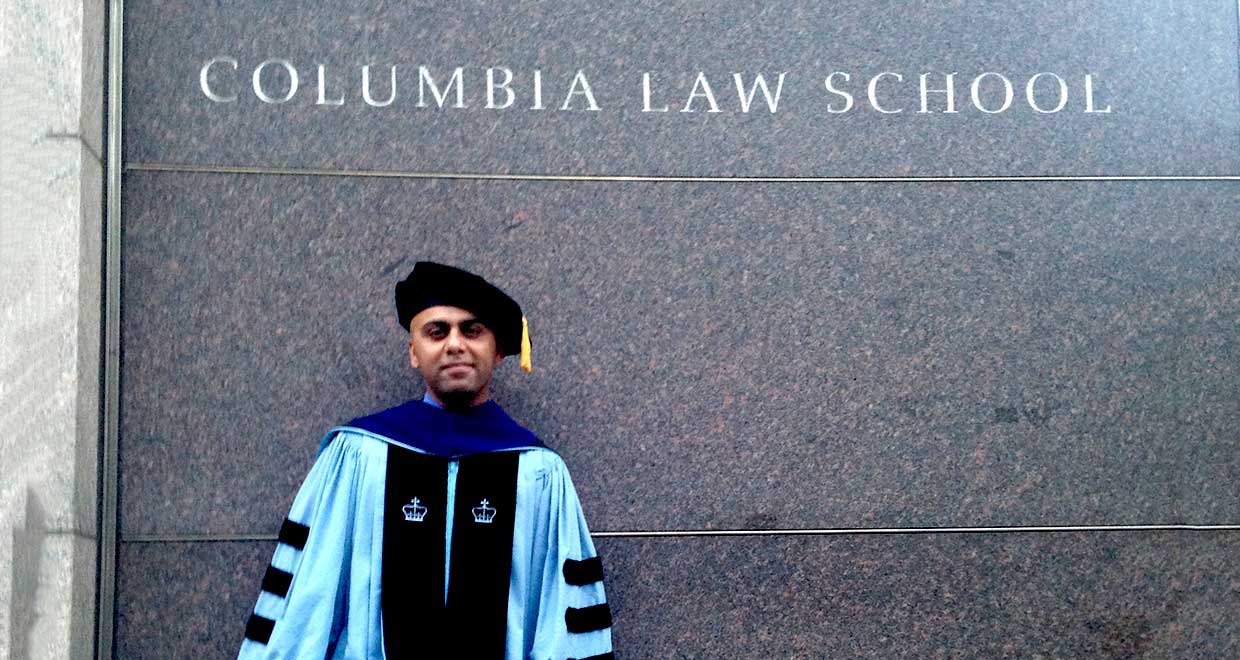
    Sannoy Das graduated from NLU Jodhpur in 2011 with a B.Sc.LL.B (Hons.) in Business Laws. His achievements during law school include winning the North India Rounds of the Phillip C. Jessup Memorial International Moot Court Competition in 2010. He was also a student volunteer at IDIA. After graduation, he was placed at Majumdar & Co., Mumbai, where he worked for a short period before switching to practising as an Advocate at Calcutta High Court. After three years of practice, he successfully applied to Harvard Law School, where he is currently a student. In this interview he talks about:

    • Mooting experience at Jessup
    • Shifting from a law firm job to litigation
    • Law school experience at Harvard Law School


    Please introduce yourself to our readers. How did you decide to take up law?

    At different times, I’ve called Mysore and Kolkata home; for a tiny bit, even Delhi. I started going to school in Mysore, and finished most of it in Kolkata, at M.P. Birla. As for law, it might have been accidental, but it’s been a while ago, so I’m a little foggy. A good friend of mine was preparing to take the exams (many back then), and I went along with her. If I hadn’t studied law, I’d have probably taken up political science.


    You graduated from NLU Jodhpur in 2011 with a B.Sc.LL.B(Hons) in Business Laws. How was your law school experience?

    It’s impossible to have a coherent strain of thought running through five years of law school. I’m sure I did a lot of things wrong, but I’m sure I left more happy than sad. I wish I had digested a few more books at the library, but one is always wiser in hindsight. Of course, as far as lessons in life go, five years at a residential law school are about as good as you will get. I also met my wife at law school. And they gave me the VC’s gold medal to go with it! So pretty good overall!


    You had Honours in Business Laws. Tell us about the Honours program at NLU-J. What other co- curricular and extra-curricular activities were you involved in, in law school?

    I think the Honours programs at NLU are pretty well designed. I think the idea of concentrations in different areas of law is a good one, and to say the least, the courses at NLU-J are well conceived. I could crib that at times, the courses weren’t well facilitated, but that seems to be a common complaint across our law schools. I think it’s also somewhat unfortunate that the overwhelming majority chose the business law concentration. I’m certainly guilty of having followed a crowd in that. Again, hindsight! I think for the Honours programs to make a good impact on a student, foundational courses have to be well-taught, and well imbibed. I think there’s a chance that at times, we slip on that count.

    As for other activities, I think I spent much more time on those than I’d consider prudent. Moot courts took up a lot of time. Even now, I don’t think I have had enough of them. I spent a few years on the moot court committee, finally as its joint convenor. I also took to debating (the parliamentary style) in college. Also, I played some badminton.


    You and your team won the North India Rounds of the Philip C. Jessup Memorial International Moot Court Competition in 2010. What are the important skills and knowledge one must possess in order to be a good mooter?

    Winning the North Rounds felt like a big deal. It was. We had to get over a very formidable NUJS team which had my good friend Deepak on it. We lost at the octa-final stage at the world rounds to Columbia. Till date, I’m sore about it. I think the months that I indulged in Jessup were the best months I spent at the University and I cannot stop gushing about it. Only recently, my team mate Manu Sanan said that Jessup now is a warm fuzzy memory. It really is; replete with an insane number of terribly lousy internal jokes. I only have good things to say about that experience. The team became great friends and still are. Not to forget our amazing coaches Giriraj and Yakshay.

    In mooting, as in everything, I suppose practice makes (somewhat) perfect. I had to go at it round over round. Of course, the love for research is very important. It’s more than just skill. Everyone on our team had a zealous drive to read one more article, one more book and one more case. As for speaking, I imagined I wasn’t too bad it, but it took many rounds of grilling to deliver some decent performances at the competition. I quite enjoyed picking up the best speaker awards at the India rounds. Even the world rank wasn’t too bad!

    Jessup continued to be a love affair thereafter. I’ve coached a few teams with varying degrees of success (but mostly disappointment). In my fifth, I enlisted as advisor to the NUJS team that year. They did a fantastic job at the international rounds.


    sannoy-das-2

    What internships did you do as a law student? What were your reasons for doing each of them and how was your experience?

    I was quite conservative about picking internships. I wouldn’t advise that any longer. I suppose an internship each at AMSS and AZB improved the chances of landing a job at a law firm, but I no longer find that an attractive idea. I have very little to talk about those internships, although I did decent work during most of them. I think I got lucky getting assigned to good partners each time. If I had to give a word of advice about picking internships, I’d strongly recommend getting a variety of experiences, at different courts and different sorts of firms.


    Upon graduating, you started working at Majmudar & Co., Mumbai as an Associate. How did you secure your appointment? Please describe the interview and induction procedure for a fresher?

    I was recruited to Majmudar on the first day of our recruitment process. Majmudar, back then, had the best recruitment procedure, which involved a three stage gruelling process – quite like big firms in other countries. The fact that their process was so thorough made me want to take the job. Also, the fact that it was a mid-sized firm meant that I was likely to shoulder more responsibility than a typical first year associate. That again, was an important factor in accepting their offer. I can’t say what it is to be inducted there now, it’s been a while since I left; but it’s certainly a good place to go if a fresher is willing to be at the business end of things in a short span of time. One tends to get baptized by fire there.


    OLYMPUS DIGITAL CAMERA

    You worked at Majmudar & Co. for six months. What did your work and responsibilities consist of? What were your reasons for leaving within such a short span of time?

    I have no complaints about the work I got at Majmudar. I had plenty of it, and that kept me happy. And I had enough time to savour Mumbai; all the good food and drink (in generous measure). So, maintaining the balance certainly wasn’t my problem. I advised on some corporate issues but most of my work was concentrated around huge sets of cases that we were handling across courts in India, and at the Bombay High Court in particular. I really cherish the exposure I had to high end litigation work in the earliest days of my career.

    Why did I leave? I had some reasons to go back to Calcutta. Also, the litigation bug bit me pretty strong while at Majmudar. Being at the Bombay High Court gave me a push to the ‘other’ side. So I packed my bag and imagined making forceful arguments every day at the Calcutta High Court.


    After leaving, you started practicing in Calcutta as an Advocate. Did you work under a senior lawyer or start your own practice? What were your reasons for moving from a corporate setting to litigation?

    Calcutta maintains the traditional solicitor-barrister/counsel divide. I cast my lot on the side of counsels, joined the bar library club and attached myself to the chamber of Mr. Samit Talukdar, one of the most prominent senior advocates of the court. In about three months, I had a few briefs trickling in. Then I had quite a few. As I said, the sheer attraction of arguing from the bar had drawn me to litigation. I lived some bit of it in the three years at the High Court. I had moved from wearing a tie to wearing a gown, but I was essentially practising a lot of company and commercial law. Even so, the sort of research that goes into preparing to write a brief or argue a case was infinitely more challenging than anything I had done before. It was like doing Jessup every day, at high speed. It was thrilling to be in the midst of volumes of case reports, treatises and piles of petitions. Very soon, my room at home, which I doubled up as an office, looked like a godown. Doing good litigation delivers great satisfaction, but mostly it’s a humbling experience, as I realized every day how much more there was to learn. I worked on a few matters with the top counsels of the court (and indeed of the country), and the challenge of being a worthwhile junior on a matter was quite great. I think I didn’t do too badly. Every once in a while, I heard a word of appreciation that made me dizzy with delight.


    After three years of practice, you decided to study further. What were your reasons for doing so, especially when the general notion is that for a career in litigation one requires practical experience more than an LL.M?

    It’s a somewhat correct notion that an LL.M. isn’t the best idea right in the middle of growing practice. I’d be lying if I said I wasn’t advised against it, and that came from quarters whose wisdom I have no reason to doubt. My seniors at the bar quite correctly advised me to be circumspect about making the decision. And I was. I don’t think I really made up my mind till pretty late. If I am to be really pragmatic, I doubt this LL.M. can have anything to do with setting up a better practice; at least not in Calcutta. If anything, having lost a year at a time when my practice was picking up, means having lost momentum. Fortunately, I did not make the decision of doing this LL.M. pragmatically. I did it because I simply felt some sort of an intellectual thirst, if you will. Not to suggest that working on cases can’t quench it, but I was craving to be theoretical, and was interested in taking liberties that I couldn’t have done while remaining committed to a client!


    Please tell us about your decision to pursue an LL.M at Harvard Law School. Please share some advice on acing the application requirements and procedure for Harvard.

    I’ve always gushed at the name Harvard. I’ve been here a while, and I still do. Not because it’s a reasonable thing to do, but I don’t espouse being reasonable all the time. As I said, I hadn’t decided about actually taking the year off to study when I applied. But when the admission letter came along, I think it was quite hard to look away. It also coincided happily with my wife’s career plans, and she was quite sure about taking her place up at the Chicago Law School. I think I’ve made a few decisions that don’t sit well with rationality. I wouldn’t advise following suit, as a matter of reasonableness. But I would advise it as a matter of principle, because I think it’s quite silly for us to be tied to decisions that we make when we’re all quite young. Not marriage of course. That one is forever!

    Applying to an LL.M., whether at HLS or elsewhere, requires some amount of dedication in crafting the materials. The key is just to start early in the admission cycle – get the referees to send in their letters and the universities in India to send in the transcripts etc. After that, it’s about writing a solid essay. I think the essay requires some good imagination more than anything else. I wrote my application on issues of private international law, because at that time I was quite committed to thinking about rules that govern conflict between jurisdictions. I think the essay requires the demonstration of both a clear understanding of a particular legal issue and a reasonable framework for thinking about solutions.


    It’s a dream for many law students to get through to Harvard Law School. What would be one thing they should necessarily do as a law student?

    They should necessarily study hard. It’s sine qua non to be reasonably well grounded in the laws of the jurisdiction one hails from. I can’t imagine what the factors are, that determine the selection process; I’m just lucky to be here. But if I were to hazard a guess, I think the admissions people at the top law schools are able to discover if the candidate has some real intellectual thirst.


    What were the subjects you were specialising in at Harvard? How has your experience been? Did you indulge in extra-curricular and co-curricular activities there?

    I came in imagining that I’d study a set of subjects that are useful in cross-border litigation. Instead, I’ve spent the year studying international and comparative law, international trade and legal theory. The LL.M. dissertation is focussed on an issue in international trade law (which for selfish reasons, I shall keep to myself). For the most part, I’ve been excited taking classes at HLS. I think the distinguishing feature of the experience for me has been the compulsion that I have felt to think critically, not only about existing regulation, but also about the existing normative views.

    HLS is abuzz with opportunities outside the classroom framework, and I’ve delighted myself attending a host of talks, conferences and symposia. Unfortunately, an LL.M. lasts only a year, and one can’t have everything. I’d have liked to do a lot of things in this one year – be a research assistant, work at the library, join a journal. I’ve managed none of that. Except Jessup. I enlisted as a coach to the team from HLS. Unfortunately, we didn’t make it past the semi-finals at the Northeast Regionals. Till now, one of the highlights of the HLS year has been a fellowship with the Salzburg Cutler Program, which is an awesome conference on all things about international law. It was my first taste of what it is like to defend a paper at a really serious academic workshop.


    Tell us about the faculty and facilities at Harvard. Please share with us a memorable incident from Harvard.

    One can’t have enough of being in awe of the faculty at Harvard. Everyone I’ve encountered is brilliant. I have special regard for my supervisor, Professor Mark Wu. But generally, it’s an environment where the intellectual stimulation is beyond anything I’ve experienced before.

    Watching six feet of snow accumulate over a week is pretty memorable. Otherwise, having studied under (the quite legendary) Duncan Kennedy, now in his year before retirement, is something worth writing in a diary.


    Going forward, how do you see your LL.M qualification would add to your career? Do you think of working abroad ever? Will you return to litigation?

    This is a question I’m not fully equipped to answer. I can make absolutely no prediction of how my career will be affected by this LL.M. I’m certainly not looking to work in a law-firm here. I can’t say further about litigation because I’m yet to sit down and make some hard choices. I am hoping to do some international trade related work.


    Please share with us your experience in litigation. What is one thing that gives premier law school students an edge over others in litigation?

    I’ve already spoken as to what my experience was as a counsel at the High Court. I enjoyed the work that I did at the High Court, and the challenges that came with doing that work. I think the second bit of this question is ill-conceived. I eschew the premier law school tag, and I think it’s an undeserving badge. Many of my contemporaries at the Calcutta High Court didn’t attend these so called ‘premier’ institutions, but were more competent than I could pretend to be. I suppose rigorous academic training makes a difference, but that’s certainly more up to the student than the institution. If on a general review, we could say that some law schools train students better than some others, then there’d be some advantage starting off; but, it gets quickly eroded in practice. I don’t think law schools train students to be practitioners, and I don’t think it’s their job to so. I think the real advantage rests with those who can learn the law as it gets applied in courts, quickly, along with court-craft and litigation strategy.


    Does the Calcutta High Court environment get stressful? What would be your suggestion to a fresher who is graduating this year and would join Calcutta High Court?

    I don’t know of any workplace where the environment causes absolutely no stress. Sure, there’s a fight for space and recognition, but it isn’t a place that a reasonably robust individual cannot survive. I was certainly privileged in the sense that I got to join a really good chamber and my senior was invested in my career. Also, I had plenty of financial muscle from my family to hold me up. Therefore, I don’t think my experience can be representative of the struggle that some others might have to go through, and I don’t intend to paint a picture that is rosier than reality. Having offered that as a caveat, I do think that the High Court is a good place to start (and continue) a great career in litigation. Of course, the court isn’t as active in the commercial space as the courts in Delhi and Mumbai, but there’s still enough work to be done. I think it’s important to have spent some time at the court before making the decision, and a graduating student would at least need to know who the best (and the most indulgent) seniors are.


    How much politics would you say is involved on the Calcutta High Court premises? How do you say one can possibly keep oneself away from this?

    If you are talking about factions in the profession, then my answer would be – yes, there are some and people get invariably implicated. Also, depending on the affiliation that a lawyer has (bar association/bar library club/incorporated law society), a degree of factionalism is almost impossible to avoid. I suppose a generally conscientious person can manage the fine line between good association and vile politicking. Also, I think the affiliations make for good cricket tournaments and the like!

    If you are talking of a political atmosphere, then I think it’s only fair that legal professionals have political views and are engaged in lawyering to achieve political ends. I think lawyering is a way of expressing ourselves as political beings and I certainly wouldn’t be shy in doing that.


    Who are your mentors and/or guides you look forward to for advice?

    I feel quite blessed because of the number of people who have advised me well during various stages from law school to the profession. I often turn to Justice N.N. Mathur, our former Vice Chancellor whenever I need to talk about career ideas, as also some of the senior advocates I worked with – my chamber senior Mr. Talukdar, Mr. S.N. Mookerji and Mr. Jishnu Saha. And my professors here at HLS – particularly, Mark Wu. However, I think the list is much longer and I must repeat myself in saying that I am indebted to more than a few people for having been mentors and guides.


    Lastly, what advice would you like to give our readers?

    I’m not going to pretend to have seen enough to dole out any meaningful advice. But to law students, I’d stress on the importance of being grounded in studying law at law school, and then making career decisions after seeing a wide spectrum of possibilities. I think there is considerable pressure exerted in law school to pick certain career paths, and while those are often excellent choices, they don’t work out so well for everyone.


  • Megha Bhagat, Independent Consultant, Human Rights in the non-profit sector, on a career in research

    Megha Bhagat, Independent Consultant, Human Rights in the non-profit sector, on a career in research

    Megha Bhagat graduated from Army Institute of Law, Mohali. She pursued an LL.M in Human Rights from NLSIU, Bangalore before going on to work at NASSCOM Foundation. She has received a Certificate of Recommendation from HRLN for extraordinary participation in the National Convention on Human Rights and Mental Health, a Certificate of Recommendation from the Supreme Court Bar Association and a Certificate of Appreciation from Amnesty International. She currently works as an independent consultant in the non-profit sector.

    In this interview, she talks about:

    • Law college experience at Army Institute of Law, Mohali.
    • Masters in Human Rights from NLSIU, Bangalore.
    • Interning and working at the NASSCOM Foundation.
    • Being an independent consultant in the non-profit sector.


    Please introduce yourself to our readers. How did you decide to take up law?

    I grew up as a typical military brat with schooling all over the country. This probably formed the foundation for making career choices that varied over the years since I got to meet different role models while moving schools. I can never answer “how” or “why” I decided to take up law but I distinctly remember saying to my history teacher back in the 9th grade that I will either be a lawyer or a journalist. I think the need to know how systems work triggered the decision to study law.


    You graduated with a BA.LLB from Army Institute of Law, Mohali. How was your law school experience? Looking back, what would you do differently?

    When I got into law college I was another 18 year old who had just gotten her first sense of academic freedom. The first year was about figuring out what was it about the subject that really fascinated me and this also typically meant not being a student who scored high grades. While the style of academics remained pretty much like school system, I started exploring the practical world of law and started embarking on internships and legal workshops. Since the college provided the option of specialising in human rights, corporate law or litigation in the 4th year I started building my understanding of what I really wanted to do.

    For the first 3 years I interned at all forms of legal offices- be it criminal lawyers in Punjab & Haryana High Court, Khaitan & Co for the corporate experience, district courts in Lucknow or Human Rights Law Network in New Delhi. This was to ensure that I knew with absolute certainty what kind of law inspired me to work in a particular sector. By the time 4th year happened it was clear that I wanted to study human rights law and interestingly I was the only student not only in the college but the complete university that opted to pursue human rights law! I spent the last two years being on my own (no faculty, no peers), not only studying the intricacies of law but also working on workshops and seminars outside the academic circle. That built my overall exposure to the various facets of options I had set for myself and created role models from the sector.

    I gave up on the idea of mooting pretty early in law college and that is one thing I would love to go back and change for myself! I think being a law student, it is a critical skill to evaluate yourself as a court room lawyer, so it’s something I missed out on.


    You received extraordinary accolades while still in law school. Please tell us about these.

    I received a Certificate of Recommendation by HRLN for extraordinary participation in the National Convention on Human Rights and Mental Health in October, 2004, a Certificate of Recommendation by the Supreme Court Bar association in April, 2005, and a Certificate of Appreciation by Amnesty International in August, 2007.

    One thing I was clear about was that I wanted exposure beyond academic life and therefore remained very active in social circles beyond law college. I worked on making long lasting professional connections at the internships I pursued and I was able to get access to opportunities that existed outside college. Since human rights was already my preferred area of expertise, I was able to find mentors very early in college who groomed me in the sector and that led to participating in sector-specific work with organisations like HRLN and Amnesty.

    I was involved in curating content for the mental health convention and leading a panel on mental health discourse. With Amnesty I was involved in working on the campaign against death penalty in India and wrote a paper on the same while at college. The Supreme Court Bar Association organises an annual conference which nominated students also attend and I was nominated by the college to take part in a discussion on changing trends in human rights discourse globally.


    You interned at the NASSCOM Foundation while in law school and were offered a job there upon finishing your studies. What should one do to get noticed in a large organisation during a short, month-long internship?

    It is very important that you are clear about how far off you see yourself in an organisation when you intern there. This gives you clarity in terms of your role in the organisation as an intern and leads you to make a better impression. In a large organisation it is critical that your interview has already hallmarked you as a different intern over others. For me, that has been my absolute strength- to have distinguished myself with specific skill sets over other interviewees. This impression is typically shared by your supervisor with other seniors in the organisation and that also defines the kind of work you will be doing as an intern.

    Secondly, it is important you join an internship with an inherent zeal and capacity to learn and unlearn. While the “interns fetch the coffee” mechanism may apply at most places I find that most organisations are looking at an intern as a nimble footer who can move between projects easily and effortlessly. I actually joined NASSCOM Foundation and before that GMR Foundation on program management roles which had nothing to do with law at all and yet I entered with a simple mantra of “it is never too late to learn new subject matters and skills”, this trait was duly recognised at both the organisations.

    You have to ensure that you have made a few solid skills of yours noticed and recognised. You can be a good researcher, a fantastic orator, a fabulous report writer, an awesome draftsman- you need to ensure that your work has made this known to the supervisor and also senior folks. They hire you back for skill sets they believe are missing in others and you have to figure that out while you are a part of the team. Lastly, socialise with the organisation! I have always believed that anybody is a person first and bosses/colleagues/peers later, so they are looking to know your working style as a person. Create/use opportunities to meet the seniors in the organisation, have personal conversations with them giving them a peek of where you come from and why you are working with them, pick up a few projects that are outside your work role and talk about those projects to the folks in the organisation. While at NF I was handling various projects from very varied perspectives and I had made my relationship building skills known to the organisation for them to hire me back to lead programs.


    You pursued an LL.M in Human Rights from NLSIU, Bangalore immediately after graduating. What were your reasons for doing so?

    I personally think it is an individual choice to pursue higher studies and their motivation to do so. My motivation was simple- I had deep dived deep into human rights studies during my under grad period without any faculty or guide support and I was deeply interested in rigorously studying the nuances of the subject under able guidance. I went on to pursue an LL.M immediately because I did not want a break in my studies and went on to specialise again in human rights at NLSIU. For me it was the best decision I ever made simply because I spent the next two years dissecting closely the working nuances of various human rights mechanisms and gathering more experience through trainings etc.


    Is it better to work for a couple of years and then go for an LL.M or do one immediately after graduating?

    Every law student should prioritise their 2 year plan right after law school early on. If you are interested in getting on with the job, then by all means pursue work immediately after law school. If you are interested in an LL.M adding specific specialities to your resume, then you should have either figured out by your final year of under-grad what subject excites you (through internships) or you can work for a few years and figure out what speciality makes the most sense to you. And of course if you are a learner like me then join an LL.M to explore what else you can extract from theoretical knowledge about the legal systems.


    You were a Research Assistant for a period of ten months on the topic of “Common Resources of Mankind”. Can you tell us the experience of taking part in this conference?

    This was for a Conference on “Commons” held in January, 2011 under the chairmanship of Nobel Laureate Elinor Ostrom. This was a huge opportunity that came along while I was pursuing my masters at NLSIU. We were chosen to participate in the research for the conference and the papers that would be presented thereof. I was a part of a small working group that was collecting global evidence of the “Common knowledge” and sharing growth stories. We worked on putting together data that indicated that not only were resources to be shared amongst nations but also that knowledge shared across nations was more conducive and relevant to the globalised world order.It was personally a very exciting and fulfilling experience since it added to my overall learning growth under such an esteemed academician.


    After graduating, you joined the NASSCOM Foundation, New Delhi as a Business Responsibility Officer. What was your work profile like? What were your main tasks?

    My work profile included program management for CSR, research and publication on relevant CSR subjects and support for the Disability Program of the organisation.

    In the first year I was tasked to build regional industry forums on Corporate Social Responsibility. I was leading 3 regions: Bangalore, Hyderabad and Chennai, and building working groups from within the IT industry to lead social impact projects within the cities. It was an interesting space to work in since it meant that I had to become well versed with all the IT/BPO companies in those regions and curate projects based on the skills that each company possessed and also work with CXO levels to change mindsets around CSR and social impact footprint of the industry.

    In the 2nd year two changes took place- I was handed the responsibility to set up operations for the organisation in Bangalore and also handed the Program Management responsibility for an internationally funded project by the Rockefeller Foundation. I moved to Bangalore to successfully start the Foundation’s south regional office and also worked on new skills of writing funding proposals, managing an international donor and pretty much moved towards program management work. I did stay in touch with the law with the Planning Commission’s work on the 5 year plan where Iwas representing the industry on the change in the disability schemes and law. Similarly, I stayed connected with policy making work while working with the Karnataka government on amending the policy for Rural BPO’s within the state and creating more inclusive policies for small entrepreneurs.


    After two years at NASSCOM, you joined the Fellowship Program at The Rockefeller Foundation. How did you secure your appointment as a Social Innovation Fellow? How was your experience there?

    The Social Innovation Fellowship at the Rockefeller Foundation was a nomination led process. All 18 fellows were selected and nominated by the Rockefeller Foundation based on our areas of specialisation and backgrounds. I was at that point of time also leading a project for the Foundation in India and working on creating a report for the global BPO industry.

    Like most fellowships this was a life changing experience. I was one of the youngest fellows in the cohort and this was especially exciting since I got to learn from very inspiring senior folks from the social impact sector. We were travelling every 3 months to a new country to look at social innovation on the ground and to learn theoretical tools from our faculty from University of Waterloo, Canada and Stockholm Institute of Resilience. The travelling diaries made the beautiful countries seem so much more closer and catered to the travel bug in me.

    It was riveting being amongst social change makers and witnessing NGO’s on the ground that were implementing social impact on a large scale and under various dynamics. At a personal level it made me introspect about my vision for myself and what else I wanted to do to change the world. I not only went on to make great friends but I’m also still inspired by the passion for social change that these amazing social innovators carry. I moved on from NASSCOM Foundation at the end of my fellowship program and started my own journey of creating social impact via various projects and organisations instead of limiting myself to one organisation.


    Please tell us about your current occupation. What do your main tasks and assignments include?

    Presently, I work as an independent consultant in the non-profit sector consulting with the International Institute of Education and Advisor at Education for Development, a non-profit organization in the education sector. I started consulting for non profits and start ups earlier this year. I currently lead operations for IIE’s new project called We Tech (Women Enhancing Technology) and led the foray of the program in India. I primarily work with the IT companies on mentoring high school girls to enter the coding space. The program is just going into its second year and I am working closely with the industry to scale the program.

    In my role with E4D I am working with a very inspiring youngster who graduated from college and decided to change the way learning systems run in the country instead of taking up a plush job. E4D set up a “maker space” on the outskirts of Bangalore and provides an alternative learning system to anybody who wants to learn from making. I work with the start up on business development, outreach to partners and organisation visioning.


    Your interest areas have been education, policy research and business strategy. How did you pursue these interest areas while still in law school?

    I have always been interested in pursuing different subjects and gaining new skills through that exploration. While at law school I was involved with various research organisations like HRLN, Amnesty, etc. and worked on research papers for various human rights subjects including education. I had a lot of time on my hand to write articles based on changing policies and utilised my professional circle to gain access to opportunities to present the research or work on new and developing research. While I interned with foundations of corporate houses I picked up the nuances of business strategy by working closely with the corporate, business development teams of the parent organisation. I was always interested in how one could integrate social responsibility within the DNA. The wide range of exposure got for myself gave me ample playing field to pursue my interests.


    You have been commended by your previous and current employers for being a people’s person and building strong working relationships. How important are social skills for a lawyer and how does one cultivate them?

    Personally I am a typical military girl, which means I am used to forming relationships where ever I go. Add to it the fact that all through my seven years of legal education I dabbled with varied institutions and organisations thus leading to an overall understanding of different industries and professionals.

    As a lawyer, I think social skills are extremely relevant if you want to grow out of your shell at a regular desk job! If you are looking to grow further up in the legal field or diversify later into varied sectors you need to socialise beyond the circle and form learning relationships with various professionals. It is important to go out of your comfort zone and interact with professionals in different fields, to have a childlike curiosity to learn something new and if there is one thing every human likes it is the opportunity to share knowledge. In my experience forming people relationships is an important component to grow as a professional and seeking out collaborators is useful in the long run. Whoever you meet through work should connect with you at a personal level too and that goes a long way in staying on as strong professional networks.


    It is a common belief that working in the areas of human rights and policy research doesn’t pay well or at least as much as a law firm does. How true is that notion and how much of a hindrance is it for people joining this area of work?

    Unfortunately the social impact sector does not have pay grades like law firms. This grim reality has led to keeping fresher level talent away from this sector. The growth in the sector takes place after the initial 4-5 years and “social work” “policy research work” haven’t picked up as mainstream skilled professions leading to much less people joining the sector. The other side of the coin is that the growth is phenomenal if you stay put for initial 3 years and learn the sector well enough. The sector requires nuanced expertise and once you have created a network for yourself and become a subject matter expert it doesn’t take much to grow from post to post.


    What are your plans for the future? What advice would you give to the students reading this interview?

    I intend to keep working in new subject areas and utilise my skills to work on solving varied social problems. I would hate to stay put in a specific area and therefore I see myself drifting from education to technology to urban development challenges to art and literature as forms of ending violence. The variety in the subject matter keeps me excited and thus will move from one project to another keeping my insane urge to travel also satisfied.

    I would say to the students that: Don’t restrict yourself to one particular field of study just because you entered a particular sector. Figure out for yourself what excites you the most and then pursue that ambition with or without law. There are amazing opportunities that exist outside the framework and as a lawyer you are already well equipped to be a rockstar in most of the nuanced sectors! Pursue a particular field because that is what inspires you every day otherwise you will just end up being another lawyer in the country!

  • Dhruv Suri, Principal Associate, PSA Legal, on leading a student organisation, LL.M from Columbia University and work at Law Firms

    Dhruv Suri, Principal Associate, PSA Legal, on leading a student organisation, LL.M from Columbia University and work at Law Firms

    Dhruv Suri graduated from Guru Gobind Singh Indraprastha University, New Delhi in 2009. While in college he co-founded a student organization called United Students which initiated the Jessica Lall and Priyadarshini Mattoo campaigns. He was invited by the then President, A.P.J. Abdul Kalam to discuss problems of OBC reservations after receiving his memorandum on the same. He has interned with AZB & Partners and Valeo, Paris. He received a PPO while interning at PSA Legal Counsellors where he was an Associate for four years before opting for an LL.M from Columbia University, New York. He has joined PSA after coming back from Columbia. He is currently a Principal Associate at PSA Legal Counsellors. In this interview he talks about:

    • Studying law at GGSIPU, New Delhi
    • Recruitment and work experience at PSA Legal Counsellors
    • Masters from Columbia University, New York


    As an introduction, please tell us about your schooling and how you decided to pursue law.

    I was born and brought up in Delhi and did my schooling from Delhi Public School, Vasant Kunj. I graduated from school in 2003 and was unsure of what I wanted to do. So much so that my family registered me for one of the law entrance exams and I ran away to Mumbai with a friend for a holiday. Of course, that did not go down too well with my family after I came back. When I came back, I took admission in Delhi University where I studied English Hons. for one year. However, for that entire year, all I did was theatre and learn dance. My attendance at college was abysmal! In 2004, I was emotionally blackmailed by my mother to register for the law entrance exams once again on the pretext that I would be given a Maruti 800 to travel to law school and an increment in my pocket money. I fell for it and got an option to study at Amity Law School. Back then, Amity Law School was a building in south Delhi and did not have the atmosphere of a “campus” that I grown accustomed to in my one year at DU. So, I opted for the main Guru Gobind Singh Indraprastha University law school which seemed like a better option. Rest assured, I got no car and travelled 40kms a day in local Delhi buses. So, this is how my journey with law started- as a “victim” of emotional blackmail from my mother! J


    You completed your law degree from Guru Gobind Singh Indraprastha University, New Delhi in 2009. What activities were you involved in there? Looking back, is there anything you wish you had done differently?

    The first few years just went by in trying to understand what law is really about. I loved courses like Legal Reasoning, Jurisprudence, History, and Contract law. I also loved mooting and showed up at any and every audition, whether I was prepared or not. I was also very active in the debating society and ensured that I participated in as many competitions as possible. Since our campus was fairly big and had lots of engineering and management colleges as well, there was always some event or the other taking place. By the time I was in my 4th year, debating became a source of extra pocket money.  However, amidst all this, I was also focussed on getting good internships and a job. In fact, if there is any regret that I have, it is that all through my final year I worked after college hours, whereas all my friends were enjoying themselves, going for lunches, movies and ensuring that their last year as a “student” was memorable. When I look back, I could have probably worried less about my career and instead made the most of my final year at law school. Eventually we all had to work but I do feel that I missed out on some fun times with my friends.


    You started a student organization called United Students. You contested the Delhi University elections and initiated the Jessica Lall and Priyadarshani Mattoo campaigns. Please tell us more about it.

    United Students happened by pure accident. I was in the latter part of my 2nd year at law school when I met the other founder members of United Students at a coffee shop in central Delhi. I had always been someone who liked to initiate and take the lead in everything I did. The trial court verdict in the Jessica Lall case was out and I was having discussions and debates with people from all quarters about the merits of case, legal arguments advanced, etc. Some common friends connected me to like Aditya Raj Kaul, a young 17 year old (now a popular Times Now reporter), who had started an online campaign in connection with the Priyadarshani Mattoo case. Aditya and I realised how similar we both were and he introduced me to the other founder members. We were all passionate about bringing about a change and decided to collaborate. I think that really was the key reason for launching United Students. We wanted the organization to encourage young Indians, particularly students, to think and debate in a cohesive manner and take up issues of governance. The idea was to engage in discussions and debates, take an informed stand and then take steps on ground to the best of our abilities. I think the legal profession is somewhat similar. Discussions and debates are synonymous with research, which is very important to take a stand and advise the client. As I got busier with law and internships and all other members got more absorbed in their lives, the organization had a natural death. However, the entire experience played a big role in how I evolved as a person and it is something that I will always cherish.


    Why didn’t you pursue a career in politics? Do you think you will enter the field again in the future?

    I remember I was doing a shoot for a big news channel during the Delhi University elections and the spokesperson of one of the bigger political parties came to me and asked me to formally join them. I wonder how different life would have been had I actually done that! But on a serious note, I did consider pursuing politics more seriously but was equally eager to graduate and practice law. Who knows, one day I may actually be able to balance a legal and political career!


    dhruv-suri-3

    During your time at law school, you interned at AZB & Partners, New Delhi and Valeo, Paris. Please describe your experiences.

    All my internship experiences were very rich. At AZB I did my first all-nighter and got a real sense of how corporate law firms work. The lawyers were extremely kind and I am still in touch with some of them. Valeo was great because I got to work in-house and attend lots of business meetings. I realised how a “business lawyer” (whether in-house or external) cannot give pragmatic advice if he/she does not have a sound understanding of the business. This was the biggest take-away from this internship and till date, I try and adopt the same approach while advising clients at PSA. Of course, I got to spend a little less than 3 months in Paris which was fantastic and the first time I stayed by myself. I made sure I saw every bridge, every museum and (almost) ever cafe and bar there.


    You also interned at PSA Legal Counsellors and then received a PPO from them. What do the recruiters at PSA look for in potential candidates? How did you secure a PPO?

    One of the most preferred modes of recruiting at PSA is to give offers to final year law students interning at the firm and then training them internally as they grow. The firm encourages building in-house talent.

    In terms of how PSA approaches recruitments of potential candidates, I think it is more or less assumed that a first year associate will not know much about the law. However, she/he should be eager to learn and work hard, and also interact and work well in a team. PSA also believes that before becoming a specialist, it is important to be a good generalist. So, if there is a student who only wishes to work in the area of, say, capital markets or intellectual property or competition, PSA would not be the best place to work. Whereas if someone is keen to do everything and gradually pick areas of interest and focus on them, PSA would be an ideal place for them.

    In my specific instance, I interned with PSA all through my final year at law school. While I was still an intern, I got actively involved in a big PE transaction. The deal was still ongoing when I graduated so I just continued working on it and did not stop. Slowly I got drawn in on a lot of other matters and before I realised, I had spent almost 5 years at the firm!


    dhruv-suri-4

    Upon graduating, you started working at PSA as an Associate. What was your work profile like?

    Like I mentioned, at PSA, you do everything in your first year. So, my work profile was nothing different. I was actively working on a PE deal, but also assisting the senior lawyers in day-to-day corporate advisory, researching for litigation matters, working on intellectual property queries and even drafting board minutes and incorporating companies. Gradually the work becomes more sophisticated and challenging but the basic training I got in my first year continues to be invaluable and (I’d like to believe) set a strong foundation. Before I left for my LL.M in 2013, I was working on sophisticated M&A transactions, advising large conglomerates on complex legal queries pertaining to contracts, IP, tax, employment etc. and arguing matters before the Competition Commission of India.


    dhruv-suri-2

    After four years at PSA, you opted for an LL.M from Columbia University, New York. How did you secure your admission at Columbia? What was your specialisation?

    So, Columbia and Harvard are two schools that I know do not offer a specialised LL.M. In fact, even as a matter of personal preference, I did not want to do a super specialised LL.M. The application process was exhausting and almost impossible to manage with long work hours. I took 10 days off in October 2012 to work on my applications and finalized as many as I could. Even the 10 days were not enough and I spent a lot of weekends on my personal statement and other school-specific essays that were required. Now when I look back, I am so glad I put in that effort because Columbia really is one of the best things that ever happened to me! Plus I got to live in New York which just takes the LL.M experience to a whole new level.

    With respect to courses, there was a fair bit of flexibility so I made sure I had a variety on my plate. Some of my courses were “Strategic International Commercial Transactions,” “Financial Statement Analysis,” “Intellectual Property Drafting,” “Negotiations,” “Corporations,” etc. All of them were taught by top-notch professors who made studying such a pleasure, an area where, in my opinion, Indian law schools have a lot of catching up to do.


    You also worked as a Research Assistant for Professor Anu Bradford in the field of antitrust laws. On what basis were you chosen for the project? How was the experience?

    I have always been very interested in competition/antitrust law. During my first month at Columbia, we received an e-mail that Professor Anu Bradford was looking for LL.M research assistants to work in the field of antitrust law. I think I drafted a short cover e-mail and sent my CV within 5 minutes of receiving the e-mail. Professor Bradford called me for an interview and soon I started working for her. The experience was so enriching because the work she asked me to do involved coding antitrust laws of multiple countries (including India) and understanding key differences in how statutes are drafted across those jurisdictions with respect to restrictive agreements, cartels, abuse of dominance, etc.. The work gave me a deep and detailed understanding of antitrust laws. Plus, she is one of the most wonderful people I know and mentored me throughout the time I was at Columbia. I am just glad I got to work with her.


    Is it better to pursue an LL.M right after college or after working for a few years?

    This is a question that a lot of people aspiring to do an LL.M ask. Honestly, I don’t think it has a right answer. A lot of my friends went for their LL.M immediately after completing law school but I chose to go after gathering some work experience. Specifically for Columbia, which has an extremely competitive curriculum, it is rare for them to admit anybody with less than 2 years of work experience. Of course, there are exceptions. Based on my experience, I do think that work experience comes in very handy, especially when you are learning about a different legal system. You are definitely wiser and more mature to gauge concepts by linking them to your practical experience. Plus, you also tend to make a lot more of your degree by networking professionally, which, I think, can be challenging if you have never worked before.


    Do you think the LL.M has improved your career prospects? Do you have larger responsibilities at PSA now?

    The LL.M has definitely helped me a lot. If I had to point out one thing, it has made me surer of my work and more confident in my interactions with clients, both Indians and foreigners. In terms of my profile, I am now a Principal Associate at the firm and manage PSA’s start-up/PE/VC practice which is extremely exciting because I interact and work with dynamic start-ups and very passionate entrepreneurs.  While I continue to do legal work, a lot of my time and energy is also spent on business development, which I thoroughly enjoy. So clearly, the responsibilities have increased and the concept of weekends has dissolved. I have to be on top of whatever I am working on all 7 days a week and I actually prefer it like that.


    Lastly, what advice would you give to law students wishing to pursue a career in corporate law and considering doing an LL.M?

    I would say that, make sure you do internships in law firms in your 4th and 5th year and be proactive when working. I enjoy working with interns who are eager to learn, proactively follow-up with me and don’t hesitate to take responsibility of their work. It is a good opportunity for you to demonstrate your attitude towards work. Also, be prepared to do any and all kinds of work. You will realise much later how the most minuscule things you worked on as an intern or first year associate come in handy during negotiations or drafting contracts. So, approach work with an open mind. Finally, if you plan to do a LL.M, my advice usually is to work for 2-3 years. It will really change your perspective and you will be able to make the most out of your academic courses and the overall LL.M experience.

    In the end, I would just say that work hard but make sure you enjoy your student life as well. That time (unless you do your LL.M) will not return. Good luck!


  • Ronak Thakkar, Associate, Jyoti Sagar Associates, on the first year at a top law firm

    Ronak Thakkar, Associate, Jyoti Sagar Associates, on the first year at a top law firm

    Ronak Thakkar is currently an Associate at J. Sagar Associates, Mumbai. He graduated from Government Law College, Mumbai, and simultaneously earned his Company Secretary degree. His internships include Tata Motors Limited, P&C Legal and J. Sagar Associates, Mumbai. He has also completed a Diploma Course in Cyber Law from Asian School of Cyber Law, followed by the Advanced Certificate Course in Foreign Trade, International Business/Trade, Marketing and Dispute Resolution from the Indian Merchants’ Chamber. In this interview he talks about:

    • Academics and co-curricular activities at GLC, Mumbai
    • Internship, recruitment and work at corporate law firms
    • Pursuing a C.S. degree along with LL.B studies


    Our readers consist of law aspirants, law students and young lawyers. How will you introduce yourself to them?

    Firstly, thank you for giving me this opportunity to share my story. This interview is going to be an experience in itself as I am usually the listener and the one who asks questions.

    I rocketed to Earth as Ronak Thakkar. I’m a corporate lawyer, 23 years old, currently working in Mumbai (Bombay, for those who prefer it that way). I am passionate about law, live life with an open, accepting mindset and am always up for a high five.


    Tell us a bit about your childhood and pre-college life as well as educational background. Do you have lawyers in your family?

    I was blessed with a very good childhood and was fortunate to have caring and supportive parents. I was a last bencher at St. Pius X High School, an all-boys school. As you’ve guessed it right, the energy and the adrenaline rush were really high.

    Honestly speaking, school has been one of the best phases I have lived through so far. I guess the feeling is the same for all of us. I have learnt a lot, made many friends and it has definitely been the foundation stone to the positive attitude with which I stand in front of you guys today. About my educational qualification, I am a law graduate from Government Law College, Mumbai.

    I am a first generation Superlawyer. I also don’t have a surname that is well-established in the fraternity.


    In India there is bit of resistance towards legal education even now. What motivated you to choose law as a career?

    I don’t personally feel that there is any resistance towards legal education now. I think students in India today are more than happy to take up law mainly because law offers you many opportunities to do your best in your chosen interest areas. The Government is doing a lot to promote legal education and make it more accessible. In GLC there is about 50% reservation for students who belong to eligible quotas like SC/ST, sports, cultural etc. and these opportunities are being utilised.  I don’t think there is any resistance.

    As far my motivation to take up law and pursue law as a career is concerned, it was simple. I could relate to it more than anything else and definitely relate to it more than I could relate to K4Fe(CN)6 + H2SO4 + H2O = K2SO4 + FeSO4 + (NH4)2SO4 + CO.

    According to me law helps you to find solutions in real life situations and is a very practical subject. I felt that by doing law I will be standing for a purpose/cause and will work towards achieving it. Therefore I took it up.

    Curiosity is the word. Law is interesting; I felt I wanted to know more. I was sure that I will be better as a lawyer than a dentist or an engineer. It wasn’t very difficult to take that decision then.


    How did you get through to GLC, Mumbai?

    I was a science student before I took up law. I was weak with numbers, never got my chemical equations right. I had realised that I had failed to make the right choice. I was about to waste a year because it was a bit late by the time I decided to do law and GLC was the only college I was able to apply to.

    While going through the admission process, I learnt that in order to get through GLC, your HSC percentage is taken into account and you are not required to give CLAT which was motivating considering that I had not given the CLAT.

    I am very happy that I got through and was a part of this excellent institution.


    Which subjects did you enjoy during your qualifying degree? What about co-curricular activities?

    I enjoyed Company law, Banking laws and Constitutional law. I contributed to the Magazine Committee of GLC in my first year.  I moved on to learn German and Japanese in my second year as learning new languages and networking are my hobbies.

    I felt that much of the law related to people and their dealings with each other, and it was crucial to understand thought processes and society to be able to work towards solving social problems. Therefore, I took up voluntary community service at the Indian Red Cross Society, Mumbai and was a part of some of their programs.

    I became a part of AIESEC, Mumbai in 2011, a branch of the world’s largest youth run organization, AIESEC International which gave me an opportunity to network and facilitate student exchanges with partner countries. It was a very positive experience as AIESEC always welcomed new ideas, promoted teamwork and leadership. As an AIESEC Organizing Committee member for “Balakalakaar 2011” I worked towards empowering under-privileged children and was instrumental in giving them a platform to showcase their talents.

    In my final year of law school, I was an active member of the GLC Students Council, the apex student body where I worked towards organizing events and promoting various initiatives for the welfare of college.


    Tell us about the places you have interned at. Did you plan your internships throughout law school?

    I did not plan my internships. As a part of my C.S. coursework, I had to do a compulsory internship for which I approached ICSI, my C.S. Institute to know how to go about the internships. Based on their guidance, I applied to companies and procured my first internship at Tata Motors Limited where I did a mix of corporate secretarial and legal work.

    As I discovered that I am more inclined towards corporate and transactional legal work, I asked some of my friends to suggest good law firms where I can learn more. After doing a bit of research online, I was able to contact the H.R. departments of these firms and submit my resume for their consideration. That’s how I procured my internships at P&C Legal, Mumbai and J. Sagar Associates, Mumbai.


    How relevant did you find your law school education with the kind of work you were required to do at law firms?

    I found it quite relevant. A law school curriculum is designed to cover everything that a law student ‘must’ know before he/she starts practice. Working on a transaction/matter will teach you more about the practical application of law to transactions/matters. But from an academic standpoint, I feel the education was very relevant to prepare one for the practicalities.


    You also managed to pursue the Company Secretary course. Tell us how did you manage it with college?

    In my first year, I saw a few students from my college applying for it. So I walked up to one of them and asked them about the course. I was told it is “core corporate law”. So I went up to www.icsi.edu to find out more and was convinced to pursue it.

    Initially it was more like following the rat race but as I discovered that I was more interested in corporate transactional work, I continued with the course and it was very helpful academically as it had important insights on subjects like mergers and acquisitions, securities law etc. which were not covered by my law school curriculum but were otherwise very relevant.

    As regards, how I managed to do it with college, I have a secret formula which is – “Be humble, hungry and the hardest worker in the room”.


    Soon after graduation, you joined J. Sagar Associates as an Associate. How did your appointment take place? How was your interview? Please give our readers some tips to nail a law firm interview.

    I applied to work with J. Sagar Associates after I completed my internship. My appointment was based on a review of my performance as an intern with the firm. My interview was a formal one and was focused on confirming my resume and ensuring that I knew what I was talking about from a “technical” standpoint.

    The interview was also about finding out if I am the right fit for the position or culture at J. Sagar Associates.

    I haven’t faced many interviews, but if I were to highlight some important points for applicants to keep in mind while applying for a job, they would be:

    Research about the law firm where you wish to apply.

    Make an effort to really understand what the firm’s expectations are of you and whether you will be in a position to meet them.

    Know your career narrative well. The career narrative must be easy to remember and retell. It should meaningfully link your past successes to your near and long-term development needs and suggest the kinds of assignments that would help to achieve those objectives It must hang together with the right combination of honesty, humility, and personal flavour.


    ronak-thakkar-2

    How tough were the first six months at your workplace?

    They were not tough or difficult. J. Sagar Associates (JSA) has a very positive, supportive and friendly work environment. I have helpful team members and well-informed, accessible partners who guide me so that I can deliver my best. This is actually very encouraging and has motivated me to learn more and get better on the job.


    Tell us about the nature of work you’re entrusted with and what a typical day is like. What is the most challenging aspect of your job?

    I am entrusted mainly with transactional and advisory work. My practice areas are private equity, mergers & acquisitions, banking & finance. I also work on general corporate commercial matters and am involved in drafting, negotiating and reviewing a variety of commercial and financing contracts.

    In my view, the most challenging aspect of my job is time management. There are deadlines to matters and it is important to be responsive to clients. When you are on multiple active transactions it becomes a bit challenging to balance between long work hours and one’s personal life.


    Do your dual qualifications complement each other in terms of your work?

    Yes to an extent. The qualifications have helped me to understand concepts better and gain much needed academic exposure before facing a practical transaction/situation.


    There is a phenomenal obsession amongst law students with maintaining a very high CGPA. How important according to you is this in securing a job in a top tier law firm?

    My personal view is that a high CGPA is definitely an important reflection of your academic performance, but it is not the only parameter on which your capabilities to be a part of the top tier law firm are adjudged.

    If your CGPA dropped because you were involved in extracurricular activities due to which you weren’t able to devote sufficient time to your studies in a particular semester, that doesn’t mean you are not a performer. But it surely means that you are a multitasker!


    You did a Diploma course in Cyber Law from Asian School of Cyber Laws. Tell us about the course structure and the utility of pursuing such Diploma courses beside studies.

    The course gives you knowledge about the information technology laws of the country and how e-commerce is regulated in India. For more information on such courses please visit: asianlaws.org. The Asian School of Cyber Laws is doing a really good job. There are tutorials conducted to make you understand the subjects in detail, the study material is helpful and exams are open book.

    I personally feel that the IT law practice is still in its developing stages in India. And from what I foresee, we are being increasingly driven by technology in our personal and professional lives with each passing day. It is naturally important to know how the law relating to technology is and will be regulated.


    You have also pursued an Advanced Certificate course in Foreign Trade, International Business/Trade, Marketing and Dispute Resolution from Indian Merchants Chamber. What was this course all about? Do you think pursuing this kind of professional courses help?

    India holds an integral part and has an important position in the global economy today. Naturally, there are going to be many cross border transactions and opportunities coming to our doorstep. As a lawyer, one will be required to work/advise on these transactions.

    The Advanced Certificate course in Foreign/International Trade course gave an overview of export-import and commercial transactions, documentation and more importantly about the foreign trade policy and the Foreign Exchange Management Act. These are key regulatory areas which will be very important to take into account if you were working or advising on a cross border transaction.

    These subjects were not covered in sufficient detail in my law school curriculum and therefore I felt the need do this course.  You can know more about the courses offered at the Indian Merchants Chamber website.


    Where do you see yourself five years from now? Would you consider going for an LL.M. abroad?

    I don’t make five year plans. I have my fingers crossed and hope that I should be doing well five years down the line.

    Yes, I might consider doing an LL.M if I manage to get a scholarship.


    What would be your parting message to law students who want to get placed in a law firm?

    I believe that ‘effort motivates accomplishment’ and if you work towards something you want in the right manner, you will achieve it. There is a Superlawyer in each of us. Find what you love to do, and just give your best.

    Firms will be more than willing to welcome you if you are good. People at firms are sweet, trust me!

    I am reachable at LinkedIn and Facebook in case anyone needs to get in touch. I take this opportunity to wish law students all the very best and I will be the happiest to know about their success stories.


  • Raghavan Ramabadran, Partner, Service Tax & VAT matters, Lakshmikumaran & Sridharan, on being a Chartered Accountant and Lawyer

    Raghavan Ramabadran, Partner, Service Tax & VAT matters, Lakshmikumaran & Sridharan, on being a Chartered Accountant and Lawyer

    Mr. Raghavan Ramabadran is a Partner at Lakshmikumaran & Sridharan. He currently heads the Service Tax and VAT practice of the Chennai and Hyderabad branches of LKS. He pursued a C.A. degree while simultaneously pursuing a B.Com course from Vivekananda College. His interest in taxation led him to join LKS after qualifying as a C.A. He further pursued a law degree from Law Centre II of Faculty of Law, Delhi University (“LCII”) while working at LKS itself.

    In this interview he talks about:

    • The LL.B and C.A. combination
    • Pursuing a law degree while working
    • Work of a Partner of Lakshmikumaran & Sridharan


    Where did you grow up and attend school? How did you decide to pursue C.A.? Please tell us a bit about yourself.

    I did my schooling in Chennai. I belong to a family full of Sanskrit scholars. In fact, my grandfather is a President’s awardee for excellence in Sanskrit. As a kid I was taught Sanskrit and Vedas. I had in fact completed my Vedic education by the time I finished my XII standard. Though I was always good in Mathematics, Science was not a subject which interested me and hence I chose to pursue a career in accountancy and enrolled myself in the C.A. course while simultaneously pursuing my B. Com course from Vivekananda College. I was always interested in taxes and once I completed my C.A. course, I applied to L&S. After joining L&S I realised how important it is to learn law to fully understand and work in taxes. Mr. Lakshmikumaran and Mr. Sridharan were very kind to me and took me to the Delhi Office for better exposure which also enabled me to attend the evening law course in Delhi University.


    After qualifying as a C.A., you joined Lakshmikumaran & Sridharan. How did you decide to join a law firm instead of practicing as a C.A.?

    As I said, I was always interested in taxes and one of my friends (who is also a C.A.) had already joined L&S. So I knew it was a great firm doing excellent service in the field of taxes. Hence, the choice was easy. I had applied to the firm. I was interviewed by Mr. Lakshmikumaran. The interview happened over several rounds and I was also asked to present a paper on Transfer pricing and the GATT Valuation Code.

    The firm already had the practice of hiring non-lawyers and therefore I was not an exception. Mr. Lakshmikumaran encouraged me to do law and explained to me how the scope of a C.A. is restricted as he cannot practise in High Courts.

    I realised that though a C.A. can render excellent advice, it is ultimately a lawyer whom he has to engage to sustain his advice before a court of law.


    What did your work profile at LKS consist of, before you were a lawyer?

    I was doing a lot of drafting which includes opinions, replies, appeals, writs, SLPs, etc. I used to do research and brief seniors in matters. Study sessions are a part of L&S culture and I was a regular in attending those. I was initially absorbed in the Customs team of L&S. Later when L&S started its practice in VAT, I was moved to the VAT Team. I was working in the VAT team till I became a lawyer.


    Tell us about your law school experience.

    When I look back at my years at LC-II, they were perhaps some of the best years of my life where I came across many intelligent and dynamic batchmates. The professors were very engaging and the curriculum was rigorous and very demanding. Everyday offered a new perspective on one’s approach to appreciating the law. Whatever I say about LC-II and its quality of education and the faculty, will be very little as its reputation speaks for itself.

    Perhaps, it would be interesting to mention here that the courses taught at law school helped me at the workplace too. At the time when the seminal BSNL case was being argued at the Supreme Court, in which L&S was substantially invested, I could appreciate and contribute to the table some of the finer aspects concerning the constitutionality of the provisions that were being debated upon.


    Is there anything you would like to have done differently?

    There is nothing that I would have liked to do differently. Looking back, I think what matters the most is how you allow the experience to enrich you and not overwhelm you. The sheer diversity of the people you meet and the insights you develop on life allow you to become a more practical individual, in a manner of speaking.


    raghavan-ramabadran-1

    How did you manage to eke out time for a regular three-year LL.B from LC-II while working at LKS? Please share with us.

    If you don’t have time in the day, steal it from night. Needless to say, switching back and forth from office to college was a demanding affair indeed. The tight schedule would otherwise be a strain on a normal individual. But maybe, it was the hunger for experience and knowledge that kept me going those years.

    The daily schedule involved coming in to the office by 7:50 A.M. From 8 A.M.-10 A.M. I would attend sales tax study sessions chaired by Mr. Sridharan himself. This was a ritual I stuck to for one and a half years, and it paid off greatly. Regular work would follow this until evening when I would scamper off to college and again head back to office to take care of pending work. Many a times, in fact most often, I would sleepover at the office lobby. Suffice  to say, this was occasionally tiring but never did I feel flushed or demotivated.


    You have more than a decade of experience in handling litigation relating to Service Tax, VAT and other areas of indirect taxes before various forums. What were the differences in your experience as a CA and as a lawyer?

    Completely different. As a lawyer, you can rely on yourself to sustain your interpretation. For a CA, there would be a two-step process to take a legal point across, one to the arguing counsel and the final one to the judge. Whereas for a lawyer, there is only one level to convince, the judge and not the arguing counsel.

    As a C.A., our exposure to law was oriented to the extent of appreciating the application of the law. However, being a lawyer one can delve into the correctness, spirit of the law and formulate its ethics and justifiability. As a C.A., we could hardly acknowledge the fine line of difference between a rule and provision. While studying law, the questioning spirit came alive.


    Currently, you head the Service Tax & VAT practice of the Chennai and Hyderabad branches of LKS. What are the best and worst parts of being a partner at one of the most successful tax law firms in the country?

    The best part easily is the bench strength at the firm. A multitude of good clients, refined nature of the tasks, variety in the kind of deliverables, priority on ethics are some of the traits that would easily attract anyone to the firm. The knowledge chest that L&S has is in its people, be it in excise law or patent prosecution. Other than this, the resources in the form of a heavily standardized information technology system, books, journals, credible physical infrastructure offers one an experience worth its weight in gold.

    The challenging part, and definitely not the worst part, is that the benchmark is very high. There are a lot of expectations to be met. Arguably though, this is something that is expected with the responsibility of being a partner at a leading law firm.

    Pondering over mystical questions like “work life balance” takes a back seat as these are questions that I do not find myself philosophically qualified to answer. Other than this, there are always the clients who keep calling at unexpected hours, which is why I am always nervous whenever my phone battery runs out, lest I miss out on an important call. The work profile for a partner is expectedly very demanding as one has to always stay sharp and alert. But all of this being said, we relished it and continue to do so.


    raghavan-ramabadran-3

    What is a workday like for you? Has work settled into a predictable pattern or are there new challenges every day?

    For a litigating lawyer, I can say that being officers of the court, we are at the mercy and behest of the court. There is no method to this madness, Ha Ha!

    On a serious note, it is always unpredictable. Appointments given to clients during the evening materialize, but where I commit to a meeting during the daytime thinking I may be able to fend some time for it, such is never the case, Add to this the usual rigours of urgent briefs, shuttling between various courts. They tend to take a toll on the body at times.

    The highlight is that being in L&S, repeat matters don’t come. The scope and dimensions of the work is new and it is a treat to get one’s hands on them. Challenging matters are a staple affair and therefore it would be fair to say that there is a negligible chance of having a predictable pattern in terms of work coming in.


    How important would you say are business development skills at such higher roles in a corporate law firm?

    Very crucial. Clients always have alternatives.


    What do you and other partners at LKS measure success by? What must interns and attorneys at LKS do in order to get noticed and/or promoted?

    Show spark. Season that with clarity of thought. L&S encourages an open-door policy and there is complete freedom to speak and express one’s views. The only touchstone that someone’s worth is judged by is sheer merit and hard work. We don’t expect interns and fresher attorneys to be ready for the work profile that comes with working at L&S. Which is why we lay emphasis on training in our daily class-room lectures. We encourage interns and juniors to bring fresh and novel thinking to the table. With commitment and analytical skills to show for it, success can definitely be achieved.


    What advice would you give to law students who wish to pursue C.A. or, alternatively, C.A. students who wish to pursue law?

    While you focus on your areas of interest, make sure you pass all the subjects. Ha Ha!

    What I meant to say is that if you intend to be a lawyer in the future, pursue those subjects in CA in which you plan to make a living in. C.A. background for becoming a lawyer is very useful. Accounting knowledge and commercial understanding of the transaction are traits that come in very handy in both transactional practice and tax litigation. My view is that such an academic profile is a potent combination, especially when it comes to leaving a mark in the realm of commercial laws.


    Lastly, what would be your advice to law students and young lawyers reading this interview?

    What you learn as a student stays in your mind forever. It is important as a student to try and understand the basics of every subject. With experience, we realize that no law is difficult if our basics are strong. Great lawyers are those whose basics are phenomenal and they never commit mistakes in basics. Rather they win complicated cases with basics.