Naina Pachnanda graduated from NUJS in 2014. Her internship experiences with Hon’ble Mr. Justice Rajiv Sahai Endlaw, Mr.Sidharth Luthra and Luthra & Luthra Law Offices, were most instrumental in strengthening her interest in litigation. At present she is working with an Additional Solicitor General in Supreme Court of India, Mr. P. S. Patwalia. Her LL.M application to University College of London was duly accepted, but she chose to not go for it at the moment and instead garner more work experience.
In this interview we talk about –
She graduated from WBNUJS and her internship experiences from various places in India.
Working as an Associate Editor of Indian Law Journal.
Declining an LL.M opportunity from University College of London.
Working with Mr. P.S. Patwalia, an Additional Solicitor General of Supreme Court of India.
How would you introduce yourself to our readers who are mainly young and enthusiastic lawyers?
I completed my law from the National University of Juridical Sciences (NUJS), Kolkata, (2009-2014). Having graduated only last year, I have the same aims and aspirations as all of you and I to strive to do better always and every time. Having developed an interest in litigation over the past five years, I am now practising under a Senior Advocate, Mr. P.S. Patwalia, who is currently an Additional Solicitor General in the Supreme Court of India.
How would you describe your pre-college life as well as educational background? Do you have lawyers in your family who motivated you to pursue a career in law?
Being an IPS Officer’s daughter, I had the opportunity to visit several cities and be educated in different schools during my childhood. I ultimately completed my schooling from Delhi Public School, R.K.Puram, where I had a very balanced student life, with the right proportion of studies and sports. During my childhood, I had the opportunity to represent my respective schools in squash, tennis, swimming and basketball. This apart I spent a great deal of my time playing the piano and gave examinations of the Associated Boards of the Royal School of Music, London.
As far as my decision to choose law as a career is concerned, my father, who is a lawyer by profession, and used to practise as an advocate in the Punjab & Haryana High Court, and my brother, who is currently a practising advocate at the Supreme Court of India, have been my inspiration behind having chosen this profession.
What inclined you towards the field of legal education? Do you reckon any specific incident that made you choose law as a career?
My brother was a law student, at the Gujarat National Law University (GNLU), at the time when I decided to sit for the Common Law Admission Test. I was greatly enchanted by the moot court competitions and conferences that he would tell me about during his stay at law school. I was also inspired by discussions with my father who used to be a lawyer at one time. Being in the police, he used to discuss various issues regarding trials and investigations and the criminal justice system, which imbibed my interest in criminal law, from the time when I was in school.
Tell us about your law school life, how instrumental was NUJS in shaping up your legal career? How well do you think your education at NUJS prepared you for real world practice of law?
I owe the person I am today, entirely to NUJS. I went in as a young girl and five years hence I came out as a strong, independent and learned woman. Today when people ask me whether to choose between a national law school and a private institution for law, I always advise them to choose a national law school, because, if given an opportunity, being in a national law school has its own charm. The competition between the students is very motivating and inspires one to do better and work to one’s fullest capacity. The kind of hard work I put in at NUJS, be it in terms of preparing for exams, or even researching for projects and tutorials, has always taught me something different. Moreover, interactions with professors, some of whom have also been educated from the best universities in the world, and other legal luminaries who visited NUJS for guest lectures and workshops, also widened my horizon about legal education. Being at NUJS has not only groomed me to be more confident but has also instilled a sense of responsibility and perseverance in me.
Tell us about your internships in law firms across India, at the High Court of Delhi and the Supreme Court. How would you recommend students to go about choosing their internships?
My first internship was an NGO based internship, at the Human Rights Law Network (HRLN), under Mr. Colin Gonsalves. I got a chance here, to impart free legal advice to the poor and the underprivileged. This made me embark on the IDIA project (Increasing Diversity by Increasing Legal Access) as an active member, during my latter years at NUJS.
Thereafter, I interned with Dua Associates, a premiere law firm in India, where I researched on issues relating to anti terrorism laws, due to my interest in the field of human rights that developed during my earlier internship at HRLN.
Discussions with my father, over trials and investigations regarding the criminal justice system, increased my interest in criminal law. This interest developed further when I interned under Mr. Sidharth Luthra ( Senior Advocate, Supreme Court of India), wherein I had the privilege of assisting him in the curative petition that was filed by the Central Bureau of Investigation in the famous Bhopal Gas Tragedy Case of 1984 which is, to date, regarded as the world’s worst industrial disaster. I not only received a feeling of self satisfaction when the judgment was declared in our favour, but there was also a sense of achievement of having been a part of the proceedings of such a landmark case.
I also keenly observed the art of court craft by witnessing various trial court proceedings and the cross examination of some of the witnesses in the famous 2G Spectrum case, where there was allocation of 2G Spectrum by the Government to various telecom providers; during my internship with Luthra & Luthra Law Offices, another premiere law firm in India. My brief stint with Amarchand Mangaldas & Suresh A Shroff & Co., gave me an exposure to arbitration, where I assisted them in matters involving commercial arbitration. Subsequently, I interned with Hon’ble Mr. Justice Rajiv Sahai Endlaw of the Delhi High Court. This internship provided me with an invaluable insight into judicial decision-making, which enabled me to enhance my research and oratory skills which are essential for a litigating lawyer.
In fact, my internship experiences with Hon’ble Mr. Justice Rajiv Sahai Endlaw, Mr.Sidharth Luthra and Luthra & Luthra Law Offices, were most instrumental in strengthening my interest in litigation.
In my opinion, law students should utilise their internships to endure different areas of law, which will make them aware of the particular field of law they are interested in; and ultimately lead them to pursue their goals.
You have presented papers at various law conferences and authored articles in several publications. Please share with our readers your experience.
Right from my first year of law school, I assisted my brother Vikrant Pachnanda, in editing articles and interviewing various legal academicians and lawyers, for the India Law Journal (ILJ), a global law journal, which was started by him, while he was a second year law student at GNLU. This imbibed in me a sense of knowledge about article writing, which is essential for a student, in any field. It also taught me how to examine legal issues and how to edit the lengthiest and most complex legal articles. This further enhanced my skills of writing and editing papers for publication and presentation at various conferences. Editing, writing and presenting papers instilled a great amount of confidence in me and improved my research and public speaking skills, which are very important for any and every law student.
My suggestion is that law students should make full and appropriate use of their time at law school, in terms of getting involved in writing articles for publication; essay writing competitions; paper presentations and other activities that will not only help them be proficient in their ability to research meticulously on various case laws and current legal issues, but also help them to be fluent and confident in speechmaking.
Please tell us a bit about India Law Journal. What are the basic constituents of an issue? Which skills do you get to hone being an Associate Editor of such a journal?
I am an Associate Editor of India Law Journal (ILJ) which is a global law journal (www.indialawjournal.com) and provides a forum for generating a cross current of ideas on emerging topical issues. India Law Journal features articles and interviews of several leading lawyers and academicians in the legal fraternity from different parts of the world and finds its place in several law libraries such as the Peace Palace Library at the International Court of Justice and the Indian Society of International Law. India Law Journal has also partnered with international organizations such as the American Bar Association, Kluwer Law International and Lexis Nexis, amongst others as a Media Partner in many international law conferences. Serving as an Associate Editor of India Law Journal has provided me with the opportunity to research on various current issues while editing articles, writing book reviews for the journal, analyzing legal issues and interviewing legal luminaries.
Please share with us your work experience with Mr. Paramjit Patwalia. What are the skills you bank upon at work?
I am very fortunate to be working under Mr. Paramjit Singh Patwalia. He is a very good senior to work under as he encourages his juniors to learn and perform to their fullest. He also guides us and instils in us, the desire to learn, improve and excel. The research and oratory skills that I gathered through my five years at NUJS including various internships, paper presentations and paper publications, have extensively helped me assist him in researching on various case laws and briefing him on several propositions of law.
What do you think clicked in your favour for your application at UCL?
(Naina had applied for admission to University College of London. She chose not to pursue her LL.M thereaftr even when her application was successfully accepted.)
Apart from academics, I was involved in a lot of extra circular activities during law school, such as writing papers for publication, presenting papers at legal conferences; editing articles, book reviews and interviewing legal luminaries for the India Law Journal (ILJ).
I was also involved in the IDIA project during law school, wherein I mentored Ms. Karthika Annamalai, through her first two years, in her academic work and overall well being. Furthermore, I represented NUJS in tennis at our sports festival, Invicta. Thus, I would say, this balance of academics and extracurricular activities during law school, coupled with my internships, worked in my favour, to secure admission at UCL.
As far as applying for admission is concerned, in my opinion, it is important to first decide on the subjects that you wish to further delve into after law school and short list universities across the globe, in accordance with the same. Thereafter, it is essential to meticulously read all guidelines and information regarding the course modules that you wish to study, in the shortlisted universities, on their respective websites. After reading this thoroughly, write your statement of purpose on the basis of this information coupled with the particulars provided in your cv, i.e. your academic and non academic achievements. It is further imperative to maintain a good rapport with college professors, have insightful discussions with them and seek their help regarding the letters of recommendation. Getting all the documents from law school, as per the requirement of the universities is the next step. I admit, applying for LL.M, is a strenuous procedure, and requires a lot of patience and hard work but where there is a will, there is a way, and the ultimate result will be worth the time and effort put in.
Do you have any plans to pursue higher education in the future? What are your future plans?
It was always my desire to pursue higher studies, straight after law school. Therefore, I applied to a few universities in the United Kingdom and secured admission in University College London (UCL) for an LL.M for the academic year 2014 to 2015. Despite UCL being a highly reputed university, I decided to garner sufficient work experience before pursuing my LL.M degree in order to make the most of it in terms of being an enriching and intellectually stimulating experience. I am happy with my decision as I have not only gained a vast amount of knowledge and expertise, in the last couple of months but have also begun to grasp the understanding of the practical aspect of law, which is imperative for a litigating lawyer.
Is there any message you would like to share with our readers?
It is important to pinpoint the field of law that you are interested in. It could be corporate law, litigation or even academics or law and policy making. No matter which field you pursue, it is necessary to work hard since there is no substitute to hard work. One should also give back to society by helping the poor and needy by engaging in pro bono work.
Jai Dehadrai graduated from ILS Pune in 2011, worked as an associate in Karanjawala & Co., got a joint masters from University of Pennsylvania Law School and Wharton University, worked at Kline & Specter Law Firm in the US, came back to India and joined the chamber of Justice S.A. Bobde as a judicial Clerk. Currently he is working as a legal consultant for the Times Group.
Most amazingly he also published a book “Aequabilis” and writes under the name “The Irreverent Lawyer” in the Times of India.
In this interview he talks about
Law school experience from ILS, Pune
Post Graduation from UPenn Law and Wharton University
Work at Karanjawala & Co., Kline & Specter Law Firm and Chambers of Justice Bobde
Current work as a legal consultant in the Times Group
Writing columns under the name of The Irreverent Lawyer
How would you introduce yourself? What motivated you to pursue a career in law?
My family is from a small town near Nagpur, called Dehad. My parents shifted to Delhi in the early 80’s, where my elder sister and I were born. We were both admitted to Delhi Public School – where my sister was hailed as a model student, and I was declared a serial offender.
I was a very naughty student in school and loved playing pranks. Although I was academically bright, my gang of friends and I would invariably get into trouble with our headmistress, Mrs. Raghavan – in whose office we practiced the fine art of talking our way out of trouble! This was probably my first brush with a tough but fair judge. My teachers encouraged me to pursue competitive debating and in the process I fell in love with the challenge of combining words with reason to change someone’s mind.
But it didn’t always work, and I learnt the hard way. We once organised a charity football match and raised a lot of money for the victims of the Tsunami, but without seeking permission from our principal. When she found out about our little ‘match’, she threatened to suspend us for a week. We tried desperately to reason and argue, which soon turned to begging and pleading!
Very similar to a Monday and Friday in the Supreme Court. Nothing worked and eventually our parents were called to school. I was nominated to speak on behalf of my friends, and I successfully bargained for a lenient punishment.
However, our vice principal, Dr. Saini, realized that the best way to deal with us was to give us the opportunity to debate competitively in a courtroom environment. Taking the cue, my partner in crime and classmate Vikrant Pachnanda and I got together to create the first ever moot court society in an Indian school. We organised several moots and had a whale of a time.
It was then that I knew, the law was going to be my calling in life and have never looked back ever since.
How was your experience at I.L.S Law College, Pune? What were your hobbies during your tenure in law school?
Studying at ILS Pune, or ‘Law College’ as it is fondly called was a fabulous experience. The campus is easily one of the most idyllic places to study law– thus aptly called the Oxford of the East. Students at ILS are from different parts of India. It has a cosmopolitan crowd. There is healthy competition – no one will try and jeopardize your work to gain an edge. Some of the sharpest minds at ILS were also the most humble. The student body was very nurturing in that sense.
The college is also blessed with some very committed professors. Right from the doyen of Contract and Civil Law, Mrs. Neelima Bhadbhade to the renowned scholar in Feminist Jurisprudence, Ms. Jaya Sagade. Mr. Ajit Kulkarni had has a roaring practice but yet chose to teach part-time. I can never forget how his lectures on drafting were even attended by practicing lawyers!
In the evenings, my friends and I would play football occasionally (they were far more talented than I could ever hope to be!) or we would go for a swim to beat the heat (ILS has its own pool, which is also built in the midst of a forest). The ILS Canteen was another favourite spot to catch up on the latest campus gossip.
Share with our readers a few actionable tips on managing high grades.
(Jai was one of the most exceptional students at ILS Law College. He had graduated with a first division and achieved highest marks in Interpretation of Statutes, Arbitration and Constitutional Law.)
I think it is really important to be intensely passionate about one’s field – excellence follows automatically. This is a really clichéd phrase but also the truth. My approach in college was to pursue as many moot courts, debates and research articles as possible, especially in the subjects that interested me. I found that it was easier and certainly a lot more fun, to learn about a subject by preparing for a competitive ‘argument’, rather than robotically mugging answers for a predictable university-pattern examination. There’s not much of a challenge in the latter.
Besides, ILS is not an autonomous institution. Thus, the marking is not internal and neither does one receive credit for papers/projects – as is the case in National Law Schools. Making notes, a list of cases and managing time is essential if you want to avoid the stress of deadlines while performing brilliantly.
You have been a mooter through your law school life, what is your take on mooting?
Mooting, was without a doubt my favourite activity at law school. It was the closest thing we had to a courtroom! Unfortunately, some students avoid mooting – for a variety of reasons. Some have stage fright, some consider it a waste of their time and while others believe it is of no utility to their intended line of corporate work. Sadly, they ignore the immense intellectual benefits that a challenging mooting experience can provide. The intellectual gymnastics involved in simultaneously dealing with a tough set of judges and a cut-throat competitor who is waiting to grill you, can get the adrenaline rushing like nothing else. Mooting also forces you to think ‘legally,’ as opposed to studying a statute or case in isolation, as one normally does in a classroom. In a moot, you must apply the law to a given set of facts, build a crisp argument which can stand up against criticism. It also forces you to think on your feet – which rarely happens in our non-Socratic classrooms.
My approach was to treat every opportunity to argue in a moot as ‘consequence-free practice.’ Besides, mooting is so much more than the mere act of submitting a coherent argument before judges. The discipline involved in preparing for a moot court competition tests your commitment for work, to your teammates and most importantly it gives you a glimpse of how gruelling and unforgiving adversarial litigation can really be.
My advice to budding mooters is to grab every opportunity to prepare a well-constructed argument. Never worry about the consequences – if you win, it’s a bonus. Else, it’s just practice for the next case.
Besides, when else are you going to argue a case without a client!
What skills did you get to hone as the President of Debating Society?
Our faculty in charge for the DebSoc, was a very encouraging professor, Mrs. Shobhana Patil. She appointed me the coordinator of the debating society quite by accident. I would meet her often to complain that ILS did not have its own debating competition to hone talent internally. She asked me to stop complaining and to do something about it. Perhaps she also felt it was time that I moved on from debating to organizing debates!
With a phenomenal team of friends, we conceptualised and established, the 1st ever Justice V.M. Tarkunde Memorial Debating Championship in 2010-11. I had interned a few times with Karanjawala and Co. in Delhi, and thus requested Mr. Raian Karanjawala to sponsor the tournament – which he very generously agreed to do. Thanks to his generosity, ILS proudly hosts a very successful parliamentary debating championship every year now.
Hosting any event teaches you many things – like working in a team, building consensus and ultimately surmounting institutional challenges. Most importantly, we had a blast interacting with all the different participants and training the freshers. At one point we even considered inviting a very controversial Maharashtra politician to judge our debate – a request which was politely denied by our principal!
What kind of internships have you done in your five years of law school?
I worked with different firms – to get a flavour of different kinds of work and also to see firm culture first hand. In my first year I worked with Dua Associates in their corporate team. Thereafter, I did a stint with Hemant Sahai and then Karanjawala & Co. I enjoyed the litigation work at Karanjawala& Co. the best, since they had the largest volume of high quality work. In my 4th year, I did a semester long internship with a subsidiary company of Tata Motors – which was also a very rewarding experience.
You managed to make a presentation to Mr. Ratan Tata personally in 2010 while interning for Tata Motors legal department. Tell us about your experience.
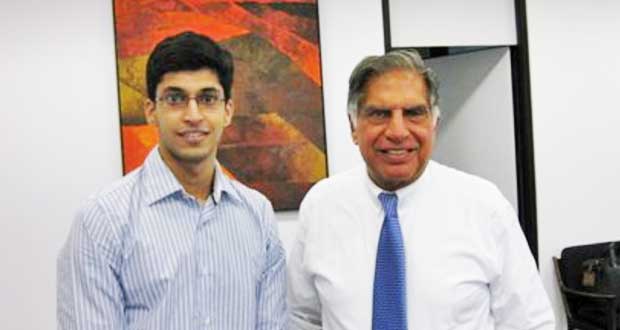
As part of my internship with the Tata Motors Subsidiary Company, I was required to conduct a legal audit of that particular unit. I discovered some regulatory anomalies, which I felt were not properly addressed by the management. Dissatisfied with their response, I wrote to Mr. Tata bringing this information to his attention. To my utter surprise, I heard back from his office a few weeks later informing me that he wanted to see me and hear about my findings first hand. The Tata’s flew me into Mumbai and I had an hour-long interaction with Mr. Tata in his corner office at Bombay House. I was enamoured by his humility and his insistence on the highest ethical standards for all his group companies – big or small. He assured me that he would address all of my concerns.
Before going for LL.M , you worked as an Associate at Karanjawala & Co in their criminal law team . How did your appointment at Karanjawala & Co. take place?
My appointment at Karanjawala & Co. was sheer luck. I had interned with the firm twice before, and upon graduating I requested Mr. Karanjawala to give me a job, which he very generously did. He is known to have a big heart! I worked for the first six months in the corporate team and then in the criminal team – I had the good fortune of exploring different aspects of the law, right from mining and electricity matters to the more sensational BMW and Arushi Talwar cases.
I was a part of the team that briefed Mr. Ram Jethmalani for Mr. Nanda’s appeal in the Supreme Court. Although I was the junior most member of the team at the time, my seniors Mr. Sandeep Kapur and Mr. Ravi Sharma gave me ample opportunities to participate in the conferences with Mr. Jethmalani. It is certainly an overwhelming experience to be in the same room as Mr. Jethmalani – his command over the law and his piercing wit are great fun for any young lawyer to observe. I remember distinctly how meticulous and thorough he was during our conferences – with meetings at his Akbar Road chamber often stretching into the wee hours of the morning prior to the hearing. But no one complained.
When the arguments commenced in Mr. Nanda’s case in the Supreme Court, I watched in awe Mr. Jethmalani pieced together all of the material he had absorbed in the preceding days, masterfully connecting the pieces of the puzzle to form a simple yet lethal argument. His ability to interpret the criminal code while unravelling the safeguards inherent in constitutional provisions is simply unsurpassed.
Mr. Karanjawala had very generously agreed to represent the parents of the slain teenager Arushi Talwar without any cost – pro bono. I was lucky in that I was able to assist my senior, Shivek, during various stages of the case in the Supreme Court. It is well known now that the Hon’ble Court did not see any merit in the applications filed before them seeking relief for the parents. But I learnt that responsible advocacy requires vigorous representation to protect your client’s interests. I certainly still believe in the parent’s innocence and perhaps in time their names will get cleared.
Working with a large litigation firm has many advantages. If the firm enjoys a good reputation, it attracts many high profile clients who expect the best quality of work. Mr. Karanjawala runs a meticulous office, and yet the environment of the firm is not stifling or overbearing. Juniors are given many opportunities to get involved in matters and interact directly with clients and Senior Advocates. Since the stakes are high, the pressure to perform tends to be higher.
When did you decide to pursue higher studies? What was your motivation?
I think lawyers must never cease to study – rather, it would be anathema to their professional success if they did so. While ILS was an excellent place to develop a fundamental understanding of the law, I craved a more challenging intellectual environment.
Abroad, the methodology of teaching is very different. Students are expected to be very well prepared before they show up for class. Professors challenge students by employing the Socratic method of teaching, which involves intense class participation. These were novelties for me, since I had only been exposed to a traditional lecture based system of education – as most of us have. My prime motivation for studying abroad was the exposure to a world-class legal education, which I was very fortunate to receive at UPenn.
Besides, I think effective lawyers must keep honing their critical thinking skills. Learning a statute and reproducing answers during a predictable exam might not be the best way of training lawyers. My advice to students contemplating an LL.M. would be to go for it, undoubtedly.
Tell us more about this Joint Master’s Degree from UPenn Law school and Wharton University.
UPenn, like some of the other Ivy League universities in the US, encourages inter-disciplinary course selection. Thus the advantage of being at Penn Law is its proximity and association with Wharton – which is a premier business school. As part of the LL.M., one is permitted to take regular courses at the business school as well – with MBA students. It is truly the best of both worlds – with course credit on one’s transcript from both schools – law and business.
I took a very interesting course on corporate diplomacy, with a Harvard trained Professor, Dr. Sanjay Patnaik. The course covered corporate strategy employed by leading multi-national firms during times of crisis. We interacted with top industry leaders and even leading politicians from the European Union who explained the intricacies of doing business in a complex regulatory environment. Besides this course, Wharton offers a gamut of options ranging from traditional corporate finance to more complex courses on business management. In addition to this, both the law school and Wharton conduct numerous talks and presentations by business and political leaders from across the world.
The exposure is simply mind-boggling – and the result is that one’s worldview is significantly impacted.
What was your topic of dissertation for Masters? Why did you choose that subject for research?
Most graduate programmes in US law schools offer a general LL.M., with a wide array of courses to specialise within the Masters programme. My areas of focus were advanced Corporate Law with M&A and US Anti Trust in the first semester. In the second semester I took litigation and drafting courses – such as Appellate Advocacy and Trial Advocacy.
The great thing about this approach is that it allows the student to customise their learning experience. I wanted a blend of corporate law and US style litigation – which is exactly what I got.
Tell us about your experience working with an eminent personality like Professor Raymond Ripple.
(Jai was the only LL.M student to have been accepted in Professor Raymond Ripple’s class on Appellate Advocacy, where he also received the highest grade.)
Yes! His were one of the best classes I took at Penn Law. Professor Raymond Ripple is actually a full-time senior counsel for a major US Conglomerate, DuPont. He taught as the adjunct professor for appellate advocacy and took only about 9-12 students for his class. I was very fortunate to have been accepted by him.
Professor Ripple taught an intense course about how to draft a high-quality federal court brief. He was very particular about the style, structure and content of the final product. One component of the final examination required us to argue before judges, exactly the same it would happen in a real federal court system. The argument was then recorded and Professor Ripple gave systematic feedback to each student about how to improve his or her presentation and strategy. As someone who is passionate about litigation, it was an enriching experience.
Which events led to your induction into Kline &Specter Law Firm? Were there any interviews or selection processes?
Upon graduating from Penn Law, I applied like everyone else to different law firms. I was very pleasantly surprised when I heard back from Kline &Specter, since it was my first choice. The email came when I was celebrating my graduation with my classmates in Miami – so we had two reasons to celebrate. They called me in for an interview with a Senior Partner, who later became my boss. We spoke about my past experience and also my interest for the specialised nature of work at K&S – pharmaceutical mass torts. Yes, incidentally, I was also the first foreign trained lawyer to have been accepted at the firm – but I owe that to the magnanimity of the founding partners who decided to take a chance with me.
How was it like working in a foreign law firm? How different was the work environment in the USA, from that in India?
American firms – much like top-tier Indian law offices, are very professional and manage their time well. There is a clear expectation for high quality work – which is recognised and duly rewarded. The routine at Kline &Specter was very comfortable and hours stretched only when there was a deadline or a key deposition coming up. The work environment was friendly and supportive. Watching Mr. Specter argue before a full bench of the Pennsylvania Supreme Court (9 judges) was an excellent experience. Top trial lawyers in the US prepare meticulously for their cases – a trait I saw in Mr. Jethmalani in India too.
Our readers would like to know about the whole case which you were involved with your partner. Please share few words about your experience.
(Jai has worked in the pharmaceutical mass torts division with the firm’s partner, Mr. Lee Balefsky, on a multi district litigation (MDL) involving a billion dollar law suit against Johnson & Johnson and American Medical Systems for manufacturing faulty pelvic implants.)
Kline &Specter is one of the top litigation firms on the US East Coast for complex pharmaceutical mass tort cases. They have built a reputation for pursuing meritorious cases in a fair manner – they are not after easy wins. I learnt from Mr. Specter that a good lawyer must keep his client’s interest at the core of his advocacy. This was especially true for those clients who had suffered horrific injuries for no fault of theirs. They deserve the highest level of commitment from those entrusted to represent them – which is what the lawyers at K&S strove to do everyday.
My work in the Mass Torts division with Mr. Balefsky was very exciting. I was involved in a complex multi-district litigation involving a medical implant manufactured by the top names in the industry. We represented a fairly large group of plaintiffs who had suffered terrible injuries as a result of these devices. Before actually taking the cases to trial, there is immense pre-trial preparatory work that goes into it. The discovery of documents can into lakhs of documents – medical papers, contracts and regulatory filings. Junior lawyers must filter through these papers with a fine toothcomb to create an arsenal of questions with which to conduct depositions of the corporate players.
Thereafter, you returned to India and joined the chamber of Justice S.A. Bobde as his judicial law clerk. What prompted you to make this choice and what made this shift possible?
The founding partner at K&S – Mr. Shanin Specter, apart from being a brilliant lawyer, is also a very supportive attorney mentor. He encouraged my work at the firm and told me that my work was very well regarded.
However, when I got the opportunity to assist Justice Bobde in India – I went to Mr. Specter with the honest question, as to what I should do next. He told me to follow my heart and to do what I felt was best for my career. He also told me that the doors to his office would be open after my clerkship concluded. The next step was obvious – I booked myself on the next plane to New Delhi and dove straight into working with his lordship. I have always dreamt of litigating in the Indian Supreme Court – and this shift made it possible.
What was your work profile while working as a judicial clerk under Justice S.A. Bobde? What do you think are the most essential things required to excel in judicial clerkship?
Justice S. A. Bobde is a very meticulous and hard working individual – he expects the same level of commitment from his law clerk. Despite many of my friends questioning my decision to pursue a clerkship at this stage of my career – I felt it was the best decision of my professional life thus far. Working at the apex gives you a top down view of how the matter has progressed through the courts – you get to see which arguments worked and which didn’t. One begins to appreciate the judge’s thought process too – which is trained like a hawk to filter out irrelevant arguments.
To be successful in a clerkship, I feel it is essential to fully understand what is expected from one’s role. The clerk must play a solid supporting role to his or her judge – by carefully following the judge’s instructions, and also by taking the initiative to make the inflow of matters as efficient as possible. Sadly, judges in India are swamped with matters through the week – the workload is truly difficult to fathom until you actually see the volume of matters that come into the office.
I had the opportunity to assist lordship on several criminal and civil matters. The most interesting of the lot was an arbitration decision that centred around the computation of interest on an arbitral award. There is much to be learnt simply by observing a judge.
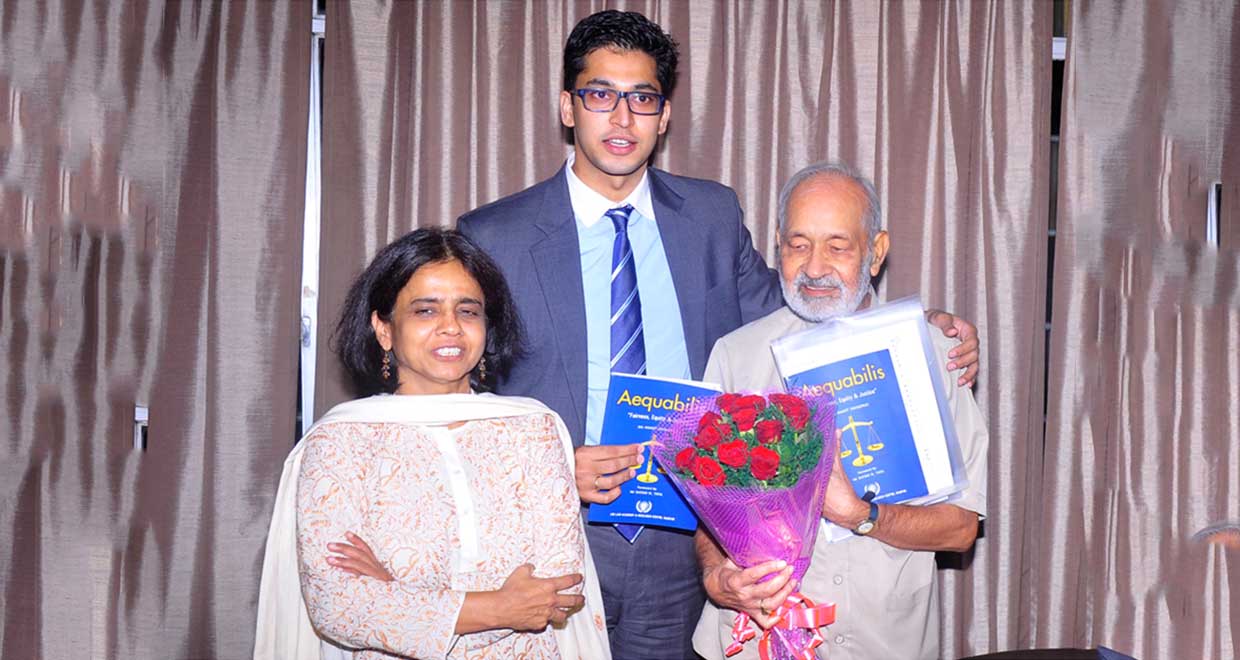
Ms. Sunita Narain and Mr. Lakhan Mehrotra
How did you think of writing a book?
(All India Reporter published Jai’s book, “Aequabilis”, which is a detailed legal study of former Chief Justice of India R.S. Pathak’s landmark judgments. It also discusses the Bhopal Gas tragedy decision in great depth and the development of mass-tort jurisprudence in India.)
This book happened by sheer accident. I’ve always looked up to Justice R.S. Pathak, as a child would admire his hero. Justice Pathak had a very gentle demeanour and an impressive command over the English language. He was an unassuming man and I was greatly inspired by him. His manner was extremely polished – a result of his fine lineage no doubt (his father was the Vice President and a famous advocate – G.S. Pathak), and he had this knack of being able to connect effortlessly with those several decades younger than him.
When he passed away, rather suddenly in 2007, I wanted to pay a tribute to his memory. When my efforts to organise a memorial lecture for him in my college did not materialise, I felt dejected and demoralised. Instead, I decided to immerse myself in his judgments and other writings – to reacquaint myself with my role model. Over time, I had read through nearly all of his judgments from his days as a high court judge and then his landmark decisions in the Supreme Court. I sensed a pattern in his writings, which was clearly distinguishable from the other cases I had read. Soon, I began critically analysing his judgments – and before I knew it, I had a collection of case comments and essays that aligned with Pathak’s core juridical philosophy.
The main chapter of the book, however, deals with the Union Carbide decision of the SC which awarded nearly half a billion dollars as compensation to the victims of the gas leak in Bhopal. I spent several hundred hours analysing this judgment and all the criticism that had been written against the decision. I realised that a lot of the hate came from journalistic reportage that had little understanding of the inherent delays in the Indian legal system – a fact that was acknowledged even by the Supreme Court. My book attempts to set the record straight in this regard – and counters the unfounded journalistic and academic criticism that this decision has faced over the decades. The fact that the Supreme Court has repeatedly upheld the original judgment is testament to the integrity and foresight of the Pathak Bench.
Share with us your experience in getting your book published and what was the reception to your book?
The editors at AIR Nagpur were extremely supportive and encouraged me to publish my writings in the form of a book. Interestingly, Mr. Ratan Tata has penned the foreword to the book and has praised the chapter on Union Carbide. Ambassador L.L. Mehrotra released the book last September at the India International Centre. The release was followed by a panel discussion with Ms. Sunita Narain – a noted environmentalist who debated the merits of the Bhopal Judgment. All in all – it was a very rewarding experience.
Currently, you are working as a Legal Consultant to the Vice Chairman and Managing Director of the Times of India Group, Mr. Samir Jain. How did you go about bagging this job?
Yes, I am presently attached with the Vice Chairman’s office at the Times Group. I wanted to understand the intricacies of the media landscape in India and also learn about corporate strategy – from a lawyer’s perspective.
I consider myself extremely fortunate to have been picked by the company to assist the CEO Group. I applied and was interviewed by their HR department, before being confirmed for the position.
Please give our readers some tips to nail an interview.
I think it’s really important to be honest and clear in any interview. Most HR professionals want candidates who can think and articulate clearly. It doesn’t help either if one has a negative attitude during the interaction – that would be a big red flag for any organisation.
How do you balance and make out time for writing blogs and other newspapers with your profession?
(Jai is one of the youngest columnists by the Times of India in 2012 and he regularly writes under the name “The Irreverent Lawyer” on legal and political issues as your hobby. Healso writes occasionally for the Hindustan Times, Niti Central, Indian Exponent, Power Politics and the Daily Pennsylvanian.)
Writing helps me to de-stress! With all the views and counterviews flying around on the 24X7 media, I find it very soothing to amplify my own voice of reason to cut through the chatter. I usually write only about issues that I’m passionate about. I dislike hypocrisy and you’ll notice that some of my writings attempt to expose the rampant doublespeak that certain groups indulge in.
I honestly do believe that lawyers can play a productive role in a democratic polity –by speaking up for the weakest sections of society. We’re also bound by our profession’s code of ethics – which demands that we strive for justice, inside and outside the courtroom.
Early mornings work best for me when I want to get some writing done. This way there’s nothing to disturb my thought process – since everyone’s either asleep, or they think that I’m still asleep!
Has writing been a passion ever since childhood? Do you have any future plans of taking up writing as a career?
Litigation is definitely my first love and I am committed to it professionally. Besides, I would make a terrible ‘fiction’ writer – I know that for a fact! Writing is a relaxing hobby for me, and I enjoy indulging in it occasionally. Unfortunately, I feel that I lack the self-restraint and neutrality that a career-journalist should possess. I feel too passionately about certain issues, and I make no effort to hide my biases. Hence writing as a journalist is ruled out for me. Besides, I enjoy the thrill of litigation far too much to do anything else!
What message do you want to give to the Government for not paying attention to this issue?
Judges in India are terribly underpaid – and it is a very serious issue that no one talks about. To compound the issue, our judges tend to be very traditional, and thus choose to suffer in silence to preserve the judiciary’s dignity. Despite their ever expanding workload and long hours, and the astronomical rise of lawyers’ fees, judicial salaries have largely stagnated at unrealistic levels. Good lawyers may one day refuse elevation on the ground of inadequate (in fact insultingly low) pay.
My article highlights this issue and warns the government of an impending constitutional disaster if this disparity is not addressed.
Lastly what would be your message for law students?
The only recipe for success in our profession is perseverance and hard work. Unfortunately, there are far too many young lawyers in Delhi and Mumbai, who are desperate to make a quick buck by adopting unethical means. Please don’t become like them. They latch on to established lawyers to become middlemen between clients and their own seniors. In the process, they swindle the client by over quoting the fee. Sadly, these so-called ‘lawyers’ never realise that their reputation at the Bar suffers immensely – and they are labelled for life.
Justice Pathak gave me excellent advice, which might be relevant to your readers too – “Work honestly for what you want. If it comes too easily, it’ll probably leave just as easily too.”
Varun Kalsi graduated in law from Amity Law School in 2007. After which he went on to pursue an LL.M. in Corporate Laws from New York University. At present Varun works as a Manager at Dua Associates.
In this interview we talk about:
His journey as a law student from Amity Law School
Studying LL.M from New York University and how it influenced his career
Working at Dua Associates.
How to gain expertise in corporate law
What brought you into studying law as your profession?
I’d say both but more of planning. Like most lawyers though I am good with my numbers, Mathematics was not my favourite subject. Back in 2002, the options were, therefore, pretty much limited to hotel management, media or law. Personally, I chose law since it seemed to me to be a more empowering medium that turned you into a professional, and is one where people hold you in great esteem, either out of admiration or fear or both!
How did you fare in academics at Amity? Would you say a great CGPA is a necessity to kickstart a good career in the legal profession?
I’d say I was amongst the bright ones in my batch with nice and healthy grades throughout my 5 years at law school and would also, like to add that, in my opinion, my batch was probably the best our law school had seen, in so far as academics and extra-curricular activities were concerned. There was immense competition even amongst friends but all in good spirit, which, in fact, led us to achieve much more than we would have done otherwise.
Considering that a fresh law graduate will not have great work experience (other than legal internships/clerkship), a potential recruiter’s primary focus would be on the candidate’s academic performance (grades and other achievements) whilst at law school. However, even if one’s CGPA is not the best, he/she may be hired by a recruiter on the basis of the candidate’s overall personality, the recruiter’s immediate requirements and the way he/she conduct himself/herself in an interview.
What skills did you get to hone as the Executive Member, Amity Law School Moot Court Society?
Acquiring organisational skills, inter-alia, was a great advantage of being an integral part of the Moot Court Society and we were nicely tested every time our college hosted the annual Moot Court Competition. Also, the exposure to other teams in terms of their manner of preparation and the way they prepared for the competition was always something one could learn and imbibe.
What is your advice to budding mooters?
(Varun has participated in various moot court competitions like Stetson International Environmental Law Moot Court Competition, Surana & Surana Corporate Law Moot Court Competition and Amity National Arbitration Moot Court competition.)
The first time you think about it, it might be difficult and you may put it on the backburner but my suggestion would be to push yourself to participate in a Moot Court competition, just for the sake of the experience. If I was never “pushed/encouraged” by my friend/batchmate- Apar Gupta, I am certain I would not even done half of what I eventually achieved. The idea is to get in there and get a feel of things as you’d never know whether you like it or not until you try it. By the aforesaid, I don’t mean that it is mandatory but I’d highly recommend that you at least give it a try, once. Perhaps, it is instrumental in your decision as to the path you’d eventually choose in your legal career, i.e. being a litigator or a corporate lawyer.
What kind of internships did you do in your law school? Did you have institutional support for procurement of internships?
I actually did a variety of internships right from with a High Court lawyer, an Advocate-on-record, few law firms (Corporate and IPR) and so on. For me, internships were always an avenue that could help me make that difficult decision- what kind of practice would I relish as a lawyer?
There was minimal institutional support available for procurement of internships.
Do you think being from a non-NLU has ever proved to be a hindrance for you? What has been your experience?
I think it depends on the organisation as to what it values more- the individual student’s calibre or his/her institution itself. To be fair to the students there are indeed organisations that openly practice such “discrimination” but then that’s not the case with the others. Also, one has to bear in mind that the institution will always play a key role for any fresh law graduate as a recruiter may view his/her abilities from the fact that the student is a product of that particular institution. I am sure such issues are also faced by MBAs who are not from ISB or IIMs but then there are always other options.
Many lawyers say that the first year after graduation is the most difficult year for young lawyers. How did you learn the ropes and what were the biggest challenges you faced?
Well, isn’t that true for all professionals? I firmly believe that all professionals are valued in terms of their experience and expertise, which can only be learnt the hard way, i.e. one has to go through the whole process or loosely speaking, the grind. My first year was challenging too especially since my senior was an experienced and seasoned lawyer who would not accept anything less than perfect but was always available to answer my questions and discuss legal issues with me. I would ensure (and still do) that I do not repeat any of my mistakes and strive to improve my drafts/opinions basis the hands-on knowledge and on-the-job experience that I’ve acquired while at work.
Right after graduating, you went on to pursue LL.M from New York University School of Law. Why did you decide to go for higher studies?
After doing different kinds of internships I was inclined towards being a corporate lawyer and therefore, felt that it would be great if I could improve upon my knowledge of Corporation laws with an international perspective to it. I’d say that I was extremely fortunate to get through NYU as its faculty, especially for courses like Corporation law and M&A, is par excellence and added a new dimension to the way I perceived the corporate law practice.
Tell us something about your LL.M year at New York University School of Law. How did this influence your career?
Not only did this year add to my legal acumen it also brought me in touch with a bunch of talented individuals who had come there from all across the globe. Also, it helped me evolve as an individual and in the process I even learnt few new things about myself. The NYU stint brought more clarity to my thought process in so far as concerns the sub-practice areas within the corporate law practice and helped me forge certain lifetime relationships, which influenced my career greatly.
Do you think it makes sense to students to go overseas to study law when they want to work/practice in India?
It’s a personal choice. For instance, for me it was a better and sounder understanding of Corporation laws with an international twist and then the thought of working abroad for a few years. I was able to achieve only the former. Therefore, it totally depends on the individual’s goal. Studying overseas is no guarantee that you will get a chance to work there too, therefore, if the ultimate goal is to work abroad it may not be the best route. It is pertinent to note that there are individuals who had been practicing in India and now are with law firms abroad and vice-versa. Thus, there is no direct co-relation between studying abroad and practicing in India.
Tell us about the nature of work you are entrusted with and what’s a typical day like?
There is no typical day for a lawyer like me as my practice areas are wide in nature being general corporate/commercial advisory and Real Estate. There are days when you are swamped with work and do not know when night falls and then there are some when you have some breathing space. Having said that, I am always on something all the time whether it is execution of work for clients or business development activity as ultimately I have to justify my cost to my firm.
How do you say one can gain expertise in corporate law? What does it take to be a good corporate lawyer?
(Varun’s key practice areas are General Corporate laws including Defence and Foreign Exchange Regulations and he is also engaged in major Real Estate Transactions.)
My recommendation would be to firstly, get the basics right. The fundamentals of the Company’s Act (as amended) and the Contract Act should be clear as these, inter-alia, are the main statutes that govern corporate transactions and are followed by other laws and regulations depending upon the nature of a transaction. Also, it would be a good idea to follow deals such as acquisitions and mergers through news items and trying to understand the drivers and mechanics to these deals as much as possible.
How do you keep yourself abreast with latest industry news and trends?
Nowadays, there are several options available such as news items, legal websites and other resources that provide me with the latest legal developments and happenings in India and around the world. Another prominent resource is keeping in touch with your colleagues working with you and otherwise.
How do you maintain a work-life balance? Are there any specific time management tips you would like to share?
The best tip is always to finish your work as soon as possible and not sit on it till the penultimate moment. This way, one may have an opportunity to have some free time to indulge in other activities. Having said that, it totally depends on the volume of work and how you manage it that eventually determines your work-life balance.
When you lawyers are hired, what kind of skills and profile are looked for?
The legal fraternity hires on need basis, i.e. in proportion to their requirements and intended revenue and other projections. For freshers, while recruiting things that matter are the institution, candidate’s academic performance and the overall personality of a candidate in order to determine his/her suitability to the job and the possibility of his/her adaptability to the work environment and the team, which he/she shall join. For working lawyers, it’s their grip of their practice areas, legal acumen, business development skills, work ethics and his/her suitability to the job and the possibility of his/her adaptability to the work environment and the team, which he/she shall join.
You must have guided several interns. How would you say that an intern can generate a positive feedback in the limited time they have?
There is only one way- ‘do as much work as you possibly can’ as only this will give you the necessary exposure. There can be times when you are not called upon for a few days to do an assignment but that should not deter you from going to different lawyers within the firm and politely asking if they could do with some assistance. Also, the other key is to carefully listen and note down the instructions given for an assignment. This will ensure that your research work is on track and if the lawyer is pleased with your work, he/she will give you more work or you may even stand a chance of an offer from the organisation in some cases.
You recently got promoted from an Associate to Manager. Which skills would you say contributed towards this promotion?
The Manager designation is one step away from becoming a Partner and in that context, it is a crucial career milestone. It brings with itself lot more responsibility and commitment both in terms of work and business development activities, which need to be met.
It’s been a while since I have been with Dua Associates, right from being an Associate to a Senior Associate and now, a Manager. I think a nice mix of some hard work, sincerity, interpersonal relationships with colleagues and good fortune are the reasons. I firmly believe that if one is consistently putting in the efforts he/she will get the necessary recognition, which may be sooner for some and perhaps, a little later for the others but it will come.
What would be your parting message to our readers?
It is important to enjoy whatever you are doing so choose your path accordingly. If you enjoy your work, you will deliver and succeed in your endeavours. Do not fret about success as it will follow your hard work with a mix of some good fortune, of course!
K K Sarachandra Bose is a corporate lawyer with experience in Dubai and various other jurisdictions over the last three decades. A member of the International Bar Association, he studied law from R.L. Law College Belgaum, Karnataka, and graduated in 1976. Currently he is a partner at Dal Al-Adalah Advocates & Legal Consultants at Dubai, and Bose & Bose & Nair at Cochin.
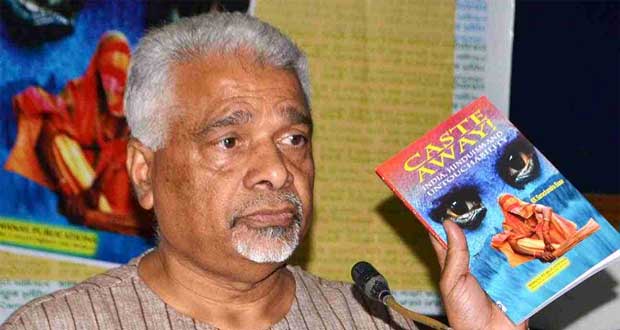
Between all his commitments of being a lawyer, he has found out time and energy to pursue a very noble mission: Eradication of caste system in India. He plans to achieve this by effecting a paradigm change in Indian law through constitutional reforms. He is the author of the book “Caste Away – India, Hinduism and Untouchability.”
In this interview he tells us about:
What prompted him to spread social awareness in India for 54 days and travel across 18,500 km.
Eradication of Caste Discrimination in India.
His second Bharat Yathra, i.e. the ‘Caste Eradication Bharat Yathra’ which starts today.
Our site is directed at law students and lawyers. How would you like to introduce yourself to our readers?
I am a corporate, commercial and contracts lawyer practicing in Dubai and other jurisdictions for the last over 36 years; a member of the International Bar Association, visiting professor in International Business Law, legal columnist in several publications, addressed over 100 law seminars as a guest speaker; Chairman of Global Dialogue Foundation, and Unity in Diversity under the auspices of the United Nations Alliance of Civilizations since its inception in 2007 till date.
Tell us about your years before law school. Were there particular childhood incidents that proved to be an inspiration for you?
My childhood was all thrilling. Being born in a very rich family and my father being a Gandhian politician gave away almost all our wealth for the welfare of the society. We lost almost all our wealth and my mother had to sell her land to pay for my college fee. My father took care of the society but not his family and children. This prompted me to first take care of me and my family and then the society. I witnessed low and high caste among human beings during my childhood in my own house when my father served food to field workers, few workers were in an enclosed place and the rest, the vast majority in the open field in pits dug and leaves inserted. I was really pained to see that my own playmates were ill-treated.
What inclined you towards legal education?
I was good in mathematics and got admission for Engineering after passing pre-degree (12 grade) but though the college fee was paid, I left Engineering and got a job and then pursued BA as an external student and then law as an internal student in R.L. Law College Belgaum, Karnataka.
What would you say were the instrumentalities of law school which helped to frame your career?
I was a studious student, though a college gunda, in the words of my college principal. When our University Vice Chancellor cancelled the Carry Over Benefit (COB) without giving any prior notice, I took the lead and got his order reversed by the State Governor, Chancellor of the University.
Our readers would be keen to know any specific incident which has driven you to become a social activist.
From my childhood, I feel the pain if another person is hurt. While in Dubai during 1977 – 1990 period, I used to visit the labour camps with journalists and highlight to the government the pathetic living conditions of the labourers.
What prompted you take up social activity and spread awareness for any grave social cause in a full time manner?
(KK Sarachandra Bose is a corporate lawyer by profession and a partner at Dal Al-Adalah Advocates & Legal Consultants at Dubai and Bose & Bose and Nair at Cochin.)
In the legal profession, I believe my clients like me so much and my opinion on corporate and contract matters are well sought by corporates of the highest order. But I always say, legal profession is for my bread and butter, my blood is social activism for the benefit of the society as a whole.
Tell us about your whole journey/social drive in your own words.
(He travelled across India for 54 days to promote the causeand covered around 18,500km along with his 30 member teamand distributed books, free of charge, across the country.)
My 54 day Jathi Nirmarjana Bodhavatkarana Sandesa Bharat Yatthra – 9 June to 1 August 2014 – was really a thrilling one. I visited the entire Shri Mahabharat including the North Eastern states which people say normally nobody visits. I could see and witness the ill effects of the evil caste system in my country. While in Rajasthan, I was told, by some local people considering themselves as low castes there, not to speak about the caste system as the upper caste people may come and harm me. I increased my volume and told very loudly that this is my country and nobody will dare stop me. Some people told me that they want to make the savarna people avarna and paint the buildings in Delhi with the same brush and paste that they are forced to carry every day to clean lavatories. I enjoyed huge support not only from the so-called lower caste people, but from the upper class who hates the caste system. In Tripura, the Buddhist Sangha there promised full support to eradicate the caste system from India.
You have authored a book “Caste Away – India, Hinduism and Untouchability”. What message did you intend to give to your readers through your book?
My book “Caste Away – India, Hinduism and Untouchability” is the result of my 40 years of research, studies, discussions and conviction on the subject, caste system in India. I have gone through our history beyond the Vedic period, or to say, prior to Vamana avatar. I have seen, as if I were there, that we had a great past prior to the Vedic period and that was exactly the Brahmanism – Sathyamvada, Dharmamchara, Athidhi Devobhava. This Brahmanism has been killed and murdered in our country for the past over 5000 years and I am re-introducing it and I am asking everyone to adhere to it.
How far would you say it is possible to eradicate the caste discrimination among Hindus and other religions from India?
It is very easy to eradicate the caste discrimination among Hindus and other religions from India. We should understand that there was no caste system before 5000 years, there was no caste system before 300 years. Similarly, there was no Hinduism before 5000 years and there was no Hinduism before 300 years. Caste system which is an offshoot of Hinduism, in the words of our Hon’ble Supreme Court, originated during the British India rule and not before. We had colour system in India, the black skinned Adivasi aborigine people and the fair or white skinned aggressors. When I say, aggressors, please do not get confused as they are also our brothers and sisters from the same grandparents, Manu and Satrupa or Adam and Eve as called in the Western world. The whole issue in the world is the two skin colours, black and white skins. Slavery originated in our country 5000 years ago as the fair skinned aggressors enslaved the black skinned Sri Mahabharatvasis. Slavery went out from our country and spread as an epidemic in the whole world. Once caste system is abolished in the Hinduism which is the breeding ground of slavery, then all those who left and became untouchable Dalit Buddhists, Dalit Jains, Dalit Sikhs, Dalit Christians, Dalit Muslims etc., will all become Brahmins in its sense – Brahmjnane iti Brahmana.
What type of feedback you were you receving from the people at large?
Feedback from the people at large is tremendous. No one has ever told me that either he or she wants the caste system to continue. There are several letters of support in my file.
What are the main social causes in your priority list which you intend to promote through your second Bharat Yatra?
(He is all set tostart hissecond Bharat Yathra, ie, the ‘Caste Eradication Bharat Yathra’ whichis commencing today on 9thMay 2015.)
In the Caste Eradicatin Bharat Yathra commencing on 9 May 2015, I will be conducting mass upanayanas in public in the presence of the five headed creator God Bhramadev representing the five elements of creation by priests well versed in pre-Vedic rites declaring all as Brahmins and thus remove that feeling of lowness in the minds of the people.
Do you follow the ideologies or philosophy of eminent leaders like Mahatma Gandhi or Raja Ram Mohan Roy in regard to eradicate caste system?
No, I do not follow ideologies or philosophies of any leader. I follow my heart and I have developed my own ideology. For instance, Shri. Mahatma Gandhi wanted to abolish untouchability by retaining the caste system. While Article 17 of our Constitution abolishes untouchability, several other articles in the Constitution reintroduces untouchability through the caste system. How can I follow such a tricky ideology or philosophy? That is why, I have loudly said, quoting several judgments of our Supreme Court, that our Constitution is tricky and there is fraud in our Constitution and it must be amended.
Did you get any reply from The Centre or do you think the government will take any serious steps or preventive measures regarding the eradication of caste discrimination from India?
(He also sent a notice to the Indian Government regarding the abolishment of caste system or to banish the caste system from India.)
I did not get any direct reply to my notice from the Government. But I received several indirect replies and reactions from the Government such as, Janardan Dwivedi’s comments to stop caste based reservations and introduce economic based reservations and Sonia Gandhi’s rebuttal thereto; Mohan Bhagavat’s call to eradicate the caste system; world religious leaders calling for eradication of the Indian caste system by 2020; International Bar Association supporting me; Supreme Court lawyers supporting me; hurried Ghar Vapasi by some Hindu orgainzations in bringing the escaped people back to their earlier low caste or slave status; etc.
Do you think you will be successful in complete eradication of poverty and casteism from India?
I am a doubtless person. I will see the end of the caste system in the very near future. Government, I mean the Indian society, will have no option but to amend the Constitution and abolish the caste system.
Did you get any positive response from there supporting your cause?
(He has also organized seminars for Indians who visit Dubai and deliver lectures to help them understand the laws, rules and regulations of the country.)
I am getting support from all quarters.
Do you think every lawyer should devote some time towards any social cause and work on it?
I do think that every lawyer should devote some time towards social causes. The lawyers unlike other professionals or businessmen, have the knowledge of the law and also have interaction with the laws, law makers and the law courts. When a layman is also not exempt from the knowledge of the law as law is considered universal, a lawyer has the privilege not only to know the laws but also to counter the laws if found unsuitable.
Last but not the least, would you like to leave any message for our readers?
I wish all your readers understand the basic human values and treat another human being as a human being, not as an animal as in the caste system based on the skin colour of the people.
Rimali Batra graduated from ILS Law College, Pune in 2010. After graduation, she worked at ICICI Bank’s Corporate Banking and Litigation team in New Delhi for a year. Thereafter, she pursued a BCL degree at the University of Oxford. After completing BCL, she joined Jindal Global Law School as a Research Associate. She subsequently accepted a job offer from J Sagar Associate’s Regulatory and Policy team and after continuing there for a while she went on to join her present office at the Regulatory team of Trilegal.
In this interview she talks about:
Reading BCL at Oxford and tips on scholarships
Being a Research Associate at JGLS
Working at JSA and moving over to Trilegal
Most of readers are budding and enthusiastic lawyers, how would you like to introduce yourself to them?
I was born and raised in Delhi. I did my schooling from Montfort Senior Secondary School located in Ashok Vihar, New Delhi. Thereafter I went to ILS Law College, Pune to do my graduation in Law. After ILS Law College, I worked with ICICI Bank’s Corporate Banking and Litigation team in New Delhi. A year and three months later, I went to University of Oxford to read law. After BCL, I joined Jindal Law School, Sonipat as a research associate and worked there for three semesters. During the second half of 2014, I joined J Sagar Associate’s Regulatory and Policy team and worked on matters concerning power (Electricity Act, 2003). I was with Mr. Amit Kapur’s team in JSA for a year and have now moved to Mr. Sitesh Mukherjee’s Regulatory team in Trilegal. I have been at Trilegal for five months now. That’s been my journey thus far.
You have had many interesting career switches from starting out as a banking lawyer then being a Research Associate at JGLS to your current profile at Trilegal. What all do you consider before taking these decisions?
One is of course bound to be surprised at the changing courses of my career paths but then it was all a part of the plan, which I hope the readers will see as this interview answers unfold. All decisions that I have made till date connect, and connect wonderfully.
I am a curious individual and don’t shy from taking risks. I have always been experimental in nature and challenges attract me and hold me. Call it my weakness, call it my strength. I believe that I perform well when I multi-task (It’s like enjoying the main course with some side dishes). That is how it has been since school days. For instance, in school I did not just study hard and well, but also trained myself to be a good basketball player (played national and international tournaments), a praiseworthy debater (both at the inter-school level and state level), a leader (school head girl) and a decent quizzer (inter-school level). Similarly in College, I did not settle for just being among the top 10 rank holder for all five years in the Pune University (ILS was one among the 20 odd colleges affiliated to the Pune University), but also represented ILS at various national and international level moot competitions, elocutions and paper presentations. At Oxford too, I read the BCL alongside playing basketball for the University of Oxford. And now whenever I have time and I am not working, I am doing either of the following – pro-bono advisory on energy laws and medical law and ethics, reading books, stock trading / following the market, writing and publishing stories or on issues of law that interest me, teaching English to underprivileged kids at home on weekends, part-time teaching at law schools or travelling.
Did you have lawyers in your family or in close proximity?
A little about my family: There are no lawyers in my family (or in extended family for that matter). My father hailed from Sonipat and my mother came to India in my Nani’s womb from Pakistan. My father was a businessmen and my mother assisted him in his business. He was and is my role model. He had no basic formal education and left school in class VI to pursue his dream of setting up a business. My mother was a national level table-tennis player and a B.Com graduate from University of Delhi.
My elder sister, who is a gold medallist, is a Human Resources manager with a renowned company in New Delhi and my younger brother, who is also a gold medallist in B.Com (H) from University of Delhi is running his own business and takes care of dad’s business. I think I inherited my mother’s sports skills and reading habits and my father’s experimental, risk bearing and helping nature. I believed that a little confusion and nervousness is always good but fear is destructive, and therefore I aim at balancing my fears and my weaknesses with my confidence and strengths, as I move forward. I also leave achievements behind and look at them as a thing of the past and aspire to achieve a little more as days go by. So, in a nut-shell, law and basketball are my passion and I am a learner and observer at heart.
Why did you decide to be a lawyer? How was your law school experience at ILS, Pune?
As far as my memory goes, I sealed the decision of being a lawyer in Class Xth – even before I decided whether to take commerce or science. My decision was based on an aptitude test that was conducted in school moral science class. Thereafter I started adding biographies of famous lawyers to my reading rack alongside the already placed biographies of basketball players. I also read a lot of John Grisham. That marked the beginning. In class XII, I joined LST for preparation. I did not fill any other forms (B.Com, Eco (H) etc) but gave entrance tests for N-Schools. At one point in time, when I did not get through Symbiosis, I almost lost hope for making it to any other N-School, but then when I made it NALSAR, I regained my strength. I also made it to ILS on merit and on sports quota. Now, the decision there was simple, but I got swayed by the India Today ranking and picked ILS over NALSAR, as the ranking placed ILS at number 1 in 2005.
ILS for me was a place of opportunities. Located in the heart of the city and walking distance from Symbiosis, ASCL, Ferguson College, FTII and Gokhale Institute of Political Science and Economics, it offered a vibrant student crowd and a bundle of opportunities. My learning was not limited to the classrooms of ILS. I participated in moots that enlarged my frame of learning, pursued diplomas in subjects that were not taught as a part of the academic curriculum and interned with NGO’s/human rights organisations in Pune. During college, I successfully completed diplomas in International Arbitration, Cyber Laws, International Business Laws, Securities Laws and Medical Law and Criminology. I was one of the speakers in the team that represented University of Pune at University of Oxford in the quarter-final rounds of the Oxford IPR Moot Competition, 2009. My first publication was on ‘domestic violence’ in the college journal (in 2007), followed by a piece on ‘separation of powers’ in the Ambedkar Law School journal (2009). During college, I also participated in cultural events like poetry writing and recitation, signing and painting. And of course I continued to play Basketball at the Deccan Gymkhana, since our college did not have a functional basketball court. I made some great friends at ILS. Overall, I believe I was able to paint my canvas with so many colours because I was in a college that gave me so much time and space to explore and go looking for opportunities, if they refuse to come to you.
When people say “Law school”, they look no further than the National Law Universities. As a graduate of ILS, Pune have you faced any such bias? What would be your advice to students in ILS?
I think the trends are changing a bit. Especially because of so many law colleges mushrooming across the country. ILS has a legacy of being one of the oldest institutions imparting legal knowledge. What ILS lacks is professional training. Meeting my counterparts from N-Schools, always encouraged me to imbibe in me the skills required to think, talk and approach life like a professional. Bias does exit but not all of us have to face it. ILS has a reputation for producing some good litigators however has not earned the same reputation in the corporate world, thereby making it difficult for kids in ILS to crack competitive corporate jobs. I recall an incident during my first job where a senior of my team, while praising my work, introduced me to be from NLS. On my prompting, he corrected himself and toned up his praises even more (considering he was surprised!). I would advise students from ILS to do additional courses and good internships because only studying law at ILS and getting a degree is not going to be enough.
My advice to students of ILS would be two-fold
(a) focus on academics in order to score well. Do not consider classroom teaching the end all of academics, that’s just the starting point; and
(b) Make the most of the time at hand. Involve yourself in activities/course or additional degree’s that interest you. ILS makes space and time for you to incorporate that in your schedule. Most importantly, do both with the sole objective of learning.
Students can consider requesting administration to take notice of events, moots and competitions that interest them and be rest assured the college will do its part. Student may also invite luminaries in the legal fraternity for lectures and seminars. Basically, what a student in ILS needs is the ‘instinct to initiate’ and ‘go towards opportunities’.
Please describe the internships that you did in college.
For internships, I always chose New Delhi, because this is where home was and logistics were easy to manage. My first internship was in the District Courts of Delhi where I read and researched on matters of criminal law and property related disputes. Thereafter, I did my second internship in Delhi High Court where I worked on matters on the original as well as the appellate side on various subjects. In my third year I did internships with Senior Advocates of Supreme Court. I then did an internship with litigation teams of two law firms and my final internship was with the Law Commission of India where I wrote a thesis (which retired into a book) on Constitutional validity of Medical Termination in India. I planned my internships and explored possible avenues for a lawyer in order to better understand my calling. By the end of five years, I was sure of being a litigator (at the least) not sure of the subject area that interests me.
You worked as a Legal Manager at ICICI Bank. How does a typical day at ICICI work out? What were your main tasks and what responsibility did you undertake?
ICICI Bank was my first employer. I was placed through college. I was based out of the Delhi office (I asked for Delhi as my location during my interview). I worked in no specific vertical, but was primarily doing litigation for/against the Bank. Anything and everything was a part of my profile. On a day I would be doing ECB lending, security creations and on another I would be researching and preparing written submissions for matters pending in the consumer forum or the Supreme Court and on yet another day I would be doing retail banking advisory. Having such a profile made it interesting to work in ICICI. I worked there for a year and a half, before I decided to do a masters.
How did your appointment take place at ICICI Bank? What kinds of questions were asked at your interview for ICICI bank?
ICICI follows a three step procedure, shortlisting on the basis of CV’s, followed by a Group Discussion and finally a personal interview. The Group Discussion revolves around a hypothetical problem relating to law of contracts and consumer protection. The personal interview is primarily based on the resume and a few HR based questions.
Please tell us about your decision to do an LL.M and how you went about choosing the program and university.
I decided to pursue my masters from Oxford ever since I visited the University in 2009 for an IPR Moot Competition. On my return, I pursued it like a dream. The advantages of doing a BCL are:
(a) it offers the students to choose a suitable combination of subjects, based on their preferences as opposed to a custom-made LLM course. So, even though I read only four subjects as part of the BCL but at the same time the rigorous workload and timelines gave me the advantage of specialising in four subjects at one time,
(b) Oxford targets on strengthening reading, breaking down complex material and articulating the same in form of legal writings/answers/tutorials. They say, don’t study BCL, you read for BCL.
What do you think clicked in your favour during the selection process for Oxford? What are the scholarships you had applied for?
I can’t answer this question with certainty. It has to be a combination of my academic performance in ILS, my statement of purpose and the write-up. Also, the fact that I assured my willingness to attend the course and pay for it, in case I did not get scholarships from Oxford, could have boosted my application. However, I did say that I will not attend if I had no scholarships at all. Other than that, achievements mentioned on my CV (like basketball, moots, diplomas etc.), my statement of purpose and my write-up may have added a little value.
How do you think a law student can build up his profile to get through to top-notch universities like Oxford?
It’s important to have a strong academic score. A rank in the law school adds value to the application. Apart from that, a student should be able to demonstrate inclination for engaging in theoretical and policy aspects of law. It is also advisable for students to have publications on their side. I remember interacting with the Dean of the University and inter alia, discussing the approach adopted by the University in considering applications from Indian law students. He talked about the law college’s ranking also being a relevant factor, apart from the academic achievements of the student.
What was your area of study during your masters at Oxford? How was the academic pressure like and did you find time to engage yourself in other activities?
I read Principles of Financial Regulations, Corporate Laws, Medical Law and Ethics and Philosophical Foundations of Common Law. The courses were rigorous and the readings ranged from being easy to intense and complex. However, I made time to be a part of the Oxford University Girl Basketball team after being shortlisted at the trials conducted at the beginning of the course. I played 4 or 5 inter-university matches and also participated in the legendry ‘Varsity Tournament’ played between Oxford and Cambridge every year.
Please tell us about the scholarships you applied to and the procedure for each.
I applied for all possible scholarships I stumbled upon during my research. I started looking for scholarships before making my application. I followed this website -governmentofindiascholarship.com. I specifically applied for Rhodes, Common Wealth Scholarship, KC Mahindra Trust, Jain Trust, Ox-Cam among others. I was awarded the KC Mahindra Trust Scholarship and the Ox-Cam Scholarships. The application procedure is a little detailed as the students need to prepare independent SOP for each and demonstrate availability of the balance funds (in case where the scholarship does not cover for everything).
The interview rounds for KC Mahindra and Ox-Cam is fairly simple and questions are primarily targeted at (a) ‘Why oxford?’ and (b) ‘What after masters?’
Additionally, I would suggest students to ask their employers or seniors they have worked with for financial assistance as some firms, seniors or employers are willing to offer funds with or without a promise from the student to come back and work with the said employer or senior.
Please describe your experience at Oxford. What were the classes and professors like?
Oxford was a scintillating experience for me. Especially, reading philosophy at Oxford gave me a deeper understanding of law, legal principles and concepts. Oxford has seminars (classroom teaching) which requires students to read before walking in. For my corporate law class I joined a group that was made by students themselves to discuss seminar questions before the seminar and help prepare better for exams.
At Oxford I was exposed to a system that takes its readings very seriously. As a Masters student, we were required to not just read hundreds of pages every week, but, to also reflect on them during our seminars. I enjoyed this practice very much and it has allowed me to hone my writing skills in the process. A typical reading list will have at least 8-10 important readings (combination of articles, case laws and policy paper series from different jurisdictions, but primarily UK and US). Professors, at best, assist as students deliberate and discuss a topic. One more thing which I found particularly interesting was the presence of an economics, finance and corporate law professor at the same time during seminars for one of my courses, namely, principles of financial regulation.
The tutorial system is quite unique. There are 4 tutorials for each subject and are spread over three semesters followed by a three hours written exam at the end of the course. I found the tutorials challenging but refreshing as they helped me assess my performance and understanding of the subject alongside attending seminars. They also helped me hone my skills of articulating my thoughts and understanding of the subject.
You switched to a pure research based career after coming from Oxford. How did this change take place? How did you get to associate yourself with Jindal Global Law School?
Academics is very close to my heart and still is. For as long as I can remember, teaching and educating has always fascinated me. When at Oxford, I heard about Jindal Law School and its dean, Dr. (Mr.) C. Raj Kumar who happens to be an alumnus of Oxford. I was given an opportunity to work as a Research Associate and lecture two courses ‘Property Laws’ and ‘Corporate Laws’. Honestly, one may see it as a switch in careers, but for me, academics fits in very well for an aspiring lawyer, especially after a masters. I also felt a dire need to re-apply and re-read my subjects, from the Indian law perspective – after I finished my masters.
Though I chose to be a litigator, I haven’t lost touch with teaching and academics (and hopefully never will). I have conducted seminars and lectured at various law schools in India, ever since I left Jindal. I am a visiting faculty with Symbiosis Law School, Noida and often visit ILS Law College for conducting week long courses, as and when time permits.
You had worked with Jyoti Sagar Associates and you are now working with Trilegal. Why this switch?
After two very fruitful and enriching years at Jindal Law School, I decide to do join regulatory litigation. I was with JSA for a year and have been with Trilegal for 5 months now and having been working on laws in the energy sector, especially the power sector. With not much precedent in the sector, the practice is demanding and engaging.
How is being a research associate or a legal manager at bank different from working at a top – notch law firm? Does the work load increase, how have you managed this transformation?
When I was in ICICI, I assisted in consumer dispute litigations for/against the bank on subjects involving ‘corporate laws’, ‘banking laws and regulations’. When at Oxford I read ‘corporate law’ and ‘financial regulations’. When at Jindal, I taught ‘corporate laws and financial regulations’. When at JSA, I put together the knowledge and experience acquired from ‘corporate laws’, ‘regulations’ and ‘litigation’; and worked hard in acquiring sector specific knowledge. Electricity/Power sector is a super-niche sector and I find it thrilling and challenging. My work at JSA was very extensive and intense. At Trilegal, I continue working on matters in the power sector with the same intensity and I enjoy it immensely.
How has the journey been so far? What are your long term goals?
For me my journey that has been the best part. The people I met, places I visited, life experiences I picked on the way, all add to me being who I am today. For today and tomorrow, I am a litigator, learner and an observer and I aspire to be perfect at what I do.
Lastly, what would be your message to a law student who wants to excel in the legal profession?
Let me quote Abraham Lincoln’s message “If you are resolutely determined to make a lawyer of yourself, the thing is more than half done already.” I echo.
When in law school, plan a little about your future. Immerse yourself in travel, cultural exchange, sports, parties and meaningful conversations, as much as possible. Don’t let your degree define your career limits. Don’t forget to explore and experiment. Take risks sometime, it adds a bitter-sweet flavour to your becoming a lawyer. If you do, then accept your failures as much as your cherish your victories.
And most importantly, keep your imagination alive.
J. Sai Deepak graduated from Anna University with Bachelors in Mechanical Engineering, after which he went on to pursue LL.B from IIT Kharagpur. After completion of law he joined Saikrishna & Associates as an Associate in 2009, where presently he has been promoted to an Associate Partner. He won the 2008 Legal Writing Competition of the International Association for the Advancement of Teaching and Research in Intellectual Property (ATRIP) as a student and writes for his blog “The Demanding Mistress”. He has also authored papers in various exemplary journals.
As a litigator at Saikrishna & Associates he led the team to many successes including the reading down of S.79(3)(b) of the Information Technology Act and the Intermediary Rules; representing Greenpeace India successfully in Tata Sons v. Greenpeace International & Anr.
In this interview we talk about:
Choosing law after completing engineering at Anna University.
Work profile at Saikrishna & Associates
Winning the 2008 Legal Writing Competition of International Association for Advancement of Teaching and Research in Intellectual Property (ATRIP)
Leading the team which represented the Internet and Mobile Association of India before the Supreme Court.
Representing Indian mobile brands such as Micromax and Intex in the suits for patent infringement filed by Ericsson
Given that most of our readers belong to the legal fraternity, how would you introduce yourself to them?
I am a first generation lawyer, an engineer-turned-general litigator with core competence in Intellectual Property Law and allied areas.
Having graduated with a Bachelors in Mechanical Engineering, what motivated you to switch streams and pursue law at IIT Kharagpur?
My dream was to pursue a Masters in Aeronautical Engineering after under-graduation, but in the penultimate semester of engineering (2005), I was in IIT Kharagpur to present a paper in a technical symposium organized by its Industrial Engineering department. It was in the inaugural speech by the then Director of IIT Kgp, Shri Shishir K. Dube, that I first heard of the new LL.B. programme which was set to commence the following year, in 2006, in IIT Kgp’s Law School known as the Rajiv Gandhi School of Intellectual Property Law. I read up more on law and realized that although I took up engineering by choice, my future lay outside of it in a profession which involved understanding and dealing with people. This was perhaps because I have always had a deep interest in history, current affairs, politics and policy and I wanted to contribute in some tangible way to at least one of these areas.
These interests, coupled with my passion for debating and public speaking, made law seem like the logical choice. The choice did not seem that logical to quite a few well-wishers. In fact, the Head of the Mechanical engineering department of my college was utterly shocked and urged me to reconsider my decision. But by then the legal bug had bitten and today I am happy I took the headlong plunge into law. As for the choice of Law School, most engineers have a soft corner for the IIT brand and this may have sub-consciously influenced my decision to study at IIT Kgp, despite the fact that the LL.B. programme was nascent.
How did you get through to the LL.B programme of IIT Kharagpur?
The LL.B. programme at IIT Kgp is limited to graduates with a first degree in science or technology or medicine. For the first batch in 2006, a Statement of Purpose had to be sent along with the application form for the entrance exam, then known as the National Aptitude Test. The Test had sections on quantitative aptitude, verbal aptitude, GK and a few fundamental questions related to the law. This was followed by a Personal Interview and candidates were selected based on cumulative scores. This being the first entrance exam for a newly established Law School, I am not sure the number of applicants was remotely comparable to other post-graduate entrances in India like GATE and CAT. I got through the entrance and the other rounds based on my preparation for engineering placements. The current process of admission to the Law School, I believe, is different.
Our readers would like to know briefly about your blogpost which made you popular in the legal fraternity. Also, what made you take up blogging as a law student?
(Sai frequently writes on his blog “The Demanding Mistress”. As a law student, his blogpost on the Bajaj-TVS patent dispute was quoted and was relied upon by a Division Bench of the Madras High Court to reverse the findings of the Single Judge.)
Blogging happened to me in a very serendipitous way and largely because of dearth of opportunities to moot. Since we were students of the first batch of a fledgling Law School, there wasn’t a mooting culture back then and it was a challenge to kick-start one given the teething troubles anynew Law School typically faces. So three of us, Nikhil Ranjan, Ashwani Balayan and I,thought it would help to organize a moot court competition (“Verdict”) in our second year in our Law School (2008) and learn from the participants by observing them moot. In the process of inviting people to judge the moot, I was directed by Yogesh Pai (now a Professor at NLU,Delhi) to SpicyIP. I came across a few posts on the Bajaj-TVS patent dispute. However, no techno-legal analysis had been undertaken in those posts.Being a mechanical engineer with a tentative understanding of the law, I volunteered to write my first post on SpicyIP analysing the issues in dispute, keeping both technical and legal jargon to the minimum.In the process, I realized that blogging, and writing in general helped me unclutter the thoughts in my head and helped me articulate my views with greater clarity. Also, compared to mooting which requires a fair amount of resources on a regular basis which I couldn’t have afforded, all that blogging needed was access to the internet and the will to read up and write.Importantly, I felt blogging gave me access to a much wider audience. All these got me hooked to it.
After my graduation from Law School when I was back home preparing to leave for Delhi to join the profession, I got a call from a friend of my mine from Law School, Arindam Roy Chowdhury, who congratulated me for being cited in a decision by the Madras High Court, which I dismissed as a prank. When I opened my email account later in the day, it was flooded with congratulatory mails and messages. It turned out that my maiden blogpost had indeed been relied upon to vacate the interim injunction granted against TVS Motors. I was told (although this hasn’t been verified) that this was one of the few instances where a law student’s work had been relied upon by a Court.
In December 2010, I founded my own blog “The Demanding Mistress” where I continue to write on innovation, IP Laws, Competition Law and policy.
What role do publications play in the life of a lawyer? What, in your view, are the few most important skills that law students should strive to acquire in order to write papers/articles effectively?
(As a law student, Sai won the 2008 Legal Writing Competition of the International Association for the Advancement of Teaching and Research in Intellectual Property (ATRIP). He has also authored various papers in many reputed journals such as Max Planck Institute’s International Review of Intellectual Property Law and Competition law.)
I think clear writing is a skill that every lawyer is expected to possess and must possess. Writing really tests the degree to which one has internalized a subject and its spirit, because the clarity with which you write is reflective of your grasp of the subject. Publications in peer-reviewed journals convey the message to prospective employers and clients that you are confident of articulating your views and subjecting them to the scrutiny of a better-informed audience. It also prepares you for legal drafting when you start practicing.
I strongly believe voracious and rigorous reading is imperative for effective writing. If you write more than you read, your writing will suffer from paucity of depth and eventually you are bound to run out of topics to write on.Also, a lawyer must know how to cater to different kinds of audiences. After all, writing for a newspaper on a legal issue is not the same as writing on a specialist blog. Importantly, when a lawyer reads or writes, his/her individual personality and training as a lawyer must come to the fore.
Soon after graduation, you joined Saikrishna & Associates in 2009 and were made Associate Partner recently. How did you secure your appointment?
My entry into the Firm was not through campus placements. In fact, I sat out of the campus placements because at that time, no litigation firm approached the Law School for recruitment. Fortunately, two things happened- first, through a combination of circumstances in which the founder of SpicyIP, Shamnad Basheer, had a role to play, I was working on the Firm’s first two patent matters in my final year in Law School. So Mr. Saikrishna Rajagopal had an opportunity to assess the quality of my work and was kind enough to offer a position in the Firm’s litigation team. Second, around the time I graduated, Mr. Gopal Subramanium, who was the Solicitor General then, too had offered a position in his Chambers. Since I wanted to gain experience in trial practice and was already familiar with Mr. Saikrishna’s style of functioning, I accepted Mr. Saikrishna’s offer.
For a law student, it’s very difficult to think of becoming an Associate Partner under six years of joining the profession. What would you say helped you gain recognition?
I’d largely credit my learning to the opportunities Mr. Saikrishna has been large-hearted enough to share. He believes in teaching through empowerment, which is at the heart of the Firm’s culture. Although this means greater responsibility in the initial years, it helps you understand the ropes of the profession faster. Plus, what I am particularly thankful for is the freedom I have, to write on any issue I wish to, so long as there is no conflict of interest. This freedom matters a lot to me personally and professionally, and I am aware of the fact that this is hard to find in a law firm set up.
I would be remiss if I did not mention how fortunate I am to have had brilliant colleagues right from my first year who enjoy discussions on the law. No question or issue is dismissed as being “too academic” or trivial. It’s a very vibrant atmosphere which is what attracts interns and makes them want to be part of the Firm. Also, one of the key strengths of the Firm is the camaraderie shared by its members, which makes one look forward to go to the Court or office each day. To me, each of these factors affects individual success when you work in a law firm.
What does an Associate Partner at a Law Firm like Saikrishna and Associates do? What falls within the scope of your responsibility? Tell us about a typical work day.
At least 3-4 days in a week, I am in the High Court for the better part of the day when the litigation season is on. After I am done with my matters for the day, I usually stay back in the Chamber to prepare for the next day or to send out opinions to Clients or to meet them. The advantage of the Firm’s flexible work hours is that one’s time is productively spent in attending to work regardless of where one is, instead of wasting it in commutation. Apart from handling matters that have been assigned to me, I contribute my mite to diversifying the litigation practice of the Firm by taking up matters which may have nothing to do with IP at all. For instance, I have a personal interest in taking up criminal matters, particularly those that relate to economic offenses, before CBI Special Courts. Fortunately for me, the Firm encourages such initiatives and my efforts on this front have thus far been reasonably successful.
You have a few landmark judgments to your credit, two of which are Tata Sons v. Greenpeace and Basmati Geographical Indication case. Kindly elaborate in brief on these two cases for the benefit of our readers.
We were engaged by Greenpeace India to represent it in Tata Sons v. Greenpeace International & Anr. in 2010, which was my second year of practice. The Suit revolves around Greenpeace India’s use of the Tata trademark in its Pacman-styled game Tata v. Turtles as part of its awareness campaign on the dangers posed by the Dhamra Port in Odisha to the nesting grounds of Olive Ridley turtles. Tata Sons alleged infringement of its trademark and defamation. The case throws up fascinating issues relating to interplay between free speech and IP rights, apart from an examination of the defense of fair comment under Indian law to an allegation of defamation. In January 2011, Justice Ravindra Bhat dismissed Tata Sons’ prayer for interim injunction and upheld the defense of fair comment on the issue of defamation and Greenpeace India’s right to use the Tata trademark in exercise of its free speech. Subject to correction, I think this decision was the first of its kind in an IP context in India and has been hailed as a landmark in several advanced IP jurisdictions. The matter is set to be taken up for final arguments in the near future.
The Basmati Geographical Indication case relates to oppositions filed by the State of Madhya Pradesh and private entities from MP to the application for GI on Basmati filed by Agricultural and Processed Food Products Export Development Authority (APEDA). The oppositions were based on non-inclusion of the State of Madhya Pradesh as part of Basmati-cultivating regions in India. On December 31, 2013, the GI Registry upheld the contention of the opponents and directed the inclusion of the State of Madhya Pradesh in the GI Application on grounds that APEDA’s basis for identification of Basmati cultivating areas in India was flawed and not rooted in history and facts. The decision has been appealed against by APEDA before the Intellectual Property Appellate Board (IPAB), which is pending adjudication.
You are also representing Indian mobile brands such as Micromax and Intex in the suits for patent infringement filed by Ericsson. Could you give our readers a broad overview of the suits?
Broadly the suits relate to Ericsson’s allegation of infringement of what it claims are “Standard Essential Patents” relating to the GSM standards used in mobile telecommunication. The validity of the patents asserted and the claim of essentiality have been challenged by the defendants. Critically, the conduct of the patentee has come under scrutiny by the Competition Commission of India for prima facie abuse of dominance under Section 4 of the Competition Act, 2002. The suits and the proceeding before the CCI are sub-judice. These suits raise issues which Indian Courts and the CCI have never had the occasion to deal with in the past. In the process of handling these matters, we have discovered several facets of IP and anti-trust law and their relationship. Personally, the learning has been great.
Section 79(3)(b) of the IT Act has been read down by the Court in the Shreya Singhal decision. Could you share with our readers the significance of the decision for internet companies?
(Sai led the team which represented the Internet and Mobile Association of India before the Supreme Court in the constitutional challenge to the intermediary liability regime under Section 79(3)(b) of the Information Technology Act and the Intermediary Rules. Mr. Saikrishna Rajagopal was the counsel for the petitioners.)
Ours was the only petition which challenged the constitutional vires of Section 79(3)(b) of the IT Act. Under the original provision prior to it being read down by the Hon’ble Supreme Court, an intermediary was expected to take down content based on “actual knowledge” received from private parties of the unlawfulness of the content hosted by it. Given the vague nature of the term “actual knowledge” and the onerous obligation cast on intermediaries by the use of the term, the Apex Court read this down to mean actual knowledge of a Court order which directed take down of the content. This ensures that intermediaries do not have to act like Courts and adjudicate on the legality of content hosted on their sites.
The second limb of the challenge was to the ability of the Government to seek take down of content which was used for commission of an “unlawful act”. The term “unlawful act” went beyond the limitations imposed by Article 19(2) of the Constitution on the Government’s power to curb free speech and expression. Consequently, the scope of “unlawful act” in the context of free speech was limited to categories of prohibitions spelt out in Article 19(2).
The reading down of Section 79(3)(b)is significant owing to the integral nature of intermediaries to the internet ecosystem and the role they place as disseminators of free speech and expression of internet users. Importantly, certainty in the application of the law is important for any business, and the business of intermediaries is no exception to this requirement.
How does it feel to have landmark judgments to your credit? Do you think achievements like this can change one’s recognition drastically?
It certainly feels good to have been part of such decisions. I’d like to clarify that each of these decisions is the consequence of the collective effort of the team.
Yes, decisions such as these help increase one’s credibility as a litigator and make it relatively easier to be considered for matters involving higher stakes. That said, regardless of the outcome, what truly helps improve one’s credibility and visibility is the quality of preparation and execution in the Court since the result in beyond your control.
You have been invited by several forums in India and abroad to present your views on IP developments in India. Please share your experience in speaking on various platforms.
Based on my experience, I think, similar to writing, the nature of the audience must be taken into account when you address a forum. I have also realized that to connect effectively with a non-legal audience, it is important to keep the legalese at a minimum and highlight the broad policy implications of a legal issue. Also, as litigators, it helps to listen to multiple viewpoints from members of the industry, academics and policy analysts because these may come handy in lucidly putting forth a complex issue before the Court.
Would you say you have “specialized” in IP law? What made you interested in the same? How do you say one can gain expertise in IP Law? What does it take to be a good IP lawyer?
I’d never say that I have “specialized” in IP Law, which is why I introduced myself as an engineer-turned-general litigator with core competence in Intellectual Property Law and allied areas. For me, IP law is just another branch of commercial law with its own peculiarities like any other area of the law. The path to attain proficiency in IP law is similar to any other branch of law, which is to read as widely and deeply as possible, and to develop the ability to apply the law to the factual matrix of a given case. Critically, for anyone to acquire expertise in commercial litigation, strong foundations in property jurisprudence and common law are a must, along with command over procedural law.
How different has the three-year program been when it comes to internships? How are internships helpful for a law student?
Since ours was a three year program, there weren’t as many opportunities to intern as in a five year integrated program. Plus, I never interned in a law firm because I had very little understanding of the concept of a firm and the option didn’t sound great to me. However, I did make it a point to acquire diverse experiences by first interning at IIM Ahmedabad and National innovation Foundation, followed by GE’s John F. Welch Technology Centre in Bangalore. These internships helped me understand the theoretical and practical aspects of innovation. I do believe internships, if rightly chosen, help a student understand her/his own strengths, weaknesses and career aspirations.
What are the qualities which Saikrishna & Associates look for in a typical CV? What do you feel makes an intern stand out and is very important for him/her to do to have a chance of getting a call back or even a PPO?
At Saikrishna & Associates, the pedigree of the Law School does not matter, nor do the achievements claimed in a CV. What matters to us are initiative, conceptual clarity, the ability to write/draft crisply and the ability to marshal arguments in support of a proposition through research and logic. If a student performs well on at least some of these counts, subject to vacancy, we offer a position in the Firm. Most of our litigators have come through internships and not campus placements.
What would be your advice to students interested in litigation?
For anyone who wishes to take up litigation, I’d say patience and hard work are equally important because unlike transactional practice, litigation takes time to reward. But when it does, the thrill is just incomparable. In a nutshell, treat litigation as a marathon run and not a 100-metre dash. Also, it would help to be comfortable with general areas of practice and be good at atleast one area of practice, which is not the same as restricting oneself to a specialist area.
Aditya Chatterjee graduated from Gujarat National Law University, Gandhinagar. His aspirations to become a litigator led to his internships with Mr. Nikhil Nayyar, Advocate-on-record, Supreme Court and at Nayak & Srikumar (now Keystone Partners). He is also the Founder Editor of “The Colloquium”, an online views journal.
His mooting achievements include the Best Memorial Award at the India Rounds of the 53rd Philip C. Jessup International Moot Court Competition where he was also adjudged Fourth Best Advocate. He is currently working at Keystone Partners. In this interview he talks about:
Law school experience at GNLU
Pursuing litigation as a career
Founding “The Colloquium”
What motivated you to pursue law as a career?
Atticus Finch from To Kill A Mockingbird 🙂 (Seriously!)
Tell us a bit about your time at GNLU.
Five years in law school have, without doubt, been my best days so far. I learnt a lot from what was taught in class and even more from just being in law school (read: hostel). I was not the exam-driven studious kind and was nowhere close to being among the toppers in class; all the same I quite liked studying and went about it in my own way. I was more involved in say organising a screening of 12 Angry Men than I was in scoring well in the evidence law paper. The approach adopted with most courses in law school certainly exposed the inter-disciplinary nature of the study of law to me. I did not like courses where we only stuck to text book material. I am grateful to some of the professors at GNLU for allowing me the freedom to explore subjects just the way I wanted to. I think somewhere this freedom has contributed to my being able to decide on litigation as my career choice early on in law school.
And academics apart…
In college I spent a great deal of my time in running GNLU’s cultural committee and starting the film club and photography club. One of football, volleyball or badminton featured in my daily schedule. I dabbled in debates and quizzes; had my share of mooting as well.
How would you compare your alma mater with other premier law institutes in India?
I don’t see how I can make an objective comparison. I have after all studied only in GNLU and know very little about how things are in other law universities. That said, I think GNLU has some extremely good faculty for some subjects, while also having its share of subjects that I would not count among GNLU’s strengths. This I assume would be the case in most other law schools as well. The important bit for me however is that, the attitude to academics in GNLU has not been completely blinkered by an examination centric system. We had enough happening around the core curriculum to keep the courses lively.
Please tell us about your approach towards academics while in college.
My approach to academics in college was somewhat unconventional. My CGPA was nothing great. I was essentially a five-point someone and just about managed to cross in to higher grades on a couple of occasions. I did not attach too much importance to studying for exams and scoring high marks. I however did put in a lot of effort into and spent more time on projects and class presentations. At times I volunteered in researching for classes as an informal teaching assistant, while also teaching a few modules to junior batches.
Tell us about the kind of internships that you did while in law school. Did you have any such experience during an internship which helped you decide your career choice?
I came in to law school with the idea that I would someday want to argue in court. Litigation was my calling and I picked internships accordingly. I applied for internships based on recommendations from friends who had previously interned under certain lawyers or on suggestions from my bosses at a particular internship. I started off with placements with lawyers who had large trial court practices and then moved on to High Court and Supreme Court internships.
There was a criminal law (trial) internship that I did in Bangalore with special focus on forensic evidence. Mr. Shankarappa’s (advocate on the criminal law side in Bangalore) practice had a great variety of such matters. I assisted in the evidence stage of a murder trial involving the death of a call-centre employee in Bangalore. This exercise involved a fair bit of understanding of how forensic evidence works. Also this particular case had attracted considerable media attention and had generated some public opinion. To some extent, during this particular internship I was taught to understand things the way a lawyer is expected to, without being too influenced by opinions created outside the case file.
All my internships have been hugely beneficial. The third year onwards, I deliberately chose to work in smaller offices where the amount of work outweighed the number of lawyers. During most of my internships I got deeply involved in the cases that were assigned to me and tried to go about research and preparations as if I was going to argue the case. Internship experiences in the chambers of Mr. Nikhil Nayyar, Advocate-on-record, Supreme Court and at Nayak & Srikumar (currently called Keystone Partners – where I am now employed) egged me on to take up litigation straight out of college.
What are the biggest hurdles and challenges of a litigation career? How do you deal with them and with litigation generally?
Well, I still am in the early days of my career and challenges are a daily feature. The initial few days I just spent in coming to terms with how little I knew of how courts work. Over time you learn on the job and things seem more comprehensible, you feel less clueless. The manner in which you deal with these challenges matures with time, as you better your understanding of the job, the law and court procedure. In the first couple of months as a litigating lawyer my sole aim was to see a hearing through without making a fool of myself. There sure were times when I did not manage that, but I must concede that every court outing, good or bad, has been a big learning experience. The only way to learn and get better, I would think, is by spending productive hours in court, preparing thoroughly for every hearing and perfecting your basics. As for court craft, there is no real way of learning it. You probably develop it for yourself by appearing in court regularly and from watching senior colleagues in action.
As for the second part of the question: Progress in litigation can be slow and testing; the only way forward is by constantly keeping at it and innovating your way through trying situations. At the end of it all though, the high that follows a good day in court makes litigation worth all the time and labour it demands.
What are the essential soft skills that a law student aspiring to make a successful career in litigation should work on?
Just the willingness to learn and the drive to keep at it.
You are the Founder Editor of ‘The Colloquium’, an online views journal. Please tell us about the experience. What made you start this website?
The initial idea was to create some sort of a platform for stories and news that are not considered news worthy by the mainstream media. Unfortunately most of the mainstream media is constrained by market limitations. The attributes that a particular story needs to boast of to make it to television studios or appear in print ensures that certain kind of news (or views) will forever be denied space. On the other extreme some very pertinent issues of public importance get limited to discussions in peer-reviewed academic journals. The Colloquium has in its own small way tried to provide space to lesser heard stories.
The experience of running the journal has been very educative. The interviews with Capt. Lakshmi Sehgal, Justice V R Krishan Iyer and Shyam Benegal have been most memorable. It gave me the opportunity of documenting glimpses of some notably extraordinary lives.
You’ve represented your university at prestigious moot court competitions. How significant do you think mooting is for law students?
Mooting can help introduce oneself to preparing a brief or researching on a point of law. That said, it cannot claim to compare with the experience of researching or drafting for a case in court. Moot courts do not always demand a nuanced understanding of the law as much as it recognises the ability to argue a certain legal proposition. As for significance to a law student, I would rate a good internship experience over a good moot experience. But given all of this you cannot take away from the excitement and fun that mooting brings with it. To some extent it teaches you that a good argument in law cannot be confused with good oratory. That substance assumes priority over style and diction is a lesson that mooting has taught me.
Your team secured the ‘Best Memorial’ award at the India Rounds of the 53rd Philip C. Jessup International Moot Court Competition. Additionally, you were also adjudged the Fourth Best Student Advocate. How did you go about your preparation?
The credit for this does not belong to me. I was fortunate to be a part of a very good team. The preparation was gruelling, at the same time very enjoyable. We spent a lot of time having heated arguments on propositions that we wanted to plead. It helped that two of my team-mates had very well-reasoned opposing views on almost every point, and thus drafting memos for rival sides became a tad bit easier. Our research was quite exhaustive and a great deal of effort went into ensuring that our memorials were unblemished. With a huge chunk of the ground work having already been done, a decent performance during the argument rounds did not seem very difficult.
You have also since drafted moot problems and judged argument rounds. What was the experience like to be on the other side?
Far less stressful!
Pic Courtesy: Ishani Dave
How important do you think that extra-curricular activities are to a law student? How can one manage time effectively?
I did not manage my time effectively. I devoted almost all my time to extra-curricular and co-curricular activities. My approach was simple – I got involved in anything that interested me and everything that I thought was worth exploring. Working on college journals, heading the cultural committee, debating, quizzing, films, photography and sports, all of these exposed me to things that a text book would never teach me. These activities in fact made classroom learning more engaging. Law school would have been quite drab had it not been for these experiences.
As a concluding message, what would be your suggestions to law students?
Do not let ‘recruitments’ take control of your life in law school.
For most of us law school happens just once, have fun while it lasts 🙂
Pranay Agrawala is a Symbiosis graduate who had interned at Dua Associates and Ernst & Young among others. Upon graduating, he joined Khaitan, Jayakar, Sud & Vohra as an Associate after which he joined Trilegal and worked there for three more years. Thereafter he started a private litigation practice. He subsequently joined the Chambers of Senior Advocate, Mr. Siddharth Luthra (former ASG) before starting his own law firm, Lex Adista. In this interview he talks about:
Interning at the Supreme Court, Dua Associates and E&Y
Working at KJSV, Trilegal and Chambers of Mr. Luthra
Experience and challenges at a startup law firm
Tell us a bit about your childhood and pre-college life as well as educational background. Did you have lawyers in your family?
During my childhood my family moved around quite a lot and I had the benefit of experiencing different cultures and becoming comfortable with varied thought processes and customs. This has been one of the biggest parts of my school education and has proved to be invaluable in my growth. I never had any lawyers in my family and throughout my childhood, I didn’t have any interactions with lawyers either. The profession was a mystery to me until I joined Symbiosis and did my first internship, with Mr. Dushyant Dave no less.
Tell us something about your college life? What activities did you participate in?
During college like most teenagers I concentrated on enjoying my life. I travelled, played sports all day etc., but now I feel that I missed out in participating in law school centric events. Having never been guided properly as to what would help me grow as a lawyer, I never benefitted from all the things a good law school has to offer. It was only towards my later years in college, especially after some serious internships, when I realised the value of extra-curricular activities, like mooting and client counselling, writing research papers etc.
What were your areas of interest during your graduation? How did you go about developing acumen in these areas?
Law school, is not geared towards exposing a student to the ‘practice’ of law; Theory and understanding statutes, philosophy etc. were given a significant focus. I still feel that the course design and structure lacked the foresight that is conducive to learning Law. Thinking back, subjects like jurisprudence, history of courts, administrative law seemed mundane and uninteresting because of a lack of perspective, but the knowledge of such subjects is greatly beneficial to practising law. Interests for me were mostly found through internships where exposure to the various practice areas made me realise the beauty of the English language; the immense application of intellect required in drafting statutes, contracts or any legal document; the sheer application of intelligence that can make the difference between a good lawyer and spectacular lawyering; and most importantly the power of knowledge. Practice areas in law became secondary to me, just the thrill of the practice of law was paramount.
What kind of internships did you do in your law school? Which internships will you consider to be right at the top and why?
Having had little or no exposure to the profession prior to going to law school, I realised the value of internships only by the third year. Despite having interned in every break, I really started absorbing the nuances of being a lawyer towards the end of the second year. Thereafter, I tried to intern at as many different organizations as possible. I interned at the Supreme Court, Dua Associates, Ernst & Young and many other firms. The reason for this was so I could find my practice area and an environment that I would feel drawn to. Although this approach had its downsides with respect to securing a job right after law school, I needed to know I was doing what I liked. An internship where I really felt like I was a lawyer was at E&Y. I feel it was a combination of maturity as a student and the good opportunities and structure at E&Y. From that point on I knew that I can be a good lawyer.
Did you learn any skills while interning? What are these skills and how did you acquire them?
Like I have mentioned above, I learned everything that I knew about being a lawyer from internships and not only from law school. During internships, notably at Dua Associates, I realised that if you desire to learn, you have to have a combination of enthusiasm (not to a point of being nauseating to associates) and hard work. The better you assist your bosses the more they want to work with you. Observe, take extensive notes, ask the right questions and don’t be afraid to be called stupid (as long as you don’t ask the same question twice); these cannons were what helped me learn at internships and I also maintain these till date. One can learn much by just paying attention.
Needless to say, I benefitted a lot from lawyers who were happy to explain concepts and teach a young aspiring lawyer. I have many to thank for my legal education, beyond college and till today.
What do you have to say about mooting at law school and legal writing for journals? Do they have any ‘bonus’ value when seeking jobs?
Like I said before, mooting, legal writing, etc. are very important. Participating in these extra-curriculars helps build confidence and skills, which are basic skills every lawyer needs to master, and like any other thing – sooner is definitely better. I gained most of this, under extreme pressure, while working and regretted not having honed these skills in college. Although, it’s a trade off for students, whether to be entirely entrenched in college or to go out and explore the world and experience life during college. Considering the nature of our profession, college is often the last opportunity to expand your horizons.
While seeking a job, it can make the difference between getting hired and passed over. It also makes a difference in the initial upward growth as someone with a certain degree of skill may be at an advantage.
Upon graduating, you started working at Khaitan, Jayakar, Sud & Vohra (“KJSV”) as an Associate. How did you secure your appointment? Please describe the interview and induction procedure for a fresher?
By the time I interned at KJSV, I had gained a lot of focus in what is expected from a lawyer. My natural attitude and approach to matters was noticed and I was able to convert that into a job opportunity. Also, the fact that my focus was on learning and gaining exposure meant that a smaller law firm was a great place to start, and was consequently easier to break into. In my personal view, in the beginning of the career a smaller law firm generally places more trust in you and consequently, bestows larger responsibility, helping you learn faster.
After having worked at Khaitan & Jayakar for a year, how did the shift to Trilegal take place? Please tell us a little about your work experience and life at Trilegal.
Given the fact that I wanted to have an all round experience in Law, after one year of practice on the civil side of litigation, I started to seek opportunities in law firms with a corporate profile. My search began a few months before the shift and I was willing to forego pay and position within the organization for a chance to gain exposure. Trilegal gave me an opportunity and I leaped at it, making the change to corporate and M&A. The shift was not easy and the expectations were often overwhelming. Trilegal is of course a great place to work and has a highly motivated team of lawyers, who never cease to set the bar of performance higher. The most important learning I took away from Trilegal was the attention to detail and research that needs to go behind any advice or action of a legal professional. As a lawyer, one is only as good as the knowledge he brings to the table, whether it be the negotiating table or the bar. This fact was driven home daily at Trilegal. I still put the same amount of attention to detail and set the bar of research very high in my own practice and with my associates.
You left one of the finest law firms in India and started your own independent private practice. What were your reasons for moving from a corporate setting to litigation?
I had not left Trilegal to start a litigation practice, but soon realised that to start a corporate practice I would have to create some credibility in the market as also become a brand on my own, so to speak. Having left the firm with a few clients (my own and not from Trilegal) already available to me, I had a steady stream of work which unfortunately lasted for only short while, and was ultimately not sustainable. Litigation is a practice more geared towards individual lawyers seeking clients and creating a presence in the profession, I simply had to shift practice areas to survive.
After a few months of your independent practice, you have joined the Chambers of Senior Advocate, Mr. Siddharth Luthra, where you have worked for almost one year. Please tell us about your experience working under the supervision of Mr. Luthra.
Like I have explained above, I needed to expand my practice to stay afloat independently. Mr. Luthra was extremely kind to me and gave me an opportunity to join his chamber while he was ASG. This proved to be a baptism by fire, as the office of the ASG was extremely busy and the intensity was only exacerbated by Mr. Luthra’s insatiable appetite for work. I did feel that I was at a slight advantage, having come from Trilegal and being adjusted to intense timelines and high expectations. Bringing my law firm approach to Mr. Luthra’s chamber helped me transition easily with respect to what was expected of me.
I likened my stint with Mr. Luthra as a sort of LL.M, where I learned the finer nuances of the practice from a seasoned and highly successful Senior Advocate. I tried to grab as much work as possible to maximize my learning and also to increase my exposure to Mr. Luthra. Court craft, legal drafting, framing arguments and managing clients’ expectations as an individual lawyer were some of areas where I focused my attention. Exposure to the Supreme Court and representing the Union of India were an icing on the cake.
Please tell us about your experience with regard to your first few sessions in court. Has it become more difficult for a fresher to achieve success?
After completing roughly an LL.M’s worth of time learning from Mr. Luthra, I once again took the tough decision to go independent and start a practice. This time, however, I was better prepared and more mature. I did not limit myself to litigation or corporate law as I felt that I was capable of providing clients with both facets of professional services. Appearing in court is a nerve racking experience at first, no matter how well prepared you are, stage fright does kick in. Keeping a calm demeanour and retaining your presence of mind, while having the eyes of all your peers on you is not an easy task. Being extremely well prepared and keeping easily understandable, well structured notes was of great help and still is.
Success is never easy. Those who say they got it easy are either being modest, or will have to struggle at some point to retain the success. The harder you work, the more opportunities for ‘success’ will become available to you. In the end though, success is relative.
Your main area of practice consists of corporate/civil advisory and litigation. Please elaborate on the cases you normally deal with and how has been your experience so far.
Coming from the varied background that I do, I afford my clients a unique perspective to legal issues and advisory. At a given time, I feel comfortable taking care of regulatory compliances and commercial work, while at the same time I can advise on dispute resolution and litigation. I feel that this gives my clients a great deal of comfort, especially when it come to handling contractual disputes which require the ability to assess and understand complex SHAs or EPC contracts and to be able to build an effective strategy.
Presently, I have a bouquet of technology and engineering companies as my clients. This is a sector of industry which has always been of interest to me and being a product of the internet age, clients find it easier to interact with me with respect to the technological aspects of commercial contracts. Of course, having a working knowledge of the internet, computer systems and engineering goes a long way in impressing a client, who then does not have to waste precious man hours in briefing their lawyers on how technology works. Relying on this unique blend which I feel I bring to the profession, I have today managed to start my own law firm, we are called Lex Adista and are a full service law firm. I represent the firm in corporate and commercial matters while my partners handle civil and criminal litigation/disputes.
What were the difficulties you faced in the early days of your practice? How difficult would you say it is to build a reputed practice? How many years of hard work does it require to build a firm clientele?
The difficulties are not far from what one would imagine. Finding clients in an industry which is teeming with talented and hard working professionals is not an easy task. To be able to sustain a steady stream of work, turning it around and finding more work to keep you going is a daily struggle. The quality of work is what ultimately decides whether your practice will be successful or not, and maintaining that quality is essential. I will give you the exact number of years it takes to build a successful law firm when I feel Lex Adista is a success.
Did you build everlasting relation with your clients? Please share some of your secret tips on how to boost fiduciary relations with the people we serve?
Having great interpersonal skills and managing client expectations are the basics for building everlasting relationships with clients. However, to maintain an everlasting professional relationship you have to provide top notch, intelligent legal advice. At the end of the day, the quality of your services and professionalism is what makes clients stick with you.
What is your workday like? Are there new challenges every day or did work fall into a predictable pattern?
My workday is quite varied. As a partner in a small start up law firm, each day I have to give equal importance to internal management, business development, client interaction and at the same time produce deliverables for clients. While it may be tiring, it’s never tiresome.
We are constantly trying to pick up new work and are not confined to any particular sector. We even advise musicians, artists, startups, designers and other creative professionals who help keep the work exciting. Sometimes, as a bonus we even get passes to upcoming events for the associates!
If someone does not go to a top law school, would you say he still has a shot at a great career in law?
Of course! A lawyer never stops learning. One is always learning on the job and what a lawyer makes of his opportunities is what creates the opportunity of having a great career. Never stop working and focus on learning, this is the advice I would give to anyone who wants to grow. I too will never stop following this.
When you hire interns and associates under you, what kind of qualities do you look for? What should an intern or aspiring lawyer do to get noticed in a positive way?
At Lex Adista, and particularly under me, we focus on an appetite for learning. I love to share knowledge and find that a heated discussion based on research is a great way to find solutions for legal issues. Attention to detail and being able to present a legal argument with proper justification is the basics of any lawyering. For an intern to get noticed or for that matter for an associate to get hired, I look for individuals with a thorough approach. Any point of law can be explained on the basis of solid research and reasoning, reliance on judicial pronouncements, commentaries and the application these to the facts of the matter at hand. Creativity and a willingness to learn are essential in my book.
Where do you see yourself and your firm in five to ten years?
We are presently trying to build a successful law firm. Currently, we are looking at expanding, both, our lawyer base and our client base and hope to do each aggressively. At the same time, we are conscious of the fact that our quality and focus should not get diluted in the process. Perhaps, it is too soon for me to predict where Lex Adista will be in five to ten years, but where I would want it to be is quite clear in my head.
What would be your parting message to law students who want to litigate just after graduation?
For any aspiring litigator, the most important advice I can give is to focus on gathering a variety of experience and to look for opportunities to learn. For a successful litigation practice having exposure to every field of law is very valuable, and can be gained in the earlier years of practice easier than later. I too pushed myself to constantly be involved in different practice areas of Law to build an all round understanding of the practice. Getting attached to big names and going after CV value can sometimes backfire, when you realise after some years of practice you may have learned very little. A lawyer is a sum total of his experience, while frequent changes can be detrimental to getting hired, knowledge and experience will always shine through.
Nipun Bhatia is a Senior Consultant with Legal League Consulting, India’s first management consultants to the global legal industry. After graduating in B.Com he pursued LL.B from Faculty of Law, Delhi University, and graduated in law in 2008. Besides being a lawyer, he is also a qualified Chartered Accountant. He has worked with Lall & Sethi Advocates as their Senior Manager – Finance, Administration & Human Resource Development. He has done a Post Graduate Certification Course in IPR from Indian Society of International Law.
In this interview he talks about:
Pursuing C.A. and law
Working at Legal League Consulting
Law firm management and Enterprise Resource Planning (ERP)
Please introduce yourself to our readers.
I am a Senior Consultant with Legal League Consulting, India’s First Management Consultants to the Global Legal Industry. While I deal with all aspects of Law Firm Management, my core areas of expertise include Finance, Human Resource Management and Enterprise Resource Planning. Besides being a lawyer, I am a qualified Chartered Accountant, which explains the interest in finance and number crunching. Prior to joining Legal League Consulting, I have worked with Lall & Sethi Advocates (now Singh & Singh Lall & Sethi), a leading IPR Firm, as their Senior Manager – Finance, Administration & Human Resource Development. My first job, however, was with an Ad Agency, which was a subsidiary of Future Group.
When did you think you were suited to a career in law? How did you get through to Faculty of Law, University of Delhi?
While studying for the Chartered Accountancy course, our curriculum included studying various laws and to my surprise I used to enjoy studying them. Reading of Acts and their practical application generated a lot of interest and I decided to give the LL.B. Entrance Test after getting through the Intermediate level of CA Course. Surprisingly, I cleared the test and made up my mind to pursue the course. Also, on a lighter note, the family used to always complain that I have this habit of arguing and sharing my views upfront in every matter, so lawyer is the best suited career option for me! Once I got through, they realized that I had taken it a tad too seriously!
After your graduation, you have pursued a Post Graduate Certification Course in IPR from Indian Society of International Law. Was it a professional requirement to enhance your career?
From college days itself, I found IPR to be a very interesting area of law and something which a common man relates to. Reading about Trademarks, Infringements, and Counterfeits etc. intrigued me and I decided to take up the Certification Course, in order to have a longer stint with the subject. At ISIL, I thoroughly enjoyed the class room sessions since the faculty encouraged live discussions and took up real life case studies. Out of the sheer interest and due to such fabulous class room training, I worked very hard on the project submissions. It also helped in studying diligently, which earned me not only the highest score in the entire batch, but also a gold medal which is my prized possession till date.
What were your areas of interest during your graduation? How did you go about developing expertise and knowledge in these areas?
As mentioned above, during the LL.B. course, I had begun to like IPR a lot. Apart from IPR, I meticulously studied for Jurisprudence as it explained a lot about evolution of law and the rationale behind it. I still remember that my notes used to be photocopied by colleagues and juniors since I used to make very neat hand-written notes, after referring to a lot of books and doing my own research. Till then, the use of typed notes and e-mails was not very common.
Another subject that was very interesting was Family Law. Being a Hindu, we have always been exposed to Hindu Customs and Practices. Thus, when we were introduced to nuances of Muslim Law, I found it very interesting to read.
You have also managed to pursue Chartered Accountancy. Tell us why did you chose to do it and what is the utility of having a qualified CA degree in your domain?
Chartered Accountancy came into the picture because my mother always wanted me to take it up as a career. When I cleared Senior Secondary Examination, I managed to score in decent eighties in Accountancy (99.99% score was not the norm at that time, as it is now). So I was told that I should pursue Chartered Accountancy since I have scored decently well and the subject is not that hard as compared to any other pure mathematics based option. So I just filled the form and cleared the Foundation Examination after nine months of study. It was only when I entered the Intermediate level that I realized that it is anything but easy!
It requires a very disciplined approach towards studies and a belief that one should never ever give up. While I would always jokingly tell the young aspiring students that one should not take up CA as a career choice since it is a very demanding commitment, I would also like to outline here that all the hard work put in through the number of years of studies and all the sacrifices made during this course are really worth it! The kind of respect this profession earns you makes every sacrifice made during the course of journey worthwhile.
What were the biggest challenges in the first year of your graduation? How did you deal with them?
I did my law graduation from Law Centre – II of Delhi University, the classes of which are held in the evening. Being an evening college, it was a favoured choice for a lot of Govt. Servants and people who have already achieved a stature in life. In the first year, it had a mixed effect on me. I used to feel intimidated by the presence of such stalwarts beside me since all of them were very intellectual and would pose lot of questions in the class. I was also hesitant to make friends with them due to the age gap. However, over the period of time, as the interaction increased, I figured out that there is lot to learn from them. The fact that they were willing to work hard at that age and gain further knowledge despite being successful professionals motivated me to a very large extent. They were not only friendly, but were very helping and tolerant towards our generation.
You have worked for a short period of time with a premier Apparel Brand and got to hone your creative skills over there. How did your appointment take place? What worked for you in securing this job?
This, being my first job, will always hold a very special position in my life. I was shortlisted through a famous online job portal and was selected after a couple of rounds of interview. After the initial few hiccups, I developed a comfort level with the Managing Director of the Company and worked under him directly. My finance background and my legal knowledge both helped in securing the job since it involved a lot of work with respect to drafting of contracts and agreements, along with regular Financial MIS Reporting. Also, the experience gained during the internships helped a lot since I was able to put the knowledge to practical testing.
Before moving to Legal League Consulting, you have worked with a leading IPR Law Firm as a Senior Manager – Finance, Administration & HR Development for three years. What kind of responsibilities were you entrusted with?
Getting a job with Lall & Sethi (now Singh & Singh Lall & Sethi) was a path breaking move in my life. Ms. Bithika Anand (Founder & CEO of Legal League Consulting and under whom I work currently) was entrusted with the responsibility of finding a Finance person for the Firm.
Through a consultant she interviewed me and found me apt for the role. Besides CA and LL.B., my certification from ISIL in IPR field also favoured me in getting selected for this role. Since the day I was appointed at the Firm, there was no looking back. Under superb training from Mr. Chander M. Lall, who is a visionary and legend in himself, I was given one challenging role after the other.
Thus, while I joined them as a Finance Manager, within a short span of two years I was promoted to Senior Manager – Finance, Administration & Human Resource Development. Had it not been for the fantastic grooming I was given under Mr. Lall, I would have still been just an accountant! Also, it is very important to mention here that being a fitness freak, Mr. Lall is an inspiration for a lot of youngsters like me. I joined the Firm as an accountant who weighed 92 Kgs and slowly got into fitness after being inspired by him. Thus, in less than a year, I was able to knock off almost 25 Kgs from my weight. I would not be exaggerating if I say that the Firm and its wonderful people brought a 360 degree turn in my personality.
How did you decide to work with Legal League Consulting?
I think I have been very fortunate to meet just the right people in my life. As mentioned above, I was initially interviewed by Ms. Bithika Anand, who placed me with Lall & Sethi. I was very sure that whenever I would decide to move on, I would go back to her. Her dynamic personality almost instantaneously surrounds you with a positive and energetic aura. Hence, it was always in my mind to work with her. So when I planned to shift my base to Mumbai, I got in touch with her. At that time Legal League Consulting was already very well known in the fraternity and I almost immediately liked the kind of work the Firm was doing. While later my plans to shift base to Mumbai were shelved, Ms. Anand took me on board and I was given assignments of handling some leading law firms within Delhi. I must also mention that coming on board with LLC was a seamless transition. Right from the very first day I was entrusted with Client Handling and Ms. Anand allowed absolute creative freedom to us in handling the mandates. The colleagues at LLC gave a hearty welcome and were more than willing to help. I always tell Bithika Ma’am that coming back to work with her at LLC was the much destined ‘Home Coming’ for me.
LLC is the first law firm management company in Indian legal industry. Can you tell us something about the kind of work LLC does?
Legal League Consulting takes pride in being a one-stop solution to all Law Firm Management needs. We assist firms in areas of strategy, acquisition, compensation benchmarking, performance appraisals, human resource management systems, employee retention, partner reward system, training, recruitment, branding and business development, knowledge management, and IT solutions amongst other services.
Apart from this, we are also actively involved in exploring and securing strategic alliances between law firms. Since more and more firms are moving towards institutionalizing themselves, we play an important role in structuring of firms. We have also been involved in setting systems and processes in place for LPOs and Legal Departments in Corporates.
Tell us in brief about your role as a Senior Consultant in the area of Finance and HR Management Solutions at Legal League Consulting.
All Senior Consultants at LLC work on specified client portfolios, headed by Ms. Bithika Anand herself and supported by a team of Consultants. Having expertise in Finance, I have majorly been involved in improving cash flows in firms. We monitor the timings of inflows and outflows of cash and encourage the firms in budgeting. There is also a substantive internal audit undertaken to identify the financial health of the firms, which is followed by suggesting best practices to be followed. We also conduct thorough checks on the profitability of the firm and compare the same with global standards, Indian standards and industry standards to show a true picture to the firm.
As far as Human Resource Management is concerned, we ensure that the performance of workforce is constantly monitored and motivation levels are maintained always. Wherever required, benchmarks for performance are set both in financial and non-financial terms, which are followed by appraisals. We suggest and implement strategies for retention of the right people by ensuring that they are suitably rewarded in the firm and their growth needs are taken care of.
You have introduced Enterprise Resource Planning (ERP) Systems across various entities to bring all facets of a law-firm in sync with each other. What is this all about? Tell us in brief about this venture introduced by you to our readers.
My interest in ERP developed manifold while working at Lall & Sethi since they were about to launch their proprietary software called ‘ClickIPR’. It enabled me to bridge the link between the lawyers’ needs and IT Professionals’ delivery. Mr. Chander M. Lall, under whom I was working at that time, used to say that ‘If I can think of it, technology can deliver it’. It is this thought that kept me driving till a particular solution was achieved for every problem at hand. The experienced gained during this stint was really helpful in suggesting ERP for law firms and implementing the same with change management.
As the firms would grow in size and geographical locations, it would be impossible to rely on paper, human effort and simple software like word and excel files. Hence, the top management understood the need for switching to a common platform where all their needs could be taken care of. Thus, manual procedures are abandoned in favour of automated solutions. ERPs today offer total management of the firm through integrated technology approach. It is your document management system, calendar management system, time-recording software, contact manager, docketing and diary manager and internal work allocation tool.
What is the main agenda of Law Firm Management? How do you think aspiring young lawyers would get benefit from this programme?
Being a successful lawyer is not just about technical skills. Every profession requires us to be a total package these days. Law Firm Management aims to broaden the horizon of the law students and get them acquainted with aspects related to everyday working of a law firm environment, ranging from billing, client management and handling, supervising administrative staff, understanding cost implication of decisions relating to schedule of fee etc., keeping your resources motivated and how to self motivate yourself, why are smooth cash flows important for survival of firm, etc., to name a few.
We would love to hear about your work profile. Being a Senior Consultant, what are your responsibilities? How is a typical day at work?
While most of the points relating to my work profile have been outlined above, a typical day at work could be defined as ‘exciting’. All of us at LLC are an excited lot, constantly bubbling with ideas. The day involves meetings at client places, internal meetings for strategy planning and work updates and a lot of sharing of knowledge with each other. There is also a steady flow of e-mails from the clients and we endeavour to get back to them in the shortest possible turnaround time. Team LLC is very well connected with each other and all latest updates are circulated within the team, except any client information which is confidential and sensitive. Ms. Bithika Anand is always approachable by a single phone call and we always keep persons working on a mandate apprised of all developments. Thus, at any given point, all people marked on a mandate are very hands-on.
How challenging is it to advise Top-Tier law firms in India?
While most of the assignments are challenging since we deal with human resources (and that’s the fun part!), the pressure is surely large when it comes to dealing with the Top-Tier Firms, since each decision – whether small or big, affects many people. Therefore, before any decision is taken and implemented, there is a proper plan conceptualized and shared with the top management. Upon their approval, and after incorporating any amendments suggested by them, buy-in is taken from all the people from top to bottom so that there is preparedness towards the change. Many times the conflicting views have to be reconciled and moderated, which is a challenging but enjoyable task.
What would you say contributes to the high attrition rate atmany top law firms?
Well, I would say that it is not one, but a combination of factors that usually leads to it. We all are aware that some of the top law firms give handsome packages to lawyers at all levels, yet face a high attrition rate. I believe that at some levels, hoarding of work and not passing on the same to the juniors contributes to dissatisfaction of juniors. The younger lot today want to learn and excel. If there are not enough opportunities extended to them, they tend to leave and find their calling elsewhere. Thus mentoring of juniors and training them to work independently should be encouraged. Contrary to this, where there is too much pressure is put on juniors, making them forcefully compromise with their work-life balance, it is also a culprit. Besides that, it is equally important to maintain calm during the moments of pressure. Unnecessary shouting, scolding in front of peers and juniors, sending stinkers over e-mails and texts are bad practices and build up the urge to walk out of the situation. Thus the organization should aim to achieve a healthy and balanced work environment, with right amounts of work pressure and creating sufficient bandwidth/expertise to handle urgent situations.
What are your thoughts on work-life balance? How do you achieve it yourself?
I believe work-life balance is a very important but ignored aspect by most of us. I would also like to mention here that some people think that sitting late and working extra hours is a way to impress their seniors. During my practical experience, I have actually seen people from the management having such expectations from their people which is very disappointing. Let me clear a basic premise here. I believe all of us are mature human beings and understand our responsibilities. Sitting late cannot be the measure of someone’s efficiency. I also do not agree with the theory that people who sit late are inefficient since they ought to have finished their work in time (during the day). I do not support either of the views. The management should make their people aware of their responsibilities and should have realistic expectations on delivery. The people, on the other hand, can put in extra effort during the need of the hour or exigency. However, by making it a habit or not speaking up if unreasonable work load is offered to them is also not correct on their part. They should share with the management when the work expectations cannot be delivered in time.
As regards my work-life balance is concerned, I believe in the theory of work hard and party harder. I am approachable by my clients round the clock and the whole LLC team extends support at odd hours too when there is requirement to help and support a client. That is how we strive to become trusted advisors of our clients and give them comfort to fall back on us at the time of need. However, normally, I hang out with friends and family almost thrice or four times a week. Ms. Anand takes us out every few months for team dinners and get-togethers, where work is strictly not to be discussed. Since my best friend is a lawyer himself, we do take holidays at least twice a year during the court holidays and travel within and outside India. LLC retreats happen every year as well. All this gives us sufficient time to unwind and bounce back with a refreshed mind.
Where do you see yourself five years down the line? What kind of work will you like to do?
I have to admit here that the legal fraternity has given me a lot and I would always be indebted to it. Therefore, I am very sure that I would like to be associated with this field for all my life. There is so much more to achieve. Law Firms are yet to embrace technology in its true sense. Many firms are yet to implement systems and processes to make their day go day running smooth and more profitable. I view loopholes and problems as opportunities to help and improve. Just as a painter starts mentally conceiving a painting upon looking at the blank canvass, I start thinking of ideas to improve the moment I come across a problem. Thus, I would work in the field of Law Firm Management for years to come. However, it is my desire to get involved in teaching sometime. Anyone from Universities & Institutions reading this article?
Would you like to start your own consultancy firm one day?
To be very candid, I don’t think I am entrepreneur material! I am more than happy working for someone and realizing my dreams while helping others achieve theirs! I have worked very closely under all my bosses and strived to make their life easy. I think I derive passion out of ‘serving’. Therefore, I don’t think starting my own consultancy is on cards anytime soon, or later!
As a concluding message, what would be your suggestions to law students?
While it may sound very philosophical, I would just say ‘Follow your heart!’ While walking the path, temptations will always come in your way. Sometimes you will overcome them, sometimes they will overcome you, it’s human. But do not let it bog you down. Study, work hard, stay updated and in between take time out for yourself. Spend time with family, make a best friend, fall in love, pursue a hobby, there is so much to do! One very important thing, choose the right people – be it a mentor, or boss, or friend or colleague or roommate. I have been blessed with right mentors, very helpful colleagues, doting friends and an awesome best friend. Our company has a lot of influence on us, so choose people with positive vibes and bright mindset. During the insane moments of your life, these choices will bring you a lot of sanity.
Athira P.S.is currently an Assistant Professor at the National University of Advanced Legal Studies, Kerala. She completed her graduation, post-graduation, and presently she is pursuing her Ph.D from University of Kerala. She has won several Awards and Gold Medals for her top-ranked academic performance every time. She was also adjudged the Best Speaker at the Stetson International Environmental Law Moot Court Competition in 2004. Athira has authored several papers and is also a member of professional organizations like Global Alliance for Justice (GAJE).
She is also the Director of the Centre for Intellectual Property Rights and the Centre for Parliamentary Studies and Law Reforms at NUALS. In this interview she talks about:
Acing academics during graduation, post graduation as well as Ph.D
Winning Best Speaker at Stetson’s and the importance of mooting
Pursuing teaching as a career
How would you like to introduce yourself? Tell us a bit about your childhood and educational background.
I am Athira P.S., currently an Assistant Professor at the National University of Advanced Legal Studies, Kerala. I have been working at NUALS since 2012. I am extremely passionate about the positive effects of law on the society and believe that legal education is as much about a proper value-system as about anything else.
About my childhood- As a student of a CBSE school in a non-Metro city, I led a very secure and non-confrontational academic and personal life. During my school days, though the norm among middle-class parents in Kerala was to incline their children towards opting for Engineering/Medicine, I was fortunate that my parents left the career choice to me. Though an above-average student, I spent most of my time pursuing extra-curricular reading, avidly going through fiction and non-fiction.
How did your interest gravitate towards law?
Law has always been of interest to me. The lives of people and the way law influences them had been a part of classics such as Bleak House by Charles Dickens, or To Kill a Mocking Bird by Harper Lee, The Black Arrow by Robert Louis Stevenson, or even the John Grisham legal thrillers. As such, I was fascinated by law and remain till date a humble student of it.
After my XIIth, while I did get admission for engineering as well as an adequate rank for medicine, I was able to convince my parents that I would do well in law better than any other discipline. As a graduate in law himself, my father encouraged this decision. After 11 years of being a student of law, I find that I am still fascinated by it.
You have done your graduation, post-graduation and also pursued Ph.D. from University of Kerala. How did your University help you mould your goals?
Though national law schools, especially NUALS was an option, as my family was based in Trivandrum, my parents urged me to join Kerala Law Academy, University of Kerala. During the five years that I was a graduate there, I participated consistently in Moot courts, both national as well as international. The exposure that mooting gives you while you are in the beginning phase of your legal studies is significant. During my post-graduation, the Department of Law, University of Kerala, provided me with the environment in which to develop critical thinking and a capacity for legal research. I later cleared the UGC-Junior Research Fellowship and joined for research.
While today there is no doubt that the tag of a ‘national law school’ seems to be extremely important, the fact that you hail from a non-national law school does not act against you, unless you allow it. I have come to realize from the careers of many of my batch-mates and alumni from the University of Kerala that the most important ingredient to success is building up one’s knowledge through hard work, awareness of the various opportunities in your field of interest and diligent effort at unremittingly pursuing your goal.
You have secured 2nd rank on graduation, secured 1st rank with distinction at LL.M and also qualified with 1st Rank in Law in the Ph.D. Entrance Exam from the University of Kerala. Please give us a few actionable tips on managing higher grades.
It has been my experience that attainment of ranks and real substantial knowledge of a particular legal area can be entirely different things. While I do not disparage ranks as a system for ascertaining academic excellence, I am not entirely convinced it is the only germane measure of appraisal. At the level of graduation in law, once you identify what the examiners are looking for, it is possible for one to write the exams to the best of one’s ability by preparation, including a scan of past years question papers, constant updating of case laws in the subjects, as well as reference to latest articles and relevant books on the subject in your answer sheets. However, personally, if one does not update oneself on subjects of law continuously (even after the semester in which the subject featured has concluded) ranks need not necessarily correspond to actual knowledge or understanding.
You currently work as an Assistant Professor at National University of Advanced Legal Studies, Cochin. What prompted you to choose teaching as a career?
To be a teacher was my earliest ambition. As a student, I have experienced first-hand the influence that a teacher has in moulding and inspiring his/her students. As a UGC-Junior Research Fellow in law, I had the opportunity to teach PG students at the Department of Law, and I realized that teaching is truly my vocation. I joined the National University of Advanced Legal Studies in 2012 and I truly cherish my profession as a teacher.
Tell us about your teaching methodology. Do you encourage students to take notes or do you engage your students in active class participation?
I have read somewhere that every teacher is a performer; success of every performance depends on its audience. Just like individuals, every class has its own pulse and rhythm. From my limited experience as a teacher, I have the impression that classes are the most enjoyable wherein the occupants, including the teacher, participate fully and animatedly in the discussion. If the teacher can bring the attention of the whole group of students to a focus point, even teaching by lecture method results in active class participation, especially when the Socratic method is employed. Additionally, other teaching methods such as moots, debates, and impromptu group discussions ensure that the class is lively and engaged. I personally prefer an inquisitive active class to a quiet, note-taking class.
What subjects are you currently teaching? What are your current research interests?
As the junior-most member of the faculty at NUALS, I have had a variety of subjects to handle. I currently teach Law of Insurance, Public International Law, Intellectual Property Rights, etc. I have taught subjects such as Legal History, Professional Ethics, Conflict of Laws, Law of Property, Society, Science and Law, Public Interest Lawyering as well as Income tax. Of these, teaching the subjects of IPR and Society, Science and Law (a flagship programme of NUALS) have helped me in the pursuit of my research on the legal instruments on regulation of stem cell research. In fact, some of my students were part of the empirical study undertaken on the subject.
Do you think students should treat their professors like friends, or is it necessary to maintain a disciplined environment to create a good classroom environment?
Today’s students are very bright- they realize that if it is pure information that they need from their studies, they need not even come to class-it is available from other sources. Necessarily, the role of the teacher has evolved to become a facilitator of gaining knowledge and a medium of value-conveyance, by supplementing the traditional teaching methodology with novel means of learning. Therefore, I advocate a via media response to the question here. In the vein of what Justice Cardozo opined, the psychological make-up and personality of the teacher is reflected in their class rooms and in the discourse with their students. In a primarily residential National University such as NUALS, where the students are of the age-group 17-22, it is important that they should be able to approach teachers and confide in them in case of any doubt or trouble; herein the teacher has to play the role of personal and professional mentor. Also, while I feel that the relationship between the teacher and her student must be friendly, it must not compromise a disciplined class room atmosphere.
Tell us about your achievements in academics. How did you go about achieving several awards?
I have been the recipient of Merit Scholarship to do LL.M. by the University of Kerala, Gold medallist and recipient of Justice Muthunayagom Memorial Prize, 2005 and also other awards like Sachivothama Shashtiabdapurthi Memorial Prize, 2005, Justice T Krishnan Nair Memorial Gold Medal Endowment, Justice M. Fathima Beevi Endowment, Malloor K. Govinda Pillai Gold Medal for Law.
These awards were for securing highest marks for various subjects of graduation- I did not take any conscious efforts to obtain these and was unaware of their existence until I was awarded them. Nevertheless, I am grateful for these and they were helpful while applying for the teaching posts, as they build up one’s resume.
Having participated and won Best Speaker award and 4th Best Memorial award in Stetson International Environmental Law Moot Court Competition in 2004,what are the important skills and knowledge one must possess in order to be a good mooter?
As a graduate student of law, mooting helps the student in getting a real feel of the life that he/she has chosen for himself. Moots give students the opportunity to familiarise themselves with the various sources of law, the methods of citation, the effective forms of address at Court, as well as skills of legal writing. Apart from the opportunity to practically explore the nuances of the various theories and provisions, the practice of mooting builds confidence as well as expands the avenues of learning.
Besides Stetson, you have also participated in many national and international Moot Court Competitions during your law school days. Tell us how important is mooting and what effect does it have on one’s CV?
As I already stated, the 5 years of graduation must be taken as a continuous learning process-if you are involved in moots, it helps you to develop in particular spheres of law and hone your skills of legal research, writing as well as argumentative skills. While impressive wins and accolades add to one’s CV, in my personal opinion, the personal development opportunities inherent in the process of mooting are far more relevant.
You have presented research papers in various national and international seminars since college days till now. Are there any key factors which one should keep in mind before presenting a paper in any national or international seminar?
As a student of law (to be a teacher is to be a perennial student), I find that the mind benefits from being taxed academically. So, wherever possible, I attend seminars, especially on topics of my academic interest, and have been fortunate to participate in international and national seminars both as resource person and presenter of research papers.
If you aspire to be a law teacher or a researcher in law, such seminars are important; they help you develop a scientific and analytical process to defend your position on a particular question/situation of legal relevance. Also, as a meeting place of active members of the legal community and academic fraternity, such Seminars provide you with recognition and familiarity as well as networking opportunities that may prove helpful at some point in your career.
You have authored various papers in many reputed Law journals. What role do publications play in the life of an academician? What, in your view, are the few most important skills that law students should strive to acquire in order to write research papers effectively?
Publications are very important, not just for academicians, but also for aspiring academicians. Alongside good academic records and UGC-NET/JRF, publications in peer-reviewed journals are essential in the research repertoire of every aspiring academic. Even after one has entered into the field of law teaching, ‘publish or perish’ mandate dictates that teachers persevere with research publications.
In order to publish a research paper, a topic of current significance must be identified. Thorough literature review is essential. Originality of thought and expression is of paramount importance. It is fundamental that a synopsis of the article/paper is prepared at the outset so that the scaffold and outline of the article is fool-proof. Once the draft is completed, it is helpful to run the paper through Viper or other plagiarism-proof software. Any mentors or experts in the particular area of law may be approached for review.
You have been appointed as the Director of Centre for Intellectual Property Rights (CIPR), Co-director of Centre for Parliamentary Studies and Law Reforms at NUALS and also a member of professional organizations like Global Alliance for Justice Education (GAJE). What are the responsibilities you are entrusted with in each of these organizations? Please share with our readers.
As NUALS aims to encourage legal research in significant arenas of law, many centres of learning were established. I am fortunate to associate with the Centre for Intellectual Property Rights (CIPR) as well as the Centre for Parliamentary Studies and Law Reforms. As the Director (i/c) of the CIPR inaugurated earlier this year, I am entrusted with organizing Seminars, workshops, special lectures as well as other programmes and to bring the CIPR as a centre of excellence. The Centre had organized a Panel Discussion on the Draft IPR Policy, DIPP on 11th March, 2015 at NUALS and intends to follow up with training programmes involving various stakeholders. Our next venture shall be a national-level essay writing competition around April 26th, the World IPR day.
As the Co-Director of the Centre for Parliamentary Studies and Law Reforms, I had organized a National Workshop on Legal Status of Sexual Minorities: The Indian Perspective and Need for Reform on February, 2014. It was attended by legal activists in this field such as Adv. Anand Grover and Adv. Arvind Narrrain, and was hailed as the first of its kind in conservative Kerala.
You have attended and organized a number of Conferences and Workshops, how has your experience been so far being associated with NUALS?
The National University of Advanced Legal Studies, Cochin is a law school that can claim many distinctions. A relatively young national law university, we have to achieve greater momentum, and the students as well as faculty aims for greater heights. The University has been fortunate to be under the guidance of various visionaries at various points of its existence, and can be said to be at its most developmental stages currently. Whether it is the expansion of infrastructure, larger intake of students, evolving of additional specializations for graduation in law as well as efforts to establish dedicated and productive centres of intensive research and learning, NUALS is right now at its golden age. I am fortunate to be a member of the NUALS family and hope that it rises to even greater heights.
A common perception in the student community is that the curriculum in most NLUs is outdated and does not equip the students with the skills that they need to solve real life problems. What are your thoughts about this perception?
While one of the very reasons highlighted for inception of NLUs was the need for stronger and practical objective-based curriculum and stress on solving of real-life issues in law as one goes along learning, the question remains-how far has this objective been realized. One reason may be the fact that curriculum is not revisited or reviewed as timely as it should be; or that the additional inputs necessarily required from the side of the participants of the learning process are not forthcoming as they should. NUALS has, as a possible solution to part of this problem, updated its entire LL.B and LL.M curriculum through an extremely intensive workshop, wherein pioneers in the field such as Dr. N.R. Madhava Menon, Dr. N.K. Jayakumar, Dr. Rose Varghese, Dr. Chandrasekhara Pillai, Dr. P. Leelakrishnan, contributed heavily. Yet, for the entire problem to be resolved, the only solution is diligent efforts on the part of the teachers as well as students to ensure that the curriculum as well as its application caters to standards par excellence.
Any important things which law school didn’t teach you but ‘teaching’ did?
As a relative newcomer to the vocation of teaching, I have come to realize that teaching and studying law, to paraphrase late Justice Krishna Iyer, is a way of life. When one’s students are as bright and inquisitive as mine are, I find myself preparing as best as I can and questioning myself conscientiously as to the potential questions, especially when I am entrusted a subject that I do not specialize in. So teaching law has taught me that a good student can be a great teacher, and more importantly, that a good teacher has to essentially be a great student.
Lastly, what would be your message to people who want to take up a career in teaching?
While doing your Post-graduation, alongside the curriculum, train yourself for clearing the UGC-NET/JRF examinations. Simultaneously publish research papers in peer-reviewed journals, participate in seminars that come your way and generally be as active as you can as a PG student of law.
In my personal opinion, these above are technicalities that favour you. However, what is mostly required is a burning passion for the subject and the unrelenting pursuit of personal and academic excellence as well as the strong desire to become a good teacher. With more law schools coming up every day and the academic community being so vibrant at the moment, I believe that the choice to be an academic is a promising and exciting one.