Category: Associates, In-House Counsels and Advocates

  • Dhruv Suri, Principal Associate, PSA Legal, on leading a student organisation, LL.M from Columbia University and work at Law Firms

    Dhruv Suri, Principal Associate, PSA Legal, on leading a student organisation, LL.M from Columbia University and work at Law Firms

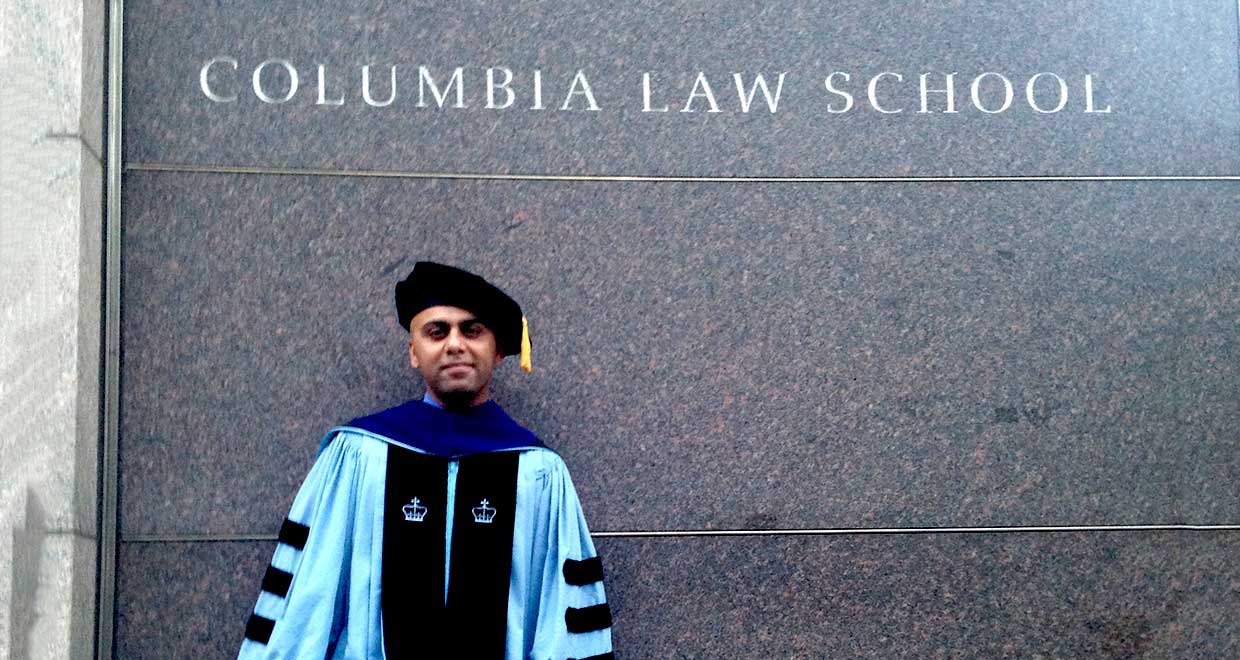
    Dhruv Suri graduated from Guru Gobind Singh Indraprastha University, New Delhi in 2009. While in college he co-founded a student organization called United Students which initiated the Jessica Lall and Priyadarshini Mattoo campaigns. He was invited by the then President, A.P.J. Abdul Kalam to discuss problems of OBC reservations after receiving his memorandum on the same. He has interned with AZB & Partners and Valeo, Paris. He received a PPO while interning at PSA Legal Counsellors where he was an Associate for four years before opting for an LL.M from Columbia University, New York. He has joined PSA after coming back from Columbia. He is currently a Principal Associate at PSA Legal Counsellors. In this interview he talks about:

    • Studying law at GGSIPU, New Delhi
    • Recruitment and work experience at PSA Legal Counsellors
    • Masters from Columbia University, New York


    As an introduction, please tell us about your schooling and how you decided to pursue law.

    I was born and brought up in Delhi and did my schooling from Delhi Public School, Vasant Kunj. I graduated from school in 2003 and was unsure of what I wanted to do. So much so that my family registered me for one of the law entrance exams and I ran away to Mumbai with a friend for a holiday. Of course, that did not go down too well with my family after I came back. When I came back, I took admission in Delhi University where I studied English Hons. for one year. However, for that entire year, all I did was theatre and learn dance. My attendance at college was abysmal! In 2004, I was emotionally blackmailed by my mother to register for the law entrance exams once again on the pretext that I would be given a Maruti 800 to travel to law school and an increment in my pocket money. I fell for it and got an option to study at Amity Law School. Back then, Amity Law School was a building in south Delhi and did not have the atmosphere of a “campus” that I grown accustomed to in my one year at DU. So, I opted for the main Guru Gobind Singh Indraprastha University law school which seemed like a better option. Rest assured, I got no car and travelled 40kms a day in local Delhi buses. So, this is how my journey with law started- as a “victim” of emotional blackmail from my mother! J


    You completed your law degree from Guru Gobind Singh Indraprastha University, New Delhi in 2009. What activities were you involved in there? Looking back, is there anything you wish you had done differently?

    The first few years just went by in trying to understand what law is really about. I loved courses like Legal Reasoning, Jurisprudence, History, and Contract law. I also loved mooting and showed up at any and every audition, whether I was prepared or not. I was also very active in the debating society and ensured that I participated in as many competitions as possible. Since our campus was fairly big and had lots of engineering and management colleges as well, there was always some event or the other taking place. By the time I was in my 4th year, debating became a source of extra pocket money.  However, amidst all this, I was also focussed on getting good internships and a job. In fact, if there is any regret that I have, it is that all through my final year I worked after college hours, whereas all my friends were enjoying themselves, going for lunches, movies and ensuring that their last year as a “student” was memorable. When I look back, I could have probably worried less about my career and instead made the most of my final year at law school. Eventually we all had to work but I do feel that I missed out on some fun times with my friends.


    You started a student organization called United Students. You contested the Delhi University elections and initiated the Jessica Lall and Priyadarshani Mattoo campaigns. Please tell us more about it.

    United Students happened by pure accident. I was in the latter part of my 2nd year at law school when I met the other founder members of United Students at a coffee shop in central Delhi. I had always been someone who liked to initiate and take the lead in everything I did. The trial court verdict in the Jessica Lall case was out and I was having discussions and debates with people from all quarters about the merits of case, legal arguments advanced, etc. Some common friends connected me to like Aditya Raj Kaul, a young 17 year old (now a popular Times Now reporter), who had started an online campaign in connection with the Priyadarshani Mattoo case. Aditya and I realised how similar we both were and he introduced me to the other founder members. We were all passionate about bringing about a change and decided to collaborate. I think that really was the key reason for launching United Students. We wanted the organization to encourage young Indians, particularly students, to think and debate in a cohesive manner and take up issues of governance. The idea was to engage in discussions and debates, take an informed stand and then take steps on ground to the best of our abilities. I think the legal profession is somewhat similar. Discussions and debates are synonymous with research, which is very important to take a stand and advise the client. As I got busier with law and internships and all other members got more absorbed in their lives, the organization had a natural death. However, the entire experience played a big role in how I evolved as a person and it is something that I will always cherish.


    Why didn’t you pursue a career in politics? Do you think you will enter the field again in the future?

    I remember I was doing a shoot for a big news channel during the Delhi University elections and the spokesperson of one of the bigger political parties came to me and asked me to formally join them. I wonder how different life would have been had I actually done that! But on a serious note, I did consider pursuing politics more seriously but was equally eager to graduate and practice law. Who knows, one day I may actually be able to balance a legal and political career!

     

    dhruv-suri-3

    During your time at law school, you interned at AZB & Partners, New Delhi and Valeo, Paris. Please describe your experiences.

    All my internship experiences were very rich. At AZB I did my first all-nighter and got a real sense of how corporate law firms work. The lawyers were extremely kind and I am still in touch with some of them. Valeo was great because I got to work in-house and attend lots of business meetings. I realised how a “business lawyer” (whether in-house or external) cannot give pragmatic advice if he/she does not have a sound understanding of the business. This was the biggest take-away from this internship and till date, I try and adopt the same approach while advising clients at PSA. Of course, I got to spend a little less than 3 months in Paris which was fantastic and the first time I stayed by myself. I made sure I saw every bridge, every museum and (almost) ever cafe and bar there.


    You also interned at PSA Legal Counsellors and then received a PPO from them. What do the recruiters at PSA look for in potential candidates? How did you secure a PPO?

    One of the most preferred modes of recruiting at PSA is to give offers to final year law students interning at the firm and then training them internally as they grow. The firm encourages building in-house talent.

    In terms of how PSA approaches recruitments of potential candidates, I think it is more or less assumed that a first year associate will not know much about the law. However, she/he should be eager to learn and work hard, and also interact and work well in a team. PSA also believes that before becoming a specialist, it is important to be a good generalist. So, if there is a student who only wishes to work in the area of, say, capital markets or intellectual property or competition, PSA would not be the best place to work. Whereas if someone is keen to do everything and gradually pick areas of interest and focus on them, PSA would be an ideal place for them.

    In my specific instance, I interned with PSA all through my final year at law school. While I was still an intern, I got actively involved in a big PE transaction. The deal was still ongoing when I graduated so I just continued working on it and did not stop. Slowly I got drawn in on a lot of other matters and before I realised, I had spent almost 5 years at the firm!

     

    dhruv-suri-4

    Upon graduating, you started working at PSA as an Associate. What was your work profile like?

    Like I mentioned, at PSA, you do everything in your first year. So, my work profile was nothing different. I was actively working on a PE deal, but also assisting the senior lawyers in day-to-day corporate advisory, researching for litigation matters, working on intellectual property queries and even drafting board minutes and incorporating companies. Gradually the work becomes more sophisticated and challenging but the basic training I got in my first year continues to be invaluable and (I’d like to believe) set a strong foundation. Before I left for my LL.M in 2013, I was working on sophisticated M&A transactions, advising large conglomerates on complex legal queries pertaining to contracts, IP, tax, employment etc. and arguing matters before the Competition Commission of India.
     

    dhruv-suri-2

    After four years at PSA, you opted for an LL.M from Columbia University, New York. How did you secure your admission at Columbia? What was your specialisation?

    So, Columbia and Harvard are two schools that I know do not offer a specialised LL.M. In fact, even as a matter of personal preference, I did not want to do a super specialised LL.M. The application process was exhausting and almost impossible to manage with long work hours. I took 10 days off in October 2012 to work on my applications and finalized as many as I could. Even the 10 days were not enough and I spent a lot of weekends on my personal statement and other school-specific essays that were required. Now when I look back, I am so glad I put in that effort because Columbia really is one of the best things that ever happened to me! Plus I got to live in New York which just takes the LL.M experience to a whole new level.

    With respect to courses, there was a fair bit of flexibility so I made sure I had a variety on my plate. Some of my courses were “Strategic International Commercial Transactions,” “Financial Statement Analysis,” “Intellectual Property Drafting,” “Negotiations,” “Corporations,” etc. All of them were taught by top-notch professors who made studying such a pleasure, an area where, in my opinion, Indian law schools have a lot of catching up to do.


    You also worked as a Research Assistant for Professor Anu Bradford in the field of antitrust laws. On what basis were you chosen for the project? How was the experience?

    I have always been very interested in competition/antitrust law. During my first month at Columbia, we received an e-mail that Professor Anu Bradford was looking for LL.M research assistants to work in the field of antitrust law. I think I drafted a short cover e-mail and sent my CV within 5 minutes of receiving the e-mail. Professor Bradford called me for an interview and soon I started working for her. The experience was so enriching because the work she asked me to do involved coding antitrust laws of multiple countries (including India) and understanding key differences in how statutes are drafted across those jurisdictions with respect to restrictive agreements, cartels, abuse of dominance, etc.. The work gave me a deep and detailed understanding of antitrust laws. Plus, she is one of the most wonderful people I know and mentored me throughout the time I was at Columbia. I am just glad I got to work with her.


    Is it better to pursue an LL.M right after college or after working for a few years?

    This is a question that a lot of people aspiring to do an LL.M ask. Honestly, I don’t think it has a right answer. A lot of my friends went for their LL.M immediately after completing law school but I chose to go after gathering some work experience. Specifically for Columbia, which has an extremely competitive curriculum, it is rare for them to admit anybody with less than 2 years of work experience. Of course, there are exceptions. Based on my experience, I do think that work experience comes in very handy, especially when you are learning about a different legal system. You are definitely wiser and more mature to gauge concepts by linking them to your practical experience. Plus, you also tend to make a lot more of your degree by networking professionally, which, I think, can be challenging if you have never worked before.


    Do you think the LL.M has improved your career prospects? Do you have larger responsibilities at PSA now?

    The LL.M has definitely helped me a lot. If I had to point out one thing, it has made me surer of my work and more confident in my interactions with clients, both Indians and foreigners. In terms of my profile, I am now a Principal Associate at the firm and manage PSA’s start-up/PE/VC practice which is extremely exciting because I interact and work with dynamic start-ups and very passionate entrepreneurs.  While I continue to do legal work, a lot of my time and energy is also spent on business development, which I thoroughly enjoy. So clearly, the responsibilities have increased and the concept of weekends has dissolved. I have to be on top of whatever I am working on all 7 days a week and I actually prefer it like that.


    Lastly, what advice would you give to law students wishing to pursue a career in corporate law and considering doing an LL.M?

    I would say that, make sure you do internships in law firms in your 4th and 5th year and be proactive when working. I enjoy working with interns who are eager to learn, proactively follow-up with me and don’t hesitate to take responsibility of their work. It is a good opportunity for you to demonstrate your attitude towards work. Also, be prepared to do any and all kinds of work. You will realise much later how the most minuscule things you worked on as an intern or first year associate come in handy during negotiations or drafting contracts. So, approach work with an open mind. Finally, if you plan to do a LL.M, my advice usually is to work for 2-3 years. It will really change your perspective and you will be able to make the most out of your academic courses and the overall LL.M experience.

    In the end, I would just say that work hard but make sure you enjoy your student life as well. That time (unless you do your LL.M) will not return. Good luck!


     

  • Ronak Thakkar, Associate, Jyoti Sagar Associates, on the first year at a top law firm

    Ronak Thakkar, Associate, Jyoti Sagar Associates, on the first year at a top law firm

    Ronak Thakkar is currently an Associate at J. Sagar Associates, Mumbai. He graduated from Government Law College, Mumbai, and simultaneously earned his Company Secretary degree. His internships include Tata Motors Limited, P&C Legal and J. Sagar Associates, Mumbai. He has also completed a Diploma Course in Cyber Law from Asian School of Cyber Law, followed by the Advanced Certificate Course in Foreign Trade, International Business/Trade, Marketing and Dispute Resolution from the Indian Merchants’ Chamber. In this interview he talks about:

    • Academics and co-curricular activities at GLC, Mumbai
    • Internship, recruitment and work at corporate law firms
    • Pursuing a C.S. degree along with LL.B studies


    Our readers consist of law aspirants, law students and young lawyers. How will you introduce yourself to them?

    Firstly, thank you for giving me this opportunity to share my story. This interview is going to be an experience in itself as I am usually the listener and the one who asks questions.

    I rocketed to Earth as Ronak Thakkar. I’m a corporate lawyer, 23 years old, currently working in Mumbai (Bombay, for those who prefer it that way). I am passionate about law, live life with an open, accepting mindset and am always up for a high five.


    Tell us a bit about your childhood and pre-college life as well as educational background. Do you have lawyers in your family?

    I was blessed with a very good childhood and was fortunate to have caring and supportive parents. I was a last bencher at St. Pius X High School, an all-boys school. As you’ve guessed it right, the energy and the adrenaline rush were really high.

    Honestly speaking, school has been one of the best phases I have lived through so far. I guess the feeling is the same for all of us. I have learnt a lot, made many friends and it has definitely been the foundation stone to the positive attitude with which I stand in front of you guys today. About my educational qualification, I am a law graduate from Government Law College, Mumbai.

    I am a first generation Superlawyer. I also don’t have a surname that is well-established in the fraternity.


    In India there is bit of resistance towards legal education even now. What motivated you to choose law as a career?

    I don’t personally feel that there is any resistance towards legal education now. I think students in India today are more than happy to take up law mainly because law offers you many opportunities to do your best in your chosen interest areas. The Government is doing a lot to promote legal education and make it more accessible. In GLC there is about 50% reservation for students who belong to eligible quotas like SC/ST, sports, cultural etc. and these opportunities are being utilised.  I don’t think there is any resistance.

    As far my motivation to take up law and pursue law as a career is concerned, it was simple. I could relate to it more than anything else and definitely relate to it more than I could relate to K4Fe(CN)6 + H2SO4 + H2O = K2SO4 + FeSO4 + (NH4)2SO4 + CO.

    According to me law helps you to find solutions in real life situations and is a very practical subject. I felt that by doing law I will be standing for a purpose/cause and will work towards achieving it. Therefore I took it up.

    Curiosity is the word. Law is interesting; I felt I wanted to know more. I was sure that I will be better as a lawyer than a dentist or an engineer. It wasn’t very difficult to take that decision then.


    How did you get through to GLC, Mumbai?

    I was a science student before I took up law. I was weak with numbers, never got my chemical equations right. I had realised that I had failed to make the right choice. I was about to waste a year because it was a bit late by the time I decided to do law and GLC was the only college I was able to apply to.

    While going through the admission process, I learnt that in order to get through GLC, your HSC percentage is taken into account and you are not required to give CLAT which was motivating considering that I had not given the CLAT.

    I am very happy that I got through and was a part of this excellent institution.


    Which subjects did you enjoy during your qualifying degree? What about co-curricular activities?

    I enjoyed Company law, Banking laws and Constitutional law. I contributed to the Magazine Committee of GLC in my first year.  I moved on to learn German and Japanese in my second year as learning new languages and networking are my hobbies.

    I felt that much of the law related to people and their dealings with each other, and it was crucial to understand thought processes and society to be able to work towards solving social problems. Therefore, I took up voluntary community service at the Indian Red Cross Society, Mumbai and was a part of some of their programs.

    I became a part of AIESEC, Mumbai in 2011, a branch of the world’s largest youth run organization, AIESEC International which gave me an opportunity to network and facilitate student exchanges with partner countries. It was a very positive experience as AIESEC always welcomed new ideas, promoted teamwork and leadership. As an AIESEC Organizing Committee member for “Balakalakaar 2011” I worked towards empowering under-privileged children and was instrumental in giving them a platform to showcase their talents.

    In my final year of law school, I was an active member of the GLC Students Council, the apex student body where I worked towards organizing events and promoting various initiatives for the welfare of college.


    Tell us about the places you have interned at. Did you plan your internships throughout law school?

    I did not plan my internships. As a part of my C.S. coursework, I had to do a compulsory internship for which I approached ICSI, my C.S. Institute to know how to go about the internships. Based on their guidance, I applied to companies and procured my first internship at Tata Motors Limited where I did a mix of corporate secretarial and legal work.

    As I discovered that I am more inclined towards corporate and transactional legal work, I asked some of my friends to suggest good law firms where I can learn more. After doing a bit of research online, I was able to contact the H.R. departments of these firms and submit my resume for their consideration. That’s how I procured my internships at P&C Legal, Mumbai and J. Sagar Associates, Mumbai.


    How relevant did you find your law school education with the kind of work you were required to do at law firms?

    I found it quite relevant. A law school curriculum is designed to cover everything that a law student ‘must’ know before he/she starts practice. Working on a transaction/matter will teach you more about the practical application of law to transactions/matters. But from an academic standpoint, I feel the education was very relevant to prepare one for the practicalities.


    You also managed to pursue the Company Secretary course. Tell us how did you manage it with college?

    In my first year, I saw a few students from my college applying for it. So I walked up to one of them and asked them about the course. I was told it is “core corporate law”. So I went up to www.icsi.edu to find out more and was convinced to pursue it.

    Initially it was more like following the rat race but as I discovered that I was more interested in corporate transactional work, I continued with the course and it was very helpful academically as it had important insights on subjects like mergers and acquisitions, securities law etc. which were not covered by my law school curriculum but were otherwise very relevant.

    As regards, how I managed to do it with college, I have a secret formula which is – “Be humble, hungry and the hardest worker in the room”.


    Soon after graduation, you joined J. Sagar Associates as an Associate. How did your appointment take place? How was your interview? Please give our readers some tips to nail a law firm interview.

    I applied to work with J. Sagar Associates after I completed my internship. My appointment was based on a review of my performance as an intern with the firm. My interview was a formal one and was focused on confirming my resume and ensuring that I knew what I was talking about from a “technical” standpoint.

    The interview was also about finding out if I am the right fit for the position or culture at J. Sagar Associates.

    I haven’t faced many interviews, but if I were to highlight some important points for applicants to keep in mind while applying for a job, they would be:

    Research about the law firm where you wish to apply.

    Make an effort to really understand what the firm’s expectations are of you and whether you will be in a position to meet them.

    Know your career narrative well. The career narrative must be easy to remember and retell. It should meaningfully link your past successes to your near and long-term development needs and suggest the kinds of assignments that would help to achieve those objectives It must hang together with the right combination of honesty, humility, and personal flavour.


    ronak-thakkar-2

    How tough were the first six months at your workplace?

    They were not tough or difficult. J. Sagar Associates (JSA) has a very positive, supportive and friendly work environment. I have helpful team members and well-informed, accessible partners who guide me so that I can deliver my best. This is actually very encouraging and has motivated me to learn more and get better on the job.


    Tell us about the nature of work you’re entrusted with and what a typical day is like. What is the most challenging aspect of your job?

    I am entrusted mainly with transactional and advisory work. My practice areas are private equity, mergers & acquisitions, banking & finance. I also work on general corporate commercial matters and am involved in drafting, negotiating and reviewing a variety of commercial and financing contracts.

    In my view, the most challenging aspect of my job is time management. There are deadlines to matters and it is important to be responsive to clients. When you are on multiple active transactions it becomes a bit challenging to balance between long work hours and one’s personal life.


    Do your dual qualifications complement each other in terms of your work?

    Yes to an extent. The qualifications have helped me to understand concepts better and gain much needed academic exposure before facing a practical transaction/situation.


    There is a phenomenal obsession amongst law students with maintaining a very high CGPA. How important according to you is this in securing a job in a top tier law firm?

    My personal view is that a high CGPA is definitely an important reflection of your academic performance, but it is not the only parameter on which your capabilities to be a part of the top tier law firm are adjudged.

    If your CGPA dropped because you were involved in extracurricular activities due to which you weren’t able to devote sufficient time to your studies in a particular semester, that doesn’t mean you are not a performer. But it surely means that you are a multitasker!


    You did a Diploma course in Cyber Law from Asian School of Cyber Laws. Tell us about the course structure and the utility of pursuing such Diploma courses beside studies.

    The course gives you knowledge about the information technology laws of the country and how e-commerce is regulated in India. For more information on such courses please visit: asianlaws.org. The Asian School of Cyber Laws is doing a really good job. There are tutorials conducted to make you understand the subjects in detail, the study material is helpful and exams are open book.

    I personally feel that the IT law practice is still in its developing stages in India. And from what I foresee, we are being increasingly driven by technology in our personal and professional lives with each passing day. It is naturally important to know how the law relating to technology is and will be regulated.


    You have also pursued an Advanced Certificate course in Foreign Trade, International Business/Trade, Marketing and Dispute Resolution from Indian Merchants Chamber. What was this course all about? Do you think pursuing this kind of professional courses help?

    India holds an integral part and has an important position in the global economy today. Naturally, there are going to be many cross border transactions and opportunities coming to our doorstep. As a lawyer, one will be required to work/advise on these transactions.

    The Advanced Certificate course in Foreign/International Trade course gave an overview of export-import and commercial transactions, documentation and more importantly about the foreign trade policy and the Foreign Exchange Management Act. These are key regulatory areas which will be very important to take into account if you were working or advising on a cross border transaction.

    These subjects were not covered in sufficient detail in my law school curriculum and therefore I felt the need do this course.  You can know more about the courses offered at the Indian Merchants Chamber website.


    Where do you see yourself five years from now? Would you consider going for an LL.M. abroad?

    I don’t make five year plans. I have my fingers crossed and hope that I should be doing well five years down the line.

    Yes, I might consider doing an LL.M if I manage to get a scholarship.


    What would be your parting message to law students who want to get placed in a law firm?

    I believe that ‘effort motivates accomplishment’ and if you work towards something you want in the right manner, you will achieve it. There is a Superlawyer in each of us. Find what you love to do, and just give your best.

    Firms will be more than willing to welcome you if you are good. People at firms are sweet, trust me!

    I am reachable at LinkedIn and Facebook in case anyone needs to get in touch. I take this opportunity to wish law students all the very best and I will be the happiest to know about their success stories.


  • Nirupama Jayasimha, Associate, Telecom Media Tech team, Trilegal, on work and LL.M from Stanford Univ

    Nirupama Jayasimha, Associate, Telecom Media Tech team, Trilegal, on work and LL.M from Stanford Univ

    Nirupama Jayasimha is a graduate from Bangalore University batch 2003-2008. Currently she is an associate at Trilegal, working in the Telecom, Media, Tech team. She has had a brief stint with Infosys and then she worked at Wilson Sonsini Goodrich and Rosati. She has completed her LL.M. from Standford University.  She has also been an Exchange Student at Université Paris X Nanterre. She shares her experience as an Exchange Student and tells us why and how an exchange programme is beneficial for a law student.

    She tells us about JN Tata scholarship application and other procedures for further studies abroad. She also talks about the job opportunities available overseas.


    Though it’s one of the most cliché question, but yet, why law? What were your areas of interest while you were studying law?

    I come from a family of eminent lawyers and engineers. Dinner time conversations were filled with stories from the court or the latest developments in technology. This led to an interest in these fields from a very early age. My father thought I would make a better lawyer and persuaded me to take law. In the meantime, the growth of IT in Bangalore presented a unique opportunity to work at the cusp of law and technology. Most of my internships were in the legal departments of technology companies to help me understand the fundamentals of technology, business and its interaction with law.


    You have been a part of Université Paris X Nanterre as an Exchange Student. How do you think such exchange programmes are beneficial for a law student? Tell us about your experience there.

    When I signed up for the exchange program, apart from getting to live in Paris without paying for it, I couldn’t think of a single way the exchange program would benefit me. If anything, it seemed like opening a Pandora’s box. I had to attend classes and take exams in a language I didn’t understand well, the college administration was not sure if the courses taken in Paris would count towards graduation and I had to live away from home for eight months which I had never done before. Call it adrenaline rush, or the compulsion to be different, I just signed-up for the program. Apart from learning enough French for a lifetime, there were no immediate benefits I saw from the exchange program. It’s only much later that I reaped the benefits. While at Infosys, I worked closely with clients in France and having an idea of civil law and French was an added advantage. It may have influenced my admission to Stanford as I was one of two students in my university to have done the program. Even today, the networks I cultivated have stood me in good stead. So, I guess, my advice to anybody who wants to take up an exchange program is to go for it! Like Steve Jobs said “its only when you look back that you will be able to connect the dots”.


    nirupama-jayasimha-2

    You have studied LL.M from Stanford University, through the J.N Tata Scholarship. Tell us in detail about the application procedure for the JN Tata scholarships and other such scholarships.

    The J.N Tata scholarship requires applicants to submit a personal statement along with their application. Based on the strength of the application, candidates are shortlisted for an interview in Bombay. Candidates are interviewed by a subject-matter expert from their particular background for an hour. A week after the interview, successful applicants are intimated by mail. The final distribution of the scholarships is at a ceremony held at the Bombay House (where you may have a chance to meet Ratan Tata!). The ceremony is also attended by scholarship alumni and distinguished members of the Tata Group.

    The Stanford acceptance letter comes out well past the deadline for most scholarship applications. I just made it in time for the JN Tata scholarship and that’s only because an extension was granted! However, there are a few scholarships that you can apply prior to sending out your college applications. Applying to these will ensure you don’t lose sleep after receiving the acceptance letter.

    In terms of the selection process for the JN Tata Scholarship, it is hard to give a definitive answer of the traits required to bag the scholarship. My advice is that it is good to spend a few days thinking about why you want to do a LL.M, how you would use it to further your career and the interests of the society at large and then present it in your application in a compelling way. This is the most important question any scholarship panel asks and is also a defining part of the application you submit to colleges.


    How was your experience with faculty and academics at Stanford University?

    As a law student, I spent a lot of time reading and thinking about technology law issues like net-neutrality, P2P sharing, patent trolls, dispute resolution in e-commerce. Quite naturally, the opportunity to study at Stanford, at the bleeding edge of all the action, was an exciting prospect. And I was not disappointed at all. The Socratic method of teaching is crafted towards making you evaluate these issues by questioning the fundamentals. In addition, hearing perspectives from competing stakeholders on issues they deal with on a daily basis makes you appreciate and understand the different facets of the issue. For instance, in a panel discussion onP2P sharing, we had the ex-CEO of Napster, Hank Barry on the panel and a lawyer from Viacom. Meeting such stalwarts on a daily basis inspired me to contribute to the evolution of technology law in a meaningful way.


    How is the recruitment/ placement situation for overseas students?

    Well, it’s not easy to find a job. If you are looking to do an LL.M just so you may work in the US, then it may not be a wise decision. To land a job in the US, an extensive network of contacts will take you much further than a LL.M degree. When you interview for jobs after your LL.M, you are competing with JD’s. A law firm will not want to pick you ahead of a JD unless you have something a JD doesn’t. More often than not, that X-factor could be your ability to bring in work from your home country. As a general observation, I found that the network one has built in India is the most effective tool to land a job in the US.


    How did you get a job as a foreign legal specialist in Wilson Sonsini Goodrich and Rosati? What kind of work did you come across?

    My boss during my stint at Infosys, Samuel Mani generously referred me to a partner at Wilson with whom he worked closely. At Wilson, I worked with the Technology Transaction team which primarily worked in representing technology companies in business transactions driven by the development, use, acquisition, or divestiture of intellectual property, including licensing, mergers and acquisitions and public and private offerings. The most interesting piece of work I was involved in was preparing a memorandum for the Demi Moore and Ashton Kutcher foundation on the ethics of web scraping to help prevent child trafficking. Additionally being from India, I helped in cross-border transactions involving Indian clients.


    nirupama-jayasimha-3

    Is it easy to have a work-life balance in this profession?

    I think you need to identify as early as possible, the things important to you in life and then prioritize them accordingly. For me, health, family and work are the top priorities. The most important of course is to maintain a healthy lifestyle, without which one can neither do justice to work (no pun intended!) nor spend quality time with your family. If one is disciplined, it is not hard to set aside an hour everyday for some sort of physical activity. I also don’t let work get in the way of having timely meals. As for prioritizing between family and work, it is very contextual and one cannot blindly prioritize one over the other. There are times when you may need to give up working on an important deal because you have a prior family commitment, and there are times when you have to miss a family event because you are committed to closing a deal. I think planning and being organized helps a lot in navigating this tightrope. It is also important that people at work respect your priorities and that people at home understand. I have been lucky to have a very supportive family, and colleagues at work who understand the importance of striking a work-life balance.


    Is there any success mantra that you follow which you would like to share with our readers?

    Howard Roark, in Fountain Head (which is my favorite book of all time) says,

    “I have, let’s say, sixty years to live. Most of that time will be spent working. I’ve chosen the work I want to do. If I find no joy in it, then I’m only condemning myself to sixty years of torture. And I can find the joy only if I do my work in the best way possible to me.”

    This really sums up what I believe. Any work you choose to do, do it to the best of your ability. The rest will take care of itself!


  • Adithya Banavar, Senior Associate, McKinsey, NY, on the job of a management consultant

    Adithya Banavar, Senior Associate, McKinsey, NY, on the job of a management consultant

    Adithya Banavar is currently a Senior Associate at McKinsey, New York. He graduated from NLSIU, Bangalore in 2011 and then joined McKinsey’s office in Chennai for two years. He was subsequently transferred to McKinsey’s New York office in 2013 as a Business Analyst. He was promoted to Senior Associate in July, 2014. His achievements during law school include being in the top 16 of the prestigious Willem C. Vis International Commercial Arbitration Moot Court Competition, Vienna.

    In this interview he talks about:

    • Experiencing law school at NLSIU, Bangalore
    • Mooting and in particular, Willem C. Vis, Vienna
    • Working at McKinsey, New York


    How would you introduce yourself? Could you please share a little bit of what motivated you to pursue law as a career?

    I am currently a Senior Associate at McKinsey in New York. I graduated from NLSIU, Bangalore in 2011 and then joined McKinsey’s office in Chennai for two years. In August 2013, I got transferred to McKinsey’s New York office where I continued as a Business Analyst. In July 2014 I was promoted to Senior Associate.

    Both my parents are lawyers and that was basically where the idea of law school came from. By the time I was done with my 12th, I had decided that I wanted nothing to do with engineering. At that time it seemed like a good idea for me to actually start doing something different, and hence, law.

    I came to know of NLS through my father who used to be a visiting professor there and has had a long standing association with the University. I wrote the entrance exams for NLS, NALSAR and NUJS. I got through NLS with a rank of 48 but as far as NUJS was concerned, my name was at the very bottom of the list!  I chose NLS mostly on account of it being closer to home.


    Given that a significant number of our readers are law school students, would you please tell us a little about your law school days at NLSIU, Bangalore?

    My experience at NLS was a little different from the typical NLS experience because I was a localite. I was more of a day scholar and didn’t stay at the hostels often. Accordingly, I had a lot less excitement in my life compared to my batch mates who lived on campus.

    Overall, the real value lies in the ecosystem that NLS creates, apart from the conventional classroom curriculum. It gives you an opportunity to do whatever you want, whether it is a moot or starting up your own eatery like Bhukkad for instance. The peer crowd around you is what makes the experience special. NLS is structured to support this. Classes start at 8:50 am in the morning and end at 1.30pm so the rest of the day is open for you to explore your wide array of interests. It makes a student understand that academics is only a part of a holistic education.

    Personally, I am a huge fan of the trimester system. I think it works really well. You have four subjects so you can clearly focus your attention. There are a few days where things could get a little intense (night before the exams!) but most of the time, you actually have time to yourself. It also gives you a very good balance of subjects. When you are studying Sociology and Economics, you are also studying Legal Methods. You see how the latter plays a role in both Sociology and Economics. Law is not something you can study in a vacuum without a broader social context and I feel the trimester system allows you to get deep into a couple of areas and truly understand the interdependencies.

    NLS also offers numerous avenues to put the law into action. I was part of two of them during my time in law school. The Legal Services Clinic (which I was a joint convenor of) has a dual mission of (i) providing legal aid to those who cannot afford it and (ii) spreading legal awareness and literacy. As a part of LSC, we set up the Bangalore chapter of IDIA (Increasing Diversity by Increasing Access) – an NGO that looks to help underprivileged students gain admission into law schools through CLAT by providing financial and training assistance; and then looks to support and mentor them through the 5 years of law school.


    adithya-banavar-2

    Have you ever felt that you have a slight advantage over your peers in other law schools owing to the fact that you are an NLSIU-graduate?

    It really depends on what you want to do in life. If you want to start your own company for example, it will make little to no difference which law school you go to. If you want to go to a top tier law firm, again it doesn’t matter that much because as far as I understand, the top 15 from any of the top National Law Schools find their feet fairly easily. Where the difference starts is in the more off-the-beaten-path career options. The reason this difference has begun is because NLS has a very strong alumni network. Many are into business, some even into modelling! One good example is McKinsey, which has numerous NLS alumni. In terms of campus recruitment, McKinsey used to only go to NLS among the top law schools (not sure if this has changed now).

    However, these are not structural barriers. I feel that if you are enterprising enough it doesn’t matter which law school you are from. For instance, when we were at the Willem C. Vis International Commercial Arbitration Moot Court Competition in Vienna, we met Martin Hunter (one of the foremost arbitration authorities in the world). He was hanging around a team of law students from KIIT, Bhubaneswar. We later learned that he comes to India and teaches a course every summer on Arbitration law at KIIT.


    How important do you think CGPA is in retrospect?

    I did not have a very high CGPA and hence my answers are potentially biased towards feeling it does not matter. I never really cared about CGPA even during law school and focused my attention on co-curricular activities like mooting. NLS recognizes this and there is a gold medal that is based on performance at moots – Best Student Advocate, which I was awarded.

    I think CGPA makes a difference if one wants to join a law firm. It makes a huge difference if one wants to pursue higher education. Once you move away from law firms and higher education, it makes far less of a difference. For litigation, it does not matter in the least!

    In the long run, I think it is important to separate out learning from having a good CGPA. I feel I learnt a lot more from mooting than I did in the classroom. Having a good grounding in law is immensely valuable in whatever you choose to pursue after law school (even if it is not directly law-related). Unfortunately, the CGPA system is far from perfect and I feel does not truly reflect how well one has understood the subject.

    You have taken part in the prestigious Willem C. Vis International Commercial Arbitration Moot Court Competition, Vienna and also finished in the Top 16. Please tell us about your experience.

    Vis is truly an amazing moot. The city is beautiful and there’s a party almost every other day. If you plan on taking last minute moot work when there, it is likely to be a very bad idea! There is just so much to do and enjoy other than the moot itself. There are almost 300 teams participating and it’s a great opportunity to meet people and know about their views, etc. and understand the law better. It is truly a once-in-a-lifetime experience.

    In relation to our performance at the moot – after securing any moot, the first thing to do is to hound past teams who have cracked the moot. The challenge we faced was that teams in the years immediately preceding us had not done very well at Vis. With hard work, an “out of the box” approach to mooting and a ton of luck, we reached the Top 16. Once you reach that position, the other 15 teams are more or less close to your own team in terms of competition. In the round of 16, we lost to a team from the College of Law, England and Wales. The head of Arbitration for Allen & Overy, Europe was their coach!

    You are currently working as a Senior Associate at McKinsey & Company in New York. How is it different from working in India?

    Although not very different in terms of work, it is quite different from a cultural perspective. Here, in the United States, the industries are well established and there is a much more defined role for consultants. In India, it is still a lot more personal and exploratory in terms of the way you work with your clients. Of course, that is a broad generalization and there are many exceptions.


    What is an average day as a Senior Associate at McKinsey & Company like for you? We would love to hear about your work profile. Please tell us about the responsibilities you are entrusted with.

    As an Analyst and a Senior Associate, you are a member of a larger team. We are given a very challenging problem from the client, which could range from ‘where should we focus for the next five years’ to ‘How do we reduce our procurement cost by 20 percent?’ Whatever the problem is, we break it up into distinct pieces and allot each of these pieces to a member of the team. Teams are small – with 2-4 people looking into at the problem on a full time basis and 2-3 more senior consultants who spread their time across multiple projects. Each person in the team owns a significant part of the answer. As a senior associate, you take a much more holistic view and are responsible for understanding how your part of the problem links with the overall problem and the broader context of the company. As an analyst, you focus on the part of the problem that you have been given. As you get more senior, the mindset changes from ‘This is what I have been allotted and I shall go solve it’ to ‘what is really going to make a significant and lasting difference to the client.’


    How can one working at a law firm at present get into McKinsey?

    During my time in India, I did not see many laterals hired from undergraduate programs. I suppose this is because the Analyst programme is a two year commitment after which you are generally expected to go to business school and come back as an Associate. Most analysts spend two years at McKinsey and then go to an NGO or go into investing before going to Business School. Some come back to McKinsey as Associates. There are also people who come back to the law with a more holistic business experience.


    Will an MBA post a five year integrated B.A/B.B.A, LL.B. course be a better combination for a job like this at McKinsey (Management consultant)?

    Yes, definitely. Business and law are two sides of the same coin. It is quite useful for one to understand the nuances of the law to make sound business decisions. Beyond that, the way you approach problems in business is exactly the same way you approach problems in litigation. Instead of searching for case law, you’re looking for facts and analyses to support your answer to the problem that the client has posed to you. In the legal context, you are getting the facts of the case, the evidence and putting them all together to support your arguments, so it is very similar in that sense (just a different context). An MBA therefore fits perfectly with a law degree and an excellent entry point into business (including consulting).


    Do you plan on doing an MBA sometime?

    I am quite not sure at this point of time. I intend to continue at McKinsey for the near future (I got promoted to associate without an MBA). Frankly, I haven’t decided anything as of now, but I should come to a decision by mid-year.


    Do you know about the management consulting industry in India? Would you like to come back and operate from here?

    Yes, I have a fair idea since I worked in India as a management consultant for 2 years. It is definitely an option and not a bad one. It’s really a question of opportunities in the areas you’d want to be in. What excites me the most is doing strategy work for TMT (Telecom, Media & High Tech) companies. From a longer term perspective (5-10 years), I think India will be one of the best markets to be in.


    As a concluding message, what would be your suggestions to law students?

    For people in their second or third year, my message to them would be to make the most of law school. Enjoy the social life along with the extracurricular and co-curricular activities. Do not get too stressed or worried about any one thing (especially CGPA!). For the ones who are about to graduate, I don’t have much to say except that they ought to do what they want, not what everyone else in their batch is doing. Their job should excite them to go to work in the morning. If not, they should already better start planning their exit (even if they have not yet started!). It’s not that every day of the year will be filled with excitement, but in balance, your irritation and frustration should not outweigh your excitement.

  • Kritika Kapoor, Assistant Manager – Legal, Reliance Broadcast Network, on work profile and experience

    Kritika Kapoor, Assistant Manager – Legal, Reliance Broadcast Network, on work profile and experience

    Kritika Kapoor is a graduate from Pravin Gandhi College of Law. She has interned with Advocate Rajesh Bijlani and SPN Law Associates under the mentorship of Advocate Satish Nagvenkar. After graduation, she started working at B4U Television Network. Meanwhile, she also pursued a Masters in Intellectual Property Rights from Mumbai University. She is currently an Assistant Manager – Legal at Reliance Broadcast Network Limited.

    In this interview she talks about:

    • Life at Pravin Gandhi College of Law
    • Working at B4U Television Network
    • Being Assistant Manager – Legal at Reliance Broadcast Network Limited


    How would you introduce yourself to our readers who are primarily budding lawyers? Did you belong to a family of lawyers?

    Hello Readers!  I come from a family with a strong science background. My father is an engineer, my sister is a dentist and my mother is a homemaker who has a degree in home science. I too, was keen on entering the medical profession and hence took up science in junior college.  It was during my junior college days that I was drawn to the legal profession whilst working on a personal property dispute. I believed pursuing law would be a challenging and intellectually rewarding career option and would complement my personality and skill sets.


    Tell us about your five year journey through law school. Share some highlights from your college days that shaped you as a professional.

    The faculty at Pravin Gandhi College of Law encouraged both academics and extra-curricular activities and the college was always buzzing with action and excitement. I participated in various activities like moots, debates, crime scene investigation competitions, essay writing competitions, etc., and the experience indeed helped me refine my research, analytic and reasoning skills.

    Signing up for various courses relating to consumer protection, property transactions, professional legal communication, etc. helped me add on to my knowledge base. I did a 4-month course on intellectual property from NMIMS which really helped me get an in-depth understanding of IP laws.

    Students should be encouraged and provided a platform to take up research papers and dissertations.

    As President of the college’s Sports Committee, I represented PGCL in various tournaments organised by law schools across India. I won individual titles in Table Tennis & Carrom and team trophies in throwball in various sports tournaments such as: ‘Yuvardha’ organised by National Law University, Jodhpur; ‘Symbhav’ organised by Symbiosis Law School, Pune; and ‘Spiritus’ organised by NLSIU, Bangalore.

    I was in-charge of managing 50+ members contingent on these trips and that truly honed my leadership, time-management, and interpersonal skills. Sports helped me imbibe essential qualities such as sportsmanship, teamwork, respect, integrity, dedication and crisis management. Above all, sports taught me how to be perseverant during times of failure and to remain humble in success. I learnt that you may not always win, but you must play the game with all your heart.


    Did you take up any internships or work during your college days?

    Throughout law school I kept myself busy with one thing or the other. I had 5 years of education ahead of me but still wanted to be occupied and financially independent.  In my first year, I took up a job at Intelenet and was working as a Sales & Service Manager for an inbound call process for Barclays Bank, UK, servicing bank accounts and up-selling banking products.

    My first legal internship was with a practicing criminal lawyer, Advocate Rajesh Bijlani. I assisted in research and drafting on contentious cases relating to murder, rape, etc. Thereafter, I worked with SPN Law Associates, under the mentorship of Advocate Satish Nagvenkar who has a strong practice in property law. It was during my stint at SPN that I acquired a good grip on drafting and pleading. A few months before my final semester exams I got placed at B4U Television Network and started working there.


    How did you secure your appointment at B4U? What did your work comprise of?  How would you describe your experience working there?

    Like all other enthusiastic final year students, I enrolled for the college placement program and simultaneously started hunting for opportunities myself.  I was contacted for an opening at B4U, which is one of the world’s leading Bollywood television networks, by a consultant who found my resume on an online job portal. I had to undergo two rounds of interviews, first with the Legal Head, Natasha D’Souza and the second was with the Chief Financial Officer, Sandeep Gupta. In the first round I had to answer a few pertinent questions related to property laws, drafting and copyright in order to verify the veracity of my resume and was then asked to draft a reply to one Public Notice. In the second round I was asked a few more questions to identify my individuality and to see if I was fitting to the company and team.

    Working at B4U, I was exposed to the niche practice of media laws. My work primarily involved drafting specialised agreements related to film acquisition & distribution, hiring of transponders, channel distribution, hiring talent, corresponding with government authorities and administrative bodies like MIB, TRAI, FDA, DAVP, IPRS and ensuring regulatory compliance. During my stint at B4U, I undertook extensive research on TRAI Regulations, content laws and the amendments to the Copyright Act. The company provided me a great learning platform and I was fortunate to work with veterans like Sandeep, Natasha and Manisha, who were extremely kind to invest their valuable time in mentoring and training me.


    Tell us about your work as an Assistant Manager – Legal at Reliance Broadcast Network Limited. How has the journey at Reliance been so far?

    Reliance Broadcast provides me with simultaneous exposure to the radio & television businesses. I am blessed with a young and vivacious team of lawyers, company secretaries, Charted Accountants, etc. with whom I closely work. My job requires me to juggle between various duties such as drafting & negotiating contracts, regulatory compliance, litigation management, liaison with counsels, intellectual property management & protection, research & strategy, setting SOPs, providing opinions, prescribing S & P procedures, corresponding with government authorities on business and policy related issues. At the office, I’m always on my toes and that’s one of the reasons I love working here.

    The exposure I’ve gained at Reliance has helped me grow professionally as well as personally. My work has been recognised and appreciated due to which I was recommended for a promotion to Assistant Manager within a few months of joining.

    While working under the leadership and able guidance of Asheesh Chatterjee, our Chief Financial Officer, I have been able to develop a strong commercial acumen and now have a more pragmatic & business focused approach. I am very grateful to my bosses – Asheesh Chaterjee, Gururaja Rao and Shikha Kapadia, who always reposed their faith in me and motivated me to perform better.


    Please tell us about the recruitment process at RBNL. What do they look for in their prospective employees?

    I have observed that employers are looking for candidates who are eager to learn and are optimistic about work. They want someone who is hard-working and a team-player.


    Tell us what your typical work day is like. What kind of work does an Assistant Manager – Legal at Reliance Broadcast Network generally deal with? How has the journey at Reliance been so far?

    A normal day at work would involve one or more of the following:

    • Drafting Agreements
    • Legal Research
    • Regulatory Compliance and correspondence
    • Opinion to S&P Team
    • Due Diligence
    • Court Visit
    • Strategy meetings
    • Liasoning with counsels

    At RBNL, I learn something new each day. I am often assigned tasks that are completely new to me and there is always scope for improving as a professional.


    In the meantime, you managed to pursue Masters in Intellectual Property Rights from Mumbai University. Was it a professional requirement to enhance your career?

    Since I was working in the media industry, I thought it would be prudent to pursue a Master’s in Intellectual Property. Besides, I’d like to be a guest lecturer of law, few years down the line.

    How can one apply for an internship at RBNL? What qualities do you look for in an intern?

    The desire to learn and basic understanding of legal concepts are qualities we look for. Usually and candidates pursuing CS and Law are preferred.


    What do you think of the young law graduates/students and the standard of education in the field currently?

    I think young law graduates feel inadequately equipped in their initial years of practice. The legal education system should be revamped so as to prepare students for the skills required in practice. Various internships during college years should be encouraged, giving students exposure to litigation, corporate set-ups, judicial jobs, research roles, etc. Once a student is aware of the various options available after graduation, he can make a more informed decision regarding his career path.


    Lastly, what would be your message for our readers?

    Well, considering my target audience is a group of aspiring lawyers I’d like to say, please make the most of your time during law school and explore the various options available to you. Don’t be swayed into choosing a path just because many of your colleagues are opting for it.  Know your own strengths and weaknesses and figure what is best suited to you. Set goals for yourself and work hard towards achieving them. Remember if you are passionate about your dreams and pursue them diligently, success will inevitably follow.


  • Sagnik Ghose, Counsel, FactSet, on work of an in-house counsel at MNCs

    Sagnik Ghose, Counsel, FactSet, on work of an in-house counsel at MNCs

    Sagnik Ghose is currently an in-house counsel for FactSet India. He graduated from NUJS in 2006. While in college, he has worked with Paras Kuhad Associates, Kolkata and interned at Reliance. After law school, Sagnik was an Assistant Manager at Dr. Reddy’s. Subsequently he has worked at the Chugh Firm, an international tax accounting firm, and IBM.

    In this interview he talks about:

    • Law school experience at NUJS
    • The first year after graduation
    • Working at various Law Firms and Companies


    How was your life before college? Kindly tell us about you pre-university educational background. Plus, do you have lawyers in your family?

    I haven’t had any lawyers in my family. My dad is a doctor and all my uncles are engineers. Plus, I have grown up in Calcutta, a city rich in art, music and cultural heritage. My mother is a trained classical musician. I, however, never had any exposure to law and the legal profession during my years growing up, and even after joining college, other than whatever exposure I got in college itself. Hence, there was almost no exposure to law during my precollege life.


    Did you not aspire to become an engineer, doctor or artist, given your family background? How did you get to know about law as a profession and what motivated you to take up the same as a career?

    Well, I was never really pressurised by my parents to do something that I didn’t have an inclination towards. However, I had very little exposure to and knowledge about the scope and array of things which a lawyer can do, except litigation. As and when I was exploring my career options during the final years of school, NUJS had come up as a new college, not even a year old. The motivation to get through to NUJS and join the legal profession was the fact that the university had been set up by Dr. Madhava Menon, who at that point of time (and even now), was a figure to reckon with. I had a discussion with my father about law as a career option, and he supported me completely. After having made up my mind, I gave the entrance exam a serious shot and became the first person in my family to enter the legal profession.


    According to you, what should a person, who hasn’t had the fortune of studying in a top law school, do so as to develop skills required in the legal profession? Do you think that they are at the same standing with NLU students?

    Well, my personal opinion is that a person graduating from a top NLU has that extra edge when it comes to campus placements only. On a close look at the industry, we can see that most of the top rated general counsels, partners or senior partners in law firms or senior law officials are from non-blue-blooded law schools, and have made their way to the top through the more difficult old school way, that is, working hard. It is after litigating for years or advising clients in Companies that they have figured out what the clients need. I think that which law school you graduate from makes little difference. Just like my other passion, cooking, it doesn’t matter which culinary school you pass out from. If after passing out, you put in your best, nothing can stop you from becoming a great chef. Even if you fail to get into an NLU, there is no reason to give up hope on the legal profession. If, after entering the professional field, you work hard and apply yourself correctly, you are guaranteed to be a successful counsel. The flip side is that, if you do graduate from an NLU and get placed in a law firm or a Company, you get to learn a lot more during the initial stint of your career. So, yes, there are both pros and cons, but I would say that studying in a top NLU is just a part of it, but certainly not the entire picture.


    sagnik-ghose-2

    How was law school? How did you go about your academics as well as extra-curricular activities? Were you into mooting?

    For me, the law school experience has been very positive. Having studied at NUJS, I got involved in many activities apart from the mandatory academics. I was a part of the student juridical association for a very long time. I did a bit of intra college moots, but I was not too much into mooting. I had realised that a career in litigation was not for me, and therefore, did not place too much of an emphasis on mooting.

    During my final year of law school, all throughout, I used to study in the first half of the day, and during afternoon I used to work in Paras Kuhad and Associates.I used to help them with small issues and research work and worked on various legal questions with a senior, Kushagra. Apart from other internships, this actually helped me mould my understanding of what actually a client is looking for, why a business lawyer is so much in demand, and what is expected from a business lawyer when he joins a Company in house.

    Apart from this, I also worked with Arjya Bir Majumdar, one of my closest friends from school, to help the WWF in whatever way we could. We actually took time off on a Sunday morning, went down to a market in Chingrihata, found turtles being sold (sale of turtle meat is banned), bought one of the live ones with our pocket money (what with us being students and money being short!), and then went to the Alipore Zoo to release it into the water!All of the above, in addition to the obligatory line of heartbreaks and new girlfriends, soulful music and endless food, hanging out at the movie halls and getting hammered at the local bars. It was an eventful five years!

    Despite them thinking otherwise, students actually have a lot of time, and they should take some time off to go get some valuable guidance under a senior lawyer to figure out what excites him or her the most.


    Kindly tell us about you internship at Reliance. Was it then that you decided to become an in-house counsel?

    Well, the Reliance internship was definitely the turning point for me. Before that, I had only worked with law firms and NGOs, but the Reliance internship actually changed everything for me. One, I had never spent so much time, almost three months, outside my city, working, that too in a city like Mumbai, which has such a brilliant work environment and where you get to work with the best of legal and business professionals. So the Reliance internship was an eye-opener on a lot of fronts, since I got to work with many good, solid lawyers, some of whom continue to be my friends even after so long. I got a learn a lot about laws around privacy, intellectual properties, copyrights, business laws, both procurement and sales, trademarks, media, technology, basically every law a lawyer can think of under the TMT business. There were a lot of intricacies that were involved in the Reliance internship. Getting a taste of the work, I decided to extend my internship. An internship is normally for 6-8 weeks, but I did it for almost 12 weeks, because of which I missed college a bit, but it was worth it. I also got a very good stipend at the end of my internship. Plus, I got due recognition for the work I did and also built a good rapport with my seniors. I also gave a couple of compliance presentations. Hence, summing up, I got really healthy work, and it helped me realise that working in a Company is something I can actually do, and contribute positively to the growth of a Company.


    Would you say that NUJS prepared you for the real professional world? Were the things that were taught at NUJS relevant to your internships and first year at work?

    Well, the answer to that is yes and no. I feel that some of the courses at that time should have been better tuned in the final year when students are looking to enter the work field. I am saying this because when I started working, I realised that almost three quarters of my time is being spent in working on contracts, which is a subject which was taught in the very first year of law school.

    So I really think that our college should have offered an advanced course on contracts, apart from the courses which were taught to us is our final years, to give students an exposure to various aspects of contract law that they would be dealing with while working. There are complex concepts like change control, confidentiality, data privacy and control, termination, warranties, indemnities, limitation of liabilities and there are various aspects to each of these concepts which one has to deal with while strategizing, understanding and negotiating contracts. I really think that every law school should offer, atleast as optional courses, tools which can equip you to deal with situations where you have to negotiate with more experienced professionals.

    For example, the person on the other side of the table would either be an in-house counsel or an external counsel. So, for an in-house counsel, it becomes very important to be more reasonable and break the ice during negotiations, whereas, for external counsels, you have to test waters and understand his level of aggression (because he has to justify his bills, I have more often faced very aggressive external counsels) and knowledge of his client before you start negotiations. Areas like these, which you learn during your professional experience, should atleast be offered as an optional course.


    After graduating from NUJS in 2006, you got to join Dr. Reddy’s Laboratories as an Assistant Manager. How did this happen, and what were your responsibilities?

    After passing out in 2006, Iwas appointed as a management trainee, and I spent about a year in probation before getting appointed as an Assistant Manager. In the first year, I was doing general corporate legal work, and then I moved on to more focused branded formulations work. My primary responsibility was to look at all the branded formulation contracts for all the thirty six countries. That is what I used to do for about a year, before I decided to move on.


    Many law students suspect that they would need to know a bit about pharmacy and chemistry if they want to join as an in-house counsel at a place like Dr. Reddy’s Laboratories. Is it true?

    Well, again yes and no. If you are looking to join as a fresher then they’ll not expect you to know much about the pharmaceutical industry, which you’ll have to learn on the job. But, if you are looking to join as an experienced professional, then ofcourse they expect you to know things like what licensing terms and conditions typically are, how much time does it take for a molecule to develop and so on. So yes, if you are joining as a fresher, you are not expected to know these nuances but if you join as a professional, you have to have a strong grip on the basics.


    How was your experience working there?

    It was excellent! I had a very good mentor in Mr. Narasimha Das, who was their General Counsel. He taught me the basics, like creating a checklist to be looked at while creating, or marking up agreements, managing time, speaking to clients and managing expectations. He exposed me to the maximum number of agreements, co-development, licensing, confidentiality, distribution, marketing, services, IT services, basically, the works. He literally held me by the hand and taught me how to strategize mark-ups and negotiations, learning body language and identifying signs of closure. I owe a great deal to him!


    After your work at Dr. Reddy’s Laboratories, you moved on to join an international tax accounting firm, the Chugh Firm. How did the shift take place, and how different was it from working at a pharmaceutical firm?

    The Chugh Firm is an international tax accounting firm. However, I joined their Indian partners, Universal Legal. I was a part of the core corporate legal team where I was helping in incorporation of Companies, post incorporation compliances, assisting in agreement processes and so on. It was very different, since I moved from an in-house counsel to a service oriented role. It was very different in terms of work culture.

    Specifically, in a mid-sized ambitious set up like Universal Legal, if you don’t provide answers to clients as of yesterday, your clients just move on the some other firm, which we could not have allowed to happen! Most of our clients used to be start-ups, who are typically hungry and desperate to succeed. They expected super high turnaround time and high quality of work. The thing with start-ups is, if you start off on a good note with them, and if it clicks, then they will be your clients for life. So I did that for about 3 years, where I learned to advise clients on a variety of legal aspects.


    After that, you joined IBM. What does an attorney do at an MNC like IBM? What were your responsibilities?

    In big Companies like IBM, the superstructure is usually broken down into wings dedicated for specific purposes. I was appointed at IBM as a deal lawyer for Global Business Services, which is their consultancy business. Basically, I used to negotiate on behalf of IBM from the legal perspective and help close deals for IBM. I used to work closely with sales, taxation, business, solutions and software teams for helping to take calls on questions of liability, protection, tax implications and so on. My time in IBM was very enjoyable, and this is the place which taught me how big Companies manage work efficiently in spite of their bulk and reach. A shout out here to Ajay Dua, who heads the legal function in IBM India for helping me out on multiple occasions with easy, workable solutions to complex problems. He has been an excellent mentor!


    At all the three places you worked, was the work similar or did you have to learn new skills every time you joined a new place?

    Well, some basic things like principles of contracts, litigation processes, HR policies etc., have to be the same, because the underlying laws are the same. The important change is whom you are working for. For example, working with Dr. Reddy’s Laboratories, you have to think from a global MNC perspective, and the effect on the position of an MNC dealing with pharmaceuticals. When you are dealing with something like pharmaceuticals, the liability is much greater, since human life is involved. One has to exercise extreme amounts of caution when you take on certain liabilities. But when you work with an IT giant like IBM, the life threatening aspect goes off the table.

    However, that doesn’t mean that there is any less liability. In a Company like IBM, you are dealing with large nationalised banks, which perform transactions worth millions of dollars in a single cycle. Accuracy and speed are tantamount to such transactions, and therefore, the liability is no less here.The heads of risk might differ but the risk of doing business is always present. One needs to figure out which risk is acceptable and which risk is absolutely non-acceptable in that particular industry. So there is this learning curve which you go through when you enter any work culture or a firm or a Company, and that is the learning curve you need to adapt to, and once that is done, things easily fall into place. So all the places where I have worked have been extremely different but equally rewarding and enriching as far as my understanding of different workplaces go.


    What are the highlights of your career till joining FactSet? How did you decide to leave IBM and join FactSet?

    FactSet has been around for a good 36 years now, and is a global leader in the field of financial information analytics, intelligence and solutions. I decided to leave IBM primarily because at IBM I was doing very high level of work, but I was doing only one kind of work, that is contracts and negotiations. I had no reason to complain, this is how any big Company functions, since efficiency is of paramount importance. After having worked with IBM for three years, the next logical step I could take was to expand my field of work in order to move up. I was looking for an opportunity where I could deal with not just contracts but also corporate matters, administrative matters, general government regulatory mechanisms, compliance matters and the entire gamut of general in house counsel queries, including sales. As a counsel for FactSet, that is just what I do, and it is brilliant working here!

    At FactSet, I have a dual role. One, I provide advice to my internal clients with regard to a number of matters, like contracts, real estate, labour, compliance, government regulations, negotiations and so on. This is at a local level. At the global level,I work a lot with the global team with regard to contract negotiations and deal making. If anybody is looking to move in an MNC which gives dual responsibility, they can expect a kind of work in which they’ll have to work at both local and global levels.


    Does your current role at FactSet involve any amount of data crunching?

    No, that is done by the operations team, just like at Dr. Reddy’s, a lawyer is not expected to develop molecules! I am the legal counsel for FactSet. As a legal counsel, you need to understand how the different wings of the Company work in tandem, what risks your Company can or cannot take, how flexible you can be for contract negotiations, which factors should influence your judgment of risks and so on.


    Do you have any vacancies for legal interns at FactSet?

    We do not have a permanent internship facility at FactSet. Normally, legal interns are taken for two reasons.

    One, they learn about FactSet and what sort of issues/ concerns come up in a global Company. That is the short term internship, which is for a month or so, which most Companies are open to.

    Secondly, there are long term internships to hunt for a good prospective employee. Currently, we aren’t really pursuing the second kind of aspect since all the positions are full but if somebody wants a shot term internship, then probably we can give it a thought.


    What do you think of higher studies as a career strategy? Do you plan to go for higher studies?

    I don’t, but then a couple of years ago I was thinking of an MBA, purely because I was interested in management, setting up a legal team and helping a Company to grow. So I would say that it’s a good idea to work for some years at different places, maybe a combination of Companies and law firms, and figure out what you are actually interested in. At that point of time, one can figure out what kind of higher studies you want to go in for, be it LL.M, MBA or anything. So it entirely depends upon a person. I have a very neutral stance with regard to higher studies, since I have seen many students studying advanced courses but still not making a mark in the market and some who havea simple law degree doing a wonderful job. So it completely depends on the person.


    The question that whether one should specialise in a particular area of law or be more of a general lawyer often comes up before law students. What is your opinion on the same?

    My opinion is to never specialise early on in your career, especially when you are in law school. That is because when you specialise, you start leaving out on some other spheres of law. Always explore the field. One should know about all the options that are available. There are so many avenues which a lawyer can go into these days, and the scope of work which a law student can do now is phenomenal. Never specialise in your last year of law school or your first year in a job. Just keep on generalising and growing on general strengths. Once you have done that, in around 8-10 years, you can know in what area you really want to go forward, if at all, and then you can specialise.


    What is your advice to law students who want to build a great legal work profile?

    A couple of them. One, you need to be a generalist at the start of your career. This comes with a disclaimer, that if you have a lawyer in your family and you at an early stage know what you want to do, it is a different ballgame. But when you don’t have that advantage, you should be a generalist at the start, and you should then build your profile with regard to being a general lawyer who is good at researching and understands the law of the land. It’s not just the work profile as far as going to office and advising your clients is concerned. You should be the scholar who a person on the road can have the confidence of approaching with a legal query and expect a well-structured, solid answer.

    Second, understand what your client wants. Always listen carefully to what your clients are saying, understand their needs and then respond. You don’t need to respond right away, but don’t give them a wrong response.

    Be very careful, since people automatically assume that being a law graduate, you are an expert in all laws. Hence, you need to be extremely careful with the advice you are dispensing. If you have read Kafka, you would be able to draw parallels between law and a big black house in a dream. You turn a corner, and all the roads look the same. It is scary for an outsider. Lawyers are supposed to be the friends, figure out the dream and help their clients. Law is as dangerous a field as medicine. So the amount of trust you place in your doctor, if the same amount of trust your client can place in you, then you are going to make it big, and there is no stopping you.

  • Nandini Kumar, Associate, KAD Legal Consultant on experience in Media and Entertainment Law

    Nandini Kumar, Associate, KAD Legal Consultant on experience in Media and Entertainment Law

    Nandini Kumar is a practicing Media, Entertainment and Sports lawyer. She graduated from Government Law College, Mumbai in 2012. During law school, she participated in various co-curricular activities including moot court competitions, debates, and conferences. From her law school days, she was interested in IP laws and therefore, pursued internships accordingly. Her diligence paid off when she received a job offer from KAD Legal and she currently works as an Associate there.

    We asked her to share her experiences and strategies she used over the years. In this interview, she talks about:

    • Studying Law from GLC, Mumbai
    • Work opportunities in media-entertainment and sports law
    • Work profile at KAD Legal


    Most of our readers are law students and young lawyers. How will you introduce yourself to them?

    Hi, I am Nandini Kumar. I am a practicing lawyer with a special interest in media-entertainment and sports law. I pursued the B.L.S LL.B. degree offered by Government Law College, Mumbai after finishing my secondary education at Delhi Public School, R.K. Puram.


    How would you describe your time at GLC, Mumbai? What are the co-curricular activities you took part in GLC?

    Being a part of the oldest law college in the country was a great learning experience.

    Since my school days, I have been involved in various social service activities and consequently, I chose to be a part of the Social Service League and Rotaract Club in college. I was also the Director of the Community Services, Rotaract Club in the second year.


    What sort of internships did you do while in law school? How instrumental were these internships in helping you decide what field of law you wished to specialize in?

    I have been interning since the first year of college. My first internship was with Senior Advocate of the Supreme Court, Mr. Vijay Hansaria who got me involved in a trademark litigation which made me inquisitive about intellectual property laws. Thereafter, I have interned at Krishna and Saurashtri, Walt Disney, Puneet Aggarwal (Advocate of Delhi High Court), Hindustan Coca-Cola Beverage Private Limited, Nishith Desai Associates and KAD Legal. These internships gave me a platform to understand the nuances of the legal profession. Most of my internships were related to intellectual property matters and drafting agreements and since I was blessed with amazing mentors at my internships, I think they played a pivotal role in my decision to pursue a career in the non-litigation media-entertainment space.


    Do NLU students have an edge over the non-NLU students?

    NLU students may have an edge over the non-NLU students when it comes to placements, however, I feel that each individual and their interest in learning the tricks of the trade are essential for kick-starting the career and continuous growth thereafter.


    You began your professional career with KAD Legal Consultants and currently works as an Associate there. How did you secure your appointment?

    I was offered a PPO at KAD Legal Consultants as I had done repetitive internships at the firm during and after the third year of college. I have had a wonderful learning experience since then at the firm.

    The firm recruits associates based on the requirements of the firm. In the past, either the final year interns have been absorbed or experienced associates have been engaged after a series of interview, both oral and written.


    What does your current work profile at KAD Legal Consultants consists of? Tell us a bit about the firm, your typical workday and the overall work/life balance.

    My current work profile consists of trademark prosecution, media and entertainment which primarily involves drafting and negotiating agreements for production houses, music composers, directors, actors and other personnel of the Indian film and television industry, persons/ companies in digital media and sports persons. The firm is a boutique law firm with an expertise in the intellectual property and securities law related matters.

    Typical work day starts at 9:30am and begins, without fail, by making a to-do list followed by drafting agreements, trademark work, client interaction and reading to update myself with the current affairs. Regarding work/life balance, just after graduation, my father gave me a book with various quotes and life lessons in relation to work/life balance. Two quotes out of the lot made a huge impact on me were “Life is not about work, office and clients. There is more to life. You need to socialize, entertain, relax and exercise. Don’t let life be meaningless” and “A person who stays late in office is not a hardworking person, instead he/she is a fool who doesn’t know how to manage work within the stipulated time. He/She is inefficient and incompetent in his work”. Initially it was difficult, but I have made best endeavours to finish work on time in order to have the luxury of having a work/life balance.


    What brought you towards Media and Entertainment Law?

    I come from a non-legal background, I had zero exposure to law before law school but I have grown up watching movies and it was extremely fascinating for me to understand how law protects the makers of movies, how brands are safeguarded, how law prohibits people from copying and manufacturing designs of a fashion designers. Intellectual property laws which form the basis of media-entertainment law made me understand these aspects and that’s why I chose to be a media-entertainment lawyer.


    Tell us something about this new and emerging field of law that you practice?

    Media-Entertainment and Sports law practice is niche and upcoming field of intellectual property law. What makes it interesting is that is still evolving which requires constant learning and interpretation of law.


    What has been your strategy to deal with errors and mistakes? How would you suggest a young associate to deal with them?

    As humans we all make mistakes. My strategy has been to accept the mistakes I have made, learn from the errors and avoid repeating them. I would advise young associates to own up to the mistakes and bring it to the attention of their senior as soon as possible. Also, have zero tolerance towards repetition of same mistakes.


    Tell us about a case that you are particularly proud of. What steps do you take to prepare for a difficult case?

    As an intern at KAD, I had assisted Mr. Kiran Desai (the Founding Partner) in drafting an endorsement agreement of a celebrity and was very excited and proud to see the hoardings of that endorsement.  My parents got particularly excited to see my name in the credits of a movie, for which the firm had provided legal assistance.

    As a media lawyer, I need to prepare for negotiations. To prepare for negotiations, I make it a point to understand the client’s needs, follow client instructions and know the agreement being negotiated inside out. I also try to have legal and logical reasoning for most of the negotiations that are put forward.


    Does KAD Legal Consultants take interns? Please tell us the procedure. What do they look for in their prospective interns and employees?

    Yes, KAD Legal does take interns. Law students can apply for internships by sending their resume along with the covering letter to contact@kadlegal.com. The firm believes in giving everyone a platform to learn. Prospective interns and employees are expected to be eager to apprehend the media-entertainment and sports law and the practical aspects of the related business. They are also expected to have clarity in thought process and expression.


    Many lawyers would say that the actual learning takes place in the years of practice. How far would you say it is true? What was the case in your situation?

    Actual’ learning does come with practice and also experience. The laws are the same for everyone. The practice and the experience provide the capability of applying and interpreting the law in the relevant situation that the client’s face. The practice and the ability to use the experience distinguish a “senior partner” from an “associate” and also a “good lawyer” from a “lawyer”. In my situation, I think I have also grown as a lawyer with time and have started identifying issue points better.


    Many law school students aspire to secure a job. What do you think most are doing wrong, from your observations?

    In today’s age, I don’t think there is anything wrong in aspiring to secure a job. It is important to understand, during the course of job, if the work excites you enough to want to learn and grow else it’s the waste of time and energy both of the employee and the employer.


    Lastly, what would be your parting message for our readers?

    Be open to learning and exploring. Think and apply your mind to every situation that appears before you. Especially, to the students who intend to intern, don’t consider any assignment given to be small or irrelevant. Good luck. 🙂

  • Jyoti Shekhar, Senior Associate, Legasis Partners on LL.M from Deakin University and work experience in Corporate Law

    Jyoti Shekhar, Senior Associate, Legasis Partners on LL.M from Deakin University and work experience in Corporate Law

    Jyoti Shekar is currently working as a Senior Associate at Legasis Partners, Delhi. She graduated with a B.S.L.LL.B degree from ILS Law College, Pune in 2007. Thereafter she started working at Mindcrest India Pvt Ltd. as a Legal Analyst. She then went on to pursue Masters in Commercial laws from Deakin University, Australia and has thereafter worked with OSC Export Services Pvt. Ltd. and Sahara India.

    In this interview she talks about:

    • Law school experience at ILS, Pune and Deakin, Melbourne
    • Work experience at OSC Export Services Pvt. Ltd. and Sahara India
    • Work as Senior Associate at Legasis Partners


    How would you introduce yourself? Please tell us a bit about how you gravitated towards law.

    Usually, I just introduce myself as a lawyer. I really do take pride in being a part of this industry, however small. Right from my childhood, I have always wanted to do law. Perhaps it had something to do with people telling me to be a lawyer due to my talkative and argumentative behaviour, or perhaps some impression left on me by a very illustrious Supreme Court Judge who was a distant relative and used to tell me stories. Honestly, I don’t know. But I do know that I never had a moment’s doubt about being a lawyer and yes, I still just introduce myself as a lawyer.


    Please tell us a little about your law school days at ILS Law College, Pune. How were you at academics?

    My college life was a lot of fun and a lot of hard work too. I was always a topper during my school days. In fact, my school refused to let me elect commerce in high school. Only after I threatened to quit the school, they reluctantly allowed me to take commerce. But I thoroughly enjoyed accountancy and business studies. I started pursuing the C.A. course along with my LL.B. That’s what kept me busy throughout college life. But I didn’t finish CA after all. But honestly, like any college student does, studying law was a last minute preparation for me, cramming all night and sacrificing sleep. I got average grades but I did have my share of fun in college.


    jyoti-shekar-3

    How important would you say good grades are for an illustrious career in legal?

    Honestly, as a student, marks and percentages mean the world to us. However, to be honest, I believe that experiencing the practical world with different kinds of people, different cultures, behaviours etc. is more important in the real world. Of course, a good grade point average is important to get into good schools for further education and to make your CV look better. But honestly, after your first job, the interviews are more about how you handle people and situations. Book knowledge is something you can always refer to, but living in the practical world and dealing with colleagues, bosses and clients is the key. I guess what I am trying to say is that although a good grade is wonderful, but it shouldn’t be your entire focus.


    How do you think internships are beneficial to law students?

    I think the best way to learn is to practice. Internships are the best source of knowledge. Looking back, I do wish I had done more internships in college. However, internships should not be just about getting certificates. To get a headstart, try to be inquisitive and learn the knack of research, reading a contract, drafting an email, observing in meetings and courts etc.


    jyoti-shekar-4

    Thereafter, you went to pursue Masters in Commercial Law from Deakin University. How would you describe your experience? What motivated you to go in for the same?

    I had an amazing experience during my masters. Actually, after finishing LL.B, I wanted a good job with a good salary. However, my father encouraged me to think long term. He told me that a good qualification will open up opportunities I couldn’t comprehend at that time. And he also said studying in a different country would expose me to different learning methods and will be a life experience. And he was right. I somehow found the courage to go ahead with the LLM plan and even felt excited by the prospect of experiencing a very different culture and academic system. That’s when the idea of going to Australia hit me. And it turned out to be the best decision of my life. When I went there, I did not know anybody in the country. Everything was completely new and different. I slowly learnt to speak their way, I worked in a grocery store, worked in their deli (and I am a strict vegetarian!!), I learnt their way of studying. We did not have exams, we only had research papers instead, lots of them. It was a whole different approach for me. I also learnt to be among people of different cultures and traditions – Australians, Chinese, Sri Lankans, and Europeans. It was very enriching. I am still active with the university’s alumni association in India. They have a lot of business networking events and activities.


    Do you think it makes sense for students to go overseas to study law when they want to practice in India?

    There was actually a time when a foreign degree looked good on CVs and that is partly why I went abroad. But as I mentioned above, it became more of a life experience for me. And another plus is that I learnt a lot about research and writing methods. Now actually, when people ask me this question, I really don’t know how to respond, since our academic system has also improved a lot and I feel it is a personal choice rather than a mandate.


    jyoti-shekar-2

    After coming back to India, you joined OSC Export Services Pvt. Ltd. as a Consultant. How did you secure your appointment? How would you describe your experience working there?

    I simply applied to their vacancy ad. They had a series of written tests which I cleared. Of course, it was quite prestigious for me to start working there after my studies due to its association with Clifford Chance LLP. I got an opportunity to work in Clifford Chance London and New York offices which exposed me to international transactions and practices.


    Thereafter you joined Sahara India as Manager Legal – Corporate Finance. What led to this shift? What kind of challenges did you face during this job?

    Though I was doing quite well in my current job at the time, I wanted to get some in-house experience, which is what I wanted out of my career then – to be an in-house counsel. When the Sahara opportunity came along, I grabbed it, especially because it required me to be in the finance department, which was fast becoming my forte. Even in Clifford Chance, I was associated with their Banking and Finance department. It turned to be an amazing sea of experience with wonderful projects. Each of us lawyers had to deal with our projects independently. I loved every minute of it. The challenges were plenty; I had to pilot transactions right from proposal stage to post closing stage, of course with the assistance of external counsels, especially in other jurisdictions. We reported to the Corporate Finance Head, who had a surprisingly good grasp of legalese. It provided me with a lot of learning and knowledge.


    Currently, you work as a Senior Associate at Legasis Partners. What prompted you to make this choice and what made this shift possible?

    Well, the Managing Partner of Legasis Partners, Mr. Suhas Tuljapurkar, is my absolute role model in this profession. I had interned with him in Mumbai and also worked with him in Pune at the beginning of my career. I jumped at the chance of working with him again in Delhi when the opportunity presented itself. I was planning my exit from Sahara and everything just fell into place.


    What kind of work and responsibilities do Senior Associates at Legasis Partners deal with?

    In Legasis Partners, we are given the opportunity to develop ourselves as professionals as per our interests and skill sets. Here, we do not believe in designations and everybody pitches in to help achieve the common objective of growth. It gives me an opportunity to be independent and learn to take decisions and also to explore various ways in which I can be useful to the organization and hence to my own self as a well rounded professional.


    Tell us about a case that you are particularly proud of. What steps do you take to prepare for a difficult case?

    Well, a parent is equally proud of all their children. Every project I have done so far, be it small or big or high profile, has made me learn new things.

    To answer the second part of your question, in any transaction, homework is the key. I need to know the entire background before starting a project. And I never hesitate to ask questions, even at the risk of sounding ridiculous. If I have a doubt in my mind, then I cannot do a convincing job.


    What is the current scenario of studying corporate law as a career option in India? How challenging is life as a corporate lawyer?

    Corporate law has developed a lot in the past few years. With the new Companies Act in force, there are lots of stringent regulations which necessitate having a strong in-house team in every company. Corporate lawyers can either be in-house or work in law firms. There is no formula for being a successful corporate lawyer, though I personally believe that grasp of legal and contractual language is very crucial to this role. Also important is your negotiation skills which comes with experience. It is also important to understand the business and commercial aspects of the transaction to be valuable to your company/clients.

    Being a transactional lawyer, life can be very hectic while a transaction is in progress. Once I had taken my laptop along on my birthday dinner! But it can be quite exciting at certain times and routine at others.


    What are the other related fields where a corporate lawyer can try hand apart from joining law firms and corporate houses?

    There are LPOs for those who like a little more regular timings and good salaries. However, these days, this depends on projects and deadlines too. Legal journalism is another interesting option. We need a lot of good law professors in different subjects. Then there are research related profiles in legal search engine companies. There are law publishing houses for those whose tastes are literary. People now are specializing in areas like legal recruitments, business development for law firms etc. I have just mentioned a few, there are lots more out there waiting to be explored and discovered.


    What do you cherish most about the experience you’ve had over the past two years?

    I have cherished every stage of my career. I interned with law firms and CA firms. I worked in LPOs. I worked as in-house counsel. I work in a law firm now. Every place has taught me a new perspective in which to look at the law and a new way in which to deal with people and situations.


    What are your plans from here on?

    I love doing different things, learning new areas and doing what I love to do. I am initiating myself in giving lectures also, whenever I can spare the time. Let’s see what the future holds. 🙂


  • Sirsanya Bandopadhyay, Advocate, Calcutta High Court, on building a career in litigation and experience in Politics

    Sirsanya Bandopadhyay, Advocate, Calcutta High Court, on building a career in litigation and experience in Politics

    Sirsanya Bandopadhyay is a practising Advocate at the Calcutta High Court. He graduated from Jogesh Chandra Choudhuri College of Law (Calcutta University) in 2010.While in college, he was an active participant in the student political body of the University and gradually grew along with it. He became the General Secretary and subsequently President of the Students’ Union. He is also the youngest member to have been inducted into the Trinamul Congress’ Party Core Committee. Currently he practices at the Calcutta High Court.

    In this interview he talks about:

    • Studying law at JCCCL, Kolkata
    • Students’ union and joining politics
    • Building a career in litigation


    How would you say your parents or close family members inspired you in taking up law?

    Though my father is an Advocate by profession and several others, from his maternal side, are in the same profession, the decision to pursue law was entirely my own. The same was taken while I was in the 3rd Standard. When I was in my third standard, one fine morning, the first thing that caught my attention was a huge picture of my father in his robes on the front page of the Bengal daily, Ananda Bazar Patrika. And I suppose that impression lived with me throughout my life and each day thereafter I imagined myself in those robes and in that corridor of the High Court at Calcutta. In fact, there have also been times when I wore his robes at home, when he wasn’t around as that gave me profound happiness.


    Please tell us a bit about your father, Mr. Kalyan Bandopadhyay’s practice. As a mentor, how did he influence your career? Did you get to hear a lot of legal discussions right from your childhood?

    My father was into business before various events led him to his senior, Late Mahitosh Mazumdar, J., under whom he practised till his senior’s elevation on 17th February 1986. As I have heard from my father, his life as a young advocate was not very easy but he worked really hard to climb up the ladder, gathering and embracing every bit of work that came his way. In his initial days he stayed in a mess with others and after his marriage he and my mother started a family in a one-room rented shelter on the terrace of a house in Dhakuria. From there his hard work has taken him to where he is today. His dedication, diligence and love towards his work has fetched him respect and repute in legal and political fields as well.

    Such stories of hard work are an inspiration in itself and surely they have inspired me to work hard and remain dedicated and grounded always. But my father never dictated what I should do in life, apart from regular reminders that I need to study hard. I must also mention that while nurturing the thought of becoming an Advocate, the stories and works of Late Siddhartha Shankar Ray had influenced me all the more.

    Legal discussions were mostly restricted to his chamber. My sister and I did eavesdrop on his telephonic conversations at home, talking about some matter or some interesting point of law, but they cannot be termed as hearing proper legal discussions.


    sirsanya-bandopadhyay-2

    Your father is also a  Lok Sabha MP and  a member of  All India Trinamul Congress Party. Did you ever think of joining politics after him?

    I joined politics even before I could realise that I had done the same. When I was fourteen years old, my father contested his first Assembly Elections from Asansol in 2001. I took a month off from school and stayed back in Asansol with him to manage his office work. Whenever I used to feel bored I used to go out with him and be a part of the campaigning. After he won in 2001, I made regular visits to Asansol from time to time and in the process got acquainted with many party workers from that area. While joining JCCLC in 2005 the only advice that came from my father was not to join the Students’ Union. But situations in college had led to factions and I happened to become a voice in the anti-incumbent faction. The students’ election in 2005 was shady and that gave fuel to the anti-incumbent motives. But I tried to abide by my father’s advice by not contesting the elections and not going to political meetings till the year 2006. But gradually the state of affairs worsened in college and it somehow demanded my active participation. I was too scared to tell my father that I was not being able to act upon his advice and contested the 2006 college elections without his consent. However, the same was brought to his knowledge by a so-called leader of the other faction during one of his morning walks. But surprisingly he didn’t tell me anything, probably because he also heard that I too had voluntarily associated myself with Trinamul Congress’s Students’ Wing.

    Stories of our anti-incumbent movement started spreading like forest fire and other colleges started inviting us for public meetings and rallies against SFI, which back then had a strong hold in most of the colleges in Bengal so much so that at one point of time, I had covered almost all the colleges in South Bengal in order to speak against SFI. The factions in rightist wings in college led to the growth of SFI/AISB in my college as well and hence the fight became a full-time job both inside and outside college. After handling matters in college till 12 noon or 1 pm, sometimes I along with my friends or at times I alone used to travel to remote locations and distant colleges in order to carry on our fight against the communist parties. In 2007, during the Singur agitation I was asked by Ms. Mamata Banerjee to speak in a public meeting at Singur to be held on 28th August 2007. The previous night I was at the southern tip of South 24 Parganas but the offer was too lucrative to be turned down and hence there I was, at my first public gathering at Singur in front of lakhs and lakhs of workers and general people who had gathered on the National Highway during Ms. Banerjee’s historic fast. After a string of such meetings I was inducted as a member of the Party’s Core Committee and I was the youngest among all the members. In the meantime, my friends and juniors in my college elected me as the General Secretary and thereafter President of the Students’ Union. The period between the year 2008 and May 2011 was spent in a state of madness. Family, friends and social life took a back seat while I and my friends/associates strived together towards the sole goal of toppling the Communist Government.


    Tell us about your years in Jogesh Chandra Choudhuri Law College (Calcutta University). What made your journey at JCCLC worth it?

    My studentship in JCCLC had started off like any other student freshly out of school. The 1st year of college was mostly consumed by fun & frolic. But the shady elections of 2005 planted the seeds of anti-incumbency in me and my friends. From then onwards, a lot of time used to be spent behind political activities. Such political activities continued till my final year in college in the year 2010. When my father came to learn about my active participation in Students’ Union, he didn’t tell me anything probably because a latent rider of good results at the end of each session played in my favour. Thus, studying hard became a ticket to an unlimited time in Students’ politics. But I was never a believer of year-round studies in law courses. Instead I spent some 20-30 days studying before exams and luckily that saw me through with palatable marks. While many of my batch-mates relied upon private tuitions during the five year course, never did I think of any such tuition for myself. What our teachers taught in class and my sister’s notes from Hazra Law College was enough for me. In fact, our Companies Law & Tax teacher Dr. N. Bhattacharya lent his free time and cleared out our doubts in Taxation Laws after college hours in the college library. In the same breath, I would like to say that our Constitution Teacher Mrs. A. Kundu is probably the best in Kolkata. Whatever I have learnt in her Constitution classes still remains a reference point from time to time. The others whom I didn’t specifically name have an equal contribution to the little knowledge I have.

    There is something in the air of JCCLC which is unmatched as compared to any other college. The closed doors between 7-11am breed a feeling of family and camaraderie. The fact that we had nowhere to go once inside the college premises made us dependant on and habituated with each other. I not only give credit to JCCLC, it’s teachers, staffs and students for my legal acumen but also for my much important social knowledge and administrative vis-a-vis leadership skills.


    sirsanya-bandopadhyay-3

    What were your plans after graduation? Did you consider joining the Civil Services ever? Which career options were available to you as a fresh graduate?

    As I said, my plan since childhood was to practise law. I never wavered on that until I actually joined practice in December 2010. In the meantime I did consider every other job/profession/business but honestly the legal profession stood out every single time. In fact, in my Higher Secondary I had opted for Science so that my options post school remain open for every other field, in case I decide not to study law. As far as Civil Service is concerned I never thought I will be able to crack those UPSC or WBCS examinations.

    As a fresh graduate several career options were available like MBA and LL.M as far as higher education is concerned. Management with law is still considered to be a lethal combination. Other job oriented options included Law Firm, LPO, BPO or private practice. While I chose the latter one, several other friends and juniors opted for the other three and are doing well.


    As a fresher just out of college, how did you manage to get a mentor for yourself? How important do you think a mentor still is in the arena of litigation?

    Coming from a legal background, I knew several other Advocates whom I could join. Since I used to go to Court sometimes, during my college days, I had my own favourites as well. But choosing a mentor wasn’t quite planned. In the latter part of Part V, I used to attend my father’s chamber but sometime in July 2010, I was badly reprimanded by my father for some reason and my rage made me decide that I wouldn’t go to his chamber anymore. But since I wanted to practise, attending someone’s chamber was important and necessary. While I was fuming with anger, my current senior’s name came to my mind and I rushed to Mr. Kishore Datta’s chamber at Dhakuria. He used to be my father’s junior since 1991/92 till around 2000. His long standing association with our family makes him a part of my family too. Thus, on 16th July 2010 I landed up in his chamber and said “ কাল থেকে আমি এখানেই আসব ” (I shall join here tomorrow).  In his usual unperturbed way he said, “Why from tomorrow? Take the D. D. Basu (on Constitution) and start today.”

    In our generation, many choose to work without a mentor or without joining someone’s chamber because they must be comfortable that way. But as far as I am concerned I will not be able to manage. Though at times when the matter or situation so demands, I appear before the Courts alone, I am extremely dependant on my senior and will like to continue under him as long as I can. In the past four and a half years of my practice under him I have never been able to satisfy my senior with my work, but I believe my perseverance & endeavour to satisfy him with my work is my path to knowledge and success.


    What were your areas of interest during your graduation? How did you go about developing expertise and knowledge in these areas?

    During graduation there were several favourites. Some because of the teachers who taught the subject while some because of the slim books. Arbitration, Constitution, C.P.C. and Environmental Laws are some favourites I remember from my graduation days. But interest brings with it disinterest. And one subject which totally repelled me was Intellectual Properties. As a matter of fact in one Academic Session I did not attend a single IP class. When my attendance in other six subjects was 80%, I had 0% in IP Classes. But such absenteeism was calculated so that I was not debarred to sit for the final examinations.


    After your graduation in 2010, you started practising at Calcutta High Court. What influenced your decision to work in litigation?

    Since the inception I wanted to be in litigation and not in some legal/government job. I always found a desk-job too monotonous and clerical. This is strictly my personal opinion and not meant to hurt or demean anyone. In an advocate’s career no two cases can be similar, just like finger-prints or human ears. The possibility of waking up to a new challenge or going to sleep with a new thought, a new understanding of law, drives me to work day in and day out. Such possibilities are remote in desk jobs. Law firms may provide such an opportunity if one lands up in a litigation oriented law firm, but being dictated by someone is not my cup of tea. And I have always been a bad employee, since the days of part-time-jobs at an event management company. The day I had quit, was probably the happiest day in the life of my boss, Mr. S. Kamal.


    A lot of law students prefer corporate jobs over a career in litigation. What is your take on this?

    The corporate sector has no relation to litigation as such. Experience in the corporate sector will not lead anyone anywhere in litigation. Litigation is a different ball game altogether. Corporate skills don’t help when the Judges ask you a question of law out of nowhere. Learning to deal with the Seniors and Judges in court needs a different expertise which takes years. Like all roads lead to Rome, all legal matters lead to Courts. I prefer to be at the juncture of certainty than at the point of probability.


    How is the work atmosphere at the Calcutta High Court presently? What have you faced as a fresh graduate?

    Calcutta High Court is like my second home; advocates there my family. No matter how bad the work atmosphere is, I shall always find it rosy. Rather, I believe if 7000-8000 Advocates can come and make a living there, the work atmosphere cannot be that bad. But then again, there is no standard to measure the same. It is as good as your perception and as bad as your negativity. True, that there is room for improvement. Advocates here areunder paid as compared to Mumbai, Delhi, Chennai or Bangalore. There is also a chord of gender-bias. The ratio of male to female advocates is still appalling and the ratio of male to female Judges is not encouraging as well.

    Life as a fresher is still as tough as it was two or four decades back. But back then, a fresh graduate had no option whatsoever to advertise and/or market himself which is readily available these days; courtesy: the social media. The concept of Public Relations was less important back then as compared to this day. Though I myself am quite fresh in litigation, the only advice to the even fresher graduates venturing into the field of litigation will be to be honest and dedicated. It is not about pedigree or clientele. It’s about discipline, dedication and delivery. If one chooses to work in the field of Litigation, one must come to court regularly, whether he/she has work or not. Coming to Court regularly fetches work by itself. Secondly, one must observe. In the field of litigation no one has the time to teach anyone else hands on. One has to learn by himself and for that one has to observe; not only big or high profile matters or Counsels, but everything under the sun. One has to observe the presentation of facts, the law, the other Court-crafts, how one deals with the clients, how one delivers. The domain is so huge that even after five years, I sometimes feel that my learning is worth only of a day. I sometimes feel it was only yesterday that I joined and that leads me to the third most important thing, patience. One has to be patient; patient at every juncture. One has to be patient when there is no work, one has to be patient when there is ample amount of work. One has to be patient in victory as well as in defeat. Lack of patience has driven several fresh graduates out of Court and I do not want the readers of this blog to face the same. Thus, the conclusion I would like to draw is that litigation is not difficult but very time consuming.


    What should be the way forward for legal education in India? Doesn’t legal education need a restructuring?

    I do not agree with such a notion. As per my understanding, two industries shall never face the bear, one is religion and the other is legal. To quote my senior Mr. Datta, “This is one place (to be read as legal industry) which has maximum revenue but zero production”.

    The process of legal education is two-folds. One, which is being imparted to law students and the other, which should be imparted to other citizens, lay men, as we may call them. The first, needs to be fortified by current affairs and up-to-date case laws. Not only the Advocates but also the teachers must be well versed with the recent judgements of the Hon’ble Supreme Court and concerned Hon’ble High Courts. A habit must be inculcated amongst the students to be philosophical about law and not just mechanically memorise the statutes. New understanding, new thoughts, out-of-the-box ideas must be given a channel towards public and/or expert gaze. The second, process must be simplified and made accessible. Spreading legal awareness is of utmost importance and the same must be done, with honesty and sincerity and not for the sake of doing it. It is sad that even today, across the world, people have family physicians but not family-lawyers. Law must be made affordable and accessible to everyone.

    The above is irrespective of my dissent in calling legal profession an industry. The lack of processing raw materials and manufacture of goods disallows the legal profession to be termed as an industry.


    Do you think having a legal background is a great advantage to flourish in this profession?

    It is a myth according to me. Having a legal background is more of a disadvantage than an advantage.

    First of all, when one joins the profession one doesn’t only inherit friends but also foes. For no reason a fresher is thrown into work politics by some seniors who are double the fresher’s age. In our social structure, an Abhishekh is expected to give the same performance like a Amitabh Bachchan in his very first movie and an Arjun is expected to make the Indian Team and score a century in his very first match like a Sachin Tendulkar. The constant comparison, the loads of expectation and the unending attempts to be pulled down is very unnerving. But as I said, patience & hard work is the only cure all these not so pleasant situations.

    At the same time, having access to my father’s library at wee hours of the night or early hours in the morning as per requirement is definitely an advantage. In a place where everyone is for himself, having someone your own whom you can trust and/or rely upon blindly is definitely a psychological advantage if not anything else. It gives one an internal strength to push through the odds.

    Since I have not flourished in the profession yet, I do not know what it takes to flourish, but what I have learned is that being honest and dedicated fetches you work. It is a continual cycle where you have to be honest and dedicated to receive work and to do the work to the best of your ability for the next and thus the cycle goes on.


    What is your workday like? Are there new challenges every day or did work fall into a predictable pattern?

    My workday generally starts at 7.30 in the morning and ends according to the work pressure but definitely not before 12 at night. The hours in between are dotted with little naps, rest and ‘adda’. But in my five years of practice in Court I have not considered my work as “work”. It is more of a hobby than a profession. Even during holidays or days off when I have nothing else to do I go to my chamber and sit down with a journal. My legal profession is my favourite pastime. Everything else seems like work to me. To me, nothing can be more interesting than talking to my clients, drafting new matters, preparing for matters on the day prior to every working day or just reading journals in the vacuum. I reiterate that every matter is different from the other. Every matter requires some other research. Even if two matters are same, the experience gathered from the first makes me research and go to the depth in the second.


    What are the difficulties one may face starting out? How difficult would you say it is to build a reputed practice?

    Since I love every bit of my profession I do not think there have been many difficulties apart from those stated above. I have enjoyed work, as well as the phases without work. I am a learner. When I have work, I learn through the work, when I do not have much work, I learn randomly. When I started, I neither had any expectations of income nor did I have any expectation of work. Everything fell into place with time. But to build a reputation, it takes a lot of hard work. One needs to decide how he wants to be known. Since I could not fathom how much knowledge I would be able to gather, I decided to be known as being honest. And I have built on it each day. I have tried to remain dedicated and deliver work as and when asked for. I do not know for sure how many exact years it takes to build a clientele. It may take 10 years to have one returning client or it may take 1 second to lose 100 clients. All these variables of income, expenditure, clients, etc are actually immaterial at the end of the day. Working with honesty and integrity is of primary importance. I repeat, building a profession, a reputation is not difficult, it’s just time consuming.


    Lastly, what would be your parting message for our readers?

    I do not think I am someone important enough to be interested in. But I have taken this process of interview to remember who I am. Amid a lot of work pressure and various events in life, we often forget who we are. This interview turned out to be a good deal of introspection and was a good way to remember what I knew about myself and learn what I didn’t.

  • Shriya Maini on choosing Oxford over Cambridge, Scholarships and the role of higher studies in Litigation

    Shriya Maini on choosing Oxford over Cambridge, Scholarships and the role of higher studies in Litigation

    Shriya Maini graduated first in class from Gujarat National Law University, Gandhinagar in 2013 with four gold medals, including that of Best Student. Thereafter, she joined the Litigation department of Amarchand Mangaldas & Suresh A. Shroff, New Delhi as an Associate in their Dispute Resolution Team. After working there for a few months, she paid heed to her calling and is pursuing the Bachelor of Civil Law Programme from Oxford on a full scholarship. In this interview, she talks about the difference in pedagogy between Indian and Foreign institutes and the relevancy of a traditional BCL degree for litigation practice.

    We took this opportunity to ask her about:

    • Experience working in the litigation department of Amarchand & Mangaldas
    • Importance of Internships
    • Choosing BCL from Oxford over LL.M from Cambridge
    • Writing a proper SOP for an LL.M
    • Applying for different types of Scholarships for high studies


    Tell us a bit about yourself. What motivated you to choose law for a career?

    If I were to answer this question absolutely honestly, I never really wanted to study law. Though, in retrospect, my family lineage reveals a close legal association (my grandfather retired from the Indian Home Ministry and my father is a practising lawyer), I don’t think I was ever motivated to make a career out of law as such. I was busy exploring the scientific world and was rather intrigued by it. I faired well in my A Levels and decided to follow my mother’s footsteps and pursue a career in medicine. Little did I know that future had something else in store for me! Over one of the many dinner table conversations, my grandfather casually mentioned how a centralized national level entrance examination called CLAT was being organized for the very first time for direct admissions to law school. I did not even know of the existence of National Law Universities until then and was reading their names for the first time on the examination brochure. To me this seemed very alluring, as a back up option, in the event that I failed my pre-medical tests. Besides, the examination (fortunately) had no negative marking. A week later, I was walked out of the hall, immensely proud of the fact that I had attempted every question on board, correct or not. Once the results came out, GNLU fell into my lap. I suppose I got lucky with my guesswork! Being a devoted daddy’s girl, I decided not to walk out on him, packed my bags and took the plunge. Hence, law happened purely by chance and not choice.


    How did you plan your internships? Were they all meticulously planned or did they just happen to you as you went through law school? Any tips you would like to share with people who want to intern at top-notch firms?

    As my vita indicates, I didn’t have a strict ‘to-be followed’ normative pattern of internships. However, I consistently endeavoured to intern at each and every place that I possibly could, be it chambers or law firms. I was sure that wherever I interned, I would substantially gain technical proficiency for my knowledge and experience, both were limited. In effect, I knew I had nothing to lose. Hence, on one hand, I thoroughly explored the corridors of the Supreme Court and Delhi High Court and on the other, I vacationed every year with commercial law firms, such as Amarchand Mangaldas & Suresh A. Shroff, Dua Associates and Jyoti Sagar Associates. Such a wide-range of internship opportunities helped me understand the everyday working and nuances of laws, be it civil, criminal or commercial.

    In the penultimate year of law school, I realized that my calling was only in Court. I was drawn towards litigation and the internships most definitely, opened me to a whole new world. I interned twice in the litigation team of Amarchand Mangaldas & Suresh A. Shroff, New Delhi under the guidance and supervision of Mr. V.P.Singh, one of the most dynamic partners of the firm. I had a fantastic experience interning with him. He had a galaxy of juniors assisting him who made the experience even more worthwhile.

    Likewise, by the end of third year, I advise all law students to have a fair idea of what they want to do. I believe the last two years are very crucial when it comes to painting career silhouettes, the so called deal makers or breakers. Hence, I strongly advise that if you haven’t already had some form of internship exposure, now is the time to get that on your CV. It would be a good idea to split the law school tenure of five years into a 3+2 structure and avidly apply for varied internship openings until the third year. Explore what you enjoy, much like the hit and trial method. I would also advise all law students to acquaint themselves with the backgrounds of firms, judges, lawyers and wherever they are making Internship applications, so that they can make an informed choice about joining them. The importance of a tailored CV cannot and must not be underestimated at any cost. I would also caution that the fourth and fifth year, being most important could be channelized towards improving one’s CGPA as much as possible. I can now affirm that though top-notch firms do not solely and specifically look for a high GPA, but it makes for a fine impression if your CGPA is more than respectable. It gives you that ‘added-edge’.


    Right after graduation you got to join the Litigation team of AMSS. How did the appointment take place?

    I secured a job with AMSS all thanks to GNLU’s Committee on Recruitment Affairs (CRA). As a core college body, CRA annually facilitates students and recruiters, on a rolling basis for on as well as off campus recruitments. I was one of the few lucky ones to grab an internship with the Litigation Team of AMSS, in my penultimate year of graduation. The selection was purely based on class rank. I vacationed once again during the winters and six months later, on the College’s zero day, I was offered a job in their Dispute Resolution Team (Litigation and Arbitration).


    What all came under your responsibility at AMSS? How was your first visit to court?

    I was rather lucky to work with some of the most hardworking people in the litigation practice at AMSS. My area of work encompassed commercial litigation and arbitration. Within the team, our supervising partner had allotted a couple of matters to each one of us. I was given an opportunity to work on an international commercial arbitration at a very early stage in my career. I worked under the leadership of some of the best people in the fraternity and handled these matters from scuff. I also drafted the first cuts of Rejoinders for a matter. On a lighter note, if I could pick one responsibility that truly came my way at AMSS, it was drafting e-mails. I learnt the significant skill of ‘written communication’, its necessity and nuances. Though challenging and interesting, these months made me actively re-think my options and pursuits. While I spent hours drafting legal documents and e-mails before a bare computer screen, some part of me began to miss the ambience and actual working of a Courtroom.


    Is it true that it is not possible to get a job in a top tier law firm without top grades and being in the top of the class?

    I am often asked this question. Being brutally honest, top tier law firms often filter students on the basis of class ranks and/or scores. Good grades most definitely matter, at least while securing internships. Unless you are offered a PPO based on your performance during an internship, even during recruitment, most top law firms are bound to take grades most seriously. This is purely due to the fact that a high CGPA depicts an academically consistent upward moving graph. However, I believe that moots and publications could also be an equally essential pointer when it comes to specialized interests. By this I mean that for a law student specifically interested in International Taxation, a paper publication or mooting experience at Nani Palkhiwala could silently speak volumes during a recruitment interview.


    What prompted you to decide to leave the largest law firm and venture out at as a sole practitioner?

    It was the same year, infact within a span of five months that I decided to leave AMSS and venture into entrepreneurial practice. Amidst sleepless nights and long office hours, I was at crossroads with my passion for ‘learning and living the law’. I would often feel academically stagnated while making document summaries, indexing compilations or drafting e-mails. One of those mundane Monday mornings when I had to report to the office at 8, I turned the wheel to reach Court instead. Yes, I admit that it was rather drastic and bold a call to take at such an early point of my age and career. Friends and family tried convincing me otherwise cautioning how hard-hitting litigation practice could be.

    Had it not been for the latter half of the year when I practised at the Supreme Court and Delhi High Court, I would not have been able to secure a scholarship for the BCL at Oxford. Hence, I firmly believe if you are true to your work, you shall most definitely reap its results, if not today then tomorrow.


    Would you say being from a family of lawyers helped you in forming your practice? How did you find your mentor? How important is a mentor in the field of litigation?

    After a brief stint at AMSS, I devoted the next 7 months to independent legal practice. It would be wrong for me to shy away from admitting that my father was the sole reason I could pivot my practice from the position at which I had left AMSS. I was fortunate to land a few cases, which were handed over to me by my father. They were a mixed bag of both, civil and criminal. He gave me a tiny working chair in the chamber apart from full freedom to not only strategize, draft and file matters but also argue them. Before I knew it, I was running a mini-office with 4-5 odd matters.

    So, I didn’t have to find a mentor! He was right there, my father. I think it is very important to have a mentor who would guide you through the myriad experiences of life, especially when we make the strategic shift from law school to the real world of practice, which can be very demanding. The two stages are immensely different and challenging in more ways than one. Law school demands academic mentoring where a guide’s role may be limited to ensuring his student performs well and steers on the right path of intelligible growth. However, at the professional level, especially in the field of litigation which is plagued with cut throat competition, it is rather difficult to perform without a mentor. My father would discuss each and every line of a case with me and always shadow me in Court, even if I was the one arguing. To him, the sole rules of survival in litigation practice were to consistently work hard, be true to your profession and never turn a client back. I hope the same would benefit some of you law students as well.


    Which universities did you apply for LL.M? How did you go about choosing which college to go to for your LL.M.? Did you ever consider Indian colleges for LL.M. now that they are also offering one-year course?

    When I began to practice, I realized that to deal with the complexity of legal and social issues, a mere Bachelors degree would not suffice. For law to evolve, it had to be understood and reasoned, not imitated and blindly followed. I decided to pursue my intellectual drive and made applications to three U.K. law Universities, including Oxford and Cambridge. I specifically did not apply to any of the U.S. law colleges for I was determined to stick to a common law background. It is ironical that now I read a lot of American case-laws, in particular contrasting the civil law approaches as opposed to the common law ones. Within the U.K., my most obvious choice was the Ox-bridge duo.

    Though I didn’t personally consider an Indian LL.M, I am sure it has much to offer. However, from my limited experience of studying my undergraduate degree at an Indian law school, I firmly believe that in terms of teaching methodology and content, we still have a long way to go. I understand that cost could be a pinching factor, but an international exposure with the most intelligent minds of the world is totally worth it.


    How did you plan your SoP? Please share your SoP with us. Please share some tips for a successful application.

    I’d like to first answer the second limb of the question. There is no set recipe of making a successful LL.M Application. A good idea could be to first zero down on a country and then pick colleges accordingly, depending upon your subject interest and of course, University reputation. You could easily find U.K. University ratings on weblinks such as http://www.topuniversities.com/university-rankings/university-subject-rankings/2014/law-legal-studies.

    These could be indeed helpful to begin with. Another piece of advice would be to filter about 5 Universities and make Applications to only those. On a personal note, I spoke to a lot of people, discussing and debating at length how the BCL was different from a conventional LL.M. Hence, I believe interacting with seniors could most definitely be an enlightening experience to help you choose a college.

    Coming to first part of the question now, an SoP should exactly be structured on the lines of the questions you have put forth in this interview. To elucidate, an SoP must explain why you’re applying to a particular University and not any other on the list. Akin matrimonial ads, SoPs in effect are intended to sell oneself in more ways than one, preferably subtle. A good head start could be to divide the SoP into three paragraphs, the first being a general introduction about who you are, where you’re coming from and what you do. The second could be about what you want to do in the future, perhaps stating a subject focus. I also suggest you add a personal touch to an SoP and include a life story or specific incident reasoning how the same prompted you to take up higher studies. For instance, there are a couple of people I know who wanted to specialize in Medical Law and Ethics and they applied to Oxford, describing at length in their SoP a heart wrenching medical story of losing a loved one.

    Another important thing to keep in mind is tailoring the SoP to suit each college. For instance, Oxford SoP must not run beyond two pages. So, an SoP for LSE or Cambridge could be fairly descriptive and detailed, but an Oxford SoP must be very crisp and coherent. You could end your SoP with a paragraph about how you could contribute as an Asian lawyer in the room.

    And yes, I would be more than willing to share my SoP with you all.

    Click here to download the Statement of Purpose


    You had decided to pursue BCL from Oxford University over Cambridge. Any specific reasons for that? How relevant would be a traditional BCL degree for your litigation practice?

    Yes, I was fortunate to have been admitted to both, the BCL (Bachelor of Civil Law) at Oxford and LL.M (Masters in Law) at Cambridge. After thorough deliberation and critical evaluation, I decided to pick the BCL over the Cambridge LL.M. Knowing that it is one of the most rigorous taught Masters in the world, I decided to challenge myself yet again. While the Cambridge LL.M is often picked by those interested in International Law or specifically Corporate Law, the Oxford BCL is definitely more litigation oriented. Hence, I naturally picked the BCL. There is another slightly less known course called the MLF (Masters in Law and Finance) which is jointly taught by the School of Business and Law at Oxford and those of you who are keen in a commerce background could definitely have a look at that.

    Another reason why I chose the BCL was the unique teaching method of Tutorials. Every term (we have trimesters at Oxford), our tutor discusses the erstwhile seminars and lectures with each and every student, in person, in effect clarifying and revising the course content. Students are given a list of questions prior to every tutorial, of which they must attempt one in writing and submit to their tutor a day before the personal session. Such an exercise is immensely helpful for students are well prepared to answer questions well in advance of the examinations. The tutorial system of teaching is unique to Oxford and hence, I would advertise the BCL even more strongly.

    I would be better equipped to answer the second question a year later. However, from hearsay sources and personal interaction with ex-BCL graduates, I can assure you all that the degree most definitely gives you a cutting edge, in terms of legal knowledge and presentation. It pushes you to think out of the box and to some extent challenge the existing laws, aimed at the formulation of ground-breaking legal arguments. Hence, the precedent based litigation practice in India could benefit multi-folds from a holistic and global degree, such as the BCL.


    shriya-maini-2

    What should one do differently in college if he wants to pursue higher studies after graduation? Would you suggest having a brief work experience before applying for LL.M?

    There is nothing particularly different that one must do as a prospective Masters student. However, in order to get a Scholarship/funding, it is essential that students keep the following in mind. Apart from consistently studying hard and smart for five years, maintaining high CGPAs and participating in a few moots or ensuring a couple of publications, one should apply well in advance if he or she intends to pursue higher studies. Applications open a year prior to admissions and in the U.K. Universities List, Cambridge is the first deadline to be met. Next is Oxford and then the others.

    Each Application has a scholarship column which all Applicants must tick in the affirmative. These ensure that wherever possible, University/college funding would automatically consider the Applicant’s request for scholarship or fees waiver. I was fortunate to have received the Dr Mrs Ambriti Salve Scholarship 2014-15 and the Bodh Raj Sawhny Memorial Trust Scholarship 2014-15 from the University of Oxford, Exeter College and hence, my studies are fully funded. In a nutshell, I would advice all law students to try and procure scholarships, researching well in advance the criteria for each, be it Inlaks, Aga Khan or the Commonwealth and accordingly, tailor your CV during law school.

    I personally believe a year’s work experience was the sole reason for me having made the cut for the Salve Scholarship. I definitely feel more confident, relaxed and sure of myself than I was when I stepped fresh out of law school. The whole Oxford experience could rather be very overwhelming and emotionally take a toll on someone who, fresh out of law school has not ventured into the real world so to say.


    Please tell us about how you applied to these abovementioned scholarships and ultimately got selected for them. What according to you is a good profile for scholarships like these?

    I was fortunate to have received the Dr. Mrs. Ambriti Salve Scholarship and Bodh Raj Sawhny Memorial Trust scholarship for the academic year 2014-15. Following a generous gift made by Mr Harish Salve, a Friend of Exeter College, University of Oxford, the scholarship is awarded each year on the basis of academic excellence to an Indian student reading for the BCL. The Salve Scholarship fully funds my tuition fees, besides granting me a cover for my living expenses.

    No, I did not make any separate Applications for the abovementioned scholarships. In fact, both of them are College linked, i.e. awarded by the Exeter College, University of Oxford. For such scholarships, you just have to tick the relevant box (affirming you want any and all type of funding available at Oxford) within the main Application that you make for the BCL. However, it would be a good idea to browse through the College websites and have a look at specific scholarships, course wise. These could require a separate application or additional documents. For instance, a useful link where you all could start from would be the official webpage of Oxford enumerating the funding options available –

    http://www.law.ox.ac.uk/postgraduate/scholarships.php.

    There is also a similar provision on the Cambridge GRADSAF for Commonwealth and Gates Scholarships, which you must apply for. No separate Application (only another SoP) is required for the same.

    The other kinds of scholarships are the ones offered by Indian organizations and donor trusts, such as Aga Khan, Narotam Sekhsaria etc. These are also worth applying for but require separate Applications to be made once you have received your offer of admission. Hence, call for such scholarships are usually doled out after March end.

    I guess I was lucky and blessed to have received such a mammoth funding award. I cannot pin point and say how the selection process exactly works but I could share with you some indicators, which could be of help.

    Firstly, it is necessary to have good grades and by this I mean, try and maintain a class rank within the first three of your batch. Secondly, it would be a good idea to pursue extra-circulars such as moots and publications in college. These look very attractive on a scholarship profile. I would also suggest that if the scholarship Application requires a write-up, play up your ‘need’ for funds factor.

    Lastly, you must be able to demonstrate why you wish to undertake studies in a particular subject specific to a College/University. I think preparing answers to these questions would be more than sufficient to organically create a decent scholarship profile.


    Given a chance to turn back the clock would you have done anything differently from what you’ve done?

    No doubt, I have taken some rather risky decisions to pursue what I truly believed in and felt was right for me then. However, I am very satisfied with each of those and stand by them even today. Having tasted the flavours of the commercial world, I am now actively involved in academia, living the law much closer than I could ever imagine. I am thoroughly enjoying and doing what I best like to – ‘studying’. Hence, even if I was given a hundred chances to turn the clock back and do things differently, I’d never do so.


    Lastly, what would be your message to a law student who is yet to decide his/her career?

    My only message to a law student who is at the brink of deciding his/her career would be to have the courage to follow your heart and grit to pull off your plan once you decide to do something different. Just because one of the paths at the crossroad appears financially alluring, it could prove to be rather professionally unpleasant. With age on your side, give yourself a complete gamut of experiences that a lawyer could have without regretting a single decision whatsoever.


    Photo Credits: Pratibimb