
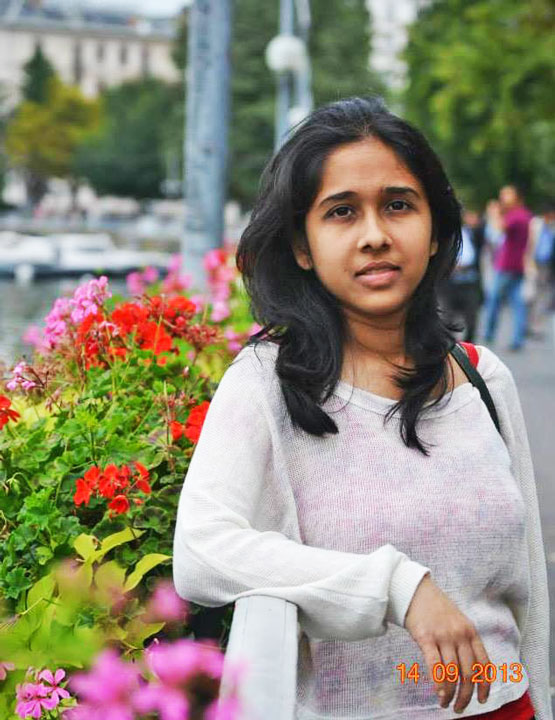
 Rukmini Das graduated from NUJS, Kolkata, in 2011. Following that, she worked with PXV Law Partners as an associate for three months, before deciding to pursue her masters. She is currently pursuing a masters in international dispute settlement, a degree which is jointly offered by the Geneva University Law School and the Graduate Institute of International and Development Studies, Geneva.
In this interview we speak to her about:
- Studying in Switzerland as opposed to more conventional destinations abroad
- Application procedure, scholarships and her curriculum
- Her experience studying in Switzerland and plans thereafter
What was your motivation behind doing LL.M.?
At the graduation level, we only touched upon all the main branches of law, learning only a little more when we took optional subjects. I decided during my 5th year that I would pursue an LL.M., but was not yet sure when or where. However, following the herd mentality, I started working in a corporate law firm right after graduation. Halfway through the year, although I liked the work atmosphere, loved my colleagues and superiors, I realized that I cannot see myself doing this year after year. This was not my area of interest! Then I started applying for LL.M.
How did you choose the university/ college? Where else did you apply? How should one go about choosing an university?
I came across the course I am studying now, on the website of the International Law Students Association (ILSA), while preparing for the Jessup Moot in 5th year (ILSA organizes Jessup). This is not a particular university/college, it is a programme organized jointly by the Geneva University Law School and the Graduate Institute of International and Development Studies, Geneva. I want to stress that I selected the course, not the school. This is very important for anyone deciding on an LL.M. [for example, Harvard is famous for its business law, and maybe some other kinds of law, but may not be the best for all branches of law. Don’t go to Harvard for the sake of Harvard, as long as your other option is among the better ones].
The main reason for zeroing in on the course that I did? The faculty! Recruitment chances are also a consideration.
I had also applied to Queen Mary’s arbitration programme (chose not to take it up) and Cambridge University (did not get a call).
What are you studying now? Why did you decide to take this particular subject? Any interesting details about the course worth sharing?
I am studying Masters in International Dispute Settlement (MIDS). I selected this for the course structure and content. It is one of a kind in the world (www.mids.ch). There are so many interesting things, I don’t know where to begin! Though the course focuses on private and public international dispute settlement (why I selected it in the first place), there are opportunities to take optional courses from the regular courses offered at the graduate institute and Geneva university law school, which means I can also take courses in substantive law subjects. There are also many intensive courses offered at MIDS, over two to three days, by the best in the profession. Tutorials are also an integral part of the curriculum, not to forget conferences, site visits to international institutions, etc. I could go on and on.
How is your experience so far? Tell us about the faculty and facilities. Anything memorable that is stuck in your mind?
The Course directors (professors of our main courses on dispute settlement), the staff all make us feel like part of a family, with regular cocktail events which give us an opportunity to talk about stuff outside class. The experience has been mind blowing! Everything is memorable. Especially memorable were the public international law tutorials because of our Tutor, who is now a professor at Geneva University, and I feel really bad for future MIDS students, who will not have the opportunity to be taught by him.
Facilities are great, giving us access to two libraries (Geneva Uni and Graduate Institute) as well as facilities coming with them.
How’s the Indian fraternity over there? Are there many Indian students?
My class has only 33 students, with one other Indian. There have been two Indians in every year of the programme, which commenced in 2008. The graduate institute has many Indian students, in economics, social sciences, development studies. I am not sure of Geneva University.
 How is the recruitment/ placement situation for overseas students?

All students are overseas in my class – not a single Swiss citizen. We get all the help possible from the career services of the graduate institute. We keep getting information on internship and job openings, via email. Career services is always there to help us with any questions we may have.
How is the academic schedule? Is there a lot of academic work?
Because of the immense flexibility in courses we can choose, in terms of optionals and intensives, and the conferences and institution visits we go for, hardly anybody has the same schedule as another. Schedules also vary from week to week. There is a LOT to read, a LOT. One week (the worst), we had to read about a 1000 pages. Except for that week, readings are in the vicinity of 500 pages, and are manageable if you manage your time well. Moreover, if you like the reading material, which you should, since you selected the courses, time should just fly. Classes are not just one-way lectures with note-taking, they are full of interesting discussions, made even more exciting with the presence of students from around 25 countries and teachers of such vast experience.
What about accommodation?
Depends on how much money you have. Of course, Geneva is among the most expensive cities in the world. Taking that into consideration, accommodation offered by MIDS administration is pretty good. Kitchens are provided, there is no concept of a “mess”. Cooking is ideal anyway – saves a lot of money!
Tell us about your classmates – is there a predominantly international crowd? What is the general age group of students?
I don’t have a single Swiss classmate. The students largely come from Europe, few from North and South America, and a decent number from Asia. I don’t have any classmates from Africa, but that is probably a coincidence this year. I have met quite a few at the Graduate Institute, part of other courses. Ages of my classmates ranges from 23 to 32 years. Many have come for their second LL.M., some have come here in the middle of their Ph.D.
Do you get time for any extra-curricular activities?
No. Partly because there’s too much to read, partly because a lot of the Geneva University activities requires a good knowledge of French!
How does one go about scholarships? Does the institute offer any scholarship?
MIDS offers a few scholarships every year (from an external sponsor). As far as I understand, they are merit-cum-need based. There are also scholarships offered by the Swiss government for Indian students, but the deadline generally expires before the MIDS offer letter arrives.
What are your future plans? Going forward, how do you expect this experience to influence your career?
My future plans are related to public international law. No further comments on that! Too early to say anything concrete. The MIDS is perfect for the faculty there, the opportunities one gets for contact-building, the variety of job opportunities in a single city! I strongly recommend it.




 Allow notifications