Category: Higher Studies

  • Avani Bansal, Advocate, District Court, Harda, on studying at Oxford and Harvard, and litigation

    Avani Bansal, Advocate, District Court, Harda, on studying at Oxford and Harvard, and litigation

    avani-bansal3Avani Bansal is a graduate from HNLU, Raipur, batch of 2011. Upon graduation she was awarded eight gold medals in different subjects. Thereafter she pursued the BCL programme at Oxford and later the M.Phil programme. She left a fully paid scholarship programme for her D.Phil from Oxford, to return to India, and started practising in her home town, Harda, Madhya Pradesh.

    In this interview we speak to her about:

    • Being an overachieving student
    • Her experience as a judicial clerk under Justice Dalweer Bhandari and in International law
    • Coming back to India to start litigation practice at District Court of Harda, MP


    Tell us about your life before law school.

    The story of my life: I was born and raised in a small district – Harda in Madhya Pradesh. I went to a boarding school, the Daly College, Indore for the final two years of schooling. Thereafter I decided to pursue law and topped the entrance of HNLU. After spending five great years at HNLU, both personally and professionally, I decided to try my luck at my dream law school. It worked and I was admitted to the BCL (LL.M) programme.

    A year well spent, passed by quickly than I imagined and I decided to continue for another year at Oxford, this time pursuing M.Phil in International and Environmental Law, and thereby hoping to earn a specialisation, hone my research skills and add another unforgettable year to my life. It went as planned and then came the crucial moment when I found myself at crossroads. I was one step away from realising my childhood dream – to earn the highest degree in my chosen field (a D.Phil). Pursuing a D.Phil (Ph.D) without scholarship was not an option.

    I tried as hard as I could and to my utter delight and surprise, I managed to get both an offer and more importantly a scholarship to cover for my D.Phil expense, even thought the latter came at the very last hour. I signed the offer for the D.Phil and then when the path seemed all clear, I paused to ask – if I really want a D.Phil which comes at the cost of the next three –four years.

    If entering academia is not what I want, was the pursuit of a D.Phil, only to get the golden letters ‘Dr.’ added to my name? After some mindboggling conversations with friends, family and ‘myself’, the little voice inside spoke. I quit the D.Phil, with apologies to those who helped in making the offer a reality and decided to come back to India to pursue my dream. As I write, I am on my desk at Harda, practicing in the Harda Trial Court with eyes full of dreams and passion for building a career in legal practice in India.


    How did you decide to study law?

    I was always inspired by the idea of making a difference. Law appealed to me because it spoke directly to social issues. As a lawyer I needed to be aware and sensitive to the society – from the bigger picture to the life of the autowallah. So, I hoped to learn tremendously without any restrictions of a ‘specialised field’. With law I thought I could continue to be interested in everything and thereby make a profession of living intensely. Besides, my passion for speaking did go well with my image of a lawyer. Finally and perhaps most crucially the person who inspires me the most – my father did his law degree, though he never practiced for lack of an English education. He saw a dream and I was thrilled to learn that we share that dream. Hence, pursuing law looked like the destined path, looked at from all counts.


    What was it like representing your school at the International Conference of Round Square?

    It was the year 2005 and Daly College, Indore (my school) was chosen to represent itself at the International Conference of Round Square, which is an annual conglomeration of the best schools around the world. If our presentation was to be successful, we were promised a permanent international membership of the Round Square International. A team of three students including me along with our Principal Dr. Sumer Singh and our Round Square Director Madam Badwar went to Melbourne with our hopes high. It was my first international trip, and so I was doubly excited to venture in a new and unfamiliar world. Making a presentation in front of the heads of schools from around the world was a life-changing experience.

    We won the international membership and friendship around the world.  I remember going on a bike tour in Melbourne as part of the adventure day and bruised my knee as the bike tumbled a 360 degree. But I was still all smiles. Sometimes venturing into an unknown world makes us realize the existence of some deeper worlds inside and gives us a greater knowledge of ourselves. It was from Australia that I first saw both India and myself in a new light, challenging the usual way of life that I was accustomed to. The ring of ‘no worries’ in the market place touched me deeply as I was seeing a society which was very warm and hospitable. Melbourne left deep impressions on me, like all firsts do!


    How did you strike a balance between academic and non academic pursuits?

    I was always a person with varied interests and I was very clear as I stepped in law school, that my aim was to work towards a well-rounded personality. Therefore I tried my hand at all possible opportunities that HNLU presented me with, both academic and non-academic. The academic pursuits such as mooting, publications, internships, conferences etc. were a natural extension of my will to explore the different aspects of a law school. But taking the five years at law school as an opportunity to work on myself as a person, I continued to participate in the non-academic pursuits as well.

    I was a dancer at school and so performed in different cultural functions at college. Debating, dramatics I could explore only in a limited way. The lack of sports infrastructure at HNLU during my days meant that physical fitness was a neglected area. However, after the first year, mooting really did take over all my other interests and I enjoyed every moot thoroughly as it left me much more confident of myself. My eight semester saw me handling three different moots, with two international moots.  I remember a friend asking me if I wasn’t always into too many things at the same time but perhaps as I explained then, I was always a person who could manage better with more things on my plate. I love to fill my day with different and varied tasks and that alone makes me productive.


    Tell us about your experience interning at the Ministry of External Affairs and ISIL.

    My fascination with trying to understand the bigger picture drew me slowly towards developing an interest in public international law. Participating in Stetson, Henry Dunant and Williem C. Vis and Jessup only fuelled the fire. Interning with MEA was inspired by trying to take a closer look at the working of the Ministry. Though that didn’t happen but the internship was a useful one as it exposed me to a rich material on public international law and state diplomacy. The ISIL internship came with multiple advantages.

    I could browse through several books and unheard journals on different subjects related to public international law and work on the upcoming moot simultaneously. Being at Bhagwan Das Road, next to the Indian Law Institute, with chai stall in the vicinity had it all for a perfect one month educational break. The application procedure for both these internships was standard. I wrote to the concerned person and got accepted. Though at ISIL, a reference through a teacher did expedite things.


    What was your stint in judicial clerkship like?

    (Avani has interned with the National Judicial Academy and Justice Dalweer Bhandari’s office.)

    My internship decisions were based on a desire to experience the variety of roles that I could take up on graduating. So, I wanted to explore what the different worlds entailed – that of litigation, academia, judiciary, media house, corporate firm etc. National Judicial Academy is a great place and interning there did help me push my intellectual boundaries. Since the place had some of the best academics, learning from their feedback proved very useful in the longer run. Also to see how an organisation such as the NJA works gave me insights into the training of the judiciary and the need for it.

    Its location and the beautiful premises were a very welcome change from the otherwise lack of attention on aesthetics at work-places. As for the judicial clerkship, I had applied through college and was allotted an internship with Justice Dalweer Bhandari amongst other judges on a purely random basis. But it proved to be a great stroke of luck as I learned tremendously at Justice Bhandari’s office. I had the opportunity to brief Justice Bhandari every day during my internship.

    The experience of reading several files in a day and discussing them with a seating judge of the Supreme Court, taught me about a judge’s perspective and way of functioning.  It also made me realise that a judge’s task of ‘finding the truth’ in the light of law is not an easy one and entails great responsibility on his/her part. Most importantly it helped me realise the importance of judiciary in the Indian legal system. His office was a very welcoming place to work and so it turned out to be a really good experience.


    How did you apply for your internship under Mr. Fali S. Nariman?

    I applied for an internship with Mr. Fali S. Nariman whilst at Oxford. He asked for a recommendation from the dean of the law faculty, Oxford, receiving which the internship was confirmed for my winter break. It took me a while to soak in the feeling that I was watching Fali from close quarters as I had been in awe of him from early days at law school. The work at his office was not very different from other litigation offices. I worked on the matters that I was given. Perhaps it was an internship that was crucial more from an experiential viewpoint than from a practical one.


    What was your time interning at law firms like?

    (Avani interned with Amarchand Mangaldas & AZB & Partners in her penultimate year of law school.)

    My decision to pursue a variety of internships meant that I didn’t have the opportunity to intern at a mid-size firm. So, when I went to these big ones in my fourth year, I was all prepared to do every kind of work. But to my surprise, I got very intellectually stimulating work and didn’t have to complain about just lifting files or printing as some of my colleagues had complained while working at other law firms. I was working with the litigation team at Amarchand and got an opportunity to work on some remarkable matters whilst there. At AZB, I did a variety of work which made me feel very confident about the breadth of practice that I could be looking as future prospects.


    Would you say your law school prepared you for the practical work which you had to do at your internship?

    I am not sure any law school can prepare someone for the practical work during internships. But if one’s theoretical foundation is strong and one is adept in basic research skills, with the right set of attitude, it’s not difficult to make the most of one’s internship. Internships, I think are not just an opportunity to showcase your talent but also to develop it further. The traditional notion of pursuing a law firm internship only in the later years at law school is not necessarily correct.

    As long as one is giving one’s best and is willing to learn, all internships can be fruitful.

    The bottom line to remember is that “No one out there teaches you a thing! It is upto you to see what is it that you can learn.” Based on this, it is difficult for me to say that one internship was better than the other for they all helped me in different ways and sharpened different skills. But if I have to be honest, my first internship with RLEK – Rural Litigation Entitlement Kendra (NGO), Dehradun stood out for me. They took us to tour the villages in Uttarakhand and as a first year law student, observing the lives of people in mountainous villages struck more chords with my soul than an internship at any other place did.

    The best experiences are those where we cannot point out what it was about them that made them special. But a group of law students, talking law to the people in villages in their language, understanding their perspectives on life, law and other things, and all this set in inexplicable natural beauty was an experience that I can never forget.


    How was your experience representing the Indian delegation at the G-8/G-20 Youth Summit?

    I represented the Indian delegation as the Environment Minister at the G-8/G-20 Youth Summit, Paris, France from 29th May-4th June 2011. There was a formal selection procedure for the G-8/G-20 Youth Summit which entailed filling an online form, shortlisting and final interview.

    Each ministry had a different agenda. The Environment Ministry Agenda included ‘Governing and financing global environmental protection, integrating environmental issues in our global rules’ and ‘Adapting the use of resources with social and economic issues’ as broad themes. The conference was a simulation of the real G-8/G-20 Summit and to our delight the final communique which emerged was sent to the world leaders attending the G-8/G-20 Summit. The conference was a great insight into the working of international negotiations.


    What was your motivation behind pursuing BCL?

    I was quite keen from the very beginning of the law school that I would want to go for higher studies if given an opportunity. I had a mixed bag of reasons motivating me for the same. Before settling into practice, I did aspire to see one of the very best law schools around the world from close quarters. Such an opportunity, I thought and rightly so as confirmed later, has great experiential value. Learning the legal subjects from the world authorities on them and an opportunity to discuss the legal concepts with them pushes one’s intellectual boundaries. Besides, being part of a culturally diverse society, brings important lessons lasting a lifetime.

    All these reasons culminated in my decision to pursue LL.M. I had applied only to five law colleges and got accepted through three of them. The offer from Oxford was the most attractive one on all counts. Besides it was a place where I felt I would fit it. So the choice was not difficult at all and I don’t regret it one bit looking back.


    How did you choose Oxford over the others?

    I think it is a personal decision based on several factors including the availability of the courses one intends to pursue, the list of professors that one hopes to interact with, the rank and prestige of the university, the place and the city that the university is in, career options etc. I wanted a quintessential ‘university’ experience. I didn’t have many people guiding me but from what I knew of Oxford, it seemed like a place away from the city buzz, a world in itself which could give me time for study and reflection in quietude.

    Besides, Oxford is known for its focus on strengthening the theoretical base and on a ‘go-deep’ versus the ‘go-wide’ approach. So, even though I could read only four subjects as part of the BCL, they came with tremendous work load and I did feel the advantage of specialising in those subjects without narrowing down my options too much.


    What are the scholarships Oxford provides for students from India?

    There aren’t any specific scholarships at Oxford for law students from India except for the Mrs. Ambriti Salve Scholarship at Exeter College. The major scholarships to look out for are the Rhodes, the Commonwealth scholarship, Inlaks and Felix.


    What were the objectives of different societies you worked with at Oxford?

    To begin with the number of options one has as a student at Oxford to engage in student run societies is mindboggling. Oxford has a student run society for every activity under the sun including social service, adventure, sports, cultural, theatre – you name it. In the first week at Oxford itself, one can find all about them at the Student Fair and register for them. Even though they are student run, they are managed extremely professionally.

    I participated in the student societies to engage with the issues they were working on and to develop an understanding of their approach. Oxford is very well connected to the leading people working in different segments and therefore had a huge advantage as working with these societies meant that one could meet and talk with people who were at the helm of affairs in the chosen field. The number of events of interest on any given day and the diversity is hard to match with any Indian institute.


    What challenges did you face as editor of the Oxford University Commonwealth Law Journal?

    Indian law schools do not pay any separate attention on developing editing skills unless one chooses to participate in the running of a magazine or a journal. So, I joined Oxford University Commonwealth Law Journal to hone my editing skills. It was great learning and the attention to the detail is a useful skill I picked up while at work.


    Did you undergo a rigorous academic schedule?

    The academic schedule was beyond comparison from the undergraduate years. Even though most subjects had only a two hour class in a week, there were week-long readings which one was expected to read before the class. One of my four subjects was Juriprudence and Political Theory which had three different seminars in a week and thereby almost thrice the workload in comparison to the other subjects.

    The basic difference from the undergraduate classes was that the objective behind the classes was to clarify one’s doubts as regards the conceptual issues rather than seeing the classroom as a place to learn the basics. Therefore, every student was expected to have covered the basics through readings before attending the classes and participate in discussions.


    What is the process of application for the Roy Goode Scholarship?

    (Avani pursued an M.Phil in Law at University of Oxford as a Roy Goode Scholar.)

    The application procedure for M.Phil was standard and required filling a form along with statement of purpose and references. BCL students had the option to submit previous references. The most crucial element of the M.Phil application procedure was the M.Phil proposal. It was on this that the application decision was primarily based. For the scholarship too, there was a standard procedure, the details of which are available on the Law Faculty of Oxford’s website. Along with the Roy Goode scholarship, I also received Graduate Assistance Fund Award. For more details visit law.ox.ac.uk.


    What was your topic of research for M.Phil?

    My topic of research for M.Phil was the need for a World Environment Organisation (WEO) and embedding the WEO debate in International Environmental Law. I am interested in the interface between International Governance and International Law and an institutional proposal such as the WEO works at this interface. Besides I was interested in a topic which has practical significance and the WEO along with other governance proposals are being actively considered by the international community to reform International Environmental Governance.


    What was your experience assisting Professor Timothy Garton Ash?

    (Avani assisted Prof. Ash, a world renowned academic, on the ‘Free Speech Project.’)

    The Free Speech Debate Project intends to further the cause of freedom of speech and expression by bringing together issues of free speech around the world on one portal. The multi-linguality of the portal is a unique feature as it hopes to get information and opinions on free speech issues accessible to one and all. I was assisting in the capacity of a blogger and a translator.


    What were the objectives of the society ‘Oxford Lawyers Without Borders’?

    (Avani was President of the society as well.)

    Oxford Lawyers Without Borders (OxLWOB) is a part of its parent organisation Lawyers Without Borders (LWOB) and works on promoting human rights issues across borders. When I first joined OxLWOB, as the panel leader of West Papua panel, we were focussing on building a legal case for the self-determination of West Papua and presented it before the Annual meeting of the Parliamentarians for West Papua.

    In the second year, as the President my task was to co-ordinate the different panels of OxLWOB and work towards building the society as a platform for students at Oxford to contribute to social causes. It was primarily due to my work for OxLWOB that I was given an ‘Honourable mention’ as part of the Vice Chancellor’s Civic Award scheme, 2013 and was the first law student to be recognised so.


    How was your experience as a foreign exchange student?

    (Avani traveled to Germany as part of an academic exchange programme with Max Planck Institute.)

    Max Planck Institute for Comparative and Private International Law, Hamburg has one of the finest collections on international law in general and private international law in particular. Also it hosts some of the finest academics working in this area. So the opportunity came with several perks including working on papers, meeting professors and was also my first trip to Germany, which I thoroughly liked.


    How was your experience interning at UN High Commissioner for Human Rights.

    Honestly everything about the internship with the UN High Commissioner for Human Rights (OHCHR) was different from the other internships I pursued. The quality of legal research that I was given, the international culture of  the institute, the work atmosphere, the friendships I made, and above all my supervisor – Cecil Aptel, who was the senior legal officer at OHCHR, was the best boss that one could hope for. Most importantly, it was an internship where I could see my work having a lot of practical significance and being used directly for the human rights issues around the world.


    Tell us about practising at District Court, Harda?

    As I mentioned earlier, I quit taking the D.Phil offer because I heard the call of duty. I intend to start my own law firm with the aim that for every matter we do for profit, we will do another matter for non-profit. A lot of young people I know enter law school because they want to make a difference. But then when they are about to finish law school, they find themselves at cross-roads. If they are serious about contributing to the society, they have limited options of litigating which practically means no money at least for the initial few years, or joining a Human Rights organisation which implies one cannot practice as a lawyer any longer or joining an NGO, whereby one is branded an activist more than a lawyer. So, I ask – why can’t one do corporate law and still contribute to the pro-bono cases one intends to work on? Since greed has no limit and every extra penny in the law firm can be used to further the business prospects, there is indeed a need for a law firm/organisation which as a matter of principle contributes towards pro-bono and does not restrict its pro-bono activities to a few cases to pay lip service to it.

    Furthermore, being interested in a variety of things such as policy making, litigating and activism, I couldn’t find a law firm/organisation that lets me explore all of these dimensions, so I have decided to create one. I don’t want to wait till I am 40 or 50 to start on my own. I want to commit my own mistakes and learn my own lessons and in the process call for individuals who share my feelings and intend to co-create such an organisation. I am calling for applications soon. The idea is to work out the team in Harda, MP, India (my hometown) for few months and start the first office in Jabalpur before the end of this year. Starting from Harda gives us an opportunity to start from the bottom. It’s an experiment but isn’t life itself one?


    Lastly, what would be your parting message for our readers?

    Whatever you do, be true to your own soul! The rest will follow. And remember as someone once said: “Whatever you think you can do or dream you can, begin it for boldness has genius, magic and power in it!” So more power to you, dear reader!


  • Iram Huq, Juris Doctor Candidate, Harvard, on interning at the UN, working pro-bono, and working in the US

    Iram Huq, Juris Doctor Candidate, Harvard, on interning at the UN, working pro-bono, and working in the US

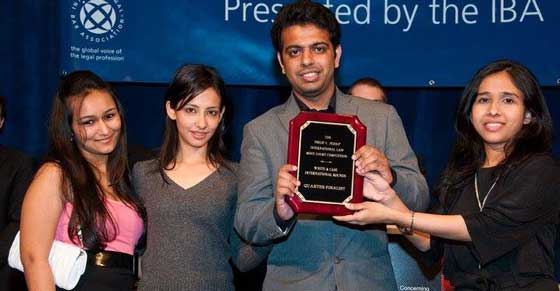
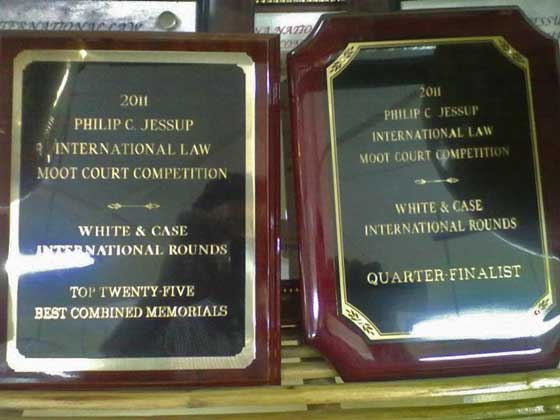
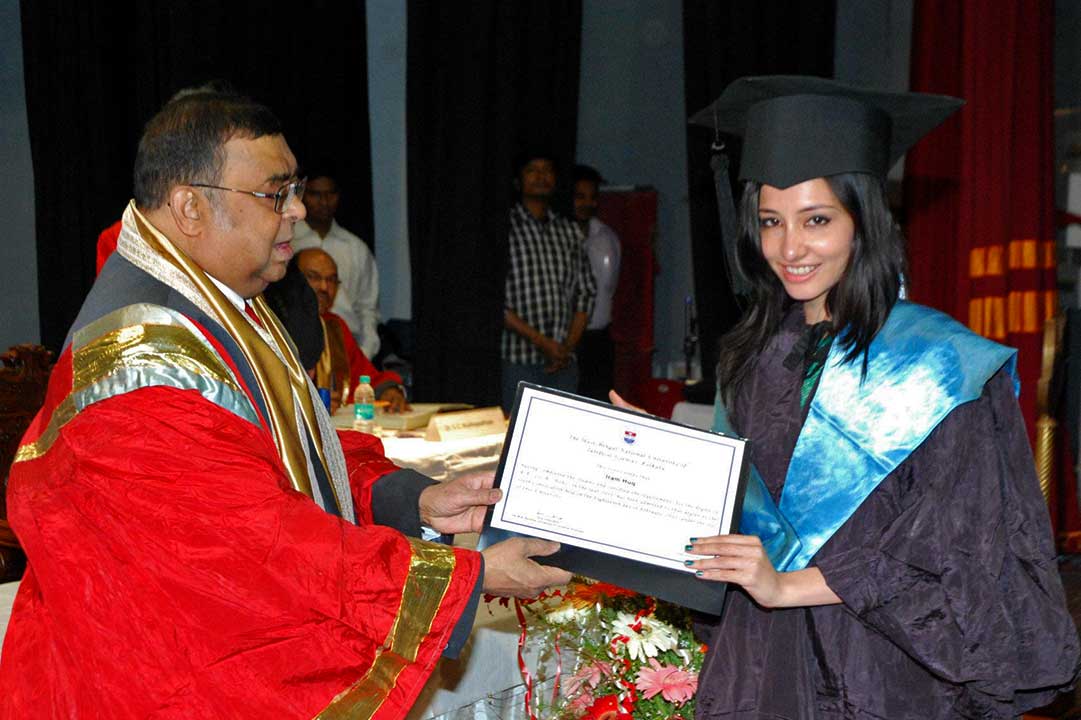
    Iram Huq is a graduate from WBNUJS, Calcutta, batch of 2011. She was a top ranker as an orator at the Phillip C. Jessup International Law Moot. She is currently a Doctor of Law at Harvard University, where she is also student of the Moot Court Board (2013-2014).

    In this interview, we speak to her about:

    • Getting a JD from Harvard
    • Interning at the United Nations
    • Taking time out for pro-bono human rights cases

    Tell us a bit about your life before college.

    I went to La Martiniere for Girls in Calcutta and was in the school’s debate team. That inspired me to write the law school entrance exams. I had studied science in plus two, and I liked Physics and Maths. Occasionally, I wish I had taken those subjects more seriously. I really enjoyed them conceptually, but I never saw myself as having a career related to either of those subjects.

    I think that my debating and science background helped me to develop a more objective view of the world. I appreciate the subjective aspects of the law, but I can’t help feeling that our legal system tends to reward sophistry and obfuscation instead of real analysis. I do not have lawyers in my family.


    What motivated you to choose law as a career?

    I wasn’t really paying attention to what people thought would be an ‘acceptable’ career. My parents were very encouraging, and my teachers also thought that law would be a great choice, given my skill set. It helped that a lot of people graduate from national law schools with excellent, respected jobs.

    I think middle-class Indian parents tend to be very conservative in estimating what careers are satisfactory for their children. However, I have learned that it is very hard to be successful at things that you do not enjoy. I am glad I was never pressured into choosing some other career.


    iram-huq3

    Did your debating skills help you at Jessup?

    Yes, that is absolutely correct. Debating is a great platform to learn public speaking. Once you understand how to put forward an argument in a clear and convincing way, you can apply that skill to any number of activities, including moot court. My father was also in debate teams of La Martiniere and St. Xavier’s so he was a great help. We had a teacher to coach us in school.

    I will say my ‘mentors’ for moot court were my friends and teammates, Deepak Raju and Rukmini Das, who helped me understand the basics of moots and coached me during the initial auditions for the moot court team. (They were both excellent mooters before I had even considered moot court). I also learned a lot from my experience in Vis Vienna, and could apply those lessons to Jessup. Deepak and I were on a debate team together, and that’s how we started working with each other. It was a pretty organic process, and I would like to believe that all three of us learned a lot from each other. I am not a fan of hierarchical team structures where the senior mooters mentor the junior mooters: the best teams are those consisting of friends.


    iram-huq4What are your thoughts on activities like mooting and article writing for journals?

    I think that writing for journals is a wonderful educational activity, if you can do it. Unfortunately, I was always too bored of academic articles to attempt to write them (but that was a personal preference). I liked mooting because, in addition to the academic part, it allowed me to travel and work on a single, practical project. Jessup (and Vis, Vienna) helped me understand how the rest of the world views different aspects of international law, improved my analytical and writing skills, and taught me how to network in professional settings. I definitely think that law students should try either mooting or writing for journals, if not both.


    Did you get any institutional support for internships from your college?

    No, I did not. NUJS was remarkably reticent when it comes to helping its students get good jobs or internships. It left everything in the hands of students, which was a good thing since the administration was both languid and incompetent. I did network with some of my seniors in law school, who recommended places where I applied and later interned. On two occasions, I secured internships through personal contacts. Young students should not be ashamed of using their contacts to secure internships. It is a perfectly natural process. If you don’t believe me, watch this TED talk


    How well do you think your education at WBNUJS prepared you for real world practice of law?

    Honestly, I think we could do with less compulsory classes and more optional classes in law school. It is absurd to think that someone who only wants to be a securities transactions lawyer should be required to study jurisprudence or intellectual property. We were required to study so many things that were absolutely useless to me when I finally began clerking at the Supreme Court. And yet, I never had the opportunity to learn subjects that would become really important in my job, like lower-court trial procedure.

    Additionally, our subjects were often taught in a completely academic manner, devoid of any instruction on how the law actually worked in practice. Finally, we never had clinics or any other option to learn through practical work. If not for moots and internships, my law school experience would have been completely inadequate.

    I do have to say that I had some excellent professors, and their teachings proved to be very useful for me later on in my work. I think law schools need to work on rewarding quality professors.


    iram-huq2

    Do you think being from WBNUJS helped your career in any way?

    Yes. Even though I complain a lot about NUJS, I have to say that I was surrounded by very intelligent students and studied under some wonderful professors. Compared to other law schools in India, NUJS has an institutional presence that reinforces an academic spirit and encourages its students to learn the law. I’m very grateful to my peers for challenging me and helping shape the direction of my legal career.


    Tell us what factors contributed to your decision to purse Juris Doctor from Harvard?

    I did not want an academic degree, like the LL.M. I was certain that I wanted to work in a law firm in the US. I was applying at a time when the rate of legal hiring was depressed (it still is), and so I concluded that the JD degree was the best option.


    iram-huq1What is the application procedure for a JD from Harvard?

    Applicants have to sit for the LSAT, and submit a couple of essays (a personal statement, a diversity statement, and any other essays they want the admissions officer to consider). Needless to say, successful applicants usually have good LSAT scores and compelling essays. Quite a few people have asked me similar questions, and it’s hard for me to explain what constitutes a ‘compelling essay’. But there is a lot of information available on the internet and on LSAC.

    I do not think that anyone can ‘hack’ their way into Harvard. My only suggestion is that applicants should be able to demonstrate a real vision of what they want to do with their Harvard Law degrees once they graduate. I do not think my own essays were particularly good, but I was able to make up for it during the phone interview. That is why I think that some imagination goes a long way.

    The application also requires at least two recommendation letters. Applicants should make sure that they get letters from teachers/employers who really know them and are willing to bat for them. But some institutional weight is also a good thing. I had a letter from Justice Patnaik, for whom I was clerking at the time I made my application. I highly recommend that graduates clerk after law school. It’s a great opportunity to learn how judges and the justice system works. And if you do good work, you’ll have a recommendation letter from a high court or supreme court judge, which is invaluable.

    As for scholarships: I am on a need-based grant at Harvard. Harvard Law does not have academic scholarships, as far as I know. Once you get in, you have to submit a lot of documents about your parents’ income and assets, and they assess a grant package. The whole process is very transparent, and applicants can find all the information on the Harvard Law website.


    Do you plan to have a career in the USA?

    Yes. I am currently working as a summer associate at WilmerHale’s New York City office. I hope to secure a job offer by the end of my internship, if everything goes well.


    You have been a Chayes Fellow for 2013-14. What does the fellowship entail?

    The Chayes Fellowship is awarded to first-year Harvard Law students who travel internationally for public service work. More information can be found at Chayes international public service fellowship


    As part of your Chayes fellowship you were an Intern at United Nations Assistance to the Khmer Rouge Trials. Please share your experience of working at Cambodia.

    Yeah, that’s what I did last summer for ten weeks. It was a great experience—I enjoyed working for the UN in Cambodia. I was working on the prosecution of senior Khmer Rouge leaders. I wrote a blog post about it: Blogs.law.harvard.edu


    I gather that most of your internships have been concentrated in and around Human Rights organisations. Is it planned or they just happened?

    I was looking for internships where I would get real experience in research, drafting and filing. It just so happens that large law firms in India rarely let interns shoulder much responsibility. Working for human rights organizations gave me a sense of purpose and also the opportunity to be far more involved in the projects to which I was assigned.

    The firm where I work at present is WilmerHale; it has a large pro bono practice with substantial human rights work. One of my projects is an asylum case. WilmerHale’s pro bono practice allows younger lawyers to shoulder greater responsibility and learn the art of appearing in court. No firm can afford to provide these opportunities in high-stakes litigation, and so human rights work is a great way for younger lawyers to acquire this experience.


    How do you manage Human Rights activities alongside the corporate world?

    I am committed to Human Rights work, but I am not a fulltime Human Rights lawyer. My goal has been to work in the corporate world for quite some time now (I have to say that I joined NUJS hoping to be a human rights lawyer). I guess I am privileged, because a few US law firms allow you to do corporate litigation work while still fighting Human Rights cases. I do not think that the two goals have to be mutually exclusive: many US law firms are very profitable even though they allow associates time for different kinds of pro bono work.


    Lastly, what would be your message to law students who want to pursue a career in human rights?

    I would say that they should go for it. Personally, I find the Human Rights ‘world’ to be a little oppressive: there is a constant sense of urgency and sadness associated with Human Rights work which interferes with my ability to objectively go about my work. But God knows we need more people dedicated to this field. I respect Human Rights lawyers for their courage and tenacity in the face of all odds. I will acknowledge that money is important, and there is not much of that in the human rights world. But we would be wrong to conflate wealth with success. If there are people who are willing to dedicate themselves to this field, we need to respect their legal skills and talent even as we respect rich and powerful lawyers.

  • Kailash Gupta on a dual degree (JD+MBA) course from Cornell, work as a paralegal and the US Legal Industry

    Kailash Gupta on a dual degree (JD+MBA) course from Cornell, work as a paralegal and the US Legal Industry

    Kailash Gupta is studying for a dual degree course from Cornell Law School. The course will certify him as a JD and as an MBA on completion. Having been educated in the US he has deep insight of the US education system which he shares with us in this interview.

    In this interview he tells us about:

    • Working as a paralegal at NOVA IP Law firm
    • Studying and clearing for LSAT
    • Studying for JD/MBA from Cornell Law School and Johnson Graduate School of Management
    • The top prerequisites for a legal career in the US


    Given that most of our readers are law students and young lawyers, how will you introduce yourself to them?

    Hi! I am Kailash and I am currently a JD/MBA Candidate at Cornell Law School and the Johnson Graduate School of Management.  I plan to work in a New York City law firm as a transactional attorney.


    Amongst the various career options, what motivated you to choose law?

    My decision to pursue a career in law came after exploring many different career paths as an undergraduate.  I have an undergraduate degree in Economics and pursuing a degree in law, with a focus in business law, seemed like the best way to satisfy both my intellectual and analytical needs.


    You have been educated in the United States. How difficult would it be for others to integrate into the education system of US?

    I was born and raised in New Jersey and have not completed any sort of formal education outside the United States.  That being said, integrating into American undergraduate institutions or law schools should not be an issue for international students.  At Cornell and other top ranked universities, school administrators and admissions officers have recently put a greater emphasis on attracting top talent from abroad.  I commonly hear several different languages being spoken as I walk through campus (including my native Telugu).  International students have several student groups on campus and many US-born students are eager to make connections with students from abroad.


    You are pursuing Juris Doctor Degree from Cornell Law School. What was the application procedure? Are there any entrance tests?

    Cornell Law School, along with the majority of other US law schools, require applicants to write a two-page personal statement along with optional essays, including addendums to explain any issues or weak spots in one’s application.  Furthermore, each applicant is required to take the Law School Admission Test (LSAT).


    How did you prepare for the entrance test? Please tell us about the top three things you kept in mind while preparing for the test. Would you say it was difficult to take the test?

    The LSAT consists of a total of six 35-minute sections.  The sections include one writing sample, two logical reasoning (LR) sections, one reading comprehension (RC) section, one logic games (LG) section, and one experimental section.  The experimental section is either a LR, LG, or RC section and does NOT count to the overall score.  The writing sample is also not incorporated into the overall score, though each school to which one sends his or her score will be able to view the essay.

    Top US law schools have trouble comparing candidates across different undergraduate universities and majors.  Unlike other graduate schools such as medical school, law schools do not require students to take specific undergraduate classes before applying.  Therefore, law school admissions officers primarily compare students based on their LSAT scores.  An applicant’s undergraduate GPA, major,and institution are secondary to one’s LSAT score.  Work experience comes in as the third most important criterion.  Therefore, high performance on the LSAT is imperative for gaining admission.

    My basic approach was to first learn the strategies of taking the exam.  Investing in exam prep materials is highly encouraged.  Secondly, once I was equipped with the basic strategies of how to tackle each question type in each section of the test, I spent significant time taking practice sections and full-length tests.

    After each test or section, I would review the questions I got wrong, identify the question type, and practice those specific types until I was able to consistently answer them correctly.  A final point to remember is the exam takes over four hours to administer.  Test-takers should prepare for the mental marathon that is taking the LSAT.  The best way is to take full-length tests leading up to the exam date.  Still, be careful not to burn out and make sure to be well rested on exam day.


    What prompted you to choose Cornell for a JD? Were there any other Universities in mind?

    I was fortunate enough to be choosing between two highly ranked law schools, Georgetown University Law Center and Cornell Law School.  GULC and Cornell each have their strengths.  GULC is located in Washington D.C., the nation’s capital.  Its location puts it in close proximity to some of the greatest legal minds of the country, which include legislators, practicing attorneys, and even the U.S. Supreme Court Justices.  Furthermore, Washington D.C. has more lawyers per capita than any other city in the country.  Cornell, on the other hand, is a small school with a tight-knit community.  Ultimately, its small size, elite faculty, extremely strong placement into big law firms, and strength in business law made it the ideal fit for me. I also completed my undergraduate degree at Cornell so I was fully accustomed to Ithaca.


    You had received the ‘CALI Excellence for the Future’ Award. What qualified you for this recognition?

    The Center for Computer-Assisted Legal Instruction is a non-profit dedicated to facilitating computer assisted legal education.  The CALI Excellence for the Future Award is given to students who receive the highest grade in each course, each semester, in participating law schools.  I received the award in my first semester for the Torts and Lawyering courses.


    What does it mean to be on the Dean’s List at the Cornell Law School?

    Dean’s List is given to students who stand in the top 30% of the class for each semester of grades.


    How important do you think are internships in shaping up the career of a person?

    Pursuing internship(s) as a law student is imperative in securing a job post-graduation.  I am in a unique situation because I am pursuing the dual degree.  Dual-degree students are required to take summer classes at the business school instead of pursuing a first-year internship.  Most pure JD students either do research for professors or intern for a judge, government agency, or non-profit during their first year summer.  At the end of the second year of study at the law school, most students, including the dual-degree students, pursue a summer associate position at a law firm.

    The second-year internships are very important in securing a job post-graduation because the vast majority of big law firms extend full-time employment offers to their summer associates.  While many law students do not plan to work in big law firms in the long run, many nonetheless pursue these second-year summer associate positions and even accept full-time offers.  The reason is that it is generally believed that work in big law firms prepare you for a career in government or business.


    You are also pursuing an MBA from Johnson Graduate School of Management. What motivated you to take it up? Would you say an MBA would better equip you in a legal career?

    As a law student with aspirations to work as a transactional attorney, pursuing an MBA was a no-brainer.  Transactional attorneys are constantly poring over business documents in their daily work.  Furthermore, transactional attorneys are often called upon to advise their clients in making decisions that directly affect a client’s business.

    Having a working knowledge of how large businesses operate, which an MBA will undoubtedly provide, is a major benefit when beginning your career as a transactional attorney.  Furthermore, the opportunity cost of one-year’s worth of salary normally associated with pursuing a dual degree program does not exist in Cornell’s three-year program.


    You began your professional career with NOVA IP Law as a Paralegal. How did you apply? What did your work profile consist of? Did it require knowledge of law?

    I applied for the position through Cornell’s job posting website prior to graduation as an undergraduate.  The position did not require any prior knowledge of law.  Working as a paralegal is a great introduction into the legal field and serves as an opportunity for one to really decide if a career in law is the right one.

    I worked in a small firm outside Washington D.C. and the experience solidified my desire to pursue a career in law.  I assisted attorneys in legal research, edited and wrote contracts and court documents, and also took on all the clerical tasks associated with office management.  Other than that, I also had the opportunity to manage several attorneys and paralegals working on a short-term basis in a document review project.


    What does being a Paralegal mean? How different is it from being an associate at a law firm?

    A paralegal is a legal assistant and serves essential functions in a law firm.  Paralegals are often divided into two distinct categories, career paralegals and short-term paralegals.  Career paralegals pursue the position as a career while short-term paralegals are often recent college graduates who are looking to work in the legal field before pursuing a law degree.  Because I worked in a small firm I was able to take on some of the tasks that normally would be reserved for career paralegals in larger firms.  A friend of mine worked as a paralegal in a large firm in Los Angeles and told me that several of the career paralegals were highly sought after by the firm’s partners when staffing different projects.  Whereas first-year and second-year associates have minimal practical understanding of real world law practice, most career paralegals more often than not have a better working knowledge of the law.

    Even in our Law course, our professors constantly reminded us to turn to the staff paralegals as sources of help when navigating the big law waters as a fresh-out-of-law-school associate.


    What are your plans for the coming five years?

    I plan to finish my degree program in 2016 and work as an associate in a law firm in New York City for the foreseeable future.


    What are the top prerequisites for a successful legal career in the U.S. for people from other countries?

    Depending on your career goals and aspirations, the unfortunate truth for international students aspiring to work in the US as a lawyer is that they must pursue a JD.  Most LL.M. students I speak to tell me that it is very difficult to secure a job with a big law firm with just an LL.M.  Many LL.M. students sit for the New York bar at the end of their programme and utilize their bar admission through international deals or litigation.

    Beyond the degree itself, law firms look for strong oral and written communication skills and top grades regardless of the fact whether you are an international or a domestic student.  International students should stay updated on the status of US legal employment market.  The past seven years have been especially tough for law students in finding employment and a huge bracket of unemployed law graduates exists. The fair logical leap is that most firms, regardless of size, are going to choose a domestic candidate as the more costly international ones need to be paid higher.


    Give us a few tips on finding out the right university for a J.D or an LL.M.

    If any readers are interested in pursuing a JD or LL.M. at a US law school some helpful sources include:

    top-law-schools.com:  This website has helpful information on constructing personal statements, school profiles and rankings, LSAT preparation, etc.

    lawschooltransparency.com:  This website has helpful employment statistics for easy comparison between U.S. law schools.

  • Dwijen Joshi on being an exceptional scholar, LL.M. from NUS and a career in International Arbitration

    Dwijen Joshi on being an exceptional scholar, LL.M. from NUS and a career in International Arbitration

    Dwijen Joshi is an exceptionally meritorious student of 2013 batch of GNLU, Gandhinagar. He has been a gold medalist in Arbitration. His interest in arbitration and litigation led him to pursue an LL.M. from National University of Singapore. He talks about the Arbitration proceedings in Singapore and he has a lot to say about the opportunities there.

    We asked Dwijen about:

    • Winning a gold medal in Arbitration and scoring well in exams
    • Studying LL.M. for a career in International Arbitration
    • Faculty, Finances and overall academics at NUS
    • Developing interest in Arbitration and ADR
    • Scope of Indian Lawyers in Singapore


    Most of our readers are law students and young lawyers. How will you introduce yourself to them?

    I completed my under graduation from Gujarat National Law University in 2013. Immediately after completing my undergraduate studies I headed to National University of Singapore to pursue Masters in Corporate and Financial Services Law. Within the broad legal sphere I have carved out my interest for Arbitration Law. Other than Law, I am very passionate about Music. I have been learning/playing Tabla since my childhood. During my time in GNLU I was part of a talented bunch of musicians in the Music Club.


    How did you gravitate towards law? Why law and not engineering or medical studies?

    I chose Law as I think there is no other field that has a convergence with all walks of life. I never saw myself as doing anything else other than being a Legal Professional. This is a profession, which tests your assertiveness and sensitivity to the aspects of society, which requires some attention or examination. I believe law is as much about contemplation and thinking as much as it is about voicing out your stand.

    It is the most dynamic profession that gives you the liberty and tools to question things that would not seem obvious to someone not trained in law. Though there are different branches of law dealing with two main building blocks of society – Government and Corporations, there is one general theme running in the undercurrents and that is of ‘fairness’. I have always been fascinated by this word.

    My family background also influenced my decision to study law. At a very young age, I began to understand the nuances of Law from my father and grandfather. Though, I always had family support in whichever field I joined, learning law was a very natural process and I took the plunge.


    You were one of the most exceptional students at GNLU. It’s not every day that someone bags gold medals! Please give us a few actionable tips on managing higher grades.

    Thanks for a very generous description! I am very grateful to GNLU for awarding me the ‘Late Mr. Milon Kumar Banerji Gold Medal’ for Alternative Dispute Resolution (Arbitration). It is a very heartening recognition.

    As far as studies are concerned it is a very personal thing so what worked for me may not be best for others. Therefore my advice is very holistically directed. I think hard work is sine qua non for good grades. Life in law school is like a marathon you have to keep running till the last semester and closely watch your pace throughout the five years.  I believe that higher grades are the by-products of the grit and passion that you show towards learning and therefore, learning should be the goal and not the grades. This will make studying enjoyable.

    I always preferred to study from my own notes as it narrows down your area of focus and can be helpful for revisions during the exams. It is very important to maintain a good mental outlook throughout the whole process. Also, I would say smart work is more important than hard work. Try to identify more relevant areas and focus on them. Regular studies will help manage your time better throughout the semesters.

    To save myself from falling into nerdy bracket, in my defense, I believe five years is a golden period to enjoy to the fullest. For some it will be the last few years as a student. So it is more important to have fun, engage in extra-curricular activities and have a balanced routine. I have been fortunate to meet amazing people here and forged relationships for lifetime.


    What was your motivation behind pursuing LL.M.? When did you finally decide that you need to do Masters?

    The decision to pursue LL.M. was the most important decision that I made in last two years. It was in my fourth year of undergraduate studies that I felt I still had one more year of student life left and took the decision. Therefore, I did not get myself registered with Committee on Recruitment Affairs (CRA) for placements. My motivation to pursue an LL.M was to have an exposure of studying law in a top ranking International Law School. It was a risky decision as it was an investment of time, energy and money. And I had again exposed myself to academic judging for sixth year in a row. But it was my passion to experience the intellectual rigour of a Law School such as NUS, which kept me driven.

    I had planned to build specialized knowledge base and skill set through an LL.M, which was not possible through an undergraduate degree. An LL.M provided me with a head start into such complex legal concepts which otherwise would be possible only after two or three years of practice.


    How did you choose NUS over others? How did you go about choosing a university?

    I followed bottoms-up approach while making the applications. I sorted out my areas of Interest and my expectations from an LL.M in terms of knowledge and skill-set. Then I went about choosing the universities, which are reputed I was interested in. Finally I had short-listed only five universities where I eventually sent my applications. All were UK based except for NUS.

    I chose not to apply to US, as pursuing LL.M there is little expensive affair. In London-based universities one gets to study four modules throughout the LL.M. whereas NUS requires completion of total 40 credits, which means one has to study 10 modules of four credits each. I chose to go to Singapore also because of my interest in Arbitration Law and increasing popularity of Singapore as a Hub of Arbitration in Asia.


    Does NUS provide students with scholarships? Are there any other institutions, which provide scholarships?

    NUS does provide for scholarships. The criterion for selection is competitive. I am not sure if they have instituted scholarships especially for Indian students. There are some scholarships awarded by British Council for UK universities. Felix and Inlaks scholarships are also very famous amongst law students. The former is only for UK universities. Ministry of HRD also has some scholarship schemes that keep changing so one has to look for it constantly.


    Did you undergo a rigorous academic schedule? How was that different from your under-graduate course?

    Life in NUS was rigorous in comparison to the under-graduate course. Time management is the key to grapple with the demands of the respective modules chosen. The faculty will expect you to go through the reading materials before each class. For some modules the assigned reading for each seminar may be painfully long and may run up to nearly hundred pages or more. The class hours are also very long. One Seminar will be three hours long.

    The class contains a very diverse group of people. Some of them will have had experience of working in law firms in their home jurisdictions on the issues being discussed in the class. So for some modules the faculty recommends to have some foundational understanding. The assessment patterns for the courses are diverse. The assessments are split across the semester and the submissions may fall within close dates. Evaluations include class presentations, research paper submissions, group exercises – I also had a chance to appear in an Arbitration moot for one of my courses.


    NUS is well renowned for its brilliant faculty. How was your experience with the faculty?

    The NUS law faculty consists of professors who have established an international repute for their contribution intheir respective areas of expertise. The best part of NUS is that it invites professors from different universities across the world to come down and conduct intensive courses in NUS itself. Intensive modules last for about three weeks. I had an opportunity to undertake Word Trade Law seminars conducted by Prof. Joseph Weiler. He is currently President of European University Institute, Florence. He is a world-renowned academician in the field of Trade Laws. He is also a distinguished panel member of World Trade Organization. I took a module on International Investment Law taught by Prof. Loukas Mistellis. He is the Director of International Arbitration at Queen Mary University, London.

    Some courses have very high demand and usually oversubscribed including the Mergers & Acquisition course conducted by Prof. Umakanth Varottil. He is an ex AMSS partner who is revered for his expertise in Corporate Law. The way stalwarts like them conduct the seminars sometimes becomes very exhilarating. As, some may follow Socratic method of teaching. In Prof. Weiler’s class it is suicidal to go unprepared. His random questions thrown at you compels you to spontaneously frame complex legal arguments and make you think on your feet. An unanswered question may bring embarrassment. It is this unique learning experience, which helps one develop exceptional skill-set necessary for an international lawyer to be. Some professors prefer lecture method of teaching and the class aura is cool with such professors.


    How difficult was studying abroad in terms of finding accommodation, finances and settling in?

    Finding an accommodation is not an issue at NUS. The university has built state of the art accommodation infrastructure called UTown. It is situated at Kent Ridge campus that is few metro-stations away from the Bukit-Timah campus where the law school is situated. The policy of NUS is to give preference to research students pursuing a doctorate and exchange students while allocating accommodation. Nevertheless, many people are able to successfully get accommodation within the university accommodation itself.

    NUS provide internal bus service to shuttle students between Utown to law campus.  Other than that, there are private hostels, which are just walking distance away from the law campus. Two such places popular amongst LL.M students coming to NUS are Evans Hostel and Singapore International Campus. I was putting up at College Green Villas, which was just a stone’s throw away from the law campus. As for finances my parents supported me.


    You were involved in a Bilateral Investment Treaty (BIT) case last year. What was this all about? How did you get to work on this? What did your job entail?

    International Arbitrations can be broadly classified into International CommercialArbitration and Investment Treaty Arbitration. India is signatory to several Bilateral Investment Treaties (BIT) with various countries. A foreign investor from the country, which is Signatory to a BIT with India, can invoke Investment Arbitration against India under such treaty. This is a developing area of Arbitration and the law is still in formative stage. The issues pertaining to jurisdiction and enforcement are most likely to come-up in such cases. I knew of a law firm in Delhi – Dutt Menon and Dunmorrsett that dealt with the famous Vodafone Tax case. They provided me an opportunity to work with them on a BIT arbitration issue. It was a very exciting opportunity and a constructive engagement before heading back to NUS.


    What are the internship opportunities in Singapore?

    It is possible to get internships in Singapore-based law firms provided the applications are sent at the right time to the right firm. For those coming to NUS for LL.M it will be helpful to them if they prepare a list of the firms where they want to intern before coming to Singapore. During the course of the semester managing internship applications alongside the usual coursework tasks, becomes little edgy.


    How did you develop interest in Arbitration? Where do you see yourself by the end of the coming five years?

    I had an interest in Dispute Resolution especially litigationeven before joining law school. At that time I did not know much about arbitration. My first initiation into the subject was when I chose to write a paper on it in my first year of Law School itself. Gradually with internships, interactions with the experts in the area and of course with formal initiation into the subject in GNLU, I realized that I have a knack for this area. Five years down the line I see myself as a counsel involved in Litigation as well as Arbitration. In the long term I see myself as working in Dispute Resolution practice area of an Indian Law firm. Moreover I see myself as an Indian lawyer qualified to practice in UK and Singapore after having cleared QLTS (Qualified Lawyer Transfer Scheme) and FPE (Foreign Practitioner Examination) for the respective jurisdictions.


    Do you think that Singapore is gradually becoming the hub of Arbitration in Asia, especially for Indian Arbitrations? What are your thoughts on this? What are the opportunities for Indian Lawyers?

    Singapore is becoming a favorite destination for the Arbitration Practitioners across Asia including India. The number of Arbitration agreements involving Indian parties, stipulating Singapore as a seat of Arbitration is increasing. A lot of sophisticated Indian Arbitration disputes are being settled in Singapore International Arbitration Center. It is a preferred destination also for ad-hoc arbitrations as Singapore courts have adopted a very favourable arbitration policy. Many Indian companies have their investments in Singapore so it becomes easy to enforce the award. In Singapore, Foreign-qualified lawyers who pass the Foreign Practitioner Examinations (FPE) can apply for a Foreign Practitioner Certificate (FPC) from the Attorney General to practice in permitted areas of Singapore law.


    Lastly, what would be your message to people who want to take up a career in Arbitration?

    I will say it is an exciting career option.  It is also very challenging at the same time. Arbitration and Litigation are two sides of the same coin. So if one enjoys spending more time arguing cases outside the office comforts, this is where they should see themselves. The skill set required for a counsel arguing before a court and before an Arbitration Tribunal is same. Except in the case of International Arbitration, the style of arguments differs if the Tribunal consists of experts trained in Civil Law in which case the style of arguments is substantially different from what Common Law lawyers like us are trained to use.

    Lastly, I will say for those who do not have a legal background in their family and want to pursue litigation as a career option, just go for it if that is your calling. There will be hardships in the beginning, the incentives are less but in the end it is your passion, which will drive you forward towards success – so that in the end you can proudly say ‘And that has made all the difference’.

  • Aakanksha Kumar on winning 15 gold medals, LL.M. from NUS and a career as a researcher & teacher

    Aakanksha Kumar on winning 15 gold medals, LL.M. from NUS and a career as a researcher & teacher

    aakanksha-kumar3Aakanksha Kumar graduated from HNLU in 2012, as an exceptional scholar, winning 15 gold medals in various subjects. Thereafter she pursued an LL.M. from the Faculty of Law, National University of Singapore. She had joined ITM University as a Research Associate last year and she shall be joining NLU Jodhpur as an Assistant Professor in July 2014. In this interview she talks about:

    • Getting higher grades and winning 15 gold medals
    • Selecting a university for higher studies
    • Scholarships, Academics and research experience at NUS
    • Experience as a Research Associate at ITM University
    • A career in teaching and research


    Most of our readers are law students and young lawyers. How will you introduce yourself to them?

    I am your everyday nerd in love with the law, and the best possible way to spread the love for the law, I believe, is to teach it effectively. I come from a north Indian family, currently based out of Bhilai, Chhattisgarh and am a Dipsite. I finished my B.A.LL.B.(Hons.) at HNLU, Raipur in 2012 and completed my Masters in International and Comparative Laws from  the Faculty of Law, National University of Singapore in July 2013. I have been teaching full-time on a research associate position, at the School of Law, ITM University, Gurgaon since July 2013 and I shall be joining the National Law University, Jodhpur w.e.f.  July 1, 2014 as Assistant Professor (Law). My teaching specialisations include Arbitration & ADR and Comparative Competition Laws, along with research interests in IPR and World Trade Law.


    How did you gravitate towards law? Why law and not engineering or medical studies?

    Well, I do have the regular “influenced by the parents” story behind my choice of pursuing a career in the law. My father, though not a lawyer, completed his LLB when I was in IX standard and I used to love reading his course books. I was always interested more in the social sciences, but since our school did not have an option to move to the Humanities stream after the X standard, I did pure sciences till XII standard and then appeared for 9 different law entrance exams, and chose HNLU over NUJS and ILS Law School, Pune. Engineering or medicine were never even remote options as I was horrible at Math and Chemistry and was looking for the first chance to give those up. Little did I realize that I will find Patent laws easier and be specializing in IPR eventually, only because my school science studies helped. The other options I had considered were in fact English Literature and Journalism.


    You were one of the most exceptional students at  HNLU. It’s not every day that someone bags 15 gold medals! Please give us a few actionable tips on managing higher grades.

    Thank you! They sure came as a welcome surprise, but I don’t really dwell on that glory, though they do add considerably to the number of pages on my CV 😉

    I was asked this question on another interview and my answer remains the same.Since Day 1 of law school, I knew I was studying law to be able to eventually teach it.  Hence the study method adopted by me was to cater to my ultimate goal – I would study first and then revise again by teaching my other batch-mates.

    Unlike the clichéd “I study for X number of hours in a day”; my study pattern varied a lot. I honestly never studied for more than 4 hours in a day. Instead, my success mantra was – undivided attention to class-room teaching and self study of the same topics that very day after classes. Hence I was able to relax when end-term exams approached, knowing that I would manage to study and revise what was taught. I had different study methods for different subjects, given their level of difficulty, or the extent of extra study required. Regular taking down of notes during classes also helped a lot in later self study. Moreover, the aim was never about getting the highest grade. It was about being so in love with the law, that one automatically wrote an answer so thorough, that the examiner couldn’t fault it.

    Also, the trick on really securing higher grades is sometimes to get inside the head of the teacher, and understand what they want in an answer. I always tell my students to carefully follow the classroom discussion, as often there may be hints on how to attempt exam questions.


    What was your motivation behind pursuing LL.M.? When did you finally decide that you need to do masters?

    Like I mentioned earlier, I knew I was studying law to be able to teach it. And one cannot do that without a Masters degree. I come from a very strongly academically oriented family. Both sets of grandparents are or have been teachers or professors. My maternal grandfather; who continues to remain a source of inspiration, is a nuclear physicist and was also the Dean of the BHU Science Faculty. My mother is an English teacher, with  Masters in both Pharmacy and English. I thus like to believe that being academically inclined is in my genes. And completing an LLM to cater to my academic pursuits was the next logical step to take.


    How did you choose NUS over others? How should one go about choosing a university?

    I had applied to mostly schools in the UK [UCL, King’s, Queen Mary’s] and NUS. I  was always looking at NUS as my top choice, given the popularity and worth attached to their International Law LLM, as well as given considerations of costs and proximity to India. Under Prof. Simon Chesterman’s (Dean, NUS Law) able guidance, the NUS International  and Comparative Laws LLM has carved for itself a special place in international legal academia. Since NUS is known to value academic excellence above all else, I was hopeful about getting in, given my CGPA and rank.

    When choosing a law school, one must not just look at the overall reputation of the school, but also at the reputation of the courses offered vis-a-vis one’s own interest areas. E.g. One chooses King’s London, to generally pursue a Competition Law specialisation Masters, or Rotterdam (Erasmus Mundus) for the Economic Laws LLM. The next very important consideration is obviously the tuition plus living expenses, and available scholarships. Other considerations include accessibility of the city and if one plans to settle down abroad, then, future employability concerns. Another important thing to remember is that an LLM abroad, while being a wonderful opportunity to network with like minded people from all parts of the world, is also not a joy ride. It’s a huge undertaking with a pretty hefty study load, and thus one must make up one’s mind thoroughly before applying. Also, one must structure one’s LLM CV to show experience – either in work, internships or research, in the chosen area of Masters Specialisation.


    Does NUS provide students with scholarships? Are there any other institutions which provide scholarships?

    Every application to the Masters Programme in NUS Law is automatically considered for scholarships, though their selection criteria is not very transparent or anywhere on paper. From the trend in the past couple of years, it is usually people [strictly applicable to Indian students] with tier 1 law firm work experience for atleast a full year, with amazing references, that get the Faculty Graduate Scholarship. So, I know of peers who had experience at Nishith Desai Associates, or at AMSS whose reference letters were written by  SC Judges or law firm managing partners, who bagged the scholarship.

    So if aiming at a scholarship at NUS, do not pursue an LLM immediately after law school, and build a credible list of referees.

    Most law schools and universities do have their own scholarships for the Masters programmes. There are also other more popular scholarships – the Fullbright for study in the US, The Commonwealth Scholarship etc. There are several institutions who offer financial aid and bursaries for foreign LLMs but I am not the right person to detail those as I didn’t research too much when I applied. For Indian Students especially, I know of UCL offering a special Chief Justice Scholarship and LSE Offers a Marchant Foundation LLM Scholarship. And all scholarships require a very well written personal statement.


    What was your topic of research for LL.M? Why did you choose that subject for research?

    At NUS Law, one need not necessarily take up the Directed Research Dissertation. One can choose to do a full course for credits instead. I,  however chose to drop a full course module and did the UROP-DR [University Research Opportunities Programme – Directed Research] for 4 credit points.

    My research thesis is titled – ‘The Taking of Evidence in International Arbitration: A New Legal Regime’ which was supervised by Prof. Gary F. Bell, who is an Associate Professor at  NUS Law and a Fellow of the Chartered Institute of Arbitrators, Singapore. I chose to complete my research project in a conflict of laws aspect of international arbitration as I was “precluded” from studying the course on International Arbitration at NUS, having completed an optional specialisation at HNLU in the same. Further, international arbitration both as a substantive field of legal study as well as its procedures, has always intrigued me, given the high level of independence and flexibility in this method of alternative resolution of disputes.

    Moreover, I always wanted to teach ADR and International Arbitration eventually, and given the mindset of Indian law school faculty selection committees, an LLM thesis in the area gives me an added advantage.


    Did you undergo a rigorous academic schedule? How was that different from your under-graduate course?

    NUS has a very demanding curriculum, that requires you to complete a total of 40 credits in the academic year. Of these 40 credits, 24 must compulsorily be of those subjects that are on the list of your chosen specialisation, and the remaining 16 can be from other specialisations. I did 32 credits of International and Comparative Laws and 8 credits of IPR. I also did one full 8 credit course on World Trade Law that was very demanding. Unlike one hour lectures, 5 days a week in India, the NUS contact hours differ. The 4 credit courses are taught once a week for a rigorous three hour seminar that is conducted in the Socratic method of teaching- learning. This meant that if one was unprepared with the assigned readings for that day’s seminar, one had to be ready to face the embarrassment. However, classes were always extremely interesting as they were more discussion based, and our professors were brilliant! Since I was anyway used to putting my nose to the grindstone even when at HNLU, the NUS curriculum didn’t come to me as a “culture shock” personally. Also, when one sees the dedication of the undergrad students who generally take the same classes, one is motivated to be as good as them, if not outshine them in class.

    What is unique to NUS, is the concept of “intensive courses” that are taught in the first three weeks of a semester, for 9 hours in a week [3 hours * 3 days], usually from 6:30PM to 9:30PM. These courses are taught by experts and stalwarts in the area and are specialisation papers. Masters students are to take one intensive course in each semester. A 6 – hour take home exam is then conducted in the 7th or 8th week of the semester for this course. So one basically completes a subject specific specialisation in just 2 months! Extremely demanding but also very fulfilling. I took the courses on EU Private International Law taught by Prof. Franco Ferrari from NYU and Comparative Competition Law and Economics taught by Prof. Roger van den Bergh from Rotterdam [Erasmus Mundus] – both very practical as opposed to theoretical papers and it was in a way, somewhat surreal to learn from and discuss with people who actually wrote the laws that were being studied.


    You also worked under Prof. Irene Calboli as a research assistant. Please share some insight on your research topic.How was your experience working with her?

    Prof. Calboli is “God” on IPR. She’s the most amazing, wonderful human being I have ever encountered in my life.  She was my course teacher for the module on International Trade and Intellectual Property Laws and I secured the highest grade in the subject, which helped me bag the coveted RA spot under her. She was extremely patient with my over exuberance and always encouraged my out of the box interpretations and suggestions, and I still continue to be in touch with her and assist her in whatever manner I can.

    My research work for her included completing and editing a chapter she was doing then on the Cultural and Economic Advantages of Geographical Indications and enhanced protection for them. The Chapter is now complete and is available on SSRN

    I also did some work on GI protection and Sustainable Development in Asia and did a compilation of GI success and failure stories from Asia, that helped her in a paper she was planning in May last year. The same eventually materialized as her presentation at the ASLI Annual Conference in Malaysia last weekend.


    NUS is well renowned for its brilliant faculty. How was your experience with the faculty?

    LLM from Singapore was a blessing and the law school is a ‘learner’s paradise’. I learnt not just about learning, but also learnt about “teaching”, which is what I had set out to do. Every single one of the professors I learnt from were brilliant and exceptional in their respective fields of expertise. Each had their own peculiar teaching methods, that were effective in their own special ways. I learnt how to handle a huge classroom from the likes of Prof. Weiler, who was the perfect person to be teaching World Trade Laws, I learnt how to be effective when teaching IPR from the likes of Prof. David Tan, who also happens to be a fashion photographer, and how being simple is the best when it comes to understanding complexities of the UN, from Prof. Chesterman. Also, unlike in India, where faculty is often, unfortunately unapproachable and passive, teachers at NUS are the most approachable, amicable and available at even odd hours to cater to your academic and research queries.


    How difficult was studying abroad in terms of finding accommodation, finances and settling in?

    Singapore was a cakewalk, given that my parents have friends there and I had visited the country before. Plus Singapore is extremely comfortable for Indians, given the vast Indian population and accessibility to Indian food, and is so so well planned that one cannot help but feel a little spoilt. In terms of finances, the country is a little heavy on the pocket as the standard of living is like being in any other European city, but I was very lucky to have bagged a seat in the University housing offered by the NUS LKY School of Public Policy which is a seven minute walk to the NUS Law Faculty, through the national heritage botanical gardens. So I ended up saving a lot on travel, and food as I was able to cook most of my meals myself. Singapore is a small, clean, very safe and beautiful country to be in.


    How was your experience at WIPO Summer School? What was the application procedure for the same?

    The WIPO Summer School again, was another experience of a lifetime. After I completed my LLM exams, I had some time to kill until Commencement so, along with research work for Prof. Calboli, I applied to the WIPO Summer School. The summer school luckily that year was happening for the first time in Singapore in association with the IPOS and the IPA. The application is to be completed online, within the deadline slots given and once selected, each student is required to complete the DL 101 General Course on IPR. Since I had already completed the DL 101 in November 2010 and had also effectively completed an LLM, I was exempt from the course. The Summer School was spread over two weeks and we had special sessions on niche areas of IP – Patent Valuation, GI Protection, Trade Mark and Merchandising, Domain Names etc taken by subject matter experts from both in the government in Singapore and from academia in both Singapore and abroad. The most fun part was the assignments especially the TM Protection – Negotiation simulation conducted by Mr. Mendes from Opteon, Australia. The student crowd was also a great mix of both lawyers and engineers and I was certainly enriched with greater knowledge upon completion and also made some great friends.


    You worked as research assistant at Centre for International Trade and Economic Laws, JGLS How was your experience as a Research Assistant there?

    CITEL was unfortunately a very short stint, but nonetheless I learnt a lot about how trade policies of our neighbours influence our own economic and trade policies. I was given the task of preparing the Trade Policy Monitoring Reports of China for Q3, 2012 as a research intern and I also assisted with research for a submission to the IIFT on Energy Subsidies in India. Prof. James Nedumpara is a very keen and able mentor to work under, and we sure did have NUS LLM stories to exchange too.


    Glitz of a corporate job often blinds a law studentand he fails to look at different career opportunities. Were you in double minds before taking up the teaching job? Why did you prefer the teaching profession over other jobs?

    At the cost of being repetitive, I did always want to end up teaching. However, I  also completed my share of regular law school internships and did intern at two tier 1 firms, in my final year for a PPO.  Also, I got a call from one, the day I sent in my NUS acceptance. I had earlier declined an IPR Litigation job offer. I would be lying if I said that I didn’t try my luck again at firms, upon my return to India, but  I eventually realized, that my calling lay in teaching and it is what I am best at.  And this also came after continued encouragement from my peers in law school, who were also happy to act as my students right before exams when I did quick syllabus recaps for them.  I also took up the teaching seminar in fifth year at HNLU, and enjoyed every minute of being in a classroom.

    I love my job, and take it very seriously. And nothing beats the sense of accomplishment one gets when an otherwise below average student in the beginning of a semester, ends up writing a brilliant paper in the end term exams.  And that is the best  personal validation and the major perk of being in this profession. Moreover, I have seen my own teachers – some were truly brilliant, the others, merely hiding behind the façade of having qualified the UGC NET. I wanted to be the teacher to future lawyers, that I didn’t have. I still am taking baby steps, and am getting there, gradually. One gets to keep learning on the job, and I have always subscribed to the policy that one learns better while teaching.


    Financial security is a major concern for law graduates who aspire to take up teaching jobs. Did you face similar concerns? What challenges did you face while working as research associateat ITM University?

    Financial security was never a concern, especially at ITMU, as ITMU pays really well to an RA, and even better to a UGC NET qualified Assistant Professor, i.e. higher than the UGC Scale of pay. However, being  in a private University, the work-life balance is a little hampered and one is expected to work for a minimum of 8 hours a day on not just classes and academics but also don several other administrative roles. So we mentored moot teams, organized guest lectures, conferences, seminars, and had additional charge of the Internship Cell, given the relatively nascent stage that the law school is in. That I think is the problem with law teaching in India. The UGC expects a certain level of research and academic output for the API Scoring. On the other hand your employer expects fulfilment of multiple administrative responsibilities, and thus, being in at a faculty position in a law school becomes a 24*7 job, sometimes work hours being worse than those at law firms.

    But if one learns to love and enjoy ones’ job, the whole drill seems worth your troubles as the perks – both financially and otherwise [student feedback] are great.


    Recently you took up a job at NLU Jodhpur as an Assistant Professor. What are your plans for the future?

    I shall be joining NLUJ w.e.f. July 1, 2014. I have been given charge of teaching Constitutional Governance and ADR. I  see NLUJ as a long term plan and hope to begin my PhD by early next year, hopefully at NLUJ itself. A book chapter is also in the pipeline. It is otherwise too soon to be taking ambitious career steps and I am just looking forward to being back in an environment I believe I am more suited to – an NLU.


    Lastly, what would be your message to people who want to take up a career in teaching?

    Though barely a year old to teaching, I do have a few observations from watching most of my family in the profession. Please do not taking up teaching because it’s the only alternative. Take it up because you want to do justice to the profession and because that’s where you know your calling lies. As a teacher, one must never shy from admitting mistakes or saying one does not know something, rather than telling one’s students the wrong thing. Also, one must treat the job with the sanctity it demands. The returns in the teaching profession do not lie in increased popularity with the students or in the amount of attention one gets from them outside the classroom. Strive to be that teacher who the students will miss when they leave, because of the knowledge they gained and retained from the classes and interactions, and not for the number of internships they bagged or attendances marked with a “P”. The returns lie in seeing one’s students do well – both inside the class and elsewhere in the world.

  • Aditya Parolia on being a partner at PSP Legal, LL.M. from NUS and transition from associate to partner

    Aditya Parolia on being a partner at PSP Legal, LL.M. from NUS and transition from associate to partner

    Aditya Parolia graduated from Guru Gobind Singh Indraprastha University, Delhi in 2011. Thereafter he pursued an LL.M. in Corporate and Financial Services from National University of Singapore. Later, he had worked as an associate at Advani & Co., and at present he is a partner at PSP Legal.

    In this interview we asked him about:

    • Faculty and academics at NUS
    • Transition from an Associate to Partner
    • Requisite skills for a successful legal career


    Tell us a bit about your childhood and pre-college life as well as educational background. Did you have lawyers in your family?

    I did my schooling from St. Peters College, Agra in Science & Computers, where I was more inclined to pursue my career as a Bio-tech Engineer. During my school days I was an average student, however, I tried my best to pay equal heed to academics, sports, debates, quizzes and other extra-curricular activities. I always had that inquisitiveness to learn something new, which turned out be a major reason for me to pursue law.

    Sports and extra-curricular, were really helpful for me when I chose to pursue law, because as a lawyer and a law-student I was not only required to have a mugged up knowledge of law but be spontaneous, a team-player, social, curious to learn and many other things which you can only grab if you have been active in other spheres as a student.

    I am a first generation lawyer and I am thankful for that, if there were lawyers in my family knowing myself I can say I could have been complacent and would have restrained my ability to think out of the box.


    What motivated you to choose law for a career?

    Always being more inclined towards science and computers, law as a career option never crossed my mind. Also, Agra not being a metro city did not show much promise for law as a profession and more importantly there was hardly anyone to guide students to various options that are available to them post matriculation. The trend was more towards engineering or medicine.  A lawyer for me, as a child was so stereotyped that it only meant a person wearing a black coat, sitting under an umbrella with a type writer. Law schools were revamping them self and Nationals Law Schools have just entered the academic regime and not many knew about five year law courses.

    Luckily my father had to shift to Delhi for few months, when I was just done with my 12th board exams; there I got to meet a few lawyers who gave me an insight towards law as a profession and five year law course. I always had interest in Political & Social Sciences and the close nexus between law and these subjects made me interested and everything else just fell into place.


    Tell us about your internships experiences. Were they all meticulously planned or did they just happen to you as you went through law school?

    Well, being in a law school in Delhi turned out to be very advantageous for me. I got an opportunity to work with many law offices/firms during my LL.B., which included tier one law firms in the capital, Solicitor General of India, two Additional Solicitor Generals, Senior Advocates, and a Judge of Supreme Court of India. This gave me a good insight about various areas of practice in legal industry and most importantly it introduced me to some practicalities of the profession. Additionally, as an intern you get to share and learn from other interns a lot, this I must say is very important part of internship, which is mostly ignored by students. I am thankful to many of my co-interns of introducing me to possible internship opportunities, law journals, online-courses, higher studies and many other such things. Internship is very important and must for law students, if not for being introduced to laws but at-least for being introduced to the profession.

    My plan all along was not to give any particular practice area priority but to gain as much experience as I could from these internships and then reach any conclusion, if possible. As for planning internships I always tried to apply at least 8-9 months in advance so that I have options to choose from as per my convenience.


    Did you have an opportunity to study the subjects you chose to specialize in your LL.M. when at college in India? What influenced you to study abroad?

    You never know what will make you change your decision in life, you can have all planned but then you may be introduced to something in absolutely different direction that will make more sense. I found myself in a similar situation, I chose all those subjects which I had studied before so that it would be comparatively easier for me and I could easily grasp their global perspective.

    But I thank my Dean Prof. Simon Chesterman for giving wonderful introductory speech and explaining us why not to choose subjects we have already studied, I ended up taking subjects like Aviation Law, Construction Law, Negotiation and Drafting of Commercial Contracts and Mergers &Acquisitions  which were absolutely new to me.

    I was out of my comfort zone I had to work hard and be prepared before every seminar/lecture. This required daily hours in the library reading some of the best authors on these subjects, which brought the best out of me. Also, after reading these subjects I can claim to have gained a new area of practice.

    Well I cannot say I had lack of influence to go for higher studies abroad, I always wanted to do so. But yes I have few of my seniors from law schools to thank for guiding me to my way there, especially Mr. Shashank Garg.

    However, we cannot ignore the lack of guidance in India for a law student who wants to pursue his/her higher studies abroad. People misrelate higher education abroad as an opportunity to find a good job there or in India, it is a misconceived notion. LL.M.s are purely academic in nature, they enhance your knowledge of law and give you different perspective to practice law.


    aditya-parolia1

    How did you go about choosing which college to go to for your LL.M.? Did you ever consider Indian colleges for LL.M.?

    Initially I chose colleges and jurisdictions where I wanted to pursue law followed by expense that was to be incurred for pursuing them. For example, I did not apply to any college in US, for sole reason that it was not in my budget. You need to know where you stand and then weigh pros and cons. As I said, LL.Ms are not something you do to get a better job, you do it to do better in your job.

    When I got an offer letter from NUS, I decided to accept it immediately and reject others, for many reasons.

    The major reasons were:-

    If you want you can read Indian laws; NUS has options like Indian Business Laws, Indian Penal Code, and Contemporary Indian Laws to name a few.

    It is commercially viable as compared to UK and States.

    The legal industry is open and promising for Indian Lawyers. Nearly half of our batch, including me, had offer letters in their hand before the final results were out.

    Also, since NYU was also offering LL.M. course in collaboration with NUS we got to read many modules provided by NYU and learn from many renowned NYU professors.

    I wanted to learn arbitration and Singapore being a major centre for Indian parties showed lot of promise. Further, studies in arbitration at NUS give huge importance to Indian practice & case laws etc. And not to forget that they have Professors like Mr. Gary Born, Mr. Lawrence Boo and Mr. M. Sohanrajha to teach the subject.

    No no doubt it is one of the top most universities in the world and has an excellent dedication towards the students. I can write pages to explain this dedication of NUS.

    No, I did not consider Indian Colleges for LL.M., no disrespect to them but it time that we revamp our higher education system. Indian Colleges rather than focusing on specialized/ super-specialized areas are still majorly focusing on subjects being taught in LL.B. The approach has to be changed, it’s not like we do not have good teachers or law schools. We have alumni who are not reputed lawyers of the country and will be more than happy to contribute.

    For instance, I was taught Mergers & Acquisitions by Prof. Umakanth Varottil at NUS, he is an NLSIU alumnus, former partner of AMSS, ranked as a leading corporate/mergers & acquisitions lawyer in India by the Chambers Global Guide and no doubt an authority on the subject.  I have seen students, in a three hour seminar, willing to stand throughout and learn from him. I had no inclination for M&A and today it’s only because of him that I am advising companies on the subject. It is simply the method and atmosphere that International Universities create that grows that willingness in a student to learn something new.


    How difficult was studying abroad in terms of finding accommodation, finances and settling in? Are there any scholarships for studying at NUS available to Indian students?

    I was working for a while before leaving for NUS and since studies at NUS was not that expensive finances was not much of a trouble though I had seek some help from my parents for the second semester.

    NUS has recently come up with a state of the art residential campus, UTown, for international students, which is fully equipped with all the required amenities, including shopping centres, food courts, restaurants, sports complex and not to miss excellent education resource centre. Also since Singapore has huge population of people of Indian origin you do not feel away from India, every food court mandatorily has an Indian food stall and shops are full of Indian food supplies. If one is applying to NUS I will advice that one should apply for hostels provided by NUS they are comparatively affordable and has transport facilities linked to them.

    Every student selected for NUS gets automatically eligible for the university scholarship. To my knowledge NUS awards three from each batch and same it communicated at-least a month before the session starts. I am not aware if there is any scholarship specifically available to Indian students.


    How was the faculty & academic schedule at NUS? Was there time enough for non-academic pursuits at NUS? How did you find the work-life balance to be?

    You can find authorities on the subjects teaching at NUS, like Gary Born, M. Sonarajha, Simon Chesterman, Umakanth Varottil, Stephen Girvin, Alan Tan, Franco Ferrari, to name a few. It will be wrong for me to even explain their credentials. The manner in which the faculty communicate and reach the students is unheard of. Then within the especially dedicated campus of NUS Law School you have LKY School of Public Policy, where you find lectures delivered by eminent world leaders every other day. We had opportunities to hear lectures and interact with renowned personalities like Mr. Pascal Lamy, Mr. SashiTaroor, Mr. Henry Kissinger, Mr. Kofi Annan and many others.

    The methodology adapted by NUS in their academic schedule is quite innovative. You generally have 5 subjects a semester, having a three-hour seminar for each subject a week. You are given academic calendar and class-schedule prior to your selection of subjects. So if one wants he can have just 2 or 3 days a week of classes, based on his selections, and rest of the week can be used by the student as he wants. In my batch that we traveled throughout Southeast Asia during our studies and it was hardly a burden on our academic schedule.

    However, since for each subject you have to write an article you will have to put hours in library from these non-class days and manage accordingly. Yes if you ask me that if you can pursue a part time job that is not possible. The modules are very demanding you need to be prepared before sitting for each lecture. The classes are also very interactive you cannot simply go unprepared. NUS had developed special software IVLE to provide students all the required readings for a lecture at-least a week in advance. The Integrated Virtual Learning Environment (IVLE) is a NUS’ custom designed and built course management system for the NUS community. It is designed to facilitate and supplement teaching at the NUS.


    Do you think higher studies help shape a successful legal professional? What would be your advice to law students who plan to go for higher studies?

    Yes I believe they do to a huge extent. I cannot say all that I learnt during my LL.M. has been put to test in practice, but surely it enhances you as a person and a lawyer. The way you see or study a subject and write on it changes to a great extent. Further, since you have to settle quickly in an alien land you become more independent and responsible.

    For me, it was a correct decision. Had I not been there I would have never shifted from my orthodox approach of law and have stayed just a litigation lawyer. Thanks to LL.M. that I now advice companies in FDI, Aviation and M&A apart from appearing in courts.

    Well I can just advice that if you are going for higher studies don’t think that you will land up getting a big job there or here in India, one might get it but that is not the purpose of higher studies. One should go for LL.M. to learn new possible approach towards law, how other legal system implement their laws, what can be possible changes that we can bring in legal system. The purpose of doing LL.M. should purely be academic and self-growth.

    Since today we have major multi-nationals coming in our country, they are very demanding and require you to work as per international standards. Until we have that experience it will be difficult for us to meet their expectations.

    Also, if I may suggest please choose few subjects which you have never studied before, it will be worth it. I should also warn that if you are thinking that LL.M. will be cake walk please be aware that you are absolutely wrong, rather it is very demanding and have high expectations.

    Plan well in advance. To start with, prepare your documents and references at least during April/May and make sure to choose your colleges wisely. Seek advice only from people who have gone for higher studies as I don’t believe it will be proper for someone to be a critic of something without experiencing it first.  If possible, work for couple of years and then go for higher studies, you will be on a better footing.


    aditya-parolia2What kind of effort should a young associate put into work to get it appreciated? What are the major differences between a young associate with a partner?

    A young associate is required to be sincere and hard working, nothing much. It will be wrong to say that he should have deep knowledge of laws and procedure, this is not possible; you get to learn them eventually, books and practice rarely co-relate in fact. But, yes you need to be aware of things and development in laws, ignorance cannot be an excuse.

    Being a partner you will have to be more responsible and a team leader at all times. Your juniors’ mistake is your mistake you cannot at any time use your juniors as a shield. As a partner you have additional responsibilities which might affect the speed of your delivery but these are essential for the job, like socialising, management, delivering lectures et.al.

    I believe responsibilities make you grow as a person, the earlier you have them the better.


    When you hire lawyers, what kind of skills and profile do you look for? Are the attributes different for working lawyers and fresh graduates?

    We just require few things in a candidate, sincerity, willingness to learn and ability to think out of the box. Candidate’s marks or which college he graduated form does not matter to us.

    Of course experienced professionals have to be scaled separately; you cannot have a set formula. If one is adding value to the firm he/she is always welcome.


    Do you offer internships at PSP Legal? What is the application process and what do you look for in a cover letter and CV?

    No currently we are not offering internships. Recently our work has grown well and our lawyers are keeping busy meeting the deadlines.  It’s not that we do not offer internships, it’s just that we have closed it for this summer.

    We believe if we have interns it is our responsibility to provide them enough exposure and give adequate time to their queries and explain them the work process. We make it a point to deliver a lecture for them, at-least once a week, explain to them about the profession.

    However, we might soon put up notification on our website for internship opportunities.


    Given a chance to turn back the clock would you have done anything differently from what you’ve done?

    You learn from your mistakes and then they become experiences in life. Experiences are said to be the most valuable things, why would you take a chance to lose it.

    And as for me, I do not really know what and how things have worked for me till now, the pieces just seemed to have fallen in right places.

    So, I am not sure that I would like to change something from past.


    Lastly, what would be your message to a student pursuing a law degree?

    Whether you are are from a NLU or not doesn’t have any bearing in your long term legal career. All that matters is your hard-work and sincerity. You have to build your own path, just keep your eyes and ears open and keep learning. Every time you put yourself out of that comfort zone you gain/learn more and emerge as a winner.

    Lastly, try to be as active as possible in extra-curricular activities it’s not about winning a moot or debate, you learn a lot in the process. This displays your ability to try things.

  • Sukrit Kapoor on Summer Schools, LL.M. from Essex University & a career in International Human Rights Law

    Sukrit Kapoor on Summer Schools, LL.M. from Essex University & a career in International Human Rights Law

    Sukrit Kapoor had graduated from GNLU, Gandhinagar in 2011. Thereafter he pursued an LL.M. in human rights law from Essex University. Being an international law enthusiast he worked at Gaza Strip for the Palestinian Centre for Human Rights and submitted reports to the UN. He also worked as a Refugee Status Determination Assistant at the UNHCR for quite some time and had joined Commonwealth Human Rights Initiative yesterday.

    In this interview Sukrit tells us about:

    • Attending Summer Schools
    • LL.M. in International Human Rights from Essex University
    • Competing in Concours Jean Pictet
    • Pursuit of a career in International Human Rights
    • Work experience at Gaza Strip


    Hi Sukrit! How would you like to introduce yourself to our readers?

    I completed my undergrad studies from GNLU in 2011 and immediately followed it up with a postgrad degree in international human rights and humanitarian law from the University of Essex in 2012. Despite being a law graduate I can’t exactly classify myself in the conventional binary of corporate lawyers and litigators, as I like to think of myself as an international law enthusiast with an interest and focus on humanitarian issues. I have recently joined an international NGO, Commonwealth Human Rights Initiative, as a Research Officer and I have previously worked with UNHCR in India and with another NGO in the Gaza Strip.


    Please tell us about what life was like in GNLU? What all activities did you pursue while on the course and how did they shape your career?

    For me GNLU, and law for that matter, happened by pure accident. I took up commercial studies during high school and easily envisioned myself becoming a typical number-crunching chartered accountant someday. However, a family friend suggested that having a base in law would boost my accountant pursuits. I ended up in GNLU with absolutely no clue, except for some very clichéd ideas, about lawyers and what they do. Needless to say, I was very lost from day one which lead to my becoming further disinterested in corporate or commercial studies. Luckily for me, I had become friends with two senior students, Kumar Ankit and Hardik Dave, who were seriously involved in establishing the Legal Services Committee and the legal aid clinic at GNLU, and with some encouragement from them I volunteered for the committee in its initial year and got accepted as a member the next year.

    Working with the clinic got me really interested in civil and social issues, but back then I didn’t think I could do similar work for a good part of my life. Interestingly enough, I ended up doing a non-legal marketing internship during my second year and followed it up with an LPO internship with the hope of combining my legal and business skills in the legal outsourcing setting. While interning at the LPO, I got the opportunity to prepare a research brief on international refugee law for an American lawyer who was helping a Haitian asylum-seeker seek refuge in the US and the court ruled in our favour. That satisfaction clicked so well for me that I decided to specialize in international law with a focus on human rights, migration issues, and armed conflicts. Thankfully, the course at GNLU was long enough to allow me to shoot some arrows in the dark while identifying my true interests, and also help me work towards them.


    You have attended a couple of summer schools. What are the aspects you considered while opting for these courses? Would you recommend law students to opt for these courses over an internship?

    I attended three summer courses during my undergrad studies. The first one was an Introduction to International Law at the Indian Society of International Law in Delhi. I attended that course immediately after my first year in law school, purely out of curiosity. The next summer school I attended was on International Affairs and Multilateral Governance: Global Migration, Cooperation and Development at The Graduate Institute of International and Developmental Studies, in Geneva and after that I participated in a programme on Protecting Human Rights Through United Nations Mechanisms, at the Human Rights Law Centre of the University of Nottingham.

    Once I got clarity on the kind of work I enjoyed and the area I wanted to specialize in, the next obvious thing on my list was to garner skills, aptitude, and acumen essential for further pursuing my interests. I reckoned these summer schools were ideal for this purpose. They seemed to be a better and wiser investment over an internship because for they offered me a broader, better and more practical understanding on issues beyond the ordinary textbook perspective, which seemed quite impossible through an internship. Also, professionals from various international organizations taught the course and I even got to visit these organizations’ headquarters and get an idea of their functions.

    So my general advice to one and all will be to opt for opportunities which will for sure help you learn and attain proficiency, and it can be through an internship, a summer school, a moot court or essay writing competition, or for that matter anything else. Remember to do the time-investment-benefit analysis and choose the best way you think you will learn.


    Following up on that, how have these summer courses helped you?

    They have helped me immensely. This might sound a little like Steve Jobs’ Stanford speech where he explains about connecting the dots and how you can only do it looking backwards, but the best example I can give is that my current job with Commonwealth Human Rights Initiative requires me to be proficient and thorough with international human rights mechanisms, so much so that among other essentials this was mentioned as a must-have in the job description. Also, attending these summer courses helped me understand the teaching methods employed by foreign educational institutions, which in turn prepared me to pursue my masters more efficiently.


    sukrit-k2Why did you decide to pursue an LL.M.? What made you choose the University of Essex? Were you considering other universities too?

    I wanted to learn more about working in the realm of human rights, migration, and armed conflicts and the LL.M. at Essex helped me do that and more. I was definitely considering other universities with great repute for masters in international law like Oxford, Columbia, Nottingham, ADH Geneva, but what attracted me towards Essex was that the academics there are professionals with years of experience, including former UN Special Rapporteurs, members of UN treaty bodies, advisers to a range of international organizations (like the OHCHR, UNHCR and WHO), as well as to NGOs around the world, and litigators before national courts, regional human rights commissions and courts, international courts and tribunals, and the UN treaty bodies.They contribute to academia by bringing a remarkable element of practicality in their teachings. Moreover, Essex happens to be the first university in the world to establish a dedicated LL.M. in the area of human rights and this ensured a very strong and omnipresent alumni. The human rights alumni are often called the Essex Mafia, because they are quite literally working in every region of the world with numerous organizations.


    You also participated in the Concours Jean Pictet while studying at Essex. Can you tell us what it is and about your experience competing in it?

    Concours Jean Pictet was one of the highlights of my Essex experience. It is a fascinating, a first-of-its-kind international humanitarian law competition which is held in a different country every year, having been held in South Africa when I participated. Each year, an impressive group of people working with organizations like ICRC, UN, international tribunals, and some academics organize this competition. It is a week-long competition where these experts cook up a hypothetical armed conflict situation which develops as each day passes and the teams participate in a range of simulations where they exhibit their knowledge of IHL and other related subjects while playing different roles of military officers, representatives of the Red Cross, armed rebels, human rights organizations and government lawyers.  Apart from reaching the semi-finals of the competition I made some really amazing friends from differentparts of the world. I strongly recommend it to anyone who wants to specialize in IHL.


    You have been closely associated with human rights ever since GNLU. Why did you choose to work in this field over a lucrative job at a law firm?

    Given the way my career interests shaped up during and post-GNLU, like I have explained earlier, I think it is this field which chose me rather than the other way around and although I am not averse to working with law firms, it isn’t something that I really wanted to do. Simply put, I realized what I enjoyed doing and kept pursuing it.


    How did you start working for the UNHCR? What was your job profile there?

    I stumbled upon the opportunity to work with UNHCR while I was in the Gaza Strip, and got selected for the job after taking a written test and appearing for an interview. I worked with UNHCR as a Refugee Status Determination Assistant, which basically means that I primarily assisted the Office in determining whether an asylum-seeker is a refugee under UNHCR’s mandate or not. I did so by meeting with the concerned asylum-seekers and interviewing them to collect their statements and other relevant information that can be used as evidence. I would then legally analyze and assess their application after thoroughly researching upon their background and the human rights situation in their respective countries of origin. Along the way, I also delivered a lecture at the Indian Society of International Law on behalf of UNHCR and assisted the Chief of Mission in preparing a speech.


    You quit your job at UNHCR recently and are now working with the Commonwealth Human Rights Initiative. Why this change?

    I now work as a Research Officer with CHRI’s Strategic Initiatives Programme, which means I monitor, research, and report on human rights issues in various Commonwealth countries; assist the organization with its advocacy initiatives at the UN, Commonwealth, and other appropriate international human rights forums and mechanisms; and network with human rights organizations in various countries. I did something similar to this in the Gaza Strip while working with an NGO there and realized that my skills are better utilized in such a role. Perhaps you can say that I sort of graduated to this job and hence, the change.


    Tell us about some of your experiences in the Gaza Strip. How has it changed your perspective?

    I landed up in Gaza straight out of university and worked there with the International Unit of Palestinian Centre for Human Rights (PCHR). I was tasked with preparing two reports on the challenges faced by Palestinian civilians in accessing appropriate judicial mechanisms and the difficulties they face in seeking reparations for damages and losses suffered by them owing to armed violence. Thanks to my brilliant colleagues, I further got the opportunity to assist PCHR with submitting various reports to the UN, representing PCHR at international conferences and facilitating partnerships with other NGOs. One of the most interesting assignments I got to work on was preparing reports on the impact of armed drones on civilians in the Gaza Strip which were submitted to the UN Special Rapporteur on promotion and protection of human rights and fundamental freedoms while countering terrorism.

    Many-a-times, I would get frustrated with the general lack of clarity on the application of some fundamental principles of international law to the situation in Gaza, but overtime I realized that such difficult situations can’t be addressed solely from a legal perspective but principled diplomatic and political measures needed to facilitate the effective implementation of law.

    I can easily call it one of the most enriching experiences in both personal and professional terms as Gaza has a charm to itself which is reflected in its people despite all the difficulties surrounding the region. Thankfully, with a lot of support from my family, lovely colleagues, and friends I managed to successfully complete my assignments there. Something that I will always cherish is how some of my Israeli friends checked on me during escalations in armed violence, while I was in Gaza.


    Lastly, what would be your advice to law students in a sentence or two?

    In a sentence or two, it is very easy to lose one’s individuality when one competes in a herd, so don’t settle for something you don’t enjoy, since to succeed naturally, one needs to genuinely love what they do. Just stop being a “rat” and you’ll definitely win the “race”. 😉

  • Deya Bhattacharya on academic publications, Femin Ijtihad & LL.M. from Central European University

    Deya Bhattacharya on academic publications, Femin Ijtihad & LL.M. from Central European University

    Deya Bhattacharya is a graduate of 2013 batch from KIIT, Bhubaneshwar. She has mainly interned at Human Rights Foundations and is currently pursuing an LL.M.  in Human Rights from the Central European University. She is a Senior Legal Researcher at the global women’s rights intiative Femin Ijtihad

    In this interview she talks about:

    • Publications and top 3 things while writing a research work
    • Internships at Human Rights Organisations
    • Work at Femin Ijtihad as a Senior Legal Researcher
    • Intricate details of an LL.M. in Human Rights from Central European University


    Most of our readers are law students and young lawyers. How will you introduce yourself to them?

    If there’s a percentage of your readers who didn’t want to take up law, but did so for whatever reason, then I will safely introduce myself as a lawyer who became one by chance. Legal studies grew on me slowly – I am, at present, a postgraduate student in Human Rights and International Justice, particularly fond of women’s rights issues and democratic transitions.


    Why did you decide to study law? Tell us about your college life.

    There is a funny story behind this. Towards the end of class eleven, a school friend and I decided to chart out our career options. I never really decided to study law. I was never interested in the pure sciences. I had always wanted to study English, and she wanted to be a lawyer. We both began preparing for law school entrances. However, as fate would have it – she studied English and is now an educational consultant and I ended up in law school.

    I loved International History and English, and my parents gave me the option of doing what I wanted to, and law somehow happened (I saw this with equanimity now; it wasn’t the case always – in the beginning I was not happy that I had chosen law).

    The first couple of years in college, though formative in many ways, were quite forgettable. I drifted from class to class, internship to internship, pretty unsure of whether what I had chosen was, in fact, good enough. Thankfully, there were a few very supportive professors who managed to help me channel my interests in a certain direction. In the latter half of college life, I became more assertive because at that point I was almost confident about what I wanted to do.


    You graduated from KIIT. Tell us what your law school experience was like. Also, what do you have to say about the supposed ‘elite’ tag attached to certain law schools? Do you believe branding is something that’s very relevant/important at any stage in a law student’s career?

    The first two batches of KIIT almost always tell you that law school, in the first couple of years, is splendid. We had brilliant professors. The quality of debates in class was remarkable. In the first three years of law school, the professors made sure that there were discussions and dialogue amongst the students; we could approach them whenever we liked, even after class hours. In fact, one of the professors (he has long left KIIT) sat me down and helped me chart out my resume and taught me how to footnote one afternoon over cups of tea.

    I was not interested in law firms (where, I have heard, the elite-tag is of consequence). So during internships it didn’t matter to me whether I was from a national law school or not. It bothered me in my fifth year during two international scholarship interviews – in one, the panelists had not bothered to read my personal statement before they called me in and asked me loose questions about everything except what I wanted to pursue; and in the second one, I was intimidated about my research work (women’s rights/transitional justice – I was told Indian lawyers aren’t really concerned about it!).

    But no, I do not think branding is the most important thing in a law student’s career. It certainly makes life comfortable – you don’t have to build walls around yourself everytime you go to a conference or a moot court. However, let’s not forget – if you’re from an elite law school, you’re expected to be better than most others.


    You have had a variety of publications mainly in Women’s rights. How did you settle for this issue?

    I am not sure why one would settle for something? I don’t like settling for things I am not interested in. KIIT offered specializations and while I saw most people in my law school taking the oft-travelled path – Corporate law, I took to International Law (something that is hardly viewed as concrete in the Indian law sphere). Anyhow, this was in my third year, and I was aching to do something along with my regular coursework.

    So, I applied to Femin Ijtihad (now, Strategic Advocacy for Human Rights or SAHR) for an unpaid online internship during that time for a Women’s Rights Case Law Project in India, and this deepened my intrigue in Women’s rights issues. The project was a minor one at that time but starting work at FI/SAHR has been both the inception and the center of my career choices. Later, I wandered from Women’s Rights proper to Women’s rights in transitions but that is a different and a much longer story.


    deya-b4What are the top 3 things you keep in mind while compiling a research work?

    I am sure different people have various ways of accumulating research.  The top three things I do while I am compiling research:

    1. I move myself away from everything and everyone else when I am working. I turn on some instrumental music and I do not liking talking when I am researching/writing.
    2. Secondly, I like my documents organized. I can spend hours and hours on this, worrying I might lose my sources. I keep them on Dropbox and segregate folders on the laptop, colour-coordinate, highlight and stick post-it notes on the hard copies that I arrange by topic. Thankfully, there is a software called Zotero that helps you keep track of your bibliography by saving your sources into a personal-library of sorts (I highly recommend this while writing papers, really helps). I also think OneNote/EverNote are excellent pieces of software to keep your article/thesis notes arranged.
    3. Lastly, the writing bit. For me, it can get excruciating to find a perfect starting point when I am beginning an article (sometimes even an assignment). I have seen when I put myself through stress, extreme unimaginable stress (please don’t try this at home!) I write better and more effectively. Another thing that I do (but may not recommend) is that I do my footnotes/endnotes in the end, after my writing is done. It can get difficult to alternate between forming cohesive arguments and doing something so clerical like footnoting, at the same time.


    Your have interned at the PUCL, PILSARC & ORF starting with reputed advocates. Please tell us if these internships were pre-planned? What did you gather from your experiences at these places?

    None of my internships were really pre-planned. I was going to do the usual NGO-court-law firm internship drill, when I realized I couldn’t follow the oft-beaten path. PUCL happened after a string of e-mails and calls. It was my first internship, and possibly, my first tryst with human rights work. They had a tiny office-space and much of our work was field work in the harsh Delhi heat. The internship introduced me to the delight of working with the grassroots, how legal ethos is an interaction of legal theory and practical work. I fell seriously ill after my first ever internship (I think I should have taken the hint and left law school for good!) Laughs…

    PILSARC, under the aegis of Dr. Rajeev Dhavan, happened at a time when I was sure that I wanted to pursue Human Rights. One of the senior researchers at PILSARC actually augmented my intrigue towards transitions and democratization, and I think I will always be grateful to her for her lecture on Pinochet’s trial, Charles Taylor and all the hybrid and international tribunals. Back home, I still have the sheet the paper somewhere, where I had scribbled about them while she spoke.

    ORF was my last internship in law school. I did a lot of conflict-related research there, but I wish it had come at a better time. I was grappling with my university applications then and I don’t think I did it much justice.


    From your experience at internships, do you think the various law schools across India prepare a student for the world outside their campus?

    To tell you the truth, I don’t. Internship breaks are between the semesters and continue for thirty to fifty days? I don’t think that this is enough time for a law student to properly understand the work culture, ethics and the like. Most law students would probably do the routine internships– first year, NGO/think tank; second year, district/high courts; third year, Supreme Court and fourth and fifth year, law firms.

    And these internships go on for a month, maximum six weeks, and by the time, you’re comfortable and have understood the nature of the work (and, decide whether or not you like it), your internship is done, you’re given the certificate and they bid you farewell.

    I think our internship programmes should be like the ones in medical schools. An entire year or two of doing what you are actually interested in, instead of numerous internships just to decorate the resume.

    Besides internships, I think knowing and understanding the vagaries of legal writing also helps. It is a much underrated skill in our community.


    You have interned largely only with human rights institutions. What inspired you to pursue human rights?

    Call it being irrational or simply only just a character flaw, I don’t like doing what everyone else is running after. Maybe I’d be great at a law firm, but I did not want to intern in any law firms because everyone from my class was doing that. This made me build a permanent mental block against law firms, and commercial law. I also avoided studying the mandatory corporate law course back in KIIT, but I had a very resolute professor who made me study it.

    Anyhow, I think this mental block coupled with the fact that I wanted to do something with people (I took up humanities in high school purely because beakers, cutting open cockroaches and atoms don’t do much for me) inspired me to pursue Human Rights. In 2011, during the Arab Spring, while scanning for news from the Middle East and the revolutions, I was almost certain that this was where my passion lay.


    You worked for two years at Femin Ijtihad as a Senior Legal Researcher. Share with us the work environment over there and the work you handled? How did you apply to them for a researcher’s post?

    As I have mentioned before, I began working with FI/SAHR as an intern. What began as an internship slowly moved towards more concrete work. I began drafting arguments for cases in the Afghan legal system, drawing up strategy papers and training manuals for strategic litigation for women’s rights in Afghanistan. In 2011, Natasha Latiff, the founder-director of SAHR offered me a position in the Executive Board of FI/SAHR as a Senior Legal Researcher, and I happily accepted.

    We have been working pro bono for a long time, and FI/SAHR believes in bridging the gap between academic and activism in women’s empowerment issues. I don’t think I’d ever refuse the position! In the last few years, we have received the FRIDA (The Young Feminist Fund) grant and the SOAS Best-Student Volunteering Projects.

    We are a team of several women from four different continents, whom I have never met! But the amount of camaraderie between us is phenomenal. I always write to Natasha whenever I am in trouble and she always makes sure she sends a positive audio-note and almost always with a solution to my problem! I am grateful to Natasha, Anna, Sara and Sarah for always being there to brainstorm on my (sometimes ridiculous) ideas.

    The work I have done here is mostly linking women’s rights to post-conflict/conflict areas. I have also assisted in strategic litigation, drafted arguments, concept notes and training modules for child custody, rape, and domestic violence issues. A project that brought us accolades is a research we (Sarah Jones, Sara Bergamaschi and I) conducted in Libya, interviewing Libyan activists on the right of political participation of women after Gaddafi’s fall. The research was published and presented in plenty of international conferences.


    deya-b3You are now pursuing an LL.M. in Human Rights from the Central European University. Tell us about the entire application process and any available scholarships to study at this university?

    The application process at Central European University, Budapest is three-fold. By the applicable deadline, you send them your application documents (résumé, statement of purpose, research essay, certificate of English proficiency, transcripts, and recommendations). Then, there is an online examination within a stipulated time limit (I think it was problem-based!). The last stage is a Skype/telephonic interview.

    CEU has a plethora of scholarships and fellowships – ranging from only tuition waivers to fellowships that take care of your tuition, lodgings, insurance and provide you with a stipend for your living costs (remember those days when we dreamed of being paid to study? This sounds almost ideal, right?). If you perform exceptionally well in your first term there, they sometimes double your stipend, as an incentive.

    Since most of my classmates here have had prior work experience or exceptional internships/volunteer work, I am almost certain that the admissions committee prefers that the students are in touch with human rights work.


    How did you decide to go for CEU over others? What other universities were you considering?

    Besides the two scholarships (Rhodes and Commonwealth), I had applied to the University of Toronto (the LL.M. program offered specific fellowships in women’s rights, human rights and transitional justice), New York University Law School (the LL.M. program offered what I really wanted to pursue: perspectives of human rights in the Middle East, and had a clinical programme in constitutional transitions), School of Oriental & African Studies (research-based programme with a concentration on women’s rights and Middle East), Cambridge University, the Graduate Institute of International and Development Studies, and CEU.

    After disappointing interviews for Rhodes and Commonwealth, Cambridge and Graduate Institute both sent me overly polite rejections (Graduate Institute sent me one in French!). The scholarships that Toronto and NYU had given me were not really enough. I received the Master’s Scholarship at SOAS, but I would have to have to pay for my own living costs. CEU gave me a full scholarship, which was my primary reason to come here. There are not a lot of financial concerns when almost everything is covered and therefore, it’s easier to concentrate on what I am really here for.

    Another reason why I chose CEU was the program – the International Justice specialization under the Human Rights LL.M. has had all the courses I have wanted to pursue (international criminal law and transitional justice related). I also did a unique internship in an archival institution – dealing with using archival evidence for human rights violations – something that I don’t think I’d do anywhere else!

    deya-b2

    How is the faculty, students and overall experience there? Please share any memorable moment which has struck you.

    The experience at CEU has been very different from my experience in KIIT. The schedule has been rigorous and back-breaking. The course is divided into six modules: each module lasts about six weeks, at the end of which there are term papers, examinations, take-home examinations. The number of credits you have to take for grade is pretty strict; you may also audit courses you are particularly interested in. In between, there is a research/internship break when you can intern or apply for a grant to go to a library/research institute for thesis research. I did everything in an attempt to get a hang of things and the turned schedule more chaotic for myself.

    The students are from diverse backgrounds and countries so during classes (and even outside) it is great to hear different experiences. The faculty is brilliant and immensely supportive! Unlike back in India, the faculty here will treat you like one of them, like an equal, which is something I’ve begun to appreciate. One of the things I like about the course (and the faculty) here is the utilization of the Socratic method in classes. It facilitates a whole range of opinions about a particular subject, instead of a group of students just blindly copying notes while a professor lectures on.

    About memorable experiences? In the beginning during the welcome week, I scared a professor (of Indian ethnicity) when I asked her quite vehemently if she could cook Indian food! After this incident, I have tried to mellow down.

    Very recently, I had long-winding discussions about my thesis with Judge Richard Goldstone, the former Chief Prosecutor of the International Tribunal for Yugoslavia. He told me he was very impressed with my interest and dedication for the subject (he is taking a course based on international criminal law) and most importantly, during our last discussion, told me I am “good stuff” and kept my thesis outline with him. What could be more exciting? I think I am going to take this experience to my grave.


    deya-b5
    Was it the course or the brand name which mattered for you? Do you hope to continue with research work or enter law practice after completing your LL.M?

    Of course. I wanted to specialize in aspects of transitional justice and international criminal law and this course provided for exactly that. (Also, CEU is just two minutes from the Danube, and Budapest is such a beautiful city to live in.)

    I complete my LL.M. in a month, but that is only the coursework. I still have my thesis to write. So, I am going to concentrate on that before deciding what I want to do hereafter. I’m very sure I will be primarily involved in research, though I wouldn’t mind exploring a combination of both research work and litigation.


    How difficult was studying abroad in terms of finding accommodation, finances and settling in? Tell us about a typical day you spent over there? Did it allow you to engage in extracurricular activities as well?

    I was certain that I wanted to do my LL.M. after law school since I was in my third year so, I was prepared to face all sorts of difficulties. I think, in my case, the difficulties occurred during the application phase – I wanted to draft perfect personal statements for each of the universities instead of writing one and using them for all the applications. That was pretty hectic. Then, deciding that I would be giving up brand-names like SOAS, Toronto and NYU for CEU (a lesser known university) because I wouldn’t have been able to afford them.

    At CEU, accommodation was a part of my scholarship along with a small stipend that is just about enough to survive. Settling in is not that complicated – the university staff helps as much as possible to help you find your way around the university as well as the city. Living alone can be slightly unnerving at first but it grows on you, and you begin to love it.

    Owing to the module structure, it is quite difficult to plan your day around it. But we get by. My day starts with waking up, taking the metro to the university, and going to class. There is always a stipulated number of readings for class, which one is expected to mandatorily complete. After classes (some ending as late as 7 pm), I come back, speak to my family and engage in either my thesis work/readings for next day or other research work.

    Sometimes, I decide to cook for the entire week to lessen my burden, and those evenings are a pandemonium. I am a night owl so I get most of my work done after dinner. I cannot sleep unless I read so there are nights when I grapple the idea whether I should go to bed or finish reading a book.

    Because this is a taught programme and the schedule is rigorous, co-curricular activities become a hassle – I have not written an abstract for a call for papers in ages! I am not a big fan of sports; the only extracurricular activity I am bothered about is to finish reading novels and that is possible! For sports enthusiasts, the bar in the dormitory airs important football matches, has a pool table and organizes regular sports events.


    What would be your message for law students wishing to pursue a future in the field of Human Rights?

    Since I am only just starting out, I have some borrowed but clichéd (though, very effective) advice: patience, and passion. Human rights, whether advocacy and research or litigation, is neither fast nor easy. It could take decades to stretch out, amend and modify the Human Rights discourse, and one will often feel intimidated by it, especially because the seniors in the field (there are exceptions, of course) will often disregard taking on younger people or ignore their ideas altogether. You will feel like abandoning everything because things do not work on a finely charted timeline, but don’t!

    As Natasha from FI/SAHR recently told me – “… keep doing your work with passion but be detached from its results.”

  • Debadyuti Banerjee, Assistant Manager, Lexplosion, on studying abroad, and her editorial experience

    Debadyuti Banerjee, Assistant Manager, Lexplosion, on studying abroad, and her editorial experience

    debadyuti-banerjee1Debadyuti Banerjee graduated at the top of her class from WBNUJS, Kolkata, in 2011. Thereafter she went to King’s College, London for an LL.M. in International Commercial and Business Laws. She has been in the editorial board of both NUJS and KCL’s Law Review. Presently, she is working as an Assistant Manager at Lexplosion, Kolkata.

    In this interview we ask her about:

    • Studying in King’s College
    • Insight into the International Commercial and Business Laws Course
    • Experience as a member of Editorial Board of NUJS and KCL Law Review.
    • Work at Lexplosion and internship requirements


    How would you like to introduce yourself to our readers?

    I am a lawyer by profession, and I’d like to clarify at the very outset that I did not gravitate towards Law but, in fact, chose it after careful consideration. I decided right after ICSE that pursuing law was the way forward for me. Till then I had been toying with two very different subjects—engineering in Computer Science or English literature. And then, I landed on the perfect combination—law!

    Awareness of the presence of conflicts in every sphere, from personal to political and the tiff between theory and implementation—how sometimes something in theory looks good but may actually be different in reality—made me keen on pursuing law as a career. It might be pertinent to mention that I do come from a family which has a long history (and hopefully future) of lawyers and judges and it’s always been a part of who I am.

    I made the switch from Science to Humanities for ISC and started preparing for the National Admission Test for admission to NUJS. I cannot begin to emphasize how helpful subjects like Economics, Sociology and Political Science at the school level were to build a solid base for the first couple of years in a LL.B course.


    Did you have an opportunity to study the subjects you chose to specialize in your LL.M?

    My specialization was in International Commercial and Business Laws from Kings College London (KCL/Kings). Other than World Trade Law, which was taught on the bare minimum terms in NUJS, I did not really get an opportunity to study the subjects that I chose in my LL.M. Lectures in World Trade Law were delivered by Federico Ortino and Piet Eeckhout, who are subject matter experts in the EU and thorough in research in this area as well. I must make a special mention of the subjects lectured by Mihael Jeklic (who has also been associated with Harvard Law School in the past)—Legal Negotiation and Analytical and Quantitative Methods for Lawyers (AQM).

    Mihael is a very cordial teacher and his classes were an absolute pleasure to attend. He adopted an extremely casual attitude inside the class, going as far as to encourage us to eat our breakfast in our early morning class! Legal negotiation involved us to engage in real life negotiation situations, sometimes in class and at other times of our convenience. These exercises consisted of real life scenarios, requiring participants to come up with well thought out BATNAs, be aware of the Zone of Possible Agreement (ZOPA) and learning on the job to exert soft skills to achieve the closest best result each person had in his/her mind. Closely related to this was AQM, where things became more interesting. These lectures weren’t lectures at all, in that it was completely a discussion.

    We got to read and talk about interesting topics like decision analysis, game theory, behavior of markets especially its irrationality, bubbles and their growth trajectory and a fair bit of accounting. The skills learnt in these courses go quite far to teach one to evaluate real life scenarios from all angles on a rational basis and would find application in litigation as well as a corporate scenario. A thing to note here was that I was the only Indian national in my batch to take both these courses. Legal negotiation was a bit more popular among my Indian counterparts as it was a half module, while AQM was a heavier subject which involved deep diving.

    For example: We were expected to take part in an exercise on Marketwatch which provided valuable insights into the mechanics of trading and provided several discussions surrounding efficient markets theory and behavioral finance. For those interested to read up on this further, I would suggest “Freakonomics” to be a good starting place. I would also recommend reading of “A Random Walk Down Wall Street” for its stellar theory on the efficient market hypothesis and Warren Buffet’s rebuttal of it.

    These are very interesting eye-opening subjects. Apologies if I rambled there. I also took International Commercial Arbitration on which I chose to submit my primary research paper. This comprised a much larger group, both international and Indian, the lectures themselves were more of a formal structured style and there were periodic (about fortnightly) written assignments to complete. Lectures were delivered by Toby Landau, Salim Moollan, Ricky Diwan, Sam Wordsworth, Maria Duval, among others.


    How did you go about choosing which college to go to for your LL.M?

    Having pursued an integrated B.A.LL.B (Hons) programme at the UG level from a prestigious law school in India, pursuing a Master of Laws seemed to be the next step for me especially since I have always been academically predisposed. I was sure that I wanted to go to the United Kingdom for my postgraduate studies. I had applied to Kings College London, Queen Mary University of London, University of Durham, University of Kent and University of Nottingham based on my course preference. I was accepted to all these Universities and was offered scholarships at KCL and Kent. I accepted KCL because of several reasons—location (both in UK and in London), faculty, ratings (consistently ranked in the world top 20 for law), history and background, employability ratings and the most important, the Kings International Graduate Scholarship that I was offered. There were only two scholarships given out that year and I was thrilled to have been offered one. Finances were always the most important consideration in my mind. (I’ll talk about it in some detail later.) KCL is international in its composition and outlook, with a wide array of organisations and societies made available for students, and this offered me a superbly rich study environment. It is located in the heart of London, and by that I mean, I could see the London Eye every day, the law department is housed in the historic Somerset House—it doesn’t get much better than that!


    You have worked on the board of the NUJS & the Kings Student Law Review. How has that experience been for you?

    That’s a very good question. Both experiences were fantastic albeit in very different ways. I worked as a Senior Associate of the NUJS Law Review and it was a great learning experience to make the transition from merely writing and onto mentoring, reviewing and finishing articles within a given time period. There was some editorial work involved, but not much, it was more about writing articles. Kings Student Law Review (KSLR) was a different ball game altogether. As a member of the Editorial Board there was a good amount of reviewing and decision making in the selection process involved. Since I was also heading the copy editing team (which is somewhat rare for a LL.M student as the other guys heading teams were PhD students), I think my previous Law Review work experience held me in good stead there. The painful bit of citing articles as a writer was of great help when I was doing the editing especially as OSCOLA was the norm and it was new to me. It was amazing that I had the independence to choose my own subordinate team members. Having been a Law Review member certainly did add to my resume when I was tailoring it for the LL.M application.


    How did your interning experience boost your LL.M. application?

    (Debadyuti has interned at Khaitan, Amarchand & Fox & Mandal in addition to interning with advocates and Supreme Court judges.)

    A well rounded CV is always helpful and I think that a variety of internships at leading law firms or advocates or even Supreme Court clerkship showed willingness to learn different skills and thriving under pressure. I believe that this unique blend of experiences also gave me an unique point of view in life and that was super helpful while writing the Case for Support applications for scholarships. Each of these internships imparted new skills and a view into how these organisations work so I would say cumulatively they all helped in grooming my legal skill set.


    debadyuti-banerjee3

    How difficult was studying abroad in terms of finding accommodation, finances and settling in?

    Personally I faced a lot of trouble with finding accommodation in London, but mine was a one off thing. There was a certain amount of time during which I was staying with kind strangers and then flat-sharing with a friend. I was finally offered a place in Kings College Hall (There are separate applications for accommodations as well—the various application processes are mind boggling!). It was a beautiful old Victorian building with a park and a thriving international body of students which made my life incredibly interesting! I got the opportunity of interacting with a wide milieu of students (both UG and PG) cutting across continents and cultures. I would definitely recommend living in student halls for the experience it offers. One needs to be careful of finances and carefully plan the expenditure from beforehand, otherwise it’s easy to go overboard since London is an expensive city. However, there are several concessions available to students like the Oyster card and discounts at departmental stores. I was extremely thankful to have been offered a scholarship award as I was very clear that I would not be pursuing my masters without one. There are several attractive scholarships available at KCL especially full scholarships now that it has received extremely generous donations from its alumni.


    How was the faculty and academic schedule at KCL?

    I spoke in detail about the faculty and the subjects before so I won’t repeat myself. A typical day would be early morning classes, hanging out with my fellow LL.M mates in the canteen discussing any topic under the sun, afternoon classes (if any), going to the library to study/pick up books, going back for late evening classes (some were scheduled at 7 pm so that active members of the Bar could come down to lecture), travelling for an hour to go back to hostel (Travelling is a big part of living in London!), reading up for future lectures and/or assignments. Readings were given beforehand and one was expected to have read most (if not all) the articles or pieces of work on the list. If you are not reading and not updated, it is very difficult to keep up with the lectures and engage in a meaningful discussion with the class. It will be waste of time if you’re not engaged in the classroom discussions is what I think. There were regular assignments and written essays which needed to be handed in on specified dates, so it was an intense course and pretty busy.


    Was there time enough for non academic pursuits at KCL?

    You need to find time for non-academic pursuits. There’s no work without play! In London there’s always something or the other happening—be it wine tasting sessions, guided tours, and the like. I found the study-life balance to be easy to handle and anyone who is good at time management would enjoy their time in KCL and London. There is an education happening inside the classroom and there is an education that London as a city has to offer. It feels extremely rewarding to have gotten a taste of both.


    How in your opinion is the LL.M experience abroad different from that in India?

    Not having pursued a LL.M from India, comparing an undergraduate course in India to a postgraduate course in the UK might be a little unfair so I would not like to venture there. However, I would like to emphasize on the world view it imparted and the variety of specialized skills I picked up in my LL.M.

    Again, I cannot really comment on the decision of my batch-mates. Personally speaking, it was never about the job prospects. I was placed as a part of the CRC process with a law firm in Mumbai which I declined to go abroad for my higher studies. I have always been keenly interested in legal writing / research and that’s what led to the LL.M.


    There is a school of thought that labels LL.Ms as being little more than an expensive holiday unless the individual concerned wishes to enter the world of academia/research? Your thoughts?

    I am yet to come across a person who has gone on this “holiday” terming it as one! It is expensive and I would not dream of having gone on a fully self-funded LL.M without a scholarship. So the “expensive” bit is definitely true. I rate the LL.M to be an educative experience beyond par—both inside and outside of the classroom. Whether one practices, joins the corporate world or is into research is a purely personal preference, but I am sure reading for an LL.M helps in that journey. In my experience, employers also give a fair amount of weightage to an education abroad.


    Tell us a bit about Lexplosion. What is an ordinary work day like?

    Lexplosion is a new age company which is blending law with technology to solve clients’ pain points. Its tagline is to “Innovate Legally” and its main product offering is a cloud-based software which offers regulatory and legal compliance management. Other than that, it also provides a plethora of services which includes a fair bit of work that a typical law firm does, like legal research on specific client queries, contract drafting, due diligence and the like. Lexplosion was set up by a group of ex AMSS, GE, Seth Dua alumni. It’s a young place with the average age being around 30. There is no ordinary work day as such; each day brings with it a set of challenging activities my way.


    Can you tell us something about mentoring interns at Lexplosion.

    I am happy with the law students that I have had the chance to interact with during my stint as a mentor here. Most are bright, enthusiastic and make me optimistic about the new gen lawyers. I wish to emphasize writing skills which is frequently missed out on. It’s important as a lawyer to have impeccable research and writing skills. And by that I mean looking at primary sources, citing everything properly and deep diving into issues to address multifarious angles. You don’t need to write using a lot of meaningless words strung together. Writing in simple formal English which shows depth of thought is how one should start.

    Regarding internship applications…a well written cover letter and a proper CV with no grammatical/spelling mistakes are a MUST and automatically points towards a person being organized and diligent. Random applications with multiple addressees are not welcome. And that does not mean putting everybody in the bcc either. There is also a telephonic interview as part of the selection process here and that is very helpful to both parties involved for determining suitability.


    Given a chance to turn back the clock would you have done anything differently from what you’ve done?

    Not second guess a lot of things!


    What would be your suggestion to law students who plans to go for higher studies?

    Do your research on the courses, faculty, living costs et al., do not blindly follow rankings and go to a University which would suit you the best. Apply well in advance of the respective deadlines for application to the selected course, scholarships and accommodation, and put in a fair bit of thought to each application. Honesty shines. I had made a controversial quote in my SOP for the KCL scholarship and had a lengthy discussion about it with my mentors at the KCL scholarship ceremony. Important takeaway for me was that people will remember you for who you are and what you stand for.


  • Guneet Kaur, Masters Candidate, UC Berkeley, on human rights, studying in California, and plans for the future

    Guneet Kaur, Masters Candidate, UC Berkeley, on human rights, studying in California, and plans for the future

    Guneet Kaur graduated from HNLU, Raipur, in 2012. Subsequently, she went on to become a Research Affiliate for the Project on Armed Conflict & People’s Rights, at the Haas School of Business, University of California, Berkeley, before deciding to pursue her Master’s Degree in Human Rights in Conflict Zones, from the University of California, Berkeley. 

    In this interview we talk to her about:

    • Her interest in human rights
    • Being a judicial clerk
    • Her curriculum at Berkeley


    Why did you decide to study law?

    I grew up in a Sikh family listening to stories from my parents about 1984, Operation Bluestar and the disappearances in Punjab during the insurgency. But it was after the riots of 2002,that I realized the true extent of what my parents told me about state complicity and mass atrocities. So, I decided then that I wanted a career where I will have the power to be vocal when injustice happens. And, Law was not a difficult choice.

    guneet-kaur2HNLU  has been very shabbily treated by the state government and its consecutive administrations. While resources and infrastructure have drastically improved over the last two years, but times were quite tough during the tenure of my batch and batches senior to us. Every law school analyst had written us off. Law Firms were not very interested in coming to our campus.  However, all of this made the student body at HNLU exceptionally strong and hard working. Lack of resources wasn’t an acceptable excuse. We went on a hunger strike to get our new campus. If law firms weren’t coming to campus, we worked really hard to secure PPOs.

    We would spend our vacations working in the law libraries in Delhi because our law school library then didn’t have most of the books we needed. My team won Henry Dunant when the library at HNLU only had one book on international humanitarian law in 2010. The story was pretty much the same for most other mooting teams but that didn’t stop us from making our mark in mooting or academic publishing. In a way we all inspired one another. By the time we were in the last semester we had not just bounced back to existence; we were in fact doing really well and still are. Those five years on the whole have been a very important life lesson.I will look back to them whenever I need inspiration.


    What motivated you to work with the ICRC and the Alternative Law Forum?

    People working in the field of human rights can be doing different kinds of jobs in different set-ups. There is research, advocacy, scholarship, litigation and then the combinations of any two or more. I wanted to explore the different platforms available to figure out my comfort zone. So, I interned with different number of organizations and people.

    ICRC generally does not take LLB students for internships but my teammates and I won the Indian and South Asian rounds of Henry Durant Moot and we were runners-up at the International Red Cross Moot. That formed a very close association with the organization and I eventually convinced them to give me a chance. It was a research based desk internship that paid well.

    Alternative law Forum was one of my dream law school internships. I was always fascinated by the work that these young group of lawyers were doing in Bangalore. ALF has an application procedure, which I filed and got through. ALF actually uses pretty much all the tools in human rights work, which makes the whole experience very productive.


    Tell us about your experience being a judicial clerk.

    (Guneet has worked at the offices of Trideep Pais and Justice S.S. Nijjer.)

    Every day in Litigation is packed with a new drama and excitement. Internships spent in courtrooms have been my favourite part of law school. I interned under Trideep Pais thrice and I also interned under Nitya Ramakrishnan and Akshay Bhan. As a matter of policy, I always chose small and mid-sized litigation offices. All three of them were very approachable and never made me feel like an intern. I got a lot of quality work and was appreciated. Junior counsels at all these offices were relatively young. So there was normally no hierarchy and I was treated like a peer, which, personally for me, made learning very easy.

    Mr. Pais is a very humble man and a very intelligent lawyer,who takes a special interest if he finds the intern is quite interested in learning. His practice is very diverse and spreads across different levels of courts in Delhi. I have worked with him preparing strategies for cross examinations, sat through conferences with senior advocates, drafted SLPs, filed and inspected documents etc. Even if I was just researching for a particular matter, in case of a briefing to a senior counsel, I would be asked to speak in the conference or if the client liked the point Mr. Pais would make it a point for the client to know that the particular legal point was found by me. I think this kind of environment, wherein, the intern is so involved in major office work and everybody in the office acknowledges his/her work is very rare for a litigation office in India. I have enjoyed every minute that I have worked there.

    Under Nitya Ma’am, I got a chance to work on some high profile human rights matters, such as the Salwa Judum case and the American Center firing case. This was in a way my first internship in a litigation office, and reading about the cases one is working on in the newspapers can be a source of great happiness for a second year dreamy-eyed law student.  But I guess the main take-away from that internship was that in Nitya Ma’am, I found a role model that I really needed. While conversations with her during as well as after the internship have been very memorable but it was observing her go about her work that had its impact on me.

    I think one-month judicial clerkships don’t contribute much to one’s learning curve or one’s CV. If someone is interested in clerking for a judge for a longer term, then a one-month clerkship makes sense to get an idea. I may be wrong but I think there is not much to learn by preparing bench memos all day long or simply observing court proceedings.


    guneet-kaur3When did you finally decide that you need to do masters?

    I went to Oxford for a diploma in international human rights law before the beginning of my fourth year.  I had already been volunteering for civil society organizations in Chhattisgarh. Till that point I had not really given LL.M a serious thought but in Oxford I realized that to work in insurgency zones and talk about conflict related violence, I needed better knowledge and understanding of international human rights tools and a vocabulary that the LL.B programme didn’t teach at all.  And I realized I needed an LL.M.


    How did you choose the university/college?

    I was looking at schools with a well-established human rights clinic that was open to LL.Ms. I knew I really needed a human rights clinical education programme to achieve the learning goals I had set for myself out of an LL.M. Harvard, Columbia and Berkeley were the only three law schools that offered clinical programs to LL.Ms. Berkeley being the world’s best public university with its legacy of social justice movements was my dream school as a kid. I was also working with the Armed Conflict project at Berkeley as a research ex-tern at that time and I wanted to continue it.  Additionally, Harvard sent me a very sweet rejection letter. I think before applying for LL.Ms, you need to be very clear about your reasons for doing an LL.M and what you want to get out of it.  Every school will offer certain specializations. Once you are clear about what you are looking for, you need to find out what different law schools are offering. Picking up schools becomes easy after that.


    Does University of California provide students with scholarships?

    There is some partial aid but being a public university, Berkeley does not have major financial aid programs for LL.Ms. There are many institutions that provide scholarships like Inlaks, Microsoft scholarship, Fulbright scholarships etc.


    Share some insights on the topic Armed Conflict and People’s Rights.

    The project is working for armed conflict resolution in conflict zones of South Asia and is developing protocols for observance of human rights and humanitarian law in the conflict zones.  I began working for the project as a research extern in my fourth year. As an extern I was collecting documentation concerning human rights violations in South Asian conflict zones and preparing memos based on that data. Once I shifted to Berkeley, I was promoted as a project research associate wherein my task was analyzing how transitional justice mechanisms worked in Latin American countries and preparing research memos.


    Did you undergo a rigorous academic schedule?

    There was a lot of flexibility given to students for choosing the number of credits they wanted to at Berkeley. It depends on the student how much academic load s/he wants to take. All US law schools use a Socratic method for teaching, wherein unlike the lecture method in India, the professor is not going to give a lecture but facilitate a discussion. A proportion of the grade is allocated for class participation and if you haven’t done the readings then you won’t be able to participate. Besides, all the discussions are so interesting that you really don’t want to sit clueless listening to everybody else. I had taken the maximum credits allowed and therefore, my schedule was very packed from Monday through Thursday. I had an average of 500 pages to read on a given school day and some school days would start at 8 a.m. in the morning, ending with the last class at 8:30 p.m.


    Prof. Alexander Coward’s mail inspired thousands of students all over the world. How was your experience with faculty?

    Prof. Coward’s e-mail wasn’t that well received within Berkeley. Coward’s message was that students should concentrate on their ‘education’ by attending their classes and not joining their peer graduate student instructors who were demanding a minimum wage, but in Berkeley, ‘education’ has never been just about classroom education. Berkeley holds a very important place in US history with its student moments coming out and protesting against segregation, homophobia, restrictions on free speech etc. and that’s what Berkeley’s education legacy is identified for. I think at least at Berkeley Law, it was understanding of societal injustices through these movements on campus that Berkeley Law graduates like Earl Warren or Ted Olsen later in their professional lives wrote new chapters in world civil rights history.

    Most of the subjects that I took at Berkeley Law have an outstanding faculty. I was taught by very learned people whose academic and professional undertakings have gotten them an international repute and these included a sitting judge of the California Supreme Court, the former head of American Civil Liberties Union, former executive director of Physicians for Human Rights who is an international experts in war crimes investigations, a pioneer in human rights clinical education, etc. Besides, there would often be guest appearances in our classes by professors experienced in war crime and torture psychiatry, anthropologists who investigate mass graves, petitioners in some path breaking cases and prominent academicians.


    How difficult was studying abroad in terms of finding accommodation, finances and settling in?

    Being in a foreign country, in an intense program like Law, can be quite overwhelming. Unlike undergraduate programs, one does not have the luxury of time to “figure it out” or seniors to guide you.  I was lucky to have a cousin who is enrolled in the undergraduate programme at Berkeley. So, I had some guidance in finding accommodation.  However, it can be taxing too. Finances will govern a lot of your expenses. However, most campuses also have student jobs. So one can also earn while studying.

    I think for a successful LL.M experience, one needs to realize at the beginning itself that s/he has nine months and set her/his priorities straight. For example for someone whomight be doing an LL.M to take a sabbatical, which is fair enough, taking too many credits is not a good idea. For someone who wants to settle in that country, it is important that the person is going for all the networking events and is doing internships at relevant places during those nine months. For people looking for jobs in International organizations, networking becomes very important.


    Is there time enough for non academic pursuits?

    Depends on how you define non-academic pursuits. I used to do some pro-bono work for the National Lawyers Guild (NLG) and California Asylum Representation Clinic in Berkeley. That can be a non-academic pursuit in a way. Although I always learnt a lot from the time I spent with these two organizations. While time was limited for other stuff but I knew that those nine months would never come back again. So, I usually used to reserve one night in the week to party and one weekend a month to explore California. I did not travel much beyond California because of financial considerations but whatever time I got, I used it to go around. I also had a host American family I would hang out with and have loads of fun.


    Tell us about your volunteering experience while studying in HNLU.

    Of the many reasons I consider myself lucky for getting HNLU, one of them is HNLU’s location in Chhattisgarh. It really helped me in developing an understanding of state sponsored human rights violations in conflict zones. While Raipur itself does not have any trace of the insurgency, but being in the capital, one cannot be indifferent to it.  Some time in my second year, the trial court convicted Binayak Sen. It was a very flawed judgment and I felt helpless that being in a law school in Raipur, I wasn’t able to do anything about it. While HNLU was a very politically active campus, once the Raman Singh government came to power, administrations were changed and our students became very insular to the happenings in the state. So there wasn’t much I could do from within HNLU. I wrote e-mails to a couple of people in People’s Union for Civil Liberties and they immediately responded. Thereafter, I started attending PUCL meetings and protests regularly. Through PUCL I met some really inspiring and learned people like BinayakSen, Sudha Bharadwaj etc. While personally PUCL was a very enriching experience, it also proved very fruitful professionally. Since I was working for PUCL, a lot of other organizations like Center for Social Justice and HRLN approached me if I wanted to volunteer for them. My work with all these organisations was the reason that I got selected for an externship with the Armed Conflict Project at Berkeley.  Additionally, I learnt a lot of professional skills like drafting, fact-finding, approaching a client, making representations to NHRC etc., from the time I spent volunteering.

    After my first semester, I realized that even if I was at the top of my game in law school, there was nothing guaranteed and since my aim wasn’t to bag a corporate job, I wasn’t proving much to anyone or myself. Law schools in India expect you to cram the existing law and vomit them in the exam sheets. I wasn’t interested in cramming the existing laws; I was interested in evolving them for a more just society. Besides, I figured that a night before the exam and overnight paper writings were keeping me afloat. Luckily, my grades didn’t matter for Berkeley but my volunteering did get me in. I guess my answer would have been probably different had I not gotten through anywhere.


    Going forward, how do you expect your experience at Berkeley will influence your career?

    It already has. When I left I had no clue what I was going to do once I was done with it. Reading subjects like “Transitional Justice” and “Perpetrators, Victims, Bystanders during Mass Atrocities” and working with the International Human Rights Clinic, I realized there is so much scope for working for the realization of human rights in India especially in conflict zones. There is an absolute dearth of a human rights vocabulary and a lack of understanding of tools available to the victims and advocates.

    Having grown up in Punjab and then spending five years in Chhattisgarh, state human rights abuses in conflict zones, have kind of been my call within human rights. For now I will be working on a fellowship with the Jagdalpur Legal Aid Group in Bastar. The idea is to understand the dynamics of different conflict zones such as Manipur, Kashmir, Punjab, Gujarat and Chhattisgarh for a while before venturing on my own. I want to eventually get into legal-policy and advocacy that solely focuses on transitional justice and human rights investigations in conflict zones of India.


    Lastly, what would be your message to people who want to have a career in human rights?

    I have not reached a stage wherein I can give a message to anyone but I will steal a line from the speech given at my Berkeley Law graduation by David Boeis. He asked all of us not to forget the reason why we joined law school. I will probably say the same thing to anyone interested in a career in human rights. A lot of us decided to go black and white, because that attire had an idea of justice attached to it. Somewhere mid-way through law school, we see our classmates running after fancy jobs and our reasons for joining law school take a back seat. Don’t let that happen to you.