Category: Interviews

  • Prashant Chandra, Associate, Vox Juris, on work experience in litigation at Vox Juris

    Prashant Chandra, Associate, Vox Juris, on work experience in litigation at Vox Juris

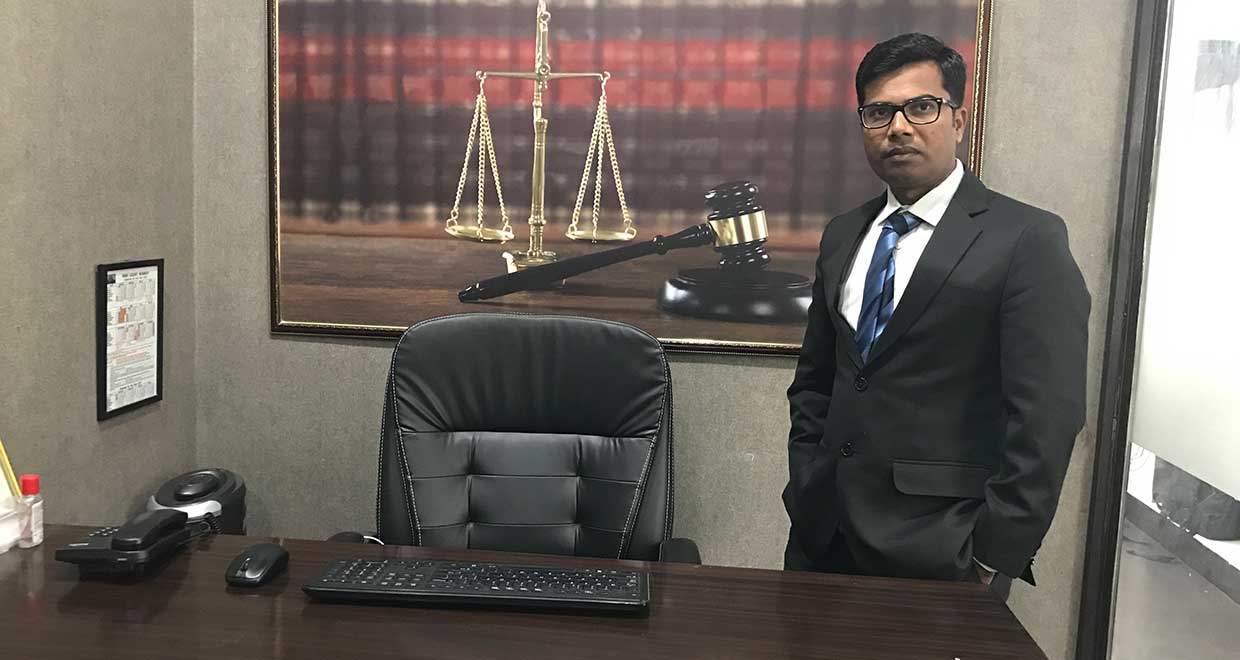
    Prashant Chandra graduated from Campus Law Centre, Faculty of Law, University of Delhi in 2011. He is a diligent and well read lawyer with acute legal acumen and professional commitment.
    With more than 3 yrs into litigation, he has handled the panel work of ICICI Bank, HDFC Bank, HDFC Standard Life Insurance Co., TATA AIA Insurance Co., Future Generali Life Insurance Co. and Aviva Life insurance Co. before various Forums/NCDRC along with trail in civil disputes viz. recovery, service, property matters before Delhi High Court and various District Courts of Delhi. At present, he is working as an associate at Vox Juris.


    In this interview he talks to us about:

    • Challenges he faced as an advocate in Delhi High Court.
    • Importance of mooting and academic writing.
    • Difference between a practice in a High Court and the Supreme Court.
    • How he decided to write his book “The Tumult over Law of Homosexuality”.


    What would be a brief introduction of you?

    I am a first generation lawyer. I am dedicated towards my work and very passionate for litigation. I come from a family of academicians and government employees. Throughout my student life I have been very active in various extracurricular activities and been involved in different vocations. I did LL.B. as 3yrs law course after my graduation so I had enough time to be involved in different professions. After having experience in different fields, I finally chose litigation as profession since it keeps me in a constant phase of motivation, gives me a chance to daily improve myself and achieve whatever I desire.


    Please elaborate on the motivating factors which helped you in choosing legal studies.

    Throughout my life I have been inquisitive about only two aspects related to anything- Firstly, the science behind a particular thing and secondly, the logic behind existence of that particular thing in that particular form. The science part involves all the technical knowhow of invention and things related to chemistry and physics whereas the logic part involves all the issues related to the rules/law governing that particular thing.

    Simply put, whenever I use any object, say a pen, the first two questions which come in my mind are: (1.) How that particular pen was crafted viz. ink put in a sleek tube/refill, writing tip made etc. (2.) Who determines the specifications related to a pen, what standards are to be maintained, what size and characteristics of a pen should be set, so as to give it a standard definition. When we look answers for such questions, we find that there is a Ball Point Pens and Refills Committee, formed by Indian Standard Institution regulating the manufacturing details of ball pens. Since I couldn’t cope up with chemistry, I decided at the initial stage of my career that I’d pursue my career in a direction which doesn’t involve studying science and would devote my time in answering the second question i.e. knowing the law governing the society.


    Were there any activities you participated in that honed your skills as a litigator? How are they relevant now?

    In 1st year of LL.B., I was able to qualify as a member of Moot Court Society, CLC, Faculty of Law, University of Delhi. Later on I kept myself engaged as participant as well as volunteer in other Moot Court Competitions organized in Faculty of Law. In 2nd year of LL.B., I did internship in Supreme Court of India. In 3rd year, I did internship in District Courts of Delhi and for two months in Dehradun District Court also.


    How did you prepare for the Bar in a span of a few months?

    I collected the material and question papers of previous years AIBE from my friends and prepared accordingly. It’s an open book paper so I also took those books and few bare acts. While preparing for AIBE along with the main portion of law one should focus on the practical aspect of law viz. limitation periods, date of amendments, punishments prescribed for major offences, authority of judges etc.


    What are the challenges of being an advocate in the Delhi High Court?

    Yes, it’s true that being an advocate in Delhi High Court is quite challenging because there is a lot of competition in Delhi High Court. But the presumption that a first generation lawyer cannot survive in Delhi High Court is a myth. The merit is always appreciated in Delhi High Court, if you are well read and prepared to present your case the way it should be presented, then you will definitely get the relief you desire. The quote; “first deserve then desire” is applicable in its strict sense in Delhi High Court.


    What are the main types of cases you focus on?

    My area of litigation is writ petitions/appeals/LPA/revision etc at High Court of Delhi and all type civil matters viz. cases related to contracts, specific performance, service matters, executions etc. Recently I have also started practicing at criminal side with few astute and experienced lawyers having vast experience of criminal trial.


    What is the most challenging case you ever faced? Is there any case that changed your perspective on the judicial system?

    The most challenging case I ever faced was in Supreme Court of India related to service matter, termination of a Class I officer on grounds of alleged misconduct. The most challenging part in that case was its 6 years of dismissal owing to incomplete and improper presentation of case in several rounds of litigations before Delhi High Court and also few applications at Supreme Court. However, at the stage of SLP, after thorough research, precise drafting and proper presentation of the case I along with other advocates of my team, were able to get the desired relief and was able to get that employee reinstated from the Supreme Court of India. Further, I am a firm believer that our judicial system is fair and reasonable with eminent judges sitting at the helm of Justice and there has not been any case which could change my perspective on the judicial system.


    How important do you think mooting and academic writing are for a law student aspiring to become an advocate?

    Mooting is very important for a student who aspires to become a lawyer. It gives you confidence, exposure and removes your hitch to present your case. Mooting helps you become an advocate and experience what lies ahead of you, even before clearing your exams. As far as academic writing is concerned it is also helpful to supplement your research. Instead of only discussing a case law at tea stall or criticizing some High Court/Supreme Court judgment, a law student should step up and try to write a case comment or article on any High Court or Supreme Court judgment, on issues of his/her choice.


    Many students aspire to practice at the Supreme Court and High Courts. Should a student first practice at the Trial Court to learn the nuances, or is it fine to start at a High Court itself?

    My advice to all my juniors has always been to do internship in Supreme Court, High Courts and for that matter in Law Firms also, while you are pursuing LL.B. But once you are enrolled as an advocate, don’t skip the trial court/district courts. Everyone should always give at least 1-2yrs in district court; the main practice is learned in trial court only. High Court and Supreme Court are extension of what you practice in lower courts. If you once skip this initial step you will spend most part of your career in learning what could have been learned in initial 2yrs of your practice. And the best part of practicing in Delhi is that all the district court lawyers here do have some matters at High Court/Supreme Court also, giving you a fair exposure in your initial period of litigation. Moreover, if you start your own practice, initially people will bring to you lower courts matters.


    What are the differences that you see between a practice in a High Court and a practice in the Supreme Court?

    The major difference what I see between practice in High Court and Supreme Court is that of the Judges. The judges of Supreme Court being more senior and experienced asks precisely very limited questions to clear the doubts and form an opinion so that justice could be done in the matter whereas in High court, while delivering justice, the judges are more inclined in the quick disposal of matter so you have to be pro active and precise while presenting your case.


    How did you decide to write your book “The Tumult Over Law of Homosexuality”?

    While I was pursuing my LL.M. from Delhi University the case of Suresh Kumar Kaushal v. Naz Foundation was decided wherein the Hon’ble Supreme Court upheld the constitutional validity of Section 377 IPC, leaving it on the legislature to amend Section 377 in its own discretion and wisdom. Then there were numerous debates and pointless discussions everywhere since the question is related to legal restrictions on privacy and liberties of people. But in all those debates and discussion, people overlooked a crucial aspect that simply amending Section 377 IPC will not serve the purpose unless the same is done as a complete societal change; to which our present society is not completely ready and the infrastructure is not enough, so I have opined that the debate on Sec 377 IPC should be deferred for some time now and status quo should be maintained until we are prepared for such a drastic change. My book deals with varied issues and concerns connected to Homosexuality and LGBT Rights. Through different chapters I have tried to cover up issues related to historical, social, physiological, legal and constitutional problems which crops up when we talk about LGBT rights. I have dealt with different issues which people usually forego but such questions shouldn’t be abjured when we talk about LGBT Rights. Through last chapter I have tried to differentiate between society’s demand of decriminalizing consensual acts covered under Section 377 IPC and its actual needs in case Section 377 IPC is amended. I have thoroughly dealt with various landmark cases viz. Naz Foundation (Delhi High Court, 2009), Suresh Kumar Kaushal (Supreme Court, 2014), NALSA (Supreme Court, 2014) and Obergefell v. Hodges (U.S. Supreme Court, 2015) on the subject matter.


    Are there any suggestions you would like to give our readers?

    For students and aspiring advocates I will suggest, reading of case laws from recent law journal whenever you get time. Advocacy is a unique profession and noble at the same time. It takes time and for first generation lawyers it becomes more struggling. Initial 1-2 yrs are most struggling, testing your patience and determination but if you don’t give up everything will be better by the time. But never forget that sky is the limit in litigation, you just have to be willing to fly as high as you want.

  • Justice Sayonara Telles Laad, on bringing justice to the people, legal education and the Indian Judicial System

    Justice Sayonara Telles Laad, on bringing justice to the people, legal education and the Indian Judicial System

    Justice Sayonara Telles Laad is the Ad-hoc District Judge and Assistant Judge, North Goa, graduated in law from G.R. Kare College of Law in the year 1987. She joined practice in the same year went on to become an Assistant Public Prosecutor in 1992. In 1996, she answered her Judiciary Examinations and has been a judge for the past 20 years. This Interview was conducted by Dietrich Almeida of GR Kare College of Law

    IN THIS INTERVIEW SHE TALKS ABOUT:

    • Importance of Extra curricular activities
    • Criminal practice
    • Changes which have impacted the legal profession


    HOW WOULD YOU INTRODUCE YOURSELF TO OUR READERS?

    I am an Ad-hoc District Judge-1 and Assistant Judge Sayonara Telles Laad. I graduated from G.R. Kare College of Law in 1986-87. I started practise as an advocate in 1987 before I joined as the Assistant Public Prosecutor in 1992. I joined the judiciary in 1996 as Civil Judge Junior Division and Judicial Magistrate First Class at Vasco, Sanguem, and Ponda and was later promoted as Senior Civil Judge and Judicial Magistrate First Class at Bicholim, Quepem, and Ponda. It’s been 28 years since I’ve done law.

     TELL OUR READERS A BIT ABOUT YOUR CHILDHOOD AND PRE-COLLEGE LIFE AS WELL AS EDUCATIONAL BACKGROUND. DO YOU HAVE LAWYERS OR BUREAUCRATS IN YOUR FAMILY?

    I have done my schooling at Guardian Angel Higher Secondary at Sanvordem, Curchorem. Then did my Higher Secondary Schooling in Arts and completed my B.A through Parvathibai Chowgule College. I come from a family of bankers and teachers. There are bureaucrats but no lawyers in my family.

     HOW DID YOU DECIDE TO OPT FOR THE FIELD OF LAW?

    Opting for law was not planned, nor was it my ambition to join the legal profession. It just happened, and I went with the flow. I was not focused like the kids now-a-days. I always wanted to study as I had the fever for answering examination. After I completed my graduation in B.A, I thought of doing M.A but in those days to pursue M.A one had to go to Panjim as it had to be done through University of Bombay. Goa University came to be established much later. As G.R. Kare college of Law was closer to home, I opted for LL.B.

     HOW HAVE EXTRA-CURRICULUM ACTIVITIES HELP YOU IN ACHIEVING YOUR GOALS?

    I have always been actively involved in extra- curricular activities like sports and cultural activities and see that I keep myself active. Extra -curricular activities helped me in developing my personality, helped me in adjusting to various situations, developed patience and confidence to be a better human being and it keeps you active and your mind alert.

     DESCRIBE YOUR EXPERIENCE WHEN YOU APPEARED IN THE COURT FOR THE FIRST TIME?

    Well, I guess it was like any other newcomer to any profession- mixture of surprises, apprehension, awe of the judges, the legal luminaries, the imposing atmosphere of the court, nervousness, awkwardness and a feeling of satisfaction to be associated with such a noble profession.

     TELL US ABOUT YOUR EXPERIENCE AS THE ASSISTANT PUBLIC PROSECUTOR.

    I had the opportunity to deal with a number of criminal cases during my tenure as Assistant Public Prosecutor which was for about 4 years before I joined judiciary. Handling criminal cases exposed me to human tendencies, human psychology, the mind-set of victims, offenders. I felt that the victims needed much more justice than they were actually getting as there was no victim compensation awarded to the victims then as per the recent amendment which has introduced victim compensation to the victims.

    rsz_sayonara_laad_2

     WHAT MADE YOU GRAVITATE TOWARDS JUDGESHIP?

    I was an Assistant Public Prosecutor when the opportunity came to apply for the post of Civil Judge Junior Division and Judicial Magistrate First Class in Goa Judiciary. I thought that opting for judiciary would be ideal as I would be exposed to handling Civil matters besides criminal cases and a variety of cases as compared to only handling criminal cases which were limitations of the post of an APP.

     WAS, THERE ANYONE, IN PARTICULAR, WHO INFLUENCED YOU WHILE DECIDING ON JUDGESHIP?

    There was no one that influenced me but I felt that judgeship is a better option for a lady in all ways as it is the next step after being an APP and a privilege to be appointed as a judge considering the nobility of the profession.

     BRIEFLY TELL US ABOUT YOUR INTEREST IN JOURNALISM.

    I dabbled in journalism prior to my legal career as I had always been a voracious reader and had a flair for writing and wanted exchange of views. I wanted to change the mind-set of society to a large number of unjust social norm and superstitious beliefs. It feels wonderful to reach out to a whole group of people out there through this medium. It’s a wonderful feeling when someone says I have read your write-up or article and it was nice and thought provoking.

    DO YOU FEEL THAT THE LEGAL PROFESSION HAS SIGNIFICANTLY CHANGED FROM THE TIME WHEN YOU DECIDED TO STUDY LAW?

    Yes of course there are a lot of changes in this field. There is computerization and upgrading of infrastructure, newer laws like Domestic Violence Act has come, Sensitization of women Gender Acts, introduction of Alternate Disputes Forum for settling cases, Plea bargaining, appointing of Paralegal Volunteers to work from grass root level, establishing front offices with Retailer Advocates on panel for those who want free legal Aid/Advice, introduction of the mobile van for creating legal awareness and disposing matters through LokAdalats by taking justice at your doorstep.

     THE BAR COUNCIL OF INDIA IS CONTEMPLATING ON THE FORMATION OF A NEW RULE WHICH WILL REQUIRE LAWYERS TO PRACTICE IN LOWER COURTS, BEFORE ARGUING BEFORE THE HIGH COURTS AND THE SUPREME COURT. IF THIS RULE IS MADE CONCRETE, DO YOU THINK IT WILL HELP?

    I think it’s a very good move indeed as the lawyers will have a good insight and in-depth knowledge of the actual practice and procedures of law and the working of the lower courts.

     WHAT DO YOU THINK ABOUT THE INDIAN JUDICIAL SYSTEM? HOW CAN IT IMPROVE ON DELIVERING JUSTICE?

    I would advocate the Common Civil Code as applicable in this state to the rest of India.

     TELL US WHICH SPECIFIC ROLE WOULD YOU LIKE TO SEE YOURSELF AFTER 10 YEARS?

    I would be retired by then and would like to create legal awareness and crusade for settlement of cases through Alternate Dispute Redressal Forum which is introduced under section 89 of the Code of Civil Procedure through means like Arbitration, Conciliation, Judicial Settlement through Lok Adalat and Mediation.

     FINALLY, WHAT PARTING MESSAGE WOULD YOU LIKE TO GIVE OUR READERS?

    I would like to stress that litigants and Advocates should be more open minded to refer matters to Alternate Dispute Redressal Forums and make sincere efforts to settle the cases as settlement of cases is cost effective and time saving and bring about peace and happiness.

  • Mihir Deshmukh, Managing Associate, Advaita Legal, on a career in taxation law

    Mihir Deshmukh, Managing Associate, Advaita Legal, on a career in taxation law

    Mihir Deshmukh graduated from Government Law College, Mumbai in 2005. He has over 11 years of experience in arguing matters relating to indirect taxes before various for a throughout the country. He is admitted as an Advocate with the Maharashtra and Goa Bar Council since 2005 and has an extensive experience in litigation in the areas of Central Excise, Service Tax, Cenvat Credit, Value Added Tax and Central Sales Tax including appearances before various High Courts and Indirect tax Tribunals. His clientele has been diverse and included Maharanta companies such as BPCL, ONGC, SAIL and MNCs such as Dish TV, Tata Group, Reliance India Ltd., Dow Chemicals, Bruker International and HCC Ltd. He also has an indirect tax advisory background and was associated with PWC and ELP during his earlier stints and was also a part of the indirect tax litigation team of EY (PDS Legal) since its inception in 2010. His areas of functional expertise include Customs, Service Tax, Central and State Sales Tax Laws, Excise, VAT, Works Contract Tax, Octroi.

    In this interview he talks to us about:

    • Importance of taxation as a subject for law students.
    • How can one gain expertise in Indirect Tax.
    • His strategy to deal with errors and mistakes.
    • Qualities that helped him to achieve the current status.


    How would you introduce yourself to our readers? Please tell us about your family and childhood.

    I am third generation lawyer, my father is an industrial law consultant ,my mother was a teacher and then a home maker who gave up her career to ensure that she could devote her entire time to us. My wife is a Professor in an engineering college pursuing her Ph.D. simultaneously. The values embedded in me, which I hold close to my heart and which I believe have made me the person I am today are because of the sacrifices made by family. I did my schooling in a small town Roha, and then had to move to Mumbai for my further studies (Junior college and Law school).


    What brought you into studying law? Was it fate or planned?

    In a lighter vein, I would call it planned fate. Like other kids who want to be a policeman or pilot or a 100 other vocations when they are growing up, I was always clear that I wanted to be a lawyer. Maybe it was because of seeing my father in the profession and my love for reading that pushed me towards it.


    How helpful was your law degree in terms of the added legal perspective to your existing knowledge? What career advantages did it bring?

    Getting a law degree brings about a different thought process to you. It helps one become more analytical. Coupled with your knowledge I believe a law degree gives one that cutting edge over others.


    How important is taxation as a subject for law students? What advice would you give our readers to consider taxation as an area of practice?

    Today, the tax subject is optional in many universities. However, to a very great extent I feel that Tax as a law subject should find place in the syllabus of every law student. Tax as a subject cannot be taught in isolation. While studying tax, one also dives into the intricacies of constitutional law, administrative law, Law of jurisprudence and interpretation of statutes, forming a gamut of legal studies. Further, with GST now coming in, there is a great demand for indirect tax layers. I would urge all your readers to consider tax as a serious option.


    What’s a typical day at work like? How can one gain expertise in Indirect Tax? What does it take to be a good Indirect Tax Lawyer?

    Typical day at work starts with flipping through pages of the law journal- electronic or print and then to rush off your feet to the court which ends with a relaxed cup of tea. The evening is spent preparing for the next days’ court. Call me old fashioned, but I believe in starting early and finishing early. I hate late working hours unless absolutely necessary. I make it a point that my team finishes at a decent time by 7.00 pm. It keeps them in balancing their work life balance and I get a team with great productivity and output.


    What are the preferred legal issues you like to work on? Do you have any hobbies that help you unwind after a long day at work?

    As a budding lawyer you really cannot be choosy about work. Though, now I am primarily and indirect tax litigator, I worked on all laws during my internship days. I believe that internships lay the foundation for your future and therefore have my reservations against the 1-2 month internships that are a norm with the law students today. It is too short a time frame to learn anything.  You should commit for a considerable period of time to learn and understand things. I was lucky enough to intern with Mr. Mohan Jayakar (Khaitan and Jayakar), the person who I credit for making me the professional I am today.

    I have always been an avid reader which as a kid inculcated me with the ease of reading the lengthiest briefs. After work, if time permits, I engage myself in gleeful reading of non-fictions. Watching masala movies always helps.


    What has been your strategy to deal with errors and mistakes? How would you advise a young associate to deal with them?

    As an officer of court, I endeavors to assist the court in the most honest and immaculate manner. I try to be sure that the court is not misled and true facts and position of law is brought before them. However, one is bound to err. The best way to correct is to reinstate the correctness at the earliest. I advice my associate to confront flaws and start improvising it without any procrastination. The trick is not to get disheartened by failure. As long as one feels they have given their 100%, then failure should not affect you.


    What steps do you take to prepare for a difficult case?

    Be it a difficult or a simple case, one should be thorough in the preparation. The reason being you can never predict what a judge might question you on. The premise is to know the facts of the case inside out and then the legal provisions pertaining to your case and relevant case laws in your favour. One thing, I would like to add here is that one should also be aware of the case laws against you if any so that you can differentiate them when quoted by the other side.


    What qualities do you think helped you achieve this status?

    I would say that to achieve success in the legal profession, on needs not only work hard but one should also work smart. You need to be ready to work hard (not to be mistaken for long hours). Hard work makes up for every other drawback one might have. That is the only virtue I would ask everyone who wants to be a successful litigator to imbibe. This industry belongs to one who is industrious.


    What would be your parting message for our readers?

    Be a litigator because it’s your passion and not just a career option. Once it is your passion, the ingredients of making it a success need not be taught to you but you will come up with your own unique recipe and success story.


  • Ms. Purvi Kapadia, Partner, Rajani Associates, on completing the Solicitors Exam and Private Equity practice

    Ms. Purvi Kapadia, Partner, Rajani Associates, on completing the Solicitors Exam and Private Equity practice

    Ms. Purvi Kapadia, graduated in law from Government Law College, with a gold medal, in the year 2002 and thereafter passed the Solicitors examination conducted by the Bombay Incorporated Law Society in October 2004. She has an experience of over 13 years in the legal Industry and is at present a partner with Rajani Associates. Interview by Kaushik Dessai of G. R. Kare College of Law.

    IN THIS INTERVIEW SHE TALKS ABOUT:

    • Successfully completing the Solicitors exam

    • Corporate practice

    • What it means to be a good private equity lawyer

    • Current reforms in Law

    HOW WOULD YOU INTRODUCE YOURSELF, GIVEN THAT MOST OUR READERS ARE YOUNG LAW STUDENTS and YOUNG LAWYERS?

    Hi. I am Purvi Kapadia, partner at Rajani Associates, a full service law firm. I handle the private equity practice of the Firm.

    WHAT INFLUENCED YOU TO JOIN LAW?

    Well… a lawyer is what I was meant to be. I am a third generation lawyer of my family and it came as a surprise to no one when I decided to study law.

    WHAT PROMPTED YOU TO PREFER CORPORATE PRACTICE OVER LITIGATION?

    Litigation practice can be very thrilling but also very slow moving. It is no secret that litigation can often be prolonged. As an articled clerk I got a chance to do a fair bit of both, litigation and corporate matters, and the fast pace of a corporate practice is what I came to like.

    WHAT ARE THE CHALLENGES YOU FACED WHEN YOU FIRST STARTED HANDLING PRIVATE EQUITY TRANSACTIONS?

    I am not sure if what I write here describes a challenge exactly, but it is something that I realised very early on in my practice as an important part of this practice and i.e. Negotiation. Both drafting the transaction documents as well as negotiating the same thrill me. But the later thrills me even more as no two negotiations are the same. I believe negotiation is an art that you master more and more with each transaction and you may not exactly start of by being good at it. I know I did not. I was just lucky to work with brilliant seniors then, from whom I could learn and better myself.

    IF A STUDENT OF LAW WISHES TO ULTIMATELY PRACTICE IN THE PRIVATE EQUITY SPACE WHAT WOULD BE YOUR ADVICE?

    While most private equity transactions revolve around the same concepts, rights and obligations, it is very important to understand that the pulse of every transaction and client is different. What may have seemed like the perfect deal for one transaction could work very differently for another transaction. Also, the business and structure of the company in which investment is proposed, as well as the management set up, holds most relevance, and the same must be understood minutely. Lastly, while a due diligence is most often considered as a routine act that simply needs to be swept out of the way, what one must remember is that the findings of a diligence exercise are in fact the very foundation of any transaction. A lot of the drafting of the transaction documents in fact depends on the findings of a diligence. Anyone wishing to practice in the private equity space must first start with doing diligence exercises and understanding the impacts of its findings.

     YOU HAVE CRACKED THE SOLICITORS’ EXAMINATION CONDUCTED BY THE BOMBAY INCORPORATED LAW SOCIETY. THE SAID EXAMINATION IS WIDELY KNOWN AS A TOUGH EXAMINATION. COULD YOU TELL US ABOUT THE STRUCTURE OF THE EXAMINATION?

    Yes, the solicitors examination is a very challenging exam. It is a great feeling to pass it. The examination is set to test ones practical knowledge rather than just theoretical knowledge. Also the questions are interwoven to cover various subjects, so it is never enough to just know the subject of which you are writing the paper. One needs to know all the other subjects as well. It most definitely is an exam that helps you gain multi dimensional knowledge and apply the same.

    WHAT WAS YOUR SUCCESS MANTRA FOR ACHIEVING SUCCESS IN THE SOLICITORS’ EXAMINATION?

    There are no shortcuts for passing the solicitor examination. If you fall in love with each of the subjects you are studying and study the same methodically, you are sure to get through. The key is not to study each subject in isolation but to understand how these laws are interwoven and interdependent. When you read a case study, you should be able to think of all the facets of law that would apply to that particular case study and not just the subject law for which you studying/ writing the paper. This is exactly how you then move on to deal with your clients in real life practice.

    AS A PARTNER AT RAJANI ASSOCIATES, WHAT IS AN AVERAGE DAY AT WORK LIKE? OUR READERS WOULD LOVE TO HEAR ABOUT THE DAY-TO-DAY RESPONSIBILITIES WHICH NEED TO BE HANDLED BY SOMEONE IN YOUR POSITION.

    From simply executing work a few years back, at this position I now mentor my team. An average day at work means a lot of interaction with my team. It is usually conversations revolving around the transactions on hand or changes in law.

    YOU HEAD THE PRIVATE EQUITY INVESTMENTS AND JOINT VENTURE TRANSACTIONS AT THE FIRM. HOW DID YOU BUILD UP YOUR EXPERIENCE IN THE PRIVATE EQUITY TRANSACTIONS?

    I have had both – skilled seniors and skilled teams on the opposite end. Both private equity and M & A transactions entail not only good drafting and reviewing skills but also thorough negotiation skills. From the first transaction I negotiated for – to the last, I have seen myself grow in confidence. Needless to add the seniors I have worked with have taught me a great deal. At the same time, if you keep an open mind you will be amazed how much you can also learn from the seniors sitting across the table.

     WHAT ARE THE OPPORTUNITIES THAT THE PRIVATE EQUITY PRACTICE HAS TO OFFER? WHAT ARE THE ESSENTIAL REQUIREMENTS TO BE A GOOD PRIVATE EQUITY LAWYERS?

    A private equity practice exposes you to various laws, not just Indian but global as well. Also, although every transaction may have the same end intent of taking or making investment, I am yet to work on a transaction that would fit the same parameters as my previous transactions. Each transaction has had its own challenges, its own negotiation meltdowns and high points. In short, no transaction has ever been the same for me and that has been amazing.

    As for the requirements of a good Private Equity lawyer, I strongly feel that a good Private Equity lawyer must learn how to understand the pulse of the transaction at hand. A Private Equity lawyer must be careful not to treat each transaction and client the same as the previous one or straight jacket the transactions. Also lawyers often forget that negotiations are not a personal battle field. What the client needs or is willing to give up or is willing to hold on to no matter what, is paramount, and that it is for the lawyer representing the client to understand and act accordingly. Above all, it is important for the lawyers to guide their clients. Often clients are unaware of, or lose sight of, the immediate or futuristic challenges they may face on the completion or non completion of a transaction and the lawyer must help the client understand the same.

     YOU HAVE BEEN WITH RAJANI ASSOCIATES SINCE 10 YEARS. PLEASE TELL US ABOUT YOUR EXPERIENCE AT THE FIRM?

    Rajani Associates is a great learning ground. No transaction or assignment in this Firm is executed as a matter of fact. Instead, every transaction and every client is handled with utmost care and as a team effort. Every transaction is headed by a partner and the partner constantly imparts both knowledge and experience to the rest of the team. In these past 10 years, I have learnt so much from my senior, the managing partner – Mr. Prem Rajani (and I continue to learn), just as I have passed on knowledge and experience to my team (and will continue to do so).

     THE PARLIAMENT OF INDIA ENACTED THE INSOLVENCY AND BANKRUPTCY CODE 2016. WHAT IS THE EFFICACY OF THIS CODE AND WHY IS IT AN IMPORTANT PIECE OF LEGISLATION?

    Change is always good and especially change in law is always a positive step towards working with the need of the hour. Bankruptcy Code likewise, is a welcome consolidation, an overhaul, of the existing bankruptcy legislations. Providing a much needed relief to the existing debt market of India, an early and faster remedy to the lenders, the Bankruptcy Code is most certainly a very important piece of legislation for India. The efficacy of the Code will however, like any other legislation (new or old), depend on the execution and implementation of the Code. A number of agencies and professionals will need to work together and effectively, to make the Code a success, and it is certainly hoped that this is achieved.

    THERE HAS BEEN A SEVERE CRITICISM OVER PUBLIC SECTOR BANKS WRITING OFF BAD LOANS. WHAT IS YOUR VIEW IN THAT REGARD?

    I partake somewhere in this criticism. Writing off such huge amounts of bad loans does ultimately somewhere come at the cost of burdening honest taxpayers and affect the shareholders of these Public Sector Undertaking banks. While the entire write off may be treated as an accounting act, and although in reality the Banks do continue to pursue their debt claims against the defaulting debtors, the write off does take the compulsion off the Banks to pursue the bad debts.

    WHAT IS YOUR ADVICE FOR FRESH GRADUATES WHO WISH TO ENTER LAW FIRMS AS ASSOCIATES?

    Well, challenges in a law firm and a legal career are the same as in any other profession. Hard work and willingness to learn are paramount. Also, in this profession practical knowledge is very treasured. Reading of law, to its understanding, to its implementation, every step is crucial and this journey can be mastered only with experience.

    WHAT WOULD BE YOUR PARTING MESSAGE FOR OUR READERS?

    Studying and practising law is exciting. Hope to see you on this side soon.


  • Alok Shah, Senior Manager – Legal (International Business) at IndiaCast Media (TV18 & Viacom18), on a career in international media distribution

    Alok Shah, Senior Manager – Legal (International Business) at IndiaCast Media (TV18 & Viacom18), on a career in international media distribution

    Alok Shah qualified in law from Pravin Gandhi College of Law in 2010 and worked at Kanga & Co. first as an Article Associate and later at Hariani & Co. as an Associate before pursuing a post-graduation diploma in Media and Entertainment law from NALSAR, Hyderabad in 2014.

    Immediately after that he got recruited at IndiaCast Media Distribution Pvt. Ltd (TV18 & Viacom18 Venture) as an Asst. Manager Legal of their International Business. Alok grew in this role and he is at present Senior Manager – Legal (International Business) at IndiaCast Media Distribution Pvt. Ltd. (TV18 and Viacom18 Venture).

    With his work experience in the international media distribution industry Alok shares talks to us about negotiation of contract with international lawyers, their interpretations, their contractual skills, and their drafting techniques amongst others.

    • His shift from law firm to in-house and private equity/real estate to media and entertainment.
    • How the Indian media and entertainment market has evolved and the dynamics of the media.
    • Challenges young lawyers might face in the media industry and the challenges he faces in dealing with international lawyers.


    Tell us a bit about yourself, and what drives you?

    Born and brought up in Mumbai, I breathe the spirit of this city.  From my childhood, I was interested in the fields of Political Science, Media, Sociology and Political Affairs. My father is a businessman and my Mother is a successful entrepreneur. Hailing from a family that is passionate about what they do, I wanted to choose a field in which I could truly excel – and that’s how I ended up pursuing law.

    My ambition and thirst for knowledge have been the driving forces in all my endeavours.


    How was your experience of legal education? Have you thought of higher studies?

    My experience in legal education was both a mix of academics and work experience. I was in Pravin Gandhi College of Law which is affiliated with Mumbai University. I enrolled for an articleship to pursue solicitors in my fourth year of law school with a reputed law firm. I was working with the youngest partner of that firm who specialised in Real Estate and Capital Markets. For me back then, work experience was a priority over higher studies, so I kept my focus on gaining as much work experience in multiple legal areas so as to ensure complete grip on the practice. At present, after completing 6 years of work experience in this industry, I plan to enrol in a business school to enhance my expertise in this industry.


    alok-shah-2

    What did you do in the year right after graduation?

    After graduation, I had an opportunity to either continue with the same firm or join another reputed law firm. This was during the time India was still reviving from the collapse of the Lehman Brothers shock, and I decided to move out of capital markets, considering the change in the market scenario. At that stage, I decided to join another cross functional law firm which had remarkable presence in multiple practice areas. I was excited to learn about new fields and wanted to take my time to decide what drives me to my best.


    What was your reason to change from a law firm to in-house?

    Well, now that was one of the most path breaking decisions of my career. I realised that it is difficult to understand the dynamics of the industry, being an external counsel who would be approached only in the event of a legal dispute. I had to be an ‘industry insider’ to understand the grassroots of the business. To summarise – I felt the need to move from ‘execution’ to ‘Strategy and Decision Making’ and that’s where my decision to shift as in-house counsel stemmed from.


    What about your shift from private equity / real estate to Media and entertainment?

    My goal to work as an in house counsel was not only to assist in legal matters but also to understand the nuances of the ever changing and complex business intricacies. Considering that I was primarily involved in private equity and real estate matters, it was not possible for me to enter a hedge-fund or a real estate conglomerate only with a law degree. My law firm had a full-fledged Media and Entertainment team as well. Call it a wonderful stroke of luck or destiny, I was involved in one such transaction and since then there has been no looking back. I gauged that Media is one of the fastest growing industries and is far more challenging in the dual avenues of law and business.


    alok-shah-3

    What is so different in Media compared to other areas of law?

    The media is one of the most revolutionary industries of this century. What is new right now may become old in the next 6 months. With new inventions, changes in technology and fast-paced innovations, it becomes very challenging not only for industry experts, but also for lawyers to keep pace with this ever growing sector. In this field, in addition to keeping a track of new legislations, a lawyer also needs to understand new technology (which is quite unlike any other field of law) – its dynamics, relevance and functionality. Moreover, Media law itself has so many different areas of practice such as distribution, licensing, acquisition, film production, artist management, merchandising etc. which makes this industry far more dynamic and specialized.


    What are the challenges that a young lawyer may face after joining this industry?

    I believe that legal education in India does not completely cover all aspects of media and entertainment laws considering that it is one of the most evolving and dynamic areas. Though Intellectual Property Rights (IPR) is one topic in our curriculum which tries to cover basic understanding of this field, I still believe that it is a limited resource to enable young graduates in understanding this industry. To overcome this challenge, I did my post – graduation diploma in Media and Entertainment laws from NALSAR University, Hyderabad. I would advise every young lawyer who is keen and passionate to enter this industry to enrol in some course enhancing knowledge in the field of Media and Entertainment law. Also, they can subscribe to magazines, web portals, newsletters concerning this industry to get a first-hand insight.


    How did the Indian market in Media and Entertainment evolve?

    Traditionally, in the pre-2000 era the Indian Media industry was not institutionalised and unregulated, under which films were funded by private money lenders, often by underworld gangsters, primarily interested in the collections from distribution rights or the box-office collections. But after it was accorded the “industry status” in 2000 by the Government of India, the following years saw the Indian films receiving funding support from the banks, Indian corporate and foreign studios thereby giving rise to more sophisticated digital production and postproduction techniques.

    As far as distribution is concerned, the Government’s move towards digitalization and addressability for cable television by 2016 is expected to provide an impetus to Direct to Home and digital cable growth. The Media and Entertainment industry is at a convergence point with digital being the buzzword and perhaps that is the reason television screens are being replaced with smart phones. From receiving news bulletins on Doordarshan to twitter updates – the Indian Media industry has come a long way.


    How is the Indian media and entertainment market different from international market?

    As far as media distribution is concerned, India is a highly regulated market as compared to other countries. In India, a broadcaster cannot have an exclusive deal with any platform since the same is prohibited under the Telecom Regulatory Authority of India (TRAI) regulations. However, the international market operates quite differently. In many western countries, the platforms insists on exclusive deals and that’s where the role of a lawyer becomes crucial, giving room for extreme and sometimes crass negotiations. In such deals, the discussions are quite pro-longed since the contract is not subject to any regulations of any territory (barring few clauses), but are based on pure commercial negotiations in which both – the distributor / broadcaster on one side and the platform on the other side try to grab the best deal for themselves.

    There are few contracts which may take more than a year just to reach a logical end during negotiations.  To summarise, in the international market the broadcaster’s main task is monetary exploitation of content, whereas in India, the broadcaster looks for maximum penetration of its content among masses.


    In how many countries is Indian Content available?

    In foreign countries, Indian content in Hindi language would not just attract the Indian community but the entire South Asian fraternity. Also, content from Indian regional languages have found substantial prominence in countries which have the presence of Indian regional audience. As far as Indian movies and television shows are concerned, they are available in more than 120 countries. It is pertinent to note that our content is dubbed and subtitled and broadcast on different foreign channels. People will be surprised to know that even in remote eastern European countries such as Georgia and Kazakhstan, our content which is dubbed in local languages is quite popular.


    Approximately how many foreign lawyers have you interacted with?  Can you share your experiences with a few of them?

    I have been involved in negotiations with approximately 20-25 foreign lawyers from different nationalities (such as US, UK, Canada, Bangladesh, Sri Lanka, Australia, New Zealand, Singapore, Russia, Pakistan, Egypt, UAE, South Africa, Brazil, Caribbean Islands etc.). There are times when there are strenuous negotiations involved especially when the first draft of the contract is shared by or with the other side whereas there are some transactions which are quite smooth since there is an existent commercial understanding in place. My personal experience has been both – enduring and challenging in dealing with lawyers from different nationalities. I have felt that the drafting skills of lawyers of western countries are worth appreciating, whereas as far as negotiations are concerned, lawyers based in Middle-East territories can give sleepless nights since they are hard to convince.


    What are the challenges you face in negotiating with foreign lawyers?

    Considering that the Media and Entertainment industry is evolving at different pace in each country; one of the most challenging aspects is to understand the technology prevalent in that country. When we are negotiating with platforms based in developed countries like US and UK, it is a daunting task as these countries are at least 5-10 years ahead of us when it comes to technology and technical know-how. As a lawyer, we need to imagine and understand how technology functions before we start with our negotiation process. Also, working in different time-zones can be quite taxing but the thrill makes it all worthy.

    Moreover, when you cannot have face to face communication or video conference, it is difficult to understand the body-language of the opposite lawyer and that makes the process more time consuming. Their language, interpretation, pronunciation and accent are another set of barriers which a lawyer may face during the negotiation process.


    What are the legal issues you generally face in negotiating a media contract especially while negotiating with international lawyers?

    There are certain legal issues pertaining to payment of royalties, indemnity, jurisdiction and governing law which are contentious to negotiate in an international distribution and acquisition contract. Limitation of liability is another thorny issue between the parties considering that in the event of any dispute the company should not be exposed to unlimited liability, that too in a foreign court of law. Negotiating a clause on payment of royalties in an international distribution contract is a tough job for an Indian lawyer due to ambiguity in the current copyright regime in India. These clauses are sometimes real deal breakers.


    How important are lawyers in this industry?

    Over time, the role of a legal department in a company has transformed from merely being a support function in an organisation to a full-fledged in-house counsel, which means that we are advisors to the senior management.  Especially in this industry, which is quite niche, I see the role of lawyers expanding specifically in international business. The CEO’s and business managers are now more than willing to rely on people with legal background for complex issues. In USA, there are many managers and business leaders in media and entertainment sector who have their origin in legal industry. In India too, the trend is changing – lawyers have been given role as business managers since they have the dual advantage of understanding and assessing the risk as well as ensuring maximum profit for the company.


    What would be your advice to young lawyers who would want to join this industry?

    There has never been a time more suitable than today to join this industry. It is exciting, fast paced and dynamic just like the present generation. Technology is set to change the world and its rapid consequences on the law cannot be ignored. There is no age limit for academic centric goals since we are in a field where one has to keep abreast with day to day developments in their respective area of practice. My advice to them is that they should not be satisfied with only becoming a better attorney but go a step ahead and get a perspective of the business world. The key to the next few decades of business operations, Indian or international rests in the hands of the lawyers of today, they only have to realise their pivotal role.


  • Ahmad Shazeb Azhar, Partner, Goswami & Associates, on work experience in litigation at Goswami & Associates

    Ahmad Shazeb Azhar, Partner, Goswami & Associates, on work experience in litigation at Goswami & Associates

    Ahmad Shazeb Azhar graduated from Aligarh Muslim University (2003-2008). He is a lawyer with almost 6+ years of standing at the Bar. He started his career in Delhi in 2010, practising regularly at Supreme Court of India, where he was the panel counsel representing the State of U.P. from 2014 onwards.

    His Core Specialties include litigation, dispute resolution, drafting, rendering advice, contracts and agreements, corporate compliance, arbitration, due diligence and legal research and securities markets.

    In this interview he talks to us about:

    • His experience at internships.
    • Advise for law students who prepare for a career while in college.
    • Value addition of a Masters degree.
    • Difference in practice and litigation at Delhi and Lucknow.


    How would you like to introduce yourself to the legal fraternity?

    I am a lawyer with almost 6+ years of standing at the Bar, at present practicing at the High Court of Judicature at Allahabad, Lucknow Bench. I started my career in Delhi in 2010, practising regularly at Supreme Court of India, where I was the panel counsel representing the State of U.P. from 2014 onwards. I also initially practised on the Original Side of the Delhi High Court, as a junior to Mr. M.R. Shamshad, Adv., dealing with some high profile commercial litigations. At present I am a Partner with a registered law firm called Goswami & Associates, which is an emerging firm, based out of Lucknow, primarily we deal with traditional litigation and dispute resolution, but are delving now into IP and other commercial areas. We have a couple of Government Banks, Insurance Companies, PSU’s and Private Companies as our clients right now.


    How did you decide to choose law as a career? Is there anyone in your family who motivated you to opt law?

    Well I am a first generation lawyer, who had no inkling what the job I was about to get into entailed. Both of my siblings are doctors in US & UK. The reason I chose law as a career was the mystique surrounding it. I had always been fascinated by the working of lawyers, as to what it was that they read on a piece of paper differently than an ordinary man. What gave them that perspective? That is what enticed me into the profession. There weren’t any family members who were already there in the profession, therefore the mystique and the curiosity was compelling enough for me to get in and explore this world of words, letters, sentences and arguments.


    How was your life at Aligarh Muslim University & Dr. RML National Law University? Did you find that your law school education prepared you for your current life?

    Life in Aligarh was completely different than expected. It’s a vast University with around 30,000 students and we used to reside in mixed hostels, wherein students from different streams and courses lived together, so that gave me a very diverse perspective of things. The more you interact with people from different fields and areas, the more your mind opens to diversity of views. The case with Dr. RML National Law University at Lucknow, was different where you get to meet the freshest and the best of the legal minds in the country, here I completed my LL.M thesis on Cartelisation under Competition Law. I was good at writing in college, be it essays, critiques or any such sort. The one thing that I regularly followed in college was to keep reading, whatever I could get my hands on, be it fiction, biographies, Russian socialist literature, History, Mythology and even John Grisham. The best part about reading is that it gives you references, analogies and ideas to construct an argument. Analogies, whether historical or mythological provide simplicity of comprehension to the listener.

    The legal education in India does not remotely prepare you with the realities of the legal profession. Considering the high premium that is placed upon the procedural aspect of law, the court craft and the client dealing aspect, the only thing that can get you prepared is to actually get in there and practice it. A mere understanding of the substantive law is not sufficient to succeed in the profession.


    Could you tell us a bit about your internship experiences?

    The first internship I did was under Dr. Sandeep Pandey, Magsaysay Award Winner and Social Activist. I actually got to stay in a village without electricity in U.P. for a month, preparing a report on the discrepancies in the land allotted under Consolidation regime by the government, which was submitted to the District Magistrate, so that was an experience. Thereafter I interned under Mr. M.R. Shamshad, Adv. whose chamber I later on joined in 2010. I also interned at Desai & Diwanji, Delhi office and under Mr. Niladri Bhattacharjee, Adv. who was gracious enough to actually credit us, the interns, by name on the Due-Diligence Report for a major company we helped prepare.


    How would you advice a law student if one has to start on to preparing for a career while in college?

    By the final year of Law College every student has a slight assumption of his or her own temperament and one’s inclination for the career we would like to choose. If you are prepared for a long meditation, then practice is a good option. But you would have to be mentally and physically prepared to handle the stress that comes with it. A total lack of finances and as a result dwindling motivation everyday is what makes practice really tough. A lot of my colleagues who started practice left it mid way because of these very reasons. Firms are a good option to join, if you have that inclination. Besides now there are so many other options that one can decide and work on right from college, be it getting into judiciary, a private company, a governmental job or even going abroad for higher studies and into academics.


    What is the value addition of a Masters in your career?

    The Masters Degree and the study for it, gives you the opportunity to delve deep into the existential basis of laws. For example for me in BALLB, the most irrelevant part of a statute was the preamble attached to it. Its importance I realised while in Masters. The basis for a statute, why is it there? What prompted its promulgation? And therefore if there is a discrepancy, how could it be filled in are all the jurisprudential questions that I got the answers to while pursuing my LL.M. With that depth of understanding, you yourself feel motivated enough to delve into and apply that knowledge to any filed you wish to pursue post your Masters.


    You have practiced at Delhi & Lucknow. Tell us the difference you feel in terms of practice and litigation between the two places?

    Delhi and Lucknow are completely different places when it comes to litigation. Lucknow being a traditional city, the outlook and perception are still evolving. I still get asked the very same question almost everywhere in Lucknow, as to whose chamber I belong to. Traditionally in Lucknow it isn’t common to see a lawyer below 40 years of age practicing independently or having started independently. Delhi has evolved in that aspect. Also in Delhi the wonderful experience of getting to meet or brief such famous senior counsels, is an experience in itself. Significant amongst them is Mr. Arvind Nigam, Senior Counsel, who had the most impact on my career as well as life. Also of significance is the experience I gained when I shifted to Supreme Court and got a chance to brief such excellent Counsels as Mr. Jethmalani, Mr. Sibal, Mr. Soli Sorabjee, Mr. P.P. Rao, Mr. Harish Salve, Mr. Salman Khursheed, Mr. Mukul Rohatgi, Dr. Dhawan etc. Lucknow bar though puts a very high premium on your knowledge of Law and has some very thorough and learned counsels amongst its members, who are as good as any lawyer in Delhi.


    What would be your parting advice to our readers?

    Be enterprising. Do what you want to do. But the keyword is “Do”. Merely thinking and planning won’t get you far. Mistakes would be made, but the experience gained would be much more beneficial. You will learn much more than what the books can make you aware of.

  • Nelson Joseph, Senior Associate, Radhakrishnan & Co., on building a firm practice and experience in corporate law

    Nelson Joseph, Senior Associate, Radhakrishnan & Co., on building a firm practice and experience in corporate law

    Nelson Joseph graduated from Government Law College, Ernakulam (2003-2007). He is a Civil-Corporate Lawyer who practices at High Court of Kerala and various other Courts, Tribunals and Commissions in Kerala and in other southern states. A first generation lawyer from an agricultural family, he began his career in 2007 at Radhakrishnan & Co., a leading civil-corporate law firm in Kochi which has operations in entire south India. He presently holds the position of Senior Associate Lawyer in the firm. His areas of interest pertain to Civil Litigation, Real Estate Laws, Banking Laws (legal opinions, legal due diligence and litigation), Customs Law, Commercial and Corporate matters etc.

    In this interview he talks to us about:

    • Challenges faced by him to complete his LL.B.
    • Difficulties faced by him to find a good law firm.
    • Skills to be developed by a law student to succeed in the field of litigation.
    • How he keeps himself updated with the legal knowledge.


    Tell us a bit about your childhood and pre-college life as well as educational background.

    I hail from a rural agricultural family in Ldukki District of Kerala. My life took a turn when I got admission to Jawahar Navodaya Vidyalaya in 6th grade. Ever since, I have been away from my native place. Meanwhile I completed my B.Com, LL.B and LL.M. from Mahatma Gandhi University, Kerala.


    As you were not from a wealthy background, what were the challenges you faced to complete your LL.B?

    It was never a childhood dream of mine to become a lawyer. In addition to that, I did not come from a financially sound family. Consequently, LL.B was the only professional course which I could enroll to, without troubling my parents. For completing my LL.B course, I supported myself by indulging in part time jobs, which gave me sufficient life experiences to thrive on the later period of my career. For instance, those employers for whom I worked with have become my clients now thereby making me realize that through every pain, we gain something and those struggles were great opportunities for me.


    So when did you realize that law is your career?

    While doing LL.B., I was not so particularly inclined to become a litigating lawyer. Although I tried my hand in attempting various competitive exams including civil service exam and searching for jobs, experiencing slips between the cup and the lip, words of my mother that “the almighty has a great plan for you” (which she quoted from The Holy Bible), kept me motivated. As a result, I believe that whenever I lose an opportunity, it has always been for something better. Despite seeing my class mates drop out for various reasons such as getting married or obtaining jobs, the motivation to sustain along with the course was always given by professors such as Mr. Paul Gomez who used to tell us that, “LL.B is a magic key, you don’t know when and where you are going to find the treasure box, so keep the key with you oiled and sharpened”. After joining Radhakrishnan & Co. as a junior Associate I realized my passion and flair lies in law.


    What difficulties did you face finding a good law firm and starting your practice?

    Being a first generation lawyer, I had to find out a good office to start my practice, which was not an easy task. In addition to that, it was very hard to survive with the meager salary offered to junior advocates by most offices. Finally, I could manage to find a firm where I would get some money for my survival and without much thought, I joined there immediately. Eventually I realized that it was one of the leading firms in South India which dealt with all domains of legal works and I was mesmerized with the kind of exposure I could get there.


    Without any God Fathers, how difficult it was for a first generation lawyer like you to survive?

    I was fortunate enough to have two wonderful seniors in the office. Adv. P. Radhakrishnan is gem of a person and a well-respected legal luminary in the state. His doors are always open for us juniors to approach with all kinds of doubt. He has been a study material for us to learn all professional qualities required for a man of law. Adv. Madhu Radhakrishnan, an alumnus of the NLSIU Bangalore, is person with lot of wisdom and empathy. He motivates me to stick on to this noble profession. His brotherly concern is not only limited to my career, but also spans across personal matters as well.

    It doesn’t matter whether you are a first generation lawyer or you belong to a lineage of lawyers. The difference is only at the beginning stage to find out a good office and the rest depends on the effort and hard work one put into it. As it is said, smooth sea never made a skilled sailor. There is nothing like adversities. Everything is an opportunity and its attitude that matters.


    How and when should a young lawyer decide to begin his own practice?

    I cannot answer this question fairly as I have not started my independent practice. The kind of exposure we get while working in a firm will be different while practicing independently. There are no rules for how and when to start own practice. There are lawyers who start their career by own practice and there are the others who are attached to firms throughout their career.  It’s a personal choice which depends on so many other factors as well.


    What types of skills should a law student strive to develop while in law school to succeed in the field of litigation?

    What we study in law school and what we practice in court are entirely different. For a litigating career, important skills one should possess are drafting skills, a good command over language and the meticulous way of observation of minute things. These can be developed during the college days. Furthermore, a lawyer should be a good content writer too. Other skills such as court craft and art of advocacy will be attained while practicing. Advocacy is an art of persuasion which can be learned by constant observation of eminent seniors. It’s not about skills; rather it’s all about the qualities lawyers possess. As lawyers’ creed says, “know your manners, tell the truth and know the law”.


    Please share with us your areas of practice.

    The firm which I work for is a client based firm rather than a subject based firm. So, all of that depends on the legal requirement of our client. For our clients, our office is like a single window system. Therefore the degree of exposure one gets here is really high. Because of this multi-disciplined and general practice, our services span across Munsiff’s courts, High Court, Tribunals and Commissions.


    How do you make new clients and retain them?

    Usually a lawyer gets clients through reference. Moreover, effective networking and good results are the key elements to get cases in. Since most of our clients are large corporate entities, it’s easy to get new clients, as the legal and other officers keep switching companies frequently. If the officers who are dealing with the law firm are satisfied, they will come back to us when they join other companies too.

    Everybody at some point of time in their life will find the need of a lawyer. So be polite but firm to people and make them feel that we are approachable and trustworthy. Clients will come naturally.

    For retention of corporate clients, more than producing results, we have to be proficient in soft skills, should possess good professionalism and proper updating of case status. Companies change their lawyers not because of poor results, but because of poor soft skills. Indeed, the law firms should adapt to the technological shifts. For instance, client companies expect an email update in the evening of the case date and also appropriate electronic documentation.


    You practice both in High Court and Trial Courts. Which is more difficult?

    High Court practice and lower court practice are different entities. In the High Court, our argument should be very precise and to the point. Whereas in Trial court, we need to do in depth study and preparation as it is where we make the foundation of the case. We should be extremely careful while drafting a plaint. On the contrary, High Court practice is comparatively easier as the procedures are simple and will get immediate results. In High court we need to show more court craft and advocacy as we get limited time to convince the judge. But the satisfaction of extracting the desired answers from the witness during cross examination could only be obtained from a trial court.


    Now a law graduate can become a judge directly from law school without any practice. What is your viewpoint on it?

    In present age, majority of students from elite law schools either appear for judicial services exam or opt for campus placement in companies immediately after the course. I would like to suggest that it is better to choose either one of the above mentioned options, after having some practical experience as a lawyer.

    It is very important for a judge to have some experience of getting a brief, conducting a case, technicalities associated with it for a better deliverance of judgment. Therefore in the interest of all, the minimum of 3 year practice as lawyer should be made mandatory for becoming a judicial officer.


    How do you keep yourself updated with the legal knowledge?

    I think one should clearly set out the working hours in such a way that it contributes in updating knowledge. As a rough formula, I would suggest, one may dedicate 75 % of the work time for actual works for the clients, 15% for continuing legal education reading journals, writing articles, attending seminars and workshops etc. and the remaining 10% for networking and finding new clients online and offline. As an example, I usually attend seminars and workshops conducted by National Law schools and other institutions to get myself updated in the profession.


    Does the college where we study really matters in the litigation career and if yes, how?

    The students from elite Law schools are better equipped and, of course, will have an advantage at the start of their career. They can easily get into big firms. But in long run, the school we studied and the marks we scored have no relevance.  What matters is how hard and intelligently we work.


    What are the areas do you think needs improvement for yourself?

    I need to find more time for general reading than the journal readings. Together with that, I also want to reduce or rather detach my personal emotional element from a case. As I am a very sensitive person, sometimes I become too emotional and identify myself with the client, which affects the professionalism.


    People say, a lawyer has to sacrifice his personal and family life to become successful in career. How do you think about it considering the hard work involved in building a career?

    It is true that one has to put the blood and sweat into it to become successful in the career. There is no substitute for hard work.  If I modify the quote of Longfellow in the context of our profession, then it could be stated as “Great lawyers won cases and attained fame by studying cases late night, while their opponents slept.” It does not imply that personal life will be affected in turn but it’s all about time management.


    What would be your advice to our readers?

    I don’t think I have reached anywhere to advice the readers who are much better than me in their insights and knowledge. But I shall share few of my thoughts I like reminding myself often for my improvement.

    1. Never feel ashamed to ask questions and doubts – We are not doing anything original. We are just following what our seniors and earlier generation did with some modifications. So when we get a case on new subject, feel free to ask our doubts to lawyers who handle similar cases and obtain copies of draft from them for our easiness.
    1. “If somebody offers you an amazing opportunity but you are not sure you can do it, say yes – then learn how to do it later”. – Richard Branson. In legal practice, there is nothing, which is hard to crack. Take whatever matters come to you. With a little research and advice, we can easily do it and become an expert in it soon. But make sure not to mess up and loose the confidence of the client.
    1. Be visible, regular and trustworthy. People are not looking for the best lawyer in the country, but a lawyer who is accessible and whom they can trust.


  • Abhishek Bhalla, Principal Associate, IndusLaw, on building a career in Corporate Law

    Abhishek Bhalla, Principal Associate, IndusLaw, on building a career in Corporate Law

    Abhishek Bhalla graduated from Guru Gobind Singh Indraprastha University (2002-2007). He joined IndusLaw in January 2016 and is a principal associate with the corporate-commercial practice. His focus areas of practice are mergers and acquisitions, joint ventures, foreign investment and general corporate and commercial matters.

    In his legal experience of almost a decade, Abhishek has structured, negotiated and drafted a wide range of transactions for foreign investors across sectors such as oil & gas, renewable energy, automotive, IT, telecommunication, aviation and hospitality.

    Abhishek advises foreign investors and multinational corporations on a wide array of legal issues relating to acquisitions, joint venture agreements, regulations governing external commercial borrowings, foreign direct investment policy, company and employment laws, etc.

    In this interview he talks to us about:

    • Advantages of starting out at a smaller law firm.
    • Disadvantages of not doing law from a National Law School.
    • What law firms look for in potential candidates?
    • What must a law student do to get hired in a top-tier law firm?


    How would you like to introduce yourself to our readers?

    Hi, I’m Abhishek Bhalla, a first generation lawyer, working as a Principal Associate at IndusLaw as part of the Corporate M&A team.

    I focus on mergers and acquisitions, joint ventures, foreign investment as well as general corporate and commercial matters. In my legal experience – spanning about a decade, I have structured, negotiated and drafted a wide range of transactions for foreign investors across sectors such as oil & gas, renewable energy, automotive, IT, telecommunication, aviation and hospitality. My experience also straddles deals across stages of evolutions ranging from capital infusion in start-ups to strategic acquisitions of significant value (as high as a billion dollars).


    Tell us about your life before you joined college. Where did your interest lie as a student and what made you gravitate towards law?

    I grew up in a family of business professionals with almost no ties with the legal fraternity. So at some level getting into law was a complete accident. However I was pretty sure that I wanted to get into a professional services career that provides options to branch out on my own later. Hence law was a natural fit. All in all though, it turned out to be a really good decision.


    Your focus areas of practice are mergers and acquisitions, joint ventures, foreign investment and general corporate and commercial matters. How did your interest develop in this field?

    After getting some exposure during internships, I decided on pursuing corporate law. Within corporate law, I worked on various kinds of matters but M&A, joint ventures and FDI interested me the most given the stakes, intensity and pace. I liked the real impact it created on the clients’ business and the level of engagement it evokes. Hence over the years I focused more and more on M&A, joint ventures and FDI, and the more I specialised the better the work got.


    You started out at RNC Legal and then shifted to Phoenix Legal when it had just started. What are the advantages of starting out at a smaller law firm?

    The biggest advantage of working in a smaller law firm is that you get to work directly with the partners from the very start. That is the fastest way of leaning to be responsible for and take ownership of your work. As a young associate, watching your work product go out to the client without much red line is a great satisfaction.

    I have been quite lucky to have worked with partners who have had the patience to guide me in the early years, and let me learn from my mistakes.


    You completed your LL.B. from University School, GGS Indraprastha University, Delhi. What are the disadvantages of not doing law from a National Law School?

    Graduating from a national law school has obvious advantages, especially for placements straight out of law-school and the long term networks that you build. At that time, the name of the law school is the often only thing on the CV which matters. However, after a few years into the profession, work experience – your reputation and personal networks – matter much more than college education. There is no substitute for on-the-job training.


    What is the importance of getting perspective from the client’s side?

    Last year, I was on secondment to BG India, the subsidiary of a British oil and gas company which has since been acquired by Shell, for about 4 months, assisting them with sale of certain off-shore assets.

    That secondment gave me a very different perspective. The bulk of the work for an in-house attorney starts where the work of external counsel ends. Application of the advice within the organisation is the real challenge. For an in-house attorney, the managers of the company are the clients. It is always useful to look at things from the other side to see how clients view and evaluate our work. I would highly recommend a secondment to anyone who gets the chance.


    If you were a law student today, would you do anything differently? If so, what would it be and why?

    I guess I would give more focus to internships. As I mentioned earlier, there is no substitute for work experience and on the job training.


    What do law firms look for in potential candidates?

     A fresher is not expected to know the law. What firms look more than anything else is the willingness to work, and of course basic analytical understanding/ability.


    What must a law student do to get hired in a top-tier law firm? What advice would you give to law students wishing to work in the same sector as you?

    I think the best possible way of getting into a firm is internships, especially in the last couple years of law school. Several internships at the same firm can get a foot into the door, and even if you do not get a PPO right away (as the firm may not require fresher’s at that point of time), you are more likely to get an interview call based on relationships you made during your internships, and convert that interview if you have the knowledge that emanates from the experience of having worked at a firm.


  • Aayush Chandra, Senior Associate, AMP Solicitors, on work experience in litigation at AMP Solicitors

    Aayush Chandra, Senior Associate, AMP Solicitors, on work experience in litigation at AMP Solicitors

    Aayush Chandra graduated from Symbiosis Law School (2006-2011). At present he is a Senior Associate at AMP Solicitors. His main work includes drafting, briefing, court appearances and research in Civil and Corporate Laws.

    In this interview he talks to us about:

    • His experience at Symbiosis Law School.
    • Role of mooting in a law student’s life.
    • Skills those are critical for a lawyer’s success.
    • How he overcame the initial jitters in a court room full of experienced lawyers and judges.


    Please share with us how you chose to study law. Do you have lawyers in your family?

    Coming from a family of Engineers and Doctors, I had to choose a Profession. Being an Engineer or a Doctor was not an option as I hated Mathematics and I could not stand an operation theatre. I remember my father, being an Engineer himself having advised me not to study Engineering as it had become quite common those days. So, I was without a choice frankly and I didn’t mind that (laughs). Then eventually the dots connected, everything fell into place and I became a lawyer by default. Being five years into the profession and still a long-long way to go both in terms of learning and experience, I can safely say that this field chose me rather than me having made a conscious decision.

    My Sister in law and my Cousin Sister are corporate lawyers and are doing very well. I am a first generation lawyer.

    Also, some of the lawyers who have had a major impact in my life are also like my extended family. A special mention for Ms. Pinky Anand, Mr. Sanjeev Sahay, Mr. Balendu Shekhar, Mr. Ashish Kumar, Mr. L.K. Singh, Mr. Rakesh Kumar Matwa and Mr. Jatin Sehgal- I owe all of them a lot.


    How was your experience at Symbiosis Law School?

    I think those five years taught me to be disciplined, to be self sufficient, to be responsible and to survive. It basically changed me from a lazy person to a street smart person. Symbiosis was good in the manner that I suddenly went from a zoo animal to a jungle animal and I could survive. The faculty was amazing; the friends were amazing and the over-all environment was great. Made some of my best friends in college, the most admired one being Jayant Dahiya.


    What role do you think mooting should play in a law student’s life?

    A very important one!! Since I wanted to step into Court practice, mooting was an important way to be able to learn to talk precise and talk sense before a Judge. Mooting is a very important curriculum that every law student should participate in as it teaches you to research, to be brief and concise in your arguments apart from learning how to address a Court. Actual Court practice is all about having good research skills, good legal interpretation to the facts at hand and then effectively putting this combined skill in a very articulate and humble manner before the Court.


    Is there any habit or skills you picked up over the years that you believe is critical to a lawyer’s success?

    Reading your laws, updating yourself on the latest position of law, not restricting yourself to any particular field and the hunger to learn are all part of the homework.

    As far as the class work or effectively putting it before a Court is concerned, I believe a lawyer should be presentable and concise to the Court hearing. One should be calm, no personal remarks against the opposite counsel, certainly no dramatics in Court and the most important skill would be to listen, listen carefully to what the judge puts to you and then answer it precisely rather than beating around the bush. That is where your Court craft comes to the fore.

    A lot of young lawyers get excited and make statements without instructions or without being sure about the factual or legal position, which as per my opinion should be avoided as then the bench doesn’t take you seriously.

    A lawyer being an officer of the Court has the duty and the responsibility to be fair to the Court and not conceal an important fact or document even if it goes against your client. It is also important to be able to draw a line between how a client sees the brief or a particular situation and how you as a lawyer, an expert in the field see it. The idea is to be a lawyer whose word can be trusted, respected and affirmed rather than being a mouthpiece of the client.


    What perception of the law and the legal system did you have before going in for an LL.B. and how did the same change through and after your graduation?

    Coming from Allahabad which has a beautiful High Court and having been family friends with some renowned lawyers, to my perception the legal world was and has been full of power, aura and respect. The ability to see a situation from both the sides and the necessary duty to carry the burden of justice on your shoulders are very difficult virtues to stand to.

    I have in my small time here tried to do just that and I sincerely hope that I keep doing that till the time I practice. I have been in effective Court practice since 2011 and luckily for me my life has thrown me into all kinds of storms. So I have appeared from the Tehsildar Court right upto the Supreme Court in different matters.

    My legal aid assignment has taught me the most. It cleared my basics in criminal law; it taught me how to deal with a client independently and how to handle a matter independently. It taught me how to apply my brains to a legal situation and how to win the day. It taught me why the seniors have a good reason to shout on their juniors if the matter is not prepared minutely and effectively.

    Since my practice has been mostly of District Courts of Delhi and the Delhi High Court, I would like to appreciate the quality of Judges we have in these Courts. They are always well versed with the files and the legal position. They are patient listeners totally calm and composed and the most motivating factor is that they promote young talent. It is a very enriching experience to appear in these Courts and every single day, a lawyer learns from it.


    What is your workday like? Are there new challenges every day or did work fall into a predictable pattern?

    Once you’re into Court practice, everyday is a new day and an exciting one and more so for me as I am on the Panel of the Legal Aid Scheme (Criminal). I wish my practice and my day never becomes predictable, I would hate it. On a working day, I am working from 9:30 am to 7:30 pm which includes Court appearances, conferences on a daily routine. This timeline is certainly extendable till 9 if a client has some urgency. The vacation days and extended weekends are a much needed part of our profession.


    If someone does not go to a top law school, would you say he still has a shot at a great career in law?

    Off course, in the end what wins the day is how much of hard work are you willing to put in to a brief. This career demands a lot of attention, a lot of perseverance and infinite amount of patience. Then slowly you start meeting your clients. This is not where it ends. What distinguishes a great lawyer from a good lawyer is how he conducts himself with his peers, with his juniors, with his clients and in the Court. The most important thing is not to lose your ethics and the trust, standard and proficiency that are expected out of a lawyer and then to be consistent day in and day out.


    How did you overcome the initial jitters in a court room full of experienced lawyers and judges?

    Mooting played an important role. But trust me nothing prepares you for your first appearance than the appearance itself. The second appearance becomes the most important then. Luckily for me, I had the full support of my senior in my first appearance, so I felt assured and it went well. The Ld. Judge at the first impression knew a young entrant is appearing and looks nervous and therefore he was very patient. As a fond memory I still have my 500 Rupee note framed with me which I received as my first appearance.


    Many students aspire to practice at the Supreme Court and High Courts. Should a student first practice at the trial court to learn the nuances, or is it fine to start at a High Court itself?

    I think the initial two years should be mandatorily in a District Court. It teaches you much more than what you will learn in 5 years in a Senior Advocate’s office. I think you should try to be a cook first before you can call yourself a Chef. You should keep your head down and learn the procedures in the District Court before you can call yourself a decent lawyer who will be able to handle a briefing and effectively brief a senior. This should be the primary aim, to equip your-self with the procedure and to learn to handle or brief a matter both as a whole or hearing wise. High Court practice is also necessary before moving towards the Supreme Court in the later years as it gives you a lot of perspective. It takes your practice to a more refined and polished level.


    Do you have any parting advice for all our readers out there?

    Yes, don’t be disheartened if this profession especially litigation doesn’t pay you at the start. No profession does. You have to gradually keep learning and build yourself up to a level and eventually it will all fall into place. Your struggling days and how you react to them will shape you as an individual both professionally and personally. Respect the struggle because it is teaching you.

    Once you hit the headlines for all the right reasons and have a BMW in front of your door, all this struggle and hard work will be worth it.

    But the BMW glamour and the jet setting lifestyle should only be an occupational privilege, don’t make it the only standard for this profession. For our profession is a very noble one. You all have the power and the education to actually assist in imparting justice and that should be the foremost aim. Rest all follows. And trust me this profession demands very big shoes to be filled in, out of which the foremost and the most important ones are ethics, temperament and knowledge.

    To end it, I personally feel that every lawyer should try to help lawyers younger to them and shape them as good leaders and human beings so that the rich and noble legacy of this profession continues.