Tag: Corporate

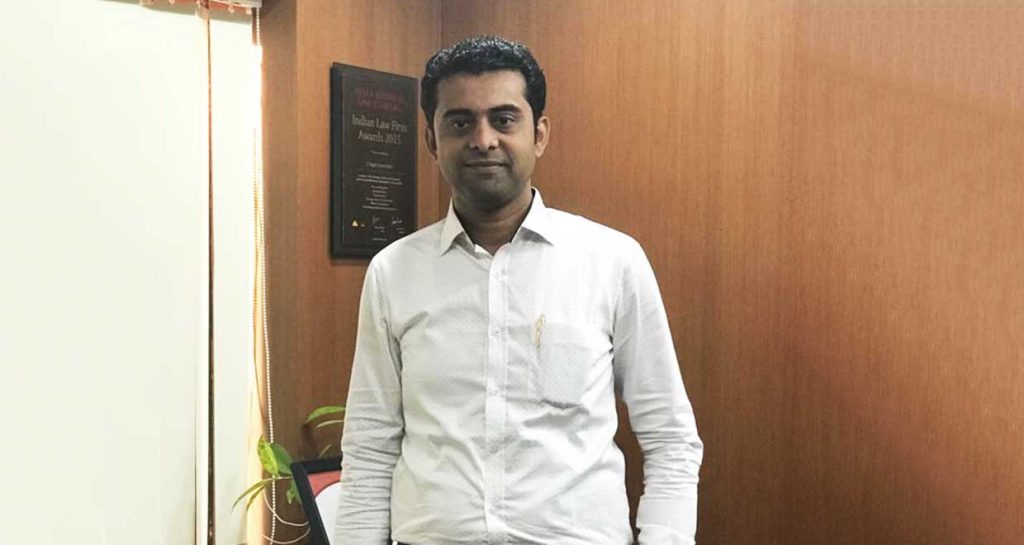
  • Arjun Perikal, Partner, J. Sagar Associates, on specialising in M&A, Corporate Laws and Dispute Resolution

    Arjun Perikal, Partner, J. Sagar Associates, on specialising in M&A, Corporate Laws and Dispute Resolution

    Arjun K. Perikal pursued his LL.B from K.L.E. Society’s Law College, Bangalore in the year 2003. Currently, he is a Partner at Bangalore office of J. Sagar Associates. He specialises in Merger and Acquisitions, General Corporate Commercial and Dispute Resolution. He also advises on the incorporation of companies and general corporate secretarial compliance, corporate contracts and mining licensing. In addition, he also has an extensive experience in advising clients on setting up of townships and liaisoning with Government / Statutory bodies for approvals/consents.  He has been practicing law for fourteen years. He has previously worked with AZB & Partners, Bangalore, and M & C Partners Bangalore.

    In this interview he talks to us about:

    • His motivation to pursue law as a career;
    • The nature of work and his experience as a corporate lawyer;
    • His opinion on the efficacy of the Companies Act, 2013.
    • The essentials of a good corporate lawyer.


    Given that most of our readers are law students, how would you introduce yourself to them? Do you come from a family of lawyers?

    Lawyer by Default! I do not come with a family legacy in law profession, for that matter it does not matter in today’s world. My father is a businessman and my extended family is into politics. I joined Law College to aid me in understanding the founding principles of our society and to support me in my future endeavour. I used to read leading business daily newspapers right from my teenage. Considering rapid economic legislations during 2000’s I felt adventuring in corporate law, about which I was passionate, is a good professional career option. My family and friends encouraged me in my decision.


    What motivated you to pursue a career in the legal field after obtaining a BSc degree? How has this combination been useful to you in your work?

    My graduation BSc was in economics, mathematics and statistics and it was always my plan to take up law studies after graduation. I believed a study of law will aid in better management strategy and be a good consultant. On hind side my economics and law background is helping me to understand and advise clients better. In between I did a management course before joining law college.


    Did you take up any internships or other extracurricular activities?

    I did not do any formal internships during my law college. But I was helping my father in some of his civil matters, business communications and observe his negotiations right from my school days. I used to observe my father’s lawyers work, prepare notes, make filings, argue matters and obtain order copies. I guess that was an intense internship and learning. I believe that experience made me acquainted with the ground work to be done for any civil litigation. Half your case is won, if you know your facts inside out. Then you need to have the acumen to think outside the box and make a crisp and gracious submission for getting an effective order.

    I did participate in couple of moots and client counselling competition. I was from a small old law college called KLE Society’s Law College (which I joined as it was walking distance from my home). There were invites for various competition and hardly any takers from my batch. I am thankful for support I got from my college to participate in such competition, when I evinced interest in participating in such competitions. My team was adjudged as runners-up at the National Level Client Counselling competition held at Kerala Law Academy. Wining over participants from 30 odd premier law institutions participating and going upto the finals was a great morale booster.


    What were your areas of interest in law school and how did you cultivate such interests?

    Constitution law, Corporate law, Law of Contract and Transfer of Property Act have always been my area of interest and my reason for pursuing law as a career.


    What were the factors that the recruiters took into account while hiring you at AZB & Partners?  Can you tell our readers about your work profile as an associate there?

    I wanted to work with a lawyer who specialised in Company law matters. So I went to the High Court registry to find out who was a good company lawyer and I found out about my senior Mr.Murali Ananthasivan. Mr.Murali was an independent lawyer in early 2003. I met him in August 2003 and he mentioned he was shifting to AZB & Partners and I could come to meet him there after a month. After persistently following-up for an opportunity to work with him, I was offered an internship opportunity in Oct ‘03. Then in Dec ‘03, I became an associate of CZB & Partners (It became AZB in 2005). I did not know much about CZB & Partners until I met Mr. Murali and his wife Mrs. Jayshri Murali, except for a vague idea that Mr. Soli Sorabjee’s daughter has opened a corporate law office in Bangalore. My plan B in case, I had not got the opportunity to work at Mr. and Mrs. Murali chambers, was to approach Zia’s office. But as luck had it, I got both under the same roof. The strong subject hold of Mr. Murali, the passion of Zia in grooming her associates to be of world class, Mr. Vivek K.Chandy’s (the other partner of AZB Bangalore) push towards meeting deadlines, and the seamless office atmosphere at AZB to work across offices and partners, helped me shape as a better corporate lawyer.


    You subsequently joined J Sagar Associates. How did this appointment happen? What is that you like about JSA?

    I followed my Senior Mr.Murali to JSA! Mr.Murali is a great person to work with. I am still learning to be  composed and cheerful as he is. I have never seen him stress over a difficult client or a case. The fundamental principles on which Mr.Jyoti Sagar has founded this institution is commendable. I believe Jyoti is a role model in Indian legal  fraternity to have walked the talk, by founding a large institution and exiting on his superannuation. Our current Senior Partner Mr.Amit Kapur is setting the new benchmark on firm standards. Glad to be part of this firm.


    What factors contributed to your being elevated to the position of a Partner?

    Honestly, I do not know what factors elevated me to the position of a Partner. But I do know I did my work diligently, managed to get clients to firms fold even from my AZB days and maintained a good professional relationship with all my colleagues.


    Can you tell our readers about the nature of your work and responsibilities as a Partner at a leading law firm? What does a typical day of work look like for you?

    I have a mixed work profile ranging from corporate structuring advisory, corporate and civil litigation, contract drafting to negotiation and property documentation. As a Partner we need to be on the top of legal developments, manage clients, constantly groom associates, evaluate and trust their skills and build a team to serve clients better.


    Can you recall your first time appearing in court, or a time you have argued a significantly important matter? Can you describe such an event and how you prepared for it?

    I don’t actually remember my first appearance in the court. But my first argument was before a consumer forum. I read facts of the case thoroughly, made notes, did some research and pulled out precedents to support arguments. My senior was to come for the matter, but for some reason he probably let me argue. I got a favorable order and it was really proud of myself as I had only been in this profession for a year at that time.


    The changes to the companies Act and the emergence of the IB code has revamped the corporate laws in India. What are your views about such developments? Are there any significant new developments you strongly agree or disagree with?

    The change to companies act as I would like to call it is like old wine in a new sleek bottle. While some changes are welcome, some amendments are made thinking every corporate default as a crime. This is hindering the ease of doing business in India. As a relief, the Government is constantly trying to bring in amendments and notifications to correct the anomalies. We also need to appreciate the fact that the Government is reactive to the issues and challenges raised, with this a proactive holistic thought process for better governance would help things get better soon.


    You have extensive experience in dispute resolution through arbitration. Do you think arbitration is or should be the future of dispute resolution in India?

    Arbitration is good way to resolve contractual disputes but we need to go to Court to enforce statutory rights. Resolution of the cases by Court vis-à-vis Arbitration has its own pros and cons. I’m sure both will co-exist.


    Did you ever consider pursuing higher education? What are your views on its necessity or importance? What advice would you have for our readers who are undecided about pursuing higher studies?

    I did not consider higher studies in law. I think it is good to pursue higher studies after at least 3-4 years of work experience. One will then know which subject to choose and would appreciate the learning better.


    How do you remain updated with all the new developments in your fields of interest and practice?

    Read updates and journals, interact with colleagues and peers.


    What are the factors you take into account when hiring fresh graduates or young lawyers? How can law students develop the qualities you look for to increase their chances of landing a job?

    Integrity, proficiency in fundamental principles of law and capability to make logical analysis are key characters that I look for in the fresh graduates. Law students should learn to develop patience, focus on their subject of passion, maintain mental composure and never do anything prejudicial to their integrity before the bar and bench. I recollect Zia in my annual appraisals would always say, “clients may say things, but I don’t go before the Bench unless I am convinced and have introspected the facts”.


    What advice do you have for our readers who are primarily college students?

    Do not be swayed by short-term monetary benefits and titles in law firms. Law is a profession you can practice till your brain stops functioning, so equip and enrich knowledge for the long haul.

  • Suhasini Rao, Co-Founder, CubeRoute Advisory Private Limited, on being a Chief Product Officer at CubeRoute Advisory Private Limited

    Suhasini Rao, Co-Founder, CubeRoute Advisory Private Limited, on being a Chief Product Officer at CubeRoute Advisory Private Limited

    Suhasini Rao graduated from University of Pune, India in 2006. She is an attorney with over a decade of diverse, post-qualification experience including chamber practice, corporate consultancy, international academics and the development sector. Areas of academic interest include public law (domestic as well as international), environmental law, developmental and infrastructural issues and public safety such as anti-harassment, anti-corruption and protection from heinous crimes.

    At present, she is the Chief Product Officer and Co-Founder of CubeRoute Advisory Private Limited.

    In this interview she talks to us about:

    • Importance of higher studies.
    • Cuberoute Advisory Private Limited.
    • Services provided by Cuberoute.
    • Her publications and importance of those publications.

    How would you like to introduce yourself to our readers?

    I am a lawyer but my work is better described as research, application and innovation in law. A large part of what I do involves trying to find easier and effective solutions to everyday problems faced by all sorts of entities while trying to comply with the law.


    What inclined you towards legal education?

    Environmental matters, especially the co-relation between the environment and crime, is a subject that has interested me for as long as I can recall. I chose to study law and to try and specialize in environmental law, as a result of interactions with environmentalists and naturalists during my school years. Subsequently, while my current area of work and practice is detached from everyday environmentalism, I try to stay in touch with the subject through research and allied projects.


    What were your areas of interest while you were in law school? How did you go about developing expertise and knowledge in these areas?

    I have a keen interest in Public international law, environmental law and criminal law since law school. From the very first year, I knew I wanted to compete in the Stetson University International Environment Law Moot Court competition, which I did in my third year. Our team went on to win the National Qualifiers and then represented India at the International Rounds. Internships too, played a roll in the learning process. Working with Mr. M.C. Mehta’s office through an internship was a fantastic learning experience. Since I am the first in my family to study law, I chose to intern with as many varied areas of law as I could, in order to better understand my capabilities and limitations and my likes and dislikes. In this process, I was lucky enough to intern in chambers of lawyers practicing at courts of first instance (civil and criminal) as well as appellate courts, and then garner some corporate and consultancy experience as well. The process of elimination is under-rated and it is important to note that unless one experiences a variety of circumstances and career realities, it is usually an incomplete picture on which crucial career choices are made.

    Share your experience at University of Torino, Italy.

    The United Nations Interregional Crime and Justice Centre (UNICRI) is one of the only institutes in the world to offer an LL.M. program in International Criminal Law. The degree is offered in conjunction with the University of Torino, Italy. Since I knew this is the subject I wished to study and that this was the only place I could do so, I chose to apply there. There have been many positive changes in the program since my time there but one of the most interesting and enduring qualities of the course is the diversity of students enrolled therein. In a class of 40 students, we had over 20 nationalities and about 15 different academic/ professional backgrounds. To this day, some of my closest friends and colleagues are those that I met at the program.

    Also, the program invites internationally acknowledged experts, justices of international courts and practicing attorneys of various international justice fora as faculty. Interaction therefore, is always academically sound and intellectually stimulating.


    How important is it for a lawyer to go for higher studies? What motivated you to pursue your LL.M. in International Criminal Law?

    A primary degree in law, such as an LLB in India or a JD in the US, is supposed to enable a graduate to practice law. So, unlike medicine or architecture or any other professional qualification, a Master’s Degree such as an LL.M. does not usually aim to enhance legal professional skills,but provides an in-depth perspective in the chosen subject as well as a chance to study a wider scope of application of such topics.

    Today, International Criminal Law is of more relevance than ever. It is that body of law that governs crimes committed across borders and across different identities of nationalities, ethnicities, and geographies. Money laundering, terrorist financing, human trafficking, piracy on the high seas, genocide, war crimes and a host of other criminal acts are increasingly prohibited and punished by all nations. This body of law, therefore, is vital to ensuring peace and justice across our world. I have always had an inclination to study investigation, international crime and cross-border matters and this program offered a good combination of the subjects. In fact, my thesis was on the subject of environmental crimes in the context of armed conflict.


    What advice would you give to people who are trying to decide which area of law to specialize in?

    There are two schools of thought to be considered while investing time, finances and resources in a second degree after a graduation in law. The first one advocates specialization in a subject closely allied to one’s chosen area of practice, if one chooses to work as a lawyer. This has obvious advantages of enabling better career opportunities, especially outside of India and also, a more comprehensive understanding of industry-related subjects. LL.M. in subjects such as project financing, international arbitration, and corporate governance can be categorized as such. On the other hand, if one is passionate about a particular area of law but which is not necessarily one that lends itself to professional practice, one can choose to earn an LL.M. in such a subject. For instance, LL.M. in human rights law, or even international criminal law are subjects that inspire academic study but are not widely practiced in India.

    Most importantly, an LL.M. is a degree that requires dedication and focus as it is a choice and not a compulsion. Hence, one should choose to earn this degree only if one is motivated to allocate sufficient time and resources to intensive study.


    Tell us something about CubeRoute Advisory Private Limited.

    Jaideep Chowdhary and I started CubeRoute over a year ago to focus on creating customized compliance solutions for our clients. Compliance with the law is an aspect that is troublesome for corporate, quasi-government and non-government actors, not because of a lack of willingness but because of a paucity of good training and awareness solutions. Legal professionals provide answers to legal queries but often miss out on accounting for business realities. Similarly, business strategies usually view legal compliance and awareness as an encumbrance. We, at CubeRoute, bridge the gap between these extremes. Our team therefore, comprises of professionals with a background in law, finance, management, marketing and business strategy, training and psychology, amongst others, to develop client-specific solutions.


    What are the services provided by the CubeRoute?

    Our services enable our clients to achieve efficient and accurate compliance with various legal mandates, in keeping with the letter as well as the spirit of the law. We provide consultancy services, business strategizing in envisaging new business models and revenue streams, content development services, corporate training and awareness workshops. We also work with child-focused entities to enable enhanced child protection mechanisms. Currently we offer services in subjects such as anti-corruption compliance, positive employment practices, child protection mechanisms and anti-competition laws. We also collaborate with various central and state government agencies in capacity building projects.

    Tell us about your publications and importance of those publications.

    Between 2014 and 2015, the Bangalore Mirror ran a weekly column – Within the Law – to highlight important legal concepts and legislation that affect the public. In this series, I wrote about the right to education, right to maintenance, marriage laws and similar issues. In 2015, I presented a paper on Women and Child Security under new legislation at the Xth Annual Conference, Centre for Public Policy, IIM – Bangalore. The publication explored the theme of bias and implementation difficulties in the anti-sexual harassment law as well as the law on sexual offences against children. Subsequently, I have authored articles for LexWitness, India’s leading magazine dedicated to legal matters, on anti-sexual harassment legislation and juvenile justice laws. I also write regularly for various online entities on subjects such as public infrastructure and property laws, family laws and security measures.


    What are your future plans?

    Individually, I would like to focus on bettering my understanding of public laws, focusing on food security, public infrastructure and anti-corruption and anti-money laundering. As a team, at CubeRoute we look forward to adding a greater suite of services, both offline and online, to our service menu and enhancing our team’s skills in serving our clients.


    What would be your message to our readers?

    Never be afraid to experiment. There is much more that can be done with a degree in law than practicing before a court. Make intelligent choices based on accurate information, but do not ignore your gut instinct. Most importantly, teach yourself the skill of how to learn – this is the one and only skill that will bring you survival and success throughout your career.


  • Shreenivas Raju, Associate, Shardul Amarchand Mangaldas, on corporate and commercial law as a field of profession

    Shreenivas Raju, Associate, Shardul Amarchand Mangaldas, on corporate and commercial law as a field of profession

    Shreenivas graduated from Loyola College, Chennai with a degree in B.Com (Hons.) and went on to pursue law from the Cardiff Law School, UK. Currently working as an Associate at the Chennai office of Shardul Amarchand Mangaldas and Co, he specializes in Corporate and Commercial Laws which according to him is also the field he aims to excel in as a lawyer. He has worked at reputed firms like Dua Associates, OSC Services Private Limited and Global Law Alliance, Singapore.

    In this interview he shares his views about –

    • Working in Indian Law firms
    • How different is Indian education system from other education systems
    • His life at Cardiff Law School
    • About His inspiration in his father
    • How Cardiff was his formative time
    • Lessons law students keep in mind before doing internships


    How would you introduce yourself, given that most of our readers are law aspirants, lawyers-in-the-making & young lawyers?

    I am Shreenivas, and I currently work as an Associate at Shardul Amarchand Mangaldas and Co.’s Chennai office. Yes, I am a Lawyer, but since you say that most of your readers are lawyers, friends of lawyers or law students, I’d frankly say that I’m not that well connected with the legal circle here, since I’m a non-Chennai boy; although I would also add that I have been working in Chennai for the past 3 and a half years and am getting to know my colleagues and fellow legal professionals from other firms / practices in Chennai better, and I don’t consider that to be a disadvantage / obstacle that will hinder my aspirations to become a great lawyer someday.


    What interest or influence propelled you to pursue law as a career? What other options were you considering apart from law and how did you make the final decision?

    When I completed my schooling, i.e., after my Std. XII board exams in May 2000, I was discussing my academic future with my father, and at that time, to be very honest with you, I was very passionate about Economics. In fact, I still am, and I guess I always will be. It is a fire inside me that will never die. So, at that time, since I had scored excellent marks in Economics in my board exams, my aim was to study and thereafter pursue Economics as a career, which, to this day, remains an unattained dream of mine. I even applied to Shri Ram College of Commerce in New Delhi, St. Xavier’s College in Mumbai, and other prestigious institutions across India, all for the B.A. Economics degree, but my father was of the opinion that a career in Economics wasn’t worth much – he felt that the only thing one could possibly achieve by studying economics is probably aim for the Nobel prize, and then basically live off research grants for the rest of his / her life in order to carry out research and compile theses. So he was not very supportive of my choice, and told me that the only option I had was to pursue a strong commerce or accountancy undergraduate degree, i.e., a Bachelor of Commerce (B.Com) degree from a reputed institution that would provide me with a thorough understanding of and exposure to the fundamental principles of commerce, business and accountancy, which would thereafter give me more clarity and focus in deciding the relevant field in which I wanted to forge a career in. He said that I could keep in touch with economics as a passion on the side if I wanted to, but that was that, and I had to stick to the aforesaid course of action. Initially, I was adamant about pursuing economics since I had offers from the afore named institutions and others, but my father never relented (even going to the extent of saying that it was either his way or the highway, since he would be the one paying for my education…!).

    So I was left with no choice but to take up the B. Com (with Honours) degree at Loyola College, Chennai. Luckily, the modules that I studies across my three years at Loyola included a module in Economics, as well as the usual modules in Financial Accounting and other fields of accounting – so, I was able to keep in touch with economics for a while during my B.Com degree. Before I knew it, three years had almost come to pass, and my father then wanted me to become a Chartered Accountant just like him. He had been a practicing Chartered Accountant for almost 23 years at that time, and his idea was that his firm / practice was already there, ready to be taken over and run by me. What he didn’t know was that I had realized very early into my B. Com degree, that I did not possess the passion and the flair for accountancy that he had. I knew that I could never do justice to this profession if I chose to become a Chartered Accountant because I didn’t have the drive. In my opinion, passion for whatever it is that one does in life is paramount in order to excel in that field– for me, there was no better example for this at that time than my father himself, a man born into a rural, agricultural family in the Badaga tribal community, who fled to erstwhile Bombay in order to pursue his dream of higher education, and ended up becoming the first ever Chartered Accountant from the his tribal community. He is a completely self-made man whose real-life rags-to-riches story would require an entirely separate interview from me to explain, and, I completely dedicate everything I have accomplished in my life today to him.  So I made this very clear to him towards the end of my B. Com degree, and told him that I wished to pursue something that I was passionate about. My father agreed to me pursuing anything I wanted but for economics and that was when I expressed an interest in pursuing a career in law. That piqued his interest as well and we sat down to discuss the options available. During the course of our discussion, he expressed a view that while the traditional law career involved qualifying and enrolling as a Barrister / Advocate with the Bar Council of India and then practicing in a court of law of one’s choosing he wanted me to explore the option of specializing in commercial or corporate law which, he thought was a fast-developing field of law with tremendous potential. One of his personal quotes which comes to my mind – “a chartered accountant is practically three-fourths a lawyer at most times…”, and being a voracious reader of the Economic Times and other business publications and magazines, made me honestly  believe that he was genuinely onto something, and so we decided that I should pursue a career in commercial / corporate law. This also seemed to make sense to me at that time since I already had a fundamental understanding of the accounting because of my undergraduate program, which I could tie in with a law degree (with specialization in commercial / corporate law modules) and thereby forge a successful career in commercial / corporate law. Even today, when I look back, I believe it was the right decision – a small example to emphasize this would be some of the transactions that I work on in my career today which involve dealing with or scrutinizing financial statements of a corporate entity – to me, these are not just accounting numbers or data, because I am aware of the underlying accounting principles behind such statements, and how the observations from a scrutiny of such statements, can be incorporated or highlighted, as and when required, in a due diligence report or a key transaction document.


    Tell us about your childhood and pre-college life? Was it always a dream to be in legal profession? If not what did you want to be? Who was your role-model?

    I have very fond memories of my childhood; it was a wonderful childhood spent mostly in Ooty and Coimbatore, where I studied at the best schools and my parents made sure that I never lacked anything. In terms of what I wanted to be when I grew up, the list is a long one – I wanted to be a police officer, a soldier in the Army…I even wanted to be Jackie Chan…!!! Till today, I’m a huge martial arts fan, and I still love and revere Jackie Chan. By the time I reached eighth / ninth grade at school though, I was completely smitten by Cricket…by the way; I’m a born cricket fanatic. I was born on June 25, 1983, the day India won the Prudential World Cup at the Lords Cricket Ground in London. My father kept a picture of me as a newborn baby alongside a picture of Kapil Dev holding aloft the famous trophy at Lords in our house.


    So yes, I was completely besotted by the game and I was playing for my School and really wanted to become a cricketer. But then again, that was a completely no-go with my father, and so was never ever possible. As I had mentioned earlier, thereafter, it was only about economics and I never contemplated the idea of becoming a lawyer while at school. In terms of role models, my cricketing inspirations were Kapil Dev, Sachin Tendulkar and Anil Kumble, and in terms of academics and a career professional, my inspiration was, is and always will be my father.


    You did your schooling, senior secondary and bachelors degree in india. Why did you select Cardiff Law School among others?

    Once my father and I had decided that law was the destination, we discussed the possible options where I could study law, and surprisingly my father and I were on the same page that to get the best possible education in law, the most appropriate place would be the place where the law was created, the country of the Magna Carta, which is the United Kingdom.

    So, why Cardiff?  Well, I did apply to other universities including Oxford, London School of Economics, and Kings College, London, as well as Cardiff. I did get through to the aforesaid institutions and   got offer letters from all of them. However, we realized that studying at the  these institutions would be an extremely costly affair – furthermore, despite being a top student in my school  and  college days (I was a gold medalist in Business Mathematics and Income Tax Law & Practice at Loyola College), scholarship offers weren’t easy to procure at all. Around the same time, we met one of our family friends whose son had studied at Cardiff and went on to procure LL.M degree from Oxford and qualified as a Solicitor after doing the Legal Practice Course (LPC) from Nottingham. He subsequently joined as an Associate in Freshfields Bruckhaus Deringer (one of the famed Magic Circle Law Firms based in London).. We also came to know that Cardiff University was a part of the Russell’s Group (i.e., the top twenty Universities in the United Kingdom) and that Cardiff Law School was not only amongst the top ten law schools of the United Kingdom but Cardiff itself was a very vibrant and a student friendly city providing great and economic education. So, we settled on Cardiff.


    Tell us about your experience at cardiff law school, Cardiff University? How would you describe your academic life at Cardiff? What curricular and extracurricular activities did you participate while in university?

    In my opinion, although the B. Com (Hons.) degree that I did at Loyola was my first undergraduate degree, the six and a half years that I spent in Cardiff (completing both my LL.B. Law (Hons.) degree and my LL.M in International Commercial Law (Masters) degree) were the true formative years of my life. I believe that, during that time, I truly discovered who I was as an individual and the extent of my capabilities and skills for which I have to thank my father for that opportunity. When you study abroad, you will notice that the differences in attitude, culture, the system of education, the system of assessment, etc. For example, the relationship between the teacher and the student – it is a relationship built on informality and trust – to this day, I cannot recall a single instance where I’ve addressed my professors / tutors as “Sir” or “Ma’am”…it was always on a first name basis, and for a new international student like me, it was as instant ice-breaker, which allowed us to be more open and frank in our interactions with our teachers, unlike in India, where certain boundaries are established immediately between the teacher and student, which, in my opinion, hamper the scope for an honest, inclusive and objective relationship during college life.

    The LL.B course was very rigorous and was delivered to students by way of lectures and tutorials (similar to group discussions). Lectures ran for five days a week between 8:00am and 3:00pm, sometimes extending later into the evenings as well, with tutorials happening everyday wherein the topics taught at the specific day’s lectures would be discussed and studied in further detail. This was a refreshing change for me from the lectures-only model that I came from in India, since the tutorial sessions were aimed at improving our understanding and consequently our application of the law. The tutorial sessions also formed a great method to revise that day’s lessons on that day itself. However, we were also required to spend quality time in the law library everyday carrying out our own independent research and supplementing the lecture study material with our own notes. All this was very different from what I had experienced in India where I would go back home after college and just complete any assignments / work given for the next day by the teachers, and when the time came to prepare for class tests or exams, all I had to do was to ensure that I committed the entire syllabus to memory (i.e., ‘mugging up’ or ‘ratta maarofy’ in Indian college lingo). Another aspect of the tutorial sessions that I enjoyed was the fact that we learned the law and developed our understanding of the law based on discussions where no one would be openly declared right or wrong – it was through interaction and open deliberations with classmates, which enabled us to develop perspective on different opinions, and to apply that perspective in our understanding of the law. In terms of assessment, we were examined by way of a mixture of exams and coursework / essays to assess your understanding, your analytical abilities, and most importantly, your understanding of the law, rather than just the strength of your memory.

    One of the most important aspects of education in the United Kingdom (and by extension, the western world) is the concept of the prevention of Plagiarism, which forms an integral part of the educational system here. This is again a very unique concept that any and every Indian student, who wishes to pursue his / her education in the UK, would do well to familiarize themselves with. The significance of plagiarism is extremely critical for every student to know, because plagiarism will not only make you liable to be failed in your degree as a whole or to be expelled from university, but it is a civil and criminal offence under the laws of the United Kingdom. The software that is used across the top universities in the United Kingdom is practically foolproof and there is no way of bypassing it. Luckily though, the top universities in the United Kingdom offer mandatory sessions on Plagiarism during their student induction sessions for international students at the start of the academic year, and so we were well-informed of its implications at the very outset.

    From a social and extra-curricular activities perspective, I was involved in various student community and local community initiatives from the Second year of my LL.B degree. During that time, I set up an Indian students’ society called YUVA – Youth of India, which went on to become the biggest Indian/ Asian student community in Cardiff and in Wales. The circumstances which led me to create the society were varied – (a) I, and many of my fellow students, had a very tough first year at Cardiff with nobody to assist or offer any support (the Indian students who had already been there for a while would never come forward to help the newbies and we were always left to fend for ourselves even at times when we needed help); (b) the Indian students studying at Cardiff University was the only student community which did not have any kind of representation through which they could present their grievances / issues to the University authorities; (c) there was no one to initiate the new students and help them to adapt to the change in culture, educational system, etc.; and (d) there was no scope for the organization of any social activities to help Indian students meet and to help them overcome homesickness, etc. I wanted to ensure that no Indian student coming to Cardiff would ever have to ever go through what I went through in my first year, which is why I approached the Cardiff University Students’ Union and created YUVA. It started out as more of a liaison between the University and its Indian students, both current and potential students. From there, YUVA began organizing events / parties for popular Indian festivals such as Diwali and Holi, which included parties, temple trips and Hindi movie-screenings at discounted rates in the local multiplexes for Indian students. Membership of the society was not restricted to Indians alone – our aim was to give the entire student community at Cardiff University a taste of Indian culture, and so we had many students of other nationalities, including Americans, Greek, English / Welsh, and Europeans. After a point in time, our events were considered “must-go-to” and during my time as President from 2004-2009, we hosted some of the biggest events in the student calendar, including our Diwali Bash in 2008, which was covered in the University’s newspaper “Gair Rhydd”, and also covered live on radio by BBC Radio Asia. Another highlight was the annual cricket match that we would organize between Indian Students and Pakistani Students during the summer every year – this cricket fixture became an annual favourite and always generated tremendous banter and camaraderie between Indian and Pakistani students, and generated a lot of buzz in the student community as a whole. All of the above led to YUVA Youth of India being declared one of the best student societies at Cardiff University, and I was voted the Best Student Society President in 2008 for my efforts.

    Other than the above. I also had the chance to pursue my greatest passion in life, i.e., Cricket, to the fullest, during my time at Cardiff. I was part of the University Cricket Team from 2004-2008, and even had the distinction of being the Captain of the team for a couple of seasons. In addition, I was also playing for a local city-based team named Cardiff Gymkhana Cricket Club in the Welsh Club Conference League, where I was also initially vice-captain and thereafter captain of the team. I also made it possible for Indian students coming to Cardiff to be able to join the aforesaid cricket league and play cricket in the summer during their time at Cardiff.

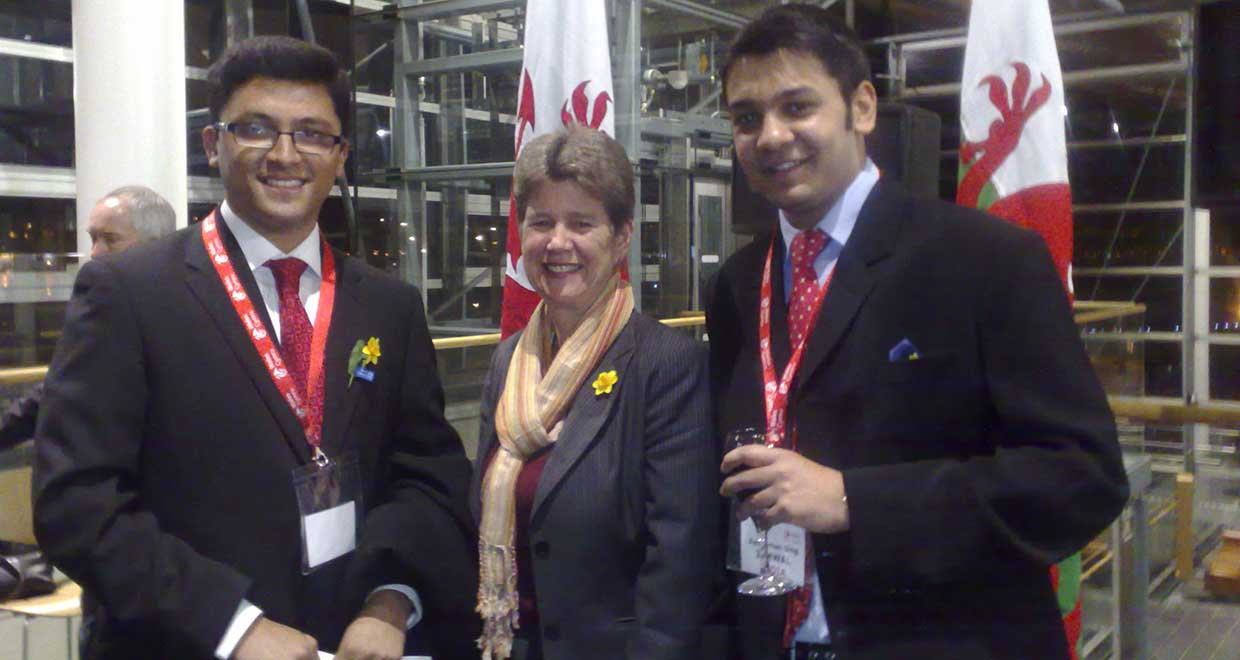
    In light of all the above, I was awarded the “Honour Roll” award by the University in 2007 – the first Indian student to receive the award in the University’s 127-year history, which subsequently led to me being chosen to represent the University at a Royal Garden Tea Party held at Buckingham Palace in July 2007, and at a State Assembly Dinner hosted by the First Minister, Rhodri Morgan AM, at the Welsh Senate – It is for these reasons why I consider my time at Cardiff University the absolute zenith of my academic and personal life so far.



    What all differences did you notice between the Indian form of education and that of abroad?

    Like I explained, I believe that, today, the Indian educational system has come a long way from its earlier avatar – this I have gleaned from my interactions with my fellow colleagues, peers and juniors. From these interactions, I understand that law courses in India are more analytical today in top institutions such as NALSAR and the National Law Schools / Universities, and as rigorous as courses in the UK and the West. At the time when I was a college student in India, as I’ve mentioned before, one major aspect of education in India was that education here was practically a test of memory power. In contrast, during my days at Cardiff, I would say 95% of the modules that I studied during the course of my LL.B and LL.M degrees had only one ‘essay’ question which was probably worth ten or twenty marks at the max – the rest were all problem questions designed to test your analytical abilities and application of the law that you have studies .This was the biggest difference, along with the plagiarism aspect that I had discussed earlier. I understand that prevention of Plagiarism is also being enforced strictly in many colleges and universities in India today.


    What internships and voluntary practical training did you take while in law school? What value addition did they provide to you in your career?

    In UK, there were many autumn and summer placement / internships that were available to students, but initially I did not partake any of them because of the rigorous nature of my LL.B course. During the course of my three year LL.B, I did not attend even a single internship or summer workshop for the first two years because of the course and the preparatory course work for the next years. The only internship that I did during that time was  in the summer break at the end of my first year when I returned to India  at M/s. Udwadia and Udeshi in Mumbai for a month. During the course of that internship, I was just accompanying the senior lawyers to the court carrying files, taking dictations, typing out affidavits, case notes, etc., carrying out case law research and offering assistance in any other manner requested. So in terms of value addition, it wasn’t a huge takeaway but it did give me a feel of what it would be like to be a part of a law firm.  . And if not anything else, I definitely felt the buzz of being around senior lawyers and associates.

    When I came to Chennai for the first time, I approached Dua Associates for a job, but instead they offered me an internship as I was yet to be enrolled with the Bar on an understanding that they will offer me the post of Associate based on my performance during the internship and once the enrolment has been accomplished. The internship was intense and lasted for almost three months and was probably the only meaningful internship that I had taken up  because, during that time, even though I was an intern, I was doing all the jobs a junior associate was supposed to do including working on legal opinions, case law research,  corporate and title due diligence exercises.  In the firm, I started under the supervision of the Corporate partner, Mr. R. Senthil Kumar, and thereafter the supervision of the Real Estate Partner, Mr. P.V. Sajiv Kumar.w I am grateful for that experience because it gave me the first real taste of corporate law and real estate law, and what it feels like to be a  part of a reputed corporate law firm, and helped me in  preparing myself for what I hope will turn out be a fruitful and meaningful legal career.


    What kind of internships would you recommend law students opt for to start building the sort of versatility and widened range of law that you are well versed with today?

    Probably the wrong question for me to be asked, as I’ve already pointed out that I have very limited legal internship experience in India. But from my interactions with peers, colleagues and juniors, I believe that one must not have a fixed mindset when they start fresh out of law school – at that time, generally, in the name of being focused, law graduated are already intent on specializing in a particular field of law and try to obtain internships that will satisfy that aim. In this regard, I would like to quote a senior partner for whom I’ve had the privilege to work with and to learn from – at the start of my career and at many instances subsequently, he told me that as an aspiring lawyer fresh out of law school, you must start with an internship in litigation. Being a corporate lawyer myself, to be honest, I know that people will be surprised by me saying this, but I do believe that the best way to start off is with litigation, because that’s the only way one will get a feeling for how law and the justice system in our country actually works. Transaction work can be learnt at the office from senior associates or by even attending training sessions, but what really happens in a court of law, the associated protocols, the application of the laws and statutes of the land, can only be understood and assimilated when you go to court, while interning under a practicing lawyer / advocate or barrister. It doesn’t matter whether it is a higher court or a lower court, start wherever you can and then go from there. Once you start going to all the big firms, there also the longer internship you get, the better. It is not in your hands.  It is pointless to have an internship for name sake rather the progression in every internship should be carried to the next one. You are going for the internship to get something out of it, right, make sure it counts. Don’t just go for an internship for that you can put a list of internships on your CV to make it look impressive. Try to have some continuity in your internship learning, even though they might be at different firms.


    Could you please tell us the role you played there and the challenges did you face during your initial days of practice?

     (Shreenivas was an integral part at Clifford Chance LLP, where he was involved in the leading acquisition of Kraft Food’s acquisition of Cadbury and several other international transactions between HSBC, Barclays and Standard Chartered Bank etc.)

    This was during my time as a Senior Consultant with OSC Services Private Limited, which is the captive Legal Process Outsourcing (LPO) unit of Clifford Chance LLP, located in Gurgaon, where, at the time of my employment, they had a team of, approximately 40 qualified Indian lawyers, whose role was assist lawyers and associates working for Clifford Chance LLP, a British law firm with a international presence cross border they do, with day-to-day transactional work. It is the world’s largest law firm which operates in about 60 countries right now. So, our job was to offer transactional assistance to lawyers across all the countries in their offices located in cities such as London, New York, Dubai, Singapore, Brussels, etc. There was hardly any challenge for me during my time there, as I had to work on British law aspects, and I was already competent in British law. The challenge was getting to learn all these transactional support work such as proofing of documents (for context and sanity), defined-terms checks, cross-reference checks, etc., which were primarily secretarial / clerical in nature. So the challenge at that time was in bringing me to do such kind of work, knowing fully well that I was a qualified lawyer and yet, I had to do work of a clerical nature, which had nothing to do with legal analysis and reasoning most of the time.

    For most of my time at OSC, as a Senior Consultant, I was called upon to be part of the diligence or drafting teams on most transactions. The acquisition of Cadbury was probably the biggest transaction that I’ve worked on so far for the obvious reason that it was the biggest deal of its kind in the industry at that time. We had different teams from multiple Clifford Chance offices across the world working on it simultaneously. My role was being part of the team that carried out diligence reviews of certain assets owned by Cadbury and creating a database that would list the said assets and the related details, which would subsequently be used as a key reference during the transaction documentation stage. The other transactions that I worked on were primarily in the Debt Capital Markets space for clients such as HSBC, Barclays, UBS, etc., who were all legacy clients of Clifford Chance LLP who were regularly involved in deals involving the issue of global definitive notes, and other instruments frequently used in debt capital market transactions.


    You have witnessed the operational style of law firms of different nations. What is your review on the working style of Indian law firms?

    While working in a foreign law firm, again, the firm culture and the work ethic are completely different. From my limited knowledge and experience, as well as from personal interactions with many foreign legal professionals during my time at Clifford Chance and Global Law Alliance LLC, I have noticed that there is a culture of accountability and responsibility – from the Partner to a Junior Associate, every person is held accountable and responsible for their actions, from the start of a transaction to its end. Associates are nurtured and made to feel a part of the transaction team from the very beginning, where they are sometimes taken along with the lead partner and the principal associates to a meeting where the firm is pitching to a potential client, and the Associate is encouraged to make a part of the pitch and thereby contribute – this goes a long way in boosting the confidence of associates and also takes them on a valuable learning curve where their perspective of the transaction starts at its very inception and ends when the transaction closes.


    Could you please tell us about your experience in the Global Law Alliance LLC, Singapore ?

    (Sreenivas was associated as a para legal at Global Law Alliance LLC, Singapore)

    Global Law Alliance in Singapore, I think, was a five to six month stint. It was different from my prior experiences because it was an absolute litigation firm primarily dealing with small as well as large litigation cases relating to tort law, accident liability, insurance claims, etc. For me, the take away from GLA was limited as I practically had no experience whatsoever in the kind of work they were pursuing, and because I had to hit the ground running and make good on deliverables with absolutely no prior training whatsoever. Additionally, I felt burnt out on many occasions during my time at GLA, because the deadlines were too intense and also because of the hectic work schedule in Singapore (which has a general six day working week, and in my case, which became a seven day week for the entirety of my stint there, and therefore meant absolutely no work-life balance). It was definitely not my cup of tea although I did enjoy occasionally going to court and observing the proceedings in some of the cases there. And, to be honest, I left it because I didn’t learn much in those six months and I felt that I was only going backward in my legal career.
     

    Tell us about your experience at Dua Associates Chennai and Cyril Amarchand Mangaldas Chennai and the work profile you were entrusted with.

    Dua Associates was my first official law-firm / associate role – as I mentioned earlier. I started there with the General Corporate practice headed by Mr. R. Senthil Kumar and was there for a period of three to four months, before moving to the Real Estate Practice headed by Mr. P.V. Sajiv Kumar, where I worked for the remainder of my time with the firm, i.e. around one year and three months. Again, as mentioned earlier, I believe that my time with Dua Associates was a steep learning curve for me and it was there that I really cut my teeth as a lawyer.  Today, my primary field is Real Estate / Real Estate Financing at SAMCO, and was my primary field at CAM as well. The foundation for this was laid at Dua Associates. It was quite an intimidating time for me since Dua Associates had, and continues to have till this day, a very well respected Chennai practice headed by the afore named senior lawyers which retains the confidence and trust of a formidable clientele.

    From there, I moved to CAM, where my work profile again involved a mixture of general corporate, real estate / real estate financing and a little bit of capital markets work. The general corporate aspect involved working primarily on corporate due diligence reviews and preparing legal opinions on various regulatory aspect, whereas the real estate component involved carrying out of detailed title due diligence reviews and the drafting / preparation of transaction documentation for real-estate financing transactions (in most cases, for the issuance of non-convertible / optionally convertible debentures).


    What prompted you to shift to the elite Indian law firms? How did your experience there differ from your earlier experiences?

    Well, what prompted my move to the elite Indian law firms is that I realized that I always wanted to be a lawyer and an associate working for a proper law firm. And when I returned from Singapore in 2013, I was already 30 and I realized that I had to move ahead to something. I joined Dua and the difference between the previous thing was that it was an LPO, the work experience is discounted wherever I go and LPO is different from a corporate kind of thing and it is more of corporate experience because of my own specific skill set, I was exposed to the legal side of things and it was a glorified back office. You’re a processor and not a lawyer and this is the biggest difference. I am a lawyer now and I was a processor then.


    Why the special interest in corporate laws and commercial laws with a special focus on commercial contracts, real estate & real-estate, financing, corporate governance, due diligence, regulatory & compliance?

    As I had mentioned earlier, that had been my idea all along. I did my B.Com (Hons.) and my law degrees (with my Masters being in Commercial Law) with a view to specializing in corporate / commercial law. However, I must admit that, when I started my education at Cardiff, I wasn’t aware of the true breadth of fields and practice areas under the ambit of corporate law / commercial law. It was only after I completed my LL.M. and during my subsequent stint at OSC Services that I realized that there was so many practice areas which one could be involved in. Subsequently, from my work experience with various firms, I have learnt, and continue to learn to this day, the nuances of the Corporate and the commercial field. in which I retain a special interest and wish to excel as a lawyer in this fields.


    What were the challenges you faced in shaping up your career as it stands today and where do you see yourself ten years from now?

    One of the biggest challenges I faced currently is keeping the fire burning inside me consistently. There are times when I get bogged down due to external and internal factors, and this is something that I am working on. Sometimes, I slip into a line of thinking that I am not where I should be right now in terms of what I have achieved in my career. I feel that I am probably three or four years behind from where I should actually be. Other than that, for me, keeping up with the ever-evolving nature of the corporate space in India and the related acts / statutes / laws, and learning how to customize the advice that we render to our clients in the current volatility of Indian markets is a key challenge. In the legal profession, it is imperative to stay at the top of your game at all times, and this means servicing the clients’ needs in the most efficient and proficient manner. For this, it is necessary to go above and beyond the call of duty and herein lays the challenge – of challenging yourself to be the best at what you do and to continually grow. Although, I also believe (as my father once told me) that the day you think you’re the best at something is the day you make the biggest mistake of your life. It is very important to acknowledge that we work in a profession where the learning never stops, and that there is always someone who is better than you and it is even more important to aspire to be as knowledgeable and as good as that person. So, therein lays the challenge- To continually learn with the same level of enthusiasm and the same level of commitment that you displayed in your younger years and not let money and any / all other internal and external factors come in the way of you becoming the best lawyer that you can be.

    Where do I see myself ten years from now? Well, I’m not the type who plans that far ahead to be honest. But I will say one thing in this regard the place where I’d ideally want to be in ten years is the following situation – at that time, if a client (on a transaction that I may be assisting the said client with) wakes up in the middle of the night or has been breaking his head all night over some legality or issue that may adversely affect the said transaction, and the said client is at their wit’s end as to how this can be resolved, then they should pick up the phone and call my number first. I want be that good a lawyer and should have earned the trust of my client to the extent that they should believe that I am the only person who can help them –  I want to be the first point of contact, the first resort for every client of mine, rather than the last resort, If I get to that place in ten years’ time, I’ll say-Mission Accomplished!


    What do you want to say to the next generation lawyers? What is your parting message to our readers?

    My message to young, aspiring lawyers (as well as aspiring law students) is that nothing comes easy in life…you have to put in the hard yards….especially in this profession.

    As a wizened legal eagle once told me, the legal profession is not a sprint, it’s a marathon. In a marathon, the eventual winner will be the one who conserves his energy, learns about his opponents, sees how they are running and sees the mistakes they are making, formulates a plan for the long run ahead, puts his head down and executes the plan with dedication and commitment, and then unleashes himself down the home stretch and leaves all his opponents behind. Similarly, the legal profession is like a marathon where you cannot expect to be successful overnight. It takes years of learning, practice and efforts to make it big as a lawyer and there’s no second way about it…!!!

    The Legal industry in India today is a burgeoning and cutthroat world where, if you’re not in for the long haul, then you’re on your way out before you know it…!!! The amount of law graduates being churned out of the law schools every year is increasing and there are hundreds of quality law graduates out there, and you are in competition with every single one of them. So, the stakes couldn’t be any higher.

    Be patient and willing to put into the hard yards…and never think that you are entitled to anything. In this profession you have to earn your stripes through dedication, learning and hard work, while also not compromising on your personal and professional integrity. And the most important thing to remember when you start as a lawyer is that your journey has just begun…be willing to learn first and then apply that learning…don’t worry about the money…give yourself a solid 2-3 years to build a good foundation  based on learning and application…be your best and the money will come automatically.


    Good Luck and God Bless!

  • Rahul Kothari, Advocate, on starting an independent practice in Corporate Law

    Rahul Kothari, Advocate, on starting an independent practice in Corporate Law

    Rahul Kothari is an alumnus of Symbiosis Law School, Pune. Having completed his BBA.LL.B from Symbiosis in the year 2009, he is currently running an independent practice on dispute resolution, contract drafting and negotiation, real estate transactions, general corporate and compliance issues. Prior to and subsequent to his graduation, he worked with Hariani & Co. for four years and then at AZB & Partners for three years, thereby gaining an immense experience in dispute resolution, contract drafting, negotiation, real estate transactions, general corporate and compliance matters. Rahul is also presently a visiting faculty at Symbiosis Law School in Pune and at Symbiosis School for Economics in Pune.

    In this interview Rahul talks about –

    • His law school experience
    • His suggestion on how to make a career in a particular field of law
    • His take on mooting writing research papers
    • His experience of independent practice
    • Scope of ADR and the recent amendments in Arbitration and Conciliation Act, 1996
    • His opinion on balancing between personal interest and financial security


    HOW WOULD YOU LIKE TO INTRODUCE YOURSELF TO OUR READERS?

    Thank you for this opportunity. I am humbled. I don’t think that at this stage I would ‘qualify’ as a SuperLawyer – but hopefully I will get there someday. And, as for the introduction, I will let the readers be the best judge of who I am once they have read this interview.


    WHAT ARE THE FACTORS THAT MOTIVATED YOU TO CHOOSE LAW OVER OTHER PROFESSIONS?

    The most clichéd response to that question would be that I had a passion for the subject and the profession. However, that is only partially true – I had in fact practically closed other doors to most other professions. I did not enjoy nor had much acumen for maths or science, but at the same time did not want to be the average B.Com graduate. Hence, that pretty much left me with only one option – law! The most crucial factor, however, was my curiosity for the subject. I first got introduced to law while I was in my 8th standard of school. It was when I first learnt of basic fundamental rights, etc. in my civics lessons. That got me interested in the subject – and the rest as they say is history!


    HOW WILL YOU DESCRIBE YOUR LAW SCHOOL EXPERIENCE?

    I would describe my law school experience as some of the best years of my life.  As far as I know, other than medicine, the five-year law course is probably one of the longest academic courses, which could get a bit hectic at times, especially around exam time. I must admit that there were some law subjects that I did not enjoy much – just because of a sheer lack of interest. However, most subjects were enjoyable. I also believe that two other factors made my time at law school extremely memorable – my friends and the law school itself i.e. Symbiosis Law School, Pune. Both these factors in a way compliment and supplement each other. Traditionally, most Symbiosis institutes have students from various parts of the country, and Symbiosis Law School was no different – which made the experience enriching and diverse.


    HOW SHOULD ONE CHOOSE A PARTICULAR FIELD OF LAW TO PURSUE AND MAKE A CAREER IN?

    That’s a very good question. I’m not sure whether there is a universally applicable or accurate answer to this question – but here’s my take.

    Imagine your time in law school (including the internships) as a buffet meal. Try a bit of everything. You may like some things, and some things you may not – but you will only know that once each item in the buffet is tasted; the experience being also necessarily personal and not dependent on someone else’s tastes. I feel that ideally, one should not choose his/her interest in a particular field of law during their time in law school – it should be done within about 2-3 years of graduating from law school. In fact, there are many areas of law that one is not even exposed to while in law school, which require in-depth specialization. One such example applicable to me was maritime law – this was not taught to us in law school at all. The massive advantage that the students have is full service law firms that take in interns as well as fresh graduates. If a student does get an opportunity, my sincere advice is to not miss out on it. These law firms tend to give an excellent exposure to interns and fresh graduates into various fields of law. Sometimes, just listening to a colleague/ senior talk about a matter can give a whole new perspective on a subject.


    WHAT’S YOUR TAKE ON THE POPULAR STAND TAKEN ON LAW STUDENTS THAT WITHOUT MOOTS OR PUBLICATIONS YOU CAN NEVER LAND A DECENT JOB?

    This is not true – but it is very important to understand the context behind this often misunderstood issue. The skill set that one tends to develop while taking part in moot courts is invaluable, namely, research, oral argument, drafting, confidence, analytical thinking and clarity of thought. These are some of the most basic and essential skills needed to make a good lawyer. Similar is the case with authoring research papers, with the missing skill of oral arguments. Hence, in my opinion, a student’s abilities tend to sharpen with the skills developed through participation in moot courts and authoring research papers. These skills also tend to help one get through an interview process better. However, it is pertinent to point out here that in no way does this mean that without participating in moot courts or authoring research papers, one’s career gets hampered. Students need to realize that the ‘real world’ requires many more skills, which many a times are not even taught in law school. In fact, I know of many lawyers who have not taken part in any moot courts or authored a single research paper, and yet, are doing exceedingly well in their respective careers.

    To conclude on this point, in my opinion, moot courts and authoring research papers may give one a better start during the first 6 months to a year as a fresh graduate with a new job, but lack of this does not hamper career prospects.


    POST-GRADUATION, YOU WORKED IN LAW FIRMS FOR SIX YEARS AFTER WHICH YOU STARTED AN INDEPENDENT PRACTICE. WAS INDEPENDENT PRACTICE ALWAYS ON YOUR MIND SINCE YOU STARTED LAW OR WAS IT THE PRODUCT OF A RECENT SHIFT OF THOUGHT?

    It was always on my mind. It was just a matter of ‘when’ not ‘if’. As a person, I enjoy my freedom, and like to do things my way. A significant aspect that I have learnt over the years is to maintain one’s individuality – and not follow the crowd. This trait does not usually yield short term and immediate returns but, in the long term, it will surely help. Most people I know tend to join a law firm and stick around to hopefully make partner someday. Being with an established law firm was never a part of my long-term plan – but establishing my own law firm was always part of the agenda.


    HOW MUCH HAS THE KNOWLEDGE AND EXPERIENCE OF WORKING AT TOP COMMERCIAL LAW FIRMS HELPED YOU IN YOUR CURRENT SEPARATE PRACTICE?

    Immensely! The knowledge and experience gained at both Hariani & Co. as well as AZB & Partners is priceless and invaluable. In addition to the regular legal work, with both firms, I tried to work on non-legal matters too. With Hariani & Co., I was the Editor of their Newsletter and also wrote a few articles. With AZB, I additionally did a little PR, attended conferences and handled some office administration too. Neither of the tasks was thrust upon me, but since my eventual plan was always to start my own law firm, these additional tasks added value to the legal knowledge that I was gaining in any case. However, a common mistake by students is to assume that a large law firm always tends to give better experience – this is not necessarily true. There are a multitude of factors which determine how fruitful, satisfying or enriching your experience with a law firm is – and the size of the law firm is a relevant but not necessarily that important a factor.

    rahul-kothari_image-1

    YOU ADVICE CLIENTS ON CIVIL AND COMMERCIAL ALTERNATIVE DISPUTE RESOLUTION (ADR). CAN YOU THROW LIGHT ON ADR AND ITS SCOPE WITHIN THE NATIONAL CONTEXT FOR OUR YOUNG READERS?

    Well, this is a little tricky. Alternate Dispute Resolution is a fairly vast subject. I feel that any attempt to answer your queries will likely result in students or young lawyers having more questions than answers, but I will give it a shot. Simply put, Alternate Dispute Resolution is basically any form of dispute resolution that is attempted to be achieved outside the traditional Court/Judicial system, usually without much of it entering the public domain. The main and most popular forms of ADR are Arbitration, Conciliation and Mediation. The Arbitration and Conciliation Act, 1996 (as amended and updated) is presently the primary statute governing ADR in India. Mediation and conciliation in the Indian context are quite similar. While some may disagree, I feel that, in the Indian context, mediation and conciliation are not very effective or efficient means of ADR, and are not likely to gain much popularity in the near future. Arbitration, I find, is a fairly effective and efficient means of ADR, especially in view of the recent amendments (which I have discussed below). The main drawbacks of most forms of ADR are lack of awareness and knowledge on the subject by parties as well as genuine willingness of parties to participate in actual ADR. Also, in relative terms, traditional litigation in India is not very expensive, and hence, does not tend to be a deterrent to a party to not approach the Courts and instead go for ADR. Although, I am hopeful that all forms of ADR become a genuine alternative for litigants, I find that other than Arbitration, there is not much scope for other forms of ADR, especially in the present and near future, and considering the current Indian context.


    WHAT DO YOU THINK ABOUT THE RECENT AMENDMENTS BROUGHT TO THE ARBITRATION AND CONCILIATION ACT, 1996? HOW BENEFICIAL IS IT IN ESTABLISHING INDIA AS AN INTERNATIONAL ARBITRATION DESTINATION?

    I think it may be too soon to give a view on the recent amendments. I feel that the amendments are well intended, but whether they can be practically achieved or not is the real question. One example is that of the timeline prescribed for completion of proceedings being 12 months with a 6-month extension. While this is an optimistic change, it may not work in the Indian context or for that matter for complicated disputes involving large sums of money. I think that the recent amendments need to be taken in the right spirit, and needs the cooperation of parties, lawyers as well as the arbitrators. If implemented correctly and in the right spirit, these amendments could bring a significant change to the Arbitration scenario in India. As for establishing India as an international arbitration destination, I feel that this is a bit of a misnomer. Most international arbitration destinations, such as Paris, London and New York are in fact cities that have developed into internal arbitration destinations. Hence, ideally, we should focus on important cities and ensure that the infrastructure, the administration as well as the Courts of that city/State support arbitration. Also, I personally feel that none of our cities may truly become ‘international’ arbitration destinations until we allow foreign lawyers to appear in Indian seated arbitrations. This I feel will completely change the game with respect to arbitration in our country.


    MANY STUDENTS TAKE UP CORPORATE JOBS, DESPITE HAVING INTERESTS IN OTHER LEGAL STREAMS, POST GRADUATION BECAUSE OF THE FINANCIAL REWARDS THAT IT OFFERS OR THE PERCEPTION THEREOF. HOW YOU THINK ONE CAN BALANCE PERSONAL INTERESTS AND FINANCIAL SECURITY?

    That’s a very difficult a question to answer. I was just speaking about this to a Senior Advocate who I have briefed in one of my matters. He told me that for the first 10 years of entering the profession (he has been practicing for over 30 years now), he did not earn any money at all. His senior just paid him a few monthly out of pocket expenses! However, he gained in terms of knowledge, immensely from his senior, and that was invaluable. I cannot imagine the current crop of lawyers going through a similar period in today’s day and age. I guess one way to balance this is that for the first few years you may join a law firm. Most of them (in large cities) pay even freshers quite well. Stick around with the firm for a few years, ensure a good amount of savings and capital, and then follow your dream in whichever other field of law that you enjoy. This could possibly have an added advantage that you get exposure for a few years in a law firm, which could possibly open up many more avenues for young lawyers.


    RAPID FIRE QUESTIONS –

    • Happiest Day as a law student and law professor –

    As a law student – when I graduated law and received my sanad (license to practice).

    As a law teacher – whenever I bump into my students after they have graduated and they thank me for teaching them. I enjoy the fact that I have, in however small a way, contributed to the law student as well as the legal profession in general.


    • Worst Day as a law student and law professor

    Not really had a ‘worst day’ as such either as a student or as a teacher. I take the ups and downs in my stride.


    • Proudest Moment –

    As a professional: My first appearance at the Bombay High Court which happened to be with a Sr. Advocate. The matter got adjourned. But I have framed a certified copy of the adjournment order recording my first appearance.

    As a teacher: When a teacher that taught me in law school sat through one of my lectures along with students of the class, and on completion of my lecture complimented my teaching. I can also proudly say that my teacher later (briefly) became my student!


    MANY LAW STUDENTS PUT THEMSELVES INTO A SHELL WHILE CHOOSING A FIELD OF LAW. THEY ARE NOT OPEN OR READY TO EXPLORE NEWER AND UNIQUE OPPORTUNITIES. WHAT SUGGESTION WOULD YOU GIVE TO SUCH STUDENTS?

    As I said above, for the first few years, consider you are at a buffet. Try a bit of everything. To quote from Forrest Gump, “Life is like a box of chocolates. You never know what you’re going to get.”


    IS THERE ANY PARTING PIECE OF ADVICE YOU WOULD LIKE TO PASS ON TO THE READERS, ESPECIALLY THE STUDENTS?

    Don’t accept mediocrity. I don’t believe in the ‘chalta-hai’ attitude. To borrow from the tagline/slogan of Mercedes – “The best or nothing” – this is the motto I tend to follow.

  • Ramanand Mundkur, Managing Partner, Mundkur Law Partners, on building his career in corporate law

    Ramanand Mundkur, Managing Partner, Mundkur Law Partners, on building his career in corporate law

    Ramanand Mundkur graduated from National Law School of India University (1989-1994). He is the managing partner of Mundkur Law Partners, and heads its corporate, M&A and life science practices. He has over twenty years of international work experience, having previously worked with the International Monetary Fund in Washington DC, the United Nations in Geneva, and Arthur Andersen in India before setting up MLP in 2007.

    Ramanand won multiple academic gold medals when graduating from India’s leading National Law School, and also holds a master’s degree from Harvard Law School, where he was a Langdon E. Gammon fellow and a Myer and Etta Dana scholar. He is qualified to practice law in India and New York.


    In this interview he talks to us about:

    • His areas of interest in law.
    • His experience at International Monetary Fund in Washington DC.
    • How his experience at Harvard prepared him for a life of academic prestige and professional success.
    • What he looks for in a typical cover letter and CV.


    How would you like to introduce yourself to our readers?

    I’m a corporate and transactional lawyer, based out of Bangalore.


    What led you to choose legal profession?

    I entered law school entirely by accident. A friend suggested me to appear for the NLSIU entrance exam and I got in. But after the first class at NLSIU (which I still remember vividly, with Dr. Menon repeatedly asking us “What is law?” and no answer being complete or satisfactory), I was hooked. I can’t think of any other subject or profession that provides the intellectual fulfillment that law does.

    So while I might have chosen law school by accident, I chose the law as a profession very deliberately. I suppose we were incredibly lucky to have been around when NLSIU was just set up, and to have that fantastic group of teachers who kindled our passion for the law.


    What were your areas of interest in the law? Did you engage in extracurricular activities while in college?

    One of my greatest difficulties has been identifying one or two “areas of interest” in the law—I found them all fascinating. I probably chose corporate law and public international law because they offered economic stability fairly early in my career and because the other areas of law e.g., constitutional law, criminal law, property, evidence, etc. didn’t appeal to me.

    Being part of the first few batches of NLSIU, I was lucky enough to be able to participate in pretty much all the extracurricular activities on offer: mooting, debating, quizzes, theatre, music (a bunch of us euphemistically called ourselves a band), cricket, football and whatever else was available to us.


    You have worked with the International Monetary Fund in Washington DC. Please share your experience.

    The Fund is a fantastic place to work at and I miss both the people there and the work I did. As a lawyer, I initially worked on the legal aspects of Fund relations with member countries (both borrowing countries as well as other Fund members). Over time, the scope of work widened to cover issues such as the Fund’s internal governance rules (including quotas, voting rights, criteria for recognition of new sates and representation) and technical assistance to certain member countries.


    As a Managing Partner of the firm, what is an average day at work like?

    It’s not as attractive as I hoped it would be. A large part of each day is spent on purely administrative issues. Moreover, because we’re a boutique firm, one has to wear many hats—advising clients, bringing in new work, ensuring we stay current with changes in the law, dealing with HR issues, managing firm finances, dealing with firm IT issues, all the way through to being “chief bottle washer” whenever required.


    How well did your experience at Harvard prepare you for a life of academic prestige and professional success?

    Harvard is probably the finest example of an enabling environment. As a student there, you’re surrounded by extremely bright, self-motivated individuals and achievers, with infrastructure and resources that are the best in the world. The faculty is outstanding and their areas of work and research are invariably cutting edge or path breaking. At times I felt one could learn and grow just by being there.


    What do you want to say to the next generation lawyers? Which are the growing areas of law where a new law student or young lawyer can focus and distinguish himself?

    Questions like that tend to be a little depressing (and ageist)—I’m definitely in no position to take on the role of an avuncular eminence grise—advising “the next generation” of lawyers. One bit of experience I would share with law students, though, is to not chase “growing” areas of the law or the next big thing. Instead, and this is pretty obvious: if you do what you enjoy, you’ll find that you enjoy doing what you do!


    Do you take interns? What do you look for in a typical cover letter and CV? How can interns manage to get positive feedback in the limited time they have?

    Yes, we do have an active internship program that works directly with certain law schools. The law schools that we work with in this regard send us CVs of suggested candidates from their senior batches, and we offer internship slots to those candidates through the law schools. As a result, we often find we don’t have slots available for individual applicants, who haven’t applied through their law schools. We encourage law schools to sign on to this program, and the schools’ placement officers can write to us at careers@mundkur.com for this purpose.

    With regard to cover letters and CVs, we look for candidates who have a consistent and reasonably strong academic, and who demonstrate that they’ve spent some time thinking about why they want to apply to our firm, and why our firm might benefit from hiring them.


    What would be your advice to our budding lawyers?

    I think this question has been answered. And it also reminds me of one other piece of advice I got early in my career and I’m happy to share with budding lawyers: it’s very important for a lawyer to know when to stop speaking.

  • V V S N Raju, Corporate Lawyer, on establishing Juris Prime Law Services

    V V S N Raju, Corporate Lawyer, on establishing Juris Prime Law Services

    V V S N Raju graduated from Osmania Universtity (1990-1993). He is a Corporate Lawyer and has over 22 years of Experience as in-house counsel and external counsel for Corporates and Financial Institutions/Banks.
    His specialties include Banking, Corporate, Documentation, Real Estate, Recovery, Litigation, Arbitration, Project Finance, Restructuring, Securitization, Mergers and Acquisitions, government liaison and Employment Laws.


    In this interview he talks to us about:

    • Inception and basic motive behind establishing Juris Prime Law Services (Law Firm).
    • Challenges faced in the initial days of establishment.
    • Services provided by the firm.
    • Uniqueness of services provided by the law firm.


    Please share with us the inception and basic motive behind establishing Juris Prime Law Services.

    During 2005 (re-launched in 2015), there were not much law firms in Hyderabad to cater the Banking, real estate and Corporate needs of local clients. So I felt it was a good time to establish a law firm which would provide best legal solutions with a practical approach to cater the needs of the clients in and around Hyderabad.


    What challenges did you face in the initial days of establishment and how did you overcome that?

    Main challenge that we faced during the initial years was getting right kind of clients and recruiting right kind of human resources. In fact, these are the challenges which are faced by all the companies at all time.

    I sort of tried a trial method and recruited fresher’s and trained them so that they can provide legal services according to the standard and quality promised by our firm to our clients.


    What are the services provided by the firm and how it caters the need of clients in Hyderabad and elsewhere?

    Juris Prime Law Services is a full service law firm. We provide legal services in following fields:

    • Arbitration & Dispute Resolution
    • Banking & Finance
    • Company Incorporation
    • Corporate & Commercial Law
    • Employment & Labour Law
    • Foreign Investment
    • Intellectual Property Rights
    • Mergers & Acquisition
    • Litigation
    • Private Equity & Venture Capital
    • Project & Corporate Finance
    • Real Estate
    • Technology, Media & Telecom

    Being a full service law firm, we are capable of providing solution to all kinds of legal complexities faced by the clients under one umbrella. We structurize client’s transaction and provide practical solutions in a legal way.


    Please share with us the uniqueness of services provided by your law firm.

    We give problem oriented solutions. We believe in specialized rather than generalized solution which makes us different from our competitors.


    What milestones have you achieved till now?

    Our growth rate has been good and satisfactory. Since our inceptions there is no time for looking back as day by day we are progressing. Over the years we have been associated and empanelled with lot of Banks and large Corporates.


    Where do you see the firm in the long run?

    There is no road map as such because I believe in working hard which is a key to success. In coming 2 years we are hoping to see our revenue increasing by manifolds with a significant increase in no. of client and we from a firm of 11 headcount hope to become a team of 20 by March 2017.


  • Smita Reddy, Legal Consultant, Lexstart, on assisting other start-ups from their incorporation to being their in-house counsel

    Smita Reddy, Legal Consultant, Lexstart, on assisting other start-ups from their incorporation to being their in-house counsel

    Smita Reddy graduated from Gujarat National Law University in 2011. At present she is working at LexStart. LexStart is a start-up which primarily caters to other start-ups assisting right from their incorporation to being their in-house counsel.


    In this interview she talks to us about:

    • Importance of CGPA.
    • How her appointment at LexStart took place.
    • Difference in working at LexStart from Amarchand & Mangaldas.
    • Strategy to deal with errors and mistakes.


    How would you like to introduce yourself to our readers?

    My name is Smita Reddy. I graduated from Gujarat National Law University in 2011 and I am currently working at LexStart. LexStart is a start-up which primarily caters to other start-ups assisting right from their incorporation to being their in-house counsel!


    How important is a CGPA for recruiters to assess students?

    CGPA being extremely important for campus placements is a given. It helps recruiters understand that you are willing to give it your all, which is always a good thing. Since they don’t really have your work experience to grill you on, your CGPA is reflective of your attitude towards work.

    Having said that, I know of some brilliant lawyers who weren’t great students to begin with. So yes, while having a good CGPA is crucial, it is also imperative that you intern before you start working. I cannot begin to stress enough on how important internships are in shaping you as a lawyer. I see so many law students wasting their internships and so many wasted opportunities. What law students need to understand is that these internships also help you in networking, plus if you’ve done a good job, you’re sure to be called back or given a pre-placement offer.


    Did you face difficulties in the beginning of your work at Amarchand & Mangaldas?

    Yes and no, because the difficulties I faced were more to do with not knowing how to go about things. I was a little lost, but since I joined with 15 other people from my law school, the process may have been a lot smoother for me than it was for other people. It was quite overwhelming in that sense, but once I got the hang of things, knew what was required of me, it became easier.

    It also helps if you know and understand that no one expects you to know everything at this stage. This is exactly what I tell fresher’s. You only need to start worrying if you’re still lost at 3 years of working!


    When did the transformation from a law student to a lawyer take place?

    I think the transformation takes place from the moment you have to take charge of something. I remember the first major assignment (where I was solely responsible for things) I was given at AMSS was helping in filing Form FC TRS. Though it would have been simpler for my senior to do it, she assigned it to me because she thought it would help me understand how things work better. And it did!

    The moment you are responsible for something, you somehow take greater care, than you would if you had a senior reviewing your work. I was blessed that way, because I was always part of teams which weren’t too big to begin with, so good assignments would end up coming to the juniors in the team.   

    Do you believe that drafting legal documents is an essential skill that most law schools in India omit to teach their students?

    Yes! While, to be fair, we did have a legal drafting course in GNLU, a couple of months of a course do not help you in drafting legal documents. What is surprising is that drafting constitutes around 60% of your work as a lawyer, irrespective of the field you are in. It is a skill set which I believe is extremely important to have as a lawyer. Plus, if you have a course on drafting in law school, you are not just suddenly thrown into drafting a share purchase agreement, without knowing the basics.

    I have had interns who didn’t know how to do basic drafting, which is quite alarming,  which is why I think the current curriculum needs to undergo changes, maybe limit learning the theoretical aspect of law to the first couple of years, and focus more on developing you practically as a lawyer.


    How did your appointment at “LexStart” take place?

    It actually happened very quickly and at the right time, I must add. I live in Tirupati, I love the place but it isn’t exactly bustling with corporate lawyers. I had reached a point of my sabbatical where it was no longer fun to be doing nothing; I was getting antsy and had to start doing something.

    My first round of interview was with Anisha Patnaik, one of my co-founders. It happened thanks to this friend of mine who had reached out to me informing me that his senior wanted a legal consultant, and that it would even be okay if I wanted to work from home. That literally sealed the deal for me, because I wasn’t keen on moving out of Tirupati. Imagine you can reach from Point A to Point B in ten minutes!

    Anyway, I am digressing, once I heard that I could work from home, I immediately asked him to send me all the necessary details. The next day Anisha reached out to me and I just wasn’t prepared even though I had gone over my CV a million times before that. After my interview with Anisha, I spoke to my other co-founder, Karthik Chandrasekar. Post this I started working in a days’ time!


    How was the job interview? Do you remember any of the questions asked to you?

    It went rather well, given that I had absolutely lost touch with law in that one year of sabbatical! Also, my founders who took my interview made me feel at ease, being fully aware that I hadn’t worked in a while and may need some time to get back to the grind. They also encouraged me to ask them questions, which I thought was a pleasant change from the usual interviews that one is used to.

    I was asked questions around VC investments primarily; I was able to answer most questions, except for one. I remember it distinctly because the moment I answered the question, I knew I was wrong, the question was on liquidation preference and what does it mean for an investor.


    How is working at LexStart any different from working at Amarchand &  Mangaldas?

    I will always maintain I loved working at AMSS, Mumbai and Delhi and will always attribute my growth as a corporate lawyer to it.

    LexStart has been a different experience from AMSS, since you act as legal counsels to companies that are growing with you. What starts with helping in the incorporation of a new company also leads to acting as their lawyers in their Series D round of funding. What this has also done is given me a fair sense of what founders in start-ups expect their lawyers to do. Since I was one of the first few people to be recruited at LexStart, I had my hands full with transactions which I was to lead, which was wonderful, since this immediately gives you a sense of work ownership. Plus, there is so much happening in the start-up space, that there is never a dull moment at work!


    What has been your strategy to deal with errors and mistakes? How would you suggest a young associate to deal with them?

    In the past, whenever I have made a mistake, I have made it a point to inform my senior. What this ends up doing if helping you learn how to handle mistakes.

    My only advise to young associates would be to always reach out to your immediate supervisor or a senior on the particular transaction and let them know. DO NOT try and hide it and hope no one would notice, because someone will, or even fix it yourself. They will do the necessary damage control. Most importantly, learn from your mistakes, check things twice or even three times before sending them out.

    Having said that, please remember you are human, and you are bound to make mistakes now and then. Move on, don’t be too hard on yourself, because that will just make things worse.


    What is your message to young law students?

    Relax and breathe!

    There is a lot of worrying about targets and deadlines coming your way once you graduate law school, but please do take internships seriously. Try gaining experience across all fields, whether it is litigation, NGO or corporate internships. It is good to know what you want from your first year in law school, but overtime you evolve as a person, and may not enjoy the fat-cheque-paying-corporate job you once dreamed of getting. Know that these varied experiences help you understand what you would actually enjoy doing and make an informed decision when its time.

  • Mihir Deshmukh, Managing Associate, Advaita Legal, on a career in taxation law

    Mihir Deshmukh, Managing Associate, Advaita Legal, on a career in taxation law

    Mihir Deshmukh graduated from Government Law College, Mumbai in 2005. He has over 11 years of experience in arguing matters relating to indirect taxes before various for a throughout the country. He is admitted as an Advocate with the Maharashtra and Goa Bar Council since 2005 and has an extensive experience in litigation in the areas of Central Excise, Service Tax, Cenvat Credit, Value Added Tax and Central Sales Tax including appearances before various High Courts and Indirect tax Tribunals. His clientele has been diverse and included Maharanta companies such as BPCL, ONGC, SAIL and MNCs such as Dish TV, Tata Group, Reliance India Ltd., Dow Chemicals, Bruker International and HCC Ltd. He also has an indirect tax advisory background and was associated with PWC and ELP during his earlier stints and was also a part of the indirect tax litigation team of EY (PDS Legal) since its inception in 2010. His areas of functional expertise include Customs, Service Tax, Central and State Sales Tax Laws, Excise, VAT, Works Contract Tax, Octroi.

    In this interview he talks to us about:

    • Importance of taxation as a subject for law students.
    • How can one gain expertise in Indirect Tax.
    • His strategy to deal with errors and mistakes.
    • Qualities that helped him to achieve the current status.


    How would you introduce yourself to our readers? Please tell us about your family and childhood.

    I am third generation lawyer, my father is an industrial law consultant ,my mother was a teacher and then a home maker who gave up her career to ensure that she could devote her entire time to us. My wife is a Professor in an engineering college pursuing her Ph.D. simultaneously. The values embedded in me, which I hold close to my heart and which I believe have made me the person I am today are because of the sacrifices made by family. I did my schooling in a small town Roha, and then had to move to Mumbai for my further studies (Junior college and Law school).


    What brought you into studying law? Was it fate or planned?

    In a lighter vein, I would call it planned fate. Like other kids who want to be a policeman or pilot or a 100 other vocations when they are growing up, I was always clear that I wanted to be a lawyer. Maybe it was because of seeing my father in the profession and my love for reading that pushed me towards it.


    How helpful was your law degree in terms of the added legal perspective to your existing knowledge? What career advantages did it bring?

    Getting a law degree brings about a different thought process to you. It helps one become more analytical. Coupled with your knowledge I believe a law degree gives one that cutting edge over others.


    How important is taxation as a subject for law students? What advice would you give our readers to consider taxation as an area of practice?

    Today, the tax subject is optional in many universities. However, to a very great extent I feel that Tax as a law subject should find place in the syllabus of every law student. Tax as a subject cannot be taught in isolation. While studying tax, one also dives into the intricacies of constitutional law, administrative law, Law of jurisprudence and interpretation of statutes, forming a gamut of legal studies. Further, with GST now coming in, there is a great demand for indirect tax layers. I would urge all your readers to consider tax as a serious option.


    What’s a typical day at work like? How can one gain expertise in Indirect Tax? What does it take to be a good Indirect Tax Lawyer?

    Typical day at work starts with flipping through pages of the law journal- electronic or print and then to rush off your feet to the court which ends with a relaxed cup of tea. The evening is spent preparing for the next days’ court. Call me old fashioned, but I believe in starting early and finishing early. I hate late working hours unless absolutely necessary. I make it a point that my team finishes at a decent time by 7.00 pm. It keeps them in balancing their work life balance and I get a team with great productivity and output.


    What are the preferred legal issues you like to work on? Do you have any hobbies that help you unwind after a long day at work?

    As a budding lawyer you really cannot be choosy about work. Though, now I am primarily and indirect tax litigator, I worked on all laws during my internship days. I believe that internships lay the foundation for your future and therefore have my reservations against the 1-2 month internships that are a norm with the law students today. It is too short a time frame to learn anything.  You should commit for a considerable period of time to learn and understand things. I was lucky enough to intern with Mr. Mohan Jayakar (Khaitan and Jayakar), the person who I credit for making me the professional I am today.

    I have always been an avid reader which as a kid inculcated me with the ease of reading the lengthiest briefs. After work, if time permits, I engage myself in gleeful reading of non-fictions. Watching masala movies always helps.


    What has been your strategy to deal with errors and mistakes? How would you advise a young associate to deal with them?

    As an officer of court, I endeavors to assist the court in the most honest and immaculate manner. I try to be sure that the court is not misled and true facts and position of law is brought before them. However, one is bound to err. The best way to correct is to reinstate the correctness at the earliest. I advice my associate to confront flaws and start improvising it without any procrastination. The trick is not to get disheartened by failure. As long as one feels they have given their 100%, then failure should not affect you.


    What steps do you take to prepare for a difficult case?

    Be it a difficult or a simple case, one should be thorough in the preparation. The reason being you can never predict what a judge might question you on. The premise is to know the facts of the case inside out and then the legal provisions pertaining to your case and relevant case laws in your favour. One thing, I would like to add here is that one should also be aware of the case laws against you if any so that you can differentiate them when quoted by the other side.


    What qualities do you think helped you achieve this status?

    I would say that to achieve success in the legal profession, on needs not only work hard but one should also work smart. You need to be ready to work hard (not to be mistaken for long hours). Hard work makes up for every other drawback one might have. That is the only virtue I would ask everyone who wants to be a successful litigator to imbibe. This industry belongs to one who is industrious.


    What would be your parting message for our readers?

    Be a litigator because it’s your passion and not just a career option. Once it is your passion, the ingredients of making it a success need not be taught to you but you will come up with your own unique recipe and success story.


  • Nelson Joseph, Senior Associate, Radhakrishnan & Co., on building a firm practice and experience in corporate law

    Nelson Joseph, Senior Associate, Radhakrishnan & Co., on building a firm practice and experience in corporate law

    Nelson Joseph graduated from Government Law College, Ernakulam (2003-2007). He is a Civil-Corporate Lawyer who practices at High Court of Kerala and various other Courts, Tribunals and Commissions in Kerala and in other southern states. A first generation lawyer from an agricultural family, he began his career in 2007 at Radhakrishnan & Co., a leading civil-corporate law firm in Kochi which has operations in entire south India. He presently holds the position of Senior Associate Lawyer in the firm. His areas of interest pertain to Civil Litigation, Real Estate Laws, Banking Laws (legal opinions, legal due diligence and litigation), Customs Law, Commercial and Corporate matters etc.

    In this interview he talks to us about:

    • Challenges faced by him to complete his LL.B.
    • Difficulties faced by him to find a good law firm.
    • Skills to be developed by a law student to succeed in the field of litigation.
    • How he keeps himself updated with the legal knowledge.


    Tell us a bit about your childhood and pre-college life as well as educational background.

    I hail from a rural agricultural family in Ldukki District of Kerala. My life took a turn when I got admission to Jawahar Navodaya Vidyalaya in 6th grade. Ever since, I have been away from my native place. Meanwhile I completed my B.Com, LL.B and LL.M. from Mahatma Gandhi University, Kerala.


    As you were not from a wealthy background, what were the challenges you faced to complete your LL.B?

    It was never a childhood dream of mine to become a lawyer. In addition to that, I did not come from a financially sound family. Consequently, LL.B was the only professional course which I could enroll to, without troubling my parents. For completing my LL.B course, I supported myself by indulging in part time jobs, which gave me sufficient life experiences to thrive on the later period of my career. For instance, those employers for whom I worked with have become my clients now thereby making me realize that through every pain, we gain something and those struggles were great opportunities for me.


    So when did you realize that law is your career?

    While doing LL.B., I was not so particularly inclined to become a litigating lawyer. Although I tried my hand in attempting various competitive exams including civil service exam and searching for jobs, experiencing slips between the cup and the lip, words of my mother that “the almighty has a great plan for you” (which she quoted from The Holy Bible), kept me motivated. As a result, I believe that whenever I lose an opportunity, it has always been for something better. Despite seeing my class mates drop out for various reasons such as getting married or obtaining jobs, the motivation to sustain along with the course was always given by professors such as Mr. Paul Gomez who used to tell us that, “LL.B is a magic key, you don’t know when and where you are going to find the treasure box, so keep the key with you oiled and sharpened”. After joining Radhakrishnan & Co. as a junior Associate I realized my passion and flair lies in law.


    What difficulties did you face finding a good law firm and starting your practice?

    Being a first generation lawyer, I had to find out a good office to start my practice, which was not an easy task. In addition to that, it was very hard to survive with the meager salary offered to junior advocates by most offices. Finally, I could manage to find a firm where I would get some money for my survival and without much thought, I joined there immediately. Eventually I realized that it was one of the leading firms in South India which dealt with all domains of legal works and I was mesmerized with the kind of exposure I could get there.


    Without any God Fathers, how difficult it was for a first generation lawyer like you to survive?

    I was fortunate enough to have two wonderful seniors in the office. Adv. P. Radhakrishnan is gem of a person and a well-respected legal luminary in the state. His doors are always open for us juniors to approach with all kinds of doubt. He has been a study material for us to learn all professional qualities required for a man of law. Adv. Madhu Radhakrishnan, an alumnus of the NLSIU Bangalore, is person with lot of wisdom and empathy. He motivates me to stick on to this noble profession. His brotherly concern is not only limited to my career, but also spans across personal matters as well.

    It doesn’t matter whether you are a first generation lawyer or you belong to a lineage of lawyers. The difference is only at the beginning stage to find out a good office and the rest depends on the effort and hard work one put into it. As it is said, smooth sea never made a skilled sailor. There is nothing like adversities. Everything is an opportunity and its attitude that matters.


    How and when should a young lawyer decide to begin his own practice?

    I cannot answer this question fairly as I have not started my independent practice. The kind of exposure we get while working in a firm will be different while practicing independently. There are no rules for how and when to start own practice. There are lawyers who start their career by own practice and there are the others who are attached to firms throughout their career.  It’s a personal choice which depends on so many other factors as well.


    What types of skills should a law student strive to develop while in law school to succeed in the field of litigation?

    What we study in law school and what we practice in court are entirely different. For a litigating career, important skills one should possess are drafting skills, a good command over language and the meticulous way of observation of minute things. These can be developed during the college days. Furthermore, a lawyer should be a good content writer too. Other skills such as court craft and art of advocacy will be attained while practicing. Advocacy is an art of persuasion which can be learned by constant observation of eminent seniors. It’s not about skills; rather it’s all about the qualities lawyers possess. As lawyers’ creed says, “know your manners, tell the truth and know the law”.


    Please share with us your areas of practice.

    The firm which I work for is a client based firm rather than a subject based firm. So, all of that depends on the legal requirement of our client. For our clients, our office is like a single window system. Therefore the degree of exposure one gets here is really high. Because of this multi-disciplined and general practice, our services span across Munsiff’s courts, High Court, Tribunals and Commissions.


    How do you make new clients and retain them?

    Usually a lawyer gets clients through reference. Moreover, effective networking and good results are the key elements to get cases in. Since most of our clients are large corporate entities, it’s easy to get new clients, as the legal and other officers keep switching companies frequently. If the officers who are dealing with the law firm are satisfied, they will come back to us when they join other companies too.

    Everybody at some point of time in their life will find the need of a lawyer. So be polite but firm to people and make them feel that we are approachable and trustworthy. Clients will come naturally.

    For retention of corporate clients, more than producing results, we have to be proficient in soft skills, should possess good professionalism and proper updating of case status. Companies change their lawyers not because of poor results, but because of poor soft skills. Indeed, the law firms should adapt to the technological shifts. For instance, client companies expect an email update in the evening of the case date and also appropriate electronic documentation.


    You practice both in High Court and Trial Courts. Which is more difficult?

    High Court practice and lower court practice are different entities. In the High Court, our argument should be very precise and to the point. Whereas in Trial court, we need to do in depth study and preparation as it is where we make the foundation of the case. We should be extremely careful while drafting a plaint. On the contrary, High Court practice is comparatively easier as the procedures are simple and will get immediate results. In High court we need to show more court craft and advocacy as we get limited time to convince the judge. But the satisfaction of extracting the desired answers from the witness during cross examination could only be obtained from a trial court.


    Now a law graduate can become a judge directly from law school without any practice. What is your viewpoint on it?

    In present age, majority of students from elite law schools either appear for judicial services exam or opt for campus placement in companies immediately after the course. I would like to suggest that it is better to choose either one of the above mentioned options, after having some practical experience as a lawyer.

    It is very important for a judge to have some experience of getting a brief, conducting a case, technicalities associated with it for a better deliverance of judgment. Therefore in the interest of all, the minimum of 3 year practice as lawyer should be made mandatory for becoming a judicial officer.


    How do you keep yourself updated with the legal knowledge?

    I think one should clearly set out the working hours in such a way that it contributes in updating knowledge. As a rough formula, I would suggest, one may dedicate 75 % of the work time for actual works for the clients, 15% for continuing legal education reading journals, writing articles, attending seminars and workshops etc. and the remaining 10% for networking and finding new clients online and offline. As an example, I usually attend seminars and workshops conducted by National Law schools and other institutions to get myself updated in the profession.


    Does the college where we study really matters in the litigation career and if yes, how?

    The students from elite Law schools are better equipped and, of course, will have an advantage at the start of their career. They can easily get into big firms. But in long run, the school we studied and the marks we scored have no relevance.  What matters is how hard and intelligently we work.


    What are the areas do you think needs improvement for yourself?

    I need to find more time for general reading than the journal readings. Together with that, I also want to reduce or rather detach my personal emotional element from a case. As I am a very sensitive person, sometimes I become too emotional and identify myself with the client, which affects the professionalism.


    People say, a lawyer has to sacrifice his personal and family life to become successful in career. How do you think about it considering the hard work involved in building a career?

    It is true that one has to put the blood and sweat into it to become successful in the career. There is no substitute for hard work.  If I modify the quote of Longfellow in the context of our profession, then it could be stated as “Great lawyers won cases and attained fame by studying cases late night, while their opponents slept.” It does not imply that personal life will be affected in turn but it’s all about time management.


    What would be your advice to our readers?

    I don’t think I have reached anywhere to advice the readers who are much better than me in their insights and knowledge. But I shall share few of my thoughts I like reminding myself often for my improvement.

    1. Never feel ashamed to ask questions and doubts – We are not doing anything original. We are just following what our seniors and earlier generation did with some modifications. So when we get a case on new subject, feel free to ask our doubts to lawyers who handle similar cases and obtain copies of draft from them for our easiness.
    1. “If somebody offers you an amazing opportunity but you are not sure you can do it, say yes – then learn how to do it later”. – Richard Branson. In legal practice, there is nothing, which is hard to crack. Take whatever matters come to you. With a little research and advice, we can easily do it and become an expert in it soon. But make sure not to mess up and loose the confidence of the client.
    1. Be visible, regular and trustworthy. People are not looking for the best lawyer in the country, but a lawyer who is accessible and whom they can trust.


  • Abhishek Bhalla, Principal Associate, IndusLaw, on building a career in Corporate Law

    Abhishek Bhalla, Principal Associate, IndusLaw, on building a career in Corporate Law

    Abhishek Bhalla graduated from Guru Gobind Singh Indraprastha University (2002-2007). He joined IndusLaw in January 2016 and is a principal associate with the corporate-commercial practice. His focus areas of practice are mergers and acquisitions, joint ventures, foreign investment and general corporate and commercial matters.

    In his legal experience of almost a decade, Abhishek has structured, negotiated and drafted a wide range of transactions for foreign investors across sectors such as oil & gas, renewable energy, automotive, IT, telecommunication, aviation and hospitality.

    Abhishek advises foreign investors and multinational corporations on a wide array of legal issues relating to acquisitions, joint venture agreements, regulations governing external commercial borrowings, foreign direct investment policy, company and employment laws, etc.

    In this interview he talks to us about:

    • Advantages of starting out at a smaller law firm.
    • Disadvantages of not doing law from a National Law School.
    • What law firms look for in potential candidates?
    • What must a law student do to get hired in a top-tier law firm?


    How would you like to introduce yourself to our readers?

    Hi, I’m Abhishek Bhalla, a first generation lawyer, working as a Principal Associate at IndusLaw as part of the Corporate M&A team.

    I focus on mergers and acquisitions, joint ventures, foreign investment as well as general corporate and commercial matters. In my legal experience – spanning about a decade, I have structured, negotiated and drafted a wide range of transactions for foreign investors across sectors such as oil & gas, renewable energy, automotive, IT, telecommunication, aviation and hospitality. My experience also straddles deals across stages of evolutions ranging from capital infusion in start-ups to strategic acquisitions of significant value (as high as a billion dollars).


    Tell us about your life before you joined college. Where did your interest lie as a student and what made you gravitate towards law?

    I grew up in a family of business professionals with almost no ties with the legal fraternity. So at some level getting into law was a complete accident. However I was pretty sure that I wanted to get into a professional services career that provides options to branch out on my own later. Hence law was a natural fit. All in all though, it turned out to be a really good decision.


    Your focus areas of practice are mergers and acquisitions, joint ventures, foreign investment and general corporate and commercial matters. How did your interest develop in this field?

    After getting some exposure during internships, I decided on pursuing corporate law. Within corporate law, I worked on various kinds of matters but M&A, joint ventures and FDI interested me the most given the stakes, intensity and pace. I liked the real impact it created on the clients’ business and the level of engagement it evokes. Hence over the years I focused more and more on M&A, joint ventures and FDI, and the more I specialised the better the work got.


    You started out at RNC Legal and then shifted to Phoenix Legal when it had just started. What are the advantages of starting out at a smaller law firm?

    The biggest advantage of working in a smaller law firm is that you get to work directly with the partners from the very start. That is the fastest way of leaning to be responsible for and take ownership of your work. As a young associate, watching your work product go out to the client without much red line is a great satisfaction.

    I have been quite lucky to have worked with partners who have had the patience to guide me in the early years, and let me learn from my mistakes.


    You completed your LL.B. from University School, GGS Indraprastha University, Delhi. What are the disadvantages of not doing law from a National Law School?

    Graduating from a national law school has obvious advantages, especially for placements straight out of law-school and the long term networks that you build. At that time, the name of the law school is the often only thing on the CV which matters. However, after a few years into the profession, work experience – your reputation and personal networks – matter much more than college education. There is no substitute for on-the-job training.


    What is the importance of getting perspective from the client’s side?

    Last year, I was on secondment to BG India, the subsidiary of a British oil and gas company which has since been acquired by Shell, for about 4 months, assisting them with sale of certain off-shore assets.

    That secondment gave me a very different perspective. The bulk of the work for an in-house attorney starts where the work of external counsel ends. Application of the advice within the organisation is the real challenge. For an in-house attorney, the managers of the company are the clients. It is always useful to look at things from the other side to see how clients view and evaluate our work. I would highly recommend a secondment to anyone who gets the chance.


    If you were a law student today, would you do anything differently? If so, what would it be and why?

    I guess I would give more focus to internships. As I mentioned earlier, there is no substitute for work experience and on the job training.


    What do law firms look for in potential candidates?

     A fresher is not expected to know the law. What firms look more than anything else is the willingness to work, and of course basic analytical understanding/ability.


    What must a law student do to get hired in a top-tier law firm? What advice would you give to law students wishing to work in the same sector as you?

    I think the best possible way of getting into a firm is internships, especially in the last couple years of law school. Several internships at the same firm can get a foot into the door, and even if you do not get a PPO right away (as the firm may not require fresher’s at that point of time), you are more likely to get an interview call based on relationships you made during your internships, and convert that interview if you have the knowledge that emanates from the experience of having worked at a firm.