Tag: ILS

  • Aahna Mehrotra, Head, Sports Law, TMT Law Practice, on LL.M in sports law from UCLA & ISDE and experience as a sports lawyer

    Aahna Mehrotra, Head, Sports Law, TMT Law Practice, on LL.M in sports law from UCLA & ISDE and experience as a sports lawyer

    Aahna Mehrotra, the head of Sports Law at TMT Law Practice, is a member of the Delhi High Court Bar Association, International Association of Sports Law, and the ASSOCHAM Sports Council.

    After graduating from ILS, Pune in 2011, she has attended various prestigious institutions for varying academic laurels from an LL.M in Entertainment, Intellectual Property and Sports Law from UCLA School of Law to a Master’s Degree in Sports Law from ISDE (Instituto Superior de Derecho y Economia), where she received the Economist & Jurist Scholarship for her practical experience and academic qualifications.

    Her many distinguished achievements include having been chosen / selected to represent the country as a part of the National Women’s Under 19 Cricket team and her involvement in multiple sports at the state level.

    Academically, she has also co-authored “Law and Sports in India”, the second edition. A work dealing with the position of sports within the constitutional framework and recent events such as the IPL probe report, doping controversies, etc.

    In this interview, Aahna talks about;

    • What influences led her to pursue law as a career
    • Her interests beyond the legal sphere and the impact they had
    • The value addition of higher studies in niche areas of the Law
    • The charm of quotes and simple expression


    How would you like to introduce yourself to our readers?

    Lawyer by choice…Writer by chance… Sports enthusiast… Stricken by wanderlust.


    Tell us about your life before you joined law school. What made you gravitate towards law?

    When I was young, my grandfather quoted John Lennon to me: “When I was five years old, my mother always told me that happiness was the key to life. When I went to school, they asked me what I wanted to be when I grew up. I wrote down ‘happy’. They told me I didn’t understand the assignment, and I told them they didn’t understand life.”

    Seeking happiness and fulfilment in every moment I live is amongst the greatest lessons I learnt from my grandfather. He held a law degree but started his career as a sports journalist, going on to become the director of the National Herald. He then moved into the arena of politics and social causes. Wearing the mantle of a trade union leader, he sought happiness in devoting himself to the cause of improving worker benefits. I particularly remember watching him return home on the shoulders of a jubilant crowd after his success in obtaining a favourable judgment in a case involving illegal termination of employment of 300 men. Young as I was, I realised how empowering it is to know the law.

    Perhaps that’s what drew me, at school, to his dual interests: sports and journalism. I was the editor of the School Annual Magazine – resurrecting it from a two-year oblivion and also pioneered the first School Newsletter, that then became a regular feature. I was appointed Captain of the School Cricket team at a time when the school coach had gone on leave. Coaching taught me patience. I learnt that people grow with praise, that critique works only in an environment of trust and emotional security, and that the joy of seeing others grow and score through the training I had given them was a victory sweeter than my own achievements at the wicket. Not only did I lead my school team to victory, but I was also appointed as the captain of the first ever All India Girls’ School Cricket Team and went on to being selected to play for the India Under-19 Cricket Team. My time at school culminated in a very special moment when I was awarded the trophy for ‘Selfless Service and Helpfulness’.

    Having completed high school, while cricket and writing seemed worthy allies, I made a choice to pursue my dream of becoming a lawyer.


    How was your ILS Law College, Pune experience?

    Having lived in a boarding school for 6 years, I was tired of living the hostel life. Therefore it was a personal choice to go to ILS over a National Law School and I have no regrets over my decision to date.

    At ILS, unlike national law schools, there wasn’t a routine time table that lasted from 9 to 5 or a road map to the kind of internships one must pursue. We were done at school by 11 a.m. on most days and had the choice to then plan our day in whatever manner we pleased, also our holidays which were fairly longer compared to national law schools. Several chose to do internships both during college days and in holidays, others spent time perfecting their skills at Moot Court competitions, I on the other hand spent my time learning about Sports Law, pursuing summer school programs and doing internships both in India and abroad.

    At ILS, no two students at the end of their 5 years, turn out to be exactly the same, which I feel is the case with National Law Schools, where most students do the same kind of internships, and therefore the competition on day zero is much harder. Studying at a National Law School has its own brand value and pros, while studying at ILS makes you more independent and responsible in terms of your choices.


    What were your areas of interest in the law? Did you engage in extra-curricular activities while in college?

    My areas of interest had always been intellectual property, entertainment, media and sports laws which sprung from the kind of activities I was involved in back in school.

    In the first year of law school, I remember walking up to my college university representative responsible for organizing the ‘Legalease’, the annual ILS Festival, and requesting for a spot in our ‘class’ (section rather) cricket team. “I hope you know they would be playing with a leather ball!”, he exclaimed. My immediate response “I was chosen to play on the India under-19 cricket team” amused him a little further. He didn’t give me a chance to play on the boys’ team but he did, in all fairness, organize a cricket match for the girls as a part of Legalease, 2006. I also played a little bit of throw ball and volley ball as and when the opportunity arose.

    Apart from playing sport, I participated in the Harvard Model United Nations and pursued a couple of diploma courses.


    What internships and voluntary practical training did you take while in law school and during your LL.M years? What value addition did they provide?

    Like all other law school students, I experimented with a whole bunch of internships. I worked at an NGO, at the Hon’ble Delhi High Court, with Mr. Mukul Rohatgi at the Hon’ble Supreme Court of India, with a barrister specializing in criminal law in London and also at a law firm in Delhi during my first 3 years of law school.

    I learnt a lot during my law firm internship, as I was given the opportunity to interact with some clients, prepare my first cease and desist notice for a trademark infringement, work on matters involving sports persons, and realised that it was what I enjoyed most and not litigation. It also helped to further develop my interest in intellectual property and related areas. I then just stuck with law firm internships and interned at TMT Law Practice twice, after which they made me a pre-placement offer. It always helps to get a job offer, if you go back to an office for a second time to intern, as they are able to gauge your ability and progress better. Also, I chose to intern at a boutique law firm so that I could make a more marked and personal contribution during my internships, instead of being lost at a large law firm.


    You pursued an LL.M from UCLA in entertainment, IP and Sports Law. Tell us about the LL.M course you took, how did you apply for it and what was life at UCLA like?

    An LL.M application is all about your Statement of Purpose (SOP) and they give little weightage to your grades or C.V., is what I learnt from personal experience.

    I applied for an LL.M while in law school to about 8 law schools in the States. It was a decision taken overnight and I did not think the SOPs through. Having been a creative writer in school, I took it all for granted and drafted my SOPs in one night and sent in my applications in December 2010. I was rejected by all 8 law schools.

    I pondered over the rejection, re-read my SOPs, and realised that they made no sense as they were a bunch of disconnected paras put together to comply with the word limit. I took the same drafts, and re-worked the structuring and choice of words and then re-applied in October, 2011. By the summer of 2012, I was spoilt for choice with an admission to all 8 law schools, some even willing to offer me scholarships.

    I had an admission to Duke University, a T-14 law school, and had even paid up the advance to block a seat and done my visa formalities when I heard from UCLA. It was the toughest decision to make, a ‘T-14 Law School’ versus the top school for entertainment law. I tried to choose the best of both worlds. While I chose to disregard the overall rankings and went with the rankings for subjects of my interest and gave importance to professors like Nimmer in picking UCLA for an LL.M., I pursued a summer school course with Duke Law School, a program run by them at the University of Geneva which gives you the opportunity to do up to 6 credits of course work. I studied sports law at the summer school offered by Duke, and then joined UCLA for my LL.M.

    UCLA gives you the opportunity to do 4 credits worth of practical training as a part of their LL.M. This, in my opinion, is what sets UCLA apart from other law schools and gives its students an edge over the others. Once made aware of this opportunity, I sat for campus placements and secured an internship at Warner Bros. Intellectual Property Dept. If there was the slightest doubt in my head about having left Duke for UCLA, I knew at that point for sure, that UCLA had been the best decision I made.

    As far as leisure activities go, all law schools in the States have a concept called the ‘Bar Review’. It has nothing to do with the American Bar Association, it is a concept wherein on every Thursday night you go review / check out a bar / club in town for drinks. Los Angeles being famous for its night life, I don’t remember ever having to repeat a bar.


    How did your interest in these fields develop?

    I constantly missed playing regular cricket through my years at law school. There weren’t too many opportunities available in Pune for women. In fact, I momentarily contemplated moving to GLC as Mumbai had a lot more to offer in terms of women’s cricket. In fact, women’s cricket only came under the auspices of BCCI in 2006, the year I had left playing cricket and started law school. My juniors from school often called and narrated stories of their experiences at Ranji, from a time when we would fund our own travel to them finally being paid Rs. 5000/- for a match. I felt really happy for them and I knew then that true happiness for me lay in uniting both my vocation (law) and passion (sports and writing). While I had lost my touch on the field due to lack of practice, I made a conscious decision to specialize in Intellectual Property and related fields like Entertainment, Media and Sports Law and in some way remain connected to Sport.

    As a writer, of course, you must always be well-versed with copyright law. I always enjoyed music, it was my only other stress buster apart from sport, so I studied Music Laws at UCLA, apart from entertainment, intellectual property and sports laws. I learnt about the dying music industry and the effects of piracy. In fact, the Intellectual Property heads at Warner Bros. even gave me the opportunity to work at the Anti-Piracy dept. for a few days, which has led to me not downloading a single song or movie illegally in the last 3 years.

    So my interest in the kind of law I practice has pretty much sprung from my hobbies and that’s why I love what I do for a living.


    Could you explain to our readers the interrelation between entertainment, IP and Sports Law?

    What is sports law? It, apart from sports specific laws like anti-doping laws and sport specific regulations, involves all laws that effect a sports person or sports league – be it contract law, labour law or intellectual property for that matter. You cannot take away from sports leagues and sports persons trademark rights, brand value, broadcasting rights and other rights like that of privacy and publicity. For any sports league to be a success, you must get into a broadcasting rights deal with the right network provider, have some good sponsorships on board, have the player assign their image rights to the league and team owners and prevent any form of trademark infringement to protect the brand from getting diluted. Players today are filing for trademarks like the ‘eleven of hearts’ by Gareth Bale or the ‘Lightning Bolt’ pose by Usain Bolt. So sports, intellectual property and entertainment are entwined fields and there exists a constant overlap.

     

    aahna-mehrotra-3

    What is an executive LL.M and what motivated the decision to pursue one on Sports Law Instituto Superior de Derecho y Economia? Tell us about the experience and what you learnt from it.

    An executive LL.M. is a Master’s program which is pursued as a distance learning course by professionals and does not require you to be present in the same city through the year.

    While I gained a fair amount in areas related to intellectual property from my year at UCLA, unfortunately I did not learn as much about Sports that are relevant to the Indian market. Therefore, I decided to pursue a second LL.M from a school in Europe.

    ISDE gave me the opportunity to interact with some of the best sports lawyers in the world in the form of professors as well as network with sports lawyers from all over the globe in the form of classmates. Sports being an international activity and with the advent of so many leagues in India, more often than not, one lands up with matters that involve athletes from other countries, so it is always advantageous to have a rapport with attorneys in other countries.


    You have taken your interest in the field to the next level by assisting Justice Mukul Mudgal in jointly writing the second edition of the book ‘Law and Sports in India’. Tell us about your experience of working with him on the book.

    Justice Mudgal is by far one of the kindest human beings I have come in contact with in the legal profession. He is forever happy to see those working under him grow and provides constant support in any endeavour you choose to pursue.
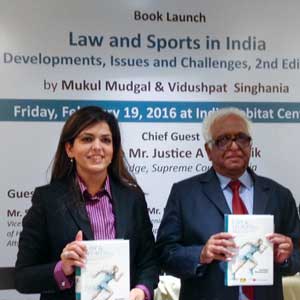
    aahna-mehrotra-2Since I did not work on the first edition, it wasn’t easy to immediately start drafting or adopt someone else’s style of writing but Justice Mudgal was patient through the process. At the same time, as most of the developments in Sports law in India have only taken place in the last 5 years, it was as good as writing a new book.

    I worked with him on drafting 8 chapters of the book. These were (i) an overview of the sports scenario today, (ii) gender discrimination, (iii) anti-doping, (iv) sports as a business, (v) labour laws, (vi) violence in sports, (vii) sports dispute resolution and (viii) grey areas. I had a huge support system in the interns who researched untiringly on some of the most unheard of issues related to the sporting scenario in India. I learnt so much from them as well, like I didn’t know there was a concept called flip-throw that existed or that a suggestion to bring an orange card into play was being made in the football arena. I learnt so much about the intricacies of sports law as we drafted chapter after chapter.

    With an LL.M in progress, pressure from the publisher to adhere to the timeline and sometimes technology betraying me with an entire chapter getting wiped out just when I was done drafting it, I often did 5 a.m. mornings and eagerly looked forward to the day we would be done drafting. The end result was worth it all. It has been a privilege to work with Justice Mudgal, who feels so strongly about eradicating the malpractices in the sports industry in India, and a great honour to have worked on what has been termed as a ‘monumental work’ and an ‘encyclopaedia’ by Mr. Soli Sorabjee.


    Which new areas can one expect to explore in Sports Law, apart from player contracts, anti-doping or sponsorship related work? Why is this an area of law more people can choose to specialize in?

    With the advent of several leagues, many international athletes are now looking at the Indian market as an avenue so there is a lot of player transfer related work, especially in football. Apart from that, with image rights becoming a popular concept world-wide, a lot of Indian players are looking to protect their rights relating to both privacy and publicity. Scandals like match-fixing give you the opportunity to work on matters that may fall under criminal law. Things like gender-discrimination and the increase in punishment under the new anti-doping code have given rise to human rights and constitutional issues in sports. A lot of broadcasters are looking to either terminate existing contracts due to the leagues not doing well or vice versa – league owners that feel that they have not made the right choice in terms of broadcasters are looking to terminate their contracts and sign new agreements. Taxation issues and labour laws too are areas that have growing issues related to sports. More and more sports management companies seem to want to hire specialists in sports law to form an integral part of their team. As the sports industry in India continues to grow, so do the issues relating to the field, and so does the legal work.


    A lot of sports leagues are mushrooming in India at the moment. What legal challenges do they face and how viable are these leagues in the long run?

    (Aahna was involved in the Player Transfer Transactions of the Indian Super League and have also been involved at various levels with the Indian Badminton League and the Indian Table Tennis League.)

    Along with Mr. Kaushik Moitra, (Partner, TMT Law Practice) the Indian Badminton League in 2013, was the first sports league I worked on. The league failed due to several reasons like mismanagement at venues, lack of staff, the appointed media agency not being proactive, VIPs demanding free tickets and special treatment, state associations not cooperating with the national associations, travel and accommodation being impractical, no itemised budget and being unprofessionalism on the whole. These are some of the most common challenges that are faced at the time of running a league, especially the first season, so all league owners must learn from the IBL 2013 and not make similar mistakes.

    As for viability, it is something that can only be determined in due course of time. The Masters Champions League held in Dubai recently failed to pick up numbers in its first season even though the concept looks very promising. The MCL organizers are hoping that the current cricketers will look at it as an avenue post retirement, so when a Dhoni joins the league on retirement, automatically the numbers will go up, however this again is mere speculation and the question is whether or not they can sustain the league until a Dhoni joins. The Kabaddi League on the other hand did unexpectedly well in the very first season, the ISL picked up a lot of momentum in the second season, so there is no fixed formula for the success of a league.


    You were an integral part of Ludus Legal, one half of which has now been absorbed by TMT Law Practice. What does the shift mean for you and how does such a shift impact the clients?

    It has always been a very enriching experience to be working under Mr. Abhishek Malhotra (Managing Partner, TMT Law Practice). He is someone who has constantly encouraged me to pursue my academic interests apart from doing just legal work for my clients. In fact I remember when I started out with TMT Law Practice, immediately after law school, we had a concept of internal presentation of papers. Every alternate Saturday, an associate would present a paper on a new topic and we would then sit and discuss the issue. It always helped in learning something, increasing our industry knowledge and growing as a lawyer and that is why I was more than willing to join them back, when the opportunity arose.

    Like I said above, it is very hard for sports to survive without intellectual property and related areas. TMT Law Practice is a boutique Technology, Media and Telecommunication law firm which can better cater to the needs of a client. The clients only benefit from this shift, as they now have a full service law firm that caters not only to their sports law needs but also offers to them specialists in the intellectual property and media industry. At Ludus, we would often use the services of TMT Law Practice, to file Trademarks for our clients and use Mr. Anish Dayal and Mr. Nitin Mishra as counsels to argue our litigation matters. Now it can all be done hassle free under one roof.


    Tell us about the kind of work profile you handle every day. What are the challenges you face and what do you like most about the job.

    On a daily basis, I handle a whole lot of agreements covering different aspects of sports law. I often participate in negotiations between league owners and sports bodies or players and league owners.

    However, what is really challenging is when an athlete comes to me for help in a doping case. On most occasions, the consumption of the banned substance is inadvertent, as the athletes come from humble backgrounds and have not been educated about how a banned substance may enter their body. They start training at an extremely young age hoping to make it to the commonwealth games or Olympics one day and maybe win that one medal, which will not only make the entire country proud but also give them a source of livelihood but just when they are about to make it, they get caught for a doping charge against them. With the new code having increased the punishment to four years, which is as good as resulting in the end of an athlete’s career, there is a lot of pressure to have the punishment of an athlete reduced. You sometimes succeed and you feel on top of the world but there are occasions you fail to get a reduction in the punishment which then tends to take a toll on you as you feel responsible for a sports person’s career coming to an end.


    Finally, what would be your parting advice to our readers?

    “Twenty years from now you will be more disappointed by the things you didn’t do than by the ones you did do. So throw off the bowlines. Sail away from the safe harbor. Catch the trade winds in your sails. Explore. Dream. Discover.”- Mark Twain

    Trust your gut, don’t be a part of the rat-race and its okay to sometimes not go by the book.

  • Abhishek Sinha, Associate Partner at Khaitan & Co., on how to gain expertise in Corporate Law

    Abhishek Sinha, Associate Partner at Khaitan & Co., on how to gain expertise in Corporate Law

    Abhishek Sinha is a dual qualified (England & Wales and India) corporate lawyer with a post-qualification experience of more than ten years. Prior to joining Khaitan, he was working as a ‘Partner’ at Shardul Amarchand, Mumbai. He started his career at a leading law firm in Mumbai (DSK Legal) and later joined the Mumbai office of AZB & Partners. In the year 2012, he was seconded to Morrison & Foerster, Tokyo as an ‘International Visiting Attorney’.    

    Abhishek has been leading transactions involving corporate and commercial laws. Abhishek has wide-ranging experience in advising on private equity matters, as well as structures requiring India entry strategies. He has been involved in various acquisition matters (both domestic and cross-border), contract negotiations, and has regularly advised his clients on investment strategies, joint ventures, strategic alliances, regulatory compliances, exit options and general corporate matters.

    To satisfy his academic inclination, in addition to his legal practice, Abhishek has been a visiting lecturer at ILS Law College (Pune), KC Law College (Mumbai) and Government Law College (Mumbai). He has also handled various academic assignments at several law colleges, including HR College (Mumbai) and the National University of Advanced Legal Studies (Cochin). He has on numerous occasions spoken at several seminars and conferences, including the Institute of Company Secretaries of India and the Institute of Advanced Legal Studies, Pune on issues pertaining to foreign direct investments, due diligence, companies act, the law relating to contracts and related subjects.

    In this interview he talks to us about:

    • Life, law and the choices he made while pursuing it.
    • The work entailed in his position, and the field of corporate law dealt with.
    • The importance of grades at the law school.
    • Importance of socializing in career progression.

    Tell us something about yourself. Where did you grow up and attend school?


    Hi! This is the much-dreaded classic question: “Tell me about yourself”! It reminds me of a quote from ‘The Office’ (I think season 5): “Sometimes I’ll start a sentence, and I don’t even know where it’s going. I just hope I find it along the way.

    I’m a dual qualified (England & Wales and India) corporate lawyer with a post-qualification experience of more than ten years. I graduated from ILS Law College, Pune in 2006 with dual bachelor degrees. Presently, I am working in the Mumbai office of Khaitan & Co, as an associate partner, primarily focusing on private equity transactions. Prior to re-joining Khaitan, last year, I was a corporate partner at Shardul Amarchand, Mumbai. For me, my first office will always remain special, and it must find a mention in this “know me” segment. I started my career at a leading law firm in Mumbai (DSK Legal) and later joined the Mumbai office of AZB & Partners. After a stint of approximately two and a half years at AZB, I joined Khaitan. I have also spent a fair amount of time at the Tokyo office of Morrison & Foerster as an ‘International Visiting Attorney’.

    I grew up in a small town, Ranchi (yes, the same place as Dhoni!) and completed my schooling from DAV Shyamli (yes, the same place as Dhoni!!). Just for my SoBo friends, Ranchi is the capital of Jharkhand (and yes you can google for Jharkhand).

    What brought you into studying law as your profession?


    Law, happened to me, just by chance and not the choice. I was a science student and didn’t score well in the entrance test to grab an MBBS seat. My rank in the CBSE PMT was just enough to get me through BDS, and I never wanted to spend my entire life looking inside someone’s mouth. My dad wanted me to join the BDS, and I was just looking for a way out. India Today magazine came to my rescue; ILS was ranked 2nd in the law colleges ranking that year, and I applied because that was the only college where the admission was based on class 12th marks. Mine was the last name in the 1st merit list. But the real motivation to pursue my law degree seriously happened in the 3rd year of my college. The only good thing about myself (I am just being modest, there are a lot of good things about me), is that once I take things seriously, I take it seriously. I worked hard and topped the Pune University in my 3rd and 4th year of college (that’s a different thing that both the years, after re-evaluation results, I was ranked 2nd). Haha!

    After joining the profession, I had the benefit of having some amazing mentors, and I think my ‘student mode’ will continue for a long time as there’s a lot to learn and I have just started.

    What were the activities you were a part of?


    I was a very active student in college. Name the ‘cell’ or the ‘committee’, and I was there in it. Apart from all the college activities, I was associated with several NGOs and experimental leadership training groups. I used to enroll for every other diploma/certificate course, thinking it may help me in getting a job. Today, the students have a lot of avenues to get information and then decide what is right for them. For me, it has always been the harder way of “hit and trial method”, but I am not complaining at all.

    Apart from the above, I used to teach in a school in Pune over the weekends and go for my long mountaineering trips by cutting down on my internship period by 10 days (well every internship), sell newspaper subscriptions and insurance products (yes I was an insurance agent from 2nd year to 5th year of college and surrendered my license, right after getting placed).

    If today, I am asked to give a list of top 3 things which is essential apart from attending regular classes, the list will look like this: (i) participating in moot courts, (ii) self-reading and writing articles or research papers; and (iii) internships.

    Tell us about the nature of work you are entrusted with and what’s a typical day like?


    Apart from merely leading transactions, involving corporate and commercial laws, I advise on private equity matters, as well as structures requiring India entry strategies. Just to give a quick flavor, my work profile includes advising on various acquisition matters (both domestic and cross-border), contract negotiations, financial investment strategies, joint ventures, strategic alliances, exit options and general corporate matters.

    A typical day at work is the same as any corporate lawyer- attending to client meetings and conference calls; internal meetings, reviewing the documents, responding to emails, etc. However, I make sure that I take out the “me time” for reading the legal updates, chatting with seniors and taking my coffee (and stamina-sticks) breaks.

    To satisfy my academic inclination, I teach at ILS Law College, KC Law College and Government Law College, Securities Law Course, the Institute of Company Secretaries of India (seminars) on issues pertaining to foreign direct investments, due diligence; companies act, the law relating to contracts and related subjects.

    How do you say one can gain expertise in corporate law? What does it take to be a good corporate lawyer?


    There’s no strategy or science behind becoming an expert in any area. If you like the subject, half the work is already done.

    I will digress a little bit, but it’s important. Most of the interviews, students are able to answer (to perfection), the questions, which are out of their regular curriculum (like questions on FDI Policy, FEMA). However, a simple question on contract act, sale of goods act, companies act, will make them scratch their ear.

    The short point is, the basics of law need to be absolutely clear. This cannot be compromised if you want to excel (I am not talking about being an average corporate lawyer). All the other fancy laws can be learnt while working. Always remember, Indian Contract Act 1872 is the “mother of all laws”, and you must know it and know it all.

    Having said all this, please make a note that just by knowing the law (or so called being an expert) will not make you a good corporate lawyer. You need to be a team player, learn to logically articulate your point/ position and never be disrespectful in an argument (unless the other person is a bully). Everything else will fall in place.

    How do you maintain a work-life balance? Are there any specific time management tips you would like to share?


    Though this is tricky, it’s critical for me. Life of a corporate lawyer is very demanding, so one has to make a conscious effort to maintain this balance. For last several years, this has worked for me (not saying that it has worked all the time):

    • maintaining an effective to-do list (and prioritize matters)
    • effectively delegating and keeping the working team on the same page, up-to-date with the matter so the person next in line can take charge whenever required
    • Learning the art of saying “no.” Sometimes this is the key (Caution: use with care).  

    Most of my friends wake up, shower, and go straight to work. They all complain about having no time to do anything. I make sure that I get at least 3 hours for myself in the morning.This makes me more productive and helps in having a peaceful workday.

    Tell us about your journey from being a student to a partner. Whether life changes after being a partner?


    For me, this journey was a natural process. I kept my focus on doing good work and left all other things to my mentors (who never disappointed me). My agenda was to complain only when I wasn’t getting challenging work

    (but that never happened).

    Life doesn’t change if you like your work and have the same vision as the firm. Just be prepared for the responsibility.

    Tell us about your international secondments. How important are these secondments?


    The six months I spent in Tokyo with Morrison & Foerster, provided me with a very different kind of exposure. Japan as a jurisdiction is a unique, distinct and process oriented. I sincerely believe that such secondments are very important for everyone who is on track for a leadership role.

    How to excel in what you do? How to become the star of the firm?


    There’s no rocket science in excelling in anything you do. You:


      • have to be passionate about what you do. If you aren’t, change
      • should keep your focus on quality work
      • shouldn’t get bothered about what people say behind your back (just remember, they are either jealous or simply jealous and that means you are doing good)  
      • Interact with your seniors. You will get to learn a lot, even in a mere 2 min conversation
      • teach a subject at some law school. You will be amazed to see how this will change things in your work life

    select a stream/ segment and be the champion in that enjoy your life.

    • If you keep taking the stress and working all days, weeks and months- what’s the fun in being a star.   

    What is the difference between a hard worker and a smart worker?


    A hard worker is a like a horse with blinkers, just running in one direction without a long-term goal. A smart worker will have a 360-degree vision, will prioritize things and effectively manage his time. No one wants to be in office over the weekends!

    Please note that there’s a difference between ‘shirking away responsibility’ and the ‘art of delegation’. As you go up the ladder, you have to be a smart worker, taking the team together towards the collective vision through effective delegation, prioritizing things and being responsible for team’s action.

    How important are the grades at a law school?


    If a survey is done, this question will top the list of every law student. We should remember one simple point, anything that reflects on ‘what all and how’ have you done things in your five years (or 3 years) of college life- is relevant, very relevant. I am not in any way looking away from the known concerns on curriculum, a pattern of examination and marking strategy. I am just trying to say things are relative, isn’t it the same for every student taking the exam? So you have to be relatively the best! Period.

    Having said this, I don’t believe that just a good grade is an indication of strong fundamental knowledge of the law, but it’s enough to bring you to the other side of the table for an interview. Isn’t that the first hurdle, which you want to cross anyway.

    Is it important to be people’s person for career progression?


    Well, this is a very tricky question. Let me answer this little differently.

    You cannot give importance to a bi-product. However, sometimes, certain bi-products are equally valuable, just like the final product itself. Therefore, the entire process force has to be directed towards the final product, and all other things will fall into place.

    I won’t say that being a people’s person is a critical criterion. But everyone likes to work in a team, which is aligned towards one goal.

    What is the importance of socializing on career progression?


    We need to understand that ‘socialization’ as a construct is not a skill-set, which needs to be developed. We are born with it. The entire premise of civilization and society is based on socialization. Ross (well…not Mike Ross!) defined socialization as “the development of the we feeling in associates and their growth in capacity and will to act together.” Gone are those days where a star corporate lawyer used to steal the show! It’s the era of “we & all” and only collective effort of the team makes an individual and the firm successful.

    Please note that socialization in this context doesn’t mean eating, drinking, smoking, partying and/or gossiping together. It means more than this! Having a meaningful conversation with everyone, greeting them, and being there when they need you (work or otherwise) is the construct, which helps you attain that maturity and stability in the system. Having said this, you shouldn’t confuse this with ‘acting in a manner to please others’.

    I feel that today, a firm may be ready to lose a star lawyer who is not a team player rather than a perfect team player. Productivity and effectiveness are directly proportionate to the collective efforts. The standards these days are so high that every other lawyer has same or similar skill-sets as far as the technical/legal skills are concerned. What will differentiate a good lawyer from the rest are the leadership skill and the ability to make team members a part of transaction/ matter they are working on. In my experience, productivity and learning agility of an associate increases exponentially when he/ she gets a feeling of “my matter” rather than “partners’ matter”.

    What message would you like to leave to our readers?


    Especially for the young corporate lawyers, it’s important that they:

    • learn to write/ draft in simple English;
    • understand and appreciate the commercial construct of transactions, and
    • understand, the client wants a solution-oriented approach.  

    I am not highlighting the obvious that they need to know the law and keeping abreast with the latest developments/transactions.

    I genuinely believe that I am a risk taker. I know that if I don’t take any chances in this short life, I will have a dull and boring life.Who wants a boring life anyway? Having said that, it doesn’t mean you will succeed every time. In fact, you will fail most of the times, but the good part is the experience you get and the fact that you will never regret “not doing it”. Regretting about things ‘that you never tried’ is worst than trying and failing.

    The short point is that you should do whatever you want to do in life if you feel it’s the right thing for you. Period. Whatever you do in life (good or bad), people around you will speak about you. It’s fine, because, at the end of the day, you are here for the experience and not to just please people around you.

    Also, if you’re good at what you do, there’s no reason you can’t brag about it.

    Always remember, we all ‘work to live’ and not ‘live to work’. Being dedicated is one thing and being in office 24/7 is another. Go out, meet with friends, travel, do something for yourself, and patiently hear everyone but listen to just yourself.

    Fitness is not just an important aspect; it’s essential if you want to enjoy your work as well as your personal life. You just can’t ignore it. I don’t need to explain what needs to be done. Everyone knows it, so don’t be lazy, go out and sweat.

  • Mini Gautam, Independent Legal Consultant, on being in-house counsel, and writing a book

    Mini Gautam, Independent Legal Consultant, on being in-house counsel, and writing a book

    Mini Gautam graduated from ILS Law College, Pune University, in 2010. Presently, she is a Senior Manager in the strategy and planning department of one of the leading infrastructure finance companies in India. She plays a key role in legal strategy and transactions crossing a certain level of criticality and threshold.

    In this interview we speak to her about:

    • Challenges associated with being an in-house counsel
    • The recruitment process in her company
    • Writing her book and the publication process

    You are working in the strategy and planning office of your company. How different is that from a regular legal function?

    I am working in the strategy office of Srei Infrastructure Finance Limited, one of the leading infrastructure finance companies in India with operations of affiliated entities extending into the oil, power, construction equipment leasing, and telecom sectors. The quality of work here is superlative. We are expected to not just pick up and read laws, but to structure and provide practical and workable solutions. The motto is to try and furnish the solution; not just identify the problem. That has helped me to look at everything from a commercial and systematic point of view.

    I don’t want to delve into the philosophy or art of law anymore as a commercial lawyer. I want to know what is it that affects my organization and to what extent. That’s it. Once I have that base knowledge, everything becomes easier.

    12650821_10153790751870446_811507915596196158_n

    What are the essential requirements that a law student must fulfill in order to pursue a career in financial services? 

    CA, CS, MBA are really helpful for working in corporate law. I don’t have any of these degrees and some of the people who I have had a chance to work with and who have a good grasp of the law and a clear understanding of concepts, do not either. So I will be compelled to say that degrees don’t add the kind of value that practical experience does. In my experience, I have found that the harder and harder you work, the more the number of hours you put in and as a lawyer, that’s pretty much all you need to be successful.

    How would you describe the roles and responsibilities associated with being a senior member of your organization?

    Thankfully, I have been given a good role in my organization. I would think corporate in-house wise, this is probably the best exposure a person can get. The scope of the work is diverse and spread across multiple sectors; so there is never a boring day or repetition of any kind. The learning curve is really good.

    Why did you shift from a mid-sized law firm to a company?

    Moving in-house from a mid – sized law firm was one of the best decisions of my life. Working in-house has made me appreciate and soak in one thing, the beauty of business. The kind of challenges involved in running a company, whether they be on a day to day and operational perspective or whether they are from a structuring and transactional viewpoint. While being in a law firm may help you understand the academic and doctrinaire aspects of law, in-house heaps a whole lot of responsibilities on you that are fundamental to the functioning and sustenance of a corporate house.

    What are the challenges associated with being an in-house counsel?

    The biggest challenge of working in-house is balancing legal and business needs and aspirations. You have to learn to pick your battles wisely; some things you fight tooth and nail for, some things you let go and live to fight on another day.

    As in-house counsel, you have to be thorough with the business requirements; every decision you make is crucial and may have spill – over effects over a long duration.

    You don’t have that much scope to go wrong or make a mistake. Your business teams rely on your judgment entirely. Once you have taken a call, that’s that.

    Would you hire a hard working student or a street smart one? 

    We are always looking for hard-working students to come on board. The willingness to work hard and yes, to some extent, the ability to work smart is the key differentiator between students who get selected as opposed to those who don’t. We don’t want to know how much you already know as a fresher; because trust me, you know nothing. We just want to know how willing you are to be remolded and recast; everyone starts at zero.

    What do you see in candidates when you go for recruitment? 

    While conducting an interview, the one thing that matters the most is the sincerity of the candidate. It is the single most important and deciding factor and is much more relevant than grades or moot courts or paper publications or internships. The practice of the law in any setup is a hard and challenging job. It requires patience, commitment and a dedicated number of long hours. The process we follow for recruitment is giving out assessment internships. We believe that gives both us a chance to review the candidate’s work and also the candidate an opportunity to understand the way we function and most importantly, our thought process. Training of resources necessarily involves having colleagues who can understand the “why” of what you are talking. Once that happens, you don’t need to micromanage or recheck work.

    10897030_10152933394005446_886127385185496502_n

    What is the role of a mentor in any job?

    A mentor is probably the single most important influence on a job. The majority of people quit their jobs because of the kind of boss they had.

    A good mentor can change your entire perspective regarding your job. The idea is not to micromanage your resources but impose faith in them; so that they take on responsibilities themselves and feel like they are adding worth to the larger scheme of things. One of the biggest mistakes I find is employers who keep repeating phrases like“one will leave ten will come”, “nobody is indispensable,” etc. especially in Indian law firms where the general assumption is that law students are being manufactured by the dozen. A good mentor will make you feel valued so that you put in that extra effort.

    An excellent resource is not easy to find and tougher to retain. Do we really want automatons who will pop out drafts and agreements without application of mind and more importantly, without an iota of genuine interest in what they are doing or do we want genuinely interested, inspired and initiated individuals who are strategically important cogs in the wheel.

    As a mentor at some point in time you will need to realize what is it you are looking for; a false sense of power at keeping track of what time your employees entered and when they left office even if they are playing candy crush under their desks? Or can you let your employee manage his own schedule, deliver good quality of work to you and if required is ready to put in 200% of what his or her capabilities are.

    You can only be a good mentor to someone if you are free from insecurities yourself, and most importantly when your focus is on getting the job done rather than just purely wanting to harass another individual. Your mentee’s growth is also a part of your own.

    What are the challenges associated with being a woman?

    Generally, I don’t feel biased against in any manner being a woman working in a corporate set-up. It is only when I attend meetings and find that in probably eight out of ten I am the only woman in the room that I realize that something is wrong with not just our country but the world over.

    Women generally start with great careers on the same footing as men. But as they move ahead, they fall behind. Marriage, children, the excuses are plenty. Yes, I understand women who are staying back at home to raise kids and look after their families are probably doing something much more worthwhile than what working women can achieve in their lifetimes. But I really hope that these are genuine cases of a voluntary choice made by a woman and not a manipulation or a societal unsaid and yet undeniable obligation.

    What are your long term goals?

    The journey may have been hard and stressful at times but if given a chance I wouldn’t want to change a thing and would retrace my steps to exactly the same destinations. While good experiences are comforting and encouraging in life, it is the bad ones that teach you in ways nothing else can.

    Honestly speaking, I fail ten times a day. I make mistakes, take wrong decisions, don’t understand certain things, may not be able to articulate myself properly, stand up for things that may not be so important while ignoring the ones that really matter, the list is sadly endless. If two years ago somebody had asked me what your weaknesses are; I would have given some smart alec answer and said my only weakness is that I don’t have any. Today, I have matured and understood myself and the world enough to know that I am far, really far behind where I want to reach and that it’s not such a bad thing. I have understood that making mistakes means learning. I have realized that perfection is a notion, not a reality; and you should never aspire to perfection. You should only aspire to growth.

    It’s hard to say what I am seeking or where I am trying to reach with certainty. As of today, I love my work and my job. It is fulfilling and satisfying. But yes, a job cannot be a long-term goal.

    There has to be some ideology or philosophy you subscribe to; something that you are so passionate about that it wakes you up every day with a cheerful buzz in your heart. I am in pursuance of that passion; hope to reach there at some point.

    What would be your advice to our readers?

    My advice to readers especially law students is please don’t take life too seriously. Nothing is life and death issue; definitely not jobs and placements. A job is a means to an end, not an end in itself. Keep your priorities in life clearly demarcated.

    Loved ones always come first, and in that list, you should put your own name on top. If anything makes you feel depressed or unhappy or dissatisfied; there is just no need to do it. There is no rush. Life is not a race. Don’t be in a hurry to get somewhere. Enjoy the journey; the journey is what life is.

    Congratulations on the release of your new book, The Gutter Princess ­ Diary of an (Un)Willing Prostitute. Where did you draw your inspiration from for this book?

    I have always been inspired to write on subject matters which are more relevant to women, how a sex worker came to be the protagonist of my first published novel, is a question I cannot answer definitively. I believe the fact that we do not feel any empathy for women who are prostitutes by choice made me feel really pained from within, because I knew that the word choice was being misinterpreted. A society which cannot provide education or means of sustenance to so many of its members, does not get the moral high ground to judge a woman who chooses to earn a living through an honest means of employment. We cannot accept such women in our fold, whereas we do not give a thought to the men who are availing their services. The fact that our society, or probably any society, carries double standards and prejudices against women is known, the question is, what we are going to do about it. This book is a simple attempt to do something about it.

    What inspired you to consider writing as a serious endeavour? 

    I have been writing since I could hold a pen, it is an outlet for me to express my emotions, happiness and frustrations. I don’t know how I would classify it, as a serious endeavour or as a hobby, one sounds too professional and one too amateur. Writing is a form of art, and it’s hard to classify or compartmentalise art. The only thing that matters is the joy it brings to the artist. I write because it makes me feel happy; the entire process of starting with a word and ending with a tale, a story revolving around characters. The more real and convincing your characters are, the more successful you are as a story teller. Fiction is a bad word; it feels “made up” and “fake,” while it doesn’t have to be so. A story of made up characters can also be as real as anyone’s life story, it all depends on where it takes the reader. I find it sad that people are losing the habit of reading due to time constraints; it is so much easier to curl up on your sofa with Netflix than to do so with a good book. But studies have shown that watching the television can add to depression while reading actually helps in developing cognitive abilities and gives you experiences the telly cannot. There is increasing awareness towards physical fitness; I wish we could also lay stress on mental well – being.


    What authors or writing would you say has influenced your style of writing? 

    I keep my writing original, and for this reason, I never give my work for feedback or reviews to other people (only exception being my husband) while I am writing, I don’t want my work to be reminiscent of someone else. I read a lot, and have read extensively from classics to contemporary literature, but when it comes to my own writing, I like to keep it as simple as possible, almost as if I am in conversation with my reader. I feel the current market is ripe for such writing, and readers are also in favour of titles which they can resonate with. However, this is no reason for the market to be flooded with only coming of age romance novels, and it is high time it opens up to other subject matters as well. A light, breezy novel is always welcome, but sometimes you need something more, something which makes you think and shakes you from within.    


    What are the challenges and learning opportunities that you were faced with in writing this book?

    The biggest challenge for me was that I didn’t want to base the novel on research; I wanted it to come out as a story and not as a documentary. I was writing about the life of a sex worker, but as a form of fiction, and that made it hard. I wanted to write about sexual abuse freely, but you know how it is in our closed society. I received some reactions from readers saying the language was too raw or harsh for them to accept, especially for people from older generations, but that they otherwise loved the content. I accept that with grace, and do not find it upsetting that some people did not like the language as long as the overall message hit them, and they could empathise with the protagonist.  


    Being a lawyer involves a lot of drafting and writing; would you say that your background and experience has helped you shape the novel that you have authored?

    Yes, there are fields which may be mutually repellent and there might be ones which don’t really attack each other, but which can go hand in hand. The legal profession is largely one which can accommodate a lot of things, you find many lawyers pursuing their other interests as well. I don’t perceive it is because the profession is less demanding, but because it follows simple common sense and analytical thinking, and therefore a good lawyer can be a good CEO or a good sports analyst or anything else he wants to be. I believe we are blessed, being lawyers, the field is vast and encompassing, and if you really apply yourself, there is a lot which can be achieved while continuing with the practice of the profession.  


    Would you consider moving into writing as a full-time occupation?

    I think the moment we make something our full time occupation or profession, we stop enjoying it, and I don’t want to do that with something as pure as writing. I also enjoy being a lawyer, and I don’t feel the need to give up one to pursue the other, not as yet, at least. I write in an erratic and eccentric manner. There are times when I have written five thousand words in a day, and then there are months when I haven’t written a word. I don’t like to force myself to write, but generally, I do keep writing for my own happiness and satisfaction. To honestly answer the question, yes, I am writing another book, whether I will publish it or not, is something I will decide based on how the book shapes up, if it shapes up at all. I started with writing on simpler and sweeter things, but after writing one book on prostitution, I found that a pen is a good weapon to hit masses with, and when you have that kind of an instrument at your disposal, you should wield it wisely. My current book is also on a social issue and has flavours of human bondage in it, but again, I am not sure, when I will complete it, I don’t like to put a deadline on something I am enjoying so thoroughly.


    How do you manage your time between your professional commitments as a lawyer and your passion for writing?

    The answer to this question is in the question itself, as you rightly say, it’s a passion, and we can always take out time for something we feel passionate about. The problem generally is not with lack of time, but with, lack of time management. I write because I need to write, it’s almost an involuntary emotion like hunger. As long as I don’t need to complete books based on deadlines, I don’t think the two would have a problem in co-existing. I don’t want to dilute the quality of my writing, and so I’d rather stick to fewer book releases but more meaningful ones. Meanwhile, it’s super being a lawyer.

  • Gulika Reddy, Advocate, Madras High Court, and IBJ fellow, on work in the social sector

    Gulika Reddy, Advocate, Madras High Court, and IBJ fellow, on work in the social sector

    Gulika Reddy is a lawyer in the High Court of Madras, a consultant at the Centre for Child and Law at National Law School of India University, an International Bridges to Justice Fellow and the founder of Schools of Equality. She graduated from ILS Law College in 2011 and since then has worked extensively in the field of human rights, crusading for the rights of women, children, climate refugees and various other victims of discrimination and injustice.

    In this interview, she tells us about:

    • Human rights law – the areas she works in and why.
    • The International Bridges to Justice Fellowship
    • Schools of Equality
    • Advice for law students wishing to pursue Human Rights Law.


    Which areas of human rights interest you most and which human rights abuses are you most interested in working to address in your career, and why?

    Social groups have been divided on the basis of various facets of identity including race, gender, sexuality, class, caste and religion, resulting in violations of individual or group rights merely due to one or more aspect of one’s identity. Growing up in India, I felt anger at the normalization of this form of social injustice. Since my life experience is closely tied to my gender, related issues were those that resonated most strongly with me. Compounding this was the social acceptance and general sense of apathy towards gender-based violence in India. My untested belief that knowledge of law was empowering and a powerful instrument for social change motivated me to go to law school.

    After I graduated, I began practicing in the High Court of Madras and soon realized that in India legal responses have neither reduced its occurrence nor have they improved access to justice for victims. In spite of protective legislations, millions are unaware of their rights, conviction rates are abysmal and attitudes within the judiciary prevent rather than promote justice. Examples of judges telling victims of abuse to “adjust” to their circumstances and suggesting rape victims mediate with or marry their rapist as a form of compromise expose inadequacies in the current system and make evident the need for a change. I have been working towards facilitating this change through interventions in the legal and education system.


    gulika-reddy-1

    You are the recipient of two fellowships the International Bridges to Justice fellowship. Describe the kind of work you’ve done as a part of the fellowship.

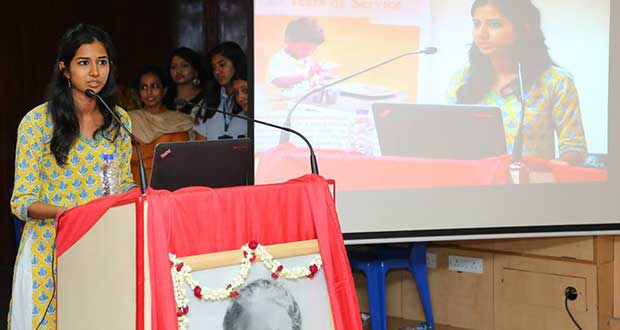
    While practicing in the High Court of Madras, it became apparent that several other challenges exist which lie outside the ambit of litigation.These relate to lack of rights awareness, inadequate access to affordable and sensitized counsel and ineffective implementation of the law. To address these issues, I began to advise non-profits that work in the field of human rights alongside my litigation practice. In recognition of my work, I was awarded a Fellowship by International Bridges to Justice, which allowed me to scale up my efforts.

    Using the fellowship, I set up a collaborative program that brought together non-governmental organizations (NGOs) andacademic institutions and to organize periodic rights awareness programs and dispense free legal aid forindigent and marginalized women. I also set up a pro bono network of lawyers to provide free legal aid for these women in prison, most of whom were sex workers who had been coerced into the sex trade and then abandoned by their families due to the “shame” associated with the trade.


    gulika-reddy-2

    What motivated you to start Schools of Equality? How would you describe the work that it does?

    Despite receiving free legal assistance, women at the awareness workshops expressed reluctance to approach the legal system, as they felt further victimized by the judicial process and functionaries under the law. To encourage functionaries to act with sensitivity and a sense of urgency, I conducted training and sensitization programs with human rights lawyer, Ms. Geeta Ramaseshan.In spite of our efforts I observed that attendees were unable to shift deeply entrenched attitudes towards women. It became apparent that the insensitivity present within the Court system was symptomatic of widely held beliefs about women and gender roles in society.

    Recognizing that gender socialization begins early and is reinforced by societal institutions, culture and media, I started Schools of Equality, an organization that runs activity-based programs which aim to shift social attitudes that perpetuate gender-based violence. The program encourages students to question notions of power related to gender and its intersectionalities like caste, class, religion and sexuality; to understand the right of choice; and to respect each other’s rights.As a part of the curriculum, they learn about their rights; interact with social justice movements, lawyers, artists, writers, photographers, musicians, performance artists, and therapists; frame their own opinions; learn creative modes of self-expression; and take action to build communities of respect.


    What is the format of the program?

    Our year-long programme has been incorporated within the mainstream school curriculum. We organize one session a week conducted by a trained facilitator, who exposes the students to a variety of approaches to equality, allowing them to frame their own opinions. Our team of facilitators come from a variety of backgrounds including law, film, journalism, art, education, psychology and theatre. This year, the sessions in the first term focussed on examining issues of identity and stereotypes. Sessions in the second term will focus on creating rights awareness and discussing the impact of media and popular culture on equality and social justice and the final term will see students draft their school constitution, plan campaigns and organise events within their local community.


    gulika-reddy-3

    How have schools responded to the programme? Can you include quotes or testimonials from schools?

    Although it was challenging to introduce this curriculum within the existing conservative school system, transformation amongst the students and action taken by them within their communities captured the attention of other schools, the national media and the local government. The local government in Chennai and Kadapa district in Andhra Pradesh appreciated this approach to addressing social justice issues and have now introduced the program in government schools at the city and village level.

    We have received extremely positive feedback from teachers, parents and students we work with. Here are some of the responses:

    Teachers: “Schools of Equality provides a safe and empathetic platform for students to talk about the most essential yet sensitive, so-called forbidden topics in society…helping students become resilient and global citizens, aware of their rights”

    “It’s so nice to see the space you have created for them (the students) where they feel comfortable to speak. They’ve opened up and seemed more confident in their own skin. For some of them, the transformation has been so positive that it’s difficult to even recognize them anymore.”

    Parent: “I have been hearing about Schools of Equality from my son. I feel you have made him feel empowered and I see him empathize as well.”

    Students:

    “I liked all of us interacting and talking about each other’s problems and also realising what empathy is and how much it matters.”

    “The questions asked in this class were thought-provoking and intriguing. This class was very useful to us.”

    “Schools of Equality has changed the way I view everything.”


    gulika-reddy-4

    What is your vision for the role human rights law and lawyers should play in promoting social justice?

    My vision is a human rights framework that provides a robust mechanism to bring national government responses closer to their international commitments. While it is important to carefully assess and arrive at a human rights framework that sufficiently represents all stakeholders, what is even more critical is ensuring states’ compliance with the same.

    We have multiple actors and agencies, working on the global issue of social injustice in different locations, at different paces, and none free from partisan politics. Rights on paper are insufficient in the absence of genuine participation in what needs to be a collective effort to deal with issues of social justice internationally. Therefore, while framing law, equal emphasis must be laid on creating fundamental enabling conditions that will aid effective implementation. This will involve building collaborative networks, facilitating coordination between state and non-state actors and conducting training and capacity building to prevent and respond to social justice violations.

    Also, lawyers must look beyond formal legal structures and be innovative and creative in developing interventions along with experts in other disciplines. These interventions must appreciate the embededdness of social injustice issues within the larger socio-cultural context, and must involve community engagement to address it at the interface of law and society. Only a multi-pronged approach that is designed with a clear understanding of this systemic problem, the factors that have contributed to it and the societal and institutional roadblocks that contribute to its perpetuation will help address issues of social injustice.


    What advice would you give law students wishing to pursue a career in Human Rights Law?

    A lot of the advice I have for a law student interested in a career in Human Rights Law is captured in the “Letter to a law student interested in social justice” by William P. Quigley: https://law.duke.edu/curriculum/pdf/interested_social_justice.pdf


  • Malek Shipchandler, Associate, Shardul Amarchand, on partaking in negotiation competitions and vacation scheme at Clifford Chance

    Malek Shipchandler, Associate, Shardul Amarchand, on partaking in negotiation competitions and vacation scheme at Clifford Chance

    Malek-ul-Ashtar Shipchandler, a 2014 batch graduate of ILS, Pune, is currently an Associate of Securities, Financial Regulatory, Corporate Law at Shardul Amarchand Mangaldas, having already worked with Economic Laws Practice (ELP) for a year.

    In this interview, he speaks to us about:

    • The significance of the Company Secretary (CS) course;
    • The experience of a Vacation Scheme at Clifford Chance;
    • The relevance of certification courses; and
    • The ability to continue with legal writing even after joining a law firm.


    Would you say that high school experiences led you to choose law?

    (Malek was part of the Student Council at school and participated in Model United Nations (MUNs) simulations, both as a delegate and Secretary General, and attended the Global Young Leaders Conference (GYLC) in Washington D.C and New York.)

    These experiences were definitely instrumental, coupled with encouragement from my family and teachers who saw in me an aptitude for oration and argumentation. I chose to be a commerce student in my penultimate and final year at school, perhaps because I was not exceptional at science related subjects but did fairly well in commerce related subjects such as economics and business administration studies; towards the end of my final year at school, the choice for me was either finance or law.


    Please share with our readers your experience at law school. What kind of activities did you participate in? How did you develop an interest for moot courts?

    Studying at ILS Law College was an excellent experience for someone who thrives in an atmosphere wherein you are not given a map of how to go about grooming yourself as a budding lawyer; except for the compulsory lectures, one is absolutely free to pursue other diplomas/courses, peruse books and journals in one of the best law libraries in India, participate in advocacy competitions, get involved in organizational activities, articulate views for publication in law journals, contribute to academic discussions post lecture in various “cells”, work with a law firm or a counsel, or simply do nothing and enjoy the cold coffee at the ILS Canteen! It has been an inspiring and humbling experience being taught by some luminaries in their own subjects, interacting with and being guided by seniors who have achieved milestones in their careers, and studying along with some stellar students who are currently not only doing well in law, but other fields as well.

    I primarily participated at intra-college and national moot courts and contributed to discussions at post-college “cells”. As a fresher and sophomore, I remember watching some brilliant seniors argue at moot courts and parliamentary debates – this sparked the keenness in me to participate in moot courts myself. Watching seniors argue at moot courts also helped me to not only understand the basics of fundamental laws like contract, torts and constitution but also gave me a chance to learn and imbibe in myself moot crafting skills such as presentation of facts, articulation of arguments, modulation of voice, rapport building with, and responding to, questions raised by the judges and rebutting contentions put forth by the opponent team.


    How did you decide to pursue the CS course? In the long run, do you think that this degree gives one an edge over other law school graduates?

    (During Malek’s second year at law school he started pursuing the Company Secretary (CS) course.)

    Pursuing CS came as a natural decision due to my inclination towards finance as well as corporate law, coupled with the fact that I had time on hand after attending lectures. Having studied for and attempting CS examinations, I am of the opinion that apart from giving you a flavour of basic concepts in company law, securities law, banking-finance law and taxation law, the way the ICSI frames its exam papers is far more objective, and challenges your legal cognitive, as compared to mere rote-writing. The CS course helps one to understand the inter-play between different corporate laws, apart from teaching how to read and interpret basic company financials – a skill very useful for corporate lawyers who interact with Promoters, CFOs and GCs, conduct diligences and draft commercial agreements.


    Do you believe ADR competitions are important, but are shadowed by the more popular moot courts in law schools? How do you think this could be changed?

    (Malek has also extensively participated in negotiation and client counselling competitions, nationally and internationally, and thereafter even judged such competitions.)

    There is no question of one advocacy activity “shadowing” the other. Moot courts and ADR related activities, I believe, are complimentary to each other in holistically grooming a budding law student. Most traditional law schools in India prefer the modus of teaching only by lecturing (rather an encouraging participative discussions or simulation learning), and that too on aspects necessary for examination purposes.

    While lectures on CPC and CrPC, and sessions on moot courts, allow students to imbibe the skill of argumentation, cross-examining and drafting, it unfortunately does not hone the art of personal communication, explaining the law to laymen in simple terms, understanding and syncing the clients’ expectations with legal modalities, and devising commercially viable solutions. These skills, I believe are indispensable for any lawyer, be it a litigator or a transactional lawyer.

    Most law students associate advocacy competitions as synonymous with moots courts and mock trials, perhaps because the number of negotiation or client counselling competitions that happen in India are far lesser in comparison to the number of moot courts. Law schools and law firms need to collaborate together and initiate more of such ADR related activities and competition. From my experience of founding the first ever negotiation competition at ILS Law College, I can say that the inputs of practicing lawyers or GCs (as compared to professors) to such activities/competitions is crucial for the quality of the activity/competition.


    You interned primarily at corporate law firms. Where did this inclination towards corporate law start from?

    John Grisham may have had a role to play! On a more serious note, I actually started my internships learning at places known for litigation. My first internship was with Hariani & Co, followed by the chambers of the then Attorney General, the late Mr. Goolam Vahanvati. Being in the second and third year of law school, more than learning the law or the procedure, it was through these litigation related experiences that I understood research methodologies, articulation of thought on paper i.e. how to draft legal notes/memos and documents management – skills which eventually helped during my corporate law internships. I believe as a law student, for the initial years at least, one must try everything and not wear blinkers concentrating on either just “litigation” or “corporate”.

    My inclination towards corporate law was sparked when I participated at the NLIU Juris Corp Moot Court Competition which gave me a chance, while researching on the moot problem, to identify and understand certain transactional nuances in securities and competition law which ultimately led to a dispute in court. I must admit that certain facets of litigation, such as argument drafting and strategy, really interest me; I am grateful that so far in my career, along with corporate-transactional work, I have been getting to do some work focussed on the Securities Appellate Tribunal and appearances before the Securities and Exchange Board of India.


    You experienced a vacation scheme at Clifford Chance. Was it different from Indian law firm internships?

    The experience can be comparable to internships offered by certain Indian law firms. Global firms such as Clifford Chance have very structured work experience schemes, almost like a course by itself, which involves learning and development of the Schemer through work assignments, attending in-house lectures, insights into the workings of different teams handling different practice areas and networking opportunities with the professionals at the firm. Firms such as Clifford Chance are driven by a philosophy of investing in their lawyers, right from the time one begins a training contract with them.

    I would encourage the readers, that given a choice between doing a LL.M and taking up a training contract, the latter should be considered hands down; there is no better teacher of practicing law than actual work experience, given the fact that law we read while studying is often very different from how it operates/is applied in the real world.


    You have scored a remarkable 99/100 in the FICCI’s certification course on Competition Laws and IP Rights. How far do you think these certification courses help a law student?

    Most traditional law schools often do not have specialized laws as part of their curriculum and are therefore not taught, at least as a core subject. Certification courses facilitate the learning of specialized laws, and are generally designed in such a manner, that it can be undertaken simultaneously while continuing your regular college activities. While there is a culture among law students of enrolling in parallel courses early on, it might make more sense to wait until the 4th or 5th year (or 3rd year in case of a three-year program) to assess where exactly one’s inclination lies – this is possible after participating in advocacy competitions, doing internships or writing papers – avenues through which one can understand what it is like to “practice” the specialized law, and not merely “read” it. From a CV building point of view during law school, especially if you have applied to intern under a particular practice group, certification courses would be a plus.


    Did you face difficulties in the beginning of your work at ELP? When did the transformation from a law student to a lawyer take place?

    (After graduating from law school, Malek joined Economic Laws Practice (ELP) and worked there for over a year.)

    It is only natural to feel challenged (not, “difficult”) when one moves from one life chapter to another viz. the academic chapter a.k.a “fun phase” to the professional a.k.a “real world phase”! That said, having interned previously at law firms and being a part of a great team headed by Mr. Suhail Nathani, made the transition for me as a student to a lawyer not only easy, but also memorable. Believe it or not, your perspective about practicing law is greatly impacted by your first job, team and senior.


    Do you believe that drafting contracts, legal opinions and other legal documents is an essential skill that most law schools in India omit to teach their students?

    I believe most law schools lay emphasis on teaching the principles of contract law as compared to actually teaching a student how to draft a contract. That said, law schools such as ILS Law College not only has a contract drafting competition but also has a subject on drafting which is taught by a renowned lawyer, Mr. Ajit Kulkarni – I still remember, his lectures were attended by non-ILS students as well as lawyers! Most traditional law schools, instead of asking students to take hand written notes of contract templates (which are otherwise available online), could consider equipping students with, and evaluating them on basic skills of drafting such as formatting, cross referencing and even proof-reading, and impart knowledge on aspects of stamp duty and registration – these are essential for drafting most contracts.


    You are now an Associate at Shardul Amarchand Mangaldas, Mumbai. What is your work profile there? Could you share your experience at the firm so far?

    A usual day for me at SAM involves team meetings, tending to client queries over phone call or email, preparation of memos/notes and drafting and reviewing of transaction related documents. We also advise on securities litigation matters, and as such, whenever required, we draft submissions to be made to the concerned authorities. Some transactions require me to work with other specialist teams in the firm, allowing me to benefit from their domain knowledge and experience. Besides encouraging regular interaction with the partners who have a plethora of experience and knowledge in their respective practice areas, the firm underscores the need for overall development of its lawyers and has implemented programs/policies where SAM lawyers share their opinions and experiences relating to a particular legislation and/or matter – this allows one to be up to date on contemporary legal developments and bake an opinion on certain contentious aspects – a must for any lawyer!


    Do you think it is important for legal professionals and law students to make their presence felt online?

    I believe, as will most people, that visibility is the key for growth in any profession. It would no doubt be helpful to reduce one’s time on social networking websites, and invest that time on professional networking websites such as LinkedIn.


    malek-shipchandler-2

    How do you find the time to research and write legal articles? Could you share a few tips with our readers on how to go about legal writing?

    Let me answer the question this way: I generally find time to write during early hours of the morning before work, or on a weekend, because writing helps me analyze cogently, organize logically, distil accurately, argue persuasively, cite knowledgeably, punctuate skilfully, and phrase smoothly, among other things. Some coveted blogs and forums also elicit the comments of experienced professionals and luminaries (either concurring or differing from the views expressed in the article) on the article, which is enlightening to read. I believe everyone has their own way of building their knowledge of the law and expressing their interpretation and application of it – legal writing is one such way which quite a few law graduates appear to adopt.

    To the readers, I can share that, while writing, I tend to implement certain guidelines which appear in a publication of the American Bar Association: “…you must struggle to achieve simplicity—and learn to achieve it without oversimplifying. That’s a tall order in an intellectually challenging discipline like the law.

    And it’s especially tall when you think of the overwhelming attraction that legalese presents to the average mind. With “pursuant to” and “assuming arguendo” and “hereinafter” and “inter alia”, you have ready-made shortcuts for feeling lawyerly. They’re like secret handshakes. They seem to make you a member of the club. Without them, you’ll feel like your pre–law-school self at a time when you may really want to feel a difference. Never mind that they typify low-grade legal writing.”


    What is your message to young law students?

    “Work until you no longer have to introduce yourself” is a mantra I endeavour to live by – try it!

  • Chinmay Bhosale, Advocate, Bombay High Court, on working with reputed Senior Advocates, Criminal Law practice and choosing litigation

    Chinmay Bhosale, Advocate, Bombay High Court, on working with reputed Senior Advocates, Criminal Law practice and choosing litigation

    Chinmay Bhosale is a graduate from ILS, Pune 2010 batch. He has been a consistent topper of his batch at University of Pune, he had also been selected in the final list of Rhodes Scholarship 2010.

    It has been five years since he joined the Bar and he has worked on high profile cases with intense legal issues like the 2G case, Hawala Scam Case, Maval Police Firing Enquiry Commission, Adarsh Commission, etc. Currently, he is pursuing his Ph.D and the topic for his thesis is ‘Malicious Prosecution’.

    Chinmay talks about :

    • His experience interning under Ashok Mundargi, Senior Counsel and Adv. Shreekant Kanetkar, Ex-Chairman, Bar Council of Maharashtra and Goa.
    • Choosing to litigate as against pursuing post graduate studies.
    • Criminal law practice in India.
    • Working on high profile cases.


    Given that most of our readers belong to legal fraternity, how would you introduce yourself to them?

    Chinmay Bhosale, to be brief J. A confident lawyer with an eidetic memory, who eventually wants to contribute to the legal profession, education and jurisprudence in my own maverick way.


    Legal studies are still only a backup option for quite a lot of students. What motivated you to choose law as a career?

    Choosing law as a career came very naturally to me. I come from a family which has acclaimed legal luminaries who have achieved success in varied fields and capacities; be that of a Senior Advocate, Chief Justice, Vice Chancellor or even a Law Minister. So, I have always felt very humbled by my surname and have had a natural awe towards law.


    What were your areas of interest during your graduation? How did you go about developing expertise and knowledge in these areas?

    I had fleeting interest in International Law at once, which led me to pursue and win a National Moot Court relating to the subject. However, my major and “only true love” has been criminal law. Apart from having immense interest in subjects like IPC, Cr.P.C. and Evidence Act, as a student I even tried to cover peripheral sub-areas like human rights, medical jurisprudence and forensic science by way of diploma courses. Also, three out of five years of my law school life I interned with Senior Advocate Ashok Mundargi, one of the giants of the criminal bar at Bombay. The internship gave me great insights into the ‘practicality’ of criminal law and the profession.


    Tell us about your law school journey from the 1st year till your final year at ILS Law College, Pune.

    My 5 year journey at ILS Law College, Pune was quite eventful. I had my share of highs and lows. I entered as an low-on-confidence novice, and emerged as a confident and ‘borderline arrogant’(as some would say J ) advocate. In this transition I tried to do a bit of everything from topping the University thrice in my five years, winning a national moot court, being the Student Representative of my batch for three years, being a part of the Student Council of ILS Law College, Pune, completing four diplomas, interning with Senior Advocates and even being amongst the final 15 students for Rhodes Scholarship, India. However, the most humbling and learning experiences were my failures, which were quite a few J


    Tell us, what kind of work did you do in your internships with Senior Counsels?

    (During his law school Chinmay has interned under Adv. Ashok Mundargi, Senior Counsel and Adv. Shreekant Kanetkar, Ex-Chairman, Bar Council of Maharashtra and Goa.)

    I was almost like a permanent intern with Senior Adv. Ashok Mundargi, as every vacation I used to be working in his chamber. Most of my time at his chamber was spent observing his arguments and interactions at client conferences; and partly trying to contribute to his arguments. My experience with Adv. Shreekant Kanetkar was quite enlightening, more because I understood that I had little or no liking towards civil laws. However, at his chamber I learnt the art of productive and crisp research, as most of my time was spent trying to learn the concepts of civil law.


    What is your advice to budding mooters?

    (Chinmay has participated in various National and Intra-College Moot Court Competitions and he was a part of the winning team of the Technology Law Moot Court Competition, IIT Kharagpur (Rajiv Gandhi School of Intellectual Property Rights), 2008.)

    Well, I never was a great mooter, so it wouldn’t be appropriate for me to give any advice on that. However, I would definitely like to say to all the budding mooters out there that please do not consider moots as the whole and sole of your life at law school. Moot courts are bereft of reality, and there is a lot more to your life at law school than mooting.


    How important do you think are co-curricular activities in shaping the legal career of a law student?

    I think co-curricular activities play a major role in shaping the legal career of any student, especially of those who wish to be a part of the action in the Courts. Quite often, it’s the persona of the Lawyer which stands out than his knowledge of law. Co-curricular activities play a major part in honing that persona. For me, I was an avid trekker, a national level sportsman and had varied interests like playing tabla, learning graphology etc. All these activities have definitely helped me in succeeding at the bar.


    chinmay-s-bhosale-1

    How was your first year after graduation?

    It was quite an internal struggle. As a law student I had an inkling towards pursing my post graduate studies from U.K. and I had admission letters from majority of the elite universities like London School of Economics, University College of London etc. However, I chose to enter the Bar straight away, as that is what I always wanted to do. So I started out in Mumbai, a city which has taught me a lot. I continued as a junior advocate at the chamber of Adv. Ashok Mundargi, where I had already interned for three years. Thereafter, I joined the chamber of Adv. Satish L. Maneshinde.


    What comprised your work at the chambers of Adv. Ashok Mundargi and Adv. Satish L. Maneshinde?

    Working as a junior advocate at the chamber of Adv. Ashok Mundargi came as a natural continuation, as I had worked previously with him. However, at some point I felt the need to learn the nuances of criminal trials. Adv. Satish L. Maneshinde is the biggest personality in Bombay when it comes to criminal trials. I always had a desire to work with him. It was at his chamber that I learnt that a legendary advocate is also a legendary persona. My experience with both of them was quite antithetical, however equally enriching.


    Please give us some highlights of the high profile cases you worked on for the benefit of our readers.

    (Chinmay has worked on high profile cases with intense legal issues like 2G case, Hawala Scam Case, Maval Police Firing Enquiry Commission, Adarsh Commission, etc.)

    I have been very fortunate to have had the pleasure of working with three Senior Advocates viz. Adv. Ashok Mundargi, Adv. Satish L. Maneshinde and my father Adv.Dr. Sureshchandra Bhosale. I got to work on endless high profile and intense cases. In cases like 2G scam and Adarsh Commission I played an assisting role, gaining a world of knowledge. On the other hand, in cases like Maval Police Firing Commission I had a very active role in recording of evidence of numerous witnesses and arguing the matter, where I defended the Maharashtra Police successfully. Apart from the love of law, one also needs to have a healthy affection towards tireless reading in order to succeed in such intense cases.


    You have started your criminal litigation practice. What influenced your decision to start criminal practice after graduation? Why not civil litigation or corporate law practice?

    As I have stated earlier, I have always had a great liking towards criminal law. It is, as they say, in my blood. My father is one of the topmost and famed criminal lawyers of Maharashtra, and that worked as a catalyst for my decision. Also, having interned with a Senior on the civil side had given me a clear idea that I did not have any inkling towards civil or corporate law.


    Please tell us about your experience with regard to your first few years in Court. Has it become more difficult for a fresher to achieve success?

    Your first few years at the bar are majorly spent observing the proceedings, and it wasn’t very different for me either. Almost all the freshers undermine the necessity of this period, and pretend to be observing. However, this is the period which will define the trajectory of the life at the bar. As rewarding and fulfilling your life can be at the bar once you are successful and a known figure, it can be equally tiring and frustrating in the earlier stage. I would advice all the freshers to patiently outlive this difficult phase, without compromising the “observing”.


    Your main area of practice consists of criminal litigation. Please elaborate on the cases you normally deal with.

    My 75% work consists of criminal litigation, rest 25% is criminal consultation what they call “white collar crimes”. Thanks to the repute of my chamber, I have the good fortune of dealing with intense criminal cases day in day out in the Courts. They range from cases of murder, attempt to murder, marital cruelty, cheating and forgery, cases under the TADA, MCOCA, Anti- Corruption etc. Apart from that, there is a heavy inflow of corporate or white collar crime cases which are majorly economic in nature.


    chinmay-s-bhosale-3

    You are also pursuing Ph.D. Your Ph.D. thesis is on ‘’Malicious Prosecution’’. Why did you choose this particular topic in particular?

    Even though there is a plethora of cases that I myself defend every day, the truth is that accusations in 90% of the cases are baseless. In my 5 years at the Bar I had to face a conviction only once as a defence counsel; and that led me to choose my Ph.D. thesis topic. In India criminal prosecutions are handled very irresponsibly, as making allegations is free in our country. At the end of the trial, the accused is only handed over a judgment of acquittal. However, the loss of reputation, business, peace of mind, time, etc. are never accounted for. It is my endeavour to make extensive study of the concept of “Malicious Prosecution” and put forth suggestions for effectively preventing the same in India.


    Indian criminal law is, to a large extent, influenced by its British counterpart. Do you think if Indians would have framed our Penal Code, it would have been better?

    It is not largely influenced, it is entirely prepared and influenced by the British. However, it would be very harsh to say that Indians would have done a better job. I feel the law commissions of 1833 and 1853 have done an exceptional job, which eventually materialised into the Indian Penal Code. Since 1860, it has required far lesser amendments than what our very own Constitution of India has needed since 1950.


    If you were asked to suggest some changes to the present Indian Criminal law, what would they be?

    It would definitely be adding a chapter relating to ‘Malicious Prosecution’ in order to curb the vexatious litigations. Also, to have an effective change in the lives of common people, the fine component of all the crimes should be substantially hiked in order to have a deterrent effect as was intended.


    Tell us about a case that you are particularly proud of. What steps do you take to prepare for a difficult case?

    I am proud of all the cases that I have handled, as I would like to believe that I put in equal amount of hardwork in each and every one of it. In order to succeed at the criminal bar, it is absolutely essential to know each and every nuance of the criminal law, majority of which is now defined by plethora of judgments. Minutest of the aspects can lead to an acquittal or conviction. Hence, I start my preparation the other way round. After reading the chargesheet, I first get well versed with the possible intricacies of criminal law involved and the settled case laws on every such point. Thereafter, accordingly I prepare for my cross examinations. If you successfully follow this approach, arguments remain as a mere formality.


    How is your experience so far? What is your workday like? Are there new challenges every day or did work fall into a predictable pattern?

    It has been a fulfilling journey so far. Eventually, how is your experience at the bar, is totally dependent on your mindset. Even our planet has to go through various seasons, it’s not too different for the lawyers J .


    Beside your professional achievement, you are also active in many other activities. Please tell us about them.

    (Chinmay has been a national level player of Netball and state level player of Basketball. Chinmay is also trained in Graphology (Hand writing analysis) by world renowned graphology expert Mr. Milind Rajore and a certified student of his institute.)

    I always had a penchant for sports, and was very good at it too. This led me to participate at a competitive level both at State and National Level. As far as Graphology is concerned, I am a very curious person. So it was simply out of the curiosity to know more about hand writing analysis that I started learning it from a renowned graphologist. It did help me in quite a few cases involving forgery too.


    You are also engaged in social service activities. Could you enlighten us, in brief, about your role.

    I was briefly involved with MAD(Make a Difference) Organisation wherein I taught English to under privileged and slum children. Also, I am associated with an organisation named CFC (Contribute for Change) where we economically aid people for varied things like medical treatments, education, sanitation, tree plantations etc. I strictly believe that I should be living my life in a way that I can reach a vantage point, from where I could bring about some change in lives of as many people as possible.


    What do you look for in the profiles of the people you collaborate with?

    Confidence is utmost important for me, as the members of my team have to interact in the Court on a daily level. Moreover, the thirst for knowledge should be apparent alongwith the confidence. Either of the two, single handedly, are not of much use.


    What would be your parting message to law students who want to litigate just after graduation?

    Well, choose litigation only if you have tonnes of patience and an unshakeable will power. However, for one who possess both these qualities, life at the Bar will be very rewarding.


  • Kirthi Srinivas, Associate, HSB Partners, on law school experience at ILS Pune and first year of graduation

    Kirthi Srinivas, Associate, HSB Partners, on law school experience at ILS Pune and first year of graduation

    Kirthi Srinivas holds a degree in B.SL, LL.B. from ILS Law College, Pune, he graduated in 2013. He has participated in various co-curricular activities and has multiple publications to his name. He was also the Convener of Corporate Law Cell at ILS which he had co-founded in his second year of law school and was also associated with ILS Law Journal. While in law school, he also managed to pursue Advanced Course in Copyright and Related Rights (DL – 201) from WIPO and Certificate Course in Competition Law & IPR from FICCI. Soon after graduation, he joined Indiabulls as a Management Trainee/Legal Office. Currently he works as an Associate at HSB Partners.

    In this interview, he talks about: –

    • His law school experience;
    • The importance of academics as well as co-curricular activities at law school; and
    • His experience at India Bulls and HSB Partners.


    Legal studies are still only a backup option for quite a lot of students. What motivated you to choose law as a career? How did you get through to ILS Law College, Pune?

    That is a correct understanding of the psyche,as a lot of students in India end up choosing technical/science or commerce stream after Grade 12primarily because of the career avenues it opens up.However, the trend is changing as a lot more students in India now understand that a legal degree offers anequally wide array of career options beyond court rooms.They recognize that the skills you pick up during law school and during initial years of practicecentres around skills like people management and added to that a lawyer’s ability to communicate effectively helps and these are skills which are at the heart of management skills andthus opens up an array of career option in other fields. Therefore, I agree with the statement in a historical context however, I believe that a career in law is now fast emerging as the primary option for a lot of youngsters in India for the aforesaid reasons.

    In my case, I had taken up science stream after Grade 10, and since, I do not have any lawyers in my immediate family I wasn’t aware of what it means to have a career in the legal profession, but my drift from science stream to legal profession was initiated by my interactions with my cousin who had just graduated from law school at that point in time and had started practising indirect taxation with Lakhsmikumaran and Sridaran at Delhi.Hearing stories abouthis experiences at work were quite interesting and sparked my interest in the legal profession.After some further research on my own I realized that legal profession had a lot to offer than the traditional clichés it is known for. Application to ILS, happened as a conscious effort as I had heard about the college from a school senior and it seemed a good place to study law. Apart from that the college is located in Pune which is known to be a college town.


    How did you fare in your academics at ILS? Would you say a great CGPA is a necessity to kickstart a good career in the legal profession?

    I believe that I had a balanced academic career at ILS, spread between academics and other extra-curricular activities which included being part of the editorial committee of the college law review, taking part in moot courts and being the convenor of the corporate law cellwhich I co-founded during my second year at ILS. I believe that maintaining a decent percentage or CGPA is desirable, but anything below that is not an end of the world scenario. I think percentages apart, a fresher needs to have skills such as willingness to learn in order to kickstart a good career in law as most of what you learn at law school are very theoretical in nature and will be unlearnt to accommodate for practical learnings which cannot be taught at law school.


    Did you have any such experience during an internship which helped you decide your career choice?

    Since ILS has a more traditional approach to testing and evaluation of the students, there was no concept of chapter-wise tests or projects or compulsory presentations etc., therefore theemphasis were on the semester exams. We had a 3 week preparatory leave prior to the semester exams and that took care of the preparation for the semester exams. So, the emphasis was always to score well in the semester exams in order to maintain a healthy aggregate percentage. Apart from that, as an addition to regular classroom academics I had enrolled myself in certain diplomas/certificate programmes thathelped me a lot.

    All my internships were with law firms and with a tax portal which included Mulla&Mulla& Craigie Blunt &Caroe, Crawford Bayley & Co, ALMT Legal, Taxsutra and Juris Corp and revolved around general corporate, mergers and acquisition, banking andcompetition/anti-trust areas of practice. Certain assignments which I carried out during my internship helped me develop interest in my current areas of practice. I feel that each internship taught me something new, but I am biased towards my internship at Crawford Bayley and Juris Corp for certain assignments which I was part of and which I thoroughly enjoyed and revolved my current areas of practice.


    What all activities did you participate in?  How important do you think that extra-curricular activities are to a law student?

    I participated in moot courts actively in the first 4 years of college and later took up drafting moot problems/case studies.As my time at college progressed my interest gravitated towards organising events at college. In second year of college, I co-founded the corporate law cell, a cell whose aim was to have an informal discussion among the student body on the latest news in the world of corporate laws et al. Apart from the aforesaid, I have been part of the editorial board of the college law review.

    Answering the second part of your query, I feel extra-curricular activities were important in shaping me and believe were an integral part of my learning experience, I believe that there is no “one size fits all” concept when it comes to how a student goes about structuring their time at law school. Therefore, it is best left to the discretion of the students.


    kirthi-srinivas-2

    What were your areas of interest during your graduation? How did you go about developing expertise and knowledge in these areas?

    My initial interest in law school revolved around international law, contracts, constitutional law as these were the initial law subjects taught to us and were quite interesting. However, over the course of my interactions with certainseniors and exposure I received during internship,my interest shiftedtowards corporate laws especially investment laws, mergers and acquisition and competition law. Developing interest is easy but sustaining it is the tough part. Writing research papers, articles, presenting at conferences are some of the options I explored. I think reading about these subjects both from a legal and a commercial perspective also helped.


    After graduation, you joined Indiabulls as a Management Trainee /Officer – Legal. What had contributed towards this appointment? What did you take away from your experience at Indiabulls?

    I was always interested working in-house for a while, but was reserving such an assignment after spending my initial years after graduation with a firm. The move to Indiabulls, therefore was as a matter of coincidence and happened as part of the placements facilitated by the college. The assignment revolved around dealing with compliances of a mortgages company. Since, my experiences prior to Indiabulls had been in the form of internships at law firms exclusively, working in-house at Indiabulls was unique. However, when I reflect on what it has taught me I would have to say working in-house lends perspective now more than ever as I can relate to being on the other side and can relate better to a client and thus I am equipped to provide appropriate solutions.


    After having worked at Indiabulls for 8 months, how did the shift to HSB Partners take place? How did you go about bagging this job? Please tell us about the recruitment process atHSB Partners?

    I had always wanted to start my career at a firm and then shift to an in-house legal department, but the reverse was true in my case. Therefore, I was on the lookout for an opportunity and heard that the firm was on the lookout for a fresher with about 1 year PQE at that point in time, added to that I wanted to focus on my areas of interest and the firm is known for its transaction and advisory capabilities in venture capital/private equity, m&aetc. and the firm has a strong clientele in South India which prompted me to make the jump. The recruitment process is quite simple and hassle free, and the firm gets in touch with prospective candidatesbased on the applications received and sets up an interview with a partner, it comprised of two rounds of interview in my case (both of which were technical in nature).The interview is based on the resume and latest developments in corporate law/regulations.


    Please give our readers some tips to perform well at a law firm interview.

    I think a law firm interview at a fresher level is designed to test your basic understanding of law, commercial awareness and common sense. First and foremost tip is to keep your resume short and relevant to the kind of opportunity you are targeting, therefore if you are interested in being a transaction lawyer your resume should be tailored to your internship experience relevant to that in case if you are a fresher. Second, you are expected to be well versed with every little detail in your resume e.g. If you have carried out a research during a past internship and the same is listed in your resume, you are required to know the position of law with respect to the same both from its historical and current standpoint.


    How tough were the first six months at your workplace?What are your day-to-day responsibilities? How is the experience so far?

    I wouldn’t say my first six months at HSB were tough. It was interesting from the standpoint of the kind of work/assignment I was exposed to. Work at HSB, generally happens as a product of debate between team mates and senior colleagues are helpful in shaping the discussion towards a productive outcome. The day-to-day responsibilities revolves around tracking various stages in which assignments are and responding accordingly. It involves reviews of opinions/documents, drafting a suite of documents based on the kind of assignment we are engaged in, client meetings and strategies in relation to the aforesaid. So, far my experience has been good. I think most of it is contributed by the variety of work we do and the clients we interact with.


    kirthi-srinivas-3

    How do you keep yourself abreast with latest industry news and trends?

    I think it is very  important to stay well versed with the constant changes to laws/regulations in order to advice client’s effectively, so the obvious answer would be to proactively track certain government websites such as MCA, RBI, SEBI etc., apart from certain blogs to keep abreast with latest changes to policy etc. However, even if one does not proactively stays in sync with the latest updates, it happens as part of work when one has to read various policies/laws/regulations and changes to them while preparing opinions and drafting documentation.


    What are the primary professional ethics you follow while at work? What has been your strategy to deal with errors and mistakes?

    The thumb rule in professional ethics which all lawyers follow is to keep our client’s work confidential. As a young lawyer, I have had my fair share of doubts but my strategy has always been “when in doubt consult your senior”. In my view, it is a better option to minimise errors/mistakes by holding back on the work/responding in haste especially if you are unsure or have a persisting doubt thus you can avoid a faulty decision from translating into an error/mistake.


    Does HSB Partners take interns? What do you feel makes an intern stand out and is very important for him to do to have a chance of getting a call back or even a PPO?

    HSB takes interns throughout the year. Interested applicant’s are required to send a short e-mail with their desired period of internship and attaching their resume, the relevant team in-charges subsequently get back on the availability of a slot for an internship. In general, if an intern has an open mind and willingness to learn coupled with the ability to work intelligently then their chances of getting a call back/ PPO increases dramatically.


    The question that whether one should specialise in a particular area of law or be more of a general lawyer often comes up before law students. What is your opinion on the same?

    I think there are no generalist in law, there are several lawyers who tend to advise on variety of subjects but they too have their specialities through which they are recognized. Being a super specialist right from the start is not advisable because it is very difficult for a lawyer to be sure of their interest right from Day 1 of practice, as the profession is quite dynamic in nature and the scope of work keeps changing, in course of time it would be highly likely that everyone dabbles with multiple practice areas, therefore it would rather be desirable to have a handful of linked subjects/ areas of practice which one has interest towards and see what interests you better in the longer run and focus on those.


    Many lawyers would say that the actual learning takes place in the years of practice. How far would you say it is true? What was the case in your situation?

    I think that is very true. Most of what one learns at law school is oriented towards theory and is vital in laying a strong foundation towards principles that make up the subject. However, law as a subject is constantly evolving therefore it is in a state of constant flux and by that token a lawyer needs to constantly unlearn and learn new things to be able to stay relevant.


    Lastly, what would be your parting message for our readers?

    For freshers specially and those who are thinking of taking up legal profession, the profession as such is slow in terms of growth as compared to investment banking, finance etc., so you will be required to have patience in order to succeed. Second, the other key principle to success in this profession is to work intelligently as opposed to working hard. Thus, it would be wiser to develop the proficiency in order to work faster to deliver with better/faster turn arounds for your clients without compromising on the quality of deliverables.


  • Priyanka Sinha, Legal Executive, Voltas, on law school and work experience as an in-house counsel

    Priyanka Sinha, Legal Executive, Voltas, on law school and work experience as an in-house counsel

    Priyanka Sinha graduated with a B.L.S.LL.B. degree from ILS Law College in 2013. As a law student she has been quite active and participated in many parliamentary debates, moot court competitions, MUNs and conferences. She has also won Best Speaker and Best Memorial awards in few of these competitions. She also has multiple publications to her name. She has been working with Voltas Ltd., as a Legal Executive since after her graduation. We have taken this opportunity to ask her about the several decisive moments in her career amongst other things including:

    • Importance of co-curricular activities and internships
    • Research papers
    • Recruitment and work at Voltas Ltd.


    How did you decide to study law? Did you have lawyers in your family?

    My decision to study law was quite impulsive to be honest. I had once heard my father say that these days law as a career is quite prospective. Still trying to figure out what he meant by that; but I would not regret the decision whatsoever.

    I am the 1st generation lawyer in my family. It depends on which stream of the profession you want to venture. As you can see, I am answering this interview without having any lawyers in my family; which I believe stands testament to the fact that you really do not need a family base if you wish to enter the corporate world. In the litigation sphere, I have heard it helps, although I do not have any personal account to share in that regard.


    How did you fare in your academics at ILS Law College, Pune? What are your thoughts on CGPA and co-curricular activities?

    I was always quite a research oriented student and I love to read. (Yes, the law books as well). So it would be fair to say that I was a decent performer in my college. A great CGPA certainly helps you to crack the seat for an interview, but to transform that to a job offer, it all depends on your understanding of the subject.

    If you are one of those stage frightened students, then these activities tend to push you out from your zone and challenge your limits. Otherwise, these activities certainly impart that extra perspective to add to your knowledge base and understanding of the legal industry as a whole.


    Having won best speaker at a few moots, what would be your one advice to budding mooters?

    Just be confident in whatever you wish to state before the judges. That is all that helps once you are inside the courtroom. Prior to that, I feel if you have done your research properly, it should not be much of a problem.


    priyanka-sinha-3

    Can you give us a few tips to ace the art of paper writing?

    During my internship days, if I did relevant research on any subject matter I used to pen down my thoughts. Even if not for publication, a write up on any subject matter helps you at any point of time.

    You have to be articulate and know the exact problem that your paper is trying to resolve. I always tried to provide a solution via my research papers. Doing a sporadic research and accumulating data isn’t what a great paper should contain. Infact a good piece of writing must contain a solution to an intricate problem.


    You have been working with Voltas Ltd., as a Legal Executive since after your graduation. Tell us a little about your work profile and the responsibilities you have been entrusted with.

    Being a Tata Group Company it has a distinct style of working and believes in recruiting people who have an appetite for learning.  As a prospective employee you can’t be choosy and must take up every opportunity that comes your way and in due course develop an interest and start working towards that.

    As an In house lawyer, I’m exposed to not only arbitration, general corporate & commercial law, Construction law, Engineering Contracts and policy matters but also substantial part of my work includes research and advisory.


    Can you tell us about a few of the most challenging problems you have faced thus far? How do you manage the workload and your personal life?

    As a fresher the biggest challenge that you face is to understand the commercial and technical aspects. It is easy to ignore the technical bit and restrict to the legality. However, it is necessary for a In-house commercial lawyer to understand the business methods with a lot of patience and bridge the gap between the growth of business and legal aspects.

    I’m equipped enough to prioritize my work and passion for dance (Kathak) and travelling.

    I believe it is not about the hours you spend at work rather it is all about willingness, enthusiasm and a right set of people around you.


    priyanka-sinha-2

    What do you think an intern should accomplish in the course of their internship to get a “callback”?

    Enthusiasm, eagerness to learn, diligence and punctuality-these are few of the essential traits that an intern must possess. For a call back, things may be different, but the aforesaid qualities generally are well appreciated by the superiors.


    What would be the one misconception you’d say you’d always held about real life legal work till the time you were an intern but changed once you started working as a lawyer?

    As an intern it was all about assisting somebody in drafting or carrying out research work but now as a lawyer it involves taking independent decision, work with minimal assistance and research coupled with advisory.


    If you could re-live your 5 years in Law school, is there something you would do differently? Where do you see yourself ten years down the line?

    No. I am quite content with the 5 years I had spent at my alma mater. I would love to go back and relive the same life again.

    I love the work that I am currently doing. I would definitely consider myself to be immensely lucky as I can boast of a job which satisfies me. Consequently, I would want to establish myself as a name in the world of Arbitration.


    Lastly, what would be your message for our readers?

    Just find meaning in whatever you do. Life is short, do not waste your time in something which you do not enjoy or feel content while doing it. As Steve Jobs once famously asked, “If today would have been your last day, would you have been doing what you are doing now?” If the answer is in the affirmative, well done, you are successful already.

    All the best!


  • Jai Dehadrai, Legal Consultant, Times Group on LL.M from UPenn, job at a US law firm and authoring a book

    Jai Dehadrai, Legal Consultant, Times Group on LL.M from UPenn, job at a US law firm and authoring a book

    Jai Dehadrai graduated from ILS Pune in 2011, worked as an associate in Karanjawala & Co., got a joint masters from University of Pennsylvania Law School and Wharton University, worked at Kline & Specter Law Firm in the US, came back to India and joined the chamber of Justice S.A. Bobde as a judicial Clerk. Currently he is working as a legal consultant for the Times Group.

    Most amazingly he also published a book “Aequabilis” and writes under the name “The Irreverent Lawyer” in the Times of India.

    In this interview he talks about

    • Law school experience from ILS, Pune
    • Post Graduation from UPenn Law and Wharton University
    • Work at Karanjawala & Co., Kline & Specter Law Firm and Chambers of Justice Bobde
    • Current work as a legal consultant in the Times Group
    • Writing columns under the name of The Irreverent Lawyer


    How would you introduce yourself? What motivated you to pursue a career in law?

    My family is from a small town near Nagpur, called Dehad. My parents shifted to Delhi in the early 80’s, where my elder sister and I were born. We were both admitted to Delhi Public School – where my sister was hailed as a model student, and I was declared a serial offender.

    I was a very naughty student in school and loved playing pranks. Although I was academically bright, my gang of friends and I would invariably get into trouble with our headmistress, Mrs. Raghavan – in whose office we practiced the fine art of talking our way out of trouble! This was probably my first brush with a tough but fair judge. My teachers encouraged me to pursue competitive debating and in the process I fell in love with the challenge of combining words with reason to change someone’s mind.

    But it didn’t always work, and I learnt the hard way. We once organised a charity football match and raised a lot of money for the victims of the Tsunami, but without seeking permission from our principal. When she found out about our little ‘match’, she threatened to suspend us for a week. We tried desperately to reason and argue, which soon turned to begging and pleading!

    Very similar to a Monday and Friday in the Supreme Court. Nothing worked and eventually our parents were called to school. I was nominated to speak on behalf of my friends, and I successfully bargained for a lenient punishment.

    However, our vice principal, Dr. Saini, realized that the best way to deal with us was to give us the opportunity to debate competitively in a courtroom environment. Taking the cue, my partner in crime and classmate Vikrant Pachnanda and I got together to create the first ever moot court society in an Indian school. We organised several moots and had a whale of a time.

    It was then that I knew, the law was going to be my calling in life and have never looked back ever since.


    How was your experience at I.L.S Law College, Pune? What were your hobbies during your tenure in law school?

    Studying at ILS Pune, or ‘Law College’ as it is fondly called was a fabulous experience. The campus is easily one of the most idyllic places to study law– thus aptly called the Oxford of the East. Students at ILS are from different parts of India. It has a cosmopolitan crowd. There is healthy competition – no one will try and jeopardize your work to gain an edge. Some of the sharpest minds at ILS were also the most humble. The student body was very nurturing in that sense.

    The college is also blessed with some very committed professors. Right from the doyen of Contract and Civil Law, Mrs. Neelima Bhadbhade to the renowned scholar in Feminist Jurisprudence, Ms. Jaya Sagade. Mr. Ajit Kulkarni had has a roaring practice but yet chose to teach part-time. I can never forget how his lectures on drafting were even attended by practicing lawyers!

    In the evenings, my friends and I would play football occasionally (they were far more talented than I could ever hope to be!) or we would go for a swim to beat the heat (ILS has its own pool, which is also built in the midst of a forest). The ILS Canteen was another favourite spot to catch up on the latest campus gossip.


    Share with our readers a few actionable tips on managing high grades.

    (Jai was one of the most exceptional students at ILS Law College. He had graduated with a first division and achieved highest marks in Interpretation of Statutes, Arbitration and Constitutional Law.)

    I think it is really important to be intensely passionate about one’s field – excellence follows automatically. This is a really clichéd phrase but also the truth. My approach in college was to pursue as many moot courts, debates and research articles as possible, especially in the subjects that interested me. I found that it was easier and certainly a lot more fun, to learn about a subject by preparing for a competitive ‘argument’, rather than robotically mugging answers for a predictable university-pattern examination. There’s not much of a challenge in the latter.

    Besides, ILS is not an autonomous institution. Thus, the marking is not internal and neither does one receive credit for papers/projects – as is the case in National Law Schools. Making notes, a list of cases and managing time is essential if you want to avoid the stress of deadlines while performing brilliantly.


    You have been a mooter through your law school life, what is your take on mooting?

    Mooting, was without a doubt my favourite activity at law school. It was the closest thing we had to a courtroom! Unfortunately, some students avoid mooting – for a variety of reasons. Some have stage fright, some consider it a waste of their time and while others believe it is of no utility to their intended line of corporate work. Sadly, they ignore the immense intellectual benefits that a challenging mooting experience can provide. The intellectual gymnastics involved in simultaneously dealing with a tough set of judges and a cut-throat competitor who is waiting to grill you, can get the adrenaline rushing like nothing else. Mooting also forces you to think ‘legally,’ as opposed to studying a statute or case in isolation, as one normally does in a classroom. In a moot, you must apply the law to a given set of facts, build a crisp argument which can stand up against criticism. It also forces you to think on your feet – which rarely happens in our non-Socratic classrooms.

    My approach was to treat every opportunity to argue in a moot as ‘consequence-free practice.’ Besides, mooting is so much more than the mere act of submitting a coherent argument before judges. The discipline involved in preparing for a moot court competition tests your commitment for work, to your teammates and most importantly it gives you a glimpse of how gruelling and unforgiving adversarial litigation can really be.

    My advice to budding mooters is to grab every opportunity to prepare a well-constructed argument. Never worry about the consequences – if you win, it’s a bonus. Else, it’s just practice for the next case.

    Besides, when else are you going to argue a case without a client!


    What skills did you get to hone as the President of Debating Society?

    Our faculty in charge for the DebSoc, was a very encouraging professor, Mrs. Shobhana Patil. She appointed me the coordinator of the debating society quite by accident. I would meet her often to complain that ILS did not have its own debating competition to hone talent internally. She asked me to stop complaining and to do something about it. Perhaps she also felt it was time that I moved on from debating to organizing debates!

    With a phenomenal team of friends, we conceptualised and established, the 1st ever Justice V.M. Tarkunde Memorial Debating Championship in 2010-11. I had interned a few times with Karanjawala and Co. in Delhi, and thus requested Mr. Raian Karanjawala to sponsor the tournament – which he very generously agreed to do. Thanks to his generosity, ILS proudly hosts a very successful parliamentary debating championship every year now.

    Hosting any event teaches you many things – like working in a team, building consensus and ultimately surmounting institutional challenges. Most importantly, we had a blast interacting with all the different participants and training the freshers. At one point we even considered inviting a very controversial Maharashtra politician to judge our debate – a request which was politely denied by our principal!


    What kind of internships have you done in your five years of law school?

    I worked with different firms – to get a flavour of different kinds of work and also to see firm culture first hand. In my first year I worked with Dua Associates in their corporate team. Thereafter, I did a stint with Hemant Sahai and then Karanjawala & Co. I enjoyed the litigation work at Karanjawala& Co. the best, since they had the largest volume of high quality work. In my 4th year, I did a semester long internship with a subsidiary company of Tata Motors – which was also a very rewarding experience.


    jai-dehadrai-1

    You managed to make a presentation to Mr. Ratan Tata personally in 2010 while interning for Tata Motors legal department. Tell us about your experience.

    As part of my internship with the Tata Motors Subsidiary Company, I was required to conduct a legal audit of that particular unit. I discovered some regulatory anomalies, which I felt were not properly addressed by the management. Dissatisfied with their response, I wrote to Mr. Tata bringing this information to his attention. To my utter surprise, I heard back from his office a few weeks later informing me that he wanted to see me and hear about my findings first hand. The Tata’s flew me into Mumbai and I had an hour-long interaction with Mr. Tata in his corner office at Bombay House. I was enamoured by his humility and his insistence on the highest ethical standards for all his group companies – big or small. He assured me that he would address all of my concerns.


    Before going for LL.M , you worked as an Associate at Karanjawala & Co in their criminal law team . How did your appointment at Karanjawala & Co. take place?

    My appointment at Karanjawala & Co. was sheer luck. I had interned with the firm twice before, and upon graduating I requested Mr. Karanjawala to give me a job, which he very generously did. He is known to have a big heart! I worked for the first six months in the corporate team and then in the criminal team – I had the good fortune of exploring different aspects of the law, right from mining and electricity matters to the more sensational BMW and Arushi Talwar cases.

    I was a part of the team that briefed Mr. Ram Jethmalani for Mr. Nanda’s appeal in the Supreme Court. Although I was the junior most member of the team at the time, my seniors Mr. Sandeep Kapur and Mr. Ravi Sharma gave me ample opportunities to participate in the conferences with Mr. Jethmalani. It is certainly an overwhelming experience to be in the same room as Mr. Jethmalani – his command over the law and his piercing wit are great fun for any young lawyer to observe. I remember distinctly how meticulous and thorough he was during our conferences – with meetings at his Akbar Road chamber often stretching into the wee hours of the morning prior to the hearing. But no one complained.

    When the arguments commenced in Mr. Nanda’s case in the Supreme Court, I watched in awe Mr. Jethmalani pieced together all of the material he had absorbed in the preceding days, masterfully connecting the pieces of the puzzle to form a simple yet lethal argument. His ability to interpret the criminal code while unravelling the safeguards inherent in constitutional provisions is simply unsurpassed.

    Mr. Karanjawala had very generously agreed to represent the parents of the slain teenager Arushi Talwar without any cost – pro bono. I was lucky in that I was able to assist my senior, Shivek, during various stages of the case in the Supreme Court. It is well known now that the Hon’ble Court did not see any merit in the applications filed before them seeking relief for the parents. But I learnt that responsible advocacy requires vigorous representation to protect your client’s interests. I certainly still believe in the parent’s innocence and perhaps in time their names will get cleared.

    Working with a large litigation firm has many advantages. If the firm enjoys a good reputation, it attracts many high profile clients who expect the best quality of work. Mr. Karanjawala runs a meticulous office, and yet the environment of the firm is not stifling or overbearing. Juniors are given many opportunities to get involved in matters and interact directly with clients and Senior Advocates. Since the stakes are high, the pressure to perform tends to be higher.


    When did you decide to pursue higher studies? What was your motivation?

    I think lawyers must never cease to study – rather, it would be anathema to their professional success if they did so. While ILS was an excellent place to develop a fundamental understanding of the law, I craved a more challenging intellectual environment.

    Abroad, the methodology of teaching is very different. Students are expected to be very well prepared before they show up for class. Professors challenge students by employing the Socratic method of teaching, which involves intense class participation. These were novelties for me, since I had only been exposed to a traditional lecture based system of education – as most of us have. My prime motivation for studying abroad was the exposure to a world-class legal education, which I was very fortunate to receive at UPenn.

    Besides, I think effective lawyers must keep honing their critical thinking skills. Learning a statute and reproducing answers during a predictable exam might not be the best way of training lawyers. My advice to students contemplating an LL.M. would be to go for it, undoubtedly.


    Tell us more about this Joint Master’s Degree from UPenn Law school and Wharton University.

    UPenn, like some of the other Ivy League universities in the US, encourages inter-disciplinary course selection. Thus the advantage of being at Penn Law is its proximity and association with Wharton – which is a premier business school. As part of the LL.M., one is permitted to take regular courses at the business school as well – with MBA students. It is truly the best of both worlds – with course credit on one’s transcript from both schools – law and business.

    jai-dehadrai-4

    I took a very interesting course on corporate diplomacy, with a Harvard trained Professor, Dr. Sanjay Patnaik. The course covered corporate strategy employed by leading multi-national firms during times of crisis. We interacted with top industry leaders and even leading politicians from the European Union who explained the intricacies of doing business in a complex regulatory environment. Besides this course, Wharton offers a gamut of options ranging from traditional corporate finance to more complex courses on business management. In addition to this, both the law school and Wharton conduct numerous talks and presentations by business and political leaders from across the world.

    The exposure is simply mind-boggling – and the result is that one’s worldview is significantly impacted.


    What was your topic of dissertation for Masters? Why did you choose that subject for research?

    Most graduate programmes in US law schools offer a general LL.M., with a wide array of courses to specialise within the Masters programme. My areas of focus were advanced Corporate Law with M&A and US Anti Trust in the first semester. In the second semester I took litigation and drafting courses – such as Appellate Advocacy and Trial Advocacy.

    The great thing about this approach is that it allows the student to customise their learning experience. I wanted a blend of corporate law and US style litigation – which is exactly what I got.


    Tell us about your experience working with an eminent personality like Professor Raymond Ripple.

    (Jai was the only LL.M student to have been accepted in Professor Raymond Ripple’s class on Appellate Advocacy, where he also received the highest grade.)

    Yes! His were one of the best classes I took at Penn Law. Professor Raymond Ripple is actually a full-time senior counsel for a major US Conglomerate, DuPont. He taught as the adjunct professor for appellate advocacy and took only about 9-12 students for his class. I was very fortunate to have been accepted by him.

    Professor Ripple taught an intense course about how to draft a high-quality federal court brief. He was very particular about the style, structure and content of the final product. One component of the final examination required us to argue before judges, exactly the same it would happen in a real federal court system. The argument was then recorded and Professor Ripple gave systematic feedback to each student about how to improve his or her presentation and strategy. As someone who is passionate about litigation, it was an enriching experience.


    jai-dehadrai-3

    Which events led to your induction into Kline &Specter Law Firm? Were there any interviews or selection processes?

    Upon graduating from Penn Law, I applied like everyone else to different law firms. I was very pleasantly surprised when I heard back from Kline &Specter, since it was my first choice. The email came when I was celebrating my graduation with my classmates in Miami – so we had two reasons to celebrate. They called me in for an interview with a Senior Partner, who later became my boss. We spoke about my past experience and also my interest for the specialised nature of work at K&S – pharmaceutical mass torts. Yes, incidentally, I was also the first foreign trained lawyer to have been accepted at the firm – but I owe that to the magnanimity of the founding partners who decided to take a chance with me.


    How was it like working in a foreign law firm? How different was the work environment in the USA, from that in India?

    American firms – much like top-tier Indian law offices, are very professional and manage their time well. There is a clear expectation for high quality work – which is recognised and duly rewarded. The routine at Kline &Specter was very comfortable and hours stretched only when there was a deadline or a key deposition coming up. The work environment was friendly and supportive. Watching Mr. Specter argue before a full bench of the Pennsylvania Supreme Court (9 judges) was an excellent experience. Top trial lawyers in the US prepare meticulously for their cases – a trait I saw in Mr. Jethmalani in India too.


    Our readers would like to know about the whole case which you were involved with your partner. Please share few words about your experience.

    (Jai has worked in the pharmaceutical mass torts division with the firm’s partner, Mr. Lee Balefsky, on a multi district litigation (MDL) involving a billion dollar law suit against Johnson & Johnson and American Medical Systems for manufacturing faulty pelvic implants.)

    Kline &Specter is one of the top litigation firms on the US East Coast for complex pharmaceutical mass tort cases. They have built a reputation for pursuing meritorious cases in a fair manner – they are not after easy wins. I learnt from Mr. Specter that a good lawyer must keep his client’s interest at the core of his advocacy. This was especially true for those clients who had suffered horrific injuries for no fault of theirs. They deserve the highest level of commitment from those entrusted to represent them – which is what the lawyers at K&S strove to do everyday.

    My work in the Mass Torts division with Mr. Balefsky was very exciting. I was involved in a complex multi-district litigation involving a medical implant manufactured by the top names in the industry. We represented a fairly large group of plaintiffs who had suffered terrible injuries as a result of these devices. Before actually taking the cases to trial, there is immense pre-trial preparatory work that goes into it. The discovery of documents can into lakhs of documents – medical papers, contracts and regulatory filings. Junior lawyers must filter through these papers with a fine toothcomb to create an arsenal of questions with which to conduct depositions of the corporate players.


    Thereafter, you returned to India and joined the chamber of Justice S.A. Bobde as his judicial law clerk. What prompted you to make this choice and what made this shift possible?

    The founding partner at K&S – Mr. Shanin Specter, apart from being a brilliant lawyer, is also a very supportive attorney mentor. He encouraged my work at the firm and told me that my work was very well regarded.

    However, when I got the opportunity to assist Justice Bobde in India – I went to Mr. Specter with the honest question, as to what I should do next. He told me to follow my heart and to do what I felt was best for my career. He also told me that the doors to his office would be open after my clerkship concluded. The next step was obvious – I booked myself on the next plane to New Delhi and dove straight into working with his lordship. I have always dreamt of litigating in the Indian Supreme Court – and this shift made it possible.


    What was your work profile while working as a judicial clerk under Justice S.A. Bobde? What do you think are the most essential things required to excel in judicial clerkship?

    Justice S. A. Bobde is a very meticulous and hard working individual – he expects the same level of commitment from his law clerk. Despite many of my friends questioning my decision to pursue a clerkship at this stage of my career – I felt it was the best decision of my professional life thus far. Working at the apex gives you a top down view of how the matter has progressed through the courts – you get to see which arguments worked and which didn’t. One begins to appreciate the judge’s thought process too – which is trained like a hawk to filter out irrelevant arguments.

    To be successful in a clerkship, I feel it is essential to fully understand what is expected from one’s role. The clerk must play a solid supporting role to his or her judge – by carefully following the judge’s instructions, and also by taking the initiative to make the inflow of matters as efficient as possible. Sadly, judges in India are swamped with matters through the week – the workload is truly difficult to fathom until you actually see the volume of matters that come into the office.

    I had the opportunity to assist lordship on several criminal and civil matters. The most interesting of the lot was an arbitration decision that centred around the computation of interest on an arbitral award. There is much to be learnt simply by observing a judge.


    jai-dehadrai-2
    Ms. Sunita Narain and Mr. Lakhan Mehrotra

    How did you think of writing a book?

    (All India Reporter published Jai’s book, “Aequabilis”, which is a detailed legal study of former Chief Justice of India R.S. Pathak’s landmark judgments. It also discusses the Bhopal Gas tragedy decision in great depth and the development of mass-tort jurisprudence in India.)

    This book happened by sheer accident. I’ve always looked up to Justice R.S. Pathak, as a child would admire his hero. Justice Pathak had a very gentle demeanour and an impressive command over the English language. He was an unassuming man and I was greatly inspired by him. His manner was extremely polished – a result of his fine lineage no doubt (his father was the Vice President and a famous advocate – G.S. Pathak), and he had this knack of being able to connect effortlessly with those several decades younger than him.

    When he passed away, rather suddenly in 2007, I wanted to pay a tribute to his memory. When my efforts to organise a memorial lecture for him in my college did not materialise, I felt dejected and demoralised. Instead, I decided to immerse myself in his judgments and other writings – to reacquaint myself with my role model. Over time, I had read through nearly all of his judgments from his days as a high court judge and then his landmark decisions in the Supreme Court. I sensed a pattern in his writings, which was clearly distinguishable from the other cases I had read. Soon, I began critically analysing his judgments – and before I knew it, I had a collection of case comments and essays that aligned with Pathak’s core juridical philosophy.

    jai-dehadrai-5

    The main chapter of the book, however, deals with the Union Carbide decision of the SC which awarded nearly half a billion dollars as compensation to the victims of the gas leak in Bhopal. I spent several hundred hours analysing this judgment and all the criticism that had been written against the decision. I realised that a lot of the hate came from journalistic reportage that had little understanding of the inherent delays in the Indian legal system – a fact that was acknowledged even by the Supreme Court. My book attempts to set the record straight in this regard – and counters the unfounded journalistic and academic criticism that this decision has faced over the decades. The fact that the Supreme Court has repeatedly upheld the original judgment is testament to the integrity and foresight of the Pathak Bench.


    Share with us your experience in getting your book published and what was the reception to your book?

    The editors at AIR Nagpur were extremely supportive and encouraged me to publish my writings in the form of a book. Interestingly, Mr. Ratan Tata has penned the foreword to the book and has praised the chapter on Union Carbide. Ambassador L.L. Mehrotra released the book last September at the India International Centre. The release was followed by a panel discussion with Ms. Sunita Narain – a noted environmentalist who debated the merits of the Bhopal Judgment. All in all – it was a very rewarding experience.


    jai-dehadrai-6

    Currently, you are working as a Legal Consultant to the Vice Chairman and Managing Director of the Times of India Group, Mr. Samir Jain. How did you go about bagging this job?

    Yes, I am presently attached with the Vice Chairman’s office at the Times Group. I wanted to understand the intricacies of the media landscape in India and also learn about corporate strategy – from a lawyer’s perspective.

    I consider myself extremely fortunate to have been picked by the company to assist the CEO Group. I applied and was interviewed by their HR department, before being confirmed for the position.


    Please give our readers some tips to nail an interview.

    I think it’s really important to be honest and clear in any interview. Most HR professionals want candidates who can think and articulate clearly. It doesn’t help either if one has a negative attitude during the interaction – that would be a big red flag for any organisation.


    How do you balance and make out time for writing blogs and other newspapers with your profession?

    (Jai is one of the youngest columnists by the Times of India in 2012 and he regularly writes under the name “The Irreverent Lawyer” on legal and political issues as your hobby. He also writes occasionally for the Hindustan Times, Niti Central, Indian Exponent, Power Politics and the Daily Pennsylvanian.)

    Writing helps me to de-stress! With all the views and counterviews flying around on the 24X7 media, I find it very soothing to amplify my own voice of reason to cut through the chatter. I usually write only about issues that I’m passionate about. I dislike hypocrisy and you’ll notice that some of my writings attempt to expose the rampant doublespeak that certain groups indulge in.

    I honestly do believe that lawyers can play a productive role in a democratic polity –by speaking up for the weakest sections of society. We’re also bound by our profession’s code of ethics – which demands that we strive for justice, inside and outside the courtroom.

    Early mornings work best for me when I want to get some writing done. This way there’s nothing to disturb my thought process – since everyone’s either asleep, or they think that I’m still asleep!

    Do check out my column here – http://blogs.timesofindia.indiatimes.com/author/jairai/


    Has writing been a passion ever since childhood? Do you have any future plans of taking up writing as a career?

    Litigation is definitely my first love and I am committed to it professionally. Besides, I would make a terrible ‘fiction’ writer – I know that for a fact! Writing is a relaxing hobby for me, and I enjoy indulging in it occasionally. Unfortunately, I feel that I lack the self-restraint and neutrality that a career-journalist should possess. I feel too passionately about certain issues, and I make no effort to hide my biases. Hence writing as a journalist is ruled out for me. Besides, I enjoy the thrill of litigation far too much to do anything else!


    What message do you want to give to the Government for not paying attention to this issue?

    (Recently, Jai has written an article in the Hindustan Times which discusses the problem of low judicial pay in India)

    Judges in India are terribly underpaid – and it is a very serious issue that no one talks about. To compound the issue, our judges tend to be very traditional, and thus choose to suffer in silence to preserve the judiciary’s dignity. Despite their ever expanding workload and long hours, and the astronomical rise of lawyers’ fees, judicial salaries have largely stagnated at unrealistic levels. Good lawyers may one day refuse elevation on the ground of inadequate (in fact insultingly low) pay.

    My article highlights this issue and warns the government of an impending constitutional disaster if this disparity is not addressed.


    Lastly what would be your message for law students?

    The only recipe for success in our profession is perseverance and hard work. Unfortunately, there are far too many young lawyers in Delhi and Mumbai, who are desperate to make a quick buck by adopting unethical means. Please don’t become like them. They latch on to established lawyers to become middlemen between clients and their own seniors. In the process, they swindle the client by over quoting the fee. Sadly, these so-called ‘lawyers’ never realise that their reputation at the Bar suffers immensely – and they are labelled for life.

    Justice Pathak gave me excellent advice, which might be relevant to your readers too – “Work honestly for what you want. If it comes too easily, it’ll probably leave just as easily too.”

  • Ranjeetsinh Pawar, Partner, Ojas Legal, on starting up with independent practice after graduation and on business development

    Ranjeetsinh Pawar, Partner, Ojas Legal, on starting up with independent practice after graduation and on business development

    Ranjeetsinh Jayendra Pawar graduated from ILS Law College, Pune in 2012. While in law school, he worked with various organization like K11 Fitness Management Co. Pvt. Ltd., 5 Fitness Club and Unique Organic Agri Tourism Pvt. Ltd. handling their Sales Operations and Business Development. Soon after graduation, he co-founded ARP Associates, a full service law firm in Pune. Very recently, ARP Associates has been renamed as OJAS Legal which is an umbrella organization that provides legal support in five major cities including Pune, Mumbai and New Delhi.

    In this interview, he talks about:

    • Law school experience at ILS Law College
    • Starting up with ARP Associates
    • Journey from ARP Associates to OJAS Legal
    • Having business operational skills as opposed to skills of a lawyer to become a partner
    • Internship opportunities at ARP Associates.


    Were your sure about pursuing a career in the legal field from the beginning or  did you think of alternate career options?

    My father was in the judiciary, so ever since I can remember, I have been closely involved with the legal profession. I was brought up in an environment that saw court procedures, criminals and police as daily affairs. There was no alternative for me, truth be told – it was clear from the very beginning.


    What made your journey with ILS worth it? What is your take on extra-curricular activities and maintaining CGPA?

    After having the kind of childhood that took me from school to school in various cities every few years, thanks to my father’s transfers as a judge, ILS was the best kind of college I could have dreamt of.

    I loved making friends and made it a point to get to know as many people as possible in the college, regardless of what batch they were in.

    My extra-curricular activities included photography and organising events like moots and conferences. Memorably, in my fourth year, we did a research project that culminated in a National Level Conference chaired by Justice P N Bhagwati himself. Working on this project with the like of Soli Sorabjee, Harish Salve, Fali Nariman and Dalveer Bhandari was the high point of my years at ILS.

    So, while a good CGPA definitely helps, it isn’t the only thing that is going to take you to success.


    What were your areas of interest during your graduation? How did you go about developing expertise and knowledge in these areas?

    Honestly speaking, I wasn’t sure of an area of interest all through my graduation. Around the final year though, I started studying property law, sparked by some personal interest and its instinctive appeal to me. I also worked with a real estate development company in the same year, assisting them with acquisition and development work. The intricate ways in which property can be transferred and its lineage be traced back through the years – almost like a human bloodline – fascinated me immeasurably. In this pursuit, extra-curricular activities like research projects and moot courts definitely helped.


    Right after graduation, you co-founded ARP Associates and currently work as a Partner there. Was it pre-planned or it just happened during last year at ILS?

    The trio that founded ARP are batchmates from ILS. It so happened that after college, when we had all taken up our respective jobs, we realised that we actually wanted to be entrepreneurs – for the freedom of being able to call the shots. Also, it dawned on us that all three of us had complimentary areas of interest, which would allow us to cover more areas of service. And so, ARP was born.


    Please tell us something about “ARP Associates”. What are the main areas of practice  of the firm?

    ARP was founded around mid-2012, with the primary goal of becoming a multi-city organisation that provided one-stop services, to individuals and entities looking for a more solution-oriented legal experience, at an easier price point.

    Since we were a start-up, we took up all sorts of work, learning it on the go. But, we continued with a clear goal. ARP gradually developed into a full service law firm, focussing on corporate advisory and litigation support.

    Very Recently, we changed ARP Associates to OJAS Legal which is an umbrella organisation that provides legal support in 5 major cities including Pune, Mumbai and New Delhi. OJAS now covers more areas of work and has more associations and partnerships to ensure that our clients have a complete service experience. Our strength has been the personal touch we provide our clients in the service which has ensured that we have retained all our clients since the beginning.


    ranjeetsinh-pawar-3

    What were the initial challenges you faced setting up your law firm and how did you get through them?

    Initially, the biggest challenge we faced was lack of experience! More, to be honest, our ‘lack of age’. People were reluctant to give us work in this field that is largely seniority-controlled, in which experience counts for more than capability, which is not entirely unjust. The work we got initially was from people who knew us. It came to a point where breaking even looked difficult and we started doubting the risk we had taken. Minor work here and there kept coming in, but not much was at stake in those cases. We had to execute these deliverables with impeccable perfection to ensure that we had some wriggle room moving on. But, one thing led to another and things turned around; our biggest support was word-of-mouth from clients.


    What is the most challenging or stressful part of being founder of a law firm? Is it easy to have a work-life balance?

    The challenging part of being a start up law firm is acquiring and executing work when your failure is a bigger possibility. The other side of the challenge is managing the human resources. Not many freshers want to work with you because you’re new, and since you’re new, you can’t pay them enough. This leads to partners having to multitask on all fronts, like work deliverables, client service, research and admin.

    Work consumes most of life – we are always available for retainer clients and emergencies. Long vacations are impossible and short one-day leaves become dearer. But today we are around three years old and have a stronger team and a presence in the industry which attracts new interns and associates. This has allowed us to be able to delegate work and duties but the burden of work keeps increasing with each day.


    How is the work culture at OJAS Legal? Are there new challenges every day or did work fall into a predictable pattern?

    The work culture in our office is quite strict, thanks to my partner Arpit Ratan, who is a total workaholic and a maverick in legal solutions. We are flexible about almost everything in administration, except client service. That is the one thing we are uncompromising about. There are new challenges literally every hour, because people come to us with issues regarding things even we aren’t too sure about. It is a continuous learning process for us partners, being on the field, liaising with government departments, researching, negotiating and strategising. Every other problem is full of surprises. Only the shock factor may have gone down slightly, but the number of surprises and problems has just increased.


    If an associate commits a mistake or an error what course of action do you follow as a partner?

    We are quite like a school when it comes to associates. An associate will be asked to sit with either of the Partners for an evaluation upon committing a mistake. S/he may be asked to repeat the work with more instructions, or review the partner’s work to learn for the future. We try to train associates to broaden their thought process and ask more questions. Our Firm believes in the power of dissent – the more the argument or questions on an issue, the better the solution.


    What kind of effort should a young associate put in to work to be appreciated? What distinguishes an associate from a partner when it comes to work?

    The associate has to reach a point of delivery at which the firm can directly forward their work to a client, with little or no changes. Mistakes in work are never the liability of an associate; the partner has to face the client about them. This is where the associate can start by thinking like the person who has to answer or face the music for delivering bad work. That’s the sign of a very efficient associate.


    What falls within the scope of your responsibility? Tell us about a usual work day.

    Most of my morning hours involve co-ordinating between our resources. The day’s to-do list has to be ticked off, and that means all the pieces need to fall in place. A major part of it is calling people and following up on their respective duties. A lot of the day is spent meeting people for different purposes – there could also be visits to client offices for various troubleshooting requirements. The end of the day is generally spent in office, reviewing the day’s deliverables from associates and researching; the partners also meet to discuss the next day’s scheduling.


    How important is it for a law firm partner to be good at business development, or are great advocating skills enough to become a partner?

    Business development is absolutely crucial to corporate law firms. Without clients, you would have no work and no growth. Great lawyering skills are definitely irreplaceable, but without good business development, they cannot reach their true, optimised potential. Meeting as many people as you can is the key to good Business Development.


    ranjeetsinh-pawar-2

    How is internship helpful for a law student?

    During my college years, interning with big corporate law firms was a rage amongst the students. It isn’t a bad thing either, but what I strongly believe is that students should try for variation in the experiences they gather during college. Work at different levels of legal institutions to understand the system better. This varied experience will help you take a better decision during your final year. Internships are definitely important, as they are the only exposure to the practical application of our education during college years.


    Does your law firm take in interns? What do you look for in a prospective applicant?

    Yes, we do take in 2-3 interns for every month from different colleges or cities. The application procedure is the same as any other place – send us a mail and we will call you in for an interview. With the interns, the only qualities we look for are zeal to learn and some sense of responsibility. The applicant needs to treat this internship with due respect, as we allow more exposure to them than most places – for example, we have interns sitting in on client meetings and interacting directly with clients. We have had some pretty great interns over the past, some of whom even worked directly on client deliverables and qualified for the strict OJAS standards.


    Please share your experience of starting up with a law firm for the benefit of law students and young lawyers who want to start up on their own.

    All I would say is don’t be afraid of the difficulties. This profession has enough work and different strata of clients’ paying capabilities allow everyone to have their pick. Just be honest to your principles and keep working.