Tag: IPR

  • Savni Dutt, Associate at Saikrishna, on copyright, patents and authoring a book

    Savni Dutt, Associate at Saikrishna, on copyright, patents and authoring a book

    Savni Dutt graduated from NLUJ in 2013. She has represented her college at prestigious moot court competitions like the ICLN ICC Trial Moot Court Competition where her team went for the International Rounds. Apart from being a part of the Editorial team during her internship with the Centre for Legislative Research and Advocacy, she has also published her book, ‘Freedom to Publish’. With her specialization and interest in Intellectual Property Law, she joined the litigation team at Saikrishna & Associates and is now working there as an Associate.

    In this interview we asked her about:

    • Graduating from NLUJ and working at Saikrishna & Associates
    • Importance of Internships, maintaining grades and experience at mooting
    • Approach to Academic Writing and publishing a book


    How would you introduce yourself? Could you please share a little bit of what motivated you to pursue law as a career?

    Throughout my time at school in Gurgaon, I was mostly involved in academics. Other than that, my interests were dance and theatre, and they continue to be. I studied law at National Law University, Jodhpur and now work as an Associate in the litigation team at Saikrishna & Associates. My interest in the study of law stemmed from the many stories I had heard of my late grandfather who was a practicing lawyer in Delhi. However, I was always inclined towards a career in research or policy and studying law seemed to be the most appropriate step towards achieving that. So while I knew I wanted to study law, the decision to actually practice law as a career only came about incidentally.
     

    savni-dutt-1

    Tell us a bit about your days at National Law University, Jodhpur?

    NLU, Jodhpur is a fully residential university that allows its students to make it their own. It gives its students a lot of time and flexibility. There is an active and competitive mooting culture at NLU Jodhpur. Most students seem to gravitate towards it but there’s enough time for other things like writing and sports to name a few, if one is interested. I chose to spend my time in helping organize our college fests as also other intra-university events.


    How were you internship experiences?

    Internships play a huge role in helping a law student find his/her area of interest and are the best source of learning. The kind of hands-on experience that a good internship can provide is unbeatable. Therefore, it is very important to choose the right kind of place for an internship to suit your interest and then to give it your best. As a student looking to learn at the job, I tried to do as many different kinds of internships as I could. My main goal was to use the period of 5 years to experience as many different kinds of legal work as I could to be able to make an informed decision about what I wanted to do once I graduated. I interned with an NGO, a research organization, with a trial court lawyer at the Tiz Hazari district court in Delhi, as also some corporate law firms. I also briefly interned with the in-house legal team of an international company. But it was the brief encounter I had with litigation during my internship at Saikrishna & Associates, which gave me the opportunity to assist on some very interesting cases, and helped me finally choose litigation over other options.


    You’ve represented your university at prestigious moot court competitions in India and abroad. How significant do you think mooting is for law students?

    I think mooting is something that all students must participate in at least once during their law course. While mooting might not be a reflection of what courts are really like, the lessons that one learns from the process and approach followed in moot courts are helpful even professionally. To me the most important things about mooting are working as a team and working within the limitations of time, pages, format, etc., that can truly be very stressful. Moot Court Competitions are a great way for students to push themselves into thinking out of the box. These are the important skills that according to me have been the handiest while drafting pleadings for court, often on short deadlines and appearing before an actual Court.
     

    savni-dutt-2

    At the 2012 ICLN ICC Trial Competition your team was one of the two that qualified from India. What was the experience like?

    The 2012 ICLN ICC Trial Competition was a surreal experience from the time our entry, for the qualification round, was scored the highest amongst the Indian entries. The format of the competition is very different from other moots and it was nerve-wracking because each speaker was responsible individually for each round. The subject matter of the moot is international criminal law, which was a big challenge for us because we had to start our reading and research on the subject from scratch. As part of our preparation we had completed a certain amount of reading even before the topic for our written assignment was sent to us. After our qualification to the international rounds and the submission of the memorials, it was a series of oral practices that continued for around two months to perfect the structure of our speech, timing and modulation.


    Please tell us about your book- ‘Freedom to Publish’. How would you recommend that law students approach academic writing?

    ‘Freedom to Publish’ is a primer aimed at an audience of authors, publishers, students and professionals to empower them with basic knowledge of possible legal issues that one must be wary of when publishing something. The book has been published by ‘Manas Saikia Foundation’ and is distributed free of cost in public interest. Mr. Saikia had the idea for the book in the wake of the growing number of instances where books and publications were being abandoned or withdrawn because of potential legal actions. The book has been kept short and simple to increase its accessibility and utility to someone who isn’t a lawyer.

    An academic piece should appeal to a wide audience. Thus, it is imperative for an author, to put ideas and research in a coherent and streamlined manner. There is also an additional responsibility to check, recheck and be absolutely sure of what is being published. These are important skills for any lawyer, and with each academic piece, one perfects them. Law students, interested in academic writing, should ensure that their publication is focused on a specific issue instead of it being on a broad subject. It is also important that the publication proposes a solution or an alternative or a concrete conclusion to explain, to the reader, the purpose that has been achieved by it.


    You’ve been a member of an editorial team as well. Please tell us about the experience. What are the things you get to learn from such an experience?

    I got an opportunity to work with the editorial team on the Policy Booklet for Parliamentarians on Millennium Development Goals and Gender Budgeting in India, during my internship with the Centre for Legislative Research and Advocacy. It was an interesting experience though short lived, as it was limited to the duration of my internship. Nevertheless it was an enriching experience that taught me the importance of compartmentalization of work while working as a team. It also taught me how I can filter my writing and appropriately convey my ideas by making them crisp and easy for the reader. This proved very helpful in the process of writing the book.


    We would love to hear about your work profile. What made you choose this particular avenue?

    After studying a course on IP, I realized that there was no other subject that came as naturally to me as this one. I also believe that our professor of IP, at the time, Mr. Yogesh Pai had a role in making the subject that much more interesting. Eventually, to test my interest I chose to intern at Krishna & Saurashtri in Bombay but I was convinced only after gaining some litigation experience at my two internships with Saikrishna & Associates in Delhi.

    I work with the litigation team so my work primarily involves cases dealing with issues of copyright, patents, trademarks along with some cases relating to media law, personality rights and tort law in the form of unfair competition and commercial misappropriation. Additionally, I’ve been lucky to be involved in the series of ongoing litigation concerning the possible overlap between the competition law and patent regime. An ordinary day at work is a balanced mix of court action, drafting, researching and brainstorming with other associates.


    What were the biggest hurdles and challenges in the first few months? How did you deal with them?

    The first six to eight months of my career were exciting, intimidating and annoying all at the same time. They were exciting because I was finally doing what I had been waiting to do from December 2012 to August 2013. It was intimidating because my actions now had consequences. One of the biggest challenges for me in the first six months of my career was coming to terms with the responsibilities that come with being a professional. Finally, I use the term annoying because for the first few months it felt like I knew nothing, which made it harder to focus. While I am still trying to figure out how to deal with being both happy and angry about work at the same time, there is one thing that I have learnt. I have learnt that things will get done.


    What, according to you, are the skills required of an advocate aspiring to build a successful career in intellectual property law?

    Every time I have been in doubt, I have been told that to be able to do build a successful career in law, one need not be a genius. Average intelligence with hard work is all one needs to become a successful lawyer.  Whatever be the field of law, there is no substitute for hard work. For those interested in IP as a potential area of practice, I would suggest extensive reading on the subject. IP is vast, it is growing and most of it is still unclear, so there is a lot of room for different views. If there is a topic that interests you, read about it as much as you can but importantly write about it too. I also feel that we focus a lot on the concepts in IP and forget the procedure. One must pay equal attention to the filing and procedure for grant or registration of an intellectual property.


    How important do you think that extra-curricular activities are to a law student?

    Any extra-curricular or co-curricular activity is extremely important for a law student simply because it adds value to one’s time and experience as a student at the same time developing some skill or characteristic. It is also a great way to begin networking, which is extremely important for any lawyer/law student. Through law school, it was my attempt to choose a different activity every semester. So if I chose to participate in a moot one semester, the next semester was dedicated to a sports fest or a parliamentary debate. This way I was able to give importance to academics, participate in events and have some spare time at college.


    As a concluding message, what would be your suggestions to law students?

    Law students must remember that it is very important to maintain a good grade and to participate and to intern but it is equally important to enjoy law school. I borrow here the unconventional yet inspiring closing words by Judge Kozinski from Mattel v. MCA Records, Inc.,

    “The parties are advised to chill.”

  • Sanyukta Banerjie on LL.M in IPR from NUS and building a career in academics

    Sanyukta Banerjie on LL.M in IPR from NUS and building a career in academics

    sanyukta-banerjie-1Sanyukta Banerjie is a 2014 Batch graduate of Gujarat National Law University, currently pursuing her LL.M from NUS, Singapore. She has been one of the brightest students at GNLU and has actively participated in theatre and music during her college life. In this interview with Superlawyer, she shares her passion for IPR and teaching and the various considerations one should keep in mind while applying for a Masters Degree.


    How would you introduce yourself to our readers who are mostly young students of law and lawyers?

    I would introduce myself as a student of law as I believe what we study in law school, or learn over internships or even on the job is really just a fraction of the expertise that is required. As cliché as it sounds, the study of law really is a life-long journey.


    Please tell us a little bit about your childhood and your background? Why did you decide to pursue law and what affected your decision?

    My childhood was spent more among books than people. In fact I remember my Mum would send me off to play with the neighbourhood kids and I would instead sidle into their rooms and pore over their collection of Pinkie, Chacha Chaudhary, Enid Blyton, etc. Come to think of it, I might have come across as a bit of a prig! Reading led to writing and coupled with the fact that I usually had an opinion on almost everything, law seemed the inevitable choice. I can’t exactly pinpoint when I had that moment of epiphany so to say, but I do think my fascination with law started because at that stage of my life, and being part of the education system that I was in, law was the only medium which permitted me and in fact encouraged me to question all that I saw around me.


    Tell us a bit about your life in law school. What activities were you involved in apart from the regular academic curriculum?

    Oh law school! Well, I think I tried my hand at almost everything once (Except sports. Everlasting anathema). I think that’s the best part of law school, or perhaps the times we live in. Every activity is so democratically organized that even if you have a fledgling of an interest in anything, there would a club for it and people as enthusiastic as you, if not more, to share that interest with you. I was part of the Theatre Club, the Music Club and the Quizzing Club. I enjoyed mooting and writing. (Even if it be just academic papers, as nerdy as that sounds.)


    Any fond memories which you would want to share with our readers related to your days in law school?

    Haha! This question makes me feel so old. I don’t know if it’s just me but law school has you living this strange dichotomous life where your superiority complex is matched only by your self-loathing. Anyway, 2012 for me was the year of a particularly high degree of self-directed hate. But in March we stood runners up at a moot court competition and I was adjudged the best oralist which helped me put things in perspective and calmed me down immensely (only for it to start all over again next year!)


    As a law school student you have done a number of internships. Please tell us a bit about them and how they helped shaping up your future career prospects.

    As depressing as it might sound to certain people depending upon their private beliefs, most fundas about law school internships are actually quite accurate. Yes, interning at a place does spike your chances of securing a job there. No, it does not matter how you secured that internship or what your grades were. And yes, the nature of the beast demands a fair amount of hobnobbing and that includes both corporate and litigation sectors.  Since I was still finding my feet career-wise when I came to law school, I went step by step. So I interned with NGOs, litigation practises and law firms and I am really glad for having sampled each of these avenues. I think they helped me define my ideas about a career vis-à-vis work culture, office environment and quality of work in a manner that reading about them or asking my seniors never would have.

    Even though my ultimate aim is to teach in India, I will always be glad to have picked up such work experience along the way because when I was pursuing undergraduate studies, I remember that those teachers who had prior experiences working in legal institutions had a sounder understanding of their subject.


    When and why did you decide to pursue an LL.M and what were the considerations you had in mind while looking at various universities? What was your motivation behind doing an LL.M. abroad? Why not an LL.M. in India?

    My wish to teach lay at the core of my intention to pursue an LL.M. I was in my last year, had vetted almost every avenue of law through internships and quite exasperatingly, I had enjoyed all of them. As you can imagine this did not particularly ease decision-making with respect to picking a career. My college conducts an ASP (Academic Support Program) program where seniors provide remedial classes on any subject of their choice/expertise. I used to volunteer for that program and would occasionally take classes. Apart from that sometimes our curricular assignments required us to conduct presentations on a particular topic in class. And I remember all along…how do I put this? I remember just being very happy doing it. Standing before a class of forty odd students and attempting to tell them about a topic in a way that would make them engage and learn; to me was a tremendously exciting proposition. I don’t know about all that found-my-calling business but I know that teaching, in any capacity, makes me happy.

    Like any other Indian kid, I wanted my decision to receive the blessings of my parents. They were onboard with it, but my Mum insisted I pursue an LL.M outside India. What I had not completely grasped at that point, but do realize now, is that an LL.M abroad really is an educational sea-change. I have not had the opportunity of pursuing an LL.M in India but I can certify to this that an LL.M abroad (from a reputed institution albeit) really does put the ‘masters’ in the Master of Laws degree.


    Given the Rupee-Dollar exchange rate, it is quite costly to do masters from a foreign country. How did this factor influence your decision?

    For me, pursuing an LL.M abroad (in the absence of a scholarship) was treading a tightrope between pursuing economy and checking college credentials. So that necessarily ruled out an education in America even though some of the IPR courses there are really good. Ultimately it came down to UK or Singapore. But at that point of time UK with its immigration policy post 2010 and the more theoretical tone of its IP course, fell short. Additionally factoring in the comparative cost benefit analysis, I opted for Singapore.


    What were your areas of interest while you were an undergraduate student and how have they helped in choosing your subjects/courses for the LL.M programme?

    Owing perhaps to the dynamic nature of the subject and the excellence of the teacher (Dr. William Nunes), my areas of interest had been Political Science and International Relations. Then the moot happened and I found the love of my academic life – IPR.   It’s worked perfectly for me, because IPR with its WIPO origins is a subject that requires an international perspective for a comprehensive interpretation and an LL.M with a specialization in IPR provides me with that.


    Tell us about your days at NUS? How rigorous is the academic schedule?

    Rigorous! You can say that again and then underscore it. Whoever refers to an LL.M degree abroad as a one-year vacation is either a crazy genius or needs to get his or her head examined! A compact one year course means a year of continuous information overload and there is no way you can cheat the system. There really isn’t. On the other hand if you pick a subject that you like (and that’s usually an option with LL.M) then NUS is the best place to be. The professors really push you but all in a really clever underhand way that makes you feel like crap anytime you slack.


    How is the Indian fraternity over there? Were there many Indian students?

    Well I have met some really friendly, intelligent and fun people. But the way I see, if you go in with an open mind, then you are bound to meet all kinds of interesting people which I am lucky to say I have. The majority students are naturally Singaporean, followed by Chinese and then Indian. Although in terms of diaspora, depending upon the electives, the class composition completely changes.


    How does one go about the scholarships? Does the institute offer any scholarship? What are the key scholarships one should look for?

    Depending upon the specialization that one’s opting for, the university does offer scholarships. For example, in case of IPR there is the Ella Cheong Intellectual Property Scholarship which is merit based and all LL.M applications are automatically vetted for it at the stage of admission. Apart from that the NUS official website has a page entirely dedicated to listing scholarships that a prospective student can look into before applying, as and when something comes up. My humble two cents on procuring a scholarship – plan ahead and have obscenely good academic records because it is quite competitive.


    What about extra-curricular activities and your hobbies at NUS?

    Postgrad for me is a complete volte face; which is code for zero extra-curricular activities. Although, as dorky as it might make me sound I love attending conferences! I really do. Mostly they are on topics that have nothing to do with my electives. It’s such a welcome break from the routine sometimes! For one, I don’t have to do any preparatory reading, so I just pop in, listen to these really amazing experts and come away with a way more nuanced understanding of a topic than the standard Wikipedia entry on it. It’s like trivia surfing but for the non-virtual world – time flies and it gets addictive real quick!


    Tell us a bit about the difference in studying at NUS and at GNLU.

    Well the most observable difference for me was in terms of the student-teacher equation. Partly due to the culture and perhaps owing to a certain amount of independence that pursing a postgraduate degree permits, the structure is a lot less hierarchical. The lack of any obvious duress on part of teachers makes students feel more in control and thereby more liable for their academic result. So naturally they apply themselves more.


    Going forward, how do you expect the LL.M experience to influence your career?

    For someone who plans on teaching law in the future, I can already sense the way this course has changed my perspective on law as well as on teaching. In spite of the wide-ranging content of this course, I constantly feel like I have so much more to learn. I think that’s always a good takeaway for anyone who plans on imparting education in such a dynamic field as law.


    Any suggestions which you would want to give for students wanting to pursue higher studies abroad?

    I would suggest them to start REALLY early. So whether it is gathering material, researching on prospective colleges, preparing their statements of motivation, arranging for scholarships or procuring letters of recommendation, just start already. You won’t even realize but just getting into the process gives you such clarity of vision with respect to what you want out of an LL.M degree or if you want one at all.

  • Sumeet Malik, Director, EBC, on studying at Franklin Pierce, the publishing business, and his experience

    Sumeet Malik, Director, EBC, on studying at Franklin Pierce, the publishing business, and his experience

    sumeet-malik-2Sumeet Malik graduated from NLSIU in 1999. Thereafter he worked briefly for nine months in Mr. K K Venugopal’s chamber and then decided to pursue an LL.M in Intellectual Property from Franklin Pierce. With his legal training and specialisation in Intellectual Property Law, he joined his family-run Eastern Book Company. Currently he is the Director at EBC and manages overall Content and Editing for EBC. We asked him about:

    • Graduating from NLSIU and from Franklin Pierce
    • Work and typical day at EBC
    • Integration of a ‘lawfirmite’ in a publishing house


    Tell us a bit about your childhood and pre-college life as well as educational background.

    I did my schooling from La Martiniere College, Lucknow, an over 150 year old institution. Law was very much in my blood – I was born in a law publishing family. My grandfather, Shri P.L. Malik who was educated only till class X, had by the dint of hard work and perseverance, compiled a book called ‘Industrial Law’ in 1950. It is today the most authoritative book relied on by Industries and Industrial houses in India. My father completed his law from the law faculty, Delhi as a gold medalist and went to do his LL.M. from Columbia University, New York. So yes, there was quite a lot of law in my background.


    The image of a lawyer back in ’94 was neither inspiring nor attractive for most students. What motivated you to choose law for a career?

    Coming from a law publishing background one would imagine studying law to be the choice, but it was an informed decision.


    How was your experience in NLSIU?

    It was a great learning experience. I met many wonderful people but everyone whom I interacted with taught me something. It would not be out of place to mention Prof. Menon and Prof. NS Gopalakrishnan to have had the most influence on me. My biggest academic takeaways from law school were my ability to research the law and how to think like a lawyer and this is what I try and tell all law students today. The law that you study while in law school will change but if you have the skills I mention then you are prepared for the rest of your life.


    Right after graduating from NLSIU you went for an LL.M. in Intellectual Property from Franklin Pierce. How was your experience with faculty and academics there?

    Actually, I worked in Mr KK Venugopal’s chamber for nine months before I went for my LL.M. Those nine months too were a great learning experience. Franklin Pierce has a great faculty. The teaching style is a little different from NLS. There is a greater emphasis on writing papers and class room discussion. The level of academics is quite high in Franklin Pierce. I would say most definitely so. My class had so many people from all over the world and I think I learned from all of them, some a little, others more.


    Would you recommend an LL.M. from Franklin Pierce to people who want to work in the Legal Publishing Industry?

    I think doing an LL.M. or a Masters programme helps in the overall development of a person. You gain a lot of exposure. An LL.M. at Franklin Pierce or any other US law school should be an added bonus for working in the Legal Publishing Industry.


    What does a Director at a publishing house like EBC do?

    EBC is a family run and managed business so each of us have our own responsibilities. My most important responsibility is content development, so whether it is enhancing content for SCC Online or co-ordinating with Authors for new titles. I edit/compile/write fifteen books in a year. Human resources for one division of the group is also looked after by me. It’s a little difficult to tell you about a typical day since each day brings different challenges. In the last year I have also travelled extensively, so there is something new that happens daily.


    What are the top three challenges you faced as a Director of EBC?

    I think that the greatest challenge is in the implementation of systems. Other challenges include the hiring and retaining of the right talent. There is a lot of expectation from the EBC group for making available high quality legal resources and quickly too. So it is important to meet those expectations.


    What would you say are the primary similarities between a conventional law firm and a publishing house?

    I would think that there is little similarity between a conventional law firm and a publishing house. The pace, expectations and deliverables are completely different. A lawfirmite can integrate into the EBC work environment but they will have to readjust all three – the pace, the expectations and the deliverables. Each project on which legal editors work has something new to offer. Learning and personal satisfaction and fulfilment are placed at a premium when working at EBC.


    When you hire law graduates, what kind of skills and profile do you look for?

    When hiring law graduates it is important to gauge their compatibility to the work i.e. of being a legal editor. Good analytical and research skills are needed to work as legal editors and since English is the medium through which this knowledge is communicated good English skills are a must. Some of the requirements are part of a person’s nature and others can be developed through practice and effort.


    What kind of effort should a young associate put in to work to get it appreciated?

    It’s hard to point out the kind of effort required to be appreciated, but honest hard work cannot remain unnoticed for long, so the emphasis should be to complete the task to the best of one’s ability and for the personal satisfaction of one’s self. No one can ever take that away from you. A young associate will usually perform tasks that have been allotted to them and a director will usually be involved in policy formulation and implementation of that policy.


    What is your impression of the current crop of young lawyers?

    There is a lot of casual attitude towards the learning process. A lot of students believe that having got into a prestigious law school is enough to land them a job or success in their lives. That’s not how it works. Develop your legal research skills. The law is ever changing. Also, get the basics right. Always think in first principles.


    Do you offer internships opportunities at EBC?

    We welcome internships at EBC. Those interested can send in their CVs to hr.manager@ebc-india.com. For us if you are willing to learn and utilize the internship for learning you are welcome to EBC.


    What would be your message to a student aspiring to join a publishing house?

    My advice to all such law students shall be: Take your learning seriously.

  • Sourav Dan, Associate, AZB & Partners, on Intellectual Property Rights, and working for Govt. of Maharashtra

    Sourav Dan, Associate, AZB & Partners, on Intellectual Property Rights, and working for Govt. of Maharashtra

    sourav-dan2Sourav Dan is a graduate from KIIT Law School, batch of 2013. He has deep rooted interest in national and international Intellectual Property laws. He has worked in IP law for top notch law firms and in a very short period of time after graduation he has been appointed as a member of the Drafting Committee of Govt. of Maharashtra due to his expertise in the sector of IP laws. In this interview we asked him a few questions about:

    • Enduring interest and research work in IP laws
    • Work at Anand & Anand and in the IPR wing of AZB partners.
    • Being selected as a Drafting Committee member of the Govt. of Maharashtra

    Tell us about your life before college.

    Being the only child of working parents, a major part of my childhood was spent in a crèche. I studied at the Assembly of God Church School in Calcutta and was an average student.  With my inclination towards Biology, the obvious choice was Science in 10+2. Initially, I wanted to be a doctor and even cleared the entrance exams, but I also gave the law entrance exams just as a fail-safe. However, as the saying goes: “Man proposes and God disposes”, I ended up being a lawyer, just like my parents. My father was an IP Attorney and my mother even though a law graduate never practiced until she retired from banking services.


    How does a B.Sc. LLB differ from a B.A. LLB?

    My Father was an IP Attorney. When he learnt that I have been called for the counseling program at KIIT, he advised me to opt for the B.Sc. LL.B. program as it would help me to understand the scientific background present in patent related issues. Academically speaking, it did give me an edge in understanding the patent cases taught at law school in the IP curriculum. Further, it also helped me in my IP (Hons.) Specialization. Given the scientific background, I was able to grasp the chemical structure, mathematical formulas and biological nomenclature easily. I would advise law aspirants to choose a stream keeping in view their professional aspirations. Given, the fact that many law schools provide options in choosing the stream, a proper understanding and knowledge of the course structure, faculty, infrastructure coupled with industry requirements shall prove beneficial in choosing a particular stream like BSc. LL.B, B.A. LL.B. or B.B.A. LL.B.


    sourav-dan4What motivated you to start writing?

    It all started when I came across an essay competition organized by GNLU while I was in the field of IPR.  The essay competition caught my eye as even five years back; it was hard to find essay competition dedicated to IP. It was vacation time and I literally had to write the essay all without any guidance or review. All I had was couple of books borrowed from the Law School Library and handful of articles from Westlaw. The only help I got was from my jurisprudence teacher, Mr. Ahmad Ali Khan who made me sit down with him and taught me the art of applying footnotes according to the Blue Book Edition. Even today, I remember most of the rules of Bluebook style of formatting (laughs). Quite surprisingly, I was adjudged as second in the essay competition and was called upon to receive the prize in the first convocation of GNLU. I believe it was this win, which propelled me to pen down more articles. There was no looking back after that. The best advice to get started in writing articles is to read more articles particularly from the reputed journals. I won’t single out any specific ones because the journal might contain articles which might be so complicated, that a young law student might not read it till the end and leave halfway disinterested and disgruntled. The safest bet is to choose articles on topics which one likes, it can be on any subject and read them. As you would read more, one would come across the underlying issues and then research more to find a solution to the issue and pen down the thoughts.


    How would you select a specific journal and approach them for publication?

    The more you read articles on a specified area of law, the better you know which journals are held in high regard. Primarily, I have seen the reputation as well as the editorial board of journals before sending them for publication. Often there was call for papers and I had happily send them my write ups for publication. Sometimes it was selected, sometimes not. But I never stepped back from trying. I used to work on my project topics diligently and transform them into articles. Structure of any article remains the same as we are taught in schools, introduction, body and conclusion. The only thing, which changes is the number of paragraphs and the style of writing. It can be giving solutions to an already existing problem or highlighting the issues and then giving solutions or it can even be a comparative approach on the topic. It’s about your contribution to that area of law. As I said earlier, the more you read, the more you know and the more you know, the more you understand what the field lacks and hence your research is to be directed to that path. It can be your interpretation also on any particular issue. Any issue is just like a prism, there are various angles to see through it and analyze the same. Hence, the various solutions one can reach.


    What got you interested in IP and internet law?

    My father being an IP Attorney, discussed a lot about brands with me since my school days. I got bitten by the IP bug back then. Once in law school, I used to read mostly on IP developments around the world. I became so engrossed that I started subscribing to the any blogs I found on IP. I am still subscribed to them! My professor at law school, Dr. Tabrez Ahmed always encouraged me to read on the subject. Internet laws is a strange bed companion with IP, particularly with Trademarks and Copyright and hence my exposure to the same. My association with Mr. Rodney D. Ryder fuelled my interest on data privacy laws, encryption technologies and internet laws. I did learn a lot from him apart from law. He is a gem of a person and is friendly to the core. You can discuss with him anything starting from literature to law. I believe that after passing away of my father in 2011, Mr. Ryder and Dr. Ahmad mentored me a lot of credit goes to them for my interest in this field. I would also like to add the very nature of IP laws is very intriguing. This area of law is fluid, dynamic and dependant on lot of external factors like economics, development, policies, human rights and many others. It’s one law which can be so abstract and yet so determinate at the same time. The best part is you always have the best of reasons to take a side and pursue or argue. I think if one is interested in one particular area of law, he/she is bound to devote more time into it. I would not say it gives expertise, but definitely more knowledge for sure. I am not competent enough to say whether it is important or not but I can claim, it does help a lot in moulding one’s career and choices.


    sourav-dan1

    How well do you think your education at law school prepared you for real world practice?

    According to me, it did prepare me well, if not fully. It provided an adequate foundation or one can say a platform and I think that is the purpose of education. Law is an applied science and can’t be learnt theoretically alone. The gap is the well known conundrum; law in theory – law in practice dichotomy. Internships provides the best and the unique opportunities to put the theories to test in a controlled environment. The best part of internships is you don’t set to lose anything (apart from making grave mistakes and listing yourself down) and you can gain immense exposure from the exercise. Internships are the best opportunities to apply the law school teaching into an arena. It provides the perfect platform to understand the dynamics of law.


    Do you think being from a non-NLU law college impeded your career in any way?

    Honestly speaking, I didn’t get replies from many law firms which may be due to my non-NLU tag. Personally, I don’t think so it impeded in any way. I joined the best IP law firm of the Country even before I passed out and currently I am working with one of the best law firms of India. However, I think that NLUs provide a better launch pads than non-NLUs and hence pushes one ahead in the race. From there it’s a solitary journey to long winding road and only the best reach the goal.


    How important are grades if one takes a long term view of one’s career?

    Almost all employers have a CGPA cut off for calling for interviews and hence the obsession for higher grades. Additionally, higher the CGPA, higher is your rank and as most employers interviews a number of candidates for a particular position, higher ranking do play a major role in selecting one. Further, an employer has limited time to interview each candidate to understand their potential and unless one is Sigmund Freud, high CGPA and ranking do provide an easy criteria for selection and is often the safest bet also. Just like a higher price tag on an item makes us believe the item as exquisite, better than others and exclusive, the quest for higher grade follows the same logic. Answering your second question, I would say it’s the rule of nature; survival of the fittest and hence the fittest shall survive and prosper the long, windy road of a legal professional. Hard work, Patience, determination and courage are the key words for a legal career; there is no overnight success. It comes slowly by practice, only the well-equipped ones survive, and hence one needs to have patience to learn, adapt and grow in this field. Don’t expect to become Harvey Spectre in your first year.


    How do online courses help a student?

    The online courses enhanced my knowledge and understanding of my area of law many folds. They supplement and complement the knowledge on any domain of law. In my case, the online courses from WIPO provided me a better understanding of IP laws in general. More so, the courses of WIPO are country-neutral and provide you with an international/global outlook of the IP laws including the treaties, which are often skipped in law school’s curriculum. It also provided me with an opportunity to interact with students from all over the world and I was quite surprised to find many working professional as students of these courses. The best part about these courses are you get to know as to how the world or your peers thinks about that thing which can be case, treaty or even a provision of law. I do believe that these courses help in the training of working professional. Now, even in India Continuing Legal Education (CLE) is being taken seriously and these online courses provides one of the best ways to keep yourself updated and to discuss freely with your peers from around the world. You not only get additional knowledge but you also get a comparative view on the topic. It’s priceless!


    How did you secure your internships?

    The mantra is to apply early aka first mover advantage as in summer and winter law firms are flocked by law students. Secondly, keep following up by email or by phone. I planned out my internship based on the complexity of the matters handled by the firm. For e.g. my first internship was in a full service law firm which handled a sizeable number of IP matters. I learnt the basics there, basic case laws on trademarks and slowly progressing to specialist law firms which handles the most complicated matters. As my interest focused on IP laws, it was easier for me to isolate boutique IP firms and apply during summer and winter slots. All my e-mails to the law firms was followed by follow up emails and phone calls just to make sure my name is on the loop. It worked often.


    What kind of work did you typically find yourself doing as an intern?

    I was fortunate enough to get research oriented work during all my internships. Generally research ranged from isolated topics to case law research for litigation.  These helped me to learn the art of creating propositions in litigation and manipulate the same depending on the facts of the case. I wouldn’t say it varied significantly on the type of work but yes, it varied on the complexity of the matters in which I was able to assist the team. I distinctly remember my internship experience with K&S Partners, when one fine day a senior associate called me up to find a case on a principle of administrative law which he intend to rely on during an IPAB proceedings scheduled for hearing two hours hence. It feels great when someone entrusts you with a job just because of his/her faith on you.  But personally my internship with Anand and Anand was my best internship so far. The sheer complexity of the matters, the research propositions which were nerve wracking and the litigation strategies that were circuitous enough to make you draw flow charts on your notebook to just understand the scenario better. It is at this place, I learnt that for every offence in your litigation strategy, you should have defence ready and you should be able to comprehend the counter attack way before you battle it out in Court. Inspired from Art of War, I believe.


    Any tips for crafting the model CV and facing an interview?

    First rule: do not make it more than two pages. Nobody reads entirely. Prioritise the biggest achievements as the reader might lose interest by the time he reaches the end of the page. Preparation for a interview takes time and is a process. And it is better not to be kept till the day. Barring the obvious tips, I would say read your CV thoroughly. You don’t want to be caught off guard while answering something which you have done in your second or third year. If your CV mentions lot of articles, make it a point to know at least the summary of the each article. The interviewer might be interested in knowing what you wrote on that article


    What myths about the legal industry did your internships help dispel?

    I always had the notion that a lawyer works alone in a matter. As soon as I started working I realized that it’s all about a team play. Each lawyer plays his/her part and a good team leader handpicks his team based on the requirements and expertise. The team works like a clock and a good team leader makes it comfortable for everyone to wrap up the work accurately and efficiently.


    sourav-dan5What is a regular work day as Associate at AZB & Partners like?

    As I stay quite far from the office, I start my day with a long one-hour train journey in Mumbai’s iconic local trains (giggles), accessing e-mails or reading news. But mostly, I have spent it reading e-mails from the multitudes of IP Blogs I have subscribed for keeping myself updated about the recent developments happening in India and worldwide. I don’t want to be surprised by my client informing me about the recent inclusion of any trademark as a well-known trademark on the list. A normal workday entails replying to e-mails, clearing up the pending-work list and managing deadlines and if any urgent work comes in finishing it on a priority basis.  As I am the junior most in the team, my work is often reviewed by at least two seniors before sending it off to the client.


    What is the procedure for applying for an internship at AZB?

    The procedure is simple and standardized. Apply via the standard ID mentioning the requisite details along with the time frame for internship.


    How do you think interns can get noticed in a positive way in the limited time they have?

    Imagine a place with more than a hundred lawyers and couple of interns, all eager to leave a mark but, more or less, all of them do the assigned work. So, the question is how one cuts above the rest given a limited time frame. I think here is where your interest, creativity, desire to learn and speed with accuracy comes into consideration. Show interest and your desire to learn as these are the indicators of your desire to grow as a lawyer. As law firms are always on a time crunch, timely delivery of good work is always praised and acknowledged. Add on some curiosity to learn and you score well in your limited time. Personally, I always believed that the phrase ‘Curiosity killed the cat’ is restricted to cats only (No offence intended).


    What is work-life balance like?

    At times I have left office at 4 AM. It does get taxing sometimes due to either complicated issues on which opinion is sought or a tight deadline. The work-life balance is often shaken but, I think it is not impossible to maintain. The initial days are the hardest as one does not only the work assigned but is also on a mission to create an impression on the management. In a corporate setting the illusory competition to leave an expression of a work horse drives most to unsettle the work-life balance. Additionally, in a huge organization, the working protocol which involves multiple layers of review often makes the entire process tedious and time consuming and hence, late hours.


    What does your role as member of Drafting Committee of Govt. of Maharashtra entail?

    At the outset, I would consider myself lucky to be appointed as a member of the Committee at this stage of my career. Primarily, it involves providing legal support to the committee in drafting the Maharashtra Clinical Establishments Bill. The responsibilities includes attending the drafting committee meetings, highlighting the inconsistencies with the Central Act, legal research on provisions of the Bill, thorough vetting of the provisions of the Bill for legal complications and also providing legal solutions to the multiple problems which often arises in inclusion or deletion of provisions of the Bill. Personally, I have gained an immense exposure to the dynamics involved in framing a legislation and got a live example of the oft-applied concept of ‘intention of the legislature’ thorough my association with the Committee.


    Lastly, what would be your message to a law student aspiring to excel at work?

    I will say that do not waste your five years of law school time thinking about where you would be after five years. Try not to miss the moments, which can give you the best days of your life time. Even bunking and lazing in your hostel room can be fun (done it umpteen times). Make friends, enjoy and keep in touch with them as these will be the very same people whom you can trust and rely. Just know no matter how much bland the law books are, Law is fun. Have fun with law. Probably no other subject allows you so much creativity and flexibility. Life has its own way of settling things down. In the end, believe in yourself and in your dreams.

  • Anwesha Pal, Masters candidate, Nottingham University, on staying in academia, pursuing IP Law and plans for the future

    Anwesha Pal, Masters candidate, Nottingham University, on staying in academia, pursuing IP Law and plans for the future

    Anwesha Pal is a graduate from NUJS, Kolkata, batch of 2009. She then went on to pursue her LL.M. in IP Laws from Nottingham University.

    In this interview we speak to Anwesha about:

    • Her time in Nottingham, the curriculum and faculty
    • Application procedures and scholarships available
    • Her decision to pursue a career in academia and plans for the future


    What was your motivation behind doing an LL.M.?

    I have always wanted to teach and when I realized that teaching law at prestigious institutions is indeed possible, I decided on pursuing my masters in law. LL.M. is an academic degree. Therefore, if you are thinking about a career in academia, then an LL.M. is mandatory. Also international exposure could be an added benefit in more ways than one. LLM should be done primarily if you want to gather more knowledge in your area of interest. An LL.M. is mandatory if you wish to study further. It is not entirely true in the present day job market that only a master’s degree in law will help you in grabbing high paying jobs.


    anwesha-pal2

    How did you choose the university? Where else did you apply?

    To do an LL.M. I thought UK would be best suited to my needs. I was interested in Intellectual Property laws and other commercial laws. I had applied to King’s College London, QMUL, University of Warwick and University of Nottingham. I went through the course structure for each, the faculty concerned with the subjects I chose to study, the place of study and the costs involved.

    University of Nottingham has one of the best faculties for Intellectual property laws in the UK and one of the most intensive courses in Masters of International Commercial Laws. With an amazing library and a brilliant atmosphere for studies and a superbly picturesque campus, every second spent there studying has been worthwhile.


    Any interesting details about the course worth sharing?

    To start with, our Intellectual property law course instructors were Dr. Estelle Derclaye and Dr. Paul Torremans who are very renowned in their fields. For all the other subjects, the seminars were coupled with lectures from Mahesh Uttamchandani from the World Bank, Pascal Kamina for Intellectual Property law and some other eminent dignitaries.


    How was your experience? Tell us about the faculty and facilities. Any memorable instances you might want to share with us?

    Situated two and a half hours from London, the facilities in and around this university are incredible. The 24 hour access to all the buildings and the library within the university was very helpful since we had to prepare for the day-to-day seminars on almost all the days and additionally research for our papers due at the end of the term. The faculty was very helpful and understanding. The staff in the school of law were equally well-informed and organised.

    The hand-outs and the manuals were extremely helpful in preparing for the classes and the students’ portal was very well designed to cater to all our research needs. University of Nottingham has access to innumerable journals across the globe in almost all the major areas of research and studies. The library is huge and divided into levels. The basement and the ground levels being group study zones designed with brightly coloured walls and a brilliantly designed cafeteria. The other two levels above it are the silent study zones with in-built study carrels that have a plethora of books and journals for almost all the humanities related subjects.

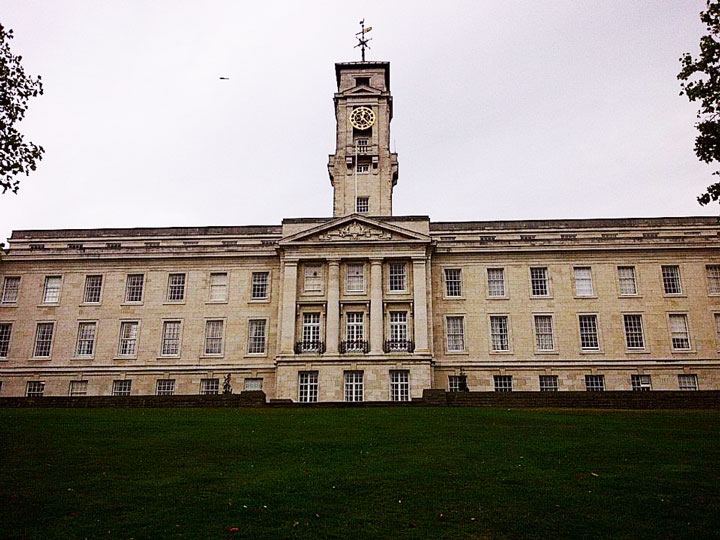
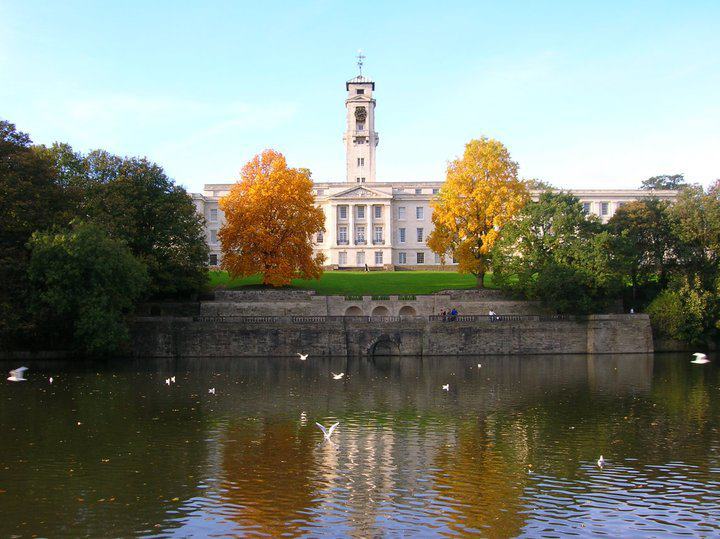
    anwesha-pal8The University of Nottingham, UK is divided into four campuses where the University Park Campus is the one where the school of law is situated amidst beautiful gardens and a lake with swans and lots of greenery. The hopper bus services are very effective which transfer you from one campus to the other for free. These are double-decker buses which run every few minutes.

    A funny thing to note here would be that two of University of Nottingham’s campuses had been shown in a Bollywood movie called Teri Meri Kahaani, which some of our European and English professors went to watch too!
    Well, I think one of the best experiences while living in the UK was when I got the opportunity to watch the Olympics (rhythmic gymnastics) at the Wembley Stadium.


    Holi at Nottingham
    Holi at Nottingham

    How’s the Indian fraternity over there? Are there many Indian students?

    The Indian community in the University is not very big. The LLM Class of 2011-12 had around 100 students out of which 25 were Indians and a few Indian origin UK citizens. The Asian community is pretty big there with a lot of students from China, Korea and South East Asia. There are many societies such as the Indian society, the Hindu society, the ISKCON society and so on where you can meet a lot of Indians too who are enrolled in various fields of study at Nottingham. These societies make you feel like you are a part of a family away from home and the activities during Holi and Diwali were very well organised which my friends from all cultures and ethnicities enjoyed alike. There are quite a few excellent Indian restaurants that have all-you-can-eat buffets in store. They are preferred by Indians and non-Indians alike.


    How is the recruitment/ placement situation for overseas students?

    Ever since the UK did away with the PSW (Post study work visa), the placement situation has not been very encouraging for international students in UK. However, there are a lot of companies including banking companies and other organisations that introduce the graduate program each year. One can always apply for the same and get recruited at the end of the training period. For students applying to law firms in the UK, I found in addition to the international law firms such as Clifford Chance, Herbert Smith and the likes, there are many ethnic minority law firms which release their training contract schemes and vacation schemes every year. The best place for the information regarding employment opportunities is in the law fairs organised by your universities.

    The University of Nottingham has the reputation of getting the majority of students employed each year, undergraduates and postgraduates alike. However, if you are interested in a career in academics, you should keep an eye out for various research associate positions in various universities in the UK including your own university. The Careers and Employability Services cell of University of Nottingham was very helpful with such information.


    How was the academic schedule? Was there a lot of academic work?

    The academic schedule was brilliantly designed, although the courses were very demanding. The course was a mix of full year and half year options along with a dissertation at the end which summed up to 180 credits overall. The students were at liberty to choose the subjects they wanted to take. The assessments for all the subjects were not the same. For some, 15 page essays had to be submitted, whereas for some there were exams in the end. The majority of the subjects one took decided the specialisation such as Masters in International Commercial Laws, European Laws, Human Rights Laws, Maritime law and so on.

    Yes, there was a lot of academic work. For the LL.M. students there were two hour seminars each day for the subjects one chose. The hand-outs for these seminars were given out and additional reading material was put on the portals a week in advance. Studying the given topics thoroughly was a must since the seminar could not be followed otherwise and moreover one would not be able to take advantage of the seminars and the discussions in the class if they were not familiar with the topics. Also, the class performance, which was instrumental in getting recommendations from the professors, was gauged according to one’s participation in the class.

    Formative assessments were also very crucial in understanding the expectations of the professors with regards to our assessments. These were not marked and were meant for practice alone. Apart from that, all the professors were very approachable and always ready to help with your doubts.


    anwesha-pal5What about accommodation?

    The accommodation that I had booked before I left for the university was Broadgate Park. It is situated in Beeston that is a 5 minutes’ walk from the School of Law and other administrative buildings. The road leading to the university goes alongside huge playgrounds, a lake with swans and a small hillock paved with neatly trimmed lawns and bushes with concealed lights that give you the feeling of living in a scenic resort.

    The experience was brilliant. The best part of it was when I was placed in the students’ accommodation with girls from various countries in my flat. I made new friends from various cultures, learnt a lot from them and shared my own too.

    With vast green expanses sunny days were enjoyed by the students whiling away their time on these lawns, debating over issues of politics, playing games and flying kites. We would even organise barbecues during summer break.

    Broadgate Park
    Broadgate Park

    Broadgate Park also organises balls every half a year. The Christmas ball is an extravagant affair with European expert acrobats performing difficult acts followed by prom dances by the guests later on in the night.

    The accommodation that I chose was that of a single study, although there are a wide variety of accommodations that one can choose from, including lesser expensive options.

    The flat that I was allotted had flatmates from Canada, Uganda and China. I found really good friends in them. They were very accommodating and immensely helpful. Exploring Nottingham with them was an experience I will never forget. Social get-togethers with classmates were another highlight that was a very culturally enriching experience. I would encourage students going abroad to take advantage of the international experience as a whole and not limit their world to studies alone.

    The accommodation also organises feasts on various occasions for free for the residing students. At such events one can get sumptuous grub, cultural exchange and make new friends.

    Nottingham is a beautiful town that hosts one of the biggest fairs in Europe which is called the Goose fair. The largest Indonesian festival in the UK was held here as well. It is the land of Robinhood and his friends and you can even find the roads of the town named after them such as the Maid Marian Way, Friar Tuck lane and so on.


    anwesha-pal3Tell us about your classmates, was there a predominantly international crowd? What was the general age group of students?

    My classmates were predominantly European and Chinese students. However, there was an eclectic mix of students from the continents of Africa and other Asian countries. The style adopted in their countries regarding research and studying case laws is very different from the ones adopted in India. The way of teaching was mostly in the form of discussion and reading beyond what was enlisted in the seminar hand-outs.

    The general age of students varied from 24 to 40 years. I met students from Pakistan and Africa who were in their 40s and were either already teaching at various institutions in their countries or working at solicitor firms or were Barristers in London. There was even a student from Czech Republic who was in his mid-thirties and had been working at Clifford Chance for a few years. Some of them were working in Government organisations in their countries.


    Did you get time for any extracurricular activities?

    The course had been designed very beautifully that it even left quite some time for pursuing activities other than the one that were related to academics. During the summers when the lake was not frozen, one could participate in rowing activities around the lake or join the swimming club or the belly dancing societies to learn something new. There are several student-run activities for the health conscious too. Also one could even join the baking club to learn baking or help with the charity functions. There was even a Quidditch society for the Harry Potter buffs. There were societies that enacted period wars, replete with costume and props. For those who were passionate about volunteering, there were charities that needed volunteers to work at the local departmental stores and places like the British Heart Foundation and Cancer Research Institutions to help raise money.

    However, for people who wanted to earn some extra bucks during the breaks, Nottingham being a university town was full of opportunities for students to work in. The ones offered by the university was the Note-taking service and other related support work for the disabled or people with handicaps in the university. The pay was very attractive with almost 16 to 20 pounds per hour with an extra holiday pay. Jobs offered by the university were by far more lucrative than any other jobs that were being offered by other organisations.


    How does one go about scholarships? Does the institute offer any scholarship?

    There are many scholarships on offer such as the Commonwealth Shared Scholarship Scheme, The Developing Solutions Masters Scholarship, IELTS Scholarships, Charles Wallace India trust Scholarship, Aga Khan foundation Scholarships, Goa Education Trust (GET) Scholarships, Chevening Scholarship and so on. The detailed information is given on the university’s website. The University offers a scholarship as well. This scholarship is given by the International Office of the University. Information about the same has been provided on the website.


    What are your future plans? Going forward, how do you expect this experience to influence your career?

    My plan at the moment is to focus on my academic career and move ahead with it. I believe the experience that I have had at Nottingham coupled with my undergraduation from NUJS would be a stepping stone to an academic career that I have always dreamt of. I hope to find better opportunities for my higher research degrees with my experience in Nottingham.