Tag: Law Firm

  • Shreenivas Raju, Associate, Shardul Amarchand Mangaldas, on corporate and commercial law as a field of profession

    Shreenivas Raju, Associate, Shardul Amarchand Mangaldas, on corporate and commercial law as a field of profession

    Shreenivas graduated from Loyola College, Chennai with a degree in B.Com (Hons.) and went on to pursue law from the Cardiff Law School, UK. Currently working as an Associate at the Chennai office of Shardul Amarchand Mangaldas and Co, he specializes in Corporate and Commercial Laws which according to him is also the field he aims to excel in as a lawyer. He has worked at reputed firms like Dua Associates, OSC Services Private Limited and Global Law Alliance, Singapore.

    In this interview he shares his views about –

    • Working in Indian Law firms
    • How different is Indian education system from other education systems
    • His life at Cardiff Law School
    • About His inspiration in his father
    • How Cardiff was his formative time
    • Lessons law students keep in mind before doing internships


    How would you introduce yourself, given that most of our readers are law aspirants, lawyers-in-the-making & young lawyers?

    I am Shreenivas, and I currently work as an Associate at Shardul Amarchand Mangaldas and Co.’s Chennai office. Yes, I am a Lawyer, but since you say that most of your readers are lawyers, friends of lawyers or law students, I’d frankly say that I’m not that well connected with the legal circle here, since I’m a non-Chennai boy; although I would also add that I have been working in Chennai for the past 3 and a half years and am getting to know my colleagues and fellow legal professionals from other firms / practices in Chennai better, and I don’t consider that to be a disadvantage / obstacle that will hinder my aspirations to become a great lawyer someday.


    What interest or influence propelled you to pursue law as a career? What other options were you considering apart from law and how did you make the final decision?

    When I completed my schooling, i.e., after my Std. XII board exams in May 2000, I was discussing my academic future with my father, and at that time, to be very honest with you, I was very passionate about Economics. In fact, I still am, and I guess I always will be. It is a fire inside me that will never die. So, at that time, since I had scored excellent marks in Economics in my board exams, my aim was to study and thereafter pursue Economics as a career, which, to this day, remains an unattained dream of mine. I even applied to Shri Ram College of Commerce in New Delhi, St. Xavier’s College in Mumbai, and other prestigious institutions across India, all for the B.A. Economics degree, but my father was of the opinion that a career in Economics wasn’t worth much – he felt that the only thing one could possibly achieve by studying economics is probably aim for the Nobel prize, and then basically live off research grants for the rest of his / her life in order to carry out research and compile theses. So he was not very supportive of my choice, and told me that the only option I had was to pursue a strong commerce or accountancy undergraduate degree, i.e., a Bachelor of Commerce (B.Com) degree from a reputed institution that would provide me with a thorough understanding of and exposure to the fundamental principles of commerce, business and accountancy, which would thereafter give me more clarity and focus in deciding the relevant field in which I wanted to forge a career in. He said that I could keep in touch with economics as a passion on the side if I wanted to, but that was that, and I had to stick to the aforesaid course of action. Initially, I was adamant about pursuing economics since I had offers from the afore named institutions and others, but my father never relented (even going to the extent of saying that it was either his way or the highway, since he would be the one paying for my education…!).

    So I was left with no choice but to take up the B. Com (with Honours) degree at Loyola College, Chennai. Luckily, the modules that I studies across my three years at Loyola included a module in Economics, as well as the usual modules in Financial Accounting and other fields of accounting – so, I was able to keep in touch with economics for a while during my B.Com degree. Before I knew it, three years had almost come to pass, and my father then wanted me to become a Chartered Accountant just like him. He had been a practicing Chartered Accountant for almost 23 years at that time, and his idea was that his firm / practice was already there, ready to be taken over and run by me. What he didn’t know was that I had realized very early into my B. Com degree, that I did not possess the passion and the flair for accountancy that he had. I knew that I could never do justice to this profession if I chose to become a Chartered Accountant because I didn’t have the drive. In my opinion, passion for whatever it is that one does in life is paramount in order to excel in that field– for me, there was no better example for this at that time than my father himself, a man born into a rural, agricultural family in the Badaga tribal community, who fled to erstwhile Bombay in order to pursue his dream of higher education, and ended up becoming the first ever Chartered Accountant from the his tribal community. He is a completely self-made man whose real-life rags-to-riches story would require an entirely separate interview from me to explain, and, I completely dedicate everything I have accomplished in my life today to him.  So I made this very clear to him towards the end of my B. Com degree, and told him that I wished to pursue something that I was passionate about. My father agreed to me pursuing anything I wanted but for economics and that was when I expressed an interest in pursuing a career in law. That piqued his interest as well and we sat down to discuss the options available. During the course of our discussion, he expressed a view that while the traditional law career involved qualifying and enrolling as a Barrister / Advocate with the Bar Council of India and then practicing in a court of law of one’s choosing he wanted me to explore the option of specializing in commercial or corporate law which, he thought was a fast-developing field of law with tremendous potential. One of his personal quotes which comes to my mind – “a chartered accountant is practically three-fourths a lawyer at most times…”, and being a voracious reader of the Economic Times and other business publications and magazines, made me honestly  believe that he was genuinely onto something, and so we decided that I should pursue a career in commercial / corporate law. This also seemed to make sense to me at that time since I already had a fundamental understanding of the accounting because of my undergraduate program, which I could tie in with a law degree (with specialization in commercial / corporate law modules) and thereby forge a successful career in commercial / corporate law. Even today, when I look back, I believe it was the right decision – a small example to emphasize this would be some of the transactions that I work on in my career today which involve dealing with or scrutinizing financial statements of a corporate entity – to me, these are not just accounting numbers or data, because I am aware of the underlying accounting principles behind such statements, and how the observations from a scrutiny of such statements, can be incorporated or highlighted, as and when required, in a due diligence report or a key transaction document.


    Tell us about your childhood and pre-college life? Was it always a dream to be in legal profession? If not what did you want to be? Who was your role-model?

    I have very fond memories of my childhood; it was a wonderful childhood spent mostly in Ooty and Coimbatore, where I studied at the best schools and my parents made sure that I never lacked anything. In terms of what I wanted to be when I grew up, the list is a long one – I wanted to be a police officer, a soldier in the Army…I even wanted to be Jackie Chan…!!! Till today, I’m a huge martial arts fan, and I still love and revere Jackie Chan. By the time I reached eighth / ninth grade at school though, I was completely smitten by Cricket…by the way; I’m a born cricket fanatic. I was born on June 25, 1983, the day India won the Prudential World Cup at the Lords Cricket Ground in London. My father kept a picture of me as a newborn baby alongside a picture of Kapil Dev holding aloft the famous trophy at Lords in our house.


    So yes, I was completely besotted by the game and I was playing for my School and really wanted to become a cricketer. But then again, that was a completely no-go with my father, and so was never ever possible. As I had mentioned earlier, thereafter, it was only about economics and I never contemplated the idea of becoming a lawyer while at school. In terms of role models, my cricketing inspirations were Kapil Dev, Sachin Tendulkar and Anil Kumble, and in terms of academics and a career professional, my inspiration was, is and always will be my father.


    You did your schooling, senior secondary and bachelors degree in india. Why did you select Cardiff Law School among others?

    Once my father and I had decided that law was the destination, we discussed the possible options where I could study law, and surprisingly my father and I were on the same page that to get the best possible education in law, the most appropriate place would be the place where the law was created, the country of the Magna Carta, which is the United Kingdom.

    So, why Cardiff?  Well, I did apply to other universities including Oxford, London School of Economics, and Kings College, London, as well as Cardiff. I did get through to the aforesaid institutions and   got offer letters from all of them. However, we realized that studying at the  these institutions would be an extremely costly affair – furthermore, despite being a top student in my school  and  college days (I was a gold medalist in Business Mathematics and Income Tax Law & Practice at Loyola College), scholarship offers weren’t easy to procure at all. Around the same time, we met one of our family friends whose son had studied at Cardiff and went on to procure LL.M degree from Oxford and qualified as a Solicitor after doing the Legal Practice Course (LPC) from Nottingham. He subsequently joined as an Associate in Freshfields Bruckhaus Deringer (one of the famed Magic Circle Law Firms based in London).. We also came to know that Cardiff University was a part of the Russell’s Group (i.e., the top twenty Universities in the United Kingdom) and that Cardiff Law School was not only amongst the top ten law schools of the United Kingdom but Cardiff itself was a very vibrant and a student friendly city providing great and economic education. So, we settled on Cardiff.


    Tell us about your experience at cardiff law school, Cardiff University? How would you describe your academic life at Cardiff? What curricular and extracurricular activities did you participate while in university?

    In my opinion, although the B. Com (Hons.) degree that I did at Loyola was my first undergraduate degree, the six and a half years that I spent in Cardiff (completing both my LL.B. Law (Hons.) degree and my LL.M in International Commercial Law (Masters) degree) were the true formative years of my life. I believe that, during that time, I truly discovered who I was as an individual and the extent of my capabilities and skills for which I have to thank my father for that opportunity. When you study abroad, you will notice that the differences in attitude, culture, the system of education, the system of assessment, etc. For example, the relationship between the teacher and the student – it is a relationship built on informality and trust – to this day, I cannot recall a single instance where I’ve addressed my professors / tutors as “Sir” or “Ma’am”…it was always on a first name basis, and for a new international student like me, it was as instant ice-breaker, which allowed us to be more open and frank in our interactions with our teachers, unlike in India, where certain boundaries are established immediately between the teacher and student, which, in my opinion, hamper the scope for an honest, inclusive and objective relationship during college life.

    The LL.B course was very rigorous and was delivered to students by way of lectures and tutorials (similar to group discussions). Lectures ran for five days a week between 8:00am and 3:00pm, sometimes extending later into the evenings as well, with tutorials happening everyday wherein the topics taught at the specific day’s lectures would be discussed and studied in further detail. This was a refreshing change for me from the lectures-only model that I came from in India, since the tutorial sessions were aimed at improving our understanding and consequently our application of the law. The tutorial sessions also formed a great method to revise that day’s lessons on that day itself. However, we were also required to spend quality time in the law library everyday carrying out our own independent research and supplementing the lecture study material with our own notes. All this was very different from what I had experienced in India where I would go back home after college and just complete any assignments / work given for the next day by the teachers, and when the time came to prepare for class tests or exams, all I had to do was to ensure that I committed the entire syllabus to memory (i.e., ‘mugging up’ or ‘ratta maarofy’ in Indian college lingo). Another aspect of the tutorial sessions that I enjoyed was the fact that we learned the law and developed our understanding of the law based on discussions where no one would be openly declared right or wrong – it was through interaction and open deliberations with classmates, which enabled us to develop perspective on different opinions, and to apply that perspective in our understanding of the law. In terms of assessment, we were examined by way of a mixture of exams and coursework / essays to assess your understanding, your analytical abilities, and most importantly, your understanding of the law, rather than just the strength of your memory.

    One of the most important aspects of education in the United Kingdom (and by extension, the western world) is the concept of the prevention of Plagiarism, which forms an integral part of the educational system here. This is again a very unique concept that any and every Indian student, who wishes to pursue his / her education in the UK, would do well to familiarize themselves with. The significance of plagiarism is extremely critical for every student to know, because plagiarism will not only make you liable to be failed in your degree as a whole or to be expelled from university, but it is a civil and criminal offence under the laws of the United Kingdom. The software that is used across the top universities in the United Kingdom is practically foolproof and there is no way of bypassing it. Luckily though, the top universities in the United Kingdom offer mandatory sessions on Plagiarism during their student induction sessions for international students at the start of the academic year, and so we were well-informed of its implications at the very outset.

    From a social and extra-curricular activities perspective, I was involved in various student community and local community initiatives from the Second year of my LL.B degree. During that time, I set up an Indian students’ society called YUVA – Youth of India, which went on to become the biggest Indian/ Asian student community in Cardiff and in Wales. The circumstances which led me to create the society were varied – (a) I, and many of my fellow students, had a very tough first year at Cardiff with nobody to assist or offer any support (the Indian students who had already been there for a while would never come forward to help the newbies and we were always left to fend for ourselves even at times when we needed help); (b) the Indian students studying at Cardiff University was the only student community which did not have any kind of representation through which they could present their grievances / issues to the University authorities; (c) there was no one to initiate the new students and help them to adapt to the change in culture, educational system, etc.; and (d) there was no scope for the organization of any social activities to help Indian students meet and to help them overcome homesickness, etc. I wanted to ensure that no Indian student coming to Cardiff would ever have to ever go through what I went through in my first year, which is why I approached the Cardiff University Students’ Union and created YUVA. It started out as more of a liaison between the University and its Indian students, both current and potential students. From there, YUVA began organizing events / parties for popular Indian festivals such as Diwali and Holi, which included parties, temple trips and Hindi movie-screenings at discounted rates in the local multiplexes for Indian students. Membership of the society was not restricted to Indians alone – our aim was to give the entire student community at Cardiff University a taste of Indian culture, and so we had many students of other nationalities, including Americans, Greek, English / Welsh, and Europeans. After a point in time, our events were considered “must-go-to” and during my time as President from 2004-2009, we hosted some of the biggest events in the student calendar, including our Diwali Bash in 2008, which was covered in the University’s newspaper “Gair Rhydd”, and also covered live on radio by BBC Radio Asia. Another highlight was the annual cricket match that we would organize between Indian Students and Pakistani Students during the summer every year – this cricket fixture became an annual favourite and always generated tremendous banter and camaraderie between Indian and Pakistani students, and generated a lot of buzz in the student community as a whole. All of the above led to YUVA Youth of India being declared one of the best student societies at Cardiff University, and I was voted the Best Student Society President in 2008 for my efforts.

    Other than the above. I also had the chance to pursue my greatest passion in life, i.e., Cricket, to the fullest, during my time at Cardiff. I was part of the University Cricket Team from 2004-2008, and even had the distinction of being the Captain of the team for a couple of seasons. In addition, I was also playing for a local city-based team named Cardiff Gymkhana Cricket Club in the Welsh Club Conference League, where I was also initially vice-captain and thereafter captain of the team. I also made it possible for Indian students coming to Cardiff to be able to join the aforesaid cricket league and play cricket in the summer during their time at Cardiff.

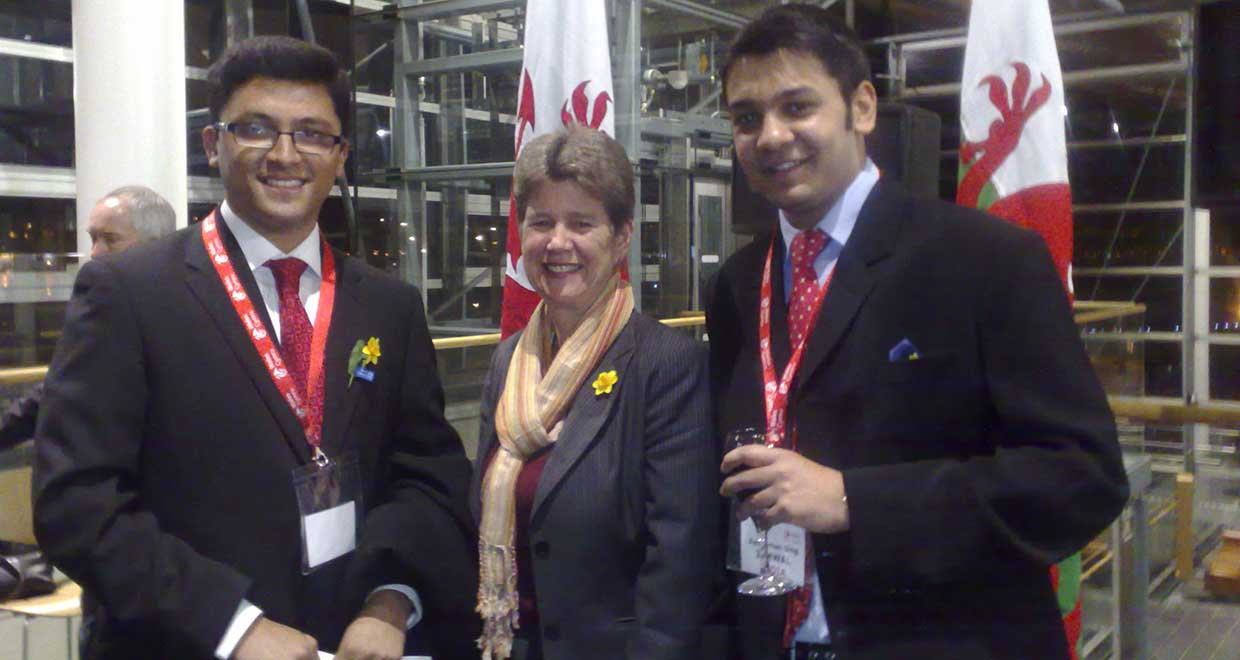
    In light of all the above, I was awarded the “Honour Roll” award by the University in 2007 – the first Indian student to receive the award in the University’s 127-year history, which subsequently led to me being chosen to represent the University at a Royal Garden Tea Party held at Buckingham Palace in July 2007, and at a State Assembly Dinner hosted by the First Minister, Rhodri Morgan AM, at the Welsh Senate – It is for these reasons why I consider my time at Cardiff University the absolute zenith of my academic and personal life so far.



    What all differences did you notice between the Indian form of education and that of abroad?

    Like I explained, I believe that, today, the Indian educational system has come a long way from its earlier avatar – this I have gleaned from my interactions with my fellow colleagues, peers and juniors. From these interactions, I understand that law courses in India are more analytical today in top institutions such as NALSAR and the National Law Schools / Universities, and as rigorous as courses in the UK and the West. At the time when I was a college student in India, as I’ve mentioned before, one major aspect of education in India was that education here was practically a test of memory power. In contrast, during my days at Cardiff, I would say 95% of the modules that I studied during the course of my LL.B and LL.M degrees had only one ‘essay’ question which was probably worth ten or twenty marks at the max – the rest were all problem questions designed to test your analytical abilities and application of the law that you have studies .This was the biggest difference, along with the plagiarism aspect that I had discussed earlier. I understand that prevention of Plagiarism is also being enforced strictly in many colleges and universities in India today.


    What internships and voluntary practical training did you take while in law school? What value addition did they provide to you in your career?

    In UK, there were many autumn and summer placement / internships that were available to students, but initially I did not partake any of them because of the rigorous nature of my LL.B course. During the course of my three year LL.B, I did not attend even a single internship or summer workshop for the first two years because of the course and the preparatory course work for the next years. The only internship that I did during that time was  in the summer break at the end of my first year when I returned to India  at M/s. Udwadia and Udeshi in Mumbai for a month. During the course of that internship, I was just accompanying the senior lawyers to the court carrying files, taking dictations, typing out affidavits, case notes, etc., carrying out case law research and offering assistance in any other manner requested. So in terms of value addition, it wasn’t a huge takeaway but it did give me a feel of what it would be like to be a part of a law firm.  . And if not anything else, I definitely felt the buzz of being around senior lawyers and associates.

    When I came to Chennai for the first time, I approached Dua Associates for a job, but instead they offered me an internship as I was yet to be enrolled with the Bar on an understanding that they will offer me the post of Associate based on my performance during the internship and once the enrolment has been accomplished. The internship was intense and lasted for almost three months and was probably the only meaningful internship that I had taken up  because, during that time, even though I was an intern, I was doing all the jobs a junior associate was supposed to do including working on legal opinions, case law research,  corporate and title due diligence exercises.  In the firm, I started under the supervision of the Corporate partner, Mr. R. Senthil Kumar, and thereafter the supervision of the Real Estate Partner, Mr. P.V. Sajiv Kumar.w I am grateful for that experience because it gave me the first real taste of corporate law and real estate law, and what it feels like to be a  part of a reputed corporate law firm, and helped me in  preparing myself for what I hope will turn out be a fruitful and meaningful legal career.


    What kind of internships would you recommend law students opt for to start building the sort of versatility and widened range of law that you are well versed with today?

    Probably the wrong question for me to be asked, as I’ve already pointed out that I have very limited legal internship experience in India. But from my interactions with peers, colleagues and juniors, I believe that one must not have a fixed mindset when they start fresh out of law school – at that time, generally, in the name of being focused, law graduated are already intent on specializing in a particular field of law and try to obtain internships that will satisfy that aim. In this regard, I would like to quote a senior partner for whom I’ve had the privilege to work with and to learn from – at the start of my career and at many instances subsequently, he told me that as an aspiring lawyer fresh out of law school, you must start with an internship in litigation. Being a corporate lawyer myself, to be honest, I know that people will be surprised by me saying this, but I do believe that the best way to start off is with litigation, because that’s the only way one will get a feeling for how law and the justice system in our country actually works. Transaction work can be learnt at the office from senior associates or by even attending training sessions, but what really happens in a court of law, the associated protocols, the application of the laws and statutes of the land, can only be understood and assimilated when you go to court, while interning under a practicing lawyer / advocate or barrister. It doesn’t matter whether it is a higher court or a lower court, start wherever you can and then go from there. Once you start going to all the big firms, there also the longer internship you get, the better. It is not in your hands.  It is pointless to have an internship for name sake rather the progression in every internship should be carried to the next one. You are going for the internship to get something out of it, right, make sure it counts. Don’t just go for an internship for that you can put a list of internships on your CV to make it look impressive. Try to have some continuity in your internship learning, even though they might be at different firms.


    Could you please tell us the role you played there and the challenges did you face during your initial days of practice?

     (Shreenivas was an integral part at Clifford Chance LLP, where he was involved in the leading acquisition of Kraft Food’s acquisition of Cadbury and several other international transactions between HSBC, Barclays and Standard Chartered Bank etc.)

    This was during my time as a Senior Consultant with OSC Services Private Limited, which is the captive Legal Process Outsourcing (LPO) unit of Clifford Chance LLP, located in Gurgaon, where, at the time of my employment, they had a team of, approximately 40 qualified Indian lawyers, whose role was assist lawyers and associates working for Clifford Chance LLP, a British law firm with a international presence cross border they do, with day-to-day transactional work. It is the world’s largest law firm which operates in about 60 countries right now. So, our job was to offer transactional assistance to lawyers across all the countries in their offices located in cities such as London, New York, Dubai, Singapore, Brussels, etc. There was hardly any challenge for me during my time there, as I had to work on British law aspects, and I was already competent in British law. The challenge was getting to learn all these transactional support work such as proofing of documents (for context and sanity), defined-terms checks, cross-reference checks, etc., which were primarily secretarial / clerical in nature. So the challenge at that time was in bringing me to do such kind of work, knowing fully well that I was a qualified lawyer and yet, I had to do work of a clerical nature, which had nothing to do with legal analysis and reasoning most of the time.

    For most of my time at OSC, as a Senior Consultant, I was called upon to be part of the diligence or drafting teams on most transactions. The acquisition of Cadbury was probably the biggest transaction that I’ve worked on so far for the obvious reason that it was the biggest deal of its kind in the industry at that time. We had different teams from multiple Clifford Chance offices across the world working on it simultaneously. My role was being part of the team that carried out diligence reviews of certain assets owned by Cadbury and creating a database that would list the said assets and the related details, which would subsequently be used as a key reference during the transaction documentation stage. The other transactions that I worked on were primarily in the Debt Capital Markets space for clients such as HSBC, Barclays, UBS, etc., who were all legacy clients of Clifford Chance LLP who were regularly involved in deals involving the issue of global definitive notes, and other instruments frequently used in debt capital market transactions.


    You have witnessed the operational style of law firms of different nations. What is your review on the working style of Indian law firms?

    While working in a foreign law firm, again, the firm culture and the work ethic are completely different. From my limited knowledge and experience, as well as from personal interactions with many foreign legal professionals during my time at Clifford Chance and Global Law Alliance LLC, I have noticed that there is a culture of accountability and responsibility – from the Partner to a Junior Associate, every person is held accountable and responsible for their actions, from the start of a transaction to its end. Associates are nurtured and made to feel a part of the transaction team from the very beginning, where they are sometimes taken along with the lead partner and the principal associates to a meeting where the firm is pitching to a potential client, and the Associate is encouraged to make a part of the pitch and thereby contribute – this goes a long way in boosting the confidence of associates and also takes them on a valuable learning curve where their perspective of the transaction starts at its very inception and ends when the transaction closes.


    Could you please tell us about your experience in the Global Law Alliance LLC, Singapore ?

    (Sreenivas was associated as a para legal at Global Law Alliance LLC, Singapore)

    Global Law Alliance in Singapore, I think, was a five to six month stint. It was different from my prior experiences because it was an absolute litigation firm primarily dealing with small as well as large litigation cases relating to tort law, accident liability, insurance claims, etc. For me, the take away from GLA was limited as I practically had no experience whatsoever in the kind of work they were pursuing, and because I had to hit the ground running and make good on deliverables with absolutely no prior training whatsoever. Additionally, I felt burnt out on many occasions during my time at GLA, because the deadlines were too intense and also because of the hectic work schedule in Singapore (which has a general six day working week, and in my case, which became a seven day week for the entirety of my stint there, and therefore meant absolutely no work-life balance). It was definitely not my cup of tea although I did enjoy occasionally going to court and observing the proceedings in some of the cases there. And, to be honest, I left it because I didn’t learn much in those six months and I felt that I was only going backward in my legal career.
     

    Tell us about your experience at Dua Associates Chennai and Cyril Amarchand Mangaldas Chennai and the work profile you were entrusted with.

    Dua Associates was my first official law-firm / associate role – as I mentioned earlier. I started there with the General Corporate practice headed by Mr. R. Senthil Kumar and was there for a period of three to four months, before moving to the Real Estate Practice headed by Mr. P.V. Sajiv Kumar, where I worked for the remainder of my time with the firm, i.e. around one year and three months. Again, as mentioned earlier, I believe that my time with Dua Associates was a steep learning curve for me and it was there that I really cut my teeth as a lawyer.  Today, my primary field is Real Estate / Real Estate Financing at SAMCO, and was my primary field at CAM as well. The foundation for this was laid at Dua Associates. It was quite an intimidating time for me since Dua Associates had, and continues to have till this day, a very well respected Chennai practice headed by the afore named senior lawyers which retains the confidence and trust of a formidable clientele.

    From there, I moved to CAM, where my work profile again involved a mixture of general corporate, real estate / real estate financing and a little bit of capital markets work. The general corporate aspect involved working primarily on corporate due diligence reviews and preparing legal opinions on various regulatory aspect, whereas the real estate component involved carrying out of detailed title due diligence reviews and the drafting / preparation of transaction documentation for real-estate financing transactions (in most cases, for the issuance of non-convertible / optionally convertible debentures).


    What prompted you to shift to the elite Indian law firms? How did your experience there differ from your earlier experiences?

    Well, what prompted my move to the elite Indian law firms is that I realized that I always wanted to be a lawyer and an associate working for a proper law firm. And when I returned from Singapore in 2013, I was already 30 and I realized that I had to move ahead to something. I joined Dua and the difference between the previous thing was that it was an LPO, the work experience is discounted wherever I go and LPO is different from a corporate kind of thing and it is more of corporate experience because of my own specific skill set, I was exposed to the legal side of things and it was a glorified back office. You’re a processor and not a lawyer and this is the biggest difference. I am a lawyer now and I was a processor then.


    Why the special interest in corporate laws and commercial laws with a special focus on commercial contracts, real estate & real-estate, financing, corporate governance, due diligence, regulatory & compliance?

    As I had mentioned earlier, that had been my idea all along. I did my B.Com (Hons.) and my law degrees (with my Masters being in Commercial Law) with a view to specializing in corporate / commercial law. However, I must admit that, when I started my education at Cardiff, I wasn’t aware of the true breadth of fields and practice areas under the ambit of corporate law / commercial law. It was only after I completed my LL.M. and during my subsequent stint at OSC Services that I realized that there was so many practice areas which one could be involved in. Subsequently, from my work experience with various firms, I have learnt, and continue to learn to this day, the nuances of the Corporate and the commercial field. in which I retain a special interest and wish to excel as a lawyer in this fields.


    What were the challenges you faced in shaping up your career as it stands today and where do you see yourself ten years from now?

    One of the biggest challenges I faced currently is keeping the fire burning inside me consistently. There are times when I get bogged down due to external and internal factors, and this is something that I am working on. Sometimes, I slip into a line of thinking that I am not where I should be right now in terms of what I have achieved in my career. I feel that I am probably three or four years behind from where I should actually be. Other than that, for me, keeping up with the ever-evolving nature of the corporate space in India and the related acts / statutes / laws, and learning how to customize the advice that we render to our clients in the current volatility of Indian markets is a key challenge. In the legal profession, it is imperative to stay at the top of your game at all times, and this means servicing the clients’ needs in the most efficient and proficient manner. For this, it is necessary to go above and beyond the call of duty and herein lays the challenge – of challenging yourself to be the best at what you do and to continually grow. Although, I also believe (as my father once told me) that the day you think you’re the best at something is the day you make the biggest mistake of your life. It is very important to acknowledge that we work in a profession where the learning never stops, and that there is always someone who is better than you and it is even more important to aspire to be as knowledgeable and as good as that person. So, therein lays the challenge- To continually learn with the same level of enthusiasm and the same level of commitment that you displayed in your younger years and not let money and any / all other internal and external factors come in the way of you becoming the best lawyer that you can be.

    Where do I see myself ten years from now? Well, I’m not the type who plans that far ahead to be honest. But I will say one thing in this regard the place where I’d ideally want to be in ten years is the following situation – at that time, if a client (on a transaction that I may be assisting the said client with) wakes up in the middle of the night or has been breaking his head all night over some legality or issue that may adversely affect the said transaction, and the said client is at their wit’s end as to how this can be resolved, then they should pick up the phone and call my number first. I want be that good a lawyer and should have earned the trust of my client to the extent that they should believe that I am the only person who can help them –  I want to be the first point of contact, the first resort for every client of mine, rather than the last resort, If I get to that place in ten years’ time, I’ll say-Mission Accomplished!


    What do you want to say to the next generation lawyers? What is your parting message to our readers?

    My message to young, aspiring lawyers (as well as aspiring law students) is that nothing comes easy in life…you have to put in the hard yards….especially in this profession.

    As a wizened legal eagle once told me, the legal profession is not a sprint, it’s a marathon. In a marathon, the eventual winner will be the one who conserves his energy, learns about his opponents, sees how they are running and sees the mistakes they are making, formulates a plan for the long run ahead, puts his head down and executes the plan with dedication and commitment, and then unleashes himself down the home stretch and leaves all his opponents behind. Similarly, the legal profession is like a marathon where you cannot expect to be successful overnight. It takes years of learning, practice and efforts to make it big as a lawyer and there’s no second way about it…!!!

    The Legal industry in India today is a burgeoning and cutthroat world where, if you’re not in for the long haul, then you’re on your way out before you know it…!!! The amount of law graduates being churned out of the law schools every year is increasing and there are hundreds of quality law graduates out there, and you are in competition with every single one of them. So, the stakes couldn’t be any higher.

    Be patient and willing to put into the hard yards…and never think that you are entitled to anything. In this profession you have to earn your stripes through dedication, learning and hard work, while also not compromising on your personal and professional integrity. And the most important thing to remember when you start as a lawyer is that your journey has just begun…be willing to learn first and then apply that learning…don’t worry about the money…give yourself a solid 2-3 years to build a good foundation  based on learning and application…be your best and the money will come automatically.


    Good Luck and God Bless!

  • Vikram Raghavan, Lead Counsel, World Bank, on work experience and authoring legal books and articles

    Vikram Raghavan, Lead Counsel, World Bank, on work experience and authoring legal books and articles

    Vikram Raghavan graduated from NLSIU, Bangalore with eight gold medals in diverse fields of law in the year 1997 and then went to pursue his masters from New York University. Right after that he started work as an attorney at O’Melveny & Myers, an international law firm in New York City.

    Currently Vikram is currently a Lead Counsel at the World Bank in Washington, DC, and he advises on conflict, fragility, refugees, and macroeconomics. Among other things, he provides legal advice about military coups; United Nations sanctions; debt relief; and loan conditionality. He has authored a book titled Communications Law in India (LexisNexis, 2006) and co-edited a volume of essays: Comparative Constitutionalism in South Asia (Oxford University Press, 2013). His articles are reflected in The Hindu and Economics and Political Weekly.

    In this interview he talks to us about:

    • Choosing law as a profession and his experience at NLSIU, Bangalore and New York University;
    • The art of managing life at law school and to develop interests in different curricular activities;
    • His formative years as a lawyer and his time at O’Melveny & Myers, New York City.
    • His early life at World Bank as a counsel and moving ahead and becoming the lead counsel at the World Bank.


    What made you opt for law as a career?

    Well, I was always interested in argumentation. My father was a lawyer and my grandfather was a lawyer as well. But the family profession, so to speak, influenced my decision only so much. When I was about thirteen years old, I read Prashant Bhushan’s book “The Case That Shook India.” I always wanted to do what he did and what he described about the court room drama.

    However, it wasn’t an easy decision because at that time law was not considered to be a prestigious profession. The National Law School had just started and not even a single judge had graduated. So, there was a lot of uncertainty about it and ultimately, the fact was I didn’t want to do science. I had taken commerce and my only options were doing economics, commerce or something else entirely. So, law looked like an attractive idea because NLSIU had just started. I gave myself a year to see if law suited me, if it had not- I guess I had an option of coming back to economics.


    Could you tell us about your life before you joined college? Where did your interests lie during your school days?

    During school, I was a stamp collector first and foremost. Philately, as a hobby, shaped my interest in world events and in general knowledge. I also obtained a lot of confidence in public speaking by speaking at the South India Philatelists Association’s second Sunday meetings in Madras. Everyone who attended had to speak. So it was a nice way to get rid of adolescent stage fright.


    What curricular and extra-curricular activities did you participate while being in university?

    Well, it was an intense period of five years. The schedule of studies, as you would know, at any National law school is quite demanding. There are deadlines for something or the other, every other week — project submissions, moot courts, mid-terms, and end terms. So I spent most of time by trying to catch up and be on top of the different deadlines that would come.

    Of course, when I was in college, there was no proper Internet. The campus itself did not have many facilities besides the library, which closed at 6.00 p.m. And you could borrow only three books. So I couldn’t say I was very productive. But during those five years, I tried my hand at different things. In my first two years, I did judo at the Sports Authority of India campus near the Law School. I tried my hand at quizzing, but there were much better quizzers at the law school than me. To be sure, there were other extra-curricular activities at NLS like sports and debates. But then again the school was filled with many talented students from the best schools in India. I simply did not have the background or training in high school to compete with them.

    The incentive system in the law school was also skewed in favour of mainstream academic excellence. There were three big things you did if you wanted to be noticed: moot courts, grades, and articles. So, basically I spent those five years trying to get good grades. And you know I don’t regret those five years. What I am today is due to those five years of hard work.


    vikram-raghavan-2

    Could you tell about your internship experiences? What sort of internships did you prefer and what learning experiences did you gain from it?

    Well, I did four internships in those five years. The first one was an internship with  R. Gandhi, which involved working on a lot of constitutional law matters. Among others, I worked with T. Sivagnanam, who is currently a judge at the Madras High Court and on the law school’s governing council as well I think. I also interned with N. Paul Vasanthakumar, the current chief justice of Jammu and Kashmir as well Ravi Chandra Babu, who is also now a judge. These judges were the three lawyers who I worked most closely with during my first internship. The second internship was in the Madras High Court focusing on criminal law under N.T Vanamamalai, a senior advocate. In my fourth year, I worked with K.K. Venugopal and in my fifth year I went to Sri Lanka to work with the Tamil leader, Dr. Neelan Tiruchelvam on the constitution-making process.


    Straight after your under-graduation you went abroad to pursue masters at New York university. What was your experience at NYU and what all differences did you notice in quality of education at NLSIU and NYU?

    Well, obviously the facilities over NLSIU were rudimentary. New York University had a lot more facilities. The library was out of this world and the NLS library in those days was still getting built. In those days, we didn’t have the internet so, you know things were different. Also American law schools are rigorous. They put a lot of effort into preparation before class. So, if you don’t read up and come to class then it would be difficult for you to follow.


    Could you please tell us about the skills and preparation needed for the moots, building arguments and the way to read a judge’s mind and what are the criteria’s a judge chooses to mark the participant?

    (Vikram has represented India at Philip C. Jessup moot court competition and he also served as the executive council member till the year 2011.)

    Mooting is something that I strongly recommend because I think it really helps in court craft and you it helps you dig deep into a legal subject. When I was a law student there weren’t so many moots like you have today. More number of moots are opportunities for people to learn and explore. Eeveryone at NLS has to compete internally first for it, and the internal competitions were in itself very intense. These competitions conducted across the different classes, which meant you had to argue against the seniors who know more law than you do.

    This was a good process, because it forced you to basically go out of your comfort zone and learn new things very quickly. Participating in the Jessup, no doubt, enhanced my interest in international law. Probably my career today is based on that experience.


    You have been an associate at O’Melveny & Myers LLP, An International Law firm. Could you please tell us the experience there?

    That was just after NYU. I spent three years at O’Melveny. I worked on corporate and transactional work and also some litigation, basically international arbitration. It was a very intense experience, because U.S Law firms practice law in a way that is very demanding.  I think the main thing for me was to be able to practice law with very smart lawyers and clients.


    You were the editor of NYU Journal of International law and politics. Could please tell us the role you played and what all things did you achieve during your tenure as an editor?

    I wasn’t the editor. A friend of mine was an editor. I was just a graduate editor. If you look at the cover page it has many editors and editor is mostly just a title. I was involved in proof reading some of the articles. I don’t know what the editorial process is like now in Indian law school but it was certainly different from what we did at NLS. At NYU, a lot of care and attention was taken to ensure that the articles are selected properly and carefully formatted and cross-checked. It is a very rigorous exercise.


    Could you please tell us about your recruitment at the World Bank and initial days of work? Is it possible for a law student to get an internship at the World Bank?

    (Vikram started at World Bank as a counsel and now he is the lead counsel of operational policy at the World Bank.)

    After three years at a law firm, I applied for and got hired as a counsel at the World Bank. When I came first here, I was given Sri Lanka and Nepal and later Afghanistan and Iraq. That experience was really worth in a way shaped my profile at the bank, working with conflict prone countries, and more unstable countries. I think it was an exciting portfolio for any lawyer to do because it has a mixture of law and policy. Working on a World Bank project is, in itself, a very challenging and rewarding thing. Sadly, we don’t offer regular internships at the World Bank’s legal department. Most of our interns come from institutional partners like NYU who pay the students a stipend. The World Bank does not have the budget nor can we take unpaid interns.


    Could please tell us how to develop writing skills to our readers who are mostly law students?

    (Vikram has authored a book on communications law in India and co-edited volumes of essays on comparative constitutionalism in South Asia, his articles are reflected in the editorial columns of The Hindu and Economic and Political Weekly.)

    I would recommend students read the work of Bryan A. Garner. He advocates writing simply and elegantly. Read his work. And you will write very differently. I guarantee it.


    How did you to continue to maintain the love for history, economics and law, despite such hectic schedule in life?

    It is always a challenge. Every day, every minute you have to find time to do different things.


    What would be your message to the young law students and budding lawyers?

    Well keep working hard, and I believe whoever keeps working hard basically succeeds. It doesn’t matter what school you go to or what grades you get, your hard work helps you. Gain expertise in the subjects that interest you. Build a brand for yourself.

  • V V S N Raju, Corporate Lawyer, on establishing Juris Prime Law Services

    V V S N Raju, Corporate Lawyer, on establishing Juris Prime Law Services

    V V S N Raju graduated from Osmania Universtity (1990-1993). He is a Corporate Lawyer and has over 22 years of Experience as in-house counsel and external counsel for Corporates and Financial Institutions/Banks.
    His specialties include Banking, Corporate, Documentation, Real Estate, Recovery, Litigation, Arbitration, Project Finance, Restructuring, Securitization, Mergers and Acquisitions, government liaison and Employment Laws.


    In this interview he talks to us about:

    • Inception and basic motive behind establishing Juris Prime Law Services (Law Firm).
    • Challenges faced in the initial days of establishment.
    • Services provided by the firm.
    • Uniqueness of services provided by the law firm.


    Please share with us the inception and basic motive behind establishing Juris Prime Law Services.

    During 2005 (re-launched in 2015), there were not much law firms in Hyderabad to cater the Banking, real estate and Corporate needs of local clients. So I felt it was a good time to establish a law firm which would provide best legal solutions with a practical approach to cater the needs of the clients in and around Hyderabad.


    What challenges did you face in the initial days of establishment and how did you overcome that?

    Main challenge that we faced during the initial years was getting right kind of clients and recruiting right kind of human resources. In fact, these are the challenges which are faced by all the companies at all time.

    I sort of tried a trial method and recruited fresher’s and trained them so that they can provide legal services according to the standard and quality promised by our firm to our clients.


    What are the services provided by the firm and how it caters the need of clients in Hyderabad and elsewhere?

    Juris Prime Law Services is a full service law firm. We provide legal services in following fields:

    • Arbitration & Dispute Resolution
    • Banking & Finance
    • Company Incorporation
    • Corporate & Commercial Law
    • Employment & Labour Law
    • Foreign Investment
    • Intellectual Property Rights
    • Mergers & Acquisition
    • Litigation
    • Private Equity & Venture Capital
    • Project & Corporate Finance
    • Real Estate
    • Technology, Media & Telecom

    Being a full service law firm, we are capable of providing solution to all kinds of legal complexities faced by the clients under one umbrella. We structurize client’s transaction and provide practical solutions in a legal way.


    Please share with us the uniqueness of services provided by your law firm.

    We give problem oriented solutions. We believe in specialized rather than generalized solution which makes us different from our competitors.


    What milestones have you achieved till now?

    Our growth rate has been good and satisfactory. Since our inceptions there is no time for looking back as day by day we are progressing. Over the years we have been associated and empanelled with lot of Banks and large Corporates.


    Where do you see the firm in the long run?

    There is no road map as such because I believe in working hard which is a key to success. In coming 2 years we are hoping to see our revenue increasing by manifolds with a significant increase in no. of client and we from a firm of 11 headcount hope to become a team of 20 by March 2017.


  • Ramakant Gaur, Partner, Ace Jurix, on work experience in litigation at Ace Jurix

    Ramakant Gaur, Partner, Ace Jurix, on work experience in litigation at Ace Jurix

    Ramakant Gaur graduated from Chaudhary Charan Singh College, Meerut in 1995. He is a game changer, defense lawyer for the complex litigations of Economic-Corporate-real estate disputes involving the criminal laws. He examines the matters closely like an investigator; ponders the prosecution’s point of view and then envisions the strategy for the defence, with his substantial experience.

    He has excelled in prosecution cases instituted by the Indian Dept. of Customs & Central Excise, Directorate of Revenue Intelligence (DRI), Directorate General of Central Excise Intelligence (DGCEI), Central Economic Intelligence Bureau, Enforcement Directorate, Economic Offense Wing and Crime Branch of Multi State Jurisdictions, Income Tax dept. etc. He has efficaciously pleaded as defence attorney, in the cases involving prevention of money laundering laws, Corruption laws & anti-drugs laws.


    In this interview he talks to us about:

    • The ways in which money laundering takes place.
    • Laws before and after Prevention of Money Laundering Act, 2002.
    • Lessons to be learn from various financial scams in India and abroad.
    • Role of national and international agencies to curb issue of money laundering.
    • Preventive measures taken to curb the flow of black money.


    What are the ways in which money laundering takes place? 

    Money laundering is a way to filter and convert ill-gotten money and conceal its illegitimate source so that it appears that the original source is a legitimate one. It is prevalent in many forms world-wide such as Hawala transactions, shell companies, terror financing, smurfing, etc. The scamsters or the money launderers generally follow these three steps, firstly, Placement of the proceeds of crime into the financial system, followed by Layering or doing away with the original source of illicit funds, and then Integrating the same into the financial system.


    What are the laws before and after Prevention of Money Laundering Act, 2002? What major amendments took place?

    Until 2002, several authorities under IT Act, Benami transactions Act, etc. adjudicated over the issue of money laundering, but with the alarming rate of transnational criminal financial activities, a need for holistic legislation gave way for the enactment of PMLA 2002. It has the provisions for the confiscation of tainted properties and was amended thrice, first in 2005, then in 2009 and then 2012. The PMLA (Amendment) Act, 2012 has enlarged the definition of money laundering by including activities such as concealment, acquisition, possession and use of proceeds of crime as criminal activities. Some other features are as follows: The amendment has introduced the concept of Corresponding law to link the provisions of Indian law with the laws of foreign countries and to provide for transfer of the proceeds of foreign predicate offence committed in any manner in India. It also adds the concept of ‘reporting entity’ which would include a banking company, financial institution, intermediary or a person carrying on a designated business or profession. The Prevention of Money Laundering Act, 2002 levied a fine up to Rs 5 lakh. The amendment act has removed this upper limit. The act has provided for provisional attachment and confiscation of property of any person (for a period not exceeding 180 days). This power may be exercised by the authority if it has reason to believe that the offence of money laundering has taken place. Part B of the Schedule in the erstwhile Act included only those crimes that are above Rs 30 lakh or more whereas Part A did not specify any monetary limit of the offence. The amended act has brought all the offences under Part A of the Schedule to ensure that the monetary thresholds do not apply to the offence of money laundering.


    What are the objectives of Prevention of Money Laundering Act, 2002? 

    The Act was introduced in order to combat and deal with the menace of Money Laundering and incidental activities in the nation in lines with India’s international obligation under the UN General Assembly’s resolution adopted in its Political Declaration and Global Program against Action. The Act majorly provides for the confiscation of the property obtained out of the proceeds of crime. It also imposes various obligations on banks, financial institutions and intermediaries to maintain records of all cash transactions. As the basic principles of evidence say that the burden to proof is on the part of the prosecution to prove the, this is the only statute where the onus lies on respondent to prove the legit source of income.


    Please share with us the success story of PMLA so far in the light of judicial pronouncements. Highlight some scandals and case studies.

    The PMLA has played undoubtedly played a deterrent role when it comes to combat/curb the menace of money laundering. The Enforcement Directorate, with the vigilant efforts made by FIU, CBDT, CBI, RBI and SEBI has confiscated crores of movable and immovable properties in the span of few years which were allegedly obtained from the proceeds of crime. It has spared absolutely nobody. From two tier-city businessmen to  top-notch names have find a mention in the hit-list of ED such as Vijay Mallya, Chagan Bhujbal, Subhrata Roy to name a few. As per the statute, ED has also attached properties situated abroad. The latest highlights being Augusta Westland case, Kingfisher fiasco, NSEL case, Kartik Chidambram and many more. ED has been absolutely ruthless in cracking down these alleged people.


    What are the lessons to be learnt from various financial scams in India and abroad? 

    To name any financial debacle in particular, would be an understatement. India has seen the infamous Hawala transactions, Satyam scam, chit fund scams, Ketan Parikh and Harshad Mehta, to name a few. They admonish towards the fact that banks and financial institutions have to be brought under the radar of regulatory and enforcement agencies. The cash transactions also have to be dragged under certain threshold limits.

    The success of RICO Act of USA, originally used to prosecute US Mafias US involved in organised crimes during 1980s, led to number of trials and convictions. It has a strong harmonious network with various enforcement agencies. On similar lines, creation of SIT on black money as a watchdog has taken a leap in investigation of black money in and out of India. As per the latest report of SIT, the data provided by the enforcement authorities shows that there are gaps in monitoring trade flows which are used by unscrupulous elements to take out precious capitals outside the country and thus damaging the fabric of the Indian economy and in order to deal with the same, the SIT has asked RBI to establish an institutional mechanism to track illicit financial flows and share data with other law enforcement agencies such as ED,DRI and CBDT and from the said data base various agencies can gather the relevant information for taking early appropriate action. This is so since the data available with one agency can be relevant to action expected to be taken by other law enforcement agency.


    What is the role of national and international agencies to curb issue of money laundering?

    Various special courts have been set up by the virtue of this Act for the purpose of trial of scheduled offences. The Enforcement Directorate has been responsible for the investigation and Prosecution of cases under PML. The Financial Intelligence Unit India (FIU-IND) is the nodal agency for the dissemination and analysis if the information pertaining to the suspicious financial activities. Apart from these, RBI, SEBI, CBDT, Police have been active at different levels to look into flow of Black money.

    At the international level, with the initiatives of UN Financial Action Task Force (FATF) was formed in 1989 to set standards and formulate policies to combat money laundering. It is today one of the most efficient organization working towards this directions, especially on Combating the Financing of Terrorism (CFT).  UN and many .other nations have enacted stricter laws on money laundering as well.


    What preventive measures are taken to curb the flow of black money? 

    Government enacting Black Money Act 2015 has been seen showing light at the end of the tunnel from where undisclosed foreign income enters into Indian system as it has stricter penalties for offences since it was the need of the hour. Also India has signed many Double Tax Avoidance Agreements, SIT has been setup to investigate this issue, and Income Declaration Scheme 2016 have been introduced, strict KYC norms to be followed by banks, Tax Information Exchange (TIE) Agreements are proposed and many other precautionary measures have been taken.

    SIT has been proposing several recommendations in this regard such as a ban on cash transactions above Rs. 3 lakhs and restricting cash holdings with individuals upto Rs. 15 Lakhs; then it has suggested to establish KYC registry; prior detection of the shell companies with the help of intelligence gathering and entrusting Serious Fraud Investigation Office (SFIO) to regularly mine the MCA 21 database for certain red flag indicators; to check upon the misuse of Participatory notes through KYC norms so as to detect the beneficial owner with the help of PAN card number. It has also suggested that all the cases pertaining to trade-based money laundering should be shared with ED by DRI so as to initiate investigation under PMLA. Therefore, our law-makers have set up the panacea to the problem of black money but its effective enforcement will be testified over the time.


    What are the loopholes in the current legal regime in India? 

    So far as prevention of money laundering is concerned it has been fairly able to do justice, but still it has certain grey areas. Real estate sector, jewellery and bullion, and NGOs are the most vulnerable sectors for occurrence of illicit financial transactions. Inadequate scrutiny structure for cash transactions, inefficient system to preserve confidential financial system and liberal attitude towards the non taxpayers are a few areas where our legal system is lagging behind.

    As, a defence lawyer of prevention of money laundering cases, it has been observed that the process of attaching properties of the accused by ED has ,mostly been done even before filing of any criminal complaint or a chargesheet been filed and thus infructuous. There is a lot that has to be done by all the vigilance authorities other than targeting big names and getting affected by media trials. The present situation demands major amendments in the grounds/process of attaching the properties under PMLA as till date this process has turned out to be absurd.


    What were the challenges you faced in shaping up your career as it stands today?

    There is no competition or challenge in the space whereas there are challenges, struggle and obstacles on the road. I preferred to create a space and develop a niche, reign of the economic loss. I had beaten the competition or challenge through strategy executed with the support of a flamboyant team.


    What would be your parting message to our readers?

    There is no shortcut to the success except hard-work. Before entering into the professional reign, study the market. No client looks for the ordinary lawyer. Start your career as a champion and excel.


  • Raj Panchmatia, Partner , Khaitan and Co., on work experience in litigation and disputes resolution

    Raj Panchmatia, Partner , Khaitan and Co., on work experience in litigation and disputes resolution

    Raj Panchmatia graduated from Mumbai University in 2000. He is a partner in the Dispute Resolution Practice group in the Mumbai Office and has a rich experience in the field of dispute resolution and commercial litigation, both at domestic and international fora. He has advised clients on a wide variety of claims under Indian Arbitration Laws, SIAC, LCIA, ICC, UNCITRAL and HKIAC and has extensive experience in dealing with disputes under all forms of contracts and agreements. Raj also advises clients on litigation before the Supreme Court of India, various High Courts of the country, the Securities Appellate Tribunal and the Company Law Board.

    Raj has worked on a number of corporate and commercial litigation matters for various private equity investors, multinational and industrial houses of the country, including prominent infrastructure, real estate, automobile, defence, hospitality, public sector undertakings and ship building companies. Raj has also represented the Government of India on various dispute resolution matters.


    In this interview he talks to us about:

    • His work at Khaitan and Co.
    • Necessity of a mentor or guide.
    • Difficulties faced in the early days of practice.
    • How he keep himself abreast with latest industry news and trends.


    You graduated from Mumbai University in 2000. What was the legal profession like back then? What were your objectives as a law student?

    Legal profession back then was still technologically evolving. Those were interesting times,as law could be found only in books and not on Google. My senior told me – work hard and rest will follow.


    How is your work at Khaitan and Co.? Please tell us a bit about your work profile. What are the responsibilities you are entrusted with?

    I am a partner at Khaitan. My core area of practice is litigation and disputes resolution. At Khaitan, I have been fortunate to be part of some of the biggest litigations and arbitrations of recent times, in terms of value and significance. My clients vary from international companies, PSUs and Indian promoters in all sectors. Joint venture disputes seem to be in vogue these days, and I advise on many of them as well. As a partner in a law firm, soft skills play an equally important role as legal skills. As a Partner your responsibility would also include building and managing a team which is effective and a practice which is robust.


    How necessary is it to have a mentor or guide to handhold a young lawyer while still in the formative years of the profession? Did you have one?

    It is good to have a mentor and a guide in your formative years who is willing to guide you through the nuances of the practice, especially if one comes from a non-legal background. In my formative years I had an opportunity to train under some of the finest legal minds Late Mr. D M Popat, Senior Partner of Mulla & Mulla & Crige Blunt and Caroe and Mr. D D Udeshi, Partner of Udwadia & Udeshi as it then was. I also had an opportunity to work under Mr. D E Udwadia, who exposed me to corporate laws, which has been very helpful in dealing with corporate disputes of today.


    What were the difficulties you faced in the early days of your practice? How many years of hard work does it require to build a firm clientele?

    Let me put it this way, if you are willing to learn and work hard, things become easier. There used to be paltry sum of stipend (compared to what interns make these days) and hours were long. I never said no for any kind of work that came my way. As I don’t come from a family of lawyers, learning on the job was the most effective way. It was tough but satisfying. Unlike in the present times technology was not so easily available and research would take far more time. I had to learn the ways to complete the research efficiently and without missing any important points. This exposed me to a variety of laws, and I gained rich and vast experience. The crucial thing, which I feel I learnt from the experience, was to apply innovative and lateral thinking, despite time pressure.

    You build relationships not clientele. You need to build trust and provide consistent quality advice. There are no fixed timelines for this.


    Could you tell us about the atmosphere in each of the places you have worked and what one should keep in mind before joining?

    I have been part of a large as well as a mid-size organization. Each organization has its own systems, which essentially shows the values and beliefs of its founders/partners. Fortunately, every place I worked at had an atmosphere of trust and it felt like a big family, which helped me grow professionally as well as individually.

    I would say that before joining a firm, one should first understand the ethos of the firm as a whole. One should choose an organisation that is known for its integrity, value systems and has a work culture that allows its resources to flourish and bring excellence at their work.


    From an Articled Clerk to Advocate and Solicitor assistant at Mulla and Mulla and Craigie Blunt & Caroe, how did it happen? What are the important attributes for an Articled Clerk to work on?

    I joined Mulla & Mulla after I qualified as an Advocate and then went on to qualify as a Solicitor. In hindsight, it was perhaps one of the best career decisions I made as I found the learning curve to be extremely satisfying. My initial training in Mullas gave me a firm foundation. There was a lot of hard work, research and reading. Practice then was not slotted in compartments which meant,I got experience in various spheres of law.

    Once a candidate decides to become an articled clerk, and has chosen a master to learn from, it is then most important to put his full faith and trust in his master.  So decide well under whom and where you want to article, as this is the place which will make a lawyer out of you.


    How do you keep yourself abreast with latest industry news and trends?

    At Khaitan we have a very good initiative which is CLE (Continuous Learning Exercise) which helps all its advocates keep themselves updated. A CLE is a monthly session where all teams present updates from their respective practice areas, followed by a brief discussion. These sessions are very helpful as you get to interact with lawyers experienced in that field. I also read judgments, legal journals and magazines as time permits. Discussing and sharing issues with my colleagues is also helpful and often bring out new nuances and directions.


    You have authored articles in various Indian and International legal journals. Please share with our readers your experience.

    Writing is not something which came to me naturally. Having said that, once you make an effort and if the result is even partially satisfying, it is a huge gratification. I intend to explore this more. Of course my team has been extremely supportive in my efforts and credit must go to them as well.


    What would be your parting message to law students?

    I can only pass on which I inherited and strongly believe in – Be true to yourself and true to your work and the rest will follow. Never shy from working hard.


  • Trupti Kulkarni, Senior Consultant, Vahura, on being a Candidate Engagement Lead at Vahura

    Trupti Kulkarni, Senior Consultant, Vahura, on being a Candidate Engagement Lead at Vahura

    Trupti Kulkarni graduated from University Law College, Bangalore in 2005. She joined Accenture Services Private Limited where she worked for an Insurance Process handling Motor Insurance Claims. She also worked with Honeywell Technology Solutions and TPI Advisory Services handling Contract Management.
    At Vahura, Trupti used to head recruitment at senior and mid- level, for corporates and law firms, concentrating on South India. She has regularly worked on General Counsel and Senior Management positions in the IT, infrastructure, manufacturing, pharma, FMCG space. More recently she has moved on to internal functions within the organisation focusing on Candidate Engagement and Employee Motivation initiatives. She also handles internal recruitment at Vahura.


    In this interview she talks to us about:

    • What prompted her to join Vahura.
    • Impacts on her after joining Vahura.
    • How legal education and training helped her in the present role.
    • Advice to a young lawyer if he/she wants to tread the alternate career path.


    How would you like to introduce yourself to our readers?

    I am a lawyer by training and a HR professional by choice. I passed out of the Bangalore University Law College in 2005. I am a second generation lawyer. My father is an advocate with more than 35 years of practice at the Bar. He handles matters pertaining to Writ Jurisdiction, Service and Constitution among others. My brother and sister-in-law are also lawyers. My brother works as an In-House lawyer while my sister-in-law has taken a break from active practice. So, in a way, I am the lawyer who took the bypass route J  I worked in-house with Accenture. Honeywell and did a brief stint with a company called TPI Advisory Services where I handled contract management. For more than 6 years now I have been working with Vahura where I have had the opportunity to don many hats and to prove myself in areas which have been new to me. I am also a mother of 2 and hence am on a constant balancing act.


    What prompted you to think of law as a career? If not law, what other options would you have considered for your career?

    Like I mentioned, I come from a family of lawyers. Dinner conversations are usually about all the court room drama and about how legal issues could have been handled differently. Some of my earliest memories from childhood are about clients walking in to our home cum office, even on Sundays, to have a discussion with my dad. Infact he has been and will always be a deep influence in my life. My dad gave up a Central Government job with the Telecom Department (8 years to be precise) to study law and to start afresh. Through sheer determination and hard work he established himself in the field to get to where he is today. With such a role model it only seemed natural for me to follow the same path. Even before I could complete my pre-university from the prestigious Mount Carmel College in Bangalore, I knew I would be studying law for the next 5 years. Now when I look back, I think that if I hadn’t tread this path, I would probably have gone on to obtain a degree in Communication Studies or Psychology at Mount Carmel and would be in a role related to either of them.


    What prompted you to change the track and join Vahura?

    My family always knew that I was more of a people’s person- someone who would be good at people interaction and counselling. I guess I took some time to realise what they already knew. By the time I had changed 3 jobs I was starting to feel that there was something missing. I was a trained lawyer so I didn’t want to be completely out of the profession, but at the same time I felt that I should be doing something different and unconventional. I was not sure what that was, though. One day, on my brother’s suggestion, I got onto the Vahura (then a part of Rainmaker) website to hunt for a job. Instead, I was more curious to read about the team there and what they did. What I read about them intrigued me. Suddenly, the missing piece of the puzzle seemed to fall in place. I contacted Vahura to ask if they were hiring. Although, they weren’t at that point of time, they reached back to me a few months later. There has been no looking back since then.


    What is the reaction of people when they hear about what you do, especially friends and family?

    I have been with Vahura for quite some time now and so most people who know me, know what I do as well. In a way, Vahura and my role here has become a part of my identity. Friends and family are generally curious to know what I mean when I say I work for a legal talent management firm. They want to understand how it works and what the business model is. Most of them usually find it interesting and say that they didn’t know something like this existed! A lot of them find what I do pretty cool and have even asked me if we would be hiring.


    Do you miss a corporate career and the perks that come with it? How easy was the transition from being an In-House Lawyer to joining a startup like Vahura?

    Since the shift was a conscious and well thought of decision, I was prepared for all the changes that would accompany it. I do remember, that have worked with a company having 5000 odd employees on campus, coming into a small office with just 2 other colleagues for company felt a little strange, initially. But the work was so interesting, there were so many new people to meet, so many different things to learn that I didn’t mind at all. The best part was not being tied to the desk. Meeting clients and professionals meant that I was constantly outside. That always helped break the monotony and made work exciting. Infact, it’s so easy to get lost in the crowd when you work for a bigger organization. Here, each small contribution that you make stands out and earns you recognition. Of course, you probably don’t get the same perks that would have come from working with a bigger organization. But then the flexibility, the opportunity to take on more responsibility, the ability to grow quickly and to expand on your learning are unmatched. They more than make up for anything else that you miss out on otherwise. I have always been very sure about what I do not want in terms of a career- long work hours, system bound work procedures etc, don’t interest me. That way, I feel that I have got more than what I could have asked for.


    How has the decision to join Vahura impacted you as a person and your growth as an individual? 

    I would say that the impact has been tremendous. I am much more confident as a person. My present role has helped me realise my own strength and the organization has seen potential in me when I myself have not. I can confidently say that I have learnt much more in these past 6 odd years than I have in any of my previous roles. I started off as a legal recruiter and was soon overseeing hiring for the entire Southern region (law firms and in-house included). When I was back from a maternity break and requested for a change of role, I was quickly absorbed into more strategic functions. I currently oversee Internal Functions and People Management, besides handling Performance Management and Internal Talent Acquisition for the organization. I also got one of the biggest opportunities in my life when I became one of the Directors on the Board, about a year and half ago. I can proudly say that I am the first Woman Director at Vahura! I don’t think I would have got this opportunity anywhere else and that too so early on in my career. If I look back at my career graph and see the entire gamut of work that I have handled, I see no regrets and I feel satisfied.


    How has your legal education and training helped you in your present role?

    My legal education and training has been a big advantage in all the roles that I have played at Vahura. We touch all aspects of Legal Talent – recruiting, consulting, governance, mentorship, community engagement. Although a legal education is not a pre-requisite for all this, it does make a huge difference. When I am recruiting a lawyer for the legal team of a company, it helps if I have been an in-house lawyer myself. It gives me an intuitive understanding, backed by practical experience which works very well for the client as well. So also, as a HR Manager for Vahura, my previous corporate experience has come handy in implementing best practices and recommending changes for the organizational well-being.


    If you were to do one thing differently, with respect to your career, what would that be?

    I would probably go back to law school and would take my internships and moots more seriously! Not that they have impacted my career progress and have affected what I am today. But they would have definitely helped me make a more informed choice and would have helped me figure out faster what WOULD NOT work for me. I interact with law students/ fresh graduates now and see how well prepared they are and how thoroughly they have researched about what they want. I can’t help but feel a pang of envy! I admire them for knowing what they want, so early on in life. It definitely gives you an edge and helps you stay focused.


    What would be your advice to a young lawyer if he/she wants to tread the alternate career path? 

    We are all in a noble profession. The opportunity to make a difference in society and in the lives of others is so much more for us as lawyers. Whether you are a litigating lawyer who is fighting for the right cause or a corporate/ law firm lawyer impacting businesses decisions, there is no limit to what you can achieve in this field. If that is not your cup of tea, then you can always be an ‘alternate lawyer’ like me and help make an impact by being on the other side of things. The ways in which you can do that are unlimited. For instance, I am presently heading a project at Vahura called ReLawnch. It is aimed at helping women lawyers make a comeback into the profession after they have taken a career break. We have had our first success by helping a woman professional start her career in litigation. The entire experience is so fulfilling and enriching that it is unparalled. To know that what you do makes you happy and that you are doing your bit to make the world that much better- that is when you know that you are doing the right thing! And if that means doing something unconventional and taking the road less travelled, so be it. If it doesn’t work, you always have the option to get back to the core legal profession. But it is important to try before you arrive at that decision.

  • Vedula Venkata Vyagraeshwara Sastry, Senior Associate, Khaitan and Co., on work experience in litigation at Khaitan and Co.

    Vedula Venkata Vyagraeshwara Sastry, Senior Associate, Khaitan and Co., on work experience in litigation at Khaitan and Co.

    Vedula Venkata Vyagraeshwara Sastry graduated from South Calcutta Law College (2006-2011). At present, he is working with Khaitan and Co. as a Senior Associate. His areas of practice include litigation (both civil & criminal), Dispute Resolution, Banking laws, Litigation & Corporate Advisories, Legal drafting & Legal research, General Corporate and Admirality matters.


    In this interview he talks to us about:

    • His experience at Khaitan and Co. till now.
    • Main areas of law he deals with.
    • Recruitment process at Khaitan nd Co.
    • Advise to law students who suffers difficulty in finding their area of interest.


    As a senior associate in Khaitan and Co., what is the work experience you have gathered till now?

    I consider myself lucky as I had the opportunity of starting my career from Khaitan & Co. and with the guidance of my mentor, Mr. Arvind Jhunjhunwala, Senior Partner of the firm all throughout, I got immense opportunities to work on new and interesting matters. Presently, I shall complete my five years in the firm this December 2016, however, I would say my extra three years exposure to work during my college days at the firm was more fruitful. Right from my early days in the firm till today, I am getting involved in variety of work and which includes  Civil matters, Company Matters Arbitration matters, Insolvency Laws, Constitutional matters Admiralty matters, Environmental matters, Consumer matters, Matters under the MSME Act, Testamentary matters, Matters relating to Debt Recovery Laws and Criminal matters.

    More importantly, my mentor always used to lay emphasis on two things First) all litigation lawyers working in a firm should make an endeavor to act and represent client’s in court with the limited assistance of Independent Counsel and should not act a Post office.  I have taken full advantage of this, and have started appearing and  arguing before Courts and also before various tribunals starting from DRT’s, CLB now NCLT , NGT, Estate Officer right from my trainee days and this is very important. I still remember that during my early days, I happened to appear before DRT to seek an adjournment on the ground of my colleague (who was in charge of the matter) and who was not present on that day. I thought it is simple so I agreed.  I was new then, was not even aware of the matter and I simply went and submitted the same. The LD member after hearing me has just said that “…Your client has admitted the dues, so I am passing an order directing your client to pay…” I was speechless, could not even react and accordingly the LD DRT passed an order directing my client to deposit around fourteen crores. From that day I decided that I will never endeavor to pray for adjournment and shall always endeavor to be fully ready and argue the matter. I must say that matter taught me the lesson to fight and after that the banks have resorted to various forums to recover the amount but I always stood in their way and ultimately the matter got settled but it was an experienceand b) Second, we should always be ready to accept the work and render our service even at the eleventh hour. I still remember that for my first matter, I had to work the whole night of 31st December 2011, and 1 January 2012, though my friends were enjoying the new year party  but  then I realized that this is the real challenge which as litigation lawyers we should be ready to take and still today, I do the same.


    What are the main areas of law that you deal with? What does a senior associate have to do at a big law firm like this?

    I am not a specialist lawyer and I do all things which come across. My main forte includes civil matters, Company Matters Arbitration matters, Insolvency Laws, Constitutional matters Admiralty matters, Environmental matters, Testamentary matters, Matters relating to Debt Recovery Laws, Consumer matters, Matters under the MSME act and Criminal matters.

    As a Senior Associate the responsibility is to ensure that you give the best service to your client. We should try and aim a situation where the client should repose full faith in the decisions and strategy advised by us. Once, a client is happy with the work and the service that would automatically pave way for new clients without any display of PR skills.


    What skills and qualities do you think have helped you achieve your current position and stature?

    First is hard work. There is no substitute to hard work. We all may not be intelligent but we should be hard working. I always wanted to be a lawyer and I love what I do and I work  hard for it and  Second is the Assistance you get from your mentors, I have been lucky that I go the guidance of eminent legal professionals, to name them, My Senior Mr. Jhunjhunwala,  Mr. S N Moookherjee, Senior Advocate, who allowed me to attend his chamber and to use his library after my work hours at the firm and have always guided me and and Mr. Anirban Ray, Advocate who always guides me in resolving the  legal problems. They all have provided me with quality guidance and have extracted the best out of me.


    What is your opinion when people say that all they have learnt is in their years of practice? What was the case in your situation?

    I agree to this as the same applies to me. Practice makes a man perfect and for lawyers both corporate and litigation it is the practice and application of law which grooms them. In college days, we don’t even realize as to how the real world would be and this system has to change. Education needs to be more precise and simple. The authorities should endeavor to act in a manner that every individual who graduates law must be in sync with the practical reality of life. Life in college is different then what exactly it appears when one chooses to join litigation and to act as a Counsel. The dimensions of life vis-a-vis in the present competitive world requires a robust system of education and learning which will make law graduates more self-sufficient


    Please tell us the recruitment process at Khaitan and Co.? How did your appointment take place?

    I believe our office has campus recruitment, where students studying at different law schools are selected. I have also seen lateral hires. So it all depends. Since I was associated with the firm since my college days, and was shaping up well, so maybe I got recruited after I graduated law in the year 2011 itself.


    What changes has being a senior associate brought into your life, do you ever feel that there is excess of work load on you?

    I do not feel any change. Life is the same. I always want more work as I do not like to sit idle and also do not like to keep things pending. I wish we had a day more than 24 hours, so that I can devote substantial time what I love doing.


    Have you ever considered litigation or starting up on your own? Would you say the opportunity a firm provides for a young lawyer is worth the trade off in building reputation?

    I am enjoying what I am doing and the  level of freedom  that my   mentor has entrusted me at work  cannot be compared so  idea  of doing independently never came across to my mind till now.


    You are working with Khaitan and Co. since your college days. What would you say contributes to the high attrition rate of the top law firms?

    It depends to person to person and also largely on the individual goals a person has for himself. Higher attrition rate is everywhere and nothing particular with law firms.


    Lots of students find it very difficult to find their area of interest. What would be your advice to law student or young lawyer who is suffering from this dilemma?

    Read well. And focus on what you want to be and aim for that. Never lose hope and always keep trying. Please try and aim what you want to be. Identity your strengths and weakness as this shall help you to focus on the areas which needs more attention. Enjoy your college learning days but at the same time also pursue your dream.


    Where do you see yourself ten years down the line? Do you aspire to be like somebody from this field?

    Ten years too far, Honestly, I have not planned that far. Presently, I want to be the most sought after lawyer by continuing what I am doing.  I want to make sure every client who comes to me is satisfied with the quality of services and that should pave way for new opportunities of assisting new client’s.

  • Prashant Chandra, Associate, Vox Juris, on work experience in litigation at Vox Juris

    Prashant Chandra, Associate, Vox Juris, on work experience in litigation at Vox Juris

    Prashant Chandra graduated from Campus Law Centre, Faculty of Law, University of Delhi in 2011. He is a diligent and well read lawyer with acute legal acumen and professional commitment.
    With more than 3 yrs into litigation, he has handled the panel work of ICICI Bank, HDFC Bank, HDFC Standard Life Insurance Co., TATA AIA Insurance Co., Future Generali Life Insurance Co. and Aviva Life insurance Co. before various Forums/NCDRC along with trail in civil disputes viz. recovery, service, property matters before Delhi High Court and various District Courts of Delhi. At present, he is working as an associate at Vox Juris.


    In this interview he talks to us about:

    • Challenges he faced as an advocate in Delhi High Court.
    • Importance of mooting and academic writing.
    • Difference between a practice in a High Court and the Supreme Court.
    • How he decided to write his book “The Tumult over Law of Homosexuality”.


    What would be a brief introduction of you?

    I am a first generation lawyer. I am dedicated towards my work and very passionate for litigation. I come from a family of academicians and government employees. Throughout my student life I have been very active in various extracurricular activities and been involved in different vocations. I did LL.B. as 3yrs law course after my graduation so I had enough time to be involved in different professions. After having experience in different fields, I finally chose litigation as profession since it keeps me in a constant phase of motivation, gives me a chance to daily improve myself and achieve whatever I desire.


    Please elaborate on the motivating factors which helped you in choosing legal studies.

    Throughout my life I have been inquisitive about only two aspects related to anything- Firstly, the science behind a particular thing and secondly, the logic behind existence of that particular thing in that particular form. The science part involves all the technical knowhow of invention and things related to chemistry and physics whereas the logic part involves all the issues related to the rules/law governing that particular thing.

    Simply put, whenever I use any object, say a pen, the first two questions which come in my mind are: (1.) How that particular pen was crafted viz. ink put in a sleek tube/refill, writing tip made etc. (2.) Who determines the specifications related to a pen, what standards are to be maintained, what size and characteristics of a pen should be set, so as to give it a standard definition. When we look answers for such questions, we find that there is a Ball Point Pens and Refills Committee, formed by Indian Standard Institution regulating the manufacturing details of ball pens. Since I couldn’t cope up with chemistry, I decided at the initial stage of my career that I’d pursue my career in a direction which doesn’t involve studying science and would devote my time in answering the second question i.e. knowing the law governing the society.


    Were there any activities you participated in that honed your skills as a litigator? How are they relevant now?

    In 1st year of LL.B., I was able to qualify as a member of Moot Court Society, CLC, Faculty of Law, University of Delhi. Later on I kept myself engaged as participant as well as volunteer in other Moot Court Competitions organized in Faculty of Law. In 2nd year of LL.B., I did internship in Supreme Court of India. In 3rd year, I did internship in District Courts of Delhi and for two months in Dehradun District Court also.


    How did you prepare for the Bar in a span of a few months?

    I collected the material and question papers of previous years AIBE from my friends and prepared accordingly. It’s an open book paper so I also took those books and few bare acts. While preparing for AIBE along with the main portion of law one should focus on the practical aspect of law viz. limitation periods, date of amendments, punishments prescribed for major offences, authority of judges etc.


    What are the challenges of being an advocate in the Delhi High Court?

    Yes, it’s true that being an advocate in Delhi High Court is quite challenging because there is a lot of competition in Delhi High Court. But the presumption that a first generation lawyer cannot survive in Delhi High Court is a myth. The merit is always appreciated in Delhi High Court, if you are well read and prepared to present your case the way it should be presented, then you will definitely get the relief you desire. The quote; “first deserve then desire” is applicable in its strict sense in Delhi High Court.


    What are the main types of cases you focus on?

    My area of litigation is writ petitions/appeals/LPA/revision etc at High Court of Delhi and all type civil matters viz. cases related to contracts, specific performance, service matters, executions etc. Recently I have also started practicing at criminal side with few astute and experienced lawyers having vast experience of criminal trial.


    What is the most challenging case you ever faced? Is there any case that changed your perspective on the judicial system?

    The most challenging case I ever faced was in Supreme Court of India related to service matter, termination of a Class I officer on grounds of alleged misconduct. The most challenging part in that case was its 6 years of dismissal owing to incomplete and improper presentation of case in several rounds of litigations before Delhi High Court and also few applications at Supreme Court. However, at the stage of SLP, after thorough research, precise drafting and proper presentation of the case I along with other advocates of my team, were able to get the desired relief and was able to get that employee reinstated from the Supreme Court of India. Further, I am a firm believer that our judicial system is fair and reasonable with eminent judges sitting at the helm of Justice and there has not been any case which could change my perspective on the judicial system.


    How important do you think mooting and academic writing are for a law student aspiring to become an advocate?

    Mooting is very important for a student who aspires to become a lawyer. It gives you confidence, exposure and removes your hitch to present your case. Mooting helps you become an advocate and experience what lies ahead of you, even before clearing your exams. As far as academic writing is concerned it is also helpful to supplement your research. Instead of only discussing a case law at tea stall or criticizing some High Court/Supreme Court judgment, a law student should step up and try to write a case comment or article on any High Court or Supreme Court judgment, on issues of his/her choice.


    Many students aspire to practice at the Supreme Court and High Courts. Should a student first practice at the Trial Court to learn the nuances, or is it fine to start at a High Court itself?

    My advice to all my juniors has always been to do internship in Supreme Court, High Courts and for that matter in Law Firms also, while you are pursuing LL.B. But once you are enrolled as an advocate, don’t skip the trial court/district courts. Everyone should always give at least 1-2yrs in district court; the main practice is learned in trial court only. High Court and Supreme Court are extension of what you practice in lower courts. If you once skip this initial step you will spend most part of your career in learning what could have been learned in initial 2yrs of your practice. And the best part of practicing in Delhi is that all the district court lawyers here do have some matters at High Court/Supreme Court also, giving you a fair exposure in your initial period of litigation. Moreover, if you start your own practice, initially people will bring to you lower courts matters.


    What are the differences that you see between a practice in a High Court and a practice in the Supreme Court?

    The major difference what I see between practice in High Court and Supreme Court is that of the Judges. The judges of Supreme Court being more senior and experienced asks precisely very limited questions to clear the doubts and form an opinion so that justice could be done in the matter whereas in High court, while delivering justice, the judges are more inclined in the quick disposal of matter so you have to be pro active and precise while presenting your case.


    How did you decide to write your book “The Tumult Over Law of Homosexuality”?

    While I was pursuing my LL.M. from Delhi University the case of Suresh Kumar Kaushal v. Naz Foundation was decided wherein the Hon’ble Supreme Court upheld the constitutional validity of Section 377 IPC, leaving it on the legislature to amend Section 377 in its own discretion and wisdom. Then there were numerous debates and pointless discussions everywhere since the question is related to legal restrictions on privacy and liberties of people. But in all those debates and discussion, people overlooked a crucial aspect that simply amending Section 377 IPC will not serve the purpose unless the same is done as a complete societal change; to which our present society is not completely ready and the infrastructure is not enough, so I have opined that the debate on Sec 377 IPC should be deferred for some time now and status quo should be maintained until we are prepared for such a drastic change. My book deals with varied issues and concerns connected to Homosexuality and LGBT Rights. Through different chapters I have tried to cover up issues related to historical, social, physiological, legal and constitutional problems which crops up when we talk about LGBT rights. I have dealt with different issues which people usually forego but such questions shouldn’t be abjured when we talk about LGBT Rights. Through last chapter I have tried to differentiate between society’s demand of decriminalizing consensual acts covered under Section 377 IPC and its actual needs in case Section 377 IPC is amended. I have thoroughly dealt with various landmark cases viz. Naz Foundation (Delhi High Court, 2009), Suresh Kumar Kaushal (Supreme Court, 2014), NALSA (Supreme Court, 2014) and Obergefell v. Hodges (U.S. Supreme Court, 2015) on the subject matter.


    Are there any suggestions you would like to give our readers?

    For students and aspiring advocates I will suggest, reading of case laws from recent law journal whenever you get time. Advocacy is a unique profession and noble at the same time. It takes time and for first generation lawyers it becomes more struggling. Initial 1-2 yrs are most struggling, testing your patience and determination but if you don’t give up everything will be better by the time. But never forget that sky is the limit in litigation, you just have to be willing to fly as high as you want.

  • Ahmad Shazeb Azhar, Partner, Goswami & Associates, on work experience in litigation at Goswami & Associates

    Ahmad Shazeb Azhar, Partner, Goswami & Associates, on work experience in litigation at Goswami & Associates

    Ahmad Shazeb Azhar graduated from Aligarh Muslim University (2003-2008). He is a lawyer with almost 6+ years of standing at the Bar. He started his career in Delhi in 2010, practising regularly at Supreme Court of India, where he was the panel counsel representing the State of U.P. from 2014 onwards.

    His Core Specialties include litigation, dispute resolution, drafting, rendering advice, contracts and agreements, corporate compliance, arbitration, due diligence and legal research and securities markets.

    In this interview he talks to us about:

    • His experience at internships.
    • Advise for law students who prepare for a career while in college.
    • Value addition of a Masters degree.
    • Difference in practice and litigation at Delhi and Lucknow.


    How would you like to introduce yourself to the legal fraternity?

    I am a lawyer with almost 6+ years of standing at the Bar, at present practicing at the High Court of Judicature at Allahabad, Lucknow Bench. I started my career in Delhi in 2010, practising regularly at Supreme Court of India, where I was the panel counsel representing the State of U.P. from 2014 onwards. I also initially practised on the Original Side of the Delhi High Court, as a junior to Mr. M.R. Shamshad, Adv., dealing with some high profile commercial litigations. At present I am a Partner with a registered law firm called Goswami & Associates, which is an emerging firm, based out of Lucknow, primarily we deal with traditional litigation and dispute resolution, but are delving now into IP and other commercial areas. We have a couple of Government Banks, Insurance Companies, PSU’s and Private Companies as our clients right now.


    How did you decide to choose law as a career? Is there anyone in your family who motivated you to opt law?

    Well I am a first generation lawyer, who had no inkling what the job I was about to get into entailed. Both of my siblings are doctors in US & UK. The reason I chose law as a career was the mystique surrounding it. I had always been fascinated by the working of lawyers, as to what it was that they read on a piece of paper differently than an ordinary man. What gave them that perspective? That is what enticed me into the profession. There weren’t any family members who were already there in the profession, therefore the mystique and the curiosity was compelling enough for me to get in and explore this world of words, letters, sentences and arguments.


    How was your life at Aligarh Muslim University & Dr. RML National Law University? Did you find that your law school education prepared you for your current life?

    Life in Aligarh was completely different than expected. It’s a vast University with around 30,000 students and we used to reside in mixed hostels, wherein students from different streams and courses lived together, so that gave me a very diverse perspective of things. The more you interact with people from different fields and areas, the more your mind opens to diversity of views. The case with Dr. RML National Law University at Lucknow, was different where you get to meet the freshest and the best of the legal minds in the country, here I completed my LL.M thesis on Cartelisation under Competition Law. I was good at writing in college, be it essays, critiques or any such sort. The one thing that I regularly followed in college was to keep reading, whatever I could get my hands on, be it fiction, biographies, Russian socialist literature, History, Mythology and even John Grisham. The best part about reading is that it gives you references, analogies and ideas to construct an argument. Analogies, whether historical or mythological provide simplicity of comprehension to the listener.

    The legal education in India does not remotely prepare you with the realities of the legal profession. Considering the high premium that is placed upon the procedural aspect of law, the court craft and the client dealing aspect, the only thing that can get you prepared is to actually get in there and practice it. A mere understanding of the substantive law is not sufficient to succeed in the profession.


    Could you tell us a bit about your internship experiences?

    The first internship I did was under Dr. Sandeep Pandey, Magsaysay Award Winner and Social Activist. I actually got to stay in a village without electricity in U.P. for a month, preparing a report on the discrepancies in the land allotted under Consolidation regime by the government, which was submitted to the District Magistrate, so that was an experience. Thereafter I interned under Mr. M.R. Shamshad, Adv. whose chamber I later on joined in 2010. I also interned at Desai & Diwanji, Delhi office and under Mr. Niladri Bhattacharjee, Adv. who was gracious enough to actually credit us, the interns, by name on the Due-Diligence Report for a major company we helped prepare.


    How would you advice a law student if one has to start on to preparing for a career while in college?

    By the final year of Law College every student has a slight assumption of his or her own temperament and one’s inclination for the career we would like to choose. If you are prepared for a long meditation, then practice is a good option. But you would have to be mentally and physically prepared to handle the stress that comes with it. A total lack of finances and as a result dwindling motivation everyday is what makes practice really tough. A lot of my colleagues who started practice left it mid way because of these very reasons. Firms are a good option to join, if you have that inclination. Besides now there are so many other options that one can decide and work on right from college, be it getting into judiciary, a private company, a governmental job or even going abroad for higher studies and into academics.


    What is the value addition of a Masters in your career?

    The Masters Degree and the study for it, gives you the opportunity to delve deep into the existential basis of laws. For example for me in BALLB, the most irrelevant part of a statute was the preamble attached to it. Its importance I realised while in Masters. The basis for a statute, why is it there? What prompted its promulgation? And therefore if there is a discrepancy, how could it be filled in are all the jurisprudential questions that I got the answers to while pursuing my LL.M. With that depth of understanding, you yourself feel motivated enough to delve into and apply that knowledge to any filed you wish to pursue post your Masters.


    You have practiced at Delhi & Lucknow. Tell us the difference you feel in terms of practice and litigation between the two places?

    Delhi and Lucknow are completely different places when it comes to litigation. Lucknow being a traditional city, the outlook and perception are still evolving. I still get asked the very same question almost everywhere in Lucknow, as to whose chamber I belong to. Traditionally in Lucknow it isn’t common to see a lawyer below 40 years of age practicing independently or having started independently. Delhi has evolved in that aspect. Also in Delhi the wonderful experience of getting to meet or brief such famous senior counsels, is an experience in itself. Significant amongst them is Mr. Arvind Nigam, Senior Counsel, who had the most impact on my career as well as life. Also of significance is the experience I gained when I shifted to Supreme Court and got a chance to brief such excellent Counsels as Mr. Jethmalani, Mr. Sibal, Mr. Soli Sorabjee, Mr. P.P. Rao, Mr. Harish Salve, Mr. Salman Khursheed, Mr. Mukul Rohatgi, Dr. Dhawan etc. Lucknow bar though puts a very high premium on your knowledge of Law and has some very thorough and learned counsels amongst its members, who are as good as any lawyer in Delhi.


    What would be your parting advice to our readers?

    Be enterprising. Do what you want to do. But the keyword is “Do”. Merely thinking and planning won’t get you far. Mistakes would be made, but the experience gained would be much more beneficial. You will learn much more than what the books can make you aware of.

