Tag: Law Firm

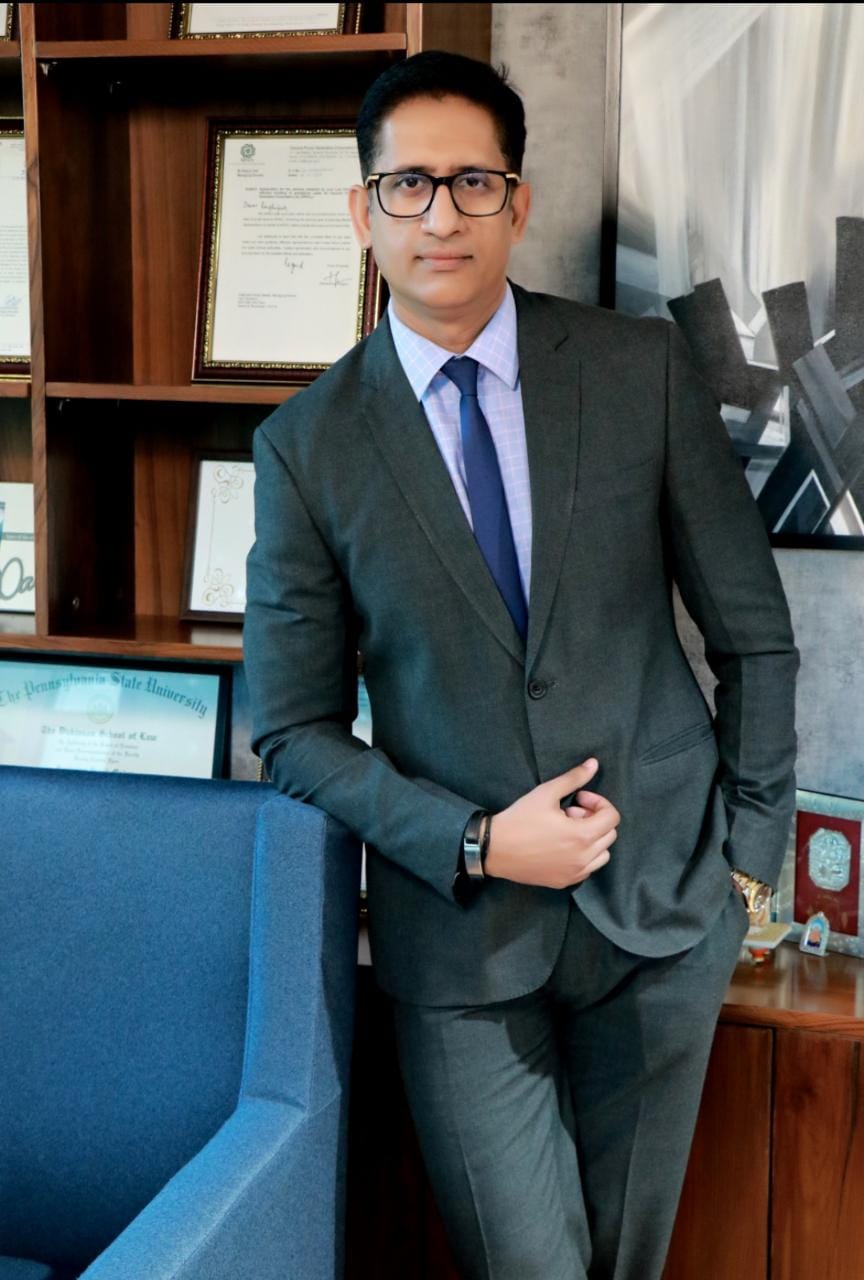
  • Binoy Parikh- part of Katalyst Advisors, a boutique structuring & advisory firm focussing on Mergers and Acquisitions

    Binoy Parikh- part of Katalyst Advisors, a boutique structuring & advisory firm focussing on Mergers and Acquisitions

    This interview has been published by Tanmaya Sharma. The Interview was taken by The SuperLawyer Team.


    How tough was pursuing C.A. with additional professional degrees like B. Com & LL.B.?

    There are two parts to any academic journey, especially when it involves an extremely practical/on the ground kind of qualification such as pursuing CA – first is the academic or theoretical knowledge itself, which is not as tough as one would perceive since many concepts would overlap with B.Com and LLB. If the fundamentals of various topics are clear (at Foundation/Intermediate level), then the theoretical knowledge is relatively comfortable to maneuver.  

    However, the second one, which is more important and will result in long-lasting benefits is the “Articleship”. I started working when I was 17 and worked effectively, in three shifts – from 9 am to 11 am, in M&A/Corporate Tax Litigation, thereafter from 11 am to 6 pm in Audit and again from 6 pm to 9 pm in M&A/Corporate Tax Litigation. Of course, given the time commitment, one has to prioritize a lot and that does create additional pressure while pursuing other degrees. However, to manage the time and overall pressure, one does have to commit to a particular mission, and while on that the time management associated with it. 

    Many students feel that tax litigation is hard to follow, but the same amused you. How can corporate tax be learned in a fun way?

    My stint with corporate tax litigation was during my Articleship/Internship period – in this context, I was new to the field and found the concept of litigation fascinating since it tests the technical prowess of corporates (and their advisors) on one hand, and the might of the Income-tax authorities on the other. Further, complex issues involving corporate restructuring, interpretation of a particular exemption/deduction, etc. would have required in-depth planning and analysis before taking such a position in the return of income, and therefore, the fascination lies in the fact that one would have to defend such a position during litigation, which would have been analysed thoroughly in the past. To me, the learning and the associated fascination comes from the fact that each position or stand is not taken on a stand alone basis, but after considering the previous stands, impact on the future financials of the company involved, interaction and interconnectedness with other regulatory laws (such as corporate law, securities law, FEMA, IndAS, etc.) and therefore, to understand a particular issue under litigation is to again understand that entire gamut of analysis undertaken in hindsight, and what could have been done at that time so that the litigation scenario could have been obviated.

    Binoy Parikh

    Would you like to share your experience of any M&A transaction that shaped your career?

    Initially, I had started my career with KPMG Mumbai in their M&A Team at the age of 20. Then when a part of the team transitioned to PwC Mumbai, I got an opportunity to directly work with the India M&A Head of PwC at the age of 22. And it was at that time, I was handed the responsibility of conceptualising and executing the merger of Cairn India with Vedanta in a $2.9 Bn all-share swap deal. The concept itself dealt with a gamut of laws and regulations owing to a complex ownership structure – tax, corporate law, FEMA, securities law, stamp duty, etc. At that time, IndAS was just taking shape, and we had to figure out the overall impact of IndAS on standalone as well as consolidated financial statements of Vedanta, and without any specific guidance, it was a challenge to apply IndAS 103 and IndAS 110, dealing with business combinations and consolidation/control assessment. Dovetailing and interconnecting all the laws was a task in itself at a conceptual level. 

    In addition to that, corporate India was transitioning from a High Court based jurisdiction to a National Company Law Tribunal based jurisdiction. So, from an execution perspective, we had to unlearn the old procedures, re-learn the new ones, and then present to the NCLT the merits of our case, which was one of the first few to be sanctioned by the NCLT post its formation. 

    I think the key takeaway from this is that the tax and regulatory landscape in India are ever-evolving and one cannot work in a static environment. And I have learnt to rely on my fundamentals while applying the fundamentals to the constantly changing dynamics in the M&A landscape.

    You are a part of “Katalyst Advisors” (Mumbai), a boutique firm focusing on Mergers & Acquisitions. How has the journey been so far?

    The journey has been fantastic so far, to answer in one line. 

    To elaborate – when I joined Katalyst Advisors since its inception, our vision has always been to be a boutique firm, focussing only on M&A and related aspects, and with a limited team so that we can do justice to the matters at hand, especially when it involves complex commercial, regulatory and tax matters. 

    Today, in the era of “accumulation”, quality has been overwhelmed by the quantity, and therefore, our vision, since its inception 4-5 years back, has been to focus only on the quality of our advice, rather than the quantity or volume of clients. This has worked well for us as we have worked on some major deals in the last couple of years – major family separation of the TVS Group, divestment of Eureka Forbes by Advent International, acquisition of Thyrocare by PharmEasy, private InvIT structure between Singapore based GIC and IRB Infra, major fundraising-related structure for the Shapoorji Pallonji Group, etc. This has added a lot of value to our learning in addition to us providing value addition to the client. 

    Apart from the client work, the notion of building a firm right from the beginning – designing the website, newsletter, etc. has excited me a lot and has given me immense satisfaction as compared to my previous endeavours.

    How challenging has it been maintaining a work-life balance in this era of Work from Home?

    Well, we have been partially working from the office since June 2020 after the first complete lockdown – however, I must say that, as an M&A professional, the focus of clients on consummating any deal has increased, and in the last 1 year, as I mentioned, we managed to close three major deals – the TVS Family restructuring (a $7 Bn family separation), acquisition of Thyrocare by PharmEasy and acquisition of Eureka Forbes by Advent International, and therefore, the work pressure has certainly increased. Of course, with high stakes involved, the concept of 9 am to 6 pm workday, or Monday to Friday working week is not obliterated, but at the same time, I have consciously managed to take some time out to maintain my physical and mental health (through regular meditation and cardio), and the hobbies that I love (for example, playing the Tabla), given that in the times of such uncertainties and limited social interaction if one focuses on being mentally and physically fit, one has won half the battle. 

    I look forward to taking some mask-less vacations soon, but till then, the personal health regime that I have managed to maintain has helped me a lot over the last 15-20 months to cope up, and, be more effective at my work.

    What is your current role? Could you walk us through how a normal day looks like in your life?  

    I am into Mergers & Acquisitions at Katalyst Advisors presently. I handle promoter-related issues, such as family settlements, succession planning, pre-IPO planning, etc. corporate restructuring and deal/ transaction advisory related issues, certain specific regulatory-related and corporate/ international tax-related issues and deal with a whole host of laws such as income-tax, FEMA (outbound/ inbound/ debt investment advisory), securities’ law (LODR, ICDR, Takeover Code, AIF/ InVITs/ REITs/ etc.), corporate law, stamp duty, IndAS, competition law, etc.

    In this context, given that we deal with very interesting issues, involving interaction with a lot of tax and regulatory laws, a “normal” day differs from day to day, but largely, it involves conceptualisation of deals, which involves various laws mentioned above, and coming up with innovative ideas to achieve the commercial objective of the client, while keeping in mind the tax and regulatory fetters. Conceptualization becomes all the more challenging and interesting, if it involves listed entities or non-resident parties, etc. 

    From an execution perspective, given that any M&A deal would most likely have in place a Share Purchase/Subscription Agreement, Shareholders’ Agreement, Non-competes, etc. and if it involves a merger/ demerger, then the entire NCLT approval process in place for approval of a Scheme of Arrangement, it requires a thorough understanding of the commercial objectives of the client, and ensuring that the same is reflected in various transaction documents, as well as ensure that the regulatory approvals (NCLT/ RD/ RoC/ OL, etc.) come through based on the definitive agreement.  

    As a result, a “normal” day would involve interacting through meetings and calls with the clients, lawyers, valuers, regulators, etc., preparing decks, notes and emails capturing our advice, following through with the above to get our idea to the client, and finally negotiating and closing the deal with the other parties/ regulators to see the deal seeing the light of day!

    You have authored several articles in relation to the M&A field, rendered several seminars, and co-authored “Impact of GAAR on Holding Structures” published in Compendium of GAAR published by the Bombay Chartered Accountants Society. How important is it to publish legal articles for law students fundraising-related in their career?

    One needs to write articles. There are several reasons for this – firstly, providing an output in a limited number of words requires a combination of thorough research, understanding the issue at hand in-depth, and then paring out the “noise” to articulate in the best possible manner so that your readers understand the core issues. Therefore, writing articles not only help in the technical knowledge getting sharpened (through research) but also the articulation skills getting honed depending on the platform where one is publishing – for example, on a technical platform, one may want to discuss more intricate technical issues, while on a general platform (such as financial dailies), one may want to translate the technical issues into more commercial ones for a wider reach.

    Binoy Parikh

    As you are an expert on Mergers and Acquisitions transactions, would you like to advise anything specific to the like-minded aspirants?

    If one likes the M&A/deals space, then one needs to understand, in detail and thoroughly, the entire gamut of tax and regulatory laws, as mentioned previously. Once the fundamentals are cleared, one can easily traverse through the constantly changing tax and regulatory environment – however, if fundamentals are not clear, then one would be lost in a cyclone of the dynamic environment. In addition, and equally important, is for one to research the commercial aspects of a deal – what was the rationale of a particular deal, what were the valuation parameters, are there similar deals taking place in the same space, was it a distressed or a voluntary deal, what would be the impact on the overall group business as a result of the deal, what would be the impact on the promoters, etc. As I mentioned earlier, any deal is different from any other deal, a deal evolves constantly before its consummation, and therefore, each deal requires a “tailored fit”, which, in turn, requires one to understand the commercial, regulatory and tax matters in-depth and apply one’s knowledge to facilitate deal consummation.


    Get in touch with:

  • Karthik Jayakumar- a Non-National-Law School graduate who became Founding Partner at Peritum Partners and co-founded an Online Journal of International Law and International Law Consultancy, called The A38 Journal

    Karthik Jayakumar- a Non-National-Law School graduate who became Founding Partner at Peritum Partners and co-founded an Online Journal of International Law and International Law Consultancy, called The A38 Journal

    This interview has been published by Tanmaya Sharma. The Interview was taken by The SuperLawyer Team.


    Is it hard for a non-national-law school graduate to find his/her “first job”? What are your thoughts?

    Unfortunately, yes – a challenge faced by non-national-law school graduates is for finding his/her first job. Several law schools have not developed/grown to the extent that national law schools have, which tends to impact the exposure that students may have. Additionally, the lack of placement opportunities leaves students with the sole choice to apply for jobs on their own – which ultimately leads them to apply to multiple places without a positive response. The pleasant change we are getting to see in the recent past however is that several lawyers/graduates are beginning to work with smaller businesses and corporate houses (as in-house counsels) and with young firms, which perhaps wasn’t so much the trend ten years back. Given the startup boom, many young lawyers are exhibiting an entrepreneurial streak, with the setting up of new firms even fresh out of law school.  

    How did you manage to get your first break at Amarchand Mangaldas?

    This is a question I get quite often. Through my time in law school, I focused on moots, seminars, and the likes. I spent ample time on improving my resume, which I think has helped me quite a bit over the years. It isn’t that I got my first break on the first attempt – I did indeed apply to several firms and did see rejection. A simple word of advice is to not give up and to keep trying to find a role that works for you. I would also take the opportunity for law school students to use the course duration to intern at different organizations/firms, to understand the options of practice areas, etc that are available for them to work towards. Through this process, a student can identify the role they specifically want to apply for and therefore work towards putting together a sharp resume for their job applications. 

    Among civil and corporate litigation, which interests you most and why?

    My pick would be corporate litigation as it is the closest to my practice areas. I feel that I am the most productive and have added most of the value in areas that I’m passionate about and understand well. Civil litigation tends to get quite tedious with the procedure and other things that I prefer not to dabble in. 

    What can be the real challenges while establishing a career in the field of law?

    The primary challenge is to find a way to set yourself apart from everyone else that you compete with. The law is the same for everyone, but finding the simplest solution that saves time, effort and money is perhaps something incredibly valuable to clients. Through the years of practice thus far, I’ve understood that keeping my knowledge up to date is only the tip of the iceberg. It’s important to understand the practical side of things alongside theory. That being said, one of the bigger challenges when it comes to setting up your law practice, is the test of patience. Given that by regulations in India a lawyer cannot solicit work, a large question always remains on how the practice may grow organically. A word of advice I have always received consistently from each of my mentors and seniors is to remain sincere and hardworking while giving each client your absolute best. 

    Karthik Jayakumar

    Funding deal and acquisition sounds like interesting areas to work in. What do you like most in these areas?


    It most definitely is an incredibly interesting area to work in. What I personally like about the areas of work is how one can tangibly secure the interests of the relevant stakeholder while seeing the deal through. The ability to structure deals to enable the growth of businesses that ultimately become larger brands – is a very satisfying process that for me is incomparable to anything else. This becomes all the more exciting when you start to represent businesses that you have been a customer/fan of.

    How does the Indian and Overseas outlook change with respect to litigation? Do overseas companies prefer litigation over ADR?


    I don’t particularly see much of a difference in terms of the outlook domestically and overseas. Conservative approaches are always to remain litigation averse and look to be as compliant as possible. Though, from my experience, it seems to be that parties globally favour ADR over traditional litigation simply because of the swift nature of redressal of disputes. Some legal systems globally are known to resolve disputes rather quickly – but the general tone seems to be leaning more in favour of ADR.

    Can an Advocate be soft-spoken yet established; what do you think about how the legal profession takes this quality?

    Most definitely. I’ve come across many litigation lawyers (including established younger lawyers as well as senior counsels) that are soft-spoken but have made a mark in the profession. Earlier, the stigma attached to a loud booming voice commanding more respect and the same improving the ‘presence’ of a lawyer seems to have vanished over the years. Be it in courtrooms or in board rooms while negotiating deals, it’s a positive change to see people looking at content over form. The ability to put across a point effectively in my opinion is the most important quality than anything else.

    Karthik Jayakumar

    Would you like to give any career/life tips to the readers?

    The simplest tip that I would give to anyone is to always keep things as simple as possible. Sticking to basics and doing that well, can often go a very long way and would help achieve more than trying to do something fancy and over the top. Consistency, hard work, and the thirst to acquire knowledge alongside finding answers are some of the key qualities to develop. As cliched as it may sound, trusting in a well-developed process and following through with the process achieves a lot more than working backwards by focusing solely on the goal. Oftentimes focusing on the goal might only add to the already existing pressure.


    Get in touch with:

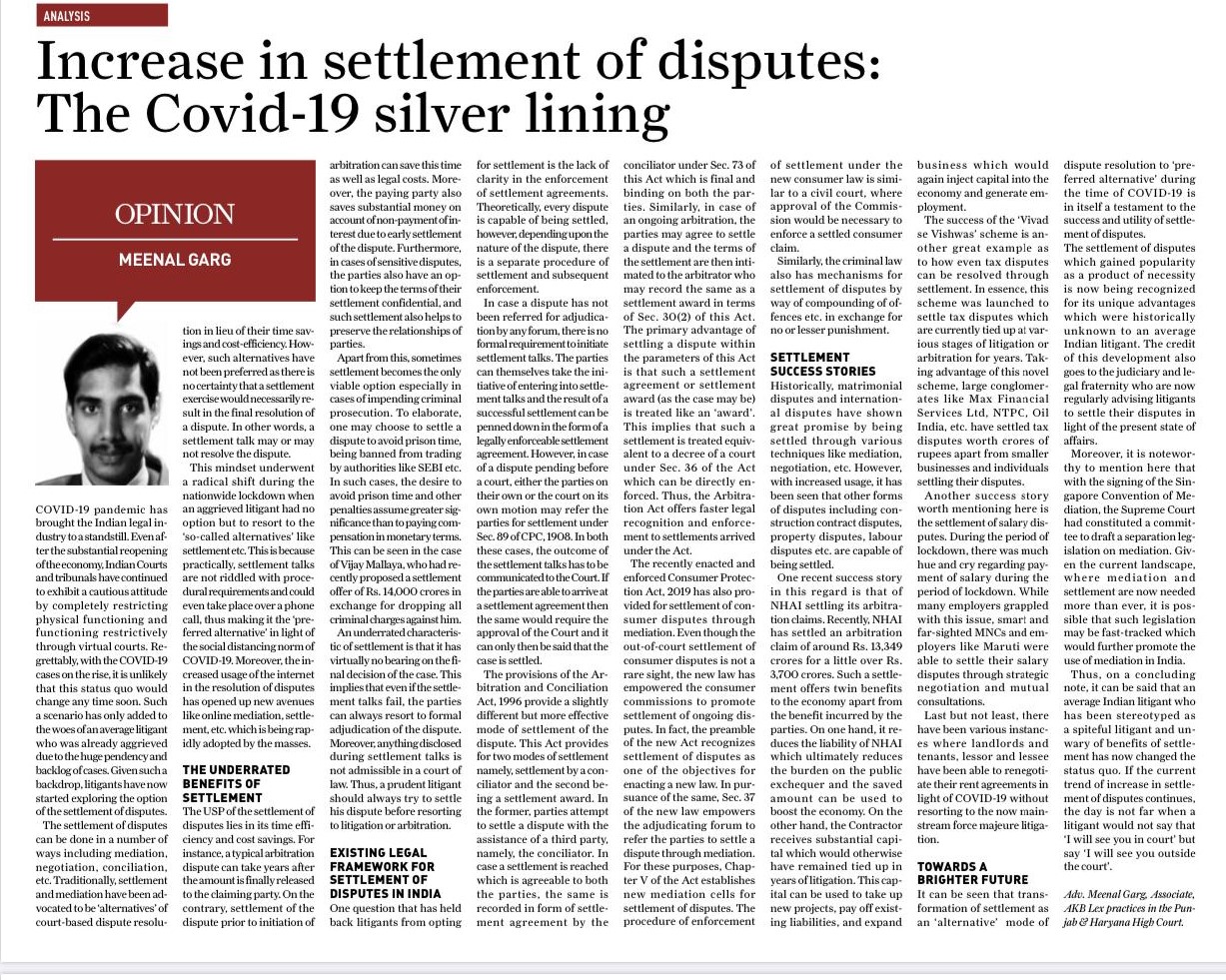
  • Meenal Garg- Associate at K.N. Legal, a boutique Arbitration Law Firm, also an ODR Consultant, Member of Young ICCA, SIAC, LCIA and MCIA, a libertarian exploring Arbitration

    Meenal Garg- Associate at K.N. Legal, a boutique Arbitration Law Firm, also an ODR Consultant, Member of Young ICCA, SIAC, LCIA and MCIA, a libertarian exploring Arbitration

    This interview has been published by Tanmaya Sharma. The Interview was taken by The SuperLawyer Team.


    Did you always want to become a Lawyer or was it something that you decided in the later part of your school life? What other career options would you have considered, if not law?

    Law was never my first choice. In fact, I was oblivious to the law as a profession and wanted to be an engineer like most of my peers. In my 10th standard, I was inevitably put to choose a career path like any other 14-year-old kid. Though I didn’t have any preference in my mind, I was introduced to the law as a profession by my father. After talking to my friends, neighbours, teachers etc. about the same, I was convinced that law would be the perfect field for me as it could help me fulfil my dream of doing a corporate job while learning something new every day. I believe that had I not been a lawyer, I would probably have been a CA or an MBA executive or maybe even an engineer.

    You are quite active on LinkedIn. How important do you think LinkedIn is for professionals? Does that also discourage young struggling minds?

    I believe that after COVD, Linkedin has become the foremost place for networking amongst the legal fraternity. According to me, if used properly, anybody can immensely benefit from this platform. At the same time, it cannot be denied that students may feel discouraged after seeing the achievements of their peers or lack of response. However, this cannot be treated as a hurdle and rather this is the necessary motivation required to reap the full benefits of this platform. According to me, continued usage of Linkedin along with posting valuable content can easily boost someone’s career. Networking has never been so simple and accessible in the legal profession before Linkedin.

    You also took part in various competitions and have published numerous papers and Articles. How important do you think these are in shaping your understanding of law?

    Writing is one of the most rudimentary skills of a lawyer. As a law firm associate or as a junior lawyer, much of a young lawyer’s time is spent drafting briefs, research notes and petitions. Therefore, through writing a lawyer can improve his understanding of the law and how to communicate his thoughts properly. Another underrated advantage of writing is a novelty. Lawyers are required to generate out of the box solutions every day to tackle everyday problems. Writing papers compels a lawyer to think and to bring novelty in his arguments. I believe that all my writing achievements and endeavours have played a major part in shaping my career and helped me reach where I am today.

    You have been working on Arbitration cases since the beginning of your career and are now working as an Associate at KN Legal. Why did you choose Arbitration and what scope do you think it has in the future? 

    I have always considered myself to be a libertarian. Therefore, the consensual basis of arbitration resonated with the libertarian in me. Moreover, as I started exploring arbitration, I just couldn’t think of anything else apart from arbitration as my career path. This is because virtually every commercial contract contains an arbitration clause today. Disputes may be big or small, but today every commercial dispute is adjudicated through arbitration. Moreover, I believe that arbitration is the future of commercial arbitration. Anyone desiring to work in a corporate setup or the commercial litigation sector necessarily needs to know about arbitration. Furthermore, in the context of India, we may see more and more instances of mandatory statutory arbitration. Therefore, the scope of arbitration is limitless.

    You also happen to be a member of various International Arbitration Centres. Besides ADR, you are a mediator and ODR Consultant at Sama. Do you think it is time for India to adopt ODR on a larger scale?

    ODR has been a subject matter of debate in India for quite some time now. However, it was because of COVID that litigants were compelled to explore ODR as an option. Moreover, in my experience, such litigants have now started to recognize the benefits of ODR. Another factor is that India’s digital infrastructure has considerably improved and therefore, repeat players should consider adopting ODR for at least less complex and repetitive disputes.

    Meenal Garg

    Can you walk us through a day in your life?  What is the life of an Associate of a boutique law firm like?

    To say that a law firm associate’s life is busy would be an understatement. Moreover, with the advent of COVID and the work from home option, the lines between professional and personal life have considerably blurred. However, this comes with a silver lining as it allows me to develop my specialisation at a quicker pace. Moreover, I am involved in every step of arbitration and litigation including pre-litigation strategy, client meetings, drafting and appearing during the hearings etc. Furthermore, the small size of the team helps to ensure effective communication. 

    You completed your Masters’ dissertation on the topic ‘Promoting Efficiency of Arbitration in India by Using Technology’. Can you tell us a bit about it and how you see promoting Arbitration using Technology in India?

    In spite of being a practising lawyer who has seen virtual arbitrations every day, I was surprised to see that there was no information regarding the use of technology in Indian arbitration. There is no awareness regarding the use of technology in arbitration in India. Therefore, I took up this topic to discover the viability of the use of technology in the Indian arbitration landscape. After my interactions with various industry experts (whom I cannot thank enough), I believe that there is a huge scope for use of technology in Indian arbitration especially in small value disputes because of its cost-effectiveness. Moreover, this market seems to be niche and only a handful number of players and users exist which is largely due to COVID. However, through proper endeavours, technology can have long term benefits for India seated arbitrations.

    Lastly, is there any suggestion or advice that you’d like to give to our readers? 

    I always say that ‘it is good to dream big but it is not bad to start small’. Students and young professionals like me should see every opportunity as a learning opportunity. With the advent of COVID, knowledge and opportunities have never been easier to grasp. Contrary to popular beliefs, quality internships can be done right from the comfort of home. Furthermore, as already stated above, writing is the most important skill for a young lawyer. Lastly, reading and engaging in meaningful conversations pertaining to any area of law can be a sure shot way to be a successful lawyer.


    Get in touch with:

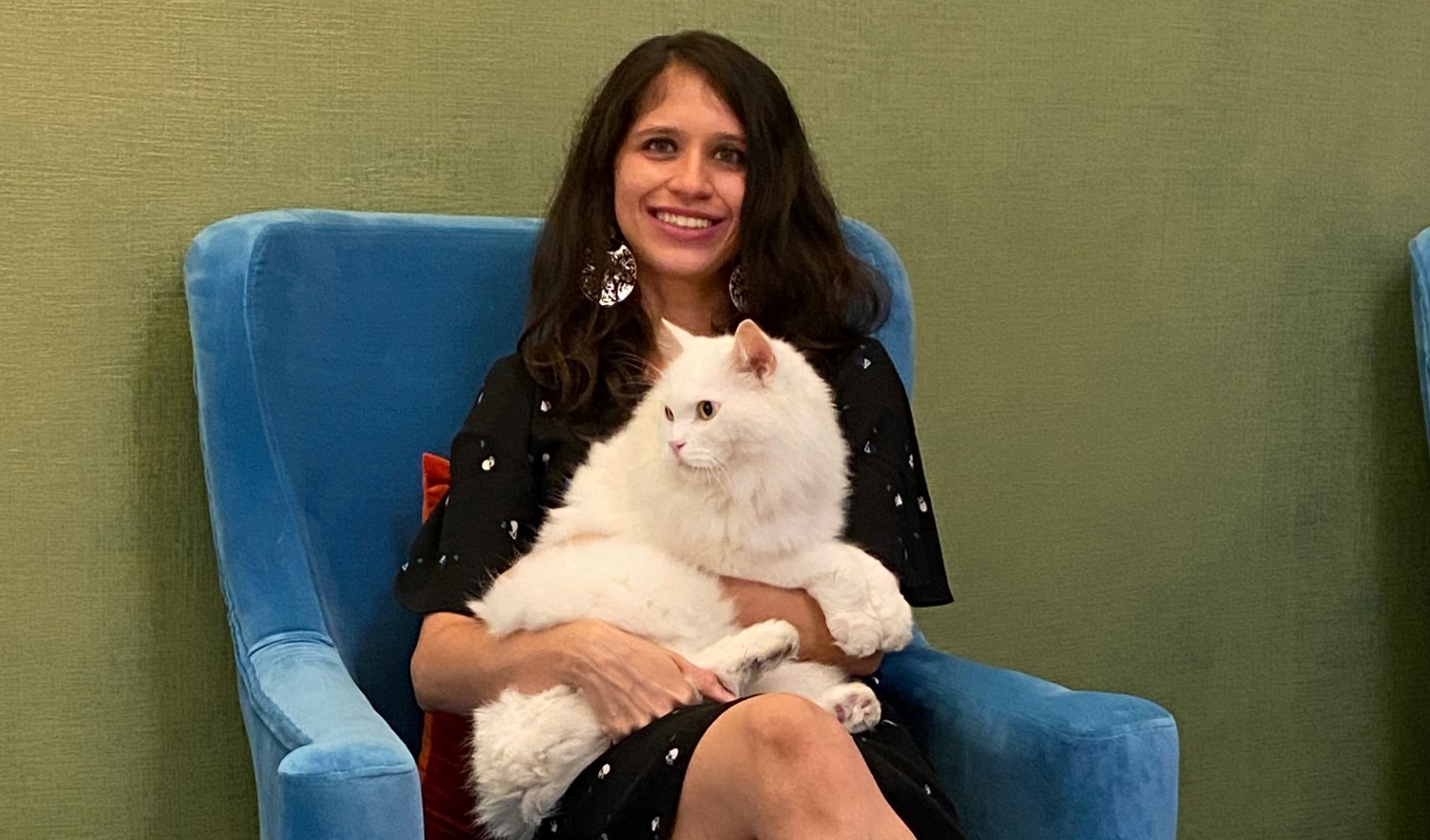
  • Jyoti Kakatkar- Senior Legal Counsel with Eight Roads Ventures- an international VC/PE firm and an ardent animal lover breaking ceiling in the Investment sector

    Jyoti Kakatkar- Senior Legal Counsel with Eight Roads Ventures- an international VC/PE firm and an ardent animal lover breaking ceiling in the Investment sector

    This interview has been published by Tanmaya Sharma. The Interview was taken by The SuperLawyer Team.


    How smooth is it to be an in-house counsel? Or is it the other way round?

    In my view, neither the in-house counsel role nor the law firm role is completely devoid of challenges and hurdles. Having been a part of both legal worlds I can safely state that each role comes with its own set of challenges and privileges.

    However, it is extremely incorrect to assume that in-house counsels are just “glorified paper-pushers”. There is a lot of responsibility that comes attached to an in-house role. When you hire an external law firm, its role and liability are limited to the ‘scope of work’ and ‘exclusion’ clauses elucidated in its engagement letter. My employment contract as an in-house counsel is devoid of any such sections. The legal liability of the organisation/transaction rests on your shoulders; even simple human errors can sometimes cause you sleepless nights due to the potential repercussions they may have. Even if you hire an external counsel, they have limitations either on bandwidth or the complete know-how regarding the commercial dynamics of the deal. There are many matters which are done/resolved without any external help. 

    So many assumptions have been made over the years regarding my move to an in-house role; that I left the law firm life “to retire”. With quality legal work coming my way at Eight Roads, I feel anything but retired. I can say that the work of an in-house counsel is exciting as well as challenging. Unfortunately, in-house roles are not always given due recognition or respect.

    People may have come across some in-house lawyers who may take their role lightly but people equally come across some law-firm counsels who may shirk responsibility. I believe that the generalization of any work role — legal or otherwise, is unfair; it’s honestly up to each individual on how they want to make the best use of the opportunity they have been presented with. I truly hope I am!

    You worked in the most renowned law firms like Cyril Amarchand Mangaldas & Khaitan & Co for about 5 years and now working as a Senior Legal Counsel with Eight Roads Ventures (an international VC/PE firm). What major changes have you found in the working approach between the three?

    It was an absolute honour to start my career with the likes of Cyril Amarchand Mangaldas and Khaitan. Both the firms are filled with some of the most reputed lawyers, and I had the chance to train under some of the very best.

    As a junior, I had the opportunity to work on some complex, high-stake transactions; and even if I wasn’t lead counsel, I got to do the groundwork, research on obscure legal points, and observe and learn from all parties involved.

    As the years progressed, so did my responsibilities, direct exposure to clients, and the learning curve was steep. However, as a part of a law firm, my daily work interactions were primarily with other lawyers. While it is the best way to garner more legal knowledge and stay abreast with the constant change in-laws, it also limited my views on how the corporate world truly applied our legal advice to their business. 

    Within the Eight Roads ecosystem, I am interacting with persons from different spheres globally — investment, finance, HR, communications, founders, company CFOs and so forth daily.

    Listening to their various conversations has given me a better understanding of how businesses operate and how best to curate my legal advice. As an in-house counsel, you don’t work “for” the client but “with” the client. You are part of the same team and are equally responsible alongside the investment members for the success or failure of any investment/project. Knowing the law is important but it is meaningless if not practically applied in any given situation. More often than not, I am aware of the commercial nuances of each deal and this helps me negotiate the key legal points, take commercial calls, and reach a mid-way understanding on other issues. There is a more holistic approach to my legal review which goes beyond just the transaction at hand. While the work of an external counsel ends once we close a deal, my work continues well beyond. I must help maintain ongoing collaborations. 

    Now we know that you work as a Senior Legal Counsel with Eight Roads Ventures, could you highlight your role in the firm?

    The role at Eight Roads is a multi-faceted one. I deal with a range of legal issues right from investment agreements, exit documents, tax matters, confidentiality concerns, debt financing, vendor documents, legal notices, insurance, corporate governance to employment contracts.

    As part of the Eight Roads’ Ventures India team (ERVI), I help strategize, negotiate and close investments in the early/growth stages of companies operating in fields of healthcare, technology, consumer, and financial services.

    I also play an important role in negotiating and implementing fund exits. The legal work at Eight Roads is not merely transactional but also relates to internal fund compliances and portfolio management. Given that Eight Roads is a part of a global platform, my work goes beyond Indian law issues. I regularly encounter matters concerning international jurisdictions and it is very interesting to compare how people commercially and legally view and assess risks associated with VC/PE deals in different jurisdictions.

    ERVI also endorses CSR activities and I am honoured to have been given a chance to spearhead these.

    A very important aspect of my role is balancing commercial considerations and relationships with founders/partner companies while ensuring I negotiate in the best legal interests of Eight Roads. Many times, I am also required to chase law firms (sometimes even my ex-peers). There may be some commercial implications, which are highly confidential if a deal does not close within certain timelines. 

    I often joke with my colleagues that the founders and law firms must equally dislike me! Unfortunately, that is the nature of my job and I can only hope that the industry can know me beyond my in-house counsel role — I am not that bad a person (at least that is my view!). I strive to the best of my ability to be practical under the given circumstances and help cultivate lasting partnerships. 

    Not many young female lawyers reach the height you achieved, what was the story behind your success? Were you the privileged child or had to dig in deep to quench the thirst? 

    I was extremely privileged to have loving parents who were supportive of my education and career decisions. Having said that, I am a first-generation practising lawyer in my family and had to find my own feet in the legal profession.

    I have no godfather in the legal industry. Before joining the three-year law course in Government Law College, Mumbai (GLC), I had completed my graduation in Mass Media from Jai Hind College. It was an altogether different field.

    While many of my media classmates had already secured jobs and earned their first salaries, I was studying hard, with no promise of a job and limited financial means.

    During my law school days, it was difficult to secure internships with law firms if you weren’t from an N-law school or had influence with a law firm partner. Having been rejected by several internship programs, I remember wanting to give up on my legal profession dreams. I nevertheless studied hard and made the most of the few internship opportunities I did manage to secure.

    My real break came on 22 September 2011 (yes, the date is imprinted in my mind) when I secured a job with the Mumbai office of the then Amarchand Mangaldas through the GLC campus placement program. After all the rejections I had faced till then, I was absolutely over the moon to have been selected by one of the best names in the industry based purely on merit. My years of hard work and my family’s faith in me had finally paid off. I couldn’t wait to treat my family to a lavish dinner with my first salary (it was Konkan Café at the President Hotel — my mother’s favourite). The rest, as they say, is history.

    In India, working females still have a responsibility to maintain their household. You are on the next level of achievement, how do you balance your professional and personal life? 

    A lot is written about working mothers and their struggles (rightfully so!). However, there is an unspoken challenge being faced by many working women in India — balancing professional lives while also being the caregiver of aged parents. With age come many illnesses, and unfortunately, India’s professional caregiver services are very expensive and unreliable. Further, not every Indian woman is a part of a large joint family with several helping hands at home. After everything our parents do for us, we would be unjust in abandoning them in their hours of need. Invariably, the caregiving duties fall on the women of the house.

    My mother was extremely ill and constantly in and out of hospitals for about a decade which spanned through my law school and the formative years of my career. At that time, we were not working from home, but I feigned sickness and worked from home, hospital, and everywhere else.

    I will not lie that it was a struggle to balance my stressful work hours, caregiving responsibilities, and just finding time to unwind; I came close to having a nervous breakdown. However, with the support of my immediate family members, I dragged myself through the hard times and found normalcy in mundane tasks.

    Today work from home has helped me find a better balance between my professional and personal life.

    During my mother’s caregiver journey, I rarely asked for help and kept my situation under the wraps at the office to continue with the image of normalcy. I have now learned that it is important to be open about any difficulties you are personally facing and not fear being judged or professionally reprimanded — especially women. Even if people return to their office full time, they should be more than encouraged to seek any assistance if needed. After all, each office colleague also has her/his own family and we can make it a safe working space by supporting each other.    

    Apart from being suit up, what interests you in your leisure time? 

    The two things I love the most and help with my stress management — spending time with animals and exercising.

    For several years, I have fostered and helped with the adoption of stray animals. In the coronavirus-induced lockdown, stray animals in my locality (and all over India) were cut off from their daily food source and were going hungry. With work from home, I was able to feed and take care of the strays in my area every day. This has now become a part of my routine and I feel incomplete without greeting my furry friends. Lately, I have also been researching animal protection laws (or lack thereof) in India. All life forms need to be equally respected and protected by law. My work and views about speciesism, animal rights, and preserving the natural environment would make for a whole separate interview!

    Exercise and the endorphins released as a result have helped me emotionally cope with some of the toughest phases in my life. I would especially recommend it to lawyers; our work can be extremely overwhelming. Physical fitness does not necessarily mean an hour of HIIT session or pumping heavyweights at the gym; it may be a brisk walk for 30 minutes around your colony. If you do not exercise, please do not wait for the New Year or a Monday! Please start slowly and you will notice positive differences — physical and mental.  

    We found that you are an active social worker. Would you like to mention your beliefs about the same?

    Jyoti Kakatkar

    Many years ago, I had read a quote by American actor Lily Tomlin which stuck with me — “I always wondered why somebody doesn’t do something about that. Then I realized I was somebody.”  It dawned upon me that I had the power to help those in need myself and did not have to wait for NGOs to do the work; NGOs are already inundated with the work pressure.

    A small act of compassion can go a long way in improving someone’s life. The act can be as simple as buying Diwali lights and giveaways every year from NGOs instead of an established brand.

    As lawyers, we do hold a certain position of power in society and legal aid is one of the most useful services we can offer to non-profits. I have had the privilege of helping a few with their legal affairs; the work is challenging and only improves my legal acumen. There are several causes out there, be it children’s education, women empowerment, poverty, terminal illnesses, environment, and so forth. If each of us picked one cause that we felt passionate about and donated our money and time towards it, our future generations will experience a kinder world. 

    The covid-19 pandemic was tough for all of us and we can still find its traces now and then. Do you want to suggest anything specific to the readers concerning the same?

    Covid-19 has been surreal and its effects devastating globally. Many people have lost livelihoods and many more loved ones. In this light, the pandemic has brought about discussions on an extremely pertinent and unspoken topic in India — grief. The Oxford Learners Dictionary defines grief as “a very sad feeling, especially when somebody dies.” I never felt the need to research the meaning of grief until my mother passed away pre-pandemic pursuant to her illness. To me grief is undefinable.

    Fully being aware of my mother’s oncoming death and having mentally prepared for the same, grief took me by surprise after a month of her passing and punched me hard in my gut. I was on my way to the airport for a work trip abroad when it hit me that I will never again receive the hundred “annoying” calls/messages from my mother asking me if I had gone through security, landed safely, had eaten well, and have enough jackets to brace the cold. It was the most damning feeling in the world.

    Since then grief continues to hit me in waves, even at some of the most inappropriate occasions with varying intensities. The reason I was so surprised at feeling grief is that none of my close friends or relatives who had lost loved ones ever warned me or confided in me how hard it is to lose someone. Every single person experiences their own, highly curated version of grief, and each version is hard. 

    While the circumstances are extremely unfortunate, it has been encouraging to see more people come forward and speak about their encounters with grief. Reading other people’s experiences with grief had helped me feel less alone, and I hope to spread more awareness on this issue. In India, Bhavana Issar’s organisation, Caregiver Saathi has created a safe space for family caregivers to exchange stories on caregiving and grief, and I am extremely happy to be associated with it. Mental well-being is necessary to be able to perform well at your job. There is no shame in asking for help. If anything, you will be doing your job and yourself a disservice if you don’t.      

    Where can we see you in the next 10 years? Are you planning for something big or staying low at the moment?

    Hopefully still be alive, healthy and happy — a decade is a long time away! Experience over the years has taught me to take one day at a time. Too many of my plans have been foiled due to unseen circumstances. Then there were plans I never made, and still, life fell into place. I do hope to continue making a positive difference — whether in the lives of animals or human beings (several or even one). 

    Any career tips to the young minds in the investment sector?

    Foremost, I would like to give a general but a very important tip to every young professional out there —please do not compare your career trajectory to others and ever feel less worthy. Yes, it is important to draw inspiration from success stories, but success again is a relative term. Each of us comes from varying backgrounds, societies, support systems (or lack thereof) and we can only try our best. 

    For young lawyers looking to start/move in-house and particularly enter the investment sector — it is a very exciting space to be in and there is ample opportunity to do good challenging legal work.

    Even the pandemic could not dampen the ever-buzzing VC/PE activity in India. India is filled with talented founders and ambitious teams, and it gives great joy to be a small part of this thriving ecosystem. However, move in-house for the right reasons — there is also hard work involved and timelines to meet. Instead of verbose paragraphs, please learn to put legal advice in simpler words. Even I am learning to better my skills every day; learning is a continuous process without an expiration date. Enter the field with an open mind. As stated earlier, in-house is less about interacting with other lawyers and more with persons from different career backgrounds. It is a great opportunity to learn different topics from them while sharing your legal expertise. In the end, find joy in the work you do, and the rest will follow (and if it doesn’t, do not be disheartened, your time will come!).


    Get in touch with:

  • INTERACTING WITH TEAM STRATAGE ON BUILDING A LAW FIRM DURING THE PANDEMIC, WORK FROM HOME CULTURE AND CHANGING THE CONVENTIONAL WAY OF WORKING. ASSOCIATE PARTNER SOUMYA SHANKER AND SENIOR ASSOCIATE MEHAK GUPTA SHARE THEIR JOURNEY

    INTERACTING WITH TEAM STRATAGE ON BUILDING A LAW FIRM DURING THE PANDEMIC, WORK FROM HOME CULTURE AND CHANGING THE CONVENTIONAL WAY OF WORKING. ASSOCIATE PARTNER SOUMYA SHANKER AND SENIOR ASSOCIATE MEHAK GUPTA SHARE THEIR JOURNEY

    This interview has been published by Maaz Akhtar Hashmi and The SuperLawyer Team. The Interview was taken by Priyanka Cholera.


    Stratage is a portmanteau of the words Strategy and Vantage. How do the words run in parallel to the aims of the firm?

    Darshan Upadhyay, Managing Partner – The Firm is established with a vision to be the best in areas of our practice. It is also a platform for the lawyers who have an entrepreneurial mindset and are exploring a place that offers them an all-round and inclusive growth. If you are advising a client as a lawyer or wish to make your career in a law firm, the virtues, strengths, ethics, commercial mindset and focus are some of the key elements to make it a successful journey. We wanted to choose the name that summarises all those elements and also stand as a daily reminder for what we all stand for and aspire as a long-term vision of the Firm. 

    What is your vision for professionals of your firm?

    Bhavin Gada, Founding Partner – We invest a lot of time and energy to train the professionals who are a part of our firm. While we have ensured that our professionals have been provided with the relevant IT infrastructure, we encourage them to be updated on the current affairs, including new laws and amendments to laws. We have been and will be working to inculcate a ‘solution-oriented approach’ in our professionals. Our vision for the professionals of our firm is that they should be ‘360° lawyers’.

    How has the journey been as Stratage has completed one year of the firm’s establishment?

    Shyam Pandya, Founding Partner – Establishing a firm is a thrilling experience – initially, there are many aspects to tie in to ensure that the systems and process are in place to envision the core value – as time passes, the key focus then changes to make sure that the team’s efforts are in the same direction as the firm’s vision and core values. Each of these efforts has nuances that may positively or negatively impact the values and vision. Our interactions with our team are, therefore, more deep and productive. All of this continues to make our journey exciting and infused with enthusiasm.

    With regards to the present economic circumstances, was it challenging to work from home and training the talent pool? How did you navigate past such impediments? 

    Soumya Shanker – One major problem that we faced was how do we induct new people? The people we started the firm with already had a pretty strong professional as well as a personal relationship. Training in our team happens at a very personal level where you just sit across or next to the person training you, such as drafting certain sentences and formatting a document. We have detailed sessions on drafting and even formatting for our team members, which everyone attends across levels. These programs have been very well received. We make sure that the personal training experience is not lost because of ‘work from home’.

    Mehak Gupta – Work from home has its boon and bane. It was a new trend in the world last year and has had its share of glory, and I feel it’s now time for ‘it’ to retire. Having joined the firm as a founder member in a ‘work from home’ environment reminds you that an office’s brick and mortar concept is for convenience and a choice but is not essential for transactional mandates. I have experienced that during this pandemic, lawyers have been casted with additional responsibilities to ensure that transactions are concluded in the absence of the conventional comfort of face-to-face meetings and contentious matters are handled to avoid any adverse orders for reasons that are irrelevant to the merits of the matter. On the bright side, as the meetings are virtual, several team members of all the advisors on a matter which sometimes is around 35-40 people, including the junior-most members can attend the calls on the matter, which they would probably have not been able to in a physical meeting set up. 

    How did you decide to join Stratage Law Partners? Is there recreational freedom and thought leadership one experiences after working in a recently founded firm and being a part of building it brick by brick? Is it liberating and more gratifying when compared to your past experiences of working with an established organization?

    Soumya Shanker – The action of setting up a firm is a risky enterprise. I have been in several firms and seen massive teams fall apart in a very short period. I’ll give you an example: I was working with a reputed law firm from 8-10 years ago, and I witnessed a huge corporate team of over thirty to forty people shrinking to a team of eight in a few months. I was very cognizant of the risk involved in setting up such an enterprise, especially in the middle of a pandemic. An entrepreneurial venture comes with its set of risks and rewards, which I am conscious about. I think it was due to a very strong faith in all the partners and in the team, with whom I have been working for more than five years. I was confident that we would be able to convert any adversity into an opportunity. I am confident that we will be able to take up any challenge and deal with it, so it is set up at two levels, the partners would be able to get in the work, and the team would be able to execute it. So for me, I can say it was not a leap of faith, but it was more “Wow, this is going to be exciting!”. This is the fifth firm that I am working with, and I have only worked with large firms so far; and with the trust reposed in me by the partners, I am sure we would have an exciting story to tell very soon. I would say I was more excited to be a founder member of the firm than apprehensive.

    Mehak Gupta – It was a no-brainer for me to take the opportunity to join Stratage. I have learnt to love the ‘law’ while working under the mentorship of my seniors, with whom I have been with since the beginning of my career and continue to work with at Stratage. In fact, I have learnt to hone my skills, to read and interpret the law much better with the team. When I was in law school, securing a job with a leading law firm and a good salary seemed like an essential thing in life. Still, gradually when I started working and practising the law, understanding the nuances involved in it, that’s when I got passionate about law. I realised that there is more to the practice of law than just money and the title. Since I began working after law school, this team has given me the opportunity to work on various matters that have developed me as a lawyer who can understand transactional matters and litigation matters.

    As the people under whom I trained were moving, the decision to join Stratage under the leadership of my mentors was easy and equally thrilling.

    Coming to the question about freedom and how much of it we got because we were part of a newly set up firm. As the next step for my self-growth, I did foresee that I would get more responsibility, not only as a lawyer but in other portfolios, and as such, I was looking forward to the additional responsibility. Moreover, being part of an organisation from its inception invigorated a sense of accountability, passion, and enthusiasm to do more.

    Being one of the young founding members of the team at Stratage Law Partners, it is known to us apart from legal work you also look over the training and internship programme at the firm, do you see yourself as the next generation of the firm with all the new ideas to keep up with changing times?

    Mehak Gupta – I was always involved in taking efforts to ensure that Stratage is well-represented regardless of the medium. With respect to the updates that go on LinkedIn, we as a team ensure that we are up to date and keep ourselves abreast about the same. The objective of this is to ensure we can assist our clients holistically and cover all the spheres of law.

    The responsibility of recruiting interns was handed over to me very recently after I got promoted to Senior Associate at Stratage. To start with, I started speaking with colleges and their Recruitment Committees. We do a lot of programs for the benefit of the interns and the other resources in the firm. Soumya and I take formatting sessions because that is very important for every lawyer.

    Soumya Shanker – Adding to what Mehak said, I think ‘people’ are our goodwill ambassadors. The ones we hire full time and the ones that come for internships, their experience speaks volumes. So, in my opinion, hiring is another area that we are trying to ensure that anyone who comes to us is given a very solid ground in fundamentals and, more importantly, is treated nicely so that they do not have a negative experience at any point in time. I personally believe that ‘culture’ is the most important element of a successful organisation, and a successful organisation results in successful and happy members of the organisation.

    What do you look for in an individual before you decide to hire them as an intern or add them to your team as a recruiter?

    Soumya Shanker – I believe communication skills are the most important in this regard. Since the way you present yourself is a big part of our profession, it becomes very crucial. The second trait I look for is their ability to take criticism. Noting and understanding criticism and working on your problems is imperative. Our team members are very professional about taking criticism. Since law schools don’t teach you vocational skills required to work in a law firm, you’re bound to make mistakes. I remember knowing nothing about how a law firm works when I first joined. Therefore learning quickly, having a proper attitude and good presentation and communication skills become key to distinguishing yourself from the crowd.

    Mehak Gupta – A good first impression lasts, and for me, a resume is essentially the reflection of the candidate on a professional as well as a personal front. As such, we narrow down the applicants, firstly on the basis of the resume and then on the basis of the interview. However, sometimes there are pleasant and unpleasant surprises during the interviews of candidates.

    Also, I would like to add that we identify a prospective candidate basis the hunger and fire to learn. We also look for pro-active young professionals who are willing to ‘walk that extra mile’. I believe that as a senior, it is my responsibility to ensure that the young professional gets the best possible learning experience according to his/her ability. 

    Could you elaborate on your journey from law school to choosing corporate law as a path? How has your relationship with your mentors affected it?

    Soumya Shanker – I come from a small town, and after appearing for my boards, I was asked to prepare for conventional competitive exams like IIT-JEE. However, I found it brutally boring, and I knew I was not fit for the field. That’s when I started looking at other options, but since both my parents are engineers and law as a profession had a reputation of being a ‘backup option’.

    Back when I was preparing for law school, we didn’t have CLAT, but I gained interest while preparing for the entrance test. I also joined online forums where people interested in law would come together to talk, discuss their views on different matters, etc.

    As for corporate law, after pursuing some litigation internships in Delhi, I struggled with it, which is why I decided to shift. The managing partner at my organization was kind enough to take me to negotiation in my first month as well. I was just awestruck when I saw him leading the negotiation in the room; the theatrical way in which he commanded everyone’s attention and how he acted inside the room just stayed with me. I’d also add that having advised clients on transactions, now I am comfortable advising clients on strategizing litigations and managing pre-litigation situations.

    So, the mentors in your profession play a major role in your career.

    Mehak Gupta – I always knew that I would be in a creative and intellectually stimulating profession. I’m a first-generation lawyer. I decided to pursue law at a very young age, and at that time, I had decided that if I’d study law, it would have to be from one of the best universities in India, which I eventually did. However, I do believe that there are other factors apart from education that are important in shaping you as a lawyer. During my law school years, I was a very active student, constantly engaging in moot court competitions and cultural activities while keeping my academic performance above average. I was interested in the transactional and advisory practice. Hence, I always interned with corporate law firms. Working on weekends or putting in long hours was not an issue for me, but I have come to realize the need for a work-life balance.

    Having seniors and mentors who encourage you to become a ‘360°’ lawyer has been a blessing for me, and I am working to achieve the same every day. A few years into the profession, I realized that the most sought-after lawyer is the one who can advise a client on transactional as well as contentious litigation matters, and I decided that pursuing an articleship under a Solicitor and, hopefully, becoming a Solicitor would enable my objective further. 

    When students from batches in the coming years graduate or join law firms as associates, they’re expected to create their niche, know their interests, or have done everything to select a path ahead. What are your thoughts about this thinking process?

    Soumya Shanker – I think it helps if you have had the opportunity to work in different fields as an intern. However, I would like to point out that adaptability and self-awareness are very important because you might be thrown into anything. So when I was interviewed, it was decided by the interviewing partner that I’d be the right fit for the corporate team, which essentially decided my career path. To avoid making mistakes early in your career, you must be self-aware, so just in case you realise that you’re not enjoying the work assigned to you or if you think you’re not the right fit, you can make a decision to switch and reinvent yourself. Timing is another prospect you need to keep in mind, especially in the present circumstances. If you decide to switch gears and try a different field of law in the middle of the pandemic, it might be difficult for you to find new teams or clients to work with. So communicating with your immediate senior regarding the kind of work you expect to be doing is crucial for your personal growth and developing lasting relations.

    Mehak Gupta – From the point of view of an intern, it is important to have interned with various teams in a law firm as well as with counsels practising at various jurisdictions to gather a preliminary understanding of different working elements, styles and requirements. Having said so, as an intern, one may not have gotten the opportunities to work, learn and understand different streams of law, and as such, may not have the sufficient knowledge to make an informed decision. From the point of view of a fresher associate, it is essential to work on a rotational basis in different practice areas during the initial years of their career to be able to judge and gravitate towards the field that piques their interest. However, having worked with my mentors, I realised that it is crucial to be receptive to any work given by them and adapt to the requirements of the team and the firm. Deciding on a career path is an evolving process and requires time, guidance of your mentors, and consideration qua your interest, priorities in life, skill and agility. 

    What is something that you will take forward from the work experience that the pandemic has given you, such that even now if offline work resumes you will carry this activity there too?

    Soumya Shanker – One important thing is not to keep everything professional. During the pandemic, I realized that it is very important to know about your colleagues well outside of work as well. The is one lesson that I would take forward from this experience is being patient with people. On long calls and sitting for long hours with someone on a document with bad connectivity, you tend to channel your emotions negatively. So retaining peace and expressing your support by making them realize that you care enough for their development by correcting them rather than criticizing them. That calmness and control over emotions are very important.

    Mehak Gupta – I feel that there should be a constant progression in your personal and professional life, and the growth should never end, despite the circumstances, including a pandemic. However, with the changing tides, I realized that it is necessary to channel your energies into building a new normal in order to become efficient. For me, the key takeaway was ‘being considerate’, which I would embrace for life. Another challenge that I had to overcome was to communicate with clarity with your team to meet the expectations of the clients, considering the work from home set-up, which I would prefer to carry forward every during an offline set-up. 

    How do you envision Stratage growing?

    Soumya Shanker – Since its inception, we’ve maintained the plan to keep it a small to mid-sized firm instead of something like a 100 person organization. This small size has helped us maintain control over the training process and also in building healthy professional relations among everyone. We can have conversations with people regularly, even outside the office, just to keep ourselves updated about everyone’s well-being. We want everyone to take away from Stratage, whether they stay or choose to leave, a happy experience and learn something valuable from us. You can’t expect people to be loyal to your organization, they may leave due to several reasons, but it’s the impression they have of you when they leave which is important.

    Mehak Gupta – To add to what Soumya said, we want to strive towards being an organization that is sought after specifically for its strategic advice, valued service and assistance in contentious issues. Having worked with the leaders of the firm since a few years, I am sure that the happiness index of the retainers and the staff associated with the firm would always be prioritized.


    Get in touch with:

  • ANSHUMAN MOZUMDAR, PARTNER AT L&L PARTNERS (FORMERLY LUTHRA & LUTHRA LAW OFFICES), SHARES HIS EXPERIENCE OF CHOOSING LAW AND GETTING THROUGH LAW SCHOOL, BEING AN INTROVERT IN A PROFESSION THAT IS OFTEN PERCEIVED TO BE FOR EXTROVERTS AND THE IMPORTANCE OF EMPATHY AND PURSUING YOUR INTERESTS

    ANSHUMAN MOZUMDAR, PARTNER AT L&L PARTNERS (FORMERLY LUTHRA & LUTHRA LAW OFFICES), SHARES HIS EXPERIENCE OF CHOOSING LAW AND GETTING THROUGH LAW SCHOOL, BEING AN INTROVERT IN A PROFESSION THAT IS OFTEN PERCEIVED TO BE FOR EXTROVERTS AND THE IMPORTANCE OF EMPATHY AND PURSUING YOUR INTERESTS

    This interview has been published by Maaz Akhtar Hashmi and The SuperLawyer Team. The Interview was taken by Priyanka Cholera.


    How would you define the term SuperLawyer? What does the word represent to you?

    I wasn’t initially comfortable with the fact that I am being interviewed as a “SuperLawyer”. I don’t think that I have achieved something that is “SuperLawyer” worthy. Most of us will have work lives spanning for 35-40 years. Even after 10 years, I feel that I have barely scratched the surface and have a long way to go. I treat my profession as a component of my life (no offence to those who think of themselves as a lawyer 24×7, 365 days a year). Possibly, legal luminaries who have created an impact on the society or fellow lawyers are more suited to such titles.

    Having said that, I do believe that there is a journey that is unique to every individual. I have mine too. My journey as a law student and a professional has been fulfilling and has had its own share of ups and downs. I feel that by narrating my journey and discussing my struggles at a personal and professional level, I may be of help to someone who is experiencing something similar or is looking for guidance or simply wants an assurance that they are on the right path.

    Do you feel serendipity played a factor in your decision to pursue a career in law? On the other hand, did engineering not seem like a better fit for you as a science student?

    I do feel that serendipity played a role in my decision to pursue law. While I must say that my decision worked out well, I didn’t really know what I was aiming to pursue in my professional life at the time of getting into college.

    I don’t have a spectacular backstory on how I decided to pursue law. It wasn’t the case that I felt inspired after reading some book, or meeting a luminary in the field of law, or experiencing some event or tragedy. I finished school from St. Xavier’s Collegiate School, Kolkata, in 2006. In those days, the general trend amongst middle-class family kids with a science background was to pursue engineering or medical. The 5-year integrated LLB wasn’t as prevalent a choice amongst students as it is today. Thankfully, students these days are a lot more aware of other professions (including law) due to the outreach of the internet and the work done by organisations such as Lawsikho.

    My initial goal was to pursue engineering and get into a top IIT. Unfortunately, my preparations took a hit when I contracted a severe case of typhoid in the 12th standard. As expected, my scores in the entrance exams weren’t adequate to secure a seat in a top engineering college. However, I didn’t want to drop a year to prepare for the next year’s entrance exams. My backup plan was to get into a reputed college and pursue an alternative stream that had good job prospects. Unfortunately (like most middle-class family kids), my decisions were driven more with the end objective of securing a decently paying job rather than choosing something which really appealed to me.

    I had heard of the 5-year integrated LLB since NLS and NALSAR were growing in popularity and NUJS was coming up the ranks. The prospect of studying at home (at NUJS) also played a part in me deciding to appear for its entrance exam. Each law university had its own entrance exam in those days. I briefly took entrance exam coaching from a private tutor and went through some of the guidebooks. While I didn’t have much idea about NLU Jodhpur, I decided to appear for its entrance exam to practice for the NLS exam scheduled to be held a couple of days after the NLU Jodhpur exam.

    I got through NLU Jodhpur and only managed to get on the waitlist of a few other NLUs. Though I wasn’t initially thrilled with the outcome, speaking to some of my teachers and school seniors allayed my concerns. NLU Jodhpur was offering an integrated B. Sc. LL.B. degree, which appealed to my science background, as well. My relatives were surprised when I told them that I was going to Rajasthan to study law. My family had to fend questions such as “why law?” and “why Jodhpur?”. While these comments created some initial doubts in my mind, I, fortunately, chose to ignore them.

    How was your law school experience? Being an introvert, did you find it challenging to get through law school? How did you overcome the initial mental barriers linked with the preconception that “introverts aren’t best suited for a legal career”?

    NLU Jodhpur’s first batch had just graduated the year before. In those days, the NLU campus wasn’t the scenic lush green campus with flower beds and so many buildings that you see today. When I stood in front of the college gate for the first time, I remember seeing vast expanses of sand and a few buildings in the middle of it. That sight was quite intimidating for a kid who had never been to a boarding school and had just left the comforts of a highly insulated middle-class environment in a city like Kolkata. My immediate reaction was to look at my father and wonder what I had done and where I had landed.

    My law school journey wasn’t a joyride as it may have been for some others. Some individuals adjust to a new environment a lot faster than others. It won’t be incorrect to say that I took about three out of my five years to fully adjust to a new city and college and “figure things out” (probably the longest amongst my batchmates). I had my own set of struggles with adjusting to a new place and life in a residential university. While I eventually learnt to figure these issues out, I realised that it is a process of self-discovery that everyone has to go through at their own pace – and there are no prizes for figuring things out sooner.  In the process, it is easy to fall prey to frustration and agony if you feel that you are unable to adapt quickly or are unclear on your future goals.

    I am an introvert. I didn’t really know what it really meant to be one until a couple of years earlier when I took a Myers Briggs personality test. It changed the way I perceive myself and helped me understand myself better. Introverts are often passed off as “shy” or “socially awkward” in our society. I used to feel like a fish out of water in college. I could not explain why I didn’t feel the urge to hang out with people more often (even with a familiar bunch of people) or was not very outspoken in my surroundings. Being an introvert does make the process of adjusting to your surroundings difficult. But I promise you – things get better with time.

    Good public speaking skills is an added advantage to every lawyer. However, it doesn’t mean that students who have initial troubles in developing these qualities cannot succeed in the legal profession. This is a misconception largely owed to how the legal profession is portrayed in movies and pop culture. I have come a long way since my initial years of college in terms of the manner in which I conduct myself. While I had my share of low points during my college and professional life, I feel that preparing well and visualizing my professional conversations made me a more confident individual. Finding my interests outside studies/work, pursuing co-curricular activities and learning new things unrelated to work also helped me immensely. At a more personal level, learning to do things without expectations and practising philanthropy (by conduct and not just economically) helped me find inner peace and gain more positivity. I also had some good mentors and teachers who helped me throughout my personal and professional journey.

    In retrospect, how would you describe your initial years at Luthra? Being a young lawyer, how did you balance work and personal commitments?

    I did several internships while in college and wrote publications in order to make my CV more compelling. For me, everything I did was about trying to get a decent job at the end of law school and find financial stability. Unknowingly, I became a part of the rat race without actually learning how to apply the knowledge in practice. It was only when I joined a law firm that I realized that this was not even the tip of the iceberg. You have to unlearn and relearn everything that you have learnt in law school, from a fresh perspective, once you join the profession. Of course, that does not take away the basic fundamentals of laws that you learn in law school – which are extremely important for any professional.

    I joined a private equity and M&A team at Luthra. When I joined, we were a team of four. Within 6 to 7 months, two colleagues (including a senior) left the firm. All of a sudden, I was reporting to the partner directly and handling client-facing work. The next year, our team recruited two more junior colleagues. I was given the responsibility of mentoring them even though I was only a first-year associate.

    The advantage of this set-up was that I wasn’t a mere cog in the wheel and was fully aware of what was happening on a transaction. I was also shouldering administrative duties and playing a managerial role while working with my junior colleagues. At times, junior associates who are a part of larger teams may lose sight of the main objective of an assignment because they aren’t being tasked with the execution of the assignment from the beginning to the end. Hence, even though I was part of a small team, I was getting direct exposure to big transactions. There was one instance where I was given a document to negotiate when I didn’t have any prior experience with negotiation. My partner encouraged me to list out the discussion points and practice what I was going to say before him prior to the negotiation. This experience was definitely a turning point in my career and made me a more confident individual. Despite these positives, there were some drawbacks and sacrifices of working in such a set-up, such as working long hours, working on weekends, losing out on social life or not being able to pursue interests outside work.

    We are looking a decade back, from being interviewed for Luthra during the campus placements and to the firm as a partner. How has this journey been for you?

    My professional journey has been fulfilling and has changed me for the better at a personal level. I have learnt to identify my strengths and translate the same into my work product. My analytical skills have greatly increased. I am also able to contribute to commercial aspects of a transaction, a quality that my clients appreciate. As I mentioned earlier, learning to swim at the deep end of the pool really helped me get early first-hand experience of the skill sets required in the field. The downsides were that I didn’t have much of a life outside the office in my growth years – hence my social life suffered. Whenever someone asks me about how it is to work in a law firm, I tell them that while the job is rewarding in various ways (including financially), it no doubt has its cons and is a tough one to stick to. For this reason, the rate of attrition in law firms is also quite high, and burnouts are quite common.

    While compensation is important, I don’t believe that people stick around in an organisation only for money or out of a sense of loyalty. They have to feel a sense of fulfilment. They have to feel valued and comfortable in the work environment. A firm or a brand name may go to the extent of assuring you of the kind of work you will get or the compensation levels. But it is never the assurance of a great work environment or culture – which is driven largely by the people in the team that you are a part of. It is therefore important for a good leader to possess empathy and good interpersonal skills.

    I stuck around at Luthra because of a positive team and office environment. I was given the freedom to grow as a professional. I made some of my closest friends in the firm. My superiors and co-workers have always been approachable enough to discuss work and personal life. I felt that I was levelling up and learning something new.  It will be incorrect to say that I didn’t have my fair share of disappointments in my professional journey. Every professional in a law firm is bound to face these moments of doubt when they start questioning whether they want to continue in the firm or not. However, overall, I am grateful for the journey and what I have managed to achieve.

    You mentioned that you had to compromise on social life early on in your professional life. Do you believe that socializing today is more about networking than it is about interacting with others?

    I don’t think that professional networking can be equated with socializing. I treat networking as part of my job, which may create opportunities for me or my firm in the future. I never paid attention to networking until I started working. Fortunately, people today are a lot more aware of the concept of networking and why it’s essential. In a week, I try to set aside a few hours to make new connections, reconnect with old ones, or read something that a connection has shared on Linkedin. Networking definitely helps every professional, and one should start as early as one can, but I feel that it’s not the most crucial requirement for a law student. Networking is a continuous process. Even if one is not good at networking initially or has started late, one can always catch up.

    In your career, you have played a key role in various transactions for brands Burger King, Starbucks Corporation and many more. Is it a milestone to represent big names that also hold a personal value as a consumer for millions? How do you keep the team spirits elevated and make a positive environment to work on high-stakes deals?

    No offence to those who feel otherwise, but I feel we corporate lawyers don’t get as many opportunities to make a difference in society as compared to litigation lawyers. While M&A, financing and IPOs form the backbone of a country’s economic activities, I personally feel that a corporate lawyer will not get the same level of satisfaction that a litigation lawyer will get after having successfully filed/argued a PIL or having secured justice for a victim.

    But while working on transactions especially involving consumer-facing parties, one does feel special. When I look at a Burger King restaurant or a Starbucks cafe today, it does bring a smile to my face. It is a representation of a tangible result of the work that I did on the transaction and gives more meaning and a sense of purpose to what I do.

    As regards your second question, I try to inculcate and build a positive work culture as the leader of my team. I detest toxic work environments and gaslighting. Unfortunately, these are quite common in a lot of workplaces and can be detrimental to a person’s self-esteem and career. People often underestimate the impact that their words can have on somebody. While I understand the need for a person to be strict with their co-workers, bad behaviour cannot be tolerated. Unfortunately, I have heard of or come across individuals in the profession who are impatient, yell at their juniors or send obnoxious emails to them when they make mistakes. I understand that it is not easy to always maintain one’s calm amidst work pressure, but one can’t treat their team in such a way. You have no right to yell at your colleagues, especially when you haven’t made an effort to educate them and explain their shortcomings. That’s your job as a senior or as a leader of the team. A lawyer’s ability to empathize with others is crucial for their growth. Everyone is built differently, has different strengths and weaknesses, and is motivated in different ways – and a team leader needs to identify that.

    Congratulations on being in the Forbes 100 Power List of 2020 and securing M&A Deal of the year (Premium) by Asian Legal Business Awards, 2020 (Thomson Reuters). What value do these titles hold on the personal and professional front? Are these a parameter of success or a checkpoint?

    I feel that awards do add some value to one’s resume and does create a good impression on a client, especially when they haven’t previously worked with you. I won’t downplay the value of such awards because it does feel good to get recognized. However, they are definitely not a measure of one’s success or quality. I have been on the side of things far too often where I have felt that I haven’t received the recognition that I deserved. So if you haven’t received an award, it doesn’t mean you are not deserving. At the same time, I will never take any such recognition for granted. At the end of the day, what matters is when the client calls and tells me that I have done a great job.

    What would you tell your younger self if you could go back in time and advise yourself about the journey ahead?

    I would be less harsh and more forgiving on myself. I would take better care of my health and well-being. I would stop putting added pressure on myself to achieve things by a certain time frame. The society sets expectations that we have to achieve certain things by a certain age. We fail to realise that there are no prizes for achieving things earlier in time. I would encourage myself to read more, learn a new language, take more interest in sports and things other than studies as there is a lot more to life than studies and work, and such pursuits help develop positivity.

    What are a few qualities you look for in a prospect when making recruiting decisions?

    Due to the kind of competition, we have in our country, the interview or selection procedure must be completed in a short period, and it may not always be an accurate representation of a candidate’s quality. Many people don’t realize that the competition is tougher in the field of law because, unlike medical or engineering, where there are more jobs and opportunities in a year, the intake in law firms throughout the country is comparatively quite low.

    I personally feel that the interview process is not the most accurate judge of a candidate though we try our best to be as objective as possible in the evaluation. For all that you know, the candidate may be having a difficult day or is generally nervous because of the pressure of trying to create an impression on the interviewer within a short span of time. Unfortunately, we have to assess what is in front of us. Personally, I would prefer to evaluate a candidate during their internship and make recruitment calls on the basis of the same. While I would definitely look into a candidate’s knowledge of basic fundamentals of law, I would also look at their ability to apply legal principles to fact situations or think through a particular problem and provide a solution using logical reasoning, even if they are unaware of the relevant law. The ability to articulate one’s thoughts efficiently also counts. During internships, I generally lookout for candidates who are able to grasp the research problem well, ask the right questions, and provide a concise and well-researched work product. Lastly, I also look for candidates who are hungry to learn and take the initiative or think out of the box to find a solution to a problem.

    What do you hope our readers will take away from your experience?

    A couple of learnings and self-realisations that have helped me in my journey:

    • Not everyone is built the same. You don’t have to be harsh on yourself or question why you behave a certain way. I suggest that everyone takes out a few minutes and attempt to take the Myers -Briggs personality test (online). The feeling of being more connected with yourself is beautiful and empowering.
    • Don’t pile up expectations on yourself or beat yourself up for not achieving them. Be easy on yourself and learn to forgive yourself for things. Everyone has their limits and weaknesses, and even I do. 
    • We don’t realize the impact our words can have on other people. Be kind to others.
    • Share and give more. To the extent feasible, talk about your failures so that others who are battling similar issues can have a better life. Be grateful to your mentors by mentoring someone else. And do so without any expectation. 
    • Never fear asking for help. At times when you feel that no one is around to help you, you will receive help from unexpected quarters. I am a big believer in the quote from Harry Potter – “Help shall be given (at Hogwarts) to those who deserve it“. I promise you that the good you do and the knowledge you impart will come back to help you when you are in need.
    • On a more professional note, set your own goals and standards (and set them high) and try to meet them instead of trying to imagine what standards your senior expects of you and trying to chase such standards. This will lend a sense of positivity to your approach. 
    • Self-evaluate yourself every six months to see if you are learning anything new or doing the same task faster or better than you did before.
    • Develop your interests, whether they are related to or unrelated to your professional life. Engage in creative pursuits outside work whenever you can.

    Get in touch with:

  • SONAL ALAGH, PARTNER AT ALAGH & KAPOOR LAW OFFICES, ON BEING A FIRST-GENERATION LAWYER, HER LITIGATION EXPERIENCE AND ESTABLISHING HER LAW FIRM

    SONAL ALAGH, PARTNER AT ALAGH & KAPOOR LAW OFFICES, ON BEING A FIRST-GENERATION LAWYER, HER LITIGATION EXPERIENCE AND ESTABLISHING HER LAW FIRM

    This interview has been published by Maaz Akhtar Hashmi and The SuperLawyer Team.


    When did it dawn unto you that Law is the correct pathway? Could you walk us through your journey in the field of Law?

    During my high school days, I was very passionate about my extempore and debate competitions. At that point, I decided to be a lawyer who argues in court (I was introduced to the terms litigation only during law school days). However, since my school days, “stage fright” was unknown to me. Therefore, it was not much of an effort game for me to put across my point of view in an easy, convincing, and assertive manner.

    Consistency, persistence, and the go-getter attitude has been a game-changer for me, as I fixed my dream to have my own law firm during my law school days itself. One important lesson that I have been learning all along my journey is never to ignore any opportunity (even the smallest) that comes across your way, as you don’t know what lies on the other side of it.

    You graduated with B.A.LL.B. from Vivekananda Institute of Professional Studies and went on to pursue your masters in Insolvency, Securities, and Investment Law from Government Law College, Mumbai, after litigating for a few years. What prompted you to pursue your masters in Insolvency, Securities and Investment Laws?

    Firstly, in my final year of law school, I opted for banking laws as my specialisation, which helped develop my interest in various RBI schemes of debt resolutions. Subsequently, I was fortunate enough that my graduation was the same as the year of commencement of the Insolvency and Bankruptcy Code, 2016. My interest was further developed in this subject while handling the first mandate in December 2016 while working with the dispute resolution team of Desai & Diwanji.

    In the year 2016 itself, I realised that the insolvency laws provide a fair playing field for all the lawyers and the way the Insolvency Code consolidated various legislations was very intriguing for me. Additionally, I thought it was a perfect combination of commercial litigation and debt resolutions, which made me pursue my masters in this field. During my masters, I realised that insolvency laws could not be seen in isolation without the entire cloud of all the commercial laws. In order to excel in commercial litigations, dispute resolution and debt resolution, insolvency laws seen in isolation are a very small part of it.

    You have multiple titles and achievements credited to your name, from working with Desai and Diwanji, Khaitan Legal Associates, being a consultant to the Oyo Group, to starting your law firm Alagh & Kapoor Law Offices. If you were to introduce yourself in a word or two, how would you do it?

    I am definitely a “Go-Getter Apologist”.

    You have also pursued a diploma in GDPR from Henley Business School, United Kingdom. How do you think GDPR helps in guiding and regulating the way companies across the world handle their customer’s personal information and protect individual’s data?

    Though India does not fall within the circuit of the European Union, and thus, even today, GDPR compliance is highly underrated amongst Indian entities. However, keeping in mind the global approach of all the MNCs and even the Indian entities having their offshore offices, all of them have to comply with the GDPR guidelines. Therefore, in today’s time, any entity has to be very sensitive towards protecting their Client’s data as the Client has provided the same under strict confidentiality.

    Learning about GDPR was very important for me from a long-term view of managing and running your own law firm. Because of this learning graph, today, We – Alagh & Kapoor Law Offices handles its Client’s data with the utmost sensitivity. Often, the team at Alagh & Kapoor Law Offices provides training sessions to Corporates, assisting them in being GDPR Compliant by providing training sessions.

    You joined Desai and Diwanji as Associate Lawyer immediately after law school. How has that experience shaped you and contributed to your interest in the field of litigation?

    While I was interning with Desai & Diwanji during the final year of my law school, I was given a preplacement offer by the dispute resolution team of Desai & Diwanji to join them as an Associate. That has been the biggest stepping stone for me as I cannot stress enough how amazing the Dispute Resolution team of Desai & Diwanji is. Starting from teaching me that how a list of dates has to be drafted to giving me opportunities to even appear before the Supreme Court of India at a very young age has shaped me into what I am today. Therefore, I would take this interview as an opportunity to show my gratitude towards the Desai & Diwanji team (Delhi) as I would not have reached where I am today if they would not have shown confidence in me during my early years.

    During the formative years of your legal practice in Indian Law Firms and Courts, proper guidance and the right tools are required to manage each step of the process. How important is it for someone to find a mentor when a lawyer sets foot into litigation?

    It is one of the most important factors in litigation, especially if you are a first-generation lawyer. I cannot emphasise enough on how important it is to have a good mentor who is ready to invest in you. I have been very fortunate indeed and have utmost gratitude towards all my seniors who have invested their time in teaching me the nuances of the law and the important surviving skills required for the field of litigation.

    You have also been involved in multiple non-performing asset (NPA) accounts referred for the insolvency resolution process under the Insolvency Bankruptcy Code (IBC) mandated by the Reserve Bank of India. How has your experience been working under the tenets of the IBC, 2016?

    The first assignment that I started working on, under tenets of the Insolvency and Bankruptcy Code, was in the month of December 2016 (with Desai & Diwanji’s Team), when the law was too new for anyone to have a grasp on it. The journey of reading the code from scratch, interpreting the same, enhancing my knowledge along with the judicial interpretation of the code, being updated with the innumerable amendments, notifications, precedents and being vigilant on all the developments, all of it together has been one unforgettable bliss.

    To gain an in-depth knowledge of the legal demands of companies, you decided to advise corporates and entered a retainership with the OYO Group as a litigation consultant, wherein you had handled dispute resolution & strategic advisory for contentious litigations. How did this experience help you cater to a larger and more diverse clientele in the future?

    Working with law firms gave me an in-depth understanding of the procedural functioning of the courts, the judicial forums of India. It helped me enhance my efficiency in delivering my assignments. However, working as a litigation consultant for a corporate made me privy to the direct demands of corporates and their expectations when they outsource work to a Law Firm. It has also helped me enhance my knowledge about the working of the corporates, including the backhand operations, which further helps me today to better understand my clients’ needs.

    Alagh & Kapoor Law Offices is a full-service law firm representing various clients ranging from beauty & healthcare, hospitality, infrastructure, banking & finance to real estate. What piece of advice would you like to give to people aspiring to establish their firm?

    My one advice would be to be competitive while quoting the fees and provide the utmost efficient services to the best of your capabilities, which would justify the trust that your client has shown in you while giving you the assignment. Please be open to taking any and every kind of mandate that comes your way. Keep in mind to work consistently on enhancing your networking skills. In the end, it is non-negotiable to be updated on current affairs/precedents/legal developments and to keep brushing your drafting skills.

    The pandemic has not only affected the way we work but also the way we manage our clients. What are the top three leadership challenges you have faced while working amid the COVID crisis?

    I might sound a little unrealistic in my approach towards my work, but the pandemic has been another stepping stone for me. With deep cuts in the pockets of the corporate sector, boutique law firms with competitive fee quotes and equally efficient services were need of the hour. During the pandemic, the advice I received from my seniors in the legal fraternity has also played a very important guiding factor for me. Starting my own youtube vlog on insolvency laws (during lockdown) was very challenging as well as knowledge enriching for me.

    All the challenges that I have faced, from building the trusts of corporates (being young and new market players) to adopting the new litigations technologies of virtual hearings, all have been a very knowledge enriching and learning experience for me; and it continues to be. My top three would be:

    1. Networking by virtual meetings;
    2. Making sure that your team does not lose motivation; and
    3. Being consistent in your efforts, focusing on long terms goals.

    How do you take care of your mental health and strive towards a good work-life balance? Do you still get time to pursue your hobbies amid a busy schedule?

    To be honest, the only thing that has made me conscious about my mental health is the outbreak of the pandemic. And to cope up with the same, the only successful habit I could develop is reading a lot of good books (for example the 5 AM club), that motivates you to further develop efficient habits and help you in being more organised. One thing that we will have to ensure on our own is striving a work-life balance and making sure to leave few hours of your day just for yourself. I prefer it to be early morning. The amount of change a 20 mins early morning workout can bring to your day is highly underrated.

    What would your advice be to all the young lawyers and law students who are deeply passionate about making a career in Law?

    Being a smart worker does not mean you can escape being a hard worker. The only prerequisite to excel in the legal profession is to really have a passion for excelling and achieving in it. Choose law only if you are passionate about it. Don’t expect easy and quick money without having your decent share of struggle. Be open to learning from the experience of your seniors in the fraternity. At last but definitely not the least, be updated.

    In the end, I would like to mention that you might come across a lot of people who might demotivate you or may question your career decisions. However, if you are passionate about your work, do not listen to anyone and follow your heart.


    Get in touch with:

  • NITI NADARAJAH, HEAD OF LEGAL (AUSTRALIA) AT PHILIP MORRIS INTERNATIONAL, ON WORKING AS AN IN-HOUSE COUNSEL, AND HER DIVERSE EXPERIENCE AT INTERNATIONAL LAW FIRMS

    NITI NADARAJAH, HEAD OF LEGAL (AUSTRALIA) AT PHILIP MORRIS INTERNATIONAL, ON WORKING AS AN IN-HOUSE COUNSEL, AND HER DIVERSE EXPERIENCE AT INTERNATIONAL LAW FIRMS

    This interview has been published by Maaz Akhtar Hashmi and The SuperLawyer Team. The Interview was taken by Priyanka Cholera.


    When did it dawn unto you that Law is the correct pathway? You have learnt French during college, are you still fluent in the language as you were during your diploma days?

    When I was in school, I had decided to study Commerce because I liked Economics, and at the same time, I also wanted to study languages because I was studying French and Mandarin Chinese. But when I started attending university, I realised that Economics taught in the university was different from what was taught at school and that I didn’t like it anymore. At the same time, I was studying some Law subjects and realised that I preferred Law to Commerce. This is the primary reason why I chose to become a lawyer.

    Unfortunately, my Mandarin is non-existent now because I stopped learning the language in grade 11, 20 years ago.  But I continued learning French throughout university and obtained a Diploma in French. I also lived in Montreal for half a year as an exchange student. During those years, my French was fluent, but it is now quite rusty.  It does come back pretty quickly though if I travel to France or another French-speaking country. I still love the language.

    After spending 6.5 years at Allen & Overy LLP, you moved to Philip Morris in Melbourne. Was that transition planned or a leap of faith?

    I worked at law firms for around a decade. I was at Blake Dawson Waldron (now Ashurst) in Melbourne before moving to A&O in London. Quite early on during my time in private practice, I realized that it wasn’t fit for me because although I enjoyed the work, I did not like the lifestyle. I found that the focus on presenteeism and billable hours drove inefficiency. It seemed counterproductive to leading a healthy balanced life. Life is about family and the things you do outside of work; it’s the things that bring you happiness. So, for me, it didn’t seem like a sustainable career choice.

    I had done a secondment at Citigroup while I was at Allen & Overy and had really enjoyed the in-house experience. I liked understanding more about a company rather than moving from one transaction to the next. Having that continuity really appealed to me. When I moved back to Australia, I decided that it would be easier to move with the firm for a number of reasons. I later realised that was probably not the best decision. Hence, the move to Philip Morris. I love being in-house. It’s a very different working style to being in a law firm and it really suits me.

    During 2008-2009 you had worked as a legal counsel in an in-house team at Citigroup, in the backdrop of a global recession. How was the experience of working with a leading finance group during a financial crisis? 

    I was on secondment from A&O with Citigroup for about 10 months and started there about a week before Lehman Brothers collapsed. The GFC impacted London-based investment banks both from a people perspective, but also in relation to the nature of the work that was being done. On a broader scale, the GFC had a huge impact on London. You could see it on the streets with businesses closing down. You would hear about friends going through restructuring processes at their workplaces; we went through one ourselves. Restructures were not as common back then, so going through them taught me a great deal about resilience. 

    As for the last year, it’s been challenging on a very different level. I think the one critical learning that has come from the pandemic is that, while you need to be resilient, you need to be human first. The uncertainty attached to the last year made me realise that life is short and that you need to live in the moment and do what you want now, not put it off to a later time.  I also learned that you need to support other people through a crisis; to not pretend that everything is okay, but rather acknowledge that it is not. What people ordinarily call “soft skills” really came to the fore in this period.

    You have worked with Philip Morris in Australia for almost 9 years now. What has the experience been like working as an in-house lawyer compared to your law firm days?

    I love working In-house; it brings consistency of workload; it allows you to really understand the business, understand the issues and get to know people on a much deeper level.

    You have been an advocate for various social issues like mental health, gender equality and leadership fluidity. How have you incorporated these topics as boardroom conversations? How can the legal industry or corporates be more inclusive of gender and mental health issues?

    I have been involved in a number of initiatives over the years, including a project regarding mental health awareness within my organisation. I was also involved in an initiative relating to flexibility in the workplace and changing perceptions around flexibility, and have done a lot of work with our inclusion and diversity committee. I believe that having conversations on all of these issues is important. As and when something comes up that relates to one of the topics that I am passionate about, I make sure I find my voice and offer my opinion on the matter.

    Secondly, it’s important is to know that you can have an impact outside of your organisation too. I have realised through my journey on LinkedIn that there are many people out there doing great work in these areas and that you can get involved at a more grassroots level.

    You’re associated with The Pink Elephants Support Network as a Peer Support Champion. Can you walk us through your role and impact the organization is trying to make? Did the support for the organization stem from a personal experience?

    In between my two children, I had two miscarriages. They had a devastating impact on my mental health. After my first, I kept working as a form of distraction, even though I was suffering internally.  When I had my second, some months after my loss someone asked me if I was okay; it made me pause. I realized in that pause that I wasn’t okay and needed to talk about why I wasn’t okay. What I realised through that conversation and my experiences is that there is a cone of silence surrounding early pregnancy loss. I didn’t realise how many people I knew had gone through something similar until I started talking about my losses. Then people would say, “I had one too, and it was horrible and really hard”.

    That’s why I started talking about my losses more publicly – to bring a voice to the topic – and during that time, someone connected me to the Pink Elephants Support Network. When I saw the work the organisation does in helping to support women who have suffered early pregnancy loss, I knew I wanted to get involved.

    You have completed a Company Director’s Course from the Australian Institute of Company Directors. Do you believe that “one should never stop learning or upscaling” even if they’re at the peak of their careers?

    I think that continuing to invest in your own learning and development is critical at any stage of your career. And that can involve a variety of things beyond formal training courses, such as listening to other people’s talks or seminars, reading books or articles and of course, learning on the job.

    What would you advise people who’re finding it difficult to voice their concerns about their workplace? Is there anything they need to be cautious about or prepare beforehand?

    I think there are a couple of things that you need to ask yourself: who is the person I am going to voice my concerns to, is that person someone I trust and do I think they are going to do something to affect change.

    I definitely think speaking up is important though.  In a LinkedIn post the other day, I said that what you walk past is what you’re willing to put up with

    The other thing I think you need to ask is whether the organisation is right for you if you are questioning toxic behaviour in that workplace.

    In the early stages of my legal career, I definitely experienced some workplace issues, including a certain level of toxic behaviour. It’s hard to speak up and have a voice in those environments when you’re so new to the profession. When we’re in the junior stages of any career we often have blinkers on with respect to the range of options available to us – they do however exist.

    You are an inspiration to many leaders who encourage vulnerability and open conversations on mental health. Do you think that Emotional Intelligence has helped you be a better leader?

    Yes, a hundred per cent. I believe Emotional Intelligence is incredibly important nowadays. It enables you to listen to people, stand back, put yourself in their shoes, and be empathetic. Emotional Intelligence is definitely one of the most important skills leaders should have.

    Have you faced silent sexism or racism for being a woman of colour? How have you dealt with it or moved past it?

    Everyone has different experiences. My personal experience has not been one of having faced overt discrimination as a woman of colour. That’s not to say that these issues don’t exist. These issues are very real, and I hear about them all the time. I view it as my privilege that I have not faced these issues myself, and therefore, I need to have a voice on these matters to be able to give back and help others who have faced these issues. Pregnancy and maternity leave is for example still a challenging area for many organisations. It is a critical time in a woman’s career and negative perceptions and biases can play a role in the way women are viewed in organisations and how they continue to progress in their careers.

    Being the wonderful storyteller that you are, have you ever considered taking up storytelling as a full-time career?

    I have fallen into storytelling very recently as a result of my journey on LinkedIn. What I have realised through telling stories is that it needs to be a part of our day-to-day life. Whatever profession you are in, storytelling can play an important role.

    For me personally, storytelling is something that I really enjoy as I love the human side of work. I believe that we are first human beings and what we do comes after that. It is important to let other people see who you are and that, for me, is where storytelling becomes relevant.

    My fundamental message is to be yourself, be authentic, do not force yourself to be someone you are not, look deep within, try and understand who you are and bring that with you to work, wherever you are! 


    Get in touch with:

  • BIJIT DAS, LEGAL COUNSEL AT OYE RICKSHAW, SHARES HIS VALUABLE INSIGHTS FROM THE FIELD OF IP LAW AND TRANSACTIONAL CORPORATE LAW

    BIJIT DAS, LEGAL COUNSEL AT OYE RICKSHAW, SHARES HIS VALUABLE INSIGHTS FROM THE FIELD OF IP LAW AND TRANSACTIONAL CORPORATE LAW

    This interview has been published by Isam Kabir and The Super Lawyer team .

    How would you like to introduce yourself to our readers in your own words? 

    I am a legal counsel presently working with OYE! Rickshaw. I have been working in the legal industry for the past seven years and was a graduate of NLU Odisha, 2014 batch, the very first batch that the college had. The college gave me many good experiences, which I have nurtured and replicated in my professional life. 

    Did you ever consider litigation as your career option?

    Yes, I was litigating for the very first year of my professional life. Still, I eventually realized that it did not suit my aspirations, so I mainly shifted to intellectual property and corporate transactional law.

    You were a Humanities student in high school. Did the subjects you study then help you choose law as a career, or were you aware of your interest in the legal field from an early point? 

    It’s a bit of both and neither of both. I took humanities back in high school purely out of self-interest. I was never good with mathematics and numbers and mainly was into literary and other creative things. I loved reading books, and I have been a voracious reader throughout my life. On the other hand, I always have been inclined towards social science subjects like Political Science, Sociology, History, etc. I liked reading social science subjects quite a lot, which is why I selected Humanities. I generally did not have law as a career path in mind at that point in time. In the last ten years, the law has picked up quite a lot among the masses, but it wasn’t an obvious choice for me. I thought I would become a journalist or be in a profession with something to do with creative writing, pursue English Honors and then take it forward from there. But one last push from my parents and I got enrolled at a one-month CLAT crash course with a friend. When I did that, I realized that I already possess a unique skill set for the subjects that are in CLAT like General Knowledge, analytical reasoning, writing and comprehension. And with just one month of a crash course, I cracked CLAT and made it to NLU Odisha. At that point in time, I was also exploring B.A. in English or Sociology. Still, when I went through the course curriculum at NLU Orissa, I realized that law itself is like a social science subject, and for the first two years, I will study a lot of social science subjects. Therefore, it appealed to me, and that is why I went for NLU Odisha.

    You recently joined Oye Rickshaw during the pandemic, so what has been the significance of this change during this time, and how would you like to elaborate on the work that OYE rickshaw essentially does?

    Just a brief background about the Company, Oye! Rickshaw is a shared, electric, micro-mobility marketplace redefining how the honest Bharat commutes. It was founded in 2017, and since then, Oye! Has raised $10Mn in Series A funding and $1Mn in Seed funding from investors like Matrix Partners, Chirate Ventures, Xiaomi, Pawan Munjal etc. With an employee base of 250+ and 7000+ Drivers, the Company is working towards making the most suitable, convenient, environment-friendly, and pocket-friendly mobility option for the people of India.

    I am currently working as a Legal Counsel at the Company, and I report to the Head of Finance. My job here is to standardize all legal processes because it is a growing company, and I manage and coordinate all the legal and regulatory aspects related to the business, and perform a highly cross-functional role which entails providing product and business counsel; structuring, drafting and negotiating commercial transactions; managing Intellectual Property (IP), real estate/lease and employment-related matters of the Company. 

    You have majored in Criminal Law at NLU, Odisha. Could you elaborate upon your experience?

    I majored in criminal law mainly because of our first Vice-Chancellor, Mr Faizan Mustafah, the current vice-chancellor of NALSAR. When he started university, he wanted to do a lot of experiments with the course curriculum. What generally happens these days at NLUs, barring a few, is that the BA LLB degree that you get is a very generalized BA LLB. You study everything, it’s optional, and you study whatever subjects are being offered, but what happened back then was that they wanted to experiment with specialized LLBs. What they did was they gave us few options like constitutional law, corporate law, criminal law, and intellectual property law. So I took up criminal law in this context. Criminal law offered a lot of diverse subjects which were not strictly related to law per se. For instance, as a part of this course, I studied a separate paper on criminology, penology, prison conditions, forensic psychology and other allied fields. That decision I had to take in the third year itself. At that time, I chose criminal law exclusively because it offered subjects I was interested in studying. Unfortunately, after coming into professional life, I realized that it’s tough to be a criminal lawyer the way I like my life to be governed. So, the knowledge of criminal law I had, I was never able to apply. I went into a completely different field. 

    Despite majoring in criminal law, you’ve interned and worked almost exclusively with law firms in the corporate field. What factors affected your choice? 

    Once I entered the profession, it was about earning a stable income and making a living and living independently. At that point in time, I was 25, and that is what mattered to me. So, a criminal practice at that time, from a non-legal background, will not fetch you a good standard of living. So, unfortunately, I couldn’t pursue it.

    Having worked both with a law firm and as an in-house counsel, what are the significant differences in the work of representation by a senior associate at a firm and an in-house counsel?

    Over here, the significant difference that I have perceived as a law graduate is the feeling that we have. The perspective that we have is we need to learn every day. We need to draft something. We need to go to courts daily, and we need to go to tribunals and keep ourselves busy. So this is one difference that I have found over here. As an in house counsel, my job is not more of a conflict generator but more of a conflict mediator. In the Company, the trend that I have noticed for the last 4-5 months, whenever there is a conflict that arises, the first thing is to mediate it, resolve it and put an end to it internally and only as a last resort go to Courts. 

    BIJIT DAS

    You mentioned that at SS Rana, one of your roles was generating work as well. So, that means you were actively involved in procuring clients?

    The firm operates because the people at the partner level encourage every person to be a working generator. Right from the 1st year itself, the firm gives you a good exposure so that while you enter the 3rd year or 4th year, you independently get to manage a lot of clients of your own also. In the second year itself, they had started sending me to conferences abroad. In the field of Intellectual Property, there are many organizations like INTA, APAA, AIPPI, etc. Year-round, every month someone has a conference somewhere around the world, and through that, everyone gets a lot of exposure. 

    You have outstanding work experience to your credit. What kind of skill set did you have to develop to adapt to diverse work environments at your workplace, be it at Axiom or a firm like UnitedLex? 

    When it comes to the skill set that I’ve developed over the years, the most important one is being an effective communicator and articulates better. This refers to both verbal communication as well as written communication through your drafts and your submissions. Another virtue that I feel is important is patience. This profession demands high levels of tolerance from you, especially in the initial two to three years, which helps you find your mojo. The third skill required is good networking skills. At any point in time, you need to have a group of people you could rely upon for professional and personal help. To have a positive growth trajectory in the law firm sector, you can’t just show up, work and then leave. You need to have a corresponding level of growth in your network each year. These three are the most critical skills, in my opinion. 

    You have been contributing as an author at Lexology, conducted workshops on trademark laws, and judged a moot court at Jamia Islamia; do you think it is essential for established members of the legal industry to interact with young law students?

    Yes, these are just those events published in an online forum, but I have spoken at multiple conferences. Jamia Islamia happened through the firm that I used to be associated with, and at that point, we used to get a lot of requests to speak at these seminars. I saw some of my colleagues taking it as a burden or an extra day of work, but I approached it differently because I just loved communicating and talking to people. I was offered to speak on IP at a conference held by Lovely Professional University. Post that, I realized that speaking at such places is an empowering experience that you do not get to enjoy every day. Most of the requests that came through were for the partners, and the rest, I used to take up. I realized that it was a chance to make your presence felt productive, so I engaged with these conferences a lot.

    I believe it is essential for established members of the legal industry to interact with young law students. I think students must see different flares in life. They should witness an advocate from the Delhi High Court as a partner at a law firm or even a CA working at a law firm. They should also interact with established academics or even members of non-legal fields to get an idea of what is possible with the education they’re getting. 

    Since you have worked with technology firms, how do you reckon the developments in the field of AI are affecting technology laws? 

    I got to practice IP at a firm and could witness the path-breaking changes it was bringing to the legal field. IP as a practice involves a lot of administrative work like maintaining an excel sheet, doing trademark searches or looking up if any new mark has been registered, which is identical to your client’s signature. Earlier, all of this was done manually, and you had to follow this chain of reporting to finish the task. However, these days I have witnessed a change that many startups, especially in the legal field, are offering automated alternatives with more accessible online forms to fill, quick search options, etc. Due to the effective utilization of technology, a lot of time has been saved for a lawyer, which can now be used on more critical tasks like brainstorming or litigating. 

    BIJIT DAS

    If given a chance, what would be one piece of advice you would give to your younger self or change one professional decision you made and why? 

    I think I would like to go back to college and study more commercial law subjects rather than criminal law. This is strictly because the work that I am doing pushes me to improvise a lot. I think I would have been in a better position if I studied these things academically before working on them.  

    Finally, any parting words of advice to young lawyers and law students? 

    I understand that it is a difficult time for everyone but even though we’re locked in our houses, try to get in touch with people, network and have a ‘can-do attitude’. Just explore the different walks of life, sit back and introspect to see what is better suited for you and pursue the same. 

    Get in touch with

  • Ashok Ram Kumar shares his experience of being an IP & Tech lawyer for over 30 years, building WordictIP, IP Markets and Innovpath and advising young lawyers.

    Ashok Ram Kumar shares his experience of being an IP & Tech lawyer for over 30 years, building WordictIP, IP Markets and Innovpath and advising young lawyers.

    This interview has been published by Isam Kabir and The Super Lawyer team .

    1.Please tell us about your law school journey; what inspired you to join this profession? 

    My great-grandfather, the late Mr Sivashankaram Pillai, had a substantial impact on my decision, and I also drew inspiration from a dear lecturer Mr Prasad. As a result, I secured a high rank in Osmania University’s first-ever entrance exam for its esteemed LLB program. A few quality professors filled my student life with simplistic learning and ever-lasting memories. These three years also saw me be a medal-winner athlete, not to overlook my captaincy of the OU Cricket Team. 

    My typical day would begin with travelling 24 km to reach the University and sit for long hours of classes. Afterwards, I would alternate between “A-Grounds” for cricket net sessions and the library.

    2.When and how did you develop an interest in IP law?

    I believe what I am today is because of my Seniors, Mr R. Sashidharan and Mr Krishnamurthy. During my time in the Chambers of Mr Krishnamurthy, I developed a great interest in intellectual property and researched upon it extensively. I would often travel to Chennai and spend time learning the various procedures in the Trademark Registry. Initially, I started dealing with trademark applications, and the first application I had filed was for a mark “Cyber Shopee”.

    3.You established your IP-based firm while working with different companies as a legal consultant over the years. How did you manage the two simultaneously?

    I initially started an IP Consulting Firm named “IPR Consultants”. I didn’t realize the impact a name could have until a client pointed out that the title suggested a consulting firm. This prompted me to rechristen IPR Consultants to Wordict and later as Wordict-IP. Wordict-IP became a well-known brand, first in the undivided state of Andhra Pradesh over the last few decades. I was a counsel for various companies, including Sierra Atlantic (now Hitachi Consulting), TMC (now Vijay Sales), SIS Infotech (a KPO Firm ), MedRC (now MediSys), Knoah Soft, Mold Tek Packaging, Aditya Birla, etc. Initially, it was difficult to spare time between Wordict-IP and consulting firms, but with time, I could cater to the work and deliver on time.

    4.What kind of challenges did you face during the initial years of establishing your firms, IP Markets, and Wordict-IP?

    I was confronted with substantial challenges during my initial years of practice. The first challenge was the lack of awareness amongst clients who thought filing a trademark or a copyright application was an exercise in futility. 

    The next challenge was to tackle the education of the lower court judges. I taught myself to be patient and develop a positive teaching attitude when dealing with matters before the lower courts. I would make it a point to thank all the judges who would be patient during my arguments and would understand the subject to pass good orders. 

    5.Please tell us about your law firms’ areas of expertise. What were your reasons for establishing separate firms for prosecution work and IP litigation?

    Wordict-IP deals with IP prosecution, including filing, prosecuting, oppositions, and rectifications. The consistent inflow of filing and prosecution work demanded greater attention, and Wordict-IP was able to cater to this by implementing in-house data management and analytical systems to ensure error-free and time-efficient compliances. 

    The management became more accessible when my wife, Sheela Ram Kumar, a software engineer, started helping with the filings. Later, she went on to pursue law at the age of 50. She enrolled herself under Telangana Bar and took complete charge of Wordict-IP. 

    While Wordict-IP catered to the needs of filing and prosecution of IP applications, the necessity to handle IP enforcement was also vital, therefore in 2013, IP Markets was established.

    I established two separate firms to have distinguished areas of operation. However, managing two different firms becomes hectic and demanding sometimes, but never was I put in a situation where I had to forgo one firm for another. 

    6. During your illustrious career spanning over three decades, you have worn many hats in the profession. What does an average day look like for you work-wise?

    I would divide this into three phases. The first was when I joined Mr R. Sashidharan in Chennai. My typical day would start with checking the list of court dates, followed by a brief discussion with my senior. Afterwards, we would rush to the court and in the evening would return to the office and look into drafting or case laws. 

    The second phase began when I joined Mr V.V. Krishna Murthy. I repeated the same practice as in Chennai, except my senior allowed me to argue most cases. He would brief me thoroughly, and I was never found stumbling through the arguments. 

    The third phase of my practice commenced the moment I decided to become independent and established Wordict-IP. My court attendance was cut to a minimum. When IP Markets was founded, it was the first time that my typical day did not have any routine since sometimes my work would start as early as 4 in the morning. 

    7.With various ventures under your expertise, how do you manage to fulfil client expectations and meet deadlines?

    Every client deserves strong advocacy that would defend their cause rather than defend them. Hence, a lawyer should be defending his client and should not be defensive. Every client expects their lawyer to win irrespective of their strength in the case, but a lawyer does not always win. Therefore, protecting a client’s interest to the best of one’s ability and managing a client’s expectations are both crucial. Both my seniors taught me that a lawyer ought to put their best leg forward. However, they should never promise the client a win in their case. 

    I believe that once a lawyer gets defensive, they are bound to lose focus and rationality. Any logical deduction made before a proceeding befalls as pointless if a lawyer does not display their calibre by presenting rationality. I warn all my clients that I can only promise my best performance rather than a win in our favour. An essential part of my practice includes mutual punctuality between the client and myself.   

    8.After filing thousands of patent/copyright/trademark applications, what do you consider to be your most noteworthy contribution?

    There is always more than what meets the eye, and to my delight, Wordict-IP rightfully claimed its facade to my other significant contributions to the IP world. Corporate Social Responsibility is the most undervalued service that a corporation can offer to the world. Every corporation must work on its CSR and aim to maximize its social appendages. Giving back to the IP world is more than a simple act of goodwill. I believe every IP granted adds up to the IP prowess of the country.

    9. In your opinion, is a background in science essential for being a patent lawyer?

    A lawyer should advocate, and that is not inclusive, to understand every minute detail of a client’s invention. But, moreover, I believe that a capable lawyer can develop skills and understand every subject, at least to the extent of arguing their client’s case. 

    A science background might be helpful while drafting a patent application. However, a lawyer who is well briefed and well prepared can handle the matter irrespective of background. 

    10. Through your venture, InnovPath, you have been involved in teaching and training law students and developing IP courses. Kindly elaborate upon the work being done through this venture?

    Innovpath is very close to my heart since teaching is my passion, and I believe knowledge is meant to be used and shared unconditionally. My idea of setting up Innovpath ensued when I was invited to become the expert resource person for Engineering Staff College of India. Innovpath is wholly involved in training, mentoring, and conducting seminars. The tag line “Pathfinders for Innovators’’ lays down the nature of work that Innovpath deals with. My immediate idea when I founded Innovpath was to involve technology in all its grandeur by formulating an innovative teaching and mentoring system. At Innovpath, emphasis is laid on the practical aspects of monetization. 

    11. Comparing your journey as a law student to that of the students today, what significant changes have you noticed?

    My journey as a law student has been comparatively more manageable than that of the students today. With the introduction of National Law schools and the Common Law Admission Test, there is hardly room for students who do not display a passion for law. Diversity in spaces is an ongoing cause, and while there is still a long way to go, there was never a better time for a student than today to dream big. Practical learning spaces gave real meaning to the concept of “true” teaching and learning. 

    However, improved education and educational facilities come at a cost, and law programs today can be financially burdening for parents and law aspirants. 

    12. What are the key traits or skills you look for while hiring a junior?

    I thoroughly believe that this is the only profession where a junior can grow in the shadow of a senior. The relationship between a senior and a junior ought to be highly healthy, transparent, and built on trust. Hiring a junior would entail bringing in someone who will have access to confidential information about your clients. This doesn’t need a walk-on-fire test for the new appointee. However, the juniors need to have the following traits.                                                                             

    1. Hard work and Burning Midnight Oil
    2. Research & Analysis
    3. Perseverance
    4. Creativity thinking Ability
    5. Listening, writing, and public speaking skills. 
    6. Patience

    13. Do you have any parting advice for law students aspiring to make it big in niche areas of law such as IPR or Technology law?

    Initially, multi-dimensional exposure in all branches of law is essential, along with building knowledge in filing procedures. Specialization can be taken up at a later stage. Thus, a lawyer’s life has three steps. 

    Stage 1: No work, no money.

    Stage 2: All work, no money.

    Stage 3: No work, all money.

    Every lawyer has to pass through these stages, and I believe that every lawyer ultimately will succeed in this profession.

    Doing specialization in IPR is rewardable, but other domains like Sports Law, Aerospace Law, or Maritime Insurance and Admiralty Law that the junior lawyers can look to specialize on. I am reminded of the saying of Joan Didion “Do not whine, do not complain, work harder, and you will never get betrayed.”

    Get connected with Ashok Ram Kumar