Tag: Law Firm

  • In Conversation with Vikrant Parashurami- A Hotel Management grad who went on to pursue Law, and now heads his own Law Firm, P Legal – Parashurami Legal

    In Conversation with Vikrant Parashurami- A Hotel Management grad who went on to pursue Law, and now heads his own Law Firm, P Legal – Parashurami Legal

    This interview has been published by Ojuswi Sahay, Sonali Parashar and the SuperLawyer Team


    What prompted you to pursue a career in Law after graduating in Science from the Institute of Hotel Management, Catering Technology and Applied Nutrition, Mumbai? 

    I wanted to study further after Hotel Management and my preferred course was Law. Also, having both parents in the Legal field further prompted and pushed me to take law as my preferred choice of stream. Having Hotel Management as a previous qualification, the plan was and still is to take up work involving the two core fields of my education i.e. the legal issue relating to the Hotel and Hospitality Industry.

    Was there any specific reason to pursue a Diploma in Modern Applied Psychology after completing Diplomas in Corporate Law, Intellectual Property Law, Cyber Law and a Post Graduate Degree in Alternative Dispute Resolution? 

    Certainly, there was a specific thought process and reason for pursuing and studying Modern Applied Psychology. The Diploma in Modern Applied Psychology involved the science of human behaviour and how to apply it to everyday life and that is an essential and inseparable part of the Legal field, especially the Litigation part of it. A study of this aspect would certainly help in practice (litigation) hence the course was taken up and completed. 

    Do you enjoy training young minds? Do you believe one can always teach and learn at the same time? Would you like to share any skills or habits that you inculcated after having years of experience in teaching?

    I absolutely love interacting with young minds and students and I started teaching right after my graduation in Hotel Management. My first class of students comprised of students from my graduate college i.e. IHM Mumbai. I am a staunch believer that one tends to learn continuously while one teaches and interacts with students.

    I have taught students of the 3 and 5 years law courses and the students in 3 years course are generally from a very broad age group and interacting with such a broad age group always gives you different perspectives about law and life in general. Teaching law students has definitely taught me to be more patient, be more open to different perspectives and be open to the idea that you might not always know everything and that there is always something to learn from everyone. 

    How can a young lawyer step into international practice? Do you think working with foreign firms propels career growth?

    Personally, I got an opportunity to work with an attorney practising with a U K based law firm because one of my professors thought I would be a good fit for the work and that professor was in fact supposed to undertake that work, but due to some prior commitments on the part of that professor, I got an opportunity to work with that Attorney and learn.

    So from my personal experience, I would say that you just have to do your best whenever you get opportunities and make sure you interact with as many people as you can during and after your law graduation or for that matter any course that you take up. Working with a foreign firm certainly gives you great exposure and that certainly helps in getting you prepared for better opportunities that come your way in your career.

    You happen to be empanelled with various Insurance Companies, online platforms, and also BMC. Can you tell us a bit about your role and which role do you enjoy the most and why?

    I am empanelled with various companies including Insurance Companies as their panel advocate. I am empanelled as a dispute resolution professional with online platforms and I am empanelled as a counsel with the Municipal Corporation of Greater Mumbai commonly known as BMC.

    As a panel advocate for insurance companies, I am required to protect their interests before Courts and Tribunals. As a Dispute Resolution Professional, I am required to be an Arbitrator, Mediator or conciliator in disputes that the parties submit to these online platforms for resolution. As a counsel for MCGM or BMC, I have the responsibility of representing the MCGM/BMC before various courts as a Counsel and arguing cases on behalf of the MCGM/BMC. 

    Very frankly I enjoy all the roles and the responsibility that comes with each as all different roles involve dealing with issues under different laws and I prefer working on a variety of laws and issues. As a member of the legal fraternity and as an advocate  I believe it is our duty to give back to the society as much as we can and by taking up different roles and by dealing with issues under a wide range of laws I feel I am getting better equipped to do my part to the best of my capabilities.

    Would you like to share your experience as a member of the Managing Committee of the Advocates Association of Western India (AAWI)? What are the eligibility criteria for this role?

    As a member of the Managing Committee of the Advocates Association of Western India, I have been able to interact with advocates practising at the Bombay High Court, especially on the Appellate Side and have been able to be a part of the committee that is supposed to be the voice for the advocates and take up their issues with the Bar Council of Maharashtra and Goa and with the High Court Association. This has also helped me in understanding another aspect of being a part of the legal fraternity that requires dealing with issues faced by the legal fraternity and resolving them.

    You also happen to be heading your legal firm by the name of P LEGAL – PARASHURAMI LEGAL since October 2019. Can you tell us a bit about your law firm? And, what is the life of a Founder of a reputed law firm and a renowned lawyer like?

    I have been practising since 2012 and have started my law firm by the name P LEGAL – PARASHURAMI LEGAL in 2019. The motto of the firm is to provide Practical, Practicable and Pragmatic legal solutions (If you take a closer look at the logo of the firm, the P in the logo has 3 lines which indicates 3 P’s which in turn stand for Practical, Practicable and Pragmatic in addition to representing my surname).

    As a firm, we take up a variety of work which includes consulting as well as litigation and we represent a variety of clientele in their legal issues and disputes. As a Law firm, it is our endeavour to expand our scope of work and take up varied work in a variety of streams in Litigation as well as non-litigation, while providing legal solutions to our clients. 

    As a firm, we also try to provide law college students opportunities to get practical experience while interning with us. 

    Coming to the aspect of being the founder of a reputed law firm and renowned lawyer, I would only say that there is a long way to go and there is a lot more work that remains to be done as the Legal field is dynamic in nature, there is always scope to do more and learn more and get better every time. 

    Also, being associated with an organisation that is recognised for doing good work and being a professional who is getting recognition for good and genuine work, only adds to the responsibility and makes me strive harder to do better work. While striving to do better you only realise that there is a lot that can be done in the field in general and for society and this entire process is most certainly a humbling experience. 

    At last, would you like to give any parting advice to the young lawyers out there as to how can they practice litigation considering the current era of digitalisation? 

    The advice I would like to give to all the young lawyers, from my personal experience, is that as lawyers we should never shy away from any sort of work that comes our way and that as lawyers we should push our limits and expand our horizons. 

    As I have earlier mentioned, the legal field is dynamic in nature and as such, every advocate gets hands-on experience in dealing with the ever-changing environment in litigation and therefore is well equipped with dealing with new things. Digitisation, I feel, is one such change which every advocate should and can adopt and adapt to and moving forward, that is going to be the way all work would be undertaken. 

    For lawyers who have recently started their practice or would be starting their practice soon, they are better placed according to me as they get an opportunity to digitise all their records right from the very beginning and that would certainly work to their advantage. 

    To wrap it up, I would like to wish all the young lawyers and budding advocates and mention the two lines or sayings that have always helped me and that would certainly help many budding lawyers in practice: 

    Work hard in silence, let your success make the noise & Never say never.


    Get in touch with Vikrant Parashurami –

  • In conversation with Anirudh Suresh – Founder and Partner at Aristo Legal and featured in the list of “Top 50 Disputes lawyers in Asia” by Thomson Reuters

    In conversation with Anirudh Suresh – Founder and Partner at Aristo Legal and featured in the list of “Top 50 Disputes lawyers in Asia” by Thomson Reuters

    This interview has been published by Sonali Parashar and the SuperLawyer Team


    How would you like to introduce yourself to our readers?

    I am Anirudh Suresh, Founder of Aristo Legal, a full-service pan Indian corporate law firm. My success story as a first-generation lawyer was recently published by Brut as I was recognised among the Top 50 Disputes Lawyers in Asia (Litigation and Arbitration) by Thomson Reuters on the basis of my work, market feedback and client recommendations. My interest in law and legal enforcement goes back to my 10th grade. While I don’t exactly recall the genesis of this interest, I sure till date remember and feel its intensity.

    We get that being a first-generation lawyer, it is difficult to find one’s footing. You started off as a Litigating Lawyer and then you moved up to become a Corporate Lawyer. Can you share what all struggles did you face while being a Litigating Lawyer and then as a Corporate Lawyer? What all skills did you learn as a Litigating Lawyer which are now assisting you in your current role?

    As a Litigating Lawyer for the first 5 years, I was working 8 AM to 8 PM, 365 days a year but I never complained about it as I was involved in my work deeply and enjoyed the learning experience step by step. It’s a matter of interest, at the end of the day. I used to appear before all courts in Bangalore for all sorts of matters and this helped me in developing a diverse and strong foundation, eventually allowing me to head the Delhi office of Bathiya Legal successfully as we had a range of matters under the Companies Act, Insolvency and Bankruptcy Code, and Competition Act. I never felt any of these experiences to be a struggle as I enjoyed the work and liked what I was doing. In fact, it never felt like work either. So, the knowledge and court craft I had developed as a litigation lawyer enabled me to successfully implement it for the corporate litigations matters that I took. This journey has given me the confidence to handle any matter before any court.

    You’ve accomplished so much in your career in such a short time; what skills do you think a law student should develop in order to pursue a career in Corporate Law?

    Firstly, I feel like I still have a lot to achieve. I would recommend that law students read the entire commentary on a subject rather than reading only the textbook. This will mean that they would have read thousands of pages, and this reading habit will help improve their drafting skills and legal communication skills. And the hard work put by them in reading so many commentaries will bear fruits when they start practising. Further, they should meet lawyers in different practice areas and understand the practical aspects of those areas. For this, I would recommend students complete at least six months of internship under a corporate law firm or a corporate lawyer. 

    You have graduated with B.A.LL.B. from B.M.S. Law College, and then went on to pursue your PG Diploma and Masters from National Law School of India University and O.P. Jindal Global University. How important do you think it is for a law student to pursue Masters? Does it help one in his career trajectory?

    I often see law students rushing to get a master’s degree immediately after graduating from law. I would recommend that the students should start their practice in a particular area of law and get accustomed to a particular practice area as a working professional and then pursue Masters in that relevant practice area. This would make the master’s degree have value as your work experience and your interest would align with it. 

    You have also led the Delhi Office of Bathiya Legal for about 3.5 years. What exactly were your responsibilities while you were there? How would you describe your experience of working at such a reputed law firm? 

    My responsibility as the head of the Delhi Office was to handle all the corporate litigation matters in Delhi, Jaipur and Chandigarh and work closely on M&A and Private Equity transactions when the buy-side or the sell-side was based in Delhi. I regularly appeared before various forums such as Supreme Court, High Court, NCLAT, NCLT, DRT, Consumer forums, etc. And this journey helped me develop myself as an advocate and realise my potential. I will forever be grateful for the platform that Bathiya Legal gave me. The amount of confidence, trust, and faith that the Partners put in me, and I hope I have reciprocated the same by ensuring positive results with the best of my efforts. I was very much impressed with the values, ethical standards and calmness to approach of the Partners which I too hope to implement. I can go on writing volumes about the positive influence this firm has had on me.

    Your work as a corporate lawyer has earned you a well-deserved appreciation in the legal industry. What have been your key learnings to date? And what does it feel like to be recognized among the Top 50 Disputes Lawyers in Asia (Litigation and Arbitration) by Thomson Reuters?

    I would like to reiterate that I still have a long way to go as known is a drop and unknown is an ocean. My key learnings to date would be that Client satisfaction is key and this can be achieved with extensive research and ensuring timely deliverables. And I feel that my work in the past which involved getting successful reliefs for clients in high profile precedent-setting matters has been acknowledged by this recognition bestowed upon me by Thomson Reuters, Asian Legal Business. 

    It is now close to a decade that you’ve been in the legal profession. What do you think is the difference between the law profession right now and the profession a decade back? And, what all changes would you like to see in our Indian Law Profession?

    The legal profession has completely changed in the past decade. Both substantively and procedurally, one could probably call it one of the most dynamic and important decades. Many new age laws such as the Insolvency and Bankruptcy Code, Companies Act being overhauled, Data protection Law etc. have come up and they are constantly subject to change based on different interpretations given by the courts every other day or based on amendments passed by the government to keep pace with the rapidly growing economy. In terms of practice, the profession and the professionals have been highly digitalised, and it becomes vital for lawyers to be tech-savvy.  

    I would like to see more courts make way for hybrid hearings such as NCLT and NCLAT. The normalization of hybrid hearings would be a much welcome development towards implementation of the online dispute resolution. I would also like to see long term internships that range at least 6 months being made mandatory for law students during their final as it helps them to get a true picture of a particular practice area.

    What would be your parting advice to the budding lawyers? How would you like to inspire those who are unsure about their future in the profession?

    Read, read, read. One should find what motivates them to keep them going. A healthy relationship with colleagues, respect towards seniors and ensuring timely deliverables to clients should be a habit rather than a mode of precaution. Never look back and compare yourself with peers, just keep yourself occupied all the time and the work you do will automatically lead you to the path suitable to you. 

    Get in touch with Anirudh Suresh:

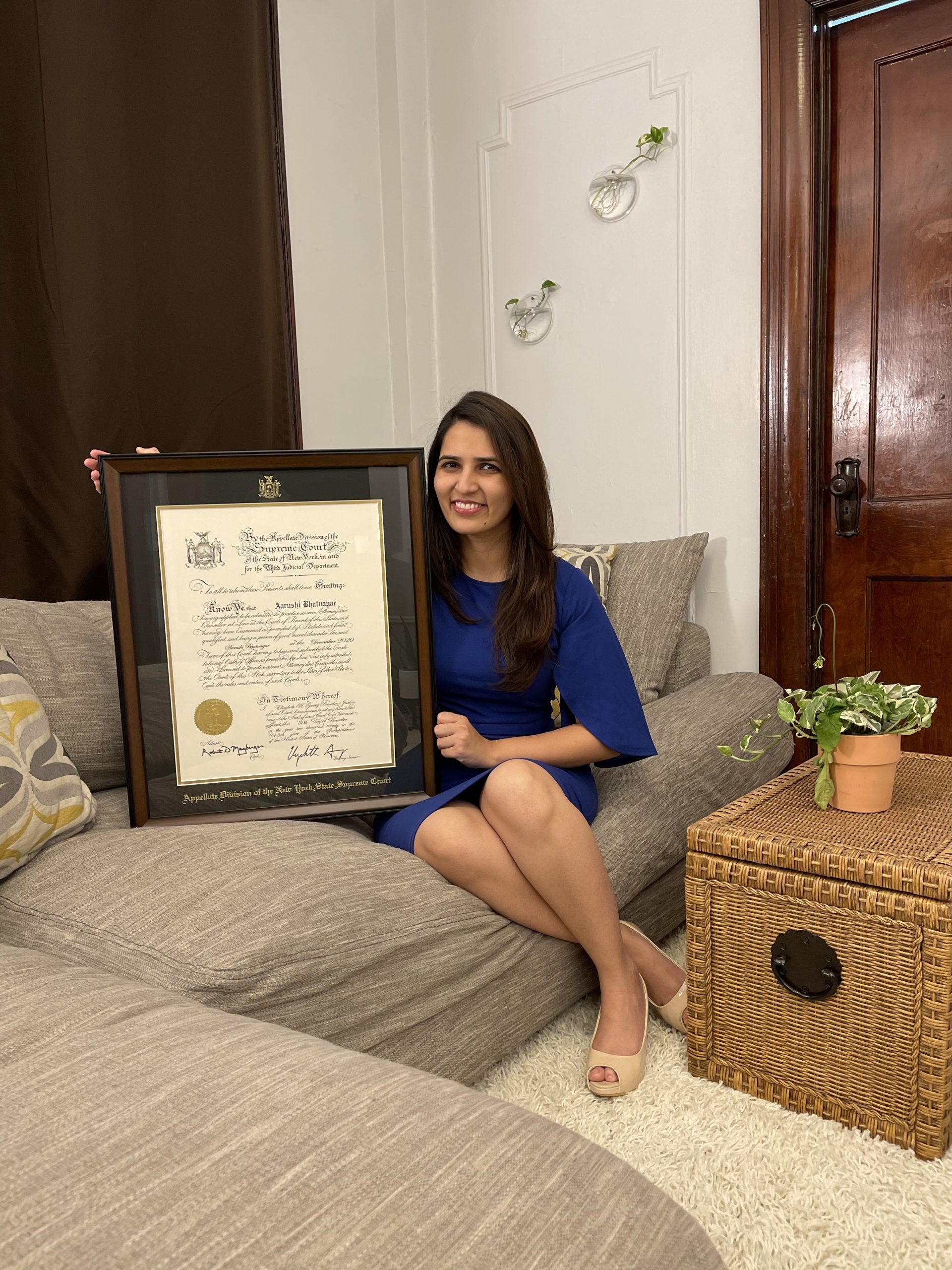
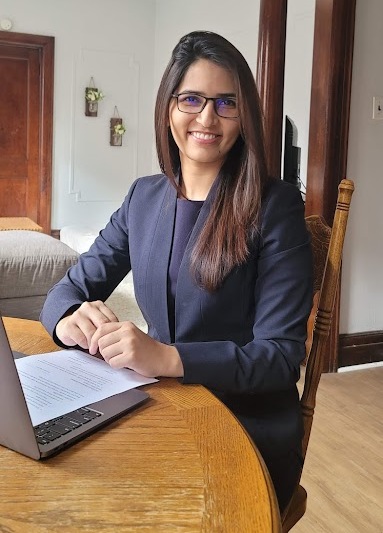
  • Ms. Aarushi Bhatnagar, Managing Attorney at PUNHANI LLC on LLM from NLU Jodhpur and NYU, cracking the NY state bar exam and practising immigration law in the United States

    Ms. Aarushi Bhatnagar, Managing Attorney at PUNHANI LLC on LLM from NLU Jodhpur and NYU, cracking the NY state bar exam and practising immigration law in the United States

    This interview has been published by Sonali Parashar and the SuperLawyer Team


    If we start from the beginning, were you always academically diligent? Did you always want to pursue law? What other career would you have chosen if not law?

    I have always considered myself a sincere but average student. I was not excessively academically inclined during my school years. Instead, my interests were directed toward art-related extra-curricular activities. Accordingly, my slam-book career goal was to be a fashion designer. At the same time, I had a strong family background in law, with multiple family members being in judiciary and litigation. Being amidst frequent family discussions involving topical legal issues, I gained valuable insight into the legal world and its opportunities. Ultimately, my interest in engaging with current affairs and doing my part to help the people around me pushed me to pursue law as a career.

    You have completed your master’s from NLU Jodhpur. Would you like to share a few tips with the students who are preparing for CLAT? How different is the preparation of CLAT PG from that of UG?

    The best advice that I can give to students preparing for the CLAT is to do as many practice tests as possible. In my experience, that is the key to cracking any competitive exam. Of course, studying and knowing the basic material that will be tested in the exam is also essential.

    I found the CLAT PG preparation to be easier than the UG preparation. The subjects tested in the CLAT PG exam are part of the law school curriculum. If one has studied and built a strong foundation in the relevant law subjects during their undergraduate years, the CLAT PG exam preparation becomes a revision exercise. On the other hand, students preparing for the CLAT UG exam are right out of high school with no formal exposure to legal academia. In such a situation, enrolling in a good entrance prep course is worth considering.

    Despite having an LL.M. Degree from NLU Jodhpur, you decided to pursue another LL.M. degree from NYU and had the flexibility of designing your course structure (subjects) there. What major considerations should one take into account while designing their course? What extra efforts have you made being a foreigner?

    Many LL.M. programs provide the students with an opportunity to design their coursework. However, one must consider several factors while making this decision. First, the coursework should align with the candidate’s short-term and long-term career aspirations. A career in law is often path-dependent, and the first job often charts the path for future professional endeavours. Second, it is essential to choose an area that complements the candidate’s prior experience. Choosing a field that builds upon the existing credentials ensures that one can make the most out of a short and rigorous LL.M. program. On the other hand, LL.M. also provides a unique opportunity to diversify into new areas. It is essential to consider one’s areas of interest and the corresponding job opportunities while striking that balance.

    As a foreigner, one should put extra effort when making space in a completely alien environment. I actively participated in networking events (both within and outside the university) and pro-bono activities, which gave me the familiarity and visibility required to succeed in the US job market. At the same time, being flexible and open-minded facilitated my venture into immigration law, a field that I have since fallen in love with.

    Can you share in brief about your current role and responsibilities as a Managing Attorney at a boutique law firm in the NJ/NY area? How do you manage to maintain a work-life balance?

    As the Managing Attorney of a boutique law firm, I have a diverse and dynamic set of responsibilities. I am responsible for onboarding clients, managing the cases from inception to completion, and handling the firm’s day-to-day operations. I advise multinational corporations, business units, and individuals on employment-based and family-based immigrant and non-immigrant visa petitions and applications. My role also entails hiring and training junior staff, including attorneys, law clerks, and paralegals.

    Compartmentalizing my work and non-work activities helps me maintain a good work-life balance. While at work, I dedicate myself to planning and executing my tasks efficiently. Breaking complex cases and procedures into simple daily tasks helps me leave the office with a sense of completion and accomplishment. It also ensures that work anxiety and stress do not spill over to my personal life. During weekends, I like to travel and engage in cooking, arts, and crafts. Having an active lifestyle rejuvenates me and prepares me for the upcoming work week. However, there are certain times when maintaining a work-life balance is challenging. In those times, having a good support system at home helped me keep my spirits up.

    You used to work as an Assistant Professor at Banasthali University, Rajasthan and now you are working in a law firm. What all struggles did you face adjusting in Banasthali and then in a Law Firm? What all things and skills did you learn as an Assistant Professor which are now assisting you in your current role as a Managing Attorney in your Law Firm?

    Teaching at a university and working in a law firm is different in certain aspects. As a teacher, I followed a well-structured curriculum and spent all my efforts ensuring that my students remained interested in the topic and benefited from the course. On the other hand, managing a law firm requires me to handle unanticipated challenges daily. However, I have enjoyed both these roles and did not face any issues in transitioning from the former to the latter. Instead, I found that the teaching skills I developed in Banasthali come in handy when I train new hires at the law firm.

    Would you like to share a bit about the field of immigration law? What is the future scope and struggles involved in the same?

    Immigration is a very dynamic field of law. It involves securing and defending the rights of immigrants from various countries and backgrounds. The legal landscape is constantly evolving, and the changes substantially impact many companies and individuals. The ongoing pandemic has amplified immigration-related issues by forcing many firms to downsize and leaving many immigrants jobless and without a livelihood. Given the ever-increasing importance of the field, it is (arguably) one of the most attractive and rewarding career paths for law students.

    You also cleared the NY state bar exam. How strenuous was the preparation? What are the eligibility criteria for the exam?

    Preparing for the NY State Bar Exam is like a full-time job. It was one of the most challenging tasks I have undertaken. Enrolling in a good bar prep course is extremely helpful.

    There are various qualifying methods to sit for the NY state bar exam. The most common criteria include graduating with a first law degree (J.D.) from an American Bar Association-approved law school. However, in the case of international students/foreign-educated lawyers, the eligibility criteria are pretty cumbersome. All foreign-educated lawyers must submit an online credential evaluation request along with the required documentation to the Board of Law Examiners. One should submit these documents even before the start of the LL.M. program because the evaluation process is time-consuming. LL.M. students must also fulfil the specified credits requirements via classroom courses in substantive and procedural law and professional skills. The official website of the New York State Board of Law Examiners provides the detailed eligibility criteria and application process.

    What will be your parting words for our readers? 

    Focus on having both career goals and life goals. Be ambitious and entrepreneurial but remember that professional success depends heavily on working smart (in addition to working hard). Reach out to people and take their guidance, rather than spending time reinventing the wheel. Be patient and diligent, and success will eventually come. Lastly, prioritize creating a wholesome life experience as it is the journey that counts.


    Get in touch with Aarushi Bhatnagar –

  • What does it take to become a partner? Sahil Narang, Partner at Khaitan & Co and AOR, Supreme Court shares his 8-year-long journey at Khaitan: from junior associate to a distinguished Partner.

    What does it take to become a partner? Sahil Narang, Partner at Khaitan & Co and AOR, Supreme Court shares his 8-year-long journey at Khaitan: from junior associate to a distinguished Partner.

    This interview has been published by Sonali Parashar and the SuperLawyer Team


    Let us begin with the most important question, did you always dream of becoming a lawyer or, did it happen by chance? Also, tell us about your journey.

    Before coming to what led me to become a lawyer- a little bit about me. I hail from Abohar, a small town, about 30 km from the India-Pakistan border, in the State of Punjab. My grandfather was a local politician and social worker, and my father was a lawyer practising at the city civil courts, Abohar who, quite often, also used to attend and appear before the District Courts at Ferozepur (later at Fazilka, a border town). So, I was exposed to the field of law at a very young age. 

    Since I grew up looking at my father, working diligently as a lawyer and collecting hundreds of books for his library every year, the curiosity towards law was imbibed in me by default. However, I had a huge interest in the field of science during my school days and wanted to become either a doctor or an engineer given the trend prevalent at that time.  I went on to study science in the 11th and 12th standard and gave competitive exams such as the IIT, AIEEE, etc. to get admission into engineering courses back then. I had an option to continue that pursuit and become an engineer, however, the innate affinity towards law imbibed within me from childhood, looking at the meticulous way my father used to practise law, pushed me to pursue the study of law. Therefore, rather than getting admission in some renowned engineering college, I enrolled in the B.A.(Hons.) program at DAV College, Chandigarh affiliated to the Panjab University, Chandigarh. I passed BA with a distinction in Political Science in 2005, post which I got selected in the three-year law course at one of the oldest institutions in the region, the Department of Laws, Chandigarh, my father’s alma mater.

    Since I was inclined to continue the study of law and give competitive examinations including the judicial services exam, I got admitted to the LL.M course at NALSAR University of Law, Hyderabad through CLAT. I was actively involved in research, pro bono work and co-curricular activities at the university during the LL.M course

    During my days at NALSAR, I was introduced to various opportunities in the field of law. I also got an opportunity to attend the Private International Law Course at the Hague Academy of International Law at, the Hague, the Netherlands in 2009. Eventually, I joined Khaitan & Co. and a decade later – here we are. 

    The present focus is on advising on regulatory issues, commercial litigation, and the representation of various clients from the entertainment and multiplex industry across India. If we draw a comparison between the global and Indian entertainment and multiplex industries, were you able to predict these advancements in the legal arena?  

    The advancement in the legal arena surrounding a sector depends upon the growth of that sector. I have been blessed to get exposure to and advise and represent clients in various sectors including in the entertainment and multiplex industry during my career. The Indian entertainment and multiplex industry caters to a very different demographic as compared to the western world. Although we receive some guidance from other countries when it comes to legal issues surrounding this sector. While there is a significant amount of autonomy and minimal regulation in western countries in the sphere of entertainment and cinemas, jurisprudence is still evolving in India. We still see heavy regulation by the government in these spheres and archaic laws which are dealing with these fields. The Indian cinema industry is faced with archaic laws which need to be updated given the fast-paced development in this area. The liberalisation of Indian cinemas and the recent shift to OTT has been a game-changer on how people consume entertainment in today’s world. The recent years have witnessed a massive influx of OTT giants such as Netflix and Amazon foraying into the Indian market. This has led to an increased reliance on Indian lawyers to assist them to find their way into the Indian space and steer clear from legal repercussions. The real challenge is for the regulation to catch up with the development of this sector.    

    You were named as one of the lawyers for Legal Era’s 40 under 40 list in the field of law for the year 2020, and you also served as the Co-Chair of Competition Law & Consumer Affairs Committee of PHDCCI for Presidential Year 2021-22. Congratulations on adding another feather to your cap. What is your next goal? Is there anything you’d like to tell us about?

    I had started with Khaitan & Co as an intern in the year 2009, got a PPO and became a Partner with the Dispute Resolution practice group, New Delhi in the year 2018. I have learnt a lot during this time. Currently, I lead a team of lawyers working on the dispute resolution side with a primary focus on commercial litigation and arbitration. The year 2020 was a very challenging year given the outbreak of the COVID-19 pandemic. It brought the best out of many of us. I was very lucky to have worked on a variety of matters despite the disruption in the legal sector because of the pandemic. It was because of the wide variety of work and the client’s recommendations that helped me get recognised in recent years. 

    However, I wish to be mindful that it’s a sea out there and there is still more to be achieved. I would want to expand my commercial litigation and arbitration practice, both domestic and international, and engage more in highly complex and challenging disputes. 

    Besides this, I would also like to contribute to the development of jurisprudence in various nuances of laws including beneficial legislations made for ease of trade and commerce.

    Having received so much from the legal fraternity, I would like to take out time to render legal advice to individuals and organisations that are unable to afford legal advice and/or cannot access legal aid. Various organisations are doing good work in this sphere. However, it is particularly overwhelming to see young law students very effectively running legal aid clinics in their colleges and effectively using social media to educate people and spread legal awareness. It would be a privilege to be associated with such benevolent activities.  

    At this juncture of my career, I would want to engage with law students and young lawyers to share the experiences and learnings, which I have received in my career to date. In fact, in furtherance of this endeavour, I have been actively participating in such webinars and would certainly like to keep that going. 

    I would conclude with a famous quote – ‘Big tasks are still out there and a lot of hard work yet to be done.

    You are involved in research and have authored some extensive research on a variety of topics. How has research work helped you stay updated with the academics as well as policy and legislative changes that we see occur from time to time?

    I think the most important tool in a lawyer’s toolbox is his / her ability to research, read and write. During my time at NALSAR University of Law, while pursuing the masters’ course, I realised that one of the best things one could invest in is books, be it academic or otherwise. This habit of reading will inculcate a life-long habit of curiosity and research.  

    This helped me immensely during my preparation for the coveted Advocate-on-record exam of the Supreme Court of India. Getting admitted is a major achievement as very few lawyers qualify in this annually held examination conducted by the Supreme Court of India.

    In addition, knowing and being abreast of the current position of law gives one confidence in dealing with and correctly advising a client.  

    Further, research methodologies would generally include comparatives analysis of legislation across jurisdictions and critique of legislation and policy prevalent in various jurisdictions. This would in turn give one perspective of laws of developed countries and what legislative changes our country may see. 

    Mr. Sahil Narang, Partner at Khaitan & Co.

    Can you give our readers a brief idea of what they need to prepare for if they want to climb the corporate ladder based on your experience representing international commercial arbitration in a variety of matters?

    There is no shortcut to hard work, perseverance, and commitment. I would add that in the initial years, a young lawyer must remain open to all kinds of work whether he/she chooses to join a law firm, a senior counsel or a chamber practice for his/her training. At a later stage, one may discover their interest in a particular field of law.  

    Further, for one to excel and climb the corporate ladder, it is important to be client-centric, innovative, detail-oriented, and prolific. These virtues will not only make one solution-oriented but also will give them an edge over other contemporaries.

    In the field of arbitration, it is important to refer to commentaries of various celebrated authors on arbitration and keep abreast of recent judgments by the courts.  

    What was the one learning experience throughout your entire career that you’d credit to have shaped your career and brought you to this point?

    My family, I would say has been my greatest motivator, and has shaped my career. Seeing my father practising law at the city civil courts, Abohar, working hard, day in and day out, motivated me at a very young age to work hard and excel in academics. Further, having roots in a very small town has made me grounded but at the same time meaningfully ambitious.

    Can you take us through a typical day in your life? Is it possible to carve out time for your other interests or hobbies given your hectic schedule as a renowned Partner at Khaitan & Co?

    In pre-covid times, most parts of my day were spent either in courts or in office. Substantial time used to be spent commuting from court to office or conferences and venues for arbitration. Travelling used to take a fair share of my time, however, with most courts and tribunals going virtual, I could save a lot of time. Consequently, efficiency increased. During covid times, my day is usually spent on reviewing drafts, attending conference calls with my colleagues in the team, clients, and senior counsel. I also make it a point to read the latest case laws of the Supreme Court and other courts on dispute resolution and arbitration. Even in my hectic schedule, I make it a point to take out time for my family. I love to read books on weekends. My favourite pastime since my college days has been to watch movies in multiplexes and the latest series on OTT platforms. I have recently picked up badminton as a sport and would also like to learn to play the piano soon.  

    What career advice do you have for our readers? In my opinion, to be successful in the field of law one must inculcate a habit of reading at a young age. One thing that has helped me in being thorough in my work is that I read every document in full, irrespective of any preconceived notions. I would advise law students to read, read and read everything you can get your hands on. To put this in perspective, my favourite quote is by Walt Disney- “There is more treasure in books than in all the pirate’s loot on Treasure Island.”


    GET IN TOUCH WITH SAHIL NARANG:

  • Kalpit Khandelwal, Principal Associate at Vaish Associates on venturing into law from a business background, the value of mentorship, and focusing on the present 

    Kalpit Khandelwal, Principal Associate at Vaish Associates on venturing into law from a business background, the value of mentorship, and focusing on the present 

    This interview has been published by Sonali Parashar and the SuperLawyer Team


    Coming from a business background, how did you gravitate towards the law? What other career would you have chosen, if not law? 

    From my early days, I was intrigued by the corporate world and wanted to be a professional instead of continuing my family business. As part of career counselling, law was identified as one of the professions’ I had the skill set for, maybe, due to my problem solving and persuasion skills. My parents always encouraged me and gave me full freedom to pursue any career of my interest. They supported me in all ways when I decided to pursue law as my career. Since my childhood, I was inclined towards computer games and also had an imaginative mind. So, if not law, I would have enrolled myself in a game designing course.

    It is said that getting a mentor is the first step towards attaining success. How true do you think the saying is? Do you think a mentor plays a crucial role in the growth of a person? What type of mentor would you suggest for a law student?

    I completely concur with the above saying, indeed I was lucky enough to get mentors in my life who had seen more talent and ability in me than I myself would have seen and helped in bringing out the same. They gave me an opportunity to work and assist them on big-ticket and complex transactions at a very early stage. I was made part of each and every phase of the transaction from the very beginning of my career so that I could learn in its entirety. I truly believe a saying that mentoring is a brain to pick, an ear to listen and a push in the right direction. In my view, every law student should have a mentor who is approachable, non-rigid, a good listener, non-judgemental, eager to invest in others, able to give honest and direct feedback. I am also fortunate enough to become a mentor for other law students now by becoming a mentor at Mentorology.     

    Litigation is notoriously time consuming and unpredictable. What changes according to you should the litigation sector imbibe to truly turn into the fundamental learning place for an advocate? Is struggling in the litigation sector worthy of effort? 

    In my view, one of the perennial reasons for excessive delay in delivering judgements is the ease of adjournments. Although Supreme Court had advised and Civil Procedure Code has enough provision for the imposition of realistic costs for every adjournment, costs are rarely imposed and therefore, litigants and their counsel think nothing before asking for an adjournment. Further, the registries of the courts are tasked with the judiciary’s administrative functions. Administrative support functions needed by the judiciary, identification of process-related inefficiencies and advisory on legal reforms, should be delegated to a specialised professional agency that has administrative expertise, specialisation, modern management practices and technologies. Also, a massive house-cleaning exercise in every single court to identify cases that are infructuous or not worth pursuing will surely reduce the pendency of legal cases. Indian legal system is also required to adopt technology and artificial intelligence in every phase of functioning. 

    Most of us struggle with pursuing different courses at a time but you pursued the Company Secretary course and Master in Business Laws while you were pursuing your law graduation. How did you manage to pull it off? Can you tell us a bit about your study pattern, and would you like to share a few tricks to ease the learning?

    The mantra I always used to sing while studying is to read as much as possible and re-read it at regular intervals. Always remember, play when you play and study when you study. Being focused in every moment is very important and challenging at the same time in today’s age of cell phones and tablets. Underlining keywords with different colours and complementing the study notes with mind maps will surely reduce the time in memorising the legal concepts. One should also inculcate a habit of reading bare acts, being the holy water of law, and judgements from college time itself. 

    You worked for almost 9 months as a Paralegal at ARA LAW, a boutique law firm and later you were handed a PPO. Can you share about your job responsibilities of both while you were a Paralegal and later on when you landed the job?

    I was never a morning person until I joined ARA LAW and used to reach the office an hour early. Every day before office hours began, I used to read the latest updates to existing laws, important judgements, legal news, etc. and used to discuss the same with my seniors, as keeping abreast with the rapidly changing corporate legal environment is essential for any lawyer. As a paralegal, I also used to research, attend and take notes of the calls/meetings, proofread agreements and make summaries of agreements/documents provided by the target entity for due diligence purposes. I have always believed in doing work diligently and sincerely without thinking much of the outcome. My work spoke for me and as a result, I was offered PPO by ARA LAW. As a lawyer, I used to assist my seniors in drafting and revising the transaction documents, preparing the due diligence reports, drafting legal opinions, etc.   

    Can you tell us a bit about your current job role and responsibilities? 

    As a transactional lawyer, I wear several hats in the process of working through a deal i.e. an advisor, mediator, negotiator and drafter. I provide advice on matters relating to M&A, strategic alliances, regulatory aspects, etc, prepare reports and opinions on diverse corporate matters relating to Companies Act, FEMA, SEBI regulations, stamp duty, etc., handle legal due diligence exercise, negotiate the transactional documents, drafting, vetting and execution of all the transactional documents. One of the biggest challenges and at the same time, most exciting aspect of M&A practice is that your schedule is exceptionally uncertain and highly variable in terms of intensity. I am fortunate enough to lead a team of associates who are extremely capable and flexible enough which makes my life easy when we are faced with an accelerated deadline. 

    You have led several acquisition deals like Patanjali’s acquisition of Ruchi Soya, acquisition of Innov8 by OYO, Lemon Tree’s acquisition of Keys Hotel and more. What were your key experiences/takeaways from these acquisitions?

    The sound understanding of commercial and business complexities besides the legal intricacies of a long-drawn M&A transaction and precisely communicating the same to the client as well as the other side while negotiating the deal is a bedrock skill that cannot be dispensed with. Further, a corporate lawyer is expected to think and reach with the same sense of adventure as that of his client as in the corporate world, there is no decision making without an element of risk. At times, in M&A transactions, you are faced with seemingly insurmountable obstacles wherein you have to train yourself to not merely focus on the specific issue at hand but also you have to consider every possibility, never being dismissive of anything and think out of the box to steer your client through the M&A deal. Further, we need to be highly responsive to clients and comfortable with interweaving work and personal life because of the technology we have today.

    What will be your parting message to our young lawyers?

    I have heard several times from young lawyers that they ‘do not understand’ their seniors or ‘have no idea what is going on’. Bizarrely on the same knot, they also shared that they do not address their queries and issues with their seniors. Establishing an open channel of communication with seniors would certainly help you in setting the work environment straight. These seniors can also show you the ropes and take you under their wings. As young lawyers, we are often driven to learn as much as we can and as fast as we can. Blinded by the thirst to improve, often we find ourselves volunteering to take on voluminous tasks which we may not be able to execute effectively. In case you find yourself in such a position, speak to your superior in advance, instead of attempting to move mountains in a short span of time. At the same time, remember always that the grind in the early years will pay off in the long years ahead in your practice. Focus all your energy on working hard. Attention to detail is also indispensable for any corporate lawyer as small mistakes could significantly cost a lot to your clients (and your organisation) and therefore, it is an absolute must for you to work on this quality from the start. 


    Get in touch with Kalpit Khandelwal:

  • Dharmendar Kamti- Managing Partner at Kamti & Singh, Founder of Literate Hub, and also the Member of ICCA & SIAC, paving his own path in the Legal industry

    Dharmendar Kamti- Managing Partner at Kamti & Singh, Founder of Literate Hub, and also the Member of ICCA & SIAC, paving his own path in the Legal industry

    This interview has been published by Tanmaya Sharma. The Interview was taken by The SuperLawyer Team.


    You were born into a family of Lawyers. Was it the guiding factor that made you pursue law as a career? If not the legal profession, what would be your go-to career plan?

    What marks my struggle as unexceptionally remarkable and inspirational is the fact of having a start-up law firm being a First Generation Lawyer. So first things first, my father is associated with a law firm but not as an advocate. I have paved my way to the Law and Legal industry all by my hard work and zeal to be a smart gen commercial lawyer. Curiosity is the best teacher. I was curious to gain and learn about the law and legal framework and thereby, interpreting and relating it in the commercial perspective. If not a lawyer, I would have loved to become a Trading Tycoon and deal with shares. 

    You happen to be a member of the International Council for Commercial Arbitration and Singapore International Arbitration Centre. Can you tell us a bit about your work there and what according to you are the ways in which India can shift and evolve in the arena of Arbitration?

    Arbitration is an evolving mechanism in the Indian Legal perspective that gained substantial attention and demand in the COVID-19 and POST-PANDEMIC ERA. The International Arbitration and Mediation Centre, Hyderabad is the first step towards recognition of International Arbitration in a global perspective in India. The Indian Legal framework has marked the recognition of the very scope and potential of Arbitration. Being a member and having an affiliation with such a prestigious and enlightening Organization, I have witnessed several events relating to Arbitration and its scope and adoption in different countries.  

    You have worked as an Associate at SNG & Partners and then as a Partner at KJS Partners Legal LLP before setting up your own firm Kamti & Singh. What according to you was that one learning experience that you’d credit to have shaped your role as a Managing Partner?

    While every new opportunity in this industry brings with itself a myriad of life-altering experiences, the one learning experience that I can with absolute confidence credited to my current role and position is the Art of management and the beauty of networking. It’s a smart world and you need to pace yourself. Keep learning and keep growing is my life motto.

    KJS Partners was also my start-up idea which I tried to execute with 4 of my friends from the same industry but due to ideology mismatch, it couldn’t reach the heights I wanted it to. But that experience didn’t stop me from having an ace in the field and flourishing in the industry. 

    You are Managing Partner of Kamti & Singh Associates. Does growth in one’s career trajectory relieves one from stressful work or is it the other way around?

    Being sheer honest, I’d say both because being a managing partner gives me the power to delegate work and build a reliable and responsible team of efficient and excellent advocates, interns and clerks. But it’s the work that can be delegated and not the responsibility. So being a managing partner, I have the responsibility of keeping my entrepreneurial streak always active which can lead to sleepless nights. 

    No alternative text description for this image

    You pursued your Bachelors with specialisation in Banking, Corporate, Finance, and Securities Law. What piqued your interest in such subjects and was it something that you decided since the beginning of your law school journey? 

    Everyone at this stage is quite indecisive/lost and naturally so. However, I have always been quite clear with my vision to become a corporate lawyer. I have always been keen to explore the relationship between entrepreneurship and the legal sphere and how it can contribute to a healthy business scenario and an efficient yet speedy legal redressal. Being aware of the know-how of the business world can give you an edge in comprehending various commercial aspects of law like due diligence and auditing.

    What were the activities, curricular and extra-curricular, that you undertook during your law school days which helped to shape your career? / What kind of internships did you undertake during your law school?

    I was always focused on my aim to drench and explore the commercial side of the law. We all have our aims and vision but the ones who take steps in pursuance of their goals are the ones who emerge victoriously. I took small steps towards my ultimate aim and pursued all my internships in commercial law starting from Linklegal, NBCC, Indlegal, Shardul Amarchand Mangaldas, SNG & Partners to later on being an associate at SNG & Partners followed by being a partner of KJS Partners and finally proceeding as a Managing Partner of Kamti & Singh. It has been an utmost hardship yet an inspiring journey for me. Apart from this, I had participated in several Moot Court Competitions and Debate Competitions during my college life to enhance my pool of knowledge and shape my skills.

    Do you think it is crucial to have a career plan beforehand or one should move with the flow?

    One needs to have a vision, but versatility is the key. Be clear as to what you want to do. But be open to exploring the ways and means. Be ready to learn and seek insights into every stream of law and make an informed decision. Ultimately, the goal is to strike a perfect balance between both.

    What would be your parting message to our readers and the young budding lawyers?

    Age is just a number and Curiosity is the best teacher. Be you and stay focused. Enjoy what you do and do what you enjoy. 


    Get in touch with:

  • Nitish Banka- Founder of Lexspeak Legal who has also marked his steps in Civil, Consumer, Criminal Litigation along with corporate legal support

    Nitish Banka- Founder of Lexspeak Legal who has also marked his steps in Civil, Consumer, Criminal Litigation along with corporate legal support

    This interview has been published by Tanmaya Sharma. The Interview was taken by The SuperLawyer Team.


    You’ve graduated with a Bachelor in Engineering and then went on to pursue Law from the University of Delhi. What motivated you to switch your stream and pursue law?

    It was demotivation that actually motivated me to do law. I was tired of the monotonous routine offered by my previous job and to break that I enrolled in an evening college offered by Delhi University at that time and thereby I entered into law and for some time I was pursuing Job as well as law side by side. But then I quit my job and entered into law and restarted my career as an Intern. Believe me, it is the most difficult task to abandon a good career and restart as an intern in a totally unrelated field and that was the actual motivation to take the law very seriously. Motivation is overrated as I was not that motivated but I had no choice other than to pursue law seriously and improve. It is a consistent effort to become better which actually worked.

    You have been actively taking up Pro-Bono cases and have done a lot of free service in your career trajectory? How important is it for Law Students and professionals to take up Pro-Bono cases and help the needy? 

    At the initial stage, maybe for 2-3 years, you should not think about the fee as the experience you will gain will work wonders in years to come. That will compensate for free or pro bono work. I recommend enrolling with legal service authority in the initial years and helping the society and when you become established in your field then also devote some time to Pro Bono activities.

    Not all students manage to get into good law colleges let alone NLUs. How did you, as an engineering student, become fortunate?

    It is not about college or fortune. It is about how desperate are you? How needy are you? How much hunger do you have? When something is not working, we blame our college, the circumstances and our background. Instead of improving ourselves, putting hours in grooming our skills, we blame them. Your college or background has nothing to do with it. It is your hunger to achieve more.

    Can you walk us through your day in life? What is the life of a Founder of a reputed law firm and a renowned lawyer? 

    I have to reach 10 AM to court if it is an argument, then have to spend a few hours preparing that too in the morning, so you can say, I have to start at 6 AM or 7 AM in the morning.

    Between 10 AM to 4 PM I have to be in court and come to the office at 4 PM or 5 PM then have to start preparing for conferences scheduled for that day. Drafting work and preparation work for the upcoming day is delegated to associates who briefs me by EOD.

    At 7 PM when I finish with conferences, I get briefs from associates and plan for the next day.

    At 8 PM-9 PM, you-tubing and blogging are scheduled.

    On weekends, I focus mainly on Judgement reading and conferences.

    How has social media impacted your career?

    As a first-generation lawyer, I started blogging in 2014, started youtube 2018 and LinkedIn in 2021 so the impact is huge as 90% of clients come through these platforms.

    It is now close to a decade that you have been a Practising Advocate at the Hon’ble Supreme Court of India and also are the Founder of LexSpeak Legal.  What kept you motivated all the way long? 

    Again, I would say motivation is overrated. Someday you will feel motivated and someday you may not. It is consistent efforts and working on different cases, handling challenges that have worked.

    Can you share with us what it is like to build a clientele from scratch? What tips would you like to share with the aspiring lawyers?

    I was blogging for almost 7 years so it was my source but there are many sources for beginners like offering free legal advice on various online/offline platforms, joining legal aid, acting as proxy counsel for various seniors which in future may refer your matters. Socializing/Networking. Taking lead in legally solving social issues.

    What key tips do you suggest to the lawyers representing in the Courts?

    Well, I am still learning things so I am not at that level to give advice or tips. But I would like to emphasize that apart from legal skills lawyers should develop allied skills like marketing, accounting, finance, blogging, business management.


    Get in touch with:

  • Soumya Shekhar- Founder of Remote Lawyer, a scholarship holder from the National University of Singapore who also worked with tier-1 law firms and MNCs

    Soumya Shekhar- Founder of Remote Lawyer, a scholarship holder from the National University of Singapore who also worked with tier-1 law firms and MNCs

    This interview has been published by Tanmaya Sharma. The Interview was taken by The SuperLawyer Team.


    Tell us about yourself – Why did you choose law? If not law, what other career options would you have considered?

    A Law of Torts book had accidentally fallen in my hands when I was in class 11th. The fact that this field required application and interpretation of existing legal principles appealed to me. Since then, I wanted to pursue my higher studies and profession as a lawyer. If not law, then I would have been a journalist or an author. I love to write and would have enjoyed merging my passion with my profession. 

    You were amongst the first batch of students that took the AILET Examinations and you stood at 16th in the All India Ranking. Could you tell us a bit about how you managed to secure such a good ranking and about your experience studying at the prestigious National Law University of Delhi?

    I think the key to securing a good rank in any competitive examination lies in solving as many mock tests as possible. No matter how well you are prepared, what matters, in the end, is how well you did in the limited time that was given to you on the particular day of the exam. To bridge the gap between well-prepared and best-prepared, one should try simulated test-taking. It not only increases the confidence but also assesses the level of your preparedness. 

    National Law University, Delhi laid the foundation for my professional career. The academic pedagogy and the vibrant culture led to holistic development. Located in Delhi, it played a major role in being able to intern even during college days. It is the bedrock of not only my development as a lawyer but also who I am as a person today.

    You have been Course Content Curator, Legal Editor, and Research Consultants to many firms and Organisations. You were also the Research Lead at WHO Legal Development Program in India. It would not be wrong to denote you as a Scholar. Can you tell us what about Research kept you going?

    I am extremely passionate about both writing and law. There was nothing better than merging both my passions together and hence, I commenced my journey as legal research professional. During the initial years of my legal consultancy career, I exclusively worked on legal content creation and knowledge management assignments. I served as an external Knowledge Management Consultant to AZB and Partners and was also the Research Lead for the WHO Legal Development Programme for Road Safety in India. 

    The way research is conceptualized commonly tends to be more theoretical than practical. However, it was the latter aspect of the same that caught my fancy. For instance, while everyone knows what a force majeure clause is, it is its application that is rarely been written about. It was the application of legal concepts that I wanted to discuss rather than the theoretical underpinnings. A reflection of this fascination with the practical perspective of legal research can still be seen on the blog of my firm, Remote Lawyer.

    You have studied at National Law University, Delhi, and completed your Masters at the National University of Singapore in Corporate and Financial Services Law. What difference did you find in the Pedagogy in Indian Schools and abroad?

    One key difference is that schools abroad focus more on understanding than rote learning. For instance, there were many occasions at the National University of Singapore, wherein we had open-book exams, take-home exams, etc. which tested a person’s ability to understand and apply the legal concept rather than reproduce the theory around the same. Another important difference I found was the focus on in-depth legal research. The research papers were thoroughly vetted and the faculty was always looking for an element of originality. 

    What was that one learning experience in your entire career trajectory that you’d credit to have shaped your career and your role as the Founder of “Remote Lawyer”?

    I left a plum middle management job at a multi-national company to start my career as an independent legal consultant in 2018 and the rest is history. My stint as an independent legal consultant taught me more about the legal profession and the field of law than any organized institution would ever have. Experience is the best teacher. When you do not have anyone to correct your mistakes, you start becoming more careful. When you have to solicit clients on your own, you automatically shed the shell of an introvert and learn how to network. It was my 2.5 years as an independent legal consultant that gave me the confidence that I can set up an organization all on my own. It taught me how one can create value in oneself. 

    Can you walk us through a day in your life? What is the life of a Founder of an Online Legal Consultancy Firm like? 

    Managing a virtual legal consultancy, such as Remote Lawyer, with a diverse clientele from varied sectors and different time zones, requires meticulous planning ahead of each day. Before I end work for the day, I create a To-Do list for the next day. Every morning, I review this To-Do list along with the corresponding deadlines and plan accordingly. A typical workday consists of reviewing and drafting agreements, drafting notices and opinions, attending negotiations and client calls. I also run a YouTube channel by the name Remote Lawyer and make it a point to create content for the same, at least once every two weeks. It is a part of my commitment to give back what I have learned to the legal fraternity. Along with client assignments, I also make it a point to take out time to curate content for the blog of my website, at least once a week. 

    It is now close to a decade that you’ve been a part of the legal fraternity. What do you think is the difference between the law profession right now and the profession a decade back? And, what all changes would you like to see in our Indian Law Profession?

    A decade back, the very concept of a virtual legal consultancy would have been unheard of. The fact that legal services can be delivered right in your inbox, without the need for you to meet your lawyer, would have been an unthinkable idea back then. The legal profession today demands change and transition from the traditional to the modern. The fact that legal tech is booming and growing and there are so many software technologies that assist us lawyers in our day-to-day life shows that we need to adopt new technological advances. The subject matter we deal with every day is also fluid. Fintech and Information Technology laws, cryptocurrencies, NFTs, etc. are novel concepts and lawyers need to keep pace with the changing legal landscape. 

    Lastly, is there any suggestion or advice that you’d like to give to our readers?

    I have always felt that creating value in oneself is extremely important. From a young age itself, try to become that resource that every company and firm wants to hire. Be meticulous in what you do. Question everything and accept nothing without supporting evidence. And most importantly, focus on application rather than rote learning. Knowing what the law is will help you to a certain extent, but understanding and applying that law in a way that helps your client is what will enable you to leave your mark as a successful lawyer. 


    Get in touch with:

  • Bhavana Chandak- Associate at Kachwaha & Partners, Delhi, also volunteering as an Additional Director of Philanthropy at CAN Foundation

    Bhavana Chandak- Associate at Kachwaha & Partners, Delhi, also volunteering as an Additional Director of Philanthropy at CAN Foundation

    This interview has been published by Tanmaya Sharma. The Interview was taken by The SuperLawyer Team.


    You participated in a few National Rowing Championships and secured a great position. What made you choose law over sports? 

    Rowing till date is very close to my heart and I will never forget the days where it was rain or shine we would go down to the jetty and race against others. My passion kept me in the sport and I won the gold medal at the National Championships more than once. I loved my journey as a rower but at the same time, I was not keen on making it my full-time profession. In the penultimate years of school, I decided to pursue law. The prospect of being a lawyer and having a voice in a society wherein I could defend myself lured me to choose law as a career. 

    Do you think that participating in National MUN, National Parliamentary Debate, or National Moot Court Competition helps in real litigation or legal fields?

    Any form of extra-curricular, be it MUN, parliamentary debates or Moots plays an important part in one’s journey in law school.    A MUN gives you exposure to a pre-prepared competition in international diplomacy whereas a Parliamentary Debate teaches you to be quick on your feet and cull out the most interesting arguments in a short span. While the former is a well-rehearsed and researched competition the latter is dependent on your knowledge. Both these competitions are extremely fun, but I would prefer a Parliamentary Debate, because of the adrenaline rush. They help hone your public speaking skills. 

    Moot Court Competitions for sure help you in real-life litigation because they are the closest experience to a courtroom during law school. You learn how to draft issues, present arguments, learn court demeanor, and understand the courtroom. You may participate as a researcher or a speaker, but in either role, you understand the basics of real-life litigation, which you can then build upon once you’re a professional. For instance, when I took part in Mediation at the Symbiosis ADR Competition, I found one of my interest areas in law and when I won the third best memorial at the Philip C. Jessup, I learned how to deal with multi-dimensional issues, court craft, and drafting. I cherish all my participation and accolades in Moot Court Competitions because they have helped me grow as a student of law. 

    Should one always intern under the same Advocate/firm or explore new places with time? What will be best for a law student to establish his/her career in law? 

    Internships are without a doubt a vital part of law school which helps you find your passion and interest areas. Having said that, it is implied that one should explore through in their nascent years, say up to your 3rd year by working at different places. By interning at different places, one is exposed to different laws, working environments, projects. For example, in my first three years, I worked with NGOs, State Commission, a boutique family law firm in Bangalore, a Calcutta High Court Advocate specializing in company law matters, Sr. Advocate Siddharth Luthra specializing in criminal law. In those years I learned how different Courts operate and got a macro understanding of various laws and practices. On the way, through my internship with the Disputes team at Khaitan & Co., I found my interest in arbitration. 

    Then in my last two years, I streamlined my internship opportunities at the Disputes team of various law firms, like Nishith Desai Associates, Dua Associates. In my final year, I was looking to intern with a law firm for the long run or do repeat internships to secure a job. Since I already knew by then that I wanted to practice arbitrations I applied for an internship at Kachwaha and Partners. Once I completed that, I received my assessment internship at the firm for two months and then I was offered a PPO in my last semester. 

    My only reason to lay down my journey so far is to depict that one should not lay their eggs in the same basket. If you are trying to find your interest then explore your options, after a while streamline your internships and then choose what fits you the best. 

    You are dealing with national and international arbitration matters. How do you feel about it?

    I am fortunate that Kachwaha & Partners has allowed me to work on multiple high stake arbitrations. The experience has been exhilarating so far! I have for a year working on both ad hoc and institutional arbitrations on an array of topics. I feel humbled that I have worked so early in my profession, worked on such big-ticket matters, and attained knowledge about the intricacies of the profession. All in all, I would say that I have had a great kick start to my journey in the field of arbitration and undoubtedly it will go a long way in the profession. 

    Could you please tell us about your role in the CAN Foundation? How has your experience with the Foundation been until now? 

    Before I get into the specific role, I’d like to tell you a little about our work. At the Foundation, we support law students at various National Law Universities to complete their academic courses and freshers as well. I work there in the capacity of Additional Director of Philanthropy. My main role is to secure as much financial support we can to help out our applicants. Over the past few months, I have worked closely with Siddharth Sir (the CEO of the Foundation) and spearheaded the fundraising campaign for our flagship program Eklayva (wherein we provide scholarships to financially distressed law students). One would expect it to be a fairly simple task, but over almost three months, my team had approached approximately 400 potential donors daily to raise funds. 

    Being involved in fundraising at such a big scale has made me more humble and conscious of my privilege. While perusing through the applications, the obstacles which students have faced, the backgrounds they hail from, their stories, can shake a person to their core. It is honestly a fulfilling task to see that our hard work over the past few months has led to awarding of scholarships to so many students in need. 

    We have an audience that is interested in legal writing. Could you tell them how to utilize their interest in shaping their career?

    Legal writing is undoubtedly a very important part of our profession, and it is a skill best developed if started early. The beauty of legal writing is that firstly, it provides you with a holistic understanding of the topic one is writing on, and secondly, it improves your drafting skills. I would advise interested students to try and pen one article each semester. This would not even put a lot of pressure on the student or hamper their extracurriculars. It is important to mention that, it is not necessary to write your articles on the same law, but rather you can choose to diversify depending on the current topic of relevance and interest. For example, I have written on niche topics in arbitration, and alongside have written pieces on environmental law, human rights law, etc. The tricky bit while writing is not penning down the article but rather choosing a good platform to publish it. One should choose a forum of repute while sending in their manuscript for publication; only then will the publication be of relevance in the long run. 

    You are a young established legal professional. What is your success mantra?

    Thank you for your kind words, but I think I am too young in the profession to be called established. However, the only mantra I abide by is to learn something new every day, however inconsequential it may seem. It may so happen that the task you are allotted might be small but only if your basics are coherent can one build a strong empire. I would also like to say that it is important to not rush in the journey because it is a marathon, not a sprint. You need to perform every day and be a better version of yourself as compared to yesterday.  

    What career tips do you want to give to our readers? 

    The only career tip I would like to give everyone who is reading this is to do their tasks diligently. There is no shortcut to hard work. So if you put in your hours and apply yourself to the task you are working on and be patient, there is absolutely nothing stopping you from attaining success in the field of your choice. 


    Get in touch with:

  • Raghujeet Singh Madan- A Managing Partner at Lex Commerci, specializes in Litigation and ADR, seamlessly resolving complex legal issues

    Raghujeet Singh Madan- A Managing Partner at Lex Commerci, specializes in Litigation and ADR, seamlessly resolving complex legal issues

    This interview has been published by Tanmaya Sharma. The Interview was taken by The SuperLawyer Team.


    “Man with a silver spoon in his mouth” is what they say to a law student having a family with a law background. How hard was it for you to climb the ladder of success you achieved to your name?

    Not just the legal profession, in various professions, next-generation taking up the profession similar to their parents does get the benefit of the best education and are the beneficiaries of the family contacts and networks. Your parents’ experience and knowledge are great resources to learn from in your career. Having a family with a law background does provide you with a foundation. However, you alone have to build a robust structure upon the same with your knowledge, skills, and accomplishments.

    The common perception about the term “silver spoon kids” usually is, that they lead an easy and cushy life, are well provided, which ensures that they lead a life of entitlement and privileges. This perception is not correct. There is a huge pressure instilled, where you are constantly compared to the members of the family. 

    There is a beautiful quote I read somewhere which says – “Focus on doing, creating, and participating in your career in ways that tell the world you have credentials that are yours and not just an extension of your parents.” I truly believe in this. In my view, second or third-generation lawyers have immense pressure, and constant gaze, which leads them to be more deserving of respect, as there are fighting battles that the others may not be even aware of.

    I also faced challenges as a young lawyer. I have worked very hard to maintain and expand my client base, set up a law firm, to retain an effective workforce. There are issues to be dealt with on an everyday basis. However, this is a part and parcel of the satisfaction you yield from this profession. These challenges, in fact, now interest me, motivate me and I enjoy dealing with them. Therefore, even if you have a law background, your hard work, life skills, and virtues are what decide your growth. 

    Let’s start from the beginning – What prompted you to choose law? Was choosing law came naturally or it felt easy to adapt?

    Family undeniably influences the level and kind of education or training that their children achieve; the knowledge they have about work; the beliefs and attitudes they have to work, and the motivation they have to succeed. Most of this is learned unconsciously. Dinner table conversations did shape my belief about the meaning that my parents derive from the work they do. Fairly speaking, the decision to pursue law came naturally to me because of my family background but it never felt easy to adapt simply because of my background. I remember the first case I ever argued, my notes for the matter started from ‘my lord’ and ended at ‘obliged your lordship’. I wrote it down like a script, the pressure was real.  You learn new skills, concepts, and ideas every single day. Remember your career is a marathon, not a sprint. In an attempt to achieve too much too early, you should not lose your flexibility to adapt to situations and ability to embrace the lessons learned.   

    It has almost been two decades since you have started your independent practice. What do you think is the difference between the law profession right now and the profession a decade back? And, what all changes would you like to see in our Indian Law Profession?

    There is a lot of change in the legal profession over time. The use of technological advances has brought a paradigm shift. We have witnessed a movement towards unlimited use of legal research platforms. Technology has offered many practical solutions to automate work. A keyword search can sort documents in 1/10th of the time it took us physically a decade back.  The immense use of technology has also brought new or wider areas of practice such as cyber laws, intellectual property laws, etc. A well-working system of virtual courts that we all experienced during the COVID-19 crisis is another revolution in our profession. This also brings to us immense time saving and creates a potential to execute more work much efficiently. All this has brought an advantage to the young lawyers who are a step ahead in using the technology. Sadly, this is not realized by any of us. As against an age-old perception where the confidence of the client only rested with a senior and experienced lawyer, I see various clients who are satisfied and are more drawn to these young meritorious lawyers.

    Technology and globalization have also brought a radical change in the expectations of the client who expects not only legal delivery but a combination of legal, technological, and process expertise. Nowadays, most of our work is done online. It has its benefits. It allows us to work across borders, travel, and have an office on wheels, etc. Legal delivery is not just about lawyers anymore, it is about delivering legal services with strategies, innovation, collaboration, transparency, responsiveness, and accessibility. This is the reason that the law firms have gained popularity over the solo practitioners with the passage of time. Law firms these days provide a one-stop solution where you may find not only lawyers but also MBA’s and Technical Experts who offer a wholesome legal delivery to the clients. 

    There are still many unexplored areas of technology that can upgrade our judicial system further. Change is inevitable. In our profession, the pace of change has been accelerated by the economic downturn and a surge in new technologies. These changes are significant and permanent. The need of the hour is that we maintain a growth mindset and exhibit a willingness to experiment. Lawyers, who adapt and are proactive, using a growth mindset, can turn changing market drivers into opportunities.

    Raghujeet Singh Madan

    Have you encountered any young rebellious mind yet who positively challenges your litigation tricks?

    Yes, a lot of times, I have come across young professionals who are way vocal and expressive about what seems wrong, unacceptable, or unreasonable to them. It is good to be expressive and opinionated. However, young lawyers need to understand the balance between expression and disrespect. In our profession, there are no written rules which tell you how to conduct yourself in the courts. However, there are plenty of unwritten rules which can be understood well only by observing experienced professionals. A lawyer’s patience, presence of mind, and ability to maintain his/her cool is what makes the transition for the lawyer. 

    I remember an associate who told me that there should be fixed hours of working in a day which should not be more than 8 hours a day and 5 days a week. He termed anything more than this as ‘inhumane’. I expressed my agreement to his proposal but I told him that such agreement will be subject to you leaving aside expectations you had from working with me.  This profession requires a person to be switched “on” all the time. One mistake of yours may result in a client’s loss. Young lawyers need to manage their day properly but the one thing that young lawyers have to keep in their mind is that they have to work very, very hard. The initial years for young lawyers are the hardest but over time they get used to it and get better with time.
    Law is not an abstract practice. Irrelevant of how well someone does academically, at the end of the day lawyers work with people, on behalf of people, and the decisions that are made affect people’s lives. Life skills and people virtues are, therefore, indispensable for becoming a good lawyer. No law schools teach you that. It is the experienced professionals and real-time practice that can make a young lawyer learn all this. Young lawyers have the potential to generate new ideas, but they need to be directed properly by someone who has a lot of experience in the legal world.

    You have a team that often burns the candles at both ends, how do you find the perfect balance in being their boss and friend at the same time?

    “No matter how brilliant your mind or strategy, if you are playing a solo game, you will always lose out to a team.” This is a very powerful saying. A good team is built by individuals that passionately embrace the vision, believe their contribution is meaningful, and are motivated to give their best effort. I value and admire my team and we trust, respect, and support each other. Making out a time to regularly recognize, reward, and celebrate the team is as much a priority as work for me. I ensure that we sit together weekly for review meetings, be there for as many birthday celebrations as possible, and to give individual time to everyone.  It is up to you to find the balance between being friendly with your employees and being a leader to them. For me, it works to spend some good time with them without any ‘work discussion’, to listen and understand their problems, to help them, and to joke around with them.  

    You have two decades of strong and comprehensive legal experience in almost all sectors, which area, according to you, interests you the most and why?

    All the fields of Law have their charm.  There are a growing number of legal specialities and subspecialties that cater to almost every legal interest. My predominant area of practice is Infrastructure commercial disputes including resolution of such disputes through Arbitration. I won’t be able to say if I chose it deliberately or I got into it by default. Nevertheless, I thoroughly enjoy practicing it. The foremost reason for the same is that you learn not just law but also various business processes dealing with such disputes. For instance, while handling disputes about the building of national highways, you learn various engineering concepts and terminology and understand how large-scale highways are built and what impact it brings to the development of our economy. This is what I call a fulfilling experience of working which makes you wiser in a manner that no school or coaching class can do. 

    Raghujeet Singh Madan

    You are alumni of the Dickinson Law School, Pennsylvania State University, U.S.A. What core life-long values were inculcated in you during that period? And, what difference did you find in the Pedagogy in Indian Schools and abroad?

    I am grateful for my experience at Dickinson Law School, Pennsylvania State University, the  U.S.A not because it made me a better lawyer but because it exposed me to different types of people that helped me develop people skills.  It was the ultimate test in self-reliance, made me more organized, independent, and appreciative of every small thing I have. In so far as education abroad is concerned, you get a chance to become immersed in a different environment which enables you to see and do things you wouldn’t expect, and meet people who have grown up in a different culture. American law school experience is all about analysis and less about memorizing rules and statutes. The system focuses that the lawyers become problem-solvers through analysis of cases and defending with the correct reasoning. It cares less about the section numbers, the statute, or even the case name. However, it is not to say that the American approach works better than the Indian. Both pedagogy systems have produced excellent lawyers.   

    It would not be wrong to say that you are well-established in the legal profession. Do you want to share your success mantra with our readers?

    My foremost advice, which also concerns me a lot, is that young lawyers should make it a habit at a very early age to care for their health. To be a good lawyer, one has to be a healthy lawyer. Sadly, our profession is falling short when it comes to well-being. Exercise every day by cutting down the time you spent watching movies or web series, treat food as fuel, and meditate. This will not only improve physical health but also will make you strong to deal with the pressures and stress that our profession brings along. 

    Lawyers must be personable, persuasive, and able to read others. Learn people skills, be attentive, and be a good observer. Read a lot. It is an exercise for our mind and a healthy mind has a major role in leading you towards success. Also, a very important virtue of a successful lawyer is to inculcate Perseverance.  Perseverance is not a long race; it is many short races one after the other. Be consistent in your efforts. Failure will come and make you stronger if you remain consistent in overcoming them. 


    Get in touch with: