Tag: Law Firm

  • Prem Rajani, Managing Partner, Rajani Associates, on building a firm practice and experience in corporate law

    Prem Rajani, Managing Partner, Rajani Associates, on building a firm practice and experience in corporate law

    Prem Rajani graduated from Government Law College in 1990 and is now the Managing Partner of Rajani Associates which was established in 1999. In this interview he talks to us about:

    • His time in law school and how facets of the profession have evolved with time.
    • The importance of moots, debating and internships.
    • Building a corporate law firm profile.
    • Working in Structuring and M&A deals.
    • Advice for young lawyers today.


    How would you like to introduce yourself to our readers, most of whom are university going law students in India?

    Currently I am the Managing Partner of Rajani Associates. Rajani Associates is a full-service law firm based in Mumbai and established in November 1999. The Firm has been involved in domestic and international practice in nearly all fields of corporate law as well as commercial litigation and property law. The Firm closely works alongside firms in the US, Europe, Middle East, South East Asia and Australia to meet the needs of our global clients. Our areas of practice are Corporate & Commercial, Mergers & Acquisitions and Competition Law, Banking and Finance, Domestic and International Capital Markets, Private Equity, Corporate Litigation and Arbitration, fund Formation, Real Estate & Trusts, Projects and Project Finance, Technology, Media & Telecom and Intellectual Property rights, Corporate Debt Restructuring, Structuring, Anti-Bribery and Corruption.


    Tell us about your life before you joined law school. What made you gravitate towards law?

    Immediately after finishing with school and college (commerce faculty from Jai Hind College) I joined Government Law College. The paramount factor that made me take up law was my father’s business that had a lot of dependency on solicitors for preparation of legal documents. Alongside my studies, very early on, I started assisting my father with his business and as a result often met many solicitors. The manner in which solicitors conducted themselves fascinated me. I started getting drawn to legalities and the documents that were being prepared. There came a point that I became so passionate about the profession that I had no doubt left in my mind that a solicitor is all I wanted to be.


    You graduated from GLC in 1990. How were the days? What would you advise our readers is the ideal things to look to get out of university, other than a degree?

    During my time law firms did not retain interns for summer/winter training and as such work training for most of us did not happen till we joined a law firm as an article for solicitor examination training. Most of us therefore very seriously attended college and read books from the library. Today the trend has changed. Young students are getting a chance to intern at a variety of established law firms giving them a chance to know and practice law outside of books and may be college attendance has taken a backseat. However I don’t necessarily mean that in a bad way. I only do wish to suggest to the younger generation that along with collecting work experience they must spend more time reading Bare Acts and established commentary books rather than simply relying on test papers to clear examinations, because after all knowledge of Law is paramount and irreplaceable. The opportunity to participate in moot courts as a student is also great and every student must to his or her best ability try and participate in them, whether as the research team or on the argument team. Lastly, irrespective of which branch of Law one wants to profess, it is my sincere belief and advice that every law student must spend the first two-three years of his or her career practicing hardcore litigation.


    What were your areas of interest in the law? Did you engage in extracurricular activities while in college?

    During my college days my areas of interest were predominantly the Transfer of Property Act, Income Tax Act and a few other substantial laws (such as the Contract Act, Trust Act, Sales of Goods Act, and Negotiable Instrument Act). Somehow, I was not very inclined towards the constitution of criminal Laws. As mentioned above, in my opinion moot court competitions, mediation competitions and debates are extremely important both in terms of gaining knowledge and to get over stage phobia. I used to stand up and address the judge as well as counter the opponent quite comfortably, all of which assisted in my overall development.


    How must a law student decide on choosing his internships?  What criteria did you follow if any?

    As I stated earlier, during the initial days a student must try to do more of litigation and property Law and accordingly select law firms established in these practice areas. In my opinion, an understanding of these Laws builds a good foundation for the general practice of Law. However if a student is already decided and is highly focused on a specific branch of Law (such as IPR) then the student must select a law firm accordingly.


    Tell us about your internship experiences while at university. How did they aid your development?

    The concept of internship did not exist during my college / university days. What existed and what I did sign up for was articleship (a specialized training programme required to pursue the examination of solicitors). I for one had a wonderful experience during my articled days. I was fortunate to have not one but three brilliant seniors. The experience and exposure I received was unmatched and changed my entire perception towards how Law is understood, applied and practiced. During my articleship days there was no access to computers or search engines (life without which is unimaginable by many youngsters today). All research was based on the traditional style of referring to books and a physical library and most often but not self-interpretation. It helped us lawyers from those days to hone our research skills, develop our sense of interpretation and most of all gain an all-round knowledge on various topics of Law.


    What led you to gravitate towards Structuring and M&A practice? What opportunities may one find in this area?

    During 1990 private equities and IPOs did not exit much and as such the corporate world mostly comprised M&A activities. Structuring became a natural choice (and is now a hobby) considering the complex Laws, most of which keep changing from time to time and the fact that no single transaction can be considered  keeping in mind only one single statue. M&A transactions at all points require the analysation of various Laws. For instance issue of a convertible security must be analysed under the Companies Act, the FDI Policy, SEBI Regulations (for a listed company) and Income Tax Act and in certain cases special statutes such as the Banking Act, Insurance Act etc.


    Prem-Rajani-2

    You were well placed after graduation with the then new Foreign Exchange laws coming in post 1991, an area you focus on. Having seen the law evolve and various sectors open up, how did this first-hand experience prove valuable?

    I am perhaps one of the few fortunate lawyers who saw the evolution of FDI from 1991 till date. Not only was I amongst those lawyers practicing the Law in 1991 but was also amongst those few who were then working in a corporate law firm. There has been a material shift from what Laws were in 1991 and what the FDI Laws are in 2016. One good aspect has been that during the past 25 years despite several Governments coming up no Government has reversed the FDI Policy. If at all, each Government has systematically liberalised the policy. The current Government has also been quite active and liberalised the policy significantly within the last 2 years. However, liberalisation at each stage has been well guarded and though one may find that there are still some restrictions, under the given economic situation of the country and the globe at large, personally I feel some of the restrictions and regulations are necessary in the interest of the nation.

    As for my personal experience, I have first hand witnessed the initiation and then the journey of FDI in this country. It has given me the advantage of knowing and understanding each stage of liberalisation. I have had the chance to follow why a certain sector was so heavily guarded and why certain sectors have slowly and gradually been liberalised together with the thought process for each change. All of this has made my journey as a lawyer very exciting.


    You have been ranked by Chambers and Partners and IFLR1000 as a leading lawyer for M&A in India. Could you tell our readers more about what this practice entails, for anyone who may be interested in taking it up?

    As stated earlier M&A is an interesting field of Law and one needs to have an overall 360 degrees view and knowledge of the various direct and ancillary Laws involved. For instance, in case of acquisition of a listed company by another listed company one needs to analyse the applicable provisions of the Companies Act, SEBI Takeover Regulations, Insider Trading Regulations, Listing Regulations, FDI Policy (in case there is a significant foreign shareholder) Competition Act, Income Tax Act, Stamp Act and in the event the target company is engaged in any specific sector (viz Banking, Insurance) then those specific statutes also need to be studied. Along with all of this, there is also always a complex grid of transaction documents to be drafted or reviewed. All of this needs proper synchronization amongst various service providers to ensure that both parties to the deal eventually get what they have bargained for.


    You founded a law firm that is doing very well today. What challenges do you think someone who wishes to start a firm or independent practice is likely to face? What would you advise them to do to mitigate such circumstances?

    The challenges faced by me when I started this law firm in November 1999 are different then what are faced by start-ups today. During 1990s, in a year only two or three new firms were registered or formed, while currently there are almost twelve to thirteen new law firms coming up each year. During 1990s, most founders /partners would usually have 10 to 15 years experience before starting their own firm; but of late I have seen that there are some of the law firm’s with partners having 5 to 7 years of experience. Some of the young law firms start out on the promise or assurance of a handful of clients and that is exactly where these law firms should be cautious, in as much as one cannot start the law firm on the strength of 4-5 clients promising some business. Also all clients at the end of the day expect quality work and at no cost should that be compromised on due to inexperience or the lack of a team.


    prem-rajani-1

    Rajani Associates has consistently been ranked at the top in dealing with Asia-Pacific M&A. Has there been a specific push towards this sector and how have you remained the best?

    We are thankful that we continue to be ranked in the top in dealing with Asia-Pacific M&A. There is no specific push towards this sector. It is just that our work speaks for itself backed by the good wishes and recommendations of our clients and occasionally the counter parties in a transaction.


    As Managing Partner of the firm, what is an average day at work like? We would love to hear about the day-to-day responsibilities that need to be handled by someone in your position.

    I am usually in the office by 9:30 -9:45 a.m. and leave around 10:00 p.m., which is nearly 12 hours in the office. Though the Managing Partner, I still enjoy hands on work in any transaction, more particularly transactions that involve conceptualisation and structuring (whether Corporate or Litigation) and at times negotiations. During the day, in addition to working on some transactions, I also need to devote time to meet clients as well as discuss office related issues with the partners and occasionally also spend time with some associates. All of this goes towards grooming budding lawyers that are the future. No doubt there is a support staff, but there are occasions when some decisions do need my intervention. In addition to all this I enjoy speaking at Seminars (which requires me to spend more time reading and updating). And above all is the updates in Law. I spend my weekends reading the latest in Law, be it judgements or reforms in statutes or policies.


    What advice do you have for fresh graduates who are entering law firms as an associate? What can they be expected to be judged on?

    As I stated earlier, my advice to the fresh graduates is that they must spend at least the first two – three years in pursuing a litigation practice and amongst other substantial statutes they must read and understand Transfer Property Act, Sale of Goods Act, Trust Act etc. These mother Acts form the basic foundation of knowledge which sadly most of the young generation of lawyers are choosing to skip in the lure of directly studying and practicing the specialised statutes. Specialised statutes are very important but without the basic knowledge of substantial statues, young lawyers will find interpretation and drafting a legally enforceable document a bit challenging.


    Finally, what is your parting message for our readers?

    Unlike some of the other professions (Medical, Engineering, MBA) that have a high entry barrier requiring extensive hard work even before graduation, the legal profession has fewer entry barriers. Challenges for lawyers begin after they pass Law. The statutes keep changing from time to time, new judgements keep updating interpretations from time to time and more importantly one’s own ability to interpret Law develops from time to time. A lawyer is required to read and update himself or herself on a daily basis and throughout his or her professional career. A lawyer must have the passion for reading and must be open for different views or interpretations.

  • Hormaz Daruwalla, Equity Partner, Khaitan and Co., on a career in taxation law

    Hormaz Daruwalla, Equity Partner, Khaitan and Co., on a career in taxation law

    Hormaz Daruwalla graduated from University of Bombay in 1987. He started his career as an Advocate with Crawford Bayley& Company, handling cases pertaining to indirect tax under Mr Dadi Engineer.

    In the year 1992, Hormaz started his practice as a Counsel at the Bombay High Court and joined the Chambers of Senior Advocate Mr Atul Setalvad.

    Hormaz is well respected and is a specialist in the fields of customs, central excise, service tax, foreign trade policy, special economic zones, anti-dumping, VAT and other local levies. He is particularly sought for his opinions generally on law and on the subjects he specialises in. His experience in advising clients on issues pertaining to indirect tax litigation, structuring, planning and other related issues makes him a popular lawyer among corporates. What makes him special is his ability in arguing cases before different fora including the High Courts and the Supreme Court of India.

    In this interview, he talks to us about:

    • Importance of Indirect taxation as a subject for law students.
    • Is specialisation a good thing in today’s professional world.
    • What does it take to be a good indirect tax lawyer.
    • Steps to prepare for a difficult case.

    Most of our readers are young lawyers and law students. How will you introduce yourself to them?

    I am just one of them but only have been around a bit longer. The challenges they face today, I face too. The excitement and energy they feel, I experience too. Over the years the choices I’ve made based on my thinking has determined who and where I am in my personal life as well as my professional career today. I don’t regret the choices I made but will always say I could’ve done better though.

    Were you always clear about your career plans considering you pursued commerce and went on to graduate in law from University of Bombay?

    I started with the LLB course at the Government Law College, Mumbai in 1984. At the same time, I also enrolled for the Company Secretaries course of the Institute of Company Secretaries of India. In 1987, I completed the LLB course, enrolled for the LLM course and was in my final group of the Company Secretaries course. During this period there was only one thing that I was certain about, which is that I wanted to become a Counsel. I had no clue of what subject of Law I would, if at all, specialise in. In those days we never had an opportunity to test, check, see and feel the subject you would make a career of. There were no internships as we have them today, but all I had was an open mind and the determination to work hard to become a Counsel. Those were the days when one had to appear in matters in Court and one needed a certain basic understanding of the working of the system. Working in a Law Firm would be the best training ground to get that basic understanding.  My batch mate and good friend Rohan Shah, now Senior Partner at Economic Law Practices, who had articled at Crawford Bayley & Company told me about a vacancy there. Their Senior Partner, Mr Dadi Engineer was a leading expert in Central Excise and Customs Law and needed the services of an Advocate Assistant. So I joined Crawford Bayley & Co and I remember the monthly remuneration used to be Rs 1,680/- (and this was before ‘tax deduction at source’ days).Indirect Tax was something new to me as the LLB course did not teach us even a word about it. I didn’t know if I’d like it or have the affinity for it or be able to cope with it or had the aptitude for it. But, as I said, nothing else mattered other than getting an opportunity to get on my race track to become a Counsel.

    What responsibilities you were entrusted with in Crawford Bayley & Company?

    My three years in that Crawford Bayley & Company was perhaps one of the most important periods in my professional career. It is here that I learnt a lot of what I know today. Those were the basics and the fundamentals. The systems, organisational skills, planning processes and most importantly my thinking process on issues of Law, were all formed at this stage. Under Mr Engineer I learnt to draft replies to notices and appeals. I soon started appearing before Departmental Officers and even the Customs, Excise and Gold (Control) Appellate Tribunal as it then was. Mr Engineer gave me a free hand at appearing and drafting. During this time I also got a great deal of experience in giving legal opinions on issues pertaining to Indirect Tax, as also structuring of businesses. But I must mention one thing that I practiced then which I am very glad I did and from which I have abundantly benefited, i.e. I have never said no to any kind of work given to me. This is something that I would always advise students and lawyers at least in the early years of their career.

    Please share your experience with Senior Advocate Mr Atul Setalvad.

    At the end of three years, I started as a Counsel in the Chamber of Senior Advocate Atul M Setalvad, as Junior to Senior Advocate Darius B Shroff. Atul Setalvad was a father figure to all of us. Atul (he insisted we all call him by his first name) was known for his crisp, concise, lucid and extremely effective drafting. He had the ability of breaking down extremely detailed and confusing issues into short, crisp and simple issues and he would get to the heart of the matter within no time.“Get your facts right first” he would say. Then study what the Law is, then apply the Law to the set of facts and only then look for authorities and precedents. He would be critical of people, who had such an obsession for precedents, that no sooner than you state a problem they rush off to look for a precedent. He also taught us never to argue the unarguable. This and much more is what I learnt in that Chamber. More importantly, it was a great place to learn lessons in honesty, integrity and humility. The skills and abilities that I acquired at Crawford Bayley & Company got honed, polished and further refined in this Chamber. I continued as a Counsel until October 2014 and during this period I appeared with the same enthusiasm and preparation before the junior most officer of the Excise and Customs Department as I would when I appeared before the Hon’ble Supreme Court of India.

    What was it that moved you to join Khaitan & Co after many years of being a Counsel?

    Khaitan & Co has an Indirect Tax Team of over 15 people spread over Mumbai, Delhi, Kolkata and Bengaluru.  The Firm wanted the benefit of my experience of appearing before the Supreme Court and the High Courts in high-value matters.  As I had this expertise, it was a good choice for me. Over the last one and a half years I have enjoyed working with the team and appeared in matters before the Supreme Court, various High Courts and the Customs, Excise and Service Tax Appellate Tribunal.  I am thoroughly enjoying every moment with people more wonderful than I can imagine and having the best of both, Court work as well as Chamber practice.

    At Khaitan & Co we have the best of cultures and I needn’t stress more but only say that it’s a respectable law firm based on values of fairness, integrity, diligence and responsibility and part of its ambition statement is “Earn we should but with dignity and pleasure.” Wow!

    How important is Indirect Taxation as a subject for law students?

    Sixty percent of all Government revenues at the Centre are from Indirect Taxation. That will give you an indication of how important the subject of Indirect Tax is in today’s environment. Every business, profession or calling today experience challenges and problems with taxation and in particular Indirect Taxation. Indirect Tax is becoming the biggest single cost for most businesses and if they can save a couple of percentages on that, that’ll mean a lot of money to add to their profits.  With the negative list regime under Service Tax, there is hardly any activity that does not involve taxation. Corporates are constantly seeking advice and assistance on issues of taxation, which issues are getting more complicated by the day. Every amendment, even if for the purpose of simplification, poses further issues. As I see it, whichever subject of law that a young lawyer may pursue as a career, a basic understanding of Indirect Taxation is an absolute must.

    Which field of law will you advise law students to pursue?

    Over the years I have met many law students and young lawyers who find the subject of taxation per se boring. To them I say, “It’s all in your head”, which is a fact. Students today have such good opportunities to test what they would be best at and internships are fantastic opportunities to get over these mental blocks. Very often a student may have a special liking towards a certain subject and may have the aptitude and affinity for that subject. The student may also be indifferent or have a dislike towards another subject. This indifference or dislike is mostly due to ignorance and lack of exposure in the right manner to that subject of law. I would say to such a student to not waste his internship opportunity on the subject he knows, he has a liking, aptitude and / or affinity for, but instead use the opportunity to actually intern in a subject that he is wary about. This way he can get a more accurate and correct picture of the subject and can then make a learned decision about his career choice. The different subjects in this field of law are vast and varied. It is only the person himself who needs to decide his choice of subject. It would be rather foolish for anyone else to make this choice for him. I would advise the student, in making this choice, to necessarily have an open mind free from blocks and prejudices caused mainly by lack of knowledge about a subject. His decision will ofcourse be guided by his own likes, dislikes and which will be in line with his character and attitude. And I say that he will be successful in anything he does so long as he has the right mental attitude and is prepared to work diligently an thirdly of course he must enjoy what he does.

    Do you think specialisation is a good thing in today’s professional world?

    It does not matter really whether one specialises or has a general all round practice. What is important though is that you can equally excel in any subject of law that you may choose. I would say that ofcourse today is the age of specialisation whether it is in the medical profession or in our legal profession.  At Khaitan & Co too, which is the best full-service law firm, each area of practice is handled and headed by specialists in that particular area of law.

    I feel that very often, like it happened to me, a young lawyer may not specialise out of choice but may find himself guided into a particular subject and before he knows it, he is branded as  a specialist in that subject. It is that branding that ensures that he gets work only relating to that particular subject of law which further confirms his specialisation.

    How can one gain expertise in Indirect Tax? What does it take to be a good Indirect Tax lawyer?

    Indirect Tax is a subject that is very volatile as well as dynamic. This requires the practitioner to constantly be appraised of the changes happening almost every day. A lazy attitude in this regard will only mean instant death, so to speak. Only his constant updating of knowledge and information and ofcourse repetition can ensure expertise in this field. This I would say will also be true for any other practice area, but it’s more so true for Indirect Tax. The student or young lawyer desiring to take up Indirect Tax as his area of practice must necessarily be prepared to read a lot of material whether it is the constant changes or Government policies or Court decisions.  And remember, there are no free lunches!

    What has been your strategy to deal with errors and mistakes?

    The first step I believe one needs to take to deal with errors and mistakes is to admit and acknowledge them. Unless this happens, one can never go any further.  Once acknowledged, the next step is to understand how and why the mistake happened. This will enable the person to eliminate the cause and consequently future mistakes. Mistakes are a very vital part of the learning process, one must understand that the day you stop making mistakes you stop learning and you stagnate.

    What steps do you take to prepare for a difficult case?

    Preparing for a difficult case is something that I have learnt to enjoy and believe me in this profession and in the subject of Indirect Tax one can get ample opportunities for such enjoyment. To start with one needs to meet the client and listen to him carefully and attentively while he tells you all about his case. This is something where many people lack. Make copious notes and perfectly understand the facts. The next stage would be to study the various provisions of law that are applicable to the facts and then understand and set out precisely what issues arise in the matter. The wheat needs to be separated from the chaff, so to speak. It is only then, after breaking up the entire case into bits and getting to the heart of the issue, that one can start figuring out a solution or answer to the issue. The answer could be either a practical one or found in interpreting the law in a particular manner by application of well-founded principles or a mix of both. The last stage would be to support the submissions by authoritative references or Case Law as applicable.

    What are the preferred legal issues you like to work on? Do you have any hobbies that help you unwind after a long day at work?

    As I said I stopped having any preference for any particular kind of legal issues. What interests me though are issues that have an impact on public at large. I have always said to the tax collector “Tax if you must, but only with the authority that you may have and with the dignity that is expected of you”. In the same breath, I also say to the tax payer “Pay your taxes honestly and avoid if you pay your taxes only within limits a decent citizen would”. There is a fine line between tax avoidance and tax evasion and many a tax avoidance schemes can very well fall within the category of tax evasion. My advice to clients has always been to keep litigation to the minimum.

    All said and done, I thoroughly enjoy what I am doing now at Khaitan & Co, but do really miss what I used to do many years ago in often appearing for NGOs in environmental matters. I do try to pursue my passion for the outdoors with an occasional trek or hike and I always look forward to a long walk in the evenings to help me unwind.

    What are your views about the upcoming GST regime?

    The GST regime is something that has attracted a lot of speculation. I wouldn’t want to add to this. Though I will say that it is a brilliant move in the right direction made by the previous Government and we all eagerly await it’s coming into effect, I don’t see it happen in the near future.  When it does come into effect, it will have many advantages to businesses. However, in the initial years all prices will shoot up considerably and will take considerable time to stabilise. Although there might be provisions for rationalisation of the tax, as I said earlier any change in the law substantive or procedural will bring up a new series of litigation which will continue for several years until settled finally. This may be good news for young lawyers.

    What would be your parting message for your readers?

    Start getting lucky and courageous in your career.

    You might wonder what I am talking about but I do not subscribe to the conventional dictionary meaning of “luck” which is “Success or failure apparently brought by chance rather than through one’s own actions.”  I would think this is an apt definition of “gambling” but not of “luck”.  But I do subscribe to what the great Roman Philosopher Seneca had to say.  He said, “Luck is what happens when preparation meets opportunity.” Opportunities come by every person in equal amounts but it’s only the one who is prepared and ready for it, who can actually see them and make good use of them. It is he who is “lucky”.  The truth is, we make our own luck and the difference between lucky and unlucky people is their level of preparedness; not only of everything else but most importantly prepared with the right mental attitude.

    Everything is constantly changing; that’s inevitable.  Change will happen whether you like it or not.  Don’t be afraid to make choices.  The wiser thing to do is to model your choices around the change to your advantage or else the change may not be to your liking.

    As far as getting lucky is concerned, start preparing for it by developing the right mental attitude.

    Get up, Get going and Good luck!


  • Avaantika Kakkar, Partner, Competition Law, Khaitan & Co., on challenges and landmarks of a career in corporate law

    Avaantika Kakkar, Partner, Competition Law, Khaitan & Co., on challenges and landmarks of a career in corporate law

    Avaantika Kakkar, a 2003 graduate of Indian Law Society’s Law College, Pune, is currently a Partner at Khaitan and CO., heading its Competition and Antitrust Law practice. Soon after graduating, she published her book, “A Perspective on Product Liability Law and Consumer Safety”, and she continues to take active interest in academia, especially if it is linked to Competition Law. In this interview, she tells us about:

    • The passion for indulging in research and how it helps build character;
    • Getting one’s work published;
    • The challenging path to success in a niche area like Competition law;
    • The nature of a corporate job; and
    • The importance of balancing personal and private life (with some great musical recommendations to help students find the crucial balance).


    How would you like to introduce yourself to our readers?

    Simply, I am Avaantika.


    What would you like to share with our readers about your time spent at ILS Pune, both within and beyond the classroom? How did the city itself play a part in your legal education?

    ILS Pune has a fantastic library – that was my favourite hang-out. It’s a college that allows you to be what you want to be and in my time, at least, we had a very supportive and encouraging faculty. We had visiting professors who were practicing lawyers with superb independent reputations, and they allowed us glimpses into what it would be like to practice law.

    One may miss the perpetual ‘internships’  that colleges in other cities offer, but at ILS, the good part is that you have all that time for a real, college life, and you use your vacations for internships and practical exposure.

    About Pune – what can I say? I love the city and keep going back! It accommodates my beautiful Alma Mater, in the heart of the city, with its own scenic hill-side (which students and teachers of the college along with the residents of Pune have to defend against the occasional threats of flyovers and by-pass roads!).

    I lived on what constituted both sides of the city back then – ILS and CAMP area (the cantonment). The city has expanded, and too much has changed, however there is always FTII, MG Road, East Street, Marz-O-Rin and THoaks (Thousand Oaks, for the uninitiated)!


    During your time spent there, what, if any, extra-curricular or co-curricular activities did you take up? How did the same affect your learning experience and prepare you for the legal sector?

    Moot courts and debates, of course. But what I enjoyed most was writing – I finished my book on product liability in India while I was in college. Of course, I felt it was ahead of its time and was never the bestseller that I had intended it to be but, yes – writing it, editing it, and finally, getting it published was a great learning curve. This has helped in moulding the writer in me, and I remain deeply involved with the publication initiatives at Khaitan & Co, and I type really fast!


    Did you always have a passion for research or was it an acquired taste? What specific experiences or circumstances lead you to write your book on product liability and consumer safety?

    I always had a passion for research – still do.

    I guess I wrote on the subject because, in my naïve-student-mind, I felt that this was a subject on which very little had been written, and I was inspired with all that sparkle in the law of torts.


    What advice would you give our readers looking to enter academia and publish their own work?

    It really depends on what you are looking to publish. There are many opportunities now, with online publications for short essays and articles that make it easier than it was. I had managed some publications in international law journals that solicited legal writing by students. There is also self-publishing, whether through e-books or traditional methods (but I would use that after exhausting all other options). Law book publishers are always on the look-out for more subjects and good writing. In fact, they still receive, read and respond to unsolicited manuscripts. Then, there is the Big 6 (or whatever the number is now) and the option of publishing great reference texts or non-fiction through them, but these would have to be extremely meaningful and insightful works that interest the publisher commercially.


    How would you say research publications impact one’s understanding of the law and the legal system? Further, how does the same impact one’s employability or desirability to prospective employers?

    Research publications help one dive deep into the subject – you become alert to nuances and learn to articulate your thoughts. I think that ours is a field that will always value clear-thinking individuals who are able to get to the depth of a problem (and also out of it!). Quality publications (or writing) are often an ask of almost every practice, including Khaitan & Co. and Nishith Desai Associates (where I worked for a brief period).


    avaantika-kakkar-2

    Given your extensive work with Competition Law in India, what would you like to share with our readers about the same as a relatively newer area of law in India?

    Competition Law is exciting because it’s a developing law in India. We are a nascent jurisdiction and it is great to be so deeply involved in the creation of precedent. The really challenging (and thrilling) aspect of competition law is that it puts you in direct touch with the conduct of, and incentive for, businesses across sectors. It’s a great practice area for lawyers who like research – one aspect of this law is that both the regulator and the practitioners look for precedent from jurisdictions that have been around much longer.


    About antitrust and competition law in general, what experiences, internships, or other activates would you say are essential to anyone looking to specialise in this field, during or after law school?

    It helps to have studied the subject extensively (this is true for most practice areas, actually). The challenge is that the subject is not always formally taught in Law Schools so one has to look for online courses or specialised short courses, which are a good start.

    I also think that a background in M&A, general corporate and commercial laws, or litigation experience, goes a long way in making a comfortable transition into this super-specialised field.


    How do you see the future of competition law in India as, and what would you advise those looking to enter the same field? To what extent do you see it as a niche area within the general sphere of corporate practise?

    Yes, competition law could be a niche practice, but I think that the general sphere constitutes an overlap of corporate practice (of course) as well as litigation, commercial laws, data protection, and intellectual property laws, at the very least. I actually see the practice of competition law as rather a melting pot of all of these practice areas. Also, it is already becoming a standalone practice across the firms that were first movers in this area and in the future, I see it as a very important constituent of full service law firms. I also see a future for boutique competition law firms – in the more distant future.


    When and how did you identify competition and antitrust law as your specialization? How did your career path or trajectory change after that?

    (Avaantika worked earlier at Udwadia & Udeshi in their general corporate advisory, and later moved on to broader corporate and commercial matters at Nishith Desai Associates)

    My varied background and diverse experience with complex corporate structuring, advisory work on the commercial side, transactions on the secondary market, my exposure to listing work as well as going private (delisting transactions) and the time that I spent on structured finance and the contentious matters that I was involved with, have all helped me work as a competition lawyer who has some value add.

    I know that today, there is a strong emphasis on specialisation from the day that students graduate – I think this is an unfortunate development of our times, and I was lucky that I had mentors, great guidance and the opportunity to choose specialisation when I had had at least 6 years of varied experience across practices.

    My career path is largely in line with what one may expect. Competition law allows for intellectual satisfaction and deep academic fulfilment.


    What would you like to share with our readers about the general work environment and the demanding nature of a corporate sector job?

    (As a partner at Khaitan & Co Avaantika has led multiple mergers and acquisitions, and acted as an advisor on many transactions and joint ventures, etc.)

    It’s the same everywhere, really. I don’t know of any job that does not demand a deep mental and physical commitment from you. It helps if you let this great profession define who you are. At some level, it impacts who you are as a person, which is not always a bad thing.

    Take some time off, read, get some exercise (or, watch a movie!), spend time with your family, but be equally focussed and committed to your profession.

    I haven’t really found the answer to how one copes with the demanding nature of a job – the truth is, you just have to find balance whenever you can, and it isn’t a very precise scale that you weigh your experiences on!

    It is obviously great to cultivate hobbies and have interests outside of work but there will be days, in fact, weeks and sometimes a few months, when it will be maddening! This is also where the organisation that you work with comes into play – do they care?


    What would you like to say about the trade off, if any, between a personal life outside the office and effort required to make it as an advocate?

    Law is a bad wife. But, she makes a good mistress, right? You have to be there for her!

    The law, the practice of medicine and at least a few other jobs (rather professions), do require us to be on our toes, work hard, work smart and do what it takes to stay relevant. This is a constant, unending process (I am sure most senior, successful doctors and lawyers would vouch for this).

    It helps to surround yourself with family (and friends) that support your passion and your ambition – this is often tougher than finding balance at work (because we don’t always get to choose our families!).

    Having said this – prioritise your work. Prioritise your life. I don’t think that we can lead a life without regrets, but regret is an avoidable circumstance! Some things are pretty obvious – I, for instance, would take no pride in describing how I missed out on important moments in my life or with my family. But, at the same time I take great pride in my work and am unapologetic about its excruciating demands – my work defines who I am – this is who I hold myself out to be – there is therefore, no scope for any misrepresentations!


    Finally, what would be your parting message for our readers, most of whom are law students and young lawyers?

    Work hard, work smart – most of all, enjoy what you do. Give in to the effort that it requires, don’t feel sorry for yourself and try not to take yourself too seriously.

    I love advising students to read (possibly listen to) Baz Lurhmann’s words. Also, listen to The Gambler by Kenny Rogers – let it play in your head and guide you as you make the choices that will come to define you, as an individual and as a professional.

  • Abhijit Joshi, Founding Partner, Veritas Legal, Ex-AZB Senior Partner on starting up with Veritas

    Abhijit Joshi, Founding Partner, Veritas Legal, Ex-AZB Senior Partner on starting up with Veritas

    Abhijit Joshi is a founding partner of Veritas Legal, Advocates and Solicitors, and is also a qualified member of the Law Society of England and Wales. Abhijit graduated in Commerce and qualified in law from Mumbai University. Over the course of his career he has worked at Amarchand Mangaldas, Dua Associates and AZB Partners. In this interview he talks to us about:

    • How he selected law and his early career.
    • Criteria for selection of associates while recruiting.
    • His formative years as a lawyer and his time at Amarchand and AZB.
    • Veritas Legal and its rapid expansion as well as advice for our readers.


    How did you decide to pursue law as a career option? Were there other lawyers in your family?

    My father passed away very young and what is not untypical of Indian families all our properties went into disputes. As a result at a very young age (school days) unfortunately I had to interact with lawyers along with my mother. It probably had a counter effect, i.e. me not wanting to take up law! So while I studied law, I never intended to become a lawyer. After trying my hand at a few things, I realized that the unplanned training I got during my childhood, had probably made me more attuned towards the profession and ultimately I decided to pursue it as a career. There is no one in my family who was ever a lawyer and I was told that this might be a serious impediment. Needless to say, I realized that if you have merit and are willing to work hard, there are no real impediments.


    abhijit-joshi-2

    Tell us about your schooling and college life before you graduated. Any fond memories or anecdotes that spring to mind that you would like to share with us?

    School days were great, but at the age of nine I lost one of my parents. It had an effect, but I coped well. I then went to Sydenham College for Commerce which was then a premier institution. There are lots of fond memories. I excelled at academics, I excelled at extra-curricular activities, I became the youngest chairperson of the Students Union. I found the love of my life, my wife. I probably learnt my early lessons on the importance of networking at the college.


    Were you always interested in corporate work? Did you have other areas of law that interested you? How did you ultimately choose your field of work?

    Corporate work has a buzz and I guess a lot of young minds would like to be associated with it. Even today, I see the same trend. I had planned nothing. I had applied to Mr. R. A. Shah at Crawford Bayley as he was the pioneer of international corporate work in those days. I was not accepted. I applied at AmarchandMangaldas and they were kind enough to take a risk on me. There were 5 to 6 lawyers in their Mumbai office in those days other than the family. I quickly realized that destiny had made the right choice for me.Amarchand was at the cutting edge of India’s economic evolution and I got to work on many of the firsts. For example, the first Euro issue, the first Cola war , etc. The firm’s orientation was towards corporate law and I eventually got interested in it and continue even today.


    How important is CGPA for a law student? While hiring, are you primarily looking at the academic record of the candidate or other areas like extra-curricular activities too?

    This is a good question. When you are judging a candidate by her resume, academics is going to form a lopsided part of consideration. However, I believe that in addition to academics other aspects of the personality of the candidate is what will give him/her the winning edge. I would assume that everyone is going to be hardworking, but it is important to know who has the “spark”. Personal interviews go a long way in getting a “gut” on the candidate. After having recruited for many, many years, it somehow comes to you within the first 5 minutes of the interview whether there is potential or not. But often this has not been fair to the candidate and this has to be validated by more scrutiny. For example, when you see extra-curricular activities, you see whether the candidate has all-round development. I would typically see what games the candidate has played. Is he a cricketer or is he a tennis player? In other words has he/she excelled at team games or individual games, is he/she a team player or a solo player.These are only aides, but I would admit that in a situation where there is not much to judge from, academics will have a very heavy weightage.


    abhijit-joshi-3

    You started your career at Amarchand Mangaldas and moved on to Dua before joining AZB. How did your initial years in practice shape your outlook?

    My initial years shaped me. My senior Mr. Cyril Shroff has left a deep impression on my work and my style of work as that is what I observed very keenly and closely during my formative years.I remember he once told me to never close the right side of a chart when you are developing options because mentally when you close it, you will feel there are no other options and you will start thinking within the box. He taught me how sound knowledge of law needs to be applied with innovation in thinking. The initial years have left an imprint on me.


    You have been associated with AZB for a number of years – you started as one of their first partners before being made CEO of AZB. How do you look back on your time at AZB?

    AZB holds a special place in my life and career. I got to observe another giant, Zia Mody. Both at Amarchand and AZB , I was around in their initial days of evolution and therefore I had the privilege of working very closely with both Mr. Cyril Shroff and Ms. Zia Mody. We were around 11 to 15 people when I joined AZB (then known as CZM) and the sheer joy of growth and the adrenaline was unparalleled. Working with Zia and Bahram was delightful as not onlywere they good lawyers, but also great human beings. I look at AZB very fondly. It has shaped me.


    Less than a year ago, you left a comfortable job to start out on your own at Veritas Legal. What prompted this move and what role do you envisage for yourself at Veritas Legal?

    I can only quote Robert Frost as an answer to this question. “The woods are lovely, dark and deep, but I have promises to keep and miles to go before I sleep.” I guess I enjoy the growth phase. I enjoy constructing. Both at Amarchand and AZB, I really enjoyed that portion of the journey. In the last decade of my career I guess I wanted to venture out and feel the excitement once again. My decision has nothing to do with any grievances about the past.It was all about the possibilities of the future. My role at Veritas Legal is dynamic at this stage. However, I do not intend to be around forever. Keeping this in mind, I did not use my name or surname in the firm name.This should never be an issue for senior talent aggregation. We have got very experienced resources. In time, I am sure they will step up and I will ease out. But before that, I would like to implement a lot of what I have learnt- what should be done and equally what should not be done. There are a lot of ideas that float in my mind. A lot of initiatives that I could not take up earlier. I intend to live each one of them. I see cultural integrity as a core part of the value system. I see value systems as the only cohesion at work place. I see that only these values will allow resources to flourish and bring excellence at their work. I hope that these will stay central to our growth and we will make all endeavors to see that these are not compromised at the altar of growth or success.


    How did large corporate deals come your way and what do you feel for your firm’s success?

    (In its relatively short period in existence, Veritas Legal has already completed around 27 transactions in the field of M&A and private equity. These include transactions for Recipharm in the acquisition of Nitin Lifesciences which is the second largest deal in India in the injectable space and Evonik acquisition of Monarch Catalyst.)

    We have more than 200 filings in various judicial fora. These have come from various sources and from all directions. I am more than pleased at the firm’s performance in the first year. But I take cognizance that the 2nd year will be more challenging than the first. We are determined to work hard and stay focused on our beliefs and hopefully better times will follow.


    Do you think the firm might perhaps be growing too fast or is hiring based on the amount of work you have to handle?

    (From having started with just two members, the firm has grown in strength to over 35 people with 25 lawyers in such a short period of time.)

    Yes, I think we have grown faster than we would have liked. However, we have not gone out and recruited anyone. The resources have been referred to us and we have recruited selectively. As matters kept coming, we kept increasing our strength to ensure that there is no burn in the system. Therefore, the growth is more a reflection of the thrust of the economy as opposed to a planned one. In fact, we have no numbers in mind. We have only quality in mind and whatever number is necessary to support the quality will be achieved.


    What do you expect from first year associates or interns from law school who wish to work for your firm?

    I do not have any eligibility criteria for interns. How do I put criteria on a student who is himself/herself discovering life? There are only basic attributes of hard work and inquisition. I love working with curious minds. I guess this is inherent and if the resource has it, it will show.


    Where do you see yourself and your firm ten years from now?

    Ten years is a long time. However, I hope that we are known for the job we do. We do not necessarily need to do everything, we do not necessarily have to be a size, but we necessarily have to be a happy place to work in and we necessarily have to be excellent at our work. I have a journey in mind with these values. The destination will reveal itself in good time.


    You are a member of the Law Society of England & Wales and qualified as a solicitor in England. How does one qualify as a solicitor in England and what advantages do you think it poses?

    Degree as such has a limited value. The knowledge you derive in gaining the degree is invaluable. Having a solicitor’s degree from England to my mind has limited value if you are practicing in India. It is not a “must have”, it is “good to have”.


    Finally, what is your parting advice for our readers?

    When I started my career, someone gave me a quote which went as under “Don’t learn the tricks of the trade – learn the trade”.I do not think that I can summarize my advice any better.

  • Nitika Marya, Vahura, on recruiting junior lawyers

    Nitika Marya, Vahura, on recruiting junior lawyers

    Nitika Marya graduated from University Institute of Legal Studies, Panjab University, Chandigarh in 2013. She did her internships with D.P. Ahuja & Co ( Patents & Coprights Attorney) in Kolkata, Lenovo- legal department, Gurgaon, SPS Bhullar, Punjab & Haryana High Court and also assisted Sivana with their contracts- a Recruitment Company in Muscat.

    At Vahura, Nitika is specifically responsible for recruiting junior lawyers with an experience of 0 to 3 years in the Delhi-NCR region and also looking into Candidate engagement and Assesment. 

    In this interview, she talks to us about:

    • Her experience at University Institute of Legal Studies, Panjab University.
    • Primary professional ethics she follows.
    • Unconventional start to her legal profession.
    • Other fields a corporate lawyer can try apart from joining law firms.

    Most of our readers are young lawyers and law students. How will you introduce yourself to them?

    I am a consultant at Vahura, a specialized legal talent search partner and a People’s person. I love networking and learning more about people from different backgrounds and have always been a sports person and a health freak. I have learnt from the experiences and situations in life and focused on developing myself into a better person with every passing day. I like to focus on being positive and healthy and working hard in the areas of my interest. I always want to be curious in my life.

    Please tell a bit of what motivated you to pursue law as a career.

    I was always interested in exploring the nexus between law and the Government Services. I always wanted a career in the Defense Services and an opportunity to work with the JAG Department had always been the reason behind my choosing a legal education and career. I had an opportunity to witness the value of a strong legal education and the impact it could have on an individual and societal level. Thanks to my uncle who was a Sessions Judge in the Panjab and Haryana High Court – someone who influenced me greatly and has been a role model to me in my entire life.

    Tell us about your college life at University Institute of Legal Studies, Panjab University.

    I really immersed myself fully into the college experience. I was chosen to be the Class representative and was genuinely interested in my education and believed in the need for practical. I was always a volunteer for field work on a number of projects that included issues like drug abuse and rehabilitation. I was not a keen orator however but never shied away from expressing my opinions. I always participated in all the extracurricular activities and as is the case with most college students, I travelled extensively with my friends.

    Did you find that your law school education had prepared you sufficiently for the many tasks you were required to execute during your internships and later at your job?

    There was very little assistance with respect to recruitments in its own way though it made me very independent. The pressure of seeking my own opportunities helped me refine my research skills and organizing abilities, which is something I have carried into my career. In a sense, law school made me very self sufficient.

    What is your take on working at a smaller law firm in early years of career rather than working at a very big law firm?

    If you’re looking for greater professional exposure and independent experiences, it’s always good to work in a smaller law firm. A smaller firm provides its employees a more diversified profile of work and encourages an attitude that is increasingly less dependent on external guidance. Spending time in a smaller law firm invariably leads to greater confidence, post which is good for someone to explore other opportunities.

    What are the primary professional ethics you follow while at work?

    I try to reflect the clients and the candidates I interact with, ensuring that I am well prepared for all discussions and negotiations. Etiquette is important and I always like to ensure that I have a complete understanding of what works where. I like to think that I should strike a balance between confidentiality and transparency wherein I never over sell or attempt to make an opportunity or a profile seem like something it is not. I like to call a spade a spade and by doing so, I earn the trust of whoever I am working with – something which is very valuable to me.

    Why is there an unconventional start to your legal profession (joining Vahura)?

    As I mentioned earlier, I always wanted to get into law because of my interest in Defense. As I continued to research opportunities in the law, I realized that there were very few resources and people who could offer guidance to young law students, particularly those interested in a more holistic perspective that looked beyond the already existing, conventional choices. I wanted to act as a bridge between students and the system and my work at Vahura allows me to do just that. You could say that it’s a way of reinterpreting the age that if you want to change the system, you have to be a part of the system and with Vahura, I interact closely with legal professionals and the industry, gaining insights into its working every day.

    What gets you to wake up every day?

    I’m excited about my work. Vahura offers me the opportunity to meet people who are interesting. I love my colleagues and the time I spend with them at work is precious. I feel like I’m getting closer to bridge the gap between professionals and students– a purpose that initially led me to Vahura.

    What is the best thing about your present job?

    I love meeting people. Vahura has given me opportunities to organize and speak at various platforms like IDIA where I have the chance to interact with young law students who are seeking answers to questions regarding their career and educations. I also look forward to meet my colleagues everyday. I also love organizing events and Vahura allows me to be in the forefront of interesting, curated experiences such as the Private Commercial Mediation Conclave – a conference co-hosted by the Centre for Advanced Mediation and Practices. I have some great memories from the Vahura – IDIA football tournament held every year where members of law firms from across the country meet up to play against each other, in the name of a good cause. I have spoken to SSB Army aspirants about my experiences taking the entrance exams and recently spoke to the IDIA scholars about preparing for the civil services exams.

    I feel like I’ve evolved as a professional and as a person I’ve become more confident and less shy of my abilities. I am always curious and feel like Vahura pushes me to learn more and more about myself.

    What are the other related fields where a corporate lawyer can try their hand apart from joining law firms and corporate houses?

    Government services and the Defense offer a range of options – there are always opportunities in JAG and the Civil Services. In addition, there are a number of Start Ups and smaller firms that are constantly looking for enthusiastic, young lawyers who are hungry to learn more and work hard on the job. Big law firms and corporate houses needn’t always be the answer and if anyone is interested, I would always be happy to speak to them one on one to discuss their concerns and answer their queries.

    What would be the one misconception you’d say you’d always held about real life legal work till the time you were an intern but changed once you started working as a lawyer?

    At an internship I always assisted the Senior. I have now understood that I need to make my own decisions with respect to my career and my life.

    What would be your parting message to law students who want to be successful in law?

    I might be repeating myself however it is very important to always stay faithful to what you want to do. Even if what you want is not a majority opinion, that’s fine and this could still mean that you have opportunities ahead. You do not always have to go to a big law firm or corporate but you can always join a startup etc. and find yourself the way Vahura helped me find myself.


  • Kavya Nagaraj, Associate, Tatva Legal, on drafting legal due diligence report

    Kavya Nagaraj, Associate, Tatva Legal, on drafting legal due diligence report

    Kavya Nagaraj graduated from National Law University, Jodhpur in 2013. During college, she was on research work and has penned down a number of paper for various seminars. She also has an excellent series of internships with a mix and match of law firms and corporations. Soon after graduation, she joined Tatva Legal and at the time of this interview worked as an Associate there.

    In this interview she talks to us about:

    • Legal due diligence report and drafting of the same.
    • Drafting skills one must acquire.
    • Challenges faced while drafting an agreement.
    • How can one learn to draft a legal opinion.

    Tell us about a legal due diligence report and drafting of the same.

    Due Diligence is a broad spectrum of investigative procedures in relation to an acquisition of a company’s shares or of assets in a commercial context, a joint venture project, a debt transaction, a financing transaction, the issue of securities or other general pre-contractual inquiries.

    The legal due diligence report is a standard, detailed / brief (depending on the client preference) report comprising of particular sections relating to a detailed review of the target company and its business.

    Every Law Firm has a unique style of drafting, be it agreements or reports. In my experience of drafting one, the legal due diligence report consists of particular sections detailing the target company’s mechanism. To name a few sections, the report will include: general corporate, borrowings / lending, agreements, licenses, real estate, insurance, personnel, intellectual property etc.

    The main agenda is to get a clear picture of the activities of the target company, relating to the transaction and how it affects the client.

    What complexities are faced while preparing a due diligence report?

    During the process of conducting a due diligence of a target company, the lawyers representing the company and the client will have series of discussions in which the complexities, be it minor or major can be resolved amicably. If any such complexity is not resolved, the parties may decide to drop the transaction.

    Sometimes a transaction drops solely because a company would not have complied with all the rules and regulations which are necessary for a transaction. For that reason, Due Diligence is now finding deserved place in Indian Statues. Mandatory provisions have been introduced for conducting due diligence. This definitely makes it easier to both the parties in conducting a due diligence and completion of a transaction.

     How can one acquire drafting skills?

    One can be good at drafting only by experience. In my opinion, everybody has a unique style of drafting because of the language used, way of expression etc. So, one should be able to give the reader a clear picture of what they want to express or convey in an agreement. Being a lawyer, you tend to read a lot of agreements / contracts / opinions etc., which are involved in a transaction. Gradually, one will have an idea about what an agreement will consist of, which would help in drafting one on their own.

    What is the difference between corporate due diligence and due diligence relating to property?

    Corporate due diligence is related to a Company, LLP, Partnership Firm, a Promoter etc. whereas, the due diligence relating to a property is an investigation regarding the marketable title of such property, which is being dealt in a transaction. Property due diligence involves tracing of title from the beginning, examination of the revenue records and the permissions obtained by the concerned authority in relation to the property. The conclusions will be given accordingly.

     What is the difference between corporate legal team and litigation?

    There is definitely a big difference between the two. Corporate legal team will mostly focus on the corporate transactions like due diligence, drafting, review of agreements, providing legal opinion etc., whereas, a litigation team focuses on the process involved in a lawsuit, like the trial, hearing, legal action etc.,.

    In my opinion, both the teams work in a totally different manner. I have had a wonderful experience with the litigation teams during my internships. Right now, I am working with a corporate team. The work and the effort involved in both the teams are enthusiastic in their own way.

     What challenges are faced while drafting an agreement?

    Lawyers draft numerous agreements. The kinds of agreements we draft can vary from a simple two page agreement to an incredibly complex hundred-page tome.Of course, the complexity of an agreement depends on the type of the transaction.

    The main thing to keep in mind while drafting is ‘clarity’. A poorly drafted agreement increases the likelihood of litigation, and makes it a liability to all the parties involved.

    Lawyers who draft agreements should develop a drafting system, one that ensures that all key provisions are actually included. They also need to know how the key provisions should be crafted.

    One should be up-to-date on the current law and best practices regarding the transaction and should be aware of the range of strategic and tactical options so that he/she can advise the clients on the pros and cons of each.

    It is important to manage the clients’ expectations, i.e., what the client wants to see in an agreement; and should avoid unnecessary provisions which are out of context; and should ensure that the agreements achieve the clients’ purposes and are enforceable under the law.

     What are the common agreements you often draft?

    Sale Deed, Agreement to Sell, Lease Deed, Mortgage Deed, Development Agreement, Power of Attorney, Termination Agreement, any other agreement, as per the requirement of the client.

    How can one learn to draft a legal opinion? What challenges are faced while drafting?

    Legal opinions are used in a variety of situations. It is basically an opinion from the Lawyers expressing the legal conclusions or legal analysis of a particular transaction or a matter which is relied on by the addressee of the opinion.

    A legal opinion solely depends on the preference of a client. It may be needed for some transactions and for some it may not be necessary. The client specifically mentions about a particular area in which they need clarity on; the opinion given by the lawyers will depend on that.

    A legal opinion consists of an outlook on whether certain transaction documentation is valid and enforceable in a particular jurisdiction and complies with the local law of that jurisdiction. It may also be regarding satisfaction of certain conditions precedents in the transaction documents and will usually be required by the lenders to give them reassurance that the legal effect of lending in the transaction concerned is what they expect it to be.

    Drafting of a legal opinion, again, differs from firm to firm. A draft of a legal opinion might include particular sections namely: the background, documents examined, scope of the opinion, the opinion, assumptions and qualifications.

    The addressee of a legal opinion will be expected to and will actually rely on the accuracy of the opinion for the purposes of evaluating the legal risks of the transaction or the project. If the opinion subsequently turns out to be inaccurate or misleading in any way, the addressee of the opinion may be entitled to bring an action against the law firm issuing the opinion. A firm’s liability will depend on the wording of the opinion, however, it is for this reason that opinion will only be given after appropriate procedures have been completed by the firm in question and will usually expressly include certain assumptions and reservations upon which the opinion is made.

    What to keep in mind while drafting a legal opinion? Can you give some high top tips to draft a legal opinion?

    It is important to keep certain factors while drafting a legal opinion.

    The basic factor is the applicable law. One should have a clear cut idea about the law which is applicable to the particular transaction and should be able to identify the issues in compliance of the same.

    Identification of legal risks is also equally important so that the addressee would consider further and evaluate.

    Nowadays, because of advancement in technology, the clients would have already done a research on the basic issues and the law before offering the transaction to a law firm. So, it is inevitable for the lawyers to make an extra effort in giving flawless opinion regarding the transaction.


  • Aahna Mehrotra, Head, Sports Law, TMT Law Practice, on LL.M in sports law from UCLA & ISDE and experience as a sports lawyer

    Aahna Mehrotra, Head, Sports Law, TMT Law Practice, on LL.M in sports law from UCLA & ISDE and experience as a sports lawyer

    Aahna Mehrotra, the head of Sports Law at TMT Law Practice, is a member of the Delhi High Court Bar Association, International Association of Sports Law, and the ASSOCHAM Sports Council.

    After graduating from ILS, Pune in 2011, she has attended various prestigious institutions for varying academic laurels from an LL.M in Entertainment, Intellectual Property and Sports Law from UCLA School of Law to a Master’s Degree in Sports Law from ISDE (Instituto Superior de Derecho y Economia), where she received the Economist & Jurist Scholarship for her practical experience and academic qualifications.

    Her many distinguished achievements include having been chosen / selected to represent the country as a part of the National Women’s Under 19 Cricket team and her involvement in multiple sports at the state level.

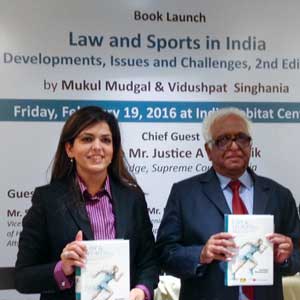
    Academically, she has also co-authored “Law and Sports in India”, the second edition. A work dealing with the position of sports within the constitutional framework and recent events such as the IPL probe report, doping controversies, etc.

    In this interview, Aahna talks about;

    • What influences led her to pursue law as a career
    • Her interests beyond the legal sphere and the impact they had
    • The value addition of higher studies in niche areas of the Law
    • The charm of quotes and simple expression


    How would you like to introduce yourself to our readers?

    Lawyer by choice…Writer by chance… Sports enthusiast… Stricken by wanderlust.


    Tell us about your life before you joined law school. What made you gravitate towards law?

    When I was young, my grandfather quoted John Lennon to me: “When I was five years old, my mother always told me that happiness was the key to life. When I went to school, they asked me what I wanted to be when I grew up. I wrote down ‘happy’. They told me I didn’t understand the assignment, and I told them they didn’t understand life.”

    Seeking happiness and fulfilment in every moment I live is amongst the greatest lessons I learnt from my grandfather. He held a law degree but started his career as a sports journalist, going on to become the director of the National Herald. He then moved into the arena of politics and social causes. Wearing the mantle of a trade union leader, he sought happiness in devoting himself to the cause of improving worker benefits. I particularly remember watching him return home on the shoulders of a jubilant crowd after his success in obtaining a favourable judgment in a case involving illegal termination of employment of 300 men. Young as I was, I realised how empowering it is to know the law.

    Perhaps that’s what drew me, at school, to his dual interests: sports and journalism. I was the editor of the School Annual Magazine – resurrecting it from a two-year oblivion and also pioneered the first School Newsletter, that then became a regular feature. I was appointed Captain of the School Cricket team at a time when the school coach had gone on leave. Coaching taught me patience. I learnt that people grow with praise, that critique works only in an environment of trust and emotional security, and that the joy of seeing others grow and score through the training I had given them was a victory sweeter than my own achievements at the wicket. Not only did I lead my school team to victory, but I was also appointed as the captain of the first ever All India Girls’ School Cricket Team and went on to being selected to play for the India Under-19 Cricket Team. My time at school culminated in a very special moment when I was awarded the trophy for ‘Selfless Service and Helpfulness’.

    Having completed high school, while cricket and writing seemed worthy allies, I made a choice to pursue my dream of becoming a lawyer.


    How was your ILS Law College, Pune experience?

    Having lived in a boarding school for 6 years, I was tired of living the hostel life. Therefore it was a personal choice to go to ILS over a National Law School and I have no regrets over my decision to date.

    At ILS, unlike national law schools, there wasn’t a routine time table that lasted from 9 to 5 or a road map to the kind of internships one must pursue. We were done at school by 11 a.m. on most days and had the choice to then plan our day in whatever manner we pleased, also our holidays which were fairly longer compared to national law schools. Several chose to do internships both during college days and in holidays, others spent time perfecting their skills at Moot Court competitions, I on the other hand spent my time learning about Sports Law, pursuing summer school programs and doing internships both in India and abroad.

    At ILS, no two students at the end of their 5 years, turn out to be exactly the same, which I feel is the case with National Law Schools, where most students do the same kind of internships, and therefore the competition on day zero is much harder. Studying at a National Law School has its own brand value and pros, while studying at ILS makes you more independent and responsible in terms of your choices.


    What were your areas of interest in the law? Did you engage in extra-curricular activities while in college?

    My areas of interest had always been intellectual property, entertainment, media and sports laws which sprung from the kind of activities I was involved in back in school.

    In the first year of law school, I remember walking up to my college university representative responsible for organizing the ‘Legalease’, the annual ILS Festival, and requesting for a spot in our ‘class’ (section rather) cricket team. “I hope you know they would be playing with a leather ball!”, he exclaimed. My immediate response “I was chosen to play on the India under-19 cricket team” amused him a little further. He didn’t give me a chance to play on the boys’ team but he did, in all fairness, organize a cricket match for the girls as a part of Legalease, 2006. I also played a little bit of throw ball and volley ball as and when the opportunity arose.

    Apart from playing sport, I participated in the Harvard Model United Nations and pursued a couple of diploma courses.


    What internships and voluntary practical training did you take while in law school and during your LL.M years? What value addition did they provide?

    Like all other law school students, I experimented with a whole bunch of internships. I worked at an NGO, at the Hon’ble Delhi High Court, with Mr. Mukul Rohatgi at the Hon’ble Supreme Court of India, with a barrister specializing in criminal law in London and also at a law firm in Delhi during my first 3 years of law school.

    I learnt a lot during my law firm internship, as I was given the opportunity to interact with some clients, prepare my first cease and desist notice for a trademark infringement, work on matters involving sports persons, and realised that it was what I enjoyed most and not litigation. It also helped to further develop my interest in intellectual property and related areas. I then just stuck with law firm internships and interned at TMT Law Practice twice, after which they made me a pre-placement offer. It always helps to get a job offer, if you go back to an office for a second time to intern, as they are able to gauge your ability and progress better. Also, I chose to intern at a boutique law firm so that I could make a more marked and personal contribution during my internships, instead of being lost at a large law firm.


    You pursued an LL.M from UCLA in entertainment, IP and Sports Law. Tell us about the LL.M course you took, how did you apply for it and what was life at UCLA like?

    An LL.M application is all about your Statement of Purpose (SOP) and they give little weightage to your grades or C.V., is what I learnt from personal experience.

    I applied for an LL.M while in law school to about 8 law schools in the States. It was a decision taken overnight and I did not think the SOPs through. Having been a creative writer in school, I took it all for granted and drafted my SOPs in one night and sent in my applications in December 2010. I was rejected by all 8 law schools.

    I pondered over the rejection, re-read my SOPs, and realised that they made no sense as they were a bunch of disconnected paras put together to comply with the word limit. I took the same drafts, and re-worked the structuring and choice of words and then re-applied in October, 2011. By the summer of 2012, I was spoilt for choice with an admission to all 8 law schools, some even willing to offer me scholarships.

    I had an admission to Duke University, a T-14 law school, and had even paid up the advance to block a seat and done my visa formalities when I heard from UCLA. It was the toughest decision to make, a ‘T-14 Law School’ versus the top school for entertainment law. I tried to choose the best of both worlds. While I chose to disregard the overall rankings and went with the rankings for subjects of my interest and gave importance to professors like Nimmer in picking UCLA for an LL.M., I pursued a summer school course with Duke Law School, a program run by them at the University of Geneva which gives you the opportunity to do up to 6 credits of course work. I studied sports law at the summer school offered by Duke, and then joined UCLA for my LL.M.

    UCLA gives you the opportunity to do 4 credits worth of practical training as a part of their LL.M. This, in my opinion, is what sets UCLA apart from other law schools and gives its students an edge over the others. Once made aware of this opportunity, I sat for campus placements and secured an internship at Warner Bros. Intellectual Property Dept. If there was the slightest doubt in my head about having left Duke for UCLA, I knew at that point for sure, that UCLA had been the best decision I made.

    As far as leisure activities go, all law schools in the States have a concept called the ‘Bar Review’. It has nothing to do with the American Bar Association, it is a concept wherein on every Thursday night you go review / check out a bar / club in town for drinks. Los Angeles being famous for its night life, I don’t remember ever having to repeat a bar.


    How did your interest in these fields develop?

    I constantly missed playing regular cricket through my years at law school. There weren’t too many opportunities available in Pune for women. In fact, I momentarily contemplated moving to GLC as Mumbai had a lot more to offer in terms of women’s cricket. In fact, women’s cricket only came under the auspices of BCCI in 2006, the year I had left playing cricket and started law school. My juniors from school often called and narrated stories of their experiences at Ranji, from a time when we would fund our own travel to them finally being paid Rs. 5000/- for a match. I felt really happy for them and I knew then that true happiness for me lay in uniting both my vocation (law) and passion (sports and writing). While I had lost my touch on the field due to lack of practice, I made a conscious decision to specialize in Intellectual Property and related fields like Entertainment, Media and Sports Law and in some way remain connected to Sport.

    As a writer, of course, you must always be well-versed with copyright law. I always enjoyed music, it was my only other stress buster apart from sport, so I studied Music Laws at UCLA, apart from entertainment, intellectual property and sports laws. I learnt about the dying music industry and the effects of piracy. In fact, the Intellectual Property heads at Warner Bros. even gave me the opportunity to work at the Anti-Piracy dept. for a few days, which has led to me not downloading a single song or movie illegally in the last 3 years.

    So my interest in the kind of law I practice has pretty much sprung from my hobbies and that’s why I love what I do for a living.


    Could you explain to our readers the interrelation between entertainment, IP and Sports Law?

    What is sports law? It, apart from sports specific laws like anti-doping laws and sport specific regulations, involves all laws that effect a sports person or sports league – be it contract law, labour law or intellectual property for that matter. You cannot take away from sports leagues and sports persons trademark rights, brand value, broadcasting rights and other rights like that of privacy and publicity. For any sports league to be a success, you must get into a broadcasting rights deal with the right network provider, have some good sponsorships on board, have the player assign their image rights to the league and team owners and prevent any form of trademark infringement to protect the brand from getting diluted. Players today are filing for trademarks like the ‘eleven of hearts’ by Gareth Bale or the ‘Lightning Bolt’ pose by Usain Bolt. So sports, intellectual property and entertainment are entwined fields and there exists a constant overlap.


    aahna-mehrotra-3

    What is an executive LL.M and what motivated the decision to pursue one on Sports Law Instituto Superior de Derecho y Economia? Tell us about the experience and what you learnt from it.

    An executive LL.M. is a Master’s program which is pursued as a distance learning course by professionals and does not require you to be present in the same city through the year.

    While I gained a fair amount in areas related to intellectual property from my year at UCLA, unfortunately I did not learn as much about Sports that are relevant to the Indian market. Therefore, I decided to pursue a second LL.M from a school in Europe.

    ISDE gave me the opportunity to interact with some of the best sports lawyers in the world in the form of professors as well as network with sports lawyers from all over the globe in the form of classmates. Sports being an international activity and with the advent of so many leagues in India, more often than not, one lands up with matters that involve athletes from other countries, so it is always advantageous to have a rapport with attorneys in other countries.


    You have taken your interest in the field to the next level by assisting Justice Mukul Mudgal in jointly writing the second edition of the book ‘Law and Sports in India’. Tell us about your experience of working with him on the book.

    Justice Mudgal is by far one of the kindest human beings I have come in contact with in the legal profession. He is forever happy to see those working under him grow and provides constant support in any endeavour you choose to pursue.

    aahna-mehrotra-2Since I did not work on the first edition, it wasn’t easy to immediately start drafting or adopt someone else’s style of writing but Justice Mudgal was patient through the process. At the same time, as most of the developments in Sports law in India have only taken place in the last 5 years, it was as good as writing a new book.

    I worked with him on drafting 8 chapters of the book. These were (i) an overview of the sports scenario today, (ii) gender discrimination, (iii) anti-doping, (iv) sports as a business, (v) labour laws, (vi) violence in sports, (vii) sports dispute resolution and (viii) grey areas. I had a huge support system in the interns who researched untiringly on some of the most unheard of issues related to the sporting scenario in India. I learnt so much from them as well, like I didn’t know there was a concept called flip-throw that existed or that a suggestion to bring an orange card into play was being made in the football arena. I learnt so much about the intricacies of sports law as we drafted chapter after chapter.

    With an LL.M in progress, pressure from the publisher to adhere to the timeline and sometimes technology betraying me with an entire chapter getting wiped out just when I was done drafting it, I often did 5 a.m. mornings and eagerly looked forward to the day we would be done drafting. The end result was worth it all. It has been a privilege to work with Justice Mudgal, who feels so strongly about eradicating the malpractices in the sports industry in India, and a great honour to have worked on what has been termed as a ‘monumental work’ and an ‘encyclopaedia’ by Mr. Soli Sorabjee.


    Which new areas can one expect to explore in Sports Law, apart from player contracts, anti-doping or sponsorship related work? Why is this an area of law more people can choose to specialize in?

    With the advent of several leagues, many international athletes are now looking at the Indian market as an avenue so there is a lot of player transfer related work, especially in football. Apart from that, with image rights becoming a popular concept world-wide, a lot of Indian players are looking to protect their rights relating to both privacy and publicity. Scandals like match-fixing give you the opportunity to work on matters that may fall under criminal law. Things like gender-discrimination and the increase in punishment under the new anti-doping code have given rise to human rights and constitutional issues in sports. A lot of broadcasters are looking to either terminate existing contracts due to the leagues not doing well or vice versa – league owners that feel that they have not made the right choice in terms of broadcasters are looking to terminate their contracts and sign new agreements. Taxation issues and labour laws too are areas that have growing issues related to sports. More and more sports management companies seem to want to hire specialists in sports law to form an integral part of their team. As the sports industry in India continues to grow, so do the issues relating to the field, and so does the legal work.


    A lot of sports leagues are mushrooming in India at the moment. What legal challenges do they face and how viable are these leagues in the long run?

    (Aahna was involved in the Player Transfer Transactions of the Indian Super League and have also been involved at various levels with the Indian Badminton League and the Indian Table Tennis League.)

    Along with Mr. Kaushik Moitra, (Partner, TMT Law Practice) the Indian Badminton League in 2013, was the first sports league I worked on. The league failed due to several reasons like mismanagement at venues, lack of staff, the appointed media agency not being proactive, VIPs demanding free tickets and special treatment, state associations not cooperating with the national associations, travel and accommodation being impractical, no itemised budget and being unprofessionalism on the whole. These are some of the most common challenges that are faced at the time of running a league, especially the first season, so all league owners must learn from the IBL 2013 and not make similar mistakes.

    As for viability, it is something that can only be determined in due course of time. The Masters Champions League held in Dubai recently failed to pick up numbers in its first season even though the concept looks very promising. The MCL organizers are hoping that the current cricketers will look at it as an avenue post retirement, so when a Dhoni joins the league on retirement, automatically the numbers will go up, however this again is mere speculation and the question is whether or not they can sustain the league until a Dhoni joins. The Kabaddi League on the other hand did unexpectedly well in the very first season, the ISL picked up a lot of momentum in the second season, so there is no fixed formula for the success of a league.


    You were an integral part of Ludus Legal, one half of which has now been absorbed by TMT Law Practice. What does the shift mean for you and how does such a shift impact the clients?

    It has always been a very enriching experience to be working under Mr. Abhishek Malhotra (Managing Partner, TMT Law Practice). He is someone who has constantly encouraged me to pursue my academic interests apart from doing just legal work for my clients. In fact I remember when I started out with TMT Law Practice, immediately after law school, we had a concept of internal presentation of papers. Every alternate Saturday, an associate would present a paper on a new topic and we would then sit and discuss the issue. It always helped in learning something, increasing our industry knowledge and growing as a lawyer and that is why I was more than willing to join them back, when the opportunity arose.

    Like I said above, it is very hard for sports to survive without intellectual property and related areas. TMT Law Practice is a boutique Technology, Media and Telecommunication law firm which can better cater to the needs of a client. The clients only benefit from this shift, as they now have a full service law firm that caters not only to their sports law needs but also offers to them specialists in the intellectual property and media industry. At Ludus, we would often use the services of TMT Law Practice, to file Trademarks for our clients and use Mr. Anish Dayal and Mr. Nitin Mishra as counsels to argue our litigation matters. Now it can all be done hassle free under one roof.


    Tell us about the kind of work profile you handle every day. What are the challenges you face and what do you like most about the job.

    On a daily basis, I handle a whole lot of agreements covering different aspects of sports law. I often participate in negotiations between league owners and sports bodies or players and league owners.

    However, what is really challenging is when an athlete comes to me for help in a doping case. On most occasions, the consumption of the banned substance is inadvertent, as the athletes come from humble backgrounds and have not been educated about how a banned substance may enter their body. They start training at an extremely young age hoping to make it to the commonwealth games or Olympics one day and maybe win that one medal, which will not only make the entire country proud but also give them a source of livelihood but just when they are about to make it, they get caught for a doping charge against them. With the new code having increased the punishment to four years, which is as good as resulting in the end of an athlete’s career, there is a lot of pressure to have the punishment of an athlete reduced. You sometimes succeed and you feel on top of the world but there are occasions you fail to get a reduction in the punishment which then tends to take a toll on you as you feel responsible for a sports person’s career coming to an end.


    Finally, what would be your parting advice to our readers?

    “Twenty years from now you will be more disappointed by the things you didn’t do than by the ones you did do. So throw off the bowlines. Sail away from the safe harbor. Catch the trade winds in your sails. Explore. Dream. Discover.”- Mark Twain

    Trust your gut, don’t be a part of the rat-race and its okay to sometimes not go by the book.

  • Rajesh Singh, Legal Advisor, on pursuing a career as a Managing Partner of R&S Associates

    Rajesh Singh, Legal Advisor, on pursuing a career as a Managing Partner of R&S Associates

    Rajesh has more than 19 years of versatile and enriching international experience advising corporate clients, CEOs, management members, boards, and business heads. He has worked in the role of General Counsel (South Asia) at 3i Infotech, Associate General Counsel at Capgemini. He has been legal adviser at senior levels in various MNCs, SMEs, and SSIs. He has been instrumental and trusted adviser in various assignments dealing with M&As, NeGP(PPP), international arbitration, dispute resolutions, Private Equity, M&A integrations issues, Labour unrest and unions matters, various matters at Ministry/EOW/Custom/DRI/ Authority, Company formation and registration (Singapore, ME & other Asian countries), data protection/privacy laws, Antitrust/Competition laws, litigations and advisory services for his organization in association with Amarchand&Mangaldas, DLA Piper, DH Law, JayeshAshar, Somandy and Associates,  Little and Company and so on.

    In this interview he talks to us about:

    • His decision to pursue law.
    • His views on career choices.
    • His experience as a corporate lawyer.
    • His advice to go for higher studies.

    How would you introduce yourself, given that most of our readers are law students, law aspirants or professionals in the legal arena?

    For my fraternity, I am one of their fellowship members consistently learning to strike a differentiator when had to compete with each of you at any stage of my life. When it comes to consolidating my energy, effort, and experience, I would like to be called as an astute corporate lawyer with 2 decades of exposure to fortunate opportunities of some international experience. My consolidation of knowledge primarily came from legal-advisory exposures on various corporate and legal activities that governed various businesses, industry, and geography, for the sake of brevity coined as “LexAdvisory”. Today, individually gaining core expertise in all aspects of LexAdvisory is practically not possible for an individual, so it is important to have a team of experts to stand behind an individual under the umbrella of an international advisory firm, like mine RSAA GLocalLexAdvisory Group….remember this is just a beginning.

    You are a B.Com graduate from the University of Mumbai. How did you decide to pursue LL.B.?

    To be frank, in those days of my initial career, my intention was to be part of management hence had immediately done Diploma in Business Management from Indian Merchant Chambers. I had no path to have a career in law. My work, assignments, and some personal and organizational challenge compelled me to do law, further to add, my attitude to have control over the assignment. I found, major snag was legal issues and challenges surrounding the assignment, so completed my law with my employment…

    How well did your experience in Mumbai prepare you for a life of academic prestige and professional success?

    Now, at this stage, after meeting law aspirants from various parts of globe, including the rural, remote and less fluent English speaking areas, I believe being in Mumbai or any similar city will always be to your advantage as the exposure to real-life incidents, ready infra, and occasions of deliberations always going to be a rich experience. Major change in me happened when I started working for global MNCs, because the perspective of life, changes when you enter into a multi-cultural environment. It grooms you differently, by influencing your thoughts, communication, stature, and appearance. It gives a different outlook to yourself and imbibes things to see the world through glass of multi-cultural professional approach, knowledge composition, and personal attitude towards clients (including internal clients) and also “Altitude”, I coined a new personal feature because I felt a point of difference in opinion of astute lawyers of different country not due to legal knowledge but the point of reference from where they see the applicability and feasibility, due to our respective knowledge-peak heights achieved in our respective legal jurisdiction or cultural and environmental sphere each of us belong to; or society that we belong that either regarded smaller issues in one country as high while another country discarded it low, e.g., Data protection laws are different from different countries and seriousness varies accordingly.

    What were the influences on your decision to pursue MBA in Human Resources? Why didn’t you opt for MBA after graduation?

    I was holding all portfolios jointly in a corporate support function and to pursue  highest qualification in Human Resource would help me count as qualified all round. During those days, I was dealing with massive industrial and personnel issues which were unnecessarily chewing away my time. I felt I lacked in understanding issues of management and personnel and at many times could not authoritatively provide solutions to blue-coloured and white-coloured differences. My intention was to stand as an adviser to the management board to tackle all corporate and legal issues; personnel issues were bothering me. I could not stand differentiator in my personal view while convincing management with a workaround was not making me happy.

    What are your views on career choices other than mainstream corporate or litigation streams such as teaching, etc.?

    Today, the corporates have started eying on lawyers to move in the business stream and contribute to business growth and expansion due to their legal analysis, meticulous practice, and advisory skills, taking risk stands minimized at the decision level itself far away to reach this stage but the world is progressing towards the same. Alternately, every individual should get involved in other streams of a career like teaching, etc., may be after gathering some work experience at corporate, law firms and independent practice because that will help relating knowledge with reality and make teaching more attractive and attentive for law students. The legal field itself is so broad that there is no need to move outside the legal stream.

    You have been a corporate lawyer for most of your career. What prompted you to take up corporate law? Share with us any experience which helped you to shape your career choices.

    In my view, corporate lawyer enjoys the power to advise business heads and largely is in a position to influence a decision of management wherever legal and compliance issues are a concern. Surprisingly, amateur corporate counsel also gets an opportunity to advise business heads in most of the corporate structure due to our ability to understand the law better than them and also professional independence is given in our day to day activity. It is your personal inquests and quests that helps you to choose the legal area that you would like to specialize in. The majority of corporate work largely deals with contract drafting and managing litigation in most of the organizations. Few organizations do have an opportunity to go into IPR, M&A, IPO, Financial Arrangements, etc. I have been fortunate to get all of these opportunities at strategic and compliance level, making my knowledge-base versatile, penetrative and probing.

    What falls within the scope of your responsibility? Tell us about a typical work day.

    In addition to above, as managing partner of international law firm, typical work day goes on strategic and management decision to structure the organization, improve the quality of service, monitor the vision and mission, inculcate good practices, motivate the team to support clients and give spontaneous advice to management or CEOs or Managing Directors of the organizations identified as a core clients. In personal observation supervise crucial and critical litigation to get appropriate knowledge and experience to tackle proceedings legally and administratively.

    What is the most challenging or stressful part of being a Partner at one of the most successful law firms in the country? Is it easy to have a work-life balance?

    Obviously, stress is part of your life be as an associate or as a partner because success of a law firm depends on how your conduct is with your client?; what knowledge and experience that you can bring to the pleadings, drafting and arguments? Besides, the challenge of face value in the court, unheard urgencies, few seconds to decide your interim success or failure may discourage your client to count on you even if you have the best army to succeed in a long run. All set and done, if you love your work, you can enjoy the challenges and heal your frustration through your internal mingling and by a sip of tea/coffee or by breathing out the failure and breath in the next moment to move towards your next achievement. Many times, time does not permit you to enjoy your success or cry on your failure as the clock of cyclic success and failure is so much inconsistent that you cannot carry one emotion for long.  Work-life balance is not a myth; you can achieve if you can start your day early and follow a disciplined method to retrieve your information and knowledge.

    What kind of effort should a young associate put into work to get it appreciated? What distinguishes an associate from a partner when it comes to work?

    There is no limit or difference in the effort; your contribution decides your fate and success as an associate. More the partner relies on your work and effort; the less the partner will supervise the associate work. Almost everything is expected to be done by the Associate under guidance and supervision of Sr. Associates, Partner or Sr. Partner. Largely, the scope is drafting, analyzing facts, and research the relevance to withstand weakness and strengthen merits of your matter.

    How important would you say are business development skills at such higher roles in a corporate law firm?

    Knowing the business is very advantageous at any stage of your career, because as a corporate lawyer, the more you know your business higher is the chance of bringing an appropriate solutions or advice. The business heads or management appreciates such corporate lawyer who can bridge law and business on a platter in such a way that both corporate lawyers and business can understand their perceptions and perspective. Besides business skills, the corporate lawyer should also work towards improving its Interpersonal skills, simplified and crisp communication skills. Team Spirit plays a vital role in large. And complex assignments as a collaboration of work is crucial to complete the larger picture as expected by the management within an expected timelines and quality.

    When you hire lawyers under you, what specific skills and profile do you look for?

    Already covered above, to broadly mention, drafting, knowledge seeker, independent in thoughts, out of box thinker, ready to work with right attitude, have excellent and simplified method of communications, ability to demonstrate and express his thoughts in clean and clear way, negotiation skills, etc

    If I want to be a legal advisor how would I go?

    Every aspirant should identify and understand legal and statutory compliance of the industry that you are focussing on. Gather relevant knowledge, team of business and legal experts working on challenges of the Industry, and form part of a forum that can either influence industry legislation or influence legislators by your thoughts, suggestions, recommendation, and actions. Once you have initiated in the above manner, invest your time to peruse legislation affecting such industry and observe live court proceedings in this regard. Peruse case laws and FAQs available on the websites of court and authority (you can refer various other means to get case research materials), to understand regular challenges faced and dealt by that Industry. This kind of development will help you to mature your understanding in respect of business nuances, court’s perspective (Ratio decidendi of the decision taken by various courts or counter arguments placed by other pleaders to understand the strength of your pleadings) and market dynamics. Focus one industry at a time. Target another similar industry, which is logically a business extension of the industry you focused on e.g. ITeS to IT, BPO to LPO, IT to Software Technology then Mobile Technology. Similarly, the logical expansion, in the process of knowledge gathering, is to experience litigation through Business Contracts by way of handling disputes under Alternate Dispute Resolution (eg Arbitration or mediation forming part of Contract; you can further deep dive in this area covering domestic and international arena of every country your organization operates its business); further to add, Contracts, generally, branches out to various legislation or points out to foreign legislation by way of its terms and conditions, hence, review of such clauses should be analysed in the light of such legislation to assess the risk and recommend mitigation plan or compliances there under.

    What would be your advice to students who wish to go for higher studies?

    Industry or legal area focussed diplomas or courses will help recruiter acknowledge your intent to practice in particular industry and legal areas. In India, degree in law, master degree in business administration (if you intend to practice as an in-house corporate lawyer) or master degree in law for practice in court; and any other diploma or courses will always be an added advantage. The student should work during their studies to ensure that business and practical sense is developed while studying and most of the reading will settle in your mind as your wisdom or knowledge.

    What would be your message to our readers who are budding lawyers and law students?

    Budding Lawyers and Law Students should be sincere, hardworking, knowledge seeker, opportunist, aggressive in work and humble in approach and communication; ethical and professional in conduct and approach, good listener, preach what you practice, and finally should have ability to convey your thoughts. Never believe that what you lost after your sincere attempts are the last opportunity for your life.


  • Roumita Dey, Associate, Agama Law Associates, on how to represent clients on behalf of the firm

    Roumita Dey, Associate, Agama Law Associates, on how to represent clients on behalf of the firm

    Roumita Dey graduated from Jogesh Chandra Chodhuri Law College (under the aegis of Calcutta University), Kolkata in 2015. At present, she is practicing corporate law at Agama Law Associates and represents clients on behalf of the firm on a daily basis.

    She drafts legal notices, legal responses, the case for opinion, Service Provider Agreement, Leave and License Agreement, IT contracts, Response/Counter-claim, etc. and is doing research work in all areas of law using Manupatra, SCC Online, Think Legal, Indian Kanoon, etc. research engines.

    She also writes articles on various areas of corporate law on a monthly basis for the firm’s blog and contributes legal updates/day-to-day legal developments in the industry in the update session

    In this interview she talks to us about:

    • Her experiences during the internships.
    • Primary essentials of a good corporate lawyer.
    • The kind of interest one needs to pursue law.
    • Current scenario of studying corporate law as a career option in India.

    What brought you into studying law as your profession?   

    I am a first generation lawyer in my family. I have chosen Humanities in my Class XII board exams and successfully passed with higher grades. Law was never in my mind that time. I was more inclined to do a simple graduation course and decided to pursue MBA later in my future. My father is a business person, and we have a family lawyer cum family friend who advises my father with regards to property related matters and also his business. My parents visited the district court in Kolkata for the purpose of property registration a couple of times and gradually influenced by seeing the lawyers advising their clients and arguing inside the courtroom. As a result, they encouraged me to take up law seriously, and I believe that my parents have seen that spark in my eyes that I was born to become a lawyer. However, I sat for the LL. B joint entrance examination of Calcutta University and have secured good rank and enrolled at Jogesh Chandra Choudhuri Law College, under the aegis of Calcutta University. To be very frank, I chose law pretty accidentally. It was more like law have chosen me and brought me into this profession. However, after enrolling myself in the B.A.LL.B course, I have started achieving good marks in the subjects and interned in big firms one after another and today I am a qualified lawyer practicing corporate law.

    Any remarkable experiences during your internships that shaped your career choices later?

    Yes, indeed the experience of working with different law firms helped me to take the proper decision of which law to specialize to flourish in my profession or I may say internship experiences shaped my career choices later on. I have done two litigation internships, where I was mostly allotted work relating to assisting senior advocate to draft affidavits, rejoinder, legal notices and to accompany senior associates to the court. Apart from these two litigation internships, I have also interned under a senior advocate of the district and sessions court (Kolkata) to gain knowledge of how the district court works, or I may say to witness the life of a litigant. However, frankly, I have not explored much during my internship days. However, after doing litigation internships, I have applied for internships in Tier – I firms in India like Trilegal, Amarchand & Mangaldas, a mid-sized law firm like Argus Partners, where I may get the flavor of corporate law. In light thereof, I have successfully interned in the aforementioned law firms and was mostly allotted research work relating to company law, securities and banking law, property law, electricity law and basic drafting work. I was also involved in the due diligence of QIP (‘’Qualified Institutional Placement’’)/due diligence of the private placement of a public company being undertaken under the supervision of the capital markets team of Amarchand & Mangaldas (Delhi Office). It was an excellent opportunity to learn and to get the chance to work with the seniors of one of the elite law firm in India. Trilegal also was another enriching experience to learn how to take the advantage of research engines and how to conduct research on case laws. These internships made me realize that corporate law is the field to explore, and there is a lot for me to learn in this field. Hence, I wanted to join a corporate law firm after graduation to be able to realize my potentiality in this field.

    What do you think is the kind of interest or aptitude one needs to pursue law?

    I am giving a quick snapshot of the abilities and skills/values; one should possess to become a lawyer or those who needs to pursue law in future. I believe the following list of core skills and values would suffice for every budding lawyer:

    1. Inquisitive: A good law student or an aspiring lawyer shall possess an inquisitive nature. Curiosity drives a person to probe and ask revealing questions. The inquisitive attorney will peel back the layers of a case, going deeper, asking for more information. This skill is necessary because it is often the small, unnoticed details that can make or break a case.  A good lawyer asks questions because they are not satisfied with accepting surface information. They know there may be more facts underneath the evidence presented.  Their inquisitive nature will push them to uncover that information.                                                                        
    2. Problem Solving Abilities: Being a problem solver is one of the root skills of any attorney. People hire lawyers because they either have a problem or are trying to avoid one. Possessing excellent problem-solving skills allow the lawyer to find solutions even when none are immediately apparent.
    3. Symptomatic Reading: Attorneys will have to read a great deal of material when they take on a client. It may be court documents, witness testimony, contracts, case law, or a myriad of other text. It is easy for anyone to skim over the information and take it at face value. Unfortunately, this can prove detrimental to a client. Moreover, law students or whoever would like to pursue law have to make a habit of reading much stuff.                                                                                                   
    4. Writing Skill: Having the ability to write well lays a solid foundation for all the documents a lawyer must write such as arguments, contracts, and legal letters.                                                                                             Written communication is a primary way that information is distributed and recorded.
    5. Conversation/ Articulation Abilities– Just as writing skills are essential, so too are verbal skills. An attorney will find it necessary to shift gears in their verbal communication style. One day they may need to speak in an authoritative manner with persuasive speech during an important trial. The next day a lawyer may need to meet with a grieving widow requiring sympathetic conversation in reassuring tones. Conversation skills are more than just the ability to say the right words. The words also need to be expressed in a proper manner.                              
    6. General Investigation/Research Skills: Law students and attorneys have to spend hours investigating and researching information for clients. Attorneys must be able to know how to perform research with speed and accuracy, and confidence in the authority of the source. If they do not know where to look for the right kind of information; their research may be flawed and inaccurate. If an attorney cannot investigate quickly, they may get bogged down and unnecessarily waste much time.    
    7. Organization / Management Skills: The attorney will also need to possess excellent time management skills. They will need to stay aware of deadlines, meeting schedules, court dates, and travel itinerary. Even simple cases will require some level of calendared items. Most attorneys will have to balance several of cases at once. This requires a high degree of time management and organizational skills

    What are the primary essentials of a good corporate lawyer? How do you say a fresh graduate can work on building these skills?

    In a nutshell, the primary essentials of a good corporate lawyer are as follows:

    1. Collaboration skills
    2.    Emotional intelligence
    3.    Financial literacy
    4.    Project management
    5.    Self-driven
    6.    Technological affinity
    7.    Time management, and,
    8. Hard working.

    A fresh law graduate should work rough day to earn these skills mentioned above along with lots of patience and effort.

    How can one learn to draft a legal notice?

    To draft a legal notice one should be aware of the relevant provisions of the Companies Act, 2013. If the notice is regarding asking information from the Company as a shareholder, i.e., ‘’Requisition Notice’’, then one should refer the provisions of Companies Act concerning inspection of books of accounts, register of members, financial statements, etc. If the notice is regarding mismanagement of the company, one should refer the relevant provisions of the Companies Act concerning oppression and mismanagement and should be aware of the Term Sheet of such company. If the notice is regarding employee dispute, one should be aware of the clauses of the employment agreement. Additionally, to draft a legal notice related to company disputes one should refer AOA & MOA of the Company along with the correspondences shared between the persons concerned.

    How can one legally update himself?

    One should spend time every day at least for half an hour to go through the websites like PRS Legislative, SEBI, RBI, MCA, CCI, IIPRD, etc. to update himself legally.

    Corporate Law sometimes comes with a humongous workload. What made you gravitate towards this field? How do you manage the workload and your personal life?

    To be very frank, for a fresher like me, personal life became a secondary or the least thing to bother at the moment. My priority is work and to learn stuff as much as I can to grow in this field. I work beyond my job hours and even in weekdays to finish my stuff. I never regret not attending my cousin’s wedding or other family events because of my engagement with my work. Corporate law is indeed very stressful for a fresher to pick up the work and learn from the senior associate or a partner in any organization. Frankly, I do not know how to balance work life and personal life together. I am not the perfect person to give advice on how to manage the workload and your personal life. However, one should take a break and refresh himself/herself whenever he/she can.

    What should a student do so that he gets placed in a reputed firm?

    1. A law student should have good CV with a handful of good internships, paper publications, and other extra-curricular activities to get selected for the interview at any reputed law firm.
    2. After getting selected for an interview, a law student, whoever apply to reputed law firms, should crack the interview at first go.
    3. I think, after cracking the interview in one go, half of the battle is won by him/her to get placed in a prominent law firm.

    Did you find that your law school education had prepared you sufficiently for the many tasks you were required to execute during your internships and later at your job?

    To be very frank and honest, I have studied in a traditional law school and hence, it did not prepare me for the tasks which I am required to do in the course of my employment with a law firm. Internships have given me the overview of how the law firm works and what kind of work an associate should do while working with a law firm after the graduation. I have simply learned from the scratch with respect to drafting and how to do an exhaustive research, from my partner of the law firm, where I presently work as an Associate. My partner teaches me every day from writing an email to the client to draft any document and what the exact format should be for drafting. She also taught me how to keep track of the clients’ mandates and how to keep myself legally updated to survive in this rat race of lawyers, and that is how I grow as a lawyer.  I think most of the fresher like me, whoever studied in any traditional law school learn everything from the scratch in the workplace where they join after their graduation.


  • Ankur Mishra, Associate Attorney, on how to draft patent specifications for Indian, Malaysian and Canadian Patent Office

    Ankur Mishra, Associate Attorney, on how to draft patent specifications for Indian, Malaysian and Canadian Patent Office

    Ankur Mishra graduated from KIIT University, Bhubaneshwar in 2013. At present, he is an Associate Attorney at KAnalysis Legal, New Delhi.


    He has an experience in drafting patent specifications for Indian, Malaysian and Canadian Patent Office. He drafts responses to objections in patent applications and conducts patent prior art search and trademark search. He also prepares Patent application, Trademark application, Copyright and Design registration applications.


    In this interview he talks to us about:

    • The importance of Science background for patent drafting and prosecution.
    • The importance of choosing honors in IP during LL.B. course.
    • The strategy before drafting and filing a patent application to avoid potential infringement.
    • Obtaining patent protection in foreign countries.


    Most of our readers are young lawyers and law students. How will you introduce yourself to them?


    Current Association: Associate Attorney at KAnalysis Legal, New Delhi. I graduated in B.Sc. LL.B (Hons. in IP) from Kalinga Institute of Industrial Technology (KIIT) University, Bhubaneswar in 2013. It is very important for a law student to decide the interested area of law in which they feel interested and comfortable to pursue their career. Since I opted for B.Sc.LL.B with biotech as a major subject in B.Sc., interest for Patents and general I.P developed in me. During the second year of the course, the students should focus on the interested area of law which they decide for their career. I decided to honors in Intellectual Property Law after the second year during my LL.B course. I interned at several I.P Law firms in their patents and trademark department which provided me the opportunity to learn the practical aspects of the I.P Law and then I was able to appreciate the theoretical knowledge with practical skills required for patent drafting and strategy for I.P rights. After completion of my LL.B course, I have been associated with I.P law firm in New Delhi and working in the areas of Patents, Design, and Trademarks law since 2013.


    Why is Science background necessary for patent drafting and prosecution?


    Science background is important for the drafting of a patent application and prosecution because generally the patent applications comprise of scientific terms. The drafter should have a sound knowledge of the scientific terms in order to draft an excellent patent application and provide the best disclosure without any confusion in the minds of the examiner examining the application. If the drafter understands the scientific terms, then he/she is able to appreciate the invention much better throughout the specification. Science background helps you appreciate the different compositions, parts, components or methods of the inventions. An invention may comprise of various scientific knowledge, methods or components which the inventor has disclosed to you along with the invention, but they all cannot be claimed, having a science background here will help you to highlight the portions of the inventions to be claimed. Science background helps you in preparing your submissions before the examiner during prosecution of the patent application. It helps you differentiate your invention from the other already existing prior arts.


    What is the importance of choosing honors in IP during LL.B. course?


    IP is an emerging field; IP plays an important role in today’s competitive world. A company with strong IP rights can flourish with a tremendous speed in the market. Companies, industries, and commercial organizations are becoming more diligent about protecting their IP rights and hence there is, and there will be demand for IP professionals in the legal field too. Choosing for honors in IP will provide students gain much deeper knowledge than the general IP course because in IP honors almost all the areas of IP are taught elaborately which will help during practical implementation. Since IP law is an emerging area in the market, those who are opting for IP honors will always be preferred in the IP industry.


    What is the importance of internships at IP Law firms?


    Internships in IP law firms provide the students to learn the practical aspects of IP Law. Internships provide the basic practical knowledge and skills required for starting a career in IP Law. Internships in IP law firms provide the student to learn the rules and regulations to draft and prosecute the IP applications. There are several forms which need to be filled and filed along with the IP applications in compliance with various Rules; internships provide exposure to those Rules and forms.


    What should be the strategy for drafting and filing a patent application to avoid potential infringement?


    The attorney should run extensive prior art search in order to determine the novelty of the invention. Sometimes it happens that the invention thought to be a novel by the inventor is available in the prior arts. If the invention is similar to already patented inventions, then it will result in infringement of the already existing patent. Analyzing the prior arts prevents the applicant from the huge loss of money and time if the invention is not novel because litigation and attorney fee may cause a huge expenditure to the applicant in case of infringement. So it is advisable that the applicant must always ask the attorney to do a detailed prior art search and provide an analysis of the similarities and differences between their invention and the prior arts. The applicant must analyze the Prior Art Report provided by the attorney and accordingly decide the future course of action.


    When should I begin investigating the patentability of my idea?


    The moment the inventor develops the idea for invention he\ she should immediately start searching for the relevant prior arts and determine the novelty of their invention. Delay in investigating the patentability may result in losing time and money to the inventor.


    What is the first step to obtaining a patent?


    The first step to obtaining a patent is to file a provisional patent application as soon as possible and then work on the invention thoroughly to file a complete specification within 12 months from the date of filing the provisional application.


    How long does it take to get a patent?


    It takes around three to four years in India and US to obtain a patent.


    Someone else is making or selling my patented device. What should I do?


    There are few steps required to be taken before determining the actual infringement by another party. First, you should compare your patent with that of the infringer’s products. It sometimes happens that the infringing product or method might seem to be the same as the patented one but they might very well different in the technical aspects. Secondly, the patentee should compare his/ her claims with infringing products or methods; then the patentee has options to proceed legally against the infringer. The patentee can send a ‘cease and desist notice’ to the infringer demanding immediate withdrawal from manufacturing and selling the products. The patentee may then offer the infringer to enter into patent licensing agreement. If the infringer agrees to enter into a licensing agreement, then it will benefit the patentee regarding royalty. If the infringer does not comply with the cease and desist notice then, in that case, the patentee has the right to file in an infringement suit against the infringer and claim monetary damages as well as an injunction.


    I would like to obtain patent protection in foreign countries. How should I proceed?


    For obtaining patent protection in foreign countries, the inventor should file foreign application within 12 months from filing the initial patent application which the applicant wants to take as a priority. The inventor can also file a single patent application under the Patent Cooperation Treaty (PCT Application) and take it as priority application to file a patent in signatory countries. The applicant after filing PCT application should file a national application in signatory countries within 30 months from the date of PCT application (31 months in a case of European Patent Office). The inventor can also directly file a foreign application with the respective Patent Office of any country where he/ she desires to obtain patent protection.


    What is the proper way to use a trademark?


    Before adopting any mark as a trademark for any product or services the applicant should first determine the availability of the mark to be used as a trademark. The applicant should request the attorney to conduct a search for the similar trademarks already applied, registered or is already being used by another party. If the mark is not being used, applied or registered by anyone then in that case the applicant should immediately file the trademark application. The applicant should use the applied mark extensively and if possible, should show the prior use of minimum three years before filing the trademark application. However, the applicant can also file a trademark application comprising any mark, logo or device which is proposed to be used by the applicant in future.


    Who can register a trademark?


    Any person including organization, associations or company who has been using the mark or intent to use the mark in future may apply for trademark registration.


    What are the steps to trademark registration?


    Steps to trademark registration are:

    (1)  Filing of a trademark application with a prescribed fee of Rs.4000.

    (2)  Issuance of an application number by the registry.

    (3)  Examination of the application.

    (4)  Issuance of an examination report comprising objections of the registry.

    (5)  Filing written response to the objections raised by the registry.

    (6)  Appearing in hearing. The applicant may also file an affidavit of use with supporting documents during the hearing.

    (7)   If the application is accepted, the registry will issue Letter of Acceptance and publish the mark in official trademark journal. The trademark application is open for the opposition after publication; the opposition should be filed within four months from the publication date. If there is no opposition, then the registry will issue the registration certificate.


    What guarantee is there that an application won’t be rejected?


    There is no such guarantee. There are several grounds prescribed under the Trademarks Act for refusal and removal of a trademark. If the trademark application abides by all the conditions and rules required for registration then, in that case, there are 100% chances of registration.


    What should be your advice to our readers?


    Intellectual Property Law is an emerging area as a career for law students. One who wishes to pursue IP as a career must be focused and shall study specialized course in IP. If a student possesses science background, then it becomes a bit easy for him/ her to draft and prosecute patent applications. Trademarks, Designs, and Copyrights are other IP areas which do not require much technical background, knowledge of general IP laws will help. Students should pursue internships in IP law firms to get practical knowledge about IP applications and their prosecutions.

    Individuals and corporates should be very diligent about their IP rights and should take all the measures to protect them because in today’s world ‘everything is IP and IP is everything’.