Tag: Law Firm

  • Arun Gupta, Founder, Factum Legal, on a profile in Corporate Commercial work and the Corporate Secretarial

    Arun Gupta, Founder, Factum Legal, on a profile in Corporate Commercial work and the Corporate Secretarial

    Arun Gupta is a Fellow member of ICSI and a member of the Bar Council of Delhi. He graduated with a B.Com(H) degree in 1995 followed by CS degree in 1999 and later qualified in law.  Arun is a lawyer with more than 15 years experience in Corporate and Commercial matters.

    Arun acted as a key contributor to the book authored by Corporate Professionals titled “Insight into Companies Bill 2012” and he is also an author of a book titled “Companies Act 2013- Impact on foreign companies in India” published by CCH, Wolters Kluwer in 2014.

    He started his own firm – Factum Legal, Advocates and Solicitors in 2013.

    In this interview he tells us about:

    • Life, law and the choices he’s made while pursuing it.
    • The benefits of having a commerce background while practicing corporate law and the value of additional degrees.
    • Factum Legal – its establishment and his plans for expansion.
    • His publication and the role of academic pursuits in a lawyer’s career.


    How would you like to introduce yourself to our readers, most of whom are students studying law?

    This is Arun Gupta, a Law Graduate and also a Fellow Member of ICSI, presently practicing as a lawyer in Corporate & Commercial Laws. I love to learn a lot and I’m always keen to upgrade my knowledge of changes in law and the impact of the same on industries.


    Tell us about your life before you joined college. Where did your interests lie as a student and what made you gravitate towards law?

    I was from a business family so as usual, I did not plan anything in my childhood. So I tried my luck in the family business also along with my studies, but after just a few months I realised that this is not my cup of tea and God had planned something else for me. I was always good in terms of scoring marks in school exams and enjoyed the law subjects, while doing regular B.com (h), so I think that was the beginning of an inclination to enter the field of corporate law.


    You specialize in corporate matters, Mergers & Acquisitions, tax law, among others. How did your interests develop in this field?

    Yes I specialise in corporate matters, Mergers & Acquisitions, Due Diligence, Compliances & Governance etc. Actually being a qualified company secretary and practitioner of Corporate Law what I enjoyed the most, from the beginning of my professional career, was to find solutions in all type of transactional issues in restructuring and also assessing and finding the potential risk in any acquisition or joint venture apart from governance and compliances issues. Being part of some fund raising activities including Initial Public Offer (IPO) & Preferential Allotment etc by corporates in India, the interest towards such areas developed and sharpened.


    How helpful was your background in commerce in aiding you with a better understanding of corporate law? Would you recommend professional degrees like the Company Secretary degree or any other such degree?

    This is very interesting, I strongly believe that a commerce background really helped me a lot in understanding commercial law, Economic and accounting issues. I initially registered myself for the science stream after passing class X, but after 5-7 days I shifted to the Commerce stream and I am extremely happy for that decision and thankful to one of my teachers for such wonderful advice. Well, I believe that an LLB degree itself gives a wider horizon in commercial, corporate, and Personal laws, but if somebody wants to explore Corporate law then a Company Secretary course would definitely add value to that person. My CS degree really helps me a lot in all kinds of Corporate Transactions and General Corporate Advisory, however one must not forget that the most important part in practical life is not really additional degrees but the approach in handling complex situations.


    Tell us about your initial years in practise – from starting out independently to the time you founded your own firm. What challenges did you face initially?

    Well, the initial years of practice were very tough, I started practicing from the beginning of my professional career and no one in my family was either an advocate/ Chartered accountant or company secretary, so to setup an independent practice was really a daunting task. But I did not bother about monetary earnings, what I concentrated on was whether I was earning knowledge or not and that really helped me in setting up own firm in 2013 again. So I think you need to maintain your patience also to be in the practice of law.


    arun-gupta-1

    Your firm, Factum Legal, has been featured as one of the Promising Legal consultants of India, 2015 by SiliconIndia. Tell us about the firm in general and the kind of work you deal with on a daily basis.

    Yes, we have been recognised as one of the Promising Legal consultants of India 2015 by a business magazine Silicon India and the credit goes to the hard work of our team factum legal and the trust of our clients. We are a boutique law firm providing a comprehensive range of legal services and solutions for domestic and international clients. Our practice area embraces advisory, execution and representation services and dispute resolution.  We are involved in all kinds of M& A transactions, Legal Due Diligence, Commercial Agreements, Corporate Compliance, Governance & Secretarial Practice, Private Equity help desk, Litigation & Alternate Dispute Resolution, Inbound & Outbound Investment Transactions, Registration and Licensing Services, Renewable Power Projects.


    What would you advise young lawyers who are starting out working in the corporate sector. What areas might they find interesting?

    My advice is don’t jump into corporate law because it is a lucrative career, but do what you enjoy most. We are lucky that we are born and practicing the profession in India as there are ample opportunities in every sphere of Legal services, so you should choose the subject based upon your knowledge and interest. My advice to all young lawyers and students is that there is no shortcut to gain knowledge, you have to work hard to become an expert in your area of interest.


    You have authored a book on the Companies Act 2013 and have quite a few publications to your name. How helpful is an academic pursuit in the life of a practising lawyer and how can one find time out for the same considering the hectic schedule one inevitably finds himself in?

    Authoring a book or writing articles and publications needs a huge time investment, and you cannot do such things just for the sake of doing them. You can write articles on a particular topic when you have command over the subject. The practice of law is based upon knowledge and expertise and an academically strong lawyer can really achieve a lot in a short period of time. If you ask about finding time, then I am of the view that time is essential, time is precious but if you enjoy something you always have time to pursue those things. Just to inform you, now also, I am working on a book relating to Companies Act 2013.


    In the present environment of cross border transaction among corporates, what is your strategy to expend internationally?

    We as a firm, believe in collaboration and mutual cooperation, so in that direction, we have joined an international legal network, which will surely help us in gaining knowledge and executing cross border transaction with local and cultural expertise. Further we have also entered into a strategic relationship with a European Full service Law firm ‘Adamas’ to serve our clients in their cross border transactions in the best and most effective manner. We will continue to expend internationally with such mutual cooperation for another few years.


    Finally, what would be your parting advice to our readers?

    I would like to suggest everyone ‘Have a zeal to learn, work hard, and discover your interest area as early as possible’ and the rest will follow on its own.

  • Vaishnavi Bhaskaran, Partner, Spectrum Legal, on advising startups and Corporate Law

    Vaishnavi Bhaskaran, Partner, Spectrum Legal, on advising startups and Corporate Law

    Vaishnavi Bhaskaran graduated from National Law University, Jodhpur in 2010. She is currently a partner at Spectrum Legal where she heads the Corporate-Commercial and Employment Law Practice. In this interview, she talks to us about:

    • Her experience at NLU, Jodhpur and decision to pursue law
    • Her view on internships and augmenting a CV
    • Her professional journey and founding ‘The Little Black Coat’
    • Spectrum Legal and her views on the field of law in the contemporary context


    What incident, influence or interest prompted you to think of law as a career? If not law, what other options would you have considered for a career?

    I have wanted to be a lawyer since the beginning of my teenage years. The idea (somewhat clichéd) first came to me after I had read a series of John Grisham novels in quick succession. Of course, the reality is vastly different from what one reads about, and I realised that soon after I entered law school. Fortunately for me however, the reality was not unpleasant. I had briefly toyed with the idea of journalism, but in the end, it was to be law.


    What would you like to say about your experience with college admissions and competitive exams?

    I was very clear that I wanted to attend one of the top-ranked national law schools, and I was very fortunate to have found a place at NLU Jodhpur.


    How would you describe your life while studying at NLU Jodhpur? What activities did you tend to favor?

    My time at NLU was undoubtedly one of the best periods of my life, and has gone a long way in shaping me, both as a professional and as a person. While at NLU, I had a clear vision of what I wanted to do once I graduated, and I focussed on doing things that would get me closer to my goal. I tended to focus on subjects that I thought would help me once I started practising, and pursued internships that would further my goals.


    Were you always clear on corporate-commercial law as your field of expertise or were you drawn towards it while studying there?

    It was after my very first litigation internship that I realised that litigation wasn’t my calling. Like most law students who start off thinking they will graduate and pursue litigation, I did initially pursue a couple of litigation internships. After I completed my second year however, I found an internship opportunity where I was given both litigation and non-litigation related work, which is when I realised that I wanted to be a corporate lawyer. Subsequently, I chose to pursue the corporate law honours course that NLU offers, in my fourth and fifth years.


    Beyond academic experience what would augment CVs of law students and make them better candidates for the same?

    Obviously, being from a good university and having a good GPA will more often than not, help you secure a good job in the legal field. However, even internships can open up doors in most organisations, if one is found to be hardworking, resourceful, knowledgeable and eager to learn.


    What kind of internships would you recommend law students opt for to start building the sort of versatility and widened range of law that you are well versed with today?

    Most small to medium law firms in Bangalore do not have the precise demarcations when it comes to areas of practice, as many larger firms do, and as a result, most lawyers tend to have wide exposure within the broader boundaries of their chosen specialisation.

    In my experience, interning with small and medium size firms provides interns an opportunity to learn a wider range of subjects.


    vaishnavi-bhaskaran-1

    Krishnamurthy & Co. (K Law), an established corporate commercial law firm, was your first placement directly after college. How did your experience there help you add to your understanding and practice of law in India?

    Immensely. In my opinion, K Law is an excellent place to start one’s career. During my time there, I worked on a very wide variety of issues and was very fortunate to have been given a high degree of responsibility at a relatively early age. Both these factors were instrumental in helping me start Spectrum Legal.


    What prompted your shift from K Law to Poovayya & Co., Advocates & Solicitors in 2011?

    At that point, I was keen to acquire more exposure and see how other firms functioned. I had interned with Poovayya & Co. previously, and had found the experience very rewarding and enjoyable.


    What went into founding The Little Black Coat in 2013? What were your motivations for the same and how did it affect your perspective on legal startups?

    Even while I was in law school, it remained my ultimate objective to set up my own law firm. At the time when I took the decision to go independent, the startup ecosystem in Bangalore was booming, and it was only a matter of time before they all needed lawyers.


    What did you learn from your experience with startups while running The Little Black Coat?

    Working with startups is a completely different experience from working with bigger and more established entities. Established companies tend to be business savvy and typically require only legal advice. Working with startups however, requires you to do a great deal of handholding and walking them through business and financial issues, in addition to providing them with legal counsel.


    Tell us what drove you to set up Spectrum Legal with Chinnappa and Co.

    By that point I had developed a small client base, and while being an independent practitioner was extremely satisfying, it is also limiting because you cannot service your clients’ needs beyond your area of practice. Additionally, being only one person, you also face issues because of a lack of bandwidth. At that point, setting up a law firm seemed the natural and logical step, and when I met my partners, I found the team a good fit to take that step with.


    What was the motivation behind creating a law firm that aims to provide all types of legal services across different fields of law in the same firm?

    Like I said above, when you practise only one area of law, it can become difficult to service a client in a complete manner. A full-service law firm brings with it a unique synergy and the ability to meet all the legal needs of a client in-house, which was the motivation in creating a firm that provide a broad spectrum of legal services.


    Working for a firm, corporates especially, is generally seen as a time intensive lifestyle which leaves little room for much else. How true would you say this is from your own experience?

    There is a great deal of truth in that. Law is indeed a time-intensive profession, but so are most careers these days. In order to succeed, one must be prepared to put in the hard work. Having said that, I think as one becomes older and more senior, there comes a time when an individual can decide what his or her priorities are, and accordingly devise a schedule in keeping up with those priorities.


    What are your thoughts on the traditional ideas of specialization in singular core areas of law as opposed to the contemporarily broader approach to a wider field of law with multiple specialties?

    In my opinion, this is a result of the market where clients are faced with multiple legal issues. When it comes to law, most of the learning happens while one is working, and as such, a specialisation develops when one has been working for a while. I personally prefer a wider area of functioning, as I find this variety exciting and challenging.


    What would be your parting message to the readers?

    Before you graduate, and during the initial stage of your career, the choices one is faced with and the possibilities can be overwhelming. However, you’re in for the long haul, and it’s imperative to never lose the joy that comes from practising law. Initially, one’s focus should be solely to learn and attempt to master one’s field, everything else will follow at its own pace.

  • Puneet Bansal, Managing Partner, Nitya Tax Associates, on being a CA + Lawyer and practice in Indirect Taxes

    Puneet Bansal, Managing Partner, Nitya Tax Associates, on being a CA + Lawyer and practice in Indirect Taxes

    Puneet Bansal graduated in B. Com. from Hansraj College, Delhi University in 1998 and thereafter he acquired an LL.B degree in 2007 by eking out time for the evening classes of Campus Law Centre of Delhi University. Over the course of his highly successful career he has worked as a Partner at Lakshmi Kumaran & Sridharan as well as BMR Associates. He is at present a Managing Partner at Nitya Tax Associates.

    In this interview he tells us about:

    • Chartered Accountancy – his time in college, the contours of the course and tips to ace the entrance exam.
    • The work in an advisory practice, his law degree and experiences as a Partner at two firms.
    • The importance and convergence of law and taxation, advice for Tax Law enthusiasts, his views on the GST and setting up Nitya Tax Associates.


    How would you introduce yourself to our readers? Please tell us about your family and childhood.

    I was born and brought-up in a middle class family. My father is a business man and mother is a house maker. Being in a middle class household, my upbringing was normal. I was a pretty average student till Class X.


    Were you always clear about your career plans considering you pursued commerce in senior secondary and went on to graduate from Hansraj College, Delhi University in B.Com?

    Never. I choose Commerce in Class XI as I was not interested in Science and Arts. It was in Class XI that I developed an interest in studies and started doing well. Since my marks in Class XII were good, I joined Hansraj College. I didn’t have any career plan till then.


    How did you manage college with your CA preparations?

    One of my uncles filled the Chartered Accountancy form and that’s how I started doing CA. Indeed, CA used to be a tough course earlier as well. I used to go to college in the first half and come back to the CA firm in the second half when I was interning. It was a tough 3 years of managing both studies and internships.


    Please tell us about your CA Articleship. What was the application procedure? How competitive was it to secure an Articleship? What was the work assigned to you?

    I did an internship in a medium-size CA firm. My senior in the CA firm was a family friend so I got the internship with ease. I did accounting, company law and Income tax related work during the internship. Importantly, I was not at all exposed to indirect taxes during my internship which is my area of profession now. The period of my internship was a thorough enjoyment and was my first chance to peek into the professional services space.


    You graduated from Hansraj College in 1998 and finished your CA course in 1999 with an All India Rank. Please enlighten our readers with some valuable tips to ace the CA examinations.

    I cleared all CA exams in the first go and was the All India 27th rank holder in the CA final. I have followed one rule for preparation for CA exams, and in fact, now as well when I am practicing on my own I abide by it and that is ‘whatever you do, do with passion and then everything will fall in place. Otherwise do not do it’. I was always interested in understanding concepts rather than clearing exams. The conceptual clarity in all the CA final subjects only helped me in clearing the exams.


    puneet-bansal-2

    Our readers would like to know about your initial days as a CA professional. Could you share with us any interesting anecdotes?

    When I became a CA, I thought that life henceforth would be easy. But I was confronted with reality soon and realized clearing CA is the start of struggles in one’s professional career. Clearing the CA exam only opens the gates to the professional world. At each stage of our professional lives, we need to prove ourselves with hard work and competence.


    Was it difficult for you to shift to a new place of work, which was primarily a law firm? Please tell us about your work experience at L&S.

    (Puneet joined Lakshmikumaran & Sridharan in 2003 as a Chartered Accountant in their indirect tax litigation practice.)

    Indeed. I was working in Maruti Udyog and suddenly decided to shift to L&S. My family was stunned and couldn’t understand my decision. Also, the decision to shift from an Industry to a Law firm was a big change in my career. Working at L&S was a great experience. It was a close knit family environment comprised of competent professionals. Initially I did litigation, and later, set up their advisory practice. It was 9 years well spent in my career.


    In 2004, you joined Delhi University to pursue law. What was the driving force behind this decision?

    As I was working in L&S and wanted to make a career in litigation, I decided to do law. The admission procedure at the Delhi University required clearance of an entrance test. Clearing the entrance test was not tough.


    Please tell us about your law school days. Did you participate in any student activities? How active were you in other college activities?

    I did law from the Campus Law Centre, Delhi University evening batch, so I used to attend the classes and write the exams. As I was working full time in L&S, I didn’t participate in student or college activities during my law school days.


    How helpful was your law degree in terms of the added legal perspective to your existing knowledge? What career advantages did it bring?

    (Puneet qualified in Law in 2007, after that he continued with L&S.)

    The law degree really helped in giving me perspectives on the Indian Constitution and various other Commercial laws. I would recommend it as a “must do” if one needs to practice tax. Further, the law degree opens an opportunity for you to appear in the High Court and Supreme Court.


    What work does advisory practice include? What were the added responsibilities as a partner of one of the leading firm in indirect taxes?

    (After establishing the advisory practice of L&S, Puneet headed this team as a partner from 2010 to 2012.)

    The advisory practice involved advising clients on Indirect Tax issues involving legal interpretation, structuring business models etc. As a Partner of a large law firm, I was responsible for advising leading corporates of India. I also had the responsibility of managing a team of 10 – 12 professionals.


    Please share with us your work experience at BMR.

    (In 2012, Puneet joined BMR & Associates LLP as a partner.)

    My professional journey wouldn’t have been complete without joining BMR. It was a totally different way of practicing when compared to a law firm. The advisory practice was more focused on bringing legal, practical and implementable solution for clients. Furthermore, I really liked the professional practices in BMR. Overall, it was a great experience.


    How important is taxation as a subject for law students? What advice would you give our readers to consider taxation as an area of practice?

    Taxation is a very important subject for law students especially if one is focused on commercial laws. Taxation plays a key role in business transactions and has the effect of making and breaking the business. The current times are most exciting times for tax professionals with so many things coming up or growing up, be it GST, Transfer Pricing, International Taxation etc. This is right time to be in the taxation field.


    What issues did you face while setting up Nitya Tax Associate? Our readers would love to know about the significance of “Nitya” in the firm’s name.

    (Puneet recently founded an independent indirect tax boutique “Nitya Tax Associates” at New Delhi.)

    The decision to start Nitya was an attempt to create something on our known outside a framework of large firm. In professional services firm, only two things are important – clients and people. Some of the leading corporates have reposed faith in us and the going has been good till now. There were initial challenges on getting good people but now, we have a good team.

    The name ‘Nitya’ has its origination in the Sanskrit word and stands for ‘continuity’ / ‘eternity’. The name is a reflection of our belief and commitment to be available to our clients.


    Please introduce us to your team. What plans do you have to take forward Nitya Tax Associates, in terms of workforce as well as setting up branches in other major cities of India?

    We have a good team with some members with experience ranging from five to eight years. Kulraj Ashpnani, Deepak Suneja and Gaurav Narula have worked in large and reputed professional services firms. As of today, we are twelve professionals -a mix of Accountants and Lawyers. As of now, our focus is on NCR though we continue to cater to clients in other parts of India. For the next one, two, years, we plan to operate from Delhi and to strengthen our foothold first.


    What are your views about the upcoming GST regime?

    The GST will significantly simplify the indirect tax regime. During the first few years, it will open a floodgate of opportunities for professionals be it accountants or lawyers.


    What are the preferred legal issues you like to work on? Do you have any hobbies that help you unwind after a long day at work?

    Working on complex Indirect Tax issues for large manufacturing clients is my favorite as of now. I also enjoy doing litigation. Spending time with my kids and watching Hindi movies really helps me unwind.


    What would be your parting message for our readers?

    It does not matter what career you choose, but whatever you choose, do it in the most exemplary way and then everything will fall in place. Success is not a destination; it is a never-ending journey.


  • Shaun Star, Founder, Australia India Advisory and Australia-India Youth Dialogue on differential experiences of working in Indian and Australian law firms

    Shaun Star, Founder, Australia India Advisory and Australia-India Youth Dialogue on differential experiences of working in Indian and Australian law firms

    Shaun Star graduated in B.Com and qualified in Law from Macquarie University in 2011, he further went on to pursue BCL from Oxford the same year. His dalliance with the Indian legal system started off with his exchange programme from the NLSIU, Bangalore as a part of his curriculum at Macquarie. Shaun is the Co-founder and Chairperson of the Australia-India Youth Dialogue, Co-founder of Crosshack and the founder of an advisory practice – the Australia India Advisory. In this interview, he expounds on:

    • His experience as an exchange student at NLSIU, Bangalore and as a BCL student in Oxford
    • His time at Clayton Utz in Australia and Amarchand Mangaldas and the Law Offices of Nandan Kamath in India.
    • The importance of LL.M degrees, differential experiences of working in Indian and Australian law firms as well as the importance of cross border ties
    • His advice for undergraduate students interested in corporate law and lawyers hoping to pursue transnational careers.


    shaun-star-1

    Your book titled, “Australia and India: Comparative Law and Legal Practice” was recently released in New Delhi? Tell us more about it.

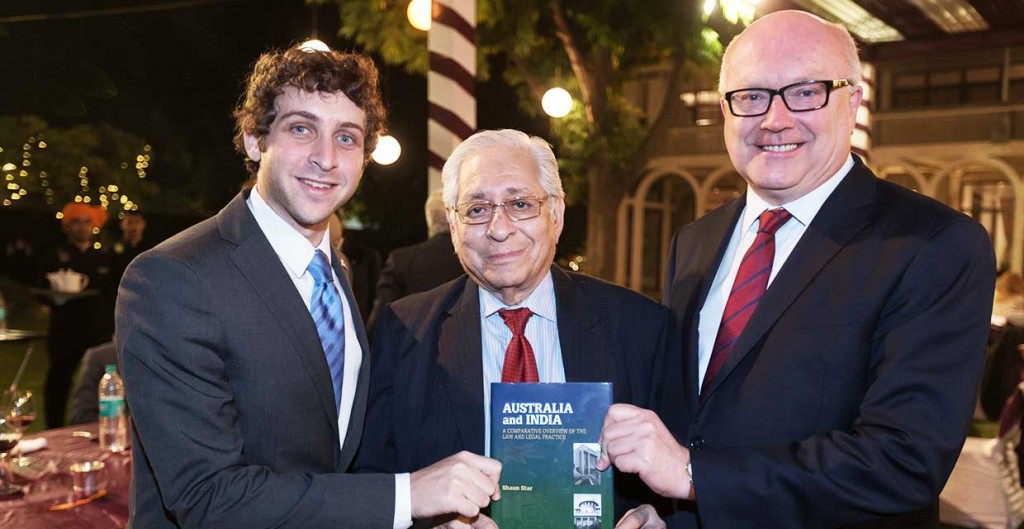
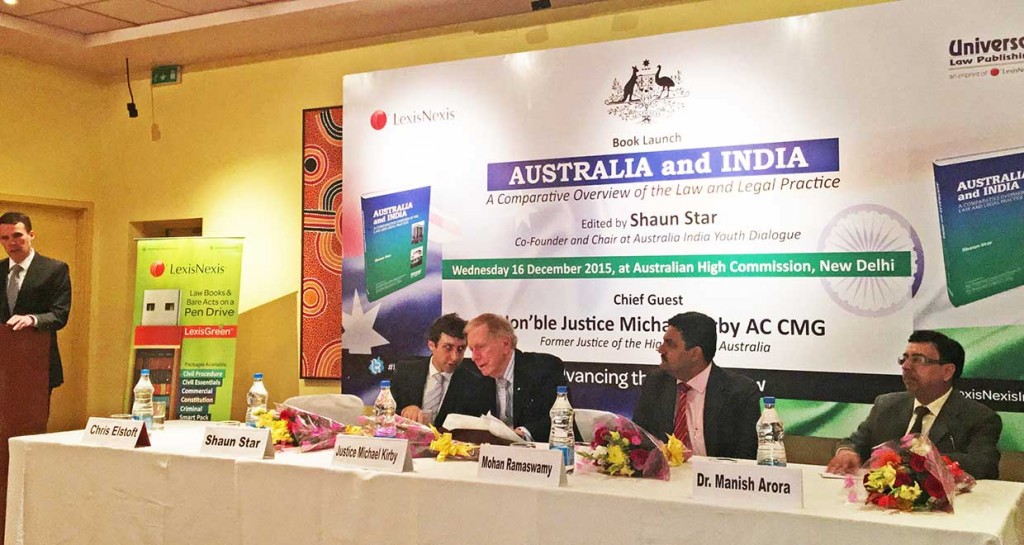
    I edited a book, entitled “Australia and India: A Comparative Overview of the Law and Legal Practice”, which compares the Indian and Australian legal systems. With forewords from the chief justices of India and Australia, the book comprises contributions written by eminent judges, barristers, lawyers and academics from both nations. The book was launched by the Attorney-Generals of Australia and India at the Australian High Commissioner’s residence in New Delhi and subsequently by The Honourable Michael Kirby AC CMG, former Justice of the High Court of Australia. It has been published by Universal Law Publishers, an imprint of Lexis Nexis.

    Each chapter of this volume has been co-authored by some of Australia’s and India’s top legal luminaries including the likes of Gopal Subramanium, Anand Grover, Haigreve Khaitan, Cyril Shroff, Pallavi Shroff, Shardul Shroff, Sumanto Basu, Madhurima Mukherjee, Nisha Kaur Uberoi and V Umakanth.

    This book is important not only because it provides a resource for those interested to learn about how these different regulatory regimes work but also because it promotes collaboration. Through this publication, I have been able to introduce many of the authors to each other for the first time – many of whom have started working on other projects together.

    More information about the book is available here.


    What do you think are the things India can learn from the Australian Legal system?

    Given the common heritage of our legal systems and the many similarities in the form and structure of our federal systems of Government, there are many more opportunities for people in both countries to learn from each other, establishing partnerships of mutual benefit and shared understanding. For example, Australia has undergone a cultural shift with respect to litigation procedures in recent decades, with a focus on efficient and cost-effective litigation. While the Indian judicial system has its own unique challenges – with the sheer size of India’s population – some of these procedures of case management which have been successfully implemented in Australia may be useful in the Indian context. Conversely, Australia can learn from India’s use of public interest litigation which has been a driving force of reform in certain areas of the law, such as in human rights, public health and the environment.


     Tell us about your experience at NLSIU.

    (Shaun’s first introduction to Indian law was as an exchange student at the National Law School of India University, Bangalore (NLSIU).)

    I was selected by the Australian Government to receive an Endeavour Award Scholarship (which is essentially Australia’s equivalent of the Fullbright Scholarship),which entitled me to study and work in India. I thoroughly enjoyed my time studying at NLSIU, where I had the opportunity to learn different aspects of Indian law.I also had the chance to meet some fantastic new friends, many of whom I have remained in contact with eversince.

    While studying at NLSIU, I chose a number of subjects which allowed me to gain an understanding of different elements of the Indian legal system. Two of those subjects were taught by NLSIU alumni who  had extensive experience as legal practitioners – I found these subjects (mergers &acquisitions and commercial arbitration) in particular worthwhile because of the nexus between academia and legal practice.


    shaun-star-3

    As an undergraduate student you worked at Clayton Utz, one of Australia’s top corporate law firms based in Sydney. How did you come across this opportunity? How was your experience at the firm?

    In Australia, many students work alongside their studies – this allows students to gain experience in law firms or other businesses (as a paralegal for instance) while still at university. Working whilst studying is often common for two reasons:

    • our degrees are more flexible, allowing students to shape their timetables around work schedules (or vice versa); and
    • living expenses as a student can be expensive and many students work alongside their studies in order to pay their way through university.

    I worked as a research assistant and paralegal in the international commercial arbitration group at Clayton Utz. In addition, I participated in the summer clerkship program at Clayton Utz which gave me experience in other practice groups (litigation, pro bono and on secondment to one of Australia’s major banks). Throughout my last two years of university, I worked two-three days per week at the firm.


    Tell us about your stint at the Law Offices of Nandan Kamath.

    During my time at the Law Offices of Nandan Kamath, I worked as a foreign qualified lawyer in the areas of sports, entertainment and intellectual property law. I had a fantastic time working with Nandan and his team. I was fortunate enough to be working there during the ICC Cricket World Cup 2011 – this was impeccable timing, given that the firm was engaged by the ICC to provide legal advisory services in connection with the event.

    During my time at the firm, I also worked with Copyright Integrity International, a firm which was engaged to establish and implement a rights protection programme for the World Cup. Through this combined experience, I therefore had great exposure to sports law during such a big international event.


    shaun-star-4

    You previously worked as a Consultant at Amarchand Mangaldas in New Delhi. How did you come across this opportunity? What were the key areas that you worked on at Amarchand?

    As a foreign qualified legal consultant for Amarchand Mangaldas, I worked on a number of domestic and international matters from across a variety of industries in the firm’s corporate advisory, mergers and acquisitions and private equity practice.

    I came across this opportunity quite fortuitously – I remember attending a lecture on Corporate Law in India by Shardul Shroff at Oxford University. After the lecture (during Q & A), I recall asking Mr Shroff about his perspective on whether he thought there was a place for foreign law firms in India. Following our short exchange at Oxford, I remained in contact with the firm and was offered a position as a consultant in the M&A practice. I thoroughly enjoyed the experience as it gave me great exposure to the corporate culture in India, working on a number of significant transactions over the 2.5 years that I worked there.


    How is it different from work at an Australian Law firm?

    The skill-sets acquired in working as a transactional lawyer are transferrable across different common law jurisdictions. Of course there are different nuances in the legal systems, which I had to learn when moving to India. Interestingly, I started working at Amarchand at a time when the new Companies Act was coming into force – so I was not the only one who had to learn how the new machinery of India’s corporate law regime functioned.

    It was also interesting adjusting to daily life in the context of an Indian law firm. In Australia, lawyers arrive at work by 8:30am and aim to leave the office at a reasonable time (although that is often not possible in the context of some transactions). In India, I was not expected to arrive at work until much later – although I would often find myself having dinner at the office with my colleagues.

    This was also due to the fact that the deal-flow in India is consistent and I have had the opportunity to work on numerous large and interesting transactions – there seems to never be a dull moment practicing corporate law in India in recent times. That being said, I always found time to catch-up with my colleagues at the local chai-wallah, a practice that I was not accustomed to in Australia.


    You pursued a BCL from Oxford. Is it true that an LL.M would help you only if you want to pursue a career in teaching rather than a career in the Industry? What is your take on the same?

    I disagree with the argument that an LL.M will only be beneficial for those pursuing a career in academia. Many successful lawyers and businesspeople in India and across the world have graduated with an LL.M. The opportunity cost of studying abroad for a year is that a young lawyer can spend that time working an extra year in a corporate law firm or as a litigator – but in my opinion, lawyers and advocates will be able to gain that practical experience in a firm throughout the rest of their lives. The experiences, networks and different perspectives that one can gain from pursuing an LL.M abroad is invaluable and serve you in good stead in your career as a professional.


    shaun-star-2

    Tell us about your involvement with the Australia-India Youth Dialogue of which you are Co-founder, and what it hopes to achieve in terms of Indo-Australian relations? Is law as a subject on the radar when it comes to AIYD?

    As Co-founder and Chair of the Australia India Youth Dialogue (AIYD), I lead a  team which organises an annual dialogue for a group of Australia’s and India’s most accomplished young leaders. The AIYD is the pre-eminent track-two young leaders’ dialogue between Australia and India. It aims to provide a sustainable platform for the youth of Australia and India to come together and foster an enduring partnership between our two great countries.

    Each year the AIYD brings together young Australian and Indian leaders, CEOs, Members of Parliament, journalists, policy-makers and athletes to discuss opportunities and challenges significant to the Australia-India relationship.

    Of the 150 young leaders who have participated in the AIYD to date, a number of delegates have been qualified lawyers. Many of these delegates have worked in corporate law practices and have had experience working with Australian and Indian clients in cross-border transactions. In addition, a number of these lawyers have policy interests in the Australia-India bilateral relationship.


    You have recently co-founded an organisation which aims to promote collaboration between young entrepreneurs in Australia and India. Can you please tell us a bit more about this?

    In collaboration with two former AIYD delegates, I am building a platform that will encourage young Australian and Indian entrepreneurs to collaborate on projects. The organisation, “Crosshack”, is still in its planning phase and we hope to roll it out in 2016.

    Essentially, Crosshack will bring together groups of entrepreneurs, designers and other young professionals from Australia and India who will meet in Australia or India and collaborate on innovative ideas to build next generation products and services. These ideas will be pitched at an annual conference and it is our hope that Crosshack will lead to collaboration between young entrepreneurs from both countries.


    Since leaving Amarchand, you have founded an advisory practice called Australia India Advisory, can you please tell us more about this.

    Running an advisory practice, I assist Australians to better understand business opportunities in Asia, particularly in India. I currently advise numerous Australian organisations (from start-ups to listed companies), assisting them with their entry and expansion into India. I have represented Australian companies across a variety of sectors, including education, energy and resources, professional services and technology.


    What advice would you give a law student or a fresh law graduate in order to succeed as a corporate lawyer?

    I think the key to success as a corporate lawyer are similar to that of any young professional in the professional services industry. While technical legal skills are important, nowadays the ability to clearly grasp difficult legal concepts and explain them in a concise way is only the first step. As a young lawyer, one has to be hungry to learn (both in terms of legal knowledge and other “soft-skills”). While it is important to work hard, it is equally important to “work smart” and learn the tricks of the trade from those more senior to you. The fantastic thing about starting out your career as a corporate lawyer is that you can see how many businesses operate across various industries – how they succeed and how (and why) they fail. I think it is important for a young lawyer to always try and see the bigger picture and constantly ask questions – by doing so, a seemingly mundane task like reviewing hundreds of documents in a due diligence process may be more rewarding in the long run.


    What advice would you give to Indian Law Grads who want to make a career as a Lawyer practicing across borders?

    My overarching advice would be to go for it! There is an increasing amount of opportunities for lawyers to gain international experience, even from within India. International transactions often involve either international clients or foreign counsel (or both) and you can learn a lot from the manner, professionalism and processes followed by these international lawyers.

    If you have an opportunity to practice abroad during your career, you should take advantage of the experience. The Indian corporate law industry is really competitive and international experience can set you apart from your peers. Applying for positions abroad can be difficult and the standards of applications and interviews are very high – invest enough time in your applications and résumés and seek advice from others who have worked abroad. If successful, work hard and learn as much as you can while working across borders.

  • Akshath Goyal, Assistant Legal Manager, PayU Payments on work experience in IPR, mooting and legal career

    Akshath Goyal, Assistant Legal Manager, PayU Payments on work experience in IPR, mooting and legal career

    Akshath Goyal graduated from the National University of Juridical Sciences in 2012. Just after graduating he worked at the Intellectual Property firm Anand & Anand, and thereafter at Shardul Amarchand Mangaldas and Co. He is passionate about Intellectual Property and has interned and worked in IP related matters since qualification. He is currently the Assistant Legal Manager at a PayU Payments Pvt. Ltd.

    In this interview, he talks to us about:

    • His experience at WBNUJS
    • The importance of clarity, networking, and hard-work
    • The experience of working in big firms and start-ups
    • How to prepare yourself for the profession beyond the first placement


    How would you introduce yourself, given that most of our readers are law aspirants, lawyers-in-the-making & young lawyers?

    I am a first generation lawyer and I graduated from WBNUJS. Post-graduation, I have worked with IP boutique firms, full service firms, and now as a counsel for a fin-tech start up company. Over the course of my relatively short career so far, though it feels like a lifetime of work, I have had the privilege of working on subjects/ areas that I enjoy with some of the smartest people in the fraternity.


    What interest or influence propelled you to pursue Law as a career? What other options were you considering apart from Law and how did you make the final decision?

    Growing up in a family of Army doctors, I was neither exposed to law nor did I grow up with any innate disposition towards the same. Prompted by my nervousness with the onset of college admissions, I spoke to my parents, teachers, counsellors, etc. most of whom, surprisingly, suggested that I try law.

    I assume one of the major reasons for that was the Law School Entrance being the only exam that tested General Knowledge and Logic for under grad admissions, and being in my school’s quiz team, they assumed that I would have an edge. I then spoke to a few seniors of mine from school, who were doing their legal studies from Bangalore and Hyderabad, and they were very encouraging. So I took the entrance exam for NUJS, which used to be held in January back then, and even before my board exams started I had gotten an admission result. That pretty much sealed it and I was off to Calcutta.

    I did think of medicine as a career option, primarily because my father is a Doctor, but once I realised that the Medical entrance exam involved extensive rote learning of facts I realised it wasn’t my cup of tea and that law just seemed to be a more appealing option for me.


    You pursued your Law from the WBNUJS. How would you describe the experience? Would you like to do anything differently if given the chance?

    My time spent at Law school was, without doubt, the happiest 5 years of my life. Calcutta was an excellent city to study in and NUJS had a lot of extremely smart and interesting people. Being a tiny campus with a small student body, you invariably ended up knowing almost everyone and befriending people not just from your batch but from batches above and below yours, which provided for a rich and diverse learning experience.

    I essentially used law school as a platform to explore my interests in law. I mooted, debated, wrote papers, joined societies and committees, conducted events and even played football for my batch team (I still think that’s my greatest achievement in college). I tried my hand at everything law school had to offer and loved every bit of it.

    The one thing that I wish had done differently was maybe focus on my grades a bit more. Unfortunately, despite being one of the best law schools in India, NUJS did not have the best faculty and the entire teaching system was geared towards rewarding rote learning rather than actual legal knowledge and acumen and I think that was one of the reasons why I just never did well academically. Looking back, I probably should have been less stubborn and made the best out of the system that was available. I also regret taking Elective courses simply based on what would appeal to potential recruiters, I now wish that I had taken those that I had genuine interest in and wanted to learn about.


    akshath-goyal-2

    How did you perform on a purely academic scale? Which disciplines did you find especially engaging and challenging? What was the reason for the same?

    On a purely academic scale, I don’t think I did all that well. I could have definitely done better, but I was left extremely disappointed with the teaching system there. We, of course, had some fantastic professors such as M.P. Singh, Ruchira Goswami, Shamnad Basheer and Anirban Mazumdar, all of whom who made a lot of effort in their lectures, but overall the system left much to be desired leaving a lot of us feeling a bit disappointed.

    I enjoyed my IP and Legal history lessons the most. In fact it was because of the fantastic set of IP professors at NUJS during my time there that I ended up choosing the field as my career.

    Having said that, grades obviously are an indicator of performance but beyond my first college arranged recruitment interview my grades haven’t really been a factor in my legal journey so far. Once you’re in an organisation and in the industry in general, your work and skills count for more than your grades. Yes, getting good grades makes it easy to get that first job or get you that first interview but beyond that it’s your knowledge, handwork and passion for the subject counts.


    How did you build a CV which could offset your academic performance?

    Grades only form a part of your application. The CGPA system unfortunately is a very unforgiving one. Abad semester and the math goes against you. Even though I started progressively improving my academic performance after my second year, overcoming the deficit created due my prior performances turned out to be extremely difficult. I would assume that’s where my extensive participation in extra-curricular activates and rigorously pursuing internships helped me off set my academic performance. The fact that I had mooted, wrote and presented papers in India and abroad and organised legal seminars and talks probably tilted the decision in my favour. Having said this, I would also like to advise law students, who are in the same boat as I was, to not underestimate the power of networking. Talk to your seniors, your professors, your friends in other law schools, actively seek advice and recommendations, etc. Most of my internships came because I wrote to people and spoke about my interests and why I wanted to work with them.

    Everyone sends a CV and a generic two liner when applying, what will separate you is the fact that your letter should be able to effectively convey why you want to work with the firm or a particular partner, something that you will only get if you invest time and effort into researching an organisation and then choosing to work with them rather than just applying to the big names.

    By all means, apply to the big 6 but know why you want to work with them, which practise area of theirs fascinates you and why. Once you do the basic leg work and convey the same effectively, I don’t see any reasons why firms will not be glad to have you on board.


    Please share with us your experience of participating in in the Surana and Surana Corporate Moot. Did the same help you find your area of interest?

    (Akshath’s team won the runners-up position at the Surana and Surana Corporate Moot)

    I believe that I owe whatever success I had as a mooter to my seniors and team mates from college. I was extremely fortunate that I had a supportive team who never lost faith in me and we ended up working well together and reached the finals of the competition. Since I hadn’t really studied corporate law before the moot, the experience helped me gain confidence in my research skills and ability to understand and solve complex problems without any formal training in the subject.

    Since I did the moot in my first year, it really was too early for it to have an impact on my choice of corporate law as a career. I did, however, enjoy researching the problem.


    What interest led you to write research papers? What research techniques did you adopt and what focal questions did you ask in order to write such a paper?

    (Akshath co-authored a paper titled ‘Freedom of Modern Media & Privacy’ which was published by the University of Thailand.)

    Technology and its interplay with law was always something that fascinated me. Which is why when an opportunity to contribute to an international journal came up, I grabbed it with both hands. The fact that I was then invited to Thailand to present the paper was just a fantastic experience. Besides this, I have also co-authored papers on Sustainable Tourism and the Impact of International Trade and its impact on the environment.

    I really didn’t follow a particular theme with my articles, I simply worked on issues that fascinated me at different points of time.


    Could you tell the readers about your internships, how you searched and applied for them, the experience and diversity of work you received a chance to engage in, the development it led to?

    Internships were something that I was very careful about. Having decided that I wanted to practise IP laws, I worked in firms with extensive IP work. Even when I did intern in full service firms like Amarchand or Karanjawala, I ensured that I worked on IP disputes and transactions.


    You worked as an Associate at Anand&Anand in Noida. What was your work profile like and how did you secure that job?

    Since I wanted to be an IP lawyer, Anand and Anand was an obvious choice. I spoke to my professor, Mr. Basher, who had previously worked at Anand and he had only good things to say about the firm- its culture and practise. Once I had a general sense of the firm, then it was all a matter of applying and interviewing with the firm. Luckily, the firm liked my previous work experiences in the field and took me in.

    Being the biggest IP firm in the country, Anand provided me with an opportunity to work on some fantastic matters for some high profile clients. Being surrounded by some of the best IP practitioners in the country was an insanely enriching experience and ensured that I built a solid foundation.


    You then went on to work as an Associate at Shardul Amarchand Mangaldas & Co, Delhi. (SAM & Co.) What prompted this shift and what was the nature of your work?

    While Anand was a great place to learn, as with all boutique firms, your role tends to get highly specific and specialised. I personally felt that it was too early for me to specialise in one part of IP. I wanted to not just work on the contentious side of IP but also on the transactional side of it. That’s where SAM & Co. with its massive corporate practise and international clientele was the best choice. At the firm, I was exposed to the various aspects of IP practise such as technology transfer agreements, comprehensive IP Protections mechanisms, Patent litigation, Regulations governing Technology and IP valuation etc. all which prepared me for my next role as counsel for fin-tech start up.


    What qualities do you think a lawyer needs to possess beyond pure numbers on paper? What advice can you provide for a more holistic learning process to attain goals?

    Look don’t get me wrong, numbers help, having great grades gives the employers the confidence that at least you have the basics sorted and that they’re not wasting their time interviewing you. However, having said that, I think one of the biggest qualities a lawyer can possess is having an insatiable hunger for knowledge and information. Don’t just stick to the course material, read things that interest you, talk to people who have been in organisations that you see yourself in.

    I think one of the best things about having a five year college life is that it gives you ample time to figure out what your interests are.  Honestly, my only recommendations to the current bunch of students would be to use this time to understand what you want to do and not where you want to be. Moot, debate, travel, network, and use all the tools available to understand what you want to do and why you want to do it.

    Don’t follow the herd if you know you’re not like them. Understand your strengths and leverage them in your favour, figure out your weaknesses and work on them. Take courses not because they are scoring, but because they interest you (if they happen to be both, then it’s a jackpot). Pursue internships not because they will look good on your CV but because you genuinely want to work in those organisations. When I was interning in Amarchand, I was initially placed in the Projects team but I knew that I wasn’t something I liked. I enjoyed IP and so I spoke to the HR department and they were more than happy to accommodate me and because I had already worked with the Partner at AMSS before, getting the shift from Anand to AMSS was extremely smooth.


    In 2015, you left SAM and Co, to work as an Assistant Legal Manager for PayU Payments. Could you tell us a bit about PayU and the nature of your work? What prompted the shift?

    Like I mentioned before, the interplay of law and technology was always something that fascinated me and there is no better industry to watch this relationship unfold than the fin-tech industry.A law firm just cannot provide you with the kind of exposure that a start up can. To be able to sit with the Product Team and conceive and tweak consumer products, to help market the same to your customers, to be part of business strategies of a young company was something that really got me excited.

    At PayU, my work is more than that of a traditional lawyer. At a firm, your job is mostly restricted to legal and regulatory advisory work, but in a company your mandate is so much more. Not only do you have to ensure the product is compliant with the existing legal and regulatory framework, but you also need to figure out how to tweak it in cases where it is not. Plus, by joining a start up, you get to be a part of something from the very beginning and gain a sense of ownership unlike any firm experience.


    Could you describe your journey from your first job to the present one and how they’ve contributed to your knowledge and skill set? What has been absolutely memorable through this period?

    Well as mentioned before, each of my jobs focussed on developing a certain skill set which I felt was necessary for me to develop as a lawyer. Since my first job was a boutique firm, it helped me strengthen my basics in the field. My job in a full service firm helped me use those basics to further expand my knowledge base. Finally at my in house job, I’ve been finally able to use my acquired skills and knowledge to work in an industry that fascinates me and challenges me on aspects of not just law but business as well.

    The fact that I have worked at some of the best firms in the country, under some of the smartest people in the industry, and had the opportunity to work in a field that I wanted to has been the best part. I have always tried to work in places that have fascinated me and so far its going well.


    Which area of law do you think, personally, has the maximum capacity to develop over the coming years and why do you think so?

    At the risk of sounding biased, I think that IP is the most fascinating field of law. It’s still developing in the country and with all the technological revolution that’s going on around us, IP will start becoming more valuable to companies than traditional tangible assets and that’s when good IP counsels will be extremely sought after. In fact, in the mature jurisdictions of US and EU, patent litigation is one of the most lucrative areas of practise and I see no reason why India will not follow suit.


    What is a typical day of work like for you? What interests do you possess outside of the sphere of the workplace?

    Again, the good thing about working in a start-up is that there is no such thing as a typical work day or work profile. Your day can range from working on internal policies for the company, to sitting with the product team and brainstorming on new ideas, or even to negotiating agreements with your business partners, vendors, auditors or your outside counsels. So there’s always a lot going on and it’s always exciting and engaging.


    What is your advice to students in order to strike the right balance in law school life?

    My advice to law students would be to use their time to figure out their interests and passions. After that, everything becomes a lot clearer and achievable. Study hard but college should also be about stepping outside your comfort zone. So, join societies, organise events, moot, debate, quiz, dance, etc., because these things play an extremely important role in shaping who you are as an individual, and while grades will help you get your first interview, the rest will help you succeed in life.


    Lastly, what makes you believe that you are not a one-shot wonder, or just a lucked out by chance lawyer? What message do you have for our readers?

    Quite honestly, I don’t think I am a one-shot wonder. I say this because I refuse to believe that only the top 10 students in a class can make good lawyers. I went to a college where only 100 kids out of the 25,000 who apply are selected. Almost all of those who end up there are extremely intelligent and motivated individuals with their own inherent strengths and weaknesses, and almost everybody from the college is doing well. So career success isn’t a monopoly for those 10 rank holders. Sure, it makes life easier to get that first job, but after that it’s all a level playing field. That’s where your passion, work ethic, knowledge and networking skills come into play. The simple fact is that the harder you work the luckier you get.

    So just because you didn’t get the grades doesn’t mean that your career is over, because 6 months down the line nobody cares about your grades. What they do care about is your work ethic and dedication, and once you have that there’s nothing that’s going to stop you from achieving your goals.


  • Abhishek Tripathy, on joining Indian Revenue Service and quitting BigLaw

    Abhishek Tripathy, on joining Indian Revenue Service and quitting BigLaw

    Abhishek Tripathy graduated from NUJS, Kolkata in 2011. Thereafter, he worked at AMSS, Mumbai for almost a year. Not much later, he realized that working in a corporate law firm was not merely what he wanted. Looking for a work area that allowed him to work at the intersection of law, policy and governance, Abhishek decided to sit for the famously tricky UPSC exams. Today, after a steady pace of determined preparation and hard work, he has qualified the UPSC and is all set to join the IRS.

    In this interview, he tells SuperLawyer about:

    • His early experiences that led him to the desire of working for the people of the country
    • His realization that mooting and other law school activities helped even those who looked for a non-legal career
    • His experience at a premier law firm and then his decision to avoid the lures of this firm and prepare for the UPSC
    • The preparation that went into cracking the UPSC exam
    • His reason for choosing the IRS


    How would you like to introduce yourself to our readers who are mostly law aspirants, law students and young lawyers?

    I graduated from NUJS in 2011, and was working briefly at AMSS Mumbai. I decided to write the UPSC CSE in 2012, after leaving AMSS. I have secured a rank of 151 in the 2014 CSE, and will soon join the Indian Revenue Service.


    How would you describe your childhood and educational background before college? Do you have lawyers or bureaucrats in your family?

    I did my schooling from BJEM School and Class XII from BJB Junior College, both in Bhubaneswar. I had science in my higher secondary course. I was active in extra and co-curriculars all through. I was an avid debater and loved public speaking and elocution.

    My family has a great diversity of professionals which includes lawyers and bureaucrats. There was thus never a dearth of role models while growing up. My mother is trained in Indian Classical music. She used to perform songs written by my maternal grandmother, in the All India Radio while she was in college! Music and literature therefore had a tremendous impact on me.

    My father was a sports-person and a marathoner. My father and grandfather encouraged me to read the newspaper daily, without fail.

    Due to my father’s frequent and long spells of postings in the Kalahandi-Bolangir-Koraput (KBK) region of Odisha, I travelled through these areas quite a bit. What I found tragic was the deprivation, but what was startlingly redeeming was the rich culture of the people. That phase had a deep impact on me. I decided to commit to the UPSC preparation due to an awareness of ground realities in such areas.

    Looking back, that helped me learn many practical things.


    How would you describe your experience as a student aspiring to study at an NLU? How would you describe your academic life at law school?

    (Abhishek graduated from West Bengal National University of Juridical Sciences, in the year 2011)

    Education at a leading NLU is as comprehensive as it gets. It exposes you to diverse life experiences. It prepares you for life. To every law school aspirant, my simple message is to just do everything in your capacity to make the cut.

    To every law school student, I would simply tell you to absorb as much as your student life offers you. Your experiences will eventually define the lawyer that you will become.

    I had a great learning experience in law school. A great pool of motivated and driven batchmates made the experience challenging and thoroughly enjoyable. We were lucky to be taught by some of the finest law professors, from India and abroad. Besides, it was a time when research output was beginning to be focussed on substantially in NUJS, under Prof. MP Singh’s visionary leadership.


    abhishek-tripathi-1

    Did you like the combination of law and humanities right from the beginning, or was it an afterthought when you realized that you had to prepare for the UPSC exams?

    I really liked the humanities subjects, especially Sociology and Political Science. Economics taught at law school helped me a lot during my UPSC preparation, as there is a clear focus on Macro-Eco. Sociology helped me build bridges and link topics. Most importantly, it taught me the art of questioning seemingly mundane aspects of life, which we take for granted.

    For example, during one of my internships I was working on sanitation and public health, and in another I was working on disaster mitigation and management and had the opportunity to interact with women’s Self Help Groups (SHGs). This confluence of law, finance, policy and grassroots issues helped me a lot while in law school and as a lawyer. It helped me even more while preparing for the UPSC. I was not just reading concepts and problems, I actually began having a fair idea about how things work in real life.

    Further, we had a good set of professors to learn from in NUJS and that in itself is a privilege.


    How was your experience with internships? Did they help you in the long run?

    I planned my internships in order to have a good variety of work experience on my resume.

    I have worked with German and Spanish Red Cross Delegations to India, on some stimulating field and research based internships. I value this phase a lot. I have interned with a Singapore based law firm. The exposure to mediation and alternative dispute resolution mechanisms in Singapore was educative.

    I have interned at most of the major law firms in India. Somehow, ironically, I never quite enjoyed these much.


    You have academically done well both in NUJS as well as in your Junior College and in School. Any actionable tips to score well in law school for our readers?

    I came into law school with the single point agenda of not just building a good CGPA but also of getting an education that taught me practical life skills.

    I was always very active in all that each of my educational institutes had to offer. In law school as well, I was focussed on diversifying my resume and learning life skills. Since I was never targeting higher education right after law school, I was not obsessed about my CGPA. But I saw so many around me who went to great lengths to gain astronomic scores, irrespective of what they lost out on. I was never a part of this race!

    In the semester I had my lowest GPA, I learnt how to swim, interned at some of the best Indian law firms, wrote and published papers and so on. Looking back, I am richer for the things I did, and the way I prioritised my life at that point, than for the GPAs I lost out on.

    Therefore, I value life skills over college grades.

    Having said that, I should clarify that for all practical reasons like an LLM or an ideal Day Zero job, a CGPA unfortunately is the sine qua non. But there are ways to find a balance.

    I really wish law firms and other recruiters found a more comprehensive way to look at a person’s life experiences. Law is all about the real life dynamics. It should not be evaluated solely on the merits of how many sections one crams or how high your scores shoot up! These are fairly important, but eventually, parts of a whole. At present, these things are treated with undue importance, if I can put it that way.


    You were an avid mooter in your law school and participated in national moots. How does mooting help if you choose a non-legal career?

    Firstly, I have not really been an ‘avid’ mooter! Yes, I have mooted and enjoyed it. But I have never been obsessed about it really. I did it as something that I ought to have done as a young law student, so that later there were no regrets. NUJS has a thriving mooting culture which is difficult to avoid initially.

    As such, mooting structures the thought process of fresh law students. It teaches valuable research skills, presentation of arguments and marshalling of facts. Most importantly, it equips us to look at both sides of a fact. All of these are precious skills, irrespective of which profession one eventually chooses. To illustrate my point, my debating and mooting skills helped me do well at my law firm interviews. My UPSC personality test was also much easier to deal with, given the continued exposure to speaking. And it certainly has helped me improve my inter-personal and communication skills as a professional.


    Did you enjoy legal writing while at law school?

    To be honest, I was more interested in legal writing and research than mooting. I was in the Magazine Committee with a team of absolutely talented seniors to learn from. I was associated with the NUJS Law Review for a fairly long time, beginning as a junior Associate Member and then subsequently rising to become an Editor. This phase taught me crucial skills like attention to detail, communication, financial and regular administration. In addition, I was taught the important of rigorously skimming through many papers, picking out the better ones and editing them thoroughly. The unique NUJS Law Review model has been path-breaking. I am glad I was a part of it, at a time when this institution was being built from scratch by Professor MP Singh and a team of brilliant seniors.


    After law school you joined AMSS, Mumbai. How was the BigLaw experience?

    (At AMSS, Abhishek worked for almost a year in the firm’s Private Equity/Mergers and Acquisitions Team)

    It was my first job, a day zero placement at that. It shall always be very special. Mumbai shall always be close to my heart for various reasons. I had always wanted to work with a major Indian law firm. But with each of my internships I realised, that I was growing disenchanted with the entire idea of corporate law firms and the typical lifestyle changes that are inevitable.

    The real life experience at AMSS made me realize that only corporate law, or even law for that matter, would not motivate me. It had to be more holistic, more challenging, and this transition had to happen on my terms.


    abhishek-tripathi-2

    When and how did you decide to go for the civil services?

    The intersection of law, policy and governance deeply interests me. The Civil Services promised that along with great diversity and a unique opportunity to work for the people directly. I was very happy being a lawyer, but I was not satisfied with just that. I wanted to marry policy and governance to it, which is why the shift to bureaucracy made sense. In many ways, the UPSC CSE presented the next level for me as a lawyer: that is, connecting the citizens and public with law and governance.

    But I wanted to pursue this career for the right reasons. So I first decided to put in my papers. I did not leave AMSS because I wanted to do the UPSC CSE.

    I left the lure of a very prestigious and glamorous job at the best Indian law firm, because it did not align with my vision and priorities in life. After two months of resigning, I finally struck out all other competing and compelling alternative career choices, and decided that I should give the UPSC exams a shot. It was based on a year-long and excruciating cost-benefit analysis, which had started while I was still in AMSS.

    For me, it has always been about following my inner vision and motivation: with some courage, a lot of guts and an unfailing faith in my actions and thoughts. The thrill of risks, backed with thorough background research, gives me an adrenaline rush! I did not write myriad exams just for practice, as many of my friends did. My only singular priority was clearing the UPSC CSE. Nothing more, but nothing less!


    To gain exposure for UPSC, what all did you do?

    I pursued independent legal and policy research. I got back to blogging on different genres and themes. That helped me in my UPSC preparation tremendously. I was attached to an international NGO, which helped me appreciate the grassroots issues. I was blogging for a junior from law school, on her website www.lawschoolsterrace.com. I liked connecting with the young law school students community through this.

    I did not want to be just another aspirant, doing what lakhs of people always do: only study! I wanted to pursue my interests and hobbies also. I wanted to grow as an individual. I wanted to reflect that in my attitude towards this exam.


    Tell us what drove you to join the Indian Revenue Service? What were your service preferences?

    My service preferences were: IAS-IRS–IPS-IFS.

    This is not going to be my first job and as such, I have no star dust in my eyes regarding the civil services. I can only do a job that I am interested in really, and one that fits into my larger vision -personally and professionally.  The IRS fit the bill perfectly.


    You have secured a very high rank in the UPSC Exam. Tell our readers how to prepare for these exams to achieve success and on preparations you underwent to crack the exam.

    This was my second attempt. I failed to clear the prelims in my first attempt as I had no understanding of what the UPSC expects of the students. Lack of focus and complacency are largely to be blamed in hindsight.

    I prepared for a year all by myself at Bhubaneswar. I moved to Delhi for around 3 months and joined Sriram’s IAS. Sriram Sir was the perfect mentor I could ask for. That short stint helped me consolidate my preparation. I came back home for my second attempt in 2014, and joined Career Launcher and another local institute, Aarohan, for prelims tests only. I did not attend the classes at these places. I only wanted to polish my preparation.

    I made use of the internet and newspapers thoroughly. I wrote tests regularly and had a fixed, yet flexible timetable with daily, monthly and exam level targets. My uncle, Mr. Santosh Behera, helped me prepare systematically for the personality test round.


    How do you plan to go ahead in time?

    As long as I am committed to my job, and keep referencing back to my law school training, I can ensure I do my work as is expected of me. The biggest impact often comes from doing the simplest of acts with great faith, honesty and sincerity.


    Please give our young readers and followers some tips to help them ace the mighty UPSC.

    Focus, and you shall have it!

    Many of us are obsessed with our Plans B, C, D so much that Plan A (clearing the UPSC) gets compromised. A friend of mine told me once that there is a reason Plan A takes time. Give it the time and energy it deserves. It will reward you, one way or the other.

    If I were to borrow the thoughts and words of the Greek poet, Constantine Cavafy, this ‘Journey to Ithaca’, is totally worth its while! So enjoy the process, and wait for success to come at its own time!

    Godspeed and best wishes to all the aspirants!


  • Sajai Singh, Partner, J. Sagar Associates, on work profile and experience in Corporate Commercial Practice

    Sajai Singh, Partner, J. Sagar Associates, on work profile and experience in Corporate Commercial Practice

    Sajai Singh graduated in B.Sc from St. John’s College, Agra and later qualified in law from Delhi University in 1990. Sajai is currently a partner at J. Sagar & Associates and the Chairperson of the firm’s Corporate Commercial Practice. Having experience spanning over more than 25 years, Sajai is an acclaimed transactional lawyer. Sajai has been the President of the International Technology Lawyers Association and is a member of the American Bar Association. In this interview he shares with us:

    • His college life, education and becoming a partner at JSA.
    • His experience as the past president of International Technology Lawyers Association, and also the field of Technology law.
    • The work entailed in his position and the field of corporate law dealt with.


    How would you like to introduce yourself to our readers, most of whom are aspiring lawyers?

    I am a first generation lawyer. My growing up years were spent moving from one cantonment to another as my father was in the Indian Army. Growing up in the army background bought a sense of discipline and commitment in me. I changed schools every two years if not earlier and my first exposure to living in a big city was when my father was posted to London and I joined him after completing my 12th Board exams, for one year.


    Could you tell us a little about your college life and why you decided to pursue a legal career?

    In college I studied Science. Chemistry was my favourite subject. Post College I studied Business Management and had an interest in International Trade. As I read more about International Trade, I realised the interplay and the key role played by Law.  It was the glue that made business possible in an organised and harmonious manner. Without the principles of law governing every aspect of business, a business transaction, like may others, would be anarchic. We had to keep referring to the ‘rules’ to answer any response to a ‘why’, a ‘how’ or a ‘what’. This was interesting, and at the same time intriguing.  That’s when I got interested in study of Law. Subsequently, I joined the Campus Law Centre, Delhi University.


    You completed degrees in B.Sc and PGD Business Management before pursuing law. Have these courses helped you in your work?

    Not just my qualification in Science and Business Management but also my secondary education in the Kendriya Vidyalaya system helped my overall growth and awareness, eventually assisting my study and practice of Law. Science taught me technical skills, while my Business Management background developed my analytical skills. My multidisciplinary exposure helps me understand the needs of my corporate clients better.


    What kind of activities did you take part in while at law school?

    Writing has always been a passion for me. While studying Law in the 80’s, mooting and debating opportunities were fewer compared to today. We made the most of the opportunities that came our way. Students today are blessed to have far more opportunities and avenues open to them. And they are not limited by geography.


    Did you do many internships while at law school? In retrospect, how important were these internships in shaping your career?

    Internship opportunities were few during my Law School days. I was, however, working while studying law. My passion for writing got me an opportunity in a leading advertising agency and I used to work in the copy department of the same. I also did part time work at Doordarshan and All India Radio. From the money I earned, I paid my rent and met my other needs. While the money I earned was not much, things were simpler, choices were scarce and my needs were simple. It were these life experiences that helped me realise the value of hard work.


    Having participated in a number of international programmes and workshops, what would you say were you biggest take-aways from each?

    I feel international exposure not only builds confidence for people from developing nations but also allows one to understand how to function in a flat world. The learning is both ways between developing and developed economies; between modern and ancient cultures; and between different professions. I have been lucky to have done courses in Wharton and with the Euromoney Institute. But the single most impactful experience for me was with the Centre of International Legal Studies/(CILS) Austria. I did a Certification Program in International Practice with them. This program took me to Dallas, where I spent 4 months working with the US law firm, Jackson & Walker. This time was an eye opener and prepared me for my forth coming move to set up open and run the Bangalore office of JSA in 1996.


    sajai-singh-1

    You have worked with J. Sagar & Associates (JSA) for 23 years now. Can you tell us the best and worst things about working in a corporate environment in general, and JSA in particular?

    I started my career as a Litigator. I moved to Corporate Law after 2 years of Litigation and Arbitration practice. I would recommend all future corporate lawyers to have some exposure to Litigation and the Court system before they shift work exclusively in the Corporate Law field. My tip on this point for aspiring lawyers would be to spend as much time in the Court Registry as they can. This exposure is key to understanding process and how the backbone of the justice system works. Contentious work develops quick thinking, contextualising and research ability, which is very useful for a Corporate Lawyer. While exciting in its own way, it may take time for Corporate Law work to replace the adrenal rush of arguing a matter before judge.

    My Experience in Corporate law field is limited to JSA. Therefore, I would not be able to comment in general about corporate law firms. JSA has been a very International, forward looking and broad canvas exposure for me. Its institutional character, ethical rooting and transparent interactions make it a very happy and comfortable environment to practice law in.


    As the Chair of JSA’s Corporate Commercial Practice, how do you recall your career traversed to bring you to your current position? What is your current work profile like?

    Since 1992, when I joined JSA, some months after it started, I worked extensively for multinational clients setting up business in India. Those were the years when India was slowly liberalising its economy and JSA was working closely with its overseas clients to try and maximise value for them as a part of their India entry strategy. Other than foreign exchange regulations, the other laws that I initially worked with were Company Law and Contract Law. With years of focus on these statutes I had a background which led to me being made the Chair of JSA’s Corporate Commercial Practice. It is my endeavour to continuously expand this practice including in areas that I am passionate about and feel will become strong practice areas in their own right very soon. These are Employment Law, Anti-corruption Law, Data Protection & Cyber Security. I am doing a fair amount of work in both these areas. In terms of my work profile, in addition to doing billable work, I am also expected to create a business development strategy, training schedules and curriculum, recruitment and HR needs and implement them for the overall growth of the practice.


    Please tell us how do you approach work with regard to management and delegation.

    As with any progression it is important to nurture the younger generation and allow it to grow develop and play a larger role. I follow the same principle in my practice. I have always been surrounded by brilliant young lawyers who have worked closely with me in delivering extraordinary service to clients. I believe in delegation. I believe in trusting my colleagues and their ability. At the same time I do feel a challenging is a good way to obtain the best performance. Unless a matter requires involved supervision or is evolving with time, I tend to keep my role limited to supervision and emerging essentials.


    Tell us about an interesting case you handled recently. What is your favourite part in the life cycle of a given matter or case?

    One of the recent anti-corruption investigations, that I worked on, involved out-of-the-box time critical thinking. Most of the challenges came from the human element rather than from a law or a regulator. And it is the ingenuity of the human mind that emerges as the most fascinating aspect of any transaction. Unravelling and anticipating this aspect is my favourite part. Using technology as an able tool has proven to be a wonderful experience.


    How did you develop an interest in Technology law?

    (Sajai was the immediate past-president of the International Technology Lawyers Association, which is a first for any Asian.)

    I have always been interested in new areas of law, which evolve with the development of Society. Be it Television Broadcast Law, Cable Television Law, Copyright Law, or information Technology Law, I have seen all of them evolve before my eyes and these have been fascinating experiences. I am sure there will be other and newer areas of law that will grab my fancy in the coming years. I look forward to that.


    Please give us some practical insight into the Information Technology sector in India juxtaposed with the same in the global context.

    From being the back office of the world, India today provides the world cutting edge consulting and advisory support. I see entrepreneurs come up with new ideas and technological breakthrough on an encouragingly frequent basis. I do hope India would evolve into an IT product, Software and Patent creations hub in the near future.


    Could you please provide us with some context in regards your long standing association with the American Bar Association?

    Since most of my clients were American Corporates doing business in India, I had to closely work with US lawyers and US General Counsel. These interactions led to me being invited to speak at several Seminars and Conferences, including those organised by PLC, IBA and ABA. These and many other associations welcomed me and my thoughts into their fold.

    ABA seemed a natural fit for my practice as it helped me understand the US legal landscape. My clients operated in this space and I had to keep abreast with it if I wanted to adequately service my clients, Thus began my association with ABA.


    Please tell us a bit more about the Private Equity and Venture Capital Committee that you are the Chair of.

    As a part of my leadership of the PE/VC Committee, I collated International experiences, regulations and understanding to what may be considered a cross border phenomenon – PE/VC investments. These collated thoughts, updates and experiences were presented to the Committee members at meetings and online.


    You conducted skill development courses on Negotiation and Transactional skills at the NLS Bangalore. What is the structure and curicula of this course?

    I like to teach and work with students. They have so many new ideas and life is looked at with different perspectives. As a part of this interest I taught at the National Law School, University of India Bangalore. Now due to time constraint I’m only able to conduct shorter skill development programs and not teach semesters as in the past. My Negotiation Skills and Transaction Skills Courses were focused on practical development of the students rather than on teaching theory. I wanted to provide my students with an opportunity to understand how negotiations are conducted in practice and the life cycle of a transaction with several live examples exercises and fact patterns. My students got an opportunity to role play in a controlled environment which I hoped would prepare them for the practice of corporate law.

    I also conduct legal workshops in different universities across the world as a part of my education initiative for ITechLaw. The recent ones that I conducted were in Colombia, Ecuador, Peru and Chile. I hope to conduct one in Cuba next year.


    What advice would you like passed on to an aspiring lawyer?

    My advice to any aspiring lawyer is to remain curious, ask questions and try to learn one new thing every day!

  • Malek Shipchandler, Associate, Shardul Amarchand, on partaking in negotiation competitions and vacation scheme at Clifford Chance

    Malek Shipchandler, Associate, Shardul Amarchand, on partaking in negotiation competitions and vacation scheme at Clifford Chance

    Malek-ul-Ashtar Shipchandler, a 2014 batch graduate of ILS, Pune, is currently an Associate of Securities, Financial Regulatory, Corporate Law at Shardul Amarchand Mangaldas, having already worked with Economic Laws Practice (ELP) for a year.

    In this interview, he speaks to us about:

    • The significance of the Company Secretary (CS) course;
    • The experience of a Vacation Scheme at Clifford Chance;
    • The relevance of certification courses; and
    • The ability to continue with legal writing even after joining a law firm.


    Would you say that high school experiences led you to choose law?

    (Malek was part of the Student Council at school and participated in Model United Nations (MUNs) simulations, both as a delegate and Secretary General, and attended the Global Young Leaders Conference (GYLC) in Washington D.C and New York.)

    These experiences were definitely instrumental, coupled with encouragement from my family and teachers who saw in me an aptitude for oration and argumentation. I chose to be a commerce student in my penultimate and final year at school, perhaps because I was not exceptional at science related subjects but did fairly well in commerce related subjects such as economics and business administration studies; towards the end of my final year at school, the choice for me was either finance or law.


    Please share with our readers your experience at law school. What kind of activities did you participate in? How did you develop an interest for moot courts?

    Studying at ILS Law College was an excellent experience for someone who thrives in an atmosphere wherein you are not given a map of how to go about grooming yourself as a budding lawyer; except for the compulsory lectures, one is absolutely free to pursue other diplomas/courses, peruse books and journals in one of the best law libraries in India, participate in advocacy competitions, get involved in organizational activities, articulate views for publication in law journals, contribute to academic discussions post lecture in various “cells”, work with a law firm or a counsel, or simply do nothing and enjoy the cold coffee at the ILS Canteen! It has been an inspiring and humbling experience being taught by some luminaries in their own subjects, interacting with and being guided by seniors who have achieved milestones in their careers, and studying along with some stellar students who are currently not only doing well in law, but other fields as well.

    I primarily participated at intra-college and national moot courts and contributed to discussions at post-college “cells”. As a fresher and sophomore, I remember watching some brilliant seniors argue at moot courts and parliamentary debates – this sparked the keenness in me to participate in moot courts myself. Watching seniors argue at moot courts also helped me to not only understand the basics of fundamental laws like contract, torts and constitution but also gave me a chance to learn and imbibe in myself moot crafting skills such as presentation of facts, articulation of arguments, modulation of voice, rapport building with, and responding to, questions raised by the judges and rebutting contentions put forth by the opponent team.


    How did you decide to pursue the CS course? In the long run, do you think that this degree gives one an edge over other law school graduates?

    (During Malek’s second year at law school he started pursuing the Company Secretary (CS) course.)

    Pursuing CS came as a natural decision due to my inclination towards finance as well as corporate law, coupled with the fact that I had time on hand after attending lectures. Having studied for and attempting CS examinations, I am of the opinion that apart from giving you a flavour of basic concepts in company law, securities law, banking-finance law and taxation law, the way the ICSI frames its exam papers is far more objective, and challenges your legal cognitive, as compared to mere rote-writing. The CS course helps one to understand the inter-play between different corporate laws, apart from teaching how to read and interpret basic company financials – a skill very useful for corporate lawyers who interact with Promoters, CFOs and GCs, conduct diligences and draft commercial agreements.


    Do you believe ADR competitions are important, but are shadowed by the more popular moot courts in law schools? How do you think this could be changed?

    (Malek has also extensively participated in negotiation and client counselling competitions, nationally and internationally, and thereafter even judged such competitions.)

    There is no question of one advocacy activity “shadowing” the other. Moot courts and ADR related activities, I believe, are complimentary to each other in holistically grooming a budding law student. Most traditional law schools in India prefer the modus of teaching only by lecturing (rather an encouraging participative discussions or simulation learning), and that too on aspects necessary for examination purposes.

    While lectures on CPC and CrPC, and sessions on moot courts, allow students to imbibe the skill of argumentation, cross-examining and drafting, it unfortunately does not hone the art of personal communication, explaining the law to laymen in simple terms, understanding and syncing the clients’ expectations with legal modalities, and devising commercially viable solutions. These skills, I believe are indispensable for any lawyer, be it a litigator or a transactional lawyer.

    Most law students associate advocacy competitions as synonymous with moots courts and mock trials, perhaps because the number of negotiation or client counselling competitions that happen in India are far lesser in comparison to the number of moot courts. Law schools and law firms need to collaborate together and initiate more of such ADR related activities and competition. From my experience of founding the first ever negotiation competition at ILS Law College, I can say that the inputs of practicing lawyers or GCs (as compared to professors) to such activities/competitions is crucial for the quality of the activity/competition.


    You interned primarily at corporate law firms. Where did this inclination towards corporate law start from?

    John Grisham may have had a role to play! On a more serious note, I actually started my internships learning at places known for litigation. My first internship was with Hariani & Co, followed by the chambers of the then Attorney General, the late Mr. Goolam Vahanvati. Being in the second and third year of law school, more than learning the law or the procedure, it was through these litigation related experiences that I understood research methodologies, articulation of thought on paper i.e. how to draft legal notes/memos and documents management – skills which eventually helped during my corporate law internships. I believe as a law student, for the initial years at least, one must try everything and not wear blinkers concentrating on either just “litigation” or “corporate”.

    My inclination towards corporate law was sparked when I participated at the NLIU Juris Corp Moot Court Competition which gave me a chance, while researching on the moot problem, to identify and understand certain transactional nuances in securities and competition law which ultimately led to a dispute in court. I must admit that certain facets of litigation, such as argument drafting and strategy, really interest me; I am grateful that so far in my career, along with corporate-transactional work, I have been getting to do some work focussed on the Securities Appellate Tribunal and appearances before the Securities and Exchange Board of India.


    You experienced a vacation scheme at Clifford Chance. Was it different from Indian law firm internships?

    The experience can be comparable to internships offered by certain Indian law firms. Global firms such as Clifford Chance have very structured work experience schemes, almost like a course by itself, which involves learning and development of the Schemer through work assignments, attending in-house lectures, insights into the workings of different teams handling different practice areas and networking opportunities with the professionals at the firm. Firms such as Clifford Chance are driven by a philosophy of investing in their lawyers, right from the time one begins a training contract with them.

    I would encourage the readers, that given a choice between doing a LL.M and taking up a training contract, the latter should be considered hands down; there is no better teacher of practicing law than actual work experience, given the fact that law we read while studying is often very different from how it operates/is applied in the real world.


    You have scored a remarkable 99/100 in the FICCI’s certification course on Competition Laws and IP Rights. How far do you think these certification courses help a law student?

    Most traditional law schools often do not have specialized laws as part of their curriculum and are therefore not taught, at least as a core subject. Certification courses facilitate the learning of specialized laws, and are generally designed in such a manner, that it can be undertaken simultaneously while continuing your regular college activities. While there is a culture among law students of enrolling in parallel courses early on, it might make more sense to wait until the 4th or 5th year (or 3rd year in case of a three-year program) to assess where exactly one’s inclination lies – this is possible after participating in advocacy competitions, doing internships or writing papers – avenues through which one can understand what it is like to “practice” the specialized law, and not merely “read” it. From a CV building point of view during law school, especially if you have applied to intern under a particular practice group, certification courses would be a plus.


    Did you face difficulties in the beginning of your work at ELP? When did the transformation from a law student to a lawyer take place?

    (After graduating from law school, Malek joined Economic Laws Practice (ELP) and worked there for over a year.)

    It is only natural to feel challenged (not, “difficult”) when one moves from one life chapter to another viz. the academic chapter a.k.a “fun phase” to the professional a.k.a “real world phase”! That said, having interned previously at law firms and being a part of a great team headed by Mr. Suhail Nathani, made the transition for me as a student to a lawyer not only easy, but also memorable. Believe it or not, your perspective about practicing law is greatly impacted by your first job, team and senior.


    Do you believe that drafting contracts, legal opinions and other legal documents is an essential skill that most law schools in India omit to teach their students?

    I believe most law schools lay emphasis on teaching the principles of contract law as compared to actually teaching a student how to draft a contract. That said, law schools such as ILS Law College not only has a contract drafting competition but also has a subject on drafting which is taught by a renowned lawyer, Mr. Ajit Kulkarni – I still remember, his lectures were attended by non-ILS students as well as lawyers! Most traditional law schools, instead of asking students to take hand written notes of contract templates (which are otherwise available online), could consider equipping students with, and evaluating them on basic skills of drafting such as formatting, cross referencing and even proof-reading, and impart knowledge on aspects of stamp duty and registration – these are essential for drafting most contracts.


    You are now an Associate at Shardul Amarchand Mangaldas, Mumbai. What is your work profile there? Could you share your experience at the firm so far?

    A usual day for me at SAM involves team meetings, tending to client queries over phone call or email, preparation of memos/notes and drafting and reviewing of transaction related documents. We also advise on securities litigation matters, and as such, whenever required, we draft submissions to be made to the concerned authorities. Some transactions require me to work with other specialist teams in the firm, allowing me to benefit from their domain knowledge and experience. Besides encouraging regular interaction with the partners who have a plethora of experience and knowledge in their respective practice areas, the firm underscores the need for overall development of its lawyers and has implemented programs/policies where SAM lawyers share their opinions and experiences relating to a particular legislation and/or matter – this allows one to be up to date on contemporary legal developments and bake an opinion on certain contentious aspects – a must for any lawyer!


    Do you think it is important for legal professionals and law students to make their presence felt online?

    I believe, as will most people, that visibility is the key for growth in any profession. It would no doubt be helpful to reduce one’s time on social networking websites, and invest that time on professional networking websites such as LinkedIn.


    malek-shipchandler-2

    How do you find the time to research and write legal articles? Could you share a few tips with our readers on how to go about legal writing?

    Let me answer the question this way: I generally find time to write during early hours of the morning before work, or on a weekend, because writing helps me analyze cogently, organize logically, distil accurately, argue persuasively, cite knowledgeably, punctuate skilfully, and phrase smoothly, among other things. Some coveted blogs and forums also elicit the comments of experienced professionals and luminaries (either concurring or differing from the views expressed in the article) on the article, which is enlightening to read. I believe everyone has their own way of building their knowledge of the law and expressing their interpretation and application of it – legal writing is one such way which quite a few law graduates appear to adopt.

    To the readers, I can share that, while writing, I tend to implement certain guidelines which appear in a publication of the American Bar Association: “…you must struggle to achieve simplicity—and learn to achieve it without oversimplifying. That’s a tall order in an intellectually challenging discipline like the law.

    And it’s especially tall when you think of the overwhelming attraction that legalese presents to the average mind. With “pursuant to” and “assuming arguendo” and “hereinafter” and “inter alia”, you have ready-made shortcuts for feeling lawyerly. They’re like secret handshakes. They seem to make you a member of the club. Without them, you’ll feel like your pre–law-school self at a time when you may really want to feel a difference. Never mind that they typify low-grade legal writing.”


    What is your message to young law students?

    “Work until you no longer have to introduce yourself” is a mantra I endeavour to live by – try it!

  • Hitesh Sablok, Founder, PackandShift.com, on entrepreneurship and quitting BigLaw to start-up

    Hitesh Sablok, Founder, PackandShift.com, on entrepreneurship and quitting BigLaw to start-up

    Hitesh Sablok studied law from Vivekananda Institute of Professional Studies (affiliated to IP University, New Delhi) in the Batch of 2003-08. A corporate lawyer by experience, now turned entrepreneur, he has worked at Vaish Associates and Amarchand & Mangaldas. Recently he has started his own business in logistics: PackandShift.com.

    PackandShift is his new venture, it is an aggregation based platform which renders economical, reliable and hassle free transportation and relocation services.

    In this interview he talks about:

    • His experience in the corporate world, the responsibilities involved.
    • Founding a startup, gathering the initial investment, finding a co-founder and other aspects regarding the same.
    • PackandShift’s main business model and facilities provided.
    • Advice for law students venturing into entrepreneurship.


    Tell us a bit about your childhood and pre-college life as well as educational background. Did you have lawyers in your family?

    I was born in Meerut and brought up in Delhi. My complete education has been from Delhi, so it won’t be wrong to call me a Delhi boy! I have been an average student throughout but always had a knack for connecting everything with logic, related concepts, application, techniques etc. My interests ranged from technology and science to nature to war history to superheroes. Major source of all this back then was the Discovery Channel, which started around the same time and till date is my favourite on TV.

    My dad, who is also a lawyer, played a very vital role in shaping up my career. In fact, it was on his advice and guidance that I entered into a law school. In fact now we have another lawyer in our family – my better half!


    You were till recently working at Vaish Associates as a Principle Associate. What constituted your work profile? What were your daily tasks and responsibilities?

    At Vaish Associates I lead teams on transactional assignments; primarily relating to M&A and PE. I was responsible for every aspect of the deal i.e. from structuring of a transaction from a regulatory perspective, discussing and negotiating the commercial terms of the deal with the opposite party, drafting, reviewing and finalizing the agreements required in accordance with the deal structure and last but not the least – ensuring proper closing the transaction (including some post-closing activities/ filings). The day used to start early and revolved around con-calls, client meetings (be it for discussing an ongoing deal or for business development) and finalizing drafts of agreements/ documents for one or the other on-going transactions.


    Earlier you were working at Amarchand Mangaldas, what was the work that you dealt with?

    At Amarchand Mangaldas I was directly reporting to my Partner and was responsible for any corporate matter that came to our team (be it a transactional matter or an opinion or general corporate advisory); however, even then my work majorly revolved around transactional assignments. It was a short but a beautiful experience working at Amarchand Mangaldas and taught me so many fine things that a professional should practice.


    Share the biggest challenges that you faced in the early days of your career. How did you address them?

    I entered as an intern and gradually became an associate… Ours was a populated team of about 20 people. Each and everyone wanted to outshine the other and get the best work. Every senior wanted the best junior to work with him, which is a very fair need. That was my initial challenge…to prove my worth! To be the best one out of the lot… I knew that the only way was to prove my ability and that’s what I went after; BUT, how do you do that when you do not have any work? I started taking up assignments which no one was probably wanting to take (cause of whatever reasons) and I also started picking up small researches from my seniors and even from my colleagues and used to give more than my 100% to the minutest aspect possible. It was from one of such researches that I got involved in my first major and full time assignment. To my surprise I was the only junior on that matter and then there was no looking back. However, this was not an easy road – there was endless brainstorming (so as to think out of the box and come up with workable, effective and legally tenable solutions), great deal of hard work (in successfully capturing the understanding in the document) and flawless execution (which used to be the icing on the cake).

    The point that I am trying to make here is that till you get an opportunity keep preparing yourself and keep finding ways to generate an opportunity; when you get it – make the best of it.


    What are the skills you banked upon to successfully carve out a niche in the corporate world?

    A focus on three important skills:

    1 – understanding the situation/ facts (UNDERSTAND);

    2 – analysing all the pros and cons and regulatory hurdles revolving around the situation (ANALYZE); and

    3 – following a problem solving approach and providing a solution basis the first two steps (SOLVE). With one’s experience and knowledge increasing every day, the inputs in the above steps shall keep on increasing; however the outcome remain constant – coming out with a best possible solution!

    The above approach coupled with discipline, dedication, hard work and ownership of work will definitely take you a long way!!


    Recently you left your job at Vaish Associates, to co-found a start-up. Do tell us a little more about packandshift.com, the business model and the idea behind it?

    🙂 After around 6 years in the profession and having experienced everything that a transactional lawyer can imagine, I wanted to take on a bigger challenge and also had this feeling of doing something of my own. After discussing with my family and a few close friends I decided to go for it and give it my best short. But this was only one third of the road to the start point.

    The second important thing was to find someone trustworthy to start-up with and on this front I was lucky to have one of my close friends Sougata (my co-founder at www.packandshift.com) to agree on taking this road with me. The last and the most difficult thing for us was to identify the sector. PackandShift’s idea originated from one of our personal experiences wherein my family and I were relocating from Delhi to Gurgaon and it was a pain for us to identify and appoint an economical and a reliable relocation service provider. Very soon we realized that finding both these qualities in one person and that too in this sector was next to impossible. Therefore, we let go of the economical part and moved forward with the reliable part and zeroed in on one of the best relocation companies in India.

    This became the starting point of our research into the completely disorganized sector and after months of research and discussion we finalised on transportation/ logistics as the sector where we would operate in and PackandShift was born.

    Currently we offer three kinds of services:

    1 – Relocation Services – Under this head we arrange for hassle-free, economical and reliable services to the customers so that they can completely sit back and relax throughout the entire relocation process. Being economical and that too along with hassle-free and reliable services is the hardest part of the game as the current players in the market who are reliable and provide hassle-free solutions are definitely not economical from a common man’s perspective.

    2 – Intra-City Transportation Services – Under this head we arrange for small trucks for anyone who requires to transport within Delhi NCR. We provide very attractive and transparent prices and the customer is also saved from the hassle of calling multiple transporters and negotiating to get the best price. This segment is very helpful for distributors, retailers, individuals buying items which can’t be transported in their personal vehicle.

    3 – Inter-City Transportation Services – Under this head we currently arrange for trucks of any size (basis the requirement) for anyone who requires to transport anything from one city to another.


    In how many cities is your business operational?

    It is impossible to start all the above segments in multiple cities at the same time. Its only been around 3 months that we have commenced operations. Currently, the focus of our Relocation Services and Intra-City Transportation Services is Delhi NCR; however, for the Inter-City Transportation Services we are currently focusing on any requirement moving to/ from Delhi NCR.

    We operate on an aggregation model and for all the above services we have identified and verified transportation partners who actually render the services to the client; however, PackandShift monitors and controls the quality and the prices (in the capacity of a third party) so that the customer can get the best possible user experience.


    Is this a new venture and concept in today’s market?

    It would be incorrect if I say that this is a new concept in today’s market; however, the approach and the mindset is different. Being transactional lawyers and being in the service industry since long, both Sougata (my co-founder) and I

    (i) understand and appreciate the importance of customer satisfaction; and

    (ii) are able to understand nuances of any sector quickly and adapt accordingly (as we have been trained to do that while advising our earlier set of clients who were operational in various sectors).

    I personally believe the above skills and approach will make the entire difference in developing an economical and a hassle free experience for any client.


    Was it a big jump from being a corporate lawyer to being an entrepreneur? Could you elaborate on why you opted out of the legal scenario?

    Throughout my legal career I was blessed to have brilliant people around me (which is a luxury today) who taught me and who have guided me always towards the right direction. My seniors always trusted my capabilities and gave me all the room and independence to handle my assignments from a very early stage. Everything was in the right place and I very much enjoyed every bit of it; however, as they say, it lacked soul! There was always an impending feeling of something missing. I always wanted to do something of my own, my own brainchild, and my very own venture! And this feeling became stronger and stronger with every passing day (especially in the last year of my legal career). This feeling coupled with the idea of PackandShift was the time I decided that now was time to take the plunge. It was definitely a very big decision as the switch was from a white collar job and corporate lifestyle (which revolved around AC offices, corner workstation with a beautiful view, client meetings and negotiations, teams and support staff to manage all your requirements etc. etc.) to a blue collar job and complete field job (having no practical office, complete day spends in the field, managing all tasks – from that of a peon to that of a CEO).


    hitesh-sablok-2

    How much market research did you conduct before going ahead with the start up? What were the odds that were not in your favour, what all obstacles did you have to overcome?

    Once we had identified the problem areas, we undertook a mammoth research to understand whether the solution would qualify as a business case or not. After we had satisfied ourselves with the business viability, we discussed and researched for about 5-6 months to understand the prevailing scenario in the sector followed by competition analysis. Once we had a grip on all this information, we started developing our model and eventually it was time to hang our boots! Honestly speaking we never went into discussing the odds in our favour or against us as we believed that the solution and the service which we aim at rendering shall only make life easy for people and therefore, there was no reason for not liking it.

    During all stages of our venture (starting from the conceptualization stage to the operations stage), the greatest obstacle was to understand this highly unorganised sector. Further, acting as an effective medium between the operators/ service providers and the customers also emerged as a herculean task considering that the demands and expectations at both the ends completely differ. However, for every problem we have always had only one solution “Customer Satisfaction” and what differs in every situation is the path to reach that solution.

    Since then it has been a continuous learning process and every day new challenges surprise us & we surprise them back! 🙂


    How did you find a co-founder? Was it an easy task?

    In my case finding a co-founder was easy. Sougata is a very close friend of mine and we have known each other and worked together for around 4 years now. We understand each other’s strengths and weaknesses and are able to make up for each other’s short comings.


    For a start-up, probably the most important factor is investment. In this regard, how did you manage the initial investment in your new business?

    Very true!! Money is a key ingredient for any start-up recipe and same was the case with us. The only thing which differs from case to case is the quantum of the monetary requirement.

    In our case, both Sougata and I have been corporate lawyers and since graduating from college, we have worked with leading law firms of the country. Thanks to our previous jobs and help from our family and friends, we were able to raises the initial investment amount and commence operations of our business.


    You have worked at larger law firms earlier and then after starting your own venture do you feel the work/life balance has changed? Is it more comfortable being your own boss or is the pressure of work almost similar?

    “Being your own boss” does not make a difference for me. If you are responsible and dedicated to your work then it actually does not matter whether you work for yourself or you work for anyone else. In both the cases you will put in your best to deliver timely results. So practically for me there has been no change in terms of work pressure. The bottom line has always and still remains “complete everything within the deadline and move to the next task”.

    Coming to work/ life balance – I definitely feel work/ life balance has changed; work takes more time now 🙂 when you decide to become an entrepreneur, it’s your job to lay down the foundation and set-up the business. At the initial stage one works for the whole office but it’s all futile if you don’t get the desired support from your family. I must say I am lucky and blessed to have a supportive family who always encourage me and stand by me. I try to spend as much time I can with my family…


    What advise will you give to young lawyers who aspire to become entrepreneurs?

    I only have two pieces of advice.

    First – always have a logical reason and a rationale for what you want to do.

    Second – understand what you wish to deliver and only then the path would be clear.

    Following these two steps have helped me throughout both my careers as they bring clarity to the entire situation and one is able to systematically approach towards the required things.


    What skills and qualities do you think have helped you achieve your current position and stature?

    I think the journey has just started for me and it’s a bit early to answer this question 🙂

    However, the basic skill set comprising of dedication, responsibility, timely delivery, result oriented approach, is useful irrespective profession and therefore, one should aim at developing and mastering them; and the only way to do that is by completely imbibing it in your routine.

    Education definitely plays an important role in shaping one’s career, but more importantly, the experience one gathers while working first hand on something, i.e. on the job training, and hard work has NO substitute. One should aim at practical experience as it plays a vital role in developing the overall thought process and the ability to take right decisions. It’s simple – the more you see, the more you understand and better you deliver.

    All of these are very small things and have been very critical in shaping my career…


    What is your long term plan, with regard to the start up? Do you plan on expanding?

    Our current and top most priority is to strengthen and stabilise PackandShift’s operations in the Delhi NCR region and thereafter, we shall plan to expand in different geographies basis the respective market and dynamics.


  • Stephen Mathias, Partner, Kochhar & Co., on being a pioneer in Technology Law and work experience

    Stephen Mathias, Partner, Kochhar & Co., on being a pioneer in Technology Law and work experience

    Stephen Mathias graduated from NLSIU, Bangalore in 1995. He pursued a diploma from the College of Law, York as a Chevening Scholar. Thereafter he joined Arthur Andersen, and worked there for three years. Later he moved on to the Bangalore office of Kochhar and Co., a leading law firm with which he has been associated since 1999 and is currently the Partner-in-charge. He is also a co-chair for the firm’s Technology Law Practice, which is a first of its kind in India.

    In this interview he talks to us about:

    • His initial interest in Law and the subsequent formulation of his career goals
    • His experience at Arthur Andersen
    • His experience as a Partner at Kochhar & Co. in Bangalore
    • The development of Technology Law Practice


    You started your legal education in 1990, can you tell us “why law”?

    I did not have any close relatives who were lawyers. I was generally interested in Economics, Political Science, etc. and law seemed to be closely allied. Moreover, National Law School had opened in Bangalore and I thought it was worthwhile to give it a shot. I wrote the entrance exam and got in. After that, I did not hesitate to join.


    Tell us a bit about your time at NLSIU.

    Looking back, it was truly a revolutionary approach to legal education. There were some special moments. For example, while learning criminal law, Prof. Joga Rao would choose a case that brought out the intricacies of the ingredients of a section, get two students to argue for one side and two students to argue for the other side. It was great fun, far more so than watching even an engrossing Law TV series. The focus was on thinking, arguing, logic, rather than on mere rote learning. Our batch was also the first in NLSIU to experience open book exams. For the first one, we all went in, rather cocky, thinking it was going to be a breeze only to come out shocked having encountered long and confusing fact situations that required us to think, navigate through the facts and figure out the relevant from the irrelevant portion. I also enjoyed Prof. Devidas’s explanations on concepts of Constitutional Law, especially his focus on equality. I would say that though the institution was not at its best on commercial law subjects like Contracts, Company Law and Taxation at that time, I think Dr. Menon was truly a pioneer in his different approach to legal education. And I’m grateful to many of the faculty members who sacrificed a lot to teach us.


    What career goals did you have in mind while studying at NLSIU?

    In my third year, I encountered Corporate Law and took to it immediately. I felt I had found my field. Later on, when we had our pick of electives, I always chose topics that were allied to Corporate Law. There was a ‘Computer and Law Society’ in law school but I did not take to the subject until after I had practiced for a couple of years. I started writing articles in my 3rd year and by the 5th year, was writing on various law related topics for the Deccan Herald and also became the editor of the students’ law journal. I remain greatly interested in writing and have written for the Economic Times in the past on law and technology.


    How was your experience working with Arthur Andersen upon your graduation from NLSIU?

    In those days, there was no campus recruitment. Andersen sent word that they were interested in hiring. I applied and got in. I was recruited at Mumbai, which I didn’t mind as I had planned to start my career in Mumbai anyway. I had a job offer from RA Shah at Crawford Bailey as well. However, Andersen was paying me 3 to 4 times more and I found it to be a more exciting opportunity. Standards were extremely high. There was a huge emphasis on client servicing. I learnt how to communicate in simple business language, coupled with a logical flow. I realized that in Corporate and Commercial law, to be a successful lawyer, one has to possess strong commercial acumen. Almost everything you do, every transaction, has a tax implication. I learnt a bit about tax while I was there. I enjoyed Bangalore more than Mumbai though, because there was no separate legal team in Bangalore due to which I got to work a lot with the accountants.


    You did a diploma in European Law from The College of Law, York. How was that experience?

    I applied for the course and received a Chevening Scholarship. It involved 6 weeks in York pursuing a diploma on European Law and 6 weeks in London working with a law firm. It provided me a chance to get some international exposure. In York, there were classes every day, but there were no exams. Most of us didn’t take it too seriously. In London, there was not much work given to me at the law firm I worked at, Wilde Sapte. I discovered an amazing city with every kind of attraction imaginable – the history, gardens, plays, musicals, museums, walks. I made it a point to experience London in some new way every single day. I had a total blast and I have to admit, it was more like a paid holiday. If the aim was to expose Indian lawyers to British culture, my participation in the scholarship was a resounding success!


    What prompted your move to Kochhar & Co. in 1999?

    Andersen closed down its legal practice in 1998. I took a small break and a bit of time to find my feet again. Kochhar & Co. were looking for a new partner for their Bangalore office/chapter. I met Rohit Kochhar and was instantly impressed. He emphasized on client servicing and I felt that he was closely aligned to my way of working and the Andersen philosophy. When I was selected, I decided to join instantly. I spent a month in Delhi initially and I found working with Rohit Kochhar and his attitude to achieving success to be quite inspirational.


    stephen-mathias-3

    Being a pioneer of technology practice you represented reputed international clients and engaged in high stakes work right from 1999. What has your experience been like as a partner heading the office in Bangalore?

    The initial years involved a lot of hard work. Rohit Kochhar gave me a great platform and freedom to build the practice. Through our tech practice, we built a clientele of international tech companies. Managing an office involves dealing with substantial non-legal work like strategy, accounting, HR, etc.

    In more recent years, our partner Suhas Srinivasiah has played a substantial role in growing the practice and has been the backbone of so much of the work that we have done.


    You set up the Technology Law Practice. How did that come about?

    When I was in Andersen, paradoxically, for Bangalore, I did a substantial amount of securities work. It has continued to be a small part of my practice. But I did a lot of work in IT Contracting. I found that there were many international tech companies who needed specialized tech lawyers. I jettisoned Securities Law, concluding that I had no future with it in Bangalore. We set up the Technology Law Practice the moment I joined Kochhar & Co. and did a lot of research on Technology Law. Those were the incredible days of the ‘dot com boom’. Internet law was changing in the US literally every week.


    What does the technology law practice really comprise of?

    There are two parts to it really.  There is general commercial work we do for tech companies.  This could be corporate compliance, employment, real estate, regulatory.  Employment and real estate are particularly large practices because a large software development, BPO or call centre unit will have a large office and a huge workforce.  Then there is the tech work – licensing, outsourcing, e-commerce, privacy, telecom, IP.  There are some more specialized areas like virtualization and voice over IP implementation which is the biggest part of the Technology Law Practice.


    Voice over IP seems to be a somewhat unique practice. Tell us a bit more about it.

    India has many restrictions on the use of voice over IP (VoIP), in terms of it being used only by persons within the same group, prohibition on inter connectivity with PSTN, etc. Then there are issues around the use of the same PBX for IP and PSTN, call managers in the cloud and overseas maintenance of voice mail and recording of calls. Every large company would have implemented a VoIP based voice communication network. They want a seamless system whereby you can use your soft phone no matter where you are, whether in office or at home or whether in India or overseas. Indian law prevents this and there is a fair amount of structuring in terms of what is permitted and what is not. Then there are separate provisions for call centres which can have IP and PSTN inter connectivity. But these undertakings are subject to numerous restrictions as well. I think I enjoy this work because it satisfies my need to be more than just a lawyer. At the same time, it is very challenging and it’s essentially a lawyer practicing within an environment of technology professionals.


    What are the key areas of technology law today?

    Internationally, technology law has never been more exciting than it is today. You have cloud computing and the ability to provide services remotely. Different applications like email, social media, e-commerce, mapping, etc. are increasing connectivity leading to huge privacy concerns. The sharing economy and the likes of Uber and Airbnb are challenging traditional ways of doing business and concepts of law. In India, there is a fair amount of unrest within traditional hardware distribution channels over the discounting of pricing by e-commerce platforms. These throw up issues relating to foreign investment regulations and competition law. At the moment, the start-up scene in India is truly exciting.


    What are your areas of work outside technology law?

    I do some amount of corporate work. I have been more active in employment law of late. A key focus for me is risk management. I help clients and other partners navigate through difficult situations, helping them understand what the different options are, the risks under each and that an optimal solution is one that balances risks and the needs of the client best. I have recently been doing work in the field of renewable energy which I find most interesting. I also spend time helping to grow different practices.


    stephen-mathias-2

    You have an interest in public policy. Tell us a little about that.

    I am terribly dismayed by the direction the regulatory environment in India has taken in the last few years. The era of liberalisation of the 1990’s has passed. India is a highly over regulated market. Many of my international clients are taken aback by the extent of restrictions and conditions to doing so many things in India. India badly needs a strong dose of right-libertarianism. There needs to be a focus on finding an optimal level of regulation so that the needs of public policy and freedom to do business are better balanced. Every restriction, every condition must be questioned and there must be a justification for the curtailment. I also feel that the expertise of corporate lawyers, as opposed to senior Supreme Court lawyers to contribute to government policy making has largely been unexplored. Corporate lawyers are closer to the clients and have a better sense of how regulations affect businesses. I’d like to see the government appoint corporate lawyers to help with reforms.


    Can you give us a few examples?

    Take the Companies Act, 2013 for example. It is a terribly retrograde legislation. There are restrictions on so many things such as your financial year, how to issue shares, transfer of shares, related party transactions and so on. Apart from that, there are still limits on voting rights for preference shares, buybacks are still difficult. To add to that, the MCA has come out with a plethora of regulations with the result being that the total volume of company law regulation in the country has increased, not decreased. I was doing an ESOP plan for a private company recently – there are regulations on private companies as to minimum vesting period, limits on promoters receiving ESOP’s, acceleration of all options in the case of death or disability, etc. This is completely unnecessary and an interference with management. The current company law has largely taken us backwards, making doing business in India much harder while creating too much uncertainty in the system.


    What do you think of the new government’s focus on ease of doing business? Would you say the bureaucrats are ‘trigger-happy’?

    The one positive thing I would say about the current government is that their sentiment is in the right place. But we were hoping for change that is transformational and we have not got it yet. There have been some changes in Company Law that have reduced some of the restrictions imposed by the new statute.

    We were looking at the new industrial relations code recently. It is largely a combination of several laws without much change in the laws. In fact, some changes make life more difficult for employers. Do we still need a law that requires a business to take permission from the government to retrench an employee? Some changes to the proposed Land Acquisition Amendment do not make complete sense and have not been properly explained, even though the key changes are absolutely essential. I get the feeling the bureaucracy is not on board with the idea of liberalising India further.


    What is life like outside of law?

    The days are full with little time to myself. I like working out at the gym. I enjoy listening to a mix of jazz, blues and country music. When I travel I map where the concerts are and try to attend some that fit my schedule. I follow the world of the internet and changes in technology and Technology Law closely. Looking after my kids takes up a large part of my weekend and spending time with family is a truly enjoyable part of life.