Tag: Law Firm

  • “Since Insolvency Law is still at a fairly nascent stage, every case brings with it a new set of challenges giving you the opportunity of contributing towards the Insolvency Jurisprudence as a whole”- Himanshu Chaubey, Partner, Edictum Law & Co.

    “Since Insolvency Law is still at a fairly nascent stage, every case brings with it a new set of challenges giving you the opportunity of contributing towards the Insolvency Jurisprudence as a whole”- Himanshu Chaubey, Partner, Edictum Law & Co.

    This Interview has been published by Pragya Chandni and The SuperLawyer Team

    Can you share the journey that led you to pursue a career in law, starting from your education at Hidayatullah National Law University? What motivated you to choose law as a profession?

    Honestly speaking I stumbled upon law by chance. I was always interested in humanities and social sciences but took up a Science in my plus 2. But I soon realised  that I was not very good at it. A friend of mine then informed me that there are these institutions called the National Law Universities and people graduating for these institutions are getting well-paying jobs. It was the first time that CLAT was being conducted for admission to these colleges. I did some research and thought that it might suit my interest. So I must admit candidly that I chose law to avoid doing Engineering and was lured by the promise of a Fat Pay Cheque .  

    As an Advocate-on-Record at the Supreme Court of India, you’ve handled matters of constitutional and national importance. Could you discuss a specific case that stood out to you, and how it shaped your perspective on legal practice?

    Ans. As an AOR one matter which really stood out for me was a case wherein My Client, who is an RTI Activist, was not being allowed to reside within the confines of a District on the basis of false FIR’s registered against him. The FIR’s were registered by the same people against whom action was being taken on the basis of representations made by My Client. The Supreme Court while allowing the Appeal observed and reiterated that the fundamental right of Free Movement and Residence across the Country cannot be curtailed on flimsy grounds. 

    Your experience involves representing clients in various High Courts, dealing with matters related to the Arbitration and Conciliation Act, 1996. Can you share insights into the challenges and strategies you often encounter in this area of law?

    Ans. An Arbitration is nothing but a trial being conducted by a judge chosen by the parties and as per rules chosen by the parties. Therefore every Arbitration has to be approached in the same manner as one would approach a Trial before a Court of First Instance. As is the case with any Trial, even in Arbitration, it is of utmost importance that all the documents and facts, which are essential for establishing the claim, are brought on record. Even though it is said that one should not hide any facts from a doctor and a lawyer, however it is also a part of Human Nature to narrate only those facts which are beneficial to us. Therefore it is our job as lawyers to even extract those facts and documents, which are harmful to us so that we are not blindsided by them during the Arbitration. If you are thorough with your facts then all other challenges are manageable.  

    In your independent practice, you’ve represented clients before the National Company Law Tribunal and drafted appeals before the National Company Law Appellate Tribunal. How did this experience contribute to your understanding of corporate law and insolvency matters?

    As a firm our primary focus is towards commercial litigation and naturally that includes litigation before the NCLT and the NCLAT. Since Insolvency Law is still at a fairly nascent stage, every case brings with it a new set of challenges. That also gives you the opportunity of contributing towards the Insolvency Jurisprudence as a whole. One case that stand out for us, which also then became a landmark judgment with respect to powers of NCLT under the IBC, is the case of E.S. Krishnamurthy v. Bharath Hi-tech Builders Ltd.  We handled that case from the NCLT uptill the Supreme Court and therefore it is very close to our Hearts. 

    As an Associate at Gohil and Singh Law Chambers, you were involved in drafting and researching on petitions before the Supreme Court. Can you share a memorable case and the legal issues you tackled during that time?

    Mr. Pradhuman Gohil, has played a big role in my development as a lawyer. I worked with him for four years and extensively worked on matters before the Supreme Court. There were several cases which helped me to hone my skills as a lawyer. However one case which stands out was a Criminal Appeal in which we were defending a person convicted for murder. The case was based purely on Circumstantial Evidence and primarily based on statements of witnesses. We prepared for that matter for over six months and the hearing went on for 3 weeks. That case had all the issues can can think of a in a Criminal Case, ranging from importance of a Statement under Section 313 CrPC, Completion of Chain in a case of Circumstantial Evidence, Veracity of the testimony of a Hostile Witness, etc. 

    During your association with the office of Mr. Ajit Kumar Sinha, Senior Advocate, you were involved in researching matters before the Supreme Court and High Courts. Can you elaborate on the types of cases you worked on and the legal principles you engaged with?

    Mr. Ajit Kumar Sinha is my mentor in the profession. I did majority of my internships under him and eventually started my career with him. I worked under his guidance for 2 and a half year. During my time with Mr. Sinha, I had the opportunity to work on matters pertaining to mining laws, service laws, Land Laws, Tender Matters etc. I also had the opportunity to assist him in the Coal Scam Matter and the NJAC matter. 

    Given your diverse legal background, from constitutional matters to criminal law and commercial transactions, what advice would you offer to recent law graduates aspiring to build a versatile legal career and those interested in practicing law at a high level and dealing with matters of constitutional significance?

    My Advice to recent law graduates to not restrict themselves to practising only in one area of Law. The Beauty of the profession lies in its diversity and therefore one must try and grab onto all the work that comes their way. One must be a jack of all trades, because that goes a long way at retaining clients. The aim has to be that for your Client you should be the one stop shop. 

    Every person has a different journey and one advice that a friend of mine once gave me is to not compare my journey with that of others. Law, and especially litigation, demands perseverance. You just need to stick around and give your hundred percent, and at the cost of sounding preachy, I must say that there are no short cuts.

    Get in touch with Himanshu Chaubey-

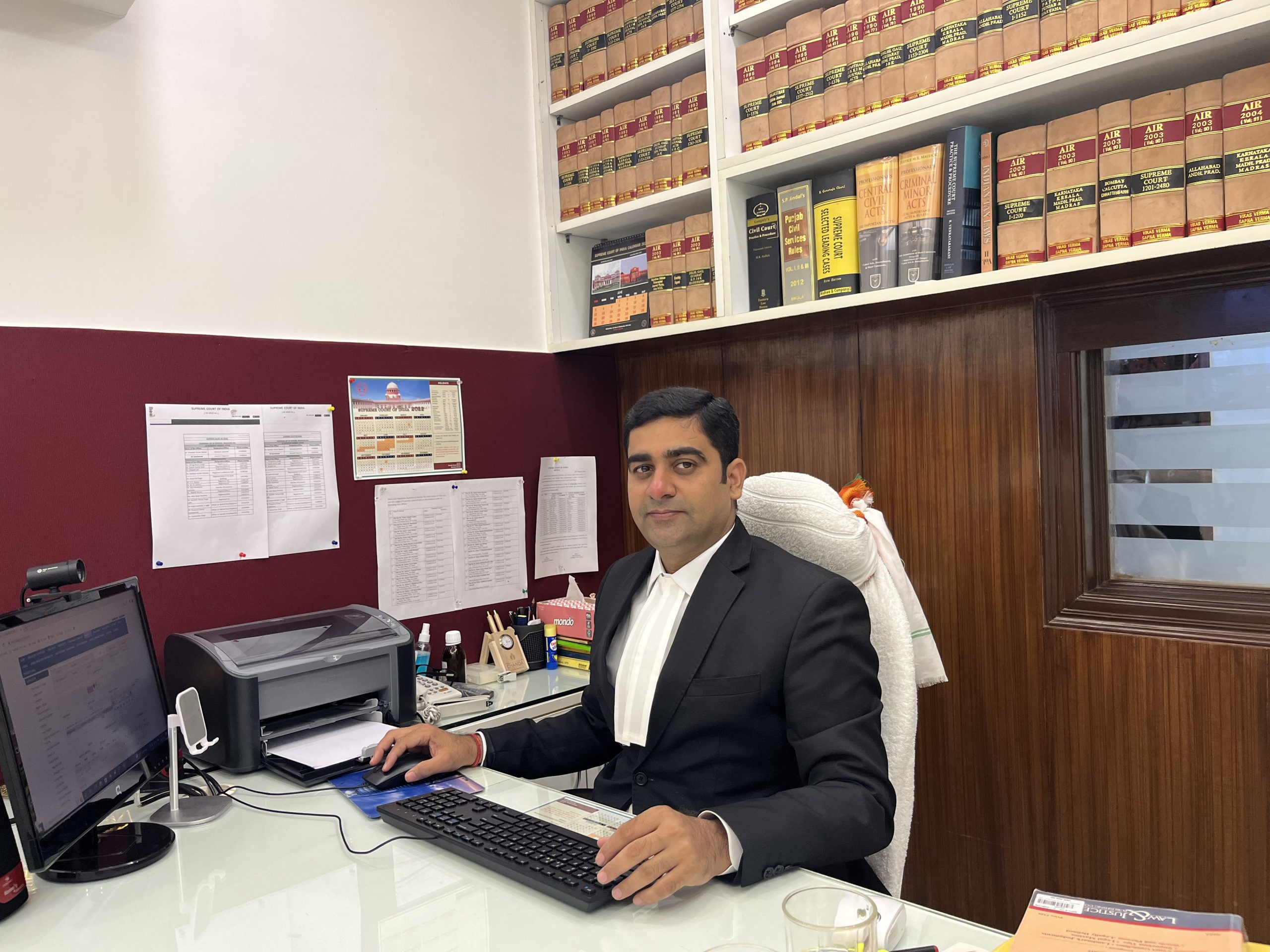
  • “Advocacy is a blend of dedication, strategy, and continuous learning, and I believe in mastering every facet of this noble profession.” – Vikas Verma, Advocate-on-Record at Supreme court of India & founder of KMS Law Firm

    “Advocacy is a blend of dedication, strategy, and continuous learning, and I believe in mastering every facet of this noble profession.” – Vikas Verma, Advocate-on-Record at Supreme court of India & founder of KMS Law Firm

    This interview has been published by Namrata Singh and The SuperLawyer Team

    What initially sparked your interest in pursuing a career in law, and could you share the motivation or experiences that led you to take the Advocate-on-Record (AOR) exam after already having an extensive 15-year career in the legal field?

    From the initial stage of my career, legal profession was passion for me, after passing my LLM, I was involved in Judiciary Coaching, then after that I was appointed as Assistant Advocate General by the Government of Haryana from 2011 to 2014, but I feel that Advocate-on-record is a prestigious position in the Supreme Court and has its own charm.

    Establishing and leading KMS Law Firm is a significant accomplishment. Could you share some insights into the challenges you faced during the initial stages of starting the firm and what motivated you to embark on this entrepreneurial journey in the field of law?

    At KMS Law Firm we have a research-oriented approach and highly experienced team which ensures a quality assistance with an assortment of legal business solutions, ranging from complex transactions. I started my journey with dedication & Hard work. 

    As the Co-Chairman of the All India Lawyers Forum, you likely engage with a diverse legal community. What initiatives or activities do you find most rewarding in fostering connections among the legal professionals across the country?

    As Co-Chairman of AILF, I have organised about 40 webinars during lockdown on different topics of law which were most significant for legal fraternity with sitting and former judges of the Hon’ble Supreme Court of India. I learnt a lot from the experiences from different speakers/guests who gave valuable insights on legal topics. 

    In your role as Emeritus Assistant Advocate General for the Government of Haryana, what are some of the legal and constitutional issues you advised on, and how did they contribute to the governance of the state?

    As the Assistant Advocate General of Government of Haryana, I was a younger officer of the court in the State of Haryana. I attended and presented before the constitutional court and divisional benches and dealt with different types of cases of Government during the tenure. I took an active part in proceedings of court in state matters.

    As the Managing Partner of KMS Law Firm, you’ve been involved in a diverse range of legal areas, from criminal law to constitutional Law. Can you share a case or experience that stands out to you, something that was particularly challenging or rewarding in your career?

    It was a great experience when I dealt with the most difficult cases of NDPS and argued before the Supreme Court and Justice Indira Banerjee gave good judgement on reducing the sentence and even waived off the fines also. 

    As a firm has a Research-Oriented Approach, could you elaborate on how this approach translates into delivery quality legal assistance to clients? How does the firm ensure its team stays well-informed and updated on legal developments?

    The firm boasts of a Highly Qualified Team to assist the clients with the legal and regulatory framework. The mindset of our team is a special mix of integrity, intelligence, energy, and strategy which is the backbone of our firm. It is this conspicuous character that makes our associates different from others. It is what enables us to be the best for our clients, – their guiding star, and their trusted legal advisor.

    In your extensive experience navigating litigations across various high-profile forums, including the Supreme Court of India and the High Courts, can you share a situation where the courtroom dynamics were particularly challenging, and how did you navigate through it to secure a positive outcome for your client?

    When I dealt with a civil case regarding a land dispute before the court of Hon’ble The Chief Justice of India and the court had made up its mind to deliver the verdict that the land could be divided amongst the parties to the suit. Even our case was on strong footing as the order of the lower court was in the favour of my client, but I tried to give my best before the court and the court finally passed an order in favour of my client.

    For law students aspiring to intern in the legal field, what suggestions would you give them to make the most out of their internship experiences? Additionally. Could you share insights into the types of internship your firm, KMS Law Firm, typically offers and skills you look for in potential interns?

    During the internship experiences, students should do research work and discuss the file, read the bare acts with interpretation and should attend court proceedings so as to know the practical nuances of law. Good communication and drafting skills is what we seek in our prospective interns.

    Balancing a career in law can be demanding. How do you unwind or pursue personal interests outside of your legal commitments? Any hobbies or activities that you particularly enjoy?

    Social Engineering is the best theory in the legal field. I am involved in yoga & Meditation which I enjoy after work. Generally, I like to visit new places for holiday breaks.

    Considering your extensive experience in the legal field and as a mentor to aspiring lawyers, what advice or suggestions would you offer to the coming generation of legal professionals? In your opinion, what can they do differently or better to thrive in the dynamic legal landscape and contribute meaningfully to the field?

    Seven lamps of advocacy are the most significant for every lawyer i.e., honesty, courage, wit, industry, eloquence, legal judgement and fellowship. One should always try to master these all. Also, with the advancement in technology in research work and filing it is necessary to be conversant with the developments in them and use them for one’s progress. Also reading judgment and discussing with seniors gives immense jurisprudential understanding of law. 

    Get in touch with Vikas Verma-

  • “While specialization is necessary, I strongly believe this approach is prejudicial to the interest of fresh graduates or ones with a couple of years of experience”- Anuj Bhandari, Advocate-on-Record, Supreme Court of India

    “While specialization is necessary, I strongly believe this approach is prejudicial to the interest of fresh graduates or ones with a couple of years of experience”- Anuj Bhandari, Advocate-on-Record, Supreme Court of India

    This Interview has been published by Pragya Chandni and The SuperLawyer Team

    Could you please share with our listeners how your journey in law began? What inspired you to pursue B.Sc. LL.B. (Corporate Law Hons.) from the National Law University, Jodhpur?

    It’s a fairly interesting story. To be true, being from a family of lawyers and judges, my father never wanted me to be a lawyer. For the final two years of my schooling I was preparing for engineering and did not even fill the forms for law entrance examinations. After clearing the entrance test for Engineering, while depositing the fee in an engineering college in Bangalore, I felt that I don’t want to be an Engineer and rather, want to become a lawyer. Hence, I requested my father to not deposit the fee and expressed my willingness to prepare for the law entrance examination. Being from Rajasthan, NLU Jodhpur was my first preference and luckily, I cleared the entrance next year. 

    Your experience spans both litigation and corporate law. What led you to choose a career path that includes extensive practice in the Supreme Court and various other courts and tribunals?

    After my graduation from NLUJ, I was fortunate to get placed with Amarchand Mangaldas, Mumbai. I was part of the Funds Team and was involved in structuring venture capital funds. One year in Amarchand gave me hands-on experience and confidence to take up corporate work which would benefit me later in my career. However, I couldn’t see myself doing only corporate work for the rest of my life and shifting to litigation was better sooner than later. I therefore shifted to Delhi and started with a litigation journey. 

    Beauty about having an independent practice is that one is not confined to a particular forum or field of law and can push boundaries. Delhi being hub of litigation work, there are ample of opportunities in various courts and tribunals. One has to rather restrict himself from taking up work in multiple forums. I try to confine myself to the Supreme Court, but work naturally spills over to the High Court and various Appellate Tribunals. 

    You’ve worked in diverse areas such as banking, arbitration, constitution, consumer, debt recovery, and more. Could you elaborate on how you found your niche within the legal profession and the areas that resonate with you the most?

    Trend lately has been on super specialization in law. The law firms have dedicated teams to handle one subject or even one area of the subject. This trend is seen more in Tier-1 and Tier 2 law firms.  While specialization is necessary, I strongly believe this approach is prejudicial to the interest of fresh graduates or ones with a couple of years of experience.  In my view, any young lawyer should not specialise at an early stage of his career, rather a lawyer should have an experience to deal with as many subjects, fields and branches of law as possible. It not only gives an overall better understanding of law but also gives the ability to apply principles, precedents, and concepts from one field to another. Interplay of various subjects of law is an important tool which needs to be understood and applied both in courts and while undertaking advisory work. 

    I encourage my juniors to take up matters across various forums and subjects and not confine themselves to any particular field. While allocating work as well, I  ensure that my team gets to work on different subjects. I believe it not only helps them to have confidence in undertaking new assignments but will also aid them later on in their career.

    From being an associate at Amarchand Mangaldas & Suresh A. Shroff & Co. to becoming a partner at Pricus Legal LLP, can you discuss the pivotal moments and experiences that shaped your career trajectory?

    Getting through Amarchand in college placement was one of the most memorable moments of my life. It was nothing short of a dream coming true, and of course it was financially highly rewarding. I was awed by the corporate culture, high profile clients and of course the stakes involved. However, having worked there for a year, I couldn’t find my calling in corporate work. As a result, I took the difficult decision of resigning from the firm and shifting to Delhi.

    I was fortunate to get a chance to work in the chamber of Mr Parag Tripathi, Senior Advocate, who was also Additional Solicitor General of India at the time. He is one of the finest orators and sharpest minds in the legal fraternity. I am proud to be part of his chamber and couldn’t have prayed for a better ‘Guru’. Working in his chamber gave me a chance of working on thousands of cases. Every day over 20 matters were listed which were split amongst 4–5 juniors. On an average each junior had to brief sir in 4 to 5 cases everyday. Every briefing used to be like a short moot court for us where we had to be ultra precise and to the point in our briefing yet making sure we don’t miss out anything relevant and at the same time answer a volley of questions. Doing this for nearly 4 years prepared us well for anything the future had to offer. 

    I took yet another difficult decision to leave the chambers of Mr. Parag Tripathi and started my practice in the later part of 2012. Subsequently,  I also cleared the Advocate-On-Record exam in 2015. 

    Having handled litigation both for individuals as well as companies, over the years, I started getting corporate advisory work as well. As we were getting corporate advisory and transactional work alongside litigation, we decided to formally incorporate Pricus Legal LLP to better manage and handle corporate work.

    Being from a litigation background, I find that the way a litigating lawyer perceives things even in any corporate transaction or documentation is very different from a corporate lawyer. Experience in litigation comes in handy to foresee possible disputes and loopholes. Therefore, as a matter of practice in our firm all corporate advisory/transaction has to go through the litigation team as well.

    As a registered Advocate-on-Record in the Supreme Court of India, you have been involved in several landmark judgments. Could you share one or two cases that you found particularly challenging or significant in your career?

    An interesting case which comes to mind is that of Bhagwan Singh v. Dilip Kumar where son of sitting MLA was involved in gang rape of a minor and was granted bail by the High Court on the ground that FIR was lodged nearly over a year after the incidence and there was no direct evidence to connect the accused with commission of alleged crime. I was representing the minor victim who approached the Supreme Court against grant of bail by the High Court. We were able to persuade Hon’ble Supreme Court to set aside the bail on the ground that High Court can’t look into the evidence at the stage of bail and should confine itself to criteria like seriousness of offence, statement of prosecutrix, likelihood of influencing the trial et cetera while deciding the bail. Judgement makes an interesting read.

    Another decision which I recollect is that of Ravi Khandelwal versus Taluka Store in which we challenged an order passed by the Larger Bench of the High Court in a reference involving question of interpreting Section 14(3) of Rajasthan Rent Control Act which provided a protection to the tenant against any suit for eviction for the first five years of tenancy. The Supreme Court overturned the conclusion of Larger Bench of High Court holding that even if a suit is filed within five years of commencement of tenancy, but during the pendency of suit five years lapse, the defect in the suit stands cured and the protection granted is achieved. However, what was more interesting was that the Hon’ble Supreme Court directed eviction of premises directly even when the appeal of the tenant was pending before the Single Judge of the High Court. Direction of eviction directly by the Supreme Court even while appeal on merits was pending before the High Court to my mind is unprecedented.

    You’ve been a panel lawyer for various esteemed organizations. How did these associations come about, and how does being a panel lawyer for such entities impact your legal practice?

    Getting any panel is fairly difficult, particularly in initial years of practice. Working in the office of ASG, all of us were empanelled with the Union of India which opened the doors for panels of other PSUs. One panel thereafter led to another over the years. Even though these panels are not usually financially very rewarding, they give an opportunity to appear and argue before the court and provide a constant source of work. In initial stages when individual clients are scarce, panel work comes in handy and ensures regular appearances before the court. 

    With your extensive experience in various legal domains, including banking, insurance, constitutional law, and more, how do you balance staying versatile with the need for deep specialization?

    There is a saying that clients choose lawyers specialization. As I mentioned earlier, I strongly believe that lawyers, particularly in litigation, should not get specialised early in their career. It is only after a few decades of practice and incidentally handling a particular kind of cases more than others, that lawyers would get specialised on their own in a particular field. Personally, I would any day choose to do a variety and different kind of work every day rather than get super specialised in any particular field. One of the reasons why I shifted from corporate to litigation was to do a variety of work, but I think that’s a very personal choice.

    Lastly, considering your journey and achievements, what advice would you like to give to fresh law graduates who are about to embark on their legal careers? What are the key lessons you’ve learned that you would like to share with them?

    I would strongly advise young lawyers to explore different fields of law for the first few years of their career before choosing and settling into one which matches their aptitude and liking. Fresh graduates should not be reluctant to change their field, particularly in the first few years of their career and do something which they can call their calling. As one progresses into his career it becomes exponentially difficult to venture into these experiments.

    I also highly recommend that every fresh graduate should start his career with litigation and rough it out in courts at least for sometime. It is only then one understands actual application of law and gives a perspective completely different from mere theoretical understanding. Even if eventually, they decide to move into a corporate setup, the experience in litigation will give them immense confidence. Getting into a super specialized team right out of college is not something I would recommend. Legal Profession is not a 5 year long but a 50 years long career and the initial few years should be an investment on oneself.

    Get in touch with Anuj Bhandari-

  • “Every client, every cross examination, every meeting, every briefing in itself presents a new experience and contributes to one’s growth”- Priyanka Sethia, Founder of the Chambers of Priyanka Sethia

    “Every client, every cross examination, every meeting, every briefing in itself presents a new experience and contributes to one’s growth”- Priyanka Sethia, Founder of the Chambers of Priyanka Sethia

    This Interview has been published by Pragya Chandni and The SuperLawyer Team

    Ma’am, can you please provide a brief introduction about yourself and your journey into the field of law?

    Hi. I am Priyanka Sethia and I have been practicing at various Courts and Tribunals across India, as an advocate for over 10 years. 

    I graduated in the field of law in 2013 and got an LL.M. in Corporate and Financial laws in 2021, while being in the profession and gained further certifications as opportunities presented themself.

    I am a certified negotiator accredited by London School of Economics & Political Sciences [2022] and a certified POSH (Diversity & Inclusion) Trainer [2023].

    I started my own law chamber – Chambers of Priyanka Sethia, in 2021 and we take up civil and commercial matters for various individual and corporate clients as well as deal in corporate practice.

    With over 10 years of experience, you have established yourself as a prominent figure in the legal fraternity. What inspired you to pursue a career in law and eventually become an advocate?

    I have shared this before, but this story never gets old for me. So, my career in law wasn’t really a given from the very beginning and I am a first generation lawyer. My roots find themselves etched in a very traditional business family. It so happened that one day, I was late to school by a few minutes and the Head of Department, Accounts who was in charge of the School Assembly that day, asked me to go back home as I was late!

    It was however only my first late show and I was aware of the finely printed school rules and regulations, set out in our Daily Academic Planner that permitted a student three late shows before being sent back for the day. With great respect, I politely took out the Academic Planner from my bag, opened the rules section and read it out to the said school teacher which stated that I had to be given three opportunities/warnings, before I could be sent back home for being late. I certainly could attend school that day but only saw disdain in that teacher’s eyes for me, on all days thereafter. Thankfully it was my last year in school and I then realized the power of Laws and Rules framed thereunder and the joy of knowing and abiding by it and of course realized my interest in reading the fine print.

    Decision to pursue law came organically to me but the decision to choose between Litigation vs Corporate Law never comes easy for anybody. While the heart wants to be in the courts and explore the passion of arguing vociferously for the clients and their cause, the mind seeks to showcase the drafting skills. So now, my Chamber is trying to strengthen both its litigation team and its corporate practice team, by continuously levelling up with diverse certifications, hiring new talent and continuous practice. At the moment, I head both the verticals and with a recent certification in POSH (Diversity & Inclusion) Training, I hope to offer various training to Corporates, in this arena.

    You founded the Chambers of Priyanka Sethia in 2021. Could you share the motivations behind starting your own law chambers and the vision you have for it?

    I have worked with some of the most incredible seniors in Profession who have mentored me throughout and continue to handhold me through difficult situations. After assisting them for about 8 years, I realized that I was ready to explore legal practice from my own perspective. 

    And so, post the Covid scenario, with experience that I had gathered from my seniors and mentors, and a postgraduate degree in my choice of practice area, I delved into independent practice and started Chambers of Priyanka Sethia in November, 2021.

    My vision for the chamber is to render exceptional legal services to our clients while being on an upward trend in the number of fresher hirings. I take pride in the fact that I welcome freshers with 0-6m experience and it’s lovely to draw inspiration from their passion and exuberance. On the work front, the chamber is striving to strengthen both its Litigation Practice and Corporate Practice. 

    You are a certified negotiator accredited by the London School of Economics & Political Sciences. How has this certification influenced your approach to negotiations, and what role does negotiation play in your legal practice?

    While engaging in Corporate Practice, often we find ourselves negotiating terms of the contract on behalf of our clients. Many-a-times, the other party is situated outside India and has a completely different approach towards the drafts/agreements compared to the Indian scenario. Being sensitive to their background, ethos, laws and culture is the key. My certification in negotiations has helped me in bridging that gap and comes in handy especially while dealing with International Corporates and has added an edge in fostering new relationships, executing contracts, and arriving at settlements. 

    Your experience covers a wide range of legal areas, including corporate practice, commercial litigation, alternative dispute resolution, and more. Can you highlight some key experiences that have significantly contributed to your growth as an advocate?

    Every case is a new learning. One cannot limit their learnings to the law. I strongly believe every person we meet is a new experience, we become wiser with each interaction. Every client, every cross examination, every meeting, every briefing in itself presents a new experience and contributes to one’s growth.

    Your expertise extends to regulatory compliance and privacy laws. How do you approach these complex areas, and what challenges do you typically encounter in ensuring compliance for your clients?

    To cite one instance, often we find that the law enforcement agencies are not well trained to understand and implement the law at the grassroot level. Recently, while dealing in a legal metrology matter, we observed that the department officer had no exposure to a couple of years old amendment in the law and required sensitization. Routinely issuing notices just to meet targets is a norm and needs to change. 

    You champion the cause of women emancipation. How do you integrate this advocacy into your legal practice, and what initiatives have you undertaken to contribute to diversity and inclusion in the legal profession?

    I believe having freshers on board or having non NLU advocates in the team is the biggest inclusion point in our profession. I am open to having good talent on board without any preconceived notions or unconscious biases.

    Besides, I take up matrimonial matters for marginalized women pro bono and ensure that they are taken to a logical conclusion.

    Considering your successful journey in law, what advice would you give to fresh graduates aspiring to pursue a career in law and make a mark in the legal profession?

    Success is a subjective term. On the work front, my request to fresh graduates aspiring to pursue a career in law is to be consistent. Do not give up without giving it a fair shot and some time.  Also, there is a great demand for lawyers with expertise in niche areas. One could also choose their practice area earlier on in their career and proceed further in that direction. 

    And, Pursue a hobby alongside the profession. This helps in keeping sane as well as sticking through. 

    Get in touch with Priyanka Sethia-

  • “Travelling to various Courts per-se add a great value, however, arguing a matter before another Court apart from your regular Court adds more experience and sharpens the argumentative skills”- Devmani Basal, Associate Partner at SNG Partners

    “Travelling to various Courts per-se add a great value, however, arguing a matter before another Court apart from your regular Court adds more experience and sharpens the argumentative skills”- Devmani Basal, Associate Partner at SNG Partners

    This Interview has been published by Pragya Chandni and The SuperLawyer Team

    Sir, could you please share the story of how you initially decided to pursue a career in law? Were there specific experiences or influences that led you to choose this path? 

    First of all, I am a second generation lawyer. I was motivated to pursue law from the beginning as Law is a noble profession and contributes a lot to society. Since my childhood, I have seen my Father’s contribution towards society as his core practice area was Criminal Law. However, during my college days, I was much inclined to pursue my career in the stock market being financially connected which goes to my core passion. Simultaneously, I was pursuing Law and finally, I decided to shift myself to Law especially in Commercial matters, which is a mixed bag of finance and commerce. I, then, shifted to Delhi.

    With almost 12 years of experience across litigation, commercial arbitration, and consumer and company litigation, what motivated you to specialize in these specific areas within the legal field? 

    I am passionate to read and learn more and more deep into financial activities related to business and commerce. This interest connects me with the litigation and enlightens me to understand the problem of a businessman in a much better way, which ultimately led to making a business decision. Law can be practiced by anyone but having basic knowledge over the general subject of the case either commercial, arbitration or consumer or company makes things easier to resolve the query in an effective way. Like an Advocate having understanding of stock market would be able to pursue a case related to stock market than a novice. Since I have interest in reading these topics, I was more inclined to specialise in the above specific areas in the legal field, so that I can deliver better than ordinary. 

    Your career includes appearances before various High Courts, the Supreme Court of India, and various tribunals. Can you highlight a particularly challenging case you’ve worked on and discuss the strategies you employed to navigate through it successfully? 

    It was in Sep’ 2014, when I caught up in a matter before Hon’ble Supreme Court. I briefed a Senior Advocate, however, he was stuck in a traffic jam and could not make it on time. I was called upon by the Bench to argue. With hesitation, I began and strenuously argued the matter. When I finished my arguments, my Senior reached the Court. However, by that time, the Hon’ble Court reserved the matter for order. The judgement was delivered in the month of March’ 2015 and finally, we succeeded. This case taught me to always be ready with the brief irrespective of engaging a Senior Advocate. I have fearlessly appeared before almost 11 High Courts of the country and numerous District Courts and Tribunals across the country and independently argue the matters. This rich experience and exposure are completely devoted to my Senior Colleague Mr. Ajay Abhay Monga Advocate, who always reposed faith on my skills and offered opportunity as and when it appeared.  

    Given your expertise in Consumer Laws, Commercial Law, and other areas, how do you stay abreast of the ever-evolving legal landscape, especially with regards to amendments and changes in laws and regulations? 

    In the current scenario, especially the deep presence of online updates and platforms, it becomes easy to keep updated. However, specific laws get evolved as and when I work upon a case file. I must state that sitting in Court, in idle time, is indeed a good way of learning and keeping updated, apart from learning argumentative skills and to have a broad idea about the temperament of a Judge.

    You’ve been associated with significant reported judgments, such as Millennium Wires vs. The State Trading Corporation of India. Can you share the role you played in these cases and the impact they had on your legal career? 

    As explained to you above, the case you highlighted was a game changer for me as it was an opportunity to independently argue a case before the Hon’ble Supreme Court in addition to the fact that many stakes were involved. I was quite nervous in the beginning, however, after the hearing concluded, I felt immensely satisfied with my performance and it boosted my confidence to argue a case before any Court. I was involved in the above case since it was before the Hon’ble High Court of Delhi, therefore, I had good command over the facts and coupled with the fact that I briefed the Senior Advocate for hearing, so I was quite prepared with the case. The preparation, briefing and discussion with Senior and deep involvement in the case since inception, in fact, gave power and confidence to present the case independently.

    Having worked on matters related to FEMA, PMLA, and other financial regulations, how do you approach advising senior management on the legal implications of business decisions, particularly in the context of financial laws? 

    Advising on the legal implications of financial laws certainly depends upon the kind of business my client is involved in coupled with their requirements. Those days are gone by, where businesses can flourish without legal support. Presently, the laws are quite stringent, which require legal advice at every stage of business decisions. Therefore, after understanding the business model and the requirements of a particular trade, I would advise my Client in making its business decisions in line with the financial laws.

    From being an Associate to now being an Associate Partner at SNG & Partners, can you discuss the key milestones and challenges you faced in your career progression? 

    I belong to Gwalior, Madhya Pradesh and shifted myself to Delhi in Sep’ 2011 to pursue my career in law. Since, I was not much active during my college days, therefore, I was completely raw, when in fact, I entered the profession. I initially practiced with some Advocate for a period of 4 months and thereafter, I began my career with SNG & Partners in March’ 2012. Our Managing Partner, Mr. Sanjay Gupta is a kind-hearted and a great mentor, who always encourages the juniors. In the beginning, rushing from one Court to another gave me an exposure to a variety of laws. I was working under Mr. Ajay Abhay Monga, Senior Partner, who gave me ample opportunities to argue the matter independently. Later on, he handed over the outstation cases portfolio to me, which added more exposure in my experience. Travelling to various Courts is per-se add a great value, however, arguing a matter before another Court, apart from your regular Court, adds more experience and sharpens the argumentative skills. Travelling to different Courts gives independence as well as enhances decision making without the support of your colleagues. It also helps you to understand the local practices of various Courts. I must add that there are no free lunches anywhere and the same goes with different Courts in different states. You will face challenges like language barriers as all the Courts in this country are not following English as their base language but these exposures not only add experience but also shape an Advocate to argue a matter in challenging circumstances as well. My journey with SNG is full of challenges in each case, however these challenges make an Advocate. I am always thankful to my Seniors for always appreciating my work and finding me suitable for new challenges. A special regard to Mr. Monga, who has been a great mentor for me and guided me in my hard times and always motivated me.

    As someone with a rich and varied legal career, what advice would you give to fresh law graduates who are just entering the legal profession? What key lessons have you learned along the way that you would like to share with them? 

    A law graduate must understand that law is a learning process, which would never end. Therefore, reading and understanding the law and its implications are essential. Like practice makes a man perfect, similarly, the more you read, the more you gain. Law graduates, during the initial days, must visit Court everyday and observe the Advocates arguing their cases and the kind of questions raised by the Benches. This will make them understand how the case is presented. You can make notes and read the file thoroughly, however, there are certain spontaneous questions, which would arise and those questions can be answered, only with your general acumen. A law graduate must not refrain from reading the topics, which are not necessary for the kind of legal practice he/she is involved in. He/She must understand that presenting a case before the Court is an art crafted by an Advocate. Thus, every advocate has a different way of presenting the case. Thus, the argumentative skills can only be learnt, when you hear and listen in a Courtroom. I wish All the Best to all the Law graduates.  

    Get in touch with Devmani Bansal-

  • “I feel each role contributes to your overall growth and helps in your evolution, if performed with full dedication”- Anjali Jain, Partner & Head – Insolvency & Restructuring Practice at Areness

    “I feel each role contributes to your overall growth and helps in your evolution, if performed with full dedication”- Anjali Jain, Partner & Head – Insolvency & Restructuring Practice at Areness

    This Interview has been published by Pragya Chandni and The SuperLawyer Team

    Can you please share the journey of how you ended up specializing in Insolvency and Restructuring practice, considering your educational background in Constitutional and Criminal Law?

    I always had a keen interest in Business, Economics, Finance and Commerce. I started my education with a B.Com (H) from Lady Shriram College, Delhi University and followed it up with LLB from Delhi University itself. While I had delved into Constitutional and Criminal Law for my Masters, my interest continued towards how law affects the economics of businesses and country as a whole, my post-graduation further strengthened my research and interpretation skills. The Insolvency Law in India has taken a rebirth in the year 2016 and post completion of my Masters, the newly enacted Insolvency & Bankruptcy Code, 2016 proved just to be the perfect practice area for me. IBC is one of its kind laws in India, more of a revolution. As I had already groomed myself on how to focus on a specific domain of law, specialising in Insolvency was only a path to be chosen. What really intrigued me about the Code, was how the law was laid from scratch with no baggage or burden of its previous laws and limited subject jurisprudence as well, I had the freedom to explore the various facets of law in light of statutory interpretation, legislative intent and judicial outlook. Also, lastly, I feel that building a practice in such a new law with hardly any precedents, skills developed in my Masters in Law from NLU – Delhi did help a lot. 

    What would you say has been the most challenging case you’ve encountered, and how did you navigate through it?

    Perhaps, every case brings with its own challenges, expectations, anticipations, and anxiety. To be honest, I am not a litigation practitioner, however, as a subject matter expert, we do participate in devising legal strategies. Sometimes the matters are at a very nascent stage where we get ample time for a 360-degree evaluation and then there are those cases where you have to prepare your front-facing team members for split second decisions. Each case brings with it its own experiences and learnings. If you have to ask me the most challenging case, mentioning one would be too unjust for the others, for reasons unknown to me so far, we are more often than not engaged in very typical particular matters only!

    As a member of INSOL International, you’ve been part of various national and international forums. Could you tell us about a specific instance where you felt your participation made a significant impact or contribution to the discussions on Insolvency, Banking, and Corporate Affairs?

    I have been very privileged to have been a part of discussions on law. What started as a resource person for law colleges, went onto being called for forums of policy discussions. Initially, it was more of an academic role with me professing how IBC works to law students. I also am actively involved as an industry resource for the Graduate Insolvency Programme at the Indian Institute of Corporate Affairs. Some time back, I was invited by State Bank of India as a part of a training session of its Law Officers on IBC and its inter-relations with the Banking sector. In one of my most memorable discussions, a global conference held on Insolvency in December 2020 where I discussed the future of IBC, especially in the post CoVid era. Lately, I have been involved in policy discussions at ASSOCHAM.

    Your professional journey involves managing a team, devising legal strategies, and handling financial planning. How do you balance the legal and managerial aspects of your role, and what advice do you have for aspiring legal professionals aiming to take on leadership positions?

    When you transition from a technical or a professional role to a management role, there is a high probability of dilution of your technical skills. For me, it came as a matter of no choice to be honest to you. If I look back, I feel it was also my interest which motivated me to assume responsibilities of Management. As I mentioned earlier, I am really passionate about the Insolvency Law and the Management responsibilities are an additional charge for me. Luckily, I am able to devote time on Practice as well besides the Management, I feel it helps me in my continuous growth and evolution. What has helped me throughout has been a very supportive team. I have also learnt a lot from attending short term Management courses as well as reading Management books. 

    My advice for aspiring legal professionals is to actively participate in various functions at their organisations such as client interviews, research, events, team management, etc. A sense of belonging towards your organisation, zeal to constantly learn and grow, participation in team meetings, events, etc., the leadership journey requires perseverance and persistence and there are countless minor unnoticeable steps which you have to climb to reach that leadership level. But not to miss out, invariable, leadership is a crown of thorns.

    Given your involvement in numerous workshops for legal officials of PSBs, including SBI, what key insights or lessons have you gained from these sessions that you think are crucial for professionals in the field of Insolvency and Banking?

    What I feel today’s times call for super-specialisation in any domain. In our interactions with officials of PSBs, what I have felt is lacking is perhaps being too overburdened with Managerial roles that professionals with such roles fall short of time for upscaling themselves on the subject. A law such as Insolvency is a very fast paced one. Not just the process, but the judicial pronouncements, policies, regulations and rules are almost updated every few days. I feel adequate time has to be devoted by every professional towards keeping himself/ herself updated on the latest developments of law.  

    You’ve been recognized as a Rising Star in 2021 by Legal Era. What do you believe are the key attributes that contributed to this recognition, and how do you continue to stay at the forefront of your field?

    I am not sure I can ever have an answer for that. I believe in simply delivering my responsibilities towards the best of my abilities regularly. However, if I have to answer that, I can only repeat that I push to keep myself updated on the law and the industry. What may have also worked for me is a complete client – centric approach which helps me start with the end in mind when I am assigned with any case, opinion or draft by our clients.

    In addition to your legal practice, you’ve authored several publications and columns. How do you manage to balance your role as a practicing advocate with your commitments as a columnist and resource person for various platforms?

    Balance is my life’s driving motto. I feel each role contributes to your overall growth and helps in your evolution, if performed with full dedication. I will give you an example here. For me, every column and publication gives me an opportunity to read in-depth on a particular proposition which I may not have in our daily professional commercially driven responsibilities. Likewise, every event where I participate as a speaker or a Resource Person, I read through comprehensively to ensure consistency and correctness. In a lot of our research reports, I get an opportunity to gain knowledge from a vantage point. So, you can say, every event, every publication or column also betters me and assists me in delivering my responsibilities as a practising advocate better. Also, it keeps the monotony at bay!!!!

    As someone who has been actively involved in legal education, what advice would you give to fresh law graduates entering the field today, particularly those interested in Insolvency and Restructuring?

    Though I feel it is still early days for me in this profession, still if I have to advise, I will only recommend law graduates to read a lot. As they say, there is no shortcut to success, likewise as much I promote advancement in technology and its use in the field of law as well, however, for a professional, responsibility is magnanimous. In the legal profession, we use our knowledge and skills for our clients at times, as officers of courts at others and for the public as a whole as well. Every judgment I have read through as a whole has helped me learn a lot more than giving me a solution for the matter at hand. Barring those who perhaps prepare for judiciary services, I find few actually even going through the entire statutes. Blogs and tools like ChatGPT can offer quick solutions when there is dearth of time, however, in early years, I would just advise young law graduates to read as much as they can. Lastly, I would say that in the initial years of your career, try to gain as much knowledge as possible and try to strengthen an overall understanding of how law works and over the years, choose a specific domain of law and build expertise in it.

    Get in touch with Anjali Jain-

  • “Law graduates should recognize that what they learn in law school is not enough for legal practice”- Anjan Neupane, Partner at Neupane Law Associates

    “Law graduates should recognize that what they learn in law school is not enough for legal practice”- Anjan Neupane, Partner at Neupane Law Associates

    This Interview has been published by Pragya Chandni and The SuperLawyer Team

    Sir, could you please share your journey of becoming a legal practitioner, from your education at the University of Aberdeen to your current position as a partner at Neupane Law Associates?

    Like every other lawyer, my journey of becoming a legal practitioner began during my law school. The most helpful experience I had was volunteering as an advisor at the Citizens Advice Scotland. We advised mostly low-income clientele legal matters relating to debt, bankruptcy, consumer, landlord, family problems, etc. Clients in difficult situations needed quick and effective legal help. There I learnt you had to focus on reaching an effective solution for the clients quickly. This learning has stayed with me until now. 

    At law school, my interest was in commercial law and I enjoyed my elective courses in corporate finance law, corporate insolvency law, and tax law very much.

    After graduating, I worked for around 2 years with a renowned senior advocate with extensive tax and commercial practice in Kathmandu. There I gained first-hand experience of Nepali contract, tax, and company laws. I also gained exposure to construction law and arbitration matters.

    There were not many lawyers with good international exposure and English language skills in Nepal at the time. Commercial law practice was very small and focused mostly on compliance. Nepal was also recovering from a decade long insurgency and foreign investors were slowly returning back. Due to the market scenario at the time, I started getting contract drafting and foreign investment related matters through my personal contacts and references from other lawyers. Thereafter, I started with my current firm Neupane Law Associates serving my own clients. Currently, we are established as a go-to law firm for corporate and commercial matters in Nepal. Our firm’s practice is ranked Band-1 by Chambers and Tier-1 by Legal 500 in Nepal for a number of years now. 

    As a leading legal practitioner in Nepal, specializing in corporate, finance, cross-border transactions, and dispute resolution, could you highlight a particularly challenging case or project you’ve worked on recently and share the key strategies you employed?

    Nepal is a challenging jurisdiction to work in due to vaguely drafted laws and bureaucratic unpredictability. Our approach is to strictly follow the law, while not being afraid to create new market practices. A rewarding experience for me early on in my career was to advise a consortium of foreign and local lenders as local counsel in the first international project finance transaction in over 20 years for Lower Solu Hydropower Project. Bridging the gap between best international practices and Nepali law was challenging. It created a market precedent that set a practice in other similar transactions. Another highlight of my career has been working as a tax and corporate law expert appointed by the Government of Nepal in the ICSID arbitration filed by Axiata. It was the largest legal dispute in Nepal’s history. It was also a learning experience to see leading international lawyers in action. 

    Our team has been working in various shareholder and construction disputes currently. They are naturally challenging and complex. In my view, a good lawyer should have the ability to simplify even the most complex issues. Being solution oriented and getting in-depth into the facts of the case are key strategies we employ.

    Your expertise spans a wide range of areas such as arbitration, litigation, banking, finance, and M&A. How do you stay updated on the evolving legal landscape in Nepal, especially considering the complexities of cross-border transactions?

    Being a transaction and disputes lawyer at the same time is very challenging from a time and knowledge management practice. However, I have found that these practice areas complement each other. I have found that the knowledge and experience gained in transactions can be used during litigation and vice versa. Being a small jurisdiction, many aspects of Nepalese commercial law jurisprudence are still unsettled. Therefore, taking inspiration from what is happening in other jurisdictions is important. Reading good international books and participating in international conferences and seminars has been very helpful in staying updated. 

    Given your involvement in advising world-renowned companies, including Texmaco, IFC, and Alibaba Group, can you share any unique challenges you’ve encountered while facilitating cross-border transactions between Indian companies and Nepal?

    The challenge in Nepal is vaguely drafted laws, unpredictability of government agencies, and lack of established market practice for new and complex transactions. Oftentimes the Nepalese counterparts are also not assisted by an experienced commercial lawyer. Some international clients do not engage a Nepali lawyer at an early stage of the transactions but only do so later. When the client has not taken advice at an early stage, the transaction structure may have to be changed at the documentation stage which becomes a problem and causes delay. Enforceability of Indian seated arbitral awards in Nepal and vice versa has also come up recently as a new challenge due to a recent Supreme Court ruling in the Sangi Brothers case.

    You’ve been recognized for your excellent knowledge of Nepali commercial and contractual law. How do you balance staying rooted in local legal nuances while also navigating the complexities of international law, especially in the context of your cross-border transactions?

    As a lawyer advising in international matters, I find that you are required to have a good command in both Nepali law and law practices internationally. In-depth recognition of the similarities and differences in the laws of Nepal and of other jurisdictions is key to our legal practice. Like I mentioned earlier, I read good international books and exchange views with lawyers in other jurisdictions to balance these aspects. 

    Your recent work includes advising on equity investments in hydropower projects and various financings. What trends do you observe in the current landscape of foreign investments in Nepal, particularly in the energy sector?

    Equity investments and financings in the hydropower sector for foreign clients have recently been challenging as Nepal has not signed power purchase agreements in US dollars and there is a lot of uncertainty about how to hedge currency risk. The Government of Nepal has come up with various hedging guidelines and regulations, however, foreign investors are yet to be convinced. Also, getting a bankable risk allocation in power purchase agreements and concession agreements has been difficult. Nevertheless, the governments of Nepal and India have entered into an agreement for Nepal to export 10,000 MWs of power to India over the next 10 years. This will open the door for Indian sponsors to sell power from Nepal to India and obtain financing from Indian banks.

    Could you shed light on your role in defending lawsuits filed against Nissan Motors by distributors? How do you approach representing clients in the automotive sector, and what unique legal challenges arise in such cases?

    We have been recently involved in a couple of cases of similar nature involving Nissan Motors, Royal Enfield, Preet Tractors and others. In my view, the key to avoiding disputes or having an upper hand when there is one is to have a well drafted distribution agreement and fully complying with the contract provisions and laws during termination. Nepalese courts can grant stay orders if contract terms are ambiguous and if the termination can be seen as unlawful due to non-compliance with contract provisions. This can be very risky and is best avoided. 

    Lastly, what advice would you give to law graduates aspiring to make a mark in corporate law, especially those interested in practicing in Nepal or dealing with cross-border transactions?

    Law graduates should recognize that what they learn in law school is not enough for legal practice. They should extensively read judicial precedents in the practice areas of their interest and international books to stay updated. They should also recognize that the law in theory and the law applied in practice might differ. They should become more commercially aware and solution oriented.

    Get in touch with Anjan Neupane-

  • “The IBC is a significant reform and its successful implementation can bring resolution to the stress situation in the country’s financial system”- Puneet Yadav, Founding Partner- Samaya Law Chambers

    “The IBC is a significant reform and its successful implementation can bring resolution to the stress situation in the country’s financial system”- Puneet Yadav, Founding Partner- Samaya Law Chambers

    This Interview has been published by Pragya Chandni and The SuperLawyer Team

    Could you share a bit about your journey into law and how you decided to pursue it as a career, especially with your educational background at National Law Institute University and Symbiosis Law School?

    My father played a significant role in guiding me to pursue law considering my personality. Then, I was always keen to pursue law since my school days and at that time law was not sought for profession as it is now. We did not have CLAT in the year 2003 and had to fill up individual forms for each college. I was fortunate enough to get through B.A.LL. B course in Symbiosis Law School, Pune. I was inclined for post graduate education and thereafter, I appeared for CLAT LLM and I got through National Law Institute University, Bhopal. It’s a wonderful experience to independently live in a hostel which makes you a confident individual to deal with every situation in your life without the support of family. I not only got to polish my legal and individual skills at the law schools but also got to make great friends during both the courses who are budding colleagues and make the legal practice feel like home.  

    You’ve had a diverse experience, from working in top legal firms to founding your own practice at Samaya Law. What inspired you to take the entrepreneurial route, and how has this journey been for you?

    I am thankful to all the law firms, their partners, and senior advocates who I worked with through my journey. I got immense experience and guidance from them which helped me build my independent practice. Since beginning, I always wanted to have my independent practice as it gives a sense of accomplishment to me, however, working in a firm setup can be equally beneficial considering the fact that the initial few years of independent practice take a toll on you mentally and financially. I was lucky enough to have my own set of clients who trusted in me and helped keep afloat in initial years of practice which is significant to keep you going. The journey of independent practice is full of peaks and valleys as its both demanding and rewarding profession. You have a thrill of victory which is unmatched and gives you a sense of pride and satisfaction and doing public interest litigation can give added satisfaction by making a difference in the lives of people. The downfall being the stress and expectation not only towards yourself but also to Clients and Judges. However, this profession can teach you resilience, perseverance and the importance of hard work which makes you a valuable legal professional.

    Your practice involves appearing before various courts and tribunals, including the and the National Company Law Tribunal and Supreme Court of India. Could you highlight a memorable or challenging case you’ve handled and the key takeaways from that experience?

    After my stint with law firms, I started my independent practice and after a few years started our law firm Samaya Law along with my partner Sourabh Gupta, Advocate and we  completed 10 years in June, 2023. We appear before all courts, tribunal across India. However, being based in Delhi gives an opportunity to physically appear before the Hon’ble Supreme Court and Appellate Tribunals. Although, now the Supreme Court also works on Hybrid mode which helps all the counsels across India to get remote access to appear and argue their cases. We recently argued a case under the maternity benefit act wherein the Petitioner was being denied maternity benefit as her contract with the government body had come to an end. In a landmark judgment, a three Judge bench of the Supreme Court in Dr. Kavita Yadav v The Secretary, Ministry of Health and Family Welfare Department & Others (17 August 2023) held that if a woman has worked in an establishment for 80 days, she would be eligible for full maternity benefits, even if such benefits exceed the term of contract. We also made a significant petition for post-graduate doctors during the COVID-19 period when they were being sent across states for their practical examination as per National Medical Commission and Diplomate of National Board guidelines. The Supreme Court intervened and directed the NMC and NBE to conduct examinations within the state so that the post graduate doctors do not have to cross state as per directives of the government of India. This brought relief to more than 1 lakhs doctors who were appearing for the examination. Each forum has its own way of working, before the Supreme Court you only get 2-3 minutes to explain your brief at the admission hearing so you need to prepare your list of dates and synopsis thoroughly and be precise with your arguments on factual and legal aspects to catch the eye of the  Judge.

    With a significant focus on drafting and vetting petitions across different legal domains, could you share some insights into your approach to crafting effective legal documents and the importance of precision in this aspect of your work?

    My advice would be to keep your focus on the facts of the case because facts forming part of the pleadings can never change and highlighting relevant facts of the case can bring life into a dead brief. It is crucial to draft pleadings that are short, persuasive, point blank and not overstated. It’s best to work on all kinds of pleadings before the trial court and High Court in the initial years of your practice which can be beneficial when you handle matters before the Appellate Courts and Supreme Court. Most part of building up a case happens at the trial court and if the pleadings are not drafted, covering the facts accurately can bring significant damage to the case as it becomes difficult to introduce new facts or legal grounds in support of the brief at appellate stage of the proceedings. The pleadings should ensure that all the relevant facts are covered on the issues to be framed and lead evidence on the said issues to support your case. In a case done by us the Hon’ble Delhi High Court in a suit (CS(OS) No.553 /2016 order dated 21.05.2019) dealing with recovery of possession of an immovable property and a counterclaim for recovery of over Rs. 5 crore had due to lacuna in the drafting and not claiming the relief for recovery of possession made an observation “This is a classic textbook case of, how not to draft a plaint, which should be taught in law colleges and to young lawyers so that such bloopers in drafting of pleadings, damaging to one’s own client, are avoided.”. The pleadings have to be factually fortified and legally formulated to bring forth your best case. 

    Having engaged in extensive research across civil, criminal, and commercial laws, could you discuss a specific area of law that you find particularly intriguing or challenging, and why?

    The latest insolvency and bankruptcy code, 2016 has brought a fresh dimension to the insolvency law including bringing new questions of law which need to be answered both by the Lawyers and Judges. The fact that the code has been modified five times in the last five years including several judgments which have been passed by the Hon’ble Supreme Court itself shows the way it is evolving and which makes it challenging. The IBC is a significant reform and its successful implementation can bring resolution to the stress situation in the country’s financial system. We constantly support the Insolvency Resolution Professionals and companies on advising them on the intricacies of the Code and its implementation. 

    Your involvement in arbitration, both domestic and international, is notable. Can you share a bit about your experiences with arbitration cases and any unique challenges or differences you’ve encountered in handling international arbitrations?

    With the introduction of Arbitration and Conciliation Amendment Act, 2015 the arbitration proceedings must be completed within a time bound manner and which has brought drastic improvement in the overall process of arbitration. The constant queries of the clients as to the time limit within which dispute would be resolved has been answered by way of the said amendment and also by bringing in Schedule IV with the amendment of 2015 the fee being charged by an arbitrator has been regulated making the whole process efficient and cost effective for the client. Thus, we advise clients to keep arbitration clauses in the agreement so that the disputes, if any, can be resolved in an efficient and timely manner. However, it is particularly important where the parties (or their assets) are in different jurisdictions or where the disputes might give rise to complex and technical issues. We recently did an international commercial arbitration under the ICC rules where the seat of arbitration was Narobi, Kenya. The arbitrators in such arbitrations are chosen by the arbitration rules which provide for a method of appointment of arbitrators in case the agreement does not name the arbitration. The cost between a sole arbitrator and three arbitrations can vary considerably in international arbitration including the efficiency within which arbitration can be completed as there is lesser need for coordination between the arbitration. However, high value and complex arbitration would be better with the panel of 3 arbitrators as they can give more insight into the decision-making process. The timelines set in the international arbitrations are strictly adhered to and any deviations are subject to high cost awarded against the defaulting party including closing their rights if no reasonable reasons have been given by the parties. In choosing the seat of arbitration, the parties should consider the effect that this might have upon the conduct of the arbitration and the potential enforceability of the ultimate award and selecting a state which is party to the New York Convention as the seat of any arbitration, provides parties considerable scope for the enforcement of their awards.

    Given your wealth of experience, what advice would you offer to law graduates who are just starting their careers in the legal field? What key lessons have you learned that you believe could benefit those embarking on their legal journey?

    I would advise all the young graduates to learn the basic skills of drafting and research in their initial years along with arguing matters before the courts whenever they get an opportunity. The key would be to accumulate as much knowledge as possible from your seniors, arguing counsels and observing proceedings before the courts. In addition, always keep yourself abreast of the times by reading the latest judgments and updates of law in every field. Always be nice to your opposite side, you will have to face them every day in court and not the clients. Never lie to the court, better lose a client than your respect and trust before the court. Lastly, always take care of your health and follow stress management by having work life harmony.

    Get in touch with Puneet Yadav-

  • “It’s this impact, the compelling stories of people, and the continuous learning from each case that fuels my passion for law, far beyond any monetary gain”- Anisha Mathur, Partner at Shepherd Law Associates

    “It’s this impact, the compelling stories of people, and the continuous learning from each case that fuels my passion for law, far beyond any monetary gain”- Anisha Mathur, Partner at Shepherd Law Associates

    This Interview has been published by Pragya Chandni and and The SuperLawyer Team

    To start, can you give our listeners a brief introduction to your background and journey in the field of law? How did you initially become interested in pursuing a legal career?

    I love stories! If you carefully hear, everyone has something to share. That’s just the essence of law.

    Growing up, I have harboured a deep love for listening to the stories of other people. Whether engaging with friends facing some challenges or family issues, I always felt a strong desire to offer solutions and guidance. The process of meeting individuals, understanding their problems, and finding ways to help them has been a fascinating aspect of my life.

    This interest and problem-solving attitude that developed in me over the years played a pivotal role in shaping my career aspirations. The realisation that a legal profession could empower me to resolve the problems of others fuelled my passion. As I delved into law subjects, and navigated the intricacies of the legal system during my internships, I became increasingly convinced that this profession was my calling.

    In essence, my journey into law is not merely a career choice but a manifestation of a lifelong passion for understanding and resolving the issues that people encounter on a day to day basis. 

    Whether it’s aiding someone to reclaim what’s rightfully theirs, providing a way out of an abusive relationship, assisting companies in debt recovery or negotiation, or facilitating legal actions, each act is incredibly fulfilling. It’s this impact, the compelling stories of people, and the continuous learning from each case that fuels my passion for law, far beyond any monetary gain. Law has a transformative power in both individual lives and society at large.

    Today, as the founding partner of Shepherd Law and Associates, my journey in law has been both diverse and enriching. With a distinction in my Masters from Queen Mary, University of London, and being NCA qualified in Canada, my practice has spanned various sectors. I have had the privilege of representing a wide range of clients, from individuals to the State of Maharashtra to US-based organisations, across fields such as Pharmaceuticals, Fintech, Artificial Intelligence, Jewellery, and Sports. This breadth of experience has allowed me to develop a versatile approach to legal challenges.


    Your LLM in Intellectual Property Law from Queen Mary, University of London is quite impressive. Could you share what drew you to specialize in intellectual property law, and how has this expertise shaped your legal career? 

    Choosing to specialise in Intellectual Property Law at Queen Mary, University of London was a thoughtful decision because I saw how applicable this area of law is globally, especially in growing industries. The course provided innovative learning opportunities, delving into areas such as the legal implications of 3D printing, the evolving video gaming industry, and emerging concerns in privacy and personality rights. These areas, especially privacy law, have now become pivotal in the global legal arena. 

    My proficiency in these domains has been crucial, from my very first job under the mentorship and guidance of Ms. Vibha Datta Makhija, Supreme Court designated Senior advocate, who has some of the most prominent cases and at the time was representing the Union of India in matters related to privacy laws. The knowledge kept helping me as I continued to guide my clients in crafting comprehensive privacy policies and Terms of Use.

    The option to study Alternative Dispute Resolution (ADR) as one of my course subjects, complemented my expertise, aligning with its growing significance in both personal and corporate dispute resolution today. Skills acquired in negotiation, mediation, and understanding ethical practices have proven invaluable in client counselling and effective case resolution through amicable settlements.

    My choice of IPR, combined with forward-thinking courses, enabled me to address a wide, international market. The course’s emphasis on creative problem-solving and open-ended exam formats, which encouraged innovative thinking over rote memorisation, greatly enriched my learning experience. For instance, my proposal for new legislation in an exam not only showcased my creative legal thinking but also contributed to my distinction in the LLM program.

    Studying abroad extended beyond academic achievements, fostering personal growth, independence, and a deeper appreciation for cultural diversity. This comprehensive experience has not just enhanced my capabilities as a legal professional but also transformed me into a well-rounded individual, prepared to excel in a global environment.

    Having worked with diverse clients across India, Singapore, and the UAE, can you highlight a couple of key experiences or cases that were particularly impactful in your career? How did you navigate the challenges posed by different legal jurisdictions and cultures?

    In my career, working with clients across India, Singapore, and UAE and many other jurisdictions, the key to handling diverse cases successfully has been comprehensive research and robust teamwork. 

    My journey in Indian law began at the Supreme Court and Delhi High Court, under the mentorship of Ms. Vibha Datta Makhija. This experience, particularly on high-profile cases like the Bofors scam and the WhatsApp-Facebook privacy issue, was crucial in understanding the nuances of representing clients in India’s highest courts. My subsequent empanelment with the State of Maharashtra, under the leadership of Mr. Nishant R. Katneshwarkar, Standing Counsel for the State at the time, built upon this foundation. The insights and skills I developed under Ms. Makhija’s guidance proved instrumental in my growth and effectiveness in these roles. The only way to navigate through challenges is to face them.

    Whether dealing with prominent clients in the arena of mixed martial arts in Bahrain, aviation in the UAE, or emerging sectors like Electric Vehicle, Artificial Intelligence, Fintech and sports in India, the approach remains consistent: engaging with industry professionals and learning continuously. This attitude has been fundamental in navigating different legal jurisdictions and cultures.

    Facing new challenges, seeking advice from experts, and always responding professionally and promptly are crucial. My guiding principle is simple: if you commit to a task, give it your all and never stop growing professionally.

    As a partner at Shepherd Law & Associates, you lead a team handling over 500 active litigation cases. How do you approach leadership, especially in a legal setting? And how do you balance strategic decision-making with day-to-day management?

    I believe in leading my team by empowering each member, creating an environment where open communication and collaboration thrive. This ensures that everyone feels valued and contributes meaningfully to our shared goals.

    I maintain a balance between strategic decision-making and day-to-day management by effectively delegating tasks and placing trust in my team’s capabilities. Regular meetings and progress reviews help me stay informed while also giving the team the autonomy they need. This approach not only streamlines our workflow but also fosters professional growth and a strong sense of ownership among team members. My role is to provide direction, instil confidence, and ensure that we meet our client commitments with the highest standards of legal service.

    In managing our practice, I have bifurcated and specialised teams dedicated to corporate matters, intellectual property rights, litigation, and so on. I make it a point to check upon my team and ensure they have a comprehensive understanding of every aspect of a case and deliver holistic solutions to our clients and my team knows that I am always reachable, at any hour of the day. 

    My team understands the unpredictable nature of court appearances. I encourage them to approach each day with a fresh mind-set, understanding that there will be good days and challenging ones, but they just need to do their best, rest everything works out. Following timelines, reaching on time, promptly responding to clients and fulfilling commitments, takes you a long way and also separates you from the crowd. Many struggle to do these things and that’s how you become different.

    Your experience spans multiple countries. Can you share insights into the challenges and advantages of handling legal matters in cross-border contexts? How do you navigate the complexities that arise in international legal representation?

    Handling legal matters in cross-border contexts presents both unique challenges and advantages. One of the main challenges is navigating different legal systems and cultural nuances, which requires extensive research and collaboration with local legal experts. This ensures accurate understanding and application of relevant laws. Another challenge is managing time zone differences and communication barriers, which we overcome through flexible working hours and clear, concise communication.

    The advantages include a broader perspective on legal issues and the opportunity to learn from diverse legal practices. It enhances our adaptability and problem-solving skills, making us more effective lawyers.

    To navigate these complexities, we focus on thorough preparation, building a network of international legal contacts, and staying updated on global legal developments. This approach ensures we provide our clients with informed, comprehensive legal representation in any international context.

    Mentoring seems to be an integral part of your role. How do you approach mentoring junior associates, and what advice do you find yourself giving most often to those starting their legal careers?


    Mentoring junior associates is deeply rewarding, yet it comes with the responsibility of guiding them through the stark realities of legal practice. I often share my own experiences, emphasising that the transition from law school to the courtroom is challenging. The practical aspects of law are much tougher than academic learning, and even something as basic as reading a case file can feel overwhelming at first.

    I remind them that internships, while valuable, are different from the reality of courtroom work, especially in litigation where initial earnings are modest. I started my career with a salary of INR 12,500/- p.m. despite my academic distinction, a stark contrast to peers in other fields. It’s easy to feel disillusioned, but persistence and passion are key.

    The journey in law is filled with learning from mistakes and facing tough feedback from seniors and judges. My advice is to embrace each day as a learning opportunity. If law is your passion, the challenges you face early in your career will eventually lead to rewarding experiences. 

    I encourage them to have faith in their journey, learn relentlessly, and approach every new challenge wholeheartedly. The path may be difficult, but it leads to growth and fulfilment beyond monetary gains.

    Passion in law leads to fulfilling outcomes, and I emphasise the importance of empathy and kindness in professional growth. The goal is to nurture not only skilled lawyers but compassionate individuals who recognise the power they hold to positively impact lives.

    What insights can you share about the motivations and challenges for new lawyers embarking on a litigation career?

    The path of litigation, particularly for first-generation lawyers, is often marked by a focus on service rather than immediate financial gain. 

    Many of us start by handling pro bono cases or assisting friends and family, building our practice without the expectation of significant remuneration. 

    This initial phase is crucial, as responsiveness and competence are key to retaining clients who often hold the misconception that lawyers are unreliable or deceitful. This is especially true for individual clients and small businesses. 

    Being successful in the legal world means being patient and not always focusing on immediate financial gains. This profession is all about learning, and you cannot become an expert overnight. It is more about consistently showing up, being open to new opportunities, and taking things one step at a time.

    When reflecting on my legal journey, I recall the initial years where I was an external member of company’s Prevention of Sexual Harassment (POSH) committee. Despite being a part of their Internal Complaints Committee (ICC), I went beyond my role to assist in problem-solving. This dedication led the same company to later offer a retainer to my firm, entrusting us with the responsibility of handling all their corporate and litigation compliances.

    Similarly, my empanelment with the State of Maharashtra before the Hon’ble Supreme Court of India followed a similar trajectory. Having previously assisted on various matters for the government to the senior, I gained the confidence to represent the State right from day one.

    The lesson learned from these experiences is that in the legal profession, don’t view yourself as a junior but see yourself as a leader, there are abundant opportunities for growth and recognition. By actively contributing and going beyond the expected role, one can build lasting relationships and open doors to new and exciting opportunities.

    Lastly, considering your journey and success in the legal field, what advice would you give to fresh law graduates who are just starting their careers? Are there any lessons you’ve learned that you wish someone had shared with you early in your career?

    Reflecting on my journey, I wouldn’t label it as a success; it’s still unfolding. A crucial understanding I have gained is the importance of compassion in the legal profession. 

    Recognising that everyone handles pressure differently and allowing space for growth and mistakes is vital. We all err, and it’s about learning and improving. Have faith in your team, rely on friends and connect with seniors. Help and seek help, there is no shame in asking what you don’t know yet.

    Early in my career, I was advised to keep going! and it’s something I firmly believe in. To fresh law graduates, my advice is to take it one day, one hour, or even one minute at a time. Be patient with yourself and your seniors. This profession will test you, but the key is to keep getting back up. Many may leave, but those who stay, grow immensely, both intellectually and financially.

    As the founding partner of Shepherd Law, I started with ‘file No.1’ and have now surpassed 500 active case files. This growth symbolises persistence and dedication.

    Another lesson that I have learnt is that one should preserve their mental peace to create a healthy work-life, in the high-pressure world of litigation or corporate, where intense concentration and problem-solving are constant, a hobby serves as a therapeutic escape. It provides a chance to unwind, offering a mental break from the complexities of legal cases and courtroom dynamics.  

    Therefore, my advice is simple, yet on bad days, extremely difficult to follow. ‘Just don’t give up yet!’

    Get in touch with Anisha Mathur-

  • “When I use the word learning, it is not limited to various laws and Court cases but also extends to communications and handling different clients”- Achal Shekhar, Partner at Ediplis Counsels 

    “When I use the word learning, it is not limited to various laws and Court cases but also extends to communications and handling different clients”- Achal Shekhar, Partner at Ediplis Counsels 

    This Interview has been published by Pragya Chandni and The SuperLawyer Team

    Can you share your journey and how you ended up becoming a litigation attorney, especially specializing in intellectual property disputes, arbitration, and corporate laws?

    It all began from a small town called Chittorgarh (Rajasthan), where I was born and did my schooling. There people were aware of only very limited career options such as engineering, BBA, MBA or BCA, MCA. Most people opted for one of these. 

    I was not inclined towards any of these and was honestly quite confused at that point. It was then through a relative that I got to know about the integrated course of BBA, LLB. I researched on the subject and that’s where I was hooked. That was my first exposure to legal life. 

    During college, I participated in a few moot court competitions (most of the time as speaker), as well as took on internships every semester. So while my initial mindset was towards joining a company as in-house counsel, from these experiences, I learned about my acumen as a litigator and speaker. Most importantly, I enjoyed it tremendously. I understood that a legal career is like a tree with several branches, but the trunk remains litigation i.e. the Court practice. Because no matter which branch you choose as your career, you will always find your way back to the trunk i.e. the court cases and litigation. 

    By the time I reached my final year of law school, I was sure that I would start my career most definitely with litigation to learn drafting, filing, arguing, preparing for Court hearings, etc. Basically all the aspects of litigation. After graduation, I joined a law office in Jaipur, Rajasthan. 

    In Jaipur – at my first job, I was handling Intellectual property infringement cases. I also helped some of my seniors in court while appearing and arguing bail applications and other cases, with no charge. My focus was to learn as much as possible in my first year. This is how I got several opportunities to argue IP infringement cases, bails, criminal first appeal, Arbitration petitions, MACT cases. 

    While the experience in Jaipur was a very rich learning experience for me, I was still worried about my financial stability. At the same time, I also started enjoying the process of  preparing cases, finding case laws, preparing arguments, occasional long nights and  then arguing in Court. All it took to make up for any tough nights, bad days, etc., was a single compliment or favourable order from the bench. 

    Another subject that has piqued my interest since my college days is the law of crimes. Naturally, I dabbled in this field as well. That said, soon I realised that Intellectual Property laws and Arbitration are comparatively newer statutes with a lot more coming especially in terms of interpretation and evolving jurisprudence. Being a first generation lawyer, I was especially keen on taking on a new challenge and mastering it- drawing me into these new subjects.

    Even when I was practicing in Jaipur, I frequently travelled to the Delhi High Court for various IP and arbitration matters. Slowly I realised that the scope of learning is far wider in Delhi for these subjects motivating my move to Delhi.

    In 2017, I got an opportunity to join a law firm in Delhi where I learned a lot about Intellectual Property Laws- such as civil and criminal cases, enforcement and raid actions, communicating with clients and general advisory. This was great exposure and after a few years I took the risk and finally decided to go independent. I wanted to explore and learn matters arising out of various other laws such as Criminal cases, Arbitration matters, other Commercial disputes, etc. 

    During my independent practice, I came in contact with the Senior Partners at Ediplis Counsels. The very first conversation was fruitful as they not only understood my passion for litigation but in fact appreciated it. So much so that I was offered a partner position to develop and manage a team for litigation. 

    With almost a decade of experience practicing law, can you highlight some of the most memorable cases you’ve worked on, particularly those involving the interface between criminal and corporate laws?

    Ahh! I always find these questions very tough to answer. I treat all my cases like my baby and it’s always difficult to choose your favourite child. However I still remember one fine day when my senior in Jaipur called me for a meeting immediately. I was informed that an FIR was lodged in Kota against one of our clients for alleged copyright infringement. This client was in fact a senior citizen. He was being taken from Alwar to Kota (Rajasthan) under custody and I was asked to leave immediately to figure out his release. This was particularly important as Diwali was approaching. I reached the police station at Kota and tried to convince police personnel that the allegation in the FIR does not constitute any offence under the Copyright law, however all efforts went in vain. 

    The next day, my senior was supposed to join me but due to some unavoidable reasons he couldn’t make it. This was when I got the opportunity to argue my first bail and my client was released. When I returned to my office in Jaipur, my senior gave me my first salary. For obvious reasons, this case is still very close to my heart. 

    Another very interesting and relevant scenario is when we recently filed an action against a social media influencer who had uploaded multiple defamatory/disparaging videos on YouTube. In this day and age of the internet, it was of utmost importance to take swift action to prevent dissemination of defamatory/disparaging content. After consulting with our client and relaying our strategies, we were able to file a suit for injunction and damages wherein on the first date of hearing, we secured an ex-parte, ad-interim temporary injunction against the social media influencer. Google was also directed to take down the disparaging videos from their platform Youtube.com 

    At the moment, we are also handling a very unique case of identity theft where an unknown person has obtained illegal digital signatures in the name of our clients, created fake LLPs, and filed trademark withdrawals impersonating our clients. We filed a writ petition seeking appropriate directions from the Delhi High Court and the Hon’ble Court was pleased to direct the government departments to reply to the representations submitted and resolve the issue within two weeks. Since these discussions and a final resolution is impending, I cannot disclose any further details for now. We curated an out of box strategy for our clients here and I’m happy to report that it has provided good results. 

    Having worked with different law firms and currently heading litigation at Ediplis Counsels, what factors influenced your career decisions and transitions between firms? 

    Litigation is generally also called “practice” i.e. the more you work, the more you learn. When I use the word learning, it is not limited to various laws and Court cases but also extends to communications and handling different clients. Each client is unique and accordingly needs different kinds of solutions, patience levels, strategies, etc. My transitions between firms was motivated by the various learning opportunities that each place provided. At every firm I have learnt a lot – not only have I learnt how to handle different kinds of cases but also to handle different kinds of clients ranging from a poor needy person, to a new and promising start-up, or even an established conglomerate or governmental body. 

    Finally, joining Ediplis as Partner was a conscious decision as now I can not only independently use my experience to serve the clients, but at the same time can always strategize with other senior partners who are experts in their respective domains. 

    Your profile mentions expertise in conducting civil and criminal raids for trademark protection. Could you share an experience or case that stands out in this aspect and the challenges you faced?

    So in Trademark Law- there are two kinds of remedies against infringement, one a civil lawsuit filed before the Court seeking injunction and second filing a criminal FIR. In both the scenarios, it is imperative to conduct search and seizure at the premises of the infringer (also known as raid). 

    I have been lucky enough to be a part of both civil and criminal raids in my journey. It involves lots of research, right from the starting till the infringing products are seized. Each experience brings something new to the table – sometimes one may have to convince police personnel or even explain the basics of IP law, other times you may have it easy with personnel who already know the procedure. The risks can also vary as it is possible that the target entity is very influential in a local area. This could create problems right in maintaining secrecy which is a crucial component before any raid- the complete procedure is not only very filmy but very exciting also.

    I still remember one raid which I conducted for a famous electronics manufacturer. The targets were spread out at 16 different shops in 6 markets located across 6 different cities of India. All the raids were conducted simultaneously. I was in a famous electronics market in Chennai. I had an intuition that this is not going to be easy and I will have to be really quick in my process. However, by the time my team and I  were concluding the seizure, the whole electronic market surrounded us. There were approximately 70-80 people who threatened us and tried to detain us in the market. I decided to approach the president of the market immediately and convince him politely to let us complete the procedure. I explained to him that we were not taking any products and that we would only click photos, make an inventory and then they can defend their case in Court. After much persuasion and cajoling, we safely came out from that market. It was a bone-chilling experience. But we were happy when the task was completed.    

    Being recognized as an IP Specialist by Asia Law Profiles and a Recommended Lawyer by Legal 500 Asia Pacific, how have these accolades impacted your career and approach to legal practice?

    The first feeling is always feeling happy and excited, when your hard work is recognized. I also treat them as milestones and it motivates me to put in more effort, with more sincerity.

    Can you shed light on your role in advising and handling Custom Recordal portfolios for various corporate and Fortune 500 companies? What challenges do you often encounter in this domain?

    The owner of an intellectual property can register its brand(s) with the Customs Authorities. This is highly recommended for brand owners. Once the brand is registered with the Customs Authority, the same is uploaded to a central database which can be accessed from all ports. Now, whenever a consignment is imported into India and customs officers suspect that it may be containing counterfeit goods, they seize it and call the representatives of brand owners (us in most cases). After a detailed inspection of the seized consignment, we file our reply stating whether the consignment has original or counterfeit goods. If the goods are original then they are released however, in case they are counterfeit, such goods are seized and destroyed thereafter.   

    There are many challenges which we face in this process-  in order to get the brand registered we need to continuously follow up with the authorities, we also keep conducting trainings for the Customs officials to apprise them about the developments in the IP laws, about the new products of our clients and the new kinds of infringement which are being imported etc. 

    Given your background in both criminal and corporate laws, how do you navigate the complexities of white-collar crimes, bail applications, and other related areas?

    We have been assisting our clients in conducting internal audits and to create appropriate risk mitigation strategies. Since the stakes involved in white-collar crimes are very high, we have to be very cautious, and thus as a general policy we have several meetings with our clients to understand their actual needs. Thereafter we curate an exclusive strategy for each client to move further. I always feel if due diligence and research is accurate, it becomes really easy to get a favourable order, be it bail applications or any other discretionary relief. 

    With your extensive experience, what advice would you give to law graduates entering the field today, particularly those interested in pursuing a career in litigation, IP disputes, and corporate laws?

    Be patient and avoid peer pressure. Every person has their own journey. In the initial days of your career, focus on learning a variety of cases/laws. I particularly always recommend my colleagues to start from scratch and have strong basics. It is important to know the legal profession right from arranging files to arguing cases. Research and knowledge is key and something one must continue at all ages and experience level in this profession. Transparency and providing a very clear picture of the case and potential results to your client is imperative. 

    Get in touch with Achal Shekhar-