Tag: Mediation

  • I would strongly suggest my peers and other senior colleagues to dedicate some time every month to speak to some law students/younger lawyers and address their queries/concerns. Trust me, you will get more than you will give- Suadat Ahmad Kirmani, Partner, IndusLaw

    I would strongly suggest my peers and other senior colleagues to dedicate some time every month to speak to some law students/younger lawyers and address their queries/concerns. Trust me, you will get more than you will give- Suadat Ahmad Kirmani, Partner, IndusLaw

    This interview has been published by  Priyanka Karwa and The SuperLawyer Team

    Sir, please tell us about your journey and how you ended up pursuing a career in law, specifically in the field of dispute resolution and advisory services?

    Law was not something that I planned to pursue. In fact, when I was in school, I wanted to join the Air Force and hence took up Physics, Chemistry and Mathematics as my subjects. However, I could not pursue that. Then the obvious choice was engineering, given my PCM background although I was not excited about the same. Having been an avid debater in school with a flair for writing, my friends and family used to joke about me becoming a lawyer someday. After a few discussions with my family, I decided to study law. 

    The journey has been full of ups and downs as with most of us. However, I have had the privilege of working with some fantastic lawyers who mentored me and helped me learn the ropes. I started back home in Srinagar in the trial courts which is the bedrock that I have built my career on. After spending little over a year in Srinagar, I moved to New Delhi and took up a corporate job. This was for two reasons – one was to get a flavor of something different than litigation and secondly, to be able to support myself while I found a decent chamber/firm which would take me. My focus, though, was always dispute resolution. In fact, in my college years, I interned only with Disputes teams. I have always loved litigation and arbitration right from my college days and that is where I always wanted to be. Further a lot of the clients that I represent include public sector undertakings which, apart from regular litigation and arbitration work, rely a lot on us to guide them in contract management and claims management which form a part of the advisory services. Advisory is not limited to only providing legal opinions but has many facets like analysing the merits of the case before initiating any form of Dispute Resolution mechanism, and sometimes dispute avoidance advisory etc. In fact, nowadays, advisory has become an important part of our work which no lawyer can escape from.

    With over 11 years of experience in arbitration, construction disputes, civil commercial litigation, and other areas of law, what initially attracted you to these areas of specialization?

    While I always knew that I wanted to be a litigation lawyer, I did not think of any specialisations. In fact, I still don’t think I have ‘specialised’ in any one stream of Dispute Resolution but certainly have done some types of matters more than others. The process of getting involved in arbitrations and construction disputes was very organic though unplanned. The team that I was a part of was involved in many high-stake construction arbitrations and that’s how I was introduced to this area of law. I was intrigued by the techno-legal aspects of these disputes which developed my interest further.

    As a highly experienced legal professional, you have represented a wide range of domestic and multinational clients in various courts, tribunals, and arbitrations. Could you share some notable cases or experiences that have shaped your career?

    Each case has taught me something new which had a huge impact on my career. However, there were few cases which were more challenging than others and required not only law related solutions but grasp of technical aspects as well. In this context, I would share the first case that I worked on where we were representing a very important Public Sector Undertaking which was tasked with developing the test tracks and related facilities in India. This case was unique for many reasons but most importantly this kind of work was being executed for the first time in India and the contractors had no prior experience in executing such contracts. Therefore, there were many issues ranging from scope of work to procurement to civil works etc and the claim amount was also huge. At the beginning, I had no clue about anything but as the time went on, I picked up things including the technical ones. I had a very supportive Partner that I was working with, and the clients were there to answer my queries as well. This was the case that drifted me towards infrastructure disputes and rest, as they say, is history. After observing my work for a couple of years, I was nominated by the Firm, that I was a part of at that time, to undertake a course on construction project management from RICS Academy which was very helpful in further understanding the deeper concepts of infrastructure projects.

    You have advised foreign companies on their projects in India and represented them before arbitral tribunals and courts. What unique challenges or considerations arise when working with international clients and navigating cross-border legal disputes?

    Advising international clients is always a different experience and comes with its own set of challenges. For example, when I was part of the China Desk at one of my previous offices, one of the major issues was the language barrier. It can be more challenging than we think. Then comes the difference in legal systems. It becomes difficult to explain how the courts work in India. Further, managing expectations is also a challenge like when they bring the knowledge of their legal systems and try to implement that in our system. One incident I remember is while I was advising a Chinese company in a case for recovery of some dues from an Indian company, the client asked if I could file an application seeking directions from the court that the debtor company’s promoter cannot fly business class, go to expensive restaurants or party in high end clubs until he has cleared his debts. It took a lot to explain to him that we do not file such applications in India. I must add that cross border arbitrations are smoother than litigation matters though. However, I strongly suggest that whenever an opportunity to work on a cross border dispute is presented, lawyers must take it up. This will give you an insight into the foreign legal systems as well as provide valuable experience of working with international clients which nowadays is required as the world continues to shrink into a global village.

    In addition to your legal practice, you have also been actively involved in speaking at conferences, delivering lectures, and co-authoring legal publications. How do these activities contribute to your professional growth, and why is it important for you to share your knowledge with others in the legal community?

    I believe it is imperative for all of us to share our knowledge with the younger generation of lawyers. Personally, I enjoy speaking to young minds at colleges and younger lawyers. They are full of energy and have so much to offer and the sheer passion in them is inspiring. They have a lot of brilliant ideas but lack the experience which is where an experienced professional can contribute to their growth. This also helps me in keeping up with what is happening in their world which enables me to be a better colleague specially to my younger colleagues. I also believe it is my way of giving back to the legal community, be it in the form of speaking at seminars, conferences or writing articles. I would strongly suggest my peers and other senior colleagues to dedicate some time every month to speak to some law students/younger lawyers and address their queries/concerns. Trust me, you will get more than you will give. 

    As a partner in IndusLaw, one of India’s premier law firms, could you tell us about your current role and responsibilities? What are some of the key aspects of your work that you find most fulfilling or challenging?

    Response: Being a part of the Disputes team, my day is like that of any Disputes lawyer, i.e., courts, conferences, meetings, reviewing of drafts etc. Apart from the regular court work, as a Partner, you lead a team which looks up to you for your experience and guidance. So, guiding the team, helping them out and the overall management of the team form an essential part of the work. Different members of the team come with different experiences and skill set. So as a Partner, I must be conscious of the same and ensure that we take everyone along and provide proper guidance and help to the team members. 

    I think what I find most challenging and fulfilling at the same time is the work we do. When you help a client in resolving their issues, it is extremely fulfilling. I also feel happy when I see my younger colleagues taking on more responsibilities and doing well in the courts. The challenges aren’t different from what you would face at a chamber, for example., ensuring quality work while meeting the committed timelines. 

    Throughout your career, you have worked on a wide range of legal matters, from commercial litigation to mergers and amalgamations, infrastructure projects, and white-collar crimes. How do you manage such diverse areas of practice, and what skills or qualities do you believe are crucial for success in handling such complex cases?

    Response: There is no shortcut or a fixed formula to be able to work on such diverse areas of practice. One of the most important virtues that one must inculcate is patience. It is not possible to achieve everything at the same time. Give it time. Take up one thing at a time. Give it your best and master it. Law practice is like a marathon and not a sprint. The required skills are, of course, the knowledge of relevant laws, ability to research and formulate the points in a cohesive and easy-to-understand manner, and good drafting skills. The good thing is that these skills are coachable, and you will have a lot of help to learn these skills. However, what you must have in addition to these skills are certain qualities, i.e., ability to work hard, integrity, and honesty. If you lack these, no amount of skill or knowledge would come to your rescue. 

    Given your experience in the legal field and your involvement in the Young IAMC Steering Committee, what advice would you give to fresh law graduates who are starting their careers? Are there any specific skills or areas of focus that you believe would be beneficial for them to develop?

    ADR mechanisms like arbitration and mediation are now preferred modes of dispute resolution. However, there is a huge dearth of professional mediation practitioners in India as well as subject matter expert arbitrators which means that there are ample opportunities for the upcoming lawyers to take up these areas and eventually become experts in them. Mediation is different from litigation as well as arbitration as it requires shunning the rigid ‘win or lose’ mentality which the younger lawyers who have a very fertile and open mind can do quicker as compared to lawyers like me who have been in the profession for some time now. My advice would be to take these subjects seriously in college, go for training wherever possible, take up internships which focus on ADR mechanisms, write papers which would help them understand the subject better. 

    Like I said earlier, law practice is like a marathon and not a sprint, so do not get disheartened if you don’t have a certain number of internships, paper publications, moots, MUNs etc on your CV. Work hard and be honest. Be critical of yourself but don’t be harsh on yourself. Also, please reach out to your family, friends, and mentors to discuss your concerns. Sometimes, the problems facing us seem big only because we perceive them as such. Therefore, it is necessary to communicate regularly and not the pressure of finding a job, getting a PPO etc get better of you. I understand these things are extremely important but your health – both mental and physical – comes first.

    Thank you once again for giving me this opportunity to share my thoughts with your readers. I wish the SuperLawyer team the very best.

  • As a lawyer, it is our duty to guide the client as to the validity of such belief on the touchstone of prevalent law and to represent the client before any adjudicatory forum to the best of our capabilities- Arvind Thapliyal, Partner at P&A Law Offices

    As a lawyer, it is our duty to guide the client as to the validity of such belief on the touchstone of prevalent law and to represent the client before any adjudicatory forum to the best of our capabilities- Arvind Thapliyal, Partner at P&A Law Offices

    This interview has been published by Priyanka Karwa and The SuperLawyer Team

    Sir, can you tell us about your journey and how you ended up pursuing a career in law? What motivated you to choose this profession?

    My journey towards pursuing law has not only been quite unexpected but also deeply influenced by personal experiences. Initially, as a science student, I was considering a career in engineering due to the IT boom as was going on at the time. However, after my class 12 exams, my father introduced me to one of his friends who happened to be a lawyer. This encounter sparked my fascination for law, and I decided to explore it further.

    To pursue my newfound interest, I joined Career Launcher to prepare for CLAT (Common Law Admission Test). The preparation period allowed me to delve into the world of law and understand its complexities and vastness. It was during this time that I realized the impact legal knowledge can have on people’s lives and how it can be used to resolve disputes and bring about justice.

    One significant motivator for me was a family dispute that my parents went through. Witnessing their mental struggle during that time made me realize the importance of legal expertise in navigating such challenging situations. I wanted to equip myself with the skills and knowledge to help others in similar circumstances.

    With this drive and motivation, I took admission in ICFAI Law School to formalize my legal education. I believe that my prior experiences and the impact of witnessing my parents’ struggle have shaped my determination to pursue a career in law. I am eager to continue learning and growing in this field.

    With over 13 years of experience, you have dealt with a wide range of legal issues such as civil, criminal, insolvency, contractual, and labor/employment disputes. Can you share some of your most significant cases or achievements that highlight your expertise in these areas?

    As a first-generation lawyer, I started my journey by gaining experience in the district court, where I was involved in inspections of various case files before different courts. This experience provided me with invaluable knowledge about the procedural aspects of the law and the different stages of any legal proceedings, which was crucial for a rookie like me. It allowed me to understand the nitty-gritty details of how the court system functions at Distt. Court level where more than substantive law, procedural law is crucial.

    After gaining some experience, I was fortunate to be exposed to both domestic and international commercial arbitration. This gave me the opportunity to be part of teams handling significant cases, such as a complex contractual dispute before the London Court of International Arbitration and a concurrent delay dispute in a construction contract before the ICC (International Chamber of Commerce). These cases required in-depth understanding of the applicable law (both governing and substantive) and expertise in handling complex legal issues.

    Additionally, I have had the privilege of working on various cases related to admiralty law before the Bombay High Court. Admiralty law deals with legal matters concerning maritime activities and maritime disputes. The case started with working for a release of a ship arrested due to non-payment of some dues, which we were successfully able to do in the shortest possible time. This experience has broadened my understanding of this specialized area of law.

    Furthermore, I have also worked on cases related to the Prevention of Money Laundering Act, 2002, The Maharashtra Protection of Interest of Depositors (In Financial Establishments) Act 1999 and other criminal cases including ones involving the Central Bureau of Investigation (CBI) and Serious Fraud Investigation Office (SFIO). These cases required a comprehensive understanding of criminal law and the ability to navigate complex legal proceedings of both substantive as well as procedural law.

    Overall, my diverse experience in handling a wide range of legal issues, including domestic and international commercial arbitration, admiralty law, and criminal cases, contractual disputes etc., has equipped me with a well-rounded skill set. I believe these experiences have honed my legal acumen and prepared me to take on new and challenging cases in the future.

    I have also represented multinational conglomerates in various proceedings for effective implementation of an approved Resolution Plan under Insolvency and Bankruptcy Code, 2016. These proceedings included Writ Petitions, Company Applications, Arbitration Applications and Special Leave Petitions before various Forums.

    In the span of 13 years of my legal profession till now, I have conducted various cases and represented many clients before various forums. However, I am restricting myself here to the cases which are on top of my mind currently. 

    Your profile mentions your proficiency in handling arbitration and court proceedings. Could you provide examples of complex arbitration or litigation cases you have handled and the outcomes you achieved?

    Every case comes with its own unique issues and complexities, either factual or legal, wherein each party in its own belief considers itself to be right and the opposite party to be wrong. As a lawyer, it is our duty to guide the client as to the validity of such belief on the touchstone of prevalent law and to represent the client before any adjudicatory forum to the best of our capabilities.

    One example of a complex arbitration case I was involved in pertained to a derivative contract. At the time, the law in India regarding derivatives contracts was still developing, particularly concerning the validity of various derivative contracts under Indian law. This dispute required a deep understanding of the interpretation of the International Swaps and Derivatives Association (ISDA) agreement, which is an internationally recognized framework for derivatives contracts.

    As part of a legal team representing an Indian company, I had the opportunity to be involved in this arbitration before the London Court of International Arbitration (LCIA). It was a challenging case as we were face-to-face with renowned international law firms, dealing with intricate issues related to the applicability of Indian law intermix with English law, and its impact on derivative contracts governed by the ISDA agreement. This early exposure to English law and its interaction with Indian law proved to be an eye-opening experience for me.

    Subsequently, I had the privilege of serving as co-counsel in another international commercial arbitration before the International Chamber of Commerce (ICC). This case revolved around a concurrent delay issue, further expanding my exposure to international law and its practical application in resolving complex disputes.

    Moreover, I had the opportunity to represent a client in a highly controversial future contracts issue, which garnered significant attention and media coverage. This case ultimately led to appearances before various forums, including the courts of the Central Bureau of Investigation (CBI), the Prevention of Money Laundering Act (PMLA) court, and the Maharashtra Protection of Investors Deposit (MPID) court.

    These experiences in complex arbitration and litigation cases have not only sharpened my legal skills but have also exposed me to a wide range of legal forums and international legal frameworks. They have further fuelled my passion for representing clients and navigating the intricacies of the law in challenging and high-profile matters. 

    As a skilled mediator, what strategies or approaches do you use to successfully resolve disputes and reach favourable outcomes for your clients?

    As a skilled mediator, I believe that successfully resolving disputes and achieving favourable outcomes at least in mediation proceedings requires a focus and understanding of managing the people involved rather than solely focusing on the dispute itself. In mediation, it is essential to create an environment that fosters amiability and allows the parties to approach the dispute rationally.

    One key strategy is to address and satisfy the ego of the parties involved. Until allegations and blame games are set aside, tempers will likely escalate, and reaching a resolution becomes challenging. By acknowledging and understanding the emotional state of the parties, we can create a conducive atmosphere for effective mediation. It is crucial to empathize with their perspectives and put ourselves in their shoes, as this increases the likelihood of finding common ground and resolving the dispute.

    However, when the proceedings shift to a legal forum, such as arbitration or other formal legal processes, the approach changes. In those situations, the focus shifts towards applying the relevant law and assessing its applicability to the specific case. While legal proceedings require adherence to applicable laws, in mediation, the emphasis is on addressing the underlying interests and concerns of the parties to achieve a mutually agreeable resolution.

    In summary, successful mediation involves skilfully managing the parties involved by creating an environment that encourages open dialogue and rational problem-solving. Understanding the parties’ mindset and satisfying their egos can pave the way for productive negotiations. In contrast, legal proceedings rely on the application of law to determine the outcome of the dispute.

    Your career progression shows that you have worked with various law firms and represented clients before different courts and forums. How have these experiences shaped your skills and knowledge in legal drafting, case management, and client handling?

    Throughout my career, working with various law firms and representing clients before different forums has significantly shaped my skills in case management and client handling. During my early years in the profession, I had the opportunity to handle a diverse range of cases, including commercial arbitration at both domestic and international levels. Although initially, my access to client handling was limited, however, as I gained the firm’s trust and acquired more experience in the field, I gradually took on client handling responsibilities as well.

    This exposure to client handling provided valuable insights into understanding the mindset of clients and the challenges they face. Each client is unique and requires personalized attention in terms of their expectations, concerns, and preferred communication style. It taught me the importance of building rapport and trust with clients while managing their expectations throughout the legal process. Clients not only seek a favourable outcome but also expect a high level of professionalism, effective communication, and timely updates from their legal counsel. Additionally, I realized that the drafting requirements for each client vary significantly. Some clients prefer a simple and straightforward language, while others may prefer a more assertive or aggressive tone, depending on the nature of the case and specific circumstances. This understanding comes with experience and often involves a trial-and-error approach to find the best approach for each client.

    Furthermore, when I transitioned to a new law firm, I had to adapt my writing practices to suit the firm’s preferred style and meet client requirements. This adaptation was necessary for convenience, ease of review, and consistency within the firm’s established formats. In many cases, clients or firms prefer to adhere to a well-settled format, as it minimizes unnecessary changes and allows for efficient review processes. This expectation is not unreasonable, especially when there is a significant workload to manage and review.

    In summary, my experiences with various law firms and client representations have honed my skills in case management and client handling. It has taught me the importance of tailoring my approach to suit each client’s unique expectations and needs while also adapting to the practices and formats preferred by the firm. Flexibility, effective communication, and a client-centric approach have been key factors in providing quality legal services and achieving successful outcomes for my clients.

    The Insolvency and Bankruptcy Code (IBC) is one of your key competencies. Could you share some insights into your experience with IBC, including any major amendments or court precedents you have studied and applied in your work?

    Since 2018, I have had extensive experience with the Insolvency and Bankruptcy Code (IBC), which has undergone multiple amendments and continues to evolve. These amendments reflect the dynamic nature of the statute, addressing the evolving needs of stakeholders and providing clarification for the courts and parties involved.

    My journey with the IBC began when I was entrusted with handling a client that had successfully acquired a stressed asset under the provisions of the IBC. Despite the clarity available in law at the time, my client faced numerous challenges and demands during the implementation of the approved resolution plan. Through collaborative efforts with my team and guidance from senior partners, we navigated these challenges by presenting our arguments before various courts and forums across the country. This experience allowed me to understand the unique aspects and procedural nuances of different high courts, as I travelled to Allahabad, Bombay, Jammu, Odisha, Nainital, and others.

    One notable accomplishment during this journey was successfully challenging and defending a criminal prosecution of my client based on a recent amendment to the IBC. This resulted in one of the most recent high court orders (at the time) quashing the criminal prosecution against a corporate debtor that had been successfully resolved under the IBC. This order marked a significant development and showcased the evolving legal landscape surrounding insolvency matters.

    Additionally, I have also successfully challenged statutory demands based on the provisions of the IBC. By closely analysing the relevant provisions and aligning them with our client’s case, we were able to defend against these demands effectively.

    Overall, my experience with the IBC has provided me with valuable insights into its evolving nature and the challenges faced by stakeholders. Through handling complex cases and navigating various courts, I have developed a deep understanding of the IBC’s intricacies and the practical implications of its amendments.

    Throughout your career, you have represented diverse corporate clients. How do you effectively manage client relationships and ensure their needs are met while navigating complex legal matters?

    As already stated above, each client comes with a specific set of problems and expectations. Effectively managing client relationships while navigating complex legal matters requires a delicate balance of understanding the client’s perspective and expectations while providing candid advice and managing their expectations realistically. 

    Open and transparent communication is key. It is essential to be candid with clients about what approaches are feasible and what may not work within the legal framework. False hopes should be avoided, and instead, clients should be provided with a comprehensive understanding of the pros and cons of different strategies, enabling them to make informed decisions. Clients appreciate being involved in the decision-making process and having a clear understanding of the potential outcomes.

    Timely and regular communication is crucial in maintaining strong client relationships. Clients value being kept informed about the progress of their case, any developments, and upcoming milestones. Maintaining clear records and documentation ensures that both the legal team and the client have an accurate and up-to-date understanding of the case. This enables clients to have a comprehensive record of their legal matters and facilitates effective collaboration between the client and the legal team.

    Additionally, actively listening to the client’s concerns and objectives allows for a deeper understanding of their needs and enables the legal team to tailor their approach accordingly. Regularly seeking feedback from clients ensures that their expectations are being met and provides an opportunity to address any concerns promptly.

    In summary, managing client relationships in complex legal matters involves clear and honest communication, managing expectations realistically, providing comprehensive information about potential outcomes, maintaining timely and accurate communication, and actively listening to and addressing client concerns. By striking the right balance between understanding the client’s perspective and providing expert legal advice, client relationships can be effectively managed and successful outcomes achieved.

    Q8. With your extensive research skills, how do you stay updated with the latest legal developments, court precedents, and amendments? How important is it to stay abreast of these changes in your field?

    Staying updated with the latest legal developments, court precedents, and amendments is crucial for a lawyer to provide effective representation and advice to clients. It is important to be aware of changes in the law as they can significantly impact legal strategies and arguments in a case.

    Being up to date with legal developments allows a lawyer to understand the evolving legal landscape and adapt their approach accordingly. It helps in identifying new arguments or defense that may arise from recent amendments or court decisions. Conversely, it also ensures that outdated provisions or precedents are not relied upon, which could lead to embarrassing situations in court.

    In today’s digital age, there are various resources available to stay informed about legal developments. Social media platforms, legal news websites, and legal research applications provide prompt updates on important cases, judgments, and legislative changes. These resources offer convenience and accessibility, allowing lawyers to tap into them for relevant updates in their practice areas.

    Engaging in thorough research is a valuable tool for a lawyer. Researching and analyzing relevant case laws and precedents help in understanding different interpretations of the law and can strengthen the arguments put forth in a case. Additionally, discussing legal matters and exchanging knowledge with colleagues can broaden the information source and provide different perspectives on legal issues.

    In summary, staying updated with the latest legal developments, court precedents, and amendments is crucial for a lawyer to provide effective representation and advice. The availability of digital resources and engaging in research and discussions with colleagues help in staying abreast of such changes, ensuring that legal strategies are informed, current, and aligned with the most recent legal developments.

    Could you share a challenging case you encountered and the innovative solution you developed to overcome the legal risks and complexities involved?

    In one challenging international commercial arbitration case, the opposing party had made a demand for breach of contract wherein various transactions were executed between the parties. However, upon reviewing the agreements between the parties, we discovered a loophole. One of the agreements stated that the transaction in question would be subject to the law of the country where the entity was registered.

    Taking advantage of this loophole, we developed an innovative solution. We argued that the entire transaction should be deemed void based on the law of the country where the entity was registered, without delving into the nature of the transactions or the parties’ breach of obligations. Our argument focused on the interpretation of whether a transaction not mentioned in the list of valid transactions should be considered valid or whether the lack of inclusion in the list rendered it invalid.

    This case demonstrated the importance of thorough contract analysis and creative problem-solving in finding alternative legal arguments to support our client’s position. By identifying the loophole and developing an innovative argument, we were able to overcome the challenge posed by the opposing party’s breach of contract claim.

    Lastly, what advice would you give to fresh law graduates who are just starting their careers? Based on your experience, what key qualities or skills should they focus on developing to succeed in the legal profession?

    For fresh law graduates starting their careers, here are some key advice and qualities/skills to focus on developing:

    1. Gain Procedural Law Exposure: It is essential to have a good understanding of procedural law, as many litigations originate from district courts where procedural aspects play a significant role. Familiarize yourself with court procedures, filings, and the rules governing different types of cases. This knowledge will be valuable when handling litigation matters.

    2. Research Skills: Cultivate strong research skills, as they are the foundation of a successful legal practice. Learn how to efficiently find and analyse legal precedents, statutes, and relevant case laws. Being able to navigate through legal databases and stay updated on the latest legal developments will give you an edge in providing well-researched advice and building strong arguments.

    3. Perseverance and Industry: Consistency and hard work are crucial in any profession, including law. Embrace the challenges and setbacks that come your way and maintain a determined attitude. Success in the legal field often requires continuous learning, adapting to changes, and consistently putting in the effort to excel. Perseverance will help you navigate through tough times and emerge stronger.

    4. Effective Communication: Develop strong communication skills, both written and oral. Clear and concise communication is vital in conveying legal concepts, negotiating, drafting documents, and representing clients effectively. Practice and refine your ability to communicate complex legal issues in a way that is easily understood by clients and colleagues. One of my mentors always used to say, if you are not able to state the problem in less than 3-4 lines that means you have still not understood the crux of the problem which needs to be addressed.

    Get in touch with Arvind Thapliyal

  • Upasana Singh Chaturvedi, Founder & CEO at Accords International, Arbitrator and Mediator In Conversation with SuperLawyer on Unconventional Careers in Law

    Upasana Singh Chaturvedi, Founder & CEO at Accords International, Arbitrator and Mediator In Conversation with SuperLawyer on Unconventional Careers in Law

    This interview has been published by Prabhjot Singh, Priyanka Karwa and The SuperLawyer Team

    We ask this question to almost everyone, but ma’am looking at your experiences, I would like to flip it a little bit, how did law choose you?

    I come from a family of lawyers, judges, and professors. I think ‘law’ chose me before I was even born. From an early age, I used to sit with my grandfather and used to observe the trials he used to preside over. Also, during my studies in history in my undergraduate course, I realized how a society’s nature is modeled and governed by the legal system that it has. This realization got me interested in exploring law as a professional carrier for myself. The campus law Center, university of Delhi helped me understand law and brush up on my legal and oratory skills.

    What were the struggles you faced in the beginning?

    By ‘beginning’ I believe you mean the beginning of my legal career. I think the biggest struggle is coping with the rigorous work routine and keeping on doing what you like the most. I was always passionate about teaching, so along with my practice, I kept on teaching at Delhi University, IP University, Bennet University, and Sewa Samarpan Samiti, which is an NGO based in India. I think this helped me pursue my dream with passion.  

    Firstly, a big congratulations on starting “Accords International”. Do you mind sharing some obstacles that might come in the way of being a founder at any firm?

    You know I have started to believe in what Elon Musk once said, “starting a company is like eating glass and staring into the abyss”. It is a difficult task to build a company, run it, and earn profits with it. My biggest challenge was to find like-minded people to work with and constitute a team that creates a conducive environment. I have been fortunate to finally find an amazing group of team members. I am liking every bit of it. No doubt you are wearing a crown of thorns, but you are your own boss. Accords International works in mediation and restorative justice. Both these fields are new to India and clients and colleagues are still learning. We provide mediation and restorative services and training regularly.

    When we talk about disputes, most of the time obviously the parties commit the same number of mistakes, and both suffer as well, before even going for conflict resolution, don’t you think there is something out before that? 

    In the event of a disagreement, it is often that the situation escalates to a conflict and then the parties take the matter to the court as a dispute. If the lawyers and other professionals who advise the parties during the initial stages have a non-adversarial mindset, then disputes can be avoided, and disagreements can be amicably settled at very early stages. This is beneficial for all, the clients, the lawyers, the courts, and the society.

    As someone who has also specialized in cybercrimes, bullying, etc, what are the core reasons that these things happen and any unconventional ways to stop the harm?

    Dan Olweus defines simple bullying as ‘unwanted aggressive behavior that is intentional and that involves an imbalance of power. Most often it is repeated over time.  If this is done via an electronic device, then that makes sit cyber-bullying.

    The four Elements of Bullying are- Aggressive Behavior, Power Imbalance, Repeated act, and the players (Perpetrator and victim). If we add a computer, cell phone, and any other electronic device to traditional bullying that will make it cyberbullying.

    The common types of cyberbullying and their reasons are:

    1. Exclusion- Publicly Ostracizing the target from the online world- Possible reason is to make the target vulnerable and lonely.
      1. Flaming- posting personal insults and vulgar texts- possible reasons are power play and intent to humiliate the target.
      2. Impersonation- pretending to be someone else. – possible reason can be entertainment or fraud
      3. Cyberstalking- using the internet and technology to follow someone- (harassment, stalking, revenge, fascination, show-off)
      4. Trolling- to deliberately provoke others- (attention seeking, revenge, boredom, personal amusement, paid by someone else)

    Accords International is working on a model for dealing with cyberbullying and online harm with the help of restorative justice. Teachers, parents, and school management can use restorative practices like regular restorative circles and non-violent communications to de-escalate conflicts at early stages.

    What are the necessary skills to have as a “Trained Mediator”?

    As a mediator, one learns

     To facilitate a conversation between two disputing parties.

    To be objective,

    To be impartial,

    To be an effective communicator,

    To feel empathetic, patient, adaptable,

    To be trustworthy,

    To understand the psychology of conflict,

    To be able to distinguish interests and needs and

    To become a better negotiator.

    “Unconventional careers in law will spoil your degree”, why has this misconception led many people far away from the legal industry revolution and how to excel oneself to reach heights?

    I think this advice worked in the previous century. Today, we live in a world where lawyers are working in tech policy, AI, cyberspace, Outer space, public policy, sustainability, diplomacy, and many other ‘unconventional’ fields. I think law teachers and colleges should update their curriculum on a regular basis and students should not only be exposed to court proceedings but also to the newer developments around the world. Accords International is working with the vision to make such experiences available to Indian students.

     Lastly Upasana, any advice to level up the skill game in this profession?

    I find reading is very important for lawyers to always keep updated and informed. Also, skill-building courses in mediation, drafting, negotiation, tech policy, etc are important to learn about new fields. Accords International has launched its next mediation training for the months of January-February 2023. Training programs like this keep young professionals updated and connected.


    Get in touch with Upasana Singh Chaturvedi-

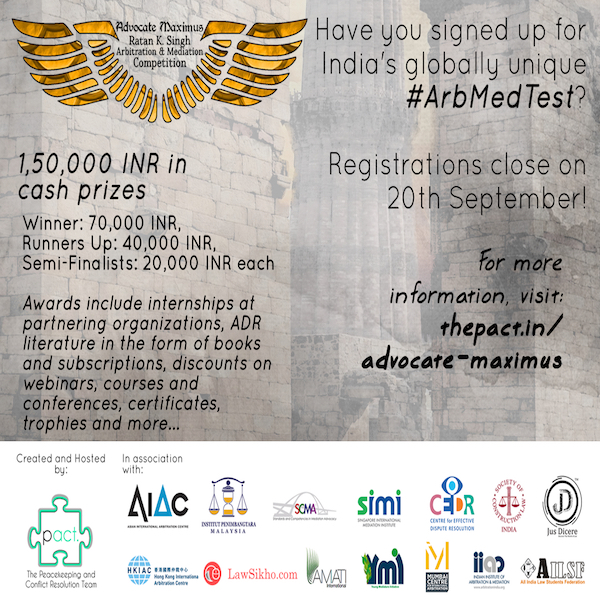
  • Advocate Maximus: sign up for the global Arb-Med competition

    Advocate Maximus: sign up for the global Arb-Med competition

    Advocate Maximus is a global platform for law eaglets to learn and compete at the biggest stage of Arbitration and Mediation. This legal cocktail (Arb-Med) has been spoken of as an exotic product for decades, but all the academics hasn’t really led to business. With exposure to some of the leading practitioners, a stage to test skills and recognition from the world’s best, we are confident #ArbMed will be the real fad.

    Advocate Maximus refers to a skilled and knowledgeable lawyer, who is as good a negotiator as she or he is a mooter. This competition is named after Advocate Ratan K Singh to recognise and honour his continuous contribution to the field of ADR. The logo is an eagle soaring in all its glory. Before the big flight, every law eaglet will have to first take the leap of faith as #ResolutionaryLawyers In this interview, we talk to Jonathan Rodrigues, Nisshant Laroia and Adv. Ratan K Singh who take us through the details of Arb-Med test, ‘Advocate Maximus’.


    WHAT IS ADVOCATE MAXIMUS?

    JONATHAN: Advocate Maximus is an Arb-Med test for law students across the globe, who fancy a career in non-conventional platforms of legal practice. It is scheduled from December 19-23, at New Delhi, the competition features Arbitration mooting sessions followed by the same competing lawyers attempting to negotiate the same dispute in a Mediation setting. The competition logo resembles a eaglet taking flight before soaring in the sky. The competition is dedicated to Advocate Ratan K Singh in recognition of his contribution and unconditional support to ADR in India.

    The PACT is collaborating with some of the biggest names in the field of dispute resolution, either as partners or supporters to Advocate Maximus. Some of these include (not limited to) SIAC, JAMS, AIAC, SIMI, CEDR, MBBI, HKIAC, MIARB, SCMA, YMI, AMATI, IIAM, etc. These collaborators have defined their roles, with the partners providing cash vouchers, discounts, books and internships as incentives for those who fare well at the competition. The final rounds of the competition will be broadcast on LawSikho.com for learning purpose and the winners will be featured on SuperLawyer.

    The inaugural and valedictory sessions of the competition will be held at India International Centre, New Delhi. The venues for the preliminary rounds, the social nights and the networking parties will be announced by the first week of October on the official website: www.thepact.in/advocate-maximus.


    IT’S A HUGE RISK ORGANISING SOMETHING INDEPENDENT OF LAW SCHOOL / UNIVERSITY REPRESENTATION. WHAT INSPIRED YOU AND WHY DO YOU THINK ITS NECESSARY?

    NISSHANT: I believe that every university should provide its students maximum exposure and opportunities for their personal learning, development and growth. Many students don’t have access to opportunities due to rigid university policies, politics in law school committees and inevitable red tapism.

    We have heard of instances where universities have had a moot court committee and an ADR cell but it is the moot court committee that had the jurisdiction of allocating the ADR competitions to students. To pick any Mediation or Negotiation competition, one has to go through the university intra moot court rounds. Moot court competitions and Mediation & Negotiation competitions are poles apart. The skills needed in both are completely different. Inspite of that, students who want to go for the big mediation competitions, couldn’t do so due to not having strong mooting skills.

    I am aware that one can’t go around every country pushing for change and that we must respect structures that are in place. But I am also a strong believer that if you feel strongly about something, try and initiate the change personally and hopefully, it will inspire others to join along. It’s time to skip the red tape and challenge yourself. The simple eligibility criterion for Advocate Maximus is – the participant has to be a law student and must have an exceptional mooting and negotiation profile.

    WHAT IS THE DRIVING FORCE BEHIND THE COMPETITION?

    JONATHAN: Created and conceptualised to highlight the role of the lawyer in the practice and promotion of out-of-court dispute resolution, Advocate Maximus aims to officially invite the lawyer community to shed their “suits” and “courts” and embrace dispute resolution. The role of the lawyer if often misunderstood and underrated in arbitration and mediation, when in reality, it’s the lawyers who determine and influence the approach of disputing parties. Whether commercial, community, personal or professional, disputes can be consensually resolved even if the parties initially chose an adversarial approach.

    The legal profession is experiencing huge tectonic shifts, where young lawyers are expected to be equipped with all round – adversarial and conciliatory – skills. There is no room for “I am a hardcore litigator, ADR is not my cup of tea”. Aware and empowered, clients today are more demanding and impatient in getting what they want. In a profession where, until now, the client has always come second, times are changing. A revolution is on the horizon and its looking for ‘Resolutionary’ Lawyers.


    WHAT IS THE VISION OF PACT?

    NISSHANT: Before being formally registered as The PACT, the idea of creating a collective of young professionals grew out of a courtroom horror where a 70-year-old old man was fighting a battle in court over a 30ft wall for 28 years. He sat on the last bench, while his lawyer walked in to court, got an adjournment, and walked out, without even glancing at him. That day, somewhere in the hearts of the cofounders, The PACT was conceived.

    The vision has remained the same – to support and encourage people from all walks of life to become effective users and ambassadors of dispute resolution; And to loop together a network of professionals in the field of consensual dispute resolution, and unite them to contribute to research, awareness and literature.

    WHAT DO ABBREVIATIONS FOR ADR & CDR STAND FOR IN SIMPLE WORDS?

    NISSHANT: ADR is an abbreviation often used to define a broad range of platforms and mechanisms that users may engage in to resolve disputes without going to court. We can go on about this, but for us at The PACT, ADR simply means Arbitration, as it is a process that is still adversarial, but is much more flexible and informal compared to a court room proceeding.

    We have been promoting mediation, negotiation and conciliation as ‘CDR’ – Consensual Dispute Resolution – mechanisms, as these platforms empower disputing parties to resolve the dispute by determining for themselves the ideal settlement. CDR mechanisms put the decision-making power in the hands of the parties. They promote direct dialogue between parties and thereby encourage them to try and understand the interests of the opposite party i.e. understanding not just what they are wanting but why they are wanting what they are wanting.


    WHAT IS THE IDEA OF ADR IN YOUNG LAWYERS?

    Adv. RATAN K SINGH: This generation has no patience to wait for justice, neither does it want to spend on court fees nor does it want to risk the loss of reputation or status. This generation wants a quick and effective fix to its problem and it wants it done discretely. This generation is fixated on being positive and it doesn’t mind giving in a little to get a little. The client is changing and the counsel needs a upgraded ammunition of knowledge and skills to deal with these trends.

    Advocate Maximus is a global platform for law eaglets to learn and compete at the biggest stage of arbitration and mediation. This legal cocktail has been spoken of as an exotic product for decades, but all the academics hasn’t really led to business. With exposure to some of the leading practitioners, a stage to test skills and recognition from the world’s best, we are confident Are-Med will finally be a reality.


    HOW CAN ONE APPLY FOR ADVOCATE MAXIMUS?

    JONATHAN: All details with regards to registration for the competition are up on the website – www.thepact.in/advocate-maximus This link has all information on team structure, competition rules, awards and the google form that needs to be filled to register. Interested teams may send in their team profile (combined or individual CVs) to advocatemaximus@thepact.in

    It is a team event. You can create your own team, putting together friends and peers from different law schools, based in different cities, countries, cultures. There is even an award for the most diverse team at the competition – The Dream Team Award.

    For the inaugural edition this December, being a law student (LLB / LLM) is a must. We plan to evolve into more wider and diverse competition in the following editions, inviting students from the business and political science background as well.


    HOW SHOULD STUDENTS PREPARE FOR ADVOCATE MAXIMUS COMPETITION?

    Adv RATAN K SINGH: Participants must firstly divide team roles according to their strengths. The Legal Associate must begin preparing the arbitration memo and assist the mooters in rehearsing their arguments. For those who don’t have specialised mooters and negotiators in the team, the counsels must begin practicing back-to-back arbitration and mediation sessions to get used to changing styles and approaches as counsels. Some teams may need to have different sets of coaches preparing them for the competition as they might seek advice from both arbitration and mediation lawyers. Shifting between the two diverse skill sets will be key to be declared winners at Advocate Maximus.


  • Bhaven Shah, Co-Founder, Presolv360, on entrepreneurship, technology and the future of dispute resolution

    Bhaven Shah, Co-Founder, Presolv360, on entrepreneurship, technology and the future of dispute resolution

    Bhaven Shah is a Chartered Accountant and has completed his law from Government Law College, Mumbai. He is the Co-Founder of Presolv360, which is India’s first homegrown cloud-based dispute management platform capable of preventing litigation, protecting people and businesses from adversities of disputes and resolving them through time-tested dispute resolution mechanisms. Bhaven has previously worked with KPMG in their M&A and tax litigation practice, R. K. Bothra & Co. and Ernst & Young in their tax and assurance practices, respectively. Besides, he has had varied experience before judicial and quasi-judicial authorities including the Supreme Court of India, High Courts of Rajasthan and Bombay, and the erstwhile insolvency boards.


    HOW WOULD YOU LIKE TO INTRODUCE YOURSELF TO OUR READERS?

    I am no super-lawyer. I am just a super-believer. I believe in our youth and that gives me the drive, I believe in India’s growth story and that gives me reason and I believe in the values passed down by our great leaders that gives me confidence that I am at the right place – ‘India’, at the right time – ‘now’, and doing the right thing – ‘Presolv360’.


    PLEASE TELL US WHAT MADE YOU PURSUE LAW?

    Law came to me by legacy. My grandfather was the first in the family to come to the land of opportunities and dreams. Since then, Mumbai was the only home known to him and my entire family. Against all odds, he brewed roaring success in the textile industry and this success was compounded by my father. The business expanded but so did complexities. Opportunities increased but so did opportunistic individuals. The economy was growing but values were rapidly eroding. From property-grabbing to non-payment of dues, from trespassing to cheques bouncing, it became a usual occurrence for many of us. Practices and professions became sophisticated, but law and procedures remained unchanged.

    Crediting my sweet and sour experiences with litigation and courts, I decided to take the law into my own hands. Scratch that, I decided to take the fate of these disputes in my own hands. The only way to begin that was by pursuing law academically, and so I did. After completing my graduation from H. R. College of Commerce and Economics, Mumbai, I enrolled myself in the Government Law College, Mumbai.


    FROM LAW TO ENTREPRENEURSHIP, WHAT MADE YOU TAKE THIS LEAP?

    In a heavily-litigated personal matter, a Supreme Court Judge (now retired) said to me in open court “Son, your father started this case and your child will have to conclude it.” And these wise words came after 29 years (read 45% of the lifespan of an average Indian) of fighting tooth and nail in Indian courts. The harsh reality is that legal cases in India last a lifetime and have a propensity to wipe out all your resources, and I faced this first hand. I didn’t want to suffer in the future, I didn’t want others to suffer, ever, and so, it was time that India and her citizens were offered a solution that changed the way they insulated themselves from disputes and litigation. Something that was quick, economical, convenient and effective. With this in mind, Presolv360 was born.

    Disputes are inevitable and are inherent to the nature of humans. So, we re-imagined, re-engineered and radically improved the ‘approach’ to dispute management. In devising this approach, the founding team of Presolv360 tapped into all possible learnings and experiences, be it law, chartered accountancy, insurance, management and of course, encounters with realities of life.


    WHAT PROBLEM ARE YOU TRYING TO ADDRESS WITH PRESOLV360?

    The traditional dispute resolution mechanisms like courts are plagued with a number of serious problems. Where 19th-century laws still dominate dispute resolution, there is a need to provide 21st-century solutions to uproot these challenges.

    Statistically speaking,

    • Everyday 40,000+ cases are filed due to the absence of dispute prevention mechanisms.
    • Approximately 67% disputants do not even attempt an alternative before litigating.
    • 80,000 crores p.a. is lost due to court hearings and loss of business. This translates to 0.77% of India’s GDP and shockingly, this figure is without accounting for professional fees.
    • On an average, it takes 13 years for the final disposal of a civil case lodged in an Indian Court.
    • It is estimated that by the year 2025, there will be 6.19 crore pending cases and at the current rate of filing of new cases against the rate of disposal, it will take 587 years to clear this backlog.

    Believe me, these numbers are not an exaggeration. Let me ask the readers to ponder over three simple questions. If the answer to any is ‘yes’, they will understand the problem we address:

    1. Would you like to enjoy a life free from disputes, litigation, and courts?
    2. Do you want to secure yourself, so nobody drags you to court?
    3. If you have a dispute, would you not like to resolve it quickly, reasonably and efficiently?


    DON’T YOU THINK THE GOVERNMENT IS AWARE OF THE PENDENCIES AND IS UNCLOGGING THE OVERBURDENED JUDICIAL SYSTEM?

    Undoubtedly. When I first spoke about confidence provided by our leaders, that included our leaders in the profession as well as those in the government. Lok Adalats, infrastructure improvements, E-Court Mission, encouraging ADR, commercial courts, state and national litigation policies, etc. are long strides in the right direction.

    While I believe that India is in extremely capable hands, it is also important to understand that, for India to tackle this grave problem, a concerted partnership is required between all stakeholders – potential and existing disputants, governments, judiciary, professionals and facilitators like us. This will ensure that only those matters worthy of the courts’ attention and judicial resources will find a place on the docket, while the remaining are dealt with in a systematic, civilized and optimal manner. This way, courts can dispense justice, governments can govern, businesses can flourish, and the citizens can enjoy a stress-free life.


    WHAT IS YOUR VALUE PROPOSITION AND WHO IS IT FOR? WHAT IMPACT WILL YOUR SOLUTION HAVE?

    Presolv360 is a unique dispute management platform that blends technology, human expertise, and innovation to provide effective dispute prevention solutions, collaborative dispute resolution mechanisms, fast-track and cost-effective alternatives to courts and protection from uncertain outcomes and adversities. This makes Presolv360 the first of its kind across the globe!

    Our services include:

    1. PresolvReview: Preventing disputes is one of the key objectives of Presolv360. With PresolvReview, our expert will review your agreement from a dispute prevention standpoint and make suitable suggestions and recommendations so that you can enjoy a dispute-free relationship and a hassle-free life.
    2. PresolvSecure: This is a plan that secures you from adversities of disputes that arise in a contractual relationship. For a small annual fee, the parties can safeguard themselves from prohibitive costs, traumatic experiences, time-consuming processes and ruined relationships, and instead ensure a speedy and effective resolution by our empaneled experts, at no additional costs.
    3. PresolvDirect: We assist parties in resolving existing disputes (whether pending in court or likely to be submitted to the court), in a collaborative environment.

    At the centre of this, all is a seamless, integrated tech platform accessible from your desktops, laptops or mobile devices to ensures affordability, convenience, efficiency, and effectiveness. The beneficiaries of this system are unrestricted, be it individuals, businesses, institutions or even governments.

    This dispute management ecosystem will have a far-reaching social and economic impact.

    – From taking an average 13 years for disposal of a case, to collaboratively resolving a dispute within 3 months.

    – From expending lakhs of rupees in litigation to resolving disputes at a fraction of that amount.

    – From uncertain outcomes and irreparable loss to certainty of resolution and conserving resources.

    – From litigation ruining relations to safeguarding them … this is the impact of Presolv360

    We have also launched the ‘Presolv for All’ Project that extends the services of Presolv360 free of cost to weaker sections and low-income groups to ensure that we, as a community, can enjoy a litigation-free future.


    WHAT ALL HAS GONE BEHIND THE MAKING OF PRESOLV360 AND PLEASE INTRODUCE YOUR TEAM TO OUR READERS.

    The learning never stops, nor does the evolution of Presolv360 and its team. I can only give you a glimpse of the groundwork undertaken, and I can assure you that our efforts, to constantly improve by reflecting on feedback from our stakeholders and the incessant spirit of innovation, will never cease as it is ingrained in every member working at Presolv360.

    You may know that dispute resolution has its roots in the Vedic age and this has been entrenched in our village system. That’s where we began, our research and studies ranged from India’s gram panchayat system to international diplomacy, from traditional dispute redressal machinery to sophisticated global practices. After this theoretical escapade, it was time to understand contemporary challenges. We undertook an ‘Appeal for Change’ survey where we interviewed over a thousand people from different walks of life to understand all the facets of disputes. It is on this robust foundation that we built and designed the Presolv360 platform.

    Along with me, Namita Shah and Aman Sanghavi are the cornerstones of Presolv360. While Namita is a lawyer, chartered accountant and a CPA from the USA, Aman hails from the insurance and management background and is also a Certified Mediator from IICA, Ministry of Corporate Affairs. Presolv360 is guided by a distinguished Board of Advisors and Mentors comprising of

    1. Ashok Barat, former Managing Director, and CEO, Forbes and Company Ltd. He is currently on the Board of several listed companies and is passionate about making mediation the primary form of dispute resolution.
    2. Tanu Mehta, Legal Counsel, Mediator and Conciliator recognized by the Bombay High Court and is an MA in Conflict Resolution & Mediation from Tel Aviv University, Israel.
    3. Rajani Iyer has been designated a Senior Counsel by the Bombay High Court and is a Mediator with over 4 decades of experience in dispute resolution.

    Presolv360 is powered by a team of fifteen members (including six dispute resolution and legal experts) with an unbreakable spirit and the determination to change the way India and her citizens deal with disputes.


    HAVE YOU RECEIVED ANY RECOGNITION SO FAR?

    Presolv360 won the ‘Start-Up Excellence Award for Technology-Enabled Dispute Management & Redressal System’ at the Indian Startup Convention (ISC) 2018. The ISC recognizes those organizations and individuals who have changed or have the potential to change the face of their respective industry. We were also shortlisted for ‘Power of Ideas’ – India’s largest entrepreneurship program. Facebook, Economic Times, Department of Science and Technology, Government of India and CIIE, IIM Ahmedabad conducted this program and received over 6500 business ideas out of which 358 were shortlisted.

    The Presolv360 team has discussed the applicability and benefits of its services with officials from the Ministry of Commerce and Industry and the Ministry of Law and Justice, Government of India. Presolv360 is privileged to be recognised by the Ministry of Law and Justice, Government of India, as providers of dispute prevention and protection services, online dispute management, negotiation (online and offline), neutral evaluation (online and offline), mediation (online and offline) and is now listed on the website of the Department of Justice. Besides, Presolv360 has also been recognised as a qualified startup under the Start-Up scheme of the Department of Industrial Policy and Promotion (DIPP), Ministry of Commerce and Industry, Government of India.


    HOW DID YOU GET THE MINISTRY TO RECOGNIZE PRESOLV360?

    The Presolv360 team made representations to the Ministry of Commerce and Industry and the Ministry of Law and Justice, Government of India. To our delight, the officials were extremely forthcoming, encouraging and provided us with insightful feedback. Following these representations, Presolv360 was listed on the website of the Department of Justice, as providers of dispute prevention and protection services, online dispute management, negotiation (online and offline), neutral evaluation (online and offline), and mediation (online and offline).

    ‘Startup India’ is a flagship initiative of the Government of India, intended to build a strong ecosystem for nurturing innovation and startups in the country that will drive sustainable economic growth and generate large-scale employment opportunities. From tax exemptions to self-certification, from credit and funding access to rebates in patent applications, this initiative is definitely a boost to the ‘ease of doing business’ objective. Presolv360’s application was accepted by the Department of Industrial Policy and Promotion since we are working towards innovation, development, and improvement of dispute management services with a scalable model and high potential of employment generation and wealth creation. If any of the readers satisfy the eligibility criteria, I would recommend they apply under the scheme and take advantage of the benefits of a recognised startup.


    WHAT WOULD BE YOUR PARTING MESSAGE TO OUR READERS?

    We are all ordinary people until we master one extraordinary power – the power of choice. The choice to hold on or to let go, the choice to give up or to be relentless, the choice to follow or to lead, the choice to destroy or to rebuild, the choice to go to courts or ‘to presolv’ – choose wisely.

    You can get in touch with me at bhaven@presolv360.com and visit https://www.presolv360.com/ for more information.


  • Pranjal Sinha, CEO and Co-Founder, ODRways, on startup, college life and JAMS Fellowship

    Pranjal Sinha, CEO and Co-Founder, ODRways, on startup, college life and JAMS Fellowship

    Pranjal is a fourth-year B.A/LLB student of West Bengal National University of Juridical Sciences (NUJS), Kolkata. He is the CEO and co-founder ODRways, one of the top twelve mediation centers recognised by Ministry of Law and Justice, Government of India. He is also the youngest recipient of  Weinstein JAMS International Fellowship, recognising his efforts in the field of Alternate Dispute Resolution (ADR). He is also a trained cyber law expert and a certified mediator from Ministry of Corporate Affairs, India. Chief Coordinator of Indian Mediation Week, a pan-India mediation awareness campaign, he strongly believes that the Indian Justice System should move away from the contentious procedure of litigation, and towards more collaborative mechanism of mediation.

    In this interview he shares with us:

    • Balancing his startup with law school
    • Being youngest recipient of the JAMS international fellowship
    • His startup ODRways
    • Mediation as a means for dispute resolution


    HOW WOULD YOU LIKE TO INTRODUCE YOURSELF TO OUR READERS?

    A fourth year student from NUJS, Kolkata, with a vision to make mediation the primary method of dispute resolution in India and a startup called ODRways to support it.

    I have been often criticised by my friends for bringing mediation in most of my conversations. Another extremely key aspect of my life, which bores my friends, is spirituality. Although blessed with poor socialising skills, I strongly believe that the secret to a happy life lies in happy relationships.


    WHAT ROLE HAS THE COLLEGE PLAYED IN SHAPING YOUR CAREER?

    An extremely crucial role!

    NUJS exposed me to a wide variety of perspectives. When I entered college in my first year, I was told about high paying packages of corporate law firms but I was also told about the prevalence of a strong entrepreneurship culture. I was told about seniors like Tanuj Kalia, Ramanuj Mukherjee, Jay Sayta, Om Agarwal etc who took the road less taken, pursued their interest and made it big.

    In fact, in my second year when I came up with the idea of ODRways, it was Om Agarwal, presently the founder of EazyCoach, who encouraged me to attend a startup event at IIM Kolkata, where I eventually met my co-founder, Vikram Kumar, and started my startup journey. I also had the good fortune to find mentors like Professor Vaneeta Patnaik and Hon’ble Justice Protik Prokash Banerjee who have been a constant support system on every step of this journey. Another advantage about NUJS is the freedom it provides. The academics are not extremely heavy and one gets the time to discover and pursue new interests and hobbies.

    Lastly and most importantly, the brand of NUJS itself has been extremely helpful. We have got to meet and network with so many influential people just by the virtue of being students of this college. This college has definitely provided me the perfect combination of freedom and resources to pursue my interests.


    YOU ARE THE CEO AND CO- FOUNDER OF ODRWAYS. HOW DO YOU BALANCE A START UP WITH A LAW SCHOOL LIFE?

    To be honest, I don’t do a great job of balancing it. To clarify, balancing academics is still doable. The real challenge is to maintain attendance. God, the fear of debarment has been a constant part of my college life. So many times, I have missed classes because of mediations being scheduled in the morning or meetings with the parties. However, I have managed to meet the minimum attendance requirement, primarily because of the supportive teachers and roommates who ensure that I reach the classroom.

    My time management skills aren’t that great too. But the technique which has been really helpful for me has been energy management. One of the biggest misconceptions about productivity is that it’s all about time management. The difference has to do with our energy and enthusiasm rather than the amount of time we have. A high state of energy while working not only improves the quality of work but also gets more done in lesser time. Some of the practices which I have imbibed in my daily routine to manage my energy well has been meditation and exercise. It helps in maintaining calm, bumping up the productivity significantly and increasing satisfaction in the work.

    And lastly, one needs to have a clear ‘why’ about pursuing something. I needed clarity in my head about why I am prioritising my start-up and not focusing on academics or co-curricular such as moot courts or debates. I have never interned since my second year but I have always had the clarity about what I want to do.

    I absolutely love the process of mediation. I strongly believe that if the power of mediation is combined with the magic of technology, it can do wonders for the state of access to justice in India. Presently, ODRways has 80 mediators in 22 cities across India. We have dealt with more than 700 disputes in the last year, ranging from small consumer disputes to 400 crore worth mining matters. The Union Ministry of Law and Justice has also recognised us in the list of top twelve ADR centers across India to help cut governmental litigation. The journey has been challenging till now but it has definitely been a worthwhile cause to work for.

    With that clarity in mind and persistence, it is not difficult to figure out a way to balance these two things and make it work.


    YOU ARE THE YOUNGEST RECIPIENT OF THE JAMS INTERNATIONAL FELLOWSHIP IN THE WORLD. WHAT IS THE APPLICATION PROCESS FOR THE SAME?

    The JAMS fellowship is an extremely interesting opportunity for people specialising in the field of Alternative Dispute Resolution. It is annually awarded to ten to fifteen experts in the field of ADR from around the world. Inaugurated in 2008, the purpose of the fellowship is to provide opportunities for qualified individuals from outside the United States to study dispute resolution processes and practices in the U.S. to assist them in their efforts to advance the resolution of disputes in their home countries. The JAMS Foundation approves Fellowships of up to $20,000 in support of projects outlined by fellowship applicants. The Program is intended for individuals who have demonstrated experience with and commitment to the field of Alternative Dispute Resolution (ADR) and who seek to increase the availability of dispute resolution education, training and services in their own countries and beyond.

    Till now, India has produce four JAMS fellows which includes former Justice M.L Mehta, Delhi High Court, former Justice Kannan, Punjab and Haryana High Court Chitra Narayan, former Partner of Jyoti Sagar Associates (JSA), Laila Ollapally, Founder of Center of Advanced Mediation Practice (CAMP), Bangalore.

    The application process is extremely comprehensive with deadline of proposal submission being in mid-September. One needs to submit a proposal explaining their experience in the field of ADR and what they intend to do with the fellowship money. Basis that proposal, candidates are shortlisted for the interview, which takes place in March. In my proposal, I primarily focused on the work my tech-mediation startup has done and how if I need to make it better, it is imperative that I strengthen my mediation skill-set as well as my business management skills. Therefore, I proposed that as a part of the fellowship, I intend on attending mediation training courses at Harvard Law School and shadow mediation at JAMS Mediation Center, and also do executive courses in Business Management at Stanford Graduate Business School and attend Business Development Program at Silicon Valley. On the basis of my proposal and dispute resolution experience, they shortlisted me for the interview stage. It was an early morning Skype interview with a panel of five members from JAMS. It was a half an hour interview where the discussion was strictly restricted to my proposal.

    The results were released in a week and with some good luck in hand, my proposal got approved and I became the youngest recipient of this Fellowship. The entrepreneurship programme at the Silicon Valley and the dispute resolution experience of JAMS will provide me with a holistic skills-set and benefit me in improving the services of my mediation center in India. I am looking forward to making the most of this opportunity.


    WHAT IS YOUR TAKE ON MEDIATION IN CRIMINAL CASES?

    This is one of the most controversial debates in the mediation circle and I can take a book to answer this question. But, in my opinion, mediation is possible in criminal cases to a certain extent.

    Firstly, section 320 of CrPC allows cases, which are considered less serious criminal offences, to be compoundable in nature. This means they can be settled outside the court with the help of a mediator provided there is consent from both the offender and the victim. Some examples being adultery, causing hurt, defamation, criminal trespass, dishonor of cheques etc.

    For serious cases, it depends heavily on the nature of circumstances. I do not subscribe to the hard line stance that there should be no scope of mediation in serious crimes and the whole matter should be entirely handled by state criminal processes. The process of mediation is often used in criminal cases abroad. According to the Centre for Justice & Reconciliation in the US, there are around 400 Victim-Offender (VO) mediation programmes running in the US and Europe for criminal cases.

    In a VO mediation, it is a pre-requisite for a mediator to ensure that both parties are psychologically capable of making the mediation a constructive experience, that the victim will not be further harmed by the meeting with the offender, and that both understand that participation is voluntary. The parties then meet to identify the injustice, rectify the harm (to make things right or restore equity), and to establish payment/monitoring schedules. Both parties present their version of the events leading up to and the circumstances surrounding the crime. The victim has a chance to speak about the personal dimensions of victimization and loss, while the offender has a chance to express remorse and to explain circumstances surrounding his/her behavior. Then the parties agree on the particular nature and extent of the harm caused by the crime in order to identify the acts necessary to repair the injury to the victim. The terms of the agreed reparation (e.g., restitution, in-kind services, etc.) are reduced to writing, along with payment and monitoring schedules.

    Studies have concluded that these mediation programmes in criminal disputes have high client satisfaction rates, victim participation rates, restitution completion rates, and have resulted in reduced fear among victims and reduced criminal behaviour by offenders.

    Considering the heavy social stratification and unequal bargaining power present in our society, it is needless to say that implementing a V-O mediation programme will be extremely challenging in India. But taking lessons from other countries, it is still possible to implement an effective Victim-Offender (VO) mediation programmes for criminal disputes in India.


    PLEASE TELL US ABOUT THE MEDIATION COURSE UNDER THE MINISTRY OF CORPORATE AFFAIRS. WOULD YOU RECOMMEND THE COURSE TO OTHER LAW STUDENTS AIMING A CAREER IN ADR?

    In 2016, I completed the commercial mediation training programme at Bangalore from Indian Institute of Corporate Affairs (IICA) under Ministry of Corporate Affairs, Government of India. The 40-hour training course gives a comprehensive insight and understanding of the mediation practice in India. It has an added benefit of being one of the first government certified mediation training courses in India which can be a brownie point for one’s resume. The faculty includes some leading mediators from India such as Anuroop Omkar, Kritika Krishna Murthy, Dr. Vijay Kumar Singh and usually has some professionals from abroad too.

    The 40-hour training courses are not the end all of learning the skills of mediation. In fact, it is impossible to learn the art of mediation from a five day training programme. These mediation training programmes provides you an exposure and insight to this new field of dispute resolution. It doesn’t make you an expert. Some of the very senior mediators in India have done around 30 mediation training programmes and they still keep attending more. The art of reframing, using metaphors and analogies, active listening etc is something which comes mainly only from practicing and observing mediations. Needless to say, these courses are expensive ranging from 30k-50k.

    So, rather than jumping for a professional mediation training course directly, I would recommend to find out more about this field of dispute resolution. There are some excellent resources available on the internet such as MediatorsAcademy, Mediate.com, Harvard PON Blog etc to find out whether you are interested in this field or not. Afterwards, it makes sense to go for a professional mediator certification.


    DO YOU THINK THAT MEDIATION AS A MEANS OF DISPUTE RESOLUTION CAN BE SUCCESSFUL IN INDIA CONSIDERING MOST CASES START WITH MEDIATION FOLLOWED BY ARBITRATION AND FINALLY END UP IN COURTS?

    Unfortunately, most cases don’t start with mediation in India. In fact, 54 percent of the population in India is not even aware of the existence of mediation services. They often confuse it with medita’t’ion or think it is the same as arbitration.

    Mediation, unlike arbitration or the system of courts, has the highest party autonomy. Parties decide what they want. The mediator is not like a judge or an arbitrator. He cannot pass an award or a judgment. His job is to ensure both parties have an effective dialogue, they move away from their adversarial positions and underlying interests are figured out. Mediation as a dispute resolution gives parties the maximum control over the procedure and the outcome. Even after 20 mediation sessions, if the parties are not happy with the way the conversation is going, they can withdraw from the process. The nature of mediation is that it is completely voluntary in nature. When parties settle in mediation, they settle for life. There is no winner or loser in mediation, it is a collaborative process where you find a common ground, which is suitable for both parties. There is no loser in this process who will challenge or appeal in a higher forum, unlike arbitration or litigation. It is one of the most beautiful methods of dispute resolution, which ensures highest party satisfaction.

    Unfortunately, we do not have a strong culture of private mediation in India. People don’t approach mediation centers on their own when they have a dispute. Their lawyers don’t recommend it either. The misconception that mediation is not a very ‘legal’ way of resolving a dispute or it is not suitable for complicated matters affects the usage of mediation in the public. We need to understand that mediation is worldwide recognised as a better method of resolving civil disputes. 95 percent of the top 1000 U.S fortune companies prefer mediation to arbitration/litigation. From Reliance Dhirubhai Ambani-Mukesh Ambani dispute to Amarchand – Mangaldas split-off to the recent Raymond family dispute, they have been resolved through the process of mediation. In order to tackle these misconceptions and mindset issues, we recently organised a pan-India mediation awareness campaign in fifteen cities across the country. It was called the Indian Mediation Week and was supported by Government of India and Supreme Court Mediation and Conciliation Project Committee (MCPC). In two months, 126 mediation awareness drives were conducted with more than 250 student volunteers working in ten cities across India and sensitising over ten thousand people by encouraging them to adopt mediation as a method of dispute resolution.

    Mediation needs to be a first response to a dispute. When you are caught in a conflict, you need a professional neutral that can facilitate communication. You need to call a mediator first. You need immediate ego-destabilisation. The adversarial processes of courts or arbitration can make the relationship worse and turn it into ego battle, where you don’t really win even if you win the case.

    Also, mediation has recently garnered some ground and shown its success as an effective method of dispute resolution in India, with Bangalore and Delhi leading the movement. Bangalore mediation center (BMC) is known to have a resolution rate of 65 percent with one case taking an average of 126 minutes. Mediation centers in Delhi such as Samadhan, Delhi Dispute Resolution Society (DDRS) etc. have shown a settlement rate of 75 percent. The Government of India, in furtherance of the PM Modi’s agenda of improving the ease of doing business rank, is taking active steps to promote mediation. In August 2017, the Union Ministry of Law and Justice released a list of twelve ADR centers across India, which will help government departments in resolving disputes since government is the biggest litigant in India. ODRways is also getting the honor of being recognized in this list by the Government. They have also passed an ordinance on 3rd May, 2018, making pre-litigation mediation mandatory for certain commercial disputes. These developments can give a huge boost to the mediation culture of India.


    YOU ARE ALSO A PRACTICING MEDIATOR WITH AN ONLINE MEDIATION PLATFORM. WHAT IS THE SKILL SET REQUIRED TO SUCCESSFULLY MEDIATE A DISPUTE?

    From all the mediations I have coordinated through my platform, I realised that there are many skills, which a good mediator needs ranging from active listening, empathy, subject matter expertise etc. But in order to be a successful mediator in India specifically, I would like to emphasise on two important skills:

    • The Art of Reframing: Reframing means changing the frame of the mind of the party. Parties to a dispute come to us in a lot of stress. They are suffering emotionally, physically and financially. It is the burden of the mediator to bring a change in mindset of the litigant. To make the parties focus more on solutions than the problem. To make the parties value their relationships. To make the parties look at the dispute as a journey or an opportunity to grow rather than a war to win. Reframing is the essence of mediation. In order to reframe well, one needs to develop a strong command over the language, using metaphors and analogies effectively, storytelling etc.
    • The art of marketing yourself: Aled Davis, Founder of MediatorsAcademy, hits the chord, when he says that mediators are not terribly good at marketing themselves because they are generally a humble bunch of professionals who like to remain in the shadows and not make a fuss or song and dance. Marketing is the core of any business, without it the chances of you succeeding are next to nothing. We need to acknowledge the importance of marketing and learn from some of techniques as suggested by him. One that really stuck with me was that while advocating for mediation, we often focus on confidentiality, impartiality, flexibility of the process etc. Parties don’t care about these attribute or that it’s an informal process or that you’ve been mediating for ten years or that you have done N mediation training programme. They want to know that the issue can be concluded in 24hrs rather than six or twelve months of litigation. They want to know that they can protect their public reputation. They want to have certainty over the cost of reaching resolution. In order to convert the enquiries into cases, focus your marketing messages around your client’s biggest needs, fears or pains.


    WHAT MESSAGE WOULD YOU LIKE TO SHARE WITH OUR READERS?

    No one knows if it’s going to work out for you.

    You don’t know what the outcome is going to be of all your effort. Therefore, it’s extremely important to enjoy what you are doing as you are going along. Rejection is okay if you are still enjoying everything BEFORE the final “no”.

    Enjoy the journey, and stop worrying so much about the destination.


  • Jonathan Rodrigues, Co-Founder, PACT, on challenges of a start up, online mediation, and a career in ADR

    Jonathan Rodrigues, Co-Founder, PACT, on challenges of a start up, online mediation, and a career in ADR

    Jonathan Rodrigues graduated from VM Salgaoncar College of Law in 2016. He is the co-founder of the Peacekeeping and Conflict Resolution Team (PACT) which is focussed on training users of dispute resolution in Negotiation, Mediation and Conciliation skills.

    In this interview we talk to him about:

    • Career in ADR
    • Challenges faced in starting PACT
    • Online Mediation in India
    • Mediation as means of dispute resolution


    HOW WOULD YOU LIKE TO INTRODUCE YOURSELF TO OUR READERS?


    Not all Super Lawyers wear a cape!

    Some choose to take off their courts and suits,

    Facilitating dialogue and resolution.

     An ‘Ideator’ by heart, a nurtured writer, a wanderer by my restless nature, I am, today, a Mediator, by profession. I know I sound ridiculously ambitious, I know the profession is associated with obscurity, but it is my mission in life to create the scope for consensual dispute resolution, that someday, kids may not sound foolish and insane when they say, “When I grow up, I want to be a mediator”.


    WHAT MOTIVATED YOU TO PURSUE LAW AFTER PURSUING B.A. IN PSYCHOLOGY?

    After graduating in Psychology, I went on to pursue criminology and forensic science as a post-graduation interest. I hopped two different universities but failed to find scope in the subject I was attracted to. I discontinued my studies and headed back home to pursue my passion for writing as a journalist. While working with the Times of India, I thought I should give legal studies a chance – this was a consequence of many people telling me I need to find a forum for my argumentative nature. Being a lawyer happened as a result of boredom and experimentation, but I’m glad I took the step. I found my true passion in the midst of all those confusing case laws and endless bare acts. I have always wanted to work to bring people together, work with differences and complications, and I found I could do that in mediation.


    PLEASE TELL US ABOUT YOUR TIME AT VM SALGAOCAR COLLEGE OF LAW?

    My time in law college was a period of a major identity crisis. I am shamelessly proud to have cleared every exam, having worked the night shift as a journalist all through my law college days. I never wished to go to court so I kept asking myself why am I even pursuing my studies in this field? I didn’t like the courtroom jargon, formalities and the ridiculous amount of procedures that are needed to find “justice”. Litigation didn’t attract me then, and that hasn’t changed to date. I couldn’t fathom the idea of the adversarial system, where is no scope to bridge the communication gap or repair relationships. This disturbed me – no matter how much a lawyer prepares and argues a case, the verdict lies in the hands of a judge, and the disputing parties have no say in the outcome.

    Of course, not every case can be referred and resolved through mediation. Similarly, not every case needs to be referred and judged in court.

    Being respectful of the over 1 million advocates and judges who are part of the profession, I believe that “justice” is temporary and not guaranteed, whereas “peace” is permanent and secured. Justice is subjective, whereas peace is objective. I chose peace over justice, and that’s where I am right now. I discovered mediation in my final year of law studies and I am grateful to my principal, who supported me to explore mediation.

    Having successfully competed as a mediator and negotiator at the CDRC Vienna 2015 and ICC Paris 2016, respectively, I co-created Lex Infinitum at V M Salgaocar College of Law – which was a huge turning point with regards to my career choice. For me, Lex Infinitum wasn’t a one-time assignment for my CV, I took it rather personally. This effort had a wider picture – it was the beginning of an endeavour to make mediation a stable profession, not a closeted charitable exercise, run on the lines of arbitration, literally and figuratively. Until I discovered mediation, I read the bare acts for the sake of marks. For instance, I remember studying for my final semester IPR paper. Glancing through my notes, it dawned on me that mediation has tremendous scope in this field. Mediation gave me direction as a law student.


    PLEASE TELL US IN DETAIL WHAT IS PACT FOCUSSED ON? WHAT MOTIVATED YOU TO START THIS?

    The Peacekeeping and Conflict Resolution Team (The PACT) is a collective of trained and certified dispute resolution practitioners who are committed to nurturing this millennial generation with tact and skills in dealing with conflicting situations. The PACT was initially conceptualized by Gracious Timothy and I, in June 2016. As passionate ADR/CDR enthusiasts, who had explored dispute resolution as law students, we were itching to create a platform for dispute resolution to take root in this country. Honestly, we didn’t know what we wanted to achieve then, or how we were going to achieve our goals; but, we knew that as long as we were dreaming and waking up every morning with a zeal to chase those dreams, we would get there.

    Nisshant Laroia is now an integral part of The PACT and as a core team of three, we work closely with national and international ADR and CDR professionals to create awareness and train users and lawyers in the field of dispute resolution. Over the last 18-20 months, The PACT has so far reached out to over 3,000 students, across two dozen law and business schools, spread over 13 states, hosting Negotiation and Mediation Boot Camps. Be it the University of Kashmir in Srinagar, or NALSAR in Hyderabad, GNLU Ahmedabad or NLU Jodhpur, ILS Pune or GLC Mumbai, the response and feedback has been positively overwhelming, encouraging us to go beyond just coaching and mentoring, and set up ADR/CDR cells and clubs in some of these institutions we have reached out to. Besides being majorly involved in Lex Infinitum during its initial years, we have already co-created a new competition (‘Intercessionis’, at ILS Pune), that exclusively deals with community conflict mediation. More such events are in the pipeline for the new academic year.

    We are in the process of creating a unique event in Jammu and Kashmir, in association with University of Kashmir’s law department. The youth of Kashmir are eager and excited to be working with us on this initiative, which will premier in October/November 2018. Similarly, The PACT is brainstorming on something special for the North-eastern states of India for early 2019.

    PACT has also conceptualized the Global Academy for Advocacy in Dispute Resolution, which premiers in Goa from June 11-16, 2018. It is an initiative to endorse skilled mediation and arbitration lawyers, with separate coursework and trainers for both, mediation and arbitration. For more details on the curriculum, trainers, accreditation, venue, fees, etc.

    Please check click on the link below: (https://www.facebook.com/pg/thepactindia/photos/?tab=album&album_id=812635982261471)

    The PACT is focused on building these platforms that empower every woman and man to proudly call themselves followers and users of consensual forms of dispute resolution. Be it conferences, competitions, literature projects, mass media assignments, we are looking to reach out to every potential user across the globe and connect with like-minded individuals who can help us create spaces of dialogue in their regions.

    The PACT was conceptualized by the peaceful beaches in Goa, grew up in colourful parts of India and is now ready to take to the world.


    WHAT WERE THE CHALLENGES YOU FACED INITIALLY ON STARTING PACT AND WHAT IS YET TO BE ACHIEVED?

     I believe our toughest challenge to date has been to find the right mentors and guidance. We have been fortunate to have met many polished and experienced professionals in the field, who have generously shared their time and friendship. We owe them our deepest gratitude for helping us grow and develop as individuals and as a team. They stay connected with us as “Friends of PACT”.

    However, not every follower is a fan, right? We have encountered many senior persons from the legal fraternity scorn and mock our ideas and dreams, but this has only made us stronger and determined. We have heard people say to us, “Burst the bubble, mediation is never going to work in India” or “Stop fooling yourself, this can never be a profession”. For every pessimist, we have met 100 optimists and we choose to work with these positive vibes.

    Yes, we have made mistakes and we have fallen short on many occasions. We don’t regret it because we have taken the approach of “burning our fingers while we learn”. Every time we discover a new limitation, a failing, we accept it and work towards fixing it, immediately. Personally, this has been my favourite part of the journey.


    DO YOU THINK THAT MEDIATION AS A MEANS OF DISPUTE RESOLUTION CAN BE SUCCESSFUL IN INDIA CONSIDERING MOST CASES FINALLY END UP IN COURTS?

    Yes, it can be successful, and it will be, soon. We need to ring in a few changes…

    Firstly, REBRAND ‘Mediation’ or for that matter, ‘Conciliation’ as a unique and different tool to dispute resolution. Stop, I repeat, stop clubbing it with arbitration or coin terms such as “other forms of ADR”. The iPhone grew as a brand, because it had its own identity, and it wasn’t marketed as “another phone in the store”. Arbitration is different, mediation is different. Both are unique and need to be treated differently. I am asking for (and we at PACT believe in this) a change in branding terminology, separate events and conferences, specific course/module/ curriculum for law students, the introduction of the concept in other study areas – arts, commerce, science, technology, sports, business, etc. Mediation cannot be looked to as a charitable option to “settle” and “compromise”. It has to be a commercially viable tool that encourages collaboration while maintaining a fine balance between interests and emotions.

    Secondly, LEGAL remedies with regards to a private Mediation settlement agreement need a revamp. The biggest fear that users have is “what happens if the other party dishonours the agreement?” The anxiety of running back to court to enforce “breach of contract” is more frustrating than going to court in the first place. Let’s keep it simple – A private mediation settlement agreement must have the same value as a conciliation settlement agreement – which is an award, treated as a decree of the court. Thus, someone who has been backbitten out of settlement agreement arising out of a private mediation has to simply seek enforcement of the “Mediation Settlement Award”.

    Before, I thought that the above could be achieved with a minor amendment to the Arbitration and Conciliation Act, but I am increasing of the belief that conciliation needs to be extracted from the Arbitration and Conciliation Act, and redrafted as a separate legislation, which also involves Mediation.

    Thirdly, INFRASTRUCTURE annexed to court premises is not something I subscribe to. State governments in India must invest in specially designed premises to create a separate setting for mediation. It may continue to remain court-referred mediation, but it must be away from the clutter and buzzing of the courtroom premises. A perfect example of this is the mediation centres started by Delhi Dispute Resolution Society. This will encourage full-time mediators and not professionals who dedicate their “after hours” time to the profession.


     WHAT WOULD BE YOUR ADVICE TO LAW STUDENTS LOOKING FOR A CAREER IN ADR?

    To those exploring a career in Mediation, I suggest getting yourself trained to be a skilled negotiator or mediator, or a skilled mediation advocate.

    Keep reading – There is a lot of literature online or you can check the Facebook group: PACT FAM – (https://www.facebook.com/groups/153574115135548/). This forum is managed by our student CDR ambassadors, Sandeep Bhalothia (JGLS) and Pallavi Gauri (NALSAR)

    Keep writing – If you want to write a simple article about mediation or dispute resolution, you may do so and send it to thepactindia@gmail.com. We will find you a platform and readers.

    Participate in competitions and conferences taking place in India and abroad. PACT is coming up with at least 3 new competitions in 2018-19, watch out for these announcements on the PACT page (https://www.facebook.com/thepactindia/)


    WHAT IS THE SKILL SET REQUIRED TO SUCCESSFULLY MEDIATE A DISPUTE?

    • Patience! – It’s not a skill as such, but it is the key that puts to test all your skills.
    • You need to have listening ear – go beyond being an active listener and be an empathic listener.
    • Don’t be afraid to compliment what you like, apologize when wrong, acknowledge what seems interesting, accept differences, competitively disagree, creatively brainstorm for mutually-satisfying solutions.


    WHAT IS YOUR ROLE AS MEDIATION CONSULTANT AT PRESOLV360?

    As an empanelled consultant, I assist Presolv360 – India’s first dispute management platform – in connecting with professionals and organisations in the field of dispute resolution and provide support for implementing established mediation practices.


    DO YOU THINK ONLINE MEDIATION CAN BE SUCCESSFULLY IMPLEMENTED IN INDIA?

    I was extremely sceptical of online dispute resolution and I still have my doubts, but this is the tech generation, so why not! This generation demands quick, accessible and tech-ridden supply of solutions to all its needs – be it food, clothing, gadgets, travel, etc. A little delay in delivery of any of these basics needs and you will have the youth shamming the service provider on every possible public forum on the internet. How, then, this generation remains indifferent and accommodating of the time-consuming court system?

    Cost effective, time efficient, comfortably casual, confidential settings, a process devoid of endless documentation, voluntary appointments, neutral facilitators and consensual settlements – it can’t get better for those who live digital lives.


    WHAT WOULD BE YOUR PARTING MESSAGE TO OUR READERS?

     I’m just an ordinary Goan boy who dared to dream beyond the familiar shores of comfort and challenged himself to explore a strange and currently non-existent career.

    Don’t be afraid to look at a career in law from a fresh perspective. If you like law as a subject and you have always wanted to be a lawyer helping people resolve disputes, and you don’t like the idea of arguing in court, there is no need to worry – you now have Mediation.

    Not all Super Lawyers wear a cape; some choose to take off their courts and suits, facilitating dialogue and resolution. As a lawyer, it has always been about your client’s interests; help them discover their true interests. You don’t have to be an adversarial lawyer; you can be a collaborative one. Don’t be afraid to be different. At the end of the day, advocate for your client’s interests, not yours!


  • Thomas P. Valenti, Chicago based Attorney, shares his experience on a career in ADR

    Thomas P. Valenti, Chicago based Attorney, shares his experience on a career in ADR

    Tom Valenti is a Chicago based conflict resolution specialist offering mediation, arbitration, and facilitation services and training, globally.

    A certified mediator, Tom has conducted numerous mediations involving civil, commercial, interpersonal and workplace matters.  He has mediated and trained extensively, both nationally and internationally, in jurisdictions all over the world.

    Tom is a member of several Bar Associations, including the American, Chicago, Illinois and Indian Bar, and is a co-founder and former Board Member of Mediation Beyond Borders.

    A member of the Chartered Institute of Arbitrators, Tom Valenti is also an Arbitrator on the Public Panel at FINRA and is an approved Arbitrator and Mediator for several governmental and regulatory bodies, including the Circuit Court of Cook County, The National Arbitration Forum and is on the Advisory Board for The Association of Mediation Assessors, Trainers and Instructors.

    Extensively trained himself in all aspects of dispute resolution, Tom’s accreditations include Conflict Transformation Skills Training, focusing on Systems Dynamics, ABA International Family Mediation Training including Hague Convention Child Abduction cases, Circuit Cook County Annexed Arbitration and Mediation Training Programs. Tom also holds a Mediation Certification at The Institute for Conflict Management and is a Board Member and Trainer at The International Academy of Dispute Resolution.

    In this interview we talk to him about:

    • Skills of a good mediator
    • Lacunae in the Indian ADR system
    •  Making a career in ADR
    • Online arbitration in India


    HOW WOULD YOU LIKE TO INTRODUCE YOURSELF TO OUR READERS?

    I am an attorney, mediator, arbitrator, facilitator and trainer. I have been extensively trained in all aspects of Dispute Resolution. I am a former Board Member of Mediators Beyond Borders International (MBBI]. I have an interest in understanding the issues raised with cross-cultural disputes. I gave the Keynote Address on Interfa`ith and Multicultural Dialogue at the Dispute Resolution conference at the Ismaili Center, London, in May 2016. I organise and facilitate dialogues on multicultural issues. I believe that across time and cultures stories connect and can change people, and in that spirit, hosts Tenx9Chicago, a storytelling platform where true experiences are shared. My interests are enhanced by his work with The International Academy of Dispute Resolution (INADR), which is a charitable organisation set up to further the interest of mediation amongst law students globally. I have  judged and trained at numerous International legal, negotiation, arbitration, and mediation competitions. I have travelled to the UK, Dubai, India and Europe to train and teach courses in Negotiation, Mediation and Arbitration. I have been trained in Peer Mediation and have trained peer mediators. I have also acted as a consultant to “Online Peer Mediation Program” a platform for practising their peer mediation skills by participating in online peer mediation simulations with other students and their trainer

    I am also an organiser of the Global Youth Development Initiative, a mentoring program for international students.

    WHAT FACTORS LED YOU TO PURSUE A CAREER IN ADR?

    As a trial lawyer in Chicago, I always tried to maintain solid relationships with my adversaries. I was asked by my adversaries in the legal community in Chicago to mediate cases that they were working on. I found that I enjoyed the experience. After some time, I decided to get formally trained as a mediator. Eventually, I fully gave up litigating and now focus only on providing services as a neutral.

    WHAT IS THE SKILL SET TO BECOME A SUCCESSFUL MEDIATOR?

    Aside from the technical skills that we teach in mediation training, the most beneficial skill is to be a good listener, followed by having patience, being trustworthy and tactful.

    HOW IS MEDIATING A DISPUTE DIFFERENT FROM ARBITRATING A DISPUTE?

    In mediation, unless hired as an evaluative mediator, we do not recommend a solution or offer specific solutions. On the contrary, in arbitration that is the specific assignment undertaken.


    YOU ARE A MEMBER OF VARIOUS ARBITRATION AND MEDIATION ASSOCIATIONS ALL OVER THE GLOBE. HOW CAN ONE ACCOMPLISH THAT?

    Many of the associations are just fee-based memberships. However, to be on a “panel” or “board” you must demonstrate an expertise and skill level as well as some specific experience.

    YOU HAVE CONDUCTED ARBITRATIONS ALL AROUND THE WORLD. WHAT LACUNAE DO YOU FEEL IN ARBITRATIONS CONDUCTED IN INDIA? HOW CAN THE INDIAN SYSTEM IMPROVE?

    It is pretty well accepted that the Indian arbitration system needs to have some changes that result in expeditious hearings, prompt awards and a cost-efficient, fair process employed by the arbitrator. These are all teachable processes. It will come down to additional training, arbitral institutions, that create appropriate rules, arbitrators who will follow the rules and advocates and parties insisting on the fair application of all of this.


    IF I WANT TO BE A GREAT ARBITRATOR WHICH UNIVERSITY SHOULD I GO TO? WHICH COURSES WOULD YOU RECOMMEND?

    I am not sure any institution can create a great arbitrator. You need a sound legal background in commercial law, experience in arbitrating matters, and a fair temperament. Indian students have always been attracted to the Queen Mary & King’s in London, MIDS in Geneva is well respected, and any of the Ivy League law schools in the USA.


    CAN ONLINE ARBITRATION BE IMPLEMENTED TO A GOOD EXTENT IN INDIA? HOW?

    I am a fan of technology and believe that this offers the best opening for younger lawyers to take a foothold in a speciality. I do not think for long hearings that the entire process can be online, but there are many opportunities to use online tools for taking testimony, holding shorter pre- hearing matters and conferences.

    WHO ARE THE STALWARTS IN ARBITRATION THAT YOU FOLLOW?

    There are many excellent arbitrators. If forced to choose, and in the interest of gender equality I would suggest people track Gary Born and Jean Kalicki.

    HOW IMPORTANT IS LLM IF ONE WISHES TO PURSUE A CAREER IN ADR?

    In the USA, not at all because of our legal education system. In other countries where there is an abbreviated educational path to practicing law, comparatively, I think it has greater value.


    HOW CAN ANY STUDENT LOOKING TO PURSUE A CAREER IN ADR GET IN TOUCH WITH YOU AND ENROLL IN YOUR TRAINING CLASSES?

    I am very available, through the common social media channels, and can be reached by email at tpv@valentilaw.com


    HOW DO YOU KEEP YOURSELF UPDATED WITH THE LATEST ADR ISSUES, NEWS AND CASES?

    I am forever, on a daily basis, reading the latest news, case reports and journals. Also, I regularly attend legal seminars both in person and online. There is an endless supply of material for all of us to use to keep our skills intact and in pace with a rapidly growing part of the law.


    WHAT MESSAGE WOULD YOU LIKE TO SHARE WITH YOUNG LAWYERS AND LAW STUDENTS LOOKING FOR A CAREER IN ADR?

    I think you are on the proper path in pursuing studies in ADR. There is no doubt that these skills will benefit you in every area of law and in life as well. So take advantage of every opportunity to participate in moots and other competitions. Join ADR cells and encourage others to spread the awareness of ADR tools, not only in the legal profession but also in your communities. In a world that has made the cost of a dispute in terms of time and money unreachable to many, we as a legal community owe it to society to make justice more accessible, and ADR is one of the best ways to increase access to justice.


  • Indian Institute of Corporate Affairs, Mediation Project

    Indian Institute of Corporate Affairs, Mediation Project

    Indian Institute of Corporate Affairs (IICA) is in the process of setting up India International Mediation Centre (IIMC), the first of its kind in India for handling various domestic and cross border commercial disputes at pre and post litigation stage. As a first step in its initiative, IICA proposes to carry out a series of mediation training across India (Delhi, Mumbai, Ahmedabad, Hyderabad, Kolkata, Chennai and Gauhati).

    The team responsible for conduct of the training program is headed by Dr. Vijay Kumar Singh, head of the School of Corporate Law and Associate Professor at IICA. Vijay has previously worked as Deputy Director (Law) at Competition Commission of India. He is a trained mediator from The International Centre for Alternative Dispute Resolution (ICADR). He is also a certified trainer on “Managing Disputes and Difficult Conversations on the Board” by Centre for Effective Dispute Resolution (CEDR) and the IFC Corporate Governance Group.

    Vijay is assisted by Anuroop Omkar and Kritika Krishnamurthy as consultants for the course. While Anuroop is a trained mediator from USA and Europe, Kritika is trained from The International Centre for Alternative Dispute Resolution (ICADR). They are Fellows of World Mediation Organization (WMO), Berlin, Germany. Anuroop is the youngest mediator appointed by Delhi Dispute Resolution Society, Ministry of Law and Justice, New Delhi.

    In this interview, they talk about

    • The need for mediation as a means of dispute resolution and its future in India
    • Their upcoming training programme and what they hope people will gain from it
    • The number of different types of people in different fields that will benefit from both their training programme and mediation skills in general.


    Tell us a bit about your team

    Vijay: Our team is headed by Dr. Bhaskar Chatterjee, Director General and CEO of Indian Institute of Corporate Affairs (IICA). Dr. Chatterjee is an ex IAS officer and has introduced the concept of CSR in India, as the first principles of CSR for the Public Sector Enterprises were written during his tenure as Secretary, DPE. His work experience has given him wide exposure in negotiation and experience of the fallacies of dispute resolution mechanisms prevalent in India. He believes corporate India is in great need of mediation which saves not only time and money but also goodwill of disputants. I am the Course Director for the training program. I am also the Head of School of Corporate Law at IICA. Before IICA I was working as a Deputy Director at the Competition Commission of India. Anuroop Omkar and Kritika Krishnamurthy are our course consultants. They are practising corporate lawyers, mediators and co-authors of the book ‘The Art of Negotiation and Mediation- Wish Bone, Funny Bone and Backbone’ by LexisNexis.


    What made you conceive the idea of mediation training and International Centre of Mediation when arbitration and litigation are the most accepted ways of dispute resolution?

    Vijay: Time and again we harp on the fact of the overburdened courts in India and the escalating cost of undertaking arbitration which many times leads to court appeals. India is on the way of becoming the global business hub of the world. We are strong propagators of the ‘ease of doing business’ but our rankings are dismal. Most foreign investors and joint venture partners are hesitant of the Indian market because of the stories they have heard of long drawn litigations in India. We need an efficacious dispute resolution mechanism for commercial disputes and mediation is the right fit. Mediation has a success rate of 80-85% in developed jurisdictions. Businesses shall get the chance to negotiate a solution to their own disputes with promise of full confidentiality. But there is lack of trained mediators in India who truly understand the essence of what mediation should be as an experience for disputants. We are on the lookout of promising mediators who can help disputants settle differences in a relaxed, informal atmosphere without prejudice. Hence, the mediation trainings- to train and empanel mediators for our proposed mediation centres.


    Where do you plan to set up the International Mediation Centre?

    Vijay: Of course, we would like to begin with our home ground which is New Delhi. But if we get the right talent pool and collaborations, we wish to set up mediation centres all over India; particularly in the cities where the trainings are planned- New Delhi, Mumbai, Ahmedabad, Hyderabad, Chennai, Kolkata, and Gauhati for the businesses in the North East of India. In our second phase, we may also target other industrial and emerging business centres in India.


    Does this training have any correlation to the NCLT & NCLAT that has been recently brought into force replacing the CLB, which would also exercise powers available with High Courts earlier in certain company law matters?

    Vijay: The pioneering step of commencement of National Company Law Tribunals and Appellate Tribunal has already been taken on June 1 this year. Section 442 of Companies Act, 2013 provides for resolution of company law disputes before the tribunals through mediation. Most of the disputes which come under these provisions are shareholder disputes, oppression and mismanagement, winding up of company owing to inability to pay debts, etc. I think these disputes are apt for resolution through mediation since the parties have a lot at stake and there is scope for win-win solutions and beneficial commercial arrangements through assisted negotiations. If given an opportunity we would be glad to assist the NCLT and NCLAT in mediation of these disputes. We also wish to promote pre-litigation of commercial disputes in India.


    Where all are the trainings happening and what is the duration of each training?

    Kritika: The trainings shall follow the international certification format of 40 hours. The training shall be for 6 days from 2 PM onwards at the following places:

    New Delhi: 19-24 July, 2016

    Mumbai: 25-30 July, 2016

    Hyderabad: 31 July-5 August, 2016

    Ahmedabad: 1-6 November, 2016

    Kolkata: 7-12 November, 2016

    Gauhati: 13-18 November, 2016

    Chennai: 19-24 November, 2016


    What should the course participants expect from the training program?

    Anuroop: Participants should expect skill based learning. Becoming a mediator requires a psychological change in your perception towards disputes. We cannot bring about this change in the participant’s mindset through only one-sided classroom teaching. The training program will also have extensive mock mediation practice and other skill based exercises to engage the participants in the training process and give the participants an actual practical insight into the practice of mediation. The training will equip the participants to deal with difficult disputants and deadlocks in negotiation. These skills are not just useful for a mediator but any corporate professional.


    For whom shall this training be beneficial to attend?

    Kritika: The training is for any person who wishes to become a mediator. It is not necessary for them to be a practising lawyer since we all face disputes and negotiate in everyday life. However, here is a tentative list of persons for whom this training shall be beneficial:

    • Judges
    • Advocates
    • In house counsels
    • Chartered Accountants
    • Company Secretaries
    • Cost & Work Accountants
    • Bureaucrats & public servants
    • Members of National Tribunals
    • Members of National, State and District Consumer Forums
    • Professional Students
    • Faculty (Law, CA, CS, Management, Commerce etc.)
    • Bankers
    • Members and employees of various sector regulators
    • Social Workers
    • Entrepreneurs & Working Professionals
    • HR and Management Professionals

    We welcome both active practioners and superannuated professionals


    Who will be Training faculty for the Mediation Training and why?

    Vijay: Avv. Stefano Cardinale shall be the Master Trainer for all the training programs. Avv. Cardinale is currently a member of the order in Rome and Barcelona, where he practices as a lawyer, professional negotiator, mediator, international management consultant and trainer. He is external independent expert of the EU Commission. He runs his own law firm Legal and Consulting International with offices all over the world. He has been guest speaker in international conflict management and mediation lectures at the World Trade Center of San Diego, at University of California San Diego (USA), at the American Chamber of Commerce of Milan, at the International Development Law Organization, at Magna Graecia University of Catanzaro, at Verona University, at Padova University (Italy), at Kharkov Law School (Ukraine), at Bar Council of India Golden Jubilee Celebrations in 2012 (India).

    The co trainers for the training program shall be practicing mediators from India so that the participants shall get exposure to the international best practices of mediation as well as their applicability in the Indian scenario.

    A tree cannot flourish unless we nourish its roots. Mediation needs to be taught by actively practising international mediators so that the first batch of commercial mediators for the India International Mediation Centre understand the right approach and mindset required to conduct mediation. Mediation fails many times not for any other reason other than faulty practises and hasty mediators. We wish to avoid that. Mediation has set best practices and if we introduce them in India with required customization, it will soon catch up in India. But we need good international exposure.


    Where do you see mediation as a practice of dispute resolution in next 5 years’ time?

    Anuroop: With increasing popularity and success of campaigns such as Startup India, Stand up India and Make in India, India is developing a new brand of entrepreneurs. They are looking for innovative dispute resolution mechanisms which will allow them constructive closure in disputes so that they can devote more time in business development. Business houses will any day choose a mechanism where they have a say in the outcome over a mechanism where there is a win-lose result. If India can learn to recycle, we can also learn to make business out of disputes. With the changing face of corporate India, the dispute resolution mechanism shall also have to keep pace. In the next five years, we see mediation as the ‘Go-to Mechanism’ for commercial disputes in India.


    Any advice for the future commercial mediators of India?

    Anuroop: Mediation has been widely accepted as one of the most preferred dispute resolution mechanism in the world. It has got an acceptance because of its broad elements which includes empathy towards disputants, time effectiveness, confidentiality and win-win solution. Various countries in the world have gone upto legislate mediation as a mandatory practice before resorting to the judicial system. My advice to the future mediators would be- in order to effectively and efficiently advice both domestic and international business houses in India we should understand that time, money and confidentiality hold a great importance to them. Keeping that in mind, we should advise them and structure their various contracts and agreements with an effective dispute resolution clause with mandatory mediation before resort to any other dispute resolution mechanism.


  • Sudhir Reddy, Founder, Reddy & Reddy Advocates & Legal Consultants, on LL.M from Cardiff and Mediation course from Oxford

    Sudhir Reddy, Founder, Reddy & Reddy Advocates & Legal Consultants, on LL.M from Cardiff and Mediation course from Oxford

    Sudhir Reddy graduated in LL.B from DES Law College, Pune University in 2009, after which he pursued his Masters from Cardiff University, United Kingdom. After completing his degree in Masters he worked in a law firm called Thodur Law Associates as an Associate Advocate. He also pursued a course of Civil/Commercial Mediation from Oxford and became an Accredited Mediator in 2014. At present, he operates his own law firm which has a practice of both litigation and corporate work.

    In this interview we talk about –

    • Choosing International Commercial Law as his specialization for LL.M
    • Pursuing a course of Civil/Commercial Mediation from Oxford
    • Becoming an Accredited Mediator by 2014
    • Starting his own law firm “Reddy & Reddy Advocates and Legal Consultants”


    Given that most of our readers belong to legal fraternity, how would you introduce yourself to them?

    To start with I am a practising advocate mainly practising in the Pune courts and the Mumbai high court. I completed my LLB from Pune University and my LLM from Cardiff University, United Kingdom. I am also a certified civil and commercial mediator .I run my own law firm in Pune which deals with litigation as well as corporate work. However before starting the law firm I did work under senior attorneys at different High Courts so that I could earn some practical experience and confidence to start my own firm. My experience in Law is not just confined to the Domestic laws but I have also gained experience in mediation and negotiations in United Kingdom after completion of International civil and commercial Mediation course from Oxford.


    Having done B.Com, what motivated you to choose law as a career? Or did it just happen?

    To tell you guys the truth, my foremost aim was to become a lawyer but being from a business class family I had to learn certain aspects of commerce mainly accounts so that I would be able to put in my efforts in the working of my father’s established business. Also having knowledge in commerce helped me cater to my corporate clients in taking managerial decisions.


    As a law graduate of Pune University, have you faced any comparison with NLUs? What would you say to the future graduates of Pune University regarding this?

    I personally feel that these are all pre conceived notions that only the NLUS can provide the needed exposure to its students. Ultimately the laws are the same it’s up to the student how he/she decides on to shape up his/her life. I personally took the needed effort to attend various seminars and small conferences pertaining to law, held during my period at the law school. It’s the knowledge you imbibe that matters which should be practical as well as theoretical knowledge.


    What were your areas of interest during your graduation? How did you go about developing expertise and knowledge in these areas?

    As a law student I never wanted to confine myself to any particular area of law. My main aim was to absorb and learn everything which was taught to me during my classes and my internships .But I had always enjoyed negotiating and mediating any disputes and I realised I was good at it because I was always successful in solving a dispute. This made me realise that I had an inclination towards solving disputes in a peaceful and non-stressful manner. I did have keen interest in alternate dispute resolution systems and outside court settlement procedures and so I become a mediator.


    What are your thoughts on activities like mooting, debating and publications in journals? What skills do law students acquire by engaging themselves in such activities?

    I have always been of an opinion that in an all-round development of a student activities like mooting, debating play a crucial role. This is where the student develops its confidence and learns legal interpretation .Also these activities will help students in inculcating good research skills. The students also realise what exact field they should be taking up after college after doing these activities.


    Right after graduating, you went for LLM. Why did you decide to go for higher studies?

    Going for LLM right after graduation was my game plan since the time I joined my LLB course .My main intention for pursing LLM was to well equip myself with the international legal scenario.UK being a common law country I was sure that this experience will benefit me in expanding the horizons of my legal knowledge internationally .


    How did you choose Cardiff University over others? How did you go about choosing a university?

    The main reason to choose Cardiff University was that it is one of the royal charter universities and also one of the well ranked universities in UK. Along with that it had a beautiful campus and an apt course that attracted me to choose this university over others.


    Why did you choose International Commercial Law as your specialization for LL.M? What motivated you to pursue your LL.M in International Commercial Law?

    My course comprised of variety of subjects like international banking, competition laws, international corporate governance and World Trade organisation, which were entirely different than the regular curriculum taught to law pursuants in India. Also there was a wide range optional modules we could opt for hence I chose to peruse International Commercial Law.


    What advice would you give to people who are trying to decide which area of law to specialise in?

    Do your internships in all the fields. Participate in moots, debate, paper presentations and client counselling competitions. All this will help you understand your weak points and make you sure on what areas of law you like and what kind of practise you are good at.


    After completing your Masters, you worked at Thodur Law Associates for an year as an Associate Advocate. How did you secure your appointment? Did you apply or got an offer from the law firm?

    After my LLM I wanted to gain practical experience for getting myself acquainted with the procedural part of a legal proceedings, Thodur Law Associates is a law firm based in Mumbai practising at High Court hence there were larger chances of me getting a vast experience.

    I had gone to Mumbai after I was back from United Kingdom to search for prospective law firms where I could actually gain practical experience. Coincidentally I met the senior partner of the firm, I narrated to him my reason for applying in the said firm, he was very impressed seeing my urge to learn and I was told to join right from the next day at their firm.


    How did you overcome your initial jitters in a courtroom full of experienced lawyers and judges? Tell us about the highs and lows.

    I am a supercharged guy since childhood, talking to unknown people, making new friends or being at a new place with new surrounding was never a challenge to me. But I still remember the first time I appeared in front of a judge was at the Bombay High Court. As soon as I stood up to mention the said matter I went blank and stood right in the same position for good one minute without a single word spoken. The judge sort of understood that I have frozen so he sort of covered up for me and told me to come next day.

    And since then till now I have changed tremendously .Now I wait eagerly to appear at the court and to prove my point.


    sudhir-reddy-1

    Thereafter, you have started your own law firm Reddy & Reddy Advocates and Legal Consultants and currently you are the Managing Partner of the firm. What prompted you to make this choice and start your own law firm?

    It’s my father’s confidence in me which gave me the courage to start my own law firm. He has been the backbone of the firm since the day of the inception of Reddy & Reddy, Advocates and Legal Consultants. He has supported me when I needed encouragement and confidence the most. To be frank there were many to discourage but few to encourage. But somehow the voice inside told me to go ahead and prove it that I can do it.


    Please tell us a bit about “Reddy & Reddy Advocates and Legal Consultants”. What is a day at work like? Is it easy to have a work-life balance?

    My day at work starts with my morning prayer and then a quick workout. I am in the office quite early because I need to take quick updates about the distribution of the work to the associates for the day. I then go ahead and start with all my client meeting and if I have an argument for the day I take a quick look at the case and have fun leading the argument at the court. There are times when I spend the whole day in the negotiation for my corporate clients but having a remarkable team keeps me relived that my office functioning at its peak. I end my day at office by taking updates from all my associates along with a nice cup of coffee.


    Tell us about the practice areas of Reddy and Reddy Advocates and Legal Consultants.

    Reddy and Reddy Advocates and Legal is  Based in Pune, it offers a full range of legal services on all aspects of the Indian law to a diversified client base, including well-known multi-national corporations functioning in India. In addition to serving our clients directly, our lawyers serve as experts of Indian law in both transactional and litigation matters. In particular, the firm has a strong practice group that specializes in mediation and negotiation, credit management, real estate, property & land laws. We are dedicated to our clients’ needs and we strive to achieve total satisfaction for our clients by legal excellence.


    Our clients include major Banks, Non-Banking Finance Companies, Real Estate, Multinationals, Industrial Houses, and Software Companies.

    The firm’s lawyers have an average experience of over 5 years in handling complex legal issues touching on almost all aspects of Indian law. We combine a personal approach with high professional standards and aim at providing comprehensive legal services to our individual, corporate, financial and commercial clients.


    In the meantime, you have pursued a course of Civil/Commercial Mediation from Oxford and became an Accredited Mediator in 2014. What prompted you to pursue this course and became a certified Mediator?

    Mediation is the next revolution in the legal field. Since our country is evolving in a very fast pace the people of our country want every issue to be resolved as fast as possible. Being a lawyer I have practically seen how burdened the court is with numerous cases. Before going for the course few of my clients had asked me if I knew any commercial mediator and that is when I decided why not me. I looked for few courses and I found the one in Oxford is what suits my requirements perfectly.

    Meditation is already a very upcoming requirement for the multinational companies because they have clients all over the world and solving disputes outside the court is more convenient for them. Mediation is immensely into existence in the European and the western legal system. So it’s always better to do a course on mediation and negotiations it will surely help them in the future.


    You have a couple of orders to your credit. Do they change one’s recognition?

    (Sudhir has orders to his credit in criminal litigation, consumer disputes, land disputes, family disputes and outside court settlements in labour and industrial disputes)

    It just makes me want to work even harder because I want to keep my clients always satisfied. My only aim is that when the client agrees to take services from us he/she attains the best of the services which my firm can provide.

    Regarding once recognition, yes it does change the recognition as it shows experience a person has and the dedications the person has put in to get the desired results.


    What were the difficulties you faced in the early days of your practice? How difficult would you say it is to build a reputable practice?

    Early days were relaxed and peaceful. I did have work from the day I started my own office but the stress of uncertainty was always there. Although it will be wrong to say that the uncertainty is not present anymore because our firm is still in its growing stage.

    I also want to say that it is quite difficult to build a reputation and then harder to maintain it, one really needs to have lot of patience in order to raise your own organisation from one level to another.  You need to have a good team with you to run the show and thankfully at this point of time I have an awesome team who helps me, guides me and back me up everywhere.


    Do you take interns? What do you look for in a prospective applicant?

    Yes, we do take interns. When we get an application for internship we usually don’t see the scores and credentials of the student because we understand different universities have different ways of marking. We usually see the cover letter and the practical experience the applicant has provided in the application and most importantly the urge of the applicant to work and learn.


    What would be your message to law students who dream of having their own law firm one day?

    Never give up. Enjoy your failure because this is the way you are learning and this is how you grow as a person. According to me there are 4 stages involved if u want to start your own firm. At the first stage you have no work no money ,second stage only work no money at the third stage good work good money and finally the fourth stage less work only money.

    Not necessarily it has to go the same way but that’s what it is like in the holistic picture. Be confident and kick off.