
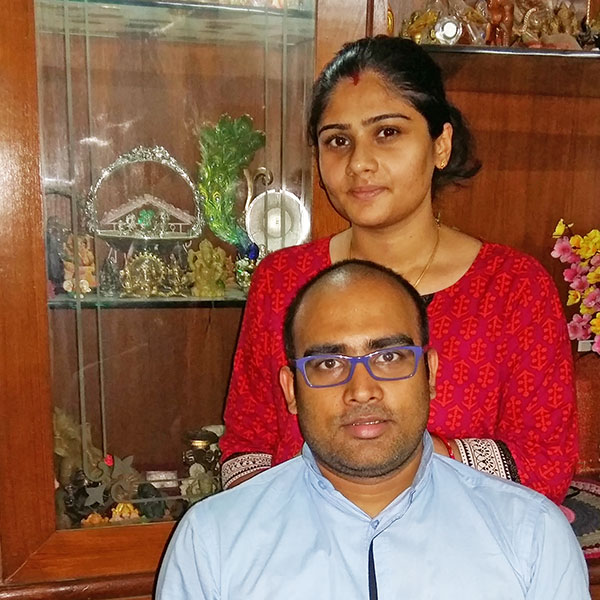
The authors Anuroop Omkar and Kritika are graduates of Gujarat National Law University (GNLU), Gandhinagar and are presently working in the Corporate Department of Lakshmikumaran & Sridharan. They have donned many hats. They jointly run a social service award Bauribandhu Mohapatra and GNLU Award for Social Service, co founded the company Bridge Mediation & Consulting Pvt. Ltd. and have been working tirelessly to spread the concept of mediation among the common masses and commercial groups in India. To give the subject more prominence and acceptance both among the masses and scholars, they decided to pen down a book on negotiation and mediation with LexisNexis. The book is extremely simple in terms of language and international in terms of quality and content. The concepts of negotiation and mediation have been explained with real life examples, childhood learning, mythological anecdotes and case studies of commercial negotiations. The book is titled ‘The Art of Negotiation and Mediation- A Wishbone, Funny Bone and a Backbone’ and is presently available on Flipkart, Amazon and LexisNexis.
Tell us a bit about your law school experience of preparing projects and dissertations. Did the practice help you to in writing a legal book?
If you make projects even a little seriously in law schools, they contribute to your knowledge base and enhance your research skills. According to us, making projects becomes interesting only if you choose an interesting topic, a real research area of law. Of course, it is not always possible, but at least in the subjects that you wish to specialize, you can always try to choose a critical area of research. Projects and dissertations help you evaluate what is your area of interest. We know many of our friends from law school who became interested in their practice area after they researched on the subject for a research paper at law school or during an internship.
Making projects and dissertations was different from writing a book in many aspects. Projects and dissertations were purely law based where we presented the existing laws and gave our interpretation and suggestions. Our book is our attempt to bring law to the common masses. We have tried to present the practice of negotiation and mediation in a way that people who don’t practice law can also easily understand. Additionally, we have also tried to bring in the commercial aspects for businessmen and practitioners. We have also discussed business case studies where applicable.
Lastly, I (Anuroop) always wanted to write on a subject where I was so comfortable that I would not have to footnote every sentence I write. While it was obligatory for us to footnote everything in our projects, our book is our own take on negotiation and mediation in India. We have made minimal use of footnotes by writing our original thoughts and interpretation. The book has helped me achieve my law school dream of minimalizing or even doing away with footnotes by promoting original thought and innovation.
Can you please explain to us the sub title of your book ‘A Wishbone, Funny Bone and a Backbone’?
We use techniques of negotiation and mediation regularly yet without consciously being aware of it in everyday life. Sometimes, the techniques don’t work to our advantage because we have the tool but we don’t know how to effectively use it. The book explains these techniques by relating them to stories, anecdotes or facts we already know but did not realize that they taught us something about mediation or negotiation. So, coming to the subtitle, if you wish to summarize the main attributes of a successful mediator or negotiator he should have a wishbone, a funny bone and a backbone.
Our subtitle is best explained in our preface. Hence quoting:
You need to have dream clouds floating in your head. You need a clear vision for what you want. You need drive and an innovative thought process. Or simply an idea that is so simple, it is out of this world. You need a wishbone.
You need the will power to sustain the setbacks in life. You need to know how to turn a frown upside down. You need optimism to see every situation with a positive twist. You need hope. You need cheer. You need a funny bone.
And finally to complete the vertebral column of dealing with disputes; you need a backbone. You need to know when your demands are reasonable. You need to know when not to allow someone to take you for a ride. You need to know when not to back out. You need to stand up for the fundamental principles of your life.
You need a wishbone, a funny bone and a backbone to be the alchemist who comes out of disputes with more than what you had when you plunged into it.
Both of you being full time Corporate and Transactional lawyers, how exactly did you write a book on ‘The Art of Negotiation and Mediation’?
Apart from our active legal practice, we also run Bridge Mediation and Consulting Pvt. Ltd. (BMCPL). BMCPL is one of the pioneers in organized international mediation and multi-cultural negotiation training and practice in India. BMCPL is in the process of providing comprehensive, world class training for students, corporate professionals, social workers, diplomats and bureaucrats in India. The training is presently provided in collaboration with Media Logos, Italy who bring in international mediators as trainers. We have held trainings for students and professionals with Tata Institute of Social Sciences (TISS), Mumbai, Gujarat National Law University (GNLU) and National Law University Jodhpur (NLU-J). So, along with our practice, we have been always interested in increasing awareness and promoting the practice of mediation in India.
Negotiation also, is the main component of every one of our transactions. The terms of a negotiated agreement vary broadly based on practical needs of the client, feasibility and durability of the terms negotiated through the agreement and legal tenability depending on various jurisdictions and sector of business. If an agreement is well negotiated, the dispute resolution will never have to be enforced by the contracting parties. A fine tuned agreement with clear negotiation based on the abovementioned criteria hardly ends up triggering the dispute resolution clause. Even if in the worst case scenario, if there is a dispute between the parties, a very strong and a reliable mechanism of third party mediation in confidentiality should be resorted to resolve the disputes without washing dirty linen in public.
Explain to us a bit about the process of mediation.
In mediation, a third neutral party manages the interaction between disputing parties. This ensures constructive negotiation between the disputing parties and helps them to agree on a resolution that is fair, durable, and workable. It is the disputants and not the mediator who creates and finally agrees on how the dispute needs to be resolved. In a way, mediation is nothing but the use of negotiation to resolve a dispute outside the traditional dispute resolution framework.
In mediation, the parties retain control over the dispute and its outcome. This central feature of mediation- self-determination by the parties- is a facet of democratic process that the voice and wisdom of people can shape outcomes responsive to particular situations. In this respect, mediation is fundamentally different from litigation and arbitration, where power to determine the outcome is ceded to an arbitrator, judge or jury.
Many myths surround mediation that mask its benefits and prevent its popularity in the marketplace. There is a common belief among business professionals that mediation lacks closure or binding authority. However this is not the case. A settlement agreement executed by the parties post mediation is as binding as all other contracts.
There are so many other books by international authors on negotiation and mediation. How do you see your book contributing to the existing literature?
As you have rightly pointed out, there is good international literature available on negotiation and mediation. We have referred to many of these good books like ‘Getting to Yes’ by William Ury and ‘The Middle Voice’ by Lela Love (who also happens to be one of my (Anuroop) trainers at the program I attended at CEU Hungary). However, cultural variations and cross cultural confluence plays a key role in the process of negotiation and mediation.
We wanted to elaborate on the concepts and international practices with an Indian flavour. It is important for us to understand that negotiation and mediation are not alien, Western concepts. They have been part of Indian culture since time immemorial. There are so many examples on use of negotiation, mediation, related techniques and concepts in the Aesop Fables, Jataka Tales as also in the Indian epics of Mahabharata and Ramayana. We have tried to introduce these concepts to our Indian readers by co relating these numerous stories we have heard since childhood but did not know had so much significance in our adult life.
Is the book India specific or does it have any global significance?
Apart from the easily affordable price of the book in the Indian market and the Indian anecdotes and case studies, the practice of mediation and negotiation has certain established best practices which have proved to work worldwide. However, the psychology, approach, expectations and cultural practices in negotiation and mediation vary significantly in every country. We have tried to present mediation as it is understood in most regions of the world where it is practised widely like USA, Europe and Singapore. So, the book definitely has global significance. Additionally, India is the next global market and the book will be useful for any person who wishes to establish business connections in India and wishes to understand Indian psychology towards negotiation and dispute resolution.
How is a 40 hour mediation training different from the regular ADR classes attended by law students across various law schools in the country?
The ADR classes in law schools are definitely very useful in preparing a base for future alternate dispute resolution (ADR) practice. The classes introduce us to the basics and lay the foundation upon which we can specialize and build a sky scraper if we wish to. But Indians presently associate ADR practice with only arbitration and the same reflects in the course curriculum at law schools. Students end up studying the Arbitration and Conciliation Act, 1996 in great detail. A class or at the max two are devoted to mediation. Negotiation is not yet acknowledged as a mode of dispute resolution although lawyers have been informally settling matters outside court since the time court system exists in India. To top it all, ADR is an optional subject in many law schools and students many times end up choosing subjects which are more ‘scoring’ or require ‘less effort’.
An internationally accredited 40 hour mediation training focuses more on skill development rather than legal interpretation. The training is generally conducted in a round table discussion format and provides participants an insight into not just mediation best practices and procedures but also related psychology, neurosciences, communication and body language. After attending the training, participants tend to approach everyday life differently. The participant’s perception of every conversation and difficult situation changes after the training. Of course, the willingness of a participant to absorb information and practice skills is another matter. That being said, being a good negotiator or mediator is more about a mindset adjustment rather than knowing the law. Most importantly, you do not need to be a qualified lawyer, psychologist or social worker to be eligible to apply for training and be a successful mediator. For instance, the housewives saved India from the impact of global financial crisis through their savings habit without being an economist. These housewives who undertake crisis management daily can also be very effective mediators.
Can the experience of a lawyer or a judge be a good enough criterion and experience for being an excellent mediator?
As we said earlier, it is not your qualification or experience in law which makes you a good mediator. What makes you a good mediator is your outlook towards disputes and life in general. For anybody to be a good mediator, you first need to step away from the adjudicatory mindset. You need to dip into the age old Vedic knowledge and be detached from the disputing parties and their conflict. You need to help disputing parties clear the cobwebs of their hurt and aggression to arrive at the real issues underlying the dispute which need to be resolved. A mediator should always approach mediation with an attitude of fortifying long lasting relationships and maintaining public goodwill of the disputing parties. We all know that an emotionally agitated person can never make good decisions. An excellent mediator calms down agitated disputants and helps them achieve an objective outlook of their dispute. Indians have a typical habit of thinking that they can solve anybody’s disputes and that their suggestions are absolute. A good mediator never succumbs to this temptation. He brings the disputants to a position where they themselves chalk out a solution. Only when the disputants themselves come up with the solution, they actually implement it instead of again objecting or appealing the outcome in a court. More and more people are refusing to accept terms being dictated to them by someone else. The rejection of debt terms by Greek public referendum is a strong indication of this changing outlook.
Also, disputants generally come with very strong emotions and positions on a mediation/negotiation table. But the tight rope walk of a mediator requires him to not be affected by the strong emotions and positions being radiated by a disputant. If the mediator is himself not objective, neutral and highly pragmatic, how will he help the disputing parties?
Bottom line-anybody can be a mediator if the person can inculcate these qualities and streamline them through training and practice. Your aptitude plus training by the right resource who is knowledgeable in international practices is key.
Does mediation have any kind of legal sanctity in India?
Presently, matters at court are being referred to mediation under Section 89 of the Code of Civil Procedure. Similar mechanism for commercial disputes is provided under Section 442 of Companies Act, 2013 but the provision and rules have not been notified yet. Indian laws provide for mediation only after parties approach the courts. Pre-litigation mediation is not governed by any laws in India presently. However, I wish to clarify here that the settlement agreement even in a pre-litigation mediation is binding under the Indian Contract Act, 1872.
The Arbitration and Conciliation Act, 1996 provides for conciliation but not mediation. It is important here to note that conciliation is not the same as mediation. ‘Conciliation’ implies a stronger form of intervention. The conciliator, not the parties, often develops and proposes the terms of settlement. In conciliation, the conciliator is usually seen as an authority figure who is responsible for figuring out the best solution for the parties. The parties come to the conciliator seeking guidance. In this regard, the role of a conciliator is distinct from the role of a mediator who is more like a referee. Mediation is nothing but assisted negotiation.
What do you mean by ‘international best practices’ of mediation as referred in your book?
Mediation is being practiced professionally in United States of America since almost the eighteenth century. Pre-litigation mediation is practised extensively in civil matters in the European Union. Due to this extended practice of professional mediation, these practitioners have come up with certain principles and practices which increase the success rate of mediation. These rules are universal and have worked across the globe. Extensive research and market analysis on how mediation works best has been conducted. In Russian there is a ‘Kahavat’ as we say in India: The wise man learns from someone else’s mistakes, the smart man learns from his own and the stupid one never learns. When the world has already set standards based on trial and error, these standards should first be adopted and implemented by us to build the foundation of mediation in India. At the next level, we should customize these standards based on our own empirical research and innovate further.
One of the best examples of an international best practice is maintaining confidentiality. The names of the disputing parties, the facts of the dispute, the mediation proceedings and the outcome of the mediation should be guarded by confidentiality. This helps disputants preserve goodwill and resolve their disputes in a way they think best without the pressure of public scrutiny and expectations.
Has your book been launched officially? If not, when is the official launch of the book? Can the readers attend your book launch?
Our book is presently available on Flipkart, Amazon and LexisNexis for the readers. But the official book launch is at India International Centre, New Delhi on 7th August 2015. Interested readers who wish to attend the book launch can definitely drop us a mail at omkaranuroop@gmail.com on or before 21st July 2015 and we would love to have them at the launch subject to availability.


 Allow notifications