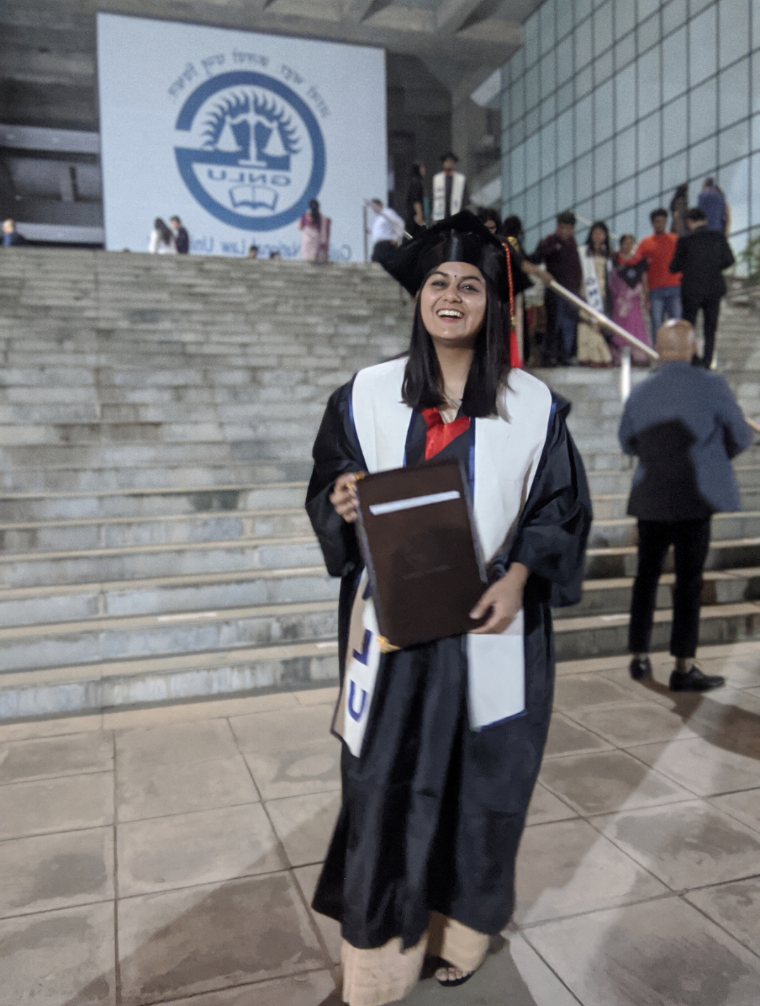
Tag: NLSIU

  • Prateek Lakra, Founding Partner at Clergy & Wisemen, In a Discussion With SuperLawyer On Legal Management & Increasing Opportunities In Same

    Prateek Lakra, Founding Partner at Clergy & Wisemen, In a Discussion With SuperLawyer On Legal Management & Increasing Opportunities In Same

    This interview has been published by Prabhjot Singh, Priyanka Karwa and The SuperLawyer Team

    What was your motivation behind choosing law as a career?

    Growing up in a family of doctors, I was surrounded by medical professionals and it was expected that I would follow in their footsteps by pursuing a career in medicine. However, as I progressed through my education, I began to have doubts about whether that was the right path for me. In my ninth grade, I developed the habit of reading the newspaper and became interested in the impact of law on our daily lives by reading articles and editorials. Additionally, I have always been drawn to challenges and the idea of making a name for myself in a unique field.

    By the end of my tenth grade, I had made the decision to pursue a career in law, despite the surprise of those around me. I chose commerce instead of biology and started my Law School preparations. Fortunately, my parents were incredibly supportive of my choice to study commerce after completing tenth grade and pursuing Law as a career.

    What were the challenges that you faced in the beginning of your career?

    The legal industry is known to be challenging and dynamic, especially for first-generation lawyers who are just starting out. When you embark on a career in law, you often have to start from scratch, building your own law firm, acquiring clients, and establishing your practice and reputation. After completing my LLM from the United Nations Interregional Crime and Justice Research Institute, I partnered with Avi Kalra to start our own law firm. While we faced many challenges in the beginning, a few stood out as particularly difficult.

    One of these challenges was that, at 24 years old, many potential clients saw me as too young to handle their cases or offer sound legal advice. I had to work hard to prove myself and earn their trust, often competing with more experienced lawyers in the industry. Another major challenge was financial. In the early days of our law firm, we had to cover our running costs and basic expenses while also trying to sustain our business. The second wave of the COVID-19 pandemic made this especially difficult, I was sleeping in the office, I could not afford a place to live and I had to choose between keeping the office or getting a place to live.

    Prateek, do you think that for a first-generation lawyer, the journey becomes a little difficult? Please explain the same wrt to your own experience.

    Absolutely, I feel that the journey becomes a little difficult for first-generation lawyers as there are lot of factors to it. Starting with your law school days, being a first generation lawyer you’re clueless as what specialization to pursue that would be best suited for you or with finding right Internships and it becomes a difficult process to apply for Internships with reference at all. Secondly, if you plan to start your own law firm/ law practice you’re all alone out there, you have start from ground zero, you have no cases, no references, no identity of your own.

    Thirdly, ‘the doubt’, since you’re the first in your family, ‘the doubt’ to work security, sustainability and expansion is always there and there’s no going back but I think being a first generation lawyer out there might be difficult process but it gives you a lifelong learning and a sense of achievement that cannot be compared to anything.

    Nowadays, people don’t have that zeal to pursue a career in litigation, what can be the reason for that apart from job security in corporate?

    When I conduct job or internship interviews, I often ask candidates if they are interested in joining the litigation or corporate team at the firm. More often than not, the answer is the corporate team. There are several factors that can influence a candidate’s decision to pursue corporate rather than litigation. One reason is that litigation can be like going to war, and one must be prepared for any situation.

    Additionally, the practical knowledge gained through litigation is significant, but it can also be a struggle. The lack of efficient judicial infrastructure, such as outdated buildings and complicated case filing processes, can be a deterrent. Additionally, the practice of law can vary significantly from one district to another, making it difficult to navigate, for example in Delhi courts the matters are called according to the list but if you go to the Gurgaon court the list is not followed and your matter is taken up as you approach the court. Furthermore, when litigating, the burden of representation falls entirely on the shoulders of the attorney, who must ultimately represent their client in court. It is no small feat. Additionally, it is important to consider that the salaries in litigation may be lower in comparison to the amount of work and energy required. It is a demanding field that requires a significant investment of time and effort.

    Prateek, What was it that kept you awake in your pursuit of success, eventually leading to you being the founder of Clergy & Wisemen?

    The concept for ‘Clergy & Wisemen’ was first formulated during my third year of law school, when Avi and I won our first National Trial Moot Court Competition. However, it wasn’t until after the first wave of the COVID-19 pandemic that we decided to officially establish the law firm. We recognized that starting a successful law firm required careful planning and preparation, and so we took a break after law school to further understand the Industry and gather the necessary skills and knowledge.

    During this time, I pursued a master’s degree at the United Nations and continued to meet new people and learn as much as possible about starting a law firm. The idea for ‘Clergy & Wisemen’ evolved and was refined through constant learning and experimentation. Even after starting the firm, we faced challenges, particularly during the second wave of COVID-19 when business was slow. However, we remained committed to our goals and continued to read, learn, and develop our legal processes in order to succeed.

    Starting a law firm at the age of 24 with no clients was a risky endeavour, and many people did not believe in our idea. However, we were determined and clear about our goals, and we consistently worked towards achieving them. Despite the challenges and doubts, we were committed to making our vision a reality. It is important to be consistent and persistent, and to always strive to overcome any obstacles that may come your way.

    Among all the specialisations, i.e., legal management, compliance, advisory and litigation, which area of law is the most interesting to you and why?

    I would say Legal Management. Legal management involves managing the legal affairs of a corporate or startup entity. This includes ensuring compliance with all laws and regulations related to contracts, taxation, licenses, and more. At ‘Clergy & Wisemen,’ we provide legal management services to a variety of companies, including protecting and regulating their intellectual property, managing the contract life cycle, and handling compliance requirements. Working in the field of legal management is constantly challenging and rewarding, as there is always something new to learn. It is important to stay up-to-date with laws, regulations, and notifications, which can be particularly challenging in areas with regularly updated laws or numerous notifications, such as with the Goods and Services Tax. Additionally, legal management often involves managing litigation, providing a well-rounded experience that encompasses both the corporate and litigation aspects of law.

    Prateek, how do you see the legal management sector increasing more opportunities for lawyers in coming times?

    The demand for legal management services has increased in recent years with the rise of startups, as these companies and corporations aim to avoid costly disputes and litigation. Legal management ensures compliance with all relevant laws and regulations, providing a cost-effective solution for these businesses. Companies with large operations may also choose to hire in-house legal managers to handle their legal affairs. If you enjoy working with various disciplines of law, legal management is a rewarding field to consider.

    How do you push through your worst times?

    Starting my own law firm has been filled with ups and downs, and there are still many challenges ahead. There have been times when I have questioned myself and doubted my abilities, and it can be easy to feel consumed by these negative emotions. To get through these difficult times, I try to maintain consistency in my work and personal pursuits and focus on activities that contribute to my own growth and the growth of the firm. It is important to prioritize one’s emotional well-being, no matter what the circumstances may be. Ultimately, the key to navigating challenges is to work smart, stay consistent, and keep moving towards your goals while also taking care of your physical and mental health.

    Talking about work-life balance, there has been ample amount of discussion on health   issues as a lawyer, what do you believe are the best practices to maintain the equilibrium? 

    Maintaining balance in life is crucial, and achieving a healthy work-life balance is essential for both personal well-being and business growth. While building ‘Clergy & Wisemen,’ I lost sight of this balance and found myself working excessively long hours, leading to negative impacts on my physical and mental health and personal relationships. Recognizing the importance of balance, I made changes to my lifestyle, including waking up early, exercising, and prioritizing time for friends and family.

    These efforts have had a significant impact on my overall well-being and productivity. I also try to be mindful of the number of hours we work at the firm, although there are occasionally times when additional hours are necessary. Regardless of the demands of work, I make it a priority to prioritize my physical and mental health by waking up early, staying active, and spending quality time with loved ones. This simple habit of waking up early has made a dramatic difference in my life and I highly recommend it to others. It helps to make the days feel longer and the mind feel clearer, leaving you full of energy.

    Few advice for our young law professionals?

    Know your goal;

    Work smart, not hard;

    Be consistent;

    Health is always first and

    Do what you love.

    – PRATEEK LAKRA

    Get in touch with Prateek Lakra-

  • Ekta Bahl, Partner at Samvad Partners, Accredited Mediator at Singapore International Mediation Institute In a FireSide Chat With SuperLawyer On Role Of AI & Legal Technology In Legal Profession

    Ekta Bahl, Partner at Samvad Partners, Accredited Mediator at Singapore International Mediation Institute In a FireSide Chat With SuperLawyer On Role Of AI & Legal Technology In Legal Profession

    This interview has been published by Prabhjot Singh, Priyanka Karwa and The SuperLawyer Team

    Did you always want to become a Lawyer or was it something that you decided in the later part of your school life? What other career options would you have considered, if not law?

    While in school, there were a lot of things that I was interested in – Biology, Computers, Design (not Fashion), etc and I was exploring careers in those areas. Law was not really on the radar even though my paternal grandfather was a practicing lawyer and his father, grandfather and several of his siblings were lawyers. I had written the entrance exam to National Institute of Design since I had a thing for magazine covers and even had an admission in Microbiology after my twelfth standard.

    Law came into the picture courtesy a friend who was going to write the entrance exam for NLSIU and I tagged along with him. When I made it through, my mum was unsure and she spoke to my god-father who convinced her that NLSIU was a good school and that I should take it up. The rest is history.

    How do different approaches of adjudicators help in critical thinking? Do you believe that it helps in understanding cross-cultural overlaps in legal systems?

    The profession of law, is all about interpretation of the law to a given set of facts, irrespective of which area of law you are practicing. The context, nature and circumstances may change, but a lawyer will always need to be able see what law “fits in”.  In my view, “critical thinking” as a word is an abstract term and the interpretation of that itself can spark a debate.

    There is a co-relation between law, logic and reasoning. I also believe that each of us have inherent problem solving skills. It is these skills that we need to focus on and hone. If we get lost in the complexity of legal issues, we will forget the most fundamental of them all.

    While it is important to observe and learn from different approaches used by different from of adjudicators, it is equally important to understand which of these approaches work for you and then adapt accordingly. At the end of the day, you need to be your own person.

    When it comes to understanding cross-cultural over-laps in legal systems, while it may give you a well-rounded understanding of the world-view of legal jurisprudence and shape you as a lawyer and a person, the choice of whether it is a necessity or not, will eventually boil down to whether it is something that you need in your chosen practice area.

    Do you believe that being related to a family of lawyers helps in this profession? 

    I am a believer of hard work, smart work and merit. While having lawyers in the family, may provide an initial push, your growth is where you take it. If you look at the who’s who of the legal fraternity today, you will find a significant number of professionals in that list who do not come from a family of lawyers/have close relatives who are lawyers.  

    Being specialised in technology law matters, how do you think this area will evolve in the future? 

    My areas of specialisation are not limited to technology laws. I also do a significant amount of work in the area of life-sciences and healthcare and real estate. Additionally, I am a trained mediator.

    Technology has infiltrated almost every area of business and consequentially every area of law – it has become a suffix used with other areas of specialization – and we will see more of that. For example, fintech, medtech, healthtech, biotech, edtech, etc.

    Technology has always pushed the boundaries of traditional legal concepts/understanding and even technologies in the early 1990’s drove conversations around “jurisdiction” and “person” – issues that we are still grappling with. Technologies such as blockchain have triggered discussions when it comes to smart contracts and crypto-currency.  

    Technology will also impact the way we do our work as lawyers, as some mundane and routine tasks will be digitised or be undertaken by using artificial intelligence. We are seeing that even today. When I started working, we went to the office of the registrar of companies do undertake a manual search for the purpose of a legal due diligence, then came online search of the documents on the website of the Ministry of Corporate Affairs – today we have AI tools that give you the entire search report and that too customised for what you are looking. You also have automatic document generators that can prepare first cut drafts of agreements. Technology is also assisting in dispute resolution.

    There is innovation happening at a faster pace than ever and we see emerging technologies being announced almost every day. Some of these emerging technologies will disrupt our lives and the way we think and work. We may see the need to amend existing laws, pass newer legislations, think of interpretation of law differently because of these emerging technologies. We also need to really evaluate as to the real value that we bring on the table as lawyers, which is something that technology cannot replace or replicate.

    AI and the role of legal technology in our profession is literally booming, do you think it will create further opportunities for young law professionals ahead?

    As mentioned earlier, AI and technology have already made inroads into the legal profession. While there are tools that assist us, they have also made certain mundane tasks that were done by people almost obsolete. The use of AI and technology in law will increase. However, it is important to differentiate the use of such AI or technology as a tool for lawyers (such as case management software, case search engines, etc) or to reduce the reliance of parties on lawyers (such as document generators) is something that legal professionals need to understand.

    A legal professional needs to be able to use AI and technology as a tool and also be able to understand and adapt to future tools. On the other hand, legal professionals need to be aware of the impact that future technologies will have on the profession of law and constantly upskill themselves for any possible disruption.

    Having said that, whenever we see disruptive new technologies, there are legal issues that go hand in hand and in some instances, we see newer business/industry verticals arising as well as newer learning. As mentioned earlier, we may see the need to amend existing laws, pass newer legislation’s, think of interpretation of law differently because of these emerging technologies.

    Newer opportunities will arise and young professionals need to keep up with the emerging developments in AI and technology to identify them.

    Please tell us a few challenges that being a mediator one has to be prepared for facing?

    Mediation is an emerging field in India. While it has been in the law books for over two decades, in some form or another, it has been in the spotlight only in the last couple of years.

    The law makers, courts, lawyers and most of all, the litigants or parties in conflict are still not aware as to what is mediation, the role of a mediator and how mediation can be used as an effective dispute resolution tool.

    Lawyers in mediation need not be only mediators. Lawyers also represent parties in mediation and they play a significant role in the mediation process. The focus so far seems to be on the mediators. However, the challenge really is having good counsel to the parties in mediation.

    Counsel to disputing parties play an important part in a mediation since they are the ones who understand the dispute from a legal perspective and are also who the parties usually trust at the first instance. The counsel also plays an important role in preparing the parties for mediation. Unfortunately, because of a lack of awareness, this preparation for mediation is seldom there and this can derail the mediation process or result in delays. Additionally, most conversations on mediation happen from either from the perspective of the mediator or on the process, but there is little conversation that happens on the role of the counsel.

    Infact, young lawyers who feel passionate about mediation, should really look at the skills required for them to be able to support and engage their clients effectively in mediation.

    Ekta, what has been your motivation for reaching thus far in life? I mean, how do you make yourself well equipped for every challenge?

    I would love to say that the challenges that every new matter brings is the motivation for me. However, that is only a small part of what motivates me. I am a very people person, so my partners, my team and clients keep me motivated to continue. I learn and reflect from my interactions with them. And for that, I am forever thankful and grateful. Adding to that bundle is the constant learning – it keeps me on my toes and keeps monotony at bay. I am forever reading and learning as the law keeps changing and this also keeps me motivated.

    I do not believe that we are always equipped for every challenge. If we were, the challenge would cease to be that – a challenge. Rather, I am always open to deal with and handle any challenge, and for that I broadly follow the following steps

    (i) keeping an open mind – my existing thought process/opinions should not cloud my judgment;

    (ii) taking a pause and reflecting on the challenge to understand it – so that I do not hurry into it without a full understanding of what I am dealing with;

    (iii) break down the challenge into smaller pieces – this gets me to understand the real issue or challenge;

    (iv) deal with the pieces that I am familiar with – comfort of being in a familiar territory;

    (v) consult with others and discuss issues that I do not understand – I am not always right and another view gives me additional perspective;

    (vi) look the final outcome holistically after putting together the pieces and see if I am satisfied with the outcome as a whole – pieces may make sense individually, but they also need to work as a whole.

    Lastly, any few suggestions for our young law professionals?

    Find yourself and be yourself – as a person and a professional. Develop your own working style, including your own language. While you may learn and be influenced by best practices, being a copycat of someone else’s personality or working style may seem good in the first, but in the longer run it catches up with you and you may not be able to keep up.  

    EKTA BAHL

    Get in touch with Ekta Bahl-

  • Rugved More, Senior Associate at Trilegal, In a Discussion With SuperLawyer On Career In Litigation & Tips To Stay Update With Recent Legal Updates

    Rugved More, Senior Associate at Trilegal, In a Discussion With SuperLawyer On Career In Litigation & Tips To Stay Update With Recent Legal Updates

    This interview has been published by Prabhjot Singh, Priyanka Karwa and The SuperLawyer Team

    What motivated you to choose law as a career? And how has been the journey so far for you?

    Legal mind was always in the family blood. However, none of them were practicing. I won’t lie that some fascinating story pulled me into law. I just took an aptitude test and law was the most favorable outcome for me. It just was inevitable after that. The journey so far has been amazing. Although, I do have an interesting tale on why I picked litigation. Superlawyer played an important part in it. During my internship, I read two of the interviews published by Superlawyer depicting the interviews of some lawyers who were then working at the first Law Firm I eventually worked with and that’s how I applied for an internship at the same firm which later turned into a PPO. 

    What were the challenges that you faced in the beginning of your career?

    Coming from a non- NLU college always demotivated me when my application for internships used to get rejected. However, I looked at the brighter side and due to my non-NLU background, I took up as many internships as possible. I also was lucky enough to take up long-term internships as non-NLU colleges afforded me that opportunity. These long-term internships were instrumental as they later turned into a job. 

    What is the most challenging case you have handled in litigation and what were your learning’s out of it? 

    The most challenging case was an international arbitration which was conducted in the summer holidays of the Bombay High Court. Though the matter was eventually settled, my biggest learning was to always be prepared. I was in a vacation zone and thinking that I should probably relax a little and this matter came out of nowhere (which tends to happen a lot in law.) It taught me to always expect the unexpected. 

    How do you ensure that your clients receive the best possible outcome? 

    I don’t think about the outcome as taught by my Mentor. I ensure to give them the best possible strategy and advice. Thinking about the outcome is like flipping a coin in litigation. As I mentioned above, expect the unexpected. 

    What strategies do you use to prepare for a litigation case? 

    Strategy changes on a day to day basis. A strategy today might not be the strategy tomorrow as it changes according to where the matter is going. Law is a lot like chess. You can’t plan your next move until your opponent plays his. 

    A fool-proof basic strategy is to just always be prepared and read the brief fully. 

    What advice would you give to someone considering a career in litigation law? 

    My advice is not only to anybody choosing litigation but to any budding lawyer. 

    A. Always be prepared for any and all matters that you’re handling;

    B. To set boundaries at workplace from the start of your career;

    C. Your health is paramount and with lawyer’s hours, you will have to put in the extra effort to maintain it.

    7. What do you consider to be the most important qualities of a successful litigation lawyer? 

    As learnt from my mentor, a successful litigation lawyer needs:

    Cool mind, amazing drafting skills, to be updated with the law, enough confidence to face any judge or lawyer appearing against you and to convince your points, to be open for learning and also open to learning from mistakes; and that clients are built by trust. 

    How do you stay up to date on changes in the law and legal practices?

    I utilize my travel time in reading articles and notifications on my phone. Also the articles shared by the Knowledge Management teams of law firms help you a lot to understand

    Among all the specialisations, which area of law is the most interesting to you and why?

    I have always been practicing as a general litigator which has allowed me to gain experience in commercial, criminal, IP, IBC and arbitration. Therefore, having a specialization is not my Forte. I endeavor to be a master of all trades and to excel in all.

    How do you maintain the work-life balance?

    Finding a right Senior is the key to maintaining a work-life balance. 

    Work is abundant wherever you go however having a good team who knows how to differentiate between work to be done on priority and work which can be put on a backburner is important. 

    Also, it never hurts to have a good conversation with your senior if you ever feel burnt out.

    What is one piece of advice you’d give to our readers, who are looking for a career in the same profession?

    Do not target working with any particular firms at the start of your career. You are eventually going to reach where you are supposed to be; at the right place and at the right time. Also, do not fall in the trap where most of the young lawyers brag about working for 20 hours continuously as it is not recommended nor is expected. 

    Not all late night burning lamps lead you to success; some lead you to health issues.

    Working hard is always a good thing but working smarter will benefit you. 

    How do you feel when you lose a matter?

    Keeping practicality aside, it definitely feels bad when any order is passed against you but law is a learning experience. Any loss can be converted to a learning and it can be used to win another matter and I have done that on numerous occasions. 


  • Sunila Awasthi, Partner at AZB & Partners In a Discussion With SuperLawyer Giving Insights On Practice Areas Such As Corporate Advisory, Employment Laws, And Information Technology

    Sunila Awasthi, Partner at AZB & Partners In a Discussion With SuperLawyer Giving Insights On Practice Areas Such As Corporate Advisory, Employment Laws, And Information Technology

    This interview has been published by Prabhjot Singh, Priyanka Karwa and The SuperLawyer Team

    What was your motivation behind choosing law as a career?

    While I did not consciously plan a career in law, circumstances led me into it. While in Class 12th, my favourite subject was political science and when it was time to decide on graduation, Lady Shri Ram College for Women was my first choice because of its reputation as an excellent college.  I was fortunate enough to get in and it was a life-changing experience for me. It was at LSR I learnt that staying silent (when you really had so many questions to ask) was injurious to only yourself – something that has helped me tremendously in my journey and I pass it onto the new generation! Parallelly, the trajectory of my personal life had already made me super conscious of rights of women at a very young age so the desire to know the legal position had taken a strong hold.

    Additionally, the family had been engaged in civil litigation for long and I was exposed to legal documents, working of litigation system in our country and the immense frustration that came with delays! After graduating in Political Science Honours, I decided to study law and joined the Faculty of Law, Delhi University. My sole motivation to have a career was financial independence and it turned out to be a career in the legal profession. Frankly it was unplanned, but I deeply believe that it was destined for me.

    What were the challenges that you faced in the beginning of your career?

    The first challenge was to find a job which did not require me to be a litigator! I passed out as a lawyer in 1992. No one, including myself had heard of “corporate law”.  But I had absolute clarity that I was not going to practise as a litigator. This puzzled my family as they would ask “then why did you do law?”. I had no answer only a strong belief that there must be something a lawyer can do which does not require her to go to court! I had witnessed the pathetic legal system during the 1980s and early 1990s, with its accompanying unimaginable harassment of litigants.

    The disastrous infrastructure of the courts at Tis Hazari, one of the district level courts at Delhi and only slightly better facilities at the Delhi High Court, were equally demotivating factors. Being a first-generation lawyer and not knowing any lawyers to guide me, I was clueless.

    I would look up classified ads in the newspaper and go for interviews in small companies looking for in-house lawyers. The few interviews that I did have, stalled at my refusal to go to court. In desperation I picked up the yellow pages of the telephone directory (yes, that was during my lifetime!) and shortlisted 10 law firms listed in that (my sole criterion was the distance I would have to travel in the DTC bus from my home – an unavoidable nightmare for any Delhi girl!). To cut a long story short, it was serendipity which brought me to Ajay Bahl & Co. which was looking for a lawyer who did not want to go to court since its corporate law work was just starting to pick up!

    The second challenge was related to the environment in which I started my corporate law career – remember this is 1993 – no precedents (for Joint Venture Agreements etc.); no computers or internet, no search engines or data resources – only physical books; recent economic liberalization meant that everything was new for the regulators, the clients and the lawyers – exciting times full of potential but also a lot more of extra effort was required and the learning curve was really steep! Looking back, I feel it were those initial challenges of scarce resources and limited support which honed my skills to be able to roll up my sleeves and dig in – persistence, resilience and sheer grit to make it happen!

    Sunila as per you, what are the skills required for being a corporate lawyer and any roadmap that a professional should follow to be the same? 

    This is a very difficult question to answer. I have seen such varied people with different skill sets doing well as corporate lawyers that in my view it boils down to individual abilities and destiny. But in general, based on my observations and personal experience, some of the essential skills in today’s scenario are

    (i) an analytical mind to be able to understand the rationale of what we are advising clients;

    (ii) effective communication, whether verbal or in writing, so that non-legal persons can also understand your advise; (iii) confidence, which comes from doing your home-work well – that requires knowledge of the law, doing proper research (as opposed to Google search!), understanding the client perspective and business needs;

    (iv) having an eye for detail and at the same time ability to look at the big picture;

    (v) ability to think things through – this helps tremendously in not giving theoretical advise to clients – world over businesses push advisors to think out-of-the-box to provide workable solutions which are also legally complaint;

    (vi) integrity – towards your profession, the law, your colleagues, organization and clients. Clients disclose the most sensitive commercial information relating to their business to their legal advisors so gaining and maintaining that trust is life-long effort!

    In hindsight I have not followed a roadmap, so I am unable to prescribe a roadmap as I believe its every individual’s journey that she has to undertake.

    Among all the practice areas, i.e. corporate advisory, employment laws, Information Technology, e-commerce, etc, Sunila, which one do you find the most interesting and challenging? 

    I have been fortunate enough to gain experience in diverse practice areas within corporate law at different points in time and each have been, in their own way, interesting as well as challenging. When I first started, I drafted commercial contracts taking help from conveyancing books! When you draft something from scratch, you understand the legal basis for which each provision that is included in the contract and sync it with client requirement. Today, with standard template forms and existing precedents, this opportunity to learn drafting is a huge loss to the profession. For me, the next phase came quite quickly because India had entered the era of economic liberalization.

    Those initial years kept corporate lawyers like me very busy with Joint Ventures & Technical Collaborations with its related drafting & negotiating contracts; obtaining regulatory approvals for foreign investment; advising foreign clients on setting up operations in India which included a whole gamut of laws relating to employment, leasing of offices, compliances and the like.

    There was never a dull moment in those days! Then the mammoth legal due diligence exercises took centre-stage. The excitement revolved around which new city the DD team was going to be based in and for how many days! I found the DD exercises gave incredible opportunity to learn about new laws, regulations and understanding different businesses. The variety for me ranged from alcohol industry, automotive parts, media, pharmaceutical companies to IT and BPOs. The advent of the Information Technology Act, 2000, again shifted the focus of work for me and new practise areas were evolving with online businesses throwing new challenges.

    The big technology companies with large workforce brought its own employment related challenges and learnings. The focus expanded to employee issues including sexual harassment at the workplace. Laws kept changing trying to keep pace with technological developments and new businesses in fast-changing corporate world. I believe the last decade or so has seen the fastest growth in terms of new practise areas for corporate lawyers with data privacy, e-commerce, fintech, crypto, ESG (environmental, social and governance), gig economy and therefore gig workers and the like taking centre stage. From my perspective, even after 30 years, what’s not to love about corporate law?

    How do you push through your worst times?

    The support of your family and your workplace is vital especially in tough times! I have been blessed in both these areas and it is their support which has made it possible for me to face any and every challenge and come out stronger. Over the past few years, for personal reasons I have been actively practising “Gratitude” and “Forgiveness”, including by attending programs conducted by subject-matter specialists, and I have benefitted immensely from it in my professional life too. It has given me a different perspective on life, made me calmer, less stressed and given me the strength to push through some of the toughest times with equanimity and grace. The fact that these changes make it easier to deal with tough clients or work situations is a bonus!

    Talking about work-life balance, there has been ample amount of discussion on health issues as a lawyer, what do you believe are the best practices to maintain the equilibrium? 

    I believe that there is no perfect formula to achieve the right balance simply because the balance must be decided by each person individually. Long before work-life balance became a “thing”, I took a very conscious decision to prioritize my family without compromising on my professional role – this is easier said than done in real life, but I still follow it. Once there is clarity on this, not only will you subconsciously work in sync with this principle, but circumstances also arise which will be conducive to achieving this objective. To use my favourite line, it is as if you set a positive intention for yourself, and the Universe conspires to deliver it to you!!

    The other important decision that I took consciously was to build a team which would make my life easier because no one can be on the treadmill constantly and forever! My mantra was, and continues to be, mentor people to take your place so that you get to get off the treadmill whenever you want to slow down or take a break. There should be no place for insecurity as there is no substitute for experience.

    My workplace gave me freedom and flexibility to achieve this objective and I am grateful for that support. The starting point for this is the coming together of people with right work ethic/drive/passion and committed to their own professional growth as well as the growth of the team and therefore the organization. Teamwork means you can delegate, share responsibilities and distribute the pressure, hopefully equitably – what better way to grow professionally without compromising on family time or “life outside of work”?

    I am also a great believer in taking periodic breaks with complete disengagement from work– whether for family vacations or doing some programs for mental well-being. I also encourage team members to plan vacations or short trips at periodic intervals and spend time with family – in my book switching off is good for rejuvenating your mind and re-charging your batteries – both for personal and professional life – so the work-life balance happens organically. Finally, if one is assured of support from team leader, team and the workplace in times of personal emergencies or family crisis then the major cause for stress is automatically removed.

    How do you make contract drafting and managing look easier for your clients? Our readers are interested in knowing that.

    I am not sure about this question? Most big companies today do contract management internally and do not look at external lawyers for this function. And as I mentioned above, no one is doing drafting today – everything is templated.

    Sunila, could you highlight some of your success habits that enable you to meet your goal?

    If you work as part of an organization then understanding the ethos of your workplace is very important. I have always been a team-player and not pursued individual glory – nothing wrong with pursuing that but I personally have not been motivated by it. As I said earlier, financial independence was my sole driving force to pursue a career. However, over the years, witnessing that your individual success is intrinsically linked to the success of others working with you and of your organization, it motivated me to make conscious effort towards building a solid team which imbibes the true philosophy of the organization.

    Our objective is to deliver the best quality & effective legal advice and support to clients in a timely and cost-efficient way. Simultaneously, the workplace environment provides equal opportunities, encourages dedication to work without compromising on personal priorities, recognizes talent & merit and rewards excellence & commitment. It may sound unreal, but it has been experiential for me. 

    Building a sustainable team has been at the core of my professional success. In my experience, individuals working together cohesively, appreciating & supporting each other while subscribing to same core values tend to thrive. And to make an effective team I put great emphasis on

    (i) mentoring juniors,

    (ii) delegating work & responsibilities while being accessible for guidance,

    (iii) direct interaction with clients,

    (iv) providing regular feedback including appreciation,

    (v) pro-active thinking & taking initiative,

    (vi) professional conduct & integrity, no matter the circumstances,

    (vii) trainings to enhance knowledge building/sharing & staying updated,

    (viii) equitable opportunities to grow individually,

    (ix) support in personal crisis,

    (x) rewards and recognition.

    I firmly believe that the present status of my professional life reflects a sense of belonging and being invested in my work and workplace. Flexibility to evolve and adapt with changing times, openness to keep learning and hear/implement new ideas, approachability and humility have all been contributory factors as well.

    If you could do it all over again, would you choose the same path for yourself? If not, what would you change?

    As I said previously, I did not consciously choose this path, I believe the path chose me! I don’t really believe in do-overs, so I guess at this stage in life I would not like to speculate what could have been…I think it’s a waste of time. What is, it is – that’s all.

    What advice would you give someone who is considering being in this field?

    Do not be blindly allured by the so-called glamour and money associated with a career in corporate law – it is a lot of hard work, nose to the grind, sheer dedication and commitment, before you see the fruits of your labour – this is true for any profession or career. The pressure is compounded by essential requirement to stay up-to-date with any changes in laws/ regulations; case law including impact of judgements or interpretation by courts or regulators. I cannot think of another profession which requires this constant necessity to be fully aware with the latest (legal) position – even if it pertains to knowledge of only your area of practise.

    Finally, in my experience, two factors which are highly overrated, which seriously impact law students or in-coming lawyers in corporate law practice, are firstly, the pedigree of the law college and secondly, the internships done while studying law. I may be old-school, but I sincerely believe, both these factors make little difference as long as the candidate is clear in her focus on what she wants to do and why.

    In all my hiring for my team since I became a partner almost 15 years ago, I have never reviewed a resume based on law college or internships or even previous organization. Having most of the best performers from so-called worst or average law colleges and unknown law firms, I believe it is mostly individual capability and drive which determines the professional path of every person (of course on an esoteric level, I would add destiny or serendipity to it as well!).

    So do not get bogged down by “pedigree” of your law college or “status” of law firms or organizations you intern or previously worked with (whether its Tier I or not etc.), instead focus on what is it that you want to do and how would you want to achieve it.


    Get in touch with Sunila Awasthi-

  • Khushboo Luthra, Associate Partner at Singhania & Partners LLP In Conversation With SuperLawyer On Importance Of Practice Development Department For Growth Oriented Firms

    Khushboo Luthra, Associate Partner at Singhania & Partners LLP In Conversation With SuperLawyer On Importance Of Practice Development Department For Growth Oriented Firms

    This interview has been published by Prabhjot Singh, Priyanka Karwa and The SuperLawyer Team

    Why did you pursue LLB after MBA-Marketing?

    A lot of what happens in our life is because of going with the flow. There were forces around me which pushed me towards law. I finished my MBA during the subprime crisis and had a few friends who were UPSC aspirants, and we used to have enriching discussions around laws, governance, economics, policy, management, international business, and regulatory environment etc.

    Law interested me and I decided to appear for University of Delhi’s Law Entrance Exam without any pressure in my head as I had already secured a PPO from Confederation of Indian Industry after my MBA-internship there. That year most of the law entrance exam was focussed on current affairs and I did not know those socialisations with friends will help me clear the entrance exam.

    You got a job at a Band 1 firm as a professional support lawyer, but you choose law practice development as career?

    I had a good 4 year long and successful stint with industry chambers early in my career. I was fortunate to get international exposure as well. A friend referred my CV for the opening as a Professional Support Lawyer in a renowned law firm and I got an opportunity to work on competition law matters with the finest minds in the country.

    I had thoroughly enjoyed my work in FICCI which involved a lot of marketing-communication, events, writing, and media relations but soon I realised that I was not enjoying being the “lawyer”.

    My heart wanted to pursue a career in management of business of law. Then I got this opportunity with Singhania & Partners which resonated with me and was a perfect opening aligning with my education background (MBA & LL.B.) , interests in communication management, and experience.

    Tell us something about Singhania & Partners and your role as Head- Practice Development at the law firm.

    Singhania & Partners is a full-service law firm and is one of the best places to work. We are recommended in the area of Corporate-M&A, Arbitration & Litigation, Employment Law, Banking and Finance etc. Over the years firm has established itself as an expert in construction disputes and infrastructure sector.  

    I joined the firm as Practice Development Manager in 2015 and was managing communications. Soon after that Mr. Ravi Singhania, Managing Partner entrusted me with implementing his vision which was to ensure that quality and correct legal content should reach information seekers through digital means. Later on, I also led the digital transformation within the organization which is still a work in progress. Over the years my role has expanded to include campus outreach and internships management as well besides other strategic practice development initiatives of the firm.

    What is your two cents of advice for other similar organizations planning digital transformation?

    Having a vision on the objectives of digitisation is an absolute must for driving the digital strategy and creating a digital ecosystem for growth driven firms. No organization would regret investing in technology, each organization is on a different learning curve and systems and processes will continue to improve once we are on this journey. Sooner you start the better it is.

    However, it is must to have a clarity on the objectives of digitisation. For instance, one should know whether through digitisation we are trying to improve marketing and client outreach or reduce duplicity of efforts in matters management, HR process improvement or internal records management or creating a digital ecosystem.

    Lastly, whatever is the objective of investing in technology make sure you click with the service provider. Service provider is as important as the software you are purchasing. Interview and assess the delivery team assigned to you. Make sure that the implementation team is committed, has shown the stability with the company and have genuine interest in understanding your business and its people. Document minutest of details, work on end user feedback, improvise, and check progress regularly.

    Why it has become strategically important to have a practice development department for growth oriented firms?

    We are living in information age; organizations must invest in ensuring that the right communication about their expertise and services reaches to information seeker. Practice development department bridges this gap and play an important role in ensuring visibility across social media, reputation management, and website management through knowledge management of the firm.

    They help create right internal and external communication to create a cohesive experience, and unified message for the prospective customers, prospective employees, internal and external stakeholders, and clients across all digital and physical platforms.

    They do so through various means such as informative content dissemination to demonstrate the firm’s expertise, managing submissions to legal directories, maintaining a record of the firm’s engagement, and facilitating conversations between fee-earners and service seekers.

    There are a lot of start-ups around law practice development consulting. Do you see law firms outsourcing this work to these start-ups?

     Yes, there are a lot of start-ups around practice development consulting of law firm. This is a growing area. However, in my opinion, no outsider can do much to assist in practice development till the firm leaders do not have the buy-in of fee-earners. Planning and execution are two sides of the same coin, the consultants might give good suggestions and plan for you but there is more to it than meet the eyes and at the end execution of these initiatives cannot happen without the involvement of internal stakeholders. If your internal team/ fee-earners are not aligned with you in meeting the practice development objectives consultants won’t be able to deliver much. Those who will be able to bridge the gap between planning and execution will survive and flourish.

    What advice would you give to someone considering a career in the legal field?

    I would recommend aspiring lawyers to do as many internships as possible and take exposure in different practice areas. Even if you have decided on practice area for you, I would recommend that lawyers should do internships in other practice areas as well to develop a holistic perspective.

    I strongly advocate that law students must do internship in the practice development departments of the law firms, and it becomes even more important if they want to establish their own practice after finishing their law degree.


    Get in touch with Khushboo Luthra-

  • Jyotsna Jayaram, Partner (Technology, Media & Telecommunications) At Trilegal In a Quick Chat With SuperLawyer On Importance Of Unconventional Skills For a Lawyer

    Jyotsna Jayaram, Partner (Technology, Media & Telecommunications) At Trilegal In a Quick Chat With SuperLawyer On Importance Of Unconventional Skills For a Lawyer

    This interview has been published by Prabhjot Singh, Priyanka Karwa and The SuperLawyer Team

    What inspired you to choose law as a career? How has been the decision so far?

    I have always been fascinated by the impact that words – verbal or written – can have and when I was in school I was always drawn to the law as a profession, particularly because of the command over language that it requires. Of course as with most children that age, I had romantic notions about becoming a criminal lawyer and being in the thick of high profile cases. However, as I prepared to join law school, I wanted to focus more on gaining a strong knowledge base of all laws before I decided on what to specialise in. I am glad I made the decision to become a lawyer and the constant learning continues to inspire me to become a better lawyer.  

    What were the challenges that you faced in the beginning of your career?

    The primary challenge was to secure a job. I was in the first batch of my law school and at that point we didn’t have established recruitment processes and most firms did not know us. We all had to work doubly hard towards getting our own internships and interviews and making a mark before we were considered for recruitment.

    Then came adapting to a work environment which was very new, highly competitive and incredibly fast paced. While law school helps build the foundation in terms of basic knowledge that is required to start off, a lot of what you need (even at the start of your career) is learned on the job.

    It was a challenge to switch out of a heavily theoretical and academic approach to a more practical style which required you to think on your feet and come up with creative solutions, while being very thorough with the law and its application. It was a also a challenge to adapt to quick timelines, long hours and a much faster pace of life. That said, the environment at work although challenging equipped me to adapt quickly and feel confident about my ability to move from my life as a student to a working professional.  

    What do you consider to be the most challenging and important aspects in this field of IT law?

    The most challenging aspect of the field of technology law is that it is changing and evolving at a very fast pace. From being a field that was subject to very minimal regulation, technology is now at the front and centre of most regulation – either in the form of new laws and regulations, or as a result of amendments and changes being made to existing laws to adapt to the digital revolution. While I believe that it is crucial to regulate the use of technology, it is important for the law to not be overly prescriptive and compliance heavy as that would be counterintuitive to very nature of technology and its ability to evolve.

    As an IT lawyer, it is important to marry the principles that the laws are based on with the functions that various technologies bring with it in such a manner that innovation is not hampered, and the harms that technology brings with it are addressed.

    This often requires us to go back to first principles, be very aware of how technology is being regulated across jurisdictions and actively following the policy initiatives with respect to technology as they most often set the context to new tech regulation.

    Often times, you will find yourself walking into a grey area with no interpretational guidance where you need to take calls based on several factors including your deep understanding of technology, the intent of regulations and regulatory perception.

    Jyotsna, do you remember any exigent experiences while advising clients on all these regulatory aspects, data privacy, etc. ? What suggestion would you give to our young law professionals to tackle the same?

    The field of technology law is very broad and encompasses several areas such as cyber security, data privacy, e-commerce, digital payments, content regulation etc. Very often these areas intersect and it is critical for us as technology lawyers to be able to address the full spectrum of issues that a client is facing without operating in silos. A good example of this is in dealing with cyber security incidents which have become very common. The nature of cyber-attacks that organisations face are highly sophisticated and evolving each day and as a result our assistance as lawyers in advising clients on regulatory and commercial aspects becomes critical.

    Cyber-attacks often come with several considerations including regulatory reporting obligations, an assessment of privacy issues (if personal data is involved), criminal law aspects while examining unauthorised access, ransomwares etc., as well as building strategy around communication to the data subjects, to the public and depending on the sector, sectoral regulators. Most often these attacks are multi-jurisdictional and require understanding and working closely with lawyers in the relevant jurisdiction to develop a common strategy.

    In order to deal with matters like this, and generally on matters related to data, technology and privacy, I would recommend that young law professionals train themselves to be nimble, highly aware of regulatory trends, enforcement and practices across jurisdictions to be able to advice clients in a holistic manner. It is also important to guide the client on an approach that is future proof and based on best practices and this often puts the client in a much better position than others who choose to only do the bare minimum when it comes to compliance.

    Jyotsna, people have started feeling that corporate is a safe option instead of choosing a longer struggling period in law, do you think the same?

    I do sense that in-house as a choice of profession has gained some more traction recently, however I don’t think this is necessarily because it is considered a ‘safe option’ as opposed to a law firm. I think in-house roles have also become an important choice as the demands of the role are similar to a lawyer in a law firm, with companies ramping up and investing in legal departments.

    In fact, the challenge of dealing with legal issues by being a part of the company as opposed to serving as external counsel, is one of the main factors that I think drives people to choose in-house. That said, I think there is generally a push to rethink how one wants to practice the law and there do seem to be several parallel tracks that have come about for professionals to choose from, instead of joining a law firm or sticking to mainstream law.

    How do you balance your work and personal life ?

    My approach to balancing work and personal life has always been to not view one as restricting or impinging on the other. I am conscious of the decisions I make when it comes to work and personal life and at all times I try and ensure that I am honouring each commitment. That said, if I am unable to manage a perfect balance, I make sure I am not hard on myself. It is not doubt easy for work to overwhelm and capture all your mind space but with time and small changes to my routine I have been able to feel like I am in control of both aspects of my life.

    For example, the time I set out for my exercise, or to spend with my child is sacrosanct and I try and schedule it in a way that does not allow work to creep in and reduce the time I set out for this. If it means I start my day an hour later, then that does not faze me and most things can in fact wait. I try and stick to a routine that is simple and flexible so that I am able to respond to the demands at work and home calmly. I also make sure that I take small breaks from work whenever I can so that I don’t feel like it is always catching up to me.

    A lawyer sometimes is expected to do work apart from legal functions as well, what are your views on the same?

    Absolutely, and this is an increasing expectation even from clients. The demand now is not just to provide sound legal advice, but also to be able to identify and balance commercial considerations in arriving at solutions. This may need you to step in to the shoes of the various stakeholders you are dealing with – for e.g. if there is a new technology product that is being launched, you need to be able to understand the objectives and outcomes from a technology, business and legal perspective.

    Further, as a lawyer, it is also important to be aware of and participate in public consultations and policy making as this often shapes the regulation that comes out. Separately, as a lawyer in a law firm, you also have several administrative functions attend to including billing, matter management, knowledge management and building and business development. All of these functions are equally important as being a lawyer and equip you to be a better and more efficient lawyer.

    Jyotsna, was there any roadmap that helped you thus far in your journey, or any mentor that supported you from the very beginning, please share how was it for you?

    I didn’t enter this profession with a specific roadmap. In fact, when I joined Trilegal I wasn’t sure of what I wanted to specialise in. When I joined, we had a rotation system and my first seat was TMT. I have since then only been part of the TMT practice and I couldn’t be happier with how things turned out. While I am not very rigid with how things pan out and often like to play things by ear, I did set various targets for myself in my journey as a lawyer and what I wanted to achieve. Most importantly, I ensure that I am always growing as a lawyer, and learning new things every day. I always kept (and continue to have) an open mind and as a result I have greatly benefited from the perspectives of my juniors, my peers and seniors.

    The partner’s practice who I started off with has always been a mentor for me and has had a huge role to play in my journey as a lawyer at Trilegal. I have learned immensely from him and the focus has always been to develop a high quality practice that focuses on learning, freedom of thought and self-challenge. It is also important to not lose sight of the importance in building out a safe, respectful and encouraging work space and that has been integral to my journey as a lawyer in this firm.

    While being in a law firm is no doubt challenging and competitive and I have had my share of tough times, overall my experience has been nothing but rewarding and enjoyable and that’s what keeps me so invested in this.

    According to you, what networking strategies should be adopted by the first generation lawyers specifically in corporate?

    Jyotsna: Networking in an orchestrated set up is a challenge for most people and at times is not very effective. I think that networking should be woven in to your practice as a lawyer where you ensure that you are meeting and investing in professional relationships in several inorganic ways. For starters, don’t wait for a specific time in your career to start networking.

    It is never too early and the earlier you start the more natural it becomes for you. Take the time out to think of people that you want to meet and engage with, find avenues to meet that person – it could be a conference, it could be a roundtable discussion or perhaps a knowledge session that you conduct, or are a part of. Keep in mind what to be of interest to that individual and if there are relevant developments, find a way to get your thoughts over to them. Don’t be shy of expressing your opinion or taking a stance as that helps the other person understand your approach and views as a lawyer.

    Most importantly, do not network with an expectation to see immediate results. Building professional relationships comes with its own gestation period and it is important to recognise that. You will find that slowly you will make a mark and people will remember you for your expertise and reach out. And for this you do not have to be the loudest voice in the room.

    Lastly, any 3 best pieces of advice for our young lawyers?


    I would just say keep an open mind, stay on top of all regulatory developments and constantly learn. No amount of knowledge is too much. And find a way to truly enjoy what you do.

    – JYOTSNA JAYARAM

    Get in touch with Jyotsna Jayaram-

  • Aarzu Khattar, Advocate At Khaitan & Partners (SJK) Shares Her Knowledge On Client Counselling, Certain Aspects of Commercial Agreements & Opportunities In Arbitration

    Aarzu Khattar, Advocate At Khaitan & Partners (SJK) Shares Her Knowledge On Client Counselling, Certain Aspects of Commercial Agreements & Opportunities In Arbitration

    This interview has been published by Prabhjot Singh, Priyanka Karwa and The SuperLawyer Team

    What inspired you to choose law as a career? How has been the decision so far?

    My journey to choose law as a career dates back to the day when I accidentally met a judicial officer at one of my relative’s place. After interacting with him, I was fascinated by his personality and his love for the law. Immediately thereafter, out of curiosity, I researched about law. In great part, I wholeheartedly thank my mother, who motivated me to pursue law. Over the past few years, I gained first-hand experience by witnessing various court proceedings, which improved my procedural knowledge of the law hence, my overall journey has been incredible.

    What were the challenges that you faced in the beginning of your career?

    The insurmountable obstacle at the beginning of my career was my introvert nature. I overcame this by watching Suits, the famous American Legal Drama Television series. Another impediment was that I am a first generation lawyer with no Godfather in the profession. I overcame this by being consistent in my efforts. I sincerely believe that dedication and constant efforts are stepping stones towards success, hence, I ensured that I learn atleast one lesson of life/ practical application of law every day without losing hopes.

    How do you handle ethical dilemmas that may arise in your work? Could you highlight some ways to tackle the same?

    Answer – In order to address ethical dilemmas that arise at work place, I preach the principle of dispute avoidance. Ethical dilemmas occur in all facets of life and I believe it is essential to address them at a nascent stage so that majority of conflicts can be avoided. It is crucial to separate yourself from the problem and act neutrally.

    We lawyers do a lot of research in making our cases but the majority of the time, when an ethical dilemma comes, we skip the critical thinking and rush to make the judgment call. It is only at a later stage that we realise about the damage that has been done and that’s when we do the damage control exercise. However, if we look upon situations of ethical dilemma from a bird’s eye view, we can be a step ahead and act rationally.

    Ethical dilemma should not always been seen as something that brings negativity. It is a way to come up with more meaningful realizations.

    How far do you see the importance of Client Counselling?

    The importance of Client Counselling can be better understood by the quote from Lois McMaster Bujold – “The dead cannot cry out for justice, it is the duty of the living to do so for them”. Client counselling is an art that we, as lawyers learn as and when we interact with aggrieved litigants. When an aggrieved person approaches a lawyer and starts narrating their dispute, it is important for a lawyer to identify and segregate the who, what, when, where and simplify the dispute redressal mechanism for the Client.

    The Lawyer should listen to the Client without any mind-chatter and give their undivided attention to the Client. A good lawyer, by good counselling will always be able to get the best relief for their Client. Efficiently communicating with the Client is the bread and butter of a lawyer and it is important that the lawyers don’t think of the Client as a money-minting machine. While interacting with the Clients, we often have to wear the hats of a psychologist, while being in the shoes of a lawyer. Focus should be upon building connections with the Client, money will follow. Be like Harvey Spector from Suits, care for your Client and settle their disputes – be the best god-damn ‘Closer’.

    Aarzu, do you believe that somewhere the craze for litigation has been vanishing lately due to job security in corporate?

    Yes, I agree with you. Young lawyers don’t wish to continue into litigation for two main reasons, first and foremost, litigation is less rewarding in the initial years, not many seniors in the profession give good pay to sustain the expenses. Secondly and most importantly, one has to devote a lot of time in litigation as the incubation time for litigation is more as compared to corporate jobs in the legal fraternity.

    To quote Justice Joseph Story – “the law is a jealous mistress and requires long and constant courtship. It is not to be won by trifling favours, but by lavish homage”. Many young lawyers enter into the litigation entirely blinded by the charm of black coat and white collar band. However, the bitter reality is that more than 70% of young lawyers who enter into litigation, filled with confidence either leave or plan to leave litigation. Some of them have genuine responsibilities of family, others who are afraid to burn the midnight oil – leave litigation in peer pressure seeing their fellow friends earn good in corporate. Now, in litigation we are experiencing brain-drain. Hard-working and intelligent lawyers are leaving litigation to enter into the corporate arena.

    Our audience knows a little about commercial agreements, also is there a whole bunch of work in that segment, how interesting is that for any corporate lawyer?

    Commercial Agreements are fascinating to work in. Drafting of these Agreements commence at the stage when parties are negotiating, if the terms between the parties are not negotiated properly or when there is a grey area, the parties end up knocking the doors of the Courts. One must make the Agreements/ Contracts diligently after understanding the fulcrum of issues between the parties and must always identify the deal breakers.

    A good lawyer knows how to draft an air-tight contract, keeping in mind the intent of parties and leaves no grey area in it. One should draft well-articulated Contracts like Louis from Suits. He always captured the imagination and intent of the parties and drafted rock-solid contracts protecting the interest of his Clients .

    Between arbitration, contracts and agreements, liasoning, and civil matters, which sector will have more opportunities in coming times for lawyers?

    Human conflicts are relentless, so disputes are inescapable. Hence all the sectors will have nearly equal opportunities for lawyers in the coming times. However, the Indian Legal System is well known for delay in adjudication. It is a conventional fact that the Hon’ble Courts are over-burdened with pending cases and it is almost impossible to provide quick and efficient relief to the aggrieved parties, Alternate Dispute Resolution in India is an endeavour made by the legislators to attain the Constitutional Goal of achieving complete justice in India.

    In today’s era, we can see a constant increase in people resorting to various ways of Alternative Dispute Redressal Mechanism for resolving their disputes amicably. Even the intention of the legislature is to resolve the disputes amongst the parties. At any stage if the Hon’ble Court witnesses a chance of settlement amongst the parties, the matter is referred to any of the alternative ways of dispute redressal mechanisms i.e. Arbitration, Mediation, Conciliation, Negotiation or Judicial Settlement by Lok Adalat for speedy redressal.

    In many cases it is even mandatory to refer to any of these alternative ways of dispute redressal mechanisms at the pre litigation stage. For example, Section 12 – A of the Commercial Courts Act envisages a mandatory reference to mediation to attempt to resolve the disputes out of the court before a suit can be instituted. I am of the opinion that Arbitration sector will have more opportunities in the coming times.  

    Talking about work-life balance, there has been ample amount of discussion on health issues as a lawyer, what do you believe are the best practices to maintain the equilibrium? 

    I sincerely believe that a good laugh and 7 – hours of sleep is the best practice to maintain the equilibrium. However, people in the legal fraternity have a habit of overworking. Life is all about balance. One should know when to stop. If we keep on working in a monotonous routine, then we would not be able to perform efficiently and effectively in the long run.

    Apart from doing regular exercise and maintaining a healthy lifestyle, we need to find a hobby. Our profession is significantly serious in nature, if we don’t enjoy the journey, we will not have much good memories to share 5 years down the lane. Mind is the greatest asset for a lawyer and its important that we must find solace in our professional lives. Only then would  we be able to enjoy our personal lives and create an actual work-life balance.

    Few advices for our young law professionals?

    Explore all areas of law before you finally make a judgment call about your niche practice.

    Stop thinking about the opinion of the world, it’s all in your head and focus upon improving the quality of your work.

    It will not be easy. Grab every opportunity that you get. If that opportunity is not given to you, go and ask for it. Do not give up. It will be worth it.

    -AARZU KHATTAR

    Get in touch with Aarzu Khattar-

  • Nikhil Mathur, Senior Associate at Shardul Amarchand Mangaldas & Co In a FireSide Chat With SuperLawyer On Corporate Litigation, IBC & Opportunities In Same

    Nikhil Mathur, Senior Associate at Shardul Amarchand Mangaldas & Co In a FireSide Chat With SuperLawyer On Corporate Litigation, IBC & Opportunities In Same

    This interview has been published by Prabhjot Singh, Priyanka Karwa and The SuperLawyer Team

    How would you describe yourself?

    I am a litigation lawyer who got into Law School wanting to be a corporate lawyer, took up science in my 10th standard to become an engineer (like my father) and aspired to be a sportsperson throughout my life. While I stand at risk to be deemed as ‘fickle minded’, I have been blessed to have the constant support from family members and the necessary guidance from mentors which eventually led me to my field of interest-litigation, that not only gets me excited to go to work every morning, but also pays the bills!

    Why did you decide to pursue law? Is there any specific reason for opting to choose litigation? Kindly share with our readers.

    The decision to pursue law was never planned. My poor performance in academics, especially in the subjects such as science/math and interest in subjects such as English and love for reading (coupled with my talent for providing detailed arguments at home) made it clear that engineering would not be the ideal way forward and pursuing law could be an exciting alternative.

    I credit my decision to opt for litigation, more specifically practicing the field of corporate litigation and IBC to Mr. Vivek Kohli, currently designated as a Senior Advocate and Advocate General, State of Sikkim and formerly the founding partner at Zeus Law Associates.

    As a fresher, I approached him for work in the field of corporate law at his firm. However, his passionate and almost bullish love for the field of litigation and my insistence on doing something in the field of corporate law led me to have the best of both worlds-i.e., the field of corporate litigation and subsequently the mandate of figuring out IBC which was very kindly offered to me at Zeus Law Associates by him.

    As rightly pointed out by him in our first meeting, litigation has the ability to not only consume a person but also give an adrenaline rush on a daily basis which would not make ‘work’ feel like ‘work’.  I feel like waking up with this feeling on a daily basis fully justifies decision to opt for this field.

    Which specific advice has helped you come thus far in law? Could you describe the role of mentors in your professional career?

    An advice I resonate with the most was actually framed in the form of a very simple question- “how bad do you want it?” I feel like this question encapsulates all the key ingredients required to be undertaken behind the scenes to achieve anything in life including forming a vision of your goals and possessing the necessary resolve and determination to continue despite failures and sacrifices.  

    I have been fortunate enough to have many wonderful mentors. As highlighted above, the entire credit and opportunity to practice in a field I love was due to my mentor Mr. Vivek Kohli.

    The very basics of the field of litigation was taught to me by my immediate senior Ms. Anubha Singh and my fellow colleagues Mr. Aishwarya Kaushiq and Ms. Sanjana Mohanty at Zeus Law Associates who still remain extremely close to me.

    The chance to work at Shardul Amarchand Mangaldas & Co. and be involved in such critical litigations which have huge impacts across various sectors was given only because Ms. Misha, Senior Partner, placed her trust on me to be part of her team at Shardul Amarchand Mangaldas & Co. Our professional careers are also dictated by one’s immediate seniors who act as mentors on a daily basis such as Mr. Vaijayant Paliwal and Mr. Siddhant Kant who being my immediate seniors at Shardul Amarchand Mangaldas & Co. have always been extremely supportive, patient and willing to offer their advice on managing situations on a daily basis.

    How did you come to work with Shardul Amarchand Mangaldas & Co.? What are some of the qualities you believe makes Shardul Amarchand Mangaldas & Co. one of the top tier firms of India?

    During my time at college, the brand name of Amarchand Mangaldas was synonymous with excellence and having a job at the firm was the most sought after by various students, including me. Thereafter, as an advocate practicing regularly before the NCLT, NCLAT and the Supreme Court, I would always notice that Shardul Amarchand Mangaldas & Co. and Ms. Misha’s team in particular always had the high stake matters which would often shape the interpretation of the law and be declared as precedents in the field of insolvency.

    From the outside, I would often notice the lawyers of Shardul Amarchand Mangaldas & Co. would always have an edge over their counterparts. The desire to be a part of such a team eventually led to my sending a hopeful email to Ms. Misha, seeking for an interview without any personal contact or reference. To my surprise and to her complete credit, not only did Ms. Misha notice my CV but also called me for an interview and gave me an opportunity to work in her team. 

    I feel Shardul Amarchand Mangaldas & Co. adopt a client centric approach working towards outcomes which not only legally but also commercially cater to clients that have huge stakes in matters.

    I believe the willingness to go above and beyond in managing deadlines, meeting Client expectations and generating true value for Clients in addition to the vast resources that the firm possesses comprising of the best lawyers in their respective fields gives Shardul Amarchand Mangaldas & Co. the edge in the market.      

    How do you maintain work-life balance Nikhil?

    While maintaining a work-life balance is crucial, I personally feel like instead of putting efforts to maintain that balance, more effort needs to be put in making sure one truly stays in the present. By this I mean, one should ideally not be thinking about their work pressures while spending their free time and vice versa.

    However, practically speaking, working at a tier-1 firm is extremely demanding and I admit it is difficult to do the above. While I do struggle with this, I have consciously worked towards implementing it.

    What are some of the challenges you have faced while representing a variety of clients before the Supreme Court, NCLAT and NCLT in the field of IBC?

    The entire field of IBC is centred around ensuring speedy and effective resolution. Any client we represent (whether it be Banks/Financial Creditors, Resolution Professionals/Liquidators, Corporate Debtors/Ex-Promoters or any other party seeking to protect their rights during the process) is usually on a deadline which requires us to constantly manage tight deadlines while delivering the high standards that the firm is known for.

    Additionally, another challenge I have sometimes faced is that due to the reputation of the firm in the market, clients which usually come to us have high expectations and unrealistic demands which sometimes are not plausible. Providing a realistic expectation of possible outcomes to clients and explaining how courts work and deal with matters from a legal standpoint is sometimes challenging with clients who only look at matters from a commercial perspective.

    How do you see corporate litigation and the field of IBC developing and creating new opportunities for lawyers?

    The field of corporate litigation is vast and involves any type of legal proceeding having anything to do with a company including disputes between inter-se management as well as incorporating measures to manage such business disputes. The field requires an intricate studying of not only corporate laws but also an understanding of the commercial aspect behind disputes.

    The field of IBC is ever evolving and dynamic with the law constantly attempting to adapt in line with the demands of its stakeholders thus necessitating the need for lawyers to not only be fully updated but also constantly strive to be ahead of the curve while advising their clients.

    Thus, there are always going to be opportunities in the field of IBC and corporate litigation and if one is interesting in merging the corporate and commercial side while also practicing disputes/litigation, these fields have huge opportunities for future lawyers.

    Any tips on how one should go about framing a CV and preparing for an interview?

    I have learnt the hard way that it is not the guy with the longest CV that gets the job. The CV should be to the point, clear and should have a purpose demonstrating to the interviewer that your core competence suits the firm and relevant team you are applying for. 

    For the interview, it is critical to know your CV. Any possible technical questions which can emanate out of your CV need to be fully prepared for in advance including any updates in the law since you last worked on that particular work item. One needs to have confidence and certainty in any statement being made. Also a sense of humour may sometimes work as well.

    Lastly, a few tips that you would like to share with our readers?

    I would say choose your mentors wisely and always have your family/support system around. My family is my biggest source of strength and it’s important to have such a strong support system in your corner specially on the tough days. 

    Also, irrespective of years of experience, actively believe and work as if you are the best in your field. Take yourself and the work you send out seriously and put yourself on such a pedestal that you are obliged to give it your best.


    Get in touch with Nikhil Mathur-

  • Rishika Kumar, Senior Associate at AB Legal (Advocates & Legal Consultants) In a Discussion With SuperLawyer On Corporate Litigation And Opportunities In Same

    Rishika Kumar, Senior Associate at AB Legal (Advocates & Legal Consultants) In a Discussion With SuperLawyer On Corporate Litigation And Opportunities In Same

    This interview has been published by Prabhjot Singh, Priyanka Karwa and The SuperLawyer Team

    What motivated you to choose law as a career? And how has been the journey so far for you?

    It was way back in my school days, when I was introduced to the subject of Civics. The subject itself is so enriching and intriguing. It was then, when I was briefly made aware of our judicial system as well as our fundamental rights, which instilled in me the hunger to know more. Hence, the quest began to learn more, which eventually brought me to a decision of taking up law as my career.

    It has been said by many, that follow what interests you and you would never fall back. During my initial days while I was an intern, I ensured that I should get to taste as many genres of law as I can.

    However, in the journey, the eagerness to learn more, was lost, rather, it shifted to the idea of having a comfortable corporate job.

    But life has it plans and eventually, I landed up with one such firm in my final days of internship which gave me a taste of corporate as well as litigation and this combination not just awed me but also ignited in me the fire of learning, which was lost in the process of becoming a lawyer from a law student. Today, it has been more than 3 years that I am working as an Advocate and the journey of a corporate litigant has just been so overwhelming, that I cannot imagine even a single day without the courts and the law.  

    What were the challenges that you faced in the beginning of your career?

    It is true that beginnings are always tough, but worth the wait. Starting my career as an Advocate in 2019, was no less than a dream.

    As we all know that Advocates are generally pictured to be an essential character of a courtroom drama and as other Advocates, I always craved to be a part of it. However, those courtrooms became a flowery dream, when the world was hit by covid. In my journey, the major challenge that I faced was of not getting the essence of being an Advocate for nearly 2 years since the courts during the pandemic became virtual.

    The virtual court has its own pros and cons but as an Advocate not going to the courts physically made me miss on a lot many courtroom essentials, as the work was confined majorly to drafting pleadings only. Further, due to work from home, the issue of filing the pleadings at courts became yet another task, hence, the introduction of e-filing was even though a necessary and welcoming change, but was even tougher to execute.

    Nonetheless, when the situation of covid subsided and things started taking its shape back to normal, the courts also started physically, and its almost a year now, since I started appearing before the Courts physically, which has brought the Advocate in me back to life and the experience of past one year has been incomparable.

    What is the most challenging case you have handled in litigation and what were your learnings out of it? 

    Litigation means challenges. Every case has its own beauty and with every case I have learnt different viewpoint in which the law can be interpreted. I won’t say that I have faced ‘the most challenging case’ till date, since I am too new to the industry and yet to explore a lot. Yet, I would say that, I have been fortunate enough to be a part of such a team in which we have faced several cases which are different from each other and are a challenge in itself. I am a part of dispute resolution team and I have been a part of the strategy making, wherein I have understood that there is no straight jacket formula to solve all the cases, each of the case have a distinct fact or law which makes the work more challenging. Moreover, I have a core practice in Insolvency & Bankruptcy Code, 2016, which is an ever-evolving law. The Code has seen several amendments over a period of 6 years and with such amendments the challenges pertaining to each case has arisen. Accordingly, the challenges have taught me to be abit more proactive towards the amendments, to be more patient and have perseverance to attain a finality in a case.

    Rishika, according to you, what exciting opportunities can corporate litigation bring in the future for the upcoming generation?

    The upcoming generation tends to have an urge to “have more in less time”. Corporate Litigation is that genre of law which provides the new gen-z lawyers a platform to have a mix experience of the business law along with the its practical application i.e., having the taste of litigation at the same time.

    With the increasing trend of start-ups in the country, there is no escape from Corporate Litigation and it is to be understood that Corporate Litigation not always aims towards court proceedings, but also has the essence of mitigating the risk of litigation in several corporate and commercial dealings by way of client counselling.

    With the boom in economy there is no doubt that there will be several business enterprises looking for expansion and restructuring and this also falls under the wing of Corporate Litigation. Hence, it won’t be wrong to state that Corporate Litigation has a lot to offer to the upcoming generation since it is the most modern and trendy genre of law.

    How do you ensure that your clients receive the best possible outcome?  Any hacks for the same?

    One of the basic principles to provide the best outcome to the client is that you have to be a good listener. In order to provide a suggestion on point, it is very important as a Counsel to hear your Client at length. A patient hearing would not only allow the Counsel to understand the facts clearly but would also help in co-relating the same with the applicable laws and to strategize the whole case. Secondly, which bears the utmost importance is, the communication between a Counsel and its Client which must be transparent and clear.

    It is essential that the Client must not hide any facts from its Counsel and the Counsel while taking up the case, if feels that the case is strong only factually and has a weak leg in law, then the same maybe well informed to the Client.

    Further, as a Counsel we ensure that our Clients are duly updated about their matters and hence all the developments howsoever small that be, should be informed to the Client in a timely manner. Thus, it is really important as a Counsel to make the Client comfortable enough to share its case and therefore a welcoming environment is must and necessary in order to retain the Clients.

    Rishika, is freelancing worth doing in the legal profession and if yes, how to master the same?

    Personally, what I believe is that, freelancing in the initial stages of the profession is a sheer waste of time and is a strict no-no for me, as it involves a lot of struggles for a newbie. However, one can very well be a freelancer after spending a sufficient amount of time in the industry.

    To master this art it is essential for one to showcase the market your USP and once people have known you because of your knowledge, you build good connections and then it is way easier to be a freelancer. 

    How useful do you think the idea of Metaverse would be in the legal industry?

    Honestly, what I believe is that Metaverse is a whole new concept in itself and this sudden change of everything from physical platform to virtual platform is not an easy change to be acceptable by all especially in the legal industry. The idea of Metaverse may sound very fascinating and may be a time-saving one, but for me these are dreamy and may have serious repercussions.

    It won’t be wrong to say that till date we have no stringent check and balances for securing the privacy and confidentiality of social media applications as there are serious questions which are still unanswered when it comes to protection of the data of an individual.

    Hence, it might happen on the digital platforms that the privileged relationship of the advocate and client is violated as the privacy is at stake as there exists no regulatory forum for such virtual universe. Therefore, it is true that things are changing rapidly in the intent to achieve a digitalised world but we are missing out on basic essence and enjoyment of everything at its pace.

    What are your thoughts on the frequent amendments that are brought under the IBC every now and then?

    Basically, amendments in a law showcases that, the law is being put to use and is being utilised by the population at large. It is true that laws have to be amended with time so as the same is viable enough for the legal system. It is quite imperative to amend the law but doing the same constantly makes it difficult to interpret and implement, as, there have been situations wherein, a case of a Corporate Debtor is pending for approval of Plan before the Adjudicating Authority, and meanwhile an amendment is introduced which has to be incorporated into the Plan and hence, the Plan is to be revised.

    This effects the whole intent of the Code as it aims towards a time-bound resolution. It is thereby certain to note that amendments are essential but it should be affected and necessitated only at certain intervals and that too with a proper mention of the nature of such amendment, i.e., prospective or retrospective, as deemed necessary, for the development of the Code.

    According to you, what networking strategies should be adopted by the first-generation lawyers specifically in corporate litigation?

    It is apposite that, for a first-generation lawyer to make a mark in the industry, it is essential to have patience, perseverance and must be hardworking along with smart work. A first-gen lawyer should mainly focus on networking and building connections.

    One can build connections by being a member to a Bar Association, wherein, one gets to meet a lot of lawyers from different genres and further, one should also attend events, seminars and conferences to build contacts. However, mere getting contact is not building, it is important for one to regularly follow-up with the new contacts. Hence, in order to build network, one should be well-recognised and known in the industry and that can either be by way of working or by way of building contacts.

    Lastly, any 3 best pieces of advice for our young lawyers?

    I have completed merely 4 years (approximately) in the legal industry and I myself is at a tender age in my professional career to advice the young ones. Nonetheless, I would like to share 3 of my basic principles which can benefit the young lawyers and they are:

    1. Know your interest, to show your interest at work;
    2. Work to learn and not to earn, as earnings would follow subsequently; and
    3. Keep clam and work hard, as there are no short-cuts in life.

    Get in touch with Rishika Kumar-

  • Anmol Maheshwari, Commissioning Editor at LexisNexis India In a FireSide Chat With SuperLawyer On LLM in IPR, Role Of Content Manager and Legal Researching

    Anmol Maheshwari, Commissioning Editor at LexisNexis India In a FireSide Chat With SuperLawyer On LLM in IPR, Role Of Content Manager and Legal Researching

    This interview has been published by Prabhjot Singh, Priyanka Karwa and The SuperLawyer Team

    What was your motivation behind choosing law as a career?

    Growing up, I spent my formative years in the company of my grandfather, who remained deeply embedded in social and political life for as long as he lived. I used to accompany him to many of his social gatherings full of lawyers, local politicians and judges which gave me an opportunity to plunge in the stirring political discussions. Every time I listened to them, I realized there was so much more to it, than what was being said. During one such event, my grandfather once said, “Look around…if you also pursue law, it will help you be whoever you want to be” and that is when I finally decided to turn his words into actions.

    What were the challenges that you faced in the beginning of your career?

    To get a job was probably the easy part but real game is to survive and thrive in it. There is a significant difference between knowing the law and its application to any legal role held by you. To put it simply, knowledge is theoretical, and skills are practical. You may be well versed with the rules of the game, its history and the statistics. But this only makes you well informed and knowledgeable, it does not make you skilled in it. To be good at a game, you must consistently practice your skills and techniques.

    Similarly, in a job knowledge is not everything. Skimming through multiple case laws, absorbing wide range of legal knowledge, being able to itemize relevant legislations does form an integral part of law school curriculum. But this is only the first step. Once you enter the real world, the project or case you are handling might require advanced research and that is where you have to showcase your skills.

    To be able to undertake that research, articulate thoughts and express ideas effectively using verbal and written communication skills to multiple audiences, as well as to listen for meaning and understanding forms a crucial part of your career.

    With LLM in Intellectual Property Laws, what drew you to this field of legal researcher and content manager, eventually as a commissioning editor?

    I studied Intellectual Property Laws from Gujarat National Law University. Ostensibly, it doesn’t sound relevant to any of my jobs but my education is coming strangely handy as my course helped me develop research and writing skills, the ability to present and argue persuasively and to develop an eye for detail.

    In particular, I chose to be in research and academic publishing because I have always enjoyed interacting with the professors and other scholars as they are the people really cutting edge with their subject area and sometimes many subjects at the same time. So, I thought it would be terrific to work with these people and be paid for it.

    What are the essential skills, abilities and personal attributes required to make it to the field of Legal Research, Writing and Publication?

    Publishing is a creative industry so commercial awareness and strong verbal and written communication skills will get one far in publishing. Focusing on research skills is also equally important. It is crucial to understand how to perform legal research, including where to start and the steps to follow. Perseverance is the key when it comes down to research.

    Can you recommend trade journals, magazines or professional associations which would be helpful for our readers?

    The World Trade Organisation produces a wide range of publications on various trade-related issues. Most of these publications may be downloaded from the WTO website. Also, WorldTradeLaw.net offers a free library of trade news and resources, as well as a subscription service, which provides summary and analysis of all WTO reports and arbitrations; a keyword index; a database of dispute settlement tables and statistics; and a user-friendly search tool for WTO cases, legal texts, and other documents.

    How does your work affect your general lifestyle?

    The working culture of publishing industry is exciting, and the working hours can be long sometimes but not insane. The industry does offers you a good work life balance. It’s a busy-buzzy environment to work in so one must be highly organized and really good at juggling between multiple tasks.

    What kind of problems and challenges do you deal in the publishing process?

    The biggest challenge is to procure manuscripts from authors within the scheduled time frame. Editors have to ensure that they do not miss the publishing deadline and authors don’t miss their writing deadline. For this, the editors are required to establish a tremendous working relationship with the authors which involves detailed correspondence and having a lot of empathy for the authors to be able to put yourself in their shoes.

    Throughout the publication process the role of editor never ceases. At any stage between signing a contract till the product hits the market, editor is the point of contact for all concerns and queries authors might have. Suppose if you are giving the authors really tight deadlines you have to explain why that is and do what you can to help them through to avoid potential slippages. Any delays at early stages can have dramatic effects on publication schedules especially when the publishers have already been advertising a book’s release and the due date needs to be changed.

    Therefore, to avoid any delays, editors spend a large part of their working week speaking with their authors. All of this is in addition to a whole myriad of administrative tasks that always need to be done.

    If you could do it all over again, would you choose the same path for yourself? If not, what would you change?

    Big YES! By the end of graduation, I was certain that litigation or working at a law firm never inspired me and during my post-graduation I realized that I am more inclined towards research and writing. Needless to say, the decision to follow my passion came with its own adjustments, particularly in terms of compensation. But the flexibility and work life balance my job offers always keeps me afloat.

    What advice would you give someone who is considering being in this field?

    The key to achieving anything and everything you desire is Action.

    So, “Wish for it, Hope for it, Dream of it, but by all means do it.” – Leslie Levine


    Get in touch with Anmol Maheshwari-