Category: Higher Studies

  • Ankit Sinha, Associate, Juris Corp, on LL.M from QMUL, and work experience in Banking and Finance Laws

    Ankit Sinha, Associate, Juris Corp, on LL.M from QMUL, and work experience in Banking and Finance Laws

    Ankit Sinha is one of the most diligent and illustrious scholars of the 2012 batch of School of Law, Christ University. He has a noteworthy academic record as he ranked in the top 5% of his batch during his college years. He had always planned to pursue Masters since his days in law school and therefore soon after graduation, he went on to pursue Masters in Banking and Finance Law from Queen Mary, University of London. After coming back to India, he started working at Juris Corp and is currently working as an Associate there.

    In this interview, he talks about:

    • Law school experience at School of Law, Christ University
    • LL.M experience at Queen Mary
    • Induction and work at Juris Corp


    How will you introduce yourself to our readers?

    The first question and I find myself lost for words. As human beings, it’s always so much more difficult to talk about yourself. Nonetheless, I’ll try. I come from a family of lawyers, tracing back to my great grandfather. I have lawyers on both my paternal and maternal side. Safe to say it didn’t take me long to fit into the scheme of things and the offerings of this profession. Outside the field of law, I’m like any other mid twenty year old- I love playing sports. I am a diehard Manchester United fan. In my spare time I love listening to music and am also an amateur photographer. I also sing and play the bass guitar.


    How did you gravitate towards law? Why law and not engineering or medical studies?

    Law wasn’t my first choice. Surprisingly, neither was engineering or medical. I loved Economics as a subject whilst I was in school. Unfortunately, as much as I loved Economics, I had an aversion towards Mathematics. Post my 12th board examinations, and once my results were announced, given that my result in Mathematics wasn’t good enough to secure a place in any Delhi University College, I decided to pursue law for a year. My father wasn’t okay with me dropping a year. My sister was pursuing law at the time, and hence I decided to follow suit.

    I appeared for a few entrance examinations, and landed up at Christ College. Within the first few years at law school, I had, during various internships, worked briefly in the field of Banking and Finance. I saw glimpses of Economics in banking and that’s where I developed my love for the subject. So much so that I went on to do my Masters in it as well. Was quite a journey from not wanting to do law, to ending up with a Masters in it.


    Tell us about your law school experience. Share some highlights from your college days that shaped you as a lawyer.

    Five years is a long time. I made some of the best friends and have some of the best memories of my life attached to law school. Like most teenagers, going to law school away from home meant freedom for the first time. Living alone and fending for yourself. In this profession, somewhere down the long winding path, you’ll find yourself stranded and alone. My five year stint at Bangalore made me independent. It made think on my feet. It made me realise that knowing that a problem exists isn’t good enough. Finding solutions was the key. Even today, the fact that I spent those years away from home, away from my parents, made me stand up on my feet. It made me see the world from a different viewpoint. I honestly believe one cannot learn the law, one can only prove to be prudent enough to find it. I developed my research abilities throughout my five years at law school and during my internships.


    How did you fare in your academics at Christ University? Would you say a great CGPA is a necessity to kickstart a good career in the legal profession?

    I ranked in the top 5% of my batch during my years at Christ College and subsequently ended up with a merit during my Masters. So safe to say I was good at studies. If it matters to kick-start your legal career, well, it does to some extent. Most law firms prefer students who excel in studies as it depicts sincerity. It’s not the only criteria, but it may help you land at interview with a prominent law firm. Once there, if you’re good enough, consider the battle won.


    Which subjects did you enjoy during your qualifying degree? What about co-curricular activities?

    Economics and Banking law! I didn’t so much so as have an iota of doubt in my mind that I wanted to pursue a career in Banking. I wasn’t interested in mooting to be honest. I spent a lot of my time playing cricket and football for the College team. In my 4th year I was appointed the convenor of the sports committee and I’m proud to say that under my stewardship, Christ College won its first ever law school sports fest when we visited NUJS, Kolkata that year. I was also an avid counter-strike fan and had the opportunity of being a part of the gaming team at Christ College as well.


    What was your motivation behind pursuing LL.M. right after your under-grad? How did you finally decide that you need to do masters?

    In my 2nd year itself I had made up my mind that I wanted to pursue my Masters in Banking and Finance. I had done my homework on the best Universities in UK for an LL.M. in Banking and Finance and had already sent across my applications by mid 4th year. Throughout law school I worked towards the requirements that each of the 5 colleges I had narrowed down on, stipulated, for an entry into their Banking and Finance programme.


    How did you choose Queen Mary, University of London over others? How did you go about choosing a university?

    I applied to five Colleges. Four of them were Colleges affiliated to the University of London. Queen Mary seemed to have the most concrete Banking and Finance programme and it fit my needs perfectly, making the final decision relatively easy.

    As a heads up to those who wish to pursue higher studies, make sure you do your homework. Rankings are attractive, but there’s a lot more to a Master’s abroad than just that. Don’t blindly follow the herd. Some colleges have better programmes than others. It’s important to narrow down the best Colleges as per your specific needs, the programme you wish to pursue and the professors conducting the relevant modules you intend to take up.


    How did you go about writing your SOP? Are there any key factors which one should keep in mind before writing the SOP?

    A statement of purpose is the driving force behind why you wish to undertake a specific programme at a specific College. It’s not meant to be a glorified version of your curriculum vitae. Keep it short and simple. Avoid flowery language. No one is judging your creative ability. Most College websites abroad specify the length of an ideal statement of purpose. Stick to the word limit. Also, and most importantly, if you intend to apply to more than one College, avoid writing a common statement of purpose. Each statement has to be specific to the College it is intended to be addressed to, keeping in mind the programme they are offering.


    How about recommendation letters? Who all recommended you to pursue LL.M?

    Two professors that I always admired at law school were more than willing to write a letter recommending me. Needless to say, one of them had taught me Banking law. If you’re planning to do a Masters, make sure at least two of your professors admire you.


    Tell us something about your LLM year at Queen Mary, London? How did this influence your career?

    It’s a different ball game altogether. In India the education system mandates that one learns the law instead of learning how to find and apply it. At Queen Mary you’re not expected to know the law, you’re expected to find answers to queries and apply the law as per the given situation at hand. This helped me immensely when I joined Juris Corp. I may not always know the law, but I know where to find it on most occasions and how to apply it appropriately.


    ankit-sinha-2

    What was your topic of research for LL.M? Why did you choose that subject for research?

    My dissertation was titled “Electronic Banking: Boon or Bane?”. During my stay at the United Kingdom I noticed how everyone would just book products online. No one really took the pain to go to a Sainsbury’s or a Tesco’s. Not during the winters at least! That’s how I ended up with a dissertation on electronic banking. My topic was a comparative analysis of the usage of electronic modes of banking by people in India and in the United Kingdom.


    After returning to India, you started working at Juris Corp as an Associate. How did you go about bagging this job?

    Juris Corp, as most know, has a very prominent banking practice. So the decision wasn’t very difficult. I sent in my resume and within a few weeks got a call from the HR department. That was followed by a series of interviews, some telephonic, some personal. The questions were primarily based on my LL.M. modules and my past internship experiences. Within two weeks I had landed myself a job at the firm, well before completing my LL.M.


    How was the job interview? Do you remember any of the questions asked to you? Please give our readers some tips to nail a law firm interview.

    I don’t remember exactly what was asked, but I do remember that a lot was asked from what I had mentioned in my curriculum vitae. Knowing your curriculum vitae inside out is of utmost importance! I was also asked specific questions on my LL.M. modules and my dissertation. The interviewer, who now happens to be the Partner I work under, kept taking lead from my answers while asking her next line of questions.


    How tough were the first six months at your workplace?

    Not at all! I am very lucky in that sense. I had a very welcoming and warm team. My Partner, who heads the Banking and Finance practice at the firm, is one of the most understanding and calmest people to work under. She has, from the inception ensured that I am at par with my peers. She along with a lot of others helped me during the initial few months. Within the first 3 months I was already in the thick of things. Tough is not a situation I experienced. It was challenging, but definitely not tough!


    What are your day-to-day responsibilities? What is the most challenging aspect of your job? How is the experience so far?

    There’s no set day-to-day responsibility. The only responsibility entrusted upon all of us is to ensure that we keep learning every day, widening our scope in the field of Banking and Finance and delivering to our client’s expectations.


    Your main practice area covers Banking and Finance Law. What prompted you to choose these practice areas? Please share with our readers.

    As monotonous as it may sound, I knew I wanted to pursue a career in Banking and Finance as early as 2008. Since then it’s been my dream and today I’m living that dream.


    How do you manage the workload and your personal life?

    That’s not always easy. Some days the workload is a lot more than on others. When you’re still new in the profession, the aim is to strive to be better and work hard. Having said that, once in a while your mind needs to take a break. We get Sundays and alternative Saturdays off. On those days I meet friends or go on road trips. That helps. Week days are all about work! On those few days when I leave office early, I prefer going home and watching television or listening to music.


    How do you keep yourself abreast with latest industry news and trends?

    We have internal FYI’s and bulletins circulated by all teams to help us keep at pace with the industry news and trends. In addition, on a weekly basis one or two associates make an internal presentation on the latest developments in their respective fields. All this helps keep at pace with the latest developments. I also track the Reserve Bank of India website on a daily basis. This further helps augment my knowledge in the field of Banking and Finance.


    What are the primary professional ethics you follow while at work? What has been your strategy to deal with errors and mistakes?

    There’s no replacement to sincerity. I make sure that I’m putting my 100% in every assignment entrusted upon me. I ensure I take up every task and perform it to the best of my ability. Errors and mistakes are inevitable. It makes us learn. It improves the way we think. Unless you really make a blunder, you’ll never end up really learning. Once I make a mistake, the next time round, while drafting that particular clause or opining on that particular aspect of law, I pay that much more attention to the finer details.


    Do you feel that higher education helps a person to have a successful legal career? What would be your word of advice to students who wish to go for higher studies?

    To each his own! There’s no sure shot formula to a successful career. Every individual has his or her own strengths, weaknesses and limitations. It’s best to abide by those because you know yourself best. As for me, yes the 18 month stint abroad did help me. Not just as a lawyer, but also as an individual. It made me a stronger person. More humble to my own shortcomings and towards life in general. So my advice would be, do what you think is best for you. Don’t follow the crowd. Be different, be unique, be yourself.


    What do you feel makes an intern stand out and is very important for him to do to have a chance of getting a call back or even a PPO?

    If I assign work to an intern, on most occasions I don’t expect him or her to find me the answer to my query. It’s not always a simple straightforward answer. For me what counts is the effort. If I’m convinced that a particular intern has the ability to learn and improve if nurtured, I always give him or her a positive feedback.


    The question that whether one should specialise in a particular area of law or be more of a general lawyer often comes up before law students. What is your opinion on the same?

    You must have heard the saying- jack of all trades, master of none! In this field and in my honest opinion, specialism is of vital importance. 10 years into the profession one will recognize you for the area of law you have a strong hold in. Having a forte is essential. The earlier you start, the better off you will be.


    What do you cherish most about the experience you’ve had over the past two years?

    I wouldn’t be able to pick one specific experience or moment. Every day has had its share of glimpses that are etched in my memory.


    Last but not least, what’s next for you?

    I’ve just started. It’s a long winding road ahead. Every day is a challenge. Every day is an opportunity to better yourself. The past is the past and the future is too far. I hope my present and every single day of it I have a new memory to cherish. I intend to take each day as it comes and strive to be the best at what I do. As once said by Steve Jobs- Stay hungry stay foolish!

  • Athira Nair, Director Centre for Intellectual Property, NUALS, on academics and extra-curricular activities

    Athira Nair, Director Centre for Intellectual Property, NUALS, on academics and extra-curricular activities

    Athira P.S.is currently an Assistant Professor at the National University of Advanced Legal Studies, Kerala. She completed her graduation, post-graduation, and presently she is pursuing her Ph.D from University of Kerala. She has won several Awards and Gold Medals for her top-ranked academic performance every time. She was also adjudged the Best Speaker at the Stetson International Environmental Law Moot Court Competition in 2004. Athira has authored several papers and is also a member of professional organizations like Global Alliance for Justice (GAJE).

    She is also the Director of the Centre for Intellectual Property Rights and the Centre for Parliamentary Studies and Law Reforms at NUALS. In this interview she talks about:

    • Acing academics during graduation, post graduation as well as Ph.D
    • Winning Best Speaker at Stetson’s and the importance of mooting
    • Pursuing teaching as a career


    How would you like to introduce yourself? Tell us a bit about your childhood and educational background.

    I am Athira P.S., currently an Assistant Professor at the National University of Advanced Legal Studies, Kerala. I have been working at NUALS since 2012. I am extremely passionate about the positive effects of law on the society and believe that legal education is as much about a proper value-system as about anything else.

    About my childhood- As a student of a CBSE school in a non-Metro city, I led a very secure and non-confrontational academic and personal life. During my school days, though the norm among middle-class parents in Kerala was to incline their children towards opting for Engineering/Medicine, I was fortunate that my parents left the career choice to me. Though an above-average student, I spent most of my time pursuing extra-curricular reading, avidly going through fiction and non-fiction.


    How did your interest gravitate towards law?

    Law has always been of interest to me. The lives of people and the way law influences them had been a part of classics such as Bleak House by Charles Dickens, or To Kill a Mocking Bird by Harper Lee, The Black Arrow by Robert Louis Stevenson, or even the John Grisham legal thrillers. As such, I was fascinated by law and remain till date a humble student of it.

    After my XIIth, while I did get admission for engineering as well as an adequate rank for medicine, I was able to convince my parents that I would do well in law better than any other discipline. As a graduate in law himself, my father encouraged this decision. After 11 years of being a student of law, I find that I am still fascinated by it.


    You have done your graduation, post-graduation and also pursued Ph.D. from University of Kerala. How did your University help you mould your goals?

    Though national law schools, especially NUALS was an option, as my family was based in Trivandrum, my parents urged me to join Kerala Law Academy, University of Kerala. During the five years that I was a graduate there, I participated consistently in Moot courts, both national as well as international. The exposure that mooting gives you while you are in the beginning phase of your legal studies is significant. During my post-graduation, the Department of Law, University of Kerala, provided me with the environment in which to develop critical thinking and a capacity for legal research. I later cleared the UGC-Junior Research Fellowship and joined for research.

    While today there is no doubt that the tag of a ‘national law school’ seems to be extremely important, the fact that you hail from a non-national law school does not act against you, unless you allow it. I have come to realize from the careers of many of my batch-mates and alumni from the University of Kerala that the most important ingredient to success is building up one’s knowledge through hard work, awareness of the various opportunities in your field of interest and diligent effort at unremittingly pursuing your goal.


    athira-nair-2

    You have secured 2nd rank on graduation, secured 1st rank with distinction at LL.M and also qualified with 1st Rank in Law in the Ph.D. Entrance Exam from the University of Kerala. Please give us a few actionable tips on managing higher grades.

    It has been my experience that attainment of ranks and real substantial knowledge of a particular legal area can be entirely different things. While I do not disparage ranks as a system for ascertaining academic excellence, I am not entirely convinced it is the only germane measure of appraisal. At the level of graduation in law, once you identify what the examiners are looking for, it is possible for one to write the exams to the best of one’s ability by preparation, including a scan of past years question papers, constant updating of case laws in the subjects, as well as reference to latest articles and relevant books on the subject in your answer sheets. However, personally, if one does not update oneself on subjects of law continuously (even after the semester in which the subject featured has concluded) ranks need not necessarily correspond to actual knowledge or understanding.


    You currently work as an Assistant Professor at National University of Advanced Legal Studies, Cochin. What prompted you to choose teaching as a career?

    To be a teacher was my earliest ambition. As a student, I have experienced first-hand the influence that a teacher has in moulding and inspiring his/her students. As a UGC-Junior Research Fellow in law, I had the opportunity to teach PG students at the Department of Law, and I realized that teaching is truly my vocation. I joined the National University of Advanced Legal Studies in 2012 and I truly cherish my profession as a teacher.


    Tell us about your teaching methodology. Do you encourage students to take notes or do you engage your students in active class participation?

    I have read somewhere that every teacher is a performer; success of every performance depends on its audience. Just like individuals, every class has its own pulse and rhythm. From my limited experience as a teacher, I have the impression that classes are the most enjoyable wherein the occupants, including the teacher, participate fully and animatedly in the discussion. If the teacher can bring the attention of the whole group of students to a focus point, even teaching by lecture method results in active class participation, especially when the Socratic method is employed. Additionally, other teaching methods such as moots, debates, and impromptu group discussions ensure that the class is lively and engaged. I personally prefer an inquisitive active class to a quiet, note-taking class.


    What subjects are you currently teaching? What are your current research interests?

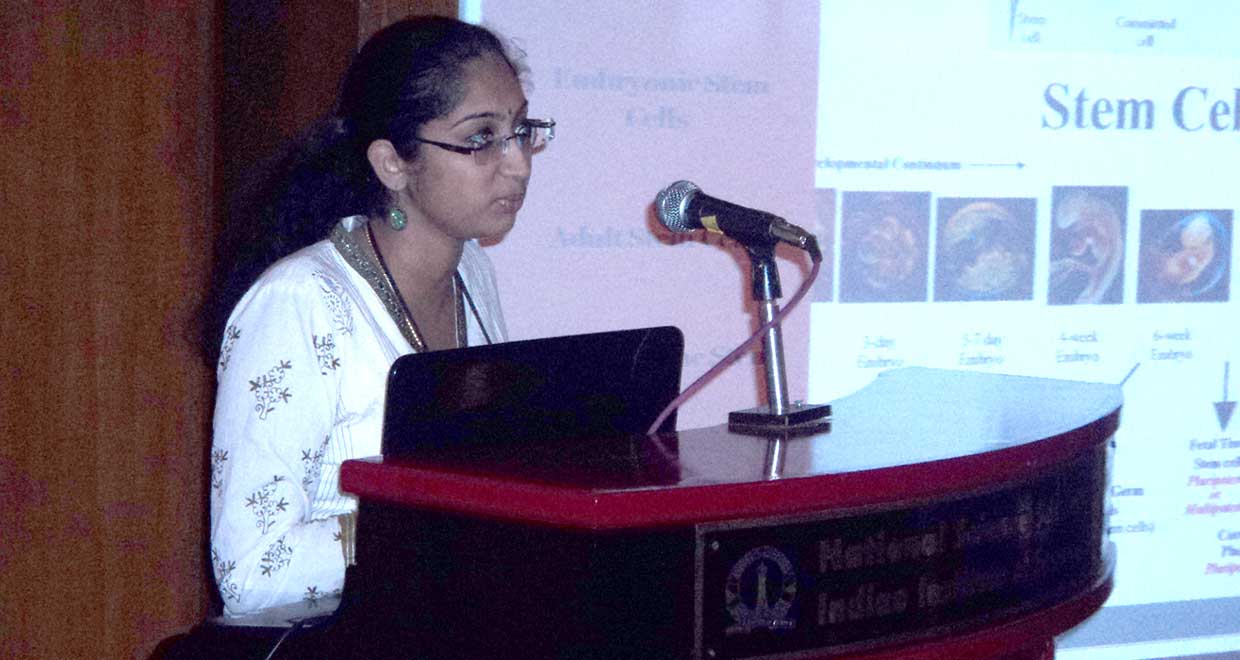
    As the junior-most member of the faculty at NUALS, I have had a variety of subjects to handle. I currently teach Law of Insurance, Public International Law, Intellectual Property Rights, etc. I have taught subjects such as Legal History, Professional Ethics, Conflict of Laws, Law of Property, Society, Science and Law, Public Interest Lawyering as well as Income tax. Of these, teaching the subjects of IPR and Society, Science and Law (a flagship programme of NUALS) have helped me in the pursuit of my research on the legal instruments on regulation of stem cell research. In fact, some of my students were part of the empirical study undertaken on the subject.


    athira-nair-3

    Do you think students should treat their professors like friends, or is it necessary to maintain a disciplined environment to create a good classroom environment?

    Today’s students are very bright- they realize that if it is pure information that they need from their studies, they need not even come to class-it is available from other sources. Necessarily, the role of the teacher has evolved to become a facilitator of gaining knowledge and a medium of value-conveyance, by supplementing the traditional teaching methodology with novel means of learning. Therefore, I advocate a via media response to the question here. In the vein of what Justice Cardozo opined, the psychological make-up and personality of the teacher is reflected in their class rooms and in the discourse with their students. In a primarily residential National University such as NUALS, where the students are of the age-group 17-22, it is important that they should be able to approach teachers and confide in them in case of any doubt or trouble; herein the teacher has to play the role of personal and professional mentor. Also, while I feel that the relationship between the teacher and her student must be friendly, it must not compromise a disciplined class room atmosphere.


    Tell us about your achievements in academics. How did you go about achieving several awards?

    I have been the recipient  of  Merit Scholarship to do LL.M. by the University of Kerala, Gold medallist and recipient  of  Justice Muthunayagom Memorial Prize, 2005  and also other  awards like  Sachivothama Shashtiabdapurthi Memorial Prize, 2005, Justice T Krishnan Nair Memorial Gold Medal Endowment, Justice M. Fathima Beevi Endowment, Malloor K. Govinda Pillai Gold Medal for Law.

    These awards were for securing highest marks for various subjects of graduation- I did not take any conscious efforts to obtain these and was unaware of their existence until I was awarded them. Nevertheless, I am grateful for these and they were helpful while applying for the teaching posts, as they build up one’s resume.


    athira-nair-4

    Having participated and won Best Speaker award and 4th Best Memorial award in Stetson International Environmental Law Moot Court Competition in 2004,what are the important skills and knowledge one must possess in order to be a good mooter?

    As a graduate student of law, mooting helps the student in getting a real feel of the life that he/she has chosen for himself. Moots give students the opportunity to familiarise themselves with the various sources of law, the methods of citation, the effective forms of address at Court, as well as skills of legal writing. Apart from the opportunity to practically explore the nuances of the various theories and provisions, the practice of mooting builds confidence as well as expands the avenues of learning.


    Besides Stetson, you have also participated in many national and international Moot Court Competitions during your law school days. Tell us how important is mooting and what effect does it have on one’s CV?

    As I already stated, the 5 years of graduation must be taken as a continuous learning process-if you are involved in moots, it helps you to develop in particular spheres of law and hone your skills of legal research, writing as well as argumentative skills. While impressive wins and accolades add to one’s CV, in my personal opinion, the personal development opportunities inherent in the process of mooting are far more relevant.


    You have presented research papers in various national and international seminars since college days till now. Are there any key factors which one should keep in mind before presenting a paper in any national or international seminar?

    As a student of law (to be a teacher is to be a perennial student), I find that the mind benefits from being taxed academically. So, wherever possible, I attend seminars, especially on topics of my academic interest, and have been fortunate to participate in international and national seminars both as resource person and presenter of research papers.

    If you aspire to be a law teacher or a researcher in law, such seminars are important; they help you develop a scientific and analytical process to defend your position on a particular question/situation of legal relevance. Also, as a meeting place of active members of the legal community and academic fraternity, such Seminars provide you with recognition and familiarity as well as networking opportunities that may prove helpful at some point in your career.


    You have authored various papers in many reputed Law journals. What role do publications play in the life of an academician? What, in your view, are the few most important skills that law students should strive to acquire in order to write research papers effectively?

    Publications are very important, not just for academicians, but also for aspiring academicians. Alongside good academic records and UGC-NET/JRF, publications in peer-reviewed journals are essential in the research repertoire of every aspiring academic. Even after one has entered into the field of law teaching, ‘publish or perish’ mandate dictates that teachers persevere with research publications.

    In order to publish a research paper, a topic of current significance must be identified. Thorough literature review is essential. Originality of thought and expression is of paramount importance. It is fundamental that a synopsis of the article/paper is prepared at the outset so that the scaffold and outline of the article is fool-proof. Once the draft is completed, it is helpful to run the paper through Viper or other plagiarism-proof software. Any mentors or experts in the particular area of law may be approached for review.


    You have been appointed as the Director of Centre for Intellectual Property Rights (CIPR), Co-director of Centre for Parliamentary Studies and Law Reforms at NUALS and also a member of professional organizations like Global Alliance for Justice Education (GAJE). What are the responsibilities you are entrusted with in each of these organizations? Please share with our readers.

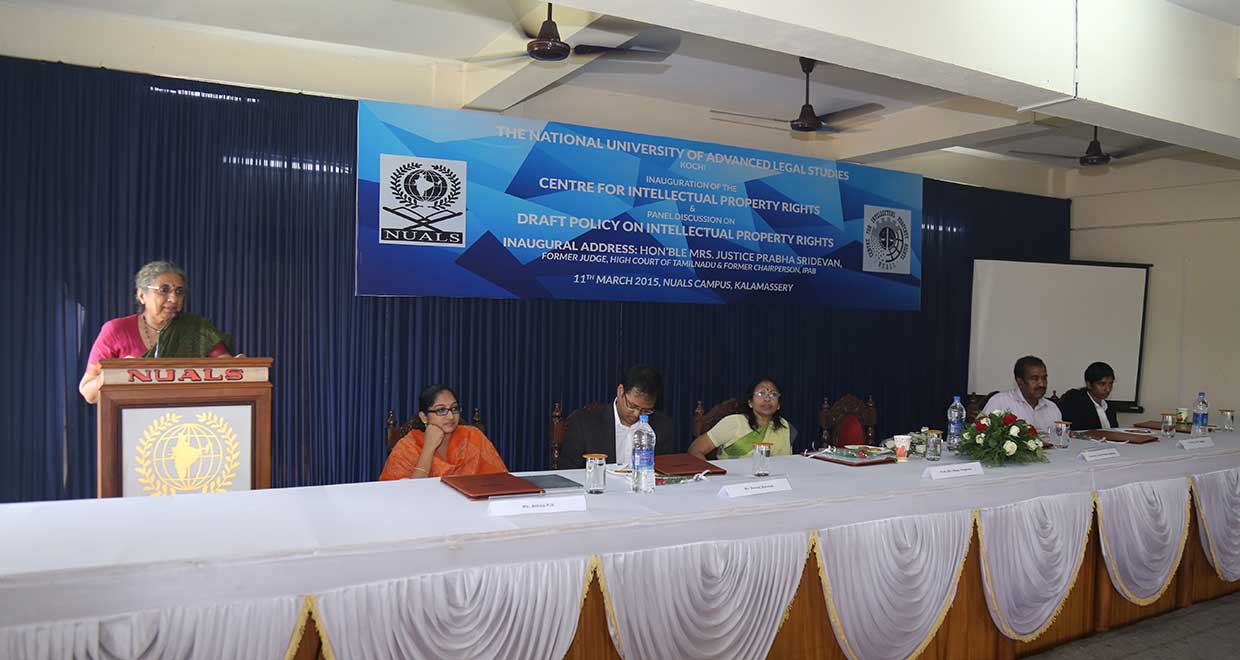
    As NUALS aims to encourage legal research in significant arenas of law, many centres of learning were established. I am fortunate to associate with the Centre for Intellectual Property Rights (CIPR) as well as the Centre for Parliamentary Studies and Law Reforms. As the Director (i/c) of the CIPR inaugurated earlier this year, I am entrusted with organizing Seminars, workshops, special lectures as well as other programmes and to bring the CIPR as a centre of excellence. The Centre had organized a Panel Discussion on the Draft IPR Policy, DIPP on 11th March, 2015 at NUALS and intends to follow up with training programmes involving various stakeholders. Our next venture shall be a national-level essay writing competition around April 26th, the World IPR day.

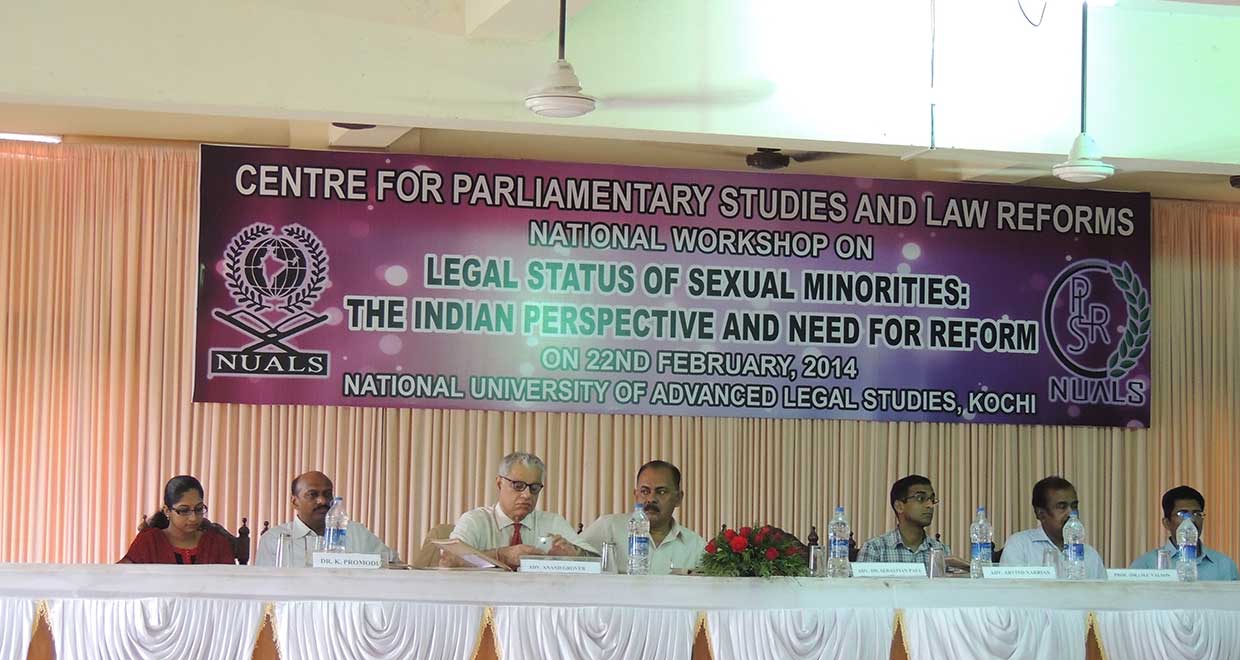
    As the Co-Director of the Centre for Parliamentary Studies and Law Reforms, I had organized a National Workshop on Legal Status of Sexual Minorities: The Indian Perspective and Need for Reform on February, 2014. It was attended by legal activists in this field such as Adv. Anand Grover and Adv. Arvind Narrrain, and was hailed as the first of its kind in conservative Kerala.


    You have attended and organized a number of Conferences and Workshops, how has your experience been so far being associated with NUALS?

    The National University of Advanced Legal Studies, Cochin is a law school that can claim many distinctions. A relatively young national law university, we have to achieve greater momentum, and the students as well as faculty aims for greater heights. The University has been fortunate to be under the guidance of various visionaries at various points of its existence, and can be said to be at its most developmental stages currently. Whether it is the expansion of infrastructure, larger intake of students, evolving of additional specializations for graduation in law as well as efforts to establish dedicated and productive centres of intensive research and learning, NUALS is right now at its golden age. I am fortunate to be a member of the NUALS family and hope that it rises to even greater heights.


    A common perception in the student community is that the curriculum in most NLUs is outdated and does not equip the students with the skills that they need to solve real life problems. What are your thoughts about this perception?

    While one of the very reasons highlighted for inception of NLUs was the need for stronger and practical objective-based curriculum and stress on solving of real-life issues in law as one goes along learning, the question remains-how far has this objective been realized. One reason may be the fact that curriculum is not revisited or reviewed as timely as it should be; or that the additional inputs necessarily required from the side of the participants of the learning process are not forthcoming as they should. NUALS has, as a possible solution to part of this problem, updated its entire LL.B and LL.M curriculum through an extremely intensive workshop, wherein pioneers in the field such as Dr. N.R. Madhava Menon, Dr. N.K. Jayakumar, Dr. Rose Varghese, Dr. Chandrasekhara Pillai, Dr. P. Leelakrishnan, contributed heavily. Yet, for the entire problem to be resolved, the only solution is diligent efforts on the part of the teachers as well as students to ensure that the curriculum as well as its application caters to standards par excellence.


    Any important things which law school didn’t teach you but ‘teaching’ did?

    As a relative newcomer to the vocation of teaching, I have come to realize that teaching and studying law, to paraphrase late Justice Krishna Iyer, is a way of life. When one’s students are as bright and inquisitive as mine are, I find myself preparing as best as I can and questioning myself conscientiously as to the potential questions, especially when I am entrusted a subject that I do not specialize in. So teaching law has taught me that a good student can be a great teacher, and more importantly, that a good teacher has to essentially be a great student.

    Lastly, what would be your message to people who want to take up a career in teaching?

    While doing your Post-graduation, alongside the curriculum, train yourself for clearing the UGC-NET/JRF examinations. Simultaneously publish research papers in peer-reviewed journals, participate in seminars that come your way and generally be as active as you can as a PG student of law.

    In my personal opinion, these above are technicalities that favour you. However, what is mostly required is a burning passion for the subject and the unrelenting pursuit of personal and academic excellence as well as the strong desire to become a good teacher. With more law schools coming up every day and the academic community being so vibrant at the moment, I believe that the choice to be an academic is a promising and exciting one.

  • Sannoy Das, Advocate, Calcutta High Court, on LL.M from Harvard and career experience in independent litigation

    Sannoy Das, Advocate, Calcutta High Court, on LL.M from Harvard and career experience in independent litigation

    Sannoy Das graduated from NLU Jodhpur in 2011 with a B.Sc.LL.B (Hons.) in Business Laws. His achievements during law school include winning the North India Rounds of the Phillip C. Jessup Memorial International Moot Court Competition in 2010. He was also a student volunteer at IDIA. After graduation, he was placed at Majumdar & Co., Mumbai, where he worked for a short period before switching to practising as an Advocate at Calcutta High Court. After three years of practice, he successfully applied to Harvard Law School, where he is currently a student. In this interview he talks about:

    • Mooting experience at Jessup
    • Shifting from a law firm job to litigation
    • Law school experience at Harvard Law School


    Please introduce yourself to our readers. How did you decide to take up law?

    At different times, I’ve called Mysore and Kolkata home; for a tiny bit, even Delhi. I started going to school in Mysore, and finished most of it in Kolkata, at M.P. Birla. As for law, it might have been accidental, but it’s been a while ago, so I’m a little foggy. A good friend of mine was preparing to take the exams (many back then), and I went along with her. If I hadn’t studied law, I’d have probably taken up political science.


    You graduated from NLU Jodhpur in 2011 with a B.Sc.LL.B(Hons) in Business Laws. How was your law school experience?

    It’s impossible to have a coherent strain of thought running through five years of law school. I’m sure I did a lot of things wrong, but I’m sure I left more happy than sad. I wish I had digested a few more books at the library, but one is always wiser in hindsight. Of course, as far as lessons in life go, five years at a residential law school are about as good as you will get. I also met my wife at law school. And they gave me the VC’s gold medal to go with it! So pretty good overall!


    You had Honours in Business Laws. Tell us about the Honours program at NLU-J. What other co- curricular and extra-curricular activities were you involved in, in law school?

    I think the Honours programs at NLU are pretty well designed. I think the idea of concentrations in different areas of law is a good one, and to say the least, the courses at NLU-J are well conceived. I could crib that at times, the courses weren’t well facilitated, but that seems to be a common complaint across our law schools. I think it’s also somewhat unfortunate that the overwhelming majority chose the business law concentration. I’m certainly guilty of having followed a crowd in that. Again, hindsight! I think for the Honours programs to make a good impact on a student, foundational courses have to be well-taught, and well imbibed. I think there’s a chance that at times, we slip on that count.

    As for other activities, I think I spent much more time on those than I’d consider prudent. Moot courts took up a lot of time. Even now, I don’t think I have had enough of them. I spent a few years on the moot court committee, finally as its joint convenor. I also took to debating (the parliamentary style) in college. Also, I played some badminton.


    You and your team won the North India Rounds of the Philip C. Jessup Memorial International Moot Court Competition in 2010. What are the important skills and knowledge one must possess in order to be a good mooter?

    Winning the North Rounds felt like a big deal. It was. We had to get over a very formidable NUJS team which had my good friend Deepak on it. We lost at the octa-final stage at the world rounds to Columbia. Till date, I’m sore about it. I think the months that I indulged in Jessup were the best months I spent at the University and I cannot stop gushing about it. Only recently, my team mate Manu Sanan said that Jessup now is a warm fuzzy memory. It really is; replete with an insane number of terribly lousy internal jokes. I only have good things to say about that experience. The team became great friends and still are. Not to forget our amazing coaches Giriraj and Yakshay.

    In mooting, as in everything, I suppose practice makes (somewhat) perfect. I had to go at it round over round. Of course, the love for research is very important. It’s more than just skill. Everyone on our team had a zealous drive to read one more article, one more book and one more case. As for speaking, I imagined I wasn’t too bad it, but it took many rounds of grilling to deliver some decent performances at the competition. I quite enjoyed picking up the best speaker awards at the India rounds. Even the world rank wasn’t too bad!

    Jessup continued to be a love affair thereafter. I’ve coached a few teams with varying degrees of success (but mostly disappointment). In my fifth, I enlisted as advisor to the NUJS team that year. They did a fantastic job at the international rounds.


    sannoy-das-2

    What internships did you do as a law student? What were your reasons for doing each of them and how was your experience?

    I was quite conservative about picking internships. I wouldn’t advise that any longer. I suppose an internship each at AMSS and AZB improved the chances of landing a job at a law firm, but I no longer find that an attractive idea. I have very little to talk about those internships, although I did decent work during most of them. I think I got lucky getting assigned to good partners each time. If I had to give a word of advice about picking internships, I’d strongly recommend getting a variety of experiences, at different courts and different sorts of firms.


    Upon graduating, you started working at Majmudar & Co., Mumbai as an Associate. How did you secure your appointment? Please describe the interview and induction procedure for a fresher?

    I was recruited to Majmudar on the first day of our recruitment process. Majmudar, back then, had the best recruitment procedure, which involved a three stage gruelling process – quite like big firms in other countries. The fact that their process was so thorough made me want to take the job. Also, the fact that it was a mid-sized firm meant that I was likely to shoulder more responsibility than a typical first year associate. That again, was an important factor in accepting their offer. I can’t say what it is to be inducted there now, it’s been a while since I left; but it’s certainly a good place to go if a fresher is willing to be at the business end of things in a short span of time. One tends to get baptized by fire there.


    OLYMPUS DIGITAL CAMERA

    You worked at Majmudar & Co. for six months. What did your work and responsibilities consist of? What were your reasons for leaving within such a short span of time?

    I have no complaints about the work I got at Majmudar. I had plenty of it, and that kept me happy. And I had enough time to savour Mumbai; all the good food and drink (in generous measure). So, maintaining the balance certainly wasn’t my problem. I advised on some corporate issues but most of my work was concentrated around huge sets of cases that we were handling across courts in India, and at the Bombay High Court in particular. I really cherish the exposure I had to high end litigation work in the earliest days of my career.

    Why did I leave? I had some reasons to go back to Calcutta. Also, the litigation bug bit me pretty strong while at Majmudar. Being at the Bombay High Court gave me a push to the ‘other’ side. So I packed my bag and imagined making forceful arguments every day at the Calcutta High Court.


    After leaving, you started practicing in Calcutta as an Advocate. Did you work under a senior lawyer or start your own practice? What were your reasons for moving from a corporate setting to litigation?

    Calcutta maintains the traditional solicitor-barrister/counsel divide. I cast my lot on the side of counsels, joined the bar library club and attached myself to the chamber of Mr. Samit Talukdar, one of the most prominent senior advocates of the court. In about three months, I had a few briefs trickling in. Then I had quite a few. As I said, the sheer attraction of arguing from the bar had drawn me to litigation. I lived some bit of it in the three years at the High Court. I had moved from wearing a tie to wearing a gown, but I was essentially practising a lot of company and commercial law. Even so, the sort of research that goes into preparing to write a brief or argue a case was infinitely more challenging than anything I had done before. It was like doing Jessup every day, at high speed. It was thrilling to be in the midst of volumes of case reports, treatises and piles of petitions. Very soon, my room at home, which I doubled up as an office, looked like a godown. Doing good litigation delivers great satisfaction, but mostly it’s a humbling experience, as I realized every day how much more there was to learn. I worked on a few matters with the top counsels of the court (and indeed of the country), and the challenge of being a worthwhile junior on a matter was quite great. I think I didn’t do too badly. Every once in a while, I heard a word of appreciation that made me dizzy with delight.


    After three years of practice, you decided to study further. What were your reasons for doing so, especially when the general notion is that for a career in litigation one requires practical experience more than an LL.M?

    It’s a somewhat correct notion that an LL.M. isn’t the best idea right in the middle of growing practice. I’d be lying if I said I wasn’t advised against it, and that came from quarters whose wisdom I have no reason to doubt. My seniors at the bar quite correctly advised me to be circumspect about making the decision. And I was. I don’t think I really made up my mind till pretty late. If I am to be really pragmatic, I doubt this LL.M. can have anything to do with setting up a better practice; at least not in Calcutta. If anything, having lost a year at a time when my practice was picking up, means having lost momentum. Fortunately, I did not make the decision of doing this LL.M. pragmatically. I did it because I simply felt some sort of an intellectual thirst, if you will. Not to suggest that working on cases can’t quench it, but I was craving to be theoretical, and was interested in taking liberties that I couldn’t have done while remaining committed to a client!


    Please tell us about your decision to pursue an LL.M at Harvard Law School. Please share some advice on acing the application requirements and procedure for Harvard.

    I’ve always gushed at the name Harvard. I’ve been here a while, and I still do. Not because it’s a reasonable thing to do, but I don’t espouse being reasonable all the time. As I said, I hadn’t decided about actually taking the year off to study when I applied. But when the admission letter came along, I think it was quite hard to look away. It also coincided happily with my wife’s career plans, and she was quite sure about taking her place up at the Chicago Law School. I think I’ve made a few decisions that don’t sit well with rationality. I wouldn’t advise following suit, as a matter of reasonableness. But I would advise it as a matter of principle, because I think it’s quite silly for us to be tied to decisions that we make when we’re all quite young. Not marriage of course. That one is forever!

    Applying to an LL.M., whether at HLS or elsewhere, requires some amount of dedication in crafting the materials. The key is just to start early in the admission cycle – get the referees to send in their letters and the universities in India to send in the transcripts etc. After that, it’s about writing a solid essay. I think the essay requires some good imagination more than anything else. I wrote my application on issues of private international law, because at that time I was quite committed to thinking about rules that govern conflict between jurisdictions. I think the essay requires the demonstration of both a clear understanding of a particular legal issue and a reasonable framework for thinking about solutions.


    It’s a dream for many law students to get through to Harvard Law School. What would be one thing they should necessarily do as a law student?

    They should necessarily study hard. It’s sine qua non to be reasonably well grounded in the laws of the jurisdiction one hails from. I can’t imagine what the factors are, that determine the selection process; I’m just lucky to be here. But if I were to hazard a guess, I think the admissions people at the top law schools are able to discover if the candidate has some real intellectual thirst.


    What were the subjects you were specialising in at Harvard? How has your experience been? Did you indulge in extra-curricular and co-curricular activities there?

    I came in imagining that I’d study a set of subjects that are useful in cross-border litigation. Instead, I’ve spent the year studying international and comparative law, international trade and legal theory. The LL.M. dissertation is focussed on an issue in international trade law (which for selfish reasons, I shall keep to myself). For the most part, I’ve been excited taking classes at HLS. I think the distinguishing feature of the experience for me has been the compulsion that I have felt to think critically, not only about existing regulation, but also about the existing normative views.

    HLS is abuzz with opportunities outside the classroom framework, and I’ve delighted myself attending a host of talks, conferences and symposia. Unfortunately, an LL.M. lasts only a year, and one can’t have everything. I’d have liked to do a lot of things in this one year – be a research assistant, work at the library, join a journal. I’ve managed none of that. Except Jessup. I enlisted as a coach to the team from HLS. Unfortunately, we didn’t make it past the semi-finals at the Northeast Regionals. Till now, one of the highlights of the HLS year has been a fellowship with the Salzburg Cutler Program, which is an awesome conference on all things about international law. It was my first taste of what it is like to defend a paper at a really serious academic workshop.


    Tell us about the faculty and facilities at Harvard. Please share with us a memorable incident from Harvard.

    One can’t have enough of being in awe of the faculty at Harvard. Everyone I’ve encountered is brilliant. I have special regard for my supervisor, Professor Mark Wu. But generally, it’s an environment where the intellectual stimulation is beyond anything I’ve experienced before.

    Watching six feet of snow accumulate over a week is pretty memorable. Otherwise, having studied under (the quite legendary) Duncan Kennedy, now in his year before retirement, is something worth writing in a diary.


    Going forward, how do you see your LL.M qualification would add to your career? Do you think of working abroad ever? Will you return to litigation?

    This is a question I’m not fully equipped to answer. I can make absolutely no prediction of how my career will be affected by this LL.M. I’m certainly not looking to work in a law-firm here. I can’t say further about litigation because I’m yet to sit down and make some hard choices. I am hoping to do some international trade related work.


    Please share with us your experience in litigation. What is one thing that gives premier law school students an edge over others in litigation?

    I’ve already spoken as to what my experience was as a counsel at the High Court. I enjoyed the work that I did at the High Court, and the challenges that came with doing that work. I think the second bit of this question is ill-conceived. I eschew the premier law school tag, and I think it’s an undeserving badge. Many of my contemporaries at the Calcutta High Court didn’t attend these so called ‘premier’ institutions, but were more competent than I could pretend to be. I suppose rigorous academic training makes a difference, but that’s certainly more up to the student than the institution. If on a general review, we could say that some law schools train students better than some others, then there’d be some advantage starting off; but, it gets quickly eroded in practice. I don’t think law schools train students to be practitioners, and I don’t think it’s their job to so. I think the real advantage rests with those who can learn the law as it gets applied in courts, quickly, along with court-craft and litigation strategy.


    Does the Calcutta High Court environment get stressful? What would be your suggestion to a fresher who is graduating this year and would join Calcutta High Court?

    I don’t know of any workplace where the environment causes absolutely no stress. Sure, there’s a fight for space and recognition, but it isn’t a place that a reasonably robust individual cannot survive. I was certainly privileged in the sense that I got to join a really good chamber and my senior was invested in my career. Also, I had plenty of financial muscle from my family to hold me up. Therefore, I don’t think my experience can be representative of the struggle that some others might have to go through, and I don’t intend to paint a picture that is rosier than reality. Having offered that as a caveat, I do think that the High Court is a good place to start (and continue) a great career in litigation. Of course, the court isn’t as active in the commercial space as the courts in Delhi and Mumbai, but there’s still enough work to be done. I think it’s important to have spent some time at the court before making the decision, and a graduating student would at least need to know who the best (and the most indulgent) seniors are.


    How much politics would you say is involved on the Calcutta High Court premises? How do you say one can possibly keep oneself away from this?

    If you are talking about factions in the profession, then my answer would be – yes, there are some and people get invariably implicated. Also, depending on the affiliation that a lawyer has (bar association/bar library club/incorporated law society), a degree of factionalism is almost impossible to avoid. I suppose a generally conscientious person can manage the fine line between good association and vile politicking. Also, I think the affiliations make for good cricket tournaments and the like!

    If you are talking of a political atmosphere, then I think it’s only fair that legal professionals have political views and are engaged in lawyering to achieve political ends. I think lawyering is a way of expressing ourselves as political beings and I certainly wouldn’t be shy in doing that.


    Who are your mentors and/or guides you look forward to for advice?

    I feel quite blessed because of the number of people who have advised me well during various stages from law school to the profession. I often turn to Justice N.N. Mathur, our former Vice Chancellor whenever I need to talk about career ideas, as also some of the senior advocates I worked with – my chamber senior Mr. Talukdar, Mr. S.N. Mookerji and Mr. Jishnu Saha. And my professors here at HLS – particularly, Mark Wu. However, I think the list is much longer and I must repeat myself in saying that I am indebted to more than a few people for having been mentors and guides.


    Lastly, what advice would you like to give our readers?

    I’m not going to pretend to have seen enough to dole out any meaningful advice. But to law students, I’d stress on the importance of being grounded in studying law at law school, and then making career decisions after seeing a wide spectrum of possibilities. I think there is considerable pressure exerted in law school to pick certain career paths, and while those are often excellent choices, they don’t work out so well for everyone.


  • Zameer Nathani, Director-Legal, Raymond, ex-Head-Legal of Balaji Telefilms on being an in-house corporate lawyer

    Zameer Nathani, Director-Legal, Raymond, ex-Head-Legal of Balaji Telefilms on being an in-house corporate lawyer

    Mr. Zameer Nathani is one of the most notable legal luminaries within the corporate fraternity. He holds a Master’s Degree in Law and Certifications from World Intellectual Property Office Academy, United Nations.

    Zameer’s corporate career began when he joined Mallar Law Consulting right after graduation. Thereafter, he was the Digital Businesses Associate Vice President-Legal at Reliance Entertainment. He later joined Balaji Telefilms where he worked as Head-Legal. In the meantime he has managed to pursue an Executive MBA from NMIMS.

    While at Balaji, he had personally handled the case for the movie “Dirty Picture” and won before Bombay High Court making it a landmark judgment on brand name, a judgment in the film industry after 1977 Movie “Sholay”.

    Zameer is currently the Director-Legal at Raymond Limited and is also the Honourable Chairman of Entertainment and Media Section at Indian National Bar Association.

    In this interview he talks about:

    • Pursuing an executive-MBA from NMIMS
    • A career in corporate law as an in-house counsel
    • Working at corporates like Reliance, Balaji and Raymond


    Given that most of our readers are law students and young lawyers, how will you introduce yourself to them? What motivated you to choose law as a career?

    My inspiration, that which made way for my decision to choose law as a career was marked by a small yet significant incident, whereby my father made me sign a contract at the age of 21 years for a business property and it made an everlasting impression on my mind of just one sentence that “Everything is about Law”.

    I then decided to pursue a career remarkably different from my family business and that has made me the ‘self-made’ man, I am today. I started working at an early age of 25 and marked the beginning of my career timeline with a lauded law firm and facilitated legal assignments for clients across diverse industry categories.


    Tell us something about your college life? Which activities did you participate in? How did you go about developing expertise and knowledge in your areas of interest?

    Apart from academics, I have had a flair for extracurricular activities always. I used to participate and have won awards for the best speaker in moot court competitions at different levels, best organizer in various inter-college moot courts, quiz contests and compeered college festivals. Developing expertise comes through practice and expediency, and it has been no different for me.


    zameer-nathani-1

    Generally the first year after graduation is the most defining time for a fresh law graduate. What would you suggest a fresh law graduate?

    Be dynamic, you have to push yourself to make sure that you grow in the profession. Be wise, learn to prioritize and distinguish between what is relevant and irrelevant. Be patient and success and growth will come gradually.


    What led to your shift from Mallar Law Consulting to Reliance?

    It is not that I wouldn’t prefer working in a company. Once you have grown as an external counsel, you can have a good role as an In-House Counsel. It is a different business environment with different challenges, but you still deal with the legal affairs of that Company.


    Thereafter you joined Balaji Telefilms as Head-Legal. What does it take to get the position of Head-Legal at that stage?

    When you have a challenging role in India’s conglomerate, you are able to pursue new challenges and thereby seamlessly take care of legal affairs as Head-Legal.


    Recently you have joined Raymond Limited as Director-Legal. What qualities do you think helped you to achieve this status?

    I would take the liberty to shorten it into three words, which are: Experience, knowledge and expertise.


    We would love to hear about your work profile. Tell us about the nature of work you’re entrusted with at Raymond.

    I work towards growth and dynamism in managing the legal affairs of this iconic and the historic group, which is the day to day management. My work profile is to supervise and manage legal affairs of Raymond Limited and its Group Companies.


    What changes has being Director-Legal brought into your life? How do you manage to strike a balance between your personal and professional life?

    I join any corporate considering the opportunities and challenges, and I love that. Work is at par with positions till date. I get up at 4:30 am, meditate and maintain a healthy life and food with a morning walk and begin the day very early for work to be completed by 8 p.m. or 9 p.m. I do not let lethargy set in and come in the way. However, I schedule a vacation once a year with my family. I even organize office outings once in six months where we socialize and have team building exercises.


    What are the primary essentials of a good corporate lawyer? How do you say a fresh graduate can work on building these skills?

    Be prepared to face challenges that come your way. Always absorb challenges and face problems as opportunities.


    Have you ever considered litigation or starting up on your own? Would you say the opportunity a firm provides for a young lawyer is worth the trade off in building a reputation?

    I have been a litigation lawyer in the past, which gives me an experience even when I am in the corporate fraternity in strategy making and arguments. No plan right now to start my own law firm.

    But yes, a reputation in my law firm earned me a job at Reliance- ADAG at a young age.


    In the meantime, you managed to pursue Executive MBA from NMIMS. How do you think an MBA can prove to be useful in a lawyer’s career in the current as well as future market?

    The importance of MBA is to know business management, financial management, team management and alignment of your leadership skills to team up with business.


    So for you, why did you feel MBA is a good option for a lawyer and why now?

    Because understanding overall management skills and functioning is necessary, especially when you are at a leadership position.


    Would you recommend Management and Marketing professionals to learn the law?

    Some knowledge of law is essential for every professional in business management.


    What would be your message to our readers who are budding lawyers and law students?

    Get your law education from good Indian and/or foreign Universities (U.K, U.S.A etc). Be dynamic, upright, and energetic. Get knowledge from wherever you can. Pertaining to local and international laws, attend seminars organised by Lex Witness, meet new people, and get on international forums for discussion on various laws (local and foreign), and I am sure growth and success shall follow.


  • Gargi Panwar, Associate at Rajani Singhania & Partners, on LL.M from Nottingham Univ for a career in corporate law

    Gargi Panwar, Associate at Rajani Singhania & Partners, on LL.M from Nottingham Univ for a career in corporate law

    Gargi Panwar graduated with a BLS.LL.B degree from Rizvi Law College, Mumbai in 2010.She started her legal career as a Junior Associate in the Chambers of Advocate Flanian G. D’souza. Thereafter she went on to pursue Masters from University of Nottingham in International Commercial Law. After coming back to India, she joined Precept Legal as an Associate. She also holds a Diploma in Corporate Law offered by Asian School of Cyber Laws. Currently, she works as an Associate at Rajani, Singhania & Partners.

    In this interview, she talks about:

    • Law school experience at Rizvi Law College, Mumbai
    • Choosing to pursue higher studies over job
    • LL.M experience at Nottingham
    • Work at Rajani, Singhania & Partners


    Given that most of our readers are law students and lawyers, how would you introduce yourself to them? What is it that motivated you to take up law as a career?

    I am Gargi Panwar, a lawyer specialising in Property Laws and Mergers & Acquisitions in Maharashtra. My work involves a lot of communication with the clients, negotiations and meetings. I call myself a part time litigator because I handle a lot of Schemes of Arrangements and Amalgamations, Schemes of Revivals and therefore I can be often seen running into Company court (sometimes if not always in the rush hour).

    It’s a little cliché but I wanted to be a lawyer since I was a 14. By the time I turned 18, I was ever determined to pursue law as a career. I am happy that I could do what I really wanted to in my career.

    Motivation is not something that comes out of always winning but sometimes the setbacks in your life motivate you to walk on the chosen path with more determination and zeal. Therefore, no matter what everyone says, always ask yourself this question “do I want to pursue it?” and if you do, then give your 100% in achieving it.


    What do you think is the kind of interest or aptitude one needs to pursue law?

    A person needs to love reading because our profession is such that we can never know everything. There is a constant change in relation to laws and regulations and therefore, in order to be up to date one needs to read. In corporate law, I feel a person needs a lot of patience and tolerance to be exercised when clients act difficult. Also, one needs the aptitude to see different outcomes of a problem and then find the most viable option at hand. This is very important in litigation as one needs to be able to identify the key issues and find most appropriate arguments for the same.


    What were your areas of interest during your graduation? How did you go about developing expertise and knowledge in these areas?

    I was always inclined towards corporate law. Not because I do not enjoy litigation, but because I love negotiations. I feel any problem can be solved if two parties sit across each other and talk. Therefore, Company Law and Alternate Dispute Resolution were my fields.


    After your graduation, you started working as a Junior Associate at the Chambers of Advocate Flanian G. D’Souza? What kind of challenges did you face during this job?

    By the end of fifth year, I realised that I need to work under an Advocate who can give me an overall experience in various streams of law. Flanian D’Souza and Jerome D’Souza are very well known lawyers in Bandra, Mumbai for Civil Law & Property Law. I approached them through a friend who was working with them. Flanian Sir instantly appreciated my confidence and my good credentials and I started working with him from the next day. I had to leave the job because I wanted to study further.


    Did you always have higher studies in your mind? If not, what motivated you to go in for the same?

    More than me, my parents were keen on sending me abroad for my LL.M. Also, I love studying. If I could, I would be a student forever.


    gargi-panwar-1

    Do you think it makes sense for students to go overseas to study law when they want to practise in India?

    It depends on what kind of practice you will have once you come back to India. If you are interested in Maritime Law, Human Rights, International Insolvency, Intellectual Property Law or like me if you want to be a specialist in Mergers &Acquisitions, then studying abroad should definitely be your choice.

    Apart from this, students may also opt to study abroad as the experience of the international standards of education, meeting people and interacting with people from all over the world, making lifelong connections with people from all over the world are few of the many advantages of studying abroad.


    After pursuing Masters, you joined Precept Legal as an Associate. What was the nature of your work there?

    I dealt with Intellectual Property Law, Property Law and Civil Law.


    Currently, you are working as an Associate at Rajani, Singhania & Partners (RSP). What prompted you to make this choice and what made this shift possible?

    After coming back from studying for my LL.M, I was looking for a placement relating to Mergers and Acquisitions. I got that opportunity in RSP.


    What kind of work and responsibilities does an Associate at Rajani, Singhania & Partners deal with? What should a student do so that he gets placed in a prestigious firm like RSP?

    I am currently working in the M&A Team. I am currently working on matters involving corporate restructuring such as arrangements, amalgamations, mergers & demergers, revival scheme matters. It’s a round the clock job, exciting and exhilarating.

    Students should work towards doing internships with firms and know the work culture of the firm. The name of the firm is important but what is more important is what you want to pursue and how will you achieve success in what you want. Confidence is also a major factor in getting jobs in law firms. A well read person is always preferred.


    gargi-panwar-5

    Tell us about a case that you are particularly proud of. What steps do you take to prepare for a difficult case?

    I am currently working on a revival of a company after almost 75 years of its incorporation and about 50 years of the company being ordered to be wound up.

    One has to know the facts and read all the papers of their matters. Also, research on various aspects of the matter is also very important.


    What is the current scenario of studying corporate law as a career option in India?

    It’s a very positive and bright future for students who opt for corporate law. There is an unquenchable thirst to absorb good minds in every law firm.


    There is a school of thought that labels LL.M’s as being little more than an expensive holiday unless the individual concerned wishes to enter the world of academia/research? Now that you are working, do you feel the experience acquired during your LL.M is relevant to your professional life?

    Definitely, I am well versed with U.K. Law, U.S. Law and Indian Law because I got an international perspective while studying for my LL.M on various subjects including intellectual property, business law, banking and regulations, cross border mobility and insolvency.

    Also, I am much more confident and sure of myself than when I was before I went abroad for my LL.M.  My earning potential has also increased because of the  added qualifications.


    What do you cherish most about the experience you’ve had over the past two years?

    The fact that I have become a confident, smart and successful woman over the past two years, esp. for the LL.M which gave me the much required exposure. I would love to hold on to my LL.M experience.


    Last but not least, what’s next for you?

    Currently I have not thought about the future but I hope I have opportunities and matters to show my skill. Also I am planning to study further and maybe do my solicitors or an MBA. Well, time will tell.

  • Dhruv Suri, Principal Associate, PSA Legal, on leading a student organisation, LL.M from Columbia University and work at Law Firms

    Dhruv Suri, Principal Associate, PSA Legal, on leading a student organisation, LL.M from Columbia University and work at Law Firms

    Dhruv Suri graduated from Guru Gobind Singh Indraprastha University, New Delhi in 2009. While in college he co-founded a student organization called United Students which initiated the Jessica Lall and Priyadarshini Mattoo campaigns. He was invited by the then President, A.P.J. Abdul Kalam to discuss problems of OBC reservations after receiving his memorandum on the same. He has interned with AZB & Partners and Valeo, Paris. He received a PPO while interning at PSA Legal Counsellors where he was an Associate for four years before opting for an LL.M from Columbia University, New York. He has joined PSA after coming back from Columbia. He is currently a Principal Associate at PSA Legal Counsellors. In this interview he talks about:

    • Studying law at GGSIPU, New Delhi
    • Recruitment and work experience at PSA Legal Counsellors
    • Masters from Columbia University, New York


    As an introduction, please tell us about your schooling and how you decided to pursue law.

    I was born and brought up in Delhi and did my schooling from Delhi Public School, Vasant Kunj. I graduated from school in 2003 and was unsure of what I wanted to do. So much so that my family registered me for one of the law entrance exams and I ran away to Mumbai with a friend for a holiday. Of course, that did not go down too well with my family after I came back. When I came back, I took admission in Delhi University where I studied English Hons. for one year. However, for that entire year, all I did was theatre and learn dance. My attendance at college was abysmal! In 2004, I was emotionally blackmailed by my mother to register for the law entrance exams once again on the pretext that I would be given a Maruti 800 to travel to law school and an increment in my pocket money. I fell for it and got an option to study at Amity Law School. Back then, Amity Law School was a building in south Delhi and did not have the atmosphere of a “campus” that I grown accustomed to in my one year at DU. So, I opted for the main Guru Gobind Singh Indraprastha University law school which seemed like a better option. Rest assured, I got no car and travelled 40kms a day in local Delhi buses. So, this is how my journey with law started- as a “victim” of emotional blackmail from my mother! J


    You completed your law degree from Guru Gobind Singh Indraprastha University, New Delhi in 2009. What activities were you involved in there? Looking back, is there anything you wish you had done differently?

    The first few years just went by in trying to understand what law is really about. I loved courses like Legal Reasoning, Jurisprudence, History, and Contract law. I also loved mooting and showed up at any and every audition, whether I was prepared or not. I was also very active in the debating society and ensured that I participated in as many competitions as possible. Since our campus was fairly big and had lots of engineering and management colleges as well, there was always some event or the other taking place. By the time I was in my 4th year, debating became a source of extra pocket money.  However, amidst all this, I was also focussed on getting good internships and a job. In fact, if there is any regret that I have, it is that all through my final year I worked after college hours, whereas all my friends were enjoying themselves, going for lunches, movies and ensuring that their last year as a “student” was memorable. When I look back, I could have probably worried less about my career and instead made the most of my final year at law school. Eventually we all had to work but I do feel that I missed out on some fun times with my friends.


    You started a student organization called United Students. You contested the Delhi University elections and initiated the Jessica Lall and Priyadarshani Mattoo campaigns. Please tell us more about it.

    United Students happened by pure accident. I was in the latter part of my 2nd year at law school when I met the other founder members of United Students at a coffee shop in central Delhi. I had always been someone who liked to initiate and take the lead in everything I did. The trial court verdict in the Jessica Lall case was out and I was having discussions and debates with people from all quarters about the merits of case, legal arguments advanced, etc. Some common friends connected me to like Aditya Raj Kaul, a young 17 year old (now a popular Times Now reporter), who had started an online campaign in connection with the Priyadarshani Mattoo case. Aditya and I realised how similar we both were and he introduced me to the other founder members. We were all passionate about bringing about a change and decided to collaborate. I think that really was the key reason for launching United Students. We wanted the organization to encourage young Indians, particularly students, to think and debate in a cohesive manner and take up issues of governance. The idea was to engage in discussions and debates, take an informed stand and then take steps on ground to the best of our abilities. I think the legal profession is somewhat similar. Discussions and debates are synonymous with research, which is very important to take a stand and advise the client. As I got busier with law and internships and all other members got more absorbed in their lives, the organization had a natural death. However, the entire experience played a big role in how I evolved as a person and it is something that I will always cherish.


    Why didn’t you pursue a career in politics? Do you think you will enter the field again in the future?

    I remember I was doing a shoot for a big news channel during the Delhi University elections and the spokesperson of one of the bigger political parties came to me and asked me to formally join them. I wonder how different life would have been had I actually done that! But on a serious note, I did consider pursuing politics more seriously but was equally eager to graduate and practice law. Who knows, one day I may actually be able to balance a legal and political career!


    dhruv-suri-3

    During your time at law school, you interned at AZB & Partners, New Delhi and Valeo, Paris. Please describe your experiences.

    All my internship experiences were very rich. At AZB I did my first all-nighter and got a real sense of how corporate law firms work. The lawyers were extremely kind and I am still in touch with some of them. Valeo was great because I got to work in-house and attend lots of business meetings. I realised how a “business lawyer” (whether in-house or external) cannot give pragmatic advice if he/she does not have a sound understanding of the business. This was the biggest take-away from this internship and till date, I try and adopt the same approach while advising clients at PSA. Of course, I got to spend a little less than 3 months in Paris which was fantastic and the first time I stayed by myself. I made sure I saw every bridge, every museum and (almost) ever cafe and bar there.


    You also interned at PSA Legal Counsellors and then received a PPO from them. What do the recruiters at PSA look for in potential candidates? How did you secure a PPO?

    One of the most preferred modes of recruiting at PSA is to give offers to final year law students interning at the firm and then training them internally as they grow. The firm encourages building in-house talent.

    In terms of how PSA approaches recruitments of potential candidates, I think it is more or less assumed that a first year associate will not know much about the law. However, she/he should be eager to learn and work hard, and also interact and work well in a team. PSA also believes that before becoming a specialist, it is important to be a good generalist. So, if there is a student who only wishes to work in the area of, say, capital markets or intellectual property or competition, PSA would not be the best place to work. Whereas if someone is keen to do everything and gradually pick areas of interest and focus on them, PSA would be an ideal place for them.

    In my specific instance, I interned with PSA all through my final year at law school. While I was still an intern, I got actively involved in a big PE transaction. The deal was still ongoing when I graduated so I just continued working on it and did not stop. Slowly I got drawn in on a lot of other matters and before I realised, I had spent almost 5 years at the firm!


    dhruv-suri-4

    Upon graduating, you started working at PSA as an Associate. What was your work profile like?

    Like I mentioned, at PSA, you do everything in your first year. So, my work profile was nothing different. I was actively working on a PE deal, but also assisting the senior lawyers in day-to-day corporate advisory, researching for litigation matters, working on intellectual property queries and even drafting board minutes and incorporating companies. Gradually the work becomes more sophisticated and challenging but the basic training I got in my first year continues to be invaluable and (I’d like to believe) set a strong foundation. Before I left for my LL.M in 2013, I was working on sophisticated M&A transactions, advising large conglomerates on complex legal queries pertaining to contracts, IP, tax, employment etc. and arguing matters before the Competition Commission of India.


    dhruv-suri-2

    After four years at PSA, you opted for an LL.M from Columbia University, New York. How did you secure your admission at Columbia? What was your specialisation?

    So, Columbia and Harvard are two schools that I know do not offer a specialised LL.M. In fact, even as a matter of personal preference, I did not want to do a super specialised LL.M. The application process was exhausting and almost impossible to manage with long work hours. I took 10 days off in October 2012 to work on my applications and finalized as many as I could. Even the 10 days were not enough and I spent a lot of weekends on my personal statement and other school-specific essays that were required. Now when I look back, I am so glad I put in that effort because Columbia really is one of the best things that ever happened to me! Plus I got to live in New York which just takes the LL.M experience to a whole new level.

    With respect to courses, there was a fair bit of flexibility so I made sure I had a variety on my plate. Some of my courses were “Strategic International Commercial Transactions,” “Financial Statement Analysis,” “Intellectual Property Drafting,” “Negotiations,” “Corporations,” etc. All of them were taught by top-notch professors who made studying such a pleasure, an area where, in my opinion, Indian law schools have a lot of catching up to do.


    You also worked as a Research Assistant for Professor Anu Bradford in the field of antitrust laws. On what basis were you chosen for the project? How was the experience?

    I have always been very interested in competition/antitrust law. During my first month at Columbia, we received an e-mail that Professor Anu Bradford was looking for LL.M research assistants to work in the field of antitrust law. I think I drafted a short cover e-mail and sent my CV within 5 minutes of receiving the e-mail. Professor Bradford called me for an interview and soon I started working for her. The experience was so enriching because the work she asked me to do involved coding antitrust laws of multiple countries (including India) and understanding key differences in how statutes are drafted across those jurisdictions with respect to restrictive agreements, cartels, abuse of dominance, etc.. The work gave me a deep and detailed understanding of antitrust laws. Plus, she is one of the most wonderful people I know and mentored me throughout the time I was at Columbia. I am just glad I got to work with her.


    Is it better to pursue an LL.M right after college or after working for a few years?

    This is a question that a lot of people aspiring to do an LL.M ask. Honestly, I don’t think it has a right answer. A lot of my friends went for their LL.M immediately after completing law school but I chose to go after gathering some work experience. Specifically for Columbia, which has an extremely competitive curriculum, it is rare for them to admit anybody with less than 2 years of work experience. Of course, there are exceptions. Based on my experience, I do think that work experience comes in very handy, especially when you are learning about a different legal system. You are definitely wiser and more mature to gauge concepts by linking them to your practical experience. Plus, you also tend to make a lot more of your degree by networking professionally, which, I think, can be challenging if you have never worked before.


    Do you think the LL.M has improved your career prospects? Do you have larger responsibilities at PSA now?

    The LL.M has definitely helped me a lot. If I had to point out one thing, it has made me surer of my work and more confident in my interactions with clients, both Indians and foreigners. In terms of my profile, I am now a Principal Associate at the firm and manage PSA’s start-up/PE/VC practice which is extremely exciting because I interact and work with dynamic start-ups and very passionate entrepreneurs.  While I continue to do legal work, a lot of my time and energy is also spent on business development, which I thoroughly enjoy. So clearly, the responsibilities have increased and the concept of weekends has dissolved. I have to be on top of whatever I am working on all 7 days a week and I actually prefer it like that.


    Lastly, what advice would you give to law students wishing to pursue a career in corporate law and considering doing an LL.M?

    I would say that, make sure you do internships in law firms in your 4th and 5th year and be proactive when working. I enjoy working with interns who are eager to learn, proactively follow-up with me and don’t hesitate to take responsibility of their work. It is a good opportunity for you to demonstrate your attitude towards work. Also, be prepared to do any and all kinds of work. You will realise much later how the most minuscule things you worked on as an intern or first year associate come in handy during negotiations or drafting contracts. So, approach work with an open mind. Finally, if you plan to do a LL.M, my advice usually is to work for 2-3 years. It will really change your perspective and you will be able to make the most out of your academic courses and the overall LL.M experience.

    In the end, I would just say that work hard but make sure you enjoy your student life as well. That time (unless you do your LL.M) will not return. Good luck!


  • Nirupama Jayasimha, Associate, Telecom Media Tech team, Trilegal, on work and LL.M from Stanford Univ

    Nirupama Jayasimha, Associate, Telecom Media Tech team, Trilegal, on work and LL.M from Stanford Univ

    Nirupama Jayasimha is a graduate from Bangalore University batch 2003-2008. Currently she is an associate at Trilegal, working in the Telecom, Media, Tech team. She has had a brief stint with Infosys and then she worked at Wilson Sonsini Goodrich and Rosati. She has completed her LL.M. from Standford University.  She has also been an Exchange Student at Université Paris X Nanterre. She shares her experience as an Exchange Student and tells us why and how an exchange programme is beneficial for a law student.

    She tells us about JN Tata scholarship application and other procedures for further studies abroad. She also talks about the job opportunities available overseas.


    Though it’s one of the most cliché question, but yet, why law? What were your areas of interest while you were studying law?

    I come from a family of eminent lawyers and engineers. Dinner time conversations were filled with stories from the court or the latest developments in technology. This led to an interest in these fields from a very early age. My father thought I would make a better lawyer and persuaded me to take law. In the meantime, the growth of IT in Bangalore presented a unique opportunity to work at the cusp of law and technology. Most of my internships were in the legal departments of technology companies to help me understand the fundamentals of technology, business and its interaction with law.


    You have been a part of Université Paris X Nanterre as an Exchange Student. How do you think such exchange programmes are beneficial for a law student? Tell us about your experience there.

    When I signed up for the exchange program, apart from getting to live in Paris without paying for it, I couldn’t think of a single way the exchange program would benefit me. If anything, it seemed like opening a Pandora’s box. I had to attend classes and take exams in a language I didn’t understand well, the college administration was not sure if the courses taken in Paris would count towards graduation and I had to live away from home for eight months which I had never done before. Call it adrenaline rush, or the compulsion to be different, I just signed-up for the program. Apart from learning enough French for a lifetime, there were no immediate benefits I saw from the exchange program. It’s only much later that I reaped the benefits. While at Infosys, I worked closely with clients in France and having an idea of civil law and French was an added advantage. It may have influenced my admission to Stanford as I was one of two students in my university to have done the program. Even today, the networks I cultivated have stood me in good stead. So, I guess, my advice to anybody who wants to take up an exchange program is to go for it! Like Steve Jobs said “its only when you look back that you will be able to connect the dots”.


    nirupama-jayasimha-2

    You have studied LL.M from Stanford University, through the J.N Tata Scholarship. Tell us in detail about the application procedure for the JN Tata scholarships and other such scholarships.

    The J.N Tata scholarship requires applicants to submit a personal statement along with their application. Based on the strength of the application, candidates are shortlisted for an interview in Bombay. Candidates are interviewed by a subject-matter expert from their particular background for an hour. A week after the interview, successful applicants are intimated by mail. The final distribution of the scholarships is at a ceremony held at the Bombay House (where you may have a chance to meet Ratan Tata!). The ceremony is also attended by scholarship alumni and distinguished members of the Tata Group.

    The Stanford acceptance letter comes out well past the deadline for most scholarship applications. I just made it in time for the JN Tata scholarship and that’s only because an extension was granted! However, there are a few scholarships that you can apply prior to sending out your college applications. Applying to these will ensure you don’t lose sleep after receiving the acceptance letter.

    In terms of the selection process for the JN Tata Scholarship, it is hard to give a definitive answer of the traits required to bag the scholarship. My advice is that it is good to spend a few days thinking about why you want to do a LL.M, how you would use it to further your career and the interests of the society at large and then present it in your application in a compelling way. This is the most important question any scholarship panel asks and is also a defining part of the application you submit to colleges.


    How was your experience with faculty and academics at Stanford University?

    As a law student, I spent a lot of time reading and thinking about technology law issues like net-neutrality, P2P sharing, patent trolls, dispute resolution in e-commerce. Quite naturally, the opportunity to study at Stanford, at the bleeding edge of all the action, was an exciting prospect. And I was not disappointed at all. The Socratic method of teaching is crafted towards making you evaluate these issues by questioning the fundamentals. In addition, hearing perspectives from competing stakeholders on issues they deal with on a daily basis makes you appreciate and understand the different facets of the issue. For instance, in a panel discussion onP2P sharing, we had the ex-CEO of Napster, Hank Barry on the panel and a lawyer from Viacom. Meeting such stalwarts on a daily basis inspired me to contribute to the evolution of technology law in a meaningful way.


    How is the recruitment/ placement situation for overseas students?

    Well, it’s not easy to find a job. If you are looking to do an LL.M just so you may work in the US, then it may not be a wise decision. To land a job in the US, an extensive network of contacts will take you much further than a LL.M degree. When you interview for jobs after your LL.M, you are competing with JD’s. A law firm will not want to pick you ahead of a JD unless you have something a JD doesn’t. More often than not, that X-factor could be your ability to bring in work from your home country. As a general observation, I found that the network one has built in India is the most effective tool to land a job in the US.


    How did you get a job as a foreign legal specialist in Wilson Sonsini Goodrich and Rosati? What kind of work did you come across?

    My boss during my stint at Infosys, Samuel Mani generously referred me to a partner at Wilson with whom he worked closely. At Wilson, I worked with the Technology Transaction team which primarily worked in representing technology companies in business transactions driven by the development, use, acquisition, or divestiture of intellectual property, including licensing, mergers and acquisitions and public and private offerings. The most interesting piece of work I was involved in was preparing a memorandum for the Demi Moore and Ashton Kutcher foundation on the ethics of web scraping to help prevent child trafficking. Additionally being from India, I helped in cross-border transactions involving Indian clients.


    nirupama-jayasimha-3

    Is it easy to have a work-life balance in this profession?

    I think you need to identify as early as possible, the things important to you in life and then prioritize them accordingly. For me, health, family and work are the top priorities. The most important of course is to maintain a healthy lifestyle, without which one can neither do justice to work (no pun intended!) nor spend quality time with your family. If one is disciplined, it is not hard to set aside an hour everyday for some sort of physical activity. I also don’t let work get in the way of having timely meals. As for prioritizing between family and work, it is very contextual and one cannot blindly prioritize one over the other. There are times when you may need to give up working on an important deal because you have a prior family commitment, and there are times when you have to miss a family event because you are committed to closing a deal. I think planning and being organized helps a lot in navigating this tightrope. It is also important that people at work respect your priorities and that people at home understand. I have been lucky to have a very supportive family, and colleagues at work who understand the importance of striking a work-life balance.


    Is there any success mantra that you follow which you would like to share with our readers?

    Howard Roark, in Fountain Head (which is my favorite book of all time) says,

    “I have, let’s say, sixty years to live. Most of that time will be spent working. I’ve chosen the work I want to do. If I find no joy in it, then I’m only condemning myself to sixty years of torture. And I can find the joy only if I do my work in the best way possible to me.”

    This really sums up what I believe. Any work you choose to do, do it to the best of your ability. The rest will take care of itself!


  • Jyoti Shekhar, Senior Associate, Legasis Partners on LL.M from Deakin University and work experience in Corporate Law

    Jyoti Shekhar, Senior Associate, Legasis Partners on LL.M from Deakin University and work experience in Corporate Law

    Jyoti Shekar is currently working as a Senior Associate at Legasis Partners, Delhi. She graduated with a B.S.L.LL.B degree from ILS Law College, Pune in 2007. Thereafter she started working at Mindcrest India Pvt Ltd. as a Legal Analyst. She then went on to pursue Masters in Commercial laws from Deakin University, Australia and has thereafter worked with OSC Export Services Pvt. Ltd. and Sahara India.

    In this interview she talks about:

    • Law school experience at ILS, Pune and Deakin, Melbourne
    • Work experience at OSC Export Services Pvt. Ltd. and Sahara India
    • Work as Senior Associate at Legasis Partners


    How would you introduce yourself? Please tell us a bit about how you gravitated towards law.

    Usually, I just introduce myself as a lawyer. I really do take pride in being a part of this industry, however small. Right from my childhood, I have always wanted to do law. Perhaps it had something to do with people telling me to be a lawyer due to my talkative and argumentative behaviour, or perhaps some impression left on me by a very illustrious Supreme Court Judge who was a distant relative and used to tell me stories. Honestly, I don’t know. But I do know that I never had a moment’s doubt about being a lawyer and yes, I still just introduce myself as a lawyer.


    Please tell us a little about your law school days at ILS Law College, Pune. How were you at academics?

    My college life was a lot of fun and a lot of hard work too. I was always a topper during my school days. In fact, my school refused to let me elect commerce in high school. Only after I threatened to quit the school, they reluctantly allowed me to take commerce. But I thoroughly enjoyed accountancy and business studies. I started pursuing the C.A. course along with my LL.B. That’s what kept me busy throughout college life. But I didn’t finish CA after all. But honestly, like any college student does, studying law was a last minute preparation for me, cramming all night and sacrificing sleep. I got average grades but I did have my share of fun in college.


    jyoti-shekar-3

    How important would you say good grades are for an illustrious career in legal?

    Honestly, as a student, marks and percentages mean the world to us. However, to be honest, I believe that experiencing the practical world with different kinds of people, different cultures, behaviours etc. is more important in the real world. Of course, a good grade point average is important to get into good schools for further education and to make your CV look better. But honestly, after your first job, the interviews are more about how you handle people and situations. Book knowledge is something you can always refer to, but living in the practical world and dealing with colleagues, bosses and clients is the key. I guess what I am trying to say is that although a good grade is wonderful, but it shouldn’t be your entire focus.


    How do you think internships are beneficial to law students?

    I think the best way to learn is to practice. Internships are the best source of knowledge. Looking back, I do wish I had done more internships in college. However, internships should not be just about getting certificates. To get a headstart, try to be inquisitive and learn the knack of research, reading a contract, drafting an email, observing in meetings and courts etc.


    jyoti-shekar-4

    Thereafter, you went to pursue Masters in Commercial Law from Deakin University. How would you describe your experience? What motivated you to go in for the same?

    I had an amazing experience during my masters. Actually, after finishing LL.B, I wanted a good job with a good salary. However, my father encouraged me to think long term. He told me that a good qualification will open up opportunities I couldn’t comprehend at that time. And he also said studying in a different country would expose me to different learning methods and will be a life experience. And he was right. I somehow found the courage to go ahead with the LLM plan and even felt excited by the prospect of experiencing a very different culture and academic system. That’s when the idea of going to Australia hit me. And it turned out to be the best decision of my life. When I went there, I did not know anybody in the country. Everything was completely new and different. I slowly learnt to speak their way, I worked in a grocery store, worked in their deli (and I am a strict vegetarian!!), I learnt their way of studying. We did not have exams, we only had research papers instead, lots of them. It was a whole different approach for me. I also learnt to be among people of different cultures and traditions – Australians, Chinese, Sri Lankans, and Europeans. It was very enriching. I am still active with the university’s alumni association in India. They have a lot of business networking events and activities.


    Do you think it makes sense for students to go overseas to study law when they want to practice in India?

    There was actually a time when a foreign degree looked good on CVs and that is partly why I went abroad. But as I mentioned above, it became more of a life experience for me. And another plus is that I learnt a lot about research and writing methods. Now actually, when people ask me this question, I really don’t know how to respond, since our academic system has also improved a lot and I feel it is a personal choice rather than a mandate.


    jyoti-shekar-2

    After coming back to India, you joined OSC Export Services Pvt. Ltd. as a Consultant. How did you secure your appointment? How would you describe your experience working there?

    I simply applied to their vacancy ad. They had a series of written tests which I cleared. Of course, it was quite prestigious for me to start working there after my studies due to its association with Clifford Chance LLP. I got an opportunity to work in Clifford Chance London and New York offices which exposed me to international transactions and practices.


    Thereafter you joined Sahara India as Manager Legal – Corporate Finance. What led to this shift? What kind of challenges did you face during this job?

    Though I was doing quite well in my current job at the time, I wanted to get some in-house experience, which is what I wanted out of my career then – to be an in-house counsel. When the Sahara opportunity came along, I grabbed it, especially because it required me to be in the finance department, which was fast becoming my forte. Even in Clifford Chance, I was associated with their Banking and Finance department. It turned to be an amazing sea of experience with wonderful projects. Each of us lawyers had to deal with our projects independently. I loved every minute of it. The challenges were plenty; I had to pilot transactions right from proposal stage to post closing stage, of course with the assistance of external counsels, especially in other jurisdictions. We reported to the Corporate Finance Head, who had a surprisingly good grasp of legalese. It provided me with a lot of learning and knowledge.


    Currently, you work as a Senior Associate at Legasis Partners. What prompted you to make this choice and what made this shift possible?

    Well, the Managing Partner of Legasis Partners, Mr. Suhas Tuljapurkar, is my absolute role model in this profession. I had interned with him in Mumbai and also worked with him in Pune at the beginning of my career. I jumped at the chance of working with him again in Delhi when the opportunity presented itself. I was planning my exit from Sahara and everything just fell into place.


    What kind of work and responsibilities do Senior Associates at Legasis Partners deal with?

    In Legasis Partners, we are given the opportunity to develop ourselves as professionals as per our interests and skill sets. Here, we do not believe in designations and everybody pitches in to help achieve the common objective of growth. It gives me an opportunity to be independent and learn to take decisions and also to explore various ways in which I can be useful to the organization and hence to my own self as a well rounded professional.


    Tell us about a case that you are particularly proud of. What steps do you take to prepare for a difficult case?

    Well, a parent is equally proud of all their children. Every project I have done so far, be it small or big or high profile, has made me learn new things.

    To answer the second part of your question, in any transaction, homework is the key. I need to know the entire background before starting a project. And I never hesitate to ask questions, even at the risk of sounding ridiculous. If I have a doubt in my mind, then I cannot do a convincing job.


    What is the current scenario of studying corporate law as a career option in India? How challenging is life as a corporate lawyer?

    Corporate law has developed a lot in the past few years. With the new Companies Act in force, there are lots of stringent regulations which necessitate having a strong in-house team in every company. Corporate lawyers can either be in-house or work in law firms. There is no formula for being a successful corporate lawyer, though I personally believe that grasp of legal and contractual language is very crucial to this role. Also important is your negotiation skills which comes with experience. It is also important to understand the business and commercial aspects of the transaction to be valuable to your company/clients.

    Being a transactional lawyer, life can be very hectic while a transaction is in progress. Once I had taken my laptop along on my birthday dinner! But it can be quite exciting at certain times and routine at others.


    What are the other related fields where a corporate lawyer can try hand apart from joining law firms and corporate houses?

    There are LPOs for those who like a little more regular timings and good salaries. However, these days, this depends on projects and deadlines too. Legal journalism is another interesting option. We need a lot of good law professors in different subjects. Then there are research related profiles in legal search engine companies. There are law publishing houses for those whose tastes are literary. People now are specializing in areas like legal recruitments, business development for law firms etc. I have just mentioned a few, there are lots more out there waiting to be explored and discovered.


    What do you cherish most about the experience you’ve had over the past two years?

    I have cherished every stage of my career. I interned with law firms and CA firms. I worked in LPOs. I worked as in-house counsel. I work in a law firm now. Every place has taught me a new perspective in which to look at the law and a new way in which to deal with people and situations.


    What are your plans from here on?

    I love doing different things, learning new areas and doing what I love to do. I am initiating myself in giving lectures also, whenever I can spare the time. Let’s see what the future holds. 🙂


  • Shriya Maini on choosing Oxford over Cambridge, Scholarships and the role of higher studies in Litigation

    Shriya Maini on choosing Oxford over Cambridge, Scholarships and the role of higher studies in Litigation

    Shriya Maini graduated first in class from Gujarat National Law University, Gandhinagar in 2013 with four gold medals, including that of Best Student. Thereafter, she joined the Litigation department of Amarchand Mangaldas & Suresh A. Shroff, New Delhi as an Associate in their Dispute Resolution Team. After working there for a few months, she paid heed to her calling and is pursuing the Bachelor of Civil Law Programme from Oxford on a full scholarship. In this interview, she talks about the difference in pedagogy between Indian and Foreign institutes and the relevancy of a traditional BCL degree for litigation practice.

    We took this opportunity to ask her about:

    • Experience working in the litigation department of Amarchand & Mangaldas
    • Importance of Internships
    • Choosing BCL from Oxford over LL.M from Cambridge
    • Writing a proper SOP for an LL.M
    • Applying for different types of Scholarships for high studies


    Tell us a bit about yourself. What motivated you to choose law for a career?

    If I were to answer this question absolutely honestly, I never really wanted to study law. Though, in retrospect, my family lineage reveals a close legal association (my grandfather retired from the Indian Home Ministry and my father is a practising lawyer), I don’t think I was ever motivated to make a career out of law as such. I was busy exploring the scientific world and was rather intrigued by it. I faired well in my A Levels and decided to follow my mother’s footsteps and pursue a career in medicine. Little did I know that future had something else in store for me! Over one of the many dinner table conversations, my grandfather casually mentioned how a centralized national level entrance examination called CLAT was being organized for the very first time for direct admissions to law school. I did not even know of the existence of National Law Universities until then and was reading their names for the first time on the examination brochure. To me this seemed very alluring, as a back up option, in the event that I failed my pre-medical tests. Besides, the examination (fortunately) had no negative marking. A week later, I was walked out of the hall, immensely proud of the fact that I had attempted every question on board, correct or not. Once the results came out, GNLU fell into my lap. I suppose I got lucky with my guesswork! Being a devoted daddy’s girl, I decided not to walk out on him, packed my bags and took the plunge. Hence, law happened purely by chance and not choice.


    How did you plan your internships? Were they all meticulously planned or did they just happen to you as you went through law school? Any tips you would like to share with people who want to intern at top-notch firms?

    As my vita indicates, I didn’t have a strict ‘to-be followed’ normative pattern of internships. However, I consistently endeavoured to intern at each and every place that I possibly could, be it chambers or law firms. I was sure that wherever I interned, I would substantially gain technical proficiency for my knowledge and experience, both were limited. In effect, I knew I had nothing to lose. Hence, on one hand, I thoroughly explored the corridors of the Supreme Court and Delhi High Court and on the other, I vacationed every year with commercial law firms, such as Amarchand Mangaldas & Suresh A. Shroff, Dua Associates and Jyoti Sagar Associates. Such a wide-range of internship opportunities helped me understand the everyday working and nuances of laws, be it civil, criminal or commercial.

    In the penultimate year of law school, I realized that my calling was only in Court. I was drawn towards litigation and the internships most definitely, opened me to a whole new world. I interned twice in the litigation team of Amarchand Mangaldas & Suresh A. Shroff, New Delhi under the guidance and supervision of Mr. V.P.Singh, one of the most dynamic partners of the firm. I had a fantastic experience interning with him. He had a galaxy of juniors assisting him who made the experience even more worthwhile.

    Likewise, by the end of third year, I advise all law students to have a fair idea of what they want to do. I believe the last two years are very crucial when it comes to painting career silhouettes, the so called deal makers or breakers. Hence, I strongly advise that if you haven’t already had some form of internship exposure, now is the time to get that on your CV. It would be a good idea to split the law school tenure of five years into a 3+2 structure and avidly apply for varied internship openings until the third year. Explore what you enjoy, much like the hit and trial method. I would also advise all law students to acquaint themselves with the backgrounds of firms, judges, lawyers and wherever they are making Internship applications, so that they can make an informed choice about joining them. The importance of a tailored CV cannot and must not be underestimated at any cost. I would also caution that the fourth and fifth year, being most important could be channelized towards improving one’s CGPA as much as possible. I can now affirm that though top-notch firms do not solely and specifically look for a high GPA, but it makes for a fine impression if your CGPA is more than respectable. It gives you that ‘added-edge’.


    Right after graduation you got to join the Litigation team of AMSS. How did the appointment take place?

    I secured a job with AMSS all thanks to GNLU’s Committee on Recruitment Affairs (CRA). As a core college body, CRA annually facilitates students and recruiters, on a rolling basis for on as well as off campus recruitments. I was one of the few lucky ones to grab an internship with the Litigation Team of AMSS, in my penultimate year of graduation. The selection was purely based on class rank. I vacationed once again during the winters and six months later, on the College’s zero day, I was offered a job in their Dispute Resolution Team (Litigation and Arbitration).


    What all came under your responsibility at AMSS? How was your first visit to court?

    I was rather lucky to work with some of the most hardworking people in the litigation practice at AMSS. My area of work encompassed commercial litigation and arbitration. Within the team, our supervising partner had allotted a couple of matters to each one of us. I was given an opportunity to work on an international commercial arbitration at a very early stage in my career. I worked under the leadership of some of the best people in the fraternity and handled these matters from scuff. I also drafted the first cuts of Rejoinders for a matter. On a lighter note, if I could pick one responsibility that truly came my way at AMSS, it was drafting e-mails. I learnt the significant skill of ‘written communication’, its necessity and nuances. Though challenging and interesting, these months made me actively re-think my options and pursuits. While I spent hours drafting legal documents and e-mails before a bare computer screen, some part of me began to miss the ambience and actual working of a Courtroom.


    Is it true that it is not possible to get a job in a top tier law firm without top grades and being in the top of the class?

    I am often asked this question. Being brutally honest, top tier law firms often filter students on the basis of class ranks and/or scores. Good grades most definitely matter, at least while securing internships. Unless you are offered a PPO based on your performance during an internship, even during recruitment, most top law firms are bound to take grades most seriously. This is purely due to the fact that a high CGPA depicts an academically consistent upward moving graph. However, I believe that moots and publications could also be an equally essential pointer when it comes to specialized interests. By this I mean that for a law student specifically interested in International Taxation, a paper publication or mooting experience at Nani Palkhiwala could silently speak volumes during a recruitment interview.


    What prompted you to decide to leave the largest law firm and venture out at as a sole practitioner?

    It was the same year, infact within a span of five months that I decided to leave AMSS and venture into entrepreneurial practice. Amidst sleepless nights and long office hours, I was at crossroads with my passion for ‘learning and living the law’. I would often feel academically stagnated while making document summaries, indexing compilations or drafting e-mails. One of those mundane Monday mornings when I had to report to the office at 8, I turned the wheel to reach Court instead. Yes, I admit that it was rather drastic and bold a call to take at such an early point of my age and career. Friends and family tried convincing me otherwise cautioning how hard-hitting litigation practice could be.

    Had it not been for the latter half of the year when I practised at the Supreme Court and Delhi High Court, I would not have been able to secure a scholarship for the BCL at Oxford. Hence, I firmly believe if you are true to your work, you shall most definitely reap its results, if not today then tomorrow.


    Would you say being from a family of lawyers helped you in forming your practice? How did you find your mentor? How important is a mentor in the field of litigation?

    After a brief stint at AMSS, I devoted the next 7 months to independent legal practice. It would be wrong for me to shy away from admitting that my father was the sole reason I could pivot my practice from the position at which I had left AMSS. I was fortunate to land a few cases, which were handed over to me by my father. They were a mixed bag of both, civil and criminal. He gave me a tiny working chair in the chamber apart from full freedom to not only strategize, draft and file matters but also argue them. Before I knew it, I was running a mini-office with 4-5 odd matters.

    So, I didn’t have to find a mentor! He was right there, my father. I think it is very important to have a mentor who would guide you through the myriad experiences of life, especially when we make the strategic shift from law school to the real world of practice, which can be very demanding. The two stages are immensely different and challenging in more ways than one. Law school demands academic mentoring where a guide’s role may be limited to ensuring his student performs well and steers on the right path of intelligible growth. However, at the professional level, especially in the field of litigation which is plagued with cut throat competition, it is rather difficult to perform without a mentor. My father would discuss each and every line of a case with me and always shadow me in Court, even if I was the one arguing. To him, the sole rules of survival in litigation practice were to consistently work hard, be true to your profession and never turn a client back. I hope the same would benefit some of you law students as well.


    Which universities did you apply for LL.M? How did you go about choosing which college to go to for your LL.M.? Did you ever consider Indian colleges for LL.M. now that they are also offering one-year course?

    When I began to practice, I realized that to deal with the complexity of legal and social issues, a mere Bachelors degree would not suffice. For law to evolve, it had to be understood and reasoned, not imitated and blindly followed. I decided to pursue my intellectual drive and made applications to three U.K. law Universities, including Oxford and Cambridge. I specifically did not apply to any of the U.S. law colleges for I was determined to stick to a common law background. It is ironical that now I read a lot of American case-laws, in particular contrasting the civil law approaches as opposed to the common law ones. Within the U.K., my most obvious choice was the Ox-bridge duo.

    Though I didn’t personally consider an Indian LL.M, I am sure it has much to offer. However, from my limited experience of studying my undergraduate degree at an Indian law school, I firmly believe that in terms of teaching methodology and content, we still have a long way to go. I understand that cost could be a pinching factor, but an international exposure with the most intelligent minds of the world is totally worth it.


    How did you plan your SoP? Please share your SoP with us. Please share some tips for a successful application.

    I’d like to first answer the second limb of the question. There is no set recipe of making a successful LL.M Application. A good idea could be to first zero down on a country and then pick colleges accordingly, depending upon your subject interest and of course, University reputation. You could easily find U.K. University ratings on weblinks such as http://www.topuniversities.com/university-rankings/university-subject-rankings/2014/law-legal-studies.

    These could be indeed helpful to begin with. Another piece of advice would be to filter about 5 Universities and make Applications to only those. On a personal note, I spoke to a lot of people, discussing and debating at length how the BCL was different from a conventional LL.M. Hence, I believe interacting with seniors could most definitely be an enlightening experience to help you choose a college.

    Coming to first part of the question now, an SoP should exactly be structured on the lines of the questions you have put forth in this interview. To elucidate, an SoP must explain why you’re applying to a particular University and not any other on the list. Akin matrimonial ads, SoPs in effect are intended to sell oneself in more ways than one, preferably subtle. A good head start could be to divide the SoP into three paragraphs, the first being a general introduction about who you are, where you’re coming from and what you do. The second could be about what you want to do in the future, perhaps stating a subject focus. I also suggest you add a personal touch to an SoP and include a life story or specific incident reasoning how the same prompted you to take up higher studies. For instance, there are a couple of people I know who wanted to specialize in Medical Law and Ethics and they applied to Oxford, describing at length in their SoP a heart wrenching medical story of losing a loved one.

    Another important thing to keep in mind is tailoring the SoP to suit each college. For instance, Oxford SoP must not run beyond two pages. So, an SoP for LSE or Cambridge could be fairly descriptive and detailed, but an Oxford SoP must be very crisp and coherent. You could end your SoP with a paragraph about how you could contribute as an Asian lawyer in the room.

    And yes, I would be more than willing to share my SoP with you all.

    Click here to download the Statement of Purpose


    You had decided to pursue BCL from Oxford University over Cambridge. Any specific reasons for that? How relevant would be a traditional BCL degree for your litigation practice?

    Yes, I was fortunate to have been admitted to both, the BCL (Bachelor of Civil Law) at Oxford and LL.M (Masters in Law) at Cambridge. After thorough deliberation and critical evaluation, I decided to pick the BCL over the Cambridge LL.M. Knowing that it is one of the most rigorous taught Masters in the world, I decided to challenge myself yet again. While the Cambridge LL.M is often picked by those interested in International Law or specifically Corporate Law, the Oxford BCL is definitely more litigation oriented. Hence, I naturally picked the BCL. There is another slightly less known course called the MLF (Masters in Law and Finance) which is jointly taught by the School of Business and Law at Oxford and those of you who are keen in a commerce background could definitely have a look at that.

    Another reason why I chose the BCL was the unique teaching method of Tutorials. Every term (we have trimesters at Oxford), our tutor discusses the erstwhile seminars and lectures with each and every student, in person, in effect clarifying and revising the course content. Students are given a list of questions prior to every tutorial, of which they must attempt one in writing and submit to their tutor a day before the personal session. Such an exercise is immensely helpful for students are well prepared to answer questions well in advance of the examinations. The tutorial system of teaching is unique to Oxford and hence, I would advertise the BCL even more strongly.

    I would be better equipped to answer the second question a year later. However, from hearsay sources and personal interaction with ex-BCL graduates, I can assure you all that the degree most definitely gives you a cutting edge, in terms of legal knowledge and presentation. It pushes you to think out of the box and to some extent challenge the existing laws, aimed at the formulation of ground-breaking legal arguments. Hence, the precedent based litigation practice in India could benefit multi-folds from a holistic and global degree, such as the BCL.


    shriya-maini-2

    What should one do differently in college if he wants to pursue higher studies after graduation? Would you suggest having a brief work experience before applying for LL.M?

    There is nothing particularly different that one must do as a prospective Masters student. However, in order to get a Scholarship/funding, it is essential that students keep the following in mind. Apart from consistently studying hard and smart for five years, maintaining high CGPAs and participating in a few moots or ensuring a couple of publications, one should apply well in advance if he or she intends to pursue higher studies. Applications open a year prior to admissions and in the U.K. Universities List, Cambridge is the first deadline to be met. Next is Oxford and then the others.

    Each Application has a scholarship column which all Applicants must tick in the affirmative. These ensure that wherever possible, University/college funding would automatically consider the Applicant’s request for scholarship or fees waiver. I was fortunate to have received the Dr Mrs Ambriti Salve Scholarship 2014-15 and the Bodh Raj Sawhny Memorial Trust Scholarship 2014-15 from the University of Oxford, Exeter College and hence, my studies are fully funded. In a nutshell, I would advice all law students to try and procure scholarships, researching well in advance the criteria for each, be it Inlaks, Aga Khan or the Commonwealth and accordingly, tailor your CV during law school.

    I personally believe a year’s work experience was the sole reason for me having made the cut for the Salve Scholarship. I definitely feel more confident, relaxed and sure of myself than I was when I stepped fresh out of law school. The whole Oxford experience could rather be very overwhelming and emotionally take a toll on someone who, fresh out of law school has not ventured into the real world so to say.


    Please tell us about how you applied to these abovementioned scholarships and ultimately got selected for them. What according to you is a good profile for scholarships like these?

    I was fortunate to have received the Dr. Mrs. Ambriti Salve Scholarship and Bodh Raj Sawhny Memorial Trust scholarship for the academic year 2014-15. Following a generous gift made by Mr Harish Salve, a Friend of Exeter College, University of Oxford, the scholarship is awarded each year on the basis of academic excellence to an Indian student reading for the BCL. The Salve Scholarship fully funds my tuition fees, besides granting me a cover for my living expenses.

    No, I did not make any separate Applications for the abovementioned scholarships. In fact, both of them are College linked, i.e. awarded by the Exeter College, University of Oxford. For such scholarships, you just have to tick the relevant box (affirming you want any and all type of funding available at Oxford) within the main Application that you make for the BCL. However, it would be a good idea to browse through the College websites and have a look at specific scholarships, course wise. These could require a separate application or additional documents. For instance, a useful link where you all could start from would be the official webpage of Oxford enumerating the funding options available –

    http://www.law.ox.ac.uk/postgraduate/scholarships.php.

    There is also a similar provision on the Cambridge GRADSAF for Commonwealth and Gates Scholarships, which you must apply for. No separate Application (only another SoP) is required for the same.

    The other kinds of scholarships are the ones offered by Indian organizations and donor trusts, such as Aga Khan, Narotam Sekhsaria etc. These are also worth applying for but require separate Applications to be made once you have received your offer of admission. Hence, call for such scholarships are usually doled out after March end.

    I guess I was lucky and blessed to have received such a mammoth funding award. I cannot pin point and say how the selection process exactly works but I could share with you some indicators, which could be of help.

    Firstly, it is necessary to have good grades and by this I mean, try and maintain a class rank within the first three of your batch. Secondly, it would be a good idea to pursue extra-circulars such as moots and publications in college. These look very attractive on a scholarship profile. I would also suggest that if the scholarship Application requires a write-up, play up your ‘need’ for funds factor.

    Lastly, you must be able to demonstrate why you wish to undertake studies in a particular subject specific to a College/University. I think preparing answers to these questions would be more than sufficient to organically create a decent scholarship profile.


    Given a chance to turn back the clock would you have done anything differently from what you’ve done?

    No doubt, I have taken some rather risky decisions to pursue what I truly believed in and felt was right for me then. However, I am very satisfied with each of those and stand by them even today. Having tasted the flavours of the commercial world, I am now actively involved in academia, living the law much closer than I could ever imagine. I am thoroughly enjoying and doing what I best like to – ‘studying’. Hence, even if I was given a hundred chances to turn the clock back and do things differently, I’d never do so.


    Lastly, what would be your message to a law student who is yet to decide his/her career?

    My only message to a law student who is at the brink of deciding his/her career would be to have the courage to follow your heart and grit to pull off your plan once you decide to do something different. Just because one of the paths at the crossroad appears financially alluring, it could prove to be rather professionally unpleasant. With age on your side, give yourself a complete gamut of experiences that a lawyer could have without regretting a single decision whatsoever.


    Photo Credits: Pratibimb

  • Khushi Pandya, PhD Scholar, University of Westminster, on higher studies, SoPs and Practice at Gujarat HC

    Khushi Pandya, PhD Scholar, University of Westminster, on higher studies, SoPs and Practice at Gujarat HC

    Khushi Pandya is a currently a Doctoral Researcher at University of Westminster. She is an alumnus of Maharaja Sayajirao University of Baroda. She pursued her LL.M in International Commercial Law from University of Westminster. She was a practising advocate before the Gujarat High Court. She has also served as a Grievance Redressal & Legal Consultant at Woman & Child Development Department, Government of Gujarat.

    In this interview she talks about:

    • LL.M and Ph.D from the University of Westminster
    • Tips on SOPs, Recommendation Letters and publications
    • Practising at the High Court of Gujarat
    • Working as a Legal Consultant in a Government Department


    Given that most of our readers are law students and young lawyers, how will you introduce yourself to them?

    Hello! I am Khushi Pandya, currently a Doctoral Researcher at University of Westminster, London. I am a proud alumnus of Maharaja Sayajirao University of Baroda, India from where I read my law degree – B.A. LL.B.  I have done my LLM in International Commercial Law from University of Westminster, London in 2011-2012. I was a practising advocate before the Gujarat High Court, State Legal Consultant with Government of Gujarat and a proud volunteer engaged with Mahiti Adhikari Gujarat Pahel. I hold an ordinary and average kind of student profile. I belong to Ahmedabad, Gujarat and have completed my schooling in the vernacular.


    How did you gravitate towards law? Tell us about your college life at  Maharaja Sayajirao University of Baroda. What activities did you partake in?

    Well, my inclination to pursue law developed as early as Class 10. My father is a journalist based in Ahmedabad and was extensively engaged from 1996 to 2005 covering various feature stories involving human rights issues or rather, I would say, stories which outline the common man’s struggle for getting what they are entitled to under the laws of our country. Hence, from the age of 8-9, consciously or sub-consciously I too, was associated with the thoughts and stories he used to share with his fellow colleagues and it gradually developed my interest in the subject. My father’s profession indirectly provided me a platform to understand that in reality, the struggle for rights has somehow become a part of an ordinary man’s life. By the time I reached Class 9 or 10, I very well understood that law is the mechanism which helps people to redress their grievances against many odds.  I completed my schooling in 2005 and chose MSU to pursue five years integrated law course – B.A. LL.B. I was in the first batch of integrated law course- B.A. LL.B at Baroda School of Legal Studies, Faculty of Law, The M. S. University of Baroda and it had all the factors you come across by being the first batch of any Course and that was mostly related to infrastructure and scarcity thereof. But renowned and experienced faculty members played very a important role during this time to nurture students’ knowledge and perspective as budding lawyers. Having renowned mentors help you a lot in getting insight of practical aspects of law. Faculty of Law, MSU gave many Justices in various High Court and Supreme Court, Advocate General, Government Pleaders, Senior Advocates and it has helped us extensively.

    At the same time, one should remember that MSU is the only residential University of Gujarat and it has its positive aspects. Like any college student, I have enjoyed a lot for five years. As one of my favourite writers C.K. Bakshi has rightly said that, “You learn more from outside of class than from within four walls of a classroom.” MSU provided me many opportunities to explore and expand my vision – be it extensive and intense election process, weeklong Youth Festival or cosmopolitan environment.

    As far as academic activities are concerned, I was ordinarily involved with studies throughout five years. During the first year of study, I was kind of an obedient student but in the following years I have bunked many classes and have spent time in the canteen discussing various developments in legal and political field. I have always scored well in semester examinations without any ATKT. I was overall a good student. Apart from day to day studies I have participated in various Legal Research and Writing Competitions/Seminars/Workshops – both in English and Gujarati language and have performed well too.

    As far as extra-curricular activities are concerned – I have extensively participated in various activities during Youth Festivals like –story and poetry writing competitions, debate or poetry recitation. I topped in Story and Poetry Writing Competition for two consecutive academic years.

    By and large those five years at BSLS, MSU were extra-ordinary in every sphere – it gave me a lawyer’s perspective by observing all facets of University life.


     What were your areas of interest during your graduation? How did you go about developing expertise and knowledge in these areas?

    Ever since I decided to take up law as a career, my entire consideration was towards issues which affect human life. Hence, during my college days my area of interest remained more towards Human Rights or instead should I say my inclination was towards Human Rights based approach. I was associated with a voluntary group which runs a legal aid clinic and focuses on legal awareness. Stories from people who came to attend such programmes are much more interesting and a kind of reality-check. Expertise come with years of practise but the various internships I undertook have definitely helped me to develop my perspective. Talking with seniors/fellow colleagues/clients, attending office helps you to gain knowledge and practical aspects of legal procedures  and that’s how you understand things. For practising law you need to understand practical aspects more; of course, books do help you but you need to understand what is termed by practising advocates as “Court Craft”.


    After graduation, you started practicing before the Gujarat High Court. What kind of difficulties did you face during that period? How did you overcome them? How would you describe your experience as?

    After graduation, I joined the Chambers of Dr. Mukul Sinha at High Court of Gujarat in May 2010 and trained until August 2011. I would say the experience was simply the best in each aspect – the kind of comfort and freedom you get as a fresher, I was made part of all kinds of discussions, I was allowed to participate in all court matters, I had access to all infrastructures and I learnt a lot. The reason behind mentioning all these is that ‘law firm culture’ is not yet developed in Ahmedabad and there are very few juniors – esspecially anyone without a background in the legal profession who get such freedom and liberty and comfort to work with Senior Advocates.

    My experience as a junior member at the Bar was fair enough. I was exposed to a variety of matters in this short span like – matters pertaining to service law, contempt law, furlough applications, constitutional matters and few other matters involving civil rights of people against politically motivated actions.


    khushi-pandya-3

    What made you pursue your LL.M from University of Westminster, London?  How would you describe your experience as? Tell us about the course structure and specialization of Master of Laws at University of Westminster?

    After working at Gujarat High Court I felt that exposure in foreign country to pursue Masters Degree in Law would be worth it. At the root of making the decision to pursue LL.M from abroad was just to get exposure – both professionally and personally. Also, the idea of going back to the classroom is always fascinating one. I made a decision in May 2011 that I want to study further and started searching for Universities and short listed a few Universities in UK. I got offers from Queen Mary, Nottingham, Durham, Birmingham and Westminster. I was awarded the Taught LL.M Scholarships 2011-12 – a fee waiver scholarship at University of Birmingham. But somehow I finalised University of Westminster to pursue my LL.M.

    The prime reason behind choosing UoW was faculty members – Dr Reza Banekar, Richard Earle, Adam Samuel, Dr Aurora Voiculescu, Simon Newman, John Flood, Joseph Tanega and many more. All of them are oceans of knowledge and I was lucky to have mentors like them. Classroom discussions and lectures were interactive in nature and it helped me a lot in developing a skill to speak up my mind and raising my views to a larger audience.

    LL.M Course at UoW is divided into  7 modules – two compulsory modules and they were : Foundations of International Commercial Law and Dissertation; five  optional modules and I took up : International Commercial Litigation, International Commercial Arbitration, Comparative Commercial Arbitration, Corporate Social Responsibility, Business and Law and Research Methodology. The course is of 180 credits – 6 modules comprising of 20 credits each and dissertation module comprising 60 credits.

    The assessment method is totally different from the one we have in LL.M courses in India. Assessment of one module is divided in two or three parts – open book class room exam, research essay, assignment to finish from morning to afternoon and problem solving questions.  Further, Masters Degree in Law from UoW requires its students to answer their questions within a specific word limit and it nurtures your habit to frame your arguments in a most precise manner. Gradually it developed the skill to reach your audience in few words.

    One of the other reasons behind choosing Westminster was that it is situated in the heart of London – just a minute walk from Oxford Circus tube Station!.

    Most fascinating and important part about studying at UoW was its library service and kind of resources you get for your research – it was simply the best.


    What are the key ingredients of a well written SOP? Can you make it personal? Any tip to those making their SOPs? What might be the one mistake that the majority make?

    Well, there is no strict formula to write an SOP. It varies from  need to need and as far as SOP for a course in a University abroad is concerned, they provide you a frame within which you have to explain yourself and that is too general and simple. My personal belief is that a well written SOP should be free of any jargon. When any organisation asks you to write a Statement of Purpose, it has to be your statement behind your inclination to take up something and your objective behind the same can be anything – personal reason, fascination, or just like that. A well written SOP, as per my opinion, can include reason to join a specific course – personal reason or any professional mileage you may get after completing that course. My suggestion rather than a tip to those making their SOPs is: write your SOP at your own, don’t copy from others’ SOP and most importantly – your consultant for higher education abroad is not supposed to write your SOP, it’s you who has to write it and penning down your mind might take up a day or two, but at the end it will exactly reflect your mind and would be far better from a stereotypical SOP written by your Consultant. I would certainly say that majority of students who consult Foreign Education Advisors leave it up to them to write one. Please don’t do so.

    Writing an SOP for applying for a scholarship/studentship equally requires you to pen down your need to seek financial assistance. When the SOP is for a scholarship, don’t embark solely on your achievements or need. All you can do is, collaborate your achievements, need and the benefit you are going to get after completion of the course.

    As far as writing down your thoughts is concerned, to sum up I would quote Friedrich Nietzsche that, “Style ought to prove that one believes in an idea; not only that one thinks it but also feels it.”

    I believe writing down your thoughts and perspective will definitely make a good SOP and  it has certainly helped me to get the Law Research Studentship Award to pursue Ph.D at UoW.


    khushi-pandya-2

    Do you think that having your recommendation letters written from distant acquaintances with influential position may backfire against you while making your application? What is the proper thing to do instead?

    My opinion is that all you need is a Recommendation Letter and it can be from anyone who knows you well – professionally or academically. Majority of institutes ask for recommendation letters from the last academic institute you have attended and in some cases they allow to have a recommendation letter from your employer. Recommendation letters are to support your application to an institute and the institute does not decide on your application solely on the basis of the recommendation letter – they do look at your grades, SOP, whether you meet  other criteria or not,  etc.


    You have publications in various renowned journals. How should one go about writing papers and getting the same published? Please share somehighlights of your best work.

    The first legal research paper I wrote was for a seminar organised by Bhavnagar University and that was in Gujarati language, discussing violence against women coming from culturally nomadic tribes. An important point to keep in mind is – writing what appeals to you is necessary – it may be purely legal, socio-legal, a novel, a story or a poem. It is said that practice does make you perfect and being in a legal profession, the habit of writing at regular intervals help you a lot. Nowadays we are in the era of social media – everything is virtual and so is your presence! As a Doctoral Researcher, during my interactions with many renowned Professors across the world, they have repeatedly advised that writing is the most important element for this profession. Publication indeed is an important factor because what you write or analyse must reach others and that’s how it is channelized across the wider community and that’s what academia actually means.

    I am in the process of producing my best work. But issues on which I have written include – Right to Potable Water in this era, Muslim Personal Law with special reference to Fatwa, scientific methods used in criminal investigation and its impact, right to information, unification of arbitration law, investor-state dispute mechanism under investment treaty regime, interface between human rights law and Bilateral Investment Treaty regime, to name a few. Currently along with my Ph.D research work, I am engaged with the  task of codifying various Government of Gujarat Resolutions along with relevant parts of Land Revenue Code pertaining to agricultural land and associated rights of farmers. I am genuinely looking forward to the outcome of this project and believe that it will be very helpful to farmers in understanding their rights and will bring awareness.


    How did publishing affect your legal career? Apart from academia, does it help one to secure jobs at all?

    I would say it boosts your confidence when you see your thoughts or work published in any peer-reviewed journal, newspaper or magazine. If you want to pursue career in teaching, having good publishing record will definitely play an important role and that is one of the University Grant Commission’s requirements too. My opinion is that solely a good publication record really does not help one to secure a job but along with that you are required to meet particular job criteria. If you are looking for a core litigation work area where you would  attend courts and meet clients on weekends or in the evenings, your senior might not be even bothered whether you have any publishing record or not. But I am told that when you are willing to secure a job in top tier law firms, publications during your academic years might be of important consideration.


    How do you identify and decide on a topic or area of law to write on? What is the process like? What are the top three things you consider as sine qua non for great research work?

    During the initial years, topic or area which appeals to you in some way or the other, you write about it. There is no strict formula or process. You choose a topic and start writing. A good point about participating in legal research paper writing competitions is you are given a specific area to write about and it makes the task easy. I believe that finding a topic to write is bit difficult and most of the time  lapses in thinking about the topic only.

    Three things as sine qua non for good research work are:

    • Interest in the topic – and be clear about three things – what you want to research on, why you want to research and how you want to research?
    • If you are involved with serious kind of research (M.Phil/Ph.D/Post-Doc kind of research) – please be aware of all developments taking place in your research subject, know all big shots involved in this research area and do in-depth reading.
    • Time-table and discipline – be clear about the time frame within which you want to finish your research work because as a human being you may procrastinate and it delays the process. So many developments are taking place and it may happen that what you are dealing with has already been dealt with by many other people just because you didn’t follow your time frame. You need to follow a military discipline at times.

    I used to serve as a Volunteer for Mahiti Adhikar Gujarat Pahel, Ahmedabad from March 2013 until I came to UK, for free Legal Aid Clinic where a number of people across Gujarat come to seek advice about various legal issues they are facing. Many a time, stories from general people help you to find a topic to write an article on. You can very well co-relate the social issues they are facing and the law/rules pertaining to the same and research further and shape it as an article.

    It is not always necessary to get it published in a journal or news paper or magazine. You can put it on your blog and seek a wider audience.


    At present, you are a Doctoral Candidate at University of Westminster. What motivated you to pursue a Ph.D.?

    Ever since I took up my LL.M dissertation, I have thought of taking it further to Doctorate research. My interest in the subject was the prime motivation to pursue a Ph.D. Along with that, encouragement and support provided by my Director of Studies who was my LL.M dissertation supervisor too, my professors, my parents and friends motivated me to take up this research project. Since my teenage years I had vaguely dreamt of pursuing a Ph.D before I turn 30; so that factor has also played a role in enrolling for a Doctorate Programme.

    It is not about studying too much. It is unlike a typical study or course and in fact, it is a kind of work i.e. research and writing which you like and that’s how you go further into it. It is a process of evolving during years of your doctorate studies – both personally and professionally. But there is some inner force which keeps on motivating you to take the process further and further. That’s all.


    Prior to pursuing a Ph.D , you’ve also worked as Grievance Redressal & Legal Consultant at Woman & Child Development Department, Government of Gujarat. Please tell us about it.

    Yes, I was a Grievance Redressal & Legal Consultant at Women & Child Development, GoG. A walk-in interview was scheduled for the appointment where all candidates had to undergo a written test and if short listed; had to face an interview. As many as 55-58 candidates appeared for the written test and 8 were shortlisted for interview and I was one of them.  Five panellists were there – Principal Secretary, WCD; Director, ICDS and three other top officers of WCD and the interview lasted for 7-8 minutes. They asked a  few general questions about my alma-mater MSU, laws pertaining to prohibiting sexual violence against women, drafting skills and my course at UoW. It was a kind of formal talk after waiting for 7.5 hours at WCD Office at Gandhinagar.

    Being a State Consultant there were many tasks to deal with. My main task was to handle all litigation before High Court and Supreme Court, preparing affidavits in reply, co-ordination with Government Pleaders. Majority of cases were Public Interest Litigation, service law matters and commercial matters arising out of tender process. Apart from that contract vetting was one of  my tasks.


    Please tell our readers about the environment of a Government department. How do the daily activities take place?

    Working with a Government Department is a different experience altogether. Important tasks include preparing affidavits in reply, monitoring all Court matters, instructing District Offices about matters pending before District Courts, briefing  higher authorities about any important developments, conferences with GP/AAG/AGP.

    In a Government Department, everything goes on file and you will hear people saying “file chalana padega iske liye”. The working environment is typical and in your initial days it annoys you too. The working style is completely different from the one you have in Chambers or Law Firm.   You keep on searching for a particular file and still couldn’t find because the person who initiated that file was transferred to some other department and the new one would say he actually doesn’t know about this issue because it’s a new subject for him/her. But gradually you learn to handle such situations and get the work done. But at the same time working with top officers of the State is also a learning opportunity.

    I was the only legal consultant in the Department managing all sorts of legal issues and had many responsibilities to deal with. Normal days were packed with work and handling various matters and attending Court. Overall it was a nice experience.


    What is your Ph.D research topic.? What was your motivation behind the selection of that topic?

    My thesis deals with the interface between the Bilateral Investment Treaty regime and International Human Rights Law. I show the conflict seen between two regimes of law- Investment law and Human Rights Law and it aims to study the need to balance investor protection vis-a-vis human rights obligations of the state and sovereignty of the state under Investment Treaty regime.


    What plans do you have once you finish your Doctoral Research? What do you plan to accomplish in the coming five years?

    I will be looking forward to teaching. But my long term goal is to get actively involved in spreading right based legal awareness in India.


    Lastly, what would be your message to law students interested in going for higher studies from India?

    If you have a dream or are willing to pursue higher studies in foreign country, you should absolutely go for it. But at the same time it must be kept in mind that higher studies in foreign country might not guarantee a dream job at the first instance when you return to India simply because you hold foreign LL.M Degree and that’s why your  purpose has to be to explore a new world- academically and personally rather than solely aiming at job employability; and  a commitment to your own self to excel in whatever work you take up would benefit ultimately. Make the best out of your one year LL.M or any other Programme in all aspects and explore a new country – culturally, academically and personally. And at last, be ready to embrace the uncomfortable!