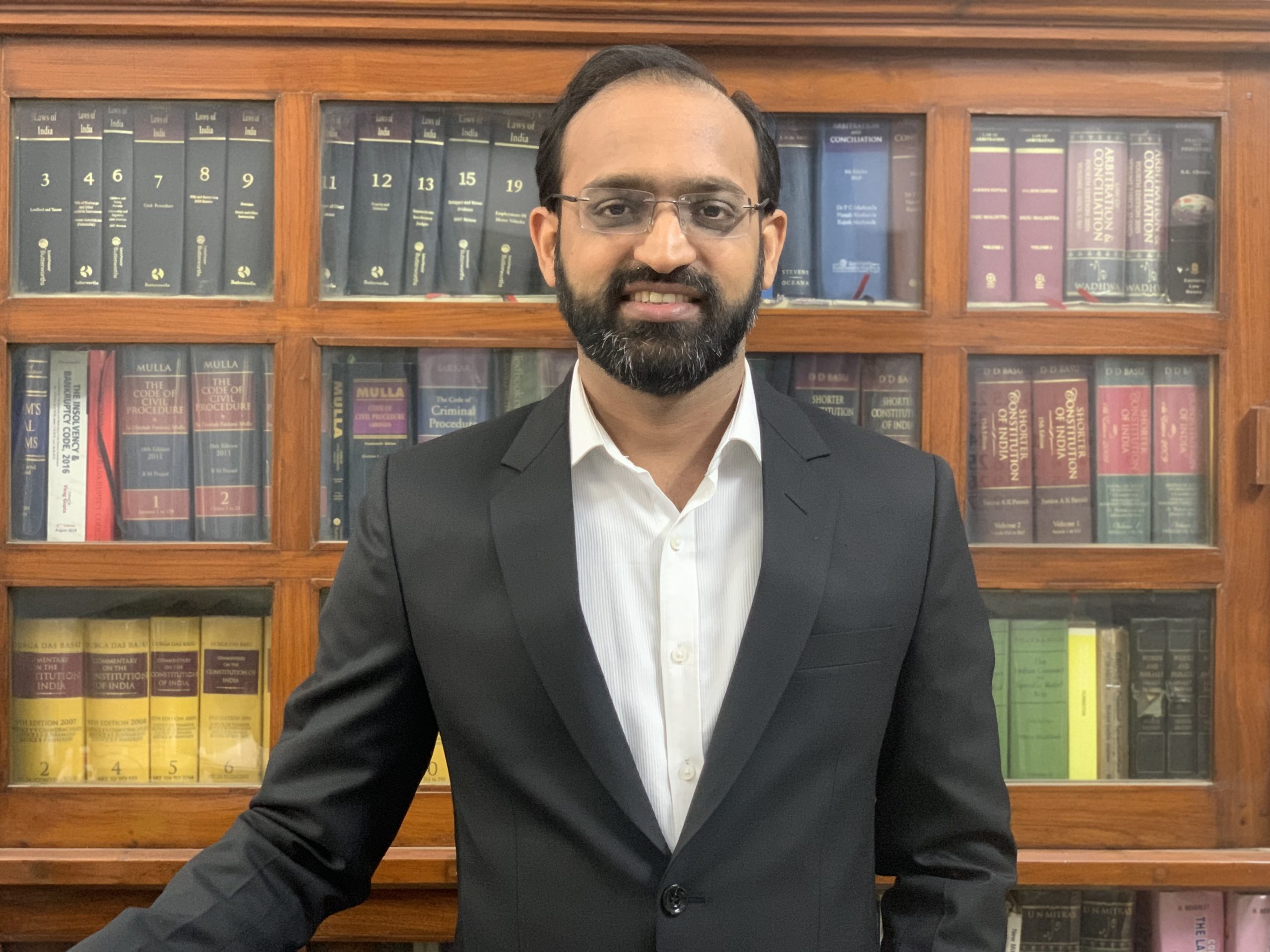
Tag: Partner

  • “Prioritize learning, dedication, and perseverance in the legal profession. There are no shortcuts to success; hence, young lawyers should embrace challenges, treat professors as legal gurus, and remain committed to continuous growth.” – Neerav Merchant, Partner at Majmudar & Partners

    “Prioritize learning, dedication, and perseverance in the legal profession. There are no shortcuts to success; hence, young lawyers should embrace challenges, treat professors as legal gurus, and remain committed to continuous growth.” – Neerav Merchant, Partner at Majmudar & Partners

    This interview has been published by Namrata Singh and The SuperLawyer Team

    Could you take us through your journey from college to your first job and eventually to becoming a partner at Majmudar & Partners? What were the pivotal moments or experiences that shaped your career path, and how did you navigate the transitions along the way? 

    I come from a legal background. My father, Mr. Pravin Merchant, was a practicing Solicitor for over 35 years, and as a result, I was exposed to law early on.  I took up different part-time assignments, internships, trainings, etc., even when I was studying in college.  However, my first job (as a legal trainee) was at Kanga & Co., one of the oldest law firms.  Thereafter, I spent few years in private practice with other prominent law firms, such as Vimadalal & Co., and Gagrat & Co., before moving as an in-house counsel. My transition to being an in-house counsel was under tenuous circumstances. My father passed away in 1995 (when I was in second year law) and the pay standards in most law firms in India in the 1990s was not that high, as compared to in-house profile.  Hence, I decided to spend few years as an in-house counsel.  Except in a few cases, not many in-house counsels go back into private practice.  I went in-house at a relatively early stage in my career and after having spent seven (7) years in-house, I felt that my learning curve had hit a plateau.  Though, I had done large private equity deals, negotiated large outsourcing contracts and even built an entire legal department, I needed more challenges, which I thought I could get only in a law firm setting.  This was the genesis of my decision to move back into a law firm.  As regards my choice of Majmudar & Partners, I knew about Majmudar’s stellar reputation and had even seen their work on a private equity deal that they did against the company where I was the general counsel.  The high-quality work, top-tier clientele, and fantastic standing, both domestically and internationally, convinced me that this was the place for me.  The transition from an in-house set-up into a law firm was challenging.  The key challenge that I faced as an in-house counsel was that of changing my mindset and approach, to be able to think like a client.  Additionally, in private practice, lawyers deal with various clients (individuals and companies), which makes it more interesting.  To summarise, the main challenge was to switch gears in my overall thinking and perspective, and to give paramount consideration to the business objectives of the company. I believe, I made this transition quite well, and this helps me in my practice today.

    Having experienced both roles as a partner in a law firm and as in-house counsel for companies like Tata Housing and Patni Computer Systems, what notable differences did you encounter in these positions, and what factors influenced your decision to transition between the two roles?

    Good question.  One should understand that the industry and sector plays a critical role for an in-house counsel as regards adapting to the legal function, whereas when it comes to operating in a law firm, one must adopt to the work ethics, culture, etc. Firstly, the in-house lawyer is required to understand the industry and sector in which he or she operates, especially, because vertical line of business brings different and interesting challenges, compulsions, limitations and risk appetite. Secondly, the management approach and focus vary for each business. Thirdly, government rules, regulations and policies vary according to industry, which is not relevant when one works in a law firm set-up.  All of this makes it imperative for an in-house lawyer to remain focussed on the sector and ensure that nothing is missed in terms of legal strategy, advice, approach, risk mitigation, etc.  I think the foregoing factors did influence my decision whilst working as practicing lawyer as also as an in-house counsel.

    Having more than 25 years of experience, you’ve witnessed significant changes in the legal landscape. What key shifts or trends do you foresee in the field of dispute resolution, arbitration, and intellectual property in the coming years? A lot has changed over the years and much of it has been for better.  Whilst, it will be impossible to identify all the major shifts or trends, the most important shifts that come to mind are that, judiciary has evolved and matured over the years, the use of technology has become more rampant, the present-day judges are commercially savvy, procedural laws have undergone various changes as also laws on arbitration have become more stringent and focussed after taking cues from cross border arbitration cases.  In my view, IPR practice deserves a compliment because it is kind of evergreen in its own right and has gained momentum over the years, especially, with an extensive increase in the use of the internet, matters relating to infringement, counterfeiting, etc., has become more rampant, there is tremendous awareness re brand protection, logos, etc.   

    You’ve represented clients in enforcing an ICC arbitration award in India. Could you share insights into the challenges and strategies involved in the enforcement process, particularly in the Indian legal context?

    This question deserves a comprehensive response, and we could end up writing a complete chapter on this issue. Broadly speaking, over the years enforcement of foreign awards in India has become smoother as the courts have become sensitive towards being pro-enforcement and acknowledging India as a signatory to the New York Convention on enforcement of foreign awards in India.  Moreover, there have been various statutory amendments and judicial pronouncements which have helped in reducing the challenges of foreign awards by Indian parties.  In my view, the biggest challenge that persists is that of asset tracing and seeking an interim injunction against disposal of the assets.

    Your role involves advising on technology and telecommunication matters. With the rapid evolution of technology, how do you stay updated on the latest legal implications and challenges in this dynamic industry?

    I have been fortunate to work in these sectors very early on.  My first stint as in-house counsel was at GTL Ltd, which was in the business of installation of radio-frequency towers, laying down optic fibre cables, and providing other related telecom services. All of this compelled me to continuous learn, read and stay on top of the regulations, interact with governmental officials, and constantly review judicial precedents touching this sector.  I had to adopt a similar approach in the areas of technology. The Information Technology Act was introduced sometime in 2000, which, since then has been the legal backbone in relation to technology law.  There has been constant learning, checking new amendments regularly, focusing on the rationale of changes, and then advising clients on a given scenario.

    In your recent transactions, you’ve been involved in diverse matters, from challenging telecom regulations to high-stakes arbitration involving global players. Could you highlight one or two recent transactions that you found particularly intriguing or challenging, and share the key strategies that led to a successful outcome for your clients?

    In the recent past, we had represented one of the large telecom service providers, operating in the business of mobile portability. The TRAI (telecom regulator) brought in a certain regulation that impacted our client’s ability to do business in India. We assessed the relevant law, regulations and provisions and checked judicial precedents, as also researched on important provisions of the Indian Constitution, and filed a constitutional writ before the Delhi High Court considering that the regulation was impacting our client’s fundamental right to do business.  After some deliberation and with excellent arguments made by eminent Sr. Counsels, we eventually succeeded in obtaining a favourable order quashing the controversial regulation.  This allowed our clients enormous commercial relief and the time and efforts spent by the firm were highly appreciated.

    Amidst your demanding legal career, how do you unwind and recharge? Could you share some of your hobbies or activities that bring you joy and relaxation outside the courtroom or office?

    I agree that having a good work-life balance is critical to reduce stress levels and to enhance productivity.  To manage stress levels, I spend my mornings in doing some physical training, reading interesting articles, etc.  In the evenings, I prefer to simply relax with family and occasionally with friends. My hobbies include reading, going for evening walks, long drives, an occasional movie in the theatre, etc.

    Given your extensive experience in the legal field, what advice would you offer to law students regarding the scope of the profession and the mindset they should cultivate while studying law?

    Firstly, all law students should opt to pursue this profession, only if they are mentally and intellectually driven to pursue such profession, and not because of any other reason. Practicing law is a serious profession as it demands commitment, dedication, and devotion.  If one compares the overall mindset of experienced lawyers versus young law students (including newly graduated lawyers), there will always be a general gap in terms of overall approach, thinking, priorities and perceptions.  In my view, law students (or freshly qualified lawyers) are dynamic, aspirational, and savvy, but they lack patience and perseverance. I would like to urge the younger generation to focus on learning, and hard work, and to treat their professors as legal gurus.  Law students should understand that there are no shortcuts to success; hence, they should not cut corners.  Youngsters should be smart in choosing their internships with firms where they genuinely see interesting client work that can help them apply legal theory in practice.

    As a seasoned lawyer, you’ve advised on foreign investment, general corporate matters, and joint ventures. What advice would you give to young lawyers aspiring to specialize in international law or corporate law?

    A simple advice to all young lawyers is to take up all kinds of work in the earlier years of their career, namely, matters relating to commercial disputes, arbitrations, securities law, foreign exchange law, employment law, or on general commercial queries, doing due diligence, working on a commercial contract, etc.  In other words, never say no to any legal work assigned by one’s senior.  After spending around 2 or 3 years as a generalist lawyer, one can pursue the vertical area of practice that is appealing or interesting.

    Get in touch with Neerav Merchant-

  • “I feel that increased technological advancement in legal practice will create better opportunities for young lawyers, will lead to increased transparency, lower rates of disputes,  faster dispute resolution, standardisation of legal fees and overall improvement of the legal system which directly impacts ease of business”- Saurabh Bhardwaj”, Partner, ORTIS Law Offices

    “I feel that increased technological advancement in legal practice will create better opportunities for young lawyers, will lead to increased transparency, lower rates of disputes,  faster dispute resolution, standardisation of legal fees and overall improvement of the legal system which directly impacts ease of business”- Saurabh Bhardwaj”, Partner, ORTIS Law Offices

    This Interview has been published by Pragya Chandni and The SuperLawyer Team

    Can you share with us what initially inspired you to pursue a career in law, and how did your journey in the legal field begin?

    My father who is a practising lawyer inspired me to become a lawyer. He believed that my analytical skills, command on languages and oratory skills would get me immense success in the legal profession. During my college days I interned with some of the best senior lawyers of the country and was mesmerised by their personalities and their court craft. I aspired to become a senior counsel one day and that’s why I started my career as a litigator. I started my career with my father but shortly thereafter joined the office of a young and successful lawyer in Tis Hazari District court. With my mentor and first boss I got the opportunity to work on some very high stake white collar crimes cases as off-counsels for tier 1 law firms. I was taking up my own matters as well as assisting my senior in his matters. After 4 years of litigation I felt I was stagnated as I had ready playbooks for all kinds of criminal and civil litigation and the cases progressed very slowly. I felt I should expand my horizons and learn a little bit about corporate legal work before I can decide which way to go.

    At this time I got the opportunity to work in the legal department of a popular Indian mobile phone company (Micromax) where I got to draft,review and negotiate commercial agreements for the first time. During my two years of working with the said company I learnt immensely about business and the role of lawyers in ensuring good business hygiene. I would work directly with business heads of various departments and get to learn in detail about their respective departments. I understood the scale of legal operations that are there in big corporations and how to manage them using available digital tools. I also learnt how to get things done by making interpersonal bonds with people which I could never learn as a litigation counsel. Later, I started my own boutique law firm with a few of my friends from law college and started providing comprehensive legal services to startups in NCR including disputes resolution, general corporate, M&A, IPR, compliances etc. In the year 2022 I decided to finally start working on my long standing dream of starting my own business in legal-tech space and that’s when i incorporated my own company to develop a B2B legal tech SaaS platform under the brand name “TrueCounsel”

    Versatility in Legal Practice:

    Legal profession is more art than science and although I do believe in the importance of specialisation, I feel a good lawyer can do anything and everything. Many great lawyers choose to specialise in one area of law but if needed they can take up any kind of challenge. A lawyer who has the capability of representing a client before the Hon’ble Supreme Court of India, can also represent a client in an international arbitration, can also negotiate a high stake deal, can also become a politician, can become a great entrepreneur etc. The level of preparedness, meticulousness, foresightedness and oratory skills that are expected of lawyers, make us ready to take any challenges head-on and with ease. We are mostly performing and at best of our behaviour be it before a court or in a virtual meeting or even when casually meeting anyone in our social circle.

    You have expertise in both litigation and corporate legal work. How did you find yourself navigating both these aspects of law, and which area do you find more challenging or rewarding?

    I find myself navigating between all aspects of law quite smoothly. I believe good research is the key to do well in any area of law or business or technology. I like to take on challenging problems and solve them by sheer hard work. All areas of law are equally challenging and rewarding in my experience and I feel that I thrive under pressure. Whenever I feel that I have become comfortable and bored, I try to take on a new and bigger challenge for myself. Presently I am focussed on learning how to mentor and train the young generation of lawyers which is very different from my generation and becoming a good leader. Also I am facing the challenges of being a tech founder and running a highly competitive business which is very different from being a lawyer.

    You mention a strong aptitude for managing large volumes of corporate disputes using the latest technology. How has technology played a role in your legal practice, and how do you see it shaping the future of dispute resolution?

    The first time I started managing huge volumes of agreements, consumer disputes and recovery matters as an in-house legal counsel, I realised this was completely different from being a litigator. This was the first time I used Microsoft Excel with the help of my boss and second mentor who is also a Chartered Accountant. I understood the importance of using digital tools effectively in order to manage large volumes of data. I had been using technology for legal research during my litigation days already along with OCR tools for extracting data easily for drafting but beyond that I did not know much about the need of tech in the legal profession. This was the time when companies such as ProVakil, Vakilsearch, MyAdvo, Mikelegal etc. had also come up with the objective of solving major pain points in the legal industry using technology. These companies provided solutions for easy discovery of legal professionals, contracts workflow management, automatic updates on court cases, enforcement of IPR etc. This caught my interest immensely as I could see that any problem can be solved using technology and that India is booming with a tech workforce which can create any kind of tech very fast. During the Covid times, the necessity for incorporating tech in legal practice got highlighted and we saw fast advancement in this direction.

    I feel that increased technological advancement in legal practice will create better opportunities for young lawyers, will lead to increased transparency, lower rates of disputes,  faster dispute resolution, standardisation of legal fees and overall improvement of the legal system which directly impacts ease of business.

    Could you share one or two experiences representing clients in high-stakes disputes that have left a lasting impact on your approach to legal representation?

    During my initial litigation days and also when I was working as an in-house counsel, I got to work on some very high stake disputes involving foreign entities. I got the opportunity to work with foreign lawyers and I was highly inspired by their inquisitive approach towards understanding Indian law. I drafted memos and legal opinions which were then vetted by tier-1 Indian law firms and finally shared with these foreign lawyers and that taught me how to appreciate law from an outsider’s perspective. I became more critical and inquisitive about statutes and legal provisions. Also I learned the importance of strategising in detail at the very commencement of a dispute and factoring in all possible outcomes of every step well in advance so that you are never caught by surprise. It also taught me how to manage voluminous documents and data effectively in order to succeed in any dispute because more than law, the facts make or break a case.

    Moving on to your current role as a Partner at Ortis Law Offices, what prompted this transition, and how has this role differed from your previous experiences?

    When I merged my law firm with Ortis Law offices, I made a hard decision to stop doing everything and focus completely on corporate legal work. This decision was prompted by the need for specialisation. I had been doing everything that would come to me and even actively generating work in all possible directions but I realised that although this keeps me motivated, it is not very effective in many ways. I realised that once you have more than 10 years of experience, you must pick an area of law and focus completely on it while generating other work for your partners in the law firm. This creates a good structural foundation for scaling up your legal practice. At Ortis Law Offices I learnt how to be a good mentor and senior. Earlier I would expect a bit too much from my juniors and as a result would become very frustrated with them. This led to low motivation and a toxic environment in my team but my senior partners at Ortis Law Offices taught me how to keep your team happy and motivated and give them space to blossom. Also, while working with other partners at the firm I learnt a lot more about working with MNCs and big clients than I had in my earlier experience.

    You’ve been involved in various acquisitions, funding rounds, and legal proceedings. Could you highlight a recent case or advisory role that stands out to you and share some key lessons or insights gained from it?

    Recently I worked on the acquisition of a company undergoing financial distress wherein I had to represent the said company and its founders. At the same time I had to negotiate settlements with the creditors of the company. This was a very stressful and hectic project wherein I learned how to keep calm and stand your ground under tremendous pressure while representing the losing side in a transaction.

    As someone with over a decade of experience in the legal field, what advice would you give to law students or recent graduates who are starting their careers in law? What lessons have you learned that you believe would be valuable for them?

    My only advice to young law students and lawyers is to do as much freelance work as possible. I believe that while working with seniors or in a law firm structure or as an in-house lawyer one tends to have huge scope for error and a lot of cushion but when you freelance you are directly answerable to the client which teaches you professionalism at a whole different level. It teaches you how to value their time and provide the highest quality of services that you can. 

    Another important advice is that you must keep adding skills in your arsenal. The moment you stop updating your skills you become obsolete and redundant. I recommend that the young lawyers should use as much technology as possible while doing their research, drafting or any other work to increase efficiency and quality of their product and keep a lookout for the latest advancements in legal tech.

    Get in touch with Saurabh Bhardwaj-

  • “Every hearing teaches something new; every case shapes a better advocate. In the dance of law, advocacy is my rhythm, and justice is my melody.” – Sonali Chopra, Partner at Arimus Law

    “Every hearing teaches something new; every case shapes a better advocate. In the dance of law, advocacy is my rhythm, and justice is my melody.” – Sonali Chopra, Partner at Arimus Law

    This interview has been published by Namrata Singh and The SuperLawyer Team

    Reflecting back on your college days, could you share your journey from how you thought of doing law to your college days, and how did you navigate the transition from college to the legal profession, especially as a first-generation lawyer? What were the challenges you encountered, and how did you overcome them to establish your career?

    I have always been my mother’s “brighter” child. When the time came for me to choose a career path, my mother casually suggested law. Being a first generation lawyer, I had no insights into the profession, its scope or its demands. In fact, I had absolutely no first-hand knowledge about the life of a lawyer, beyond what is depicted in television, movies and John Grisham novels. At that time, after I compared law to the other conventional career choices, being a lawyer excited me the most. As my curiosity drifted towards law, the decision was made. To be honest, when I look back, I think doing law was just a choice I made by chance. But almost 15 years later I can honestly say that it was one of the best choices I have made.

    I studied law at Dr. RML National Law University and I am who I am today because of what my time in law school taught me. The five years I spent in law school were very internship centric. After the internships I did in my first year of law school, I realised that they gave me the practical exposure that law school did not. From my second year in law school, I started interning, every chance I got. While not taking away from the importance of academics, I truly feel that internships gave me first-hand knowledge about the profession. They exposed me to the practicalities and realities of a lawyer’s life. 

    Owing to my internship experiences, by the end of my third year in law school, I was quite sure that I wanted to start my career as a litigation lawyer. 

    My transition from college to the legal profession was smoother than I had anticipated it to be. Before I finished my last semester, I had job offers from two litigations firms. One offer I got was on account of a long internship I did at the firm and the other one was on account of an interview I gave while I was in my last semester. 

    In 2013, Lawctopus and Legally India posted several job openings. I remember I applied for the opening of an Associate at Arimus Law. I got an interview call. The interview was assessment based and not just an interaction with the Partner, Mr. Arjun Singh Bawa. A day before the interview I was sent a fact sheet and was told to prepare arguments from both sides. The interview was like a moot court competition. I argued my case and I got the job! It was one of the most exciting interviews I ever gave. In fact, even now, 10 years later, we still follow this assessment interview model while hiring at Arimus Law.

    The only difficulty I faced during the transition was the choice I had to make between the two job offers. One was with a very reputed law firm and one was with a comparatively newer law firm. Not having a mentor in the profession to guide me in the right direction, this choice was a tough one to make. I weighed the pros and cons, as I knew them then, and took the decision to join the latter, Arimus Law. My decision was swayed by the fact that Arimus Law had more trial work. 

    During this roller coaster ride, the biggest challenge I encountered was not having a professional mentor who I could go to for advice and guidance. 

    You’ve worked with various renowned advocates and senior advocates. Can you share a memorable experience or lesson that significantly influenced your approach to legal practice?

    I have been very fortunate to have got the chance to work with several renowned advocates and senior advocates. Every interaction with another lawyer has taught me something but the key learnings I have got over the years that I still keep in mind today are:

    1. Put effort into your list of dates and synopsis. It might be the only thing a Judge reads before dealing with your case. 
    2. Pleadings can make or break a case. Draft crisply, there is no need for non-essential verbosity. 
    3. Master your brief. Don’t just read it, think about it, dream about it. Make the brief your story. 
    4. By failing to prepare, you are preparing to fail. 

    You’ve had a diverse and impactful legal career, starting as an Associate at Arimus Law and now being a Partner in the same firm. Can you share a memorable experience or case that has significantly shaped your journey as a lawyer?

    While I was still in law school, my mother’s ancestral property in Delhi became the subject matter of litigation. I (and also my mother) strongly believe that this case has played a major role in making me the lawyer I am today. Being a property related dispute, it has a civil law angle, a testamentary law angle and also a criminal law angle. 

    When I was in law school my mother used to go and attend the hearings of this case before the Hon’ble Delhi High Court. Before each hearing I would have long conversations with my mother about what the case was listed for, what the lawyer’s strategy was, what could be the possible outcomes of the hearing etc. Whenever I was in Delhi for an internship or a break, I used to accompany my mother for meetings with the lawyer and for the court hearings. 

    The fact that I became a litigant before a litigation lawyer changed the way I deal with my Clients today. I make an effort to be more compassionate, empathetic, honest and available to my Clients. 

    It is also this case that enabled me to, very early on in my career, familiarise myself with the dynamics of a courtroom. What I have learnt about courtroom dynamics from this case is something that I benefit from, till date. Effective advocacy is so much more than just knowing the law. During the initial years of my career, the exposure I got from this case helped me bridge the gap between the theoretical world of law and the real-world courtroom dynamics.

    This case is still pending adjudication and every hearing still teaches me something new. 

    You’ve been appointed as a Local Commissioner to record evidence in various Suits by the Ld. Judges of the District Courts of Delhi. Could you share some insights into this role and how it contributes to the legal process?

    I’d like to start by quoting from the judgment of the Hon’ble Delhi High Court passed in Pushpa Devi Vs. Bimla Devi & Ors. (AIR 2000 DELHI 141)  – 

    “…However sad as it may seem the reality today is that Suits do not reach hearing for a large number of years…Delay therefore defeats justice”

    This judgement was passed over 2 decades ago but the situation unfortunately is still the same. 

    In my active practice before the trial courts in Delhi and on the original side in the Delhi High Court I have witnessed cases languishing for years at the stage of evidence. This is solely because of the sheer burden there is on the Courts these days coupled with the lack of infrastructure. I truly believe that the process of appointing local commissioners to record evidence in suits has considerably cut short the time a suit takes to become ripe for arguments. 

    You transitioned from an independent practice to becoming a Partner at Arimus Law. What factors influenced your decision to join the firm, and how has this shift impacted your approach to legal work and professional growth?

    I started as an Associate in Arimus Law in 2013 and I worked there for almost 3 years. 

    During my time at Arimus Law, I got the chance to research, draft, participate in client meetings and appear before multiple courts in a day. Within the first 6 months at Arimus Law, Mr. Bawa gave me the opportunity to argue a matter that I had drafted and got filed before the Hon’ble Delhi High Court. One evening before the matter was listed, Mr. Bawa made me practice my arguments before him and the next date he sat next to me and told me to take the lead. Every day after I came back from Court, I had so many questions, about the law, about the procedure or about an argument I heard another lawyer make in Court. Every evening somewhere between 7 PM to 8 PM, Mr. Arjun Singh Bawa, my then boss (and now Partner) used to wrap up his client meetings and take a coffee/snack break. It was during this time that I used to go into his cabin and bombard him with all my questions and doubts. I still remember how he used to patiently answer all my questions and clear all my doubts. Soon this became a ritual. My time as an Associate at Arimus Law was enriching and very rewarding. 

    After about 3 years, I started feeling complacent at work and that is when I decided to quit Arimus Law and look for other opportunities. Over the next 3 years I worked at various other chambers and gained more experience. 

    In 2018, when I had a few clients and enough money in my account to make rent for six months, I decided to take the plunge and set up my independent practice. To be honest, it was very daunting at the beginning. There were many unsettling moments of self-doubt, unsureness and fear. But with God’s grace, luck and a lot of hard work, I think I was able to establish a successful independent practice. I never gave myself enough credit but when I survived the COVID 19 pandemic without having to give up my office space, I realised I had done something right. 

    After I started working independently, I collaborated with Arimus Law for a few matters. In the end of 2022, when we had come out of the pandemic, I began wondering, “what next?”. To my surprise, serendipitously, in the beginning of 2023, Mr. Arjun Singh Bawa offered me partnership in the firm. 

    The 2 primary factors that influenced my decision to take up this offer were the experience I had working as Mr. Bawa’s associate in Arimus Law and the collaborative work environment that a firm set up can offer more easily as opposed to independent practice.

    The shift from being an independent (first generation) counsel to a Partner in a law firm has definitely made me more equipped. With the assistance of the exceptional team that we have built at Arimus Law, I am able to do more work without compromising on quality. 

    Could you share some insights into the challenges you faced in both roles? What were the unique challenges of working independently, and how have they evolved or changed since becoming a partner in a firm? How do you navigate these challenges while maintaining the high standards of legal practice?

    The biggest challenge I faced as an independent practitioner was to acquire new clients. When I started my independent practice in 2018 I had a handful of clients. I remember the time when I had court hearings only 2-3 times a week. This was a tough adjustment after being an associate in chambers where I’d get to appear in multiple Courts in a single day. However, I used that extra time I got out of Court to work more extensively on my briefs and find ways to get my Clients favourable results. Eventually, over the years I was able to do some good work for my initial clients who then graciously recommended me to their friends and family. 

    At Arimus Law I work with 3 other Partners. Mr. Arjun Singh Bawa who primarily handles commercial and contractual disputes, Mr. Arjun Dewan who primarily handles criminal and medical negligence disputes and Mr. Arjun Mukherjee who primarily handles IPR and criminal disputes. Over the last 6 months, we have built a team of young, dynamic and very talented lawyers. I must say that it has been my absolute pleasure to have a chance to work with all the members of our team. 

    Learning to balance responsibility, not only as a lawyer but in other roles is a challenge I have faced in my current role as a Partner but I am enthusiastically learning how to be a good lawyer, a mentor, a leader, and a good team player, all at the same time. 

    You’ve revised the 16th edition of the Pollock & Mulla – Specific Relief Act, 1963. What motivated you to take on this task, and how do you believe this contributes to the legal community and practitioners?

    I believe that the legal profession and academia are interlaced. I took up this task knowing that it will complement and enrich my legal practice by providing me with a platform to learn and grow.

    I don’t know about others, but even today, in the age of the internet, search engines and legal research tools, whenever I come across a provision of law with which I am not completely familiar, I look up a commentary to find the starting point of my research. I sincerely hope the revised edition of the Pollock & Mulla – Specific Relief Act, 1963 helps members of the legal community familiarize themselves with the Specific Relief (Amendment) Act, 2018. 

    Apart from your legal pursuits, you’ve trained in Bharatanatyam and performed several Bharatanatyam Recitals under the guidance of Padma Shree Geeta Chandran. Many individuals find it challenging to sustain their passion for the arts as they become busier with their professions or during higher studies. We’re curious to know about your journey with Bharatanatyam—how did your interest in this classical dance form grow alongside your legal career?

    I was blessed to have a structured upbringing with academics, dance, sports etc. I started to learn Bharatanatyam at the age of 6. At Natya Vriksha under the tutelage of Geeta Akka, dance was just one of the multitude things I learnt. Geeta Akka filled my young mind with art, music, culture, history, mythology as well as social values of justice, equity an inclusion. Natya Vriksha was my second home. I danced regularly from the age of 6 till I turned 18, when I left to study law at Dr. RML National Law University, Lucknow. 

    Over the years I developed a passion for Bharatanatyam and all its nuances. During and even after law school I tried very hard to multitask and continue my journey in Bharatnatyam while practicing law. But both Bharatantayam and practising law are hard task masters. The practise of law leaves little time for anything else. Amidst the demands of my career in law, I could not give Bharatanatyam the time and effort it required. 

    At the age of 24, I made the very tough decision of giving up my dream of becoming a Bharatanatyam dancer. However, thanks to my Guru, Padma Shri Geeta Chandran and the Natya Vriksha Dance Company, Bharatanatyam is still a part of my life. Both my Guru and her dance company perform regularly and I am fortunate enough to have the opportunity to witness these magical performances. 

    There have been days where I feel that the law took away Bharatanatyam from me, but then, in all fairness, the law has given me back so much more!

    As a panel member in various debates aired on Times Now and Mirror Now, how do you see the role of legal professionals in shaping public discourse on legal issues?

    In today’s world, the media is playing an undeniably important role in creating and shaping public opinion. There are several instances where the general public is unaware of the correct position of law in respect of certain issues. It is in such situations that legal professionals should be made part of a public discourse in order to enable them to highlight the correct position of law. This in turn gives the public the complete information that they should have to make an opinion. 

    Internships play a crucial role in a law student’s journey. Can you share insights into the kind of internships you pursued during your college days and how those experiences influenced your career choices? Additionally, what advice would you give to law students when it comes to selecting internships, especially considering the trend where many aspire to intern at tier 1 law firms?

    My recollection of my journey and transition from law school to the legal profession is a first-hand example of the importance of internships in a law student’s journey. Being a first generation lawyer I had no insight into the realities of the legal profession. Like I said earlier, my exposure was restricted to only what was depicted in television, movies and books. 

    When I started law school, I was hopelessly home sick. To begin with, internships were an excuse to go back home to Delhi. In my first year I interned with two NGOs. I bagged these internships through family acquaintances. 

    In my second year I interned with Mr. Vikas Dhawan (who is now a designated senior). He was then an advocate practicing primarily on the Original Side in the Delhi High Court. He was our lawyer in my mother’s property matter so it was again an easy internship to get. It was my time in his office that got me really excited about litigation. However, I still wanted to intern in different fields of law before deciding which one I was most interested in. 

    The next few internships were hard to get. I did not know many people in the profession and all my e-mail applications (sent months in advance) remained unanswered. But I did not lose hope! 

    I remember, in 2011, I printed several copies of my then 1 page CV and roamed the streets of Defence Colony (the hub of lawyers’ offices in Delhi). I walked into so many offices and handed over my CV to anyone who would take it. I bagged my next few internships like this. This exercise got me the opportunity to intern with Mr. P.K. Dubey ( now a designated Senior), Zeus Law, Mr. A.S Chandhiok (Senior Advocate), Sikri & Company etc.  

    I also briefly interned in the Corporate Division of O.P. Khaitan & Co. After my previous internships in the field of litigation, my short stint here was enough for me to know that I was not meant to be a corporate lawyer. The stifling hustle-bustle inside and outside the courtrooms  excited me the most. 

    I personally did not intern in any tier 1 law firm. This was only because I never got the opportunity. During my law school years I did fret a lot about not having any tier 1 law firm names on my CV but then, there was honestly not much more I could do about it. 

    I chose to not give up or lose heart. I took up every opportunity I could lay my hands on. I made connections as I went. And, I worked hard, very hard. 

    Being a first generation lawyer I can be very blunt and say, the journey can be challenging. My only advice to law students and young lawyers is to be brave, be curious, chase experience and continue learning. Take up every opportunity you can lay your hands on, be it big or small. There is no better teacher than experience!

    Get in touch with Sonali Chopra –

  • “In the dynamic realm of corporate law, success is not just about transactions; it’s about teamwork, evolving strategies, and navigating complexities. Each challenge is an opportunity to craft a lasting impact.” – Payal Dayal, Partner – Corporate Head, AKS Partners (Advocates | Solicitors | Consultants)

    “In the dynamic realm of corporate law, success is not just about transactions; it’s about teamwork, evolving strategies, and navigating complexities. Each challenge is an opportunity to craft a lasting impact.” – Payal Dayal, Partner – Corporate Head, AKS Partners (Advocates | Solicitors | Consultants)

    This interview has been published by Namrata Singh and The SuperLawyer Team

    Reflecting on your journey, from pursuing law to your college days, could you share some key moments or experiences that influenced your decision to enter the legal profession? How did your time in law school shape your understanding of the legal landscape and contribute to the path you’ve taken in your career today?

    At the outset I must share that pursuing law just happened. I am a first-generation lawyer and hence the thought of doing law never came in discussions during my growing up years. But yes, one thing I knew, my grandfather wanted my father to be a lawyer so when I cleared my law entrance exam and finally got admitted to Amity Law School, I thought to myself how proud my grandfather would be, had he lived to see this day, as I get to fulfil his dreams. Other than that, it was sheer luck and destiny to do law from Amity in as much as I only gave the entrance exam for Amity Law School and cracked it!  

    Moving on to the first semester of law and the introduction to moot courts was all too overwhelming for me. I was always an active member of the moot court society and loved to participate in moot court competitions. I started admiring the dynamics of law as a field of study and enjoyed my college days to the fullest. A few subjects like International Law, Constitutional Law, Intellectual Property Law and Corporate Law were amongst my favourites. To top it all, I never missed a good internship opportunity which got me more in touch with the profession as it was practiced – being very different from our moot courts and theory we learn in college.

    After doing my final semester three-month internship with a top tier law firm in the corporate team, I decided to work in a law firm and in the corporate field rather than dawning the black robes.

    Your journey has been quite diverse, spanning from serving as an intern at organizations like Steel Authority of India Limited to your current role as Partner – Corporate Head at AKS Partners. How have these varied experiences shaped your perspective on corporate law, and what valuable lessons have you learned along the way?

    Each internship and each role in my previous law firms including the current one taught me a different lesson. As an intern at Steel Authority of India, I was involved with their ongoing arbitrations. As an intern at the International Labour Organisation, an agency of the United Nations, I gained knowledge of different aspects of labour disputes, and so on and so forth. My internship experience, irrespective of the organisation or a firm, have always been enriching ones. However, when one starts practicing, that becomes a different ball game altogether.

    What I am today in the professional field I owe to my mentor under whose mentorship I commenced my professional journey in the corporate field around 17 years back. It was truly there that my career shaped the way it has. I assisted and then independently undertook many transactions in diverse industry segments, opined on various industry specific issues, worked on FDI matters which fascinated me a lot at the time. These past learnings have eased my role and responsibility as a Partner-Corporate Head at AKS Partners. 

    The biggest learning that I take from the diverse experiences I have had is that teamwork always yields good results. You need to have trust in your team, at whatever position you are on the ladder. It plays a big role especially when you are mentoring juniors and delegating tasks to them. When I started out in the profession, my mentor always backed me. At times I would come up with ideas and solutions that my mentor had not thought of. That gave me a lot of confidence, and I have made it a point to imbibe the same confidence in my juniors. Another big learning is that clients often come to you with a ‘solution’ already in mind. Doing exactly as they say is often the easiest way but may not always be the best way. Therefore, you need to look at the problem objectively and guide them in the right direction.                            

    As a partner, you’ve represented clients before the Reserve Bank of India in compounding matters. How do you approach such regulatory challenges, and what strategies do you employ to navigate through the intricacies of regulatory compliance?

    I have appeared before the Reserve Bank of India (Mumbai) a couple of times but initially I appeared while I was still a Senior Associate. My mentor had utmost faith in me that I could handle the matter independently. Having said that, there is no shortcut to being thoroughly prepared particularly prior to appearing before the regulatory authorities. The regulatory authorities always appreciate lawyers who have systematically and carefully drafted their application and stated the reason behind a compoundable contravention. A methodically and logically drafted application taking care of all the nuances increases the chances of reaching the ears of the regulatory authorities. 

    Your horizontal practice areas include Commercial Contracts, Corporate compliance, Joint Venture/ Collaboration/ Acquisition, and more. Is there a specific area that you find particularly fascinating or challenging, and why?

    Acquisitions clubbed with market entry/ investment advisory, inter-alia, is my specialisation and what excites me the most is that each acquisition has a different strategy from the other and that there is no straitjacket formula that fits one and all. Particularly when there is a foreign company involved, FDI advisory clubbed with tax advise becomes very significant and the right structure and entry route is strategically quintessential. Very often, it is this first step which is challenging in addition to negotiating difficult aspects (usually the parked points) for which the principals are on loggerheads at the negotiating table. Having said that, taking the transaction to its righteous end, i.e., completion or closing as one may call it, excites me the most.   

    The Corporate Due Diligences you’ve undertaken covered a wide range of areas, including Labour and Industrial Laws, Environmental Laws, and Competition Law. How do you stay abreast of the ever-evolving legal landscape in these diverse fields, and how do you ensure your advice is both current and relevant?

    As a lawyer, it is one’s job to stay updated with the law at all times. I keep myself updated by reading the SCC every fortnightly and by frequenting regulator websites like RBI, SEBI, CCI, IBBI, MCA for latest notifications, master directions, press-notes, etc. on a daily basis before I begin my work for the day.

    To answer the second part of your question, before giving advise I always check the sectoral regulations and any updates on the point including in the form of apex court decisions.

    You’ve been involved in publications, including ‘The Drone Dichotomy – A Game Changer.’ What sparked your interest in this particular topic, and how do you see the legal landscape evolving with emerging technologies like drones?

    When I embarked writing on the topic, the regulations were yet to come out and the authorities were still grappling with the facts, i.e., the opportunities such a technology presented and challenges that it could pose as the idea of using “Drones” for various purposes was relatively new for the country. It immediately ignited my brainwaves to think of how this potential technology could be used and that too in a regulated way and even more towards the privacy concerns that were hovering in my mind for some time in case of absence of sufficient regulations on this aspect.

    Since then, the legal landscape has evolved substantially. The Ministry of Civil Aviation Government of India (MoCA) has framed comprehensive laws to ensure proper regulation of use of drones. The framework addresses concerns like safety standards, airspace management and privacy challenges. Of course there are several other aspects that are bound to crop up with more and more use of the technology and the regulator, i.e., MoCA, will have to come up with practical solutions whether it be on determination of liability in the event of an accident with various jurisdictions involved or accountability in case of remote controlled drones. International collaboration on regulating drone technology is no longer a far-flung concept.

    Your sector expertise ranges from Manufacturing to Renewable Energy. How do you keep yourself updated with the nuances of such varied industries, and what role does industry-specific knowledge play in your legal practice?

    I reiterate that one should keep reading and stay updated on the legal framework and nuances particularly in the sectors that one practices in. This can be done by reading the statutory framework along with the landmark judgments and articles on the point in the relevant sector.

    During your time at Amity Law School, you were an active member of the Amity Moot Court Society. Can you share your perspective on the significance of participating in moot court competitions for law students? How do you believe these experiences contribute to a student’s overall legal education and career development?

    I believe moot courts help the students in three ways. Firstly, it teaches the students to research, and not just in a bookish way but how one tackles situations in the profession. Second, it improves the drafting skills and to express oneself in an erudite manner. And most importantly, the arguing skills. Many students may not be natural speakers so it helps them to open up and become comfortable in facing the judges and making their point.

    Hence, I believe it is very important for students to participate in moot court competitions. Mere participation gives the students a lot of confidence, irrespective of winning or losing, and frankly, it teaches one how to accept defeat and prepares the students for the tough beginnings that await them.

    Internships play a crucial role in shaping a legal professional’s early career. What advice would you give to law students about choosing the right type of internship? For instance, do you recommend working under a senior advocate, in a law firm, or exploring other avenues, and why?

    I would recommend the law students to intern in every field and experience for themselves as to what appeals to them individualistically. All students cannot be pigeon-holed into any given category. Given the individualistic mindset, some may like arbitration and pursue a career accordingly, some may like litigation would accordingly prefer to pursue any further internships in the litigation wing of a firm or an individual practitioner and some would like the dynamics of the corporate set-up or some may even take to intellectual property law practice. My only advise for the students is that they should not miss any opportunity to intern and intern sincerely and explore for themselves as to what appeals to them the most.

    In addition to your professional achievements, we’d love to know more about your personal interests. What hobbies or activities do you engage in outside of the legal realm to unwind and recharge?

    The best way to unwind for me is to spend quality time with my daughter. Other than that, I like to paint and read fictional/ non-fictional books.

    Given your diverse experiences, both in law firms and as an independent legal practitioner, how would you compare the learning experiences in these different settings? What unique advantages or challenges do each offer, and how can young professionals leverage them to enhance their skills and knowledge

    My diverse experience made the difference between law firm practice and independent practice crystal clear to me. While in the latter, you are your own boss and command accordingly, in the former, depending on which rung of the ladder you are on, you mostly have a senior to poke you out of your slumber and weigh you down with lots of work irrespective of how much you already have on your plate. But then that’s what keeps you on your toes and it gives you utmost satisfaction at the end of the day to tick off things done from the to-do list one made in the morning. However, independent practice, while more lucrative, is not that easy, whether to establish or to command, as one has to be utmost sure of the advise one gives to the client as remember, you are your own boss and there is no cushion in the form of a senior. But this really enthrals you as you keep going and learn and master the art.  

    Get in touch with Payal Dayal-

  • “Since Insolvency Law is still at a fairly nascent stage, every case brings with it a new set of challenges giving you the opportunity of contributing towards the Insolvency Jurisprudence as a whole”- Himanshu Chaubey, Partner, Edictum Law & Co.

    “Since Insolvency Law is still at a fairly nascent stage, every case brings with it a new set of challenges giving you the opportunity of contributing towards the Insolvency Jurisprudence as a whole”- Himanshu Chaubey, Partner, Edictum Law & Co.

    This Interview has been published by Pragya Chandni and The SuperLawyer Team

    Can you share the journey that led you to pursue a career in law, starting from your education at Hidayatullah National Law University? What motivated you to choose law as a profession?

    Honestly speaking I stumbled upon law by chance. I was always interested in humanities and social sciences but took up a Science in my plus 2. But I soon realised  that I was not very good at it. A friend of mine then informed me that there are these institutions called the National Law Universities and people graduating for these institutions are getting well-paying jobs. It was the first time that CLAT was being conducted for admission to these colleges. I did some research and thought that it might suit my interest. So I must admit candidly that I chose law to avoid doing Engineering and was lured by the promise of a Fat Pay Cheque .  

    As an Advocate-on-Record at the Supreme Court of India, you’ve handled matters of constitutional and national importance. Could you discuss a specific case that stood out to you, and how it shaped your perspective on legal practice?

    Ans. As an AOR one matter which really stood out for me was a case wherein My Client, who is an RTI Activist, was not being allowed to reside within the confines of a District on the basis of false FIR’s registered against him. The FIR’s were registered by the same people against whom action was being taken on the basis of representations made by My Client. The Supreme Court while allowing the Appeal observed and reiterated that the fundamental right of Free Movement and Residence across the Country cannot be curtailed on flimsy grounds. 

    Your experience involves representing clients in various High Courts, dealing with matters related to the Arbitration and Conciliation Act, 1996. Can you share insights into the challenges and strategies you often encounter in this area of law?

    Ans. An Arbitration is nothing but a trial being conducted by a judge chosen by the parties and as per rules chosen by the parties. Therefore every Arbitration has to be approached in the same manner as one would approach a Trial before a Court of First Instance. As is the case with any Trial, even in Arbitration, it is of utmost importance that all the documents and facts, which are essential for establishing the claim, are brought on record. Even though it is said that one should not hide any facts from a doctor and a lawyer, however it is also a part of Human Nature to narrate only those facts which are beneficial to us. Therefore it is our job as lawyers to even extract those facts and documents, which are harmful to us so that we are not blindsided by them during the Arbitration. If you are thorough with your facts then all other challenges are manageable.  

    In your independent practice, you’ve represented clients before the National Company Law Tribunal and drafted appeals before the National Company Law Appellate Tribunal. How did this experience contribute to your understanding of corporate law and insolvency matters?

    As a firm our primary focus is towards commercial litigation and naturally that includes litigation before the NCLT and the NCLAT. Since Insolvency Law is still at a fairly nascent stage, every case brings with it a new set of challenges. That also gives you the opportunity of contributing towards the Insolvency Jurisprudence as a whole. One case that stand out for us, which also then became a landmark judgment with respect to powers of NCLT under the IBC, is the case of E.S. Krishnamurthy v. Bharath Hi-tech Builders Ltd.  We handled that case from the NCLT uptill the Supreme Court and therefore it is very close to our Hearts. 

    As an Associate at Gohil and Singh Law Chambers, you were involved in drafting and researching on petitions before the Supreme Court. Can you share a memorable case and the legal issues you tackled during that time?

    Mr. Pradhuman Gohil, has played a big role in my development as a lawyer. I worked with him for four years and extensively worked on matters before the Supreme Court. There were several cases which helped me to hone my skills as a lawyer. However one case which stands out was a Criminal Appeal in which we were defending a person convicted for murder. The case was based purely on Circumstantial Evidence and primarily based on statements of witnesses. We prepared for that matter for over six months and the hearing went on for 3 weeks. That case had all the issues can can think of a in a Criminal Case, ranging from importance of a Statement under Section 313 CrPC, Completion of Chain in a case of Circumstantial Evidence, Veracity of the testimony of a Hostile Witness, etc. 

    During your association with the office of Mr. Ajit Kumar Sinha, Senior Advocate, you were involved in researching matters before the Supreme Court and High Courts. Can you elaborate on the types of cases you worked on and the legal principles you engaged with?

    Mr. Ajit Kumar Sinha is my mentor in the profession. I did majority of my internships under him and eventually started my career with him. I worked under his guidance for 2 and a half year. During my time with Mr. Sinha, I had the opportunity to work on matters pertaining to mining laws, service laws, Land Laws, Tender Matters etc. I also had the opportunity to assist him in the Coal Scam Matter and the NJAC matter. 

    Given your diverse legal background, from constitutional matters to criminal law and commercial transactions, what advice would you offer to recent law graduates aspiring to build a versatile legal career and those interested in practicing law at a high level and dealing with matters of constitutional significance?

    My Advice to recent law graduates to not restrict themselves to practising only in one area of Law. The Beauty of the profession lies in its diversity and therefore one must try and grab onto all the work that comes their way. One must be a jack of all trades, because that goes a long way at retaining clients. The aim has to be that for your Client you should be the one stop shop. 

    Every person has a different journey and one advice that a friend of mine once gave me is to not compare my journey with that of others. Law, and especially litigation, demands perseverance. You just need to stick around and give your hundred percent, and at the cost of sounding preachy, I must say that there are no short cuts.

    Get in touch with Himanshu Chaubey-

  • “While specialization is necessary, I strongly believe this approach is prejudicial to the interest of fresh graduates or ones with a couple of years of experience”- Anuj Bhandari, Advocate-on-Record, Supreme Court of India

    “While specialization is necessary, I strongly believe this approach is prejudicial to the interest of fresh graduates or ones with a couple of years of experience”- Anuj Bhandari, Advocate-on-Record, Supreme Court of India

    This Interview has been published by Pragya Chandni and The SuperLawyer Team

    Could you please share with our listeners how your journey in law began? What inspired you to pursue B.Sc. LL.B. (Corporate Law Hons.) from the National Law University, Jodhpur?

    It’s a fairly interesting story. To be true, being from a family of lawyers and judges, my father never wanted me to be a lawyer. For the final two years of my schooling I was preparing for engineering and did not even fill the forms for law entrance examinations. After clearing the entrance test for Engineering, while depositing the fee in an engineering college in Bangalore, I felt that I don’t want to be an Engineer and rather, want to become a lawyer. Hence, I requested my father to not deposit the fee and expressed my willingness to prepare for the law entrance examination. Being from Rajasthan, NLU Jodhpur was my first preference and luckily, I cleared the entrance next year. 

    Your experience spans both litigation and corporate law. What led you to choose a career path that includes extensive practice in the Supreme Court and various other courts and tribunals?

    After my graduation from NLUJ, I was fortunate to get placed with Amarchand Mangaldas, Mumbai. I was part of the Funds Team and was involved in structuring venture capital funds. One year in Amarchand gave me hands-on experience and confidence to take up corporate work which would benefit me later in my career. However, I couldn’t see myself doing only corporate work for the rest of my life and shifting to litigation was better sooner than later. I therefore shifted to Delhi and started with a litigation journey. 

    Beauty about having an independent practice is that one is not confined to a particular forum or field of law and can push boundaries. Delhi being hub of litigation work, there are ample of opportunities in various courts and tribunals. One has to rather restrict himself from taking up work in multiple forums. I try to confine myself to the Supreme Court, but work naturally spills over to the High Court and various Appellate Tribunals. 

    You’ve worked in diverse areas such as banking, arbitration, constitution, consumer, debt recovery, and more. Could you elaborate on how you found your niche within the legal profession and the areas that resonate with you the most?

    Trend lately has been on super specialization in law. The law firms have dedicated teams to handle one subject or even one area of the subject. This trend is seen more in Tier-1 and Tier 2 law firms.  While specialization is necessary, I strongly believe this approach is prejudicial to the interest of fresh graduates or ones with a couple of years of experience.  In my view, any young lawyer should not specialise at an early stage of his career, rather a lawyer should have an experience to deal with as many subjects, fields and branches of law as possible. It not only gives an overall better understanding of law but also gives the ability to apply principles, precedents, and concepts from one field to another. Interplay of various subjects of law is an important tool which needs to be understood and applied both in courts and while undertaking advisory work. 

    I encourage my juniors to take up matters across various forums and subjects and not confine themselves to any particular field. While allocating work as well, I  ensure that my team gets to work on different subjects. I believe it not only helps them to have confidence in undertaking new assignments but will also aid them later on in their career.

    From being an associate at Amarchand Mangaldas & Suresh A. Shroff & Co. to becoming a partner at Pricus Legal LLP, can you discuss the pivotal moments and experiences that shaped your career trajectory?

    Getting through Amarchand in college placement was one of the most memorable moments of my life. It was nothing short of a dream coming true, and of course it was financially highly rewarding. I was awed by the corporate culture, high profile clients and of course the stakes involved. However, having worked there for a year, I couldn’t find my calling in corporate work. As a result, I took the difficult decision of resigning from the firm and shifting to Delhi.

    I was fortunate to get a chance to work in the chamber of Mr Parag Tripathi, Senior Advocate, who was also Additional Solicitor General of India at the time. He is one of the finest orators and sharpest minds in the legal fraternity. I am proud to be part of his chamber and couldn’t have prayed for a better ‘Guru’. Working in his chamber gave me a chance of working on thousands of cases. Every day over 20 matters were listed which were split amongst 4–5 juniors. On an average each junior had to brief sir in 4 to 5 cases everyday. Every briefing used to be like a short moot court for us where we had to be ultra precise and to the point in our briefing yet making sure we don’t miss out anything relevant and at the same time answer a volley of questions. Doing this for nearly 4 years prepared us well for anything the future had to offer. 

    I took yet another difficult decision to leave the chambers of Mr. Parag Tripathi and started my practice in the later part of 2012. Subsequently,  I also cleared the Advocate-On-Record exam in 2015. 

    Having handled litigation both for individuals as well as companies, over the years, I started getting corporate advisory work as well. As we were getting corporate advisory and transactional work alongside litigation, we decided to formally incorporate Pricus Legal LLP to better manage and handle corporate work.

    Being from a litigation background, I find that the way a litigating lawyer perceives things even in any corporate transaction or documentation is very different from a corporate lawyer. Experience in litigation comes in handy to foresee possible disputes and loopholes. Therefore, as a matter of practice in our firm all corporate advisory/transaction has to go through the litigation team as well.

    As a registered Advocate-on-Record in the Supreme Court of India, you have been involved in several landmark judgments. Could you share one or two cases that you found particularly challenging or significant in your career?

    An interesting case which comes to mind is that of Bhagwan Singh v. Dilip Kumar where son of sitting MLA was involved in gang rape of a minor and was granted bail by the High Court on the ground that FIR was lodged nearly over a year after the incidence and there was no direct evidence to connect the accused with commission of alleged crime. I was representing the minor victim who approached the Supreme Court against grant of bail by the High Court. We were able to persuade Hon’ble Supreme Court to set aside the bail on the ground that High Court can’t look into the evidence at the stage of bail and should confine itself to criteria like seriousness of offence, statement of prosecutrix, likelihood of influencing the trial et cetera while deciding the bail. Judgement makes an interesting read.

    Another decision which I recollect is that of Ravi Khandelwal versus Taluka Store in which we challenged an order passed by the Larger Bench of the High Court in a reference involving question of interpreting Section 14(3) of Rajasthan Rent Control Act which provided a protection to the tenant against any suit for eviction for the first five years of tenancy. The Supreme Court overturned the conclusion of Larger Bench of High Court holding that even if a suit is filed within five years of commencement of tenancy, but during the pendency of suit five years lapse, the defect in the suit stands cured and the protection granted is achieved. However, what was more interesting was that the Hon’ble Supreme Court directed eviction of premises directly even when the appeal of the tenant was pending before the Single Judge of the High Court. Direction of eviction directly by the Supreme Court even while appeal on merits was pending before the High Court to my mind is unprecedented.

    You’ve been a panel lawyer for various esteemed organizations. How did these associations come about, and how does being a panel lawyer for such entities impact your legal practice?

    Getting any panel is fairly difficult, particularly in initial years of practice. Working in the office of ASG, all of us were empanelled with the Union of India which opened the doors for panels of other PSUs. One panel thereafter led to another over the years. Even though these panels are not usually financially very rewarding, they give an opportunity to appear and argue before the court and provide a constant source of work. In initial stages when individual clients are scarce, panel work comes in handy and ensures regular appearances before the court. 

    With your extensive experience in various legal domains, including banking, insurance, constitutional law, and more, how do you balance staying versatile with the need for deep specialization?

    There is a saying that clients choose lawyers specialization. As I mentioned earlier, I strongly believe that lawyers, particularly in litigation, should not get specialised early in their career. It is only after a few decades of practice and incidentally handling a particular kind of cases more than others, that lawyers would get specialised on their own in a particular field. Personally, I would any day choose to do a variety and different kind of work every day rather than get super specialised in any particular field. One of the reasons why I shifted from corporate to litigation was to do a variety of work, but I think that’s a very personal choice.

    Lastly, considering your journey and achievements, what advice would you like to give to fresh law graduates who are about to embark on their legal careers? What are the key lessons you’ve learned that you would like to share with them?

    I would strongly advise young lawyers to explore different fields of law for the first few years of their career before choosing and settling into one which matches their aptitude and liking. Fresh graduates should not be reluctant to change their field, particularly in the first few years of their career and do something which they can call their calling. As one progresses into his career it becomes exponentially difficult to venture into these experiments.

    I also highly recommend that every fresh graduate should start his career with litigation and rough it out in courts at least for sometime. It is only then one understands actual application of law and gives a perspective completely different from mere theoretical understanding. Even if eventually, they decide to move into a corporate setup, the experience in litigation will give them immense confidence. Getting into a super specialized team right out of college is not something I would recommend. Legal Profession is not a 5 year long but a 50 years long career and the initial few years should be an investment on oneself.

    Get in touch with Anuj Bhandari-

  • “I feel each role contributes to your overall growth and helps in your evolution, if performed with full dedication”- Anjali Jain, Partner & Head – Insolvency & Restructuring Practice at Areness

    “I feel each role contributes to your overall growth and helps in your evolution, if performed with full dedication”- Anjali Jain, Partner & Head – Insolvency & Restructuring Practice at Areness

    This Interview has been published by Pragya Chandni and The SuperLawyer Team

    Can you please share the journey of how you ended up specializing in Insolvency and Restructuring practice, considering your educational background in Constitutional and Criminal Law?

    I always had a keen interest in Business, Economics, Finance and Commerce. I started my education with a B.Com (H) from Lady Shriram College, Delhi University and followed it up with LLB from Delhi University itself. While I had delved into Constitutional and Criminal Law for my Masters, my interest continued towards how law affects the economics of businesses and country as a whole, my post-graduation further strengthened my research and interpretation skills. The Insolvency Law in India has taken a rebirth in the year 2016 and post completion of my Masters, the newly enacted Insolvency & Bankruptcy Code, 2016 proved just to be the perfect practice area for me. IBC is one of its kind laws in India, more of a revolution. As I had already groomed myself on how to focus on a specific domain of law, specialising in Insolvency was only a path to be chosen. What really intrigued me about the Code, was how the law was laid from scratch with no baggage or burden of its previous laws and limited subject jurisprudence as well, I had the freedom to explore the various facets of law in light of statutory interpretation, legislative intent and judicial outlook. Also, lastly, I feel that building a practice in such a new law with hardly any precedents, skills developed in my Masters in Law from NLU – Delhi did help a lot. 

    What would you say has been the most challenging case you’ve encountered, and how did you navigate through it?

    Perhaps, every case brings with its own challenges, expectations, anticipations, and anxiety. To be honest, I am not a litigation practitioner, however, as a subject matter expert, we do participate in devising legal strategies. Sometimes the matters are at a very nascent stage where we get ample time for a 360-degree evaluation and then there are those cases where you have to prepare your front-facing team members for split second decisions. Each case brings with it its own experiences and learnings. If you have to ask me the most challenging case, mentioning one would be too unjust for the others, for reasons unknown to me so far, we are more often than not engaged in very typical particular matters only!

    As a member of INSOL International, you’ve been part of various national and international forums. Could you tell us about a specific instance where you felt your participation made a significant impact or contribution to the discussions on Insolvency, Banking, and Corporate Affairs?

    I have been very privileged to have been a part of discussions on law. What started as a resource person for law colleges, went onto being called for forums of policy discussions. Initially, it was more of an academic role with me professing how IBC works to law students. I also am actively involved as an industry resource for the Graduate Insolvency Programme at the Indian Institute of Corporate Affairs. Some time back, I was invited by State Bank of India as a part of a training session of its Law Officers on IBC and its inter-relations with the Banking sector. In one of my most memorable discussions, a global conference held on Insolvency in December 2020 where I discussed the future of IBC, especially in the post CoVid era. Lately, I have been involved in policy discussions at ASSOCHAM.

    Your professional journey involves managing a team, devising legal strategies, and handling financial planning. How do you balance the legal and managerial aspects of your role, and what advice do you have for aspiring legal professionals aiming to take on leadership positions?

    When you transition from a technical or a professional role to a management role, there is a high probability of dilution of your technical skills. For me, it came as a matter of no choice to be honest to you. If I look back, I feel it was also my interest which motivated me to assume responsibilities of Management. As I mentioned earlier, I am really passionate about the Insolvency Law and the Management responsibilities are an additional charge for me. Luckily, I am able to devote time on Practice as well besides the Management, I feel it helps me in my continuous growth and evolution. What has helped me throughout has been a very supportive team. I have also learnt a lot from attending short term Management courses as well as reading Management books. 

    My advice for aspiring legal professionals is to actively participate in various functions at their organisations such as client interviews, research, events, team management, etc. A sense of belonging towards your organisation, zeal to constantly learn and grow, participation in team meetings, events, etc., the leadership journey requires perseverance and persistence and there are countless minor unnoticeable steps which you have to climb to reach that leadership level. But not to miss out, invariable, leadership is a crown of thorns.

    Given your involvement in numerous workshops for legal officials of PSBs, including SBI, what key insights or lessons have you gained from these sessions that you think are crucial for professionals in the field of Insolvency and Banking?

    What I feel today’s times call for super-specialisation in any domain. In our interactions with officials of PSBs, what I have felt is lacking is perhaps being too overburdened with Managerial roles that professionals with such roles fall short of time for upscaling themselves on the subject. A law such as Insolvency is a very fast paced one. Not just the process, but the judicial pronouncements, policies, regulations and rules are almost updated every few days. I feel adequate time has to be devoted by every professional towards keeping himself/ herself updated on the latest developments of law.  

    You’ve been recognized as a Rising Star in 2021 by Legal Era. What do you believe are the key attributes that contributed to this recognition, and how do you continue to stay at the forefront of your field?

    I am not sure I can ever have an answer for that. I believe in simply delivering my responsibilities towards the best of my abilities regularly. However, if I have to answer that, I can only repeat that I push to keep myself updated on the law and the industry. What may have also worked for me is a complete client – centric approach which helps me start with the end in mind when I am assigned with any case, opinion or draft by our clients.

    In addition to your legal practice, you’ve authored several publications and columns. How do you manage to balance your role as a practicing advocate with your commitments as a columnist and resource person for various platforms?

    Balance is my life’s driving motto. I feel each role contributes to your overall growth and helps in your evolution, if performed with full dedication. I will give you an example here. For me, every column and publication gives me an opportunity to read in-depth on a particular proposition which I may not have in our daily professional commercially driven responsibilities. Likewise, every event where I participate as a speaker or a Resource Person, I read through comprehensively to ensure consistency and correctness. In a lot of our research reports, I get an opportunity to gain knowledge from a vantage point. So, you can say, every event, every publication or column also betters me and assists me in delivering my responsibilities as a practising advocate better. Also, it keeps the monotony at bay!!!!

    As someone who has been actively involved in legal education, what advice would you give to fresh law graduates entering the field today, particularly those interested in Insolvency and Restructuring?

    Though I feel it is still early days for me in this profession, still if I have to advise, I will only recommend law graduates to read a lot. As they say, there is no shortcut to success, likewise as much I promote advancement in technology and its use in the field of law as well, however, for a professional, responsibility is magnanimous. In the legal profession, we use our knowledge and skills for our clients at times, as officers of courts at others and for the public as a whole as well. Every judgment I have read through as a whole has helped me learn a lot more than giving me a solution for the matter at hand. Barring those who perhaps prepare for judiciary services, I find few actually even going through the entire statutes. Blogs and tools like ChatGPT can offer quick solutions when there is dearth of time, however, in early years, I would just advise young law graduates to read as much as they can. Lastly, I would say that in the initial years of your career, try to gain as much knowledge as possible and try to strengthen an overall understanding of how law works and over the years, choose a specific domain of law and build expertise in it.

    Get in touch with Anjali Jain-

  • “Law graduates should recognize that what they learn in law school is not enough for legal practice”- Anjan Neupane, Partner at Neupane Law Associates

    “Law graduates should recognize that what they learn in law school is not enough for legal practice”- Anjan Neupane, Partner at Neupane Law Associates

    This Interview has been published by Pragya Chandni and The SuperLawyer Team

    Sir, could you please share your journey of becoming a legal practitioner, from your education at the University of Aberdeen to your current position as a partner at Neupane Law Associates?

    Like every other lawyer, my journey of becoming a legal practitioner began during my law school. The most helpful experience I had was volunteering as an advisor at the Citizens Advice Scotland. We advised mostly low-income clientele legal matters relating to debt, bankruptcy, consumer, landlord, family problems, etc. Clients in difficult situations needed quick and effective legal help. There I learnt you had to focus on reaching an effective solution for the clients quickly. This learning has stayed with me until now. 

    At law school, my interest was in commercial law and I enjoyed my elective courses in corporate finance law, corporate insolvency law, and tax law very much.

    After graduating, I worked for around 2 years with a renowned senior advocate with extensive tax and commercial practice in Kathmandu. There I gained first-hand experience of Nepali contract, tax, and company laws. I also gained exposure to construction law and arbitration matters.

    There were not many lawyers with good international exposure and English language skills in Nepal at the time. Commercial law practice was very small and focused mostly on compliance. Nepal was also recovering from a decade long insurgency and foreign investors were slowly returning back. Due to the market scenario at the time, I started getting contract drafting and foreign investment related matters through my personal contacts and references from other lawyers. Thereafter, I started with my current firm Neupane Law Associates serving my own clients. Currently, we are established as a go-to law firm for corporate and commercial matters in Nepal. Our firm’s practice is ranked Band-1 by Chambers and Tier-1 by Legal 500 in Nepal for a number of years now. 

    As a leading legal practitioner in Nepal, specializing in corporate, finance, cross-border transactions, and dispute resolution, could you highlight a particularly challenging case or project you’ve worked on recently and share the key strategies you employed?

    Nepal is a challenging jurisdiction to work in due to vaguely drafted laws and bureaucratic unpredictability. Our approach is to strictly follow the law, while not being afraid to create new market practices. A rewarding experience for me early on in my career was to advise a consortium of foreign and local lenders as local counsel in the first international project finance transaction in over 20 years for Lower Solu Hydropower Project. Bridging the gap between best international practices and Nepali law was challenging. It created a market precedent that set a practice in other similar transactions. Another highlight of my career has been working as a tax and corporate law expert appointed by the Government of Nepal in the ICSID arbitration filed by Axiata. It was the largest legal dispute in Nepal’s history. It was also a learning experience to see leading international lawyers in action. 

    Our team has been working in various shareholder and construction disputes currently. They are naturally challenging and complex. In my view, a good lawyer should have the ability to simplify even the most complex issues. Being solution oriented and getting in-depth into the facts of the case are key strategies we employ.

    Your expertise spans a wide range of areas such as arbitration, litigation, banking, finance, and M&A. How do you stay updated on the evolving legal landscape in Nepal, especially considering the complexities of cross-border transactions?

    Being a transaction and disputes lawyer at the same time is very challenging from a time and knowledge management practice. However, I have found that these practice areas complement each other. I have found that the knowledge and experience gained in transactions can be used during litigation and vice versa. Being a small jurisdiction, many aspects of Nepalese commercial law jurisprudence are still unsettled. Therefore, taking inspiration from what is happening in other jurisdictions is important. Reading good international books and participating in international conferences and seminars has been very helpful in staying updated. 

    Given your involvement in advising world-renowned companies, including Texmaco, IFC, and Alibaba Group, can you share any unique challenges you’ve encountered while facilitating cross-border transactions between Indian companies and Nepal?

    The challenge in Nepal is vaguely drafted laws, unpredictability of government agencies, and lack of established market practice for new and complex transactions. Oftentimes the Nepalese counterparts are also not assisted by an experienced commercial lawyer. Some international clients do not engage a Nepali lawyer at an early stage of the transactions but only do so later. When the client has not taken advice at an early stage, the transaction structure may have to be changed at the documentation stage which becomes a problem and causes delay. Enforceability of Indian seated arbitral awards in Nepal and vice versa has also come up recently as a new challenge due to a recent Supreme Court ruling in the Sangi Brothers case.

    You’ve been recognized for your excellent knowledge of Nepali commercial and contractual law. How do you balance staying rooted in local legal nuances while also navigating the complexities of international law, especially in the context of your cross-border transactions?

    As a lawyer advising in international matters, I find that you are required to have a good command in both Nepali law and law practices internationally. In-depth recognition of the similarities and differences in the laws of Nepal and of other jurisdictions is key to our legal practice. Like I mentioned earlier, I read good international books and exchange views with lawyers in other jurisdictions to balance these aspects. 

    Your recent work includes advising on equity investments in hydropower projects and various financings. What trends do you observe in the current landscape of foreign investments in Nepal, particularly in the energy sector?

    Equity investments and financings in the hydropower sector for foreign clients have recently been challenging as Nepal has not signed power purchase agreements in US dollars and there is a lot of uncertainty about how to hedge currency risk. The Government of Nepal has come up with various hedging guidelines and regulations, however, foreign investors are yet to be convinced. Also, getting a bankable risk allocation in power purchase agreements and concession agreements has been difficult. Nevertheless, the governments of Nepal and India have entered into an agreement for Nepal to export 10,000 MWs of power to India over the next 10 years. This will open the door for Indian sponsors to sell power from Nepal to India and obtain financing from Indian banks.

    Could you shed light on your role in defending lawsuits filed against Nissan Motors by distributors? How do you approach representing clients in the automotive sector, and what unique legal challenges arise in such cases?

    We have been recently involved in a couple of cases of similar nature involving Nissan Motors, Royal Enfield, Preet Tractors and others. In my view, the key to avoiding disputes or having an upper hand when there is one is to have a well drafted distribution agreement and fully complying with the contract provisions and laws during termination. Nepalese courts can grant stay orders if contract terms are ambiguous and if the termination can be seen as unlawful due to non-compliance with contract provisions. This can be very risky and is best avoided. 

    Lastly, what advice would you give to law graduates aspiring to make a mark in corporate law, especially those interested in practicing in Nepal or dealing with cross-border transactions?

    Law graduates should recognize that what they learn in law school is not enough for legal practice. They should extensively read judicial precedents in the practice areas of their interest and international books to stay updated. They should also recognize that the law in theory and the law applied in practice might differ. They should become more commercially aware and solution oriented.

    Get in touch with Anjan Neupane-

  • “It’s this impact, the compelling stories of people, and the continuous learning from each case that fuels my passion for law, far beyond any monetary gain”- Anisha Mathur, Partner at Shepherd Law Associates

    “It’s this impact, the compelling stories of people, and the continuous learning from each case that fuels my passion for law, far beyond any monetary gain”- Anisha Mathur, Partner at Shepherd Law Associates

    This Interview has been published by Pragya Chandni and and The SuperLawyer Team

    To start, can you give our listeners a brief introduction to your background and journey in the field of law? How did you initially become interested in pursuing a legal career?

    I love stories! If you carefully hear, everyone has something to share. That’s just the essence of law.

    Growing up, I have harboured a deep love for listening to the stories of other people. Whether engaging with friends facing some challenges or family issues, I always felt a strong desire to offer solutions and guidance. The process of meeting individuals, understanding their problems, and finding ways to help them has been a fascinating aspect of my life.

    This interest and problem-solving attitude that developed in me over the years played a pivotal role in shaping my career aspirations. The realisation that a legal profession could empower me to resolve the problems of others fuelled my passion. As I delved into law subjects, and navigated the intricacies of the legal system during my internships, I became increasingly convinced that this profession was my calling.

    In essence, my journey into law is not merely a career choice but a manifestation of a lifelong passion for understanding and resolving the issues that people encounter on a day to day basis. 

    Whether it’s aiding someone to reclaim what’s rightfully theirs, providing a way out of an abusive relationship, assisting companies in debt recovery or negotiation, or facilitating legal actions, each act is incredibly fulfilling. It’s this impact, the compelling stories of people, and the continuous learning from each case that fuels my passion for law, far beyond any monetary gain. Law has a transformative power in both individual lives and society at large.

    Today, as the founding partner of Shepherd Law and Associates, my journey in law has been both diverse and enriching. With a distinction in my Masters from Queen Mary, University of London, and being NCA qualified in Canada, my practice has spanned various sectors. I have had the privilege of representing a wide range of clients, from individuals to the State of Maharashtra to US-based organisations, across fields such as Pharmaceuticals, Fintech, Artificial Intelligence, Jewellery, and Sports. This breadth of experience has allowed me to develop a versatile approach to legal challenges.


    Your LLM in Intellectual Property Law from Queen Mary, University of London is quite impressive. Could you share what drew you to specialize in intellectual property law, and how has this expertise shaped your legal career? 

    Choosing to specialise in Intellectual Property Law at Queen Mary, University of London was a thoughtful decision because I saw how applicable this area of law is globally, especially in growing industries. The course provided innovative learning opportunities, delving into areas such as the legal implications of 3D printing, the evolving video gaming industry, and emerging concerns in privacy and personality rights. These areas, especially privacy law, have now become pivotal in the global legal arena. 

    My proficiency in these domains has been crucial, from my very first job under the mentorship and guidance of Ms. Vibha Datta Makhija, Supreme Court designated Senior advocate, who has some of the most prominent cases and at the time was representing the Union of India in matters related to privacy laws. The knowledge kept helping me as I continued to guide my clients in crafting comprehensive privacy policies and Terms of Use.

    The option to study Alternative Dispute Resolution (ADR) as one of my course subjects, complemented my expertise, aligning with its growing significance in both personal and corporate dispute resolution today. Skills acquired in negotiation, mediation, and understanding ethical practices have proven invaluable in client counselling and effective case resolution through amicable settlements.

    My choice of IPR, combined with forward-thinking courses, enabled me to address a wide, international market. The course’s emphasis on creative problem-solving and open-ended exam formats, which encouraged innovative thinking over rote memorisation, greatly enriched my learning experience. For instance, my proposal for new legislation in an exam not only showcased my creative legal thinking but also contributed to my distinction in the LLM program.

    Studying abroad extended beyond academic achievements, fostering personal growth, independence, and a deeper appreciation for cultural diversity. This comprehensive experience has not just enhanced my capabilities as a legal professional but also transformed me into a well-rounded individual, prepared to excel in a global environment.

    Having worked with diverse clients across India, Singapore, and the UAE, can you highlight a couple of key experiences or cases that were particularly impactful in your career? How did you navigate the challenges posed by different legal jurisdictions and cultures?

    In my career, working with clients across India, Singapore, and UAE and many other jurisdictions, the key to handling diverse cases successfully has been comprehensive research and robust teamwork. 

    My journey in Indian law began at the Supreme Court and Delhi High Court, under the mentorship of Ms. Vibha Datta Makhija. This experience, particularly on high-profile cases like the Bofors scam and the WhatsApp-Facebook privacy issue, was crucial in understanding the nuances of representing clients in India’s highest courts. My subsequent empanelment with the State of Maharashtra, under the leadership of Mr. Nishant R. Katneshwarkar, Standing Counsel for the State at the time, built upon this foundation. The insights and skills I developed under Ms. Makhija’s guidance proved instrumental in my growth and effectiveness in these roles. The only way to navigate through challenges is to face them.

    Whether dealing with prominent clients in the arena of mixed martial arts in Bahrain, aviation in the UAE, or emerging sectors like Electric Vehicle, Artificial Intelligence, Fintech and sports in India, the approach remains consistent: engaging with industry professionals and learning continuously. This attitude has been fundamental in navigating different legal jurisdictions and cultures.

    Facing new challenges, seeking advice from experts, and always responding professionally and promptly are crucial. My guiding principle is simple: if you commit to a task, give it your all and never stop growing professionally.

    As a partner at Shepherd Law & Associates, you lead a team handling over 500 active litigation cases. How do you approach leadership, especially in a legal setting? And how do you balance strategic decision-making with day-to-day management?

    I believe in leading my team by empowering each member, creating an environment where open communication and collaboration thrive. This ensures that everyone feels valued and contributes meaningfully to our shared goals.

    I maintain a balance between strategic decision-making and day-to-day management by effectively delegating tasks and placing trust in my team’s capabilities. Regular meetings and progress reviews help me stay informed while also giving the team the autonomy they need. This approach not only streamlines our workflow but also fosters professional growth and a strong sense of ownership among team members. My role is to provide direction, instil confidence, and ensure that we meet our client commitments with the highest standards of legal service.

    In managing our practice, I have bifurcated and specialised teams dedicated to corporate matters, intellectual property rights, litigation, and so on. I make it a point to check upon my team and ensure they have a comprehensive understanding of every aspect of a case and deliver holistic solutions to our clients and my team knows that I am always reachable, at any hour of the day. 

    My team understands the unpredictable nature of court appearances. I encourage them to approach each day with a fresh mind-set, understanding that there will be good days and challenging ones, but they just need to do their best, rest everything works out. Following timelines, reaching on time, promptly responding to clients and fulfilling commitments, takes you a long way and also separates you from the crowd. Many struggle to do these things and that’s how you become different.

    Your experience spans multiple countries. Can you share insights into the challenges and advantages of handling legal matters in cross-border contexts? How do you navigate the complexities that arise in international legal representation?

    Handling legal matters in cross-border contexts presents both unique challenges and advantages. One of the main challenges is navigating different legal systems and cultural nuances, which requires extensive research and collaboration with local legal experts. This ensures accurate understanding and application of relevant laws. Another challenge is managing time zone differences and communication barriers, which we overcome through flexible working hours and clear, concise communication.

    The advantages include a broader perspective on legal issues and the opportunity to learn from diverse legal practices. It enhances our adaptability and problem-solving skills, making us more effective lawyers.

    To navigate these complexities, we focus on thorough preparation, building a network of international legal contacts, and staying updated on global legal developments. This approach ensures we provide our clients with informed, comprehensive legal representation in any international context.

    Mentoring seems to be an integral part of your role. How do you approach mentoring junior associates, and what advice do you find yourself giving most often to those starting their legal careers?


    Mentoring junior associates is deeply rewarding, yet it comes with the responsibility of guiding them through the stark realities of legal practice. I often share my own experiences, emphasising that the transition from law school to the courtroom is challenging. The practical aspects of law are much tougher than academic learning, and even something as basic as reading a case file can feel overwhelming at first.

    I remind them that internships, while valuable, are different from the reality of courtroom work, especially in litigation where initial earnings are modest. I started my career with a salary of INR 12,500/- p.m. despite my academic distinction, a stark contrast to peers in other fields. It’s easy to feel disillusioned, but persistence and passion are key.

    The journey in law is filled with learning from mistakes and facing tough feedback from seniors and judges. My advice is to embrace each day as a learning opportunity. If law is your passion, the challenges you face early in your career will eventually lead to rewarding experiences. 

    I encourage them to have faith in their journey, learn relentlessly, and approach every new challenge wholeheartedly. The path may be difficult, but it leads to growth and fulfilment beyond monetary gains.

    Passion in law leads to fulfilling outcomes, and I emphasise the importance of empathy and kindness in professional growth. The goal is to nurture not only skilled lawyers but compassionate individuals who recognise the power they hold to positively impact lives.

    What insights can you share about the motivations and challenges for new lawyers embarking on a litigation career?

    The path of litigation, particularly for first-generation lawyers, is often marked by a focus on service rather than immediate financial gain. 

    Many of us start by handling pro bono cases or assisting friends and family, building our practice without the expectation of significant remuneration. 

    This initial phase is crucial, as responsiveness and competence are key to retaining clients who often hold the misconception that lawyers are unreliable or deceitful. This is especially true for individual clients and small businesses. 

    Being successful in the legal world means being patient and not always focusing on immediate financial gains. This profession is all about learning, and you cannot become an expert overnight. It is more about consistently showing up, being open to new opportunities, and taking things one step at a time.

    When reflecting on my legal journey, I recall the initial years where I was an external member of company’s Prevention of Sexual Harassment (POSH) committee. Despite being a part of their Internal Complaints Committee (ICC), I went beyond my role to assist in problem-solving. This dedication led the same company to later offer a retainer to my firm, entrusting us with the responsibility of handling all their corporate and litigation compliances.

    Similarly, my empanelment with the State of Maharashtra before the Hon’ble Supreme Court of India followed a similar trajectory. Having previously assisted on various matters for the government to the senior, I gained the confidence to represent the State right from day one.

    The lesson learned from these experiences is that in the legal profession, don’t view yourself as a junior but see yourself as a leader, there are abundant opportunities for growth and recognition. By actively contributing and going beyond the expected role, one can build lasting relationships and open doors to new and exciting opportunities.

    Lastly, considering your journey and success in the legal field, what advice would you give to fresh law graduates who are just starting their careers? Are there any lessons you’ve learned that you wish someone had shared with you early in your career?

    Reflecting on my journey, I wouldn’t label it as a success; it’s still unfolding. A crucial understanding I have gained is the importance of compassion in the legal profession. 

    Recognising that everyone handles pressure differently and allowing space for growth and mistakes is vital. We all err, and it’s about learning and improving. Have faith in your team, rely on friends and connect with seniors. Help and seek help, there is no shame in asking what you don’t know yet.

    Early in my career, I was advised to keep going! and it’s something I firmly believe in. To fresh law graduates, my advice is to take it one day, one hour, or even one minute at a time. Be patient with yourself and your seniors. This profession will test you, but the key is to keep getting back up. Many may leave, but those who stay, grow immensely, both intellectually and financially.

    As the founding partner of Shepherd Law, I started with ‘file No.1’ and have now surpassed 500 active case files. This growth symbolises persistence and dedication.

    Another lesson that I have learnt is that one should preserve their mental peace to create a healthy work-life, in the high-pressure world of litigation or corporate, where intense concentration and problem-solving are constant, a hobby serves as a therapeutic escape. It provides a chance to unwind, offering a mental break from the complexities of legal cases and courtroom dynamics.  

    Therefore, my advice is simple, yet on bad days, extremely difficult to follow. ‘Just don’t give up yet!’

    Get in touch with Anisha Mathur-

  • “When I use the word learning, it is not limited to various laws and Court cases but also extends to communications and handling different clients”- Achal Shekhar, Partner at Ediplis Counsels 

    “When I use the word learning, it is not limited to various laws and Court cases but also extends to communications and handling different clients”- Achal Shekhar, Partner at Ediplis Counsels 

    This Interview has been published by Pragya Chandni and The SuperLawyer Team

    Can you share your journey and how you ended up becoming a litigation attorney, especially specializing in intellectual property disputes, arbitration, and corporate laws?

    It all began from a small town called Chittorgarh (Rajasthan), where I was born and did my schooling. There people were aware of only very limited career options such as engineering, BBA, MBA or BCA, MCA. Most people opted for one of these. 

    I was not inclined towards any of these and was honestly quite confused at that point. It was then through a relative that I got to know about the integrated course of BBA, LLB. I researched on the subject and that’s where I was hooked. That was my first exposure to legal life. 

    During college, I participated in a few moot court competitions (most of the time as speaker), as well as took on internships every semester. So while my initial mindset was towards joining a company as in-house counsel, from these experiences, I learned about my acumen as a litigator and speaker. Most importantly, I enjoyed it tremendously. I understood that a legal career is like a tree with several branches, but the trunk remains litigation i.e. the Court practice. Because no matter which branch you choose as your career, you will always find your way back to the trunk i.e. the court cases and litigation. 

    By the time I reached my final year of law school, I was sure that I would start my career most definitely with litigation to learn drafting, filing, arguing, preparing for Court hearings, etc. Basically all the aspects of litigation. After graduation, I joined a law office in Jaipur, Rajasthan. 

    In Jaipur – at my first job, I was handling Intellectual property infringement cases. I also helped some of my seniors in court while appearing and arguing bail applications and other cases, with no charge. My focus was to learn as much as possible in my first year. This is how I got several opportunities to argue IP infringement cases, bails, criminal first appeal, Arbitration petitions, MACT cases. 

    While the experience in Jaipur was a very rich learning experience for me, I was still worried about my financial stability. At the same time, I also started enjoying the process of  preparing cases, finding case laws, preparing arguments, occasional long nights and  then arguing in Court. All it took to make up for any tough nights, bad days, etc., was a single compliment or favourable order from the bench. 

    Another subject that has piqued my interest since my college days is the law of crimes. Naturally, I dabbled in this field as well. That said, soon I realised that Intellectual Property laws and Arbitration are comparatively newer statutes with a lot more coming especially in terms of interpretation and evolving jurisprudence. Being a first generation lawyer, I was especially keen on taking on a new challenge and mastering it- drawing me into these new subjects.

    Even when I was practicing in Jaipur, I frequently travelled to the Delhi High Court for various IP and arbitration matters. Slowly I realised that the scope of learning is far wider in Delhi for these subjects motivating my move to Delhi.

    In 2017, I got an opportunity to join a law firm in Delhi where I learned a lot about Intellectual Property Laws- such as civil and criminal cases, enforcement and raid actions, communicating with clients and general advisory. This was great exposure and after a few years I took the risk and finally decided to go independent. I wanted to explore and learn matters arising out of various other laws such as Criminal cases, Arbitration matters, other Commercial disputes, etc. 

    During my independent practice, I came in contact with the Senior Partners at Ediplis Counsels. The very first conversation was fruitful as they not only understood my passion for litigation but in fact appreciated it. So much so that I was offered a partner position to develop and manage a team for litigation. 

    With almost a decade of experience practicing law, can you highlight some of the most memorable cases you’ve worked on, particularly those involving the interface between criminal and corporate laws?

    Ahh! I always find these questions very tough to answer. I treat all my cases like my baby and it’s always difficult to choose your favourite child. However I still remember one fine day when my senior in Jaipur called me for a meeting immediately. I was informed that an FIR was lodged in Kota against one of our clients for alleged copyright infringement. This client was in fact a senior citizen. He was being taken from Alwar to Kota (Rajasthan) under custody and I was asked to leave immediately to figure out his release. This was particularly important as Diwali was approaching. I reached the police station at Kota and tried to convince police personnel that the allegation in the FIR does not constitute any offence under the Copyright law, however all efforts went in vain. 

    The next day, my senior was supposed to join me but due to some unavoidable reasons he couldn’t make it. This was when I got the opportunity to argue my first bail and my client was released. When I returned to my office in Jaipur, my senior gave me my first salary. For obvious reasons, this case is still very close to my heart. 

    Another very interesting and relevant scenario is when we recently filed an action against a social media influencer who had uploaded multiple defamatory/disparaging videos on YouTube. In this day and age of the internet, it was of utmost importance to take swift action to prevent dissemination of defamatory/disparaging content. After consulting with our client and relaying our strategies, we were able to file a suit for injunction and damages wherein on the first date of hearing, we secured an ex-parte, ad-interim temporary injunction against the social media influencer. Google was also directed to take down the disparaging videos from their platform Youtube.com 

    At the moment, we are also handling a very unique case of identity theft where an unknown person has obtained illegal digital signatures in the name of our clients, created fake LLPs, and filed trademark withdrawals impersonating our clients. We filed a writ petition seeking appropriate directions from the Delhi High Court and the Hon’ble Court was pleased to direct the government departments to reply to the representations submitted and resolve the issue within two weeks. Since these discussions and a final resolution is impending, I cannot disclose any further details for now. We curated an out of box strategy for our clients here and I’m happy to report that it has provided good results. 

    Having worked with different law firms and currently heading litigation at Ediplis Counsels, what factors influenced your career decisions and transitions between firms? 

    Litigation is generally also called “practice” i.e. the more you work, the more you learn. When I use the word learning, it is not limited to various laws and Court cases but also extends to communications and handling different clients. Each client is unique and accordingly needs different kinds of solutions, patience levels, strategies, etc. My transitions between firms was motivated by the various learning opportunities that each place provided. At every firm I have learnt a lot – not only have I learnt how to handle different kinds of cases but also to handle different kinds of clients ranging from a poor needy person, to a new and promising start-up, or even an established conglomerate or governmental body. 

    Finally, joining Ediplis as Partner was a conscious decision as now I can not only independently use my experience to serve the clients, but at the same time can always strategize with other senior partners who are experts in their respective domains. 

    Your profile mentions expertise in conducting civil and criminal raids for trademark protection. Could you share an experience or case that stands out in this aspect and the challenges you faced?

    So in Trademark Law- there are two kinds of remedies against infringement, one a civil lawsuit filed before the Court seeking injunction and second filing a criminal FIR. In both the scenarios, it is imperative to conduct search and seizure at the premises of the infringer (also known as raid). 

    I have been lucky enough to be a part of both civil and criminal raids in my journey. It involves lots of research, right from the starting till the infringing products are seized. Each experience brings something new to the table – sometimes one may have to convince police personnel or even explain the basics of IP law, other times you may have it easy with personnel who already know the procedure. The risks can also vary as it is possible that the target entity is very influential in a local area. This could create problems right in maintaining secrecy which is a crucial component before any raid- the complete procedure is not only very filmy but very exciting also.

    I still remember one raid which I conducted for a famous electronics manufacturer. The targets were spread out at 16 different shops in 6 markets located across 6 different cities of India. All the raids were conducted simultaneously. I was in a famous electronics market in Chennai. I had an intuition that this is not going to be easy and I will have to be really quick in my process. However, by the time my team and I  were concluding the seizure, the whole electronic market surrounded us. There were approximately 70-80 people who threatened us and tried to detain us in the market. I decided to approach the president of the market immediately and convince him politely to let us complete the procedure. I explained to him that we were not taking any products and that we would only click photos, make an inventory and then they can defend their case in Court. After much persuasion and cajoling, we safely came out from that market. It was a bone-chilling experience. But we were happy when the task was completed.    

    Being recognized as an IP Specialist by Asia Law Profiles and a Recommended Lawyer by Legal 500 Asia Pacific, how have these accolades impacted your career and approach to legal practice?

    The first feeling is always feeling happy and excited, when your hard work is recognized. I also treat them as milestones and it motivates me to put in more effort, with more sincerity.

    Can you shed light on your role in advising and handling Custom Recordal portfolios for various corporate and Fortune 500 companies? What challenges do you often encounter in this domain?

    The owner of an intellectual property can register its brand(s) with the Customs Authorities. This is highly recommended for brand owners. Once the brand is registered with the Customs Authority, the same is uploaded to a central database which can be accessed from all ports. Now, whenever a consignment is imported into India and customs officers suspect that it may be containing counterfeit goods, they seize it and call the representatives of brand owners (us in most cases). After a detailed inspection of the seized consignment, we file our reply stating whether the consignment has original or counterfeit goods. If the goods are original then they are released however, in case they are counterfeit, such goods are seized and destroyed thereafter.   

    There are many challenges which we face in this process-  in order to get the brand registered we need to continuously follow up with the authorities, we also keep conducting trainings for the Customs officials to apprise them about the developments in the IP laws, about the new products of our clients and the new kinds of infringement which are being imported etc. 

    Given your background in both criminal and corporate laws, how do you navigate the complexities of white-collar crimes, bail applications, and other related areas?

    We have been assisting our clients in conducting internal audits and to create appropriate risk mitigation strategies. Since the stakes involved in white-collar crimes are very high, we have to be very cautious, and thus as a general policy we have several meetings with our clients to understand their actual needs. Thereafter we curate an exclusive strategy for each client to move further. I always feel if due diligence and research is accurate, it becomes really easy to get a favourable order, be it bail applications or any other discretionary relief. 

    With your extensive experience, what advice would you give to law graduates entering the field today, particularly those interested in pursuing a career in litigation, IP disputes, and corporate laws?

    Be patient and avoid peer pressure. Every person has their own journey. In the initial days of your career, focus on learning a variety of cases/laws. I particularly always recommend my colleagues to start from scratch and have strong basics. It is important to know the legal profession right from arranging files to arguing cases. Research and knowledge is key and something one must continue at all ages and experience level in this profession. Transparency and providing a very clear picture of the case and potential results to your client is imperative. 

    Get in touch with Achal Shekhar-