Tag: Litigation

  • Manisha Karia, Advocate on Record, Supreme Court, on quitting law firm and setting up independent practice

    Manisha Karia, Advocate on Record, Supreme Court, on quitting law firm and setting up independent practice

    Manisha Karia graduated from ILS Law School, Pune in 2000. Soon after graduation, she started working as an Associate at Thakker & Thakker, Solicitors & Advocates where she worked for a year. Later she switched to Dua Associates where she worked as a Senior Associate. Thereafter she left her job and started practicing independently before Supreme Court of India, Delhi High Court and other appellate forums at New Delhi. She has been practising independently from last nine years.

    In this interview, she talks about:

    • Work experience at Thakker & Thakker and Dua Associates
    • Co-authoring a chapter in “Electronic Evidence” by LexisNexis, UK
    • Building reputation and clientèle
    • Independent practice and experience of a decade in litigation


    You graduated from ILS, Pune in 2000. What was the legal profession like back then? What were your objectives as a law student?

    I always wanted to peruse challenging carrier to have my own identity as professional and at the same time to serve society. My father always aspired me to take up civil services. There were apprehensions and opposition from friends and relatives about a girl taking up law especially when I was to become first generation lawyer. My parents have been a great support for me throughout. I still remember that with great difficulty, I admission in ILS, Pune as that time five years law course was offered by very few colleges.

    My sole objective was to give my best and to do justice to the opportunity and choice I had made. I made library as my second home and worked really hard to overcome language fear as I have studied throughout in my mother tongue till class 10th. In my 2nd year I participated in moot court competition and I was among top 3 that gave me confidence. My professors were encouraging and involved me in research for Hindu Law and Constitutional Law workshops organised by college. That really diverted me from civil service exam preparation and I was more fascinated to peruse law as my law career and took every opportunity coming on my way and in my 3rd year itself. I started attending chamber of a senior advocate, Mr. S.V. Kanitkar in Pune to understand nuances of original side of civil litigation at trial courts. Initially for 6 months after college, I used to attend court, which gave me clarity about original side of litigation, which is still helping me in my practice in Supreme Court.


    When you pursued law, not much of an importance was laid upon internships. But the scenario now seems to have been changed. How relevant do you think are internships for a present law student?

    During my student years, we only had one internship in final year. Now almost all law schools give prominence to internship as part of curriculum, which I feel is very vital for every law student. Students have options to work with senior advocates, law firms and individual lawyers, PSUs and NGOs. These opportunities provide students an insight into how each practice of law is different from other and they are better equipped to decide about their career in law profession. Also, internship with the judges of High Court and Supreme Court gives fair idea about decision making processes in the Courts. Today is an era of specialisation. Internships immensely help students to determine whether to pursue corporate or litigation practice either in law firms or with Senior Counsel or individual lawyers and also decide area of specialisation.


    How valuable would you say your legal education was at ILS? When did you actually experience the learning curve? What is your opinion when people say that all that they have learnt is in their years of practice?

    As I said, my learning during five years at ILS still helps me every day. Starting from 1st presentation to participating several competitions and workshops and special courses conducted during student days, prepared me to face the challenges of the legal profession. Our professors are still our mentors and guides of lifetime. They treated us as family and guided throughout. We were always encouraged to participate in moot court competitions and many other opportunities for research and presentations. It all depends on how you make best of the opportunities. The Legal Aid Cell helped us to provide practical advice to litigants in early days of student life. The Mock Trials gave us insight into art of cross-examination and in-depth analysis of Evidence Act in practical way, which has become rare in today’s legal education where the subjects on procedural law are being taught in less than six months.

    I believe practicing law is never ending learning process, the older you grow, the expectations and learning increases. Yes, there is no doubt that you learn a lot when you actually start practicing, but if you take student years seriously, that forms a strong base for your further learning. Five years is a long period to built a foundation which none of the law student should miss as once you enter profession with added responsibility and demanding work, one really doesn’t get time improve or devote time to any special skill. I strongly feel that one can only achieve something by investing time and this profession requires dedication in formative years at law school, which can be best used for development of these skills including research, basics of drafting, presentations, debating etc. If the beginning is right, one gets a different level of confidence and clarity in terms of basic knowledge and skills for this noble profession by the time you actually enter the profession.


    How was your work as a corporate lawyer at Dua Associates? Please tell us a little about your work profile while working there. What were the responsibilities you were entrusted with?

    After passing out, being eldest in the family, my siblings were still studying. I wanted share financial responsibility of my father and also gain some law firm experience as I had never experienced firm work culture. Therefore, I joined Thakker & Thakker before even final year results were out. I really learnt a lot starting from how to work long hours (12-16 hours a day) and what is billable and non billable hours, maintaining time sheets and pending work list, drafting of several contracts, FEMA, RBI, SEBI regulations and I got to do my first arbitration and learnt a lot about IPR registrations. I also assisted in two big IPR litigations in Bombay High Court and also got opportunity to do some Tax work.

    Thereafter, I joined Dua Associates, Mumbai office and there again it was branch office of Delhi based firm, so I got to do all kind of work including due diligences, property documents drafting, lots of IPR work (mainly worldwide trade mark and patent registration assignments), attending hearings in Trade Mark Registry and IPR litigation in Bombay High Court along with other corporate commercial litigation. Also I had an opportunity to prepare guidelines/manual for police officers for IPR and information technology law related cases as law was new in India. I was lucky to work in this office and concerned partners had given lot of responsibilities and freedom to work as I was communicating with lawyers / firms from almost 40 countries for trade mark and patent work. I worked in Bombay for about 5 years which were tough years as I used to travel 3 hours every day from New Mumbai to Fort and back, but I really enjoyed work culture and those were foundation years of my life, which really taught me many things in all respect and it was a true struggle as first generation lawyer.


    How did you decide to quit your job and start up with your independent practice?

    That’s like a every girl’s story! I got married in 2004 and shifted base to Delhi. I initially worked with Delhi office of Dua Associates for some time. However, I had to take a break for my daughter’s birth and focus on her upbringing. During this period, I contributed and co-authored a chapter on India in book published by LexisNexis, UK on “Electronic Evidence”, which is an authority on the subject. I also started working with my father-in-law, who is a Senior Advocate and Former Judge of Gujarat High Court and started attending Supreme Court on regular basis.

    I considered options of joining back law firms, but to be able to manage both family and career and to strike that right balance, I decided start up my independent practice. One of my friends from Pune referred Special Leave Petition of her sister in which there was issue as regards to interstate transfer of matter from one state to another state by High Court and I got a chance to argue that matter pro bono before Supreme Court where other side was represented by Senior Advocate. I did my best and it was well appreciated by the Hon’ble Judges as well as other seniors present. I became more confident and I knew that when I do what I love and feel passionate about, I will find a way and can handle the family and my profession too. Then, I started taking matters before High Court of Delhi, NCDRC, Company Law Board and other Appellate Tribunals along with the Supreme Court and after having a few years’ experience in the Supreme Court, I decided to appear in Advocate of Record examination. This has been tough experience with multiple responsibilities, but, yes, I had choice to do my own work at own working hours (apart from courts hours) and family was also taken care of. The clients and briefing lawyers have been really supportive and understanding. Today, after years of struggle, I have my own office and am being able to give full time to my practice.


    What are your main practice areas? How has been your experience so far?

    As an Advocate of Record in Supreme Court, I handle multidisciplinary practice as one cannot have specific practice area we represent and file every type of matter. I have been handling both civil and criminal Special Leave Petitions, Transfer Petitions and Writ Petitions before the Supreme Court. Off late, I have been doing more of Tax and IPR related matters.

    I have been appearing in Constitutional, Company, Consumer, Property, Service law and Environmental law related matters. My journey as a lady lawyer has been full of ups and downs. Legal profession has been somewhat male dominated, however there a change in past few years. I only know how to put my head down and do my work to the best of my abilities and like to take limited work and do justice to the matters I have taken responsibility of.


    As a practising lawyer how did you manage to learn the basics of court room practice? Did you have anyone to guide and mentor you during the initial days of your practice?

    My experience at lower courts during my internship as student gave me real understanding of evidence and procedural aspects and working in a Firm and Bombay High Court really helped me how to handle clients, drafting, preparing for cases and briefing seniors and, yes, I am really blessed to be guided by my father-in-law, who is my mentor and many other seniors who always corrected me and encouraged me. You can really understand court room practice by being vigilant and observant in court rooms and each matter teaches you something new. As young lawyer, in initial days I used to spend lot of time listening to many Senior Advocates arguing in Court during regular hearing days.

    Many things as regards to court room practice, one learns by everyday experience and Supreme Court has wide variety of matters work and has lawyers and clients coming from all over from India. Mastering facts and applicability of law and logical thinking and strategy can really get you through in complicated matters. There is no shortcut and working hard always pays.


    How necessary is it to have a mentor/guide to handhold a young lawyer while still in the formative years of the profession? Did you have one?

    It is very important to have able and good guide/senior in formative years as there are so many things which seniors can help you with their vast experience. It is very necessary to work under an ethical senior and proper guidance as many young lawyers hardly work with seniors or organisations and jump into independent practice and find short cuts to earn fast money. In formative years one needs to work on detail, cultivating habit of reading and full research before drafting and arguing new matters. I was always told by seniors to be updated on recent case laws and by reading judgments one can really improve on legal language. I really learnt basics of litigation from Mr. S. V. Kanitkar and Mr. J. V. Thakker and seniors from the Firms I worked with and in Supreme Court my father-in-law made me understand how to go to the root of the matter by marshalling the facts and doing detailed research before drafting or arguing.


    What were the difficulties you faced in the early days of your practice? How difficult would you say it is to build a reputed practice? How many years of hard work does it require to build a firm clientele?

    Being leady with added responsibility of family, small baby it was very difficult to start and continue with independent practice and survive in the profession in Delhi. It was difficult to revive contacts and get back the trust to come back full time in practice. It takes about 6-7 years to set up full-fledged practice and one need lot of patience, consistency and dedication. Many clients don’t want to pay the due fees to junior lawyers and one has to really struggle hard. In initial days of practice I could barely mange to recover even expenses and to save on cost and time I had office cum residence.


    Did you build everlasting relation with your clients? Please share some of your secret tips on how to boost fiduciary relations with the people we serve?

    Yes, many of my clients and briefing lawyers are old contacts and relations which were developed while working in Mumbai and references from others states. Clients are always result oriented. You may not always get good case, but it depends on how you present it before the Court. If you show your performance by trying your best, many times efforts are well appreciated irrespective of result. I believe in giving clear idea to the clients about favourable and against points in their case and reasonable chance success/failure in the matter before filing any case. Many times this is really helpful and they come back with more work even if the result was not favourable in one of their matters. I have even refused client to file SLP where I felt there was no point when they were advised by others to file the matter. I strongly believe that one has to be honest and sincere to the client. Also being proactive to call or email to keep client updated before they call and to answer queries promptly at any time helps to develop good relations and builds confidence with clients.


    The Bar Council of India has recently come out with new Certificate of Practice and Renewal Rules, 2014. What is your take on this?

    I see the logic and I am sure it is in the interest of young lawyers joining the profession. According to me, basic knowledge and experience of trial court and high court is necessary before starting practice in Supreme Court as that gives better understanding, perspective and ability to conduct cases in efficient and better manner.


    How is the work atmosphere at the Supreme Court presently? Do you think it has become more difficult for a fresher to be successful compared to a decade earlier? What would you advise a fresh graduate as he enters the world of litigation today?

    In the Supreme Court has lawyers and judges coming from all over India and one gets to see diversity and different level of performance, which makes it a very challenging atmosphere. The numbers of lawyers have really increased in past few years and at the same time elevation of eminent practicing lawyers as judges of Supreme Court has really helped in changing the scene. Numbers of designation of AORs as Senior Advocates by Supreme Court and number of practicing lady lawyers and Senior Advocates have also increased. Many Judges are very accommodative and encourage junior lawyers and AORs to argue matters. My advice to the fresh graduate who enters in litigation is to choose good senior or law firm where you will get variety of work to do, improve your drafting as much as you can in initial years, clear your doubts by discussing with seniors, spend maximum time attending court hearing and read judgements on daily basis and research work without entirely relying on online resources. One should never appear in Court without knowing or reading the brief.


    Indian criminal law is, to a large extent, influenced by its British counterpart. Do you think if Indians would have framed our Penal Code, it would have been better?

    Although Indian Penal Code was drafted more than 150 years before it is still effective. Indian laws and entire legal system is largely influenced by English legal system and I do not see that it would have been better if we would have drafted it as over last so many years, we have made several amendments to all archaic laws to meet the changes in society and technology.


    When you hire interns under you, what kind of qualities do you look for? What should an intern do to get noticed in a positive way?

    I prefer interns who are eager to learn and ready to do any legal work assigned with dedication and without any hesitation. As fresher, one would not know how to go about case, but they should ask relevant questions and understand from seniors the subject matter and scope work and research required. To be noticed in positive manner, reading the brief before conferences and hearings and doing detailed research and preparing note on matter in paramount.


    In the last ten years you must have seen the change in litigation field. What would you say about this?

    The litigation field has considerably changed. With e-filing and use of technology, the processes have become easier and faster. It saves time and costs for litigants. Litigation is also becoming very expensive for quality of legal advice. Backlog of cases is increasing every year. With elevation of many eminent lawyers as Judges of Supreme Court and High Courts, the things are really improving. Hopefully, we would see major changes by reducing delays in justice delivery system and making the best legal advice affordable for everyone in coming years.


    What would be your parting message to law students who want to litigate just after graduation?

    In the end, I would like to covey to students to make use of their student years to the maximum, develop writing and speaking skills, do as many internship and participate in moot court competitions. It would really help one develops skills of doing right research and work hard in early days of practice. I wish all students a very best luck in their legal pursuits.


  • Shriya Maini on choosing Oxford over Cambridge, Scholarships and the role of higher studies in Litigation

    Shriya Maini on choosing Oxford over Cambridge, Scholarships and the role of higher studies in Litigation

    Shriya Maini graduated first in class from Gujarat National Law University, Gandhinagar in 2013 with four gold medals, including that of Best Student. Thereafter, she joined the Litigation department of Amarchand Mangaldas & Suresh A. Shroff, New Delhi as an Associate in their Dispute Resolution Team. After working there for a few months, she paid heed to her calling and is pursuing the Bachelor of Civil Law Programme from Oxford on a full scholarship. In this interview, she talks about the difference in pedagogy between Indian and Foreign institutes and the relevancy of a traditional BCL degree for litigation practice.

    We took this opportunity to ask her about:

    • Experience working in the litigation department of Amarchand & Mangaldas
    • Importance of Internships
    • Choosing BCL from Oxford over LL.M from Cambridge
    • Writing a proper SOP for an LL.M
    • Applying for different types of Scholarships for high studies


    Tell us a bit about yourself. What motivated you to choose law for a career?

    If I were to answer this question absolutely honestly, I never really wanted to study law. Though, in retrospect, my family lineage reveals a close legal association (my grandfather retired from the Indian Home Ministry and my father is a practising lawyer), I don’t think I was ever motivated to make a career out of law as such. I was busy exploring the scientific world and was rather intrigued by it. I faired well in my A Levels and decided to follow my mother’s footsteps and pursue a career in medicine. Little did I know that future had something else in store for me! Over one of the many dinner table conversations, my grandfather casually mentioned how a centralized national level entrance examination called CLAT was being organized for the very first time for direct admissions to law school. I did not even know of the existence of National Law Universities until then and was reading their names for the first time on the examination brochure. To me this seemed very alluring, as a back up option, in the event that I failed my pre-medical tests. Besides, the examination (fortunately) had no negative marking. A week later, I was walked out of the hall, immensely proud of the fact that I had attempted every question on board, correct or not. Once the results came out, GNLU fell into my lap. I suppose I got lucky with my guesswork! Being a devoted daddy’s girl, I decided not to walk out on him, packed my bags and took the plunge. Hence, law happened purely by chance and not choice.


    How did you plan your internships? Were they all meticulously planned or did they just happen to you as you went through law school? Any tips you would like to share with people who want to intern at top-notch firms?

    As my vita indicates, I didn’t have a strict ‘to-be followed’ normative pattern of internships. However, I consistently endeavoured to intern at each and every place that I possibly could, be it chambers or law firms. I was sure that wherever I interned, I would substantially gain technical proficiency for my knowledge and experience, both were limited. In effect, I knew I had nothing to lose. Hence, on one hand, I thoroughly explored the corridors of the Supreme Court and Delhi High Court and on the other, I vacationed every year with commercial law firms, such as Amarchand Mangaldas & Suresh A. Shroff, Dua Associates and Jyoti Sagar Associates. Such a wide-range of internship opportunities helped me understand the everyday working and nuances of laws, be it civil, criminal or commercial.

    In the penultimate year of law school, I realized that my calling was only in Court. I was drawn towards litigation and the internships most definitely, opened me to a whole new world. I interned twice in the litigation team of Amarchand Mangaldas & Suresh A. Shroff, New Delhi under the guidance and supervision of Mr. V.P.Singh, one of the most dynamic partners of the firm. I had a fantastic experience interning with him. He had a galaxy of juniors assisting him who made the experience even more worthwhile.

    Likewise, by the end of third year, I advise all law students to have a fair idea of what they want to do. I believe the last two years are very crucial when it comes to painting career silhouettes, the so called deal makers or breakers. Hence, I strongly advise that if you haven’t already had some form of internship exposure, now is the time to get that on your CV. It would be a good idea to split the law school tenure of five years into a 3+2 structure and avidly apply for varied internship openings until the third year. Explore what you enjoy, much like the hit and trial method. I would also advise all law students to acquaint themselves with the backgrounds of firms, judges, lawyers and wherever they are making Internship applications, so that they can make an informed choice about joining them. The importance of a tailored CV cannot and must not be underestimated at any cost. I would also caution that the fourth and fifth year, being most important could be channelized towards improving one’s CGPA as much as possible. I can now affirm that though top-notch firms do not solely and specifically look for a high GPA, but it makes for a fine impression if your CGPA is more than respectable. It gives you that ‘added-edge’.


    Right after graduation you got to join the Litigation team of AMSS. How did the appointment take place?

    I secured a job with AMSS all thanks to GNLU’s Committee on Recruitment Affairs (CRA). As a core college body, CRA annually facilitates students and recruiters, on a rolling basis for on as well as off campus recruitments. I was one of the few lucky ones to grab an internship with the Litigation Team of AMSS, in my penultimate year of graduation. The selection was purely based on class rank. I vacationed once again during the winters and six months later, on the College’s zero day, I was offered a job in their Dispute Resolution Team (Litigation and Arbitration).


    What all came under your responsibility at AMSS? How was your first visit to court?

    I was rather lucky to work with some of the most hardworking people in the litigation practice at AMSS. My area of work encompassed commercial litigation and arbitration. Within the team, our supervising partner had allotted a couple of matters to each one of us. I was given an opportunity to work on an international commercial arbitration at a very early stage in my career. I worked under the leadership of some of the best people in the fraternity and handled these matters from scuff. I also drafted the first cuts of Rejoinders for a matter. On a lighter note, if I could pick one responsibility that truly came my way at AMSS, it was drafting e-mails. I learnt the significant skill of ‘written communication’, its necessity and nuances. Though challenging and interesting, these months made me actively re-think my options and pursuits. While I spent hours drafting legal documents and e-mails before a bare computer screen, some part of me began to miss the ambience and actual working of a Courtroom.


    Is it true that it is not possible to get a job in a top tier law firm without top grades and being in the top of the class?

    I am often asked this question. Being brutally honest, top tier law firms often filter students on the basis of class ranks and/or scores. Good grades most definitely matter, at least while securing internships. Unless you are offered a PPO based on your performance during an internship, even during recruitment, most top law firms are bound to take grades most seriously. This is purely due to the fact that a high CGPA depicts an academically consistent upward moving graph. However, I believe that moots and publications could also be an equally essential pointer when it comes to specialized interests. By this I mean that for a law student specifically interested in International Taxation, a paper publication or mooting experience at Nani Palkhiwala could silently speak volumes during a recruitment interview.


    What prompted you to decide to leave the largest law firm and venture out at as a sole practitioner?

    It was the same year, infact within a span of five months that I decided to leave AMSS and venture into entrepreneurial practice. Amidst sleepless nights and long office hours, I was at crossroads with my passion for ‘learning and living the law’. I would often feel academically stagnated while making document summaries, indexing compilations or drafting e-mails. One of those mundane Monday mornings when I had to report to the office at 8, I turned the wheel to reach Court instead. Yes, I admit that it was rather drastic and bold a call to take at such an early point of my age and career. Friends and family tried convincing me otherwise cautioning how hard-hitting litigation practice could be.

    Had it not been for the latter half of the year when I practised at the Supreme Court and Delhi High Court, I would not have been able to secure a scholarship for the BCL at Oxford. Hence, I firmly believe if you are true to your work, you shall most definitely reap its results, if not today then tomorrow.


    Would you say being from a family of lawyers helped you in forming your practice? How did you find your mentor? How important is a mentor in the field of litigation?

    After a brief stint at AMSS, I devoted the next 7 months to independent legal practice. It would be wrong for me to shy away from admitting that my father was the sole reason I could pivot my practice from the position at which I had left AMSS. I was fortunate to land a few cases, which were handed over to me by my father. They were a mixed bag of both, civil and criminal. He gave me a tiny working chair in the chamber apart from full freedom to not only strategize, draft and file matters but also argue them. Before I knew it, I was running a mini-office with 4-5 odd matters.

    So, I didn’t have to find a mentor! He was right there, my father. I think it is very important to have a mentor who would guide you through the myriad experiences of life, especially when we make the strategic shift from law school to the real world of practice, which can be very demanding. The two stages are immensely different and challenging in more ways than one. Law school demands academic mentoring where a guide’s role may be limited to ensuring his student performs well and steers on the right path of intelligible growth. However, at the professional level, especially in the field of litigation which is plagued with cut throat competition, it is rather difficult to perform without a mentor. My father would discuss each and every line of a case with me and always shadow me in Court, even if I was the one arguing. To him, the sole rules of survival in litigation practice were to consistently work hard, be true to your profession and never turn a client back. I hope the same would benefit some of you law students as well.


    Which universities did you apply for LL.M? How did you go about choosing which college to go to for your LL.M.? Did you ever consider Indian colleges for LL.M. now that they are also offering one-year course?

    When I began to practice, I realized that to deal with the complexity of legal and social issues, a mere Bachelors degree would not suffice. For law to evolve, it had to be understood and reasoned, not imitated and blindly followed. I decided to pursue my intellectual drive and made applications to three U.K. law Universities, including Oxford and Cambridge. I specifically did not apply to any of the U.S. law colleges for I was determined to stick to a common law background. It is ironical that now I read a lot of American case-laws, in particular contrasting the civil law approaches as opposed to the common law ones. Within the U.K., my most obvious choice was the Ox-bridge duo.

    Though I didn’t personally consider an Indian LL.M, I am sure it has much to offer. However, from my limited experience of studying my undergraduate degree at an Indian law school, I firmly believe that in terms of teaching methodology and content, we still have a long way to go. I understand that cost could be a pinching factor, but an international exposure with the most intelligent minds of the world is totally worth it.


    How did you plan your SoP? Please share your SoP with us. Please share some tips for a successful application.

    I’d like to first answer the second limb of the question. There is no set recipe of making a successful LL.M Application. A good idea could be to first zero down on a country and then pick colleges accordingly, depending upon your subject interest and of course, University reputation. You could easily find U.K. University ratings on weblinks such as http://www.topuniversities.com/university-rankings/university-subject-rankings/2014/law-legal-studies.

    These could be indeed helpful to begin with. Another piece of advice would be to filter about 5 Universities and make Applications to only those. On a personal note, I spoke to a lot of people, discussing and debating at length how the BCL was different from a conventional LL.M. Hence, I believe interacting with seniors could most definitely be an enlightening experience to help you choose a college.

    Coming to first part of the question now, an SoP should exactly be structured on the lines of the questions you have put forth in this interview. To elucidate, an SoP must explain why you’re applying to a particular University and not any other on the list. Akin matrimonial ads, SoPs in effect are intended to sell oneself in more ways than one, preferably subtle. A good head start could be to divide the SoP into three paragraphs, the first being a general introduction about who you are, where you’re coming from and what you do. The second could be about what you want to do in the future, perhaps stating a subject focus. I also suggest you add a personal touch to an SoP and include a life story or specific incident reasoning how the same prompted you to take up higher studies. For instance, there are a couple of people I know who wanted to specialize in Medical Law and Ethics and they applied to Oxford, describing at length in their SoP a heart wrenching medical story of losing a loved one.

    Another important thing to keep in mind is tailoring the SoP to suit each college. For instance, Oxford SoP must not run beyond two pages. So, an SoP for LSE or Cambridge could be fairly descriptive and detailed, but an Oxford SoP must be very crisp and coherent. You could end your SoP with a paragraph about how you could contribute as an Asian lawyer in the room.

    And yes, I would be more than willing to share my SoP with you all.

    Click here to download the Statement of Purpose


    You had decided to pursue BCL from Oxford University over Cambridge. Any specific reasons for that? How relevant would be a traditional BCL degree for your litigation practice?

    Yes, I was fortunate to have been admitted to both, the BCL (Bachelor of Civil Law) at Oxford and LL.M (Masters in Law) at Cambridge. After thorough deliberation and critical evaluation, I decided to pick the BCL over the Cambridge LL.M. Knowing that it is one of the most rigorous taught Masters in the world, I decided to challenge myself yet again. While the Cambridge LL.M is often picked by those interested in International Law or specifically Corporate Law, the Oxford BCL is definitely more litigation oriented. Hence, I naturally picked the BCL. There is another slightly less known course called the MLF (Masters in Law and Finance) which is jointly taught by the School of Business and Law at Oxford and those of you who are keen in a commerce background could definitely have a look at that.

    Another reason why I chose the BCL was the unique teaching method of Tutorials. Every term (we have trimesters at Oxford), our tutor discusses the erstwhile seminars and lectures with each and every student, in person, in effect clarifying and revising the course content. Students are given a list of questions prior to every tutorial, of which they must attempt one in writing and submit to their tutor a day before the personal session. Such an exercise is immensely helpful for students are well prepared to answer questions well in advance of the examinations. The tutorial system of teaching is unique to Oxford and hence, I would advertise the BCL even more strongly.

    I would be better equipped to answer the second question a year later. However, from hearsay sources and personal interaction with ex-BCL graduates, I can assure you all that the degree most definitely gives you a cutting edge, in terms of legal knowledge and presentation. It pushes you to think out of the box and to some extent challenge the existing laws, aimed at the formulation of ground-breaking legal arguments. Hence, the precedent based litigation practice in India could benefit multi-folds from a holistic and global degree, such as the BCL.


    shriya-maini-2

    What should one do differently in college if he wants to pursue higher studies after graduation? Would you suggest having a brief work experience before applying for LL.M?

    There is nothing particularly different that one must do as a prospective Masters student. However, in order to get a Scholarship/funding, it is essential that students keep the following in mind. Apart from consistently studying hard and smart for five years, maintaining high CGPAs and participating in a few moots or ensuring a couple of publications, one should apply well in advance if he or she intends to pursue higher studies. Applications open a year prior to admissions and in the U.K. Universities List, Cambridge is the first deadline to be met. Next is Oxford and then the others.

    Each Application has a scholarship column which all Applicants must tick in the affirmative. These ensure that wherever possible, University/college funding would automatically consider the Applicant’s request for scholarship or fees waiver. I was fortunate to have received the Dr Mrs Ambriti Salve Scholarship 2014-15 and the Bodh Raj Sawhny Memorial Trust Scholarship 2014-15 from the University of Oxford, Exeter College and hence, my studies are fully funded. In a nutshell, I would advice all law students to try and procure scholarships, researching well in advance the criteria for each, be it Inlaks, Aga Khan or the Commonwealth and accordingly, tailor your CV during law school.

    I personally believe a year’s work experience was the sole reason for me having made the cut for the Salve Scholarship. I definitely feel more confident, relaxed and sure of myself than I was when I stepped fresh out of law school. The whole Oxford experience could rather be very overwhelming and emotionally take a toll on someone who, fresh out of law school has not ventured into the real world so to say.


    Please tell us about how you applied to these abovementioned scholarships and ultimately got selected for them. What according to you is a good profile for scholarships like these?

    I was fortunate to have received the Dr. Mrs. Ambriti Salve Scholarship and Bodh Raj Sawhny Memorial Trust scholarship for the academic year 2014-15. Following a generous gift made by Mr Harish Salve, a Friend of Exeter College, University of Oxford, the scholarship is awarded each year on the basis of academic excellence to an Indian student reading for the BCL. The Salve Scholarship fully funds my tuition fees, besides granting me a cover for my living expenses.

    No, I did not make any separate Applications for the abovementioned scholarships. In fact, both of them are College linked, i.e. awarded by the Exeter College, University of Oxford. For such scholarships, you just have to tick the relevant box (affirming you want any and all type of funding available at Oxford) within the main Application that you make for the BCL. However, it would be a good idea to browse through the College websites and have a look at specific scholarships, course wise. These could require a separate application or additional documents. For instance, a useful link where you all could start from would be the official webpage of Oxford enumerating the funding options available –

    http://www.law.ox.ac.uk/postgraduate/scholarships.php.

    There is also a similar provision on the Cambridge GRADSAF for Commonwealth and Gates Scholarships, which you must apply for. No separate Application (only another SoP) is required for the same.

    The other kinds of scholarships are the ones offered by Indian organizations and donor trusts, such as Aga Khan, Narotam Sekhsaria etc. These are also worth applying for but require separate Applications to be made once you have received your offer of admission. Hence, call for such scholarships are usually doled out after March end.

    I guess I was lucky and blessed to have received such a mammoth funding award. I cannot pin point and say how the selection process exactly works but I could share with you some indicators, which could be of help.

    Firstly, it is necessary to have good grades and by this I mean, try and maintain a class rank within the first three of your batch. Secondly, it would be a good idea to pursue extra-circulars such as moots and publications in college. These look very attractive on a scholarship profile. I would also suggest that if the scholarship Application requires a write-up, play up your ‘need’ for funds factor.

    Lastly, you must be able to demonstrate why you wish to undertake studies in a particular subject specific to a College/University. I think preparing answers to these questions would be more than sufficient to organically create a decent scholarship profile.


    Given a chance to turn back the clock would you have done anything differently from what you’ve done?

    No doubt, I have taken some rather risky decisions to pursue what I truly believed in and felt was right for me then. However, I am very satisfied with each of those and stand by them even today. Having tasted the flavours of the commercial world, I am now actively involved in academia, living the law much closer than I could ever imagine. I am thoroughly enjoying and doing what I best like to – ‘studying’. Hence, even if I was given a hundred chances to turn the clock back and do things differently, I’d never do so.


    Lastly, what would be your message to a law student who is yet to decide his/her career?

    My only message to a law student who is at the brink of deciding his/her career would be to have the courage to follow your heart and grit to pull off your plan once you decide to do something different. Just because one of the paths at the crossroad appears financially alluring, it could prove to be rather professionally unpleasant. With age on your side, give yourself a complete gamut of experiences that a lawyer could have without regretting a single decision whatsoever.


    Photo Credits: Pratibimb

  • Avik Ghatak, Advocate, Criminal Law, on Litigation and LL.M in Human Rights Law from Univ of Exeter

    Avik Ghatak, Advocate, Criminal Law, on Litigation and LL.M in Human Rights Law from Univ of Exeter

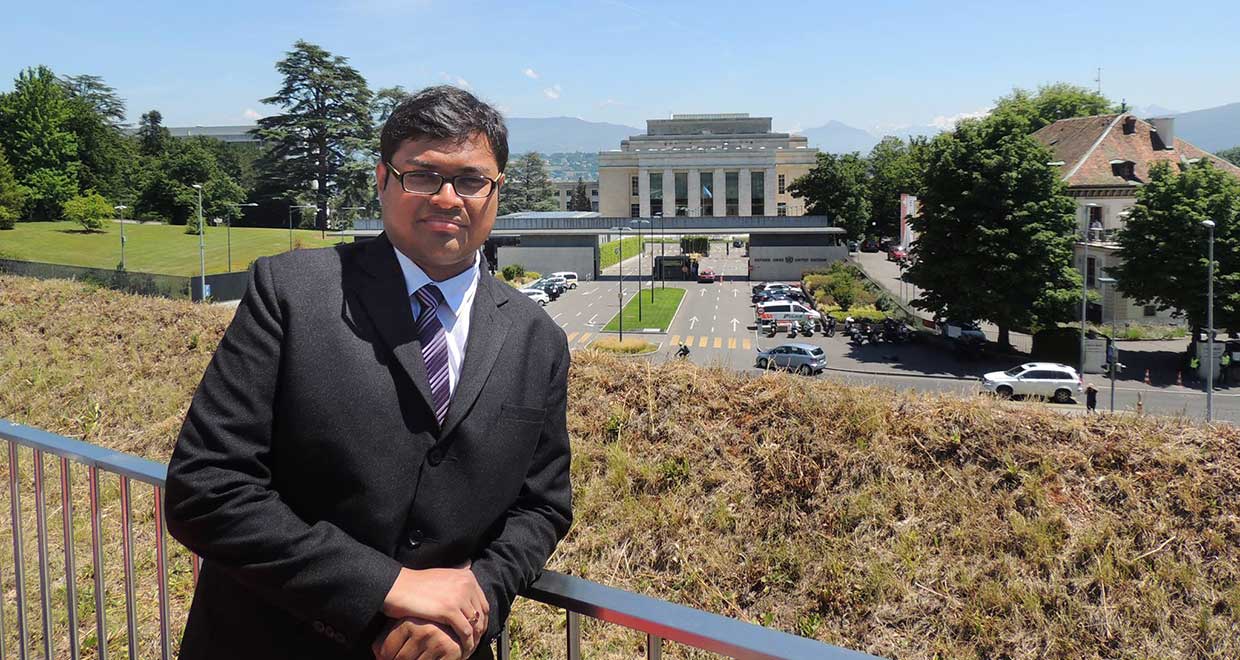
    Avik Ghatak graduated from Jogesh Chandra Chaudhuri Law College, Kolkata in 2011. He started his legal career as an Advocate in the Sub-Divisional Court of Asansol and District Court of Burdwan. Thereafter he pursued Masters from University of Exetor, Devon in International Human Rights Law. He also attended the Certificate Course on International Humanitarian Law organized by the Instituto Internazionale di Diritto Umanitario in San Remo, Italy and Geneva. He has also published numerous papers and currently practises at the High Court at Calcutta.

    In this interview he talks about:

    • Law college experience at JCC Law College, Kolkata
    • Masters at University of Exeter, Devon
    • Publishing various papers
    • Building a career in criminal law litigation at the Trial Courts


    Please introduce yourself to our readers. Tell us a little bit about your childhood and your background?

    A warm hello to all the readers of SuperLawyer. I am Avik Ghatak and I am an Advocate at the Hon’ble High Court at Calcutta. It gives me immense pleasure to be able to reach out to all the readers of this forum and share my views and experiences with them.

    I was born and brought up in Asansol in the state of West Bengal. I studied at St. Patrick’s Higher Secondary School till class X and completed my higher secondary from Burnpur Riverside School.

    After that, I had gotten through to Symbiosis Law School, Pune for my LL.B., but decided to pursue my graduation from Jogesh Chandra Chaudhuri Law College, under the aegis of the University of Calcutta..

    I started my career as a junior advocate at the chamber of Mr. Somenath Chattaraj at the Sub-divisional Court at Asansol.

    Occasionally, I also had the opportunity to appear before the District Court at Burdwan, West Bengal. After a year of practicing as a litigator, I got through to the University of Exeter in the U.K., from where I completed my LL.M. in International Human Rights Law. After completion of the same, I re-joined the profession and started practicing at the Hon’ble High Court at Calcutta.

    While being able to give relief to clients gives me an immense satisfaction as a litigator, academics too, continues to interest me to no end. After having completed a Diploma in Cyber Laws through the distance mode, I was fortunate enough to be able to get the opportunity to attend a short certificate course in International Humanitarian Law last year.


    Do you have lawyers in your family? Would you say your parents were instrumental in your decision to pursue law?

    I am the 4th generation in a line of advocates. There is no dearth of advocates on my mother’s side too. My mother is also an advocate while her elder brother is an Ex-Judge of the High Court at Calcutta and his elder daughter, i.e. my cousin and her husband are advocates too.

    As interesting as it may sound, neither of my parents wanted me to pursue law as a career. In fact, I had decided on leaving Symbiosis Law School after getting through to the same, and joining the University of Calcutta, since I thought that Kolkata would be a better place to prepare for the engineering entrance exams that are held in the state. However, fate had other plans in store for me. By the end of the 1st year of LL.B., I was so interested in the subject of law, that changing my stream was no longer an option for me.


    Your father, Mr. Moloy Ghatak is a prominent lawyer & former Law Minister of West Bengal. How did he influence your career as a mentor? Did you get to hear legal discussions right from your childhood days?

    Considering the fact that almost my whole family is comprised of advocates, including both my parents, there is no denying that I did in fact, come across legal discussions and terminology from a very young age.

    Ever since joining practice, my father has been a source of constant support for me, whether as a senior to consult or a mentor to guide me through the times when I have come under duress. He has always been my idol as a human being. Now, his success as a counsel is also something that I look up to and would like to replicate in the days to come.


    Your father is also an MLA and a member of All India Trinamul Congress party (TMC). Did you ever think of joining politics?

    Like in advocacy, my father is not the first politician of our family. Politics in our family, to the best of my knowledge, goes back even further than advocacy. Inspired, as most young minds are during their college days, by such a background and charged with thoughts of revolutionising the prevalent scenario, I did dabble in college politics for a couple of years before realization dawned on me that politics is most certainly not my cup of tea.


    How would you describe your time at Jogesh Chandra Choudhuri Law College (affiliated to Calcutta University)? Please share some memorable experiences of your college life.

    In two words, it was life changing. I went to J.C.C. Law College as someone who was more interested in preparing for the engineering entrance exams next year. At the end of the 5 years there I was convinced that I would have had committed the greatest blunder of my life had I not decided to pursue a subject as interesting as law. The credit of making someone pretty disinterested in the subject to actually start loving the same goes completely to our professors and lecturers.

    There are probably too many memorable experiences to write home about. Among them, the experience of organising an art and craft competition for the students, re-launching our College’s law journal after a gap of a few years and winning the Moot Court Competition at Hazra Law College, would probably take the cake. Also, our very first class at college, where we were given a lecture by the then Principal of J.C.C. Law College, Dr. Manik Bhattacharya, remains a memorable experience for me. His statement that those coming from families having legal backgrounds ought not take success for granted since expectations from them would be sky high and almost impossible to meet and his quip that ‘A successful advocate barely ever enjoys his life and it is rather his children who do so’, shall remain etched in my memory for a long time to come.


    In Calcutta, universities are always charged up with a political atmosphere. How was your experience in such an atmosphere?

    Yes, I was indeed engulfed by such a political atmosphere and activism till I called quits sometime later. It is perhaps better to enter politics when we have something to give to politics rather than the other way round. The best example that comes to my mind is my father, who established himself professionally before taking the plunge. Another person from our very own High Court would be Mr. Kalyan Banerjee, who rose to the pinnacle of success as an advocate before deciding that it was time enough for him to become a legislator from a litigator.

    My experience in the midst of such an enlightened community of people, as I stated earlier, was very enriching, not only academically but also through the lessons of life that I had the opportunity to learn during my years at the University of Calcutta.


    You have nine publications in various renowned journals. How should one go about writing papers and getting the same published?

    The first and foremost thing that one should keep in mind when one intends to write a paper is whether the question that he/she seeks to answer through his/her research work or the topic he/she wishes to deal with is feasible or not. Being over-ambitious is of little help since choosing a vague or a wide ranging topic would pose significant problems for the author of the paper in collecting primary data. More importantly, to be able to collect and collate such a huge amount of information within the restricted number of words, as most journals tend to have a word limit for the submissions that one makes to them, would become that much tougher if the topic is not precise and focussed. A research paper also needs to be structured in the sense that one needs to be able to clearly define what one wants to say through the paper. The cardinal rule while writing a paper is to always remember that each line and each paragraph in the paper must be related to the question one is trying to answer in the paper.

    Also, last but not the least, there is no use in giving a long winding introduction or in merely compiling existing information vis-a-vis the topic you have chosen. What is rather of more importance is to be able to do some analysis of your own and preferably coming up with some suggestions on how to improve the law and/or the policy dealt with in your paper so that the law/policy is better adapted to the needs of an ever changing world/ society.


    After your graduation in graduating in 2011, you have started your criminal law practice at the Sub-Divisional Court of Asansol and also practised at the District Court of  Burdwan. What did you gather from your experience at the trial courts?

    On seeing most of my friends joining the High Court directly, I had been a bit averse to joining the lower court before making the switch to our state’s only constitutional court. It was on my father’s insistence that I went back to my hometown to start practicing as an advocate at the sub-divisional court situated there. And now I realise that it was a very good decision since when practicing at an appellate court, like the High Court, it is very necessary for you to be having a clear idea about the procedures of the trial court. And that is exactly what you gain if you practice at the lower courts, at least for some time, before making the switch to the higher courts, whether at the state or at the federal level.


    What influenced your decision to start your criminal practice just after graduation?

    Criminal law has always fascinated me. Not surprisingly, it had been my forte at college as well. Also, both my parents were criminal law practitioners. It is perhaps a combination of the above stated factors that influenced me to take up criminal law practice immediately after graduation. I would, however, also like to state that I consider these divisions in legal practice to be very artificial. This is especially true in the backdrop of the fact that at the graduation level we study all the major laws and as advocates, we are supposed to have a basic understanding of all or at least, most of them, even if we cannot claim to hold sway over all of them.


    avik-ghatak-2

    At what point did you decide to pursue your Masters at the University of Exeter? What was your motivation?

    It was after spending some time in legal practice that I had a lingering feeling that I still had some academics left in me. A few publications, especially a couple of them in a law journal published by the reputed and respected Common Law House publishers in Kolkata, further fuelled my thoughts in this regard. Aniket Mukherjee, one of our family friends and also a senior at J.C.C. Law College, who had himself completed his masters from the U.K., inspired me to go for an LL.M. One thing led to another and I landed up at the University of Exeter pursuing my Legum Magister.


    How was your experience at Exeter University?

    The experience at Exeter was vastly different from anything that I had come across in India during my graduation days. To begin with, there were no written exams for the subjects (referred to as modules therein) and hence no concept of buying the last ten years question papers and memorizing the answers . However, the absence of written exams did not mean unlimited free time since we were required to submit research essays in all the subjects we had chosen. Legal education over there depends much more on research work and analysis than over here. So, in a way, there weren’t too many shortcuts or last night studies. The path to success lay in the library, if I may say so.

    The library was absolutely fantastic with law journals from all major legal jurisdictions and systems, including those from India. Students over there are also given access to the best online journals available over the internet. I literally had almost the whole legal world at my fingertips while studying as a student at the University.

    A multi-national teaching staff, including among their ranks, a Special Rapporteur of the United Nations Secretary General and also a Refugee Status Determination Officer of the United Nations High Commissioner for Refugees, and a similarly diverse student group, further enhanced the knowledge exchange process. That is something that is available at only very few law universities in India.


    Why have you chosen International Human Rights as your specialization for LL.M?

    Most of whom I know to have done their LL.M., have pursued International Business Laws or International Commercial Laws. Perhaps it is more lucrative in terms of job prospects. But somehow, interest in this particular branch of law continues to elude me till date. International Human Rights Law was thus, pretty much an obvious choice since international law and human rights had been as close to my heart as criminal law.


    How difficult was studying abroad in terms of finding accommodation, finances and settling in?

    I shall begin with the last issue put forth in this question. Settling in was never a problem in the U.K. since they have a multi-cultural society with people from various countries and cultures residing therein for a long period of time. Racism is down to a near zero. All my concerns regarding whether I would be able to integrate into the society over there or not, were laid to rest pretty soon after my arrival at the University.

    Finding an accommodation hadn’t been a problem since I had put up at accommodation provided by the University.. However, when I decided to move out, it proved to be a tough task since as per the agreement with the University, one has to get someone who, at that point of time wasn’t staying at any of the University provided accommodation, to take your place or to continue to pay the entire fees for the University accommodation for the whole year. Fortunately, I did not have to wait for long to get such a replacement. However, my suggestion to anyone reading this and contemplating to pursue his/her LL.M. abroad, would be to decide beforehand as to whether one would like to stay at University provided accommodation or at an independent accommodation because once you ink the accommodation agreement with the University, the way out of the same could be very tough and not everyone could get as lucky as I did in getting a replacement who matches the terms of the agreement.

    Lastly, it is a known fact that studying in the western countries is a much costlier proposition than studying anywhere in India. Hence, prospective students would be better advised to look for scholarships, if the same is on offer. Over and above the same, perhaps putting up at a shared accommodation and not spending too much on travelling, a natural attraction for anyone going abroad for studies, should do the trick as far as the finances are concerned.


    avik-ghatak-3

    You were as one of the 50 professionals from around the world to attend a Certificate Course on International Humanitarian Law organised by the Istituto Internazionale di Diritto Umanitario in San Remo, Italy and also in Geneva. How was the overall experience? What was this course all about?

     I had been fortunate enough to be sent, along with 15 others from my University to attend the 82nd session of the United Nations Committee on the Elimination of Racial Discrimination and the 54th session of the United Nations Committee on the Elimination of Discrimination Against Women at the United Nations Office at Geneva in February, 2013. It is over there that I came to know about the Istituto Internazionale di Diritto Umanitario in San Remo, Italy. The Institute primarily deals with the military personnel from around the world, training them in the rules of engagement in accordance with International Humanitarian Law. In order to achieve their aims in this regard, they work in close collaboration with the likes of the International Committee of the Red Cross and has operational relations with the likes of the European Union and the N.A.T.O. They also organise a handful of courses for civilian personnel and I was fortunate enough to be selected to one such certificate course on International Humanitarian Law.

    The experience of being able to come into contact and converse with military personnel, diplomats, professors, personnel from the UN and other international organisations such as the International Committee of the Red Cross, Amnesty International, Caritas etc. and lawyers drawn from a pool of countries spanning over all the continents on earth is something that perhaps cannot be expressed in words. Understandably, it was a very enriching experience.
    The course was on Humanitarian Law wherein the functioning of the same was explained to us by various military personnel and jurists, including Special Rapporteurs of the United Nations Secretary General and Judges of international courts, at times, through exercises resembling real life decision making inside the battle command centres. Also, the relation that Humanitarian Law shares with Human Rights Law, International Criminal Law and as well as International Refugee Law was explained at length, over the course of two weeks.


    You currently practice at the Appellate side of Calcutta High Court. How is the work atmosphere at the High Court presently?

    As time progresses, our society is faced with newer challenges that are to be overcome. And in an attempt to do that, new laws are enacted by our legislatures or amendments are made to the existing ones. More the number of laws more would be the number of litigations though there may be certain exceptions. Hence the scope for private practice at the High Court is better than ever before and I am of the firm belief that the best days are yet to come. So, under no circumstances would I say that it has become more difficult for a fresher to be successful.
    As far as the atmosphere is concerned, having practiced at other lower courts in the past, I have found the High Court at Calcutta to be much friendlier to new comers than most other places. Most seniors are more than willing to help out the juniors when the juniors find themselves on a sticky wicket. And it is not as if they do so with an expectation of getting briefed by the junior concerned. I, for example, have been fortunate to have had worked with a senior who not only allowed me to brief other senior advocates, if the clients so wished, but also to appear against him in matters where, by a stroke of fate, we ended up representing opposite parties in the same case.

    It would be advisable for a fresh graduate to not expect a huge amount of money in his bank account at the end of every month, at least for the first few years of his practice career. Advocacy surely isn’t the place where one can rake in the money right from the word go. One would do better to do away with any vanity or air of superiority and get his head down into becoming a good clerk to begin with. In the words of my senior at the Asansol Court, ‘One has to first become a good clerk if one is to become a successful advocate later on.’ Basically, one would have to know the procedure of the Court inside out before concentrating on the laws since knowing the procedures himself/herself would make him/her less dependent on others in basic matters such as those relating to the filing of a case, for example. Next comes the knowledge of law and the finesse of arguing a matter in the court, both of which one learns over a span of a life time. There are barely any last minute quick fixes or short cuts to success in this profession.


    Many law students prefer corporate jobs over a career in litigation. What is your take on this? Is it better to work in the corporate sector for a few years before starting litigation?

    A High Court Justice had once famously quipped that he is proud that his college produces eminent lawyers and jurists instead of producing ‘corporate slaves’. An ex-Supreme Court Justice, while in conversation with a representative team from our college had stated that he felt that the corporate lawyers contribute nothing to the legal field in terms of legal jurisprudence and interpretation of the laws.

    Such views, though, are generally restricted to our previous generations. Being someone from a generation, a good chunk of whose members have gone into the corporate sector or into law firms, I don’t possess such a traditional view in this regard. In fact, I do understand that in the initial days, a corporate job does seem to be much more lucrative. We are also in an age when most of our friends who go into other streams, especially engineering, get corporate jobs immediately after graduation and their lifestyle and economic stability does appeal to students of the legal field too.

    Also, some students may actually need the economic support in the form of salary that one would get on joining a corporate job or a firm after passing LL.B. That is something that advocacy, by and large, would fail to provide you with during the initial days. Also, some may not want the daily hassles and the schedule less life that comes along with a career in litigation. Hence, corporate jobs for those in the legal field is also a necessity in today’s age, as it provides an additional career option, and a pretty good one at that, to the law graduates.

    I do not have any previous experience of either interning or working in the corporate sector and hence I may not be the best person to be speaking to in this regard. However, to the best of my belief, I do not think that working for a few years in the corporate sector before starting a career in litigation would make much of a difference, especially since the nature of the work that one does at the corporate sector is vastly different from the work that one would be required to do in litigation. One’s experience in the corporate sector is useful for a career in litigation or not, would perhaps depend on how much exposure one gets to the proceedings of the courts during one’s work as a corporate lawyer. However, the experience relating to the drafting of legal documents that one would be required to undertake in the corporate sector is surely going to come in handy even in litigation.


    How did you get to connect with your clients? How many years of practice do you think would be required to build a firm clientele?

    I believe that working at the lower courts at Asansol, Durgapur and Burdwan went a long way in increasing contacts among the advocates practicing over there. And once I shifted to the High Court, advocates from these places found someone they knew and had worked with, to send their cases to, if and when they needed to send some matter up to the High Court. I also make it a point to visit the lower courts in and around Kolkata on a periodic basis, if and when an opportunity to do so presents itself before me. Such visits however, are never at the cost of my work at the High Court since that is my primary place of work.

    As far as direct interaction with the clients is concerned, one has to remember that most of them come to us only when they are in distress and hence, they may seem to be a bit repetitive with their questions at times and at other times, they may seem not to be able to understand your point of view due to a multitude of reasons including their general lack of legal knowledge. One would do better to keep one’s calm under such circumstances. Ultimately, no matter what one says, even the clients understand that you may lose a matter after all. What matters is that they should be able to see in you the intent to give it your best. Good behaviour with clients is a must because our very profession, after all, is in existence to help them out with their legal problems.

    As far as the number of years it would take someone to build a firm clientele is something that would vary from advocate to advocate and there is no straitjacket answer in this regard.


    How is your experience so far? What is your workday like? Are there new challenges every day or did work fall into a predictable pattern?

    My experience at the High Court has been exciting, complete with its share of ups and downs.
    I tend to reach court a little early, i.e. within 9:30 to 10:00, a habit that was inculcated in me by my senior, Mr. Debasish Roy, when I had joined the High Court. After completing Court in the evening I tend to be able to come back home if there are no conferences and dive headlong into studying for the cases scheduled to come up for hearing on the next day or draft documents that are to be filed in the days to come. If however, I am required to meet some senior for any conference then the time by which I am able to return home completely depends on the timing of such a conference.

    Once in this profession, one has to be ready to attend conferences that are held at the convenience of the seniors, whether they are held at midnight or before sunrise in the morning. Life, effectively becomes schedule less. But then, that is part and parcel of advocacy.

    My grandfather used to say that every day is a battle for an advocate. Quite obviously, when you are engaged in a battle on a daily basis, things would not tend to be predictable at all. Two cases may be similar but no two cases are ever the same and hence predictability is not something that one can come across in this profession since each case requires individual care due to its uniqueness, thereby throwing a new challenge at the advocate handling the same. The only thing predictable about a day in an advocate’s life is perhaps that it would be unpredictable.


    What would be your parting message to law students who want to litigate just after graduation?

    Hard, though intelligent work, an indomitable appetite for legal and as well as other related knowledge, loads of patience and humility can and is bound to lead to a success story after a certain point of time. Those coming into litigation must keep in mind that it is not for nothing that we are referred to as ‘Learned’ advocates from day one. We have to behave and act as learned people if we are to do justice to our profession.

    Having said that, I would like to wish all the best to all the law students wishing to become legal practitioners after graduation.

    Last, but not the least, I would also like to say, in the words of my mentor Mr. Protik Prokash Banerjee, ‘Welcome to the Glorious Uncertainty’.


  • Adithya Reddy, Advocate, Tax Matters on setting up an independent litigation practice

    Adithya Reddy, Advocate, Tax Matters on setting up an independent litigation practice

    Adithya Reddy graduated from WBNUJS in 2008 and started his career in litigation as an Associate at HSB Partners. He then moved on to work at the Department of Commercial Taxes, Government of Tamil Nadu as a Government Advocate, and continued working on a variety of commercial law and taxation matters, before leaving to set up his independent practice.

    Here, he talks to us about

    • Why internships in the first three years of law school are a waste
    • Why one must only pursue the field of law they are truly interested in
    • The pros and cons of working as a Government Advocate
    • How to set up an independent litigation practice


    How did you choose to become a lawyer? What were your objectives when you thought about law while still in the preliminary years of at NUJS?

    Law has always offered more career opportunities than what are commonly known. If anything, the variety of opportunities has only increased in recent years. In fact, I remember that this was the first thing Prof. Madhava Menon told me at my interview while joining NUJS in 2003. He said one should leave all career options open at least till the first 3 years of law schools.   This is what I tried to do in NUJS. While I always believed that litigation is where a lawyer can prove his worth the most, I did consider other options like pursuing academics or policy research.

    My friends had no views about my career choice. I would be exaggerating if I say I myself was keen on becoming a lawyer. I was only sure of wanting to become a professional. In fact it was my mother who was totally impressed by her friend’s son who had just graduated from NLS and was drawing a 6-digit salary. She then wanted me to join a law-entrance coaching course, which I did more out of indifference than interest.


    How relevant do you think are internships for a present law student?

    Most people who get a corporate job do so because of one good internship in their 3rd or 4th year. That is why, I see no reason why they should keep interning in different firms right from their 1st or 2nd year, that too twice or thrice a year. Even for litigation, it might, at best, help in gaining some basic idea about how a court works. It gives you no particular advantage when you start as practice. I am also not sure how the number of internships one does makes any difference, say to an LL.M application.


    When did you actually experience the learning curve? What is your opinion when people say that all that they have learnt is in their years of practice?

    My law school experience was very valuable for two reasons:

    First, as you are competing with students of very high calibre, you have to learn independently of anything that the law school may provide for.

    Secondly, a national law school by virtue of its brand and the people at its helm exposes its students to avenues and opportunities that no law student from an ordinary law school can get. I would say my learning curve increased once I found some optional subjects interesting after my third year.

    Many people say that what is taught in law schools is not relevant for a litigating lawyer. This is absolutely true for a lawyer till he establishes good practice and starts arguing cases regularly. Once a lawyer develops enough practice to argue cases involving questions of law on a daily basis his academic knowledge gives him a distinct edge over his peers. So it is important for a national law school student to stay in touch with everything he learnt in law school and keep updating himself/ herself with current legal developments. It is also important to maintain research skills which many national law school students learn well through moots etc.


    How was your work as a litigating lawyer at HSB Partners? Please tell us a little about your work profile while working there. Tell us what a typical day at work was like for you?

    I was a litigating lawyer. HSB has considerable amount of litigation practice. In fact I started working in the city civil court for the first few months. I worked on many high profile litigations involving top corporates in the high court. I also worked in tribunals like the Company Law Board and Consumer forum. Most of the litigation was relating to commercial disputes. I was very lucky to have worked under the firm’s partner Mr. T.K. Bhaskar who was himself a NLS graduate. He gave me full independence in handling much of his litigation practice. Mr. Bhaskar was also kind enough to entrust me with some very interesting non-litigation/ corporate matters, something I never expected.

    A typical day at HSB started with me entering office by 9.00 am, much before most other associates, and sitting with the clerk to note cases in the daily cause list. The next 30-40 minutes involved hectic searching for case bundles and last minute preparation for the day’s cases. I used to leave for court with few other colleagues and come back in the evening. The work day used to end anytime between 8 to 10 pm depending upon the amount of work required to be done for the next day.  The most hectic day used to be when a client needed an urgent case to be filed or when a case involving voluminous documentation and research was being argued in court.


    adithya-reddy-2

    Thereafter you worked as a Government Advocate for the Department of Commercial Taxes, Govt. of Tamil Nadu. How did your appointment take place? What were the responsibilities you were entrusted with?

    Many people fear taking up litigation as a career option for lack of family background or a connections in the profession. My appointment as government advocate is a great example how one can receive help in the profession independent of these things. I was recommended to become a government advocate by an Additional Advocate General only because he had noticed me as a good junior lawyer. I will forever be indebted to him.

    For the first one year (since my appointment in early 2012) I was lawyer for the TN Government’s commercial tax department. Sales Tax/ Value Added Tax is one of the few areas of taxation which falls within state government’s jurisdiction. I argued many cases on behalf of the revenue involving the subject before the High Court. This stint also gave me my first few reported judgments.

    In early 2013 the TN Government appointed a new Advocate General who is also one of Madras High Court’s most senior and knowledgeable lawyers. He had known me from before and requested me assist him in his work on behalf of the government. I readily agreed. I worked with him for one and a half years. The variety of work I did in the AG’s office was mind boggling and I can say with some lack of humility that very few young lawyers would have had such kind of exposure. This was bound to be, because government is the biggest litigant and is involved in cases touching upon almost every branch of law. A lot of credit for this would also go to the AG who treated me very kindly and gave me full independence to interact with the senior-most bureaucrats and officers in the government.


    How and when did you decide to quit your job and start up with independent practice?

    I decided to resign as a government advocate in October 2014 for two reasons. Firstly my work , especially in the AG’s office, left me with very little time for anything else. I was entering my 7th year in the profession with no time to think of my own practice. Developing one’s independent practice involves a lot of struggle. As a government advocate I was getting used to so much comfort that I used to have sleepless nights thinking of how I was going to manage when I begin independently some day. So I decided there was no point postponing the inevitable.

    The second reason which is less significant is that being a government advocate required one also to be loyal to the political dispensation that was in power in the state. Not only did I have no sympathies for the political party ruling in the state, but I had my own political affiliations which I could not and did not want to hide beyond a point. I always felt guilty about having to lie to people about my political views.

    Normally nobody would pay much attention to the political affiliation of a government advocate. But as government advocate attached to the AG’s office I was the centre of a lot of attention. That was when I realized that people were talking behind my back about whether I belonged to the ruling party or not. This prompted me to quicken my decision.


    What are you main practice areas? How has been your experience so far? Is it more comfortable be your own boss or is the pressure of work almost similar?

    It has only been three months since I started independently. For this short period I have got more work than I expected. That only makes me nervous about maintaining this momentum. A lot private work I am getting also relates to the same area I worked on as a government advocate viz. sales tax/ VAT. But I am trying to get more work in other areas.

    It is much less comfortable to be your own boss in the initial years. You have to think of how much you earn because you have expenses to meet. This is something you can blissfully ignore when you are a junior because the senior’s infrastructure, staffs etc. is already there. Also there are expectations to meet.


    As a practicing lawyer how did you manage to learn the basics of court room practice? Did you have anyone to guide and mentor you during the initial days of your practice?

    Every senior I worked with has been a guide and mentor. It is just not possible for me or any junior lawyer to learn court practice without observing seniors and learning how they deal with clients, judges and other lawyers. What happens in the court room is just half of the work that forms part of litigation. There is drafting which you learn more directly from your senior by reading his drafts and by taking dictations from him if necessary. Also there is filing which you learn from the clerk.


    How did your first hearing as an independent practitioner go? Which are the most memorable cases till now?

    Well, as I said it has been only three months since I began independently. So it is too early to talk of memorable cases. The first case I argued after setting up my own practice was for a client who was faced with an adverse sales tax assessment. The judge set aside the assessment holding that the assessing officer had not applied his mind to the issue. I need to mention here that having good judges to represent your cases before is extremely crucial for a young lawyer to make a mark. A client is often only concerned about the result of his case. Judges who pay lesser attention to a case only because it is being argued by a young lawyer put his/her career prospects in great jeopardy. I have been lucky to have appeared to before some very good judges as an independent lawyer.


    What is your workday like? Are there new challenges every day or did work fall into a predictable pattern?

    My work day currently is a lot more relaxed than what it used to be. I don’t miss my daily golf practice and spend little more time on my political/ social activities. Most importantly I don’t miss my calls or at least I ensure I return them at the earliest! This is because now I have freedom to set my own schedule. I can go to court only for the time that my cases are taken up and leave immediately after that. The major challenge is to get new work and to retain clients I’ve just got. I’ve realized that it not always possible to impress a client. As long I am convinced that I have done my best for the client I remain satisfied. These are issues which are far less relevant when you are a junior.


    How far is theoretical knowledge in law schools consistent with the practical arena?

    It is very important once you start arguing your cases regularly. It gives you a clear edge. It is also important to impress your senior when you are still a junior.


    The Bar Council of India has recently come out with new Certificate of Practice and Renewal Rules, 2014. What is your take on this?

    I think it makes sense. Though, what is technically required to be considered by the Supreme Court is only questions of law, it is very essential for a Supreme Court lawyer to know how his case might have been decided at trial. Otherwise the approach tends to be very academic and detached from facts. Also it might help sensitise lawyers to the plight of clients who have to go through the entire process before coming to the Supreme Court.


    How to make a conscious career choice – corporate vs. litigation?

    My advice has always been for people to go with what interests them most. If somebody genuinely believes earning good money, that too pretty early in life, is important than obviously taking up a corporate job is better. I see some of my seniors from NUJS are already partners in the biggest law firms. This is guarantee of a prosperous and comfortable life. But litigation definitely allows you to grow to your full potential as a lawyer.  The uncertainty is what is exciting. The freedom is very satisfying. Also once you are a successful litigator, there is no limit to how much you can earn.

    Another advice would be for students to be sure of what they want to do before taking the plunge. At least in litigation the competition is tough and every day you spend doing something else is a waste. There are many people with a head-start. Lawyers with a family background have a distinct advantage. They can probably afford to try out other options before joining their father/ relative’s practice. But for a fresh lawyer every day brings new opportunities and new contacts.


    What would be your parting message to law students who want to litigate just after graduation?

    Never shy away from litigation because of the uncertainty. That is the most interesting aspect of the career. You could be under stress not knowing what to do next, only to be pleasantly surprised the very next day. It could be in the form of a big case or a big acquaintance, but rewards will keep coming to you from the most unexpected quarters. All that you need to do is show your talent and sincerity. Also, no matter how important success is, honesty and ethics have their own charm and will hold you in good stead throughout your career.

  • Santhosh Mathew, Standing Counsel, Calicut University, on how he built his litigation practice

    Santhosh Mathew, Standing Counsel, Calicut University, on how he built his litigation practice

    Santhosh Mathew is an alumnus of the NLSIU, Bangalore of the 1995 graduating batch. He focused on litigation right from the beginning. A first generation lawyer, he started his practice at Dandapani Associates in 1995. He became independent and co-founded a litigation firm in 2004. He is currently a Standing Counsel for the University of Calicut. His practice areas are in Writ Petitions, Telecom, Media laws, Banking Laws, Company Law and Service Laws.

    In this interview he tells us about:

    • His first few years after graduation
    • Role of mentors in litigation
    • Work of a Standing Counsel
    • Necessary skills for the legal profession


    Tell us a bit about your pre-college years. What motivated you to study law?

    My grandfather was a District Sessions Judge at the time of his retirement in 1964. My father after graduating in law from the Government Law College, Ernakulam, joined ‘Malayala Manorama’ which is a leading Vernacular Daily, as its Personnel and Administration Manager. He used to take care of the Company’s legal matters His classmates from GLC, Mr. K.P Dandapani (A former Judge of the Kerala High Court and the present Advocate General of Kerala) and Mrs. Sumathi Dandapani were very close family friends.

    After completing my 10th Standard like any other youngster at that time I joined for pre degree (equivalent to present day higher secondary) and took Physics, Chemistry and Biology along with Mathematics to pursue a career in Medicine or Engineering. In time, Mr. Dandapani came to know about the National Law School of India University, Bangalore and bought an application form for me. When the entrance results came out, I was in the waiting list and hence joined ILS Pune which has an awesome campus. After two weeks, my admission at NLS Bangalore was confirmed and finally, I landed up at the “Harvard of the East” in 1990 with Roll no: BLIJ 189. The classes back then used to be held in one of the three car sheds which were converted to class rooms later on. That was the beginning of a wonderful journey in my legal Career.


    Tell us about your objectives while in the preliminary years of Law College. What were your plans after graduation?

    In my preliminary year my intention was to clear courses without getting too many repeats. Since I was not a very hard working student I was happy with my B+ grades! I studied the notes prepared by my Classmates Mr. Piyush Joshi and Mr. V. Umakanth. In my first year I interned with Adv. P.C. Abraham in the District court at Kottayam. I feel it is very important that all students start by doing an internship with a lawyer who practices in the lower courts and learn to draft Civil Suits and Criminal Complaints first. Merely by walking along with the Court Clerk will teach you the filing procedure.

    From the Second year onwards I used to do my internship with Mr. & Mrs. Dandapani who used to entrust me with various matters to do research and also with drafting of pleadings. My internships helped me to make up my mind to be a litigator. My appeal to all the law Students reading this is to use all the opportunities you get during your internship to decide what you want to do after graduating. Nobody will entrust you with any responsibility unless you volunteer. Only if you display a passion to take up responsibilities, the seniors with whom you intern will have the confidence or inclination to entrust you with more work. I understand that some lawyers don’t pay the interns. My appeal to those lawyers would be to loosen their purse strings a bit and pay a stipend which will at least cover their expenses.


    santhosh-mathew-2

    Looking back, how significant do you think that your legal education was? When did you happen to experience the learning curve?

    I sincerely regret not being a serious law student. Since I was not a very ambitious person I was more involved in co-curricular activities and did not spend too much time participating in Moot Courts other than the mandatory ones which were required as part of the curriculum. Since we had a fine group of students from all over the country I got to learn about various cultures and made some great friends. The projects done every trimester helped us to learn about different research methodologies and made us better equipped to do legal research.

    By the time we graduated we had a clear idea as to how case law could be worked up. This helped me tremendously in my career as a lawyer. So to all the law students out there, my appeal would be to try and identify a topic you can relate to and do an honest work with all earnestness. During my LL.B. course I ended up doing a lot of absurd projects which on hindsight makes me wonder, “Why on earth did I do those projects?” Please remember that you will be the sole beneficiary of your project and if you do a shabby work, you will be fooling no one but yourself.


    Do you feel that there is a difference in the court atmosphere between now and when you started practice? Has it become easier or more difficult for a young lawyer to establish himself?

    I believe the present day judges are much more accommodative of junior lawyers. In Kerala the Judges never had a fascination for Senior Lawyers from outside. So the local lawyers received great exposure which resulted in improving the quality of such local lawyers. My seniors Mr. K.P. Dandapani and Mrs. Sumathy Dandapani were always encouraging and permitted the juniors to take up their own matters which helped us to build up our careers apart from being a major boost to our self esteem.

    In fact all the juniors who have been mentored by Mr. & Mrs. Dandapani have made a mark for themselves after becoming independent. I was with Dandapani Associates for 9 years from 1995 till 2004 when I set up independent practice with my wonderful partner Mr. Sathish Ninan who is my friend, philosopher and guide. So it is very important to find a good office and work with a senior for a decent span of time. Court crafting is something you don’t acquire over night. It is very important that you don’t compromise on your integrity for monetary gains. If you get a bad name in this profession, you are DOOMED.


    Please tell us about your experience with regard to your first few sessions in court. Has it become more difficult for a fresher to achieve success?

    In my first year of practice there was a complaint filed by the then Chief Minister Mr. E.K. Nayanar against ‘Malayala Manorama’ before the Press Council of India. The complainant had instructed Senior Counsel Mr. Rajeev Dhavan. We had instructed Mr. Gopal Subramanium. Justice Sawanth was the then Chairman of the Press Council.

    When the matter was taken up, Mr. Rajeev Dhavan started arguing and Mr. Gopal Subramaniam became unavailable as he had to go to the Supreme Court for some urgent matter. When our turn came up, “yours truly” had no other option but to argue the matter and with God’s grace we got a favourable verdict. My client was so happy that they celebrated my victory by publishing my photograph in the ‘Malayala Manorama’ newspapers by celebrating it as a victory by a young David over Goliath.

    On a lighter note, a lot of my friends at the Bar after seeing my snap in the newspaper thought I had met with an accident! This was a big boost to my budding career. Thereafter there have been numerous opportunities in the last nineteen years of my career where I have been at the right place at the right time.

    For instance, when Mont Blanc came out with the ‘Mahatma Gandhi pens’, we filed a PIL in the Kerala High Court against the sale of those pens in India alleging violation of the provisions of Emblems and Names (Prevention of Improper Use) Act, 1950. As a result, Mont Blanc undertook before the High Court of Kerala that it will not sell the ‘Mahatma Gandhi series’ pens in India.

    We have conducted a lot of cases before the High Court relating to issues relating to health hazards from Telecommunication Towers. We have been successfully representing most of the major cellular operators and Telecom infrastructure providers in Kerala before the various Courts. We have represented various educational institutions challenging the unreasonable restrictions imposed by the State Government which adversely affected their minority rights guaranteed under the Constitution of India.

    God has been extremely kind to me. One must have the self confidence that he or she can handle any matter that comes his/her’s way. If we don’t know the subject matter in detail, we should study extra hard and consult the seniors who are experts in that field. The legal profession is a unique profession where seniors are willing to go out of their way to guide a junior counsel in need. While arguing a matter if a judge asks a question to which you readily don’t have an answer, have the humility to admit that fact and be assured most of the judges would be more than happy to grant you time to work up and make your submission. Remember Bench and Bar are two sides of the same coin and you have a duty to our client to win a case but you have a bigger duty as a responsible officer of the Court to assist the Court to arrive at legally correct judgments. Therefore, never mislead the Court.


    What was the role of mentors in your case? How important do you think a mentor is in the field of litigation?

    I was extremely lucky to have wonderful seniors like Mr. K.P Dandapani, Mrs. Sumathi Dandapani and Mr. Jaju Babu who are all designated Senior Counsels who mentored me and had tremendous confidence in my abilities. This motivated me to reach office at 7.30 AM and work till late night until the work entrusted was finished completely. They paid me handsomely which was also a very important factor as far as a junior lawyer is concerned. It is very important for a young lawyer to have a mentor to guide him/her just like a toddler during infancy.


    Please tell us about the requisite soft skills which are essential for a young lawyer to build a successful career?

    There is no substitute for hard work. Try to get a good mentor. Be ready to take whatever assignment that is given and never shirk away from responsibilities. Learn to respect your colleagues and opposite side lawyers. Invest in proper infrastructure. Don’t be concerned about money. Always be courteous to the judges. You don’t win any case by picking up a fight with a presiding officer! You will only succeed in losing not only that case but other matters too till the judge gets tired of dismissing your matters! It’s good to have aggression and self confidence but over confidence would land you in trouble. Always be prepared and never go to argue a case without preparing properly. Always take the relevant statutes and the latest case laws on the point when you go to argue a matter. Never underestimate the opposite side.


    How did you build up your client base? How many years of practice would you say it requires to build a firm clientele?

    There is no hard and fast rule for this. Work hard and put in your best effort when a client comes to you. Satisfied clients will in turn, get you more clients. Legal profession is a unique profession where you cannot build up a client base through marketing gimmicks. One needs a lot of luck to be at the right place at the right time. There are so many learned lawyers who have vanished due to lack of opportunities. I genuinely feel that not all are capable of being leaders. There is a lot of space for everyone here. The lawyers who are incapable of building up a client base on their own must find good senior or like minded lawyers and form a firm and learn to manage things. Some are good in impressing clients but may not be effective lawyers. These two categories can form a common platform. Gone are the days of individual practitioners. A group of like minded lawyers providing a one stop shop would become the order of the day in the future.


    What has been your experience of being a Standing Counsel? How is the work pressure and what are your responsibilities like?

    Being a Standing Counsel of an institution like the University of Calicut was purely providential. It was a huge responsibility. In June 2011, nearly 4000 case files were brought over to my office and I didn’t know where to start with. Within three years, I have with the support of my able colleagues Mr. Arun Thomas and Mr. Jennis Stephen, disposed off nearly 2500 cases. I consider it a huge opportunity to help students who have a genuine cause to have their grievance redressed.

    A lot of old service matters could be disposed off. The High Court judges who dealt with the jurisdiction are very efficiently disposing off matters. The biggest challenge was to build a good working relationship with the client and to get instructions on time. Giving timely legal advice and getting instructions from the various departments of the University were all difficult in the beginning but over a period of time it started functioning smoothly like a well oiled bicycle. One must learn to respect the representative of the client who comes to instruct you.

    I was fortunate to have a great team right from the Vice Chancellor till the Assistant in the Legal Department who would be ready to render all possible support and assistance. Each day was a new learning experience. Being a Standing Counsel of a prestigious institution increases your visibility and gives you tremendous exposure. You get to argue cases against the best lawyers in the field. You get to learn the subject in extenso.


    When you hire lawyers, what kind of skills and profile do you look for? What kind of a profile suits best to the profession?

    All the lawyers we have hired have been recommended by my friends. We have been extremely lucky to have a set of sincere hardworking colleagues. I personally feel that young associates must be delegated work depending on their potential. Over burdening a junior lawyer with work he/she cannot do will only help in demoralising them. At the same time I hasten to add that each one should be pushed to their optimum to make them good lawyers and better individuals.

    Right from the time of internship in their first year, law students must try out different options like NGOs, Law Firms, Individual practitioners etc. and by the time one completes the third year he/she must have a clear idea about where they want to be after graduating. As a junior lawyer one must not be bothered too much about the monetary aspect. For the first five years it really helps if one has a generous and understanding father.

    I was really privileged to have a great father who ensured that all my needs were to be taken care of so that I could concentrate in my work. If you are serious about the profession, you must be ready to put in long hours at work. Be assured after some time in your career those long hours you have put in as a young lawyer will definitely help you in your journey. I have seen a lot of youngsters in my time. Some of them have started their blogs, websites, entrance coaching centres etc, taken up theatre and even marriage photography mainly because most of them eventually got fagged out after learning “Law” for five years and this prompted them to do something out of the box.


    Do you think that achievements such as having a landmark judgment to your credit can change one’s recognition drastically?

    I don’t think so. I strongly believe each day is a new day and you have to consistently deliver your best. There is no place for complacency in this profession. You cannot afford to rest on your laurels. In fact some of my important cases which we won did not actually get the client the relief which they ultimately wanted. They were classic cases of “operation successful but patient dead”. It definitely feels nice when your peers send you a text in appreciation of your efforts after reading a reported judgment which you have argued.


    Do you feel that there are differences between students of ‘elite’ law schools and students from other law colleges and traditional universities?

    Frankly it is difficult to generalise. The students from the ‘elite’ law schools have a structured curriculum which makes them better equipped. I guess one gets a 5-10% head start if you graduate from a good law school. But if any student feels that he is superior in any way to his peers who have graduated from other law colleges he is a FOOL.

    Once you enter the profession if you don’t work hard, others will catch up and before you realise it, they will run over you. It is high time and the scheme and syllabus of all law colleges are also structured in a similar fashion which will do away with artificial barriers. With the right kind of opportunities and a proper level playing field, anyone with a passion will be able to make a mark in this profession.


    What are your views on the future of Indian legal education? How would you suggest that a law student manages to stay ahead?

    It is high time the three year courses are stopped. After retirement persons must not be permitted to enter the profession as a litigator. They could be permitted to practise in non litigation areas. The State Bar Councils must provide for a stipend for young lawyers from economically weak backgrounds to survive for at least 5 years after graduation. All lawyers have a duty to contribute to that corpus. Courses which gives more in depth exposure to applications should be evolved and incorporated into the curriculum in place of those which require mugging up and reproducing what you have memorised. An opportunity must be provided to young first generation promising law graduates to get a placement with a successful lawyer. All of us have an obligation to reach out and do our little bit for our young brothers and sisters who join the profession with all earnestness to become “social engineers”.


    What would be your advice to young law students? How do you think that they should approach their career?

    Don’t be an arm chair critic who looks down on everything in life. Learn to appreciate the good things in life. Equip yourself and make yourself marketable. Be ready to work hard. Be practical in what you want to achieve. Everybody cannot be a Harish Salve, K.K. Venugopal, N.R. Madhava Menon, or a Cyril Shroff. India is one of the biggest populations in the world. Everyone has a legal requirement at least once in his/her lifetime. If we can make a qualitative difference to at least one person due to our expertise we can make the world a better place to live in. Ours is a noble profession.

    Let us collectively restore its lost glory. Wish you all a Merry Christmas and a Happy New Year!

  • Sandeep Huilgol, Tax Attorney, King & Partridge on an LL.M from King’s College and work in Civil & Tax Matters

    Sandeep Huilgol, Tax Attorney, King & Partridge on an LL.M from King’s College and work in Civil & Tax Matters

    Sandeep Huilgol is a graduate of ILS Law College, 2010 batch, and of King’s College, London, 2011 batch. For the past three and a quarter years, he has been working in Bangalore, practicing as a civil and tax advocate at King & Partridge. We asked him to share his experiences and strategies he used over the years.

    We took this opportunity to ask him about:

    • Pursuing an LL.M. from King’s College, London
    • Writing a proper SoP for an LL.M and having a Letter of Recommendation
    • Working at King & Partridge


    How did you gravitate towards law? Why law and not engineering or medical studies?

    After I got over my initial, albeit strange dream of becoming a lumberjack in Canada, I only ever dreamed of becoming a lawyer. I was fascinated by civics and political science in school, and the book, “Yes, Minister” further strengthened my interest towards the profession. It’s been nearly ten years since I started at ILS, and I can honestly say that I’ve never looked back.


    How would you describe your time at ILS Pune?

    My time at ILS was a wonderful mix of academics, fun, and growing-up. To be honest, I wasn’t always too hard working as a student, but I managed to put in the extra hours either the week or night before an exam. It’s not an approach I would recommend to anyone, and looking back, I sometimes wish I had worked harder throughout the year. It’s a lesson which, hopefully, the readers of this interview can pick up from me.


    What were your areas of interest during your graduation? How did you go about developing knowledge in these areas?

    Certain subjects fascinated me, such as constitutional law, tax, and jurisprudence. Moot courts however, were something I always looked forward to. I was also very lucky to have had the experience of both, researching / speaking at moot courts, as well as judging a moot court. In my opinion, the best way to go about developing proficiency would be to participate in as many moot courts / debates / seminars as possible. While reading is something all of us can and will do, and over time, knowledge will eventually be garnered, the ability to speak / orate is something that can only be developed by trial and error. Don’t let initial setbacks put you off. Keep trying until it becomes second nature.


    What was your motivation behind pursuing an LL.M right after graduation? When did you finally decide that you need to do masters?

    There were a few reasons that motivated me to apply for an LL,M immediately after my graduation.

    One: I wanted to litigate and I was aware that the chances of me taking time off after commencing work were very low.

    Two: I wanted to push myself academically. Like I said, I don’t think I did justice to my academics during my time at ILS and I felt the growing need to study and learn something out of choice, and not merely for the sake of exams. King’s is a world-renowned institution and I was acutely aware of the quality of its facilities and faculty.

    Lastly, the opportunity to live abroad, and that too in a city like London, was something I could not turn down.


    sandeep-huilgol-1

    How did you choose King’s College, University of London over others? How did you go about choosing a university?

    There were a number of boxes I had to check before I opted for King’s. I analysed the Times UK university ratings, sought reviews from my seniors who had actually gone to the UK to do their LL.M.s, attended UK Education fairs, interviewed faculty from King’s and other colleges which had been arranged at these fairs, approached education consulting service providers and lastly, I approached a few senior lawyers in Bangalore and asked them for their views insofar as pursuing an LL.M. was concerned.


    How did you go about writing your SoP? Are there any key factors which one should keep in mind before writing the SoP?

    My SoP was essentially my mission statement. It was my way of putting down on paper the events that led me to opt for law, the reasons for pursuing my masters, the person I would like to see myself become and so on.

    As for the second question, in my opinion, one’s SoP should be a reflection of one’s ideas, thoughts, and aspirations. Honesty in one’s SoP shines through. Be clear in thought and keep it simple. The reader is not going to meet you in person. The SoP is his / her only way of getting to know who you are. In other words, the SoP is your way of making a good first impression. To me, the key points are honesty, simplicity, and clarity of thought.


    How about recommendation letters? Who all recommended you to pursue LL.M?

    Three of my professors at ILS provided me with letters of recommendation (‘LoR’). I asked only those teachers who had taught me more than one subject, and with whom I had interacted with on a more personal level. That way, I hoped that their own impressions of me would be expressed in their LoRs. It’s a tip which I’d give the readers of this interview as well. Again, if a professor asks you to draft a LoR which is to be vetted by him / her, keep it simple, don’t blow your own trumpet unreasonably, and stick to actual accomplishments / feats.

    The readers of LoRs pore over thousands of LoRs annually. They are able to discern the genuine ones from the overly self-eulogising ones.


    How will you compare King’s College, London with that of Indian Law Schools?

    Vastly different. The pedagogy at King’s was much more interactive and engaging. A lot of room was given for individual thought. Subjects were not taught at King’s. On the contrary, subjects were discussed and debated. It was thoroughly enjoyable. My year in London just flew by and I will always look back with very fond memories. A special mention has to be made here for my professor, Ms. Penney Lewis, who is without a doubt, the best professor I have ever had!


    What was your topic of research for LL.M? Why did you choose that subject for research?

    My dissertation was titled, “Are our bodies really ours? A case for legalising the trade in human organs”. It’s a topic which is close to my heart and, while I admit it is a controversial topic, the legalising of trade in human organs is something I’m keen to see it happen in the near future.


    sandeep-huilgol-3

    You are currently working at King & Partridge, Bangalore. How did you go about bagging this job? Please tell us about the recruitment process at K&P?

    My application, via e-mail, was addressed to one of the partners at K&P. Thereafter, I was called in for a personal interview with each of the partners, pursuant to which I was offered a job in the firm, which I gladly accepted.


    So how did the interview go? Do you happen to recall any of the questions?

    To be honest, it’s a bit of a blur as it’s been over three years! While I can’t remember the actual questions that were posed to me, I do remember that they were more aimed at determining the person I was and discovering my general attitude and approach to work and life, as opposed to questions of a legal nature.


    What are your day-to-day responsibilities? How is the experience so far?

    As a practicing advocate, my work-profile consists of the following:

    (1) Drafting,

    (2) Researching,

    (3) Assisting my senior colleagues while they prepare for arguments, and

    (4) Appearances before trial courts, tribunals, and the High Court.

    Work has thus far been fascinating, rewarding, and enriching. Most importantly, it’s been fun! However I must admit that I like almost everyone else suffer from Sunday-evening blues!


    What would be your parting message to our readers who are mainly young lawyers and law students?

    First and foremost, enjoy your time in college! You will never get those five years again so make the most of it. Study, participate actively in moot courts / seminars / extra-curricular activities, but also remember to have fun. When work begins however, one must work hard. As clichéd as it may sound, there really is no substitute for hard work. One must read as voraciously as one can, be it work-related briefs and journals, as well as non-work related literature and newspapers / magazines. Although I have not even worked for four years, I can confidently say that it’s a rewarding career-choice. One must however be patient. Only if the foundation is strong and sturdy, which is only possible through diligence and discipline, will the latter years be fruitful. Commitment to the profession and more importantly to justice along with honesty in all walks of life, mixed with a healthy and necessary dose of sports and fun should make for a long and enriching career.

  • Aditya Sondhi, Senior Counsel, Karnataka High Court, on building a career in litigation

    Aditya Sondhi, Senior Counsel, Karnataka High Court, on building a career in litigation

    Aditya Sondhi is an alumnus of the NLSIU, Bangalore. He graduated from NLSIU in 1998, and had thereafter independently set up his litigation practice, ‘brick-by-brick’. He was recently (in June, 2014) designated a Senior Counsel at the Karnataka High Court.

    In this interview, he reckons his first hearing at the court and shares with us his in-depth experience of advocacy. There is so much to learn from here. Read on!


    Please tell our readers what motivated you to take up legal studies?

    I was an accidental lawyer. One had heard of the NLSIU at Bangalore in the early 1990s, and when the entrance exam came along, I sat for it just for a lark. My plans were to go to England after my 12th standard. As it turned out, I cleared the Law School exam and ended up staying on in Bangalore.


    Have the NLUs been able to produce socially relevant lawyers? What is your take on this, given that many chose to take up firm jobs?

    Quite so, because those who have taken up social-action practice have made their mark. There is a saying in Hindi – Sau sonar ki, ek lauhar ki (For a hundred blows of a goldsmith, a single blow of the blacksmith). Despite many NLU alumni taking up corporate law at firms, the few who have taken up socially relevant lawyering have [sociallocker] more than made up for their tribe. Like my classmates and friends at the ALF.


    aditya-sondhi-2

    How was your law school experience at NLSIU? Are there any memorable moments which you would like to share?

    I was fairly nonchalant about being in NLS and hence didn’t necessarily get very deeply influenced by the ethos of the place. Equally, my contribution to the institution as a student was negligible. I do, however, vividly remember our founder-director Dr. Madhava Menon at the orientation programme in 1993, clearly mentioning that the object of the Law School was to contribute purposefully to the Bar. For me, that was a clarion call of sorts and helped me take up litigation once I graduated without even an iota of doubt.


    How do you say a law student can shape up his profile for litigation while still in law school? Do moots and academic writing help?

    Moots and academic writing scarcely help one shape up for practice. Though moot courts may give a mild flavour of what it is like to prepare and argue a brief, the lack of accountability to a real client or a real cause makes the experience artificial. Academic writing in fact makes it difficult to adjust to pleadings for court, which are meant to be concise, uncomplicated and largely factual. Even the legal grounds that are pleaded are expected to be scholarly, yet pithy. Closer attention to research and strenuous litigation internships can surely muster up a skill-set that comes handy in the long run. Most importantly, law students must stay clear of the anti-litigation propaganda that goes around and make up their own minds about practice.


    How were the first few years after your graduation? Would you say law school prepared you for the real world practice of law?

    They were the toughest years of my life. Simply, because I realized how ignorant and wet behind the ears I was. It was more a case of trying to survive in practice, rather than succeed. This was due to the fact that one knew so little and experience could only be gathered the hard way. Law School did not prepare me for this episode, as the culture in NLS was generally removed from litigation and concentrated more on academia and corporate, in-house practice. Of course, the few professors who had shown us glimpses of the real world outside, like Dr. Lalit Kumar Rao (may he rest in peace), were valuable mentors.


    Please tell us about how you decided to pursue litigation. What were the other opportunities you were considering?

    As I said earlier, Dr. Menon’s message stayed with me. This, coupled with the fact that I was offended by very senior professionals coming down for pre-placement talks and simply selling their firms to the students. I always wanted to work in an environment where I would be inspired by my seniors. Not be seduced by them to join them. That changes the entire grain of how you approach your life ahead. A robust placement in my fourth year with Mr. Dipankar Gupta in the Supreme Court and in the final year with Mr. Udaya Holla clinched it for me.


    Did you have a mentor while in your formative years of your practice? How was your experience arguing at the court for the first time?

    Not directly, but Mr. Holla shaped my career tremendously by simply giving me opportunities to argue matters in the High Court from the day I enrolled. His style of mentorship is quite stringent and effective – to throw you in the deep and let you swim for yourself. Something he has done himself with remarkable élan. On the evening that I got my sanad, when I offered my senior some sweets, he reciprocated by offering me two files for the next day to argue in Court!

    One was a writ petition before the legendary Justice R V Raveendran, in which former Advocate General Mr. B V Acharya appeared for the petitioner, and I could not get to open my mouth for the respondent! Not so much out of fear, but more because I had over-prepared for the case and did not know where to begin. (Fortunately for me, the other case allotted to me was adjourned!).


    What was the attitude of judges towards new advocates? Has it changed over the years? Are there any specific challenges to be faced on the first day?

    As I recounted my first hearing above, I can say that soon enough I became confident to argue more assertively and calmly in Court, and tribute here must be paid to some wonderful judges at the time who were most encouraging to juniors. I can recall Justice Dattu, Justice Rangavitalachar, Justice P V Reddy, Justice Mohan Kumar, Justice Thakur, Justice PatriBasavangoud and Justice Rajaratnam, among many others. Some of them were tough task-masters but at the same time, never bullied or discouraged juniors. This brings out the best in junior advocates – knowing they need to be fully prepared and that the Court will hear them impartially. The greatest challenge in the beginning is the mind-block that one has with the system – uncertainty as to how the Courts will treat a new entrant. Good seniors and judges help you keep the faith.


    How do you say we can boost the fiduciary relations between clients and us? How many years of practice would you say is required to build a firm clientele?

    One good performance is sufficient to build faith in the party. Clients, generally, only expect their Counsel to be prompt in their filings, honest to the T and to give it their best when the case is heard. Of course, the unethical practice of soliciting clients makes it very difficult for solo, first-generation practitioners who stay true to their code of conduct. I would say, my clientele was never as large as many other lawyers. However, it was built brick-by-brick, and that takes years.


    What all does a Senior Counsel have to do? Please tell us about a typical work day.

    Seniors have the benefit of not having to worry about mundane, micro-management of cases and are only required to argue their matters to the best of their ability, after being briefed by the advocate on record. However, the very fact that one is a designated Senior mandates greater preparation, better submissions and total fairness to the Hon’ble Court. Typically, a day entails briefings by Counsel on record and interaction with juniors to prop up the research. Thereafter, it’s a question of waiting your turn in Court and arguing the brief. Evenings are at Chambers, where briefings and reading continue.


    aditya-sondhi-1

    What are your core areas of practice? How do you say one can find his domain?

    I’ve always maintained that litigation is a speciality in itself and thereafter one may or may not concentrate on any core area of law. I would say my work broadly covers commercial and constitutional law, on both the civil and criminal side. Having said that, there is a great thrill in arguing newer areas of law, where one is outside his / her comfort zone and where one must work doubly hard to do justice to a brief. Unless one already knows what area of law he should practice in, it is best to free-fall and discover the areas of interest as one goes along.


    What is the transformation from being a Counsel to Senior Counsel like? Are business development skills mandatory at such higher roles?

    A designated Senior Counsel at the time of his / her designation must already be made of the stuff that is expected of a Senior. If that is so, the transition is not so sharp, though one does face several practical changes in terms of retiring from pending cases, avoiding direct client interaction and so on.

    I’m afraid, that the words ‘business’ and ‘practice’ do not go together in the profession. The skills are professional and entail the entire gamut of skills required for better advocacy. Not least, a high degree of ethics, which one must constantly strive to uphold. And which is no easy task.


    How did you take time out for pursuing higher studies? Would you say higher studies are necessary for a career in litigation?

    I got my masters’ in political science through correspondence and thereafter a PhD, while I was practising. This I did only because I missed the academic side a little. Otherwise, neither did I intend to pursue an LL.M nor do I think one can afford to take much time off from practice to pursue higher studies. Particularly, if you are a first-generation lawyer and have to stay at it from day one.


    What are the skills that you look for when you hire juniors under you? How do you reckon that law students should develop these skills?

    The hunger to learn and the modesty to know that they know very little. My chambers are ill-suited for juniors who are smug and all-knowing. These are not so much skills as they are an attitude. And that attitude needs to be developed by introspection.


    When you accept interns under you, what kind of qualities do you look for? How do you say interns should go about their work so as to get noticed in a positive way in the limited time they have?

    I find it quite difficult to screen interns considering the number of students who apply. And I get all sorts. Really good, keen interns and others who are there as a formality. Interns clearly need to slog and make the most of their time in Court, without waiting to be spoon-fed assignments. Internships are meant to get a feel of what Courts are like, and that effort has to come from the interns themselves. A lot of them sit around hoping I will do the needful for them. And they are usually disappointed.


    Having mentored quite a few students have you found any difference between NLU and Non-NLU students? Do you think law schools have a role to play in one’s career trajectory?

    Non-NLU students show a greater hunger to learn, especially non-NLSIU ones. There is no chip-on-the-shoulder and there is an eagerness to show the world that one’s aptitude does not necessarily depend on the law school that they come from. In any case, NLSIU alumni do not choose to work with me and I have had all of two NLSIU products work with me in all these years! My best juniors have come from the local law colleges. My first junior, Nidhishree, was a gold-medallist from the ULC, Bangalore and has proved to be fine advocate with a bright future ahead of her.


    Is there any other suggestion you would like to give to our budding lawyers?

    The Law is an amazing universe – with diversity and depth, with unsolved mysteries and with room for everyone who accepts it whole-heartedly. But, as they say in cricket, no one is bigger than the game.

    [/sociallocker]

  • Jomol Joy, Associate at Chambers of Geeta Luthra, on experience of Year 1 in litigation

    Jomol Joy, Associate at Chambers of Geeta Luthra, on experience of Year 1 in litigation

    Jomol Joy graduated from NLIU, Bhopal in 2014. Her interest in litigation led her to start her career with practice and is currently an associate at the Chambers of Senior Advocate Geeta Luthra. She has been quite involved in Debating and Mooting as a student. We asked her to share her experiences and strategies she used over the years.

    In this interview she talks about:

    • Her life and journey as a law student
    • Mooting and other co curricular activities
    • Internships during law school
    • A career in litigation practice


    What brought you into legal studies? Did you not consider medical or engineering as a career?

    Even though I believe that no one knows you better than yourself, but when it comes to answering the question, it is always a challenge. I’m an advocate by profession, who in her little time of her own likes organising events only as a matter of interest. I like clicking pictures, cooking, teaching and dancing. If asked to describe myself, I would say I’m an energetic, hardworking, ambitious, tolerant, adaptive, and a positive social butterfly who believes that your happiness is in your hands.

    I’m answerable to my conscience, I have had a vision and for many years to come the only set goal and desire is to be designated as a Senior Advocate from the Delhi High Court. Back in college, I was given the title of ‘Joan of Arc’, which I believe suits the fighter in me. Maybe it is the same tendency that brought me to this profession. I’m a believer of the saying, “Everything happens for a reason”. My decision to pursue law was certainly not a result of an in-depth introspection, even though many factors were responsible for the decision.

    The most honest and genuine reason was to explore the option of studying in a national law university in my own hometown. Another predominant factor was CLAT. It is only after solving a mock test paper at one of the coaching centres did I get an idea about the legal studies and it was only after that I decided to do law. However, till date I have never regretted my decision to pursue law, in fact from the very first year of my law school I have felt that I belong to the profession, and as time passed and I gradually unfolded the new faces of the legal profession, I was always more excited for the next. I did consider engineering at the first instance, as I always had an interest in programming, but when it came to choosing either of the two, I chose law.


    jomol-joy-2

    Tell us about your years in law school. What made your journey with NLIU worth it?

    Five years is not a very long period according to me, but even those five years of time spent at NLIU had been the most remarkable and life changing years of my life. Each passing day at NLIU had only been a new learning experience for me. Not even a single day would pass when I had to sit idle doing nothing.

    Today as a litigating lawyer when I have to work even 20 out of 24 hours mostly on a daily basis, I do not find it burdensome or unusual as NLIU has prepared me for this right from the beginning. Be it moot courts, debates or client counselling, or activities of different university cells, NLIU has honestly played a major role in my overall grooming as a lawyer and has equipped me to adapt to the lifestyle of a lawyer. With each passing day, my decision to pursue law has only become stronger, because had it not been for the co-curricular activities I would not have got a platform to mould my legal aptitude.

    In the first two years I experimented as much as I could and by the third year I streamlined my schedule and devoted my time to those activities which I thought were more pertinent to my career in litigation such as moots, client counselling. Also in our university, activities of all kinds are student prerogative mostly, so that always gave us a room for exploring and experimenting new things, and fortunately our faculty members have always supported our, so organising university moots or other competitions in the University were always fun and easygoing.

    Also being a part of the NLIU fraternity has only opened doors to more and more opportunities for me, be it receiving invites for some of the most reputed law schools of the country or the respect one gets by virtue of being a part of the NLIU family has always boosted my spirits.


    Tell us about the trimester system at NLIU. Any improvements you feel it could do with?

    As the popular opinion goes, trimester system is demanding and taxing, to an extent true, especially in a law school. One has to work their way up to be consistently able to regularly perform the balancing act where on one hand you need to meet your deadlines for both academics  as well as co-curricular activities. But by the end of these five years at NLIU I have realised that the trimester system had played a very crucial role in preparing my work schedule. I can draw several similarities between the trimester system and my work schedule.


    Tell us about some of your most interesting internship experiences.

    I cannot grade my internships, but I can say one thing that every internship has helped me grow, be it an NGO or chambers of an advocate or a corporate firm, every place has played a major role in  helping me decide my future. Unless one explores all the options at ones disposal, one cannot make an informed choice so according to me internships were highly instrumental in my decision making.

    However my internship at the chambers of Advocate Satish Tamta has developed my interest in criminal law. I believe Satish sir is one of the very few advocates who would take pains to take time out from his busy schedule and discuss law with his interns which made that internship an extremely enlightening experience. Also it is very important to have an experienced yet approachable mentor who believes in sharing his valuable understanding of law with his juniors.


    You have participated in various moot court competitions and have also won few of these competitions. What is your advice to budding mooters?

    Mooting for me had become a passion so much that in the last few months of fifth year when most of the students prefer chilling and partying, I chose to do a last moot of my law school life which I was adamant on winning as a tribute to my law school. It played a huge role in inculcating my interest in litigation, and which by God’s grace we won.


    You have joined the Chambers of Geeta Luthra as an Associate this June. Did you ever plan to join a corporate law firm? Do you plan to pursue litigation from now onwards?

    Litigation was not always on my list nor did I pursue law to litigate, in fact like any other student of law, when I joined the law school only thing I was sure of was that I want to do law but what after that was something I had figured out only in the due course. And when you are not sure as to where you have to head, the best thing to do is to explore and experiment as much as you can in the time available and I did exactly that. Starting from Human Rights Commission to NGO to litigation firms to corporate, I explored quite a many of them and by the end of my 3rd year I was clear about one thing, which was that corporate law practice was certainly not my cup of tea, the very thought of not going to courts, not being able to argue, not being able to practice made me more inclined to litigation. I wish to set up my own practice independently. I had always been in awe of the profession, especially the work style of a litigating lawyer, from soliciting to counselling to arguing, the joy of being known for your work, being known for your work as an attorney, the pride of being designated. The power, the respect the profession gives you is unparallel.


    How did your appointment at the Chambers of Geeta Luthra take place? What would you say clicked in favour of you in getting to work with her?

    I had applied at the chambers for an internship in my fourth year during the summer break in the month of June, but unfortunately as the courts had closed, I only had the opportunity to assist Geeta Ma’am for only four days on two bail matters, and thereafter some of the associates at the chambers, including Sanjeev sir and Harish sir with some drafting. But it was only during this internship that I realised that quality does matter, more than quantity. If your work has quality, it can make an impact, and that too a long lasting one.

    Since by the time the courts opened and work resumed I had gone back but even in that short time, Geeta Ma’am and other associates had acknowledged my work and recognised me for it which gave me a great boost.

    Thereafter, I was offered a place in their chambers, however to get a little more acquainted with the work culture and to be sure about my decision I had a call back internship in October for another 15 days, and it came as a surprise to me that Geeta Ma’am was kind enough to recognise me and appreciate me for the work I did for her and the entire office welcomed me back and it was then I realised that this is where I belong to. So the best thing about this office is that it has young minds, some of the best in the profession with great calibre which keeps the healthy spirit of competition on at the same time a warm and friendly environment thus making it a family which stands by each other. If you have the ability then you will be rewarded with opportunities, you will be guided throughout, shielded and most importantly your work will be rewarded.


    A lot of law students prefer corporate jobs over a career in litigation. Is it better to work in the corporate sector for a few years before starting litigation?

    To each his own, but it is true that there is an increasing trend to join corporate jobs over the traditional litigation practice. According to me, the biggest factor that influences the decision is the quick earning and perks corporate offers right after your studies. Everyone aims at a comfortable secure life, especially after college, one would not want to burden their parents or ask them for money, so it is natural to have money factor playing a predominant role in deciding and shaping ones career choices.

    Not everyone is fortunate to be able to afford a luxurious lifestyle and still be doing a job of his own choice. However, for those who wish to secure their finances before stepping into litigation, and who wish to try their hand at corporate, it is always an option. However, as my little understanding goes, both are two distinct fields of practice of law so it is not necessary to begin with corporate, however as I said it is good to experience everything, depending on the time and opportunity one has. For me, doing what I wanted mattered more than money because when you are living your dream any sacrifice you make, any hardship you go through gives you a great sense of pride and not misery. Moreover, hard work and smart work never ditches you, so if you do your bit, money is certain to follow.


    Do you think top notch grades have given you an advantage over others in your arena of litigation? How useful would you say would be being a topper for people who want to practice?

    I was never among the toppers of my batch and to be honest, I did not even make an attempt to. That however does not mean I had a casual approach about law or the profession, our system is such where good grades and consistent good performance is given importance, and in that process very often the importance of quality education and in-depth study is lost, at least I felt it on many occasions.

    So those who topped the batch they certainly put their best foot forward and their efforts are worth appreciating and they have their own priorities, but as far as I’m concerned I believed in doing a holistic study not just for the sake of scoring well but as a matter of learning, so I scored decent enough. As far as litigation is concerned, I haven’t come across a situation where I had to prove my grades; however excellence and brilliance is appreciated everywhere, even in litigation. There it is more about proving your mettle in court appearances, earning the confidence of the client and that of the judge, making a place for yourself in the bar and getting favourable orders.


    What is your workday like? Are there new challenges every day or did work fall into a predictable pattern?

    Workday here at the Chambers of Sr. Advocate Geeta Luthra is a new challenge every day. Presently I’m doing a potpourri of matters ranging from bail petitions, suits, writs, SLPs and many more matters ranging from criminal law to matrimonial law to service matters to land acquisition matters. For someone who is barely 6 months into the profession, having exposure to such a variety of matters is indeed a blessing.


    How necessary is it to have a mentor/guide to handhold a young lawyer while still in the formative years of litigation?

    I’m a person who believes that everyone has something to teach, irrespective of his age or experience. I’m not of the opinion that one needs to have a designated senior as his/her mentor in the initial years of litigation, but I believe to have someone who can handhold you in fact  supervise your actions and not spoon feed you is who you need. Someone who gives you enough room to experiment, who wishes to see your growth with his, who trusts you with his work at the same time keeps a close watch on your work just in time to salvage in case of a faux pas.

    Thus, what one needs is a vigilant yet a comforting senior. And I must mention, I’m in the right hands, if you are looking for a vast exposure, from civil to criminal law, increasing opportunities to argue, in an office where you are assigned matters and are expected to handle it fully from handling the clients to getting it filed and to argue the matters and it goes without saying, opportunity to work on some fine cases, work with some of the best legal minds in the profession are few of the many perks you get while working at the chambers of Senior Advocate Geeta Luthra.


    How difficult would you say it is to build a reputed practice?

    Well it is too early for me to answer this question as I’m still in the “early days of practice” as you put it. But having seen many others who have set up their full fledged practice in the profession, I can only say it is very unpredictable, it highly depends on the career decisions you make, your performance, your social skills, it differs from person to person and even law to law, I have heard people say that it is still easier to make a standing in civil side but to develop a clientele on the criminal side and to make a standing there can take even more time than what it should take on the civil side. I’m yet to explore this aspect so maybe I’m a little too young into the profession to answer the question.


    Do you think your experience in mooting shall help you in your litigation career?

    My answer is a big yes to this question.  In fact, I realised it in my last two years of law school that my mooting experience had been a great help, I could myself sense a drastic difference in my internship performance post the increasing moot exposure. Even though there are many factors which affect the mooting experience such as the kind of moot one decides to go for, the issues of law involved, etc., but moots of all kinds do play a massive role in grooming the lawyer in you. There are several things which I find are in common between a moot and real practice of law.

    Approach to a given problem, applying one’s mind to it, analysis and digging the issues involved, strategising the arguments and then drafting a foolproof written submission, addressing the court and putting forth your submissions in a way that you get your arguments across in the desired way are challenges which I face even today as a practising advocate. Thus, moots are an excellent platform to hone your advocacy skills, thus winning or losing does not matter, what you take home is more refined better prepared lawyer, therefore in a moot everyone is a winner.


    What can the law schools do to encourage more people into litigation?

    I guess law schools should understand the relevance of internships and inculcate the practice of interning at different places right from the beginning of their law school. College administration should facilitate students with as many opportunities to intern as many law schools have a student run PCC which needs to be backed by the university administration so that the internship and recruitment of the students gets a boost.

    It is also important to guide students into selecting the right kind of internship at the right time, for instance internship in a top tier corporate firm in your very first year of law education might not do as much help as an internship with probably a district court or an NGO. Thus, this is where the law school needs to chip in. Also, law schools should facilitate interactive sessions of students with some of the inspiring minds in the legal profession so that they could make informed choices.

    What would be your parting message to law students who want to litigate just after graduation?

    I would say, go for it. If you wish to practice, and this goes without saying; sacrifices and hard work are quintessential for anything one decides to go for. People often start with a career in corporate fearing the initial financial burden that one might face in litigation, but at the end I have seen many switch to litigation for want of interest to work in corporate. Thus, striking a balance between what you want to do and your other considerations in life is a must.

    Even though some of them who are quite focussed and have already planned their career to suit their needs, my advice is not for them, as there happens to be many out there initially wish to pay off their education loan or wish to build a bank balance for their initial years of litigation struggle. But most important is to have your priorities set straight, and the determination to sustain. Many a times into the profession one might lose patience and feel low, but one must remember that only temporary, hard work and good work is appreciated and rewarded everywhere, sooner or later.

    In fact there are many litigation firms that pay decent remuneration to freshers also, considering you perform well. If you feel for the profession with utmost passion, all these sacrifices would only make you a strong person and more importantly give you a sense of pride. Working hours and remuneration all seem small before the joy of getting favourable orders from the court, at least that is what my little experience says. So, according to me right after graduation is always a better option as then you have the energy the zeal at its peak which could help you sail through the tough building years of litigation.

  • Sankalp Sharma, Partner at Sankalp Sharma & Associates on How he established an independent practice

    Sankalp Sharma, Partner at Sankalp Sharma & Associates on How he established an independent practice

    Sankalp Sharma graduated from NLIU, Bhopal in 2010. He thereafter joined the Office of Manjit Singh Ahluwalia and then moved on to work with Virender Goswami & Associates. His work at these places spanned a time period of almost 2 years. In June 2012, he started up with Sankalp Sharma and Associates.

    We asked him to share his insights of:

    • Building a career in litigation
    • Building up a firm clientele
    • Challenges of setting up a law firm on one’s own


    How did law happen? Did you ever think of alternate career options?

    Law for someone like me, was always the most logical thing to do, the idea was to be someone that is both independent and socially useful. Growing up all that I wanted to be is someone who’s not dependent on others for survival, I guess the idea has stuck and found the basis behind a lot of decisions that I take in life. I believe I was just made for litigation.


    sankalp-sharma

    Tell us about your years in law school. Do you believe that excellent CGPA is the key to all success?

    Years in law school can be summarized as the most amazing learning experience both academically, socially, and personally. For a person who comes from a small city, every day spent at the NLIU was absolutely worth it. I took part in almost everything that came my way, be it mooting, client counselling, being part of organization committees of different events organized at the Institute. The idea was rather simple, I wanted to know more and more about different spheres of people in the society, how they function, how do they approach difficulties and these minute observations can only be made when you participate, no matter what event it is, different people that you meet and participate with, each and every one of them will teach you something new. I personally believe mooting definitely made a huge difference. It helped me to learn the skill of penetrative and focused research, structured presentations, anticipation and on the spot witty responses that in a real life court room make a huge difference.

    Whether CGPA is key to all success, the answer is definitely not, however CGPA is for sure key to most of the success. I am yet to find people, out of law school, who have done well for themselves academically and not in professional life. The academic years make the foundation of what you turn out to be later. In whatever little time I have spent in the profession, I can tell you this much, that it does not allow you to rework your basics, you may find people really working hard in professional life and succeeding without having great CGPA’s; however, with same hard work people with good CGPA’s have done wonders. Amongst all the fun and once in lifetime experience at the Institute, we must never forget that the basic reason we are at that place is to learn.


    What were your areas of interest during your graduation?

    I fell in love with the constitution, right at the nascent stages of my college life, It was followed by contract, CPC, CrPC, Company Law, Competition law and so forth. The principle that I personally followed with my academic work was to keep it really simple, multiple readings of the bare provision followed by prolonged discussions with professors and my friends. I have found that there is no shortcut to learning, you simply have to study. Participating in events always help and one should do more and more, life post college turns extremely competitive, your participations help you hone your skills, be it speaking, logical thinking and analysis, it also helps you to built connections that help you in later years.


    Right after graduation, you joined the Office of Manjit Singh Ahluwalia where you worked for almost one year. How did your appointment take place? Please tell us about your experience working there.

    Mr. Manjit Singh Ahluwalia, is one of the leading advocates practicing in Delhi High Court. I had interned with him during my college years, at the last one, he made me an offer to come and join him, kind of what we call as PPO. Working with him I learnt the basics. The best thing about his office was that he had all sorts of matters, from civil to criminal work at High Court, from arbitrations to hard core trial matters. Personally he is a gem of a person, I would say an amazing defense lawyer, an intriguing legal mind with a knack of just ripping into the opposite side. He gave me a lot of freedom, right from drafting to arguments, and all that he ever said “go ahead and do it, I am right behind you”. The result was, right after passing out from the College, I was independently handling clients, arguing matters. My days with him taught me almost everything that one can possibly learn standing from defense side. He was the one, who taught me the practical fundamentals of independent litigation practice, the difficulties that you face and how to just keep going despite the ups and downs in the profession.


    You thereafter left the Office of Manjit Singh Ahluwalia to start working at Virender Goswami & Associates. What led to this shift? How was your experience working there?

    The Shift from Mr Ahluwalia to Mr. Goswami was a planned move. I had worked a lot with Mr Ahluwalia during my internship years as well, and after almost an year I realized that I was getting more and more comfortable, things were getting easier, I have followed a simple formula in life; don’t let yourself get too comfortable, if you are getting comfortable, means that your learning curve is starting to go down. So I decided that it’s time for me to move on, next I wanted to work at an office that has more work from the plaintiff/ prosecution side, I had to learn the art of prosecuting, Mr. Goswami again is one of the leading lawyers at Delhi High Court, I am yet to see any lawyer who is better than him in terms of cross examination of a witness, his was an art that has been learnt from years of practice, at times with him in a cross examination I could see him toying with the witnesses. Even before the cross examinations he would predict the responses to each and every question, the detailed planning and possible tactics were well thought of, the depth and understanding of evidence law that he posses is unmatched, with him I learnt looking at matters differently, more from the perspective of how something gets proved, what facts will make your case and how to put them correctly.


    After having worked at Virender Gowami & Associates for one year, you started your independent practice. What prompted you to make this choice and start a law firm?

    I worked with Mr. Goswami for one and a half year, the idea of starting on my own was always on my mind, the plunge was again based on the same fundamental, life getting too comfortable. While working at both the offices, I had already started working on my social contacts, people had started approaching me with small matters, once the number started increasing to a level where I felt I could take the risk of starting on my own, I just went for it.


    How did you overcome your initial jitters in a courtroom full of experienced lawyers and judges? Tell us about the highs and lows.

    You never overcome the small amount of nervousness, at least I haven’t , I personally believe that it’s a good thing, it means that you are serious about your job. I was never too overawed by big lawyers and judges, for me they were always people from whom I had to learn, yet maintain my own individuality. My High came in terms of one of the matter that I argued for a socially backward class girl that was thrown out of a school, the matter was greatly argued at the High Court level and ultimately went up to the Supreme Court where it was compromised with school consenting for admission. The low came in terms of a matter in the Supreme Court, The matter was relating to a lady who killed a man trying to rape her, the matter embroiled in a political controversy and resulted in her conviction for life. I tried my best to build a case up In Supreme Court, yet despite my best efforts I could not make a good case.


    Did you ever consider a career in the corporate sector? Is it better to work in the corporate sector for a few years before starting litigation?

    I was always inclined towards litigation, I Just loved the feel of court rooms, the big arguments, the entire set up, However, I did my internships on the corporate side as well, just to be sure that I am not made for it. Preferring corporate or litigation is always a personal choice, it is also a personality choice, some of us are simply not made for the rigors of litigation, some of us don’t have the patience to see it though, at times financial reasons don’t allow you to chose litigation as well. Litigation without doubt takes a lot of courage, a little madness, you have to be mentally strong, give up the natural human tendency to go for the comforts of life, money, stability etc. Especially when you know that you too could easily take that route. If you intent to litigate, the early you start the better it is for you, if you enter into corporate world, it makes you comfortable in terms of financial stability, and after that its hard to enter litigation where financial stability is a big question.


    Please tell us a bit about “Sankalp Sharma & Associates”. What is a day at work like? Is it easy to have a work-life balance?

    We are a start-up, the idea is to provide professional, honest and comprehensive solutions to legal issues. We are focused in providing legal solutions to our clients that would help them in long term business development as well. Integrity, sincerity and honesty is what we live by. Working at office is based on a simple philosophy of “we do what we say.” The most difficult part is to build up a clientele and fulfil the commitment that we give to our clients. With a start-up your reputation is always tested and is on the line each and every time. The work life balance is obviously not easy to maintain, you have to make schedule and try your best to follow it, at times it works at times it doesn’t and that’s life.


    If someone who works with you makes a mistake or an error in an assignment what course of action do you follow as a partner?

    Work culture is simple, be sincere and work hard, in a litigation office, the challenges are never-ending, every matter has its own twist, litigation has nothing predictable, trust me. Mistakes are part and parcel of our lives, all of us make them, and the idea is to learn and not to repeat it again. All that I expect from people who work with me is to give their 100 %, as long as you are doing it, all is fine.


    What were the difficulties you faced in the early days of your practice? How difficult would you say it is to build a reputable practice?

    The most difficult part in the early years of practice, especially when you are young is to make your client believe that, though you do not have grey hairs on your head, the grey matter inside is good enough to give the opponents a good run for their money. Initial infrastructure developments, financial managements, building social contacts are obvious difficulties. However, the hidden difficulties that you face is the constant question mark that people around you put up to you about your success, the capacity to keep the fire burning despite a series of bad days, lack of clients and so forth.

    It’s not only about the practice, anything in life that you want to make big, will come with its own baggage of problems, no one will ever say that I became successful in life without going through the problems associated with it. Similarly in practice the problems are many, yet you will always have answers to them, if you are willing to put your heart and soul into it.

    One cannot fix a time frame to build a clientele, for one it’s a continuous process. Secondly it greatly depends on your social contacts and connections with the right people and the hard work that you put in to it. However, in my experience, if you are reasonably active and connected and are working heard and sincere with your work, your practice should start to move in span of two years, a decent clientele would take reasonable 5 to 7 years to build.


    What can the law schools do to encourage more people into litigation? Do you think the law school curriculum requires overhaul?

    I personally believe, that no one can encourage you to be in litigation, it is a very personal and introspective choice in life, law schools are not structured to make someone make a certain choice. Moreover, litigation is not merely a profession, it’s how you choose to live your life till the end of days and no law school, no person can make it for you, no one can push you to take it either. It should always be a well thought of decision in life. I don’t think that law school curriculum needs an overhaul, it only needs restructuring. I have a very firm belief that the role of the law school is limited to make a young mind look at the various options he has in life, introduce him to an amazing number of subjects and choice, ,teach him to read law, and thereafter leave him free to make his own path, curriculum etc are very minute things in the bigger picture of life.


    Do you take interns? What do you look for in a prospective applicant?

    We do take interns, the procedure is similar to most of the places, you write to us and we respond back with loads of question to see you fit our requirement or not. What we look for is sincerity, hard work and the ‘never say no’ attitude.


    What would be your message to law students who dream of having their own law firm one day?

    If you have a dream be it owning your own law firm or any other thing, you have to treasure it, see it as a small plant, that has to be nurtured, protected from the storm and lightning, you have to have that belief in you and your dream to make it a reality. Hard work, sincerity, patience, perseverance, self belief, honesty, integrity and never say never attitude are qualities or pillars on which your dreams will stand.

    For litigation, you should start as early as possible, in law school focus on core subjects like Constitution, CPC, CrPC, Evidence, TPA, IPC and the likes, develop the capacity to study for long hours, develop skills of research and speaking. Participate in as many competitions that you can. Don’t focus on big names while your internships, rather focus on places that have loads of work and less hands, so that you get an opportunity to deal with the real things, work at places where you can see a variety of work, place that gives you freedom to implement your learning and ideas. Start working on your social contacts at a very early stage; decide which areas you are most comfortable with and which city you would want to start your practice at. Work for some time with a good office so as to give yourself sometime to make your presence felt in that circle and lastly, once you have that self belief that you are ready. Take the Plunge.


  • Saurabh Kumar on Litigation at Trial and Supreme Courts and an MBA from IIM Calcutta

    Saurabh Kumar on Litigation at Trial and Supreme Courts and an MBA from IIM Calcutta

    Saurabh Kumar is a graduate of the 2004 batch of Amity Law School, GGSIPU. Right after graduation he joined Scriboards and thereafter he took to independent practice at Trial Courts. Later in 2007, he had the opportunity to work for Senior Advocate, H. S. Phoolka as a Senior Associate, and he worked there till 2009.

    In 2009, he started up his own litigation practice with a team of four lawyers mainly practising in Economic Offences and IP matters. In 2013, he secured himself admission in IIM Calcutta for an MBA and on graduation from there he was appointed as a Senior Manager of the Legal Team at Marvel Realtors in 2014 He has since then been given additional responsibility of all Marketing activities, heading a team of 10 and is also responsible for sales performance audit as part of the CEO’s office..

    He is currently a professional with a dual profile, one of that of an MBA and another of a lawyer, with a keen interest in technology, and in-depth understanding of various business and legal processes.

    In this interview you will get to read what he has to say about:

    • Choosing law as a career option
    • Litigation experience at High Court and Supreme court
    • Pursuing an MBA from IIM Calcutta
    • Important skills of a Lawyer


    What impressed upon you the idea to study law? How was your law school experience?

    I had a pretty circuitous route to law school. I had joined the National Defence Academy right after my school. After about 2 years, I had to leave the course on medical grounds probably making me one of country’s youngest pensioners at the age of 19!

    My father then encouraged me to prepare for law school. At that time, Amity was starting their first five year law program in Delhi. I did well at the entrance exam and secured admission. At that time, my parents were a bit reluctant to send me to another city to read law. So studying law as a day scholar was the option for me. I really enjoyed my tenure at the law school. I had the privilege to be the first ever representative of the law school at National level moots. I absolutely loved moot courts. If I can single out one memory/ one method of learning law, it would be moot courts. Apart from Moots, I was also into quizzing and I won a few competitions there at the law school and later even at IIM Calcutta.


    A lot of law students promise to take up pro-bono work and do some socially relevant work. Have these ideas ever crossed your mind?

    I think at one level it is fashionable to say that as a lawyer, one is doing pro-bono work. But just because there are no financials involved between a lawyer and client, the level of legal effort involved does not reduce. I had the privilege to work with Mr. H.S. Phoolka senior advocate, who does a lot of social work with his heart and soul. To be honest, that was one of the points that attracted me to him and his practice and a chance to be part of it. I was also part of the Delhi High Court legal aid committee. I did some matters there. It was a mixed bag. While some clients were indeed grateful, some others were probably the most demanding clients I have ever dealt with. At present, I assist some smart entrepreneurs, but mostly those who are at present operating out of the incubation centre set up at IIM Calcutta and at IIT Madras. It is more out of friendship though. One must, as much as one can, do some pro-bono work. But how much would depend on one’s personal bandwidth.


    Soon after graduation you joined Preconcept, (Now called Scriboard) as an Associate. How did your appointment take place?

    I had interned a large part of my college days with Lex Orbis. Prof. Balachandran was kind enough to introduce me to Manoj Pillai (Partner, Lex Orbis). I absolutely loved the place. Whatever little I know about IPR, are from my learnings there. It made me extremely confident of what I can achieve as a lawyer (maybe overconfident J ).

    Rodney was starting off own his own. At that time, I felt, it would be a good idea to join a start-up. We did not really have structured placements at that time at Amity, Delhi. It was more as to who knows who. Rodney was a visiting faculty at law school. That is how I knew him.


    Generally the first year after graduation is the most defining time of a fresh law graduate. What would you suggest a fresh law graduate should do to hold spirit and utilise the opportunities available?

    One word: Learn. While law school gives you the depth. Practicing law gives you a totally different approach to law. Suddenly you see law affecting real people, real situations and you, as a young lawyer are in the middle of it. Personally, it took time for me to grasp this difference. (between court room law and class room law). If I could go back in time, I would perhaps try to reduce the awe I had of the interaction between law and real life and focus more on the learnings.

    Another thing: while at law school, we majorly study substantive law. In the real world, practice has a lot to do with people management and legal procedures. It takes time to learn both.


    After working at Preconcept for a year you left it to start practice at Trial Courts of Delhi and started working with Mr. Prashant Mendiratta. How did that go?

    I was always keen on trial court practice. At that time Prashant Mendiratta, from the first batch NLS, Bangalore was looking for a junior. I had worked earlier with Prashant as an intern (from Prof M.K. Balachandran’s reference, a former professor of NLS Bangalore and now the director of Amity Law School) Since I was keen on trial court practice, it was a no-brainer to start work with Prashant.


    What did you gather from your experience at the trial courts?

    Trial court practice opens up your mind to the real aspects of law. What are pleadings and why are the way they are , the value of evidence, the way documents/events are proved, What and the whys of proof, dealing with varied personnel, be it the court staff, police, opposing counsels and of course the Judge. The way the various applications are filed and arguments conducted. In short, how a court actually functions. I learned a lot, about law and procedures working with Prashant.


    Later you had the opportunity to work with Sr. Advocate H.S. Phoolka. How did the appointment take place? How did your stint at trial court prove to be helpful here?

    I got in touch with Mr. Phoolka through his nephew who was undergoing a Pilot training course with my father. Since I was keen on learning High Court practice and procedure, I was looking to work with a senior advocate in the High Court and Supreme Court. I met Mr. Phoolka, introduced myself, shared my resume and that’s it. After a few weeks, if I remember correctly, Mr. Phoolka’s immediate junior was going independent and that is when he called me to join his chamber. That’s where I learned most of High court and Supreme Court practice and procedure.


    Thereafter you prepared for and joined IIM Calcutta. How difficult would you say it was?

    Actually, I had my eyes on Indian School of Business and not the IIMs. I felt that I would not even be selected for the IIMs. IIMs being too Maths oriented. Nonetheless, I applied.

    To be honest, it is not a difficult paper to crack. All you need is practice and consistency. And a clarity as to why MBA when the faculty grills you in the interview. I had thought of working at a big law firm.  And I felt that the management education would be an added advantage for my candidature.

    (Saurabh has since been made part of the CEO’s office. He is now looking after legal, Sales performance audit and has been given the overall charge of the Marketing division at Marvel Realtors.)


    What are the tips and strategies you which you would like to share with other law students which you followed and developed in order to achieve success in the exam?

    The most important question / clarity that one must have is why. Once that clarity comes in, motivation follows and rest all becomes secondary.

    Strategies for cracking the exam?

    Well, hard work. And better get used to that. Because the quality that is there inside such campuses is quite intimidating. If you are not the kind of person, who does not like to put an all-nighter on the law subject you hate most, or have a mortal fear of deadlines, chances are, you will not be able to do justice to yourself with relatively alien management subjects.


    So for you, why did you feel MBA is a good option for a lawyer and why now?

    Well, for me personally, I had reached a point where I felt that working in chamber has its own benefits, it would be better to work in a firm with multiple lawyer setup. Approaching firms without any value add would not make me stand out from the multiple applications that firms receive on a daily basis

    One option was to study Masters from US/UK, but the reason I preferred management education was that primarily I could showcase myself as a candidate who brings on the table, knowledge and skill set that would be a different point of view on the table. At the end of the day, even firms need management. Secondly, I believe that as a lawyer grows in profession, while he keeps getting better and better at his technical legal skills, managing the legal practice become important. Ergo, a management education.


    How was your experience of IIM-C? Please comment on the faculty and facilities.

    Our very first class was taken by Prof Sougoto Ray, perhaps one of the finest strategy teachers in India, today. It was an absolute privilege to be taught by some of the finest academics in the country, if not the world. If I would have to zero in on the finest learnings in my life, I would perhaps rate the education at IIM and the Army discipline at N.D.A. at the very top of the list.

    Needless to say, the faculty is absolutely top class. They expect you to challenge the theories in class and corner them. One professor – Prof. Rohit Varman, taught us consumer behaviour. He is perhaps the most theoretically immaculate professors out there. On the very first day he said, “Look, I don’t have all the answers”. The guy had all the answers! He even has a fan club on Facebook!

    Another professor, Prashant Mishra, who taught us Marketing and some electives, would summarise the entire Indian economy from the days when Bajaj Scooters were available only in US dollars to the present day E-tail economy succinctly in 15 minutes flat.

    The finance professors. One word: wow! People speak languages. Those guys spoke numbers!

    You go to the famed IIM Calcutta library, pick up a book on economics, chances are, if its’ an Indian author, he is a professor who would be teaching you the subject tomorrow. Rule of the class: “Ask me a question on economics, I cannot answer.” “You can read the book, ask me something on economics not covered in the book.”

    Professor Balram Avitathur, who was one of the faculty who taught us operations, actually gave us articles from Economist to read and understand SCM (supply chain management) So what’s so the big deal? Major portion of the end term paper was based on those articles! Not on textbooks. Not on some journals. Not on case studies. But on articles in a news weekly! I would never look as Zara as only a fashion store now! I could go on and on regarding the professors and the subjects. Every single one of them be it in People Management to Finance to Marketing to Statistics, were masters of their own field. Not to mention the brilliance of the class I was part of. To be part of a select gathering that consists of the finest brains from fields as varied as Automobiles to Chemicals to IT to Construction and know that they are in as much awe of you as you are of them. It is an absolutely wonderful feeling. Not to mention friends for life. In fact, in our first class itself, the professor stated- learnings aside, the friendship and the bond that people make here at IIM, – you would keep that for life.

    When did you realise the importance of an MBA in your professional profile? How do you think an MBA can prove to be useful in a lawyer’s career?

    I honestly feel that one can learn business practicing. The world’s biggest businessmen are not MBA from Tier 1 institutes, rather they have learned on the job.

    In my opinion, business education teaches, amongst other things two major elements. One: how to learn from others experiences so that you don’t make mistakes and learn from others. And two: how to remove personal biases, via proper usage of statistics, data tools, and subject specific knowledge.

    The main motivation for me to do an MBA was to in addition to the reasons stated above, was to showcase my academic rigour and to use the network built at the Business school and the alumni network professionally.


    In retrospect how do you think an MBA from one of the most reputed B-schools has strengthened your career opportunities?

    The quality of young lawyers graduating from the top law schools is and will only go up from here. My batch was the first of the five year law school graduates (in Delhi) and the quality is for all to see. But what happens a decade of legal practice down the line. We will have some fantastic and quality lawyers, arguably the best in the world. But these very same immensely skilled professionals would have to learn managing the “business of law”. Some will excel, others will prefer to stick to their technical expertise, which is all good, but as one progresses up in career, management becomes imperative. For any recruiter looking at my profile, management education would only make my candidature stand out. At mid-level at least, People & business management and business development starts to become all important. In my opinion, therefore, the rigours of an MBA education from IIM, will only add to the legal skills I have developed.


    How did your appointment as a Senior Manager of the Legal Team at Marvel Realtors take place?

    This position at Marvel was via the campus placements at IIM.

    Your current work profile is quite different from that of the profile of a trial advocate. How did you decide to adapt into this requirement of completely new set of skills?

    It is not actually in terms of the technicalities. Yes, I don’t prepare evidences or go to court on a daily basis. In trial courts, to be honest there were far too many independent variables, acting totally independent of each other (sometimes, unpredictably so). In my present profile, apart from handling legal, I also look after Sales audit, and am responsible for almost all marketing initiatives as part of the CEO’s office here at Marvel.

    At the end of the day, there is a team, a competent team that does more of the jobs well and successfully. It becomes more of a team handling role than out and out sales and marketing or legal. The end goal is that the team achieves its targets and performs competently. Be it in Legal, Sales or Marketing. A large part of the role also involves co-ordinating activities with vendors.

    Does your current work profile include any scope of litigation? Do you plan to return to mainstream litigation in the long term?

    There is litigation at the present role. There is also a lot of drafting, conveyancing and real estate due diligence that is involved. I do plan to work in legal field, albeit with a focus on managing legal practice.


    In between all these commitments, you have managed to teach as a visiting Faculty of Law in Amity University. What has your experience in teaching been like? Do you look forward to such opportunity in future?

    I love teaching. But in all honesty, teaching requires full time commitment. In law, no question is wrong or out of scope of any discussion. It is refreshing to interact with budding lawyers and some of them can challenge you on what is law. I do look forward to such opportunities where I can balance teaching and my professional life.


    You have made several decisive career moves in the last ten years. What all should one consider while making such decisions? What are the primary goals which you want to achieve?

    Decisive? The only decisive career move that I felt I had to make was to do this MBA from IIM Calcutta. What was my goal? – To be a kind of a lawyer who brings added value to any discussions & argument and the follow-up action, than what only a lawyer would bring/do. It is but obvious that as one grows professionally, management become extremely important. My goal was to be of value both in law as well as in management.


    What would be your message to our readers who are law students and lawyers?

    I think law is one of the most versatile professions out there. However, it’s also a profession where it is relatively easy to fall behind unless one puts in an effort to be updated with the latest regulations and judgments. Perseverance pays. Keep learning!